Inspired by Autumn Leaves

adult learning, art, Attitudes, autumn leaves, cognitive decline, Creativity, Enneagram, Imagination, inspiration, Matisse, Ministry, Painting, Spirituality, trees, Van Gogh

I returned from a spiritual retreat at Mount Eagle, at which we studied the Enneagram. This is our United Methodist camp site dedicated to holy listening. Of the nine spiritual personality types, I happen to be a Four: The Creative. I’m “The Sensitive, Introspective Type: Expressive, Dramatic, Self-Absorbed, and Temperamental.” Fours are self-aware, sensitive, and reserved. They’re emotionally honest, creative, and personal, but also can be moody and self-conscious. Fours sometimes feel vulnerable and defective, so they’ll withdraw from others, and they can also feel disdainful and exempt from ordinary ways of living. A Four typically has problems with melancholy, self-indulgence, and self-pity; but at their best, they’re inspired and highly creative, and they’re able to renew themselves and transform their experiences.

One of the things I’ve learned over my years of teaching art is every student is unique. They all aren’t Creative Fours, even if they have an interest in art. When I taught in schools, some of the students didn’t even have an interest in art at all. It was a requirement, and they were unwilling prisoners, who were set on rebellion because they knew they wouldn’t succeed. In most education classes, this would be true. Art education classes teach young teachers how to make lesson plans with distinct outcomes and a list of steps. This makes grading easy: did the student follow the steps and how close did their product match the model?

I don’t teach art this way. Children learn to walk by crawling, but they have to roll over and pull up first. Each step is an improvement over the first one. As long as a student keeps working and learning, their work will improve. We adults have to silence the judgmental voices in our heads that tells us, “You aren’t any good.” Instead, let’s listen to that inner voice of joy which says, “Wow, we’re having fun playing with the colors and making shapes appear—it’s like magic!”

We first looked at a few images of leaf paintings to get some ideas. Often by Friday morning, my brain needs some extra caffeine as well as extra jolts of creative input to get an inspired thought to percolate through the fog. We don’t all learn just by listening, but by seeing also. Sometimes students need a demonstration or hands-on experience to figure out the best way to use the materials. I always try to let them manipulate the materials themselves, since the best way to learn is by doing. This isn’t brain surgery, so we won’t harm anyone. We also won’t lose our salvation if the paint gets out of hand. We can always save our old works and say, “Look where I started from!”

Yayoi Kusama: Leaf painting (1990)

Tim was entranced by the Yayoi Kusama Leaf painting (1990), so he began to work on drawing a leaf in this manner. He’s recovering from carpal tunnel surgery, so smaller movements are better therapy for his hand.

Tim: Leaf drawing in progress

Not everyone is focused on details. Milton Avery is a modern colorist who simplifies the landscape into its essential elements. His trees often look like large leaves.

Milton Avery: Landscape with Trees

The bright colors of the autumn leaves in the landscape provided Mike’s color scheme for his one brilliant tree. Mike has exuberance in all he does.

Mike: Tree Aflame

Henri Rousseau was famed for his jungle scenes. These were green in every shade possible. He visited the botanical gardens in Paris for his inspiration.

Van Gogh favored yellow and orange, especially in his later years. The Mulberry Tree from 1889 is a lovely example.

Norton Simon Art Foundation, Pasadena, CA

Gail went outside to grab an actual leaf, rather than work from her imagination. She has a direct connection with nature, maybe because of her years with the national parks.

A leaf against our painting cloth

Repeating this leaf shape, she covered the canvas with it, allowing it to overlap in some areas and run off the edges in others. Using a monochromatic color scheme, she gave the illusion of shadows and light.

Gail’s Golden Leaves

Matisse sought to reunify humans with each other and with nature. As the great painter said, “What I dream of is a balanced, pure and quiet art which can avoid the trouble of frustrating subjects. This kind of art gives everyone’s mind peace and comfort, like a comfortable chair where they can have a rest when tired.”

Matisse: The Dance, 1909-1910

Viewers in Matisse’s day thought his brightly colored painting of dancers was quite daring, but today we can appreciate his work as an ode to life, joy and nature.

Cornelia: Dancing Leaves

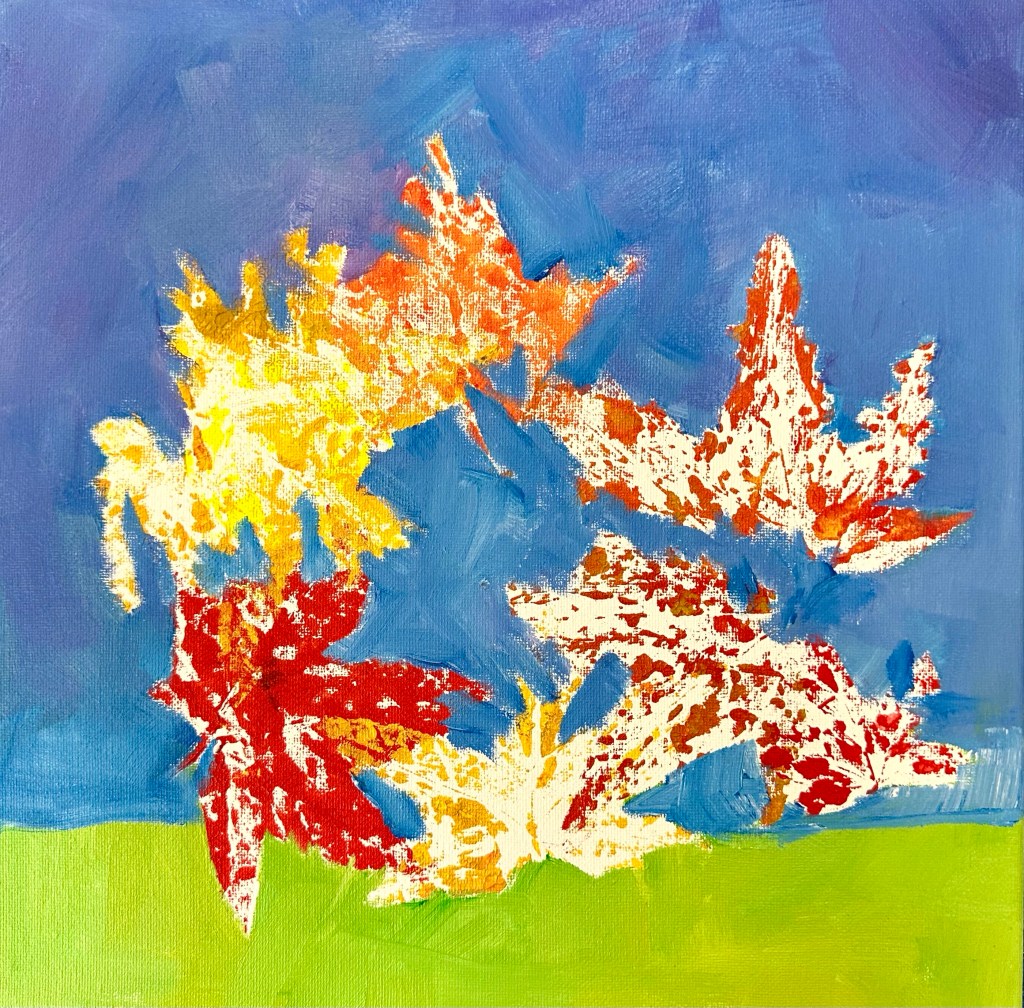
As I’ve been watching the brisk winds blow the gold and red leaves from the trees this fall, I’ve also watched them dance against the bright cerulean sky. When the sun shines on these dancers, they glow even brighter than before. They don’t have a care for tomorrow, much less for today. Now and this moment is enough for them. They remind me of the Lord’s advice to us on the Sermon on the Mount in Matthew 6:34—

“So do not worry about tomorrow, for tomorrow will bring worries of its own. Today’s trouble is enough for today.”

I painted the back side of the leaves with a thin coat of acrylic paint and laid them one by one down on the white surface of the canvas. Then I gently hand rubbed the top of each leaf until I thought I’d transferred the paint. The hansa yellow was least successful as a print color, so I over printed it at the end. I mixed the green ground with the cerulean blue and two yellows. The sky has cerulean, violet, Ultramarine, and white. These I mixed as I painted, so the sky wasn’t an even color. (All skies change color due to atmosphere and distance: they get lighter toward the horizon).

Next Friday we’re going to make stamp prints. You may have cut your own design in a potato once upon a time in scouts or used vegetables to make prints. We can also use leaves, natural materials, metal objects, or found objects to create prints. Art is a time to explore and experiment. We’ll find out what works and what doesn’t!! Curiosity and the willingness to experiment and explore are all aspects of creativity. We can all learn to stretch our boundaries and learn resilience, which are experiences that help us address the stresses and challenges of daily life.

I learn something new every day. Today I learned a starfish has a brain that covers its entire body. Its whole body is made up of brain nodes! There are days I wish I were a starfish: I would have loads of brain cells!

Joy, peace, and happiness to everyone!

Cornelia


Type Four: The Individualist — The Enneagram Institute

https://www.enneagraminstitute.com/type-4

The 9 Enneagram Types — The Enneagram Institute

https://www.enneagraminstitute.com/type-descriptions

Art Analysis: Dance by Henri Matisse – Artsper Magazine

The Persistence of Effort

adult learning, Altars, art, Attitudes, beauty, brain plasticity, Children, cognitive decline, Creativity, exercise, Food, Habits, Health, Holy Spirit, inspiration, knitting, Love, Ministry, mystery, nature, Painting, Prayer, pumpkins, purpose, rabbits, renewal, Right Brain, sleep, Van Gogh, vision

These shoes are made for walking

I was reading an article in the New York Times the other day. In “How I Learned to Love Finishing Last,” the author wrote about her slow pace as a runner. As one who regularly finishes last in my age group in the annual Spa 5K Walk each November, I’m optimistic one day I might get old enough to be in a nonagenarian age group all on my own. Perhaps if I’m 90 and still doing a 5K, they’ll give me a ribbon just for participating! “The last will be first and the first will be last,” especially if there’s only one of us in the race!

“When we compare ourselves to others,” said Dr. Justin Ross, a clinical psychologist in Denver who specializes in athlete mental health and performance, “we set ourselves up to suffer. Instead, the real psychological benefits come from enjoying what your body can do.”

Portrait of Yayoi Kusama in costume in front of pumpkin painting, photo: Noriko Takasugi

Suffering physically isn’t what art class is about, although we may suffer indignities to our egos, but this shouldn’t hold us back from doing our art works. The case of the Japanese artist Yayoi Kusama is evidence even hallucinations of voices and images can’t keep an artist from creating. If our daily efforts don’t measure up to what we imagined in our mind, it’s merely because our inner eye sees better than our hands can execute our vision. Sometimes our eye forgets what it once learned, for we haven’t used our skill of looking in a while. A runner doesn’t leap off the couch and immediately run a marathon or even a 5K. The smart athlete takes the time to train progressively for the distance beforehand. Also, they get new shoes.

Kroger Run: Two ghost pumpkins and a small pie pumpkin

Sometimes the coach has slept over the summer also. Just as students in school need a time to relearn last year’s lessons, as a coach in art class I sometimes forget the lessons, which are second nature to me because they’ve been inculcated by multiple teachers since I was eight years old, aren’t as ingrained to my own students. I also forget I’m always observing everything around me: cloud patterns, changing colors on trees, sunlight dappling on tree branches, shadows on the ground, and reflections in windows. I think about these patterns rather than about what I need to do next or next week. My calendar will remind me of these things in due time. I’ll be wrapping this up soon so I can work on my monthly Rabbit blog.

Rabbit playing “Hide the Pumpkin.”

A National Institute on Aging study found five healthy lifestyle factors — physical activity, not smoking, not drinking heavily, following the Mediterranean-style diet, and engaging in mentally stimulating activities — can have important benefits. People who engaged in four or five of these behaviors had a 60% lower risk of developing Alzheimer’s compared to those who only followed one or none. People who followed two or three of the activities had a 37% lower risk. This is your free wellness plan from Dr. Cornie, who has no medical degree, but did stay in a Holiday Inn once.

Debunking the Myth of the Split Brain Theory

Although we commonly think art is a “right brained” activity, in 2013 a group of researchers at the University of Utah discovered people actually use both sides of their brains equally. Back in the 1970’s when I was seeking employment after graduate school, the “Art is a right brain myth” ruled the creative work world. I once suggested I’d be a good candidate for a museum position because I understood both the artistic and the logical mind. I was not hired. Intuitive understanding of the brain a half century ahead of time doesn’t exactly open the doors to a fancy job.

As I recall, I got a checker’s job in a grocery store and ended up counting the teller trays and preparing the bank deposits for that store. The good news is creating works of art is a multi-process activity, one that depends on several brain regions and on redundancy of art-related functional representation rather than on a single cerebral hemisphere, region or pathway. This means even when we lose our ability to form words (typically a left hemisphere activity) our ability to create art still exists. We can still express our inner feelings and thoughts. This is good news for the aging and those who love them.

Yayoi Kusama – Pumpkin, 2014, installation view, Donum Estate, California, photo: Robert Berg

One one the great sadnesses in my ministry is being with young people who desperately want to have their old one’s memories recorded, but waited too late to ask them or were too busy with their own lives to sit and listen to these stories of the olden days. Once their old person has a stroke and loses the ability to form words, the opportunity has passed. Those stories will be locked in their minds due to aphasia, and no one or no amount of time will pull them out. We always tell young parents their babies need to be enjoyed while they’re still young, but we should also tell families to get the stories of their elders while they still can. “Strike while the iron is still hot” will take on a new meaning one day.

We needed bigger pumpkins

Gail and I were the only ones in class today. Lauralei showed up to gift us chocolate cake and keep us company. Tim and Mike were out of town. Gail and I both repainted old canvases. I showed some of the unusual ways pumpkins have been decorated by various artists, but none of them sparked any interest. We got down to work by covering our old canvas with a base of titanium white paint. Then I located all three of the pumpkins with circles and drew a baseline for the object on which they sat. I didn’t look over at Gail’s work for a while, but then I noticed she’d almost completely finished one pumpkin without roughing in the shapes of the others.

Gail had a big canvas today.

“Did you plan on finishing that one pumpkin before drawing the other two?” I asked.

Gail gave me a “needs more caffeine” stare.

“That’s what I thought. Maybe next time draw in the rough shapes so you get everything located in space relevant to each other.”

Pumpkin Spice Latte Time

We kept on painting until clean up time. I often say “I’ve slept since then.” It’s my all purpose excuse for forgetfulness or just plain airheadedness. Sometimes I have my mind on other things and I’m not focused on what’s in front of me. I forget about the wisdom of Brother Lawrence, who said “many do not advance in the Christian progress because they stick in penances and particular exercises while they neglect the love of God which is the end. This appeared plainly by their works and was the reason why we see so little solid virtue.” He also said, “there needed neither art nor science for going to God, but only a heart resolutely determined to apply itself to nothing but Him and to love Him only.”

Cornelia’s small painting of pumpkins

We know Brother Lawrence from the classic text, The Practice of the Presence of God. Although it dates from the late 17th century, his lessons on living life in joy in the present moment, all for the love of God are invaluable for us modern folks who tend to live for our 15 minutes of personal fame, social media clicks, or self interest. We aren’t used to the monastic life today, or to the discipline of that lifestyle. We live in a Burger King world, in which each individual gets his or her own way to every extent possible. Unfortunately, the Christian lifestyle is one of discipline, but not harsh punishment:

“Now, discipline always seems painful rather than pleasant at the time, but later it yields the peaceful fruit of righteousness to those who have been trained by it.” ~~ Hebrews 12:11

In art class we focus on the disciplines, just as the guild artists taught the apprentices back in the day. These disciplines are not only for safety, for some of our art tools are dangerous, but also some of our techniques are proven to yield better results than others. This is why carpenters measure twice and cut once. They also cut on the outside of the line, rather than the inside. They can shave down a piece easier than adding to it. Murphy’s Law recognizes this: “A wire cut to length will be too short.”

Zen Tangle drawing of pumpkins: exercise in texture

Art class has no mysteries, but we can forget the “secret gnostic knowledge passed down by word of mouth” from our previous classes. I often use the excuse “I’ve slept since then.” Another good excuse is “My mind has gone to Pluto.” I share these with you all, for they’ve always worked for me. Of course it helps to be a natural blonde. Then again, I’m very organized, but I’m also very active, so sometimes my calendar gets overwhelmed, and I pull out the “OOPS! Card.” Even in retirement I’m still creating and sharing my faith through art and writing. It’s my way of exercising those brain cells to keep them from dying off. We old folks can still learn new things, even if it takes longer. This is what we call the persistence of effort. Those who keep using their skills won’t be losing those skills.

The same goes for learning a new skill. It’s all a matter of repetition. We can’t get frustrated if we don’t get it on the first try. We won’t be a good role model for the young if we have that attitude. We need to lower our expectations. I used to think I couldn’t knit, but only crochet. After my mom, who was a stellar knitter passed on, a friend taught me to knit in an afternoon! Where this sudden bilateral coordination came from I have no idea, but it was so welcome. Perhaps I needed to be in the right frame of mind, or I wanted to be able to carry on my mom’s memory, but I was definitely receptive to her teaching.

Letter to Theo Van Gogh, September 18, 1888

It’s never too late to learn and we’re never too old to start learning. Art isn’t just good for the brain, but it’s good for the soul. Art is our attempt to represent truth, beauty, and nature in media that can be accessible to others. By doing this, we bear witness to the creation and the Creator. We only need give our best efforts, and let God’s Spirit guide our growth.

Joy, peace, and perseverance,

Cornelia

We have pumpkins galore on the autumn altar.

How I Learned to Love Finishing Last


How the Aging Brain Affects Thinking | National Institute on Aging

https://www.nia.nih.gov/health/how-aging-brain-affects-thinking

The creative-right vs analytical-left brain myth: debunked! – Dr Sarah McKay https://drsarahmckay.com/left-brain-right-brain-myth/

Art and brain: insights from neuropsychology, biology and evolution – PMC

https://www.ncbi.nlm.nih.gov/pmc/articles/PMC2815940/

The Project Gutenberg eBook of The Practice of the Presence of God, by Brother of the Resurrection Lawrence (free ebook)

https://www.gutenberg.org/cache/epub/5657/pg5657.html

Perspective: How We See

adult learning, art, Attitudes, Creativity, inspiration, Leonardo da Vinci, Ministry, mystery, Painting, perfection, perspective, Philosophy, risk, salvation

Perspective is both a mental outlook on life and our ability to view things in their true relations or relative importance. In art class, we use the tools of perspective to make a two dimensional surface appear three dimensional. One of the techniques is drawing parallel lines as converging in order to give the illusion of depth and distance. An untrained eye doesn’t see this at first, but once the illusion is pointed out to them, they never can unsee it. We worked last year with one vanishing point—railway tracks—and two vanishing points—buildings seen on the corners.

Two Point Perspective

There are mysteries in this world which we don’t understand, but those of us who have been taught by others with this “secret hidden wisdom” can share it with others. The Ancient Greek mystery religions kept their knowledge for only the select few, who learned it by word of mouth in secret ceremonies. The early Gospel, however, was proclaimed openly to all who would receive it. Yet even in Corinth, some believers wanted to be more special or spiritual than others. Paul wrote them, saying they needed  to know “Nothing beyond what is written,” for the scriptures contained within enough for their salvation (1 Corinthians 4:6). As an apostle, he was a steward of the “Mysteries of God,” and even if he were to understand “all mysteries and all knowledge, and…have all faith, so as to remove mountains, but… not have love…(he’d be) nothing.” (1 Cor 13:2)

Cornelia: Art Room Door

As a teacher, I can provide students with learning opportunities for every skill in art. Thanks to  Oaklawn UMC, and the generosity of my clergy pals over the years, I have a space in which to teach. I don’t charge for the lessons, since I consider this my ministry in retirement. I’ve taught every age from kindergarten through adulthood. There’s no age I don’t relate to. As Dale Chihuly says about art: “Most of art is the work. Not every piece is a success. We learn from our mistakes more than from our successes. If we don’t show up to work, we never have a chance to do well.” (It’s not an exact quote—I watched the film last night).

Gail: stage 1

As I tell folks, we may be saved by grace, but progress in art is by works. We can’t have our egos invested in the product. Right now Tim is in recovery from carpal tunnel surgery. Doing light exercises with pencil is good for his wrist muscles. Art class is a form of physical therapy. He wanted to draw a pumpkin because it had some shapes he’s struggled with over time. He noticed if he moved forward or backward by mere inches, the image he saw was different. This too is a matter of perspective. What is our view point: is it fixed or variable?

Gail: stage 2

Gail and I worked on painting an interior scene. I freehanded my painting, while Gail used her ruler and pencil to draw in the door shapes. I still wasn’t totally recovered from my colonoscopy—my age is catching up on me. My brain felt foggy, but I was trying. We came back for a second week to work on this project.

Gail: stage 3—extended floors

When we leave our work, we have an opportunity to clear our minds and reflect on other things. On returning to our canvas, we then look at our image with fresh eyes. My engineer friends call this the “saturation principle.” Just as the land can only absorb so much water before it runs off, our minds will get clogged up and we just can’t seem to make progress. Getting up for a drink or a walk about is a good thing. Sometimes the paint won’t dry fast enough for us either! That’s an indication to work in another area, even if we don’t want to. We must listen to what our work is telling us.

I often let my paintings rest overnight while I get a good night’s sleep also. In the morning, I’ll see if it still holds up, or if I need to keep painting. Sometimes I’ll take a “finished” painting down after a few months and repaint it. If it won’t last three months under my eye, it doesn’t leave the house. But I’ve learned from the experience. If we ever quit learning, we are dead. I don’t plan on being dead any time soon.

ABC—Positive and Negative Choices

Learning how to see in art is the most important lesson in art. Most of us won’t be Michaelangelo or Leonardo, but we can be the best of who we are. Our outlook on life in art means accepting our imperfections and our weaknesses. Some people can’t accept the learning curve necessary to make acceptable looking products. The point of art class isn’t the product. It’s the process of doing. With the doing, the “product” will come around eventually. We just need to have a positive attitude. Besides, our salvation isn’t dependent upon our accomplishments in art, but our faith in Christ and our love for Christ spread abroad into God’s world.

A Gift from my Mom

Perspective is also our attitude towards life. As Bob Ross, the great philosopher of happy trees and the joy of painting once said,

“If you have light on light, you have nothing. If you have dark on dark, you have nothing. It’s like in life. You gotta have a little sadness once in a while, so you know when the good times are coming. I’m waiting on the good times now.”

He said this in a PBS episode filmed shortly after his wife had passed away. Art class is also therapy for the soul, for we paint our emotions on the canvas, whether we realize it or not. We don’t have to talk about our feelings, but art helps us express them.

When I taught art back in the dark ages, I told my students if they learned only one thing from me, they would never forget it. A positive attitude leads to positive behavior and positive behavior leads to positive consequences. A negative attitude leads to negative behavior and negative behavior leads to negative consequences. That’s the simple ABC’s of life in the art room. Try it. You’ll like it. This is how we teach “Perspective.”


Joy and peace,


Cornelia

Master of Glass: The Art of Dale Chihuly

https://www.imdb.com/title/tt24862190/?ref_=ext_shr_lnk


Feeling Down? Here Are the Best Bob Ross Pep Talks


REMEMBERING SEPTEMBER 11th

9/1/11, 911, Altars, art, Attitudes, Christmas, Easter, Faith, Forgiveness, grief, Healing, hope, Icons, inspiration, Ministry, Painting, renewal, Spirituality

Looking up at the night sky, I think of the Eskimo Proverb which says, “ Perhaps they are not stars, but rather openings in Heaven where the love of our lost ones pours through and shines down upon us to let us know they are happy.” The fatal September 2001 event at 7:14 am CDT impressed its significance on the nation to such a great extent that 93% of American adults 30 years old or greater can tell you exactly where they were when they first heard about the attacks. Only 42% of those 25 and younger can do the same.

NGC 3603: From Beginning To End
Credit: Wolfgang Brandner (JPL/IPAC), Eva K. Grebel (U. Wash.), You-Hua Chu (UIUC), NASA

I remember my church was fuller than for Easter or Christmas on the Sunday after the devastation of the Twin Towers, the collapse of the Pentagon, and the crash of the airplane in which the terrorists had hoped to hit the White House. Only those brave passengers of Flight 93 stood between the terrorists achieving a psychological victory and their ultimate ignoble demise. As I recall, people were eager to hear “What is the Christian Response to Violence?” If they hoped to hear the one and only response, as the THE implies in the sermon title, the air was let out of their balloons.

A photo taken on September 11, 2001 by the New York City Police Department as the North Tower collapses, engulfing lower Manhattan in smoke and ash.

Of course, Christians across the centuries have had three major responses to violence. The first is “turning the other cheek” or nonviolence. We see this in the Biblical witness, for Jesus admonishes his followers in Matthew 5:38-42—

“You have heard that it was said, ‘An eye for an eye and a tooth for a tooth.’ But I say to you, Do not resist an evildoer. But if anyone strikes you on the right cheek, turn the other also; and if anyone wants to sue you and take your coat, give your cloak as well; and if anyone forces you to go one mile, go also the second mile. Give to everyone who begs from you, and do not refuse anyone who wants to borrow from you.”

Il Tintoretto: Christ before Pilate, Museum Scuola di San Rocco, Venice

Jesus himself practiced a non-violence response to violence when he appeared before Pilate after his arrest. Pilate questioned Jesus in Matthew 27:11-14—

Now Jesus stood before the governor; and the governor asked him, “Are you the King of the Jews?” Jesus said, “You say so.” But when he was accused by the chief priests and elders, he did not answer. Then Pilate said to him, “Do you not hear how many accusations they make against you?” But he gave him no answer, not even to a single charge, so that the governor was greatly amazed.

Unknown German artist: Aquamanile in the Form of a Mounted Knight, Copper alloy, ca. 1250, used to pour water over hands at the altar or at dinner table, Metropolitan Museum of Art, New York City.

The opposite of non-violence is the Crusade mindset. In this response, the infidel is “othered” to the point of inhumanity. Because the unbelievers don’t share the same god, purging them from the living is a good deed, worthy of merit for salvation or for forgiveness of past sins. As you can imagine, this makes people who believe in other gods “less than human,” so what we modern people would consider war crimes would be easy to commit for a person in Crusade mentality. We still hear vestiges of this dualist mindset in the vocabulary of people who talk about “weaponizing government” or those who feel the need to “hit the ground running.” If we’re always in “attack mode” at work, we need to question how we think about others if we believe we’re in a hostile environment or in enemy territory.

If the Christian has both a head and a heart, both of which are being conformed to the love, mercy, and justice of God, then we must have a middle way between passive nonviolence and crusade extremism. This golden mean is the Just War Theory. It’s taught in all our military academies and has its beginnings in Christian theology. The saints Augustine of Hippo and Thomas Aquinas developed the primary ideas:

  • Make war only for a just cause
  • Be sure your intentions are right
  • Only legitimate authority can make war
  • Use just proportionally in the war, nothing to excess
  • Go to war as a last resort 
  • During war only attack military targets, not civilians 
  • Following unjust orders isn’t a legal defense for unjust actions 
  • Punish war crimes, compensate victims
  • Peace treaties must be fair and just to all, even the warmongers
Psalter Saint Louis et Blanche de Castile, MS 1186, BnF, folio 11b

Those of us who struggle with conflict—if we have a family, we have conflict or if we live in a community, we have conflict—yes, I’m starting to meddle now. You knew I’d get around to it. After all, God the Father had Adam and Eve, and God tossed those two kids out of the House. They had everything, and still wouldn’t follow the one rule (Don’t eat from that one tree). Just one rule. How hard could that be? It was downhill from there.

I always take comfort, knowing God had troublesome children. It means perfect parents can still have conflict at home. This gives hope to us less than perfect folks. The Bible reminds us always how God still loves the human race and hasn’t give up on us, so we don’t give up on those we have fusses with. We don’t roll over and play dead, yet we don’t set out on a crusade against unruly kids or others with whom we have conflicts. As Micah 7:18 reminds us about God’s Compassion and Steadfast Love:

Who is a God like you, pardoning iniquity and passing over the transgression of the remnant of your possession? He does not retain his anger forever, because he delights in showing clemency.

Remnant of the Twin Towers

Maybe we should look at the just war thoughts and modify our attitudes and behaviors. We can come to a peace, even if others cannot. As Jesus says in Matthew 5:9—

“Blessed are the peacemakers,

for they will be called children of God.”


Joy and Peace,

Cornelia


Two Decades Later, the Enduring Legacy of 9/11 | Pew Research Center


Just War Theory – The Ethics Centre Ethics Explainer
https://ethics.org.au/ethics-explainer-just-war/


OAKLAWN FRIDAY ART CLASS

adult learning, art, Creativity, Faith, Holy Spirit, Imagination, inspiration, Ministry, Painting, perfection, purpose, renewal, vision

WE’RE BACK!!!

Ready or not, the creative juices must be stirred. If the brain has lain fallow all summer, or it’s been overworked keeping the youngsters occupied, now you can find your own groove again.

Our first meeting will be Friday, September 8, at 10 am in the old fellowship hall. Bring your own acrylic paints, brushes, and a canvas or canvas panel to paint on. We begin with a short visual inspiration from some great art works, I give some direction on the skill we’ll work on in the session, and then everyone is free to bring their own unique expression to their paintings. We don’t copy my work and judge how well a person can match it. Instead, we learn from others and stretch our own skills to create something new.

Paul Klee: Houses

Making great art isn’t our first purpose. As we age, we will lose our ability to learn new skills until we lose our memory of what we just ate for breakfast. Challenging our brains is one of the best ways to keep our brain cells firing and “chatting with one another.” Socialization and encouragement also helps to keep our brains young.

Frank Lloyd Wright: Stained Glass Design

Making art means we also will have to give up our desire to be perfect. Artists quickly learn perfection comes from practice, or working at it. Every baby stumbles and falls as they learn to walk, but dotting adults encourage every trembling step. This is what art teachers also do. I’ve always had a rule in my classes, especially when I taught in middle school:

No Negative Talking about People or Art.

This includes a student’s own art works. They always had to give at least three positive comments about their work before they spoke about the negative. “My work needs improvement” is a better way to say “My work stinks!”

Of course, we’ve all grown up and worked in environments where negativity is the rule. Art class is a place of grace because this is how life should be. If we can transform a blank canvas into a field of color, why can’t we transform our communities and our world into fields of hope, joy, and love?

Blue Monochromatic Study of the City

Perhaps because we often try to make everyone copy/fit into our idea of the proper end product, rather than allow everyone discover their own creative response to the given subject of the day. Finding our own voice and our own expression is important. Even beginners will have their own unique voice and vision, if they only allow the creating spirit of God work through them. The museums of our world are richer and more vibrant because artists have listened to the Spirit of the Creating God. We might do well to realize God’s creative energies are varied and vibrant also, just as Isaiah wrote about his vision of God’s Glorious New Creation:

“For I am about to create new heavens and a new earth;

the former things shall not be remembered or come to mind.

But be glad and rejoice forever in what I am creating;

for I am about to create Jerusalem as a joy, and its people as a delight.” (65:17-18)

James Wyper: City of Dreams

I hope to see you in art class. I don’t charge for the class sessions, since this is one of my ministries as a retired elder in the United Methodist Church. As John Wesley once said, “The World is my Parish.”

Joy and Peace,

Pastor Cornelia

Pears and Apples

adult learning, Altars, apples, Aristotle, art, brain plasticity, change, cognitive decline, color Wheel, Creativity, exercise, Fear, Habits, Holy Spirit, inspiration, Lent, Leonardo da Vinci, Painting, perfection, Physical Training, purpose, risk, Thomas Merton, Van Gogh

Still Life with canvas, pallet, and brushes

Aristotle said in his Poetics, “The aim of art is to represent not the outward appearance of things, but their inward significance, and this, and not the external manner and detail, is true reality.”

He spoke mainly about poetry, which was the highest art of his age, but his words also apply to the fine arts. Today, many people are still mesmerized by artists who practice various styles of realism, but they overlook the artists who show us the realities of emotion and inner vision.

The good news about art.

“Art enables us to find ourselves and lose ourselves at the same time,” said the spiritual writer, Thomas Merton. Some people use art as a cathartic exercise, and pour out their inner emotions on the canvas or their chosen media. Jackson Pollock’s drip paintings and Van Gogh’s late works are good examples of emotional expression. We all know folks who have a project going in their garage. They go work on “that worthless piece of junk” to focus their attention and energy on fixing something on which they can make a difference, instead of getting tied up in knots about things they can’t change and must accept. Gardening and knitting are also good hobbies for focusing this energy.

We know our nervous system grows to the modes in which it has been exercised. This is what we call building a habit over time. Just as a child doesn’t walk straight out of the womb, they have preparatory skills that must be acquired by stages as they grow. Exercising their muscles by rolling over also helps to strengthen their necks to hold their heads up. Crawling leads to pulling up, and that leads to letting go to learn balance.

Each time a child repeats these movements, he or she will simplify the movements required to achieve the needed result, make them more accurate, and diminish fatigue. In this, they’re building habits that bring them closer to walking. Rushing them to achieve “early” walking actually puts them behind cognitively.

Not only are there twenty five body parts in a baby’s body that are used in the crawl movement, but crawling also strengthens the hip sockets, so the baby will have a strong platform on which to stand. Crawling helps the corpus callosum, which is a band of nerve fibers between the hemispheres of the brain. Criss-cross crawling on the knees and hands stimulates the corpus callosum to develop in a balanced way, facilitating the hemispheres of the brain to communicate. These cross lateral movements work both sides of the body evenly and involve coordinated movements of the eyes, ears, hands, feet, and core muscles. This helps support cognitive function, problem solving, and ease of learning. Exploring the floor in a baby proofed home allows your baby to achieve his or her optimal potential.

Gail’s Painting

“Practice makes perfect” is only as true as the practice is directed in a true direction. This is where a teacher, a parent, a coach, or a spiritual guide comes into play. Only one who’s been led well can lead others with grace. We don’t tear down the learner, but ask questions, give guidance, help them see alternative paths, and allow them a safe place to explore their choices.

Art class isn’t brain surgery. No one will die if the painting isn’t successful, and no one’s salvation is at risk if the painting doesn’t come out the way we hoped it might. Art class is a safe place to take risks, unlike jumping from a tall tower without a parachute. Learning to accept failure on our canvases and coming back next time to try again is a mark of resilience and courage. Every time we fail closer to our target, we realize we’re gaining on it! We never say I CAN’T in art class.

Crawl before you Walk or Run

The sad reality is we can teach and expand the horizons of young people up til the age of 25 or 30. After that, they seem to lose energy and desire to learn more or to change. They “habitually” repeat their previous acts, for good or for ill. We’ve all heard the old saying, “You can’t teach an old dog new tricks.” Those of us who are no longer young have sometimes been accused of being set in our ways. Some of us are afraid we won’t excel at a new challenge, for we’ve always been held to a high standard of achievement. Since none of us will be the next Georgia O’Keefe or Leonardo da Vinci, we can set that worry aside. They both had more years to practice than we have left in front of us. Instead, we should give our remaining time our most focused attention, so we can get the most from our experience.

My high school chemistry book had the same information in it which my daddy’s college chemistry book covered. He was amazed I was learning “advanced” ideas at my young age. In 1982 R. Buckminister Fuller introduced the idea of the “knowledge doubling curve.” Up until 1900, knowledge doubled every century. By 1945, knowledge doubled every 25 years and by 1982, it doubled every year. Some say it’s now doubling twice a day! The newest computer we buy off the shelf today is already obsolete.

We can’t train our students for the jobs of today because these jobs likely won’t exist tomorrow. We need to train people to be lifetime learners instead. Luckily, we don’t have to know all things, but we do need the skills to find the knowledge and sort through the best sources for the best possible information.

1930-2006

Today, knowledge we acquire in high school, college, graduate school, and our last job may already be obsolete. (I’m one who still grieves the loss of Pluto as a planet; it exists but is a dwarf planet in the Kuiper Belt). This is especially true in fast moving fields like technology. As futurist Alvin Toffler wrote, “the illiterate of the 21st century will not be those who cannot read and write, but those who cannot learn, unlearn, and relearn.”

This means all of us will need to become lifelong learners or we’ll risk losing touch with an ever evolving world. Maybe we think our brains can’t handle something new, for we’ve heard about the effect of aging. Cognitive process studies with older brains show learning, memory, and problem-solving in humans are often less efficient in these areas.

However, it has recently been established that dogs show many of the same kind of age related changes that humans do. A study in Vienna showed that older dogs learned new tasks just as well as younger dogs, although they took longer to do so and required more repetitive corrections. This aptitude is also known as “resilience training.”

I think it’s also important to know why we want to keep our brains agile as we move into our later years. John Wesley was fond of repeating William Law’s summary from the Practical Treatise on Christian Perfection,

“Do all the good you can, to all you can,
by any means you can, as long as you can.”

Because Wesley was better known than William Law, this quote is now attributed to Wesley alone. We Methodists have made it our own, however, and have carried its banner around the globe in our world wide mission efforts made possible by our Connectional ministries. Wesley thought enough of Law’s writing to reprint 19 editions of his work.

My late mother, at the age of eighty, learned how to use a laptop computer. She was motivated because she wanted to see emailed photos of her grandchildren, but then she realized she also could find recipes. When a child in her hometown needed a Mercy Flight, she used her new skills to get him transportation to an out of state hospital for treatment. I occasionally had to reteach her on how to double click quickly on her icons, rather than slowly, but she finally caught on.

iPad drawing of pear and apple

If we want to keep our brains agile throughout our middle, silver, and golden years, we always need to try new things. Doing art challenges makes our brain build new neural pathways. Every time we look at a still life or a landscape, we have to make multiple decisions: what shapes do I see—circles, squares, triangles, or rectangles; how do these shapes relate to one another on the plane of our canvas; what is most important; what colors will I use; what emotions do I want to express; and where will I begin?

Eventually, we will find our “style.” We don’t find a style by copying another’s work, but we create enough works until our hand becomes one with our spirit. Since God has placed a special spark of God’s own creative Spirit within each of us, eventually we’ll experience the joy of being one with God when we are in our painting moments. As Paul said to the Romans (8:16):

“The Spirit Himself bears witness with our spirit
that we are children of God.”

Last Friday we had a simple still life as our inspiration. Half our class was out sick with spring pollen troubles, but it was good to see those who could come after a two week hiatus. After a brief show and tell to get us inspired by other artists’ takes on the subject for the day, we got started. I reminded everyone not to make the fruit too tiny, so it wouldn’t get lost on the canvas. I believe everyone succeeded with this goal!

Mike’s painting

Mike painted his whole canvas with one brush. This gave the fruit a certain texture with contrasting colors, and the background, which was in a close value, didn’t show much brush strokes or texture. I like the perspective he chose, which brings the viewer in close to these fruit.

Gail tried a larger canvas with bolder colors than she normally uses. It was more dramatic and stronger in contrast than usual, while she kept her smooth strokes of paint as usual. She also took a view from above.

Cornelia’s Fruits

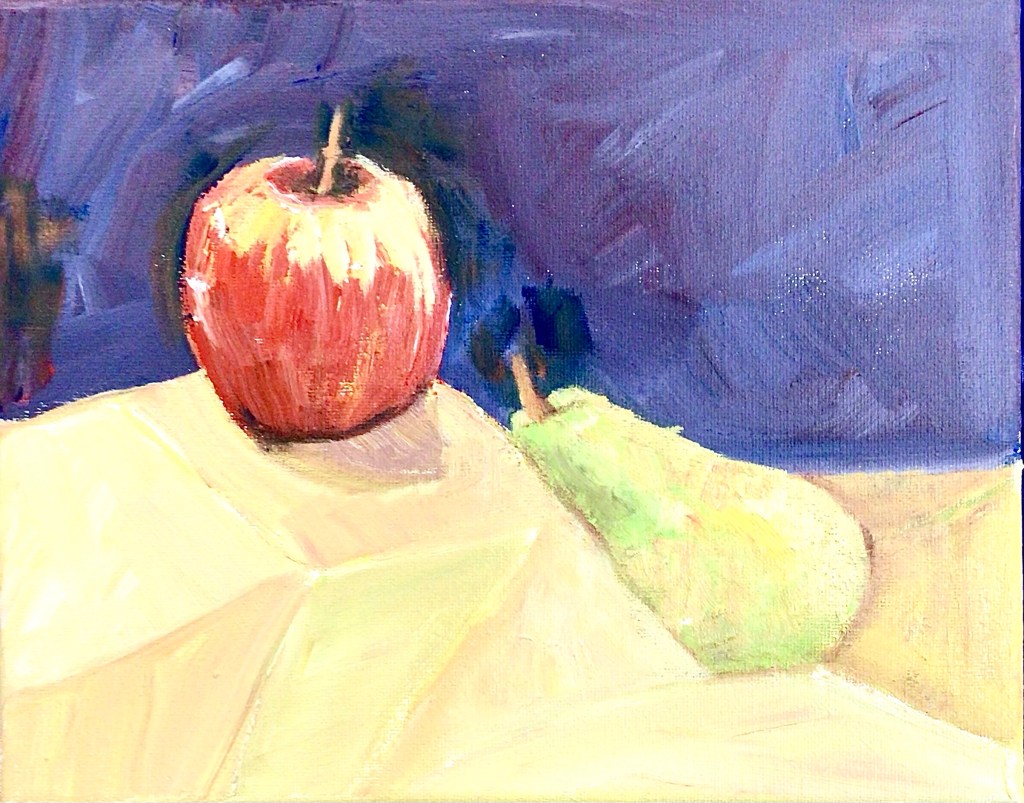
I stuck to a traditional rendering of the still life, since I do many abstract paintings in my own studio. I’d call these two Day and Night, for the Apple is quite awake and the Pear seems to need a little nap. It’s a study in contrasts: red and green, blue violet and yellow orange—a color wheel study masquerading as a still life.

Next week we’re in the season of Lent. As Christ turns his face towards Jerusalem, we’ll begin a study on the icons. This will be accessible and interesting. You’ll end up with your own icon for your personal worship center also.

Joy and Peace,

Cornelia

Classics in the History of Psychology — James (1890) Chapter 4
https://psychclassics.yorku.ca/James/Principles/prin4.htm

Crawling is important for childhood brain development
https://thefnc.com/research/crawling-is-important-for-childhood-brain-development/

You Can Teach an Old Dog New Tricks | Psychology Today
https://www.psychologytoday.com/us/blog/canine-corner/201602/you-can-teach-old-dog-new-tricks

Letters of John Wesley – John Wesley, Augustine Birrell – Google Books, p.423
https://books.google.com/books/about/Letters_of_John_Wesley.html?id=zgYu6NpqWDEC

What It Takes To Change Your Brain’s Patterns After Age 25 https://www.fastcompany.com/3045424/what-it-takes-to-change-your-brains-patterns-after-age-25

Radical Love

art, Attitudes, Faith, Forgiveness, Healing, holidays, Holy Spirit, hope, inspiration, Love, Martin Luther Ling, Ministry, Reflection, silkscreen, Spirituality, Uncategorized, Valentine’s Day

Victorian Embossed Valentine Card

Valentine’s Day is all about love. Television advertisements push candies, dipped gold “eternal” roses, gaudy jewelry—a price for every pocketbook—and the dating apps have been in full swing since the new year.

“Everybody needs somebody to love,” the old song goes. The Blues Brothers sing this oldie before their mad escape from the Illinois Law Enforcement Community. Solomon Burkes treats it with his indigenous soul blues from his lived experience and The Rolling Stones give it their percussive upbeat treatment. Wilson Picket has a good cover, but I don’t recommend the explicit version of Rod Wave’s Sneaky Links. Fitz and the Tantrums was interesting. My “old person “ is probably showing about the edges here.

Martin Luther King, Jr. Quote

We all can love our friends or sweethearts, especially in mid February. After all, February is “for lovers.” The bigger question is, How do we love our enemies? Dr. Martin Luther King, Jr., in his book, A Gift of Love, writes:

“First, we must develop and maintain the capacity to forgive. (The one) who is devoid of the power to forgive is devoid of the power to love. It is impossible even to begin the act of loving one’s enemies without the prior acceptance of the necessity, over and over again, of forgiving those who inflict evil and injury upon us.”

Well, how can I forgive the person who hurt me, my child, my family, my tribe, or my community? We all want that person to come crawling to us and ask for forgiveness, but that’s not how radical love works. We want the wrong doer to show remorse and ask us for mercy and forgiveness. This puts them in a subordinate position and us in a position of power. But that’s not how radical love works. Radical love initiates forgiveness, even if the wrongdoer never shows contrition.

Dr. King goes on to say:

“It is also necessary to realize that the forgiving act must always be initiated by the person who has been wronged, the victim of some great hurt, the recipient of some tortuous injustice, the absorber of some terrible act of oppression.”

Sir Terry Frost: Sun Tree, 2003, Silkscreen on Paper with 9 collage elements. Frost was a prisoner of war in WWII with Adrian Heath, who taught him to paint. They were both imprisoned in Stalag 383, in Germany.

Why must the wronged take on the indignity of offering forgiveness to unrepentant wrongdoers? In this act, we become most like Christ on the cross, who in his final moments, forgave not only the thief who asked for forgiveness, but also all those who crucified him, who had no intention of repenting. Our problem is we enjoy being like the risen Christ, the one with the “name above all names,” but most of us don’t want to “pick up our cross and follow” Jesus, especially if it leads to an ignominious death on that very cross.

Sir Terry Frost: Blue Love Tree, 2003, Silkscreen on Paper

As Dr. King wrote,

“The wrongdoer may request forgiveness. He may come to himself, and, like the prodigal son, move up some dusty road, his heart palpitating with the desire for forgiveness. But only the injured neighbor, the loving father back home, can really pour out the warm waters of forgiveness.”

The injured one, whose heart has been broken and wounded by someone else’s words or deeds, is the only one who can heal the broken rift between them. This is why the deepest lovers of Christ are most often the wounded ones who’ve been healed by God’s mercy, grace, and forgiveness. The woman with the alabaster jar of ointment anointed Jesus’ feet in the house of the Pharisee, but the host had failed at the minimum hospitality for his guest, so Jesus reminded him (Luke 7:47):

“Therefore, I tell you, her sins, which were many, have been forgiven; hence she has shown great love. But the one to whom little is forgiven, loves little.”

Mending Broken Hearts, silkscreen, artist unknown

If we would be healers in our broken and fragmented world, we need to first address our own woundedness. Each of us has a hidden pain or suffering, for this is the human condition. If we give this to God, our healing makes us into vessels where our cracks are filled with precious gold. We can offer more love, more forgiveness, and more hope to people who have been sitting in darkness and despair. People are waiting for joy and love to flow out in abundance from God’s heart into our hearts and into their world. Then we can be the light in the darkness for them, the holy fire that lights the embers of hope in their hearts, not just on St. Valentine’s Day, but every day.

Joy, Peace, and Love,

Cornelia

Kintsugi: Mending cracks with gold

Excerpt from A Gift of Love | Penguin Random House Canada
By Dr. Martin Luther King, Jr.
Chapter 5, Loving Your Enemies

https://www.penguinrandomhouse.ca/books/212014/a-gift-of-love-by-martin-luther-king-jr/9780807000632/excerpt

Chaos and the Order of the Day

911, adult learning, Altars, art, Astrology, Creativity, Faith, Imagination, Israel, Leonardo da Vinci, Ministry, Painting, Spirituality, vision

Morse Peckham, author of Man’s Rage for Chaos, believed “Order is humanity’s freedom; but the rage for order creates its own limits on that freedom.” Art, he maintained, enabled the artist to fight that rage, which destroys what it would create. Only the rage for chaos can balance the rage for order.

Stellar Bones: Aries zodiac sign. Horoscope. Illustration for souvenirs and social networks.

As one who was born under the Aries sun, with an Aries moon, and a Virgo rising sign, I fully understand this rage for chaos and order within my own body. I somehow always have fifty-eleven projects and and even more ideas I’d like to accomplish, but I too have the same limits as all other people: we all have only 24 hours on any given day. Some of these moments must be given to the life giving nurture of the body, which carries our great mind and imagination and the hands which do our good works. Some days the balance scales of Virgo call my chaos into order, while on others my Aries excitement causes the balance to quaver. This tension shows up in my work.

Venus and Saturn at Early Sunset: follow the line of the building

I mention my astrological signs, for once in ages past, people believed the stars ruled their lives. The heroes ascended into the stars—Sagittarius, the archer, while other constellations were named for animals or the humans who were turned into animals, such as bears and swans. Some got their names for resembling objects—the dippers, while others were named for legendary persons—Cassiopeia’s chair and Orion’s Belt come to mind. In the time of dark skies, our ancestors could pick out these sky patterns with ease. Light pollution in our cities makes these shapes harder to discern every year. Our national parks may be the only places our city dwelling future generations will be able to see the night sky in all its glory.

The Ancient Greeks believed the gods ruled their fates. The writer Pausanius listed the many shrines to the deities in Athens, including “in the Athenian market-place among the objects not generally known is an altar to Mercy, of all divinities the most useful in the life of mortals and in the vicissitudes of fortune, but honored by the Athenians alone among the Greeks. And they are conspicuous not only for their humanity but also for their devotion to religion. They have an altar to Shamefastness, one to Rumour and one to Effort. It is quite obvious that those who excel in piety are correspondingly rewarded by good fortune.”

Altar to an Unknown God, Athens, Greece

The apostle Paul even noted the Athenians had a temple to an “unknown god,” just in case they didn’t cover their bases with offerings to all the other deities (Acts 17:23). Yet, you already know him, he said, for

“The God who made the world and everything in it, he who is Lord of heaven and earth, does not live in shrines made by human hands, nor is he served by human hands, as though he needed anything, since he himself gives to all mortals life and breath and all things.” — Acts 17:24-25

Our creation story in Genesis 1:1-2 begins with familiar words:

“In the beginning when God created the heavens and the earth, the earth was a formless void and darkness covered the face of the deep, while a wind from God swept over the face of the waters.”

Milton addressed the same Spirit of God, which was at creation, in his epic poem, Paradise Lost:

“And chiefly Thou O Spirit, that dost prefer Before all Temples th’ upright heart and pure, Instruct me, for Thou know’st; Thou from the first Wast present, and with mighty wings outspread. and with mighty wings outspread. Dove-like satst brooding on the vast Abyss And mad’st it pregnant.”

William Blake: Temptation of Adam and Eve, Pittsburgh Univ.

God is always creating order out of nothingness, but human beings have a tendency to create disorder wherever they go. We aren’t God, or even “as gods,” as the first humans hoped to be in the garden when they ate that fateful fruit. Even knowing “good from evil” doesn’t seem to keep us from our propensity to engage in chaos. I don’t live in a messy home, but because I put away some of my projects when I lose interest, I can forget where I “hid them.” I know what they look like, I can find others like them, but I might need several days to find the intended object of my desire. I’ll put all of these in ONE PLACE when I’m done with them. This will guarantee I’ll lose them all at once the next time I go looking for them!

Frank Hinder: Bomber Crash, 1941

In art class, we began our projects by thinking about the contrast of order and chaos. The emotional experience of the disruption chaos brings to our sense of order can change our perception of our position in the world. When Frank Hinder was serving in World War II, his bomber was shot down. As part of his therapy, he painted his memory of that occasion. That chaos in his life got channeled into a painting, for art allows us a safe haven in which we can experience cognitive dissonance.

Most of us wouldn’t willingly chose to experience such an event first hand, but we can imagine it in art, poetry, music, or fiction. This is why we exercise our creative freedom. Dealing with raw emotions in paint or other media is better than stuffing them inside, from where they can fester and harm us, or worse, break out and inflict terrible wounds upon others. We seek to center our emotions and focus our energies in a more balanced, positive manner, much like the renaissance genius, Leonardo da Vinci.

Leonardo: Virtuvian Man

Lauralei is finishing up a drawing and is going to work the famous Leonardo Virtuvian Man into it somehow. I can hardly wait to see this. Virtuvian Man is a classic Renaissance image of order: Leonardo saw the great picture chart of the human body he had produced through his anatomical drawings and his Vitruvian Man drawing as a cosmografia del minor mondo (cosmography of the microcosm). He believed the workings of the human body were an analogy for the workings of the universe. That’s seeing order in the many details.

Mike has been called away from class the past two weeks to take care of courthouse business. He has a 9/11 work in mind, if the judge ever lets him go. He has many images in his mind, so simplifying the many into a few might help him get his ideas out of his head and onto the canvas. He’s got business to attend to, however, so all things will come about in God’s good time.

Gail’s Painting of Creation

Gail chose the first day of creation as her inspiration. The tiny words are photocopies from a child’s Bible, which are plucked from the first chapter of Genesis. They read more as white directional or linear strokes than actual words, but I have a major cataract in my right eye, and my judgment on readability is suspect at the moment. Others may be able to see the words better than I. She used a sponge on this canvas, a new technique for her. She also wants to use gold leaf flakes to finish it out, so she may yet have another step to it.

First Work: Overhead View of Ancient Jerusalem

This small square painting began from an image of an old Jerusalem map with the surrounding walls of the city. This site was destroyed numerous times over the centuries, notably in 587 BCE by the Babylonians, in 70 CE by the Romans, while the walls were destroyed by the Muslim Calif in 1250 CE, but Suliman the Magnificent rebuilt them in 1538-1541 CE. In addition to the sacks of war, earthwakes and other disasters have rendered the era of Christ to the deep basements, which are only accessed today by descending narrow, spiral staircases. The era of the prophets of the Babylonian Exile are deeper yet. The famous Western Wall of the Herodian Temple, rebuilt after Solomon’s Temple was destroyed by the Babylonians, is only the upper third of the structure.

The people of Israel believed God’s favor rested upon them because of their proximity to God’s Temple. The prophets were quick to remind them, “They were to be holy, as God is holy,” for the Temple wasn’t a magic token like a rabbit’s foot. The book of Joel probably was written in the post exile period, around 350 BCE, but could be as early as 650 BCE, due to its description of an eclipse. The prophet reminds the people:

“So you shall know that I, the LORD your God, dwell in Zion, my holy mountain. And Jerusalem shall be holy, and strangers shall never again pass through it.” (Joel 3:17)

When the king and his court, the learned priests, all the educated tradespeople, and anyone who had any skill or knowledge was taken into slavery far distant from the sacred land where they worshipped their tribal god, the people had to wonder if God was still their god in this foreign land. Would God hear their prayers? If they could no longer offer sacrifices or make the required pilgrimages to God’s altar, were they faithful to their god anymore? In their grief, they wrote Psalms 137:4-5:

“How could we sing the LORD’s song in a foreign land? If I forget you, O Jerusalem, let my right hand wither!”

During the Exile, the Hebrew people developed the synagogue as the focus of their worship of God and the study of scripture, as well as a place of prayer and fellowship, and the site of life’s transitional rituals. In 538 BCE, Babylon fell and the Jewish exiles eturned to their homeland to rebuild the walls and the temple. For the people, the earlier promise of God from the prophet was finally being fulfilled:

“Return to the LORD, your God, for he is gracious and merciful, slow to anger, and abounding in steadfast love, and relents from punishing.” —Joel 3:13

Back home, both the synagogue and the Temple prospered, but when the Romans sacked Jerusalem and destroyed the Temple in 70 CE, all of the pious acts transferred to the synagogues and the homes of the faithful. Never again were sacrifices made for Passover, but the thought of the Holy City remained. The closer one came to the Mount where the Temple once stood, because the area was more holy, so the person coming near had to be more ritually pure. They may have chanted from Psalms 125:1 in unison as they made their ascent:

“Those who trust in the LORD are like Mount Zion, which cannot be moved, but abides forever.”

God’s Love Flows Beyond The City Walls

Today, Mount Zion is holy to the Muslim faith, for there Mohammad is said to have received the words of the Quran and also to have been lifted into heaven from here. This is also the traditional site of the Binding of Issac (Genesis 22), and it’s holy also to Christians because this is the temple where the boy Jesus was found in “his father’s house” (Luke 2:41).

The three great monotheistic faiths have fought for generations within their families of origin over who has rights to be included in the family, beginning with Abraham and Sarah’s attempt to fulfill God’s promise of an heir by using the slave woman Hagar. When God showed up to announce the birth of Isaac, it was unbelievable. When Sarah had her promised child, Hagar and Ishmael were sent out to die in the desert. God saved them, however, but the two blood relatives haven’t gotten along since.

Christians accept the promised messiah, but those years of crusading and crushing the “Muslim infidels” have left a bad taste in their mouths for us, and for some of us too. We all keep fighting, even though we’re all branches off the same tree. We all claim the same holy sites and we’ll fight over them “till the last dog dies.”

As Jesus reminded the Samaritan Woman in John 4:21 & 23:

“Woman, believe me, the hour is coming when you will worship the Father neither on this mountain nor in Jerusalem…But the hour is coming, and is now here, when the true worshipers will worship the Father in spirit and truth, for the Father seeks such as these to worship him.”

Remember the lesson of the exile: God is everywhere and not fixed to one altar or site. The same God who led us through the wilderness also leads us through the ups and downs of our daily lives, wherever we find ourselves. No disruption or chaos can move the steadfast God of love and mercy from our side.

Joy and peace,

CORNELIA

The Project Gutenberg eBook of Astronomical Myths, by John F. Blake, 1877.

https://www.gutenberg.org/files/36495/36495-h/36495-h.htm#Page_269

PAUSANIAS, DESCRIPTION OF GREECE 1.17-29 – Theoi Classical Texts Library

https://www.theoi.com/Text/Pausanias1B.html

Milton: Paradise Lost, DjVu Editions E-books, © 2001, Global Language Resources, Inc.

http://triggs.djvu.org/djvu-editions.com/MILTON/LOST/Download.pdf#page5

The Vitruvian Man – by Leonardo da Vinci

https://www.leonardodavinci.net/the-vitruvian-man.jsp

Growth in Faith and Art is a Risky Business

adult learning, arkansas, art, brain plasticity, change, Children, Creativity, Faith, Holy Spirit, hope, Icons, Imagination, inspiration, john wesley, Ministry, New Year, Painting, Pantocrator, perfection, photography, purpose, risk, Spirituality, vision

Oscar Wilde famously said, “Life imitates art far more than art imitates life.” This is because the self-conscious aim of life is to find expression and art offers it certain beautiful forms, through which it may realize that energy. Yet most people who look at artworks judge them for the degree to which they represent “three dimensional reality,” in either two or three dimensions (painting, draw,or sculpture and assemblage).

Often I’ve been asked about my colorful landscapes, “Don’t you ever paint these in normal colors?”

My answer is usually, “How do we know the colors we see today are the original colors of Creation? After all, we now live in a fallen and broken world. Perhaps these bright colors were God’s original palette.” I’m not painting just what I see, but what was and what is yet to come. These are visions of a better world, where the leaves clap their hands for joy.

In art class, we not only struggle to master drawing shapes “as they are,” but also to challenge our minds to break free of our need to exactly reproduce the shapes before us. We always have the tension to make only a “copy of the image before us,” rather than to meet the image on a spiritual plane and portray an intimate portrait of its inner truth.

When we meet a stranger, we can hide behind our masks and keep our distance. Likewise, we can fail to become intimate with our painting’s subject matter. The resulting work is cold and dead, like a limp handshake. It’s a risky business to bare your heart to the canvas and paint. The brush will tell if your heart and soul is in it or not.

We get more comfortable with this risky business by practicing risk taking. It’s not like we’re facing tigers in a circus cage or jumping out of an airplane without a parachute. We can’t lose our salvation in Christ if we make a bad painting. We only have a new level from which to start afresh. All growth requires risk and failure. We discover what works, keep that, and eliminate the unuseful.

Willingness to learn is related to the “growth mind-set.” This is the belief your abilities aren’t fixed but can improve. This willingness is a belief not primarily about the self, but about the world. It’s a belief every class or learning experience offers something worthwhile, even if we don’t know in advance what that something is. Every teacher or parent worth their salt has to believe their students or children can learn and grow, or they need to give up their profession so another can grow. The first lesson even the most recalcitrant student needs to learn is to believe growth and progress is possible.

Christ on Tree of Life, San Clemente Basilica, 12th Century mosaic, Rome, Italy.

The Christian life has a parallel to the growth mindset. The whole of the Christian life is wrapped up in this faith: with God’s help, we can go on to perfection. This is a basic Methodist belief known as sanctification. We also call it going on to perfection in love of God and neighbor. Some of us think because we’re not able to change on our own, we don’t need to grow in our love. God has done all the work for us in Christ. The Holy Spirit was sent to be a truthful guide:

“When the Spirit of truth comes, he will guide you into all the truth;
for he will not speak on his own, but will speak whatever he hears,
and he will declare to you the things that are to come.” (John 16:13)

Christ in Majesty, Book-Cover Plaque, French, Limoges, enamel, ca. 1200 CE, Metropolitan Museum of Art, NYC.

Paul speaks of this truth in Philippians 3:20-21, when he reminds the people of their present state as sojourners in this world, while their citizenship is elsewhere:

“But our citizenship is in heaven, and it is from there that
we are expecting a Savior, the Lord Jesus Christ.
He will transform our humble bodies that they may be conformed
to his glorious body, by the power that also enables him
to make all things subject to himself.”

Mother About to Wash Her Sleepy Child Mary Cassatt, 1880

If life is a journey, the Christian life is even more of a pilgrimage. We all go through stages of faith if we seriously reflect and consider our beliefs when our life experiences intersect with our faith. Our earliest stage of faith begins with our parents or caregivers. Here we learn to trust or distrust, as we experience an embodied faith. The next stage is early childhood (age 3-7). Faith at this stage is experiential and develops through encounters with stories, images, the influence of others, a deeper intuitive sense of what is right and wrong, and innocent perceptions of how God causes the universe to function.

Michaelangelo: Creation of Adam, Sistine Chapel Ceiling

The next stage has been labeled “Mythic-Literal Faith” (Ages 7-12). Children at this stage have a belief in justice and fairness in religious matters, a sense of reciprocity in the workings of the universe (e.g. doing good will result in a good result, doing bad will cause a bad thing to happen) and an anthropomorphic image of God (e.g. a man with a long white beard who lives in the clouds). Religious metaphors are often taken literally, thus leading to misunderstandings. If God’s rewards or punishments don’t apply in proper retribution, in the believer’s mind, their faith in God’s system becomes fragile.

Théodore Géricault, Raft of the Medusa, 1818–19, oil on canvas, Louvre, Paris.

“The Conventional Faith” stage (12-adult) arises when individuals join a religious institution, belief system, or authority, and begin the growth of a personal religious or spiritual identity. Conflicts occur when one’s beliefs are challenged are often ignored because they represent too much of a threat to one’s faith-based identity.

Théodore Géricault’s “Raft of the Medusa,”painted in 1818–19, is nearly 17 by 23 feet large. It commands its space as any proper historic painting of the past ever did. Rather than present a moral lesson from the past, the artist instead chose to paint an event from his present time: the rescue of the abandoned sailors and slaves from a wrecked ship. The French nation had sent the new governor of the Senegal colony, his family, and some other government officials and others on the Medusa. The government officials went to secure French possession of the colony and to assure the continuation of the covert slave trade, even though France had officially abolished the practice. Another group aboard the Medusa was composed of reformers and abolitionists who hoped to eliminate the practice of slavery in Senegal by engaging the local Senegalese and the French colonists in the development of an agricultural cooperative that would make the colony self-sustaining.

On the way, the ship ran aground and broke up. The officials and their families were put in lifeboats, but the 150 others on board got a makeshift raft, which was tied to the lifeboats. When the raft impeded the lifeboats, the officials cut the raft loose and all the lives with it. Only 15 were rescued after days at sea, and only ten lived to tell their tales. It was a scandal of the times. Géricault read all the newspapers, interviewed survivors, and made studies from ancient sculptures to inform his design. When younger artists saw his inspirational work in the Paris Salon, they knew a sea change had happened. Conservative critics and writers were appalled and accused Géricault of creating a disgusting, repulsive mistake. They were not yet ready to leave the past behind.

William Faulkner once said, “You cannot swim for new horizons until you have courage to lose sight of the shore” (The Mansion , 1959). When we meet that initial storm, our first thought is to bring our fragile bark into port. In life, we batten down the hatches and book it for a safe harbor. In art class, we want to fall back on what we’ve always done before, what we know we can do, and what we’ve been successful with in the past. This is our “safe harbor.”

“Individuative-Reflective Faith” (Mid-Twenties to Late Thirties). The individual takes personal responsibility for her beliefs or feelings, often by angst and struggle. Religious or spiritual beliefs can take on greater complexity and shades of nuance, and a greater sense of open-mindedness. These can also open up the individual to potential conflicts as the different beliefs or traditions collide.

To progress and grow in our art skills, or to move through the “dark night of the soul” when we question our formerly held spiritual truths, is a crucial time. Crucial is a word sharing the same root as crucifix. The crux of both of these situations results in a life and death situation. Not that the person quits breathing or their heart stops beating, but will their old life die and their faith be reborn anew? Also, will they trust a power greater than themselves to bring them back from the depths? Many of us aren’t willing to give up control to anyone, and certainly not to a God we can’t see. We’re two year olds in our spiritual lives too often, for “I can do it myself!” Is our answer to everything and everyone. (Test it out—how many of you read the directions after you start putting a project together?)

The Cross that Spoke to St. Francis, San Damiano Chapel, Italy, 1205 CE

“Conjunctive” Faith (Mid-Life Crisis). A person at this stage acknowledges paradoxes and the mysteries attendant on transcendent values. This causes the person to move beyond the conventional religious traditions or beliefs he may have inherited from previous stages of development. A resolution of the conflicts of this stage occurs when the person is able to hold a multi-dimensional perspective that acknowledges ”truth’ as something that cannot be articulated through any particular statement of faith. This is where the Holy Awe begins to fill all the nooks and crannies from which it was once forbidden.

Face of Christ (All People of the World), photo montage

“Universalizing” Faith (or ”Enlightenment”). (Later Adulthood). This stage is only rarely achieved by individuals. A person at this stage is not hemmed in by differences in religious or spiritual beliefs among people in the world, but regards all beings as worthy of compassion and deep understanding. Here, individuals ”walk the talk” of the great religious traditions (e.g. ”the kingdom of God is within you”).

“Jesus of the People” by Janet McKenzie.

In 1999 Janet McKenzie’s painting “Jesus of the People” was selected winner of the National Catholic Reporter’s competition for a new image of Jesus by judge Sister Wendy Beckett, host of the PBS show “Sister Wendy’s Story of Painting.” In the words of Sister Wendy, “This is a haunting image of a peasant Jesus—dark, thick-lipped, looking out on us with ineffable dignity, with sadness but with confidence. Over His white robe He draws the darkness of our lack of love, holding it to Himself, prepared to transform all sorrows if we will let Him.” The model was an African-American woman and the painting includes a yin-yang symbol of Eastern traditions and feather of Native American traditions. (Photo courtesy of Paul Smith)

Next week, we’ll still be working on order and chaos. We got started on this at our first meeting, and the concept is a challenge. I’ll write about our class work then. We’re always open to anyone joining us, for you come as you are and begin where you are. Our art group is a “one room schoolhouse” with all levels of students mixed together. We may all be doing the “same project,” but everyone does it at their own skill level. I give you special attention according to your needs.

Remember, “The only way you can be behind is if you never start.”

Joy and peace,

Cornelia

Life Imitates Life | Lapham’s Quarterly
https://www.laphamsquarterly.org/swindle-fraud/life-imitates-life

The Stages of Faith According to James W. Fowler | Thomas Armstrong, Ph.D.
https://www.institute4learning.com/2020/06/12/the-stages-of-faith-according-to-james-w-fowler/

Théodore Géricault, Raft of the Medusa – Smarthistory
https://smarthistory.org/theodore-gericault-raft-of-the-medusa/

Video and photo slideshow: The many faces of Jesus
https://religionnews.com/2014/01/28/video-photo-slideshow-many-faces-jesus/

Winter Solstice 2022

arkansas, art, Faith, Food, hope, inspiration, Light of the World, Ministry, New Year, shadows, Spirituality, Stonehenge, trees, winter solstice

This shortest day of the year is the Winter Solstice, which is on Wednesday, December 21, at 4:48 P.M. EST, in the Northern Hemisphere. Some think of this as the Longest Night, but I’m a person of the light, not the darkness. I always prefer to look to the light, no matter how dim or feeble it may seem.

Be the Light

Yet darkness is a necessary experience in our lives. We do not yet live in the land of the “unclouded sky” or the heavenly realm:

“And the city has no need of sun or moon to shine on it, for the glory of God is its light, and its lamp is the Lamb.” —Revelation 21:23

Kindness is a warm fire

In the darkness, growth often happens: germination and rooting are two types of unseen activity that help produce the plant we see above ground. Without adequate light, the visible plant won’t thrive. So both darkness and light are at work to produce fruit in our lives.

“We know that all things work together for good for those who love God, who are called according to his purpose.” —Romans 8:28

Rejoice! The days will get brighter soon!

The Winter Solstice in Hot Springs is at 3:48 pm CST on Wednesday, December 21, 2022. In terms of daylight, this day is 4 hours, 37 minutes shorter than the June solstice. In most locations north of the equator, the shortest day of the year is around this date. The good news about the Winter Solstice is the days will begin to lengthen, although imperceptibly at first: one minute, four minutes, seven minutes, ten minutes, thirteen minutes, sixteen minutes, and so on.

In Scandinavia, the Norse celebrated Yule from December 21, the winter solstice, through January. In recognition of the sun’s return, fathers and sons would bring home large logs, which they would set on fire. The people would feast until the log burned out, which could take as many as 12 days. Today we recognize the source of the “Twelve Days of Christmas” song in this festival. The Norse believed that each spark from the fire represented a new pig or calf that would be born during the coming year. Prosperity for all in the New Year!

In this present darkness, a small light still shines brightly

In this time of stress and strain, grief and gripes, let’s look to the in-breaking light, and the renewal of life and love. Here’s a “Winter Solstice Chant” by Annie Finch, for your pleasure:

Vines, leaves, roots of darkness, growing, now you are uncurled and cover our eyes with the edge of winter sky leaning over us in icy stars Vines, leaves, roots of darkness, growing, come with your seasons, your fullness, your end.

Rice Krispy Stonehenge

Of course, if you can’t get your travel plans together at the last minute to visit Stonehenge, England for the winter solstice celebration, you can always make Rice Krispies Bars in the shape of the ancient monument. The recipe link is at the bottom of the page. Hint: don’t turn the heat up high or your treats will be hard. Due to high carbohydrate count, one “pillar” of Stonehenge Krispies is actually two servings.

Modern Yule Log

Joy and peace and a Good Yule log,

CORNELIA

Annie Finch, “Winter Solstice Chant” from Calendars, published by Tupelo Press. Copyright © 2003 by Annie Finch. Reprinted by permission of the author.

Sunrise and sunset times in Hot Springs https://www.timeanddate.com/sun/@4115412

The Original Rice Krispies Treats™ Recipe https://www.ricekrispies.com/en_US/recipes/the-original-treats-recipe.html