Sunflowers and Shadows

adult learning, Alexander the Great, art, Carl Jung, Creativity, Faith, grief, Holy Spirit, Imagination, inspiration, Ministry, Painting, perfection, Plato, Prayer, Socrates, Stress, Ukraine

DeLee 2019, Drying Sunflowers

A sunflower follows the sun. Actually, only young sunflowers track the sun across the sky, while mature sunflowers face east. Why is this? Why do we care? As sunflowers fill our Facebook feeds and social media posts, most of us are looking at flowers so we can ignore the awful consequences of this unprovoked war. Right now, many of us are heartbroken because of the humanitarian crisis unfolding in Ukraine. I had only a passing knowledge of this country because of its well known naïve artist, Maria Primachenko and her paintings of fantastic imaginative animals in gardens. They have always been a delight to my soul and a joy to my spirit. Many of her works include the sunflower, Ukraine’s national flower. Sunflowers have been grown in Ukraine since the mid 1800’s, and are not only an important export crop, but also a symbol of peace. When Ukraine gave up its nuclear weapons in 1994, people planted sunflowers as a symbol of the peace they hoped would follow.

Maria Primachenko
A Dove Has Spread Her Wings And Asks For Peace (1982)

Sunflowers, when young, follow the sun on a 24 hour circadian cycle, just as our bodies have a similar cycle keyed to the light and dark. When the flowers are growing, they maximize their time facing the sun, but once they’re mature, they set their face toward the east, since this gives the head maximum warmth. Bees love warmth, so keeping the buzzing crowds near is in the sunflowers’ best interest for pollination and reproduction.

Heat map of sunflowers at different times of the day

Most of us prefer the sunny days. Clouds, storms, and distress aren’t our first choices. After the last few years of pandemic stresses, we’re unprepared for yet another crisis, even if it seems to be on a distant continent. Our own supply chain for reserves of caring and concern have been stretched thin by the nearly million deaths from COVID in our nation alone, not to mention the worldwide death toll of over 6 million. On Friday in Sam’s Club, I met a lady who complimented me on my flowered pants, which I was wearing in honor of the Ukrainian folk painter, whose museum had been bombed by the Russian army.

“I can’t bear to even listen to the news any more. It’s all so awful,” she said.

I should wear this shirt on Friday at Sam’s Club.

“I know. It reminds me too much of domestic violence cases, where the man decides he’ll punish the ex by killing all the children and taking himself out also.”

My blood sugar usually drops low on Friday after art class, before I eat lunch, so I don’t have my usual, civilized filter on my mouth. The look of awareness on her face was the sudden recognition of a truth she had refused to see before. Sometimes we need to face our fears and deal with them. This is the hero journey. None of us can travel it alone, but far too many fail to ever set out on it at all, even with a spiritual companion or guide. My failure to snack at art class upset her comfortable apple cart and caused her distress. She ran out of Sam’s in a heartbeat. I was able to chat with a baby and her mom later on, who was amazed her child wasn’t at all afraid of this stranger. Food is a medicine for my mood and a bridle for my mouth.

Morandi: Still Life of Bottles with Strange Shadow

On a sunny day, we can see our shadow. Most of us are afraid of our own flickering shadows. We don’t want to see the darkness within us, even though we’re ever ready to see the sinister images of others. Like a sunflower, we’ll turn instead to the light and only see the good, the beautiful, and the true.

A story I remember from my classical art studies regards Alexander the Great and the shadows. His father Phillip II, the ancient king of Macedon, had a difficult, high strung horse, which no one had been able to ride. In fact, it was downright vicious and unmanageable, which made it less of a “gift” to the ruler. Alexander, even though a youth, noticed the handsome horse was disturbed by his own shadow, so he turned the animal’s head into the sun, attached the bridle, and was able to mount him. Alexander rode Bucephalus until the horse’s death at the Battle of the Hydaspes in 326 B.C.E. In his honor, Alexander named a local city, Bucephala (sometimes identified with the modern Jhelum, in the Punjab province of Pakistan), after him.

Mosaic of Alexander the Great and Darius in Battle from the House of The Faun, Pompeii, 3rd century BCE

“Who looks outside, dreams; who looks inside, awakes,” Carl Jung wrote to one Fanny Bowditch, on the eve of his entry into military service during the First World War. Jung believed as long as you looked at other people and projected your own psychology into them, you could never reach harmony with yourself. Jung taught all persons had a shadow side to their personality, or those aspects of ourselves which we’ve repressed. These may be both bad or good aspects, for some of us have yet to realize our own brutal natures, as well as the heroic figures which we’ve also buried inside.

DeLee: Endless Nights of Pain, Ireland, 1973

My old granddaddy was fond of saying, “When you point out another’s failings, you have three fingers pointing back at yourself.” I came to learn I couldn’t recognize the fault in others unless I could claim it also in my own self. This keeps one humble for sure, but it also keeps a person from thinking he or she has any godlike or dictator qualities.

This brings me to another famous shadow story involving Alexander the Great. After his father’s death, he visited Corinth, where Diogenes the Cynic lived in 326 BCE. Diogenes was famous for carrying a lamp in the middle of the day in his “search for an honest man.” In the most famous exchange of this meeting, Alexander asked Diogenes whether there was anything he could do for him. Diogenes, who was enjoying the warmth of the autumn sun, answered, “Stand aside to stop blocking the sun.”

Statue of Diogenes and Alexander

This abrupt response, showing Diogenes’ utter contempt for the power and prestige craved by Alexander, inspired many artists over the years. Although Alexander’s attendants took offense at Diogenes’ rudeness to their king, Alexander himself wasn’t displeased. Leaving, Alexander was said to reply, “If I were not Alexander, I would want to be Diogenes.”

When I brought these delightful images from Maria Primachenko to class, Gail and Mike were amazed at how bright, flat, and clean her designs were. Partly this is due to her use of gouache, an opaque water based color paint. She also uses repeated motifs, symmetry, and clean lines with sharp color contrasts to make her images “pop,” as the decorators say. Mike, who favors textures, was thrilled to see another artist who paints like he does. Gail was glad to process the distressing news through flowers and the yellow and blue of the national flag of Ukraine.

Gail’s Unfinished Painting

Often we don’t feel “safe” speaking about dark or upsetting experiences, preferring instead to bury them deep inside. This is maybe the worst decision we can make, for like a poison or an infection, what we refuse to bring to the light will fester and grow. Then it further sickens the body or the mind until it becomes unrecognizable and unhealthy. Perhaps this is when we move from being rational to irrational. As I always tell folks, “Just because you think the world operates on reason and order, doesn’t make it so.” By this I mean, we live in a world with accidents, change, disease, sociopaths, and greed. In biblical terms, we live in a broken and fallen world, one in which even those of us who are “saved by the blood of Christ” from the wages of sin are “not yet perfected in the love of God and neighbor.”

This is what it means as a Christian to carry the Jungian shadow within us. If we believe keeping a law is the best evidence of our faithfulness, we can overlook the moral quality of the law itself and find ourselves carrying out harm, rather than doing good. As the writer of Hebrews explains in the platonic argument of Christ’s Sacrifice Once for All:

“Since the law has only a shadow of the good things to come and not the true form of these realities, it can never, by the same sacrifices that are continually offered year after year, make perfect those who approach.” (10:1)

Mike’s unfinished painting

If we want to be law keepers, we can’t be picking and choosing which laws we want to keep, as if the law were a cafeteria or buffet table. Jesus certainly knew what potholes lay ahead of him after his baptism in the Jordan River. A forty day fast in the wilderness is great for getting your head together and dealing with our human nature’s dark side of desire for security, power, and equality with god.

Maria Primachenko
Don’t Feast Your Eye’s On Other People’s Bread (1983)

I post my Artandicon blog on LinkedIn as well as on my various spiritual formation Facebook pages which I manage. I sometimes get a message from folks there. One was from a friend, who mentioned she really wanted to get back into her art, “for it brings her peace.” I tell people, “the process of making art brings satisfaction, but we’re not ever satisfied with the work itself.” If we were ever to be satisfied with the work, if we thought we could reach no higher, or if we thought so highly of ourselves that we’d made the last best artwork for all times, then we’d have to quit and make pancakes, until we’d perfected those. And then we’d find a new obsession.

Cornelia’s Painting with Nuclear Monster Destroying a Church

My favorite monsters are those from the Japanese nuclear monster movies of the 1950’s. They are both kitschy and scary. The sunflowers destroyed by these monsters of war will fall to earth and be reborn once again in ever increasing numbers. If hope is the last to die, it’s also the first to rise again. As long as one has breath, one can hope. As Paul wrote to the believers in Rome long ago,

“May the God of hope fill you with all joy and peace in believing, so that you may abound in hope by the power of the Holy Spirit.” (15:13)

Making art is a metaphor for the hero’s journey. Jung believed art was important because often the hands will solve a mystery that the intellect has struggled with in vain. We don’t know what battle or monster awaits, but we also don’t know what divine spirit will come to our aid. Along the fantastic inward journey, we’ll meet the very same creatures who are outside of us. They arise in our dreams, but they were planted in our awakening moments. We may have been turning our faces towards the sun, like the baby sunflowers or the horse Bucephalus, but soon enough we’ll trust the one who guides us and we’ll go wherever it’s necessary.

The journey toward Christian perfection in love is a heroic journey, one which we can only undertake with the help of the Holy Spirit. Along the way, we also travel with others on same road: mystics, saints, and holy persons from yesterday and today. As the old camp song refrain goes,

“And they’ll know we’re Christians by our love, by our love,
They’ll know we’re Christians by our love.”

Maria Primachenko:
May I Give This Ukrainian Bread To All People In This Big Wide World (1982)

The following prayer, Psalm 23, has comforted people for thousands of years in times of trouble and grief. Here in the English Standard Version, if you have fears, trepidations, or trembles, it might help you to calm your spirit. As you speak it aloud to the rhythm of your inhalation and exhalation of breath, remember those who have given up their lives rather than reject their faith: Christian martyrs in the Roman coliseum, Jewish martyrs in the holocaust, and democratic freedom fighters around the world. Let your voice be heard, even as their voice is being silenced:

The LORD is my shepherd; I shall not want.
He makes me lie down in green pastures.
He leads me beside still waters.
He restores my soul.
He leads me in paths of righteousness
for his name’s sake.
Even though I walk through the valley of the shadow of death,
I will fear no evil,
for you are with me;
your rod and your staff,
they comfort me.
You prepare a table before me
in the presence of my enemies;
you anoint my head with oil;
my cup overflows.
Surely goodness and mercy shall follow me
all the days of my life,
and I shall dwell in the house of the LORD
forever.

Joy, peace, and sunflowers,

Cornelia

The Mystery Of Why Sunflowers Turn To Follow The Sun — Solved : The Two-Way : NPR
https://www.npr.org/sections/thetwo-way/2016/08/05/488891151/the-mystery-of-why-sunflowers-turn-to-follow-the-sun-solved

Alexander and Bucephalus | Department of Classics | University of Colorado Boulder
https://www.colorado.edu/classics/2018/06/19/alexander-and-bucephalus

Putin’s Invasion of Ukraine Is a Sin All Russians Will Bear
https://www.bloomberg.com/opinion/articles/2022-02-24/putin-s-invasion-of-ukraine-is-a-terrible-sin-that-all-russians-will-bear

Carl Jung: “Who looks outside dreams; who looks inside awakes.” – Carl Jung Depth Psychology
https://carljungdepthpsychologysite.blog/2020/02/08/carl-jung-i-am-afraid-that-the-mere-fact-of-my-presence-takes-you-away-from-yourself/

Carl Jung – Archetypes – Shadow
https://www.carl-jung.net/shadow.html

Carl Jung: “Often the hands will solve a mystery that the intellect has struggled with in vain.” – Jung Currents
https://jungcurrents.com/jung-hands-intellect-mystery

They’ll Know Are Christians by Our Love
https://www.hymnlyrics.org/newlyrics_t/theyll_know_we_are_christians_by_our_love.php

The Heart of the City

arkansas, art, change, city, cognitive maps, Creativity, Historic neighborhood, hope, Imagination, mystery, Painting, trees

Cities are growing organisms, each having their central growth from their place of origin. Some begin on a waterfront, as a place of trade. Other communities began along a creek, where people would meet to connect, trade, and settle differences in peace. These were safe spaces, welcoming places, but they existed only so long as everyone acknowledged them.

In our cities today, safe spaces are rare. Some reasons are we don’t know everyone anymore, since our populations are so large. We don’t know who to trust, so we trust no one. If we’re anonymous, we think can do what we want, since no one knows who we are and we don’t know whom we harm. Of course, this is absurd, for if we do harm to another, we aren’t living out our best life, not to mention we’re not living out the wisdom of “Do unto others what you want done unto yourself.”

“Who knows what lurks in the heart of man?” the old radio program asked. “The Shadow knows,” was the answer. Most of what we know as the city is hidden behind the layers of paint, wallpaper, and various accretions of dust in our historic district. In Hot Springs, we can eat hamburgers in buildings where mobsters would hang out, walk the streets where old time baseball players strolled, and take hot baths where our ancestors took the “cure” for every disease known to humankind. They got clean, but the cure didn’t take.

Autumn Facade, Downtown Hot Springs

We have a civic interest in renewing our old buildings, for they attract tourists and provide incomes for owners and workers in our restaurants, shops, and hotels of all sizes and qualities. We have dive bars and first-class accommodations within a mile of each other. This is a sure sign of a community in transition. I won’t name either, but if Hot Springs were to be the setting of an old-time radio show, it wouldn’t lack for interesting characters or venues.

During this pandemic era, for it’s stretched long enough now to be called such a lengthy time, I’ve been working on a group of cognitive maps. A cognitive map is any visual representation of a person’s (or a group’s) mental model for a given process or concept. Cognitive maps have no visual rules they need to obey. There’s also no restriction on how the concepts and the relationships between them are visually represented. If we were to take a number of people to the same place, we’d most likely end up with the same number of maps. Some parts might overlap, but everyone would notice different aspects of the landscape.

My own cognitive maps start with a screen shot of a google map of a place I’ve been prepandemic, and work in process through sketches, then several layers of paint, and finally, the end product. This last stopping point sometimes comes only after I think I’ve finished the painting, but I leave it sitting out where I can look at it some more. In the looking, I discover, I’m not ready to release this image out to the world. It lacks unity, power, focus, or some other defining quality I can’t put words to. I only know I am unhappy with it the longer I look at it.

When I cook a recipe, I have a certainty if I follow the directions, I measure correctly, and my oven is true to temperature, I’ll come out with a good approximation of the original recipe. Afterall, I’m recreating someone else’s process and instructions. Making something new, from the imagination is part of the creative process. Sometimes the end product arrives easily, but other times, its birth is a struggle, and the child arrives crying to beat the band.

Creekside Landscape, Hot Springs, 2021 springtime

Most of us are used to seeing the landscape from our upright view, for we walk through our world with our head up every day as we reconnoiter along our daily paths. Some of us keep our heads buried in our phones, so we depend on the good nature of others to keep us from bumping into them, or these people must have particularly good side vision to avoid collisions with other walkers. We don’t have the bird’s eye view of the city, so we don’t see how the streets connect or how they follow the elevation changes. We also don’t get to see the patterns of tree growth, or the hidden waterways. Mostly we have a patchwork vision of just the immediate areas we inhabit, but not a vision of the whole.

Greenway Park Map: Apple Pencil Drawing on Google Map

I saved a screenshot to my iPad so I could draw on it. Color for me has emotional energy, so as I drew, I over laid the first colors with others. The changes the drawing went through prepared me for the changes through which the painting would transition. This pandemic has certainly been a time of change, but life has always been changing. One of my old friends always said, “Human beings are meant to change. We’re brand-new people every 27 days! That’s how often we get a whole new skin.”

I spent many years in the church, an organization not noted for changing. It’s not the organization that doesn’t want to change, but the people. We find those same people resistant to change in NASCAR fans, football fans, and any other group you want to name. As one wag said, “It was the 56th Super Bowl and they finally had rap music in Los Angeles, and NASCAR had Pit Bull at the LA Coliseum for the Clash for the first time in 43 years. If you have a point, it’s time to make it.” If we don’t like change, we should quit washing our bodies, since we’re just hurrying those dead skin cells off to their final demise.

First Stage of Greenway Park Map Painting

Artists must embrace change, however, for the moment we put a mark on a canvas or tap a stone with a chisel and hammer, we’ve changed the surface before us. We can’t be afraid to go into the emptiness or the unknown, for there we’ll find the beauty of the unspoken or the hope of the silence in which we work.

This stage of the painting adheres closely to the drawn image. The blue streets define the city blocks and a few building shapes are notated. It’s a complicated street map from one of our older sections of town.

Second Stage of Greenway Park Map Painting

On this repainting, I balanced the colors better, but kept the greens and oranges. I signed it, for I thought I was “finished.” I set it down in my living room to observe it for a while. I often do this with my work, for if it still looks good after six months, I think it’ll survive for a year. If it lasts a year, I think it’ll last longer. If I look at it three years later and it doesn’t survive, I’ll destroy it. This was painted during the winter, with the worst low light of the season. No wonder it looked grim under the brightening light of the returning sun.

Final Stage Greenway Map

Some sunshine has come into my life here in the middle of February. I’m very sensitive to the transition of light across the seasons, so when it begins to leave in October, I start shutting down. When the light begins to return again, I awake, as if from a hibernation. Perhaps this is the reason I took all my yellows and reds and overpainted the other colors on the canvas. Now my canvas is almost monochromatic, except for small streaks and blobs of color in places. You can still see the city blocks and streets, but now the over all feeling is less of a map and more of an energy record of the city area.

This is the city as it grows, as it lives, and as it changes. The dynamics and life blood of the city move and pulse as it transforms. Hot Springs is unique in that we keep as much of our old as possible and build new when we must. I’m thankful for this city, for its love of the arts, and its honor of its history, as well as its embrace of the future.

After all, that’s all any of us can do, is remember who we are, whose we are, and give thanks to the one whose steadfast love remains forever.

Joy and Peace,

Cornelia

How Often Does the Epidermis Renew?
https://www.webmd.com/beauty/cosmetic-procedures-overview-skin

The City

adult learning, art, city, cognitive maps, Creativity, hope, Imagination, inspiration, Painting, pandemic

As an itinerant Methodist pastor I, along with my sisters and brothers, have had the privilege of answering God’s call to minister in different cities and towns. Sometimes I questioned the wisdom of the Holy Spirit working through my district superintendents and bishop, but I wasn’t alone in this. Other clergy have wondered why they were sent to “exile cities, ” just as our congregations often wondered why the bishop sent them the very last person at the bottom of the clergy bucket.

The prophet Jeremiah spoke to the people taken from their homeland into exile in Babylon after the fall of Jerusalem in 587 BCE:

“But seek the welfare of the city where I have sent you into exile, and pray to the LORD on its behalf, for in its welfare you will find your welfare.” (29:7)

God has a way of putting us where we need to be, just as God has a way of providing the leaders we need. Maybe not the leader we want, but the leader we need. Also maybe not the location we’d put at the top of our bucket list, but the place where God needs us to be in this present moment.

Making a painting has some of this same expectation and disappointment. In class we had the inspiration of “The City.” We don’t paint just the shapes, but also the emotions we feel about the subject matter. If we like the city, we’ll respond well, but if the idea of the city is distressing to us, we might not even be able to work at all. If I don’t have sufficient caffeine by 10 am, my creative juices don’t flow swiftly.

City in the Dark of Night

This was one of the inspiration images. It may be best understood as, “Who knows what evil lurks in the hearts of men? The Shadow knows!” Also a poem, “The Cities Inside Us,” by Alberto Ríos, says “what the Shadow knows:”

We live in secret cities
And we travel unmapped roads.

We speak words between us that we recognize
But which cannot be looked up.

They are our words.
They come from very far inside our mouths.

You and I, we are the secret citizens of the city
Inside us, and inside us

There go all the cars we have driven
And seen, there are all the people

We know and have known, there
Are all the places that are

But which used to be as well. This is where
They went. They did not disappear.

We each take a piece
Through the eye and through the ear.

It’s loud inside us, in there, and when we speak
In the outside world

We have to hope that some of that sound
Does not come out, that an arm

Not reach out
In place of the tongue.

Overpainted Houses

These brightly colored houses are the last layer of a heavily overpainted canvas. Underneath the house shapes with their gabled roofs, we can still see the faint images of rectangular buildings. The artist also scratched through the paint in places for texture and stumbled colors on top of other colors. This technique takes more time than two hours, since the bottom layers need to dry before the upper layers are added. The quality of paint is different also, since thin paint isn’t able to handle this type of work. It yields a much livelier and more optimistic image than the dark one above.

Seaside Houses

This image has not only the brightly colored houses of a seaside city, but also their reflections in the water below. The sky is broken up into planes of various tints of blue. There’s three distinct sections: foreground, middle ground, and background. It’s located in a real space, even though it’s rendered in flat and decorative colors.

Dusty’s Buildings on the Lawn

Dusty painted his buildings on a green lawn for a nice landscape setting. While he didn’t have time to render any details in our short class time, I could tell he was thoughtful about the placement of his colors and shapes.

Mike’s Atmospheric Sky and Cityscape

I asked Mike what his Myers Briggs Type was, since he has no trouble making a plan and executing it. My guess his first and last letters are E and J, and most likely S and T in the middle. Not everyone can make a plan right away, but some have to work on the canvas and let the painting begin to call itself into being. It becomes more of a conversation between the artist and the artwork.

Mike enjoyed bringing to life the night sky with its clouds and full moon. The mystery of a city and its buildings’ windows blazing with light in the night must be a memory he holds dear.

Lauralei’s City Under the Clouds

Lauralei’s city had some moody, overhanging clouds. The buildings underneath were transparent and fragile. It was as if they were a glass city, and a threatening storm cloud hung over the city. Worry and stress can wear a person down. I know anxiety is something I’ve had to deal with my whole life. “You can’t cross the bridge until you get to it,” my mother always said. My Nannie would chime in, “Today’s trouble is enough. Don’t go borrowing trouble from tomorrow!” It’s best sometimes to put the work down and try again after giving our concerns over to God:

“The prayer of the humble pierces the clouds,
and it will not rest until it reaches its goal;
it will not desist until the Most High responds.”
~~ Sirach 35:21

Sally’s City

Sally would have liked to work some more on last week’s painting, but tried this project instead. She’s still learning the limits of her paints, so this is why the building on the left has one green dot darker than the others. It was painted into the wet ground, so it picked up that color and dulled it. I saw that move out of the corner of my eye and suggested she let the building dry first. If we work all over the surface, or “do the big before the small,” we have a good chance our colors will stay clean and fresh. If we want grayed colors, we go ahead and paint into wet areas. The orange and blue complementary colors contrast nicely with the grays and violets.

Gail’s Copenhagen Painting

Gail used a photo to do her painting at home while under quarantine. She made a good rendering. I’d suggested to the group the week before we would do a city scene, so if they had a photo on their phone, or a postcard from a vacation, they were welcome to bring it. I guess the dog ate everyone’s homework! Except for Gail.

Gail’s inspiration image and painting
Cornelia’s Cognitive Map—1

My work went through several stages, rather like our continuing COVID pandemic. The map covers the area between our two city hospitals, National Park Medical Center and CHI St. Vincent. The former is at 100% occupancy in its ICU beds and the latter is at half capacity. National Park’s regular beds are almost 80% full, while CHI’s are about 55% full. In class time, I laid down some base colors according to a pattern from Google maps. Then it was time to pick up, clean our tools, and go home.

Cognitive Map—2

At home, after I recovered from a weekend of four exciting football games, I took several of my oldest fabric face masks, which are inadequate for our latest highly transmissible omicron variant. Abandoned masks are a common sight, joining the rest of the urban detritus that sully our city sidewalks now. I also added some of my grandmother’s crocheted rickrack for one of the main streets. I overpainted the bright colors with dark blue colors. Somehow rolling into the third year of this pandemic has sucked some of the energy out of me.

Cognitive Map—3

The dark night of COVID couldn’t last long for me, for I always have hope. I picked up my iridescent colors: silver, gold, and bronze. Mixing these, as I scumbled them over the base colors, I thought of the Psalmist (104:30):

“When you send forth your spirit, they are created;
and you renew the face of the ground.”

Cognitive Map—4

I wasn’t truly satisfied until I pulled the gold, silver, and bronze mix over all the whole surface. Only a few of the bright colors from the original under painting remained as key notes to bring the eye around the canvas. I think I might have to make more three dimensional areas in another work. This one doesn’t have quite enough.

When I taught young children, I used to remind their parents children have a different purpose in art than adults do. Children are excited about the process, while adults want a finished image. Kids will push a work beyond its “boundary” just to experience the activity of making art, while adults often hold themselves back for fear they might go over the edge. We grownups need to have more of that childlike abandon, since going over the edge in art isn’t going to threaten life or limb.

This week we’ll paint from wildflowers. Drawing from our imagination is difficult if we haven’t practiced this skill. Drawing from an object we can see is much easier. We can look at it and sort out the basic shapes and lines. We can check the proportions to see if they relate to one another correctly. Sometimes we discover drawing from real life is actually just as hard as making something up out of our own creative ideas. Actually, everything about art is equally easy and difficult at one and the same time. We just have to relax and make the colors and shapes appear on the surface.

Remember the words of hope from Jeremiah to the captives in Babylon:

“For surely I know the plans I have for you, says the LORD, plans for your welfare and not for harm, to give you a future with hope. Then when you call upon me and come and pray to me, I will hear you. When you search for me, you will find me; if you seek me with all your heart, I will let you find me, says the LORD, and I will restore your fortunes and gather you from all the nations and all the places where I have driven you, says the LORD, and I will bring you back to the place from which I sent you into exile (29:11-14).”

Joy and peace,

Cornelia

The Cities Inside Us by Alberto Ríos – Poems | Academy of American Poets
https://poets.org/poem/cities-inside-us

COVID-19 (Coronavirus) Hospital Capacity in Garland County, Arkansas
https://data.progress-index.com/covid-19-hospital-capacity/arkansas/05/garland-county/05051/

Rabbit! Rabbit! Welcome to December!

art, Christmas, coronavirus, Faith, Family, Food, grief, Hanukkah, holidays, Imagination, Ministry, nature, pandemic, purpose, vaccinations, winter solstice

“The more things change, the more they stay the same,” my daddy was fond of saying. We often long for the “way things used to be,” as if the Golden Age of the past was the best of all times. Yet, that past often exists only in our memories, but not in the lived reality of all persons. This is the classic story of the young prince, who while sheltered within the confines of his sumptuous palace never knew want, but once he walked among his people, he saw suffering and need everywhere. Today we know him as the Buddha, or Siddhartha Gautama. Many over the centuries have wondered why suffering exists in the world, or why they themselves must suffer. The Buddha saw all life as suffering, or rather our inability to accept the impermanence, change, and dissatisfaction with the present moment.

Rabbit Buddha

The Golden Age is a myth and poetic concept, as well as a political and philosophical construct. It began in Greece and was fixed in people’s minds by the time of the Roman Emperor Augustus. The Golden Age is a dream of an “earlier time when people lived peaceful, untroubled lives, and the earth supplied all their wants.” Those who read the Bible can easily find a parallel story in the first humans, who lived in the Garden of Eden. Of all the high and holy days in our cultural calendar, Christmas rates number one for nostalgia, both the personal kind and the universal type.

Nostalgia is the state of being homesick, or a wistful or excessively sentimental yearning, either for the return to or of some past period or irrecoverable condition. It can be a salve for those who suffer, or it can be more salt poured into an open wound. It just depends on how one frames the experience. We feel “homesick “ in the worst possible way, for we yearn for the security of the familiar and the safe. Mostly we yearn for the people we love and are kin to us.

Happy Rabbit Family

I remember the year I divorced my husband. It was necessary, for I couldn’t trust him to care for our daughter due to his alcoholism. The first Christmas was hard, for his family chose him and shut me out, as did all his friends. Decorating the Christmas tree was always a family affair in the Golden Age of my memories of Christmas. If this year I had no family, I would bring friends to decorate my tree. Just because I’d always celebrated one way before, I wouldn’t let my circumstances keep me from finding joy this Christmas. I called my young mother friends, invited their families to my home, and we decorated my tree within an inch of its life. It was my best tree ever! And then we ate and drank a toast to our creation. My friends were salve for my suffering, and helped me create a good memory, which still gives me pleasure to this day, four decades later.

Big Holiday Family Dinners

Christmas brings families together, but this is a double edged sword. While we all want to be with our families, we also know oil and water don’t mix. After both my parents died, I often ate with some of my clergy pals’ families. I was glad to know they had relatives who also wore their crazy pants to dinner. If I ate with congregation members, they were often on their best behavior, as if I were some sort of god on earth. You’d think after six months at a charge, I’d already have disabused them of that notion, but some people never see your true nature, but only the image of every pastor they’ve ever known before. More often, I’d get pastoral calls of family crises during holiday seasons, so after years of this recurrence, I finally learned to plan for it. I eventually realized we all have a Golden Age of Christmas in our minds, but in real life, we live in the Age of Iron. When reality hits our delusions, the disconnect is palpable. We feel it in our very bones.

1896 Thomas Nast illustration in Clement Clark Moore’s ‘Twas the Night Before Christmas

For many Americans, images of Victorian Christmases include memories of “children all snug in their beds with their visions of sugar plums dancing in their heads,” which we recognize as one of the opening lines of Clement Clark Moore’s “A Visit from St. Nicholas,” a.k.a. “Twas the Night Before Christmas.” These sugar plums aren’t sugared fruits, but are more like candy covered peanuts or almonds. Jelly beans also are made by this same process. Whatever these treats were, the children dreamed of a world of happiness, sweetness, and delight.

As my Depression Era mother would say, “If wishes were horses, beggars would be kings.” That outlook never stopped me or my brothers from wanting everything in the Sears Christmas catalog, even though we knew these were just suggestions for Santa. Yet we never felt deprived, for whatever we received was a gift, plus it was more than we had before. On Thanksgiving day this year, consumers spent at a pace of at least $3.5 million per minute on line due to stores being closed for the holiday. This year, the average household is pegged to spend $924 for online shopping, more than double the $440 expected for in-store.

December 15 is Wear Your Pearls Day

The National Retail Federation (NRF) projects November/December retail sales of $843.4 billion to $859 billion, up 8.5% to 10.5% from 2020 results. NRF said its forecast — excluding automobile dealers, gas stations, and restaurants, and covering Nov. 1 to Dec. 31— tops the previous high of $777.3 billion. This total is up 8.2% over 2020, as well as the average gain of 4.4% over the past five years. This increase is in spite of supply chain hiccups, rising gas prices, and the pockets of as yet unvaccinated individuals, who continue to be the greatest number of COVID admissions to our hospitals. It’s as if we’re trying to replace the suffering of our present with presents for those we love. This also accounts for our desire to donate to charities at this season.

Scrooge of Christmas

Yet the Scrooge of Christmas continues to be COVID, for as an Augusta University Medical analysis released in May of 2021 revealed, which looked at COVID-19 related deaths in vaccinated versus unvaccinated individuals—only .8% (150) of vaccinated people accounted for the 18,000 COVID-19 deaths in May. If you want to give someone the gift of life this Christmas, take them to the local pharmacy and get them started on their vaccinations.

The Centers for Disease Control and Prevention has found both infection-induced and vaccine-induced immunity are durable for at least six months — but vaccines are more consistent in their protection and offer a huge boost in antibodies for people previously infected. Unfortunately, unvaccinated persons are also the prime hosts in which the virus can mutate, so the Grinch has already brought us the latest variant of concern, Omicron.

This variant was first identified in the South African peninsula, due to their excellent testing facilities. Of course, now the nations of the world have isolated the countries there, so they now feel punished by these bans. Travelers arriving in major world airports already have tested positive for for this variant, so we can expect disruptions and quarantines worldwide to follow. During this holiday season of restoring relationships, COVID keeps breaking our ties instead of rebuilding them.

DeLee: Found Objects find a home in the No Room Inn

We can long for the Golden Age of light from our younger days, when our parents took on the big worries so we could have the pleasant memories of an untroubled childhood, or we can fix our sight on the lights of our faith. The great star of the east which announced the birth of Jesus was a pale light compared to “The true light, which enlightens everyone, (which) was coming into the world.” (John 1:9) His was “The light (which) shines in the darkness, and the darkness did not overcome it.” (John 1:5).

Colorful Menorah

Our Jewish friends meet the darkness of this Hanukkah season with prayers and menorahs, nightly lighting candles to disperse the darkness of hopelessness against great foes. They remember doing battle against spiritual powers, with God empowering their weakness. God never comes for the strong, but has a special kindness for the poor and weak. This is why we should feel blessed, no matter our personal experience, but especially during the holidays. The ceremony begins on November 28 and ends December 6, since it’s set by the lunar calendar.

So also are these December celebrations light filled: Burning the Yule Log on the 4th, St. Lucia on the 13th, the Winter Solstice on the 21st, Kwanzaa on the 26th, and finally, New Year’s Eve. Our good earth will bring its tilt back towards the sun gradually in the days following the winter solstice. This darkness too shall pass, whether it’s our personal grief or our universal suffering.

Winter Solstice brings back the Light

We’ll keep walking until we meet the better land beyond the horizon. If this isn’t yet the Golden Age of our memories or the Golden Age of our sugar plumb dreams, let’s work together as we walk to build a better world for all people, “for we are what he has made us, created in Christ Jesus for good works, which God prepared beforehand to be our way of life.” (Ephesians 2:10)

Merry Christmas and Happy Holidays to all my Bunny Friends!

May you have a mindful holiday, full of joy and peace,

Cornelia

Dukkha: What the Buddha Meant by ‘Life Is Suffering’
https://www.learnreligions.com/life-is-suffering-what-does-that-mean-450094

Reckford, Kenneth J. “Some Appearances of the Golden Age.” The Classical Journal, vol. 54, no. 2, The Classical Association of the Middle West and South, 1958, pp. 79–87, http://www.jstor.org/stable/3294223.

Wynne Parry: Why We Feel Nostalgic During the Holidays
https://www.livescience.com/17571-nostalgia-holidays-memories.html

Sugar Plums: They’re Not What You Think They Are – The Atlantic
https://www.theatlantic.com/health/archive/2010/12/sugar-plums-theyre-not-what-you-think-they-are/68385/

U.S. Thanksgiving Online Shopping Spending to Set Record
https://www.bloomberg.com/news/articles/2021-11-26/u-s-thanksgiving-spending-to-set-record-as-shoppers-move-online

U.S. holiday retail sales outlook brings good tidings
https://www.supermarketnews.com/consumer-trends/us-holiday-retail-sales-outlook-brings-good-tidings

The Washington Post: CDC finds immunity from vaccines is more consistent than from infection, but both last at least six months
https://www.washingtonpost.com/health/2021/11/01/what-works-better-vaccines-or-natural-immunity/

Staggering COVID-19 Statistic: 98% to 99% of Americans Dying are Unvaccinated – AU/UGA Medical Partnership
https://medicalpartnership.usg.edu/covid-19-staggering-statistic-98-to-99-of-americans-dying-are-unvaccinated/

Night before Christmas, Creator: Moore, Clement Clarke, 1779-1863 ( Author, Primary ), date: c1896, The University of Florida, George A. Smathers Libraries, Donor: Egolf, Robert
McLoughlin Bros., inc ( Publisher )
Nast, Thomas 1840-1902 ( Illustrator ) https://ufdc.ufl.edu/UF00085407/00001

All of the versions of Clements’ work can be found at the UF Library site. The illustrations are telling of the age in which they drawn.

Rabbit, Rabbit, Welcome to June!

arkansas, art, Astrology, change, Children, coronavirus, Faith, Family, Forgiveness, Healing, hope, Mental Illness, pandemic, photography, renewal, Stonehenge, summer solstice, Travel

Road Trip, anyone?

Can you believe we’re almost halfway through 2021? My how time flies when you’re having fun! And to think only a year or so ago, we thought our lives were going to be locked up behind closed doors forever and a day! Amazing how following good hand washing practices, not congregating in large groups, and wearing masks managed to stem the larger transmission of this deadly pandemic in most areas, until we could begin getting shots in people’s arms. Now that about half of Americans are vaccinated, the summer months are looking “like the good ole summertime” of memory.

Folks are going en masse on vacation and indulging their pent up travel bug by plane, car, and train, as well as bus and cruise ship. I live in a tourist town, so a goodly number of the 34 million people who kicked off the summer vacation season by traveling in a car are jamming our city streets. We’re thankful for them, however, for they spend money at the local hotels and restaurants, and that means the folks who work there can support their families. The City of Hot Springs has 38,468 people, while Garland County has 96,371. We have year round visitors, with more enjoying our hospitality in the spring and summer. Annually over 2.1 million people visit us to hold conventions, reunions, weddings, and vacations in our fair, historic town. Some days you can’t stir them with a stick. You’d think this was Times Square in New York City, or a rabbit farm.

But I digress. Those who visit us here in the Ozarks seem to be better mannered than those who travel elsewhere. Perhaps because they drive here, they refrain from alcohol until they arrive, unlike the airline passengers who’ve gained their fifteen minutes of infamy on social media and a lifetime ban from traveling on the friendly skies of the major airlines. No one will miss these bad actors on airplanes in these early days of recovering from the pandemic. Instead, we might want to recover some “good old summertime events and activities” in their place.

Vacation Bible School

One of my fondest memories from childhood was Vacation Bible School. I looked forward to it each year for the arts and crafts projects, the singing, and the snacks. I might have remembered the teachings, but I liked being with my friends from across town, who went to other schools. We could see more of each other during VBS. Children who attended my home church always created a traditional craft, the plaster hand cast. I made one in the 1950’s when I put my right hand into a pie plate full of quickset plaster. After it dried, I was allowed to pick one color to paint it. In the 1980’s, my daughter made the same craft, but she could paint it any way she wanted; she always fancied rainbows.

The Helping Hand

Rainbows and Joy

If I learned anything in Bible School, it’s we’re called to give our hands to God’s service for good for all, especially for the weak and defenseless. Also, no hand is too small to serve God. The good news is even if VBS isn’t able to be held inside at one place with the usual songs, skits, and crafts, it could always be held in a park, in a parking lot, or by traveling from backyard to backyard in carpools, or “car pods” as we call them today.

Sidewalk Entrepreneurs

Another fond memory is the neighborhood lemonade or Kool-Aid stand. As I recall, this endeavor was never profitable, but it kept us out of trouble for at least an entire afternoon. If we kids managed to keep our noses clean that long, it was likely a world record. Our parents were glad for the peace and quiet, and the opportunity for adult conversation. We kids worked together to solve our own problems and overcome any obstacles to our sales project. Of course, my brothers usually retorted to my suggestions, “You’re not the boss of me!” To which I’d reply, “But I’m older and I know better!” We’d hash it out and find a middle way.

Sometime in the middle of summer I’d get a break from those ornery brothers and get to go to camp. At first it was YWCA Day Camp, then Church Camp at an old Works Project Administration lake, and on to tent camping with the Girl Scouts. While the water might taste like iron in places, if I were thirsty, I’d drink it gladly. Some places we built our own tables with tree limbs and ropes. I learned knot tying and cooperation out in the woods. I also learned how to cook an entire meal in the coals of a fire by wrapping it in tinfoil. As my daddy would say, “There’s more than one way to skin a cat.”

Father Rabbit

Speaking of Fathers, a major holiday for all rabbits is Father’s Day on June 20th. We all have a father who has guided us in the good paths of life, even if this person wasn’t our birth or adoptive father. Often it’s another outside the family unit, such as a teacher, a coach, a pastor or lay leader in our faith tradition. For those rabbits among us who had distressing experiences with their fathers, this is a fraught day, for our past memories can color current events and relationships. If we cannot change our past, we can change how the past affects our present and our future. This is part of the healing process by which we face the pains of the past and gain power over the memories so we can have a better future not only for ourselves, but also for the next generation. Otherwise, our pain can become an unwelcome generational inheritance.

D-Day Invasion of Europe, World War II, June 6 US troops of the 4th Infantry Division “Famous Fourth” land on ‘Utah Beach’ as Allied forces storm the Normandy beaches on D-Day.

Just as soldiers returning from wars have to put aside the mental and physical wounds of wartime with medical and psychological help, anyone who has suffered abuse at the hands of a father figure also needs healing. PTSD help available through the VA for everyone. They have apps available at the link below anyone can access, but nothing takes the place of a human professional. Your health care provider or clergy person can refer you.

Of course, for fathers, the meaning of “manhood” is always in question, as American historian Timothy Marr wrote in American Masculinities: A Historical Encyclopedia (Sage Reference Publication 1st edition) that in the holiday’s early decades, men ‘scoffed at the holiday’s sentimental attempts to domesticate manliness with flowers and gift giving, or they derided the proliferation of such holidays as a commercial gimmick to sell more products — often paid for by the father himself.'” We usually gave Dad a necktie, or handkerchiefs. These are gifts going the way of the dodo bird, so my guess today’s equivalent is sports equipment or tech wearables.

National Iced Tea Day

The 1904 World’s Fair

We have the hot summer of the 1904 St. Louis World’s Fair to thanks for the popularity of iced tea. In fact, if you believe the tales, more new American foods were invented at the 1904 World’s Fair in St. Louis, Missouri, than during any other single event in history. The list includes the hamburger, the hot dog, peanut butter, iced tea, the club sandwich, cotton candy, and the ice cream cone, to name just a few.

Art Nouveau Gilt Glasses from Austria, mouth blown, 1910

By the First World War, Americans were buying tall glasses, which became commonly known as iced-tea glasses, long spoons suitable for stirring sugar into taller glasses and lemon forks. Prohibition, which ran from 1920 to 1933, helped boost the popularity of iced tea as Americans looked at alternatives to drinking beer, wine and hard liquor, which were made illegal during this period.
Cold tea first appeared in the early nineteenth century when cold green tea punches spiked with booze gained in popularity. Recipes for “punches” began appearing in English and American cookbooks, and called for green tea, rather than the black tea consumed by most Americans today.  

Early Iced Tea Recipe

In 2003, Georgia State Representative John Noel introduced a House Bill proposing that all Georgia restaurants that serve tea be required to serve sweet tea. It was done apparently as an April Fool’s Day joke. Noel is said to have acknowledged that the bill was an attempt to bring humor to the Legislature, but wouldn’t mind if it became law. This is certainly better legislation than some of the recent laws Georgia and other southern states have passed recently to combat the imaginary boogeyman of a stolen election and voter fraud, although there were zero instances of voter fraud in Georgia in 2020, and only 20 total instances in the conservative Heritage Center Voter Fraud Data Base. The ancient, well worn wisdom is “Don’t fix what ain’t broke.”

Summer Solstice

Stonehenge under Snow, 1947, Bill Brandt. Credit: the Museum of Modern Art – MoMa, New York.

We meet the middle of our astrological year on the summer solstice, which will occur on June 20, at 10:32 pm CDT in the USA. The most famous solstice site is certainly Stonehenge, in England. The stone settings at Stonehenge were built at a time of “great change in prehistory,” says English Heritage, “just as new styles of ‘Beaker’ pottery and the knowledge of metalworking, together with a transition to the burial of individuals with grave goods, were arriving from Europe. From about 2400 BC, well furnished Beaker graves such as that of the Amesbury Arche are found nearby”.

The Cyclone, Coney Island: Roller Coaster Thrills, Nat Norman, 1962

Perhaps in American society we’re at a turning point, just as the days are approaching the summer solstice. It’s as if we’ve been on a roller coaster carnival ride on the ups and downs, and now we’ve chugged our way up to the very heights. We’re ready to throw our hands up over our heads and scream all the way home and get off the ride ready to go again. We can’t forget the rest of the world beyond our shores, for if we don’t defeat the virus abroad, it will come back to carry us on the roller coaster ride again. Besides, the generosity of the American spirit calls us to heal the nations of the world, for the good of all.

Sons who are Fathers and Grandfathers now.

The summer solstice is the longest day of the year of the year, so all good bunnies should remember to reapply sunscreen every few hours if you’re playing in pools or running through sprinklers or enjoying the waves on a sandy beach. A hat is also good. Don’t forget to drink lots of water, for the warm breezes can dry you out, the activity can tire you out, and then you get cranky in the afternoon. Take a nap in the afternoon, or just rest inside in a cool place and read a book. Don’t wait till August to do your whole summer reading program. You’ll thank your old teacher rabbit for this suggestion, as the days begin to dwindle down again and routines require relearning.

Summer Solstice

I’m in the middle of a condo renovation, so I’ve got very busy rabbits coming and going, with hammering and banging noises all day long. We’re down to the bathroom now, so sometimes I have water and sometimes I don’t, but at least I live near others who can open their homes to me. We’ve all been isolated for the past year, so some of us may take time to lower the walls and learn to once again to trust one another. Not everyone should get the welcome mat, especially unvaccinated persons. Yet hope is on the horizon, for two of the main vaccines have sought full approval from the FDA, and children 12 and above can get the vaccine now.

De Gray Lake Resort: a sunset so magnificent I had to stop and photograph it.

As we rabbits always say,
“Sing praises to the LORD, O you his faithful ones,
and give thanks to his holy name.
For his anger is but for a moment;
his favor is for a lifetime.
Weeping may linger for the night,
but joy comes with the morning.”

~~ Psalms 30:4-5

May your sunrises and sunsets always be glorious,

Joy and Peace,
Cornelia

PTSD help available through the VA for everyone: apps for mindfulness and information at this site, plus links to Veterans Administration
https://maibergerinstitute.com/june-is-national-ptsd-awareness-month/

Face Masks for Children
https://www.healthychildren.org/English/health-issues/conditions/COVID-19/Pages/Cloth-Face-Coverings-for-Children-During-COVID-19.aspx

The 1904 World’s Fair: A Turning Point for American Food
https://www.seriouseats.com/food-history-1904-worlds-fair-st-louis

American Masculinities: A Historical Encyclopedia (Sage Reference Publication): Carroll, Bret: 9780761925408: Amazon.com: Books
https://www.amazon.com/American-Masculinities-Historical-Encyclopedia-Publication/dp/0761925406

Celebrating Iced Tea Day
https://www.nationalicedteaday.com/celebrating-iced-tea-day.html#.YLbJ5y08L4A

Heritage Center Voter Fraud Data Base
https://www.heritage.org/voterfraud/search?state=GA&combine=&year=&case_type=All&fraud_type=All&page=0

History Extra: Stonehenge
https://www.historyextra.com/period/stone-age/10-facts-about-stonehenge/

Spring Trees Renew Our Hope

adult learning, arkansas, art, butterflies, coronavirus, Creativity, Faith, Forgiveness, hope, Imagination, Love, nature, Painting, pandemic, picasso, Spirituality, trees, vision

Greenway Trail, Hot Springs

Picasso is often thought to have said, “Art washes away from the soul the dust of everyday life.” However, just as we tend to view anything on the internet as true, along comes a meme from Abraham Lincoln reminding us of the exact opposite proposition. As one of my old debate team mentors in high school used to say, “Consider the source. Use a verified source. Use a trusted source. Use a legitimate source. Facts, not opinions, count in the argument.” This is the flag we raised, put a light on it, and saluted every day in speech class. This also limited my library quest, for my search engine of choice in those low technology days was the card catalog at my neighborhood library and rummaging through whatever national news magazines came on subscription there.

Abraham Lincoln said it, so it must be True!

As much as I love this quote, “Art washes away from the soul the dust of everyday life,” and resonate with it, it doesn’t sound like Picasso. He’s also purported to be the source of “Others have seen what is and asked why. I have seen what could be and asked why not.” It’s not too different from “Some men see things as they are and say why? I dream things that never were and say why not?” This latter is a famous line paraphrasing George Bernard Shaw’s play Back To Methuselah, and was spoken at Robert F. Kennedy, Jr’s funeral elegy.

Perhaps it doesn’t matter we aren’t original thinkers, but only that we stretch our thinking beyond what we already know. In 1982, futurist and inventor R. Buckminster Fuller estimated that up until 1900, human knowledge doubled approximately every century, but by 1945 it was doubling every 25 years. By 1982, knowledge doubled every 12-13 months. Today, knowledge doubles about every 12 hours! For some people, this is absolutely too much to bear, and for others, it’s a reason to yearn for simpler times. However, I’m not willing to give up the GPS and maps in my vehicle, for I have a tendency to be chronically lost. I do find some interesting backroads along the detours I take in error. I just get lost less often than I once did.

Art and other creative ventures are the means by which we deal with our anxieties of this world, for if we have pain and troubles there, we can either create a world of beauty to balance our struggles or we can let all that pent up energy out so it doesn’t eat us up from the inside out. If we’re making landscapes, we might have butterflies or forest fires, depending on how we process our soul journeys.

Margaret’s Butterfly Landscape

Margaret’s landscape has the breeze blowing through the trees and flowers. The clouds are also carried along by these same winds. She was wanting to paint a flittering butterfly, and wondered out loud “How does a butterfly fly?”

I didn’t know exactly, and wasn’t into acting out my inner butterfly, but Apple Music has a wonderful tune by Ludovico Einaudi called “Day 1: Golden Butterflies.”

I found it on my phone and played it for her. Art class calls upon all the senses, just as reading a biblical text does. How can we get into a mood or intention of a writer or an artist if we don’t use every one of the senses the good Lord gifted us with? Art isn’t just for the eyes, but we should appreciate the textures even if we don’t actually touch them.

In our Friday art class, I always show examples of how other artists have approached our theme for the day. I collect them in my Pinterest account. For Spring Trees, the goal is to use the cool side of the palette, with a variety of greens, and add spring colored flowers of white, pink, or yellows. Blues and violets also show up with wisteria and bluebells. As I showed the group about a dozen different artists’ works, I reminded them: “You can’t go wrong! Every one of these artists solved spring trees in a different way. Some painted only the tree, some painted just the reflection in the water, others painted the whole landscape. Some focused on the people more than the trees. If your colors stay cool, if we can tell these shapes are trees, and if you use your own ideas to elaborate on this basic format, you’ll do a great job! We can always improve on the next one.”

People are so worried about pleasing others, or not measuring up to some standard. What standard are we setting for ourselves anyway? If we want to shoot baskets like LeBron James or Stephen Curry, we’d better be prepared to work. Curry shoots around 2,000 shots a week: He takes a minimum of 250 a day, plus another 100 before every game. It’s a counterintuitive fact that a player with the supplest shot in the NBA, whose overarching quality is feel, has the hands and work habits of a woodchopper. Likewise, LeBron works out even on his “off day,” with only Sunday as a day of rest. Check out this workout. This is why he’s called the “King.”

LeBron’s Workout

If we were writing poetry, would we fail to start because we couldn’t produce from our heart and hand the words which move us, as do the passionate lines of Shakespeare’s pen? He had to start somewhere, for sure. “While salvation is by faith,” I always tell folks, “proficiency in arts and crafts usually comes from works.” The more we practice, the better we become. Some of excellence results from acquiring good eye hand coordination, or fine motor control, but also we begin to learn what our media can do and what it won’t do. We enter into a friendship and then into a love affair with it. We begin to anticipate where it will go, just as we often can finish our best friend’s sentences for them. Take a break and read Shakespeare’s 18th sonnet out loud for a moment:

Shall I compare thee to a summer’s day? Thou art more lovely and more temperate: Rough winds do shake the darling buds of May, And summer’s lease hath all too short a date;

Sometime too hot the eye of heaven shines, And often is his gold complexion dimm’d; And every fair from fair sometime declines, By chance or nature’s changing course untrimm’d;

But thy eternal summer shall not fade, Nor lose possession of that fair thou ow’st; Nor shall death brag thou wander’st in his shade, When in eternal lines to time thou grow’st:

So long as men can breathe or eyes can see, So long lives this, and this gives life to thee.

“The artist is a receptacle for emotions that come from all over the place: from the sky, from the earth, from a scrap of paper, from a passing shape, from a spider’s web,” Picasso told Alfred H. Barr, Jr. Just as everything is grist for the poet’s mill, so we bring all that we are to our art experiences. If we’re glad, sad, angry, or any other emotion, this gets poured out into our work through the colors we choose, the subject matter, or the way we use the media. This pandemic will be remembered not only for its cruel loss of life, but also for its neurological complications for the post COVID survivors, since a high percentage have mood and anxiety trouble diagnoses for the first time within six months of their infection. This is how we know COVID isn’t just a bad flu.

I omit the state of depression, for if one feels blue, one can work, but true depression takes away the will to work, to get out of bed, get dressed, or have the energy to brush one’s teeth. No one gets out of that state alone. Help and intervention are needed. I’ve been a chronic depressive for over half a century, and “snapping out of it” isn’t possible for people with this health condition. If I have a sunny and positive outlook on life, it’s because I’ve learned to think optimistically and I’m medicated properly. Plus I attend counseling sessions so I can keep a good perspective on life. If life is getting you down now, please seek help from a trusted medical provider or a pastor. Jesus meant it when he said, “I came that they may have life, and have it abundantly” (John 10:10). Faith healing also comes from ordinary means.

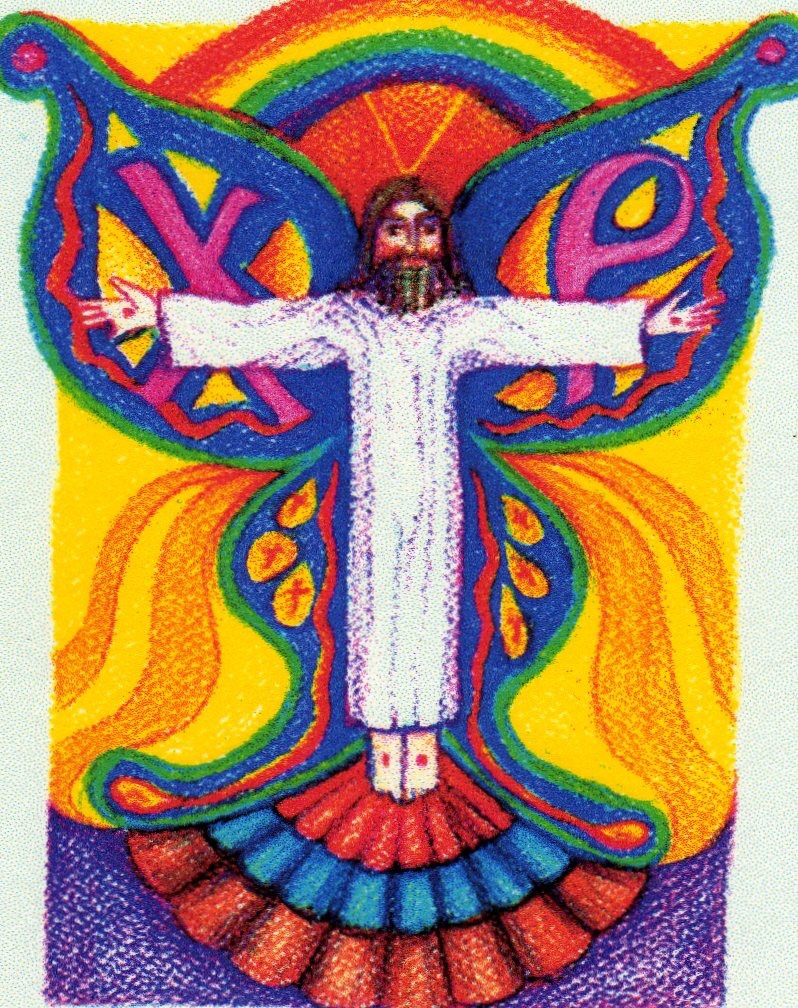
Jesus Icon

Our art class gives our group a safe place to stretch their minds, to take self care time, and to try a new skill that won’t kill anyone. It’s not like chainsaw juggling , where if you miss, you get a free ride to the ER or the funeral home. We don’t do that sort of thing. That’s more excitement than I can stand. I used to teach middle school art classes, so I had days, when the moon was full, that I sometimes thought I was juggling chain saws. Juggling plastic spoons is more my style today.

Gail is supervising home schooling during the pandemic. I don’t know how all the other parents and grandparents are doing in this particular time, but I remember the chaos which ensued one spring break as the pink eye ran amuck through the elementary school at which I taught. The headmaster gave everyone an extra week for spring break, an act which caused my students’ parents to call me in a panic, “What am I going to DO with my child for a WHOLE WEEK?!”

I laughed and said, “Keep them away from children who have pink eye.” I suppose I didn’t commiserate with them, as they thought I should. These people are now grandparents and I hope that one week back then showed them they could manage a whole pandemic today.

Gail’s Recycled Trees

Gail’s trips to fuel her caffeine need causes her to visit different coffee shops. The cup sleeves come in different patterns of corrugated cardboard. Of course, this paper product originally came from a tree, so she brought them in to be recycled and repurposed into an art piece about spring trees. Since she worked for the forest service, this is right in line with her love of nature and concern for stewardship of our natural resources. Gail also likes to plan and think her way through a theme.

Mike’s Trees and Stream

Mike gets his idea in a big, global whole. Then he seems to boil it down to a manageable size in a few moments, as he mentally discards the least workable parts. In a few minutes, he’s ready to paint a scene from memory or from his imagination. He applies lessons learned from other classes. For instance, painting in the background first is easier than trying to paint up to foreground details. This painting began with the stream, the green trees, the white trees, and then the popping pink trees for an accent.

Cornelia’s Start

I was painting trees with wisteria vines from a photograph I took near my home. The coffee spot at the Airport and MLK Freeway had moved, so when I turned in that driveway, I came to the notice of one of Hot Springs Finest. As he rolled down his window, I turned around and smiled.

“Hello, I’m just taking photographs of the wisteria in the trees.”

“I saw your car and thought you might be in trouble.”

“Not this time, but thanks for checking on me. I often stop to take pictures of our beautiful city.”

Wisteria in the Urban Forest

While we were talking, his radio went off and he had to go help someone else. Life interrupts our time together, and we don’t know how much time we have on this side of heaven. Many of the things we fight over will be meaningless in the great arc of history. When we meet each other on the other side, we won’t care about these things, for our whole attention will be God and the Lamb who sits upon the throne. If on this side of heaven, we learn to love more and forgive better, we’ll all be going on to perfection, whether we are in life or art.

RFK Jr Funeral Elegy

https://politicaldog101.com/2018/03/robert-kennedy-did-george-bernand-shaw/

Art Thoughts: Trees

https://pin.it/2IejRzm

The hidden price Steph Curry pays for making the impossible seem effortless

https://www.washingtonpost.com/sports/wizards/steph-curry-can-he-handle-the-full-court-pressure-of-super-stardom/2016/04/08/3dc96ca8-f6ab-11e5-a3ce-f06b5ba21f33_story.html?tid=a_classic-iphone&no_nav=true

Thriving in a World of “Knowledge Half-Life”

https://www.cio.com/article/3387637/thriving-in-a-world-of-knowledge-half-life.html

Elizabeth Cowling, Pablo Picasso (2002). “Picasso: style and meaning”, Phaidon Press. Also quoted in Alfred H. Barr Jr., Picasso: Fifty Years of his Art (1946).

https://www.oxfordreference.com/view/10.1093/acref/9780191826719.001.0001/q-oro-ed4-00008311

Shakespeare: Sonnet 18

https://www.poetryfoundation.org/poems/45087/sonnet-18-shall-i-compare-thee-to-a-summers-day

Ludovico Einaudi: Day 1: Golden Butterflies

https://music.apple.com/us/album/day-1-golden-butterflies/1451626902?i=1451627427

Also available on Amazon music streaming services

6-month neurological and psychiatric outcomes in 236 379 survivors of COVID-19: a retrospective cohort study using electronic health records – The Lancet Psychiatry

https://www.thelancet.com/journals/lanpsy/article/PIIS2215-0366(21)00084-5/fulltext

Point of View

adult learning, arkansas, art, Attitudes, Creativity, Easter, Faith, Good Friday, Healing, holidays, hope, Imagination, Love, Ministry, ministry, Painting, renewal, Right Brain, Spirituality, vision

Christ Reigns

It’s a matter of perspective.

The point of view determines the perspective of a work of art. One’s point of view, or preconceived bias, can determine how one sees the world and the decisions they make about the information that comes to them. If we think the world is a scary place, resources are few and won’t be enough for everyone, then, we’ll operate from fear and hoarding. If we believe God’s promises are faithful and God will indeed provide for our needs, then we’ll live in trust and hope, even as we order our lives to want less and enjoy simpler pleasures.

I always find it strange how the people in the Bible who have the greatest riches also have the most difficulty following Jesus. Matthew in 16:24-26 speaks to this topic in the section on “The Cross and Self-Denial:”

Then Jesus told his disciples, “If any want to become my followers, let them deny themselves and take up their cross and follow me. For those who want to save their life will lose it, and those who lose their life for my sake will find it. For what will it profit them if they gain the whole world but forfeit their life? Or what will they give in return for their life?

“Here is your Son“

Of course, even in the 1st century AD, people wanted to have material possessions, a good income, and wealth stored up for the future. When Jesus said, “whoever does not take up the cross and follow me is not worthy of me,” (Matthew 10:38), he invited his followers to enter a despicable journey.

The Via Dolorosa isn’t named the Way of Grief for nothing. People walked it, bearing a heavy cross beam, on the way to an undignified death, a punishment reserved for criminals.

Crucified On Crosses

Yet Jesus transformed this ancient punishment into a means of redemption. He took a symbol of death and made it into a hope for new life. Because of this , the author of Hebrews 12:2 could write, “Looking to Jesus the pioneer and perfecter of our faith, who for the sake of the joy that was set before him endured the cross, disregarding its shame, and has taken his seat at the right hand of the throne of God.”

Cross Icon by Gail

Now we can live the Easter promise written in Ephesians 2:12-18:

“Remember that you were at that time without Christ, being aliens from the commonwealth of Israel, and strangers to the covenants of promise, having no hope and without God in the world. But now in Christ Jesus you who once were far off have been brought near by the blood of Christ. For he is our peace; in his flesh he has made both groups into one and has broken down the dividing wall, that is, the hostility between us. He has abolished the law with its commandments and ordinances, that he might create in himself one new humanity in place of the two, thus making peace, and might reconcile both groups to God in one body through the cross, thus putting to death that hostility through it. So he came and proclaimed peace to you who were far off and peace to those who were near; for through him both of us have access in one Spirit to the Father.”

Multimedia icon by Lorilee

So we who live on this side of the resurrection have a joy to celebrate every day. For us the cross is a sign of victory over sin and death, and the evidence of new life and love God has for God’s world and God’s peoples. As we read in Colossians 1:19-20—

“For in him all the fullness of God was pleased to dwell, and through him God was pleased to reconcile to himself all things, whether on earth or in heaven, by making peace through the blood of his cross.”

Work in progress by Mike: Stained Glass Design

Rabbit! Rabbit! Welcome to April

art, chocolate, coronavirus, Creativity, Easter, Faith, garden, Garvan Woodlands Garden, Good Friday, greek myths, Healing, holidays, Holy Spirit, hope, Imagination, Love, Ministry, mystery, nature, Painting, pandemic, poverty, purpose, rabbits, Racism, renewal, Spirituality, trees, vision

April Bunny

I love the springtime, for all the colors of green are in abundance. I live on the lake on a property originally developed to be a high rise hotel and casino, until the city derailed that plan. Then it became vacation condos and retirement homes. Since it’s located on a large plot of timbered land, I even see my rabbit neighbors on occasion. My bunny friends usually move about at dawn and dusk. I’m not an early bird, and since Covid, my “out and abouts” have been seriously curtailed, so I’ve yet to see my four legged furry neighbors this year. Maybe I’ll have a better chance to see the Easter Bunny. I did purchase his dark chocolate cousin from Dove, who’s been reduced to a single ounce and will be gone by Easter Sunday. The ears went first, of course.

Dove Bunnies

Our parents found ways in the old days to keep us active and entertained in the weeks leading up to Easter. One of my favorite experiences was egg dying and decorating. Back in Mom’s kitchen, boiling water, vinegar and colored pellets went into the coffee cups before we wrangled the wire holder and lowered the hard boiled egg into the dye. If we dipped the egg all the way in or held it for a longer time, we could get deeper colors. One year I even attempted to use only natural dyes, such as beets, cabbage, and onions. My “science-anthropology” experiment didn’t turn out as pretty as the PAAS collection, but I learned a lot. Crayon resist worked with both dye types, however. Perhaps I never appreciated how fortunate I was my mom taught school and my dad encouraged us kids to learn everything about our world. Almost anything was a science project in his mind.

Crayon Box

As a child, I knew I’d arrived when I graduated to the big crayola box with  sixty four colors in it. Suddenly I had a year round wealth of shades and hues at my command, plus I could combine them for even more variety: Here are the colors that ended up being in the 64 count box in 1958: orchid, lavender, carnation pink, thistle, red violet, violet red, brick red, magenta, maroon, mulberry, Indian red, red, melon, salmon, orange red, red orange, orange, flesh, maize, goldenrod, yellow orange, apricot, orange yellow, yellow, lemon yellow, green yellow, spring green, yellow green, sea green, olive green, green, pine green, aquamarine, forest green, turquoise blue, green blue, sky blue, blue green, periwinkle, blue, navy blue, midnight blue, cornflower, blue gray, cadet blue, violet, blue, blue violet, violet, plum, tan, burnt orange, mahogany, burnt sienna, brown, raw sienna, bittersweet, raw umber, sepia, black, silver, gray, gold, copper, white. I could make any landscape sing with whatever color my young imagination called forth. My birthday month always calls forth all the colors nature has on her palette.

Spring Trees, Old Farmland

Of course, not every tree sports a shade of green as its primary dress in the springtime. Some bud out all in white, others in dark red violet, while still others bloom out in light pinks. If I squint my aging eyes today, I can see a haphazard lace design across the landscape before me in multicolored threads, with a few embroidered trunks to give it a semblance of stability. Those trunks might be Indian red (an iron red) mixed with the old Prussian blue (now known as midnight blue) to make a warm black. Using the straight carbon black crayon made the black too stark, or so my portrait painting grandmother told me. The old “flesh color” has been renamed “peach,” in recognition of the diversity of skin color in our world today. Many other colors in the box can be combined to get the perfect shade of a person’s facial tone, no matter how light, dark, yellow, white, red, or brown. The 64 box has enough colors to capture any facial tone, for sure.

When I see the ever changing beauty of the natural world about me, I can’t help but have hope. I look back not only to simpler times, but also forward in hope to a time when once again I will feel the joy of breaking the seal of a brand new box of crayons and when I can revel in the fresh, unsullied scent of pure wax and touch with reverence the clean paper wrappers. Easter dresses always show up in the pastel colors, even if we have to toss our dark winter coats over them when the weather turns cool, as it often does.

Maybe you don’t have such a strong attachment to art supplies as I do, but surely this April is a holy season for many people, and not just for the rabbits who live among us. Some how we people of faith across the centuries and around the world respond to the annual renewal of life and the promise of hope when life seems most precarious. While my faith experience is deeply rooted in Christianity, the worldwide communities of faith respond to springtime with some common traditions.

It’s no wonder one of the great myths of the ancient Greeks and Romans dealt with the changing seasons, but also with the hope of eternal life. Demeter was the goddess of agriculture and crops, whose daughter Persephone was taken into the underworld. Hades kept her there against her will, so while Demeter grieved, the crops failed, people starved, and the gods weren’t honored. Zeus, the king of the gods, forced Hades to release Persephone, but since she had eaten a few pomegranate seeds, she had to spend part of the year underground. This set up the seasons and was the impetus for the famed Elysian Mysteries.

The week long rituals were based on a symbolic reading of the story of Demeter and Persephone.  It provided initiates with a vision of the afterlife so powerful, it forever changed the way they saw their world and their place in it. They no longer feared death, for they  recognized they were immortal souls temporarily in mortal bodies. In the same way Persephone went down to the land of the dead and returned to that of the living each year, so would every human being die only to live again on another plane of existence or in another body.

Cave Entrance: The Plutonium, Eleusinia, Greece

The spring rite was the lesser mysteries, without which one couldn’t enter the greater mysteries of autumn. Anyone who was present in the city and spoke Greek could attend, unlike some of the closed gnostic mysteries, which were available only to a chosen few. The whole community participated, for the life of the family, as well as the earth, depended on the abundance of the earth. In fact, the only paved road in Greece in ancient times was from Athens to Eleusius, and a modern road now follows the same path.

The White Road to Eleusis (The Sacred Way)

Aristotle wrote about the contrast of the cathartic experience of watching a tragic drama whereby the spectator is purged of the negative emotions of fear and pity, while an initiate of the Mysteries would undergo physical, emotional, and spiritual cleansing in preparation for the main part of the ritual— a spiritual identification with the Mother and Daughter in their separation and suffering and then joyful reunion, a transformation from death to rebirth. Through her or his own inner spiritual desires and participation in the rites, the initiate then was prepared to receive a “seeing” into the deepest mysteries of life.

This communal ritual wasn’t just for the individual, but for the family, the city state, and even the world itself. Let’s keep that idea in mind as we consider the other rituals of faith, renewal, and restoration of this spring season.

Our Vice President’s husband Doug Emhoff, 56, is the first Jewish spouse of a vice president or president. “After a year of social distancing and mask wearing, it’s impossible not to feel isolated at times. So it’s events like this one, events that creatively bring family and friends and communities together, that keep us connected and remind us that we’re not alone,” Emhoff said at the Seder ceremony before noting he got to do one of his “favorite things” and introduce the vice president.

“Our family, like so many families in the United States, the state of Israel and around the world, will begin to celebrate the sacred holiday of Passover this weekend,” Vice President Kamala Harris said. “And the Passover story is powerful. It reminds us of the resilience of the human spirit in the face of injustice. It urges us to keep the faith in the face of uncertainty.”

Bitter Greens

“This year, as we dip our greens in salt water and pour out our ceremonial wine and eat our bitter herbs, let us commit, once again, to repairing the world,” she said.

This is the great witness of the Passover story, for it’s a story of hope and liberation. It’s a story of God keeping God’s promises and God’s faithfulness for those who suffer. If anyone needs to hear words of liberation, faithfulness, hope, and promises kept, it’s our whole world, which is suffering with covid, hate, nationalism, racism, and extremism.

Leonardo Da Vinci: The Last Supper was a Passover Seder

Passover, like many holidays, combines the celebration of an event from Jewish memory with a recognition of the cycles of nature. As the Jewish people remember their ancestors’ liberation, they also recognize the stirrings of spring and rebirth happening in the world. The symbols on the table bring together elements of both kinds of celebration. In the ritual, families take a vegetable, representing joy at the dawning of spring after a long, cold winter. Most will use a green vegetable, such as parsley or celery, but some families from Eastern Europe have a tradition of using a boiled potato, since greens were hard to come by at Passover time. Whatever symbol of spring and sustenance used, it’s dipped it into salt water, a symbol of the tears the  ancestors shed as slaves. Before eating it, a short blessing is said:

Baruch Atah Adonai, Eloheinu Melech ha-olam, borei p’ree ha-adama.

We praise God, Ruler of Everything, who creates the fruits of the earth.

At the end of the meal, celebrants bless the final cup of wine according to Jewish tradition and law. As the faithful have had the pleasure to gather (virtually) for a seder this year, they hope to once again have the opportunity of gather in person in the years to come. The prayer is God brings health and healing to Israel and all the people of the world, especially those impacted by natural tragedy and war. As folks say every year, “Next year in Jerusalem!”

Yet another spring festival is the Hindu celebration of Holi, which has been observed all over India since ancient times. Holi’s precise form and purpose displays great variety. Originally, Holi was an agricultural festival celebrating the arrival of spring. This aspect still plays a significant part in the festival in the form of the colored powders: Holi is a time when man and nature alike throw off the gloom of winter and rejoice in the colors and liveliness of spring.

Holi Festival Celebration

Holi also commemorates various events in Hindu mythology, but for most Hindus it provides a temporary opportunity for Hindus to disregard social norms, indulge in merrymaking and generally “let loose.” The central ritual of Holi is the throwing and applying of colored water and powders on friends and family, which gives the holiday its common name “Festival of Colors.” Holi is spread out over two days (it used to be five, and in some places it is longer). A large communal bonfire burns in the town center to light the evening festivities.

The entire holiday is associated with a loosening of social restrictions normally associated with caste, sex, status and age. Holi thus bridges social gaps and brings people together: employees and employers, men and women, rich and poor, young and old. Holi is also characterized by the loosening of social norms governing polite behavior and the resulting general atmosphere of licentious merrymaking and ribald language and behavior. A common saying heard during Holi is bura na mano, Holi hai (“don’t feel offended, it’s Holi”).

This festival has transferred into western culture as part of the celebrations at the end of races and other communal bonding events, a fact which leads some to charge the west with cultural appropriation, but the followers of Holi aren’t offended if the intention is good.

While Easter in the western world has become a cultural celebration of cleaning house, redecorating, wearing new and brighter clothes, and doing brunch with lighter foods, in the Christian church, Easter still retains its central place of honor. As Henri Nouwen writes, “When Jesus was anticipating his own death he kept repeating the same theme to his disciples: “My death is good for you, because my death will bear many fruits beyond my death. When I die I will not leave you alone, but I will send you my Spirit, the Paraclete, the Counselor. And my Spirit will reveal to you who I am, what I am teaching you. My Spirit will lead you into the truth and will allow you to have a relationship with me that was not possible before my death. My Spirit will help you to form community and grow in strength.” Jesus sees that the real fruits of his life will mature after his death. That is why he adds, “It is good for you that I go.”

Prayer to the Holy Spirit

While Jesus did reach out to those ignored by the traditional faith community of his day, he was also concerned for the whole community over and above the individual alone. While the church, who are the “ones called out,” is composed of individuals, we’re called to gather together for worship, prayer, instruction, and to be sent out to do ministries in the name of Jesus. Some today put their personal relationship with Jesus above their relationship with the beloved community or with the suffering body of Christ, which is found in the marginalized people beyond the church door.

So along with Nouwen, we have to ask, “If that is true, then the real question for me as I consider my own death is not: how much can I still accomplish before I die, or will I be a burden to others? No, the real question is: how can I live so that my death will be fruitful for others? In other words, how can my death be a gift for my loved ones so that they can reap the fruits of my life after I have died? This question can be answered only if I am first willing to admit Jesus’ vision of death, as a valid possibility for me.”

Grunewald: Resurrection

Since Easter is the celebration of the great resurrection story, it’s the story of the  renewal, not only of life, but the renewal of hope and faith. When our world looks its most bleak, we can still hope for a better future. When our God seems to have abandoned us, we can still trust in God’s unfailing promise to fulfill God’s commitments to God’s well loved people. When Mary Magdalene runs to meet the risen Christ in the garden, he tells her, “Do not hold on to me, because I have not yet ascended to the Father. But go to my brothers and say to them, ‘I am ascending to my Father and your Father, to my God and your God.’ ”

We don’t keep good news for ourselves, but spread it to others. This is the best argument for the communal nature of resurrection faith. It should change us, so we should want to change God’s world and God’s people for the better. If we’re transformed by love, we also should transform the world with love. If we’ve been justified by the grace of God’s mercy, we should want to bring justice to marginalized communities who’ve experienced systemic injustice.

In summary, what ties all these spring festivals together is a hope for a new creation and a better life, either in this world or in the world beyond. Sometimes we need to have assurances of the life to come to live well in this life, while other times we need a hope for this world in order to live for tomorrow. Likely our faith practices speak to our deep human need for freedom and also to the need for our suffering to have meaning. Only if we change our suffering into a catalyst for relieving the suffering of others can we being these faith promises of spring renewal into reality. Then the ancient hopes of slaves, who were liberated, can come true today also. When the fears of death and life of everyday people are healed, their hopes and dreams are made possible by the power of god working through them. Then we too can sing the songs of freedom, put our energy into freeing others who are in bondage, and bring about God’s new creation, even as God’s spirit is renewing the face of the earth.

Springtime in Garvan Woodland Gardens

True Colors: Creating Natural Food Dyes at Home — Edible LA

https://www.ediblela.com/news/natural-food-dyes

Original Boxes of 64 Crayola Crayons | Jenny’s Crayon Collection

http://www.jennyscrayoncollection.com/2020/10/original-boxes-of-64-crayola-crayons.html

Doug Emhoff and Kamala Harris Celebrate First Passover at the White House

https://people.com/politics/doug-emhoff-and-kamala-harris-celebrate-first-passover-at-the-white-house/

The Ritual Path of Initiation into the Eleusinian Mysteries

(c) 2009, Mara Lynn Keller, Ph.D., California Institute of Integral Studies

https://www.ciis.edu/WSE/WSE%20Documents/WSE%20PDFs/07_keller.pdf

The Eleusinian Mysteries: The Rites of Demeter – World History Encyclopedia

https://www.ancient.eu/article/32/the-eleusinian-mysteries-the-rites-of-demeter/

A Seder for Everyone

http://www.jfcsboston.org/Portals/0/Uploads/Documents/The%20Wandering%20Is%20Over%20Haggadah%202015.pdf

Holi Religion Facts

https://religionfacts.com/holi

Text excerpts taken from “You are the Beloved”

by Henri J.M. Nouwen

© 2017 by The Henri Nouwen Legacy Trust.

Published by Convergent Books.

Rabbit! Rabbit! Welcome to March!

arkansas, art, Attitudes, change, Faith, Family, haiku, hope, nature, Pi Day, renewal, Spring Equinox, St. Patrick’s Day, texas, trees

March is Women’s History month and the time of the Vernal Equinox.  Spring can’t come too soon for this old rabbit. While my heater keeps my den cozy and at an even temperature, I’m convinced my bones are a xylophone knocking a chattering tone inside the multiple layers of clothing and afghans in which I’m wrapped. Going outside isn’t on my list of things to do. I’m actually thankful for zooming and online shopping.

Snow and Morning Fog

Every year my local community has its brush with a false spring, only to have another round of winter weather come round to slap it silly. In New York, the maple syrup run begins about March, while sap starts to flow between mid-February and mid-March. Farther south, in the Ozark Mountains, sugar maple sap can be collected as early as January. The exact time of year depends upon where you live and weather conditions. Sap flows when daytime temperatures rise above freezing (32 degrees Fahrenheit /0 Celsius) and nighttime temperatures fall below freezing. The rising temperature creates pressure in the tree generating the sap flow. This is basically a transfer of the sap from the tree above the ground and the root system below the ground. The sap generally flows for 4 to 6 weeks, with the best sap produced early on in the sap-flowing season.

Pancakes and Bacon

While I don’t have any maple trees in my neck of the woods, I do believe in using real maple syrup on my pancakes and crepes. I keep a homemade pancake mix ready for those days I really need a comfort food breakfast. All I have to do is add a couple of beaten eggs and some water. The instant milk, flours, salt, and baking powder is already included. No one needs to buy this in a package. I can add chocolate chips, chopped nuts, or bits of fruit for variety. It’s so good and filling with uncured bacon and only a tablespoon of syrup. Of course, this plan only works if I have utilities at my rabbit den. Otherwise I retreat to the condo hallway, where the condo association’s generator keeps the emergency lights on and two live outlets. Crockpot food and hot coffee become the food of the rabbit gods in such crisis situations.

A wonderful coincidence of joy In New York and New England is the sap starts up in the sugar maples the very day the bluebird arrives, and the sugar-making begins forthwith. “The bird is generally a mere disembodied voice; a rumor in the air for two or three days before it takes visible shape before you,” as John Burroughs wrote in Wake-Robin, first published in 1871.

March 2015 Snow Scene

January through March, November and December are the usual months with snowfall. The month with the most snowfall in Hot Springs is February when snow falls for 1.7 days and typically aggregates up to 0.94″ (24mm) of snow. This February in two days we had more than two feet of snow from back to back polar punches. It was cold, but not record setting, unlike the state’s coldest day, when the city of Gravette set the record at -29° F on February 13, 1905. The latest snow in Arkansas history happened in May of 2013, when Decatur, a town near the northwest border, got five inches of snowfall! I’m hoping we don’t get a late spring snow, post vernal equinox. Mother Nature would add insult to indignity.

Woman and Rabbit

While we Arkansas rabbits were iced in, we didn’t have to endure the ongoing trauma of our fellow Texans to the south. Sadly, they were out of power and/or water for several days running. Extreme weather events will catch us bunnies by surprise if we don’t listen to those who know about the changing climate. Of course, if it costs money to prevent systemic utility failures, sometimes we decide to take a chance the weather situation won’t repeat itself. Suffering costs money too: lost wages, insurance claims, health risks, vehicle accidents, and food shortages. An article in Bloomberg estimated about $50 billion in damages from this recent winter storm season, according to AccuWeather, a commercial forecasting company. In comparison, the entire 2020 hurricane season caused “only” $60 billion in damage.

Rabbits need to ask if saving money in the short term is worth losing money over the long term. Another way to ask is how much risk are we willing to take? Mrs. Rabbit is always telling Peter and the others, “Don’t go into the garden when Mr. McGregor is there. You’ll come to no good end.” Of course this is when all the foolish, inexperienced rabbits go to the garden! My mother rabbit continually reminded the younger me, “Experience is a hard teacher and a diploma from the school of hard knocks is very expensive.” Like her, I earned every strand of my grey hairs.

Usually in the springtime, we’re thinking of our gardens and perusing seed catalogs. We can count on our local Walmart having some early plants to set out to brighten our gardens, but this year we’re all looking for snow shovels. The winter haiku of Matsuo Basho (1644-1694) clearly expressed his own viewpoints comparing it to the other seasons. While October to December was winter in Japan, as the old calendar designated it, his poem still fits Arkansas’ late spring snow:

Let’s go out

To see the snow view

Where we slip and fall.

Tracks up the Road

But the snow won’t last forever and neither will standard time. Yes, just as the days begin to get longer and we revel in the wonder of a sunrise and a sunset while we’re still awake, along comes the annual conversion to DST, for daylight saving time begins on March 14th, also known as Pie Day, because 3.1417 is the number of Pi in mathematics. If you make an apple pie for Sunday, you might want to add a few drops of green food coloring to the apples, so your leftovers will be good for St. Patrick’s day on the 17th.

Of course, the vernal equinox is our big excitement in the month of March, for this full moon governs two religious holidays celebrated by Jews and Christians. They’re linked, of course, because Jesus was a Jew. The Passover is celebrated to recall the people’s release from bondage in Egypt and their time with God in the wilderness until they reached the promised land. Because Jesus was crucified on the Eve of the Passover, Palm Sunday and Easter typically fall around the time of the Jewish Passover. The spring equinox falls on March 20, which also marks the Persian New Year. Easter always falls on the first Sunday after the first full moon that occurs after the vernal equinox, which signifies the beginning of spring in the northern hemisphere.

These times of renewal celebrated in the various faith communities remind us spring is a time of new beginnings and new growth. We can have a renewed hope when we shake off the cold burdens of a long winter. We can have a new spirit awaken in our heart when we hear a songbird sing its melody. When the trees leaf out in their first green lace, our frowns begin to thaw. One day in the month of March, we may find ourselves throwing back the curtains in the morning to greet the cerulean sky with a song:

Blue skies Smiling at me

Nothing but blue skies Do I see

Bluebirds Singing a song

Nothing but bluebirds All day long

(Irving Berlin, Blue Skies, 1927)

March is a month of hope and optimism, for who plants a garden except in hope? We don’t know if we’ll get sufficient rain or sun, or if we’ll have too much of a good thing. Farmers and gardeners are like parents, for they bring new life into this world with the hope they’ll be able to tend the gift God has given them. As Emily Dickinson says in her 1891 poem, “Hope,”

Hope is the thing with feathers

That perches in the soul,

And sings the tune without the words,

And never stops at all, ….

This rabbit still thinks hope endures, and if “Somewhere over the rainbow, bluebirds fly. Birds fly over the rainbow, why, then oh why can’t I?” I’ll have another cup of hot mint tea and contemplate this journey in my deepest heart. May your garden always grow the fruits of Joy and Peace, 

Cornelia

Quotes About Bluebirds

http://www.sialis.org/quotes.htm

Making Maple Sugar for the Hobbyist

https://tapmytrees.com/tap-tree/

Making Maple Sugar in the Ozarks

https://edibleozarkansas.ediblecommunities.com/things-do/water-tree-making-maple-syrup-ozarks

Winter haiku poems, Matsuo Basho’s examples | Masterpieces of Japanese Culture

https://www.masterpiece-of-japanese-culture.com/literatures-and-poems/haiku/matsuo-basho/haiku-poems-winter-examples-matsuo-basho

The Single Largest Snowfall in Arkansas Happened in 2011

https://www.onlyinyourstate.com/arkansas/ar-2011-snow-fall-record/

Texas Grid Calls Off Emergency as Cold Eases: Energy Update

https://www.bloomberg.com/news/articles/2021-02-17/texas-crisis-deepens-economic-fallout-spreads-energy-update

Somewhere Over the Rainbow

Words by Edgard Y. Harburg, Over the Rainbow, from the film Wizard of Oz, 1939

Charlie Brown Clay Stars

adult learning, arkansas, art, Astrology, CharlieBrown, coronavirus, cosmology, Creativity, Faith, Family, grief, Healing, holidays, Imagination, Israel, Ministry, ministry, nature, pandemic, Spirituality

“Close Encounters of the Third Kind” might best describe my and Gail’s latest adventure at the Oaklawn art class. Pinterest Fail is another synonym for our latest escapade. If my daddy were to describe the result, he’d say, “Close, but no cigar.” That’s a quintessential American expression, which is little used elsewhere in the English-speaking world. The first recorded use of “close, but no cigar” in print was in Sayre and Twist’s publishing of the script of the 1935 film version of Annie Oakley: “Close, Colonel, but no cigar!” I’m very fond of these ancient phrases, which are daily passing from the common parlance, even as new words are invented. These were our first attempts at this craft, so our learning curve resembled the same disastrous, steep ascent of the daily Covid infection chart.

The 1977 movie title “Close Encounters “ was derived from a classification of close encounters with aliens as set forth by the American UFO researcher J. Allen Hynek. Close Encounters of the First Kind refer to the sighting of a UFO. Physical evidence of a UFO are classed as Close Encounters of the Second Kind. Actual contact with an alien is a Close Encounter of the Third Kind. Therefore, our air dried cornstarch, salt, and baking soda clay objects, which should have looked neat, crisp, and clean, instead came out more like visitors from another planet, whose embodied boundaries were disintegrating in an inhospitable atmosphere.

Yes, I blame the recipes, which said “warm water,” rather than naming an actual temperature. Just as science projects and recipes for bread need accurate measurements and temperatures for success, so does cornstarch clay. Gail mentioned her clay began to heat up under her hands as she worked it. Mine never did, but I had to add rock salt to my mix because I ran out of table salt. Don’t do this! The salt crystals won’t melt and I had chunks in my finished pieces. The proportions of the recipe I used are equal amounts of each ingredient, so if you have just a limited amount of one, measure it and give the others to the main bowl in the same amount.

Bowl with Ingredients

Once the dough looks like mashed potatoes, don’t eat it. Instead, turn it out on parchment or waxed paper and knead it a bit. Then use a rolling pin to get the dough about ¼ inch thick. Use cookie cutters to get your shapes. Put them on a clean, flat surface, such as the back of a sheet pan. Take a plastic straw to put a hole in the upper part of the cutout. This works best if the shape is a touch dry, since the damp dough will close up. The hole is for the string hanger. The rolling pin might need flouring with corn starch if it sticks to the clay.

I also took some leaves and twigs from the bushes on the church property to use as embossing. I put these down on the cutouts, gave them a rolling pin once over or twice, maybe three, and made sure not to over flatten the shape. You could also use a decorative rolling pin as the last roll to make an all over pattern if you like that idea. A patterned doily or a scrap of lace would make a good pattern also.

Natural Decorations

When class was over, we cleaned our mess up with hot water and paper towels. I let the water run in the sink to make sure any small remains were washed far down the pipes. All the big scraps should be thrown in the trash. When I got home, I wasn’t in the mood to let these air dry for days and days. They already looked like they belonged on Charlie Brown’s Christmas tree, so I put them in the oven at 200F.

Water boils at 212F, so at 200F these shapes would be slowly drying out. I baked them on a cookie sheet for 30 minutes on each side. I did notice a bit of toasting in places, but I planned on painting these, so I don’t think it matters. I did lose the points off a few stars, but in this year of the Pandemic, perhaps some of us may be able to identify with the brokenness and vulnerability of these imperfect objects. We may want everything and everyone to be perfectly normal, but standard operating procedure isn’t on the menu for this year’s Thanksgiving or Christmas. We’re all suffering in one way or another, just like these ornaments.

Broken Stars

I didn’t preheat the oven, for the clay objects don’t need to be shocked into a different temperature. We don’t preheat a kiln before we fire clay pottery, but raise the whole to the same temperature at one time. Of course, if you’re making a recipe with flour, yeast, or eggs, and you need your concoction to rise, you do need a preheated oven. Otherwise, just put the food into a cold oven and let your nose tell you when it’s done. Preheating is a waste of energy if you don’t need it for the recipe. These clay pieces will be hot when you remove them from the oven. Let them cool until you can pick them up without dropping them like a hot potato (a metaphor from the 1800’s).

Painted Star and Bells

I did take a sharp paring knife to the edges to smooth them out. Yes, I didn’t like the raggedy look. You can’t do this cleanup roughly or with big whacks. This is the fine tuning of your shape. I used to help a porcelain doll maker back in my home town. I would sand the final shape of the doll baby’s faces, hands, and feet for her to paint. She appreciated my work because I would keep the anatomical details correct and give the little faces individual personalities. Portraits in porcelain aren’t that easy, but I wouldn’t rush to finish. If we’re always on to the next task, we might miss the opportunity to meet God in the work we’re doing in the moment.

Right now in this current crisis, most of us are limiting our time out and about. If we go to the grocery store, we find our goods and get out. I do the self check out or scan and go wherever I am so I don’t have to stand in lines. I do miss the interaction and chats I used to have with folks. I decided recently even if I were masked, I would begin to speak to others. So far on each outing, at least one person has shared their feelings of grief or loss, which are a result of this pandemic. Because we are forced to limit our contacts, we’ve also lost our opportunities to share our daily joys and our challenges. If we don’t use our words, we’ll lose them. We need time to share our lives and be a community for one another, since we’re all in this together. These are God moments in which we can be a blessing to others, as well as to receive a blessing from them.

This loss of conversation will be even grimmer if our loved ones pass on during this pandemic, for their memories will cease to be available to the younger generation, and their stories will no longer be shared. As these old ones age, and their frailties become like the imperfect points on my Charlie Brown stars, we realize we won’t have them much longer. Even more so, we’ve come to realize this pandemic spares neither the young nor the full of life, as more and more of our friends are struck by this disease. Any one of us could become a Charlie Brown Christmas star at any moment. I have family members who’ve had it, friends who’ve died from it, and my heart goes out to all who suffer with it, especially those who have lost their incomes because of it.

Those who now deal with the persisting side effects of this disease don’t get near the encouragement or assistance they need in their recovery, since the rest of us are too worn down from self care and from caring for those who’re newly ill. Even the health care workers, first responders, and essential workers who have to keep the rest of us safe, well fed, and secure are struggling under the long term stressors of this pandemic. We have a responsibility to care for them so they can keep going under duress. All these folks need a sign from us that they aren’t forgotten.

Christmas Tree Star

Unique stars have always been a herald or sign of unusual events to follow. The gospel of Matthew (2:1-2) records the visit of the magi, astrologers from the east, to King Herod:

In the time of King Herod, after Jesus was born in Bethlehem of Judea, wise men from the East came to Jerusalem, asking, “Where is the child who has been born king of the Jews? For we observed his star at its rising, and have come to pay him homage.”

These foreigners recognized the sea change about to happen in the world, for soon earthly kingdoms would recede in importance, and the powerful would lose their sway. If they could see this sign in the sky, we have to wonder why no one in Israel was considering what the star’s arrival signified. Perhaps the learned priests knew, but didn’t want to tell King Herod the bad news:

Thus says the LORD,
who gives the sun for light by day
and the fixed order of the moon and the stars for light by night,
who stirs up the sea so that its waves roar—
the LORD of hosts is his name:
If this fixed order were ever to cease
from my presence, says the LORD,
then also the offspring of Israel would cease
to be a nation before me forever.
(Jeremiah 31:35-36)

Of course, today most of us no longer believe the stars and planets affect our daily lives, nor are we “born under a bad sign,” as the blues players sing. Once we clean up the Thanksgiving meal, many of us will turn our thoughts to the holiday season. I’ll remove the last of the autumnal gourds and bring out a few winter seasonal objects every week until New Year’s. As the seasons change, we note the changes in our world. If the days are growing shorter and darker, we ourselves can still be lights in the world, as Paul wrote to the Philippians (2:14-15):

Do all things without murmuring and arguing, so that you may be blameless and innocent, children of God without blemish in the midst of a crooked. and perverse generation, in which you shine like stars in the world.

Multiple Layers of Gold and Silver Acrylic Paint on the Ornaments

Even if we’re Charlie Brown stars, our lights will be a beacon of hope for all the world to see.

Joy and Peace,
Cornelia

Air Dry Clay Recipe Using More Baking Soda (better recipe)
https://mamapapabubba.com/2016/02/16/homemade-air-dry-modelling-clay-aka-baking-soda-clay/

Reasons to Preheat the Oven
https://www.epicurious.com/expert-advice/do-i-really-need-to-preheat-the-oven-article