Picasso’s African Masks and Inner Mysteries

adult learning, art, Creativity, cubism, elections, Imagination, inspiration, Painting, picasso, renewal, The Lord of The Rings, Thomas Merton, vision

What is the key to open the door to the hidden mysteries? For Frodo and his fellow travelers in The Lord of the Rings trilogy, they needed to know the elvish answer to the riddle, “Speak friend and enter.” Gandalf knows this language, so they enter with ease. For years, the Egyptian hieroglyphics were unintelligible because we had no living person who knew the ancient language. After the discovery of the Rosetta Stone in Egypt with its three languages depicting the same text, the race was on to translate the pictographic writing.

Rosetta Stone, British Museum

In art school my fellow students and I worked in our shared studio classes daily, but sometimes we never made any progress. Then the day would come when the light bulb clicked on in one of our brains. When we took a break, instead of giving everyone’s work a cursory glance before going out for a snack, we would linger and take in the special magic of a unique vision. Where does this special insight come from? Is it a visitation from above? Or a piercing of the soul by divine artistic insight? Sometimes I think the rare and the strange shock us out of our ease and complacency.

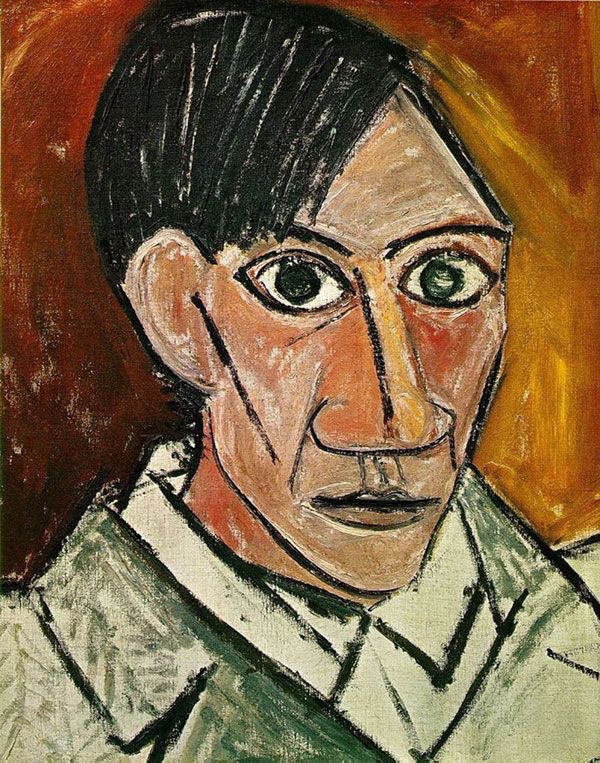
Picasso: Self Portrait, oil on canvas, 1907.

Art historians divide Picasso’s early periods into his Blue Period (1901-1904), the Rose Period (1905-1907), the African-influenced Period (1908-1909), and Cubism (1909-1919). Some art historians call Picasso’s African Period his “Proto-Cubist” or primitive period. It lasted from 1907 to 1909. Picasso was 24 years old when he saw an exhibit of African art at the ethnographic museum at Palais du Trocadéro. He experienced a “revelation” and began to explore African art further. African masks and sculptures strongly influenced Picasso’s art for several years, when he began to paint in sculptural forms, earth tones, and in flattened sharpened shapes.


Pablo Picasso in his Montmartre Studio,1908, via The Guardian

Picasso had first seen an African mask at Gertrude Stein’s home. Recalling his visit to the Trocadéro Museum of Ethnology (now the Musée de l’Homme), Picasso said of the museum:

“A smell of mould and neglect caught me by the throat. I was so depressed that I would have chosen to leave immediately. But I forced myself to stay, to examine these masks, all these objects that people had created with a sacred, magical purpose, to serve as intermediaries between them and the unknown, hostile forces surrounding them, trying in that way to overcome their fears by giving them color and form. And then I understood what painting really meant. It’s not an aesthetic process; it’s a form of magic that interposes itself between us and the hostile universe, a means of seizing power by imposing a form on our terrors as well as on our desires. The day I understood this, I had found my path.”

That path led Picasso to what he called his “periode nègre” (black period) or African period. It lasted only a few years, to 1909, but it turned Picasso into an avid collector of African art, masks, and sculptures that inspired him for the rest of his career.

Picasso: Woman with joined hands, 1907, Paris.

In our art class we chatted about how these masks inspired Picasso. Picasso used a palette of earthy tones, overlapping browns, and yellows with dark reds. By using Cubism, he explored a simplified geometry and the redefinition of perspectives. He tried to reveal objects from a different vantage point—from the mind, not only how the eyes perceive them. His Les Demoiselles d’Avignon signified a radical break from the naturalism that had defined Western art since the Renaissance, derailing former notions of what art was supposed to look like.

Picasso: Les Demoiselles d’Avignon (1907), oil on canvas.

People criticized Picasso’s two-dimensional women as unfeminine, for their confrontational demeanor was a complete departure from the traditional depiction of female beauty. Artists and critics alike received the work negatively and saw its menacing sex workers as promiscuous and unfit for Paris salons. Picasso rolled up the canvas, considered scandalous even amongst his innermost circle, and stored it in his studio for years to come. Yet this groundbreaking painting influenced his future works.

As Thomas Merton wrote in No Man Is an Island:

“In an aesthetic experience, in the creation or the contemplation of a work of art, the psychological conscience is able to attain some of its highest and most perfect fulfillments. Art enables us to find ourselves and lose ourselves at the same time.”

Picasso broke through the accepted boundaries of Western culture and discovered his true spirit in through the voices of the ancestors speaking from the African past. He met the other and found himself. By bringing the African masks into his studio, Picasso lived out the message of Hebrews 13:2—

“Do not neglect to show hospitality to strangers, for by doing that some have entertained angels without knowing it.”

As artists today, who seek to find their own true self and unique voice, we must both find ourselves and lose ourselves. We must lose our preconceived notions of who we should be and discover our true selves. Some artists use this as license to be caricatures of an artist, but actual artists have work ethics because they have obligations to galleries and clients. Looking like an artist and being an artist are two different things. Finding our true selves is not only a task for creatives, but also a lifetime journey for all people engaged in spiritual growth. We all can recover the image of God, which is our true self, by both God’s grace and our cooperation in doing good to all.

We artists are not here to make pretty pictures, but to break down the boundaries between our walls that keep us estranged from God and neighbor. We are not as bold as Picasso! Most of us are not risk takers. Willingness to leap out in faith is what marks a famous artist. That same riskiness is what marks the prophets of the Bible. Prophets never praise the status quo, but remind the people of the nature of their God:

“For the LORD your God is God of gods and Lord of lords, the great God, mighty and awesome, who is not partial and takes no bribe, who executes justice for the orphan and the widow, and who loves the strangers, providing them food and clothing.” (Deuteronomy 10:17-18)

Isaiah 1:17 reminded the people of his day, “learn to do good; seek justice, rescue the oppressed, defend the orphan, and plead for the widow.” Jesus will pick up this same voice in Matthew 25:40, “And the king will answer them, ‘Truly I tell you, just as you did it to one of the least of these who are members of my family, you did it to me.’”

So how will we find our unique voice and creative expression today? The more we steep our heart and mind in the great spiritual writings of the ages, particularly those of whom have come through great suffering or difficulties, the closer we will come to understanding our own challenges in life. These hardships are not hurdles or barriers to our progress, but refiners of any weakness that needed to be strengthened.

As my teachers always said, “We test you, not to see how ignorant you are, but to see what we failed to teach well.”

I always liked their attitude better! I did not feel so dumb when I missed the right answer on their tests. I always liked art better, for more than one answer could be correct. If we work within the parameters of the assignment, we can interpret the art with our own vision and style.

Our recent class with the African masks was a big diversion from our usual method of working. First, the masks are from a different culture. They are as much of a culture shock to us as they were to Picasso. He had the privilege of buying them in the Parisian curio shops, so they sat around in his environment. We only had images. The mystery of these objects might not connect to us as they did to him.

Mike’s Mask

Mike brought several masks from his home collection. He decided to paint one that spoke to him. Like Picasso, he had an emotional connection to this mask. He made a successful rendering of the object before him. Unfinished, he would bring it back to the next class.

Tim’s First Layers

Tim worked on a mask representing his wife. He first painted his background with a dark wash, then began drawing a lighter design on top of it. The contrast of the dark and light without the middle tone was difficult for me to look at, but he seemed to be enjoying getting the big shapes down. I often let people work without jumping into change their activity. I figure they will learn more from going down a dead-end road by themselves than if I stop them before they go there. They will ask about this, and we will talk about it. They will not do it again. A little suffering leads to learning if we do no harm to the body.

Gail’s First Layets

Gail S. understood the concept of simplifying the faces into a mask. She chose a photo of herself and her granddaughter. With two mask shapes, she had multiple decisions to make. As with the others, her work was unfinished at the end of class.

This was a difficult and challenging lesson for everyone. Asking students to make an emotional connection and render the object also was aspirational. It also gave me an opportunity to see where they were on this learning journey. I will not issue this sort of challenge again for a while. I was afraid I had been boring them, but maybe not. I may need to bring brownies next Friday to make up to them. For some, they may be “grief snacks,” while for others, they will be “encouragement food.” If my bunged-up shoulder permits, I will indulge in grief baking. Otherwise, I will just eat the chocolate ice cream in my freezer, and ask for understanding.

Cornelia’s Trump Portrait

I painted a Trump mask to get my emotions out and not have them bottled up inside. If we dislike an attribute in another person, it is because we have that attribute in our own life. I can get incredibly angry, but I bottle it up and it hurts me. I do not often let anyone else see it, so it can make me sick from holding it in. Whenever someone calls you a name, I remember the old song my parents taught me when I was a child:

“Sticks and stones may break my bones, but words will never hurt me.”

Anger is a difficult emotion for many people, especially for women. It is a “culturally unacceptable behavior,” for we have always expected strong emotions from men, but this expectation is changing over the generations. Proverbs 14:29 reminds all of us,

“Whoever is slow to anger has great understanding, but one who has a hasty temper exalts folly.”

The Old Testament often speaks of God’s anger, but this is because God’s people keep finding other gods to worship instead of the one true God. Psalms 145:8-9 reminds us of God’s true nature:

“The LORD is gracious and merciful, slow to anger and abounding in steadfast love.

The LORD is good to all, and his compassion is over all that he has made.”

The hidden mystery is in plain sight. It is the word of hope we hear:  We are not sinners in the hand of an angry God. We are all beloved and God’s everlasting grace is redeeming us always. When things fall apart, God works to reframe and renew, even if we have difficulty recognizing God’s new creation or wanting to take part in God’s plans for the new heaven and the new earth.

Joy, peace, and recovery,

Cornelia


Historical Influence of African Art in the Modern Art Movement – ARTDEX

Pablo Picasso – Artists – Mnuchin Gallery

https://www.mnuchingallery.com/artists/pablo-picasso#:~:text=Picasso’s%20early%20work%20can%20be,Cubism%20(1909%2D1919)

Stealing beauty | Art | The Guardian

https://www.theguardian.com/artanddesign/2006/mar/15/art

Historical Influence of African Art in the Modern Art Movement – ARTDEX

Sticks And Stones May Break My Bones – Meaning & Origin of The Phrase

https://www.phrases.org.uk/meanings/sticks-and-stones-may-break-my-bones.html


Pears and Apples

adult learning, Altars, apples, Aristotle, art, brain plasticity, change, cognitive decline, color Wheel, Creativity, exercise, Fear, Habits, Holy Spirit, inspiration, Lent, Leonardo da Vinci, Painting, perfection, Physical Training, purpose, risk, Thomas Merton, Van Gogh

Still Life with canvas, pallet, and brushes

Aristotle said in his Poetics, “The aim of art is to represent not the outward appearance of things, but their inward significance, and this, and not the external manner and detail, is true reality.”

He spoke mainly about poetry, which was the highest art of his age, but his words also apply to the fine arts. Today, many people are still mesmerized by artists who practice various styles of realism, but they overlook the artists who show us the realities of emotion and inner vision.

The good news about art.

“Art enables us to find ourselves and lose ourselves at the same time,” said the spiritual writer, Thomas Merton. Some people use art as a cathartic exercise, and pour out their inner emotions on the canvas or their chosen media. Jackson Pollock’s drip paintings and Van Gogh’s late works are good examples of emotional expression. We all know folks who have a project going in their garage. They go work on “that worthless piece of junk” to focus their attention and energy on fixing something on which they can make a difference, instead of getting tied up in knots about things they can’t change and must accept. Gardening and knitting are also good hobbies for focusing this energy.

We know our nervous system grows to the modes in which it has been exercised. This is what we call building a habit over time. Just as a child doesn’t walk straight out of the womb, they have preparatory skills that must be acquired by stages as they grow. Exercising their muscles by rolling over also helps to strengthen their necks to hold their heads up. Crawling leads to pulling up, and that leads to letting go to learn balance.

Each time a child repeats these movements, he or she will simplify the movements required to achieve the needed result, make them more accurate, and diminish fatigue. In this, they’re building habits that bring them closer to walking. Rushing them to achieve “early” walking actually puts them behind cognitively.

Not only are there twenty five body parts in a baby’s body that are used in the crawl movement, but crawling also strengthens the hip sockets, so the baby will have a strong platform on which to stand. Crawling helps the corpus callosum, which is a band of nerve fibers between the hemispheres of the brain. Criss-cross crawling on the knees and hands stimulates the corpus callosum to develop in a balanced way, facilitating the hemispheres of the brain to communicate. These cross lateral movements work both sides of the body evenly and involve coordinated movements of the eyes, ears, hands, feet, and core muscles. This helps support cognitive function, problem solving, and ease of learning. Exploring the floor in a baby proofed home allows your baby to achieve his or her optimal potential.

Gail’s Painting

“Practice makes perfect” is only as true as the practice is directed in a true direction. This is where a teacher, a parent, a coach, or a spiritual guide comes into play. Only one who’s been led well can lead others with grace. We don’t tear down the learner, but ask questions, give guidance, help them see alternative paths, and allow them a safe place to explore their choices.

Art class isn’t brain surgery. No one will die if the painting isn’t successful, and no one’s salvation is at risk if the painting doesn’t come out the way we hoped it might. Art class is a safe place to take risks, unlike jumping from a tall tower without a parachute. Learning to accept failure on our canvases and coming back next time to try again is a mark of resilience and courage. Every time we fail closer to our target, we realize we’re gaining on it! We never say I CAN’T in art class.

Crawl before you Walk or Run

The sad reality is we can teach and expand the horizons of young people up til the age of 25 or 30. After that, they seem to lose energy and desire to learn more or to change. They “habitually” repeat their previous acts, for good or for ill. We’ve all heard the old saying, “You can’t teach an old dog new tricks.” Those of us who are no longer young have sometimes been accused of being set in our ways. Some of us are afraid we won’t excel at a new challenge, for we’ve always been held to a high standard of achievement. Since none of us will be the next Georgia O’Keefe or Leonardo da Vinci, we can set that worry aside. They both had more years to practice than we have left in front of us. Instead, we should give our remaining time our most focused attention, so we can get the most from our experience.

My high school chemistry book had the same information in it which my daddy’s college chemistry book covered. He was amazed I was learning “advanced” ideas at my young age. In 1982 R. Buckminister Fuller introduced the idea of the “knowledge doubling curve.” Up until 1900, knowledge doubled every century. By 1945, knowledge doubled every 25 years and by 1982, it doubled every year. Some say it’s now doubling twice a day! The newest computer we buy off the shelf today is already obsolete.

We can’t train our students for the jobs of today because these jobs likely won’t exist tomorrow. We need to train people to be lifetime learners instead. Luckily, we don’t have to know all things, but we do need the skills to find the knowledge and sort through the best sources for the best possible information.

1930-2006

Today, knowledge we acquire in high school, college, graduate school, and our last job may already be obsolete. (I’m one who still grieves the loss of Pluto as a planet; it exists but is a dwarf planet in the Kuiper Belt). This is especially true in fast moving fields like technology. As futurist Alvin Toffler wrote, “the illiterate of the 21st century will not be those who cannot read and write, but those who cannot learn, unlearn, and relearn.”

This means all of us will need to become lifelong learners or we’ll risk losing touch with an ever evolving world. Maybe we think our brains can’t handle something new, for we’ve heard about the effect of aging. Cognitive process studies with older brains show learning, memory, and problem-solving in humans are often less efficient in these areas.

However, it has recently been established that dogs show many of the same kind of age related changes that humans do. A study in Vienna showed that older dogs learned new tasks just as well as younger dogs, although they took longer to do so and required more repetitive corrections. This aptitude is also known as “resilience training.”

I think it’s also important to know why we want to keep our brains agile as we move into our later years. John Wesley was fond of repeating William Law’s summary from the Practical Treatise on Christian Perfection,

“Do all the good you can, to all you can,
by any means you can, as long as you can.”

Because Wesley was better known than William Law, this quote is now attributed to Wesley alone. We Methodists have made it our own, however, and have carried its banner around the globe in our world wide mission efforts made possible by our Connectional ministries. Wesley thought enough of Law’s writing to reprint 19 editions of his work.

My late mother, at the age of eighty, learned how to use a laptop computer. She was motivated because she wanted to see emailed photos of her grandchildren, but then she realized she also could find recipes. When a child in her hometown needed a Mercy Flight, she used her new skills to get him transportation to an out of state hospital for treatment. I occasionally had to reteach her on how to double click quickly on her icons, rather than slowly, but she finally caught on.

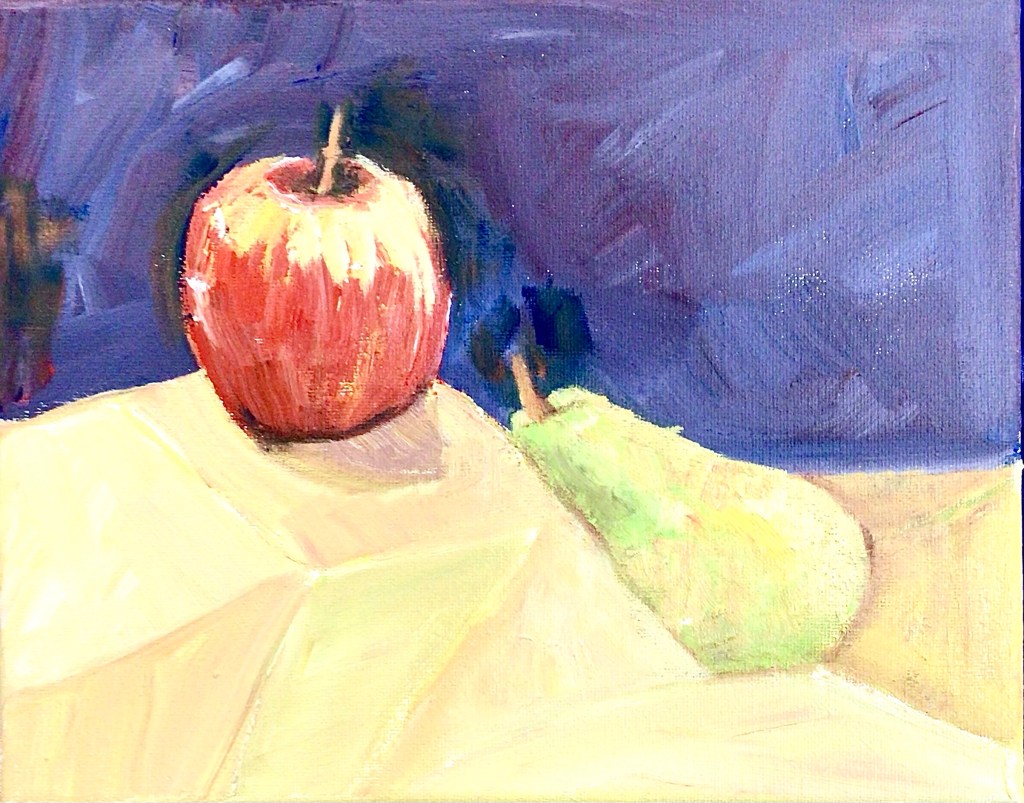
iPad drawing of pear and apple

If we want to keep our brains agile throughout our middle, silver, and golden years, we always need to try new things. Doing art challenges makes our brain build new neural pathways. Every time we look at a still life or a landscape, we have to make multiple decisions: what shapes do I see—circles, squares, triangles, or rectangles; how do these shapes relate to one another on the plane of our canvas; what is most important; what colors will I use; what emotions do I want to express; and where will I begin?

Eventually, we will find our “style.” We don’t find a style by copying another’s work, but we create enough works until our hand becomes one with our spirit. Since God has placed a special spark of God’s own creative Spirit within each of us, eventually we’ll experience the joy of being one with God when we are in our painting moments. As Paul said to the Romans (8:16):

“The Spirit Himself bears witness with our spirit
that we are children of God.”

Last Friday we had a simple still life as our inspiration. Half our class was out sick with spring pollen troubles, but it was good to see those who could come after a two week hiatus. After a brief show and tell to get us inspired by other artists’ takes on the subject for the day, we got started. I reminded everyone not to make the fruit too tiny, so it wouldn’t get lost on the canvas. I believe everyone succeeded with this goal!

Mike’s painting

Mike painted his whole canvas with one brush. This gave the fruit a certain texture with contrasting colors, and the background, which was in a close value, didn’t show much brush strokes or texture. I like the perspective he chose, which brings the viewer in close to these fruit.

Gail tried a larger canvas with bolder colors than she normally uses. It was more dramatic and stronger in contrast than usual, while she kept her smooth strokes of paint as usual. She also took a view from above.

Cornelia’s Fruits

I stuck to a traditional rendering of the still life, since I do many abstract paintings in my own studio. I’d call these two Day and Night, for the Apple is quite awake and the Pear seems to need a little nap. It’s a study in contrasts: red and green, blue violet and yellow orange—a color wheel study masquerading as a still life.

Next week we’re in the season of Lent. As Christ turns his face towards Jerusalem, we’ll begin a study on the icons. This will be accessible and interesting. You’ll end up with your own icon for your personal worship center also.

Joy and Peace,

Cornelia

Classics in the History of Psychology — James (1890) Chapter 4
https://psychclassics.yorku.ca/James/Principles/prin4.htm

Crawling is important for childhood brain development
https://thefnc.com/research/crawling-is-important-for-childhood-brain-development/

You Can Teach an Old Dog New Tricks | Psychology Today
https://www.psychologytoday.com/us/blog/canine-corner/201602/you-can-teach-old-dog-new-tricks

Letters of John Wesley – John Wesley, Augustine Birrell – Google Books, p.423
https://books.google.com/books/about/Letters_of_John_Wesley.html?id=zgYu6NpqWDEC

What It Takes To Change Your Brain’s Patterns After Age 25 https://www.fastcompany.com/3045424/what-it-takes-to-change-your-brains-patterns-after-age-25