I See the Icon—The Icon Sees Me

art, beauty, Faith, Holy Spirit, Icons, Imagination, incarnation, inspiration, Love, Mandylion, mystery, Painting, Pantocrator, Plato, renewal, salvation, St. Athanasius, vision

The icons of Christ radiate a sense of calm, a spiritual experience created countless times by various artists over the ages. Each one channels the spiritual force which lies outside of language, mystery, and mysticism. Over the years, we’ve come to understand the icon serves as a window into the world beyond our own. In this world we think of dualities: good and evil, winning and losing, ours and theirs. In the world beyond ours, everything belongs to God, we are all one, and no one lacks for anything. The heavenly banquet table is a never ending feast for everyone and no one is reduced to begging for the crumbs that fall from it. No one hungers or thirsts in this land of the unclouded sky.
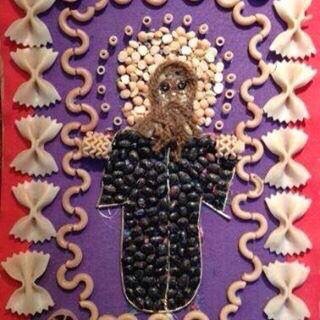
Jesus is the Bread of Life

The icon represents to us the world we yearn to be. In this respect, it’s a “wormhole” from the fully perfected world to this world, which is still going onto perfection. The New Heaven and the New Earth promised in Revelation 21:1-4 speaks to this very event:

Then I saw a new heaven and a new earth; for the first heaven and the first earth had passed away, and the sea was no more. And I saw the holy city, the new Jerusalem, coming down out of heaven from God, prepared as a bride adorned for her husband. And I heard a loud voice from the throne saying, “See, the home of God is among mortals. He will dwell with them; they will be his peoples, and God himself will be with them; he will wipe every tear from their eyes. Death will be no more; mourning and crying and pain will be no more, for the first things have passed away.”

The Good Shepherd

Until that time comes, we have the icons gazing upon us to remind us of this promise, as well as of our calling to be coworkers with God in bringing this world into fruition. If we see with spiritual eyes, we’ll be able to look beyond the paint and canvas, beyond the image and likeness, and beyond material truth to see the spiritual truth of the icon before us.

To understand the icon better,we ought to take a trip in the WayBack machine to Ancient Greece to visit Plato and study up on his philosophy. This is important because whether they know it or not, artists of every stripe and measure participate in this “not yet, but yearning for a better world” as they make their art. In the 4th C BCE, Plato believed the true reality was in the ideal forms which existed in a world outside of this one which we daily experience. Every form we see on earth is merely a copy of the ideal form, but not the “truth.” Plato’s truth existed in this realm of ideas, rather than in the senses. This is the opposite of how most modern people look for “truth,” especially scientific or observational evidence based truths.

Christ Enthroned

For Plato, the ideals of good and truth had to exist as a form in the eternal world so we could recognize them in our transitory world. All things, even virtue, justice, love, and beauty, must have an ideal form in this realm beyond our sensibilities. Where we get into trouble is believing this world’s representations of the ideal forms must follow the pattern exactly. The examples we consider beautiful can change over the centuries, but the idea of beauty as the highest ideal of loveliness never changes. This is why we don’t keep repeating Greek and Roman Classical themes for our public buildings in the modern era.

James 1:17 says of God: “Every generous act of giving, with every perfect gift, is from above, coming down from the Father of lights, with whom there is no variation or shadow due to change.”

The Golden Christ

When we say “God doesn’t change,” we mean God never quits loving us, always wants to save us, and always wants to work for good for those who love the Lord and are called according to God’s purposes. God does change God’s mind when we give up our wayward ways and return to godly ways. The Old Testament is full of times God had a change of heart. Maybe some of these events were the people having a heart change and coming back to God. God does seem absent when we turn away, while God seems near when we turn towards God.

Coptic Jewel Icon

But I digress, and I plead the hot weather. Plato’s perfect forms are the subject, especially the form of the Good. For Plato, only the soul or the mind can know the true forms, while the sensible body is suspect. Plato’s philosophy is a form of dualism, which elevates the spiritual over the physical. This is an important concept for early Christianity, since they had to hash out an understanding of the incarnation of Christ. For some, Jesus was purely divine, while for others he was purely human.
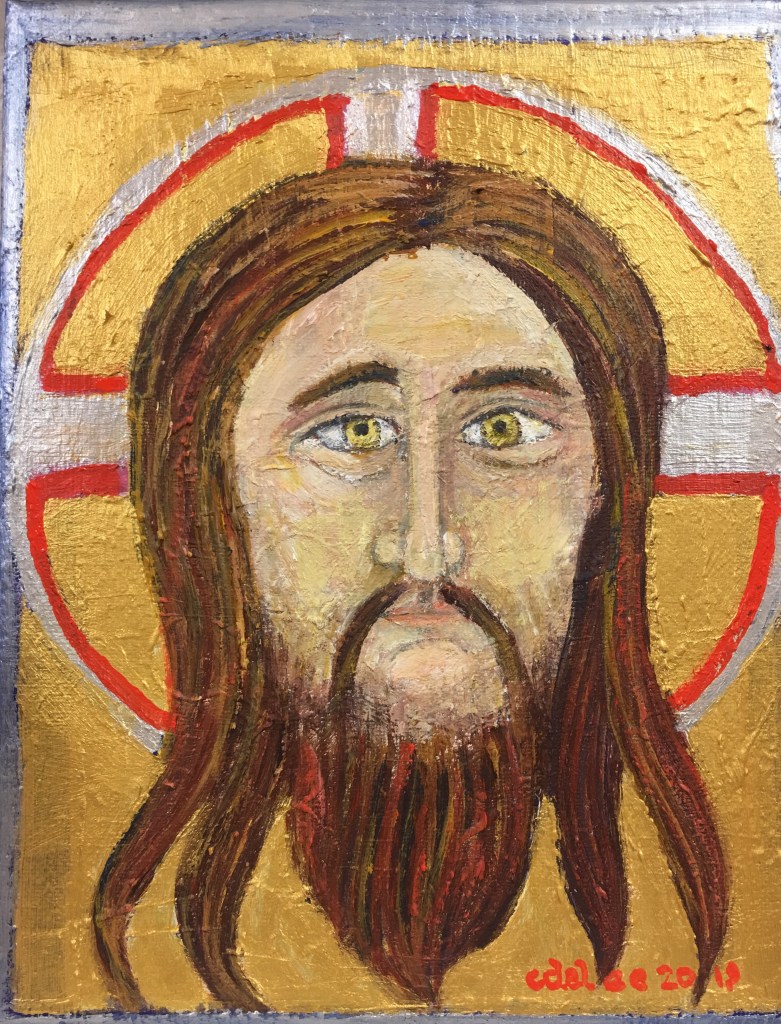
Variation on the Christ Not Made by Hands Icon

The traditional interpretation of Jesus Christ is he is both fully human and fully divine, as Athanasius so succinctly said in his treatise On the Incarnation: “for God became man so that man might become god” (54:3). This theology of theosis, or perfection in love, always boggles the mind of those of us who are used to 1 + 1 = 2, or the sensible and mathematic physical reality of this world. One of the rallying cries back in those days was “There never was a time when the Son wasn’t the Son.” People marched in the streets to proclaim this belief: the Son of God never gave up his divinity even when he became human for the sake of our salvation. It was necessary for him to become human to save all of us and only if he were completely God would he be able to save us entirely.

Christ Pantocrator

For the icon painters, Athanasius also is informative when he writes about the Incarnation: “and He manifested Himself by a body that we might receive the idea of the unseen Father; and He endured the insolence of men that we might inherit immortality.”

As Jesus says in John 14:7, “If you know me, you will know my Father also. From now on you do know him and have seen him.” Like Phillip, we can only believe in what we’ve seen. Many of us are doubting Thomases, who need to touch and hold onto physical proof before we can be convinced. The icons remind us that Jesus is

“the image of the invisible God, the firstborn of all creation; for in him all things in heaven and on earth were created, things visible and invisible, whether thrones or dominions or rulers or powers—all things have been created through him and for him” (Colossians 1:15-16).

What image is the Christ icon? That depends on the time and place where the icon was created, but all images share certain qualities. The eyes are prominent, the mouth is small, the forehead is broad, and the lower jaw is small. Most of the icons of Christ look like a philosopher, rather than a warrior king, which was the original meaning of the Jewish messiah. All icons have at least one ear visible to hear the prayers of the faithful.

These letters form the present participle, ὤν, of the Greek verb to be, with a masculine singular definite article, ὁ. A literal translation of Ὁ ὬΝ would be “the being one,” which does not mean much. “He who is” is a better translation

The backgrounds are gold and represent a timeless, eternal spiritual space. Today, yesterday, and tomorrow are all the same for God, who is known by the name I AM. In John 8:58, Jesus got into an argument with some of the Pharisees over who were the true children of Abraham. When he told them, “Very truly, I tell you, before Abraham was, I am,” they were ready to stone him  for claiming to be god. Moreover, as the author of Hebrews reminds us, “Jesus Christ is the same yesterday and today and forever” (13:8).

Roman Icon, 12th CE, oil on wood panel, Vatican Museum

The icon itself isn’t holy, but the image it represents is holy. This is why icons are venerated , while Christ is worshipped. The image isn’t holy, but the person represented is holy. In this sense, every icon points to the ideal form of Christ in the spiritual world beyond us and the icon acts as a window or a wormhole opening so that spiritual world can enter into our sensible and material world here. The more we live with an icon, the more our hearts and minds are tuned to the silent harmonics of the hymns of joy, peace, love, beauty, generosity, and compassion. This is because we become open to the truth of Christ in a mystical way which supersedes our own personal beliefs and experiences. We lose our attachment to the world of dualisms and enter into the world of union with the divine. We are undergoing theosis. Theosis is more than just salvation and divine pardon, but is  rather the process of spiritual transformation that culminates in mystical union with God. It is a cooperative work of the Holy Spirit and the believer that results in this union.

After 12th Century Vatican Icon

Art has a way of affecting the energies of a human being. It’s well known how certain colors affect mood, so designers use these techniques to create appropriate spaces in buildings. Public art adds to the charm of a city and likewise, destroying green spaces can render a city to grimness. Having art in one’s home or office elevates it above the ordinary.

Even artists who aren’t painting icons, but are making landscapes or abstractions can be said to be seeking a platonic form, one which only they may see in their own mind’s eye. We keep looking for the next challenge, the creation which comes closest to our imagination. We artists keep on going, however, for each new work not only refines our imagination, but it also moves us closer to our desired goal. We’re like long distance runners who always seek a new personal best!

Resurrection Christ

The icon makes a claim on our lives as we return its gaze. In the silence, Christ asks, “Are you going onto perfection in the love of God and neighbor?” We take a silent stock of our lives and our interactions in prayer. Most days we agree with the apostle Paul in his letter to the Philippians (3:12):

“Not that I have already attained this—that is, I have not already been perfected— but I strive to lay hold of that for which Christ Jesus also laid hold of me (NET).”

Joy and peace,

Cornelia

Plato
https://www.webpages.uidaho.edu/engl257/classical/platonic%20idealism.htm

Early Christian Heresies
http://webspace.ship.edu/cgboer/heresies.html

CHURCH FATHERS: On the Incarnation of the Word (Athanasius) 54:3. https://www.newadvent.org/fathers/2802.htm


Rabbit! Rabbit!

art, Astrology, autumnal equinox, brain plasticity, change, cognitive decline, coronavirus, cosmology, Creativity, Family, Great American Eclipse, greek myths, Helios, nature, Painting, pandemic, photography, rabbits, Reflection, The Lord of The Rings, trees, vision

Welcome to August!

In the long summer evenings, after an extended car trip, and way beyond the too many times I’d asked my mother and daddy rabbits, “Are we there yet?” I would get their firm reminders I wasn’t to bother them any more, for they too were hot, tired, and daddy had to pay attention to the road. In the gathering darkness, I’d rest my blonde curls on the door near the open window. We had God air conditioning back then. We rolled down the window glass of our old Pontiac and drove as fast as the road would allow.

Go Faster!

I’d watch the darkening shadows as the landscape passed by this opening, noticing how the kudzu vines changed the trees into strange and monstrous shapes in the growing gloom, but I couldn’t take my eyes off of these apparitions. I was certain if I did, they’d begin to make their way toward our family car. I think I was at the age of magical thinking, for I believed I could keep these haints at bay by my will alone.

The soft flup flup of rubber tires half melting on the overheated concrete road, combined with my brother rabbits’ body heat in the seat beside me, and the enforced silence of our parents who’d had a long day with their hyperactive bunny brood finally had an effect on my eyelids. Try as I might, I would fall asleep at my watch, only to be awakened by my daddy’s sing song voice as he tickled my toes:

“This little piggy went to market, this little piggy stayed home.
This little piggy ate roast beef, and this little piggy had none!
And this little piggy cried wee-wee-wee all the way home!”

I’d rub my eyes as he picked me up to carry me into the house and into my bedroom. On the way, I’d always say,

“I see the moon, and the moon sees me,
God bless the moon, and God bless me!”

Perhaps this is a generational gift in my family, for when my own dear bunny child was small, we repeated these same scenes until she was too heavy for me to carry. The moon blessing dates from 1784 and the little piggy rhyme is even older: 1728.

That latter date is when horses and carriages were banned from Boston Common. Since I went to school in Boston, I can attest no horses, carriages, or cows are now on the grounds of the Common, which is now a 50 acre public park. The Common dates from 1634, when William Blaxton sold the remainder of his land to the Puritans, receiving six shillings or more from each shareholder to purchase the land for this public land. This was the site of the Boston Massacre, in which five people died. One good thing about going to school in an historic community, everywhere you went, you weren’t far from history.

When I think of history, I think not only of the stories we pass down to the next generation, but also of the stories we weave for ourselves. How do we remember our childhood or our families of origin? This is a generational gift of privilege, for those who lost their families when they were young may not have memories to weave together. Refugees from wars and violence might not want to recall traumatic experiences. Yet Abraham, the father of the Jewish nation, is remembered as “My ancestor was a wandering Arameam” (Deut 26:5).

Some of us choose to write about our better days, for they outnumber our bad days. Everyone has imperfections, but each of us rabbits are still going on to perfection with the help of the good God above. Perhaps when we see the beauty of the full bright moon against a dark, clear night, our heart leaps inside and says,

“I see the moon, and the moon sees me,
God bless the moon, and God bless me!”

For some of us rabbits, nature brings us closer to God than anything else. The majesty of the summer thunderclouds rising in the heated air, and giving way to either refreshing rain or flashing floods, reminds us once again of the powers of God unleashed in God’s creation. The rainbow after the storm is the promise once again of that covenant made so long ago: the earth will never be destroyed by floods again. In the rainbow, in the light of all the colors, we hear God’s promise of love and care for God’s creation and God’s creatures.

DeLee: Blue Moon

I’m looking at a full super moon tonight, July 3, but August will have TWO super moons. Looking ahead to September 29, we’ll have our FOURTH super moon in a row. The moon on the 31st of August will be a blue moon. This is the second full moon in the same month. We won’t have another blue moon until May, 2026. This is why things that don’t happen often are called “once in a blue moon” events.

Once upon a time, we were agrarian people who eked out a subsistence living on the land. The persistence of The Old Farmer’s Almanac and other ancient weather wisdom lore is proof you can take the bunny out of the country, but you can’t take the country out of the bunny. Yet as our alphabetical generations accumulate beyond the boomers, like Lucy on the Honeymooners, we often “got some explaining to do” to make ourselves understood.

Sirius in the Night Sky

We can count the “Dog Days of Summer” among the sayings folks don’t understand today. The term has nothing to do with the four legged creatures known as our best friends, but instead, it’s an astronomical term. The name comes from Sirius, the Dog Star, which rises before dawn. We find it on a vertical line below the three stars of Orion’s Belt. Sirius was named from the Greek Seirios, which means ‘glowing’ or ‘scorcher.’ This is an apt description of the warmest days from mid July to mid August.

Crepe Myrtle Bark Peeling in the Heat

Aratus, a Greek 3rd BCE poet wrote in his astronomical poem Phaenomena, (p. 328 ff, trans. Mair):

“A star that keenest of all blazes with a searing flame and him men call Seirios (Sirius). When he rises with Helios (the Sun), no longer do the trees deceive him by the feeble freshness of their leaves. For easily with his keen glance he pierces their ranks, and to some he gives strength but of others he blights the bark utterly. Of him too at his setting are we aware.”

These Dog Days of Summer in the ancient Mediterranean were marked not only by heat, but also by drought and pistelence. This year, with an El Niño weather pattern, wild fires, floods, and extreme heat have settled on the area due to a heat dome, which the European meteorologists have named Cerebus, after the three-headed dog guardian to Hades. The ruins on the Acropolis now close from noon to late afternoon to prevent heat illness.

Porch of the Maidens, Acropolis, Athens

Although the ancient Greeks and Romans believed Sirius was the reason for summer’s intense heat, we know now that star is too far away to affect our weather. What does affect our weather today is the result of human activities. Back in the Eemian period, around 116,000 to 129,000 years ago, the earth’s axis was tilted more towards the sun than now. This caused our northern polar region to be warmer and grow trees, which kept snow from accumulating. As a result, the earth’s temperature was 2 degrees C hotter than preindustrial levels, while today’s temperatures average 1 degree C warmer.

Today, we have evidence of geographic drift caused by climate change in our crops. Areas once known for coffee or wheat are shrinking, moving further north or to higher altitudes. We also see shrinking polar ice sheets, which cause ocean levels to rise. More water, combined with more heat leads to more intense storms. We also have rivers of wind, aka the jet stream, which lock in the heat domes. These can persist for days, while the rest of the earth gets flooding and storms.

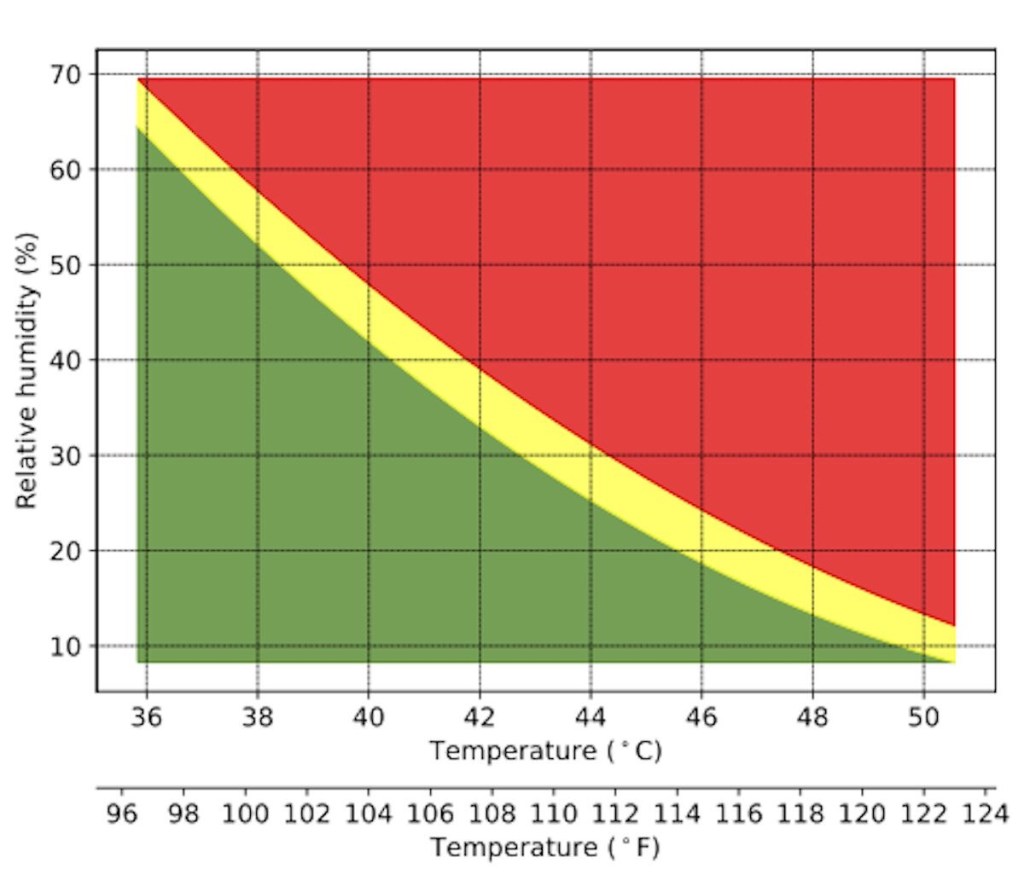
Not a Watermelon Chart: Similar to the National Weather Service’s heat index chart, this chart translates combinations of air temperature and relative humidity into critical environmental limits, above which core body temperature rises. The border between the yellow and red areas represents the average critical environmental limit for young men and women at minimal activity.

Extreme heat is the number-one weather-related cause of death in the U.S., and it kills more people most years than hurricanes, floods and tornadoes combined. Despite the fact that extreme heat has been the number one cause of weather-related deaths in the United States over the last three decades, the federal government has repeatedly declined to declare extreme heat a federal disaster. The US government has never issued a federal disaster declaration for an extreme heat event in the three times it’s been requested, even as heat domes and long, uninterrupted stretches of 100-plus degree days have claimed lives in cities and states across the country in recent years.

The 10 hottest years on record have occurred since 2010 and the month of June alone in the USA has broken over 1,000 high temperature records. The combination of El Niño, a warming ocean current, and climate change is the cause. The excessive heat in the oceans are causing coral diebacks, which have negative implications for future hurricane shore losses, since coral reefs break the incoming waves.

We bunnies can blame the Stafford Act for this. Natural disasters in the USA are handled by FEMA—Federal Emergency Management Agency. The Robert T. Stafford Disaster Relief and Emergency Assistance Act, PL 100-707, was signed into law November 23, 1988 when Congress amended the Disaster Relief Act of 1974, PL 93-288. Named for the Vermont senator who was instrumental in its passage, this is one of the 100 laws a President can use to declare a national emergency or disaster. Former President Trump used it to declare the COVID pandemic an emergency. It’s this Stafford Act that defines “Emergency.”

According to Congressional laws, a disaster emergency is “any occasion or instance for which, in the determination of the President, Federal assistance is needed to supplement state and local efforts and capabilities to save lives and to protect property and public health and safety, or to lessen or avert the threat of a catastrophe in any part of the United States in a Major Disaster.

The act defines “major disaster” as any natural catastrophe (including any hurricane, tornado, storm, high water, winddriven water, tidal wave, tsunami, earthquake, volcanic eruption, landslide, mudslide, snowstorm, or drought), or, regardless of cause, any fire, flood, or explosion, in any part of the USA, which in the determination of the President, causes damage of sufficient severity and magnitude to warrant major disaster assistance under this chapter to supplement the efforts and available resources of states, local governments, and disaster relief organizations in alleviating the damage, loss, hardship, or suffering caused thereby.

Fires of Mordor have nothing on Phoenix Heat

To get heat relief, it will require an Act of Congress. In plain speak, we’ll see snowfall before heat relief legislation becomes law in today’s divided and polarized congressional body. In the last century, we bunnies weren’t thinking about climate change, extreme weather events, or even naming our winter storms. Perhaps next summer we’ll begin naming our extended heat waves and treat them with the same seriousness as we give to hurricanes and blizzards.

In the meantime, this bunny has set her AC to cool and is keeping the ice bin filled and the tea jar full. I’m feeling the siren call of the school supply aisle, so I’ll find a cool morning in mid August to go buy ink pens, notebooks, and some postynotes. A bunny who keeps learning will always stay young. Building new pathways for the neurons is like cleaning out the clutter in our brain box.

Write now, Edit later. The stories are more important than the form.

I always recommend picking up a new skill or renewing an old one, for not only do creative activities give us an opportunity to focus on something other than how hot it is, but also we can enjoy our progress as we continue to work. If you’ve ever wanted to write about your family history, begin now, for the day will come for all of us when we won’t remember the ones we love. This bunny hopes you have bunnies who love you and honor you for who you’ve always been, even if you become the “one who comes to kiss me every afternoon at 4 o’clock.”

Pluto: Now a Dwarf Planet

I’ll probably go buy my journal supplies on August 24th, and sit in my favorite coffee shop for a bit to drink in memory of Pluto, who was worthy enough to be a planet for my generation,but has been demoted to a dwarf planet because it hasn’t cleared its neighborhood of other objects.

I look forward to cooler breezes, falling leaves, and Pumpkin Spice lattes. See you in September!

Joy, peace, and iced tea,

Cornelia

The Project Gutenberg eBook of Gammer Gurton’s Garland, or, The Nursery Parnassus, by Joseph Ritson.
https://www.gutenberg.org/files/34601/34601-h/34601-h.htm

Teaching Early Math to Children—This Little Piggy
https://www-tc.pbs.org/parents/earlymath/pdf/LittlePiggy.pdf

Origin of This Little Piggy
https://www.rhymes.org.uk/this_little_piggy.htm

Boston Common Master Plan
https://www.bostoncommonmasterplan.com/history

Super Moons, Blue Moons
https://www.fullmoonphase.com/

What is a blue moon and when will the next one occur? | Royal Observatory Greenwich https://www.rmg.co.uk/stories/topics/what-blue-moon-how-often-does-it-occur

SIRIUS (Seirios) – Greek God of Dog-Star https://www.theoi.com/Titan/AsterSeirios.html

THE DOG DAYS OF SUMMER: European heat wave takes toll on tourists – Travel Industry Today
https://travelindustrytoday.com/the-dog-days-of-summer-european-heat-wave-takes-toll-on-tourists/

42 U.S. Code § 5122 – Definitions | U.S. Code | US Law | LII / Legal Information Institute FEMA STAFFORD ACT
https://www.law.cornell.edu/uscode/text/42/5122
https://www.fema.gov/disaster/stafford-act

Extreme Heat Is Deadlier Than Hurricanes, Floods and Tornadoes Combined – Scientific American
https://www.scientificamerican.com/article/extreme-heat-is-deadlier-than-hurricanes-floods-and-tornadoes-combined/

From Japan to Louisiana to Rome, Here Are Ten Heat Records Earth Has Broken Since June | Smart News| Smithsonian Magazine https://www.smithsonianmag.com/smart-news/ten-heat-records-earth-has-broken-since-june-180982562/