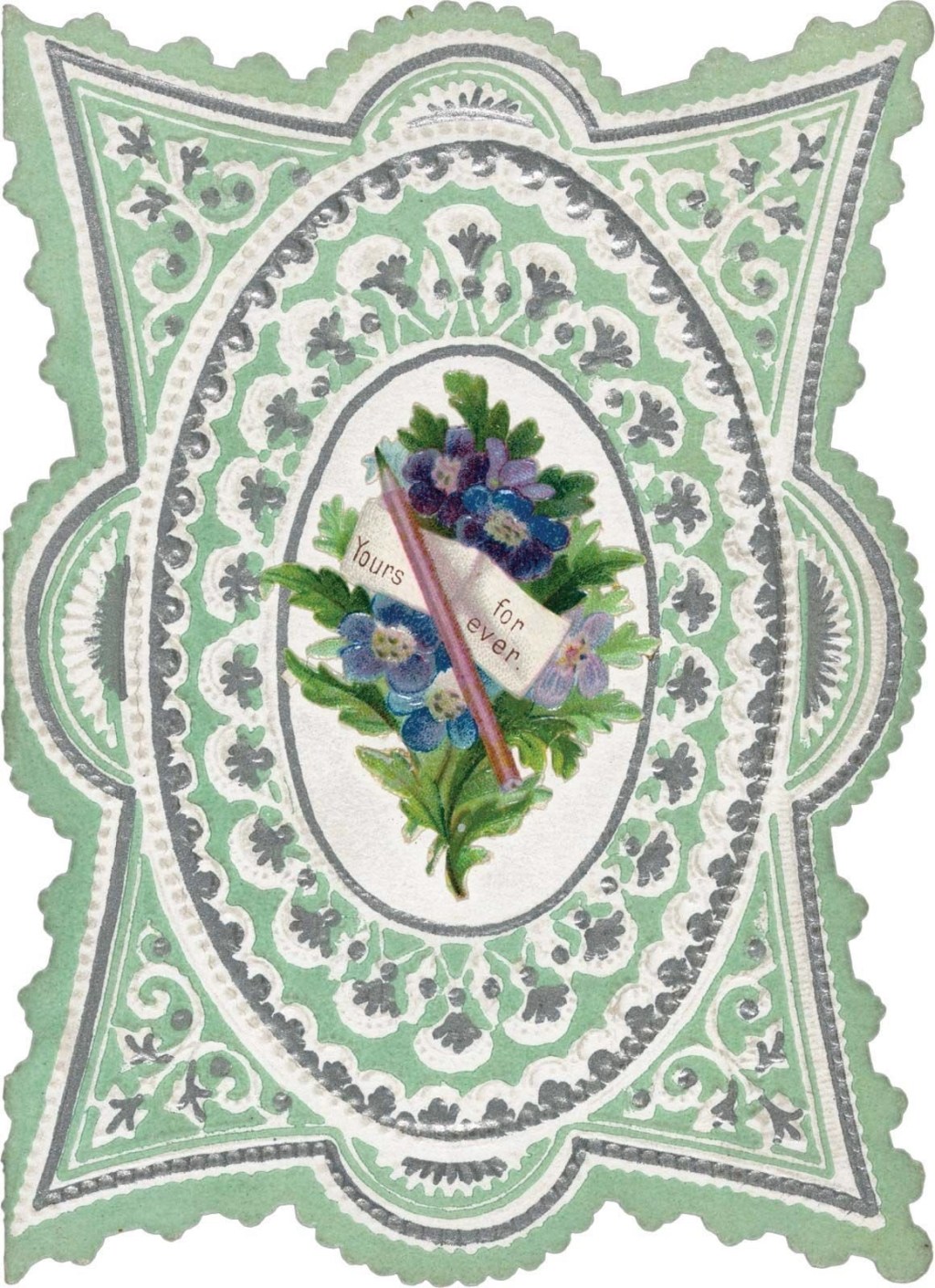
Elizabeth Barrett Browning, the poet answered in her Sonnets from the Portuguese, “Let me count the ways.” On Valentine’s Day, some of the many ways people shared their love were by sending chocolates, flowers, and cards. Most of us think we are honoring St. Valentine, or at least one of the three third CE saints of the same name who were martyred for their faithfulness to Christ.
The first Valentine from Africa was persecuted and killed along with his followers. Nothing more is known about him. The other two saints may even be the same person. The first was a priest in Rome and the other was a bishop in what is now Terni, Italy. Both performed healing miracles, never renounced their faith, and both lost their heads as martyrs. The reason for their martyrdom differs: the Roman Valentine died for converting others to Christianity, while the Terni Valentine died for marrying soldiers in secret against the emperor’s command.

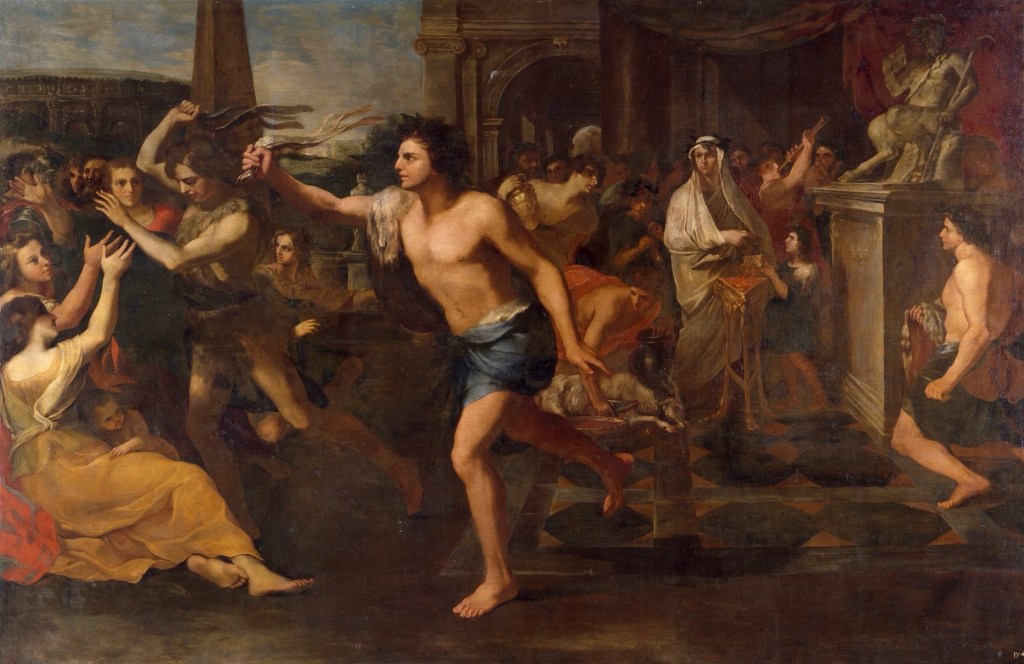
In the 5th CE, Pope Gelasius transformed the Roman fertility festival of Lupercalia, which the citizens celebrated from February 13 to 15, into a feast day for St. Valentine. This bawdy fertility rite featured animal sacrifice and “hookups.” Of course it needed “chastening!” Bring on the flowers, gifts of food, and letters.
Scholars believe people did not welcome the change eagerly, since the first love letters didn’t appear until Chaucer’s 14th CE poem, “The Parliament of Foules.” (This is the early English spelling of FOWELS.) This was a satirical, romantic poem written to commemorate the engagement of King Richard II and Anne of Bohemia in 1382. As a result, the royal court began to write love notes to one another during the bird mating season. Chaucer was certainly an early influencer!
As in the ancient world, people today also would rather celebrate than work. The first century Romans dedicated almost a half year to festivals for various gods or civic purposes. They also had private ceremonies for family gatherings, such as remembering the anniversaries of a deceased person and calling their name to life again. By the second century, Marcus Aurelius had restored the business year to 230 days, but by the 3rd CE, a public calendar records 200 public holidays celebrated once again with many gladiatorial games. Our current tradition of “feasting from Thanksgiving through Christmas, Super Bowl, and Valentine’s Day, only calls a halt on Pancake Tuesday,” otherwise known as Fat Tuesday or Mardi Gras. I would contend for a gold medal in this Olympic Feasting Contest, if only one were offered.
But the days march on toward Ash Wednesday and our Lenten fasts. Some of us will give up the heart shaped boxes of chocolate we received for Valentine’s Day, while others of us will decide to ration these treats to only one per day. Others will give up shouting at the daily indignities delivered on our television newscasts instead. Or we will decide to look inward and decide what idolatry drives us as we note the lust for power and influence in our political classes.
Maybe we will choose instead to work on a positive trait during these forty days of Lent before we celebrate the resurrection of Jesus Christ. This is the purest meaning of Valentine’s Day: to have love for one another in the same way God loves all of God’s creation. 1 John 4: 7-10 reminds us about the true nature of God’s love:
“Beloved, let us love one another, because love is from God. Everyone who loves is born of God and knows God. Whoever does not love, does not know God, for God is love. God’s love was revealed among us in this way: God sent his only Son into the world so that we might live through him.”
The writer of this letter goes on to say, “We love because God first loved us.” As creatures made in the image and likeness of God, we share God’s attributes of love and mercy. We learn to hate and destroy because we all fall short of the glory of God. We look to others as models rather than aspiring to our original model to become our best and truest self. When we harm ourselves or others, or destroy the world around us, we have forgotten how to love as God loves. Our failings in love are the cause of the ills in the world.
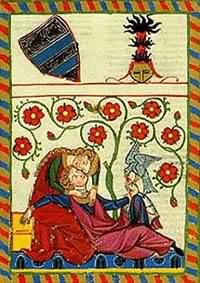
Courtly love was a poetic ideal of the Middle Ages. Knights would choose a lady of the court to serve and love from afar, in most cases, since many of the women were already married or promised to others. Religious devotions to the Virgin Mary and secular love eventually both melded into a stream of poetic literature we now call courtly love, such as the famous 13th CE Romance of the Rose. While earlier poems sought to win over the lady, the medieval period poems emphasized loyalty and service. The ultimate poem of this type is Dante’s Divine Comedy.

Even during the Civil War, soldiers did not forget their loved ones at home. They sent them handmade valentines made from scrounged paper scraps. Love will find a way to express the depths of devotion, especially when life is bitter and hard. A memory of sweet and tender moments with a beloved can help a soldier live from day to day. Unfortunately, in that great Civil War, our ancestors who professed their faith in the same God and read the same Bible did not understand the verse, “Those who say, “I love God,” and hate their brothers or sisters, are liars; for those who do not love a brother or sister whom they have seen, cannot love God whom they have not seen.” (1 John 4:20)
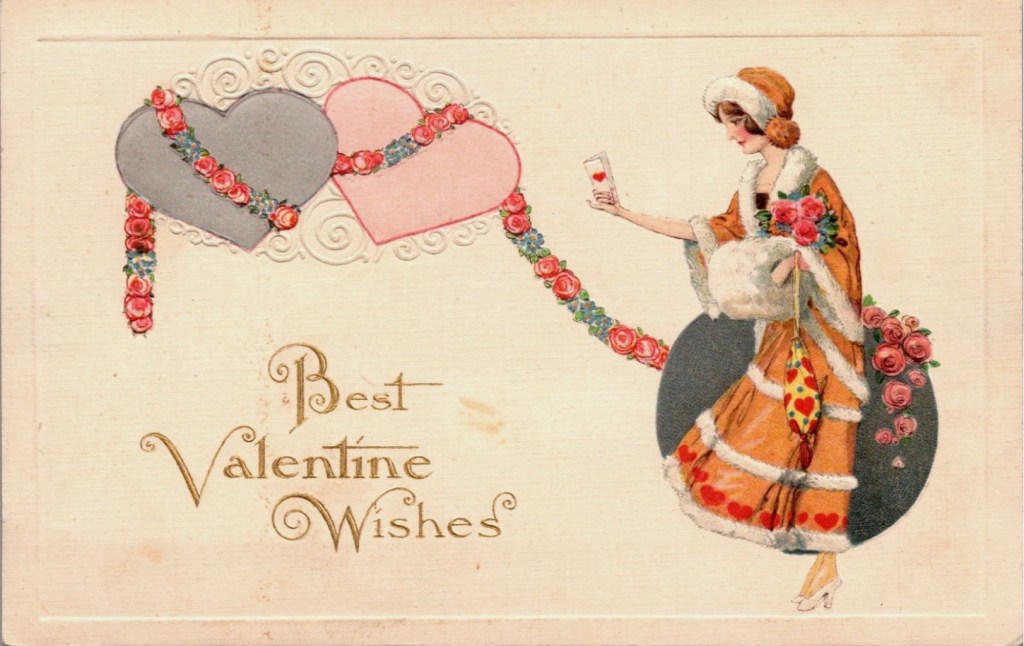
Valentines in the more modern era aren’t limited to spouses. People gave them to best friends and even gave them in memory of deceased loved ones. Every grade school child has memories of making a shoebox “post office” for their class Valentine’s Day party and receiving a card from every student in the class. It was a rule! Leave no one out. Even if you didn’t really like them or had a grudge against them, on Valentine’s Day you made the effort to practice loving your classmates.

This humorous food card from the 1940’s reminds me of the amusing juvenile valentines my friends and I traded in the 1950’s and 60’s. Our superheroes “packed a wallop on our hearts.”

Of course, making handmade valentines has never gone out of fashion, just as love never goes out of style. Some things are eternal. Just as God created all that is, we who share the image of God share the delight of creation. Creating is our natural gift, but the joy and appreciation for this special gift we all share often gets snuffed out by age eight or ten. Sometimes the adults in our lives decide creative acts are “too messy” or they get embarrassed when their children explore the use of scissors on their own hair. Bad haircuts will grow out. Depriving the world of the next Leonardo or Matisse is inexcusable.
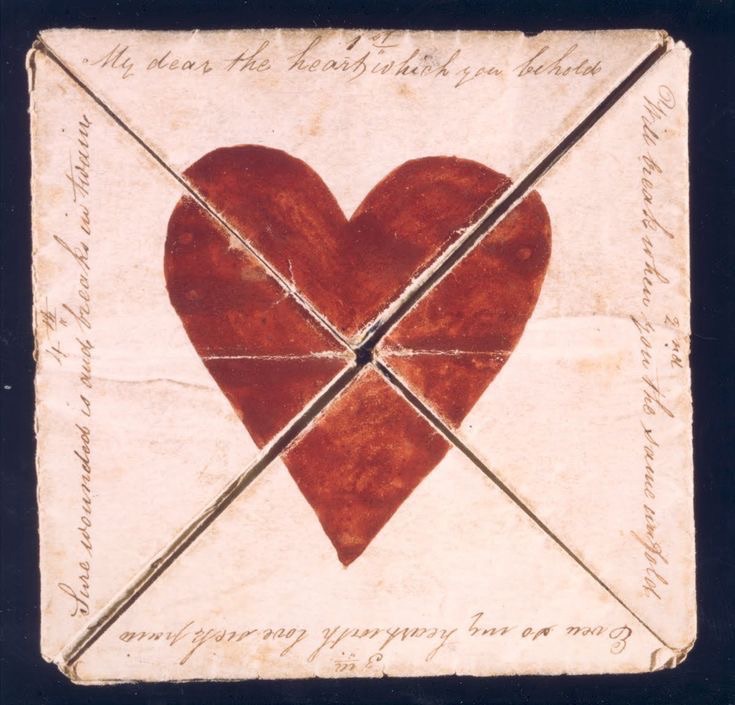
As we pursue the task of being more loving day by day, we cannot give this effort only to a single holiday. While we painted Valentine inspired art works for our recent class, we should remember Colossians 3:14—
“Above all, clothe yourselves with love, which binds everything together in perfect harmony.”

As we walk with Christ toward the cross during Lent, we should remember it was God’s love which sent God’s Son to live as one of us, to die as a human being, and to rise from the dead as a promise for all who believed in his work on the cross for all creation. The old 1738 Charles Wesley hymn, Amazing Love, has the wonderful refrain: “Amazing love! how can it be That Thou, my God, should die for me!”

Our United Methodist theology teaches every one and every thing will one day reach perfection in love by the grace of God and our cooperating acts. In truth, I’m going to need a lot of grace to get there! Just as we saw the Olympic athletes who have practiced and disciplined their bodies to achieve their goals, they still sometimes fall short. They use this disappointment to motivate themselves to do more and to trust the process. As people of faith, we understand we cannot perfect ourselves in love, but must eventually trust in the goodness of God’s greater powers to complete our work. As Philippians 3:21reminds us,
“He will transform our humble body that it may be conformed to his glorious body, by the power that also enables him to make all things subject to himself.”

Sometimes we can turn an ordinary work into one with extra pizazz by adding a textured element. Gail W was carefully painting three overlapping hearts in three different shades of red varying toward pink. At the end of class, she cut up an old sponge into a heart shape, dabbed it into her remaining paint, and tapped these varied colors over her meticulous ground. The juxtaposition of the controlled areas versus the other ones gives her painting interest.

The vagaries of life sometimes knock aside our best intentions to be creative or more loving—or any other positive goal which we set for ourselves. Just as I find myself saying, “I want to be more charitable to others and speak more with love in my heart,” I find snarky comments slipping past my teeth. As a Christian, I am supposed to live “in the world, but not be of the world.” Obviously, I should stay off social media more often!
Also, we get called into the busyness of the world and go to solve the problems as they arise, as if they were fires threatening lives. Not all problems are life threatening. We should jump for the truly extreme problems, while we shunt the less pressing needs to the bottom of our list. This allows us to finish our priorities first, rather than racing to handle other people’s anxieties instead. Learning to say NO to others, as well as to ourselves, is a spiritual growth opportunity.
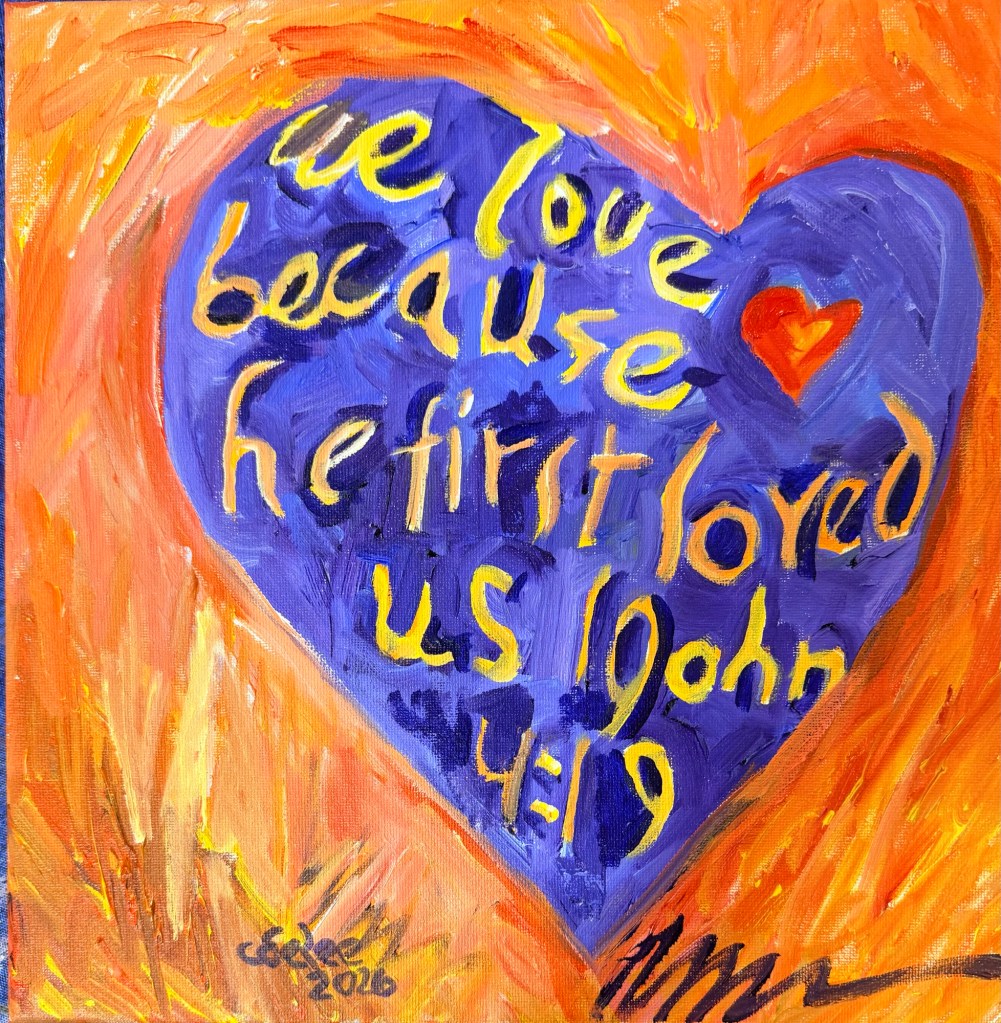
One of my favorite texts is 1 John 4:19— “We love because he first loved us.” My Bible app lists 542 examples of the word love in both the Old and New Testaments. It lists only 106 instances of the word hate. Reading the words of faith which we have received over the centuries leads a person whose heart is open to the truth of God to know God’s love is stronger than human hate. Anyone who hates has turned their face away from the love of God, which shines brightly on all persons, even those who have forgotten God or no longer believe in God. As psalm 36:5-6 sums up our faith:
Your steadfast love, O LORD, extends to the heavens,
your faithfulness to the clouds.
Your righteousness is like the mighty mountains,
your judgments are like the great deep;
you save humans and animals alike, O LORD.
This Lent, we can all carry on the promise of Saint Valentine (you pick the one you like). We can all practice loving our fellow humans with more sincerity as well as to care for and protect our environment. After all, this world is the only home we have. It is also an inheritance we can pass down to the next generation. Also, you, my dear reader, are God’s special creation. Take care of yourself, for you are God’s gift to others.
Joy, Peace, and Love,
Cornelia
Sonnets from the Portuguese 43: How do I love… | The Poetry Foundation
Who Was St. Valentine?
Why Do We Give Valentine Cards? | Britannica
https://www.britannica.com/story/why-do-we-give-valentine-cards
Holidays and Festivals in Ancient Rome: Lupercalia, Saturnalia | Early European History And Religion — Facts and Details
https://europe.factsanddetails.com/article/entry-378.html
Courtly love | Definition, History, Rules, & Examples | Britannica
https://www.britannica.com/art/courtly-love
And Can It Be, That I Should Gain? | My.Hymnary
https://my.hymnary.org/song/50/and-can-it-be-that-i-should-gain

 Artandicon's Blog
Leave a comment