

We are a people who follow Jesus, “the pioneer and perfecter of our faith, who for the sake of the joy that was set before him endured the cross, disregarding its shame, and (who) has taken his seat at the right hand of the throne of God,” as the writer of Hebrews 12:2 reminds us. The suffering servant motif of Christ was once a model all early Christians expected to inherit and emulate.
The Suffering Servant
Paul spoke to this suffering model in his letter to the Romans:
“…How can we who died to sin go on living in it? Do you not know that all of us who have been baptized into Christ Jesus were baptized into his death? Therefore, we have been buried with him by baptism into death, so that, just as Christ was raised from the dead by the glory of the Father, so we too might walk in newness of life. For if we have been united with him in a death like his, we will certainly be united with him in a resurrection like his.” (6:2-5)
Paul’s first sentence is perceptive because he recognizes many who call on the name of Christ nevertheless go on living an unchristlike life. In the early Christian centuries, many didn’t get baptized until they were near death because they weren’t ready to change their wicked ways. The early Christian habit of hyper-delayed baptism is well attested by the later fourth century. Apparently, the reasoning behind waiting until fairly late in life was the belief baptism cleansed sin once and only once. Consequently, any meaningful sin after baptism could leave one in a serious lurch in the economy of salvation. We have the well-known example of the early 4th CE Emperor Constantine who delayed baptism until his deathbed.
Of course, this is a misunderstanding of the Holy Spirit’s work of perfecting our human nature, but it took many centuries to work this out. We can thank John Wesley for our understanding the works of grace in the ongoing process of Christian Perfection. Baptism washes us from the stain of original sin, which is common to all humanity. Baptism also anoints us with the Holy Spirit to be continually with us and bring us to know God’s saving love in Jesus Christ.
As we grow in faith and the Spirit of God calls us to give our lives to Christ, we are justified from past sins. Some faith communities stop here, so they need over and over justification. They have no ongoing theology of sanctifying grace. We United Methodists do have this great gift, which we can give to the world. When we aren’t going on to perfection in love quite as fast as our neighbors wish we were, it’s because we’re being stubborn and resisting God’s grace.
W. H. Auden says it best:
“We would rather be ruined than changed,
We would rather die in our dread
Than climb the cross of the moment
And let our illusions die.”
The Cross and Self-Denial
The cross is ever a witness to our willingness or unwillingness to bear the cross of Christ. As Jesus told his disciples:
“If any want to become my followers, let them deny themselves and take up their cross and follow me. For those who want to save their life will lose it, and those who lose their life for my sake will find it. For what will it profit them if they gain the whole world but forfeit their life? Or what will they give in return for their life? (Matthew 16:24-26)
Often we interpret this verse in terms of giving up material possessions, but we can never give up outward things unless we’re first willing to give up our false images of ourselves. We might want to be large and in charge, or soft and sweet. Perhaps our self image is invested in being holy and serious. We may even be the class clown. These are only masks behind which we hide our truths and vulnerabilities.
Jesus spoke a parable in John 12:24-25—
“Very truly, I tell you, unless a grain of wheat falls into the earth and dies, it remains just a single grain; but if it dies, it bears much fruit. Those who love their life lose it, and those who hate their life in this world will keep it for eternal life.”
If we want to be changed, we must die to our ordinary selves, and then rise as a new creation. If we remain the same, we won’t be much, but if we’re willing to take on the image of Christ, we can be a new creation of the first order.
How The Witness was made
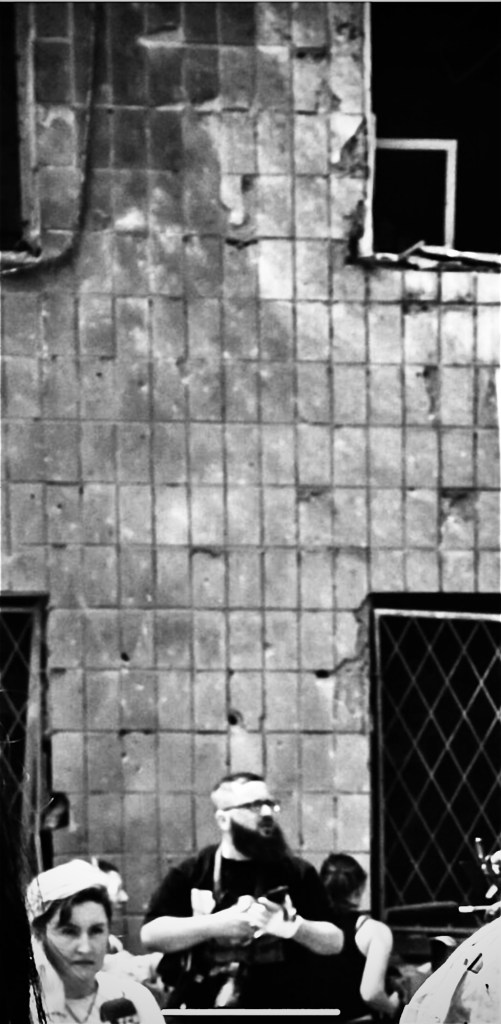
This is how art gets made. I saw an image of a bombed-out children’s hospital in Ukraine. Because the photographer had cropped it in a certain way, I saw an image of a cross on the brickwork. Those rectangular bricks contrasted with the diamond shaped wire work in the darkened areas in the four outer quadrants. I usually weave the whole painting surface, but this time I wove only the cross area. That was a challenge. I had to invent a new way to secure the woven canvas strips on the wooden stretcher strips.
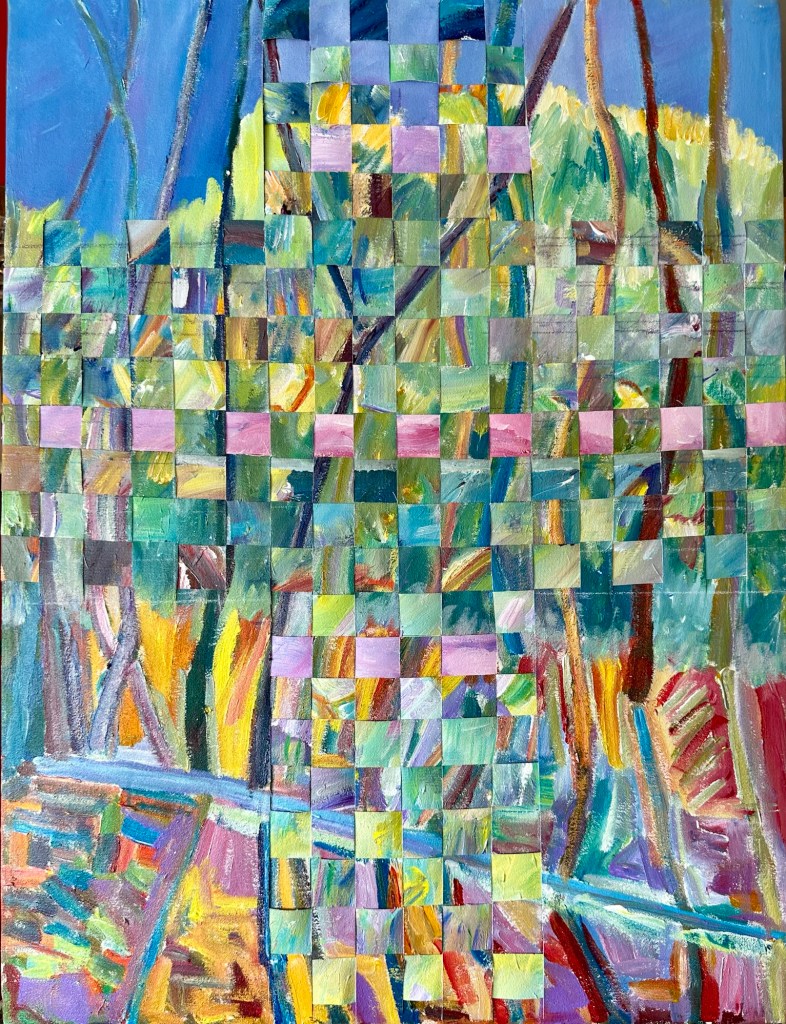
As I painted the first layer, I made all the contrast of bright colors in the cross and dark blues and reds in the outer quadrants. The next day, I added a gold wash over the cross squares and painted diamond line patterns over the dark quadrants. I came back to add silver into the diamond shapes and to touch up the diagonal lines. I also painted the sides of the canvas to unify it.

I began with a gritty black and white image, but ended up with bright colors, silver and gold. This too is a metaphor for for the change which we undergo when we die to old selves and begin our transformation into the wholeness of the new creation in Christ. As Paul wrote to the Corinthians:

“So if anyone is in Christ, there is a new creation: everything old has passed away; see, everything has become new! All this is from God, who reconciled us to himself through Christ, and has given us the ministry of reconciliation; that is, in Christ God was reconciling the world to himself, not counting their trespasses against them, and entrusting the message of reconciliation to us.” (2 Corinthians 5:17-19)
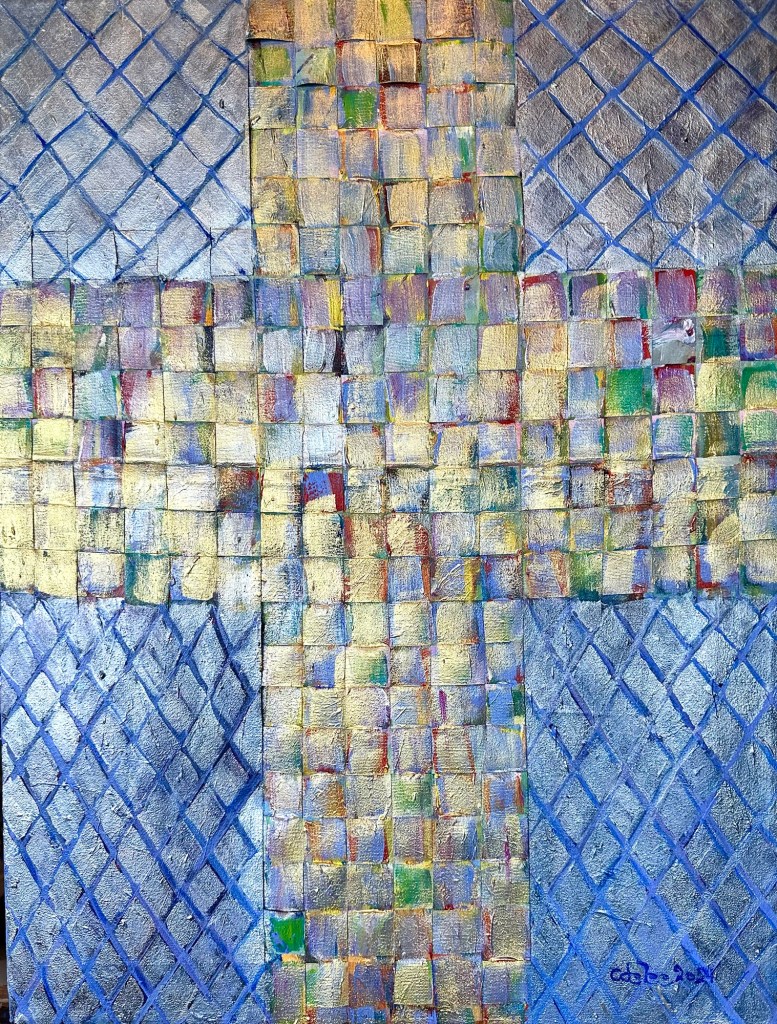
The cross isn’t a means to divide us from one another, just because we hold varying views on baptism, holy communion, pastoral authority, and scriptural authority or interpretation. The cross stands as a witness to all who are willing to give up their identities to their old egos and claim the only one uniting all persons every day.
Unity through the Cross
This is the Christ, whose love was so great for all creation, he was willing to be lifted up on the cross to draw all humankind unto himself. As Jesus said in John 12:32-33—
“And I, when I am lifted up from the earth, will draw all people to myself.” (He said this to indicate the kind of death he was to die.)

Delusional Mathematics
As we self interested people today have difficulty with many of the words of Christ, we resort to our cafeteria style of choosing which bites we want to enjoy. If a dish in the line is too expensive or not on our diet plan, we can ignore it. The problem with Christ is how we can ignore one claim upon our faith, reject another, and keep another. As a dieter from way back days, I splurged on many a Big Mac or Whopper and large fries, which I washed down with a giant Diet Coke. Unfortunately, my body didn’t follow the same mathematical logic of my mind. I was practicing delusional math.

“This is my commandment, that you love one another as I have loved you. No one has greater love than this, to lay down one’s life for one’s friends. You are my friends if you do what I command you” (John 15:12-14). John Wesley, in his sermon, The Almost Christian, talks about those who have the outward form of Christianity, but not the inward being. They can be recognized by their attendance at Sunday services, their good deeds, and their attention to the outward shows of ritual. Inside, however, their hearts aren’t filled with love, but with anger, spite, or mere duty instead. They lack sincerity, which is a classic characteristic of one who wears a false mask.
The Last Presidential Assassination
When Ronald Regan was shot by a would-be assassin, his diary recorded his thoughts on his excruciating experience.
“Getting shot hurts. Still my fear was growing because no matter how hard I tried to breathe it seemed I was getting less & less air. I focused on that tiled ceiling and prayed. But I realized I couldn’t ask for God’s help while at the same time I felt hatred for the mixed-up young man who had shot me. Isn’t that the meaning of the lost sheep? We are all God’s children & therefore equally beloved by him. I began to pray for his soul and that he would find his way back to the fold.”
The Altogether Christian
To be a Christian in the true sense, Wesley says the “Altogether Christian” requires us both to “love God and neighbor in our hearts until nothing else exists.” This means even our enemies. I personally find this the most difficult part. I can hold a grudge with the best of the nonbelievers. Yet I don’t find myself calling those people evil or deranged, like so many others who seek to find a reason for their scapegoating.
I can still see people, even myself, as part of flawed and fallen humanity.
Christian Perfection
Wesley defines the pure faith: “Now, whatsoever has this faith, which purifies the heart, (by the power of God, who dwelleth therein,) from pride, anger, desire, from all unrighteousness, from all filthiness of flesh or spirit; which fills it with love stronger than death, both to God and to all mankind; love that doth the works of God, glorying to spend and be spent for all men, and that endureth with joy, not only the reproach of Christ, the being mocked, despised, and hated of all men, but whatsoever the wisdom of God permits the malice of men or devils to inflict: whosoever has this faith, thus working by love is not almost only, but altogether a Christian.”
Under John Wesley’s exacting standards, we may all be “almost Christians,” but the good news is we can always hope in the one who gave his life to begin a new life in us and others. If we pray for our enemies’ faults, which we spot so easily because they are our own, God will help to heal both them and us.

The Cross Supplants Division
An ancient wisdom story told among the rabbis says the students were questioned on the difference between night and day. All their answers marked divisions: some prayers are said only at certain hours, or there isn’t enough light to distinguish one field or a house from another. The rabbi grew frustrated and cut them off. “You only know how to divide! Daylight begins when you can look on your neighbor’s face and see a friend, not an enemy.”
In this time of division, the witness of the cross reminds us Christ died for all humanity, so no one is outside the love of Christ. If we’re to love our neighbor as ourselves, caring for the poor and marginalized should be a priority for the people of faith. Our neighbors don’t stop at our borders, for our world is interconnected.
Migrations were a fact back in Abraham’s day, when Egypt was the land of opportunity. We ought to treat immigrants better than the Pharaohs treated the Hebrew people. Moreover, in our current political landscape, we might want to quit name calling and playing to the lowest denominator of our bases. Policy statements won’t get sound bites on television, but that’s a good thing. Sound bites play to our false selves and not to our true selves in Christ Jesus.

I can close with a poem from the Persian poet Rumi:
I only speak of the Sun
because the Sun is my Beloved
I worship even the dust at His feet.
I am not a night-lover and do not praise sleep
I am the messenger of the Sun !
Secretly I will ask Him and pass the answers to you.
Like the Sun I shine on those who are forsaken
I may look drunk and disheveled but I speak the Truth.
Tear off the mask, your face is glorious,
your heart may be cold as stone but
I will warm it with my raging fire.
No longer will I speak of sunsets or rising Moons,
I will bring you love’s wine
for I am born of the Sun
I am a King !
Joy, peace, and sacrificial love,
Cornelia
—W. H. Auden, The Age of Anxiety: A Baroque Eclogue (Princeton, NJ: Princeton University Press, 2011), 105.
Baptismal Trajectories in Early Christianity, Part III: Toward an Explanation – Ad Fontes
https://adfontesjournal.com/church-history/baptismal-trajectories-in-early-christianity-
Wesley’s Sermon Reprints: The Almost Christian | Christian History Magazine
https://christianhistoryinstitute.org/magazine/article/wesleys-sermon-reprints-almost-
The Regan Diaries—
Rumi: Ghazal (Ode) 1621
Translated by Azima Melita Kolin and Maryam Mafi
Rumi: Hidden Music, HarperCollins Publishers Ltd, 2001

 Artandicon's Blog
Leave a comment