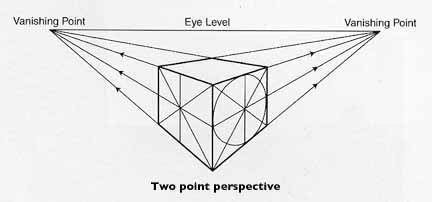
On September 11th we were back in art class again. Some things never get old: every teacher goes over last year’s lessons as a refresher for the returning students. This also serves as an introduction for new students. We teachers see what our former students remember and they get surprised by how much they have improved over the years. I always tell people there is no such thing as works righteousness when it comes to our salvation, but putting in the work really does count when it comes to art. We need to learn to see, especially if we are doing perspective, which is the secret language of making three-dimensional shapes look real on a two-dimensional plane.
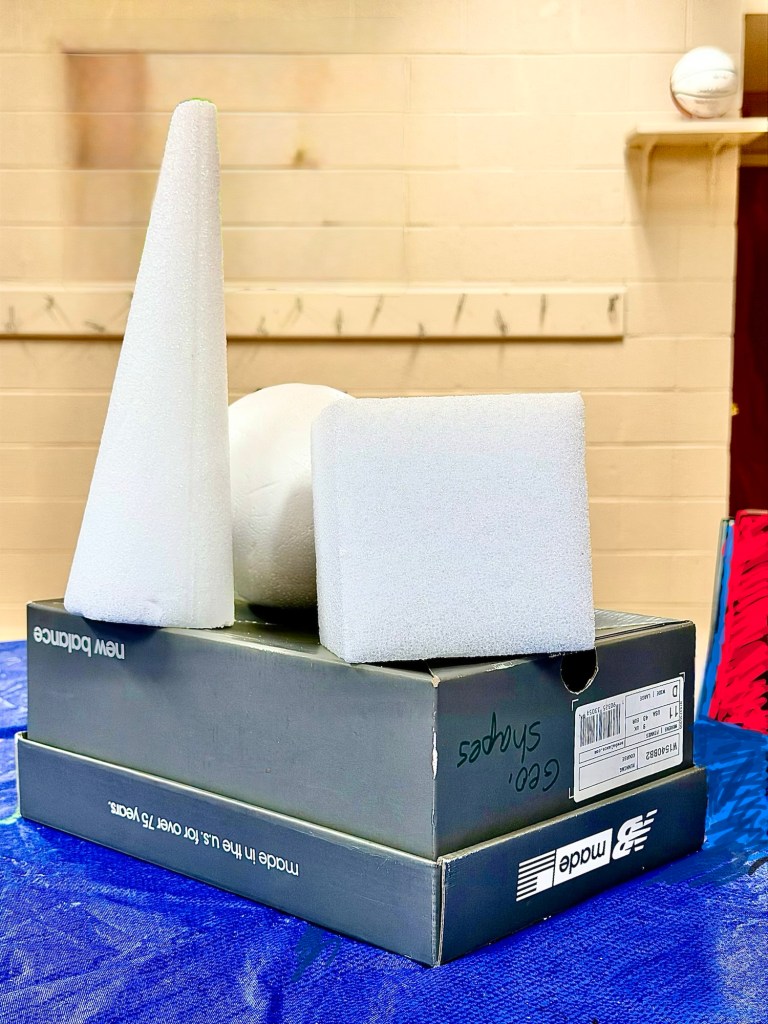
When we approach the subject matter, we first struggle to distinguish the objects in space and draw lines to describe their relationship between each other and the ground on which they sit. Sometimes we look only at each individual object rather than at all the objects in relation to the others. This leads to weird sizes or tilted planes, both of which make our drawing look “unreal.” Then we must adjust something, but if we are new to perspective, we do not yet see the problem area. This is when we need a guide to point out the landmarks, so to speak.
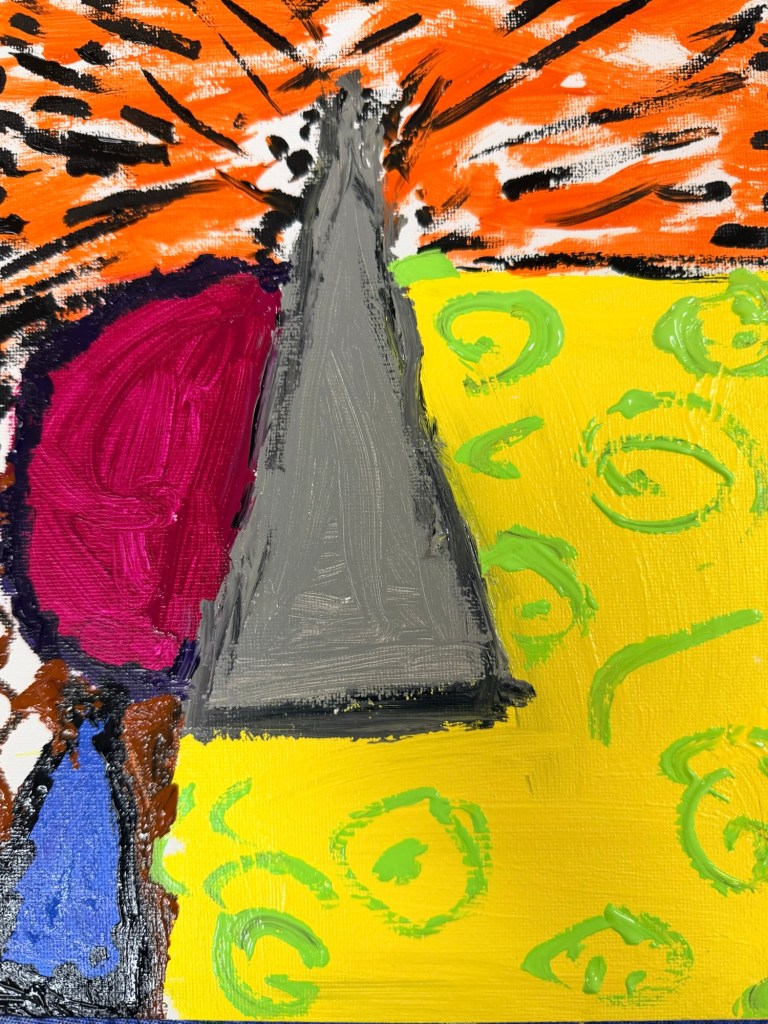
Mike: Geometric Shapes, 2019
Because Mike has been painting the geometric shapes for five years now, he took the freedom to bring his personal style and creative spirit to the subject. Rather than explore perspective, he flattened the shapes into colorful patterns with Matisse like decorative swirls. Art class is his passion and emotional release from the work of his daily life.
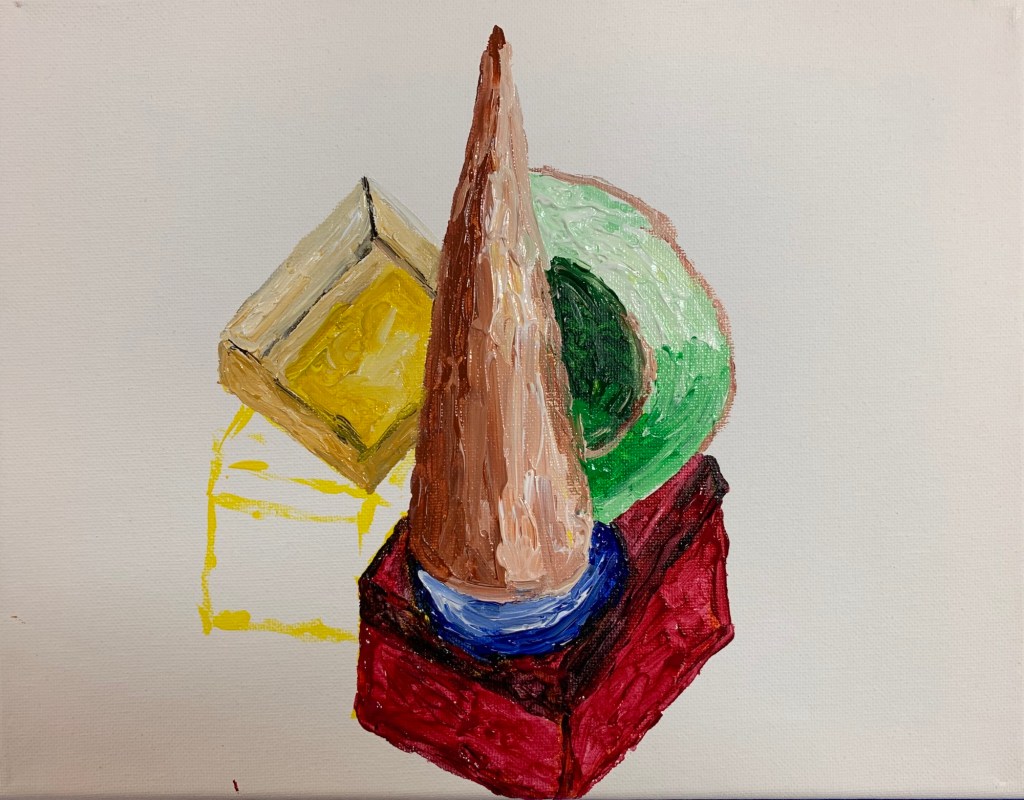
Gail W. has also benefited from several years of the practice in “seeing and writing in the visual language of perspective.” Just as learning a foreign tongue requires practice and at first feels clumsy, so with experience our speaking, reading, and understanding becomes easier with repetition. Gail exclaimed with joy how confident she feels now with multiple years of struggle under her belt. Her work shows the progress in seeing she had made over the past few years.
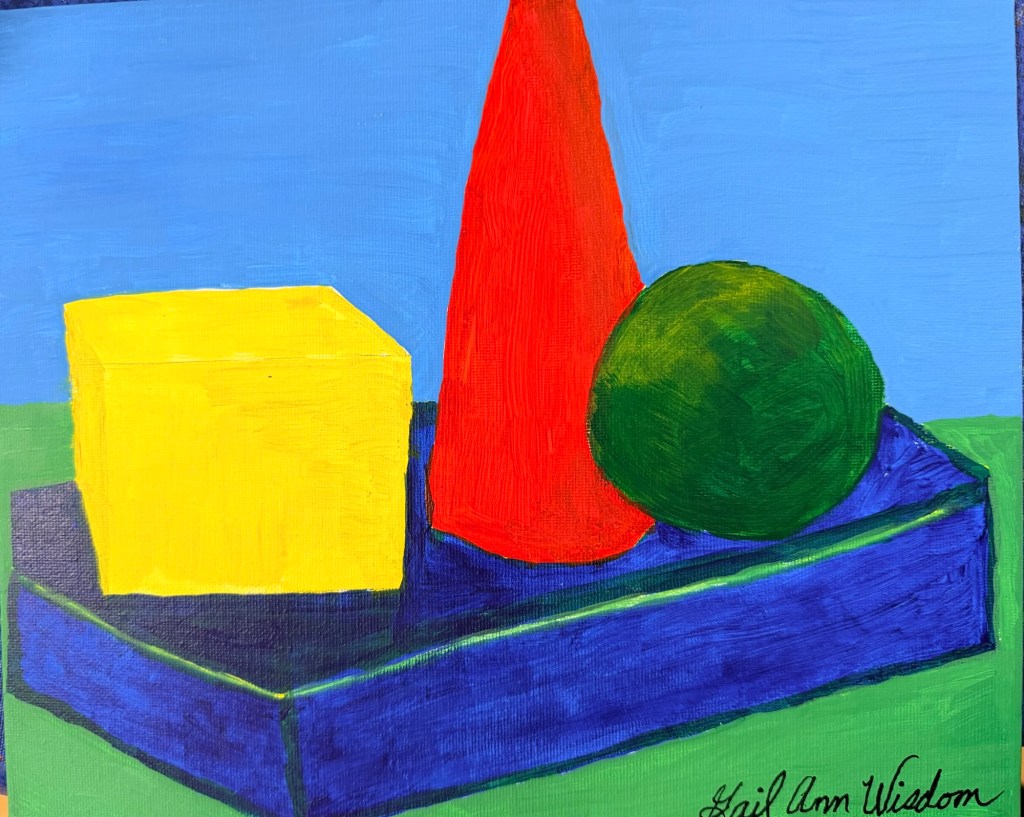
Gail W: Perspective Objects, 2026
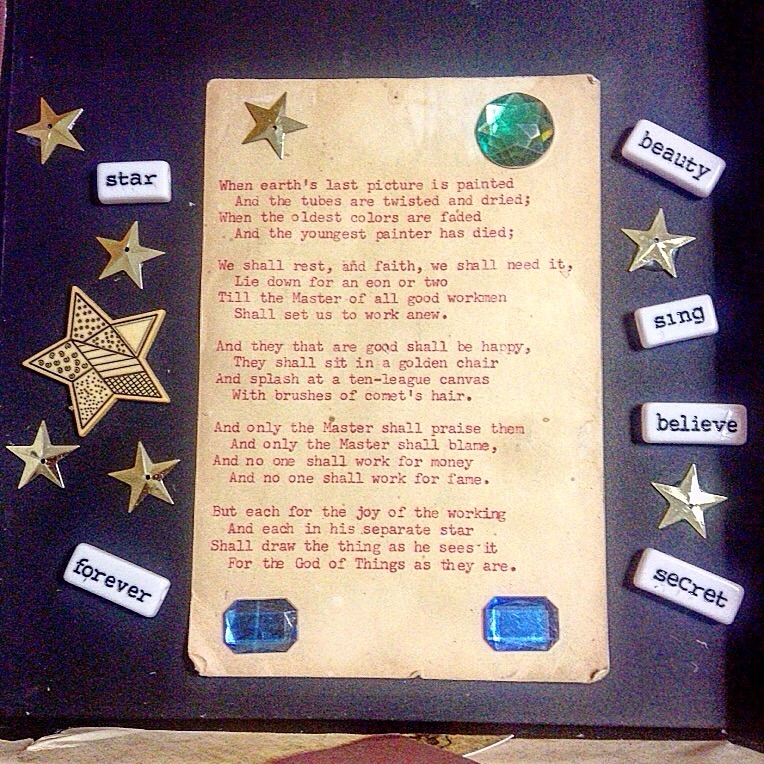
When Earth’s Last Picture is Painted
(L’Envoi to “The Seven Seas”)
by Rudyard Kipling
When Earth’s last picture is painted and the tubes are twisted and dried,
When the oldest colors have faded, and the youngest critic has died,
We shall rest, and, faith, we shall need it–lie down for an aeon or two,
Till the Master of All Good Workmen shall put us to work anew.
And those that were good shall be happy; they shall sit in a golden chair;
They shall splash at a ten-league canvas with brushes of comets’ hair.
They shall find real saints to draw from–Magdalene, Peter, and Paul;
They shall work for an age at a sitting and never be tired at all!
And only The Master shall praise us, and only The Master shall blame;
And no one shall work for money, and no one shall work for fame,
But each for the joy of the working, and each, in his separate star,
Shall draw the Thing as he sees It for the God of Things as They are!
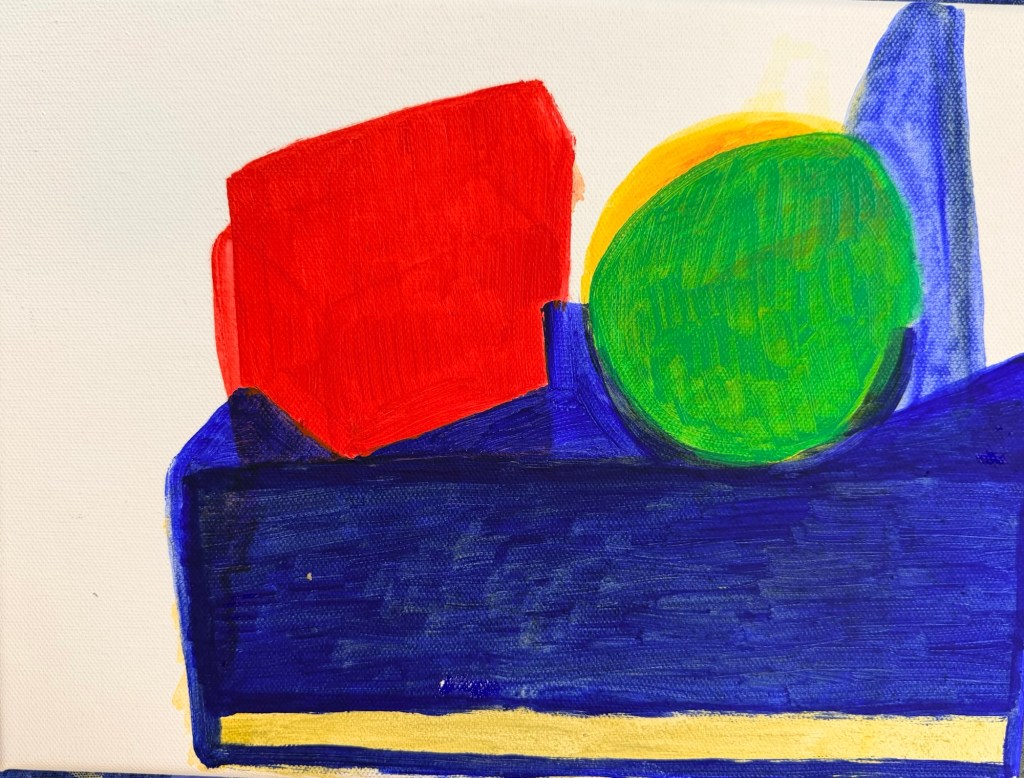
Kathy: Geometric Objects, 2026
Kathy is a new student in our Friday class. While she has a creative background and does beautiful Zen Tangle artworks, she was interested in giving some traditional art classes a try. Her style depends on flat or two-dimensional designs, but in art classes, we often are working from “life,” so we are translating three-dimensional forms on to a two-dimensional surface. This is the new language Kathy already likely intuitively knows, but needs a guide to bring it to her awareness. Her work shows some common struggles of someone new to perspective. She will figure this out in time.
Leonardo da Vinci said: “There are three classes of people: Those who see. Those who see when they are shown. Those who do not see.”
As a teacher, I’m a firm believer in having a positive attitude. Everyone will see eventually, if they are willing to sit with the problem long enough. Those who don’t want to have their mind or their world expanded are not meant for the art studio anyway. We soon learn the more we try to control our art, the less of art it is. It may have technique, color, perspective, value, and a theme, but it will lack emotion and spiritual depth or power.
As an example of how artists and poets refine and rework their creative ideas, “When Earth’s Last Picture is Painted,” the poem was first published in the New York Sun on Sunday 28 August 1892, without a title, following Kipling’s article “Half-a Dozen Pictures”. After their first publication, these verses were printed in the USA under the title “The Toilers.”
On 20 August 1892, The Times published an article by Kipling, “Half-a-Dozen Pictures.” The article describes a visit to an art gallery and Kipling’s reflections on the failure of most painters to match the beauty and vitality of the world around them. His main concern is to urge artists of all kinds to get out and see the world for themselves: (Letters of Travel 1892-1913 p. 40):
“Now, disregarding these things and others—wonders and miracles all—men are content to sit in studios and, by light that is not light, to fake subjects from pots and pans and rags and bricks that are called “pieces of color.” Their collection of rubbish costs in the end quite as much as a ticket, a first-class one, to new worlds where the “props” are given away with the sunshine.” (Letters of Travel 1892-1913 p.77).
Eight days later, when the same article was published in the New York Sun, it closed with the untitled poem ‘When Earth’s Last Picture is Painted…’ which changed the article’s emphasis from an exhortation to artists to become travelers and pioneers, to what sounds very much like a manifesto for realism in art:
“And only Rembrandt shall teach us and only Van Dyck shall blame;
And no one shall work for money, and no one shall work for fame,
But each for the joy of working, and each, in his separate star,
Shall draw the Thing as he sees It for the God of Things as They are! “
Four years later in 1896, Kipling changed the first line of that stanza to:
“And only the Master shall praise us, and only the Master shall blame,”
and used the poem as “L’Envoi” to The Seven Seas. In this context, with the references to Rembrandt and van Dyck removed, the poem becomes a romantic encapsulation of the views advanced throughout The Seven Seas—that true joy in life comes from dedication to whatever work is in hand, and that the task of the Artist is to convey to others the excitement and wonder of an expanding world.
What I find fascinating about Kipling’s poem is not only its final message of what is the artist’s true purpose, but also how his understanding of this purpose changed over the years. Between 1892 and 1896, Kipling got married, honeymooned in Japan, lost his fortune in a bank collapse, moved to America, and built a dream home. Unfortunately, Kipling had laid out a formal English garden on a plot of land on which his brother-in-law was used to cutting hay. They got into a legal spat, newspapers wanted interviews, and things went downhill from there! The Kiplings moved back to England in 1896 and set up housekeeping near his parents. His financial fortunes had improved from his literary career, so they were more stable. Things went well for all until 1899, when their oldest daughter caught pneumonia and died. Kipling was never the same again.
Our life experiences change us, for the better or the worse. Everyone in America experienced the events of September 11th, but some of us were at Ground Zero as the Twin Towers were falling, others were in the Pentagon when it was struck, and others were on the airplane which crashed in the field and denied the terrorists their mission. The rest of America and the world experienced 9/11 vicariously through the twenty-four-hour news media saturation coverage.
This event has taken years to process, not just four years, and not just a quarter century. Some people are still full of hate for any “other outsider” because they have the same religious identity as the terrorists. These people only see in dualist terms, for they do not understand that a terrorist is an extremist position of any mindset or belief. We have Christian extremism, Muslim extremism, Jewish extremism, and other religious extremisms in our world today. The extremist position is not the way of love and compassion of the trinitarian God who comes to us as Father, Son, and Holy Spirit. I would venture to say, many practitioners of the other great religions of the world also view the extremist elements within their groups with dismay.
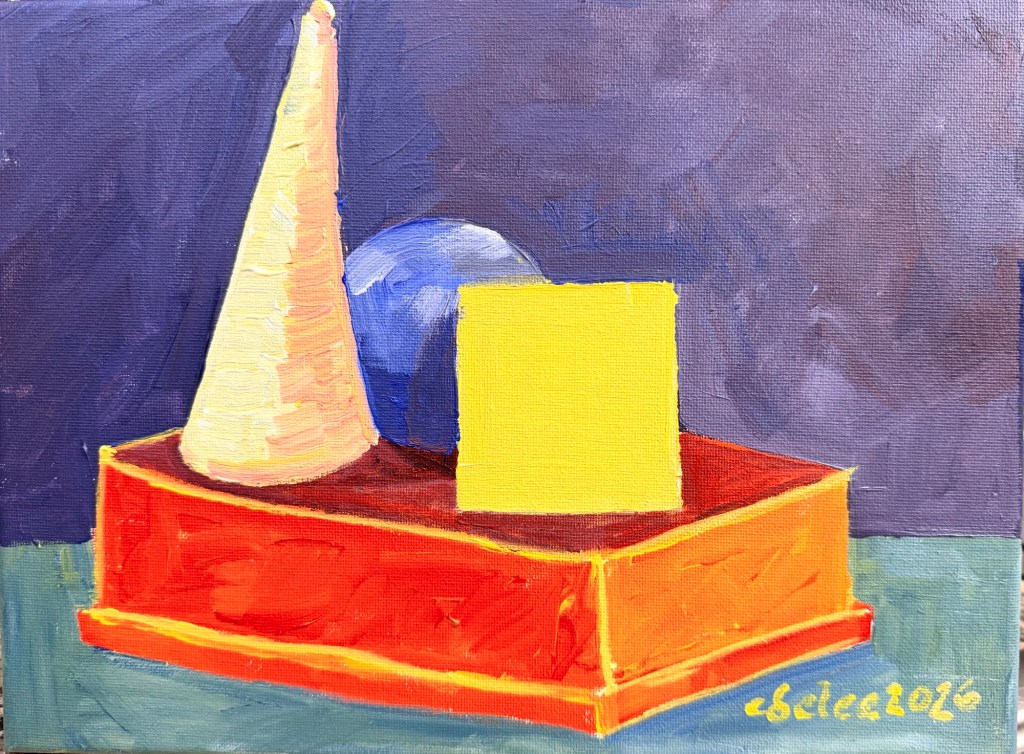
The truth I find in Kipling’s poem is he moves from the human to the divine as the ultimate source and judge. At first he says, “And only Rembrandt shall teach us and only Van Dyck shall blame,” but after life with its ups and downs have worked its educational effects upon him, he knows differently: “And only the Master shall praise us, and only the Master shall blame.” If I were to reflect upon the poem further, I would add, if we are giving our whole hearts to our work, the Master will have only one response:
“Well done, good and faithful servant…
Enter into the joy of your master.”
—Matthew 25:21 ESV
May you find joy and peace in all you do and stretch your mind daily,
Cornelia
Kiplings left Vermont in 1896 after a fierce quarrel with Beatty Balestier
Rudyard Kipling | The Poetry Foundation
https://www.poetryfoundation.org/poets/rudyard-kipling
When Earth’s Last Picture is Painted – The Kipling Society


Leave a comment