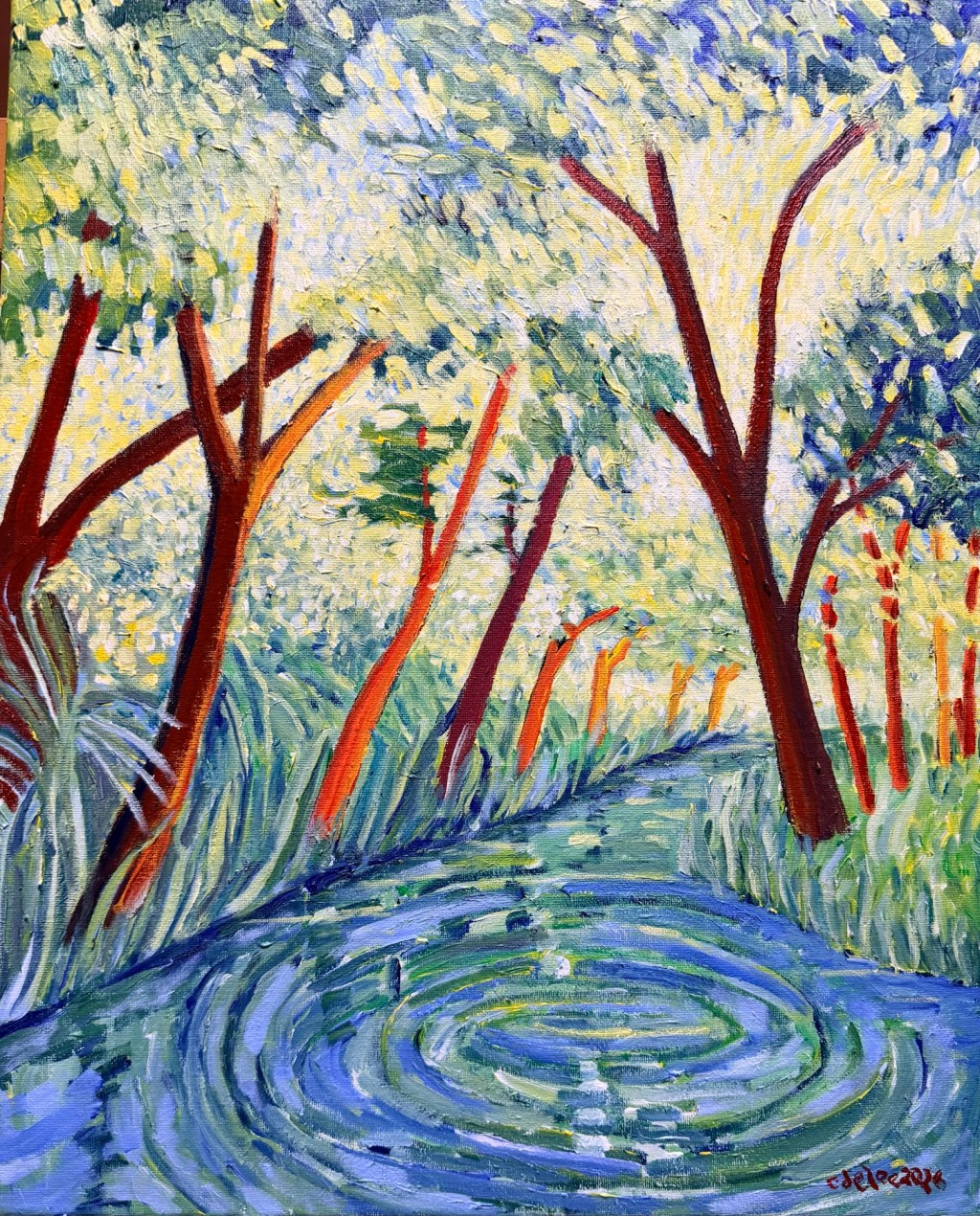

Paul Klee said in his Creative Credo a century ago, “Art does not reproduce the visible, rather, it makes visible.” What does art make visible? It’s not just the media we use, but the experience of the place, the feelings of the moment, the emotion of an event, and the nature of the place, person, and time expressed with art materials. With abstract art, the colors and forms no longer relate to actual reality, but take on a meaning for themselves alone.
Of course, viewers must have the ability to see these visible realms which the artists so carefully craft. I spent a month in London during my art school days. While I was at the National Gallery of Art, I was standing at the side of one of JMW Turner’s famous paintings: Ulysses Deriding Polyphemus. While I was busy drawing it in my sketchbook, people came and went. One gentleman approached the painting, gave it a hard look, read the title plate on the frame aloud, and stepped back to look at the painting once more. Then he said, “I don’t see it. I don’t see it at all.”

This reproduction doesn’t do the painting justice by any stretch of the imagination. Although the kindly gentleman did not have the inner eye to see the one eyed giant upon the upper left side cliff, or the tiny figures in the small boats below, or the small, upraised arm of Ulysses as he shook his fist at the one-eyed Cyclops ready to rain boulders down upon his armada, it was plain as the nose on my face to me. I had both a deep grounding in classical mythology from my years of high school Latin Studies, as well as multiple years of art history. We need to know the great myths of Greece and Rome if we are to to understand English literature and psychology.
Art can make the world visible so the viewer can see it, but we also need the tools and experience to see what art wants us to see. This is the purpose of art appreciation, for otherwise we would only “like what we think is good.” The common phrase is, “I don’t know much about art, but I know what I like.” Some of us can like very ordinary things, just as some of us don’t know what we like until our friends like it first. Then we also need to like it.
The nursery book story of Goldilocks and the Three Bears comes to mind. Each bear had a different preference for the temperature of their porridge, and a different comfort level for their beds and chairs. They were all in one family. If they also had art preferences, I imagine they would have had varying likes here too.
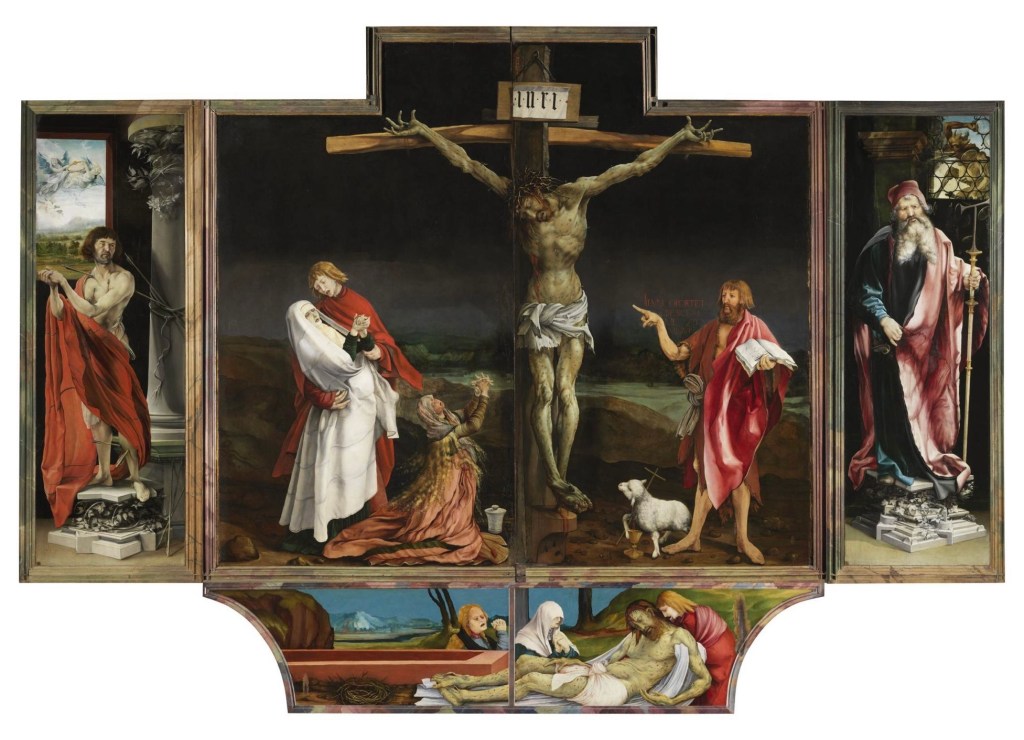
Some say art should only make us feel good about ourselves and never disturb us. If that were the case, we never would have had the great masterpieces against war, like Picasso’s Guernica, Grunewald’s Isenheim Altarpiece of a plague-stricken Christ painted during a European plague outbreak, or JMW Turner’s “Slave Ship (Slavers Throwing Overboard the Dead and Dying, Typhoon Coming On),” which he painted in support of the antislavery movement in England.

Turner showed his painting with his own verse, dating from about 1812:
“Aloft all hands, strike the top-masts and belay;
Yon angry setting sun and fierce-edged clouds
Declare the Typhon’s coming.
Before it sweeps your decks, throw overboard
The dead and dying – ne’er heed their chains
Hope, Hope, fallacious Hope!
Where is thy market now?”
Because insurance designated persons for the slave markets as cargo rather than human beings, ship captains would lighten the load of their less valuable goods if a storm threatened their boat. The sick, dying, and elderly were the first to be cast overboard. The slave trade was brutal for all concerned.
Artists, who had never been to sea or even experienced such horror firsthand, could see with the inner eye of their soul the suffering of all humanity: the ones tossed into the depths of the sea, the sailors who diminished their own humanity by participating in this cruelty, the captains who earned money by transporting enslaved persons, and the disgust of the whole economic system that profited from the exploitation of slave labor.
Not everyone has the eyes to see systemic injustice or suffering in this world. Many of us only want beautiful images which allow us to escape our own pain and misery for a few moments. Or we want an image which reminds us of a beautiful place or experience, for then when we gaze upon it, we can stop our anxious running and doing about and so quiet our busy brains. We know we need a resting place. We are just too busy to do it!
Psalm 1:3 tells us about those who meditate: “They are like trees planted by streams of water, which yield their fruit in its season, and their leaves do not wither. In all that they do, they prosper.” As an Old Testament verse, the writer specifically mentions God’s law for meditation purposes, but modern people might include all the Bible, while not holding one verse in greater significance, unless it is this one:
“‘You shall love the Lord your God with all your heart, and with all your soul, and with all your mind.’ This is the greatest and first commandment. And a second is like it: ‘You shall love your neighbor as yourself.’” (Matthew 22:37-39)

I have “gone through some things,” as the young people say, over the last couple of years. These things are pain related, but most of these are a natural consequence of aging. Our bodies lose the cushions between our disks and bones. I have arthritis in several places, but the worst is in my hands. I knew my hand wasn’t connecting to my brain very well because I no longer had a delicate touch with my brush. Low grade pain also clouds your senses, and it makes a person feel overall crummy. Neck surgery helped to correct the discs, but getting low dose X-ray therapy on my hand and thumb joints is helping even more. I’m feeling much better now and while not like my 40-year-old self, I do feel at least ten years younger! Age is a state of mind, for if we don’t mind, age doesn’t matter.

One of the difficulties of aging is losing touch with your senses. Cooks may lose their sense of taste or smell, but artists lose their senses of touch and sight. We can have someone else taste the dish so we can adjust the seasoning, but no one can take over our hands or eyes to make our unique creations. The late works of all artists all show a “looseness and freedom” which their earlier works did not. We can either struggle to recover our early style, or we can listen to our bodies and paint with the hand we have today.
National Gallery, London
I have a friend with fibromyalgia who had given up on her writing because of her pain. I suggested she might try “speak to text,” as her first draft. While it’s not perfect, she would get most of her ideas down and spend less time typing on the finished work. I was glad to see her voice once more in print. Often when we are in pain, we can no longer see the light, but are stuck in the maelstrom of our worries and fears. Someone who has already passed through this whirlpool, as Ulysses passed through Scylla (monster) and Charybdis (whirlpool) on his journey home, can offer hope to a suffering person. Creative people always find a way.
When I was too depressed in my youthful art school days to paint, I would embroider designs from scratch, weave with odd materials, or craft scraps of wood together until my mood had passed or I was once again inspired. I was very emotional when I was young, but as I grew older, I became more even keeled. Life has a way of honing the sharp edges off a person.

This recent work went through three separate stages. The first layer was just to get the basic sense of the shapes and colors on the canvas. The texture is fairly flat with only a bit of tactile and value changes.

Painting on top of the acrylic layer gives a juicier finish to the surface than the first layer, which was on the prepared ground. Building up the acrylic paint surface also gives it more of an oil paint look. Here I began to add details in the grasses and the leaf masses of the tree canopy. About this time, I realized I had two different perspectives working in the painting. The trees and stream were typical one point perspective, but I had drawn the whirlpool as if I were looking at it from above. The trees hanging over it keep the viewer’s eye in the foreground, while the light takes the eye to the horizon. This sets up a pull: will we stay in the whirlpool of life or move to the light beyond?

For the last stage I added another layer of light cadmium yellow and cerulean blue to the sky areas. I also mixed these two colors in varying amounts, sometimes adding ultramarine blue to develop the greens of the ground and add shadows to the background trees. I also painted the tree trunks with mixtures of these colors and a red. Keeping a limited palette colors isn’t one of my long suites, but it is a well-known technique for making a tight coherence in a painting. The painting took on a warmer glow as I worked.
If we remember from where our source of light comes, our shadows and highlights will always be true. In photography we ask our subjects to face the light, for this gives our camera the best lighting on the image we most care about: the people. In his message to the world, Jesus reminded us, “I have come as light into the world, so that everyone who believes in me should not remain in the darkness” (John 12:46). If we always look toward the light, we will see Christ. We won’t see the shadows of doom or the whirlpools of woe that the purveyors of darkness tell us about daily. We are meant to be “the light of the world!” Why would we hide this light inside our own home only?
This is why the world needs artists and poets, musicians, and dreamers. In fact, we all need imagination to see beyond the visible world to the invisible creation beyond our physical world. We also need the mind of Christ, to see light, not darkness; to build up, rather than destroy; to heal, not harm; to feed, not starve; and to serve, not rule. We all have the gift of creativity, for the creating God made each one of us in the Creator’s own image.
I hope each of you discover in the days to come how God awakens your gift of creativity within you. Allow your “inner child to come forth and bring this gift to Christ,” and do not let the adult in you forbid them to come! We all can practice creative activities, and grow in the process as well.
Joy and Peace,
Cornelia
Paul Klee – Oxford Reference
https://www.oxfordreference.com/display/10.1093/acref/9780191826719.001.0001/q-oro-ed4-00006380
“In the beginning was the verb …” said Klee in the “Creative Credo.”
Once Emerged from the Gray of Night, 1918 by Paul Klee
https://www.paulklee.net/once-emerged-from-the-gray-of-night.jsp
The Story in Paintings: Turner’s narratives – The Eclectic Light Company
https://eclecticlight.co/2016/01/29/the-story-in-paintings-turners-narratives/


Leave a Reply