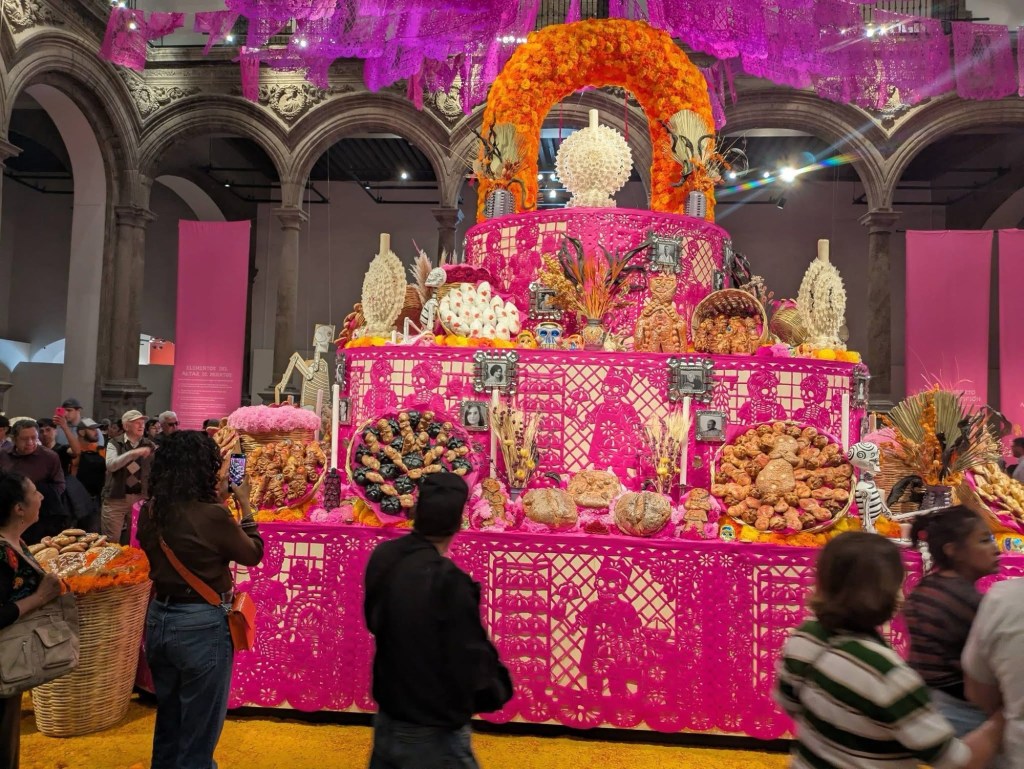
As All Saints’ Day and All Hallows Eve approached, our art class moved on from the harvest and Halloween themes of the Great Pumpkin. Inspired by the Mexican tradition of the Dia de Los Muertos altars to the honored ancestors, we made frames for photo collages of our own loved ones of blessed memory.
The Aztecs honored the Lady of the Dead, Mictēcacihuātl, Queen of Mictlān (the underworld) during the whole month of August, but after the Spanish conquest, the influence of the Catholic religion shifted this reverence for the ancestors to All Saints’ Day on November 1st. The modern Dia de Los Muertos festival is a fusion of those traditional practices with Christian worship rituals. As in ancient times, the living and the dead share in ritual meals in which the dead are the “guests of honor.”
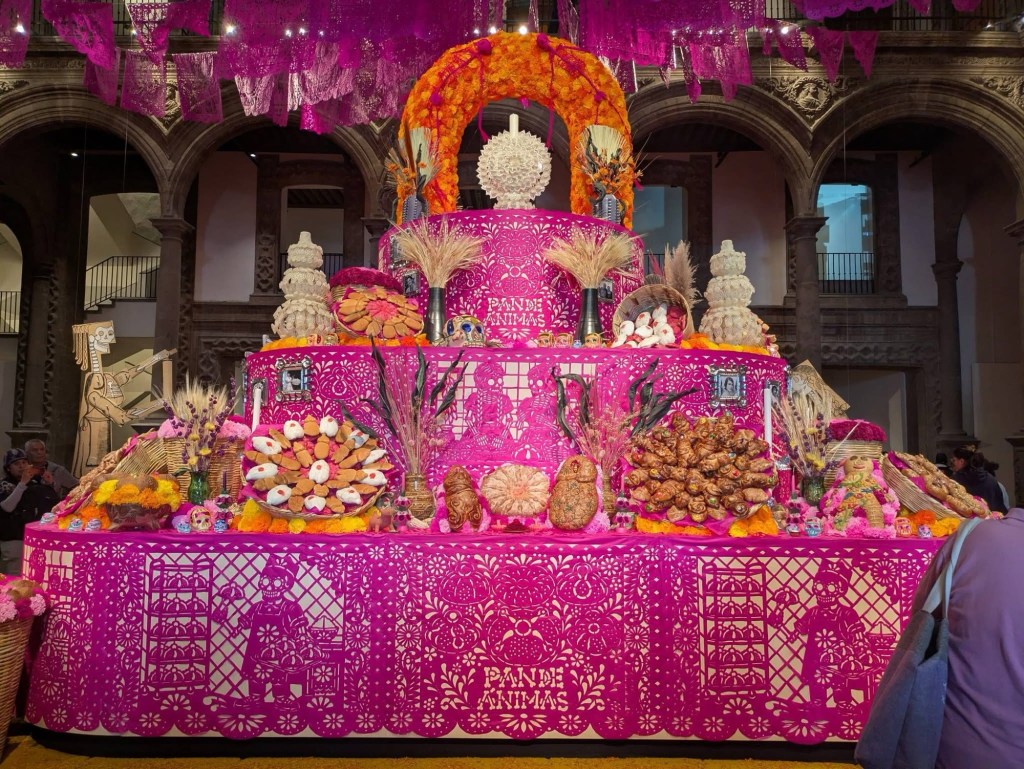
Traditional Day of the Dead Altars (ofrendas) serve as a spiritual bridge to honor the deceased. They incorporate marigolds to symbolize the fragility of life, guiding the spirits of the deceased homeward with their scent. People eat foods like pan de muerto and mole, which represent love and hospitality. They also drink champurrado (Mexican hot chocolate) and tequila, to quench the spirits’ thirst.
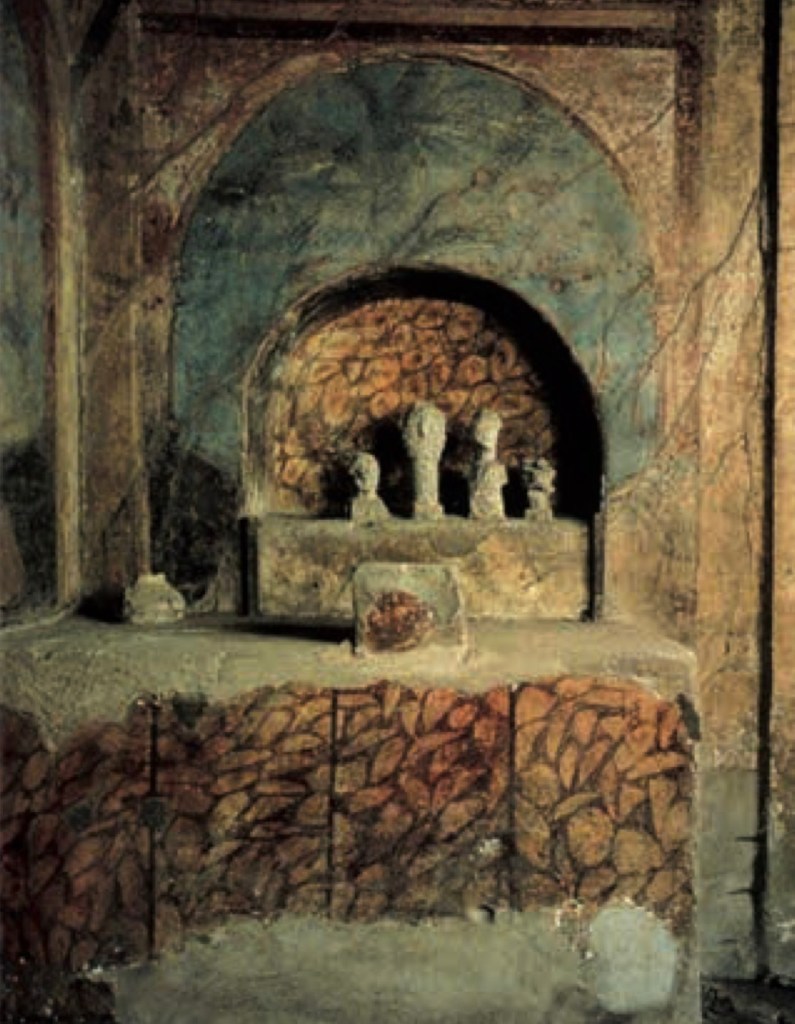
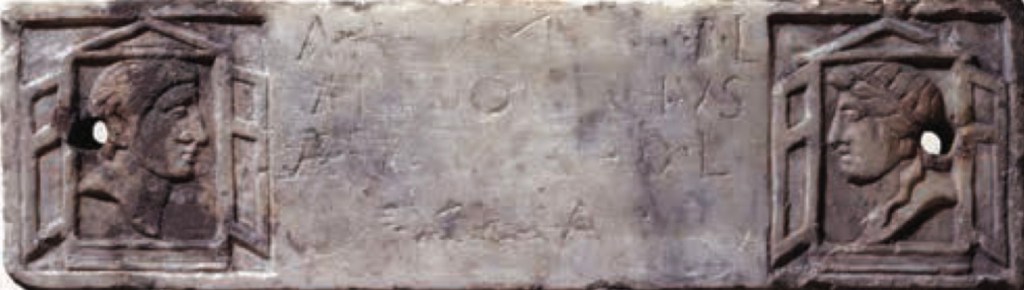
If we think this is a strange behavior found only in the New World, the ancient Romans also practiced similar ancestor rites. Cities and States also had foundational leaders whose spirits lived on as lares to guide future generations. All citizens needed to honor the spirits of these lares, for they existed to guide the people in the true ways. They had a set time for the whole community to honor the ancestors of the city known as the Parentalia, a festival which lasted for more than a week each year, from February 13 to February 21. Each family group also had its individual lares or ancestral spirits, which continued to exist beyond their mortal lives. Every household had a special place dedicated to these ancestors and every meal eaten by the living included a morsel gift to the departed spirits to invoke their blessings.
Today we gather at Thanksgiving and other “high holy family occasions” to eat, drink, and tell the stories of our ancestors and our families. We talk about the good times and the tough times. We laugh and we cry. We fuss, we kiss and we make up. We are family, those who are alive today, and those who live forever in our hearts and minds.
When we make an offerenda, the altar to bring the image of our beloved one to mind, our very act of making this object is an offering of love and memory that calls out across the cosmos to the spirit of our loved one who shook off the mortal coil some time ago. Our planning may struggle at first, for memories flood our heart with emotions of loss, grief, and desire to be with the person. Once this initial experience passes, we can get our hands to work. I always have difficulty working if my mind is not clear, but once I can find my calm center, I can work well.
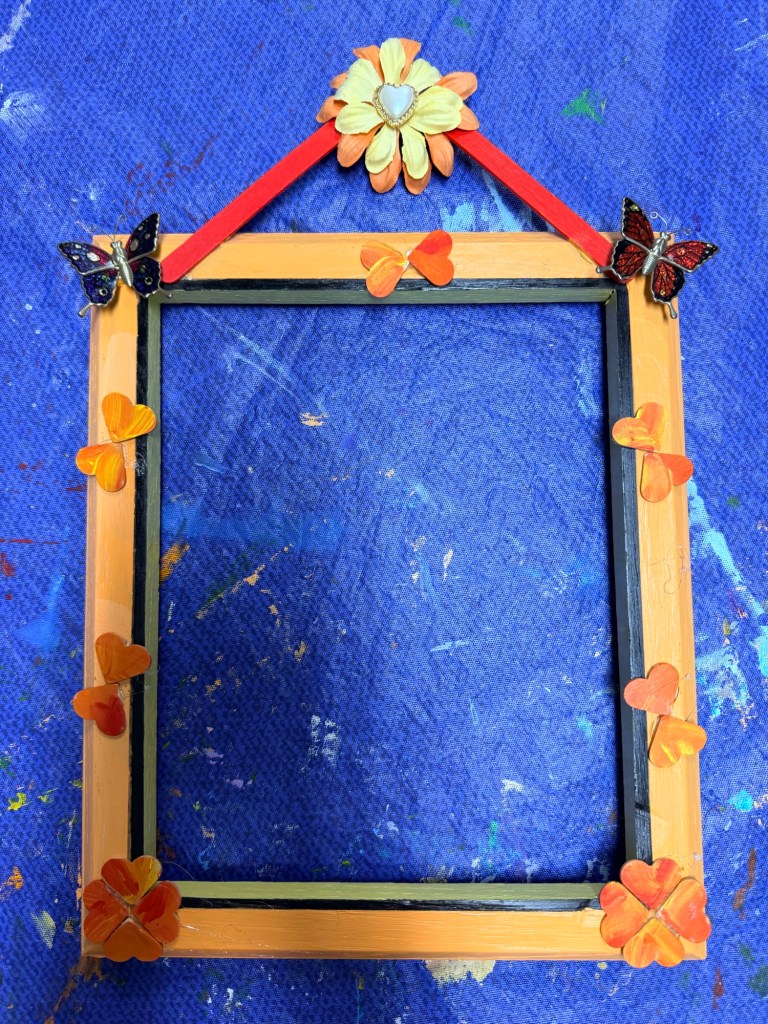
The two Gails and I worked on this project, since Mike was enjoying the fall foliage up north. We each spent three weeks on it between the frame and the collage, for a total of six plus hours. All of us worked a bit at home to tighten up the details.
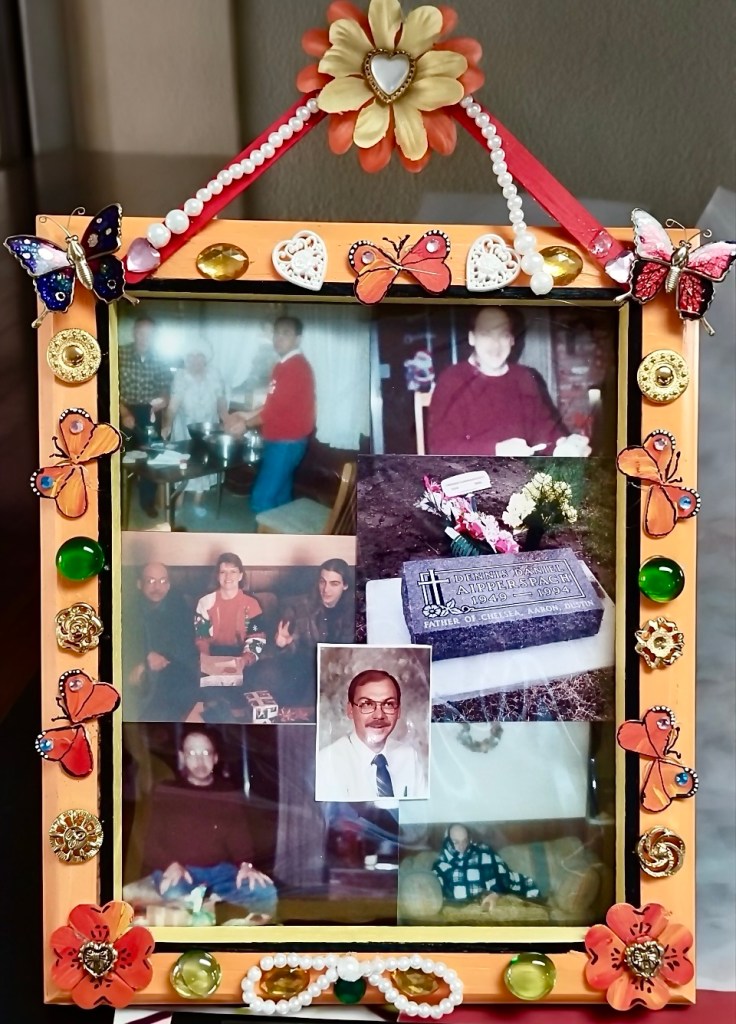
Gail W. had painted her frame, then highlighted it inside, and then made a second highlight color because the first was too stark. On the second day, she painted all the wooden hearts to be butterflies and flowers before she glued them on the frame. That was foresight. This kept the frame clean. She then worked at home to finish her altar, which turned out beautifully. Note how the wooden butterflies have tiny details to resemble monarchs, a symbol of the spirits of the dead. The corner flowers also have delicate details and jeweled centers. The popsicle sticks give her frame an altar shape, plus the point has a multicolored flower with a central jewel. Her photos of her loved one will be a sweet memory to recall for every day of the year.
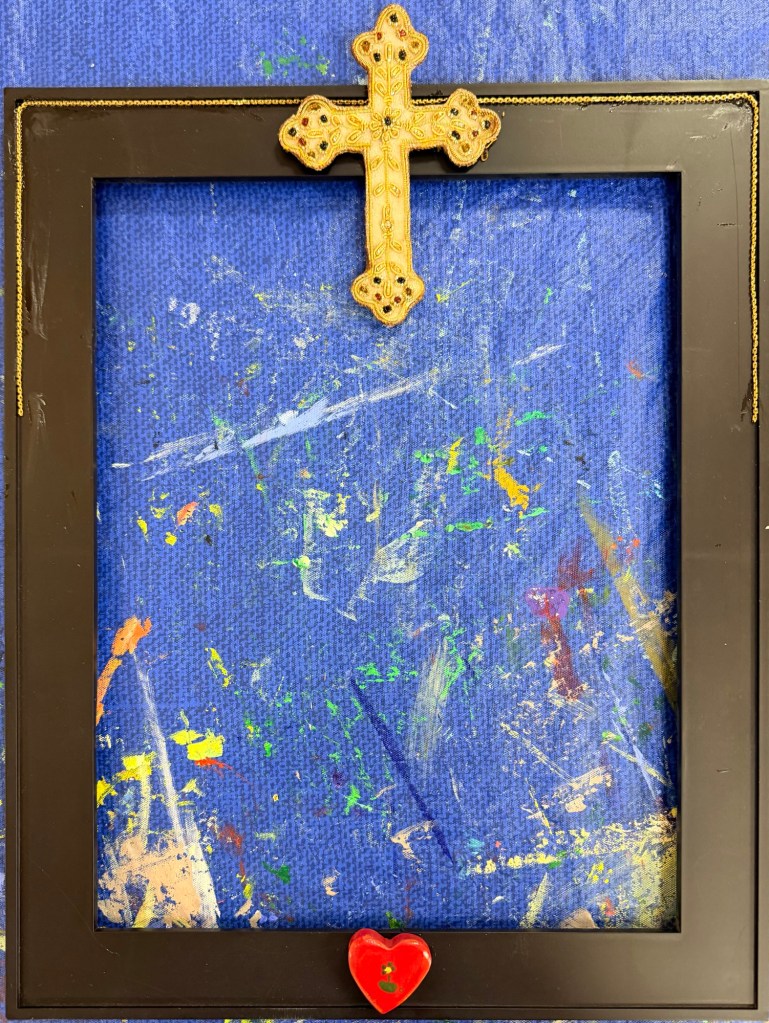
Gail S. wanted to remember her father, a navy veteran. I was glad she found a use for the elegant cross I bought years ago. I was sure I could do something with it, but never did. Another one of my “round tuit” projects, but I digress. Gail usually has a plan in mind and gets going quickly, but this project started off slowly. We all have our seasons. The fabric stuffed cross did not want to stick to the frame.
When we hit a technical barrier, sometimes that throws off our whole creative energy for the day. I have been known not to be able to put a mark on the canvas because I find my studio too messy and distracting. I can block out a lot, but if I can see too much out of the corner of my eye, I cannot focus on what is important.
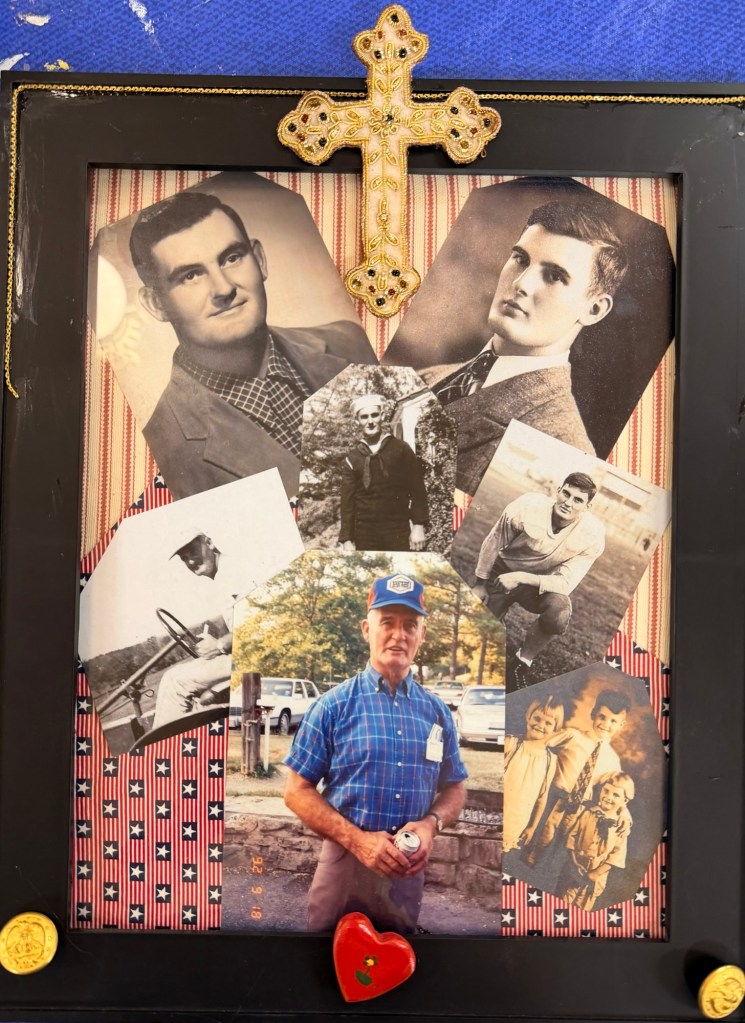
By the second week, Gail S. was rolling along again. She had her patriotic fabric and all her photos in hand. I like the angular shapes which repeat throughout, as well as the placement of the only colored photo in the center. When we incorporate buttons on our frames, the stem always causes a problem. Gail solved this by placing a washer beneath the button to take up that extra space. The other offerendas were typically gaudy in true Mexican style, but Gail S. stayed true to the personality of her father, which I believe captures his spirit best.
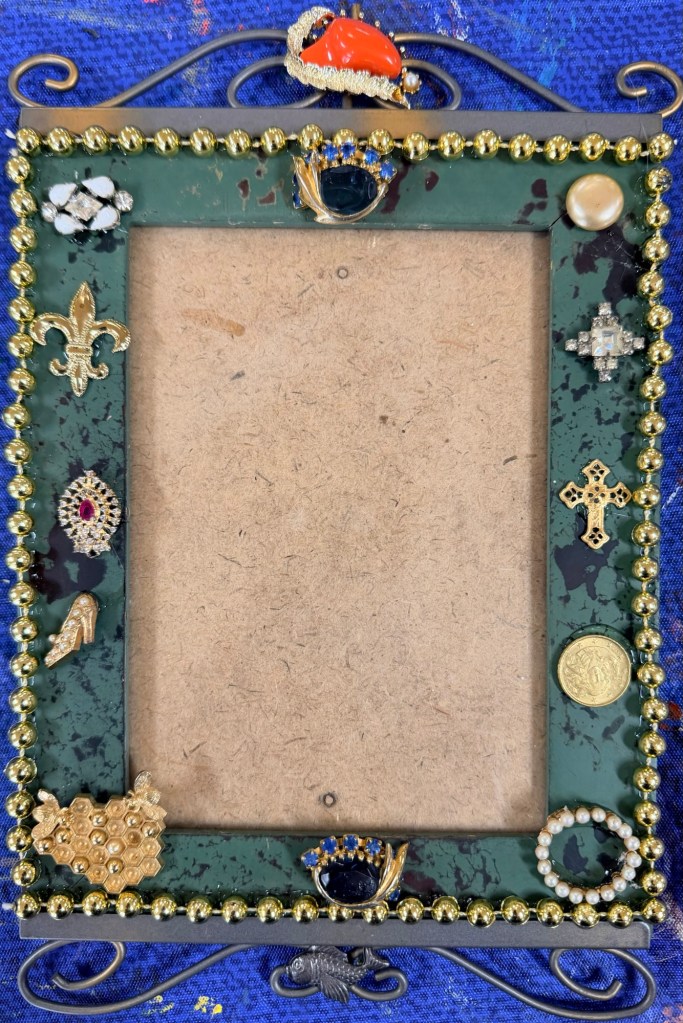
I made two offerenda frames, but only one collage. I was putting old jewelry on two old frames at the same time. Once I held the jewel with the E6000 glue on the frame for about 30 seconds, it set up enough for me to take my hand off it. However, if I bumped the frame by putting another jewel on it, the first one began to slide. I am not much for idle hands or waiting, so I worked on a second piece at the same time. I took two weeks to make the two frames, and the third week to make the collage.
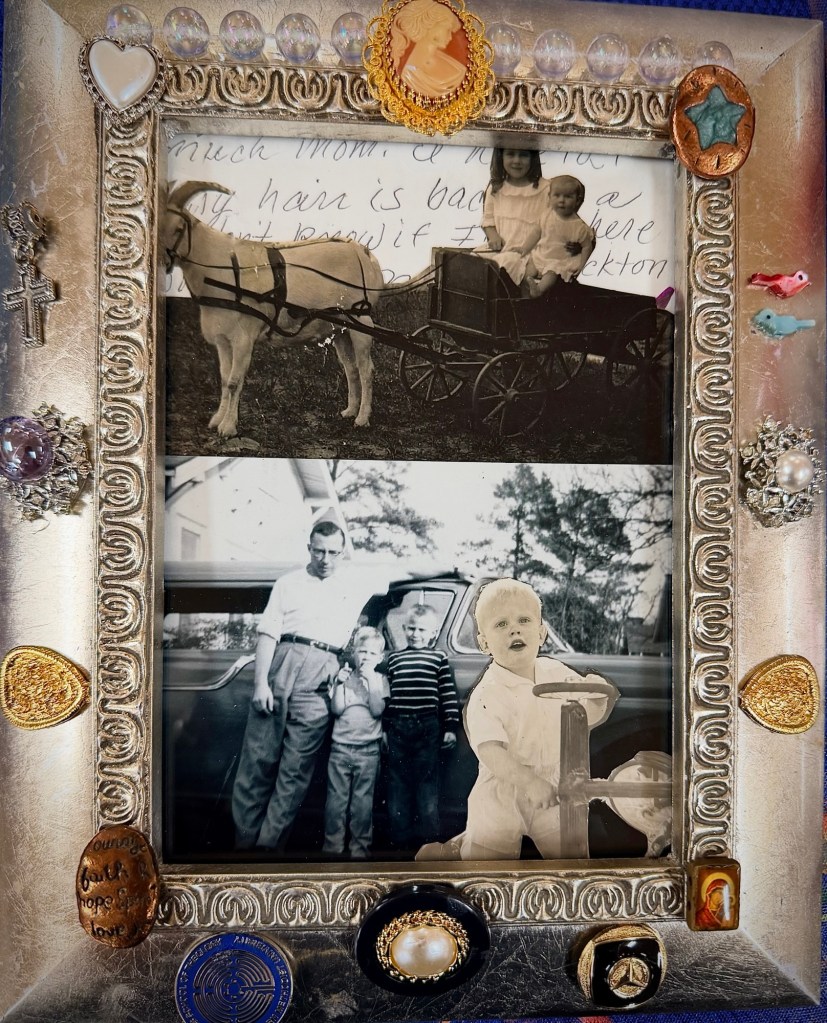
As the background, I used a letter from my deceased daughter, and two large photographs from my distant and immediate past. The upper photo of the Billy goat and cart is of my aunt and mother, who were seven years apart. The family called them the “black and white sisters” because my aunt had her father’s black hair and mom had her mother’s blonde hair. The bottom photo is from 1957, with my dad and two brothers. The cutout is my younger brother, who has loved anything on wheels since he first got his tricycle. I included various pieces of junk jewelry I have collected over the years.
The little pink and blue fetish birds are from a tourist trinket necklace my daughter bought when we went on a trip out to Arizona many years ago.
I am a sentimental person, so I keep such things as this, for they remind me of the good times and the people who are no longer in my life. If I cannot will them from them from the grave, I can believe in the abundant love and grace of our God to offer mercy and hope to every soul at death’s door. When we see Christ in all his loving glory, offering his broken body to our broken bodies to make us whole and fit to stand before the living God, then we understand the meaning of Revelation 21:5,
“And the one who was seated on the throne said, “See, I am making all things new.”
We can have this transformed life in this world also, by the power of the Holy Spirit, if we are willing. This is not mere assent to Christ in name, but accepting Christ in whole, not in part. If we want to be Christian in fact, Christ must live in us! I can image no greater altar or offerenda than this!
Joy, peace, and altars to Christ,
Cornelia
Discover the Rich History of Day of the Dead
https://miguelcamarena.com/blogs/news/day-of-the-dead-history?srsltid=AYCX9vI4WdFi8g0M6jr-eaWSEGZfctYl1pGR9yudkj8CGZUCsFPGnzN6
Emily A. Susina: Don’t Fear the Reaper: The Purpose of Religious Festivals in Ancient Rome
Illinois Wesleyan University, esusina@iwu.edu
https://digitalcommons.iwu.edu/constructing/vol12/iss1/13
CHIARA M. MAZZERI: Ancestors at the gate
Form, function and symbolism of the imagines maiorum (A comparative analysis of Etruscan and Roman funerary art)


Leave a Reply