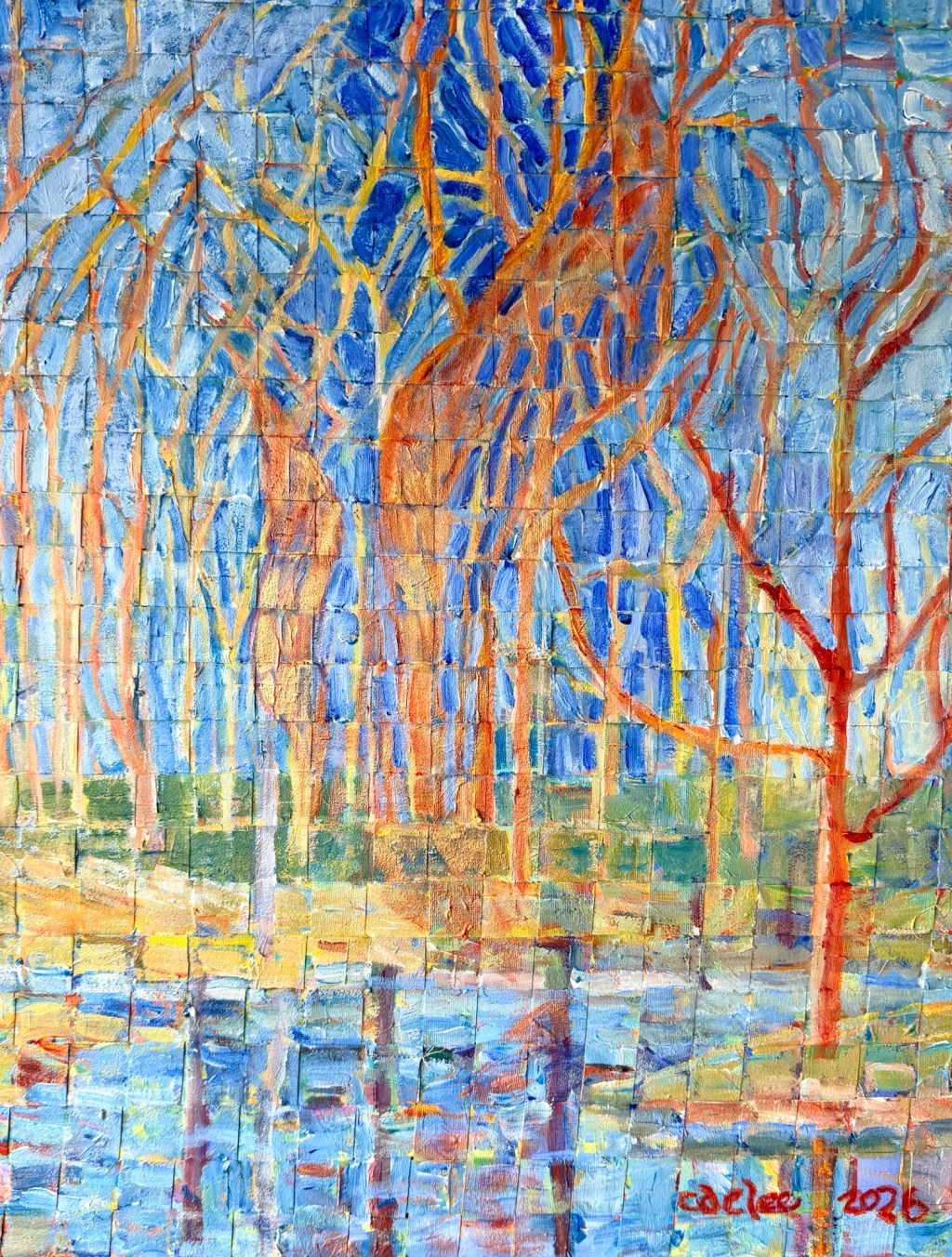
The landscape has always been a favorite subject for me as an artist, for unlike a human sitter, the land never tires, cramps, or hungers. Still lifes of fruit or flowers might rot or shrivel before you finish a complicated work. The landscape we can return to daily. The clouds might be different, but the objects in it do not move. Cezanne’s mountains and Van Gogh’s wheat fields are examples of important themes in their works.
For me, trees and water are significant motifs. Even when I was a child attending summer camp, the mysteries of the trees near the creeks held more interest for me than all the other trees along the forest paths. Those trees, which hung by their exposed roots where the creek had washed away the surrounding dirt as it had flowed down to the lake below, had managed to survive and provide hidden homes for all sorts of wildlife. The creek worked to take down the mighty trees over time, but because the trees had strong roots, they survived and made a place for the other, smaller denizens of the forest and creek environment. Early biblical writers (Psalm 1:3) took notice of this trait also and compared those who walked with God to be like such trees:
“They are like trees
planted by streams of water,
which yield their fruit in its season,
and their leaves do not wither.
In all that they do, they prosper.”
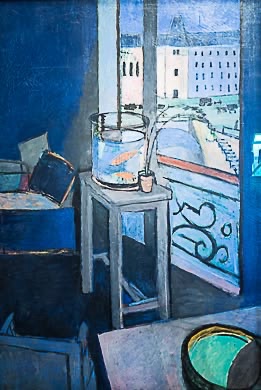
Nature has a way of breaking through our complex and overstimulated environment. We have so many things calling for our attention today—alerts for breaking news, sports updates, price drops (that might be wishful thinking), and reminders of upcoming events—we can hardly keep our mind on a single thought for half an hour. The average attention span of a human adult in 2025 was only 8.25 seconds, which is less than a goldfish’s 9 second attention span.
Matisse had traveled to Morocco and admired the laid-back lifestyle of its people, who sometimes could sit for extended periods of time gazing into their goldfish bowls. Unlike the frenetic French, the Moroccan people valued contemplation and tranquility. He considered their way of life to be a “paradise lost,” much as his fellow artist Gauguin saw the island peoples he lived with. Of course, today we might ask if the goldfish are contemplating us, rather than if we are contemplating them, since our attention spans are getting shorter with every use of our digital media. I personally have turned off all alerts in all my apps on my devices. If it’s really important, y’all can call me.
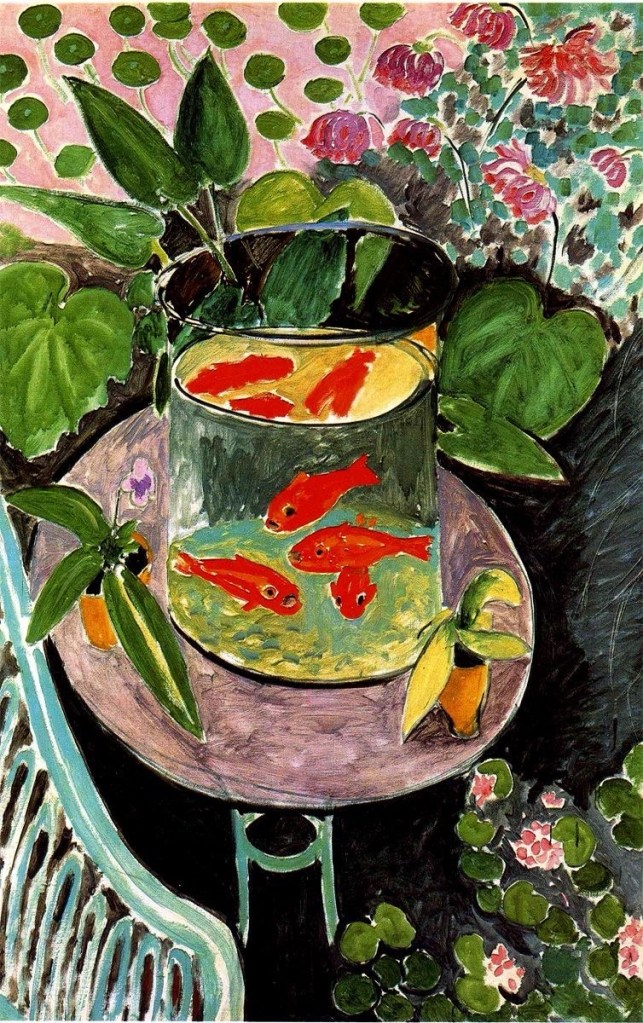
Matisse lived in a different age and focused his attention on his creative work. He understood the call on his heart to interact with a world beyond the sensible. While some of us might be content to paint what we see and merely render a likeness of the world in which we live, Matisse and other renowned artists always looked for the emotional connection to the natural world.
“Most painters require direct contact with objects in order to feel that they exist, and they can only reproduce them under strictly physical conditions. They look for an external light to illuminate them internally. Whereas the artist or the poet possesses an interior light which transforms objects to make a new world of them—sensitive, organized, a living world . . .”
Often, I have walked through an entire forest without seeing any interesting image at all. As I was about to exit, I would hear a silent prompting in my mind, “Turn around!” When I did, I saw the most wonderful tree! It had no form or majesty from one direction, but from another viewpoint, it was magnificent!
Sometimes our point of view can make all the difference between how we see our situation or a landscape. We only need to be open to the voice, instead of distracted by our busy to do lists and media alerts. I might not have been able to see the landscape’s best offerings that day because I was looking too intently for an image. If I had set out on the walk, the landscape might have found me instead. As Psalm 19:1-4a tells us:
“The heavens are telling the glory of God;
and the firmament proclaims his handiwork.
Day to day pours forth speech,
and night to night declares knowledge.
There is no speech, nor are there words;
their voice is not heard;
yet their voice goes out through all the earth,
and their words to the end of the world.”
Matisse is known for his use of color. For him, color helps to express light, not the physical phenomenon, but the true light that only exists, which is in the artist’s brain. For this forest painting, the golden light of an afternoon sun filtering through the forest after I attended the celebration of life for a seminary friend stopped my journey homeward. Of course I had to take a photograph. Whenever I sense “God is in this place,” I make a photographic record. These are the raw material from which I find my inspiration for my artwork. Not every place speaks to me. Although the burning bush of Moses reminds us there is no place so deserted or “godforsaken” where God will not make God’s presence known, not every place speaks to me. Or I do not listen well enough to hear.
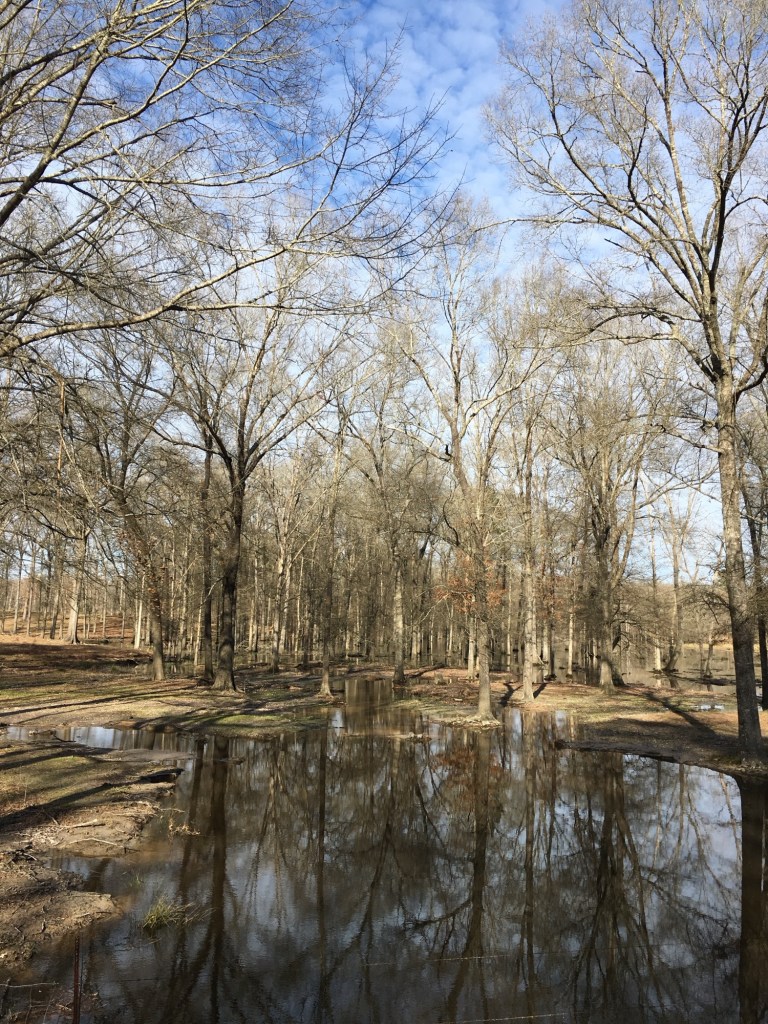
No matter where I have gone in this world, I have found places where I sense the presence of God. Sometimes these are in the “well prayed places” of known historic religious sites, but just as often, I sense the presence of God in nature. I never thought the trees or rocks were holy or held the spirit of God. Instead, I always felt the creative presence of God in nature. Perhaps I felt a kindred spirit, even though I recognized God’s power exceeded mine exponentially!
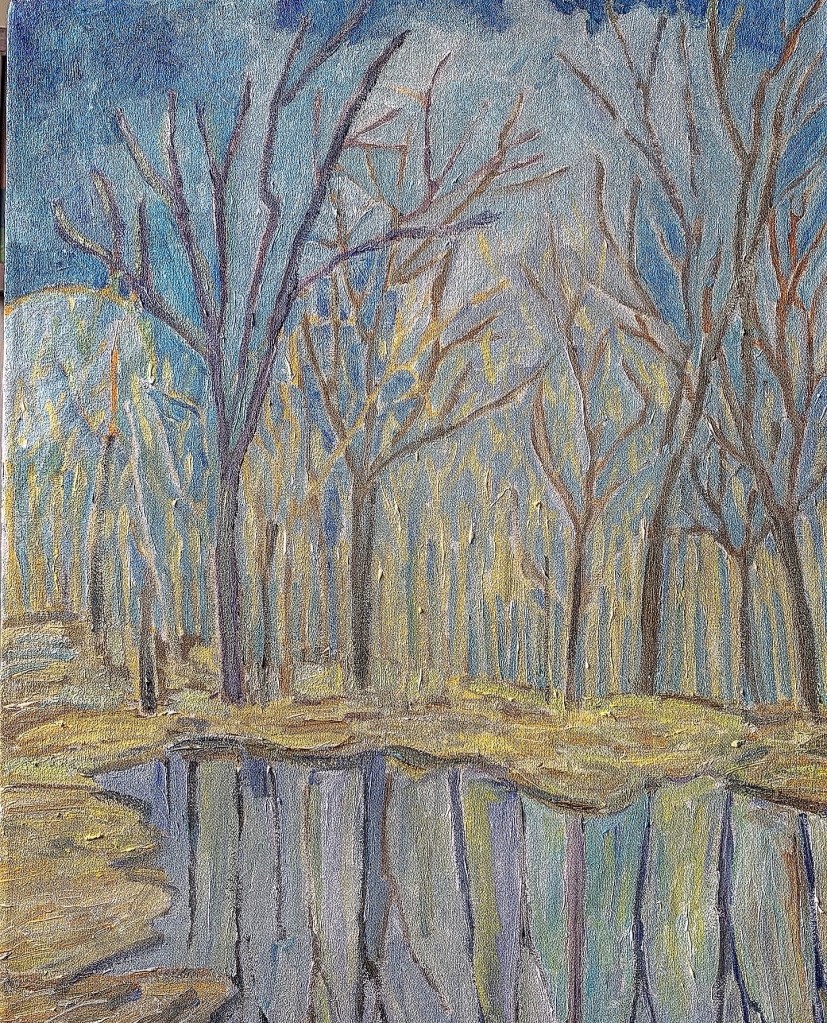
I painted the first image from this photograph in 2019. During the early throes of the Covid pandemic, many deaths were all on our hearts. I remembered with sadness all those losses on top of my own friend’s demise. It was quite grey and a low value, not alive in the light of God that I remembered the scene. It was a grief effort.
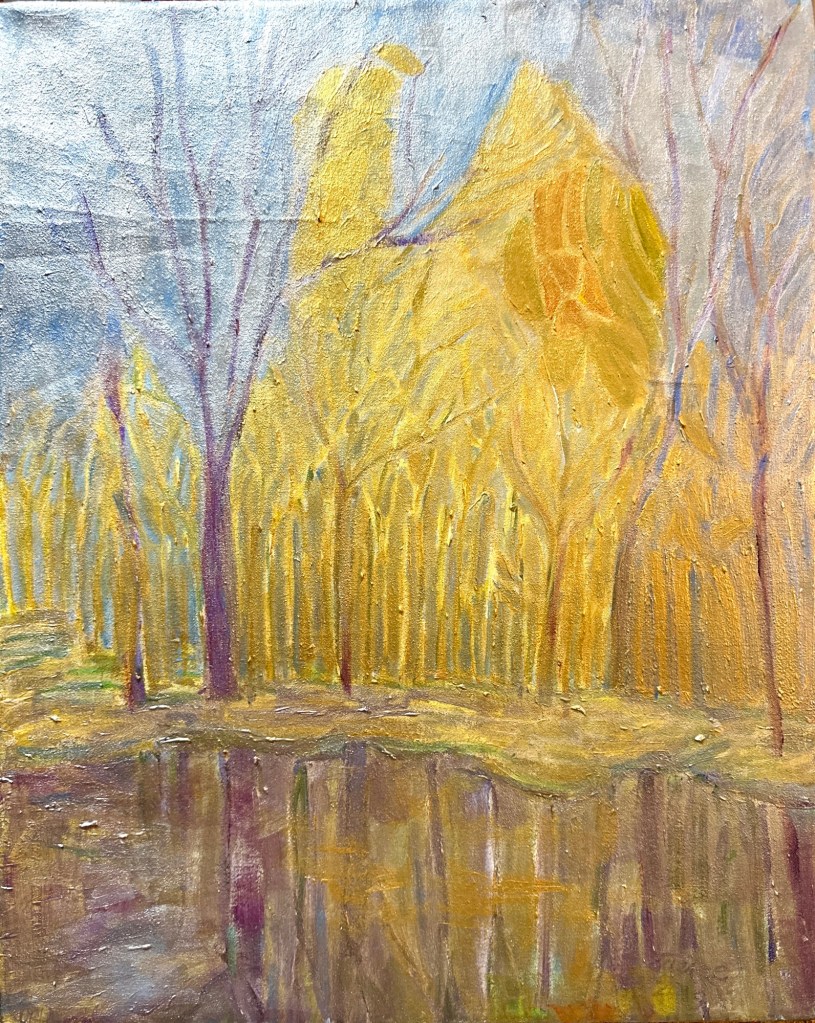
I set it aside for several years. Four years later, our country was in a better place and so was I. When I pulled this out, I realized it did not match up with my original vision of hope which I had felt when I experienced the landscape. I added the gold paint to the canvas and some red glaze also. As I painted, I realized I was making a golden church in the middle of the forest. A small flame was growing within it. My forest had become a golden cathedral with the fire of the spirit kindled inside. This painting gave me hope, for no matter what struggles we may go through under grey and cloudy skies, we always have a bright fire burning in our midst.
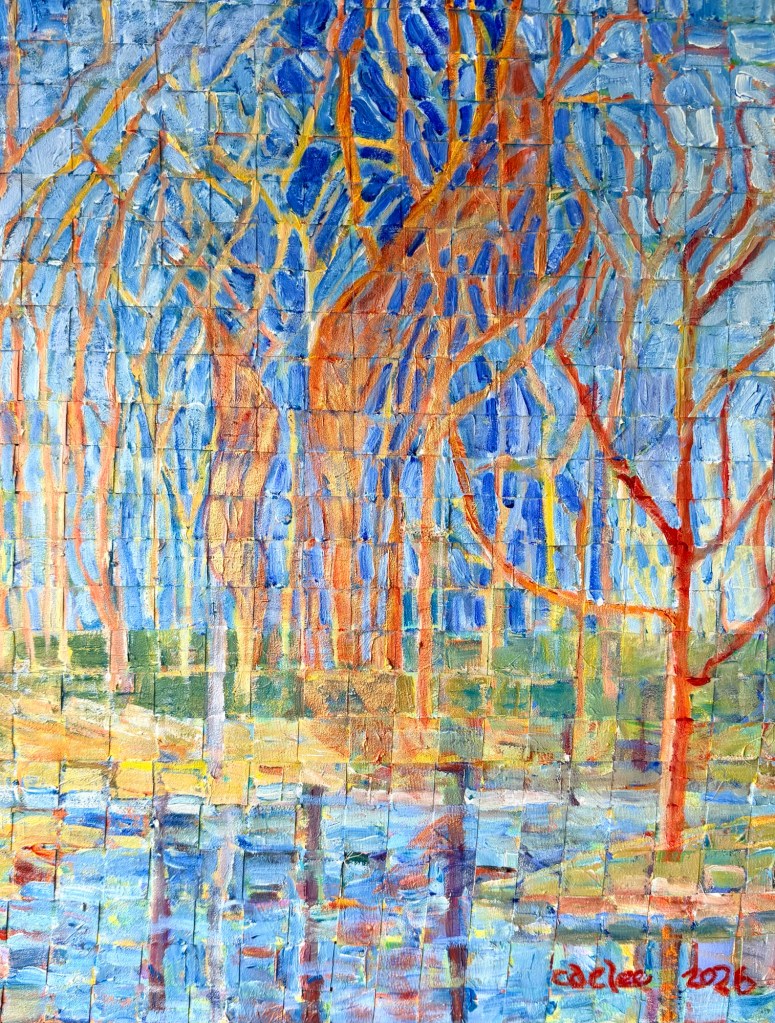
I came back again to this same theme and landscape this summer after almost seven years. I am no different than many other artists who return to the same trough. We come back because an idea has a psychic hold on us, or we think we can perfect its execution, or because we delight in the forms. All these reasons are at work in my latest work. This most recent painting is the only one on a woven canvas. It has layers of color for underpainting as a starting point. This extra layer adds texture and depth to the artwork. While the trees are not natural colored, they have emotional colors. The red bark corresponds to the red fire of the flames of the Holy Spirit. Every tree might burst into flame at any moment! The tree limbs have an energy mimicking the dynamic of a flickering flame.
If we ever get distressed and think God has abandoned us on our journey, we can recall the Hebrew tribes who wandered in the wilderness for generations until they reached the promised land. They always had the presence of God in all those days.
“Neither the pillar of cloud by day nor the pillar of fire by night left its place in front of the people.” (Exodus 13:22)
As Jesus used to say, “Let anyone with ears to hear listen!” (Mark 4:23)
I pray each of us will be open to the voice of God and tune out all our worries and distractions.
Joy and peace,
Cornelia
Average Human Attention Span Statistics & Facts [2024] – Samba Recovery
The Goldfish, 1912 by Henri Matisse
https://www.henrimatisse.org/goldfish.jsp
Meditations on a Goldfish Bowl: Autonomy and Analogy in Matisse

 Artandicon's Blog
Leave a comment