St. John of the Cross spoke of the “dark night of the soul” when his faith in the certainty of his beliefs became doubt. He discovered his deep valley of struggle was necessary to climb back into the bright light of faith in God alone, rather than his faith in the teachings about God or his own worthiness derived from his faith in God. We artists also must go through a similar process of struggle and be willing to go beyond what we know and are comfortable doing, especially if we are “good at it,” to grow beyond our current level. After all, growth marks our creative life, just as the gardens we plant must flourish or we plow them under and plant something that will grow! This is the mark of greatness: just as artists mature in their craft, so the people of faith develop a deeper connection with the mysteries of God. While we will always see in part, we can still “taste and see that the Lord is good!” (Psalm 34:8)
Our last art classes for this year have concluded and we are now in our summer break. I will give a shoutout to all who have endured the challenges I have thrown at them over the past months. We all come to art class with varying levels of experience and confidence. Art class is where we gain competence in both our skills and our faith we can meet any challenge. When we say, “the struggle is real,” our moving from acrylics to watercolors brings this statement into full view. Acrylic paint is opaque, while watercolor depends on transparency to get its full effect. Our Prang student watercolor palettes also are not the most forgiving pigments available. Unless we become “one with the medium,” we find bringing a good message with these paints difficult.
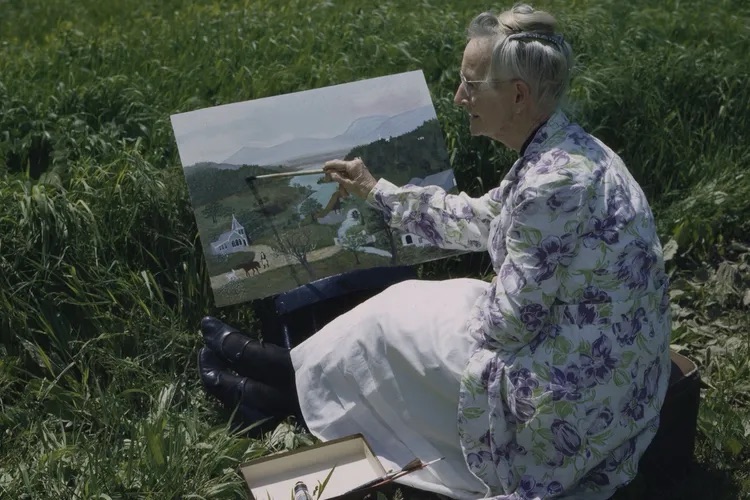
We still can find a benefit, even if our work leaves something to be desired. Art and other creative activities are well known for the way they can slow biological aging. A study has shown those who most often take part in artistic pursuits slow the pace of their biological aging the most. Under one of the study’s methods of assessment, those who did so at least weekly slowed their aging process by 4%, while monthly engagement led to it slowing by 3%. Likewise, another test showed those who undertook an arts activity at least once a week were on average a year younger biologically than those who rarely engaged in such pursuits. This is better than those who exercised once a week and were only six months younger by that measure. The takeaway is if you cannot exercise your body to stay young, you can still exercise your mind for anti-aging benefits.
Participation in art class is useful for more than just for producing a good piece. If this were the case, we all would do factory piece work for the “sofa sized paintings sold as original art” at discount stores across the internet. Art class is a time of community, relationships, cognitive development, as well as building new skills. It is a true one room schoolhouse, for everyone begins at their own level and grows from there. Even if we draw or paint the same image, we all come from our own experience and skill level. I give teaching guidance to each person based on their individual needs. We do not become Michelangelo in one class. Instead, we will always struggle to reach the master’s skill over our lifetimes through our own “dark nights of the soul.” If we persist through our doubts in our abilities or our lack of faith in ourselves or our teacher, then we will discover the act of creating anything leads to being a creative person. This discovery of our creative self leads us to the Creator God. Once we connect the creation with the Creator, all of creation becomes alive with God: the red bird, the pink sunrise, the dark storm clouds, the rainbow, the smiling baby, the first green leaf of spring, the red leaves of autumn, and more.
I have lived almost eight decades on this earth. I have been “doing art” my whole life. My grandmother was a portrait and still life painter. She painted until a stroke took her arm away. She also took continual classes for the opportunity to get critiques from others. Someone with a good eye can see what another artist is struggling with and can make suggestions on how to overcome the hurdle. The only question someone needs to answer is “do you want to grow, or are you comfortable doing the same thing all the time?” Some people find commercial success repeating a certain style. Others continue to change because they are still growing and seeking new horizons. They make their peace with “success as the world defines it.” Money is the capitalist definition of success, while spiritual success means finding truth, or art for art for art’s sake.
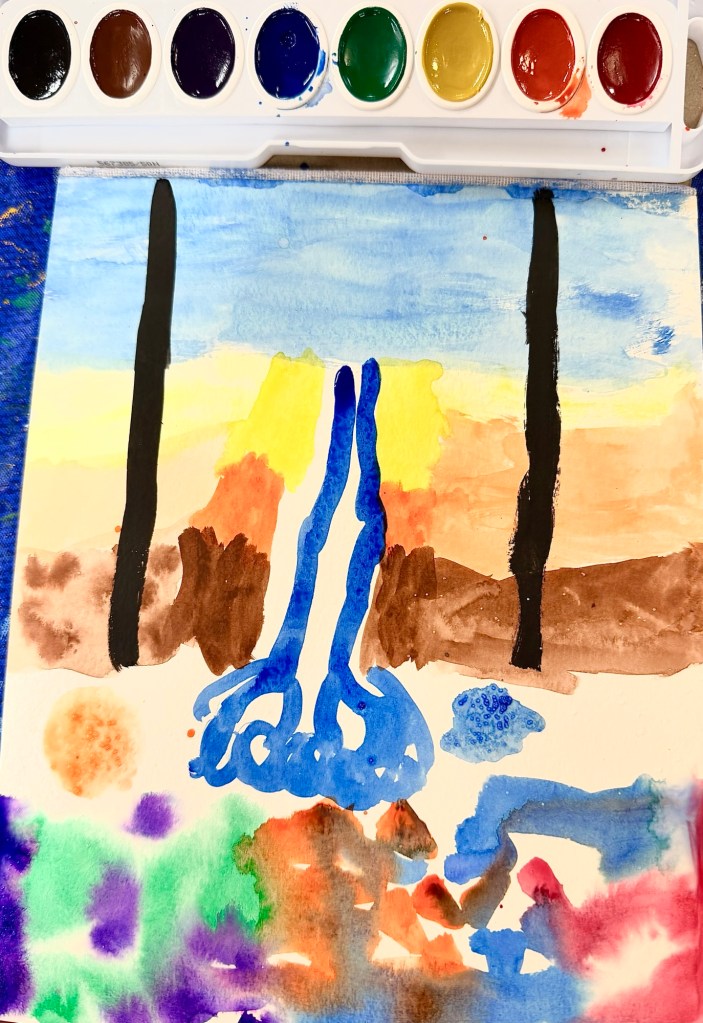
Mike’s Waterfall shows the palette of the Prang Colors we use in the class. I used to instruct students with this brand because they are the best colors. My grandmother showed me how to mix the orange and red to get a warmer red when I was a young girl. Before then, I only used the colors straight from the pan. “Experience is a great teacher.” The Prang red is a cool red, suitable for making a violet. The bottom area of his painting is a wet in wet technique, so the colors bleed into each other. Mike always paints with vigor and authority. He goes for it every time. His joy leaps off the page.
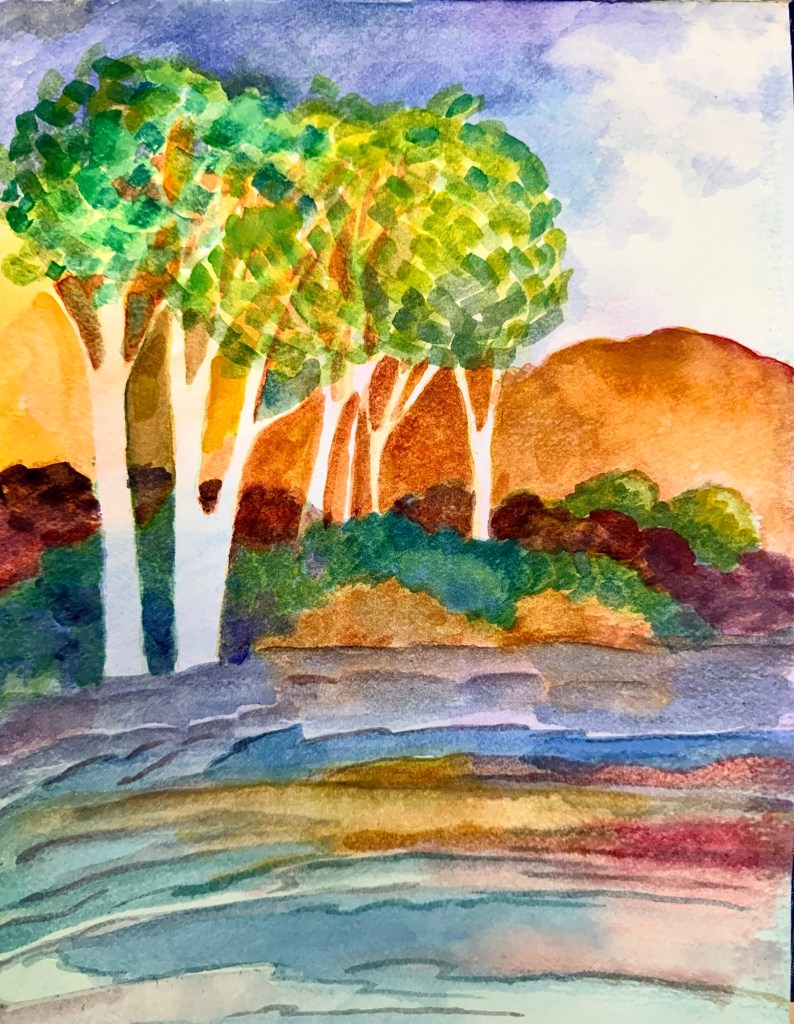
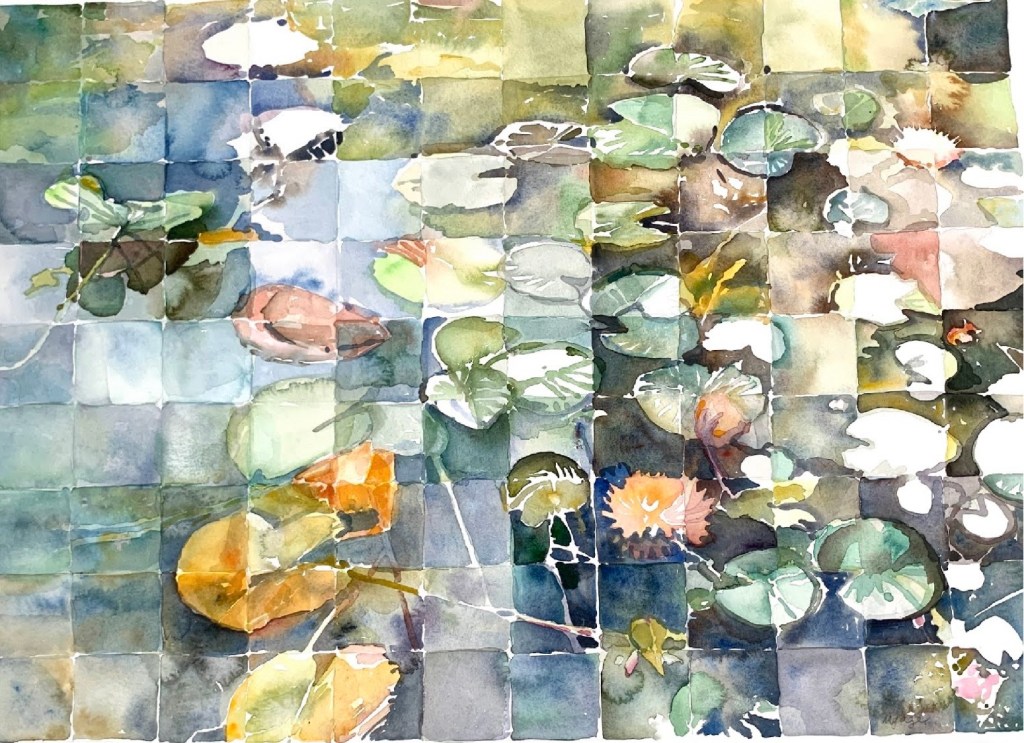
We also worked on a negative painting exercise in which we painted some pale washes across the whole surface of our papers. We took a blow dryer to set the dampness quickly so we could paint clean lines without bleeding. Then we layered more colors to form our shapes, making sure to leave some areas noticeably lighter. Because I had done these projects many times before, this was much easier for me than for everyone else. The thought process alone plus carrying an idea from week to week is challenging. Another instance of “the struggle is real!” Yet, if our aging brains are going to develop new neuron pathways, we must step up to the challenge. As the Mandalorian says, “This is the way.”
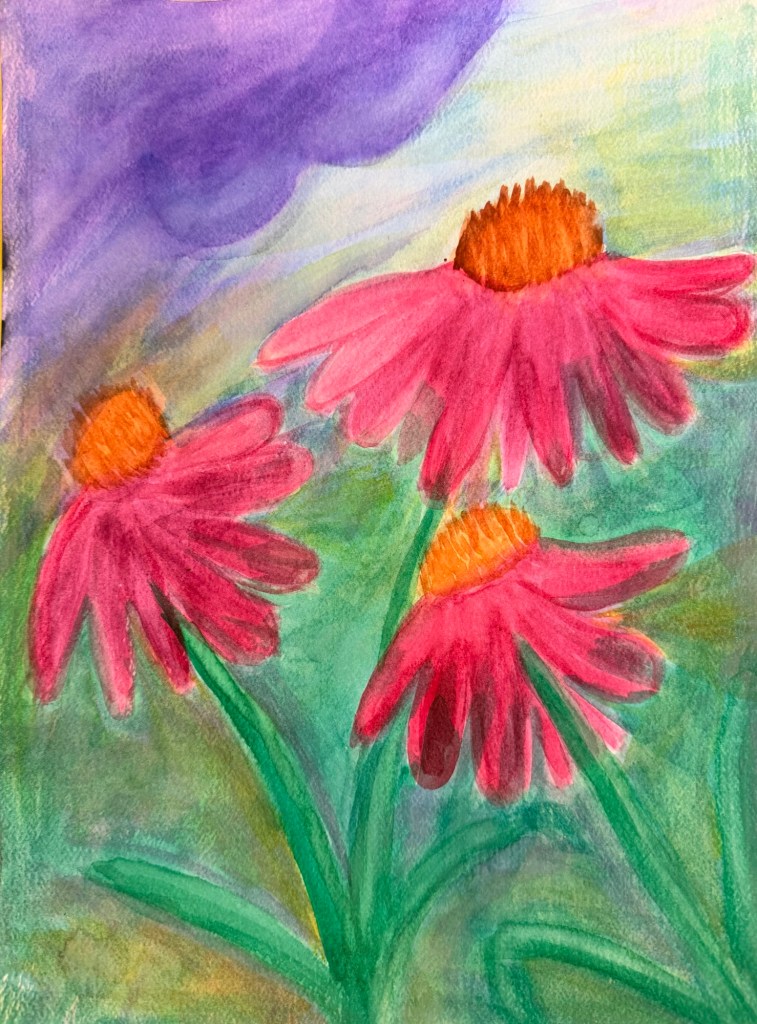
Like the Mandalorian, Gail S. went through her own personal battles and missed a class due to eye surgery. Once back, she picked up where she left off. Keeping a memory of a project in mind from week to another is a mark of long-term thinking processes. As we age, our short-term memory begins to fail. In the worst case, we will sit at the breakfast table before a plate full of toast crumbs and egg smears, while asking, “When will breakfast be served?” Thankfully, none of us are there yet!
Gail’s flowers always speak to her love of nature and the beauty of God’s creation. Over the various times she worked on this project, she learned how to pick up and remove the color from areas by using clear water and a clean brush. If you do not clean the brush each time, however, you just move the paint around. Fixing an error in watercolor is tedious, so it helps to pre-plan as much as possible. Planning ahead is a cognitive skill we can all use to our advantage. As my nanny used to say, “Look before you leap!”
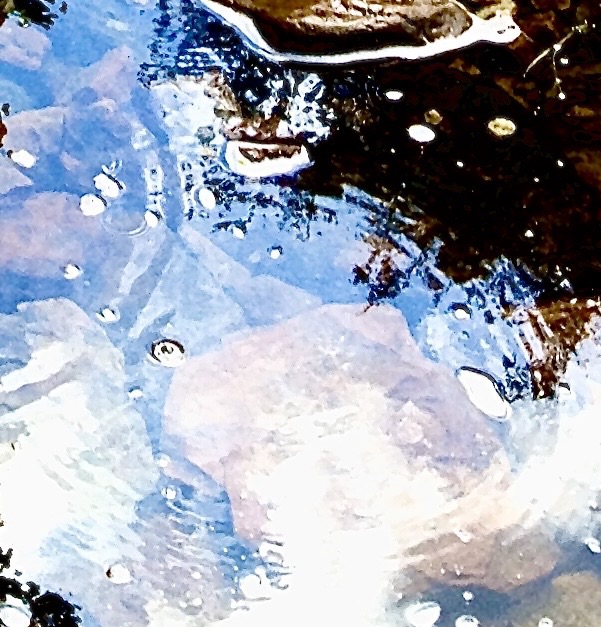
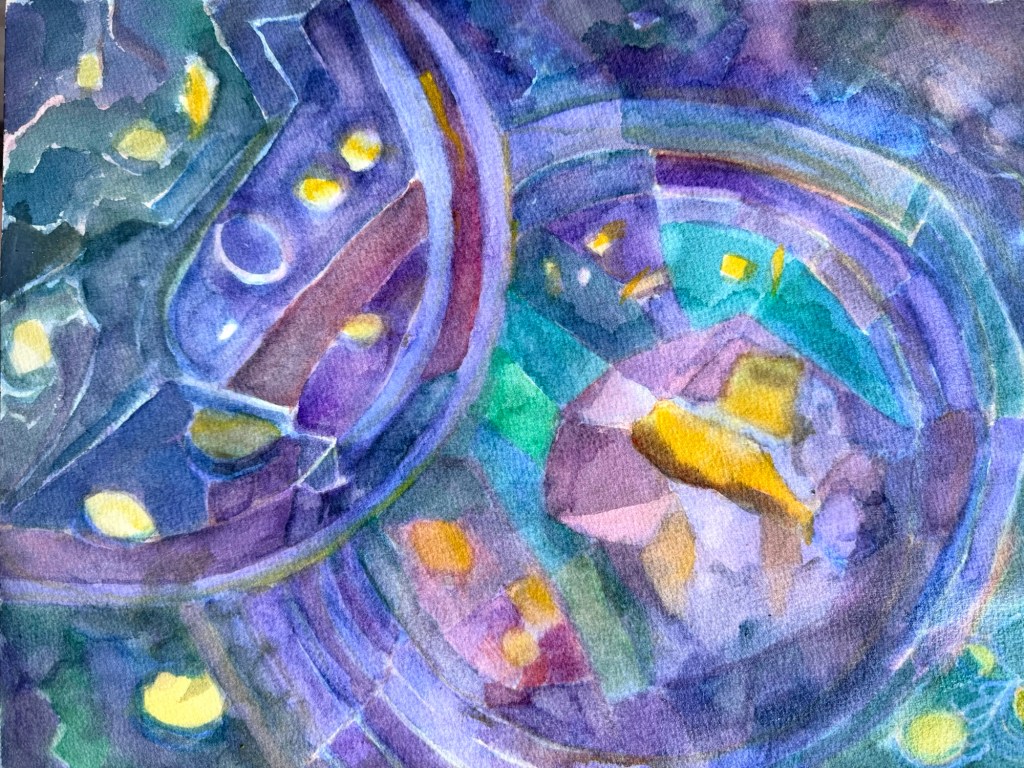
I also worked on a painting I had started last year. While on retreat at Mt. Sequoyah Conference Center back in 2013, I had taken a photograph of the water circles in the rocky fountain feature on the property. I lost track of the photo and began to work on the painting from memory.
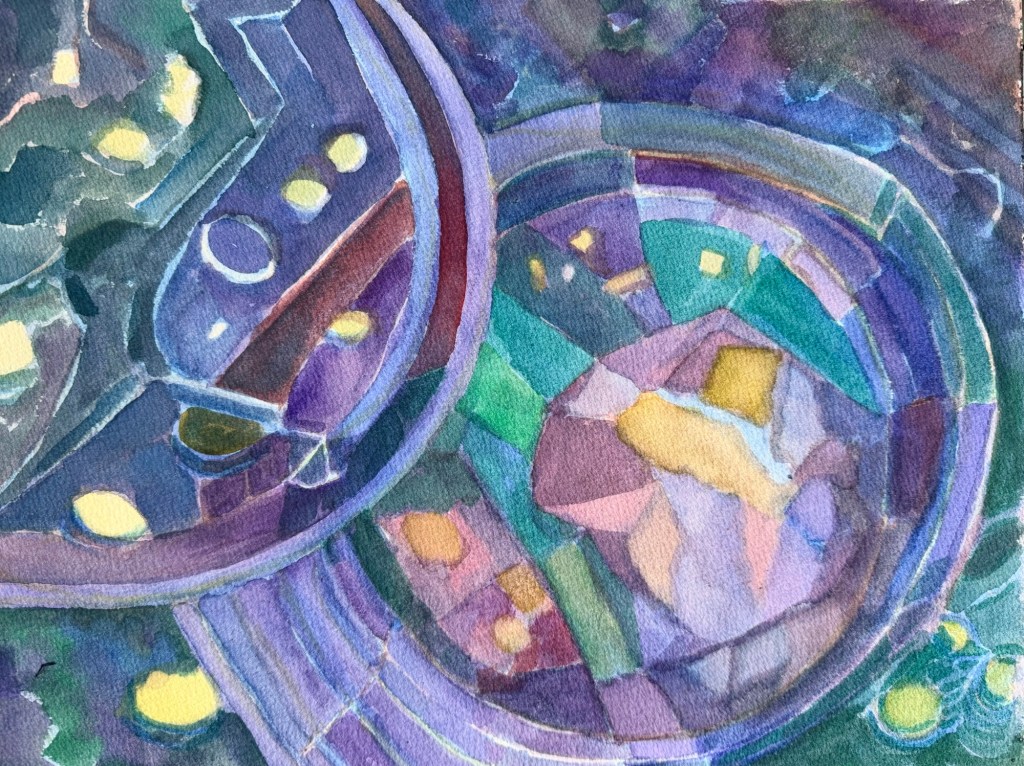
I thought one day I would work on a painting of it. I have started and stopped working on this idea over the last dozen or so years, even to the point where I have now lost the original idea. It no longer matters whether my painting matches nature’s design. My latest painting now must stand alone as as a new creation, for it can never be rocks and water. It will always be Prang watercolor pigments on paper. I am thinking I want to do an acrylic painting now. Also, I want to pick up some of the darker colors to get some lighter values in the work. One challenge down, and another to go! We go from the night-to-night struggle, always thankful for the next day’s progress.
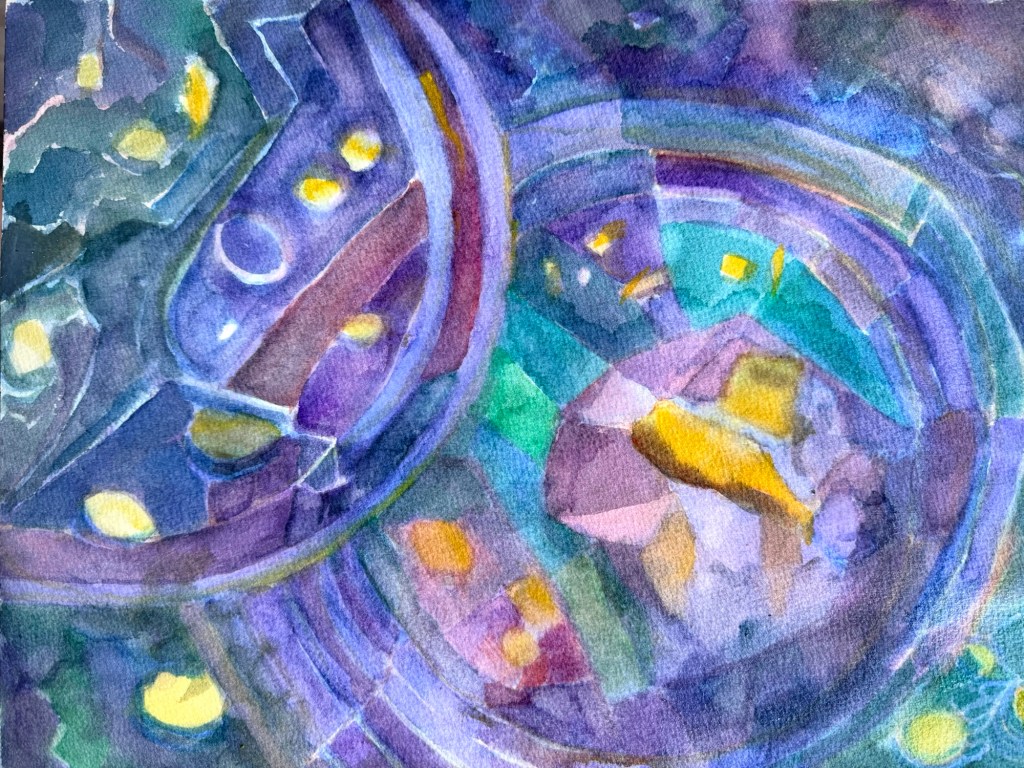
Of course I wasn’t going to let this go forever, not even an afternoon. When I get a bee in my bonnet, I’m going to swat it until I can’t swat anymore! Is art a passion, an obsession, or a calling? It’s certainly more than a hobby for some of us. I pulled up the colors out of the wheels so I could see the underpainting which I had lost. This gave my work a lighter life. It was still too rigid and not yet the moment of stillness of flowing water which I wanted to capture. I decided to take a stencil brush, load it with water, and stomp it around the lines. I was watching to make sure I wasn’t picking up the paint and moving it around. My paper towel got a workout! Once I destroyed some of the harsh lines, I went back in with bright yellows a a touch of red. I may have thrown a fish in this pool, for good measure.
I enjoy this second effort more than the first because it represents the depths we often need to go in order to achieve a higher achievement. In this case, my only real suffering was I knew it was not the best I could do, but if I persevered, I would learn much. If I also came out with a good product, well and good. That isn’t my first goal. Becoming the best I can be is my gift to God in return for the gifts God has given me.
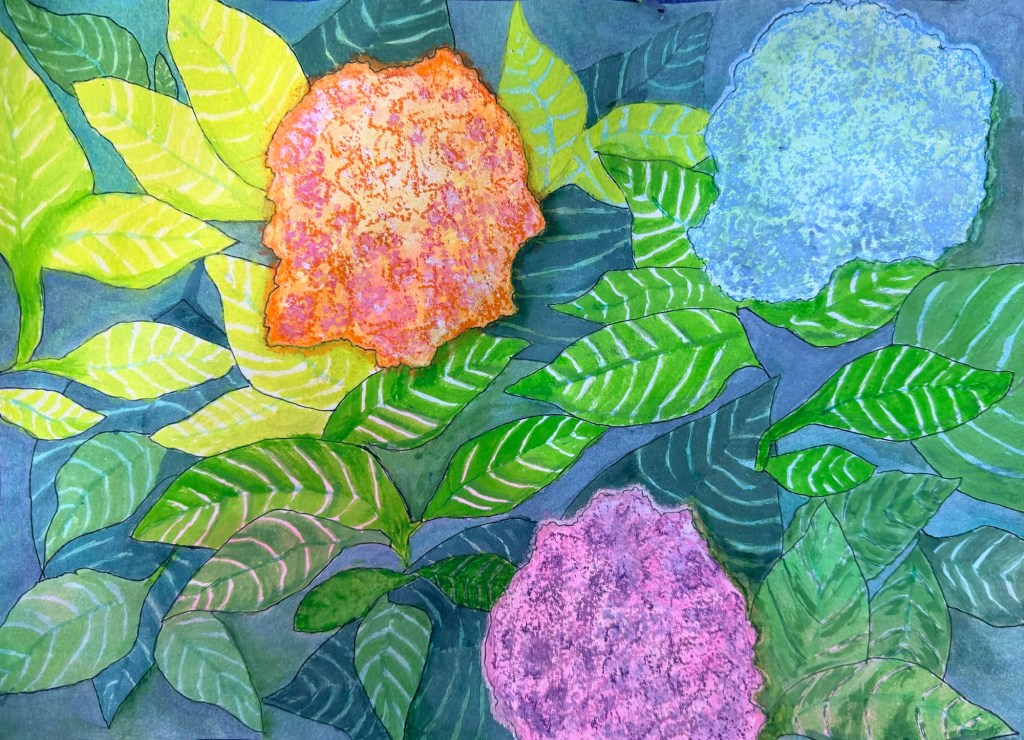
Teachers and coaches are always thrilled to see students come alive when they learn a new skill. When the brain, heart, and hand connect, the whole person’s body lights up! Often there is an audible “Yes!” from the extroverts, or at least a smile from the introverts. Teachers and coaches do not need praise, but their payoff is in the achievements and growth of their students. In fact, if my students were not learning, I always figured I was not teaching them well and therefore needed to find a new angle to crack open the door to their abilities.
On this negative painting project Gail W. asked, “How do I make this leaf go behind the other?” I repeated a lesson we had learned in shadows, “Dark goes behind light.” Problem solved.
When a leaf was too dark in a place it needed to be light, she asked for help again. “How can I get this leaf lighter?” This is where we used the wet brush technique to pick up color. I suggested she use this picked up color to darken another area that was too light. This was a mind-blowing concept! If we think about it, the perfect color exists on the paper, so we should use it elsewhere to draw our eye around the space.
On her own, Gail W. delineated the leaf veins with the wash colors underneath the painting. As a result, each leaf has its own distinct character and personality. I think this this is the finest painting she did all year long, not only because she persisted through the struggles, but because she found ways to overcome the challenges over a month’s time.
The creative life is always a form of struggle, for often we have ideas our hands cannot bring into being. If our skills are not at the point at which we can create what we can imagine, then practice and struggling to the next breakthrough point is the necessary “dark night of the soul” for the creative person. “Struggling artist” in the world’s economy means a person who does not make a living from art sales. In truth, every artist struggles if they progress to their highest levels. We all know deep inside we have more to give and more to seek. The question is rather, “At what point will we seek comfort rather than struggle?”
As in the Christian life, the art life is not a comfortable life. It is a countercultural life. The whole idea of profit/loss, power/submission, and we/them is meaningless to Christ:
“Then Jesus told his disciples, “If any want to become my followers, let them deny themselves and take up their cross and follow me. For those who want to save their life will lose it, and those who lose their life for my sake will find it. For what will it profit them if they gain the whole world but lose their life? Or what will they give in return for their life?” (Matthew 16:24-26)
I will see folks again in the autumn, on the first Friday after Labor Day, which is September 11, 2026. The good Lord willing and the creek don’t rise!
Joy and Peace,
Cornelia
Arts and cultural engagement ‘linked to slower pace of biological slower pace of biological aging’
Group arts interventions for depression and anxiety among older adults: a systematic review and meta-analysis | Nature Mental Health
https://www.nature.com/articles/s44220-024-00368-1


Leave a Reply