In the season of Lent, the forty days before Easter, Christians walk with Jesus toward the cross as he prepares for his death and resurrection. Luke 9:51 tells us, “When the days drew near for him to be taken up, he set his face to go to Jerusalem.” Luke relates many of the miracles, parables, and conflict stories in the following chapters before the events of Holy Week.
The noun ἀνάλημψις appears only once, in Luke 9:51, where it denotes the definitive “taking-up” of Jesus Christ to the Father. This form carries the idea of a completed, upward transfer and frames the rest of Luke’s Gospel as a deliberate march toward the cross, resurrection, and ultimate exaltation. Luke is the only gospel writer to use this unique word. It also occurs at the end of Luke when Jesus blesses the disciples and “is taken up,” as well as in Acts to refer to the Ascension. Luke presents the Ascension, not as an epilogue, but as the climactic vindication of Christ’s earthly mission and the necessary prelude to the Spirit’s outpouring (Acts 2:33). Hold on to this thought: it’s important.
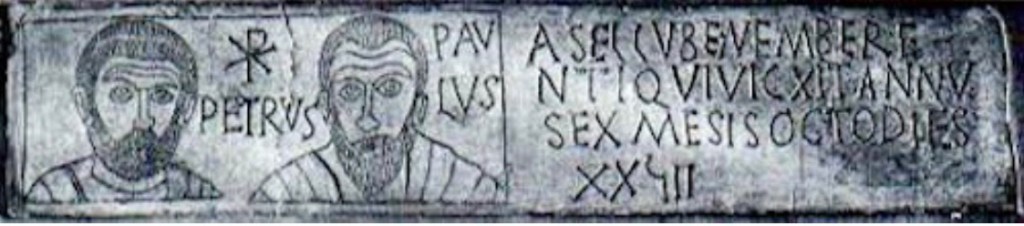
While ἀνάλημψις appears only once, its verbal cognate ἀναλαμβάνω (Strong’s 353) and related descriptions (ἐπαίρω, αρπάζω) underline the same movement heaven-ward. In 1 Timothy 3: 16, the word means to take up, lift up, or bring up:
“Without any doubt, the mystery of our religion is great:
He was revealed in flesh,
vindicated in spirit,
seen by angels,
proclaimed among Gentiles,
believed in throughout the world,
taken up in glory.”
The following sentences use a similar word, hērpasthē/ἡρπάσθη, which has the added flavor of seizing or violently snatching an object or person. Paul speaks of his mystical experiences with this same word in 2 Corinthians 12:2—
“I know a man in Christ who fourteen years ago — whether in the body I do not know or apart from the body I do not know, only God knows — such a man was caught up to the third heaven.”
Also using the same word is this verse from Revelation 12:5 about the Ascension of Christ:
“So the woman gave birth to a son, a male child, who is going to rule all the nations with an iron rod; but her child was taken up to God and to his throne.”
Why do I spend so much time on a single verb in the Greek text? Does this have anything to do with the disciplines of Lent? What does this verb ἀνάλημψις (taking up) matter for creative people or for anyone of faith today? These four questions need answers, for sure, especially as we approach Good Friday and Easter Sunday. We also might want to answer why we call a horrific event “good” while we are at it.
While we find this verb just once in the New Testament, it also appears in the Septuagint, the Greek version of the Old Testament. In Genesis 5:24, referring to Enoch’s ascension into the heavens: “Enoch walked with God; then he was no more, because God took him.” Another prefiguration of the Ascension is found in 2 Kings 2:11— “As they continued walking and talking, a chariot of fire and horses of fire separated the two of them, and Elijah ascended in a whirlwind into heaven.”
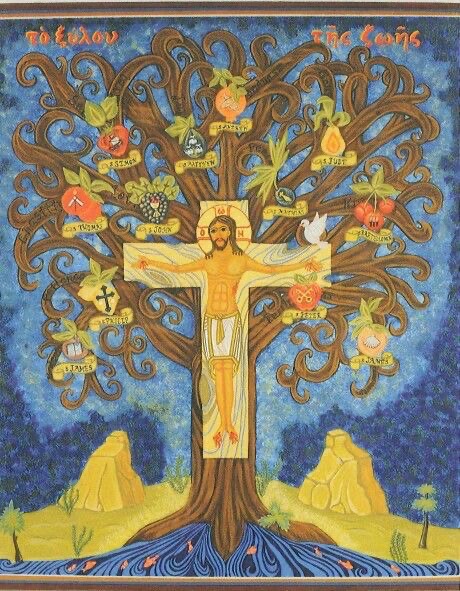
These two verses, which were in the authoritative text of first century Christianity, remind us God is the primary actor in all the above events. While we in the 21st CE often focus more on Jesus Christ, the first Christians recognized the ultimate power of God in the mighty acts of God’s Son and the Holy Spirit which proceeded from the Trinity. We don’t have time to discuss the niceties of “how or from whom” the Spirit proceeds, but it was so important, the Eastern and Western Churches split over this issue in 1054.
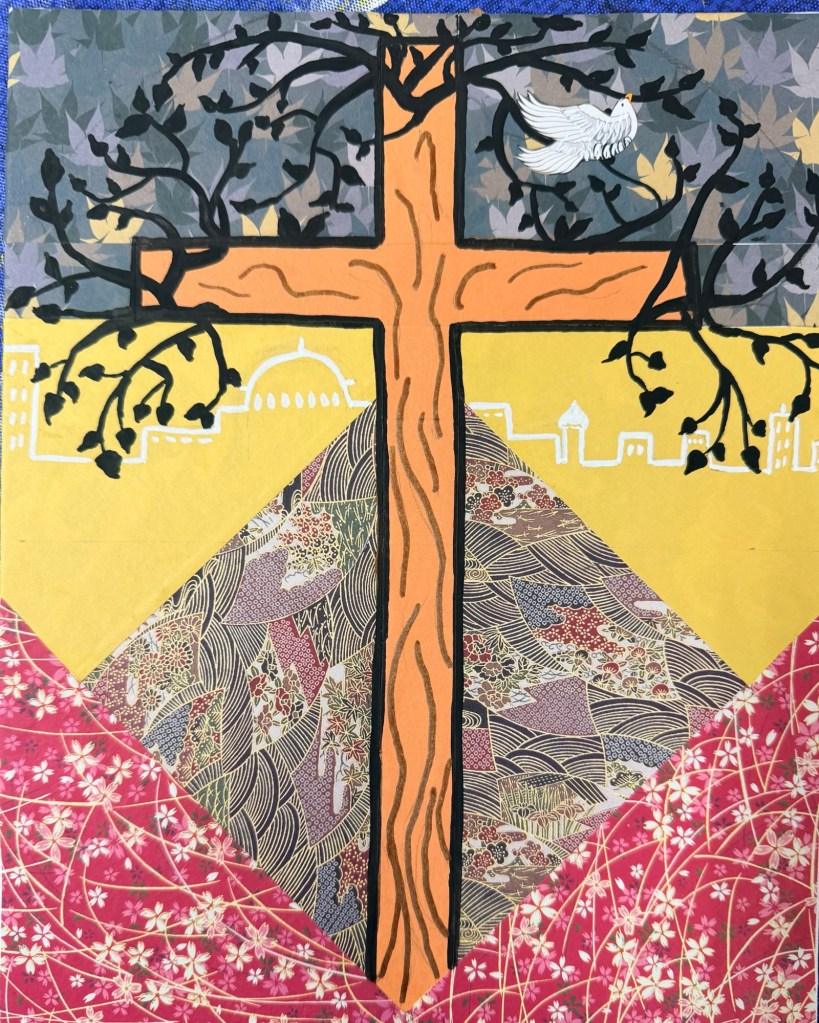
When I look at Gail W’s cross, which she made from various origami papers, glue, and colored ink markers, I see the struggle to rise beyond the original motif she had originally in mind. At first, she thought of a living cross, with a tree in full leaf, but the origami paper didn’t lend itself to such detailed cutting. As she began to piece it together, some of her shapes began to overpower others because they all had too much pattern. She needed a solid color for the eye to rest. By adding the gold middle ground, the foreground triangles came alive. We could see the three hills of Golgotha, where the two thieves and Christ were crucified. Then she outlined the cross, as well as giving it a texture. Remembering her original idea, Gail drew a living vine growing from the wood. She also drew in the skyline of the city of Jerusalem, for criminals were always executed outside of the holy city.
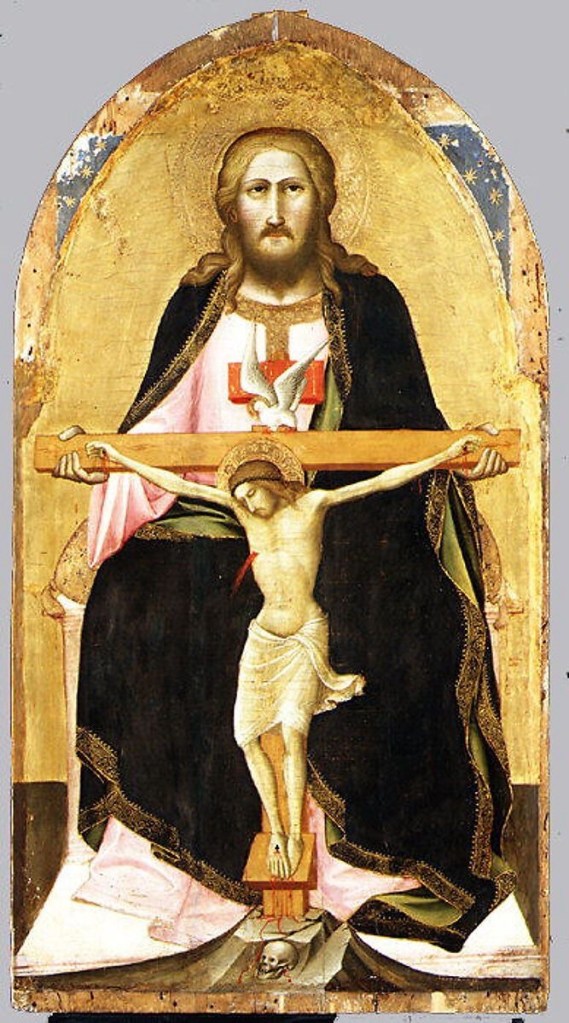
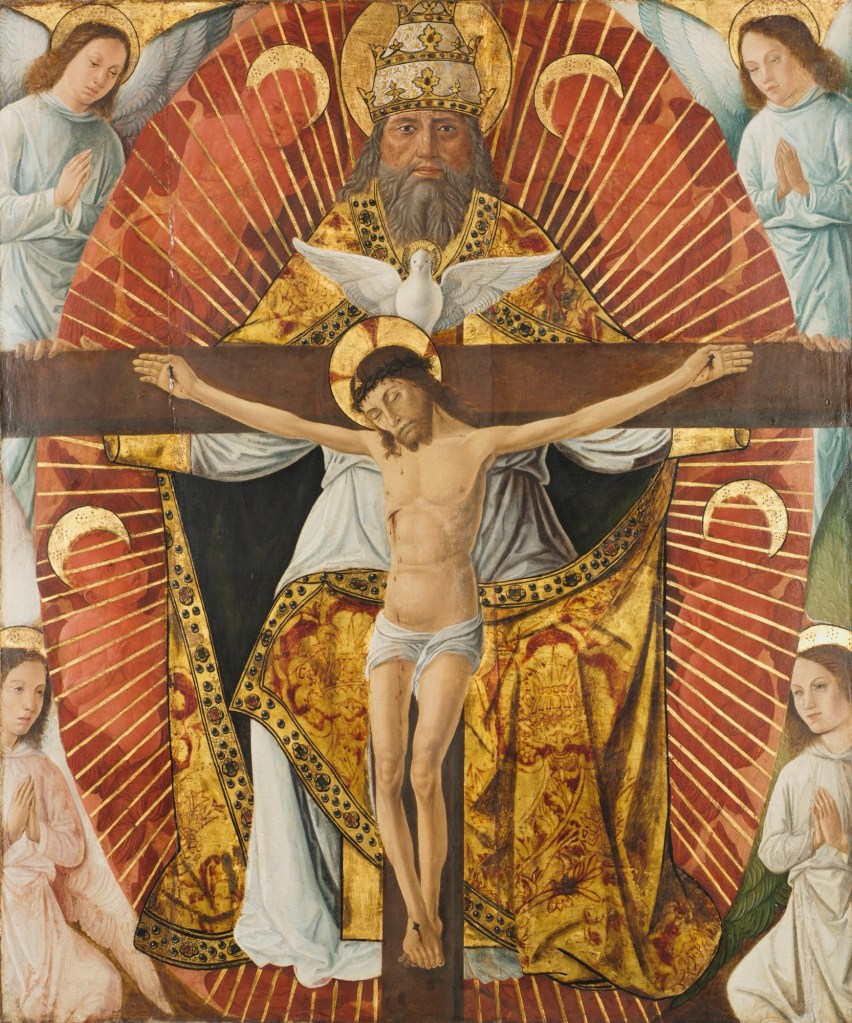
Agnolo Gaddi: The Trinity, ca. 1390–96, Tempera on wood, gold ground; Overall, with arched top, 53 1/2 x 28 3/4 in. (135.9 x 73 cm); painted surface 51 1/8 x 27 7/8 in. (129.9 x 70.8 cm), Metropolitan Museum of Art, New York City, NY.
In Agnolo Gaddi’s beautiful 14th century painting of the Trinity, God the Father and God the Son share the same visage, while the dove represents the Holy Spirit. The dove has always been associated with the Holy Spirit, even if it wasn’t given corporeal form. The priestly story of creation in Genesis 1:2-3 imagines the beginnings this way:
“In the beginning when God created the heavens and the earth, the earth was a formless void and darkness covered the face of the deep, while a wind from God swept over the face of the waters.”
We can also translate the word for wind as “while the spirit of God” (or while a mighty wind) swept over the face of the waters. The Hebrew is ruach, which means spirit, wind, or breath, depending on the context. As a theological point, although the word Trinity isn’t mentioned in scripture, we find evidence of the triune nature of God throughout the received text from the very beginning in the Old Testament and continuing through the New Testament.
Cleveland Art Museum
Gail W’s collage includes a dove, which she cut carefully from a crane origami paper. Since cranes have much longer necks, beaks, and legs than doves, she had some redesigning to do on this creature to bring it into dove form. She was successful and placed it exactly right.
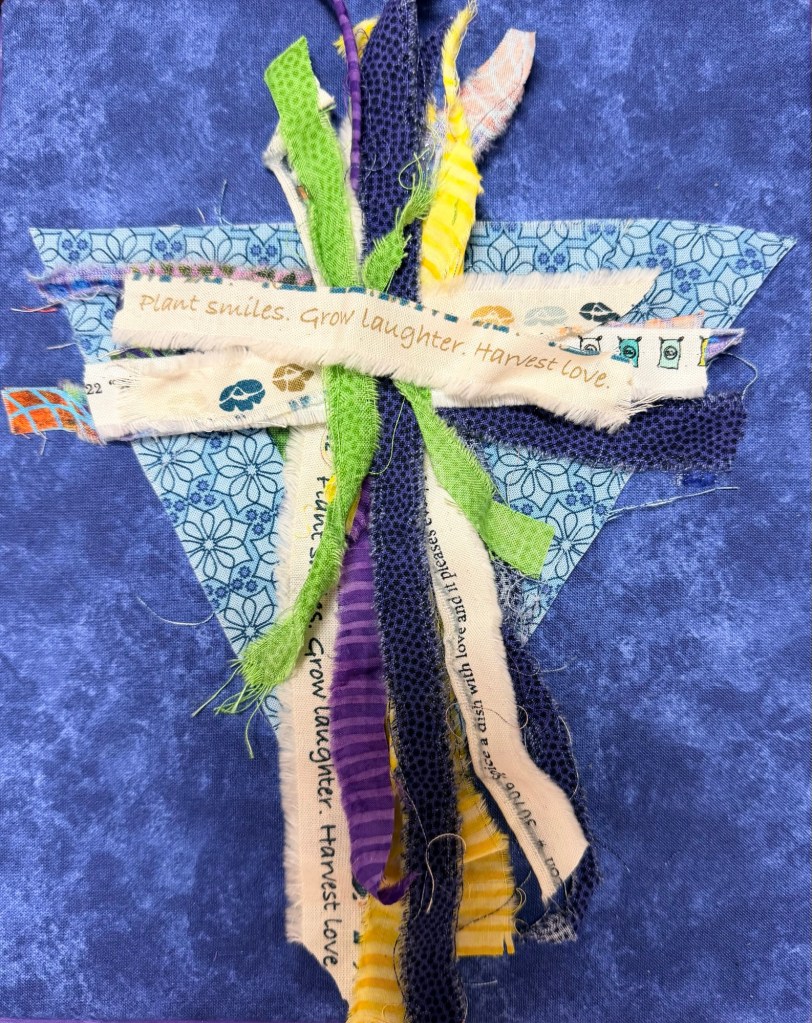
Marilyn: The Old Ragged Cross, fabric and glue
Marilyn is an accomplished sewer and can make her sewing machine work wonders to behold. While I haven’t seen her projects, I can tell by her keeping of the scraps she has lots of experience and puts love into all her work. Many of the “leftovers” which she brought to this cross project were selvages, the edges of fabric. In the old days, these were plain and unadorned, but she has a whole collection of fabric edges with beautiful sayings on them. Marilyn first had to cover her background on the canvas panel. She was amazed when I told her she already knew how to do this.
“You can make a bed?”
“Of course!”
“Ever made hospital corners on the foot of the sheets?”
She looked at me like I was crazy, but this is exactly how we wrap a canvas, only the “sheet” gets hospital corners on all four corners of the mattress/pad.
Once she got going on this project, she added her triangle from her quilt making basket. Remember, wherever the Son is, the Father and the Spirit are there also. The Trinity never is a “Binity” or a “singularity.” The Trinity is always unified, all three working as one, always for our salvation and the redemption of all creation.
Then she laid all the ragged edges of strips of color on top of the triangle, taking some time to find the right balance to suit her eye. She noticed the strips needed fraying, so that also took time. Just as Rome wasn’t built in a day, art projects sometimes take longer than one expects. What I noticed about the frayed edges is we don’t bring our best selves to Christ, but we bring our ragged and frayed selves for healing. This isn’t an Old Rugged Cross, but an Old Ragged Cross, one which is accessible to all the people on the edges and margins. Marilyn has the heart for those who need a healing presence. She can bring the Christ Hope to those who need it.
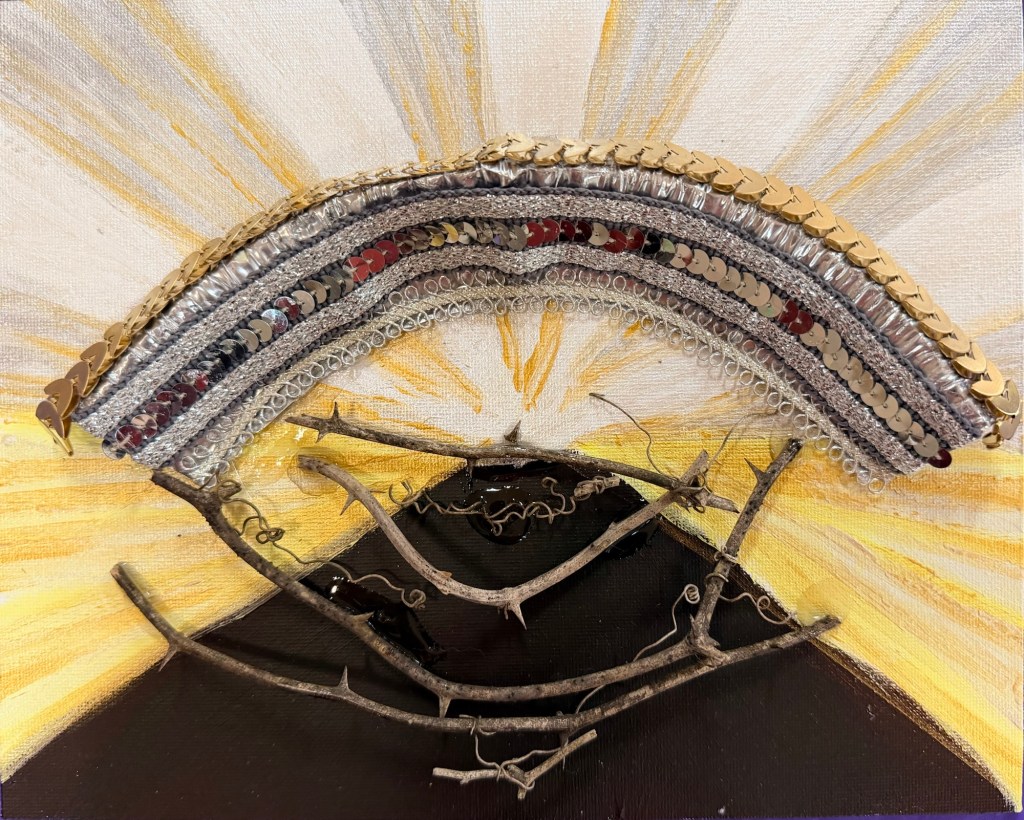
Gail Sears also worked on a multimedia project for this journey to the cross project. As a person with a background working in the National Park Service, she always brings a concern for nature and conservation of resources. Reusing and repurposing ordinary materials into a new creation is what God does with us all the time when we give our everyday selves to God’s transforming grace. As Paul reminds us in Philippians 3:21—
“He will transform our humble bodies that they may be conformed to the body of his glory, by the power that also enables him to make all things subject to himself.”
After she painted the background, Gail used a tinfoil pie plate for the crown. Cutting tabs on the curve to glue down the crown was the most difficult aspect of the project. Gluing down a curve is hard because matching a straight or flat piece to a round or curved section requires cutting out triangular sections to ease the curve around or make it lie flat in this case. After she secured the base crown, Gail decorated it with some old jewelry pieces, some of which craftspeople made from industrial materials. She also added some scrap sequined pieces to complete the crown. Having done this, Gail added sticks with thorns, for the broken crown of thorns. As Hebrews 12:2 reminds us, we are always
“…looking to Jesus the pioneer and perfecter of our faith, who for the sake of the joy that was set before him endured the cross, disregarding its shame, and has taken his seat at the right hand of the throne of God.”
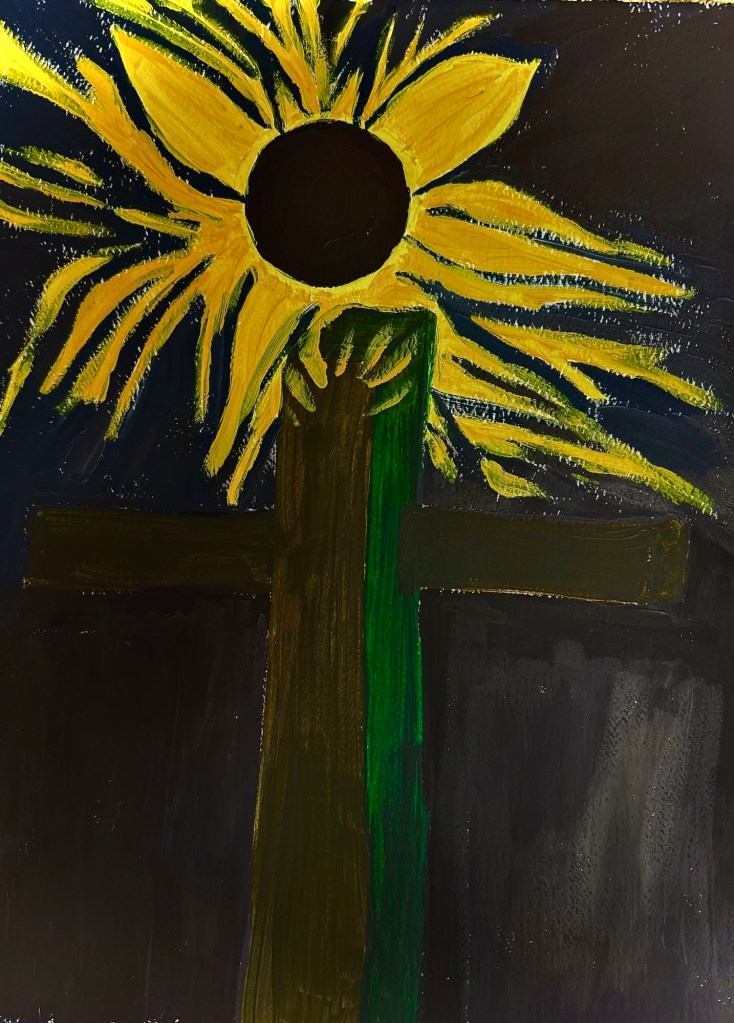
Gail S also completed an extra painting on the last day of our sessions as she remembered the Great American Eclipse from 2024. This was a pretty exciting time in town, with many of our financial institutions closing their lobbies out of caution because the local law enforcement agencies were out policing the crowds in the parks and downtown. (I guess they thought it was more difficult to rob the drive through tellers, since they couldn’t hold them hostage.) The sun’s corona is only visible during the darkness of a total eclipse. During ancient times, an eclipse indicated an important event, one that could end wars or topple dynasties. If we truly took our faith as seriously as those who were present at the event, we too would say, “Truly this man was God’s Son!” (Mark 15:39)
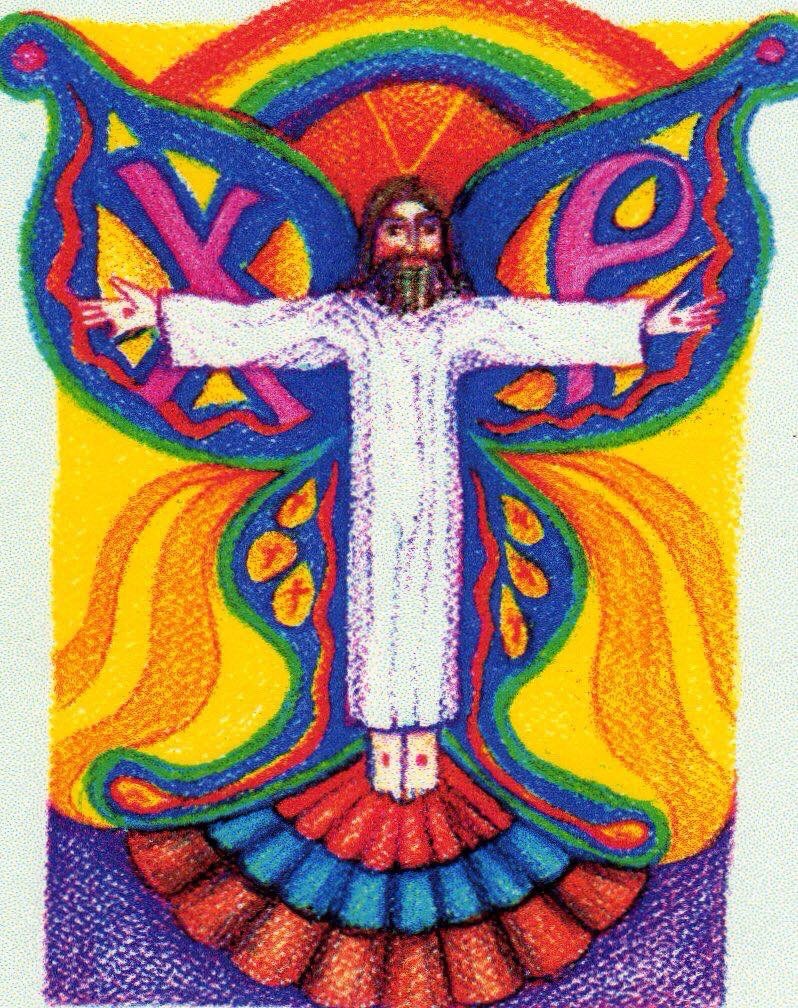
This image of the risen Christ has been with me since my first year of Seminary. I used colored pencils on heavy weight Arches watercolor paper, which leads to the white speckled effect because the paper is highly textured. I added a shell, for our baptism, and the Greek letters Chi Rho, which stand for the Chrismon, or the abbreviation of Christ’s name. This is also the sign Constantine saw in the sky when he heard the words, “In this sign you shall conquer.” He then instructed his soldiers to mark this sign on their shields before the battle at the Milvian Bridge in 213 CE. After this victory, Constantine declared Christianity legal in the Roman Empire. This is when many of the great pagan temples and holy sites became Christian churches or associated with healing miracles from the New Testament gospels. I also used the rainbow motif for the great promise from God to Noah in Genesis 9:12-14—
“When I bring clouds over the earth and the bow is seen in the clouds, I will remember my covenant that is between me and you and every living creature of all flesh; and the waters shall never again become a flood to destroy all flesh.”
Some people believe God has always been a harsh and judgmental being, but they are only projecting their own image upon God. If they read the whole of scripture, instead of individual texts taken out of context, they would discover God has always cared for the creatures and the creation God created in the first place. Even those who didn’t live up to God’s desires for their lives, God still cared for and provided for them.
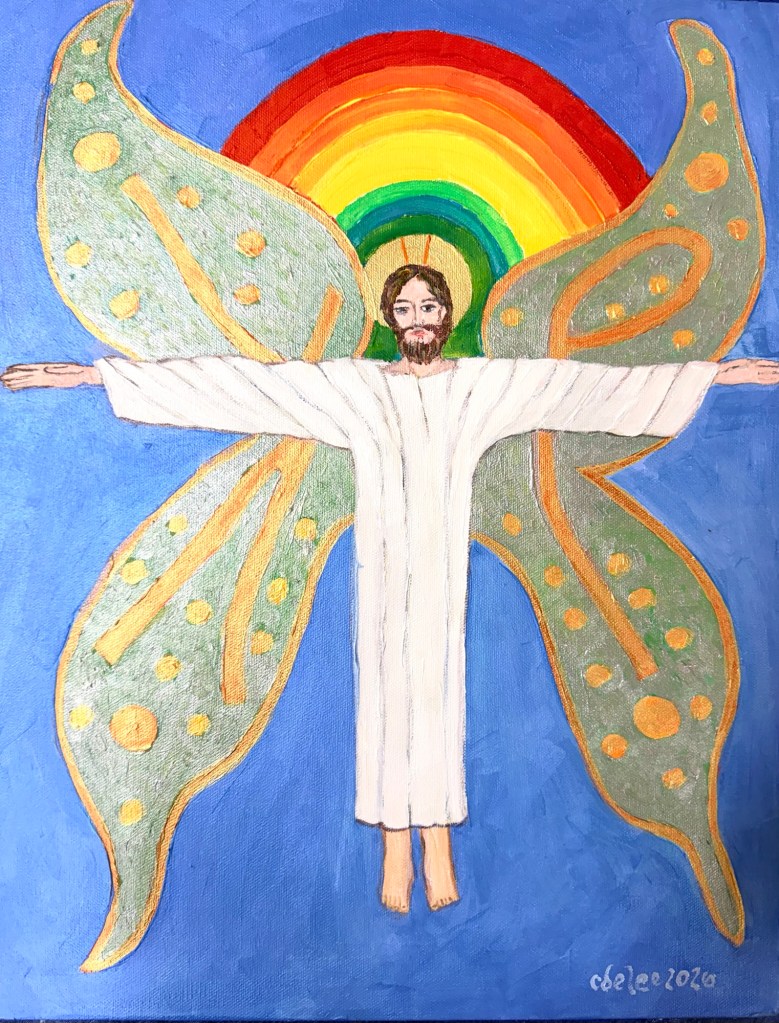
DeLee: Butterfly Christ, 2026, acrylic on canvas, 16” x 20”
When I revisited this theme thirty years later, after serving multiple congregations, as well as leading spiritual formation ministries and social justice ministries, the Chi Rho symbol is still a meaningful sign for me. Not only did Christians once use it as a secret sign to recognize one another, like the fish sign, but it also reminded them of the crucified Christ.
Sometimes serving, either as a volunteer or as clergy, can seem to be an onerous task. Often, we may think others take us for granted, or the weight of the world weighs solely on our shoulders. Whenever I got to flailing, I usually got a bad attitude. For an adjustment, I would go help someone in more desperate circumstances than myself. I would remember the compassion of Christ:
“Come to me, all you that are weary and are carrying heavy burdens, and I will give you rest.” —Matthew 11:28
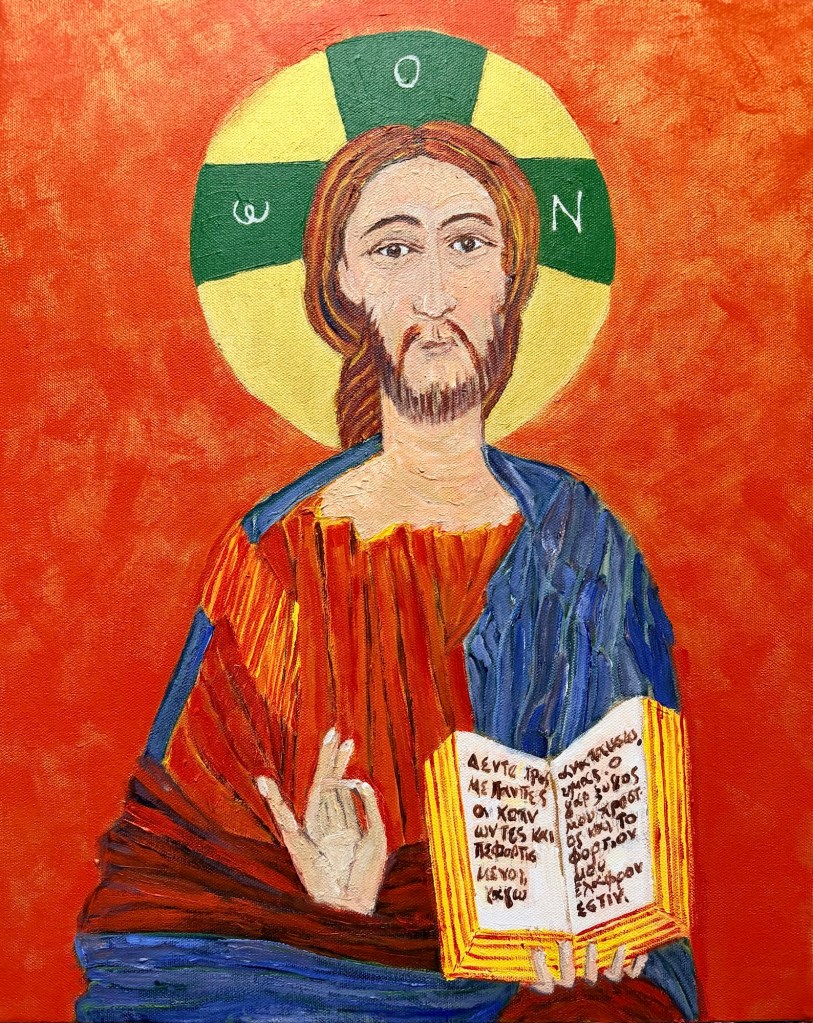
Today we outsource almost everything: we hire professionals to cook our meals, fix our plumbing, and do our yard work. In a few generations, we may even have robots that can do many of the jobs people can do today. Yet, we still need the human connection and satisfaction which comes from doing hands on ministry. When we make a difference in a person’s life, we experience a blessing in our own life. If we want to experience the risen Christ in our own lives, all we need to do is make a difference in the life of someone else in Christ’s name. As Malachi 4:2 says,
“But for you who revere my name the sun of righteousness shall rise, with healing in its wings.”
The resurrected Christ does not suffer, for the crucified Christ bore the pain of the disordered creation in his body. The resurrected Christ is a promise of victory over sin and death, so we may always have life and love. Anything less means we have not given our whole life to Christ. We have a helper, the Holy Spirit, who can energize us daily to make a deeper commitment to Christ. The resurrected Christ still carries the memories of the crucifixion, but the resurrection has transformed this trauma into a blessing for all creation.
The risen Christ reminds us of seeds planted into the dark ground (Mark 4). Some will rise up from the depths to provide beauty or nourishment for people, while weeds and thorns will choke out others, so they won’t grow. This is a reminder that wearing a cross around our neck or a fish emblem on our car isn’t what saves us, but the love of God that overflows in our hearts out into the hurting and broken world.
The healing power of God is for each of us, for “…you are a chosen race, a royal priesthood, a holy nation, God’s own people, in order that you may proclaim the mighty acts of him who called you out of darkness into his marvelous light.” (1 Peter 2:9) This is the best reason Good Friday is good, indeed. The gift of Christ to make us one with God and whole with God is finally complete. “God became human that we humans might become as divine,” is how the early church explained the Incarnation. Most of us understand the gifts at Christmas celebrating Christ’s birth, but we have difficulty understanding God’s great gift to us at the Easter Season. If we can understand that we can have a new life in the dying and rising Christ, we will live with joy and hope.

As we move toward the Ascension of Christ and the coming of the Holy Spirit at Pentecost, I hope each of you “take up” some creative endeavor: plant a garden, learn to knit or crochet, try some new recipes, learn how to do some simple home repairs, or take up a new mission at your church. You might not be excellent on your first efforts, but all new challenges are learning experiences. Stick with it, and you will find your groove. Relax, and remember, it’s not like you’re doing brain surgery!
Joy and Peace,
Cornelia
ἁρπάζω | Free Online Greek Dictionary | billmounce.com
https://www.billmounce.com/greek-dictionary/harpazo
ἀναλαμβάνω | Free Online Greek Dictionary | billmounce.com
https://www.billmounce.com/greek-dictionary/analambano
The Chi Rho Symbol – EARLY CHURCH HISTORY
https://earlychurchhistory.org/christian-symbols/the-chi-rho-symbol/

 Artandicon's Blog
Leave a comment