After a long dry spell due to attending to other important matters, such as the taxman and the excitement of my annual conference, I have returned to my studio with pent up joy for painting. While all of us need to take care of the business of everyday life, I am finding I move more slowly as I age. This is normal, yet my mind has not yet fully grasped this consequence. I speak of consequences because when I was younger, I rocked and rolled all night and worked all day. As Bon Jovi says, “I will sleep when I’m dead!”

Consequences have always been important to the makers of myths. The Greeks and Romans shared a wisdom tradition of moderation and the middle way. They even had a name for it: the Golden Mean. Aristotle defined the basic principle of the golden mean 2,500 years ago as moderation or striving for a balance between extremes. Depending on the circumstances, a person practicing the golden mean might make different choices. Since all choices have consequences, even not choosing has a consequence. Therefore, if we are to practice wisdom, we also must consider the unintended consequences of our choices.

This is where the Ancient Greek myth of Icarus gets interesting. Icarus was the son of Daedalus, a skilled craftsman, who built the famous labyrinth on Crete for King Minos to imprison the Minotaur, a half-man and half-beast, who was the product of an illicit union. Daedalus had built a wooden cow for the queen to hide inside so she could mate with the white bull Poseidon, the god of the sea, had gifted to her husband. He was supposed to have sacrificed it to the gods but decided to keep it for himself instead. The gods punished the king by causing the queen to yearn unnaturally for the animal and she had a half human/half beast child as a result. When Theseus arrived as part of the annual sacrifice to the Minotaur, the princess fell in love with the handsome tribute. Daedalus gave her a ball of string so Theseus could find his way back out of the labyrinth. When Theseus killed the Minotaur, he and the princess escaped from Crete. The gods were angry at the king for keeping the sacrifice for himself, and the king took his anger for his wife out on Daedalus by putting him into prison.

Daedalus then used his craftsmanship to build a set of wings for him and his son. As the Roman poet Ovid wrote in Bk VIII:183-235, Daedalus and Icarus (translated by A.S. Kline, sourced from University of Virginia):
“He laid down lines of feathers, beginning with the smallest, following the shorter with longer ones, so that you might think they had grown like that, on a slant. In that way, long ago, the rustic panpipes were graduated, with lengthening reeds. Then he fastened them together with thread at the middle, and bees’-wax at the base, and, when he had arranged them, he flexed each one into a gentle curve, so that they imitated real bird’s wings. His son, Icarus, stood next to him, and, not realizing that he was handling things that would endanger him, caught laughingly at the down that blew in the passing breeze, and softened the yellow beeswax with his thumb, and, in his play, hindered his father’s marvelous work.”
After finishing his work, Daedalus flight tested his wings. Then he gave instructions to Icarus:
“When he had put the last touches to what he had begun, the artificer balanced his own body between the two wings and hovered in the moving air. He instructed the boy as well, saying ‘Let me warn you, Icarus, to take the middle way, in case the moisture weighs down your wings, if you fly too low, or if you go too high, the sun scorches them. Travel between the extremes.”
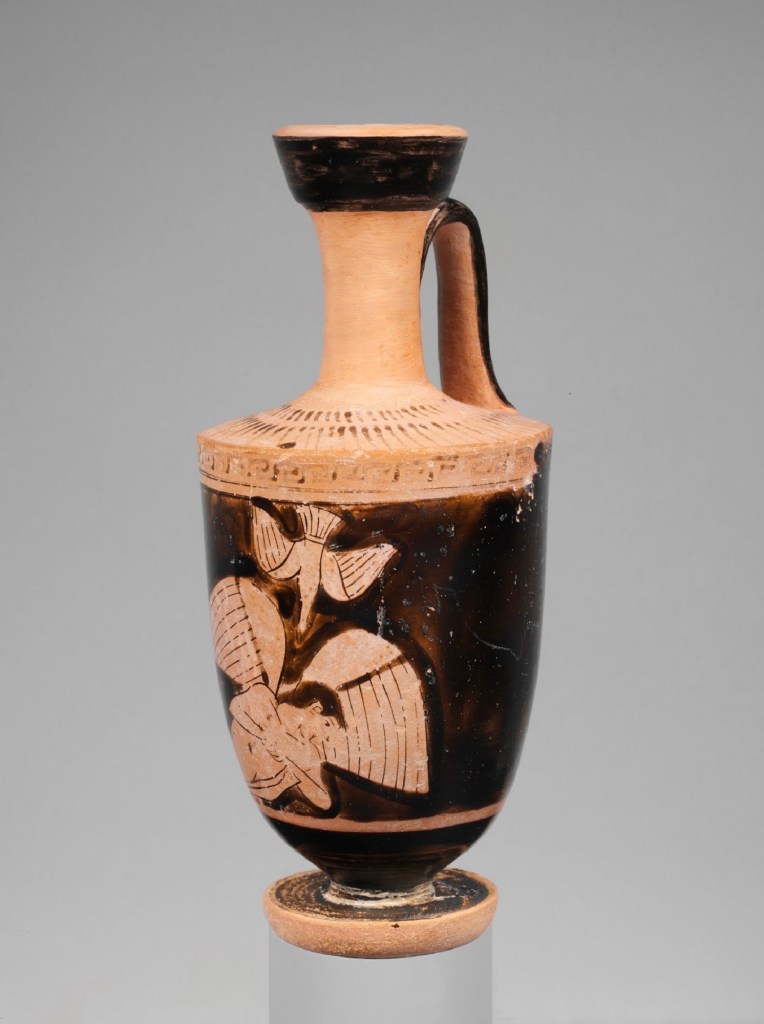
“The middle way is safest and best.”
This is the Goldilocks principle of today: “not too hot, not too cold, but just right.” When I taught art classes, even my kindergartners understood the Goldilocks principle. They did not need to know this was Ancient Greek wisdom or biblical wisdom tradition. They understood they could take a work too far, which sometimes they did. It did not matter in the great scheme of things, for art is always a learning experience. Sometimes they lost the work in the excitement and energy of making the marks, just as Icarus lost his feathers when he flew too high near the sun.
“His nearness to the devouring sun softened the fragrant wax that held the wings: and the wax melted: he flailed with bare arms, but losing his oar-like wings, could not ride the air.”

The good news in art class is we do not have an infinitely deep ocean ready to receive our helpless body as it falls from the great height to which it has soared. We can always start over tomorrow on a fresh canvas or with new clay or other media. Our failures in the studio are transitory, while Icarus lost his one and only life by not attending to the one principle which would have saved it. Actions have consequences.
The authors of the Archaic and Classical Greece literature we have today wrote at about the same time as the Hebrew Bible’s various compositions. Indeed, “Ancient Greece” included colonies close to Ancient Israel and Judah. The historical memory these writings preserve have similar chronological structures. Many of the traditions that interest us today come from the middle of the first millennium BCE but look back to events that the authors of these texts tend to understand as having occurred roughly the same amount of time earlier; they place their legendary eras in approximately the same region of time. They also come from “similarly fragmentary contexts,” meaning we only have a small proportion of what there once was, and now we must guess about how popular or representative any given story could have been.
An example of a Greek wisdom proverb is “Works by young men, advice by middle-aged men, prayers by old men,” as quoted in Hesiod’s “Works and Days.” The philosopher Aristotle would give such seasoned middle-aged advice as these gems:
Courage is the middle way between cowardice (deficiency) and recklessness (excess).
Confidence is the middle way between self-deprecation (deficiency) and arrogance (excess).
Generosity is the middle way between stinginess (deficiency) and profligacy (excess).
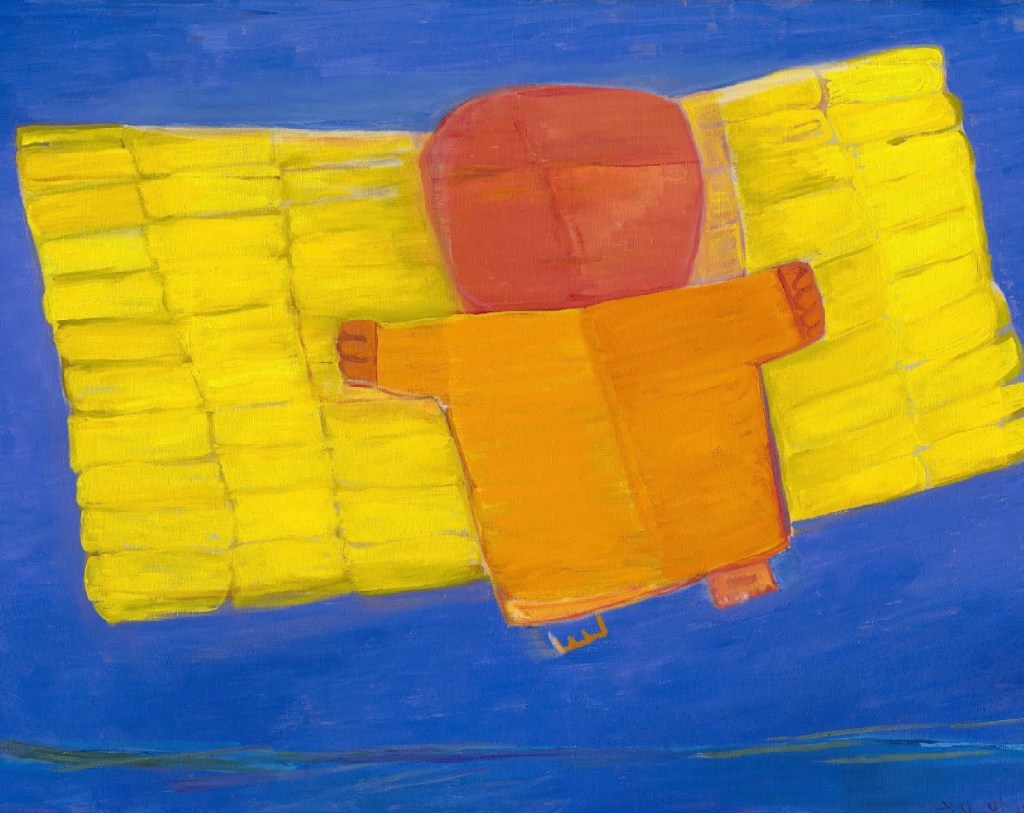
In the Greek and Roman myths, those who fly too high or try to make themselves equal to the gods never end well. Icarus is a classic story of not listening to advice from the more experienced generation. I once believed “no one over age thirty had anything of value to contribute to my personal situation and experience,” but I can now say with the added experience of a good half century of living beyond this age, “the middle way is safest and best.”
The extremes of courage in war and life are sometimes only the Golden Mean in that given situation. Doing nothing would be one extreme, running away would be the other extreme. Going headlong into danger is the actual middle path. In life we make decisions which not only to benefit ourselves, but every choice we make affects others. I have friends who complain vociferously about Big Pharma and all the other large corporations that make decisions on our health. They forget their own genetic makeup and their childhood eating habits, for which they were not responsible, affect much of much of their own health. We also cannot make up in our last two decades for six prior decades worth of stress, poor food choices, lack of exercise, and environmental pollution. The cartoon song, “Let it Go,” is good advice for most of this stress. We can make our best choices now and live with whatever comes later with equanimity. Reducing stress is always a golden mean choice. Taking a pill will not make much of a difference in our health if we also do not alter our lifestyle. Also change takes time.

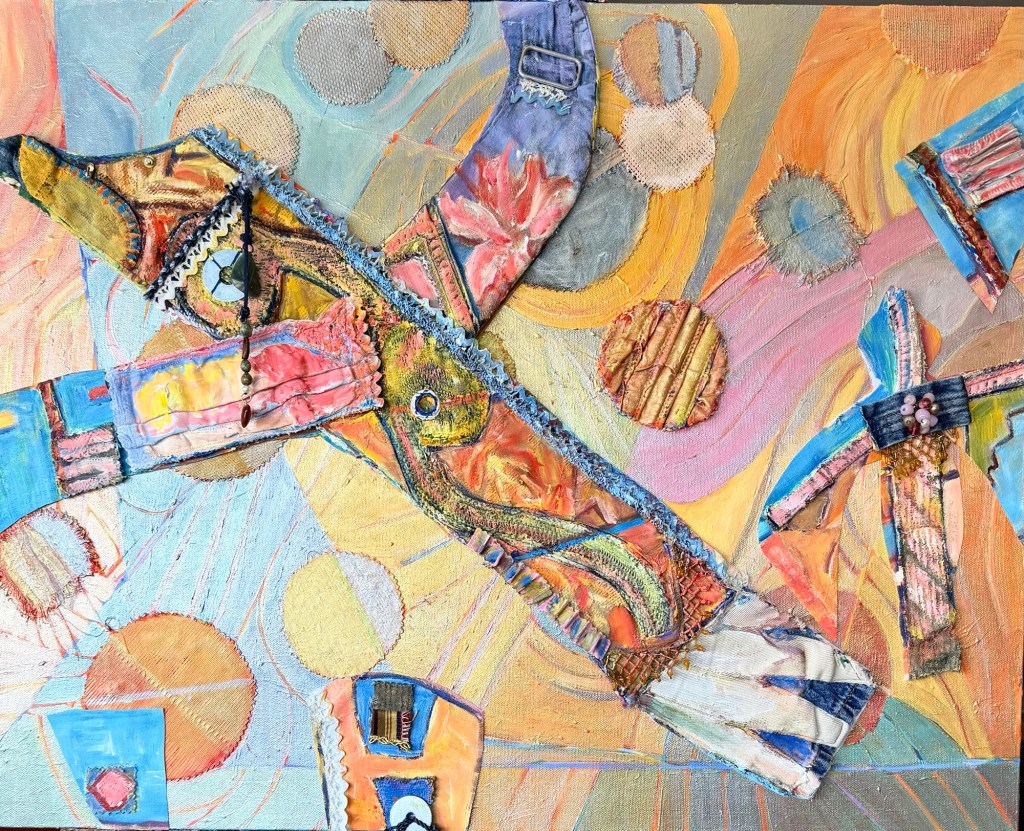
To make this work, I took an old painting from the era when I was doing Google map inspired works. I removed it from the wooden supports and cut out a bird shape, keeping the embellishment intact. Then I cut off the glove and cut another bird shape out of the large diagonal motif. As I thought about Icarus flying, I could see him among the seabirds swooping up and down on the waves of the winds. As Icarus flapped his newfound wings, he must have rejoiced at the flash of freedom he now shared with the birds. In his joy, he forgot he was not a bird with real wings, only a boy who thought he was a bird. I had made this old artwork from a handmade preaching stole using denim fabric and a garden glove, along with beads and metal washers. I repurposed the glove as a tail for the Icarus/bird.

Finally, I took a few of the scrap pieces and cut wings for the birds which are flying on the outer edges of the space. I glued it all onto another old artwork of shimmering suns. This is the moment of exuberance before Icarus’ fateful consequence happens. If we are inexperienced, we will not know the stove is too hot until we touch it. Our modern stoves are well insulated, unlike the iron monstrosities of yesteryear. We still keep our children away from the stove with the warning, “No! Hot!” Even so, at least one child will test this concept when our back is turned. This is why children under the age of 3 years are most likely to have a burn or scald in the home. Parents need to have “eyes in the back of their heads,” or at least always consider what would be the consequences of their actions or the unintended consequences of a different choice.
I am sure Daedalus hoped Icarus would listen to his advice and take the middle path, but Daedalus had always been craftier than he was wise. The ancient myth says in a pique of jealousy, Daedalus had killed his own nephew, who invented the drawing compass and the saw. This act brought Daedalus to Crete, where he used his talents to make that wooden cow to deceive both man and the gods. And now the Minotaur story has come full circle. Some of us live long enough to learn from experience, which is an extremely expensive education. Regret, death, and tragedy are part of the human condition, while the gods live on eternally in Greek and Roman mythology.
The wisdom of Ecclesiastes 8:6-9 reminds us:
“For every matter has its time and way, although the troubles of mortals lie heavy upon them. Indeed, they do not know what is to be, for who can tell them how it will be? No one has power over the wind to restrain the wind, or power over the day of death; there is no discharge from the battle, nor does wickedness deliver those who practice it. All this I observed, applying my mind to all that is done under the sun, while one person exercises authority over another to the other’s hurt.”
Even back in biblical times, people in power took advantage of the powerless and oppressed them. Today is no different. The great oral tradition on which the book of Genesis is based has a character we know all too well, as we read in 3:1—
“Now the serpent was more crafty than any other wild animal that the LORD God had made. He said to the woman, “Did God say, ‘You shall not eat from any tree in the garden’?”
Being more crafty in this instance is this creature’s ability to twist the meanings of words and get the humans to doubt God. Listening to God is the best choice, the Golden Mean! Listening to the snake is not going to end well for Adam and Eve, as we find out later.
When we cook a soup, we add spices and salt it, then simmer it for a while until the flavors come together. Then we need to taste it again to adjust the seasoning. If we are experimenting with a new recipe, we might need to do some real adjusting! If this is a well-known recipe, we might already be close and not need much of any adjustment. The same goes for a painting. We might put down the rough layers of the painting first, then go away and look at the work with a fresh eye. Then we can paint again, but eventually our inner sense tells us to stop and set the brush down. This inner voice comes from experience and from listening to the painting.

Artists who believe they can imprint their will upon the canvas will eventually succumb to pride. The creative spirit will dry up, for this spirit does not come just from one’s skill or training. It is a cooperative process between the medium and the imagination of the artist. If the artist is humble enough to open themselves to the spirit of the subject matter and their media, then they can bring a truth to their work that is free of tropes and stereotypes. Then we will be the clay, and God will be our potter; for we are all the work of God’s hand (Isaiah 64:8).
In every work, we artists seek the Golden Mean—that point at which if we add even the one more stroke, we will have done too much. To do this dance of the Spirit, we must be open to the silent voice only the most sensitive people will hear. We cannot call it out, but it will call to us when it is ready.
This is a case of turning up the thermostat to heat your house more quickly. If you want the home to be 68F, putting the thermostat at 80F will not rush the process. Your home will reach optimal temperature when it is ready, no matter high how you set the thermostat. We need to breathe and wait. The voice that says, “Quit working!” means it! Step away from the canvas and set down your brush. Walk away and come back for a fresh look. If you are unsure, leave it for another day. Come back after a good night’s rest. Nothing is sadder than to crash into the sea like Icarus. In art terms, this is when we try to push past our limits. Seek the Golden Mean and keep your wings dry.
Joy and peace,
Cornelia
Ovid’s Icarus – The Rise of Icarus: The Resurgence of The Fall of Icarus as a Modern Myth
Approaching Comparisons with Ancient Greek Traditions | Bible Interpretation
https://bibleinterp.arizona.edu/articles/approaching-comparisons-ancient-greek-traditions
Proverbs and Wisdom Traditions in Archaic Greek Culture
Severity and Clinical Outcomes of Pediatric Burns—A Comprehensive Analysis of Influencing Factors – PMC
https://pmc.ncbi.nlm.nih.gov/articles/PMC11355916/
Daedalus | Achievements, Art, & Myth | Britannica
https://www.britannica.com/topic/Daedalus-Greek-mythology


Leave a Reply