How to do it as an artist or any other professional. 
Or lollygagger in the workplace.
I personally like #8—Why don’t you ever paint landscapes in normal colors?
![]()
![]()
Not everyone has an icon of a Christmas tree. I made this “holy image, worthy of reverence and honor, a window into heaven,” while appointed to a church which venerated its symbols of Christmas more than the Christ who brought the day into being. Of course, they didn’t see it this way. When they elevated the giant chrismond tree and blocked the view of the large cross, they only thought of staging the tree in its best glory. These were the same folks who wondered if we would have a “come and go communion service” on Christmas Eve instead of candlelight, carols, and communion. It would fit their busy schedules so much better, after all.
Sometimes we need to remember Christmas isn’t about us, the tree, or the gifts. I made these icon trees as a reminder to myself more than anything. PEACE is the greatest gift our world needs today. We need not only peace among nations, but also among peoples, and within our own hearts. If we aren’t at peace, we won’t find it wrapped in a package. The bill will arrive in January, and then we’ll really need peace!
I no longer have this bejeweled icon. Once it was a satire, a comedic take on a tree more holy than the God whose birth it celebrated. Then it transformed, taking on its own holy purpose when I gave it away to a young family. They’d had a rough spell that year. Dad was working part time at the storage units where I keep the things that don’t fit into my condo.
They didn’t have money for a Christmas tree. I took them some of my extra decor along with some encouragement. The latter may have done more good, but the tree of peace, funky as it is, was an outward and visible reminder of god’s love and care of his hurting children. If we can’t be the Incarnation of Love come down at Christmas, will we be the embodied Christ of Love for the world on any other day of the year?
Be present for the world, rather than looking for presents under a tree.
Irrepressible sleepiness–it comes over one at times.
My night class on World Religions at seminary with Ruben Habito began with silent breathing. Centering, he called it. Some of us called it falling asleep. A long day of work or classes, or both, with a short night of sleep before an early morning wake up alarm marked our days back then. We were fueled by liquid caffeine and too many carbs. We ran on the adrenaline of excitement and the necessity to cram two lives into one day. We were crazy people, but we didn’t know it.
We didn’t realize the gift of silence and quiet our zen master was offering to us. We were doers, not accustomed to being. To be silent, still, and to breathe in and out as we sought an unmoving center after the hubbub of our day was our bedtime ritual, not a preparation for learning. More than a few of us crossed over into LaLa Land.
Some time during the class, we would return to this world, much refreshed from our power nap. We could get any notes we missed from a less sleep deprived classmate. Our zen master was also a priest, who knew our needs and offered this gift of ministry for his congregation. He wasn’t bothered by our sleeping through his lectures, for if we needed to rest, God would take care of our learning elsewhere.
When I went out as a pastor in the church, I remembered this lesson of grace. When people fell asleep in church, I knew God would bring the message to them later from the ones who stayed awake. If their lives were so out of whack they needed to sleep in church, I needed to pray for them. After all, it’s not about me, it’s about God.
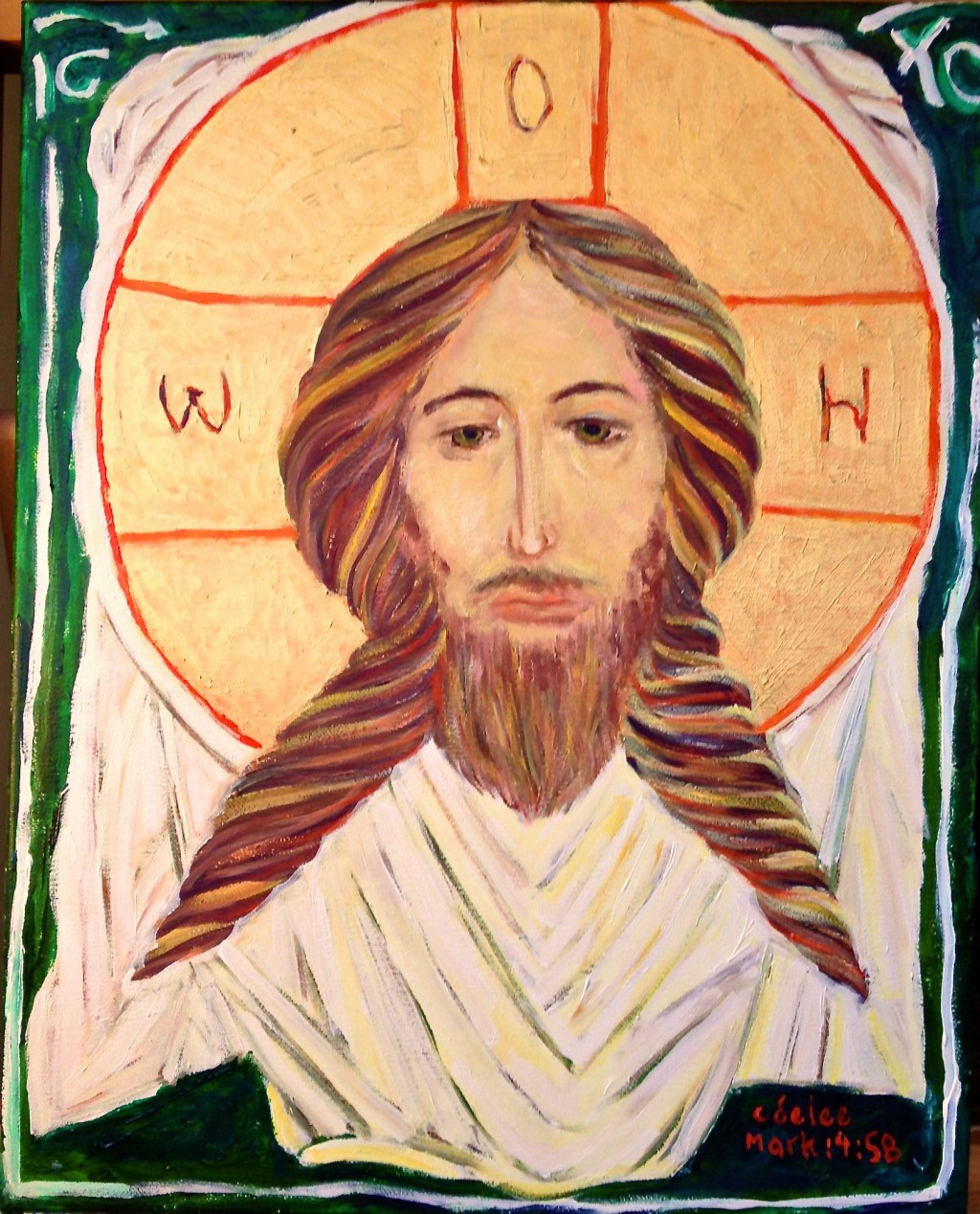
“I have said this to you, so that in me you may have peace. In the world you face persecution. But take courage; I have conquered the world! — John 16:33
Cornelia DeLee: Christ Overcoming the World, acrylic on canvas, 2015. (36″ X 36″)
Actually, that’s my stunt double. Just like Chuck Norris, I’m too brave to cry. Or, the heat dries up any form of moisture that escapes my eyes. The stuff oozing from my pores is a different matter altogether. I think those 3,000,000,000 holes scattered across my body are each an eye leaking the tears our real ducts can’t cry.
The real Chuck Norris never sweats. He breaks any sweat that comes near him. Sweat is afraid of Chuck Norris, for he is the epitome of cool. How cool is Chuck Norris? We could defeat global warming if we unleashed his massive forces of chill. His sustained energy could bring down the ocean’s temperature by 4 degrees. In fact, Chuck Norris has the cooling equivalency of two Antarctic continents plus the Arctic ice cap.
Many things make my stunt double cry. Mostly they are those events, situations, or conditions that I cannot fix or make better for someone else. I spent years helping my daughter try to overcome the effects of her abuse. Others also gave their best efforts also. Her mental illnesses haves always impaired her ability to trust others or to stay on a treatment plan. Once she became an adult, she could choose, even if she didn’t make good choices, or have the ability to choose well.
I could cry about this forever, or let my stunt double have this role. I chose to grieve about this loss, shed enough tears, and find a way to live my own life by meeting the hopeless, the suffering, the despairing, the lost, the victims, and the ones “who’ve been down so long , it looks like up” to them. After all, this is where Christ met me. I knew if he could reach into my dark pit and pull me up into the light, if I offered Christ to others, he would the same for them.
When I get to the point of dragging out my Chuck Norris stunt double, I know it’s because good old Chuck is a cultural Christ figure. When I want a power for good to make a difference in my world, I call on this Texas Ranger. Instead, I should call on the spiritual power that flows through me:
“My soul clings to you; your right hand supports me.” (Psalm 63:8)
I may not be able to relieve the suffering of any one person, but I know God in his mercy understands and has compassion on all who suffer. God didn’t withhold God’s own son, but gave him up to suffer for all of us (Romans 8:32). Through this suffering we are united with those everywhere who experience wretchedness of any sort. Too often we hear that the winners of this world are our heroes, but faith tells us that those who lose their lives will gain their lives.
If we are to best grow into the Christ life, we cannot forget those who suffer while we are being healed, nor those who hunger or thirst while our stomachs are full. The real Chuck Norris would not send his stunt double to do good in this world.
Recently a male acquaintance of mine had the temerity to suggest that perhaps I might need one of those buttons that calls for help to a distant monitoring site. I had told him I’d been sick and he knew I lived alone. I was feeling much better by then and retorted, “As long as I can walk the around the 1.5 miles of Mercy Hospital, I don’t need a button that says I’ve fallen and can’t get up!” He escaped my wrath by a quick exit into the elevator. Indeed!
“I can do all things through him who strengthens me,” Paul said of Christ to the Philippians (4:13). Isaiah reminds us that God “gives power to the faint, and strengthens the powerless. Even youths will faint and be weary, and the young fall exhausted; but those that wait upon the LORD shall renew their strength, they shall mount up with wings like eagles, they run and not be weary, they shall walk and not be faint.” (40:29-31).
With verses like these ringing in our ears, well meaning people of faith do great harm to God’s gift, which is God’s own image, whether male or female (Genesis1:27). We run our precious images into the ground until they are flat exhausted, burnt out, overwhelmed, physically sick or plain old addicted to either the work, the adulation, or some other less desirable habit. We forget that the one person who is “the image of the invisible God, the firstborn of all creation” (Colossians 1:15) is also the same one of whom was said, “And the Word became flesh and lived among us” (John 1:14). John’s gospel alone mentions that “Jesus, tired out by his journey, was sitting by the well” (4:6). No other gospel author speaks of the Lord’s humanness as does John. If Jesus can get tired and need rest, why is it we who follow him cannot do the same thing?
We think we are being good shepherds by being always at work, always on call, always at work. I have clergy pals who feel they have to justify their exercise time as “prayer time or sermon preparation.” I have other friends that have worked themselves into the hospital with exhaustion, yet tried to leave against medical advice just to do someone’s funeral because they were jealous of another pastor coming into their church. The stress of disaster relief efforts in addition to all our other responsibilities can be the straw that breaks the camel’s back. Hurricane Gustave in 2008 put several of us in lower Arkansas into the hospital with stress related heart events. Fainting into your spaghetti at the community meal gets you a free ride to the local hospital, even if you go under protest!
I won’t begin to list the side effects of all this stress on our precious bodies, other than to say that when we put ourselves under this much stress, we eat more comfort foods, we exercise less and we sleep less. All these acts cause us to eat more comfort foods. If we really want to live a Jesus lifestyle, start walking! Give up your need to be a Ken or Barbie doll perfect person and tell your people you are going out to find the lost sheep.
The lost sheep is your identity as a child of God, not your calling as a pastor or your ministry in the church or the world. It isn’t how you make your money as a banker, a mechanic, a coder, or a salesperson. This isn’t you as a mom or a dad, but you as God’s own child. If you are feeling lost in the role of what you do, you are a lost sheep. This icon (image) of the Good Shepherd should point you to the only one who can find you and bring you home safely from the wilderness. If you are with him, you stand under the tree of life, whose leaves are used for healing. Your wounds will be healed and you will heal the wounds of others also.
For further reading, a classic spiritual text is Henri Nouwen’s THE WOUNDED HEALER
“If we say that we have fellowship with him, and walk in darkness, we lie, and do not the truth…” ~~ 1 John 1:6
Oh, Paula Dean, the Butter Queen! Once you were everywhere seen,
but now you just seem awfully mean. Or were you just good at hiding your true self until you got so big that you thought you were untouchable? Worse, did you lose your good self in the chase for fame and fortune as you left your humble startup beginnings behind you?
The famous Peter Principle may be at work here: we will all rise to the level of our incompetency. As befits our food metaphor, “The cream that rises to the top always sours.” The further up the food chain we go, the more we are surrounded by “yes-sayers.” These are folks who approve our every whim and never tell us “no.” Like politicians, movie stars, athletes, and anyone else in a position of power, those who surround them say, “yes” so that they too may stay in the shadow of power also. Sometimes these folks need someone to tell them NO: “No, Justin Bieber, having a monkey isn’t a good idea if you’re traveling to Europe.” “No, Tiger Woods, having affairs with umpteen hot honeys isn’t smart if you want to keep your wife and baby and sponsors happy.” “No, Lance Armstrong, blood doping is wrong, even if everyone else is doing it.” We really wonder why no one said, “NO, Paula Dean, allowing racist or sexist comments and pornography at your restaurants isn’t a good idea.” (http://www.nytimes.com/2013/06/26/dining/paula-deens-words-ripple-among-southern-chefs.html?pagewanted=1&_r=2)
Our first knee jerk response is to support Paula Deen because she is a southern gal who made her way up to the big time on her own. She is a real rags to riches story and this resonates with us, for if she can do it, any of us can have a shot at the American Dream. Along the way she became a caricature of her former self, or an actor playing a part. When Ms. Deen was diagnosed with Type 2 Diabetes, she kept this illness a secret and continued to produce recipes that were toxic to persons with her disease (http://www.businessinsider.com/paula-deens-10-most-unhealthy-recipes-2013-6?op=1).
Only much later did she reveal her disease, and then as a paid spokes person for an anti-diabetic pill. Some would say this is crass, and not sass. The proof is always in the pudding, as my Nannie used to say. Her cooking show on the Food Network lost audience share over this issue of untruth. When her show was up for renewal, the Food Network cut her expensive show to concentrate on their reality/competition food shows that appeal to a younger demographic. (http://online.wsj.com/article/SB10001424127887323998604578567832751771860.html)
The floodgates opened: her tears flowed as fast as her partner companies dropped her. Why was she not forgiven? She said, “I’m sorry? I said something wrong years ago, but that’s not me!” It seems that it may not be so. She may not be able to tell the difference between the sweet gal she used to be and who she is now. (http://www.businessinsider.com/paula-deens-controversial-career-2013-6
When King David was confronted with his sins of adultery and murder, he repented before the LORD and asked God to “create in (him) a clean heart, and put a new and right spirit in (him)” (Psalm 51:10) When we recognize the wrongness of our former ways, we ask God to help us change so that we can become a different person and leave our old ways behind us. When the doctor tells you that you are now a Type 2 Diabetic, this is usually a wake-up call for most people. This diagnosis changes your whole life from the food you can eat, to the exercise you must have, and the constant monitoring of your blood sugar. You learn to read the nutrition labels on packaging, discover that processed food is off limits for you because it’s mostly carbohydrates, and you discover how to cook from scratch. You throw away your Paula Deen Cook Books because they are the “pellets with the poison” and learn to cook from scratch using whole foods from the perimeter of the grocery store.
We can’t live in the darkness about Diabetes or its precursor (reactive hypoglycemia), but must share our condition. I personally have found that no one makes meals on retreats that are suitable for my health needs, so I usually pack in extra foods and have them for my own meals or snacks. Otherwise I will be fed a high dose of carbs, which will make my blood sugar crash and I will be irritable. I don’t consider this to be my “true personality,” but if I eat the wrong food, I’m not a kind person.
When Paula Deen failed to have her heart changed, or her “come to Jesus moment,” she failed to realize that what she did in the past is still continuing in the present. She became more like Lance Armstrong who came to the first stage of the Tour de France this weekend and said, “winning wouldn’t have been possible in (his) era without doping.” They both act as if the worst thing they did was to get caught, but they don’t have real remorse for their act itself. This is what we call “walking in darkness…and do not the truth.” Paula had Diabetes 2 and continued to build a $16 million dollar empire with recipes that bring on the condition. Tiger Woods and Martha Stewart got rehabilitated because they took time off (Tiger in sex rehab and Martha in jail) and had the opportunity to strip away all the circus of fame and power to get down to the person, to the human being that puts on her blue jeans one leg at a time, that ties his sneakers one shoelace at a time. They discovered their true selves again, found their roots, reconnected with their faith, and met others that had made a mess of their lives. Sometimes we have to break down, take our consequences and take our losses before we can appreciate forgiveness and redemption.
She was on the buttered slippery slope months ago, but this “fall from grace” may be just what Our Butter Queen needs. Ms. Paula will have a “time out” from the excitement of power to enjoy the humility of her own life again, and to remember who she is, where she comes from, and to whom she owes her success. When she recovers her true self, she may find that God will call her to a new mission, a hopeful, and a healing mission. After all, nearly 155 million Americans adults are overweight or obese, including our very own Butter Queen. Add to this number 24 million children and the number of butterballs rolled in sugar is amazing. I include myself in this number, for my BMI is 34.2 (above 30 is obese) (http://www.mayoclinic.com/health/bmi-calculator/NU00597).
Perhaps Paula will recognize that her recipes contribute to her disease and to America’s obesity epidemic. If she uses this to remake herself into something new and better, more humble and more honest, and if her recipes reflect this, she has an opportunity for redemption. However, if she brings back the same old package back with the high calorie, high fat contents, I think the shelf life of her product has hit its expiration point, for people today want honesty and authenticity in their food and in their relationships.
How can we have an authentic relationship with God and with other people? God is willing to forgive our sins, even if we think they are unforgivable. The world may hold a grudge against us for a long time, for this is the way of the world. God is not of this world, for when the world will not forgive, God will. When the world remembers, God remembers our sin no more (Isa 43:25). All we can do is to love as God loves, forgive others as God forgives us, and live a new life in love as God enables us.
To help clean your heart, take press on letters or stencils, or use a large font on your computer. Write out your negative aspects/sins/imperfections/brokenness. We all have them. If you need a kick start, google “7 deadly sins.” That should get you started! Once you have those printed out on your paper, then write in large open letters (stencil font) the word “LOVE” or “PEACE”. Color it as you feel led. Use this as a prayer focus this week.
“The horse is made ready for the day of battle, but the victory belongs to the Lord.” ~~ Proverbs 21:31
As I journeyed with my group along the Silk Road on the fourth day of our pilgrimage, we saw the twin peaked volcano Mount Erciyes, on which St. George of Cappadocia was said to have slain the dragon. As we made our 400 miles across the sunlit fields with poplar trees into the tufted fairy mountain volcanic formations, I had several conversations about art and artists with my fellow travelers. We had visited the Firca Ceramic Factory in the morning. The artisans there explained their apprentice program and the process of training to become a master potter. Not everyone makes the cut, of course, but they can still be employed at the level of tradesman or tourist ware producer.
For people who have no concept of the time, effort, sensibility or spirit that is necessary to produce a great work of art, this “educational session” went right over their heads. Others had their “consciousness raised,” as we used to say back in the old days. This latter group happily gave a fair price for the extraordinary works of these artists’ hands. I myself brought home a small plate of colorful fish to remind me that I am always called to “fish and to catch the hearts, souls, minds, and bodies of others for the sake of Christ and his church” (Matt 4:19).
At lunch I visited with one of my new friends. She asked, “Why did it take Michelangelo so long to paint the Sistine Chapel?” Because it was fresco—fresh plaster. He could only work while the plaster was wet. Bodies with clothes and landscapes went quickly, but nudes and faces were painted more slowly. If we could get up close we could tell by the edges and lines how much he did in a sitting. “Oh. Everyone who saw the chapel on our tour was kind of bored with it all. Now I understand why it was so important.”
I realized it’s because not many of us make art anymore, just as most of us don’t can jams or jellies. We also don’t quilt, knit, crochet or embroider. We buy our clothes premade and our foods prepackaged. Cooking from “scratch” is a lost art. We don’t seem to want to dirty our hands any more with the creative process. Instead, we have lost the spirit that calls us to enter into battle with the raw materials. We are a people without faith that God is with us in these fights. It is as if we are afraid to risk losing the battle, so we do not enter the fray.
I have recently been teaching art to prekindergarten children. The first thing I had to teach their classroom teacher was that “failure in art is part of the process of learning how to succeed.” In other words, it’s not the finished product of polished perfection that we seek, but the child’s growth in using the tools correctly and their creative response to the imagination challenge of the day.
The second teaching principle was allowing the child to do his/her own work. Many of our parents have “taken over” doing for our children so they can have a good outcome. These children will have poor motor skills and will not be self-sufficient when they grow older. They will be less independent and less confident. However, they can master skills in art class that can give them a sense of self-esteem that comes from accomplishing a task, taking charge of their own work, and creating their own designs from their own fertile imaginations.
The third principle about art is joy, and I usually don’t have to teach this to the children. They love to play and the colors, materials, textures, and tools are great ways to explore the world in play. For adults, however, art is about the finished product from the get-go, so we worry that our idea will not come across on the canvas or paper. For the work to come alive, the artist must let go of that original idea and go with the image that begins to come to life on the canvas. Sticking with the old idea is like staying with the old battle plan when the lines of engagement begin to shift. We all know what happened to General Custer at Little Big Horn. The same death will happen to our creative product if we don’t pay attention to the new information coming t us from the front lines.
Likewise, in our lives, we don’t listen to the battles going on in our hearts, minds and bodies. Some might call this our conscience, or that voice that whispers “this isn’t right for you.” That other voice that whispers so sweetly, “but everyone else is doing it…” is like St. George’s dragon, or the personification of evil. Flip Wilson’s character Geraldine used to say, “The Devil made me do it!”
We can go along with the “demon voice” of “everyone else is doing it” and discover that our moral standards are at the lowest common denominator, and we make decisions not on any ultimate truths or standards, but on conditional and relative criteria. The ground is always shifting under us, like a mountain about to erupt. If we refuse to fight this particular dragon and “go along to get along,” then either our mental health or our physical health will begin to fail us. We may intellectually marshal the arguments of reason for our refusal to do battle against this insidious dragon, but like the fiery beasts of the old tales, they will surely begin to ravish the countryside. In this case, the country isn’t Cappadocia, but the heart and mind of the one who needs to gird the horse for battle.
Many of our modern illnesses are related to stress, which comes from having to reconcile two discordant tunes in one’s head. Only when we can fine that one tune to hear will we be both well and at peace. Another image is trying to “spot paint a wall that was painted too many years ago.” Putting fresh paint over dull color will make this one spot stick out like a sore thumb. One must paint the whole wall, and of course, the other three walls and the ceiling, for the rest will look too sad next to that freshly painted wall. The truth is we can’t just put a new piece of cloth on to an old garment; we must change out the whole thing. This is called a “make over” or a life style change, or the “new life in Christ.”
I myself have had a lifestyle change from the hectic, caring for the lives of others that is the life of a pastor to the new life of caring for myself in these years of being on incapacity leave. These past four years others from my old life have pushed me to be “more involved and to do more ministry with and for others” in the hope that I will be able to return one day to full or part-time ministerial service.
As I listen to my body, I realize that the stresses of these activities aren’t for me anymore. I can do them on an occasional basis, but not on a weekly basis, and definitely not on a daily basis. I am healthier when I am in the solitude of my studio writing and painting. I need the quiet to stay well and avoid the stress that brings on the seizures. Here I can reflect on the battles between good and evil, the struggles we all have to live the full Christian life.
We all do battle against the dragon. Some of us want to be at the heart of the action, to receive the affirmations of the people to be there for them and to touch their lives. We think if we can make a difference here, it will atone for our failures to make a difference somewhere else or in some one else. We will be at peace when we understand that while we may gird the horse and swing the sword, “the battle belongs to the LORD.”
As an artwork for spiritual reflection, find an icon of St. George and the Dragon. As you meditate upon it, write out the words of your particular “dragons.” These are the powers and principalities that you struggle against: pride, fear, self-doubt, worry, hopelessness, arrogance, anger, weakness, hate, etc. You can make the words of any size or shape. Embellish them with wings, give them an elongated tail, scales and an open gaping mouth. Now draw a large sword, gleaming brightly in the light of day. Upon this sword write the words of power that come from scripture: “The battle belongs to the LORD!”
Keep this image near you this week and draw strength from it: God is at your right hand!
For photo & info on the volcano at Mt. Erciyes: http://volcanocafe.wordpress.com/2012/03/29/cappadocia-upright-volcano-of-turkey/
For Illnesses related to Stress: http://www.webmd.com/balance/stress-management/features/10-fixable-stress-related-health-problems
“The kiln tests the potter’s vessels…” ~~ Ecclesiasticus 27:5
I was baking cookies all day Friday, my oven never going higher than 375
degrees Fahrenheit. This is a great test for butter, sugar and flour: leave it in that heated box too long and the smoke detector just outside the kitchen door will start its screeching. Pottery however, gets tested at much higher temperatures in the kiln. When I was in Turkey recently, I visited at the Firca Ceramic Shop in Avanos. The craftsmen there work in a cave that was carved out in the middle ages and have been plying their trade for over two hundred years. They make museum reproduction pieces as well as their own creative work done in the Turkish decorative style. Their artists learn their trade by producing first the trade or tourist goods, and then progress onto the craftsman’s level and then to the artist’s level at which they sign their work.
The quality of the ceramic ware may vary, but all the pieces are subjected to the same testing in the heat of the kiln: very high temperatures to turn the fragile clay into hard and durable pottery. In fact, the whole process of making a pot or dish is one of pressure and stress upon malleable clay. First the clay lumps are slammed upon a plaster slab to drive the bubbles of air out. If these stayed inside the clay during the firing, the air trapped inside would expand and explode the pot as the kiln heated up. Then the clay is slammed upon a wheel. The potter dips her hands into water, applies pressure to the sides and the top and begins to raise the cylinder to a certain height. Then holding the sides with one hand and pushing in with a thumb, the potter pulls the clay in a firm and even motion out to the desired width. Only then does she raise the pot to its final height. Once the clay dries out, it goes to the oven/kiln for the first firing; this makes it hard enough to work on for the glazing/painting so that it won’t break. The final firing at the highest temperature (2400 F) sets the glaze. Even here, the results aren’t predictable: the glazes can slip, they can give off gases that discolor other glazes on other pots, or the kiln can cool too quickly and break the pots when the cold air hits their hot skins. The stress of being made into a beautiful pot is sometimes too much to bear.
As I was baking sugar cookies, I was cutting the next batch into stars,
snowflakes, and bells. I would pull out the cooked batch and let them cool on the pan for a minute. Then as I took them up with a spatula, some of them would break. Since I was giving these away, I was forced to eat the broken ones. It is a rule in Cornie’s Kitchen: “only the best goes out for others.” I know that no one forced me to do this, but someone had to do it, and I wasn’t waiting for volunteers. Even a sweet cookie breaks under the stress of the heat of the oven. “If you can’t stand the heat, get out of the kitchen” is the old saw that gets repeated during times of stress.
I have noticed that this holiday season has been a time of stress for many people. I remember that when I was in active ministry, I used to clear my calendar between Thanksgiving and Christmas because I would be handling a lot more counseling for people having seasonal meltdowns than at any other time of the year. I have felt the stress in the air even though I don’t have a church of my own now. The Kroger clerk told me how she really felt about the guy in produce who didn’t mark all three of the brands of blueberries that were on sale that week. I have friends that I had to recommend to a “real counselor” because they were using me as a therapist and weren’t ever talking to me about anything else anymore. They no longer were “friends” for I never heard about their lives, but only about their sickness. It was stressing me out to the point that it was impacting my health, for I was starting to have the auras that warn a seizure might be imminent. At least I have an early warning system, and can take counter measures in defense.
But what about the people who are tied into the news 24/7? Their stress levels are off the wall, for every event is part of their immediate pain and suffering. And what of the people who are mentally unstable, who feed off the constant attention given to the intense interest and glorification of the victims of mass shootings? There have been 62 mass shootings in the last three decades, and 24 in the last seven years alone. Mass shootings are those in which four or more people have died. (http://www.washingtonpost.com/blogs/wonkblog/wp/2012/12/14/why-are-mass-shootings-becoming-more-frequent/)
These people may not be able to set boundaries on their obsessions and then they finally give into them. The fact that they have a gun is what makes the carnage so devastating. The sad thing is most of these mass shootings were done with legal guns. Perhaps the only answer is to have armed guards at every public gathering place, but then we would be living in a police state. I don’t think most Americans want that to happen.
Perhaps I am lucky in having a physical condition such as a seizure disorder that can send the “flashing yellow light” that warns me to slow down. Stress lowers the seizure threshold, so too much of a good thing or too much of a bad thing can cause my brain’s electrons to misfire. I don’t know what sets off a mass murderer, but I do know what stresses out the average person: things that are out of control. I remind everyone I meet, we are not in control of how anyone else receives our words, our actions, or our intentions. We are only in control of what we do, think, say, act, and intend. We cannot make a silk purse out of a sow’s ear. We can lead a horse to water, but we cannot make it drink.
As someone living with epilepsy, I know that if I smell things that no one else can smell, I need to cut back on anything that causes stress in my life. In ancient times, folks would have screamed “demon possession!” Today, we modern people are beyond that, and realize that the kiln of life is just “testing this cracked pot.” I can either keep on going and ignore the warning signs and explode into a seizure, or I can back away and stay seizure free. I choose the latter.
Our lives “explode” sometimes, though most of us don’t become mass murderers. We have fights, fusses, dramas, and all the other distresses of the human condition. It seems all the worse at Christmas because we have the expectation of an idealized and serene family experiencing a blessed birth.
Most of us don’t realize that the reason “there was no room for them at the inn” was because no one wanted Mary and Joseph and their “inconvenient truth” which was “conceived out of wedlock” to be born at their hotel. People were cruel then too. They stayed in a stable because one innkeeper wasn’t so hardhearted. God gave the message of the Christ child to the shepherds and to the foreigners, but not to the Israelite priests or the middle class merchants, for God’s love for human kind includes the poor outcasts and the aliens. The king and the priests conspired to kill all the baby boys, but the Holy Family had already fled into Egypt. Does the early life of Jesus sound like a sweet innocent Hallmark or Lifetime movie now? (Luke 2, Matthew 2).
Jesus’ life was more like ours: full of stress and pain, not all sweetness and light. Remember that the baby in the manger doesn’t bring the faith you need to get through the days like these, but the Christ who endures the trials of the kiln, the Savior who tests his love for you on the cross.
As an artwork to process your pain in the midst of darkness, consider Christ as the Light that comes into the World. Chiaroscuro is the term we use for strong contrasts of light and darkness. Set your subject in a strong light, so that the shadows are equally intense. Have only part of your image appear against the darkness. Use paint, crayon, pastel, pencil or photography. Consider how goodness in this world is sometimes obscured by evil, and how we have to find the silver lining in every cloud.
Meditate upon this verse: “We know that all things work together for good for those who love God, who are called according to his purpose.” ~~ Romans 8:28
“There are winds created for vengeance and in their anger they can dislodge mountains. On the day of reckoning they will pour out their strength and calm the anger of their Maker.” ~~ Ecclesiasticus 39: 28
Seventeen days and counting to Christmas: Grey Thursday, Black Friday
and the Great Christmas Sales are upon us. Wal-Mart is covered up with people like the great ski slopes in the mountains should be covered with snow at this time of year. The Salvation Army bell ringers are out, but their friendly jingles and smiles aren’t making much of a dent into the general mood with Fiscal Cliffadedron, Egyptian Meltdown, Iranian Idiots, or Syrian Chemical Weapon threats weighing heavy in the air.
People aren’t much in the mood for Christmas this year, perhaps because our expectations are too high. We wanted a “Good Thanksgiving” with a happy family all gathered around the table, but the drunk uncle made his appearance once again and the kids all wanted to text the entire meal, while Dad wanted the food served in the “media room” so he wouldn’t miss any of the game. This didn’t make any of the lady folks happy after baking and cooking for two days for the thirty-minute meal. So the gals took the credit cards and maxed them out on the early deals Thursday afternoon.
Now we have the incessant commercials of increasing expectations berating us on the TV: moving up to a bigger car, a bigger diamond, or giving your stepchild a diamond just like the one you gave her Mom (this is outrageous, children shouldn’t get diamonds until they are grownups! They need to have something to look forward to!). But most of our lives today aren’t like this, for we are more like the 99% and less like the 1%.
I was recently in Turkey in the region of Cappadocia. There is an area called the Fairy Mountains that has unusual stone pillars and shapes that have been worn away by the wind, rain, and blowing sand. One such
shape is a camel, and another grouping of three is known as the “holy family.” This Nativity Scene makes me think of all the precious sculptures I’ve seen. Most of them are highly sophisticated, brightly colored, and “clean” for that is truly how we view holiness. This isn’t the world the Christ Child was brought into by his parents, however.
Mary was a young teenager when the angel came to tell her she would bring the Christ into the world without benefit of a husband, that is, it would be a virgin birth. Folks in the village soon began to talk, and Joseph was going to break off their engagement, but an angel told him in a dream it would all work out ok. When Mary began to show, however, she needed to leave town, so she went to see her older cousin Elizabeth who was also with child. These two were alike in that they were “outsiders:” Elizabeth was alone because her husband wasn’t able to speak because he doubted the Lord was at work in his wife’s pregnancy and Mary was alone because her family and town doubted her story.
When the census time came, everyone had to go to their ancestral hometown. Mary and Joseph went to Bethlehem, the city of David, but no one would let them stay in their inn. The text says there was no room for them in the inn, but Joseph wasn’t a stupid or slow man. He didn’t wait until the last minute to take his very pregnant wife on this trip, so that all the hotels and motels were already full. People back then are just like people now: they talk, they make judgments, and folks decide that out of wedlock babies are unwelcome in their nice establishments. One innkeeper did take pity upon them and gave the family a place in the stable among the animals. The baby was born there; the king of the world had a manger for his throne, and the animals for his court. Angels proclaimed the Savior’s birth to shepherds, outcast persons on the margins of society because they were not clean. They were the first to honor him. Strangers from the east came to worship him and give him gifts, aliens and nonbelievers rather than the Jews themselves. His mother “…treasured all these words and pondered them in her heart” (Luke 2:19).
The King and the priests heard the strangers from the east ask: “Where is the child who has been born king of the Jews? For we observed his star at its rising, and have come to pay him homage” (Matthew 2:2). They conspired among themselves to murder all the newborn baby boys when they didn’t find out the one name. Joseph took Mary and Jesus in the middle of the night out into Egypt, for he was warned in a dream that the child was in danger.
This Christ Child knows the pains of the world from the very beginning of conception, for he knows the loneliness of the poor and the isolated, the rejected and the misunderstood. He knows that if the king of the world will be rejected and despised, so will all we lesser human beings. If we are persecuted in this world, we are in good company, since he was singled out from birth and many innocents died on his behalf (Matt 2:13-33). His family fled with the clothes on their backs, but they carried the gold, frankincense and myrrh gifts he received as gifts for his ministry and burial.
Most people don’t read the Nativity Story this way, but when I look at the way the wind wears away the stone, I have to think that these figures are the strength that is left after the winds have torn away the soft parts. The hard parts, that core that remains, is the true part that is the inner strength that comes from the inner spirit of a person. The winds may move mountains and reveal a new shape, but that is just God’s recreating power at work.
The biblical word for wind and spirit are the same, so the Holy Spirit can be the rushing wind that changes our hearts and minds into the new shape God has in mind for us. The American Bible Society says that each American home has 4.3 bibles in it in 2012. However, most people aren’t reading it, for 46% couldn’t tell the difference between the Koran, the Bible, or the Book of Mormon. What’s worse, 50% of Americans, including Christians, couldn’t name ANY of the four gospels (Matthew, Mark, Luke, & John). The Bible’s oral traditions have been around for 6,000 years, and it’s been written down for 4,000 years. Surely that is a testimony to its robustness: the winds of other ideas may blow against it, but its inner strength stands firm against all the storms.
As a spiritual art project, make your own nativity from found objects, the more humble the better. If you go on a nature walk, find rocks or pine cones and paint them with minimal decoration so that they are recognizable as “figure” or “animal”. If you make them from toilet paper rolls, use construction paper and simplify the figure drapery. These should be fun because you need to quit thinking “perfect” and allow yourself to “enjoy Christmas for a change!” Have yourself a Merry Simple Christmas!
“Indeed, there have to be factions among you, for only so will it become clear who among you are genuine.” ~~ 1 Cor 11:19
Red State, Blue State. Latest polling numbers. Romney chooses Ryan—Breaking news! Pick Bump, Attack Dog, Spin Doctors, and Campaign Ads.
I’m already
warming up my remote and I long ago quit watching cable news of any type or stripe. If there are factions in the American public concerning our politics, why are we surprised when we discover that divisions prevail inside the hallowed walls of our places of worship?
First, we have a misguided idea that the church is a warehouse for saints. This metaphor is the farthest from reality, for the church is more like a factory that takes raw materials (sinners) and re-processes them over a period of time into a more useful product, “the saints.” Even though we are “saved by our faith in Christ,” our old sin habits remain, and that is the long term work of the factory as the imperfect saints who carry the image of the holy God within them yearn and work to be conformed to the truth of God’s holiness in the entirety of their lives: heart, soul, mind and body. In as sense, we remain in the finishing room of this factory/church until we die. Then God takes us for our final “touch up” into his heaven and we are put into his eternal service there.
The earthly factory that is the church is an odd enterprise, for it’s the body of Christ. It serves the body that lives within the walls of its meeting place, but it also serves the body that hungers, thirsts, is naked, imprisoned, lonely, and oppressed outside of its walls. These saints in process sometimes fall out into factions over the best way to do these things, who should lead them, or what teaching to follow. Sometimes they don’t want to do the work at all. This bloc is the most difficult, for they want to let others work, cast blame on why it isn’t being done better, or done as it was in their day (when things were glorious in the factory and everyone prospered). Of course, they aren’t going to come off Mount Critical to advise or mentor a new generation because that would take time and energy out of their well-earned retirements.
I think of this last crowd as the “surplus saints” who are last year’s model. It’s best if we just ignore their carping, pet them on the head and tell them how wonderful they are and send them off on yet another trip to the local gardens or the museum. Keep them active and busy, but keep them off the working floor if possible, unless they share the vision that God means for us to work for good in his world as long as we live just as he is working for good in all things (Rom 8:28, Eph 2:10).
Paul says that factions show up in a church so that the “genuine will be sorted out.” The ancient farmer separated wheat from the chaff by throwing all of it up into the air. The wind blew away the lighter chaff and the heavier seeds fell to the ground. So also the storms of life come to us as individuals and as a church. If we think of these times of sifting wheat from chaff, separating the true from the false, then we will endure with equanimity the struggle before us. The factions without and within our sacred walls won’t disturb our inner peace.
I have a friend who is stressed over the Muslims attacking the Christians in Africa. She believes that will happen in America and attaches this belief to our current president’s work in opening a dialogue with Muslim countries. I think she is projecting outward her stress that she deals with at home with her bipolar adult son and his wife who are awaiting a long delayed Social Security disability claim. This is her way of diffusing the stress she has to deal with by worrying about something that she can’t do anything about. If she were to step back from her situation, she would realize that she can’t cure his illness, she can’t make the claim come quicker, and if it does come through with a lump sum back payment, her son will not be able to manage the money and will be just as homeless in a year as he was when she and her husband brought them home to live here in Arkansas. He is forty something years old and needs professional help. They can’t see it yet, and so she blames Obama for her lack of inner peace. I don’t think he is the “great Satan” she thinks he is, nor is he the savior of the universe or even a lesser angel. Man or woman alone will not solve the unsolvable problems of this world, whether they be political, religious or social.
In theses storms, we seek a quiet place. Every four years, I have a mute button that works very well. My general rule is the first campaign that throws the first mudball is the one I vote against. It’s already happened, so when the early voting opens, I can get my ballot down and counted. There is a spiritual quiet place that is better than any mute button: it is the place of “being” and “resting in God.” We are such active people; we have goals, to do lists, five-year plans, bucket lists, and planners to organize our lives. We often forget to plan “rest” and “downtime” as if it were a negative quality in our lives. Sometimes we even come to work sick because we are saving our sick days for our kids or because corporate frowns on “illness as weakness.”
If we were to take our calendars and day timers and post regular times for “quiet time with God,” then when someone wanted to schedule that time with us, we could say, “I have a prior commitment. Would the hour before or after be better for you?” The same would hold for exercise, or time with our spouse or loved one or child. What? You don’t keep a calendar? You don’t have a schedule, a routine to your life? No wonder you feel fragmented, “factioned” and fractioned! This is our spiritual practice this week, to set a disciplined schedule for waking and bedtime, for meals, for daily quiet time with God (20 minutes) and for exercise (30 minutes daily). Journal about your experience. Was it difficult to begin, or did you benefit by the end of the week?
As an art project, use the three primary colors, plus black and white. I chose scrapbook paper because I had it handy. I used a large ruler to cut the rectangles and squares with a matt knife. Once I laid out my design, I used scrapbook sticky tape to attach the papers, but you could use glue. Keeping the design in rectangles and squares makes us focus and pay attention to the lines, colors, lights and darks. An hour or two will pass and you will not think of much else but the work in front of you. This is how resting in God feels. Your breathing will be steadier, your blood pressure will be lower as you will feel calmer. (Unless you are that Type A personality that just had to make this a race to the finish in RECORD TIME!! HIGH FIVE!!) The good news is that “God is at work in all of us, both to will and to work for his good purpose” (Romans 8:28).