Rabbit! Rabbit! Welcome to May!

art, beauty, Civil War, inspiration, King Charles of England Coronation, Lassen Volcanic National Park, Memorial Day, Mother’s Day, Painting


If April showers bring May flowers, your bunny buddy now lives in a blooming greenhouse. Yes, record rainfall and stupendous snowfall are causing even the deserts to bloom. For years, the long-term drought in California has caused a lack of wildflowers. With the recent floods and deep snow in the mountains, the full extent of this year’s super bloom in California won’t be clear until peak bloom hits places like Lassen Volcanic National Park in the northern part of the state. Peak bloom is expected there in June or July, after all the snow there has thawed.

Lassen National Park Wildflowers

However, the second week of May is National Wildflower Week. The wildflowers growing by the side of public roads and in national parks are protected. Don’t pick wildflowers or their seed heads there. On private property, ask permission before picking them. Obtain seeds from reliable sources that cultivated the flowers for their seeds. When choosing flowering plants that aren’t wild or naturalized in your area, mimic their growing conditions. You may have to supplement rainfall with occasional watering and/or fertilizing. While we’ve had a good rain this year, xeriscaping or planting your lawn with wildflowers or local plants is a great way to save on water. It won’t look like a manicured carpet, however. Maybe your flowerbeds can get wider each year until the carpet is gone.

Lassen Volcano Cone

I visited the Lassen Volcanic National Park last October when I journeyed out west to visit the grand rabbits. While I could have flown over all this great land we call America, I decided to travel by car. We have too many beautiful natural treasures which we protect and conserve in our national parks. Also, after several years of confinement due to the pandemic, I had some pent up travelling in my blood. The park is 166 square miles large and contains the world’s largest plug volcano, which was first active 27,000 years ago. It last erupted in 1917 when the park was set aside.

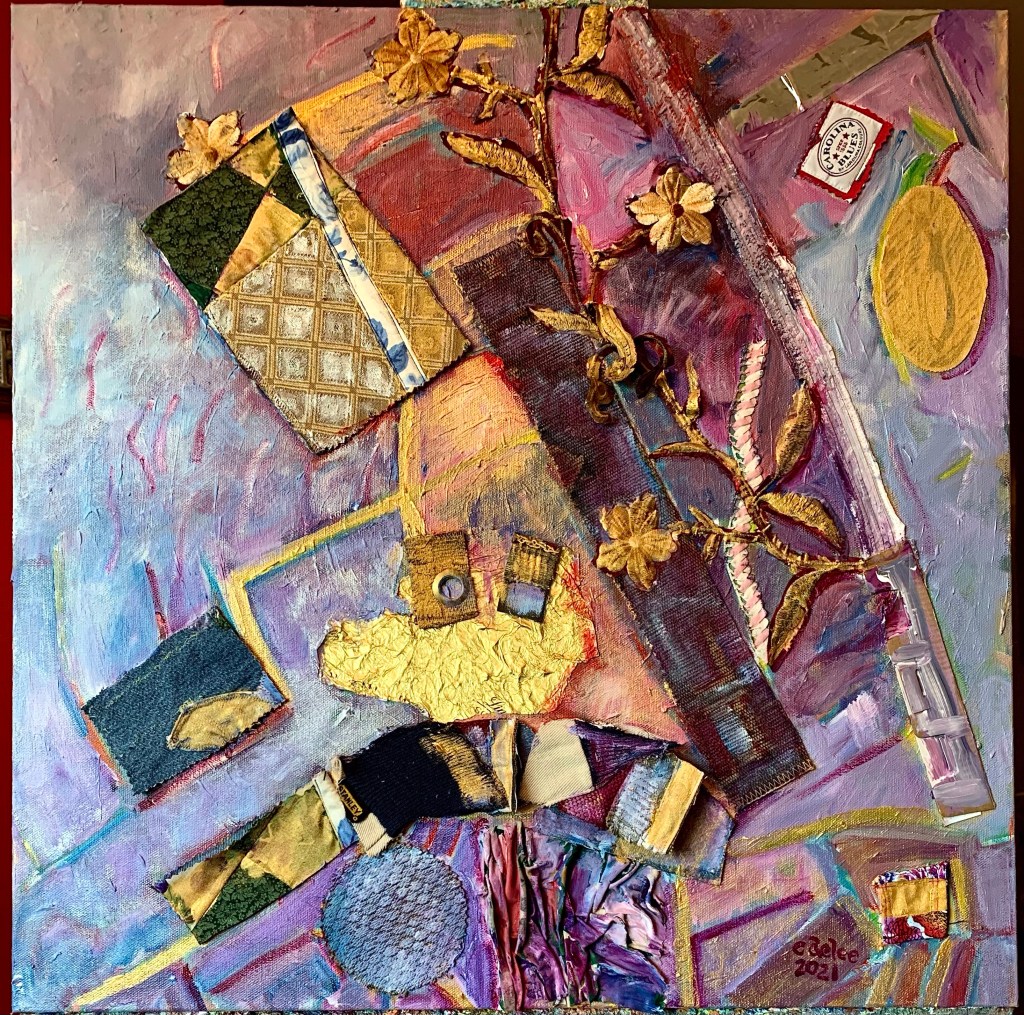
DeLee: Great Dixie Fire, mixed media and acrylic paint

This is also the site of the great 2021 Dixie Fire, which started on July 13, and burned for 104 days. Five California counties and 963,276 acres burned. Why would anyone outside of the immediate area care about this? The forests in Lassen Volcanic National Park can store almost as much carbon as 600,000 Americans emit in one year. Unfortunately, park forests are dying from a combination of threats: increased drought, wildfire, and pathogens like beetles and blister rust. Lassen Volcanic Park rangers are working to protect vulnerable tree species through monitoring, research, and management actions whenever necessary and appropriate.

As a rabbit of faith, I live on this earth, and as long as I live here, I’m called to care for it, to do no harm to it, and to heal it where it’s hurting. This is the same calling I have for our fellow creatures, for the same God created us all and cares for us all equally. I love the wildflowers so much, I even stop on the roadside to take a selfie among them. The Highway Patrol in Liberty, North Carolina doesn’t take kindly to strangers taking selfies among their precious poppies. I was “checked out” and asked to “move along.” Perhaps they’re not used to rabbits with cameras? I do seem to attract the attention of the local law whenever I’m out photographing.

Selfie in Field of Poppies: May 8, 2014

Other weekly celebrations we rabbits can enjoy in May are:

Week One—Be Kind to Animals Week and Nurse’s Week
Week Three—National Bike Week and National Police Week
Week Four—Emergency Medical Services Week

Some celebrations get the entire month of May. Among them are:

Asian American and Pacific Islander Heritage Month
Older Americans and Foster Care Month
Gifts from the Garden and National Salad Month
Lupus Awareness and National Blood Pressure Month
National Barbecue and National Hamburger Month
Date Your Mate and National Photograph Month
National Bike Month

May 3–World Press Freedom Day Rabbit Writer

In 1993, the UN General Assembly proclaimed May 3rd each year to be World Press Freedom Day. This is a UN Sponsored annual event. A free press is a bedrock necessity for democracy to thrive. When ruling powers control the messages which the rabbit population gets to hear, we rabbits only hear one side of the story. This discourages freedoms of thought and expression of opinion. While democracy sometimes seems messy, the voices of the majority will ultimately prevail. Yet the voices of the marginalized must be recognized and respected, for their rights can’t be curtailed to please the majority. A free press brings both voices to light.

AI Image: Rabbit with Light Saber

May 4–The National Day of Prayer always happens on the first Thursday of May. This year it coincides with “May the Fourth Be with You” day. Each of these celebrations speaks to the deep need within the rabbit heart for a connection to a power greater than ourselves. At some point in time, each one of us will realize our ego self is really a false self or mask of bravado and competence. When we cast off this mask, we might feel naked toward the world, but God or the Force can finally fill our emptiness. Most rabbits will never take off this false mask, however, for being naked in God’s or the Force’s presence is unimaginable to us.

“Rabbit Handstand” wood sculpture by Teresita Gonzalez

May 5–Cinco de Mayo is always on May 5th. I was playing cards with some rabbit friends the other night. One has a grand baby born on Cinco de Mayo. “What day is Cinco de Mayo?” he asked. “It’s always May 5th, silly.”

“Why is that?” All the card players answered, “Because Cinco de Mayo is a date, like Christmas is a date, when something important happened.”

This is a group of white rabbits, as you may have gathered, but some of us have spent time in Hispanic communities. The Mexican army defeated the French army at the Battle of Puebla on May 5, 1862. This single military battle signified the defeat of a European colonial power, a victory for the Mexican people, and is the root of Cinco de Mayo. Mexican Independence Day is September 15th. We can celebrate along with our brother and sister rabbits by sharing Mexican food and drink, enjoying music, and dancing. And what rabbit doesn’t love the excuse for a party?

St. Edward crown for May 6–Coronation of King Charles of England has over $4.5B worth of jewels in it.

While we American rabbits cast off our colonial bonds back in the 18th century, some of us have never lost our fascination with the royal family and their sagas. Plus we’re always up for a celebration if it means drink and cake. After the death of Queen Elizabeth, her son Charles became King of England. His official coronation ceremony will be smaller in many respects than Elizabeth’s: only 2,000 guests rather than 8,000 and business or military attire will be worn, but no tiaras or ermines allowed.

Since 1066, Westminster Abbey has been the site for regal coronations , beginning with William the Conqueror on Christmas Day. The St. Edwards Crown weighs in at 5 pounds, so the new monarch will live out the saying, “Uneasy lies the head that wears a crown,” (Shakespeare, Henry IV. Part II, 1597). While the Crown Jewels are considered priceless, a 2019 study found in total, the coronation crown would cost $4, 519, 719. That would buy a bunch of carrots and then some!

Coronation chair with the Stone of Scone

The Stone of Destiny (also known as the Stone of Scone) is an ancient sandstone block weighing 336 pounds, which was used for centuries in the coronation of Scottish kings before being seized in 1296 by King Edward I, who had it built into a throne at Westminster Abbey. There it lay until Christmas Day 1950, when, in an audacious caper, four Scottish nationalist students tried to steal it and take it back north of the border. Eventually, in 1996, the stone was returned to Scotland. Now, top-secret and high-security preparations are being made to take it back down to Westminster Abbey for the coronation.

King Bugs Bunny wears Ermine and a Crown

If the rabbit ears on your Telly are angled just right, and your alarm clock goes off in time, you can watch special coverage from Saturday, May 6, from 5 to 10 a.m. ET on your local ABC station. If you have a BBC streaming service, they’ll definitely carry the public events, including the concert on the day after. This will be a public holiday in Great Britain, of course. Both Apple and Spotify have official playlists (link below).

Secretariat Wins Triple Crown, Jockey Ron Turcotte Looks Back at 31 Length Victory in 1973 Belmont Stakes

After the early morning British crowd, if you’ve swilled enough caffeine and nibbled enough scones (the pastry kind, not the stones) you can chill with a mint julep and the Kentucky Horse Royalty congregating at the Derby’s 149th Run for the Roses. This year, of the twenty horses lined up for the opening bell, eight have a pedigree traced to the Triple Crown winner of 50 years ago, Secretariat. No horse has ever matched his magnificence or personality. To watch him pull away from the pack and leave them in his dust was a wonder to behold. He’d be waiting for those stragglers in the winner’s circle when they finally crossed the finish line, and be looking at their sweating, huffing hulks, as if he were thinking, “What took you guys so long?” One of a kind, Secretariat won the 1973 Derby, coming from last to first, and five decades later, he’s still the Derby record holder at 1:59 2/5.

Kentucky Derby Hats are Extraordinary

If you attend in person, the dress code is “Business Casual:” Jackets and blazers, vests, shirts with collars, sweaters, dresses, pantsuits, slacks and capri pants are appropriate. Hats are expected. If watching from your rabbit den, anything goes. Coverage is on NBC from 12 noon to 7:30 pm ET. The race itself goes off at 6:57 pm ET. That’s a lot of mint juleps, so pace your imbibing or you’ll miss the actual race itself.

May 14–Mother’s Day

On May 8, 1908 the US Senate voted against Mother’s Day! WHAT WERE THEY THINKING? Afterall, at that time, only men could vote and all the holidays honored men. Maybe those senators realized what side their bread was buttered on. A day to honor the Grandpaws might have passed with votes to spare. The women behind this cause weren’t to be denied. Even before the ratification of the 19th ammendment giving them the right to vote in August of 1920, President Woodrow Wilson proclaimed the second Sunday in May as a perpetual memorial day of honor to mothers everywhere.

We rabbits today can’t even imagine any of our elected officials treating us as less than our brothers before the law, disrespecting the 14th Amendment of our Constitution:

“No State shall make or enforce any law which shall abridge the privileges or immunities of citizens of the United States; nor shall any State deprive any person of life, liberty, or property, without due process of law; nor deny to any person within its jurisdiction the equal protection of the laws.”

Mr. Peabody’s WABAC Machine

Today some of our legislators seem to live in a distant century, having traveled there with the cartoon Sherman in Mr. Peabody’s WABAC (way-back) machine. I sometimes wish this way-back machine had enough power to transport its passengers back to the earliest days of creation. Maybe having a front row seat and hearing God’s voice in God’s act of creating the first human beings would work a mighty change in their hearts and minds:

So God created humankind in his image,
in the image of God he created them;
male and female he created them.

~~ Genesis 1:27

May 25—Carry a Towel Day

May 25–Carry a Towel Day. If you are at loss to understand this holiday, please read The Hitchhiker’s Guide to Understanding The Galaxy. When the earth is moments away from demolition by aliens so they can construct an intergalactic highway, Ford Perfect saves young Arthur Dent. Together they travel across space and time to find the meaning of the universe and return to save earth. If you aren’t into this holiday, the good news is it’s also National Wine Day. Splurge on a fine vintage, invite a friend or two over to share the conversation and discuss the meaning of life.

Memorial Day Celebration rooted in memories of our Civil War

Memorial Day will be celebrated on Monday, May 29, for the 3 day federal and state holiday. The banks will also close. Some of my Southern rabbit cousins still refuse to recognize Monday as Memorial, because “It ought to be on the 31st, like it was in granddaddy’s day.” I note they still attend the family picnics and shoot off firecrackers over the weekend. They are old bunnies and have gotten somewhat crotchety as the years have put a kink in their hop. I find myself getting older also, but I keep reminding myself each new day is a blessing and an opportunity for growth. I try to keep learning new things so my brain will keep adjusting to new challenges.

As the calendar passes from May to June, the weather will beckon us to spend more time outdoors, so let’s remember these words written in 1848 from the Rev. Charles Kingsley, also known as Parson Lott:

Attributed to Henry Peacham: Tinted drawing of Book 2, Emblem X: Cum severitate lenitas (Severity with Mercy), British Library, London.

“Never lose an opportunity of seeing anything beautiful. Beauty is God’s hand-writing—a way-side sacrament; welcome it in every fair face, every fair sky, every fair flower, and thank for it Him, the fountain of all loveliness, and drink it in, simply and earnestly, with all your eyes; it is a charmed draught, a cup of blessing.”

Or as the ancient manuscript illuminator wrote, Cum severitate lenitas (Even in harshness, there is mercy.).

Until June, I leave you with joy, peace, and rainbows,

Cornelia

King Charles Coronation Playlist https://www.townandcountrymag.com/society/tradition/a43399168/king-charles-coronation-playlist-spotify/

More May Holidays
https://www.holidayinsights.com/moreholidays/may.htm

Dixie Fire Statistics
https://www.fire.ca.gov/incidents/2021/7/13/dixie-fire/

Lassen Volcano National Park
https://www.nps.gov/lavo/learn/nature/climate-change.htm

Westminster Abbey Stone of Scone
https://www.westminster-abbey.org/about-the-abbey/history/the-coronation-chair

A Coronation F.A.Q.
https://www.nytimes.com/interactive/2023/style/king-charles-coronation.html?smid=nytcore-ios-share&referringSource=articleShare

2023 Kentucky Derby
https://www.courier-journal.com/story/sports/horses/kentucky-derby/2023/04/27/secretariat-descendants-2023-kentucky-derby-field-at-churchill-downs/69992169007/

Beauty is God’s Handwriting
https://quoteinvestigator.com/2014/05/21/beauty/

How Much is the British Coronation Crown Worth? https://britishheritage.com/history/edwards-coronation-crown-worth

Rabbit! Rabbit!

arkansas, art, chocolate, Easter, Faith, Food, Garden of Gethsemane, Good Friday, holidays, Holy Thursday, john wesley, Love, Painting, photography, rabbits, Salvador Dali, Spirituality, Spring Equinox, United Methodist Church


Welcome to April 2023

April Fool! Caught you! Were you the prankster or the pranked? Even an institution as stuffy as the British Broadcasting Corporation isn’t above pranking the public on the first day of April. If a fool and his money are soon parted, then whatever the BBC was selling, they were having a jolly good time in their advertising department. You can watch their mini documentary on Flying Penguins below:

When I was at Perkins Seminary, we editors of the weekly newsletter had a tradition of an April Surprise. This followed the practice of the former Babylonian Schismatic, which was an alternative, satirical student newsletter published occasionally between 1981 and 1988.

One year, when I was coeditor, it was more of an April Debacle. My partner in crime and I were sure the beach ball bouncing off the usual chapel steeple logo would be enough to clue our community into the prank. However, we failed to realize how little sleep our fellow students actually got during school weeks, how seriously they took the printed word, and worst of all, that our newsletter also went to bishops’ widows in faraway places. This last was what got us into the real trouble.

Our faux reports of Perkins losing its accreditation due to shenanigans of prior graduates, who were in the news at the time, had graduate students storming the dean’s office. Even worse, the bishop’s widows were calling him to inquire what kind of school he was overseeing. The fact schools can only lose accreditation for their own failures (and not the trespasses of former students or faculty) never crossed anyone’s mind in the ensuing uproar. So of course, we criminals wrote handwritten letters of apology to the widows and printed retractions in the next newsletter for the students. I now understand why my mother said I sometimes take things too seriously. Still, I’ve have found others who make me look like a giggle queen.

The Giggle Queen and her Pet Rabbit

Speaking of giggles, although the historical roots of April Fool’s Day are shrouded in mystery, the British, who are mostly known for their dry wit and stiff upper lip, seem to enjoy this holiday to excess. Especially at the BBC, which back in 1957, produced a fascinating prank documentary on the Swiss Artisanal Spaghetti Industry. They showed a Swiss family harvesting ripe spaghetti strands from their spaghetti bushes. At the time because of rationing, spaghetti wasn’t widely available. After 1956 in the British Isles, Italian companies opened spaghetti factories and Italian immigrants opened restaurants. The British developed a taste for this food. As a result, some British families were so enthusiastic, they wanted to purchase their own spaghetti bushes for a home garden. Others were unhappy to be pranked. This may be one of the first times the medium of television was used to stage an April Fool’s Day hoax.

Moveable Feasts: Passover and Easter

Israel was an ancient agricultural culture and followed a lunar calendar, so sighting the full moon was important. Passover is always pegged to the Hebrew calendar, which is based on the lunar cycle. It starts in the middle of the month of Nisan, when the moon is full, typically falling in March or April of the modern Gregorian calendar. As a result, Passover typically begins very close to Easter. Easter Sunday is always the first Sunday after the first full moon after the Spring Equinox. However, due to the shorter Hebrew calendar, sometimes it gets a leap month to keep it in tune with the seasons. In 2024, when the leap month plays a part, we’ll have an early Easter on March 21st, but Passover won’t start until April 22nd.

Rabbit Last Supper

These religious holidays are forever entertwined because of the historical events of the Last Supper, which we assume was a ritual meal or Seder, and the crucifixion on a Friday, which required Christ’s body to be taken down from the cross due to the beginning of Passover at sunset.The Last Supper took place on a Thursday night, even though the actual Passover didn’t begin until Friday night.

Dali: The Sacrament of the Last Supper, 1955, oil on canvas, National Gallery of Art, Washington D. C.

As Wesley’s Notes on The New Testament observe, “Jesus took the bread—the bread or cake, which the master of the family used to divide among them, after they had eaten the passover. The custom our Lord now transferred to a nobler use. This bread is, that is, signifies or represents my body, according to the style of the sacred writers.”

We know this because Jesus was arrested in Gesthemane after this meal and then taken to the Roman Governor Pilate on Friday morning, the day of Preparation for the Passover. John 18:28 reminds us how the temple priests “…took Jesus from Caiaphas to Pilate’s headquarters. It was early in the morning. They themselves did not enter the headquarters, so as to avoid ritual defilement and to be able to eat the Passover.”

Early Handdrawn Valentine, 1814, writing in an unending circle

The Jews in the first century kept faithfulness according to laws of separation and purity, so they kept away from unbelievers on holy days. This was the biblical practice of the time. Early Christians continued this practice until Paul began his outreach to the Greek and Roman citizens of the world. When in the later gospel of John (14:15) Christ says, “if ye love me, keep my commandments, Wesley’s commentary understands this to mean: “Immediately after faith he exhorts to love and good works.” This is why we United Methodists practice an open table at Holy Communion, or the Lord’s Supper, for all who love the Lord and desire to be in love and fellowship with their neighbors are welcome at his table. We don’t exclude anyone, for God includes all people into the circle of God’s love.

Love never ends and love never dies

Since Easter Sunday is always the first Sunday after the first full moon after the spring equinox, this makes Easter a “moveable feast.” Unlike a picnic, for which we tote our fixings from our kitchen to a park or to the countryside, or unlike a house to house “progressive dinner,” Easter is called “moveable” because it’s not on a fixed date like Christmas or New Year’s Day.

Baked Ham with Canned Pineapple Rings and Cloves

My family’s Easter feast always centered about a baked ham, often covered with canned pineapple rings and studded with cloves. We were a modern American 1950-60’s family and Betty Crocker reigned in my mother’s kitchen. Just this week I saw a tv advertisement of a family feast with this very same baked ham. I suppose when the economy gets dicey, people pull out old familiar recipes from the great-great-grandmother’s kitchen. Since I have a new great-grandchild on the way, and a knitting project started, I can safely say, this isn’t an April Fool’s joke. I’ve seen the sonogram images!

2012-2022 Top Ten Cities for Extreme Weather Warnings issued by National Weather Service

“April showers bring May flowers” is an ancient rhyme. Unfortunately, these showers also bring pollens of every kind, since trees and flowers both acquire crowns of glory. The Old Farmer’s’ Almanac notes while November has a bit more rain in store for Arkansas than April usually brings, this month’s warmer weather favors conditions for flowers to bloom and trees to bud. While we might tire of the storms and the havoc they wrack upon the populace, we’re always thankful if they only cause damage to property and don’t take human lives.

Sick Bunny

Across North America, the pollen season has lengthened by 20 days since 1990. Pollen concentrations have also increased by 21 percent over the past three decades. This means some of us have been doctoring ourselves or visiting the RD—real doctor—since February. The stubbornest of us waited until almost April because we were convinced we could heal ourselves. If you still have no energy and are grumpy to boot after a month, you too need a RD. Better living through chemistry with put a perk back into your bunny hop.

Stylish Bunnies

Speaking of the weather, I have seen many years now of Easter sunrise services, and even more later noontime Easter feasts. One thing ties them all together: no matter how cute my spring outfit is, no one ever sees it because I’m always wearing a raincoat or a winter coat over it. My guess is rain and cool weather will come and our egg hunts will likely be inside. As long as there’s a dark chocolate Easter rabbit for my personal gratification, I’ll be happy. I discovered last year’s version stored in the cabinet, so I’d better make some chocolate chip cookies soon.

Only hugging can save us

There’s plenty of silly or merchandising holidays in April, but you can read about them at the link below my name. Until May, I remain your April Fool…

Joy, peace, and chocolate rabbits for everyone,

Cornelia

April Daily Holidays, National, International. Holiday Insights.
https://www.holidayinsights.com/moreholidays/april.htm

Why Easter and Passover are observed on different dates each year
https://www.azcentral.com/story/travel/arizona/2018/03/28/why-easter-and-passover-have-different-dates-each-year/466341002/

The worst cities in the U.S. for allergies
https://www.washingtonpost.com/climate-environment/2023/03/16/allergy-season-pollen-count-climate/

BBC Flying Penguin Documentary April Fool Prank
https://youtu.be/9dfWzp7rYR4

BBC 1957 Spaghetti Documentary April Fool Prank
https://youtu.be/8scpGwbvxvI

BBC ON THIS DAY | 1 | 1957: BBC fools the nation
http://news.bbc.co.uk/onthisday/hi/dates/stories/april/1/newsid_2819000/2819261.stm

No spuds please, we’re British
https://www.theguardian.com/g2/story/0,3604,371547,00.html

Is April Really The Month of Showers? – Farmers’ Almanac
https://www.farmersalmanac.com/april-showers-bring-may-flowers-34814

Where the Most Weather Warnings Are Issued in the U.S. | Weather Underground
https://www.wunderground.com/article/safety/thunderstorms/news/2022-03-18-most-national-weather-service-warnings-us

Growth in Faith and Art is a Risky Business

adult learning, arkansas, art, brain plasticity, change, Children, Creativity, Faith, Holy Spirit, hope, Icons, Imagination, inspiration, john wesley, Ministry, New Year, Painting, Pantocrator, perfection, photography, purpose, risk, Spirituality, vision

Oscar Wilde famously said, “Life imitates art far more than art imitates life.” This is because the self-conscious aim of life is to find expression and art offers it certain beautiful forms, through which it may realize that energy. Yet most people who look at artworks judge them for the degree to which they represent “three dimensional reality,” in either two or three dimensions (painting, draw,or sculpture and assemblage).

Often I’ve been asked about my colorful landscapes, “Don’t you ever paint these in normal colors?”

My answer is usually, “How do we know the colors we see today are the original colors of Creation? After all, we now live in a fallen and broken world. Perhaps these bright colors were God’s original palette.” I’m not painting just what I see, but what was and what is yet to come. These are visions of a better world, where the leaves clap their hands for joy.

In art class, we not only struggle to master drawing shapes “as they are,” but also to challenge our minds to break free of our need to exactly reproduce the shapes before us. We always have the tension to make only a “copy of the image before us,” rather than to meet the image on a spiritual plane and portray an intimate portrait of its inner truth.

When we meet a stranger, we can hide behind our masks and keep our distance. Likewise, we can fail to become intimate with our painting’s subject matter. The resulting work is cold and dead, like a limp handshake. It’s a risky business to bare your heart to the canvas and paint. The brush will tell if your heart and soul is in it or not.

We get more comfortable with this risky business by practicing risk taking. It’s not like we’re facing tigers in a circus cage or jumping out of an airplane without a parachute. We can’t lose our salvation in Christ if we make a bad painting. We only have a new level from which to start afresh. All growth requires risk and failure. We discover what works, keep that, and eliminate the unuseful.

Willingness to learn is related to the “growth mind-set.” This is the belief your abilities aren’t fixed but can improve. This willingness is a belief not primarily about the self, but about the world. It’s a belief every class or learning experience offers something worthwhile, even if we don’t know in advance what that something is. Every teacher or parent worth their salt has to believe their students or children can learn and grow, or they need to give up their profession so another can grow. The first lesson even the most recalcitrant student needs to learn is to believe growth and progress is possible.

Christ on Tree of Life, San Clemente Basilica, 12th Century mosaic, Rome, Italy.

The Christian life has a parallel to the growth mindset. The whole of the Christian life is wrapped up in this faith: with God’s help, we can go on to perfection. This is a basic Methodist belief known as sanctification. We also call it going on to perfection in love of God and neighbor. Some of us think because we’re not able to change on our own, we don’t need to grow in our love. God has done all the work for us in Christ. The Holy Spirit was sent to be a truthful guide:

“When the Spirit of truth comes, he will guide you into all the truth;
for he will not speak on his own, but will speak whatever he hears,
and he will declare to you the things that are to come.” (John 16:13)

Christ in Majesty, Book-Cover Plaque, French, Limoges, enamel, ca. 1200 CE, Metropolitan Museum of Art, NYC.

Paul speaks of this truth in Philippians 3:20-21, when he reminds the people of their present state as sojourners in this world, while their citizenship is elsewhere:

“But our citizenship is in heaven, and it is from there that
we are expecting a Savior, the Lord Jesus Christ.
He will transform our humble bodies that they may be conformed
to his glorious body, by the power that also enables him
to make all things subject to himself.”

Mother About to Wash Her Sleepy Child Mary Cassatt, 1880

If life is a journey, the Christian life is even more of a pilgrimage. We all go through stages of faith if we seriously reflect and consider our beliefs when our life experiences intersect with our faith. Our earliest stage of faith begins with our parents or caregivers. Here we learn to trust or distrust, as we experience an embodied faith. The next stage is early childhood (age 3-7). Faith at this stage is experiential and develops through encounters with stories, images, the influence of others, a deeper intuitive sense of what is right and wrong, and innocent perceptions of how God causes the universe to function.

Michaelangelo: Creation of Adam, Sistine Chapel Ceiling

The next stage has been labeled “Mythic-Literal Faith” (Ages 7-12). Children at this stage have a belief in justice and fairness in religious matters, a sense of reciprocity in the workings of the universe (e.g. doing good will result in a good result, doing bad will cause a bad thing to happen) and an anthropomorphic image of God (e.g. a man with a long white beard who lives in the clouds). Religious metaphors are often taken literally, thus leading to misunderstandings. If God’s rewards or punishments don’t apply in proper retribution, in the believer’s mind, their faith in God’s system becomes fragile.

Théodore Géricault, Raft of the Medusa, 1818–19, oil on canvas, Louvre, Paris.

“The Conventional Faith” stage (12-adult) arises when individuals join a religious institution, belief system, or authority, and begin the growth of a personal religious or spiritual identity. Conflicts occur when one’s beliefs are challenged are often ignored because they represent too much of a threat to one’s faith-based identity.

Théodore Géricault’s “Raft of the Medusa,”painted in 1818–19, is nearly 17 by 23 feet large. It commands its space as any proper historic painting of the past ever did. Rather than present a moral lesson from the past, the artist instead chose to paint an event from his present time: the rescue of the abandoned sailors and slaves from a wrecked ship. The French nation had sent the new governor of the Senegal colony, his family, and some other government officials and others on the Medusa. The government officials went to secure French possession of the colony and to assure the continuation of the covert slave trade, even though France had officially abolished the practice. Another group aboard the Medusa was composed of reformers and abolitionists who hoped to eliminate the practice of slavery in Senegal by engaging the local Senegalese and the French colonists in the development of an agricultural cooperative that would make the colony self-sustaining.

On the way, the ship ran aground and broke up. The officials and their families were put in lifeboats, but the 150 others on board got a makeshift raft, which was tied to the lifeboats. When the raft impeded the lifeboats, the officials cut the raft loose and all the lives with it. Only 15 were rescued after days at sea, and only ten lived to tell their tales. It was a scandal of the times. Géricault read all the newspapers, interviewed survivors, and made studies from ancient sculptures to inform his design. When younger artists saw his inspirational work in the Paris Salon, they knew a sea change had happened. Conservative critics and writers were appalled and accused Géricault of creating a disgusting, repulsive mistake. They were not yet ready to leave the past behind.

William Faulkner once said, “You cannot swim for new horizons until you have courage to lose sight of the shore” (The Mansion , 1959). When we meet that initial storm, our first thought is to bring our fragile bark into port. In life, we batten down the hatches and book it for a safe harbor. In art class, we want to fall back on what we’ve always done before, what we know we can do, and what we’ve been successful with in the past. This is our “safe harbor.”

“Individuative-Reflective Faith” (Mid-Twenties to Late Thirties). The individual takes personal responsibility for her beliefs or feelings, often by angst and struggle. Religious or spiritual beliefs can take on greater complexity and shades of nuance, and a greater sense of open-mindedness. These can also open up the individual to potential conflicts as the different beliefs or traditions collide.

To progress and grow in our art skills, or to move through the “dark night of the soul” when we question our formerly held spiritual truths, is a crucial time. Crucial is a word sharing the same root as crucifix. The crux of both of these situations results in a life and death situation. Not that the person quits breathing or their heart stops beating, but will their old life die and their faith be reborn anew? Also, will they trust a power greater than themselves to bring them back from the depths? Many of us aren’t willing to give up control to anyone, and certainly not to a God we can’t see. We’re two year olds in our spiritual lives too often, for “I can do it myself!” Is our answer to everything and everyone. (Test it out—how many of you read the directions after you start putting a project together?)

The Cross that Spoke to St. Francis, San Damiano Chapel, Italy, 1205 CE

“Conjunctive” Faith (Mid-Life Crisis). A person at this stage acknowledges paradoxes and the mysteries attendant on transcendent values. This causes the person to move beyond the conventional religious traditions or beliefs he may have inherited from previous stages of development. A resolution of the conflicts of this stage occurs when the person is able to hold a multi-dimensional perspective that acknowledges ”truth’ as something that cannot be articulated through any particular statement of faith. This is where the Holy Awe begins to fill all the nooks and crannies from which it was once forbidden.

Face of Christ (All People of the World), photo montage

“Universalizing” Faith (or ”Enlightenment”). (Later Adulthood). This stage is only rarely achieved by individuals. A person at this stage is not hemmed in by differences in religious or spiritual beliefs among people in the world, but regards all beings as worthy of compassion and deep understanding. Here, individuals ”walk the talk” of the great religious traditions (e.g. ”the kingdom of God is within you”).

“Jesus of the People” by Janet McKenzie.

In 1999 Janet McKenzie’s painting “Jesus of the People” was selected winner of the National Catholic Reporter’s competition for a new image of Jesus by judge Sister Wendy Beckett, host of the PBS show “Sister Wendy’s Story of Painting.” In the words of Sister Wendy, “This is a haunting image of a peasant Jesus—dark, thick-lipped, looking out on us with ineffable dignity, with sadness but with confidence. Over His white robe He draws the darkness of our lack of love, holding it to Himself, prepared to transform all sorrows if we will let Him.” The model was an African-American woman and the painting includes a yin-yang symbol of Eastern traditions and feather of Native American traditions. (Photo courtesy of Paul Smith)

Next week, we’ll still be working on order and chaos. We got started on this at our first meeting, and the concept is a challenge. I’ll write about our class work then. We’re always open to anyone joining us, for you come as you are and begin where you are. Our art group is a “one room schoolhouse” with all levels of students mixed together. We may all be doing the “same project,” but everyone does it at their own skill level. I give you special attention according to your needs.

Remember, “The only way you can be behind is if you never start.”

Joy and peace,

Cornelia

Life Imitates Life | Lapham’s Quarterly
https://www.laphamsquarterly.org/swindle-fraud/life-imitates-life

The Stages of Faith According to James W. Fowler | Thomas Armstrong, Ph.D.
https://www.institute4learning.com/2020/06/12/the-stages-of-faith-according-to-james-w-fowler/

Théodore Géricault, Raft of the Medusa – Smarthistory
https://smarthistory.org/theodore-gericault-raft-of-the-medusa/

Video and photo slideshow: The many faces of Jesus
https://religionnews.com/2014/01/28/video-photo-slideshow-many-faces-jesus/

Seeds of Dissent and a Harvest of Distrust

Ancestry, arkansas, art, Faith, Family, Forgiveness, greek myths, Holy Spirit, hope, incarnation, inspiration, john wesley, Love, Ministry, Painting, perfection, poverty, purpose, Ravenna Italy, renewal, Retirement, stewardship, Stress, United Methodist Church, vision

Christ Enthroned with the Angels
6th century Mosaic
Church of Sant’Apollinare Nuovo, Ravenna, Italy

Nothing springs full grown to life in an instant. Everything begins in a seed, which is planted, watered, and nourished into full growth. Only in myths or fantasies can an idea come into being instantly. Zeus had a very bad headache, a “splitting headache,” that birthed his daughter Athena, the goddess of wisdom. She leapt out in fully grown from his brow. We don’t take this myth to be scientifically true, but as a metaphor for the difficulty and struggles we undergo to obtain wisdom. As my daddy used to tell me after I’d learned some hard life lesson, “The school of experience is a rough master, and we all earn a costly degree in gaining its wisdom.”

Little Master Lip Painter Attributed to the Phrynos Painter: Birth of Athena, Attic Black Figure Ware, Kylix, Date ca. 555 – 550 B.C., Early Archaic Period,

Some of us will repeat the same lessons over and over, as if we expect to get a different result. The purpose of an education isn’t to regurgitate a right answer to pass a test, but to understand why the answer is right. That’s why math classes require showing the steps to the solution, rather than the “full blown adult answer” only. In matters of faith or ethics, many of us haven’t had the training to “set out the proof” for our final answer or deed. In fact, in one situation we may think or act one way, and quite differently in another.

The name for this behavior is “situational ethics.” Less kindly, it’s also known as spinelessness, shiftiness, being two faced, or dishonesty. Mostly it means people don’t have a true center or a plumb line by which they measure themselves. If we’re measuring our lives against other people, we’re measuring against other fallible human beings. Even our heroes have feet of clay, for none of us are gods. When I used to call my parents out on this character trait, they always told me, “Do as I say, not as I do.” This sets up a moral conflict for most people, even those raised in the church or in religious homes.

We need to have a moral center based on a higher authority than our individual or cultural conventions, one that includes or exceeds the ethics of the group to which we belong, and not just our individual beliefs and actions. Professional groups—physicians, lawyers, clergy, educators, and others—all have ethical standards for caring for those they serve, even if they morally disagree with the behaviors that bring them into their care. Who decides the ethics of the group? At the risk of making my favorite seminary professor, Billy Abraham, roll about in his still fresh grave, we United Methodists do have the so-called Wesleyan Quadrilateral of Scripture, Tradition, Reason, and Experience to guide us. Often we assign our personal life experience to this latter quadrilateral edge, but Wesley meant our Experience of the Assurance of God’s All Embracing and Adopting Love. As Wesley once said, “God is able to save all to the uttermost.”

The Good Samaritan by English School, (19th century)

Ethics and morals are often used as synonyms, but ethics refer to rules provided by an external source, e.g., codes of conduct in workplaces or principles in religions. Morals refer to an individual’s own principles regarding right and wrong. Ethics is a a late 17th century word derived from the Greek ēthos (disposition, character), in contrast to pathos (suffering). In Latin it means ‘character, depiction of character’, or (plural) ‘customs’.

Then we have the words moral and morals. The first is concerned with the principles of right and wrong behavior. The goodness or badness of human character is another concern. From these, people decide what behavior is considered right or acceptable in a particular society. We often say a person has morals if they conform to standards of behavior or beliefs concerning what is and is not acceptable for them to do. We can speak of “the corruption of public morals, “ or you can hear people talking as if “they believe addicts have no morals and can’t be trusted,” rather than understanding the disease and abuse bases which often underlie addictions.

These distinctions don’t change the negative consequences of the addict’s behaviors, yet the addicted person still has the same image of God and the same potential for wholeness each of us have, but perhaps with more suffering, or pathos. If we judge the morality of a person’s choices, and then refer that moral state to the individual’s worthiness, we can end up losing compassion for the person as well as losing the will to help them better their lives. This leads to hard heartedness and a lack of love. We reject our neighbors and make them strangers, unwelcome to our world. We forget our spiritual ancestors were once strangers in a strange land, wanderers without a home. How easily we forget our savior, who had no place to be born even in his ancestral home, and whose family fled religious persecution and certain death to live in Egypt, far from home. Strange how some Christians have no sympathy for others in the same fix today.

Moral is a word from the late Middle English by way of the Latin moralis, from mos, mor- ‘custom’, with the plural mores or ‘morals’. It refers to one having the property of being right or wrong, good or evil, or voluntary or deliberate, and therefore open to ethical appraisal. When we apply moral attributes to a person, it means “capable of moral action; able to choose between right and wrong, or good and evil.” Not until 1803 did moral come to mean “virtuous with regard to sexual conduct,” according to the Oxford English Dictionary.

As a noun, we meet the word in the Latin Moralia, the title of St Gregory the Great’s moral exposition of the Book of Job. Later it was applied to the works of various classical writers. All Methodists and the holiness denominations birthed from the seed of the great Methodist revival recognize the genius of John Wesley. We all quote him, but we also apply his wisdom through our own individual preconceived notions of what is “good, true, and noble.”

When John Wesley was asked, “What is that faith whereby we are sanctified?” he answered:

“First believe that God has promised to save you from all sin, and to fill you with all holiness; secondly, believe that He is able thus to save to the uttermost all that come unto God through him; thirdly, believe that He is willing, as well as able, to save you to the uttermost; to purify you from all sin, and fill up all your heart with love. Believe fourthly, that He is not only able, but willing to do it now! Not when you come to die; not at any distant time; not tomorrow, but today. He will then enable you to believe, it is done, according to His Word.”

In the old days, we said we were “going on to perfection,” not that we were so bold as to claim that we’d already arrived there or been perfected. Oh no, we allowed God could complete this for us and had the power to do it, as well as the will, but our human nature was still fallible. If a word comes up more than once in a text, writers go to the thesaurus for an alternative, but in reading scripture, we learned repetition was a sign of importance, a marker especially meant for those of us who are slow learners in the school of life.

Oliver O’Donovan in “Scripture and Christian Ethics” writes, “Moral theologians have a secret knowledge, apparently concealed from other kinds of theologians, especially those devoted to hermeneutics. They know that the most mysterious and most difficult question we ever have to answer is not, what does Scripture mean?, but, what does the situation we are facing mean?, where do we find ourselves existentially?”

We tend to speak as if our selves and our situations were known quantities, so that it only remains to choose out of Scripture whatever seems to fit our circumstances as we conceive them. Scripture has an uncanny way of shedding light on our self and our situation, to overcome our preconceptions about them. We don’t read about our situation directly in the Scriptures, yet it’s from the Scriptures we gain categories of understanding, which re-frame our view of our situation and ourselves. We can’t look for individual texts to guide our actions, but need to consider the whole of the revealed Scripture and God’s nature as we discern our path forward.

Carl Bloch: Monk Looking in a Mirror, 1875, oil on canvas, Nivaagaard Museum, Denmark.

In this sense, the Bible is a mirror which reflects our inner nature to us, convicting us of our failings and giving us grace and comfort in our times of need. We can learn much about ourselves from the verses we lean on, just as much as we can by the verses we ignore. There’s a reason we interpret texts by the whole of scripture, and not piecemeal. This is one way we understand the authority of scripture.

As an interesting aside, SWTX, my original conference, which approved my candidacy for the ministry, didn’t think I should attend seminary because I scored so low on the abstract reasoning tests I took. They didn’t think I would make 65, seminary’s passing grade, in my class work. It’s true I learn and process differently, but knowing this, I crammed a three year program into four years. If I’m slow to grasp the whole until I first understand the parts, this doesn’t reflect on my fitness for ministry or my intellectual ability. It merely reflects a different way of processing information. There’s more way to skin a cat, and many ways people learn.

When I taught art classes, I had to make sure I covered all the learning methods for all my students to have success. I talked about the project, I demonstrated the techniques, I had the steps written out, and for some few children, I had to place their hands in the optimum position to get them started. This covered ear and eye learning, visual reminders, and haptic or touch learning. Some students needed multiple types of learning throughout their working time on a project. Some needed reteaching every class period. Some just needed encouragement when they got stuck at a rough patch. Most all had to learn to talk in positive terms about themselves and their work, as well as about others and their creative process also.

I talk about this teaching method, for this is how we consciously or unconsciously teach those around us ethics and morals. As one youth asked me at a church I once served, “Why are you wearing your cross today? It’s not Sunday.”

“Because Jesus is important to me every day, not just on the day I lead church services.”

I realized even though her family was very active and faithful in our congregation, when they were out in the world of day to day folks, they didn’t stand out from the crowd. Maybe one day day this child will come to a time when wearing a cross becomes bearing a cross. Then again, how many people willingly choose suffering for the sake of the body of Christ? This suffering is often difficult for those of us who’ve committed our lives to Christ’s call, but we realize most laity won’t voluntarily submit to that kind of stress. Yet experience is a great teacher. We learn from others, even those who have differing opinions and choose different actions.

Wesley’s Sermon, “The Nature of Enthusiasm,” has some advice for us: “Beware you are not a fiery, persecuting enthusiast. Do not imagine that God has called you (just contrary to the spirit of Him you style your Master) to destroy men’s lives, and not to save them. Never dream of forcing men into the ways of God. Think yourself, and let think. Use no constraint in matters of religion. Even those who are farthest out of the way never compel to come in by any other means than reason, truth, and love.”

Jean Bondel: The fall of man—Adam and Eve eat from the Tree of Knowledge of Good and Evil, 1372, illustrated manuscript, National Library of the Netherlands.

As a further reminder from his all time classic Sermon, On Working Out Our Own Salvation, 1785: “By justification we are saved from the guilt of sin…by sanctification we are saved from the power and root of sin…”In modern terms, when we profess our faith, Christ saves us from the guilt of that first sin. Some say Adam and Eve were disobedient. They then emphasize rule keeping as their moral choice. There’s always a reason behind every behavior, however. Why were they disobedient? We hear the answer in the parable of the Tree of Wisdom:

“But the serpent said to the woman, “You will not die; for God knows that when you eat of it your eyes will be opened, and you will be like God, knowing good and evil.” (Genesis 3:4-5)

The man and the woman both heard the half truth, saw the shiny fruit, believed the promises of a creature rather than their creator, and ate the fruit they hoped would make them like gods. Instead they only gained knowledge of their nakedness and vulnerability. This first lesson of the school of life came with cost: fig leaves ooze irritating sap. They won’t choose this solution again. God’s providence replaced their poor choice with animal skin clothing even as God sent them out into the world. We might say the attitude of pride or greed drove their bad behavior and was the cause of their negative consequences.

As we grow in holiness and love of God and neighbor, the Holy Spirit destroys any remaining root of sin. One of the important sins, Wesley noted, was pride. Pride is that feeling of deep pleasure or satisfaction we get from our own achievements, or those of our family, tribe, nation, or other associated group. In matters of faith, we always have to remember Paul’s admonition to the Romans (10:9-13):

“because if you confess with your lips that Jesus is Lord and believe in your heart that God raised him from the dead, you will be saved. For one believes with the heart and so is justified, and one confesses with the mouth and so is saved. The scripture says, “No one who believes in him will be put to shame.” For there is no distinction between Jew and Greek; the same Lord is Lord of all and is generous to all who call on him. For, “Everyone who calls on the name of the Lord shall be saved.”

Paul reminds us of the unity of the Jews and the Gentiles, the clean and the unclean, the former masters and slaves, with the gulf now bridged between the former God worshippers and the idol worshiping strangers. Now there’s “no Jew nor Greek, no slave or free, no male or female, but all are one in Christ Jesus” (Galatians 3:28).

When we joined together into one annual conference in 2003, almost twenty years ago, we had good reasons to make one combined administrative body for our faith community. We had underfunded pension obligations, we were over heavy with administrators, and clergy didn’t have equity in retirement accumulation. Likewise, the conferences weren’t equally treated, since one didn’t fully fund pension needs, an act which caused clergy to seek appointments in the other conference, thus robbing the first of talents and gifts. These were the logical consequences of attitudes and behaviors, however.

Historic Souvenir—Can you drink this cup?

The logical person thought, “Let’s make Arkansas One Faith, One Focus, One Fellowship,” and this will solve all our problems. It may have looked good on paper, but our congregations had been used to a personal touch to remind them at least once a year they belonged to a greater whole. Their pride in showing off their home church and being a good host for the Superintendent was taken from them if they were just attendees at another group meeting. The moral choice of what’s better for me, a relaxing Sunday afternoon with my family or a meeting elsewhere, gets weighed and measured.

So now here we are, nearly twenty years into this optimistic marriage of the two annual conferences. The seeds for dissent and discontent were planted long ago, even before this joining. When I inventoried the historic memorabilia of the dead bishops at the SMU Bridwell Library, I saw how the chaos of the Vietnam War era and the sea changes our society were experiencing then affected our church in many ways. Some wanted to hold onto tradition more tightly, while others were ready to experiment with new wine in fresh wine skins. These were just “outer trappings,” however, for the message of “saved by faith, sanctified by faith, and made perfect in love by faith” never changes. This is Christ’s work, enabled by the Holy Spirit.

The past sixty years, as the last two decades, haven’t always been smooth sailing. We often have had trials, storms, and tribulations on our shared journeys. Sometimes we’re so far out to sea, we don’t see the land, and the skies are occluded, so we can’t take a bearing off the stars. Yet God’s spirit will blow us along, for even detours are within God’s providence. As James reminds us:

“Consider it pure joy, my brothers and sisters, whenever you face trials of many kinds, because you know that the testing of your faith produces perseverance. Let perseverance finish its work so that you may be mature and complete, not lacking anything.” (1:2-4)

Van Gogh: The Good Samaritan, after Delaquoix, 1890, oil on canvas, Kroller-Muller Museum, Netherlands

Today we also have powerful economic and political forces that are like wolves in sheep’s clothing. They purport to work for religion and democracy, but actually work against the stewardship of our earth ‘s resources and environment, fail to care for the poor and dispossessed, and support military interventions around the world. Moreover, some of them actively work to destabilize religious denominations with social justice callings, such as the UMC, the Presbyterian Church USA, and others. Some today think “things fall apart; the center will not hold.”

Two final words in summary: one is from the ancient wisdom tradition and the other from Paul’s paean of joy in the midst of suffering. Proverbs 22:1 reminds us, “A good name is to be chosen rather than great riches, and favor is better than silver or gold.” My dying grandfather spoke these words to me in his last hours. Ive always considered them a plumb line for my life.

Byzantine Mosaic, Ravenna, Italy

“Finally, brothers and sisters, whatever is true, whatever is noble, whatever is right, whatever is pure, whatever is lovely, whatever is admirable—if anything is excellent or praiseworthy—think about such things. Whatever you have learned or received or heard from me, or seen in me—put it into practice. And the God of peace will be with you.” — Philippians 4:8-9

Joy and Peace,

Cornelia

Oliver O’Donovan: Scripture and Christian Ethics
(This is a great read!)
https://biblicalstudies.org.uk/pdf/anvil/24-1_021.pdf

John Wesley: Repentance in Believers (Sermon 14), “Repent ye, and believe the gospel.” Mark 1:15. The Complete Works of John Wesley, vol. 1 of 3, Kindle ereader. Read on line here:
http://www.godonthe.net/wesley/jws_014.html

John Wesley’s Quotes – Seedbed
https://seedbed.com/on-john-wesley-quotes/

InterChurch Holiness Convention: a community project of various Wesleyan holiness denominations, with all male leadership
https://ihconvention.com/devotional/may-9-2/

On Patience: James 1:4–But let patience have her perfect work, that you may be perfect and entire, wanting nothing.
https://biblehub.com/sermons/auth/collyer/patience.htm

The Grammarphobia Blog: Ethics vs. morals
https://www.grammarphobia.com/blog/2012/02/ethics-vs-morals.html

The Second Coming by William Butler Yeats | Poetry Foundation https://www.poetryfoundation.org/poems/43290/the-second-coming

The Mosaic Christ

art, Creativity, Faith, Historic neighborhood, Holy Spirit, hope, Icons, incarnation, inspiration, Italy, mystery, Painting, perfection, Ravenna Italy, Reflection, renewal, Spirituality, Travel, vision

The Body of Christ is All of Us

The Body of Christ represents the perfection of all humanity as the image of God. The body of Christ we know as the church is made of many individuals, just as a mosaic design is constructed of many pieces to make a whole. I think of these as the “two bodies of Christ,” even though the literalists among us might think Jesus has only one body. The mysterious body of Christ is what Paul speaks about in his letter to the Romans:

“For as in one body we have many members, and not all the members have the same function, so we, who are many, are one body in Christ, and individually we are members one of another” (12:4-5).

I Am the Bread of Life: Macaroni Christ Icon

Since each one of us is made in the image of God, but of ordinary materials, together we become a mosaic of the whole Body of Christ, going onto his perfection as we encounter and encourage one another within and without the church. After all, the body of Christ isn’t limited to the walls of our buildings, for Christ said in Matthew 25:40—

“And the king will answer them, ‘Truly I tell you, just as you did it to one of the least of these who are members of my family, you did it to me.’”

I have a penchant for recycling canvases and paintings which no longer please me. I’m willing to destroy them and make something new. They die and are reborn into a new life. I learned something from that former experience, but now it’s time to move on. When I read my Bible, I’m always getting new inspiration and ideas from the same verses. I have texts I’ve preached on at least a dozen times, but I always came at it from a different angle. This is how we know the Bible is a living document and the Holy Spirit is always at work in us to reveal what we need to hear for our time and place.

Basilica of Sant’ Apollinaire: The Good Shepherd

We Christians in the Western world have tended to limit God’s self revelation to the spoken word and, to a lesser degree, to the Eucharistic elements in the Institution of the Lord’s Supper:

“While they were eating, he took a loaf of bread, and after blessing it he broke it, gave it to them, and said, “Take; this is my body.” (Mark 14:22).

Unfortunately, when we emptied the world of images of God, we also emptied the created world of God. This is why art is so important and necessary to bring us back to appreciate not only creativity, but also the creating God.

Likewise, images in art are beautiful and inspiring. Some which I’ve had the privilege to see in person over the years have made a difference in my artistic and spiritual journeys. These are a few which have inspired me: Byzantine mosaics in Ravenna, Pompeiian artifacts buried by Vesuvius, and the sacred treasures of the Vatican.

Emperor Justinian

I’ll focus only on the mosaics in Ravenna, which is the site of the Mausoleum of Theoderic (c.520) and the Basilica of Sant’ Apollinaire Nuovo (500-514), both built by Theodoric the Great (454-526). Here too is the Basilica of San Vitale (c.527-546), begun by Queen Amalasuntha (495-535), Theodoric’s daughter; and the Basilica of Sant’ Apollinare in Classe (c.535-549), built by the Greek banker Julianus Argentarius, who also financed the church of San Vitale. These were all very important people of their time.

San Vitale, Ravenna

Although many of Ravenna’s surviving structures have been heavily restored, the city remains the most important site of Byzantine art outside Constantinople, notably for its exquisite decorative art, including mosaics, relief sculpture, mural pictures, ceramic art, maiolica, ivory carving, marble inlays, goldsmithing, ornamented sarcophagi and much more. This treasure house of art objects made Ravenna a must see on our itinerary during my summer in Italy.

My parents gave me the choice of a car or a trip to Italy with the University Systems of Georgia for my college graduation present. Of course, I took the trip. Cars are everywhere and I could get my own one day or ride the bus if I needed to get somewhere. Italy was a trip of a lifetime, for we’d spend a whole summer in the studios in Cortona, and travel about the countryside on day trips during the session. I even got good enough with my Italian to hold small conversations with native speakers. People even invited into their homes for lunch, where I got my first taste of rabbit. These animals were sold live in the farmer’s market in Cortona’s town square on Saturdays.

At every site we visited, I stood amazed in the presence of some ancient and inspiring work of art. In the historic churches, the best artists and craftspeople of the era had the opportunity to put their skills to good use, for they were not only working for notable patrons, but also for God. Money wasn’t an object either, for extravagance for God was considered a good work worthy of a heavenly reward.

Of course, seeing the art works and experiencing the spiritual impact of the works in their setting are two entirely different things. On a tour, when huge groups of people are tramping in and out of the sanctuary, tour leaders raise their flags, signs, or ubiquitous water bottles to quiet their group before they give a lecture, and then they turn en mass like a flock of ducks, everyone exiting together to clamber onto the bus or to walk to the next place to view some sacred site.

Golden Mosaics in San Vitale

As a person on a spiritual pilgrimage, this experience can be quite jarring unless you prepare yourself in advance. Even though in that period of my life I wasn’t a believer in a personal god, nevertheless I was still seeking the mysterious experience of the presence of God. I found if I took a few moments of personal quiet to put my spirit in a receptive mode before I entered the holy spaces, I was able to ignore the chaos around me. No longer did I focus on the comings and goings of the people around me, but I looked up instead at the beautiful artworks and the glory the ancient artists wanted to give to God as they rendered the images on the walls or sculpted the images.

These mosaics are fantastic works of art, with each image made of thousands of tiny pieces of stone and glass. In the early morning light, the golden tesserae shimmer and reflect the sunlight streaming inside. When viewed in this light, the figures would see to float in a heavenly light.

6th-century apse mosaic of Sant’Apollinare in Classe.

The icons of Christ always have an other worldly look about them, as Jesus said,

“My kingdom is not from this world.” (John 18:36).

We always see in the icon the resurrected body of Christ, the heavenly body of Christ, not merely the physical body of Christ. As Paul reminds us in 1 Corinthians 15:44—

“It is sown a physical body, it is raised a spiritual body. If there is a physical body, there is also a spiritual body.”

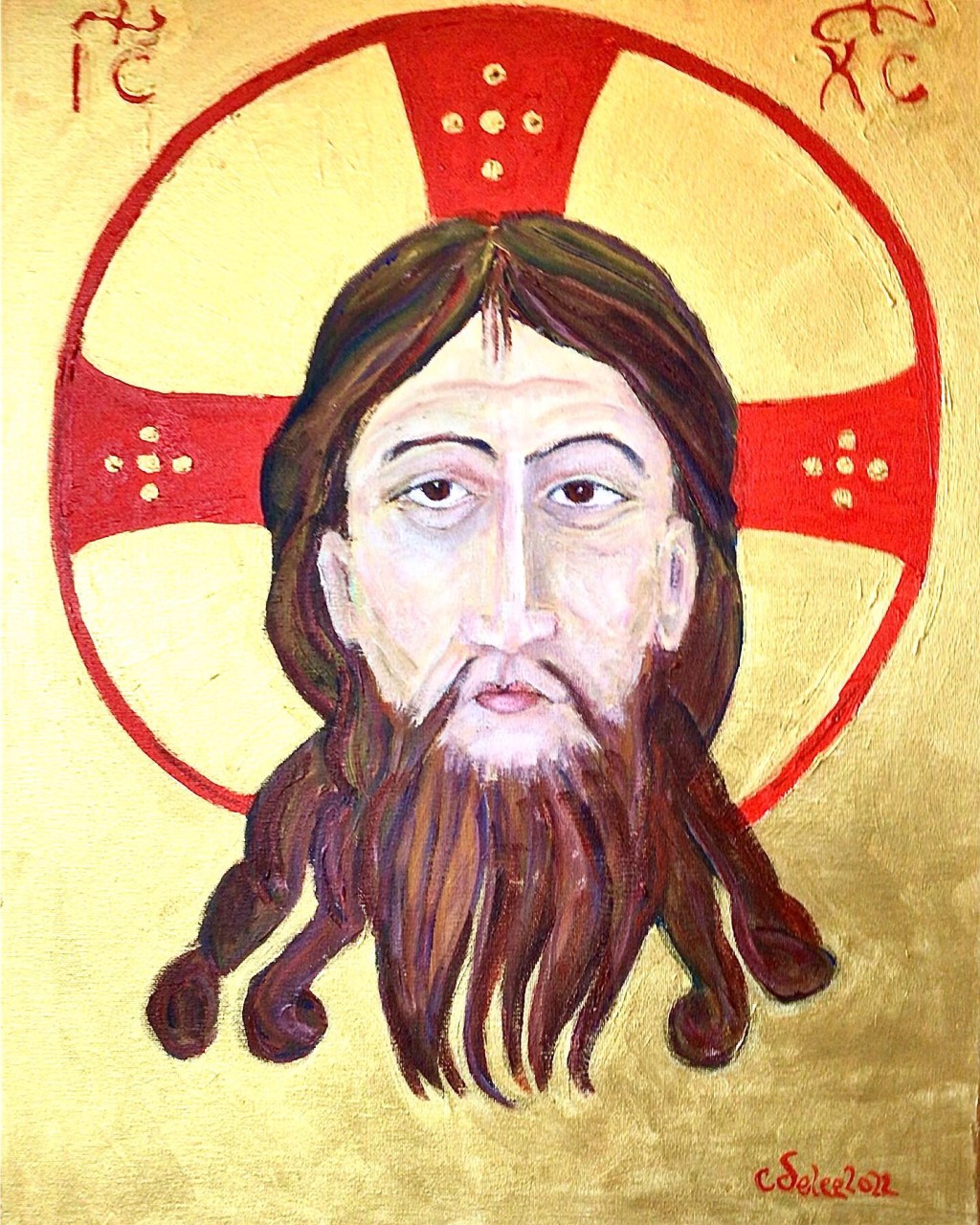
This is why the icons have elongated faces, small mouths, and large eyes. Their facial proportions are not “realistic “according to “actual proportions.” In western art, representation of physical reality with perspective, foreshortening, and shading gives us a sense of earthly realism. Icon “writers” reject perspective, and other cues of reality to give their works a sense of “other worldliness.”

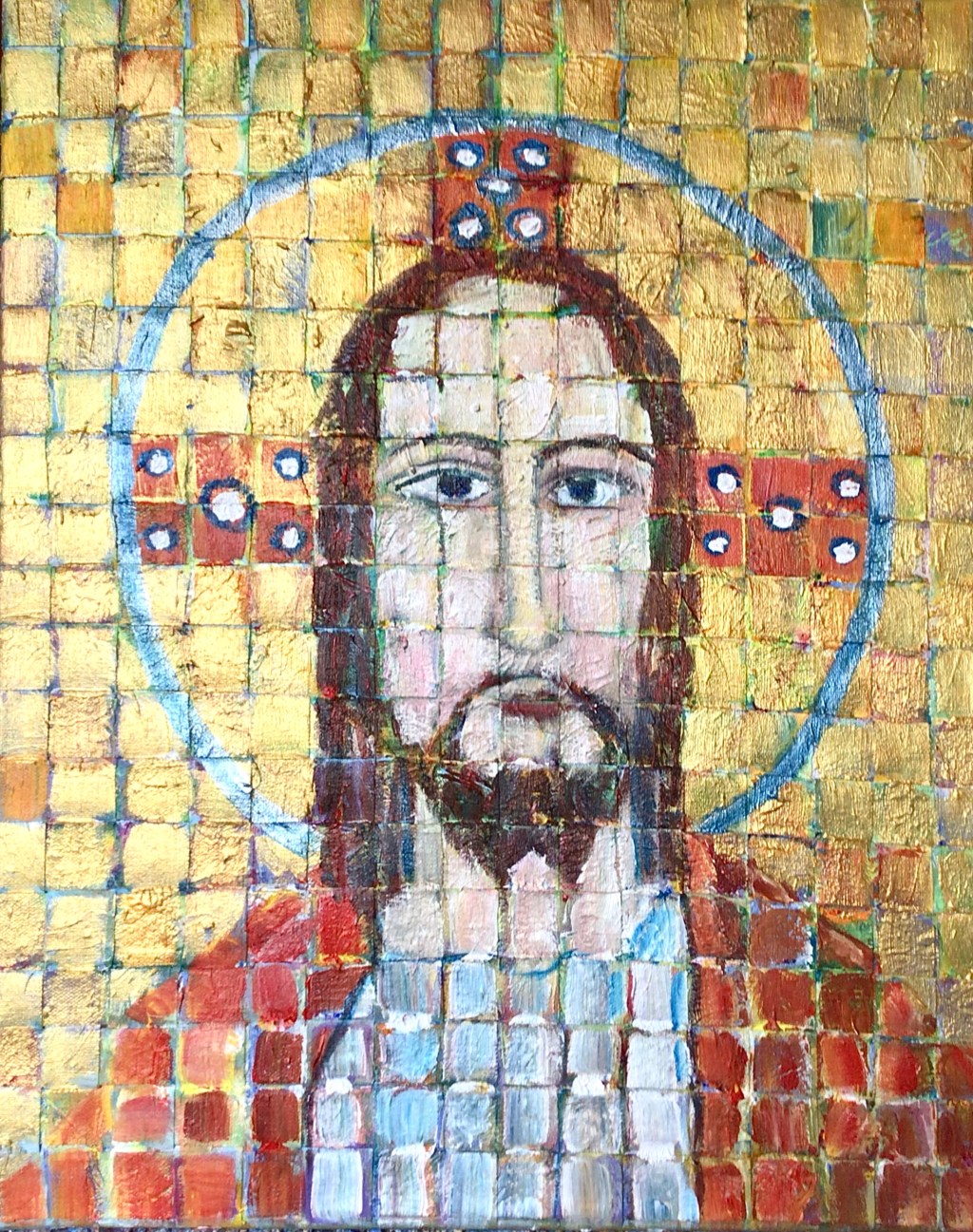
Mosaic Christ Painting

In other words, we see what we are going on to be, rather than what we are now. The icons are a window into the spiritual or heavenly world. If we have an icon in our home, it is a conduit to that heavenly world, much like a wormhole is a conduit to another point in space. Christ’s eyes have a far away look, as if he sees beyond this moment of now, in which we so firmly fix ourselves, to see the future hope of which the prophet Jeremiah speaks in 29:11—

“For surely I know the plans I have for you, says the LORD, plans for your welfare and not for harm, to give you a future with hope.”

This Mosaic Christ woven canvas art work has a light coat of gold acrylic paint over the multi colored background, so the colors show through. Because the brushstrokes don’t cover the whole square, the grid colors show up as colored mortar. The shape of the face and the hair aren’t treated subtly as in a painting, but take on the look of a mosaic.

When I paint an icon, I lose all sense of time. I enter into that holy time in which God IS, and where Jesus is when he says, “Very truly, I tell you, before Abraham was, I AM.” (John 8:58) In other words, I lose all concept of chronological time and enter into the kairos time of God: the right and opportune time, which is known only to God. I stop painting when I sense I’m taking back control of the brush, for then I’ve left kairos time and reentered chronological time.

I look at the clock and think, “Snack time.” It’s time to stop, take care of my physical body, until I’m once again able to renter that spiritual space where time has no meaning, for I’m at home with God. Painting a holy icon is a truly spiritual experience, for those who make their hearts open to the opportunity to experience the holy encroaching into this world. I hope your eyes now are more opened to seeing the holy image of God in-breaking into this earthly realm.

Joy, peace, and sugar cookies,

Cornelia

Rabbit! Rabbit! Welcome to July

adult learning, art, Children, Declaration of Independence, Family, Foundational Documents, Habits, holidays, Independence Day, inspiration, instagram, Painting, purpose, rabbits, risk, sleep, summer vacation, Virginia Bill of Rights, vision

It s time to celebrate!

Are we the United States of America or the Un-Tied States of America? One of the apocryphal sayings misattributed to the great Benjamin Franklin is “We must all hang together, or assuredly we shall all hang separately.” Many are the words of wisdom from those who can’t speak up for themselves anymore, but especially numerous are the aphorisms of those we hold in high esteem, the founders of our nation.

As a young rabbit, my summers were often spent in the game of “School,” as the days lengthened beyond the end of actual school. My mother rabbit, a school teacher in real life, would find me underneath the shade tree in our backyard where I’d be instructing my younger neighbor rabbits sitting in neat rows. Since old school teachers never lose their calling to teach, the upcoming anniversary of the birth of our nation is an opportunity for all of us to remember our national struggle for independence and liberty was a cause both difficult and hard won.

I’ll take one of each flavor, thank you!

As we rabbits pull out our flags, bunting, firecrackers, and ice cream churns, we might want to take a moment to remember the danger and risk our ancestors took to become an independent nation, rather than colonies subservient to the English crown. For many great reasons we can thank our ancestors for their refusal to endure the insults of taxation without representation and the indignities of having all their judicial decisions subject to revision by a foreign party. Indeed, the colonists lived as second class citizens, a fact which grated upon their very souls. Many were their entreaties to the King of England for redress of these wrongs, but to no avail.

Redress is the righting of a wrong. Some wrongs are more wrong than others, to be sure. As a young rabbit in the first year of junior high school, I discovered all my classmates had later bedtimes than I did. In fact, I was still turning in at 7 pm along with my baby brother, who was a mere 8 years old. I made an extensive survey of my different class groups and discovered the average bedtime was 8 pm. I knew my old fashioned rabbit parents would never let me stay up until 10 pm at my tender age.

Every Bunny Needs a Good Night’s Sleep

My daddy was always saying, “Young rabbits need their sleep to grow up big, strong, healthy, smart, and good looking.” I never had a good argument against these reasons, so I’d go to bed, even if I might sneak a flashlight and read a book under the covers. I did get permission to stay up to the late hour of 8 pm, however. Perhaps rebellion is part of the American DNA.

Birthing the American Union wasn’t easy. The collection of individual colonies operated separately and had their own interests. Joining them together into one whole wasn’t an easy task, for each would have to put the common good ahead of their own individual needs and desires. Benjamin Franklin proposed The Albany Plan In July 21, 1754, for a union of the American provinces, which he proposed to a conference of provincial delegates at Albany, New York, to better battle the French and their Indian allies. We remember this era as the French and Indian Wars.

Benjamin Franklin. Plan of Proposed Union (Albany Plan), 1754. Manuscript. Hazard Papers in the Peter Force Collection, Manuscript Division, Library of Congress (2.00.02)

The Albany Plan called for proportional representation in a national legislature and a president general appointed by the King of Great Britain. It served as a model for Franklin’s revolutionary Plan of Confederation in 1775. His original idea germinated in people’s minds, along with other writings which Franklin “lay upon the table.” Not everyone was ready to approve these proposals, but his proposed Draft Articles of Confederation helped the committee when they finally began to focus their action in July, 1775 to write what became our constitution.

In November, 1755, Governor Morris of Pennsylvania pressed for a Militia Act in order to recruit persons for defense of the area from Indian and French attacks. The military units contemplated were purely voluntary and the officers, though commissioned by the governor, were to be elected from below, not appointed from above. The most important difference was that in 1747 the Association was a completely extra-legal body created by the volunteers themselves, while in 1755 the military units were, for the first time in Pennsylvania history, to be established by formal legislative act. And during the eleven months before news of its disallowance by the King reached the colony, the act did serve, in spite of its limitations, as a basis for raising reserve forces for provincial defense.

The Virginia delegates to the Philadelphia convention of 1774 went with this charge in hand:

“It cannot admit of a Doubt but that British Subjects in America are entitled to the same Rights and Privileges as their Fellow Subjects possess in Britain; and therefore, that the Power assumed by the British Parliament to bind America by their Statutes, in all Cases whatsoever, is unconstitutional, and the Source of these unhappy Differences.”

The crown had placed an embargo on the colonists and had forbidden them to import any manufactured goods, books, and while they might trade with other parts of the realm, those countries didn’t have to reciprocate. Economic sanctions were used for political purposes even in the 18th century.

Richard Henry Lee of Virginia introduced a Resolution of Independence on June 7, 1776.

Thomas Paine’s pamphlet Common Sense, published in January 1776, was sold by the thousands. By the middle of May 1776, eight colonies had decided that they would support independence. When the Continental Congress met in Philadelphia Hall on June 7, 1776, Richard Henry Lee of Virginia read his resolution beginning: “Resolved: That these United Colonies are, and of right ought to be, free and independent States, that they are absolved from all allegiance to the British Crown, and that all political connection between them and the State of Great Britain is, and ought to be, totally dissolved.”

After 21 years of planning, priming, and planting of the seeds for the fragile fruit of a New Democratic nation, it would finally come to life in the July 1776 Declaration of Independence and the 1789 Constitution of the United States of America. Yet not everyone was on board, not everyone wanted to leave the established relationship, even if it wasn’t the best situation.

Thomas Jefferson: Rough Draft of Declaration of Independence

Jefferson modeled the Declaration of Independence on the Virginia Bill of Rights, which became the basis for the Bill of Rights of the new Constitution of the United States of America. Notice the sections on 3: Governance by the Majority, 5: Separation of Governmental Powers, with Executive and Legislative members returned to private service, 12: Freedom of the Press, and 13: Armed State Militias.

“That a well-regulated militia, composed of the body of the people, trained to arms, is the proper, natural, and safe defense of a free state; that standing armies, in time of peace, should be avoided as dangerous to liberty; and that in all cases the military should be under strict subordination to, and governed by, the civil power.”

Virginia Declaration of Rights, one of several pages

Section 13 of the Virginia Bill of Rights is one of the founding documents of our nation. Many today talk about “what the founders wanted.” One way we can know in part is to look at the historic records, although they are few and far between. We can find these in the National Archives, the Library of Congress, and at the Smithsonian Museum, among others. We don’t have to be mind readers or seek some medium to channel the spirits of their ancestral vision. We’re fortunate they and their descendants recognized their importance to history. Today we throw away records at a fast pace, not knowing what will be important for the future.

Rabbit Picnic in the Present Moment

While today nearly every young rabbit instagrams their lunch or their night out with a comment, which lasts in perpetuity on the internet, sometimes to a more mature rabbit’s shame and embarrassment, people nearly 250 years ago had to sit down, collect their thoughts, sharpen a quill pen, dip it frequently into the ink well, and write on precious sheets of paper.

Scholars think the Declaration of Independence was not signed by any of the delegates of the Continental Congress on July 4. The huge canvas painting by John Trumbull hanging in the grand Rotunda of the U.S. Capitol depicting the signing of the Declaration is a work of imagination. In his biography of John Adams, historian David McCullough wrote: “No such scene, with all the delegates present, ever occurred at Philadelphia.” We do have Jefferson’s draft copy as well as several printed copies that are “originals,” plus the clean, handwritten copy we treasure as a founding document.

John Trumbull, American, 1756–1843
The Declaration of Independence, July 4, 1776
1786–1820, Oil on canvas,
Yale University Art Gallery,
New Haven, Connecticut

If we had been members of the Second Continental Congress in 1776, we would have been rebels and considered traitors by the King. He would have posted a reward for the capture of each of us, since we were the most prominent rebel leaders. Soon enough the largest British armada ever assembled would anchor just outside New York harbor. By affixing our names to the document,we pledged our life,our fortune, and our sacred honor to the cause of freedom. Perhaps this would causes us today to pause. Then again, we might dip the quill into the ink well and take our first breath as a free American. We’d sign our name with pride. We would be part of history now.

As we prepare our menus for our backyard barbecues and make our plans for block parties, let’s remember in most urban areas firecrackers and explosive devices are banned, except for professional light and sound experiences. Be safe in large crowds, especially at night and in entertainment districts. Be safe, be smart, keep hot food hot and cold food cold.

Jello Pudding Icebox Cake with Graham Cracker Layers and Fresh Fruit Flag Design

Joy, peace, and history,

Cornelia

Choose your preferred font and “sign the Declaration of Independence”
https://www.archives.gov/founding-docs/join-the-signers

Jefferson’s Rough Draft of Declaration of Independence. [Digital ID# us0002_2]//www.loc.gov/exhibits/creating-the-united-states/DeclarationofIndependence/RevolutionoftheMind/Assets/us0002_2_725.Jpeg

Is July 2 America’s true Independence Day? John Adams thought so. – The Washington Post. https://www.washingtonpost.com/news/answer-sheet/wp/2016/07/01/is-july-2-the-true-independence-day-john-adams-thought-so/

Silk Declaration of Independence Scarf, Full size, supports the US National Archive
https://www.nationalarchivesstore.org/products/declaration-of-independence-silk-scarf

Militia Act, [25 November 1755]
https://founders.archives.gov/documents/Franklin/01-06-02-0116

Rabbit! Rabbit!

adult learning, at risk kids, brain plasticity, Children, city, Dreamscape, Faith, Family, flowers, Healing, holidays, Icons, Love, mandala, Mandylion, Ministry, ministry, nature, Prayer, purpose, rabbits, Reflection, renewal, risk, school shootings, shame, Spirituality, Stonehenge, summer solstice, texas, Uncategorized

Welcome to June! I’ve found my sunshades and my flip flops, so this rabbit is ready for a summer vacation. Old school teachers never die, they just take the summer off. And teachers, as well as students, will need a summer off, along with some intensive counseling, to get them ready to return in a healthy frame of mind next fall.

Summer Solstice Mandala

In my early years in ministry, I served in a certain county where many people were caught up in despair. I often complained to my district superintendent of my desire to pour mood elevators into the public water supply.

“You do know drugging the water supply isn’t exactly an acceptable activity for a Methodist minister?”

“Oh, yeah, but it sure would make my job easier.”

Rabbits Love One Another

Remember, June 3 is Love Conquerors All Day. I need to remind myself of this on occasion when I want to take the easy road. As Jesus reminds us in Matthew 7:13—

“Enter through the narrow gate; for the gate is wide
and the road is easy that leads to destruction,
and there are many who take it.”

Taking the easy way out isn’t always the best choice, but it’s the one we rabbits most often choose. We rabbits don’t like to rock the boat, and we like to make all the other rabbits happy if at all possible. The only problem is if we please A, B gets upset. If we please B, A gets upset. We don’t even try to please C, since C is so cranky, even the good Lord Jesus couldn’t fry an egg to please them. We set our hearts and minds on pleasing God, as best we can, and hope to hear the words, “Well done, good and faithful servant, enter into the joy of your master.”

Make Mine Chocolate Ice Cream Day

Chocolate ice cream brings me joy any day of the year, but June 7 is a day dedicated to this frozen delight. Don’t worry about frying eggs, but keep it frozen. I like mine plain, but fresh strawberries or peaches are a nice addition, plus some chopped nuts. Always go for complex, unless you just can’t wait. Then grab a spoon and eat it straight from the pint. (Mark it with your name, since you ate from it.)

Often we cut the Gordian Knot and go for the shortcut to our complex problems. Sometimes this is a good solution, for the shortest distance between two points is a straight line. My daughter used to call my vacation navigation shortcuts “the long cuts,” since I’m directionally challenged. Most of the time, that straight line went through swamp land and alligators. I can hear her voice now, “NOOOOO!!!” I’m known for taking the scenic route, so I often see America’s less known sights, which are off the beaten path.

In the gospel of Luke (14:34), Jesus quotes a proverbial saying:

“Salt is good; but if salt has lost its taste, how can its saltiness be restored?”

Another translation of the latter portion of this verse is “how can it be used for seasoning?”

When I think of loss, I think of a life snuffed out. Some people are burned out, so we can say they’ve lost their seasoning ability. There’s no vim or vigor in them. Other lives are cut short and aren’t able to fulfill their purpose to season the great soup of our community. Our past month was marked by 47 mass shooting incidents in May alone. A mass shooting incident is defined as one in which at least four people are injured or killed, not including the shooter. Suicides aren’t included.

Suicides are also a public health problem. They are the “deaths of despair” that leave ripples of grief and hopelessness in the survivors. They’re the ultimate shortcut solution to a problem, the placing of a period where life has placed a comma or a semicolon. My daughter once attempted suicide by downing half a bottle of aspirin. I noticed the open bottle and pills scattered across the floor. She said the “dog ate it.”

“That’s too bad, I’m going to miss that dog. She won’t be long for this world. We’ll need to make burial plans for her.”

“Well, actually, I’m the one who ate the aspirin.”

“Then we’re going to the hospital. You aren’t going to like getting your stomach pumped, but it’s better than being dead. You want to have a chance to grow up and have a good life. A dog we can replace. You—not so much.”

It was a rough time in her life, and mine too. But God was with us. And we had support from counselors, friends, family, and our church family. My work family and my clients supported me too. I must be the most extroverted rabbit in the patch, because I asked everyone for help. It turned out my problem was shared by everyone else. I discovered I wasn’t alone, but was the most ordinary of rabbits around.

This is a humbling experience, especially when you’re a first child and the only girl. I admit to being spoiled, but don’t let my brother rabbits hear me say this. I’ll deny it to my last breath: I’m like every other rabbit I know. I want to think I’m someone special, even when I’m just as fluffy as every other bunny out there on Gods green earth.

June 21—Summer Solstice

Unfortunately, half the suicides today are committed with a gun, not aspirins. When looking at overall gun deaths, roughly two-thirds are attributed to suicides—a proportion that is consistent across most states. Gun suicides are on the rise and data also indicates men, white Americans, older people, and individuals living in rural areas present higher rates of gun suicides. Another group presenting a unique risk for suicide is current and former members of the armed forces, especially those with PTSD.

Compared with the general population, current and former military members have significantly higher rates of gun ownership. According to a 2015 study, nearly 50% of U.S. veterans own a gun. In contrast, studies suggest that only about 22% of the general U.S. population owns firearms. Similarly, the age groups of 50 to 64 years old and 65 and older have the highest rates of gun ownership, according to a 2017 Pew Research Center study. This can further explain the high rates of suicide among older veterans.

According to data from the U.S. Department of Veterans Affairs (VA), in 2019, close to 4,332 veterans died by gun suicide in the United States, representing close to 18 percent of the total number of gun suicides reported by the Centers for Disease Control and Prevention (CDC) during that year. Perhaps more alarming is the fact this figure shows a veteran is killed by gun suicide every two hours. In 2019, active duty military members committed suicide by gun 64% of the 498 total (318), almost one gun suicide per day.

Why isn’t anyone speaking about this? For all the lip service our politicians give to the flag and to the armed service members, they seem to forget them once they’re no longer useful to fight their wars or march in their parades. Perhaps because Congress won’t devote any money to study the effects of gun violence on the citizens of our Beautiful America, so we have to fund private studies here and there to piece together a patchwork of facts of this scourge on the peace of our people.

My young neighbor, only 8 years old, was in a panic as he knocked on my door the other day. His parents hadn’t come straight up the elevator, as they’d said they would. He was crying to beat the band and was sure something bad had happened to them. I invited him inside and left the door open so we could see them come past. He was so worked up, he couldn’t sit down. I suggested a call to his daddy, but they came walking past just at that moment.

June 19—Father’s Day

We don’t realize what terror these school shootings put our children through. There’s no safe place for them any more, no matter how “hardened” we make the buildings. Some person always breaks the shell at the most inopportune moment.

Some rabbits will have empty seats at their family reunion tables because someone decided to act impulsively. Father’s Day (June 19) won’t be a celebration without the son or daughter to give Dad the tie, the golf balls, or breakfast in bed.

I think back to my own childhood. We worried in the 1950’s more about the urban legends of Halloween candy poisoning, when we were more likely to get killed crossing Highway 1, a four lane highway running through our town. My mother rabbit would wait for me to ride the trolley home from school. She would wait until the near lane of traffic cleared before she walked out to the center median and time this so the far lane’s cars would finish passing so she could walk across the newly empty lanes to meet me on the other side. We held hands and crossed in the same manner on the way back to our home.

This was our routine from the start of school until sometime in the autumn. Mother was delayed one day, so I sat down to wait for her and opened my book to read. I was wearing a brown jacket against the early cool spell, and my dirty blonde hair blended in with the pile of dry leaves on the ground. Intent on my book, I failed to see her come outside. She overlooked me and went inside thinking I’d missed my ride.

A bit later, I decided if she wasn’t coming for me, I’d come to her. Gathering up my possessions, I stood on the curbside. I watched the comings and goings of the quickly moving traffic. Once I saw the break in the pattern, I walked out into the clearing, waited at the median, and crossed behind the trailing traffic of the second lane. When I walked inside, my mother had a conniption fit. After this, I began riding my bicycle to school, and my brother got to come with me.

Brain Functions

Not everyone is mature enough to cross a four lane busy highway by themselves when they’re in the fourth grade, which is the same age as the children who lost their lives at Robb Elementary in Uvalde, Texas. . Some people still need to be supervised at work even in their 20’s. The brain keeps maturing past age 21, as the frontal lobes, which are home to key components of the neural circuitry underlying “executive functions” (such as planning, working memory, and impulse control) are among the last areas of the brain to mature; they may not be fully developed until halfway through the third decade of life. Although neuroscience has been called upon to determine adulthood, there is little empirical evidence to support age 18, the current legal age of majority, as an accurate marker of adult capacities.

Since May 24, the date of this tragedy in Uvalde, Texas, the gunviolencearchive.org has recorded 16 mass shootings in six days, with 79 killed or wounded. Some of these are high school graduation parties where uninvited guests arrived and gunfire broke out, others are the result of young people wandering about in the late hours and getting into trouble with guns. During my time of ministry, youth, alcohol, and firearms were usually a recipe for trouble. Maybe parental rabbits’ brains are still developing too, if they aren’t able to put their rabbit foot down and tell the junior rabbits to leave their weapons at home. Visiting Jack Rabbit in jail for accidental death or intentional use of a firearm will throw a curve into your best laid plans for your progeny.

Rabbits in Cars Going for a Joyride

Instead, cities may have to reinstitute curfews after dark to curtail the opportunities for gun violence. Or they could raise the age to buy a weapon and require a longer waiting time and a more thorough background check. I wouldn’t be opposed to a training class and a test to see if the owner knows how to use the weapon safely. After all, we do this for the 2 ton weapon of mass destruction known as the family automobile. So what if the founding fathers never had autos; they also never had automatic pistols or large magazine weapons, modeled on the ones used in combat.

Did I mention June is National Safety Month? Its emphasis is workplace safety, but as a former teacher, this old rabbit reminds you, between 2009 and 2020, teachers’ workplaces are in schools, which is where 30% of mass shootings occurred in public places (schools, malls, or bars), while 61% of mass shootings occurred entirely in the home and another 9% occurred partially in a home and partially in a public location. The common factor in these is the gun and the presence of domestic violence. In at least 53 percent of mass shootings between 2009 and 2020, the perpetrator shot a current or former intimate partner or family member during the rampage.

Richard Small seen posing with his rifle before turning it over to police.
(Joshua Lott/The Washington Post)

I know y’all usually expect a bright and cheery note from me at the beginning of the month, but my heart is broken. Thoughts and prayers are nice, but they don’t stop the carnage. We need to make some changes. At least one man has turned in his assault weapon to his local police station, so it doesn’t fall into the wrong hands. He couldn’t bear the thought of it being used to perpetrate a similar crime if he were to sell it. If we parents don’t say no to our children, if we keep voting for politicians who are doing nothing, then we get to keep the distinction of having the highest rate of violent gun deaths for any of the developed countries.

That’s not the American Exceptionalism I believe in. We can do better. These are crimes against the common good and against the innocent. The shooter shares the primary blame, but everyone who does nothing to change our society for the better also shares the blame and shame for the next group of victims. At the rate we’re going, we’re having about one mass shooting per day. Eventually this scourge will come to YourTown, USA, and your small town police force will be just as flabbergasted as poor Uvalde’s. How could this happen in our little corner of the world?

I cry along with Jeremiah ( 8:21-22):

For the hurt of my poor people I am hurt,
I mourn, and dismay has taken hold of me.
Is there no balm in Gilead?
Is there no physician there?
Why then has the health of my poor people
not been restored?

Time Magazine Cover from 2019 with all the Mass Shooting Locations Named

Sometimes we go along with the attributes of cultural Christianity, rather than practicing the Christianity of Jesus Christ. Romans 12:2 reminds us

“Do not be conformed to this world, but be transformed
by the renewing of your minds, so that you may discern
what is the will of God—what is good and acceptable and perfect.”

Joy, peace, and balm for hurting souls,

Rev. Cornelia

Deadly Dreams: What Motivates School Shootings? – Scientific American
https://www.scientificamerican.com/article/deadly-dreams/

You can view a report of any 2022 mass shooting incident by visiting the list on the Gun Violence Archive’s website:
https://www.gunviolencearchive.org/reports/mass-shooting

Poisoned Halloween Candy | Snopes.com
https://www.scientificamerican.com/article/deadly-dreams/

Mass Shootings in America | Everytown Research & Policy | Everytown Research & Policy
https://everytownresearch.org/maps/mass-shootings-in-america/

Adolescent Maturity and the Brain: The Promise and Pitfalls of Neuroscience Research in Adolescent Health Policy – PMC
https://www.ncbi.nlm.nih.gov/pmc/articles/PMC2892678/

Guns and Mass Shootings: Data Show Why US Is Outlier on Deaths From Firearms
https://www.bloomberg.com/graphics/2022-us-gun-violence-world-comparison/

Texas romance with guns tested by Uvalde school shooting – The Washington Post
https://www.washingtonpost.com/nation/2022/05/30/uvalde-shooting-guns/

Autumn Leaf Prints

adult learning, art, autumn leaves, Carl Jung, Christmas, coronavirus, Creativity, Faith, grief, holidays, inspiration, nature, Painting, renewal, shadows, Spirituality, trees, vaccinations, vision

As the days grow shorter, the pile of leaves grows larger. This is Einstein’s equation for autumn. I know “Energy equals Mass times the speed of Light squared” isn’t really congruent with all those bags of leaves accumulating on the edge of the streets of the front yards in your neighborhood. It just seems that way. When I bought my first little stucco, flat roofed house back in my hometown, the former owners reminded me at closing, “Be sure and rake the roof every autumn.”

Of course I forgot about this, until the twenty something major trees around my little flat roofed house dumped all their leaves on my roof. How did I know? When it rained, those leaves blocked the drainage holes, so water came inside the ceiling light fixtures of my kitchen in the back of the house. As soon as the rain quit, I had the ladder out and was filling the big, black garbage bags with soggy leaves. If you only fill them half way, they’ll stay intact when tossing them over the parapet. I was younger then, and trainable. I didn’t forget when autumn came the next year.

Gail’s Leaves floating on Water

I’ve always thought leaves “fell” off the trees or the wind blew them off, but I asked Mr. Google, “Why do leaves fall?” Turns out, the trees cut them off with scissor cells. The leaves are only useful for making food for the tree. They are the seasonal kitchen staff, so the tree lets them go for the winter and brings in a new crew in the spring. The changing light and cooler temperatures triggers a hormone that makes this happen.

The scissor cells are stained red and mark the boundary between the branch (left) and the leaf stalk.
University of Wisconsin Plant Image Teaching Collection

If the leaves stayed on the tree, they’d wake up during a winter warm spell, start their food production work, and then get frozen when the cold inevitably returns. The tree knows the lifespan of the leaf, and this is the natural course of the life cycle. New growth will come in the spring, after a period of rest and recovery.

Lauralei’s Memories of The Leaves that Were

Our holiday season coincides with darkening days and marketing excess. Most of the commercials show happy families with lots of presents in heavily decorated holiday environments. Statistics show 25% of people are estranged from their families, and one out of every 463 Americans alive at the beginning of 2020 has since died of covid-19, the disease caused by the novel coronavirus. About 1 in 8 Americans say that a member of their family died of the virus; another fifth say that they lost a close friend, according to YouGov polling. These are staggering numbers, for in the US alone, 779,293 people have lost their lives as of November 30, 2021. One too many Thanksgiving tables had an empty place setting for a loved one no longer among us, and this will be a blue Christmas for many families.

If this were a war, maybe folks would get all excited and consider good health practices such as mask wearing , hand washing, and vaccinations their patriotic duty. Instead, they throw themselves into the breach of a thousand tiny viruses as if they were seeking the congressional gold medal for valor, and end up leaving their families with nothing but medical bills, grief, and the loss of their presence. Into this weary season comes Omicron, yet another variant, but an expected event due to the lack of worldwide access to vaccines and the virus’s ability to mutate in immunocompromised individuals. The enemy keeps evolving and the battles continue, whether we’re weary of the struggle or not.

“The Falling Leaves,” by Margaret Postgate Cole of England, is one of the first anti-war poems from a woman’s perspective. It was written in November 1915, during the First World War, when from 1914 to 1918, Flanders Fields was a major battle theatre on the Western Front. A million soldiers from more than 50 different countries were wounded, missing or killed in action there. Entire cities and villages were destroyed, their population scattered across Europe and beyond. The tradition of poppies on Veterans Day came from the red flowers given life from the blood spilled on this battlefield. COVID today is exacting it’s own cruel battle toll, with children left orphaned and spouses left without their mates. The adverse affects on this generation may be equal to those who went through the great flu pandemic of 1918 or the Great Depression.

War may be necessary in some instances, but it’s never to be glorified. There’s always a sadness related to the loss of life, regret over the great expense poured out that might have been used to build rather than destroy, and the cruelties that attend actions when we make others into evil enemies and refuse to see them as human as we are. Her poem speaks poignantly to this human loss:

Today, as I rode by,
I saw the brown leaves dropping from their tree
In a still afternoon,
When no wind whirled them whistling to the sky,
But thickly, silently,
They fell, like snowflakes wiping out the noon;
And wandered slowly thence
For thinking of a gallant multitude
Which now all withering lay,
Slain by no wind of age or pestilence,
But in their beauty strewed
Like snowflakes falling on the Flemish clay.

Source: Margaret Postgate’s Poems (1918)

If we want to treat these end of year days as “days of denial” of all that’s grim in the world to focus only on the good and the light, we’s be like people who claim we have no shadow. Carl Jung believed the shadow included everything in the unconscious mind, good or bad. Also, the shadow might include only the part of the personality that you don’t want to identify as self, but still is a part of your unconscious mind. This dark side of your personality contains everything your conscious mind can’t admit about itself.

When we read the birth story of Jesus, we often focus on the angels and the gifts of the magi. We forget these heavenly hosts are God’s armies and the magi came to meet the new king. These were revolutionary acts that caused King Herod to feel insecure and threatened, so he slaughtered the innocent babies born at this time. The Bible never forgets this shadow side of life, for this is why Christ came into our world:

“to give light to those who sit in darkness and in the shadow of death, to guide our feet into the way of peace.” ~ Luke 1:79

Joy and Peace,

Cornelia

Why Leaves Really Fall Off Trees : Krulwich Wonders… : NPR
https://www.npr.org/templates/story/story.php?storyId=114288700

The Depths Of Estrangement: Why Family Rifts Happen And How To Heal
https://www.wbur.org/hereandnow/2020/12/24/family-estrangement-holidays

[The Washington Post] Analysis | A third of Americans say close friends or family have died of covid-19
https://www.washingtonpost.com/politics/2021/10/13/third-americans-say-close-friends-or-family-have-died-covid-19/

Visit Flanders Fields | VISITFLANDERS
https://www.visitflanders.com/en/themes/flanders_fields/

Golden Leaves on a Silver Breeze

arkansas, art, autumnal equinox, beauty, cognitive maps, Creativity, Dreamscape, Faith, flowers, Holy Spirit, hope, Imagination, inspiration, ministry, mystery, nature, Painting, Retirement, Spirituality, Travel

Autumn is just around the corner: I know this in my heart of hearts. My friends, who have lost hope in this endless pandemic, tell me, “It’s heat stress, nothing more.” I persist in my belief the bright yellow leaves scattered among the green canopies and the orange and red tinged foliage are the harbingers of the cool breezes of fall.

When the thermometer kisses 100 F and the heat factors have blown past that number like a NASCAR driver taking a hot lap for the pole position, my body only wants to swill decaf iced tea and stay close to the air conditioning. When I taught art back in Louisiana, my art rooms were in an old wooden shotgun shack. It wasn’t air conditioned because “it’s tradition, so it won’t be air conditioned, no matter how much you ask for it.” Private schools have their “traditions,” some of which aren’t healthy for either the teachers or the students.

Two days into the school year, I fainted from the heat. A visit to the nurse’s station got me glasses of sugary iced tea and cold compresses, plus it was air conditioned. I thought I’d died and gone to heaven. Someone drove me to my dad’s office in the Medical Arts building across from the hospital. I got the once over and was sent home to rest, drink plenty of fluids, and not go outside. My couch never looked so good to me. Mom and dad even kept my little girl so I could rest.

I learned later I had a brush with death. Passing out with other people there allowed me to be helped. People who are alone in the heat aren’t so fortunate. Heat can kill a person. The hurricane Ida is already taking out the utilities in south Louisiana, which means they might not be back for weeks. The hospitals full of Covid patients hope to have ten days of power and food, but that’s just to get them through until relief supplies can roll in.

Dreamscape: Airport

I actually repainted this canvas a second time, since I wasn’t thoroughly pleased with it on the first go round. The Airport image above is the first incarnation of this painting. While I don’t mind the colors in the ground, the overall texture of the work didn’t appeal to my senses and the runway with its numeral stuck out like a sore thumb. It was either going into the trash bin of my work, or I’d leave it alone long enough to find the inspiration to cure it.

Painting is a journey in itself, as the white canvas disappears under the brushstrokes of color. We can think of a pristine sand beach in the early morning, and its well marked surface erased by the high tide under the moonlight, only to be marked again when the sun rises. As Benjamin Disraeli, the British Prime Minister in the 19th century once said:

“Like all great travellers, I have seen more than I remember, and remember more than I have seen.”

Sometimes we can better solve a problem by ignoring it, for the the problem will find its own solution. Trying to impose our solution upon it just leads to more death, but not to life. Letting the painting come into being in its own time is a better choice, for it can’t be born before its time. In the spiritual life, kairos time is God’s time, while chronos is human time. When we work on deadlines or punch a clock, we operate on chronological, human time, but if we wait for the inspiration from the divine energy, we’re operating in the God moment, or the propitious moment for decision or action.

Golden Leaves on a Silver Breeze

Along my life journey, I’ve made some unique handmade preaching stoles. When I decided I no longer had use for them in retirement, I decided to cut them up. This is why some of the pieces are the same rectangular size, such as the gold and silver diamonds pattern with the blue and white diagonal stripe in the upper left corner. Some of the pieces are the backings, and others are deconstructed sections. I incorporated several types of gold: acrylic paint, embroidery thread, and a metallic candy wrapper. I also used multiple textures of lace and fabric, some of which I overpainted. All of these come from recycled fabrics. In life, nothing is wasted.

Perhaps this no longer looks like a map of an airport, but more like a place remembered in a dream, when one wants to travel on the whiff of a breeze, which has brought a half remembered smell of a time in the past or a love long lost. Autumn can bring those memories to mind, as well as our hopes for a more beautiful future, for just as a leaf flutters free from its tree, our thoughts can fly away: golden leaves on silver breezes.

Look for the golden leaves, my friends, and let them call to mind those of fond memory and the dreams of journeys yet to come.

Joy and Peace,

Cornelia

Memories and Forgiveness

arkansas, art, brain plasticity, butterflies, Carl Jung, change, cognitive decline, Creativity, Faith, Family, Fear, Forgiveness, garden, Healing, Holy Spirit, hope, Imagination, Love, Ministry, Painting, Philosophy, Reflection, renewal, salvation, shame, Spirituality, trees, vision

Does God, who knows all things, also have a memory, or can God choose to forget?

I often wonder about such ideas, for when we ordinary folk experience horrific traumas, we often say, “This is going to be with me for the rest of my life. I’ll never get over it.” In some cases this may be true, especially if the person doesn’t seek long term counseling and faith support to deal with the soul damaging harm. With assistance, one can heal from the pain, even while remembering the injury, just as a broken bone can be mended over time.

Those who’ve been wounded and healed can go on to help others heal from their pain and brokenness. The memories of the wound remain, just like a scar on the skin, but they don’t interfere with living a positive and productive life. For those whom Henri Nouwen called “wounded healers,” and who find meaning in their suffering, their lives are a model for others to emulate, for their memories don’t destroy them.

If we look at the nature of God—the one who is, the one who will be, and the one always becoming—we can understand better the discussion between Jesus and the Temple authorities in John 8:56-59–

“Your ancestor Abraham rejoiced that he would see my day; he saw it and was glad.”

Then the Jews said to him, “You are not yet fifty years old, and have you seen Abraham?”

Jesus said to them, “Very truly, I tell you, before Abraham was, I am.”

So they picked up stones to throw at him, but Jesus hid himself and went out of the temple.

Moses and the Burning Bush

Jesus made the claim to the I AM name and being of God, an act of blasphemy, which the devout Jews found outrageous, since it made him equal to God. Their memories of Moses meeting God in the burning bush are to this day a seminal recollection of their liberation story from their Egyptian captivity:

But Moses said to God, “If I come to the Israelites and say to them, ‘The God of your ancestors has sent me to you,’ and they ask me, ‘What is his name?’ what shall I say to them?”

God said to Moses, “I AM WHO I AM.” He said further, “Thus you shall say to the Israelites, ‘I AM has sent me to you.’ ” (Exodus 3:13-14)

Can one who always lives in the present have a memory of the past, or envision the future? I met a lady at Sam’s Club in the days before the July 4th weekend. She was standing in the center of the entrance while folks were pushing baskets quickly past on either side of her. I thought she looked like the choose cone at a NASCAR restart. Bewildered and worried, she was looking for someone who wasn’t to be found. I asked her if she needed help, and she was even uncertain about this request. I suggested we walk over to customer service. On the way, I discovered her name and that her people had walked off to shop without waiting for her. She didn’t know their names, but she did know hers.

I thought about my own daddy, who had Parkinson’s and Alzheimer’s diseases. He progressively lost the memory of our family members: first my younger brothers, then me, and finally my mother became “the lady who came to kiss him every afternoon at 4 o’clock.” However, he could remember every bit of his medical training, even when he slipped and fell. On entry to the ER, he began ordering the medical staff about as if he were in charge. They tried to shush him up, until they realized he was running the accustomed intake drill.

Map Landscape of Hot Springs

Memories are like this, for we keep some which we find necessary and yet lose some very important ones we’d really like to hold onto. We also keep painful memories longer than happy memories, perhaps as a survival instinct. We won’t touch that hot stove again! This doesn’t bode well for our overall optimism, however, if we end up seeing the world as a fraught and dangerous place. How we imprint the emotions on our memories is still debated, for we tend to assign positive or negative emotions to events of our past. Then these affect our future experiences. This is why some of us fear dogs, while others of us approach them with respect, allowing the animal to sniff us out and accept us before we interact with them. We can change our future reactions to old memories, but this is a work in process.

God never gets old, even though God is eternal. If God is always I AM, or I AM WHAT I AM or I WILL BE WHAT I WILL BE, then God is a very present god and as well as a God of the future. If the past is also the present for God, then perhaps the past may be also as the future. In fact, for all we humans know time, as we understand it, may have no meaning for God, and what we think of as past, present, and future, God may experience as the eternal NOW. This may be how we understand Hebrews 13:8— “Jesus Christ is the same yesterday and today and forever.”

Recently I’ve been finding old mementos, souvenirs of my youth. Some are faded newspaper clippings, others are letters from old boyfriends, and then there’s the strange and esoteric memorabilia that somehow survived over half a century in storage along the various stages of my journey. My people are genetically predisposed to collecting. Did I ever mention my grandmother’s ball of tinfoil she kept on the kitchen window sill next to the sweet potato plant she was growing in the old mason jar? I come by this habit through my maternal line.

As I’ve been going through these, I had no difficulty throwing away utility bills from the early 2000’s, but then I found the college freshman beanie from my childhood boyfriend. He lived thirteen houses down the street from me. We had a thing for each other all through junior high and high school. For some reason, he gifted it to me. That motive is lost to the fog of memory now. Perhaps as Isaiah 43:18 says:

“Do not remember the former things,
or consider the things of old.
I am about to do a new thing;
now it springs forth, do you not perceive it?”

Memories of a Landscape

When I picked up this ancient cap of shame, for that’s exactly what it is, since it marks its wearer out as the low man on the totem pole, I marveled at how small the hat was. I don’t remember my beloved having a pinhead! In fact, I mooned and pined over his handsome and athletic form. Then again, I was young. As I held it in my hands, I felt the need to recreate something new from it. I had a landscape painting which had gone poorly because I was ill. I decided to paint over it, using the hat as the central tree structure, and adding some cut fabric trees to balance it. I also found some printed butterflies I cut out for embellishment. Once I glued those shapes on the canvas, I could repaint the canvas.

As I destroyed the old canvas and remade it into a new creation, the words from the prophet Isaiah (43:25) came to mind:

“I, I am He, who blots out your transgressions for my own sake, and I will not remember your sins.”

God is a forgiving god, but more importantly, God is a forgetting god. How many times do we say, “I’ll forgive, but I won’t forget?” We might as well say, “I’m not forgiving or forgetting, because I’m going to carry this wound or harm or slight FOREVER.” So much for our going onto perfection in love, or learning to love as God loves.

The cornerstone of all forgiveness is self-forgiveness. Too many of us believe the verse from John 3:16 only applies to the world, but not to themselves individually—

“For God so loved the world that he gave his only Son, so that everyone who believes in him may not perish but may have eternal life.”

If we can’t forgive the darkness within us, or the mistakes we’ve made, or allow God to forgive us, how are we to forgive others? In fact, if we tell God our sins are too great for God to forgive, we’ve set ourselves above God’s authority to forgive sins. This is pride, authority, and idolatry all wrapped into one. We’ve made ourselves into a god, rejecting God. The Pharisees of old rejected Jesus for this very reason.

Who was the most forgiving person in all of scripture? Jesus, of course, for he claimed authority to forgive sins just as God did, as when Jesus healed the paralytic whose friends let him down through the roof (Luke 5:20-24). Those who were nearby wondered at his boldness, but he asked, “What’s easier, forgiving sins or saying stand up and walk?” If we’re going to claim the name of Christ, we too are going to be forgiving people. Forgiving is an act that heals not only the other, but also ourselves. If we can’t forgive, we’ll never be able to forget, or transform our painful memory into one which God can use for the healing of others.

Map of Hot Springs: Airport

In a sense, we make a new map in our minds and hearts of our old landscapes of pain and sorrow. What once were places of despair can become fertile fields, if not gardens of delight. Our wounds become the tender points which open us up to the suffering of others, and allow us to minister to their needs. Our healing is part of God’s steadfast love. As Jeremiah reminds us:

“No longer shall they teach one another, or say to each other, “Know the LORD,” for they shall all know me, from the least of them to the greatest, says the LORD; for I will forgive their iniquity, and remember their sin no more.” (31:34)

When I think of the faithfulness of God, I also believe in the timelessness of God. When Jesus meets his disciples in Galilee to give them the Great Commission in Matthew 28:20, he says, “And remember, I am with you always, to the end of the age.” When this present age ends and God renews the heavens and the earth, how will we experience time in the new creation? Surely, if God is making all things new, we won’t be in this same world anymore and the rules it follows won’t be the same. We aren’t thinking boldly enough or big enough if we limit God to only recreating only the current fallen and broken world we have now.

Maybe if more of us began to think on the world a forgiving and loving God could create, we could begin to remake this present world into the new creation. If we were to make acts of love and forgiveness more prominent in our daily lives, we might restore our neighbor to fellowship and community. We can forgive even those who don’t seek it, for they’re the ones who’re most in need of forgiveness. With a forgiving and loving God’s help, we can do this.

Joy and Peace,

Cornelia

How memories form and fade: Strong memories are encoded by teams of neurons working together in synchrony – ScienceDaily
https://www.sciencedaily.com/releases/2019/08/190823140729.htm