A Prayer to End All Suffering

art, crucifixion, Deesis Icon, Easter, Faith, Good Friday, grief, Healing, hope, Icons, incarnation, inspiration, Lent, Painting, Prayer, renewal, Spirituality, Strength, suffering, vision


I don’t don’t know about you, but I don’t willingly sign up for pain or suffering. Pollen season isn’t my friend. I could do without all this yellow and green stuff clogging my brain cells and my lungs. As I cough and die, swill decongestant tonics, and huff my asthma inhaler, I wonder if this particular cross bearing has to be on my things to do list every Lenten season.

Mid 10th CE ivory Deesis Icon, Metropolitan Museum of Art, NYC

As Jesus turned his face towards Jerusalem, he knew his fate was certain. His message began to change, as he told his followers in Luke 14:27, “Whoever does not carry the cross and follow me cannot be my disciple.” Of course, not all were ready to hear or to follow, for some had obligations at home, and others weren’t yet ready to live the itinerant life. Many today don’t answer the call to ministry because they can’t see the long unknown road ahead. Only those willing to walk by faith and not by sight will journey off, trusting in God’s providence, mercy and grace.

Earliest sculpture panel of the Crucifixion, Maskell Passion Ivories, 420-430 CE, one of four carved panels of a sarcophagus, British Museum, London.

I used to say, “Give me a few months and I can whittle any group down to size. I can prune with the best of gardeners—all I have to do is read actual scripture!” I figure if folks want to get mad, they should take it out on the original writers. Blaming the messenger is useless. As the apostle Paul says:

“For the message about the cross is foolishness to those who are perishing, but to us who are being saved it is the power of God.” (1 Corinthians 1:18)

The oldest icon of the Crucifixion of Christ, Greek Orthodox Holy Monastery of St. Catherine, Mount Sinai, 8th CE

The ancient crucifixion icons glorify the triumph of the Incarnate God and his victory over death, which is the consequence of our fall; that fatal moment in the garden of Eden when Adam and Eve chose to desire to be like God, even though they had only the image, but not the ability to be gods themselves. Icons of the crucifixion represent Christ who, fully human and fully divine, takes on death so humanity no longer has to die. Christ conquers death by being a suffering servant, he becomes a victorious king.

Mary from the Hagia Sophia Deesis mosaic

Most of us would rather jump to the Bible’s Victory story and skip its Victim sections because we live in an age which validates the strong and successful, while denying the worth of the weak and wounded. Easter and Palm Sunday are more triumphant celebrations than the sonorous and somber Foot-washing Maundy Thursday and Good Friday Vigils. Yet without suffering, would we have cause for rejoicing? Would we even know the meaning of joy without some pain in our lives? Everyone has some pain in their life, whether it’s the pain of an unrequited love, the loss of a child stillborn, a divorce, a war wound, a frenemy wound, or some other brokenness.

Stage one

Mary knew early on her child of destiny would bring her both joy and pain, as all mothers discover soon enough. Luke records in 2:34-35,

“Then Simeon blessed them and said to his mother Mary, “This child is destined for the falling and the rising of many in Israel, and to be a sign that will be opposed so that the inner thoughts of many will be revealed—and a sword will pierce your own soul too.”

Deesis. Top center front panel of the Harbaville Triptych. Ivory. Ca. 940-960 CE. Musée du Louvre, Paris.

Many today only want to show the happy times in their hyper-curated lives on social media. As a result, “Keeping up with the Joneses” gets harder all the time. With Facebook’s constant encouragement of “you may know algorithms,” we’re encouraged to add more friends to our circle. We’re exposed to too many families of that surname, when once we only knew a few who lived in our own neighborhoods. If all these Jones folks are always smiling widely for the camera, we might be tempted to ask, “Why don’t I feel like smiling also?”

I know people who don’t read newspapers, watch the news on television, or even listen to the snippets on the radio. “Too much bad news!” They too don’t want to hear of the suffering, the plight of the weak, or face their seeming impotence to do anything about it. We are weak people. We are not strong, no matter how often we quote passages like Philippians 4:13—

I can do all things through him who strengthens me.”

Richard Rohr, in The Enneagram, A Christian Perspective, says, “It is the things that you cannot do anything about and the things that you cannot do anything with that do something with you.” Suffering and prayer are what truly transform us, if only we don’t waste time looking for someone to blame.

13th CE Hagia Sophia Mosaic, Istanbul, Turkey

So far, no one person has been able to stop the Russian invasion of the democratic nation of Ukraine, but plenty of people are holding up an aid package that would help this small country fight this battle at great cost to life and limb. The Ukrainians suffer and America dithers. We seem to think our leaders have infinite powers, as if they were gods, but we forget all people are only human and have only the image of god, but no huma has either the power or the glory of the true God.

Unknown Ukrainian Artist: The Deesis, Icon, Tempera, silvering on gesso-grounded two-piece fir-wood panel, engraving, carving; 1735, h 114, w 84, d 9, National Art Museum of Ukraine.

So far, no one person has been able to keep either Hamas or Israel from wreaking havoc on each other. My daddy used to say, “you can’t make a silk purse out of a sow’s ear.” After years of teaching and pastoring, I’d throw my two cents in: “we can lead a horse to water, but we can’t make it drink.” As long as people are invested in retribution, they will return suffering for suffering. The sad truth is people who have never processed their own suffering will cause suffering for others as well as for themselves. The children will cry. And the women will cry. But now the men are crying too.

Late Roman Magical gem; intaglio; green-brown jasper; oval; bevelled edge on side B, 2nd-3rd CE, British Museum, London.

No one has a magic wand to eliminate suffering or harm. In ancient times, the image of the crucified Christ was used as a magic charm to keep the wearer from harm. Some people today wear a cross for the same reason; it’s a fashion statement, a good luck charm, and a symbol of their faith. Instead of a charm, we offer acts of prayer and mercy.

Hagia Sophia Deesis Mary icon 2024, finished

We don’t just cry for the fact of the sufferings we endure, or for the sufferings of others, but we cry out in our suffering to the only one who can hear us, heal us and make whole our broken hearts and homes. We cry out to the God, who created all of us in God’s own image out of the dust of an obliterated and bombed out land. We cry out to the God who brings rains in their seasons to a land parched by climate change and ruined by reckless use of natural resources. We cry out to the God who raised God’s son from the dead, even as people everywhere bury their own dead sons and daughters from the wars fought by nations and non-state actors who wrestle for power in tiny slivers of contested territories.

Christ and the Apostles in the Heavenly Jerusalem, apse mosaic, early fifth century, Rome, Santa Pudenziana.

We can see in this image a dramatic transformation in the conception of Christ from the pre-Constantinian period. In the Santa Pudenziana mosaic, Christ is shown in the center seated on a jewel encrusted throne. He is surrounded by apostles, biblical women, and symbolic images of the four gospel writers. The ideal landscape is the New Jerusalem, or the Heavenly Kingdom. This image was created after Constantine’s victory and conversion to Christianity. Prior to this, Christian art repurposed Greco-Roman themes of the Good Shepherd and the Apollo Sun god.

Unknown Artist: Plaque with Christ flanked by the Virgin and Saint John, late 19th–early 20th century (Byzantine style), Cloisonné enamel, gold; 6 9/16 x 5 9/16 x 1/16 in. (16.6 x 14.1 x 0.1 cm); Metropolitan Museum of Art, NYC, Gift of the Estate of Mrs. Otto H. Kahn, 1952, Accession Number: 52.54.1

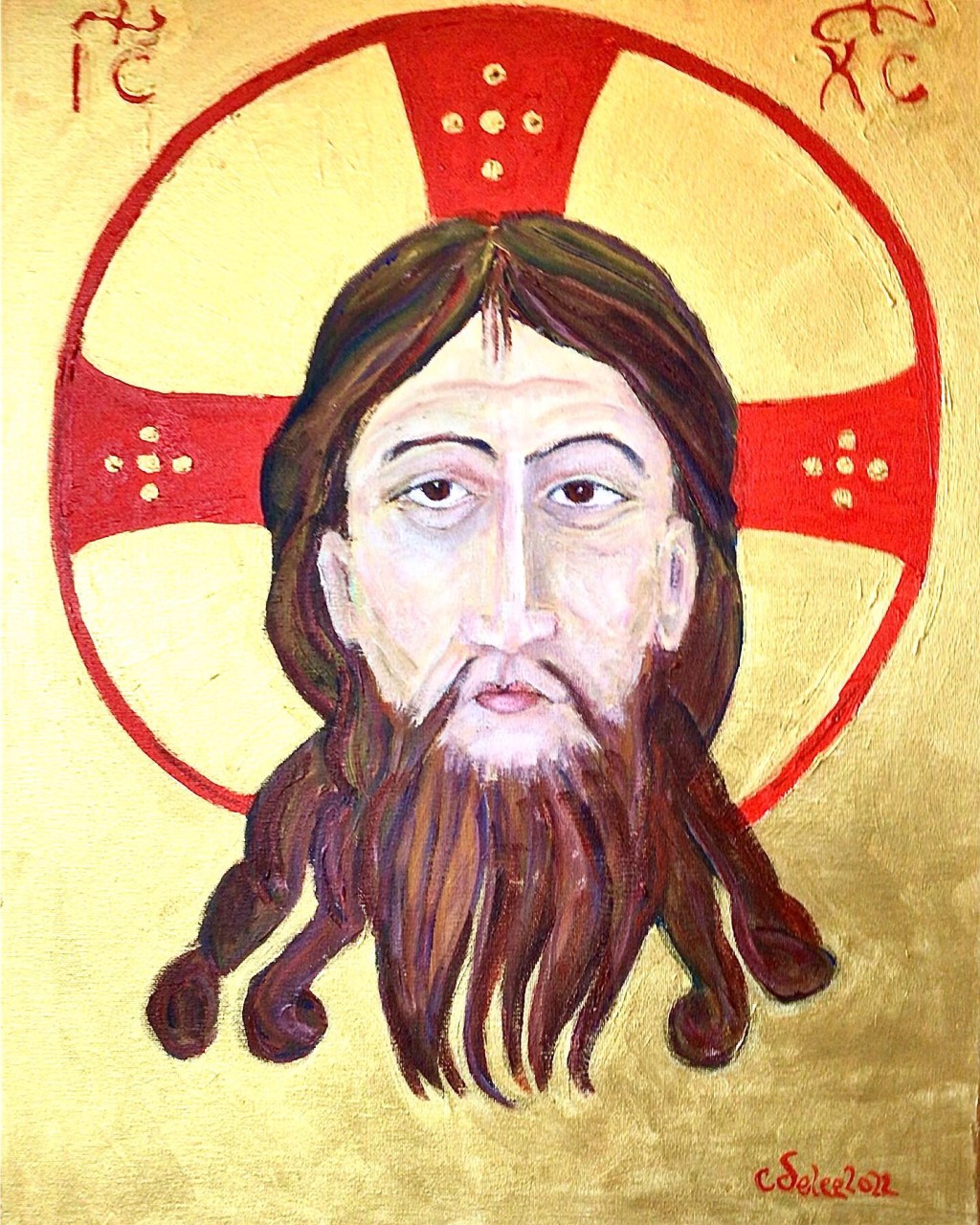
The Byzantine Empire was fond of the Deesis Icon, which has Christ in the center bounded by the Virgin Mary and the Precursor, John the Baptist, on either side. They both entreat the Lord in prayer. This was one of the most widespread middle Byzantine icon types. The name comes from the Greek δέησις or “supplication,” which in Byzantine art, describes a representation of Christ enthroned and flanked by supplicants, such as the Virgin Mary, St. John the Baptist, or other saints and/or angels. Images of the deesis often appear on an iconostasis, or the screen separating the altar from the people. The subject matter traditionally represents the first witnesses to Christ’s divinity, the Virgin and Saint John, who came to be seen as holy figures who would act as intercessors with him on behalf of humanity.

The Deesis. End of the 17th century. Northern Russia. Wood, gesso, tempera. Found from the village Nizhnyaya (Dolgovitsi), Tarnoga Raion, Vologda Oblast. Collection of Nikolai Kormashov.

Nikolai Kormashov, an Estonian artist and collector, who collected and restored a great collection of 15th-20th century Russian icons during his lifetime said, “That which is not destined to perish, announces itself again and again, to attest to elusive spiritual beauty and the light of truth.”

The truth is all people of every country and culture in every age will suffer, but God isn’t removed and distant from our pain. God, through the incarnation of the Son, has experienced our human suffering from the birth pangs of Christ’s birth to the hunger, thirst, and weariness of his itinerant earthly preaching. Not only this, but God through God’s Son knows the heartbreak of betrayal and insult, the sting of the whip, and the pain of death on a cross.

The light of truth for the Easter season is this: in the midst of darkness and death, God raised his Son to light and life, so we too might lose the chains of sin and death and live to light and love. As the people of prayer, we ask for the gift of hope to give light to those in darkness and a helping hand to those in need.

Joy and peace,

Cornelia

Relief plaque icon, depicting the Deesis Crucifixion with full-length figures of the Virgin on the left and St John on the right, Late Byzantine (13 thc). Materials: Steatite – Gold

Greek déēsis entreaty, equivalent to deē-, variant stem of déesthai to beg + -sis-sis

Leonid Ouspensky: The Meaning of Icons, revised edition, St. Vladimir’s Seminary Press, Crestwood, NY, 1999, p. 180.

DEESIS Definition & Usage Examples | Dictionary.com
https://www.dictionary.com/browse/deesis

Saved Sanctity: Icons from the Collection of Nikolai Kormashov – Art Museums
https://www.lnmm.lv/en/art-museum-riga-bourse/exhibitions/saved-sanctity-icons-from-the-collection-of-nikolai-kormashov-437

Image— The oldest icon of the Crucifixion of Christ at the Greek Orthodox Holy Monastery of St. Catherine on Mount Sinai is an extraordinary testament to the intricate relationship between the Greco-Roman art heritage and early Christian iconography. This invaluable artifact offers a unique glimpse into the artistic and cultural milieu of the time, highlighting the exchange of ideas and the shared history that shaped the development of Christian art in 8th CE. See following link for comparison of early Roman and Christian art.

http://employees.oneonta.edu/farberas/arth/arth212/post_constant_conc_christ.html

Nick Haslam: The Body Keeps the Score: how a bestselling book helps us understand trauma – but inflates the definition of it

https://theconversation.com/the-body-keeps-the-score-how-a-bestselling-book-helps-us-understand-trauma-but-inflates-the-definition-of-it-184735

OAKLAWN FRIDAY ART CLASS

adult learning, art, Creativity, Faith, Holy Spirit, Imagination, inspiration, Ministry, Painting, perfection, purpose, renewal, vision

WE’RE BACK!!!

Ready or not, the creative juices must be stirred. If the brain has lain fallow all summer, or it’s been overworked keeping the youngsters occupied, now you can find your own groove again.

Our first meeting will be Friday, September 8, at 10 am in the old fellowship hall. Bring your own acrylic paints, brushes, and a canvas or canvas panel to paint on. We begin with a short visual inspiration from some great art works, I give some direction on the skill we’ll work on in the session, and then everyone is free to bring their own unique expression to their paintings. We don’t copy my work and judge how well a person can match it. Instead, we learn from others and stretch our own skills to create something new.

Paul Klee: Houses

Making great art isn’t our first purpose. As we age, we will lose our ability to learn new skills until we lose our memory of what we just ate for breakfast. Challenging our brains is one of the best ways to keep our brain cells firing and “chatting with one another.” Socialization and encouragement also helps to keep our brains young.

Frank Lloyd Wright: Stained Glass Design

Making art means we also will have to give up our desire to be perfect. Artists quickly learn perfection comes from practice, or working at it. Every baby stumbles and falls as they learn to walk, but dotting adults encourage every trembling step. This is what art teachers also do. I’ve always had a rule in my classes, especially when I taught in middle school:

No Negative Talking about People or Art.

This includes a student’s own art works. They always had to give at least three positive comments about their work before they spoke about the negative. “My work needs improvement” is a better way to say “My work stinks!”

Of course, we’ve all grown up and worked in environments where negativity is the rule. Art class is a place of grace because this is how life should be. If we can transform a blank canvas into a field of color, why can’t we transform our communities and our world into fields of hope, joy, and love?

Blue Monochromatic Study of the City

Perhaps because we often try to make everyone copy/fit into our idea of the proper end product, rather than allow everyone discover their own creative response to the given subject of the day. Finding our own voice and our own expression is important. Even beginners will have their own unique voice and vision, if they only allow the creating spirit of God work through them. The museums of our world are richer and more vibrant because artists have listened to the Spirit of the Creating God. We might do well to realize God’s creative energies are varied and vibrant also, just as Isaiah wrote about his vision of God’s Glorious New Creation:

“For I am about to create new heavens and a new earth;

the former things shall not be remembered or come to mind.

But be glad and rejoice forever in what I am creating;

for I am about to create Jerusalem as a joy, and its people as a delight.” (65:17-18)

James Wyper: City of Dreams

I hope to see you in art class. I don’t charge for the class sessions, since this is one of my ministries as a retired elder in the United Methodist Church. As John Wesley once said, “The World is my Parish.”

Joy and Peace,

Pastor Cornelia

Rabbit! Rabbit!

art, Astrology, autumnal equinox, brain plasticity, change, cognitive decline, coronavirus, cosmology, Creativity, Family, Great American Eclipse, greek myths, Helios, nature, Painting, pandemic, photography, rabbits, Reflection, The Lord of The Rings, trees, vision

Welcome to August!

In the long summer evenings, after an extended car trip, and way beyond the too many times I’d asked my mother and daddy rabbits, “Are we there yet?” I would get their firm reminders I wasn’t to bother them any more, for they too were hot, tired, and daddy had to pay attention to the road. In the gathering darkness, I’d rest my blonde curls on the door near the open window. We had God air conditioning back then. We rolled down the window glass of our old Pontiac and drove as fast as the road would allow.

Go Faster!

I’d watch the darkening shadows as the landscape passed by this opening, noticing how the kudzu vines changed the trees into strange and monstrous shapes in the growing gloom, but I couldn’t take my eyes off of these apparitions. I was certain if I did, they’d begin to make their way toward our family car. I think I was at the age of magical thinking, for I believed I could keep these haints at bay by my will alone.

The soft flup flup of rubber tires half melting on the overheated concrete road, combined with my brother rabbits’ body heat in the seat beside me, and the enforced silence of our parents who’d had a long day with their hyperactive bunny brood finally had an effect on my eyelids. Try as I might, I would fall asleep at my watch, only to be awakened by my daddy’s sing song voice as he tickled my toes:

“This little piggy went to market, this little piggy stayed home.
This little piggy ate roast beef, and this little piggy had none!
And this little piggy cried wee-wee-wee all the way home!”

I’d rub my eyes as he picked me up to carry me into the house and into my bedroom. On the way, I’d always say,

“I see the moon, and the moon sees me,
God bless the moon, and God bless me!”

Perhaps this is a generational gift in my family, for when my own dear bunny child was small, we repeated these same scenes until she was too heavy for me to carry. The moon blessing dates from 1784 and the little piggy rhyme is even older: 1728.

That latter date is when horses and carriages were banned from Boston Common. Since I went to school in Boston, I can attest no horses, carriages, or cows are now on the grounds of the Common, which is now a 50 acre public park. The Common dates from 1634, when William Blaxton sold the remainder of his land to the Puritans, receiving six shillings or more from each shareholder to purchase the land for this public land. This was the site of the Boston Massacre, in which five people died. One good thing about going to school in an historic community, everywhere you went, you weren’t far from history.

When I think of history, I think not only of the stories we pass down to the next generation, but also of the stories we weave for ourselves. How do we remember our childhood or our families of origin? This is a generational gift of privilege, for those who lost their families when they were young may not have memories to weave together. Refugees from wars and violence might not want to recall traumatic experiences. Yet Abraham, the father of the Jewish nation, is remembered as “My ancestor was a wandering Arameam” (Deut 26:5).

Some of us choose to write about our better days, for they outnumber our bad days. Everyone has imperfections, but each of us rabbits are still going on to perfection with the help of the good God above. Perhaps when we see the beauty of the full bright moon against a dark, clear night, our heart leaps inside and says,

“I see the moon, and the moon sees me,
God bless the moon, and God bless me!”

For some of us rabbits, nature brings us closer to God than anything else. The majesty of the summer thunderclouds rising in the heated air, and giving way to either refreshing rain or flashing floods, reminds us once again of the powers of God unleashed in God’s creation. The rainbow after the storm is the promise once again of that covenant made so long ago: the earth will never be destroyed by floods again. In the rainbow, in the light of all the colors, we hear God’s promise of love and care for God’s creation and God’s creatures.

DeLee: Blue Moon

I’m looking at a full super moon tonight, July 3, but August will have TWO super moons. Looking ahead to September 29, we’ll have our FOURTH super moon in a row. The moon on the 31st of August will be a blue moon. This is the second full moon in the same month. We won’t have another blue moon until May, 2026. This is why things that don’t happen often are called “once in a blue moon” events.

Once upon a time, we were agrarian people who eked out a subsistence living on the land. The persistence of The Old Farmer’s Almanac and other ancient weather wisdom lore is proof you can take the bunny out of the country, but you can’t take the country out of the bunny. Yet as our alphabetical generations accumulate beyond the boomers, like Lucy on the Honeymooners, we often “got some explaining to do” to make ourselves understood.

Sirius in the Night Sky

We can count the “Dog Days of Summer” among the sayings folks don’t understand today. The term has nothing to do with the four legged creatures known as our best friends, but instead, it’s an astronomical term. The name comes from Sirius, the Dog Star, which rises before dawn. We find it on a vertical line below the three stars of Orion’s Belt. Sirius was named from the Greek Seirios, which means ‘glowing’ or ‘scorcher.’ This is an apt description of the warmest days from mid July to mid August.

Crepe Myrtle Bark Peeling in the Heat

Aratus, a Greek 3rd BCE poet wrote in his astronomical poem Phaenomena, (p. 328 ff, trans. Mair):

“A star that keenest of all blazes with a searing flame and him men call Seirios (Sirius). When he rises with Helios (the Sun), no longer do the trees deceive him by the feeble freshness of their leaves. For easily with his keen glance he pierces their ranks, and to some he gives strength but of others he blights the bark utterly. Of him too at his setting are we aware.”

These Dog Days of Summer in the ancient Mediterranean were marked not only by heat, but also by drought and pistelence. This year, with an El Niño weather pattern, wild fires, floods, and extreme heat have settled on the area due to a heat dome, which the European meteorologists have named Cerebus, after the three-headed dog guardian to Hades. The ruins on the Acropolis now close from noon to late afternoon to prevent heat illness.

Porch of the Maidens, Acropolis, Athens

Although the ancient Greeks and Romans believed Sirius was the reason for summer’s intense heat, we know now that star is too far away to affect our weather. What does affect our weather today is the result of human activities. Back in the Eemian period, around 116,000 to 129,000 years ago, the earth’s axis was tilted more towards the sun than now. This caused our northern polar region to be warmer and grow trees, which kept snow from accumulating. As a result, the earth’s temperature was 2 degrees C hotter than preindustrial levels, while today’s temperatures average 1 degree C warmer.

Today, we have evidence of geographic drift caused by climate change in our crops. Areas once known for coffee or wheat are shrinking, moving further north or to higher altitudes. We also see shrinking polar ice sheets, which cause ocean levels to rise. More water, combined with more heat leads to more intense storms. We also have rivers of wind, aka the jet stream, which lock in the heat domes. These can persist for days, while the rest of the earth gets flooding and storms.

Not a Watermelon Chart: Similar to the National Weather Service’s heat index chart, this chart translates combinations of air temperature and relative humidity into critical environmental limits, above which core body temperature rises. The border between the yellow and red areas represents the average critical environmental limit for young men and women at minimal activity.

Extreme heat is the number-one weather-related cause of death in the U.S., and it kills more people most years than hurricanes, floods and tornadoes combined. Despite the fact that extreme heat has been the number one cause of weather-related deaths in the United States over the last three decades, the federal government has repeatedly declined to declare extreme heat a federal disaster. The US government has never issued a federal disaster declaration for an extreme heat event in the three times it’s been requested, even as heat domes and long, uninterrupted stretches of 100-plus degree days have claimed lives in cities and states across the country in recent years.

The 10 hottest years on record have occurred since 2010 and the month of June alone in the USA has broken over 1,000 high temperature records. The combination of El Niño, a warming ocean current, and climate change is the cause. The excessive heat in the oceans are causing coral diebacks, which have negative implications for future hurricane shore losses, since coral reefs break the incoming waves.

We bunnies can blame the Stafford Act for this. Natural disasters in the USA are handled by FEMA—Federal Emergency Management Agency. The Robert T. Stafford Disaster Relief and Emergency Assistance Act, PL 100-707, was signed into law November 23, 1988 when Congress amended the Disaster Relief Act of 1974, PL 93-288. Named for the Vermont senator who was instrumental in its passage, this is one of the 100 laws a President can use to declare a national emergency or disaster. Former President Trump used it to declare the COVID pandemic an emergency. It’s this Stafford Act that defines “Emergency.”

According to Congressional laws, a disaster emergency is “any occasion or instance for which, in the determination of the President, Federal assistance is needed to supplement state and local efforts and capabilities to save lives and to protect property and public health and safety, or to lessen or avert the threat of a catastrophe in any part of the United States in a Major Disaster.

The act defines “major disaster” as any natural catastrophe (including any hurricane, tornado, storm, high water, winddriven water, tidal wave, tsunami, earthquake, volcanic eruption, landslide, mudslide, snowstorm, or drought), or, regardless of cause, any fire, flood, or explosion, in any part of the USA, which in the determination of the President, causes damage of sufficient severity and magnitude to warrant major disaster assistance under this chapter to supplement the efforts and available resources of states, local governments, and disaster relief organizations in alleviating the damage, loss, hardship, or suffering caused thereby.

Fires of Mordor have nothing on Phoenix Heat

To get heat relief, it will require an Act of Congress. In plain speak, we’ll see snowfall before heat relief legislation becomes law in today’s divided and polarized congressional body. In the last century, we bunnies weren’t thinking about climate change, extreme weather events, or even naming our winter storms. Perhaps next summer we’ll begin naming our extended heat waves and treat them with the same seriousness as we give to hurricanes and blizzards.

In the meantime, this bunny has set her AC to cool and is keeping the ice bin filled and the tea jar full. I’m feeling the siren call of the school supply aisle, so I’ll find a cool morning in mid August to go buy ink pens, notebooks, and some postynotes. A bunny who keeps learning will always stay young. Building new pathways for the neurons is like cleaning out the clutter in our brain box.

Write now, Edit later. The stories are more important than the form.

I always recommend picking up a new skill or renewing an old one, for not only do creative activities give us an opportunity to focus on something other than how hot it is, but also we can enjoy our progress as we continue to work. If you’ve ever wanted to write about your family history, begin now, for the day will come for all of us when we won’t remember the ones we love. This bunny hopes you have bunnies who love you and honor you for who you’ve always been, even if you become the “one who comes to kiss me every afternoon at 4 o’clock.”

Pluto: Now a Dwarf Planet

I’ll probably go buy my journal supplies on August 24th, and sit in my favorite coffee shop for a bit to drink in memory of Pluto, who was worthy enough to be a planet for my generation,but has been demoted to a dwarf planet because it hasn’t cleared its neighborhood of other objects.

I look forward to cooler breezes, falling leaves, and Pumpkin Spice lattes. See you in September!

Joy, peace, and iced tea,

Cornelia

The Project Gutenberg eBook of Gammer Gurton’s Garland, or, The Nursery Parnassus, by Joseph Ritson.
https://www.gutenberg.org/files/34601/34601-h/34601-h.htm

Teaching Early Math to Children—This Little Piggy
https://www-tc.pbs.org/parents/earlymath/pdf/LittlePiggy.pdf

Origin of This Little Piggy
https://www.rhymes.org.uk/this_little_piggy.htm

Boston Common Master Plan
https://www.bostoncommonmasterplan.com/history

Super Moons, Blue Moons
https://www.fullmoonphase.com/

What is a blue moon and when will the next one occur? | Royal Observatory Greenwich https://www.rmg.co.uk/stories/topics/what-blue-moon-how-often-does-it-occur

SIRIUS (Seirios) – Greek God of Dog-Star https://www.theoi.com/Titan/AsterSeirios.html

THE DOG DAYS OF SUMMER: European heat wave takes toll on tourists – Travel Industry Today
https://travelindustrytoday.com/the-dog-days-of-summer-european-heat-wave-takes-toll-on-tourists/

42 U.S. Code § 5122 – Definitions | U.S. Code | US Law | LII / Legal Information Institute FEMA STAFFORD ACT
https://www.law.cornell.edu/uscode/text/42/5122
https://www.fema.gov/disaster/stafford-act

Extreme Heat Is Deadlier Than Hurricanes, Floods and Tornadoes Combined – Scientific American
https://www.scientificamerican.com/article/extreme-heat-is-deadlier-than-hurricanes-floods-and-tornadoes-combined/

From Japan to Louisiana to Rome, Here Are Ten Heat Records Earth Has Broken Since June | Smart News| Smithsonian Magazine https://www.smithsonianmag.com/smart-news/ten-heat-records-earth-has-broken-since-june-180982562/

Growth in Faith and Art is a Risky Business

adult learning, arkansas, art, brain plasticity, change, Children, Creativity, Faith, Holy Spirit, hope, Icons, Imagination, inspiration, john wesley, Ministry, New Year, Painting, Pantocrator, perfection, photography, purpose, risk, Spirituality, vision

Oscar Wilde famously said, “Life imitates art far more than art imitates life.” This is because the self-conscious aim of life is to find expression and art offers it certain beautiful forms, through which it may realize that energy. Yet most people who look at artworks judge them for the degree to which they represent “three dimensional reality,” in either two or three dimensions (painting, draw,or sculpture and assemblage).

Often I’ve been asked about my colorful landscapes, “Don’t you ever paint these in normal colors?”

My answer is usually, “How do we know the colors we see today are the original colors of Creation? After all, we now live in a fallen and broken world. Perhaps these bright colors were God’s original palette.” I’m not painting just what I see, but what was and what is yet to come. These are visions of a better world, where the leaves clap their hands for joy.

In art class, we not only struggle to master drawing shapes “as they are,” but also to challenge our minds to break free of our need to exactly reproduce the shapes before us. We always have the tension to make only a “copy of the image before us,” rather than to meet the image on a spiritual plane and portray an intimate portrait of its inner truth.

When we meet a stranger, we can hide behind our masks and keep our distance. Likewise, we can fail to become intimate with our painting’s subject matter. The resulting work is cold and dead, like a limp handshake. It’s a risky business to bare your heart to the canvas and paint. The brush will tell if your heart and soul is in it or not.

We get more comfortable with this risky business by practicing risk taking. It’s not like we’re facing tigers in a circus cage or jumping out of an airplane without a parachute. We can’t lose our salvation in Christ if we make a bad painting. We only have a new level from which to start afresh. All growth requires risk and failure. We discover what works, keep that, and eliminate the unuseful.

Willingness to learn is related to the “growth mind-set.” This is the belief your abilities aren’t fixed but can improve. This willingness is a belief not primarily about the self, but about the world. It’s a belief every class or learning experience offers something worthwhile, even if we don’t know in advance what that something is. Every teacher or parent worth their salt has to believe their students or children can learn and grow, or they need to give up their profession so another can grow. The first lesson even the most recalcitrant student needs to learn is to believe growth and progress is possible.

Christ on Tree of Life, San Clemente Basilica, 12th Century mosaic, Rome, Italy.

The Christian life has a parallel to the growth mindset. The whole of the Christian life is wrapped up in this faith: with God’s help, we can go on to perfection. This is a basic Methodist belief known as sanctification. We also call it going on to perfection in love of God and neighbor. Some of us think because we’re not able to change on our own, we don’t need to grow in our love. God has done all the work for us in Christ. The Holy Spirit was sent to be a truthful guide:

“When the Spirit of truth comes, he will guide you into all the truth;
for he will not speak on his own, but will speak whatever he hears,
and he will declare to you the things that are to come.” (John 16:13)

Christ in Majesty, Book-Cover Plaque, French, Limoges, enamel, ca. 1200 CE, Metropolitan Museum of Art, NYC.

Paul speaks of this truth in Philippians 3:20-21, when he reminds the people of their present state as sojourners in this world, while their citizenship is elsewhere:

“But our citizenship is in heaven, and it is from there that
we are expecting a Savior, the Lord Jesus Christ.
He will transform our humble bodies that they may be conformed
to his glorious body, by the power that also enables him
to make all things subject to himself.”

Mother About to Wash Her Sleepy Child Mary Cassatt, 1880

If life is a journey, the Christian life is even more of a pilgrimage. We all go through stages of faith if we seriously reflect and consider our beliefs when our life experiences intersect with our faith. Our earliest stage of faith begins with our parents or caregivers. Here we learn to trust or distrust, as we experience an embodied faith. The next stage is early childhood (age 3-7). Faith at this stage is experiential and develops through encounters with stories, images, the influence of others, a deeper intuitive sense of what is right and wrong, and innocent perceptions of how God causes the universe to function.

Michaelangelo: Creation of Adam, Sistine Chapel Ceiling

The next stage has been labeled “Mythic-Literal Faith” (Ages 7-12). Children at this stage have a belief in justice and fairness in religious matters, a sense of reciprocity in the workings of the universe (e.g. doing good will result in a good result, doing bad will cause a bad thing to happen) and an anthropomorphic image of God (e.g. a man with a long white beard who lives in the clouds). Religious metaphors are often taken literally, thus leading to misunderstandings. If God’s rewards or punishments don’t apply in proper retribution, in the believer’s mind, their faith in God’s system becomes fragile.

Théodore Géricault, Raft of the Medusa, 1818–19, oil on canvas, Louvre, Paris.

“The Conventional Faith” stage (12-adult) arises when individuals join a religious institution, belief system, or authority, and begin the growth of a personal religious or spiritual identity. Conflicts occur when one’s beliefs are challenged are often ignored because they represent too much of a threat to one’s faith-based identity.

Théodore Géricault’s “Raft of the Medusa,”painted in 1818–19, is nearly 17 by 23 feet large. It commands its space as any proper historic painting of the past ever did. Rather than present a moral lesson from the past, the artist instead chose to paint an event from his present time: the rescue of the abandoned sailors and slaves from a wrecked ship. The French nation had sent the new governor of the Senegal colony, his family, and some other government officials and others on the Medusa. The government officials went to secure French possession of the colony and to assure the continuation of the covert slave trade, even though France had officially abolished the practice. Another group aboard the Medusa was composed of reformers and abolitionists who hoped to eliminate the practice of slavery in Senegal by engaging the local Senegalese and the French colonists in the development of an agricultural cooperative that would make the colony self-sustaining.

On the way, the ship ran aground and broke up. The officials and their families were put in lifeboats, but the 150 others on board got a makeshift raft, which was tied to the lifeboats. When the raft impeded the lifeboats, the officials cut the raft loose and all the lives with it. Only 15 were rescued after days at sea, and only ten lived to tell their tales. It was a scandal of the times. Géricault read all the newspapers, interviewed survivors, and made studies from ancient sculptures to inform his design. When younger artists saw his inspirational work in the Paris Salon, they knew a sea change had happened. Conservative critics and writers were appalled and accused Géricault of creating a disgusting, repulsive mistake. They were not yet ready to leave the past behind.

William Faulkner once said, “You cannot swim for new horizons until you have courage to lose sight of the shore” (The Mansion , 1959). When we meet that initial storm, our first thought is to bring our fragile bark into port. In life, we batten down the hatches and book it for a safe harbor. In art class, we want to fall back on what we’ve always done before, what we know we can do, and what we’ve been successful with in the past. This is our “safe harbor.”

“Individuative-Reflective Faith” (Mid-Twenties to Late Thirties). The individual takes personal responsibility for her beliefs or feelings, often by angst and struggle. Religious or spiritual beliefs can take on greater complexity and shades of nuance, and a greater sense of open-mindedness. These can also open up the individual to potential conflicts as the different beliefs or traditions collide.

To progress and grow in our art skills, or to move through the “dark night of the soul” when we question our formerly held spiritual truths, is a crucial time. Crucial is a word sharing the same root as crucifix. The crux of both of these situations results in a life and death situation. Not that the person quits breathing or their heart stops beating, but will their old life die and their faith be reborn anew? Also, will they trust a power greater than themselves to bring them back from the depths? Many of us aren’t willing to give up control to anyone, and certainly not to a God we can’t see. We’re two year olds in our spiritual lives too often, for “I can do it myself!” Is our answer to everything and everyone. (Test it out—how many of you read the directions after you start putting a project together?)

The Cross that Spoke to St. Francis, San Damiano Chapel, Italy, 1205 CE

“Conjunctive” Faith (Mid-Life Crisis). A person at this stage acknowledges paradoxes and the mysteries attendant on transcendent values. This causes the person to move beyond the conventional religious traditions or beliefs he may have inherited from previous stages of development. A resolution of the conflicts of this stage occurs when the person is able to hold a multi-dimensional perspective that acknowledges ”truth’ as something that cannot be articulated through any particular statement of faith. This is where the Holy Awe begins to fill all the nooks and crannies from which it was once forbidden.

Face of Christ (All People of the World), photo montage

“Universalizing” Faith (or ”Enlightenment”). (Later Adulthood). This stage is only rarely achieved by individuals. A person at this stage is not hemmed in by differences in religious or spiritual beliefs among people in the world, but regards all beings as worthy of compassion and deep understanding. Here, individuals ”walk the talk” of the great religious traditions (e.g. ”the kingdom of God is within you”).

“Jesus of the People” by Janet McKenzie.

In 1999 Janet McKenzie’s painting “Jesus of the People” was selected winner of the National Catholic Reporter’s competition for a new image of Jesus by judge Sister Wendy Beckett, host of the PBS show “Sister Wendy’s Story of Painting.” In the words of Sister Wendy, “This is a haunting image of a peasant Jesus—dark, thick-lipped, looking out on us with ineffable dignity, with sadness but with confidence. Over His white robe He draws the darkness of our lack of love, holding it to Himself, prepared to transform all sorrows if we will let Him.” The model was an African-American woman and the painting includes a yin-yang symbol of Eastern traditions and feather of Native American traditions. (Photo courtesy of Paul Smith)

Next week, we’ll still be working on order and chaos. We got started on this at our first meeting, and the concept is a challenge. I’ll write about our class work then. We’re always open to anyone joining us, for you come as you are and begin where you are. Our art group is a “one room schoolhouse” with all levels of students mixed together. We may all be doing the “same project,” but everyone does it at their own skill level. I give you special attention according to your needs.

Remember, “The only way you can be behind is if you never start.”

Joy and peace,

Cornelia

Life Imitates Life | Lapham’s Quarterly
https://www.laphamsquarterly.org/swindle-fraud/life-imitates-life

The Stages of Faith According to James W. Fowler | Thomas Armstrong, Ph.D.
https://www.institute4learning.com/2020/06/12/the-stages-of-faith-according-to-james-w-fowler/

Théodore Géricault, Raft of the Medusa – Smarthistory
https://smarthistory.org/theodore-gericault-raft-of-the-medusa/

Video and photo slideshow: The many faces of Jesus
https://religionnews.com/2014/01/28/video-photo-slideshow-many-faces-jesus/

My Summer Vacation

adult learning, art, Creativity, crucifixion, Faith, Family, Forgiveness, holidays, Imagination, inspiration, mandala, Ministry, Painting, purpose, Spirituality, summer vacation

Friday Night Food Fight

The last day of our art class we had a “free for all.” Not exactly a “food fight” or “slug fest” free for all, but a finish up or start a personal project type of day. Our class never disappoints me. Mike brought in his patio parrots, some of which have seen better days. These are papier-mâché sculptures that have been brightly painted and covered with shellac. He hopes to paint over them and repair them so they will look respectable once again in the poolside area. If that’s not possible, I see a vacation south of the border in his future.

A Typical Parrot by the Pool

Gail brought an icon she didn’t quite finish to add gold outlining to the figures. This detail gave her work an extra embellishment to bring it to life. Before, she’d left an edge of white canvas between the background and the figures. This had the same effect, but also gave her work an unfinished appearance.

Gail’s Icon

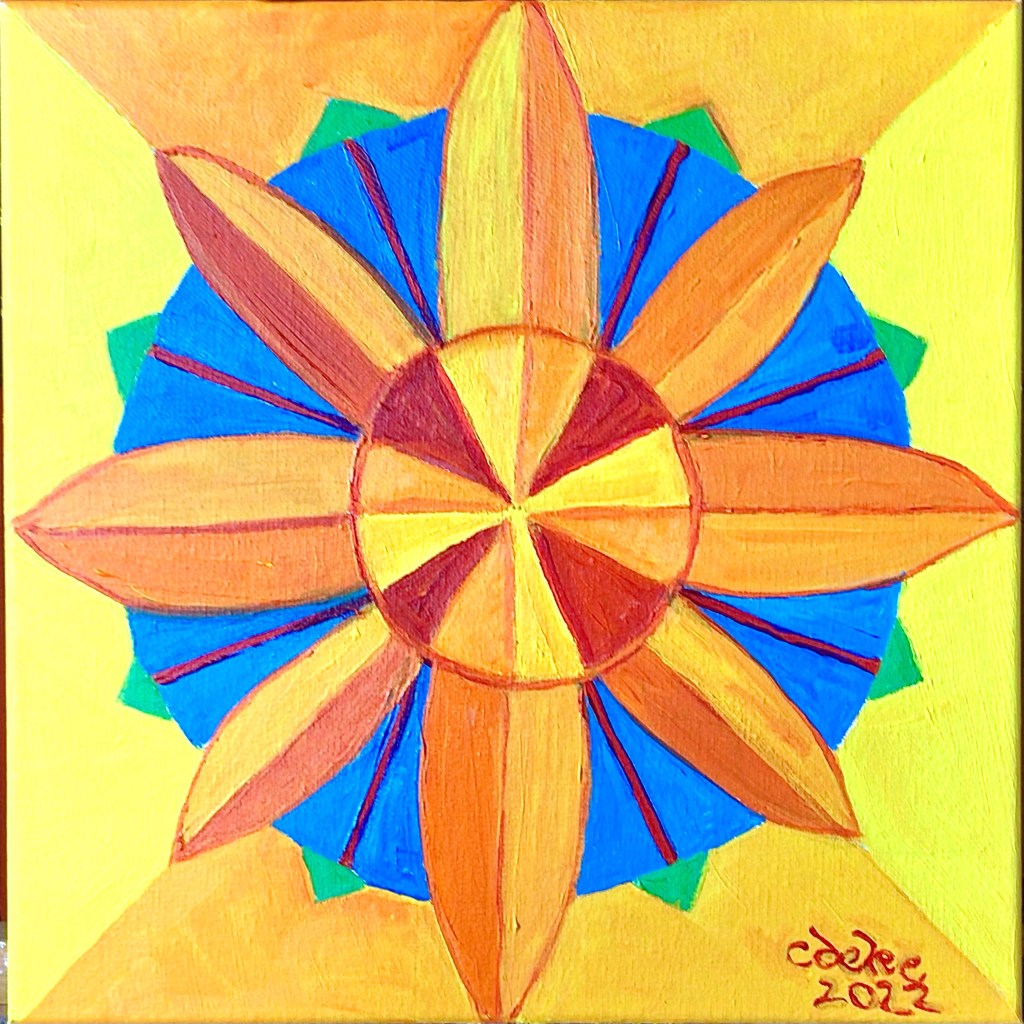
I’ve been working on a series of Creation Icons from the first chapter of Genesis. Actually, they’re mandalas, but they serve the same purpose as an icon: to focus the viewer’s sight into the window of the world beyond this one and to contemplate the universal mysteries of the universe and the God who created it. The Creation inspired me because I’ve seen old icons with this theme painted both in figurative and abstract styles.

This one represents Day three and is from The Nuremberg Chronicles (1493). Written by Hartmann Schedel and illustrated with woodcuts by Michael Wolgemut, it represents a monumental place in the history of the printed page. One of the most beautifully illustrated texts of all time, the approximately 600 pages, in-folio, contain 1,804 woodcuts intended to communicate to the public a schedule of events predetermined by God, beginning with the Creation, and ending with the end of time.

Creation of Plants by Wolgemut

My icon is a stylized flower against a blue sky with a cross in the center to remind us, as John 1:1-3 says,

“In the beginning was the Word, and the Word was with God,
and the Word was God. He was in the beginning with God.
All things came into being through him,
and without him not one thing came into being.”

Third Day Of Creation Icon

I chose a sunflower as my representative plant, for the young plants constantly track the sun’s transit across the sky each day. The older plants don’t make use of this mechanism of heliotropism, but always face east to wait for the sunrise. The ancient wisdom says when Christ comes in his final glory, he’ll first appear in the east at the Beautiful Gate in Jerusalem. However, the Bible says in Revelation 1:7,

“Look! He is coming with the clouds;
every eye will see him,
even those who pierced him;
and on his account all the tribes of the earth will wail.
So it is to be. Amen.”

I think it best to be ready, day or night, for like the servants whose master has gone off on a trip, we don’t know when he’s coming back. We should be always ready, always eager to serve. We’re never too young or too old to be a servant for Christ. As we grow older, one of our best gifts is mentoring the next generation for leadership. Perhaps they’ll make mistakes, or maybe they’ll do things differently than we did, but mission and ministry will happen.

Most mistakes don’t matter in the great scheme of life, unless they’re breaking a moral or legal law. If they’re just doing a task in a different order, like my arrangement of the dishes in the dishwasher at my mother’s house, we should probably leave that alone. I went and sat in the den and let my mother load the next evening’s dirty dishes because “If you’re going to rearrange everything, you might as well put them in yourself.” She did that one night and sat in the den the next night. Training is everything. My mom spent years training me, so I learned from the best. When it’s time to let go, you step aside and let them do it on their own. Learning from mistakes is part of leadership.

In art class we also learn from our mistakes. Sometimes we find out our palettes are too small to mix up all the different colors we want. This can limit our color schemes, muddy our colors, or tempt us into putting more color over the old color in the same tiny space for mixing. Then we look at our painting and wonder why it’s grey and dull, but fail to notice how dark our glass of brush water is. When the water gets dark, we need to pour it out and get clean water, or we carry that wash water full of pigments into our painting with our brush. In a like manner, if we hold our grudges or anger over time, these soil and blemish our souls. Washing them clean through prayer to God makes a difference in our countenance and joy. We’re brighter people when we rid ourselves of these burdens.

I’m taking the summer off from teaching. I have an art show planned for August to September at the Garland County Library, so I’ll be finishing up some work for that event. I also have a couple of chores around my condo planned, and more of my SOULJOURNIES blog to put into shape. I’m excited about these creative renewal projects. I’ll see y’all on the flip side.

Joy, peace, and sunshine,

Cornelia

The Science Behind Why Sunflowers Move
https://spectrumlocalnews.com/nys/buffalo/weather/2020/08/29/the-science-behind-why-some-sunflowers-move

Springtime Is A Golden Age

adult learning, arkansas, art, beauty, brain plasticity, change, cosmology, Creativity, Evangelism, Faith, flowers, Health, Ministry, nature, Painting, pandemic, photography, quilting, renewal, shadows, Travel, trees, vision

Every nation has its Golden Age. Usually, it’s a bye gone time, located in the dim past, and remembered faintly only by the oldest of the old. My Golden Age is my childhood, for I spent much unfettered time out in nature, whether it was in the backyard, the neighborhood, or at camp. I was so excited about camp, I would lay out my clothes for day camp, and pack my dad’s old army duffle bag a whole month in advance for week long camp. Mother would see this overstuffed cylinder, and laugh, “What are you planning on wearing between now and then?” My excitement and my planning didn’t always get all the facts together.

Going out into nature has always revived my soul, even as a child. Walking under trees, beside a lake, and sleeping with the sounds of the wild places instead of civilization has always appealed to me. If I have a choice between traveling on a major highway or on a back road, I often choose the back road. Today with GPS, we know how far the next gasoline station or rest stop will be. The back roads often have the most interesting sites and sights. The main highways are efficient, but the little roads retain their charm.

The Great Goat Encounter in Efland, NC

Whenever I longed for the gentler days and the healing powers of nature, I would seek out the back roads of Arkansas. Sometimes I would get into my car and drive until I found the solace of the natural world. If I got lost, it didn’t matter, for I had no particular place to go. I would find the place I was meant to discover, as Aldous Huxley, the English writer said, “The goal in life is to discover that you’ve always been where you were supposed to be.”

 I’ve always trusted the word of the prophet Isaiah (58:11):

The LORD will guide you continually,

and satisfy your needs in parched places,

and make your bones strong;

and you shall be like a watered garden,

like a spring of water,

whose waters never fail.

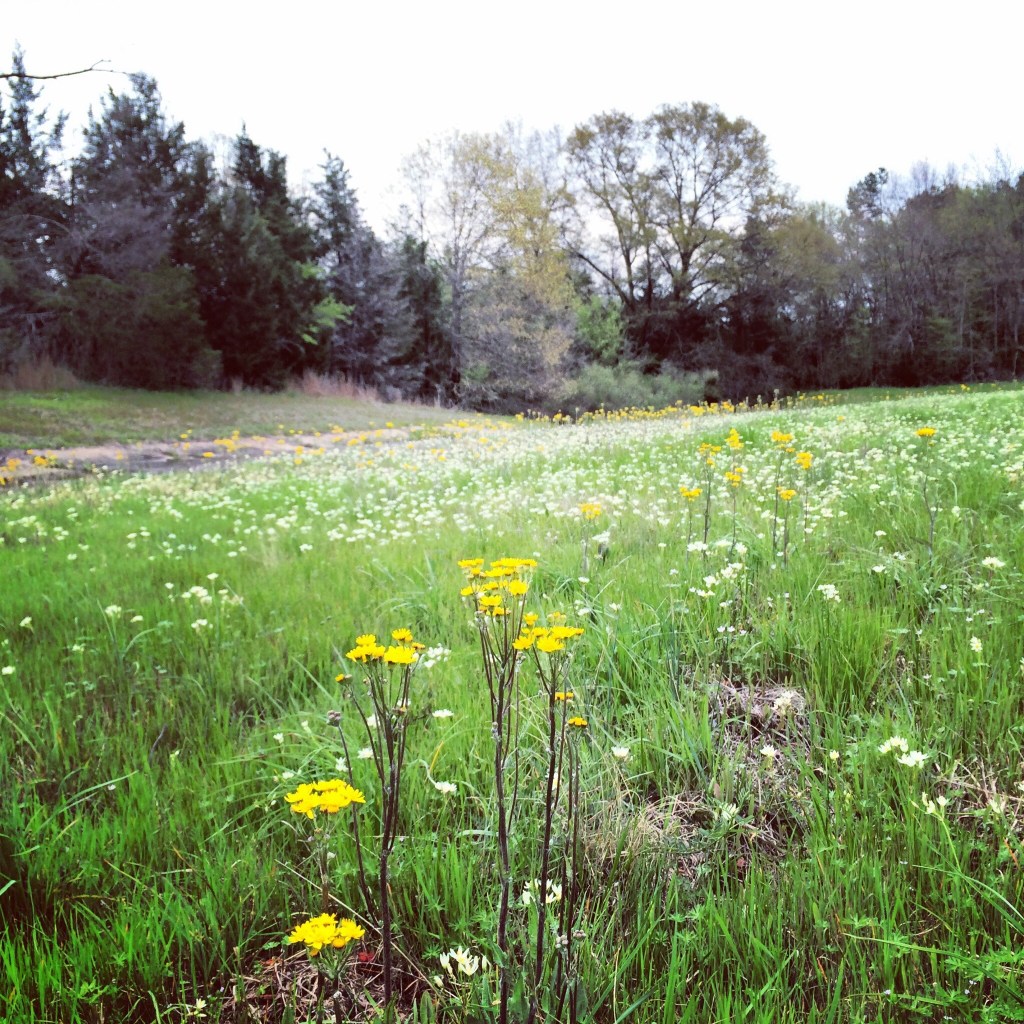
Of course, those who know my navigating skills might question how I ever found my way anywhere. The secret is all small roads lead to a larger road. Also, if I ever grew concerned, I’d stop and ask for directions back to the big highway. I’ve met some interesting folks by getting lost, just as I’ve found some beautiful landscapes. I’ve never been in such a hurry I can’t stop and take a photo. These images I use for inspiration for future paintings. I took this photo by the roadside off interstate 30 west, near Texas 44 west, near Simms, Texas, in 2014.

DeLee: Wildflowers near Simms, Texas

While the flowers by the side of this road were only yellow, I decided to add in notable reds and blues, since those are well known colors from Texas also. These primary colors represent lazy Susans, Indian paintbrush, and bluebells. The wind and light in the trees were beginning to freshen up, a true sign of spring on the plains. The whole is full of light and has the promise of the new life and hope, which every spring brings to those who find renewal in nature. William Allingham, an English Poet of the 19th century, wrote a poem called “Wayside Flowers.”

DeLee: Texas Wildflowers

Pluck not the wayside flower,

It is the traveller’s dower;

A thousand passers-by

Its beauties may espy,

May win a touch of blessing

From Nature’s mild caressing.

The sad of heart perceives

A violet under leaves

Like sonic fresh-budding hope;

The primrose on the slope

A spot of sunshine dwells,

And cheerful message tells

Of kind renewing power;

The nodding bluebell’s dye

Is drawn from happy sky.

Then spare the wayside flower!

It is the traveller’s dower.

When we speak of a dower, this is a treasure or endowment gifted to a future visitor who passes by. Because of this, all travelers should respect the wildflowers and leave them in situ. All living organisms need to reproduce. Digging up wildflowers, picking wildflowers, or collecting their seed will reduce a plant’s ability to reproduce and will adversely affect its long-term survival in that location. Removing wildflowers from the wild can have a detrimental affect on pollinators and other animals that depend on that species for food and cover. Removing wildflowers from our national forests and grasslands prevents other visitors from enjoying our natural heritage. Most wildflowers when dug from their natural habitat do not survive being transplanted.

Every nation has its Golden Age, an idyllic past in which all her citizens were supremely confident, filled with energy and enthusiasm and utterly convinced that their country provided the heights of artistic, scientific, and civic achievement for all. The Greeks had their Golden Age after the Persian Wars with the building of the great architectural monuments on the Acropolis, the morality and philosophy of Socrates, Plato, and their followers, as well as the physician Hippocrates, who’s considered the father of western medicine. “Future ages will wonder at us, as the present age wonders at us now,” remarked Pericles, the Greek statesman, orator and general of Athens during the Golden Age.

The Parthenon on the Acropolis of Athens

America had her Golden Age also, that period time we know as the post-World War II economic boom when manufacturing and employment were at their peak. Many people my age wonder why these present times don’t continue the past prosperity, but most forget our world economy has changed, especially since the 1980’s. To give an example, I had friends in the oil business back in Louisiana. They let the roughnecks go and they went out into the fields to take their place. At the same time, when oil prices were so low, the private school where I taught art let me go, since they considered my subject an elective. The art classroom was the only place some students could achieve and find positive affirmation during the school day, but the school would oversee the increased discipline needs. Even during this decade, employers were cutting jobs and asking employees to do the work of two people. Labor has taken a beating in the decades since.

In the forty years since, our whole life has changed. When I was young, a high school education was sufficient for many entry level jobs. Back in 1941, less than half the U.S. population age 25 and older had a high school diploma, while today, 90 percent has that achievement. When my dad was a young man, an 8th grade education was more than sufficient for blue collar jobs. Today at least two years at a community college is the new  “Union Card” for employment. Why is this, you ask? Our young people need to know more than we did! Our adults also need to keep learning! This is why I keep teaching myself new things, going to seminars, and writing blogs that require research.

I’m very proud of our class members who attend the Friday Art Experience at Oaklawn UMC. Work can sometimes take a priority over this enrichment experiment, and we went on hiatus for part of the pandemic. One of the goals I gave the group was to find their own voice and not to copy mine or someone else’s. We can learn from each other, for we all have a unique perspective on life and how we interact with the world. When we stretch ourselves, we create new pathways in our brains, a process called brain plasticity. A new activity that forces you to think and learn, plus require ongoing practice can be one of the best ways to keep the brain healthy, since eventually our cognitive skills will wane.  Thinking and memory will be more challenging, so we need to build up our reserves.

Much research has found that creative outlets like painting and other art forms, learning an instrument, doing expressive or autobiographical writing, and learning a language also can improve cognitive function. A 2014 study in Gerontologist reviewed 31 studies that focused on how these specific endeavors affected older adults’ mental skills and found that all of them improved several aspects of memory like recalling instructions and processing speed.

I don’t know about you, but I was born with only two brain cells and one of them seems to travel regularly to the planet Pluto. I need to be in the studio as often as possible if I’m to call that wandering cell back from its journey elsewhere. Art for me is life, just as a walk among the trees or beside a creek renews my soul. As the Psalmist writes in Psalm 19:1, The heavens are telling the glory of God; and the firmament proclaims his handiwork.

Artist’s logarithmic scale conception of the observable universe.

Gail was the only one attending this week. Graduations, which  were happening in various academic settings, kept others away. She brought a photo of a field of yellow flowers, with a house up on a hill. In the middle ground was a pond and on the crest of the hill were a windrow of cedars. We discussed the formal elements for a bit. I showed a series of wildflower ideas as a slideshow to give a sense of the varied way artists across history have approached this subject.

Then we got down to work. Note the sense of light and air in Gail’s painting. The windrow of trees shows the direction of the sun and we can sense the breeze coming from the same side. This is an unfinished painting, so we can’t tell if the yellow meadow will have more varied colors, but the first layers of the wildflowers in the foreground give us the sense it might.

Gail’s unfinished wildflower painting

Sometimes we can finish a painting in one sitting, but other times, even a small work takes another session. Life is a work in progress. We can’t hurry it. When we finish a work, we often find flaws in it. This is because we’ve learned new skills, and we judge our work by our new abilities, rather than by those skills we had when we began. Artists aren’t like those who look to the past for a Golden Age. Instead, they look to the future.

Benjamin Franklin said, “The Golden Age was never the present age.” Usually the Golden Age is a fondly remembered past, but only the best parts of it are treasured by those who benefited most by it. We need to remember, as William James, the American philosopher reminds us, “There are two lives, the natural and the spiritual, and we must lose the one before we can participate in the other.”

Or as 2 Corinthians 5:17-20, so aptly puts it:

So if anyone is in Christ, there is a new creation: everything old has passed away; see, everything has become new! All this is from God, who reconciled us to himself through Christ, and has given us the ministry of reconciliation; that is, in Christ God was reconciling the world to himself, not counting their trespasses against them, and entrusting the message of reconciliation to us. So we are ambassadors for Christ, since God is making his appeal through us; we entreat you on behalf of Christ, be reconciled to God.

If we do this, we can bring the Golden Age into the present for all people.


Ethics and Native Plants

https://www.fs.fed.us/wildflowers/ethics/index.shtml

The Golden Age of Greece

https://www.historymuseum.ca/cmc/exhibitions/civil/greece/gr1050e.html

Train your brain – Harvard Health

https://www.health.harvard.edu/mind-and-mood/train-your-brain


Listening to Flowers

adult learning, art, coronavirus, Creativity, Faith, flowers, grief, Healing, Holy Spirit, Imagination, Painting, pandemic, Reflection, Stress, vision

Listening to God is one of the hardest tasks most of us will ever undertake. How can we hear God’s voice, which has been described as the sound of sheer silence, when we live in the midst of the furious cacophony of our frantic world? If we do take time to be still, our own thoughts jump around inside our skull as if they were so many monkeys in a tree. We also find obstacles to our being still enough to listen to this silence, for there’s people who need us, work to be done, cattle to rustle, and snakes to kill. Even in the midst of a pandemic, life goes on.

Listen to the Flowers

The pandemic has also added extra levels of pain to our lives, for we’ve not only lost the support of our communal practices and our social experiences, but many of us have lost a friend or loved one to the coronavirus. We grieve for the life we used to live before social distancing and we grieve for the lives we’ve lost to the disease itself. Then there’s doom scrolling, the unfortunate habit too many of us find ourselves drawn to when we can’t draw ourselves away from the latest post on social media or update on breaking news about the latest indignity or harm this virus has done to humanity. All this wearies us and as we grow more tired, we lose our sensitivity to the small and quiet things.

It’s alright to admit we’re struggling, for then we can truly live out the verse,

“But God chose what is foolish in the world to shame the wise;
God chose what is low and despised in the world,
things that are not, to reduce to nothing things that are,
so that no one might boast in the presence of God”

(1 Corinthians 1:27-29).

As I’ve continued my painting in my own studio, I recognize I have ebbs and flows of energies. This is normal in every creative person’s life and work. We work through the rough times so if inspiration happens to fall upon us from on high, we’ll be there to receive it. If this doesn’t happen, the canvas can get painted over, cut up and rewoven, or eventually destroyed altogether. It’s a painting, an object from which to learn and to listen as we gain skill in our craft.

When I was younger, however, I treated my works as if they were precious and alive, like a child. Perhaps I hadn’t made enough of them, and I also hadn’t had my own flesh and blood child. Once I had a child, I learned I couldn’t do what I thought was best for her, but I needed to listen to her and figure out what she needed. Since babies cry and don’t talk right away, this took some doing. But there were signs, of course: if I’d just fed her, she might need burping or a diaper change. If she woke up from a nap, nursing and rocking was a good choice. Later as she got older, I had more to learn, but it was a while before she said words.

Our paintings never speak out loud, yet we need to listen to what they tell us, just as our subject matter never communicates a word to us, but we hear it calling to us, “Paint me!” In class this week, Tatiana brought flowers from her gardens for us to paint. She focused on the tiger Lilly and got a good rendering of it. She had some new paints, so she laid the color down thick. It would have to dry before she could straighten up any details.

Tiger Lily

Gail was finishing up the carrot flowers. She had roughed in the shapes with lights and darks last week. This week, getting the lacy details of the flower heads needed a plan. We looked at Seurat, the French pointillist painter, who set dots one beside another to make the shapes and to mix the colors. This was a new technique that she modified for her own.

Carrot Flowers

Glen was painting a violet flower, and had a tender rendering in pink. It was quite well drawn, with good highlighting. I suggested he put a light blue wash on it. He must have enjoyed the blue, for he painted out his beautiful flower. I’ve done this myself. I keep going until lose it, and then I regret it. When an artist is learning a new technique, he or she will often over do it until the painting feels dead. This happens to me when my blood sugar dips and not enough energy gets to my brain. I can even feel it coming on and I have to stop myself before I begin to lose my fresh hand.

Blue Violet Flower

This is why an artist always has to be listening to the flower, if that’s the subject matter of the day, and also to the artist’s own self, as well as the painting. I think of this as a lesser trinity. Just as the Father, the Son, and the Holy Spirit all listen and commune together, so the artist, the subject, and the art work need to listen and communicate together. If we would quiet ourselves so we could hear the voice of the flower speaking to us or our art work telling us what it needed, we might be more likely to hear the still, small voice of the God, who is Three in One.

Flowers in Vases

Welcome to My World

adult learning, architecture, art, Creativity, Habits, Imagination, Painting, shadows, vision

The Physician

I’m currently reading Noah Gordon’s The Physician, the story of a Christian masquerading as a Jew so he can study in the ancient medical school in Persia during the Middle Ages. Authors have to describe their characters and the world they inhabit in order for the reader to imagine a realistic place, even if the location could only exist in the imagination. I find this book a great escape from the histrionics of the recent news cycles.

An artist who wants to render a three dimensional scene on a two dimensional surface has the extra challenge of learning a new visual language to describe the scene. Drawing in perspective is a brand new way of seeing and rendering a multidimensional world on a flat surface so the appearance of depth and solidity is realized. In some paintings, the artist’s style of painting depicts objects with photographically realistic detail. These works can “fool the eye” of the viewer.

The realism of Gerrit Dou’s “The Doctor” allows us to see the portrait of the physician through a window niche. The bas relief sculptural rendering on the wall is partly covered by a luxurious rug, on which a burnished copper dish rests. The window behind the Doctor adds a back light, but he uses the primary light from the niche opening to observe the liquid in the specimen container. His assistant is in the dimmer light of the background. We are looking through this window and watching him pursue his calling.

In other art works, the “realism” isn’t so much concerned with photographic accuracy, but with the emotional experience of the space rendered. The Scream, painted in 1893 by Edvard Munch, uses classical one point perspective to introduce the sensation of depth with the bridge. The two people walking away balance the one facing forward, who screams from the gut. The colors and shapes of the landscape are emotional reflections of the interior, psychic experiences of the screamer.

The Scream

In art class last year, we had several lessons on perspective. Most students, no matter what their age, dislike these basic lessons. They want to jump right in and learn to paint a still life, figure, landscape, or a building. Unfortunately, if they jump over these basic instructions in drawing, they struggle to set a form in space or have difficulty getting the proportions of the objects correct in relation to eschew other. Art school students usually have have an entire semester class devoted to the multiple forms of perspective. I remember drawing the overhead pipes, book shelves, the corners of rooms, and anything else that had a vanishing point.

Black and White Sketch of Geometric Figures

Perspective teaches us how to see by eliminating the extraneous and unnecessary information and concentrating instead on only the simplest and essential forms and lines. We can hold our paint brush handle up to the objects to measure them. This helps us know if the cone is twice the height of the cube, or 2.5 times. When we lay in our first sketch in a pale yellow wash, we don’t worry if it isn’t exact, we can adjust it with the paint. Why don’t we draw it in pencil? This tool tends to confine our creativity, since we’re used to small movements for writing and filling in correct answers from our school days. It has an eraser, so we struggle to get it “right.” Then we don’t paint with our hearts, but mechanically fill in the lines of a paint by number design.

Last week I was sick, and when I came back from the dead, others were down for the count, working the polls, or working in the salt mines. Gail and I were the only ones in attendance. She’d had the benefit of doing this lesson before, so I suggested we take the setup as a springboard for our imagination. We looked at some modern architecture, which depend on geometric forms for their design interest. One that caught our eye was a simple stacked design of rectangular blocks in a smoky atmosphere: Charles Willard Moore’s “Late Entry to the Tribune Tower Competition, Perspective,” 1980.

Moore: Tribune Tower Entry

When we got busy painting, I put on Dvorak’s New World Symphony, since we were creating a new world for our new buildings to inhabit (the link below is to you tube, if you want to listen along). I also ate a few Girl Scout Samoas, since I bought several cookie boxes from Gail. They reside in the freezer now so I don’t eat them all before Easter. I’m sure Gail can supply you if you want cookies.

While painting, I often lose track of time, perhaps because I enter into this “other world” of my creation. I focus on the image I see and the image I paint on the canvas. My problems fade away, for all I can think about are how to bring the form closer to the foreground: do I need a lighter, brighter color or do I need to change the direction of my brush stroke too? I may need to darken the shape behind or the shadow below it to best evoke the depth of space. Sometimes just a line across the back is enough to set the objects in space, but if we’re trying to build a new world, we might have to indicate some form of landscape.

We talked about the science fiction movies which invent an entire language complete with syntax and vocabulary for the various peoples and architecture suitable for their worlds. If we lived on a planet of crystalline structures, we’d always see the individual parts of white light. Then we’d be people who analyzed the world about us and looked for multiple meanings in the simplest of sayings. If we lived on a hot desert world, we might yearn for cool, dark places, so caves would be our preferred dwelling places. There’s a home for each person, for as Jesus reminded his disciples in John 14:2—

“In my Father’s house there are many dwelling places.
If it were not so, would I have told you that I go to prepare a place for you?”

What is real, you ask, and what is true? What comes from the heart and mind of the artist is real and true. It may not be of high quality, but proficiency comes from putting your true self into your work, without holding back. As the hand gains competence, the heart and mind have to struggle to remain true to the unique person who creates the work. The great danger is we become proficient at pleasing others for the sake of fame or fortune. Then we make pretty pictures, which will decorate walls and match furniture, but we may not reach the depths of the human heart and emotion required to produce lasting works of art.

Martian Landscape

None of us in our art class are here for fame and glory, yet we are progressing as the weeks go by. I like the rich texture of Gail’s Martian landscape and the red dust filled atmosphere of her painting. The odd geometric shapes look right at home on the extra planetary body. My landscape has a spring fondant look of a non-Lenten pilgrimage hostel or BNB. If anyone wants to journey elsewhere, the road is open before us, and is limited only by our imagination. Art class is where we let our minds stretch to consider the impossible and then create a structure to take us there. This is why VISION, HOPE, and OPTIMISM are also part of the artist’s toolbox.

Unfinished Fondant Landscape

Trompe-l’œil Painting
https://jhna.org/articles/gerrit-dous-enchanting-trompe-loeil-virtuosity-agency-in-early-modern-collections/

Gerrit Dou, The Doctor, 1653, oil on panel, 49.3 x 37 cm. Kunsthistorisches Museum, Vienna, inv. no. GG 592. Photo credit: Erich Lessing / Art Resource, NY (artwork in the public domain)

Edward Munch: The Scream
https://www.edvardmunch.org/the-scream.jsp

Dvorak: New World Symphony
https://youtu.be/Qut5e3OfCvg

ICONS OF THE NATIVITY

adult learning, art, Christmas, Creativity, Faith, grief, Health, holidays, Icons, Meditation, Ministry, mystery, Reflection, Spirituality, vision, Work

Icon of the Nativity

What is the most important image of the birthplace of Christ? For some of us, it’s a stable filled with hay and animals, in which the Holy Family fill with divine light. For others, the essence is the Holy Family alone. For others, those who brought various gifts take prominence. The early icons describe a dark cave, similar to the tomb in which Christ was laid after his crucifixion. This shouldn’t surprise us, for his birth made him at-one-with-us, just as his death and resurrection made at-one-ment for us. If a picture is worth a thousand words, the icons are worth a million words, or a whole theological thesis.

The cave, manger, and swaddling clothes are indications of the kenosis (emptying) of the Godhead, His abasement, and the utter humility of Him who, invisible in His nature, became visible in the flesh for humanity’s sake, was born in a cave, wrapped in swaddling clothes, and thus foreshadowed His death and burial, in the sepulcher and the burial clothes.

Icon of the Burial of Christ

The icons are a window into the holy spaces, into the heavenly realm, or the spiritual world, whereas western paintings from the renaissance onward are representations of our three dimensional world on a flat surface. Icons have their own vocabulary and forms, so a wonder working icon from the 4th century would be copied over and over again into the present age. Modern icon painters would reinterpret the themes of the ancient icons, but until these images prove themselves to be “spiritual windows,” they’ll be mere paintings, but they won’t be true icons.

In the western world, we’re more likely to consider the narrative in traditional art, so the story details are as important as the design and color elements. Over the centuries the style changes with the artists,, but the main elements tend to stay the same.

Durer, Perspective Nativity

With the Renaissance, artists and their patrons were more interested in the humanity of Christ, as well as the human figure itself. The landscape gets rendered in all its glory, and the architecture of the towns calls us to take a walking tour through it. By the baroque period, artists create a full scale Broadway production scene on their canvases. A “cast of thousands” seem to heighten the importance of the event portrayed.

Rogier van der Weyden, Nativity with the Donor Pieter Bladelin

Our class worked these past two weeks on The Nativity. Gail’s memory of her family incubating a premature baby in a dresser drawer became her Jesus in the Manger. While this may sound strange to some folks, my great grandparents also nursed a premie in this same manner in rural Louisiana. Adding layers of color to her ground, as Rothko did in his color field paintings, was her goal. I failed to get another photo. She’s still working on it.

And they laid him in a dresser drawer, for he was too small for a crib

Mike was working on a shed and the sky. This was more exciting to him than anything else. The figures came later. I also failed to photo them.

First stage of the Nativity shed

He had a coworker pass away during this time. If his mind wasn’t in this work completely, I could understand. His vacation painting of the beach chair at sunset was more of what he can do when his mind is free and his heart is at peace.

Vacation is really great

When I’m sick, I have limited artistic ability. By this, I mean I have no spiritual sensitivity to the world. I can’t feel connected to the shapes, colors, or forms. I’m “dead to this world” as well to the world beyond this one. My hand feels like lead, and my one brain cell which hasn’t gone to Pluto is only working at 20% power. I don’t do sick well, for I take it as a great inconvenience, if not an insult to my nature. I have people to see and paintings to make. I may destroy this little work, but it does have the traditional icon themes of the cave and the swaddling clothes of the birth and death of Christ.

Nativity in a Nimbus

When we go back and sit before an icon, we’re struck by the silent voice of the image. We have a choice: we can dismiss this still, small voice, or we can pause and listen to the voice of God speaking to our heart. I hope we don’t race off to do yet one more of the many “got to do lists” of the Christmas season, but sit for a moment, with a hot cup of our favorite beverage and a little cookie, and mingle with the mystical voices from heaven. We will be choosing the better part, just as Jesus said to Martha, “You are worried and distracted by many things; there is need of only one thing. Mary has chosen the better part, which will not be taken away from her.” (Luke 10:38-42)

NOTES:

Best source for Icons: Ouspensky & Lossky, The Meaning of Icons

Rogier van der Weyden, Nativity with the Donor Pieter Bladelin, center panel of the Middleburg (Bladelin) Altarpiece, ca. 1445, oil on panel, 91 x 89 cm. Gemäldegalerie, Staatliche Museen zu Berlin, Berlin, inv. no. Nr. 535 (artwork in the public domain)

Time and Art March Along

adult learning, art, Creativity, Faith, Health, Ministry, Painting, purpose, renewal, Spirituality, vision

Time and the tide waits for no one, we’re certain of this, for we can no more wrestle the waters of the sea to keep the waves from their constant flowing in and out than we can stop the minutes and seconds from slipping into the past, where they’ll be only a memory for a while.

As a mother, I endured the pains of childbirth for excruciating moments, but when I held my beloved daughter in my arms, I immediately began to replace those difficult memories with the present joys of her new life and my new hopes for our life to come. I learned how quickly a newborn child could grow, for she hardly had a chance to wear those cute 3 month old clothes before she outgrew them. When she was six, I bought her lace Sox and white patent leather shoes two weeks before her baptism, but she out grew them and walked to the font barefooted to receive the sacramental water.

Apple

I was appalled, but children’s feet don’t pay attention to parent’s pocketbooks or church calendars. Besides, God called her to holy ground, so her feet needed to be bared. The rest of us were just doing church. Time and tide, as well as the Holy Spirit, can’t be controlled by any human means. We have to ask, what does this have to do with art?

Fruit

Samuel Johnson, the English author said, “The true art of memory is the art of attention.” To what do we pay attention?

1. To the various lists of chores we need to do before we can do something for our own joy or spiritual health?

2. To our list of fears and anxieties about what others will think of our choice to do an activity?

3. To our feelings of inadequacy if we don’t achieve instant success?

I could name others, but in truth, the true art of memory, which is the art of attention, is being present to oneself and to the present moment. We aren’t asked to be in the future or the past, but in the now. This isn’t as easy as it seems, but it’s extremely rewarding. When an artist “gets into this zone of the present moment,” all cares fall away, thinking about pains and problems ceases, and only the creative process and the creation becomes important. In a sense, the artist enters into the life of the creating God. How is this so? God is I AM, or the one who is I AM BECOMING. God is also I WILL BE, for God’s name is all of the “being and becoming” verbs at once.

Autumn Leaves

I began formal art lessons at age 8 years old, but not everyone has that opportunity. Grandma Moses began painting at 78 years of age. Some people paint for fame or to try to earn a living. That was my goal before God called me to the ministry. Now I see my art as the opportunity for others to grow closer to God as a form of meditation. It’s also a good way to challenge the brain, since learning new things helps to keep the mind sharp. Adults need this, along with exercise, a healthy lifestyle, and companionship.

Over the last year, two students have persisted. Both have improved their drawing skills, they are better able to make self directed choices, they are better problem solvers, they see better, and their painting skills are improving. Moreover, while they say “I really don’t have time for this, but if I don’t do it, I get overwhelmed by too many other things. Art class helps me clear out a space for myself.”

Autumn Leaves

In a sense, painting is like prayer. If we don’t have time for prayer, we can find our lives cycling out of control. We are ships on tides we can’t control and live from day to day, watching the leaves of our calendars fly past us, never to return again. Some of us may like living in chaos, since it gives us the feeling of being alive. Others choose to live in chaos because then they don’t have to deal with their feelings, but can spend their time putting out the fires. If we stop for prayer, or stop to paint, these feelings will come to the surface. At least in prayer or in art class, we’re in a place where God is close at hand. As the scriptures promise,

“The Lord is near to all who call on him, to all who call on him in truth.” (Psalms 145:18)