A PAINTED DREAM: GOING LEFT TO TURN RIGHT

butterflies, Creativity, Dreamscape, Holy Spirit, Icons, Imagination, Meditation, mystery, Painting, purpose, Secrets, sleep, Spirituality, Travel, Uncategorized, vision, Work

20140722-132034-48034571.jpg

A few months ago, I woke up with this Franz Marc blue horse in my mind. Clouds were overhanging the Rocky Mountains in the distance. On the high plains stood a solitary tree that had several Spirit feathers attached to the limbs. Red threads fluttered in the breeze. This horse, which I knew by now was my own self in a spirit animal form, was coming close to this tree.

So, is it a Tree of Life? An Ancestor Tree (burial site)? A Good Luck Tree for Travelers and Wayfarers? Or is it a Marker Tree that says “Killroy was here”? Maybe it’s just my brain “taking out the trash of the previous weeks and days,” so that I can deal with my waking life more easily!

I’m still pondering the meaning. I had to paint this image to get it out of my mind and into the real world. Maybe here I will discover its truth for me.

I also needed to work on something that I could finish quickly and feel the joy of immediate accomplishment. I’m involved in a number of long term projects in my creative life right now. I’m on the third draft of THE WANDERING SOUL, my first installment novel, which I’m posting as weekly chapters at http://www.souljournieswordpress.wordpress.com. I’m also writing a second novel, THE ACCIDENTAL VACATION, which is in the journal or handwritten stage just now.

I have been painting butterflies, but have a commission for an icon. With my own work, I can go crazy and push the paint wherever the Spirit moves me. The icon, however, falls within boundaries and rules. I have to have my mind and heart still in order to submit to that discipline. It’s not my first nature! I do it, however, because this focused work allows me more power and freedom when I return to my own creative process. It’s a mystery, but sometimes we go left to turn right.

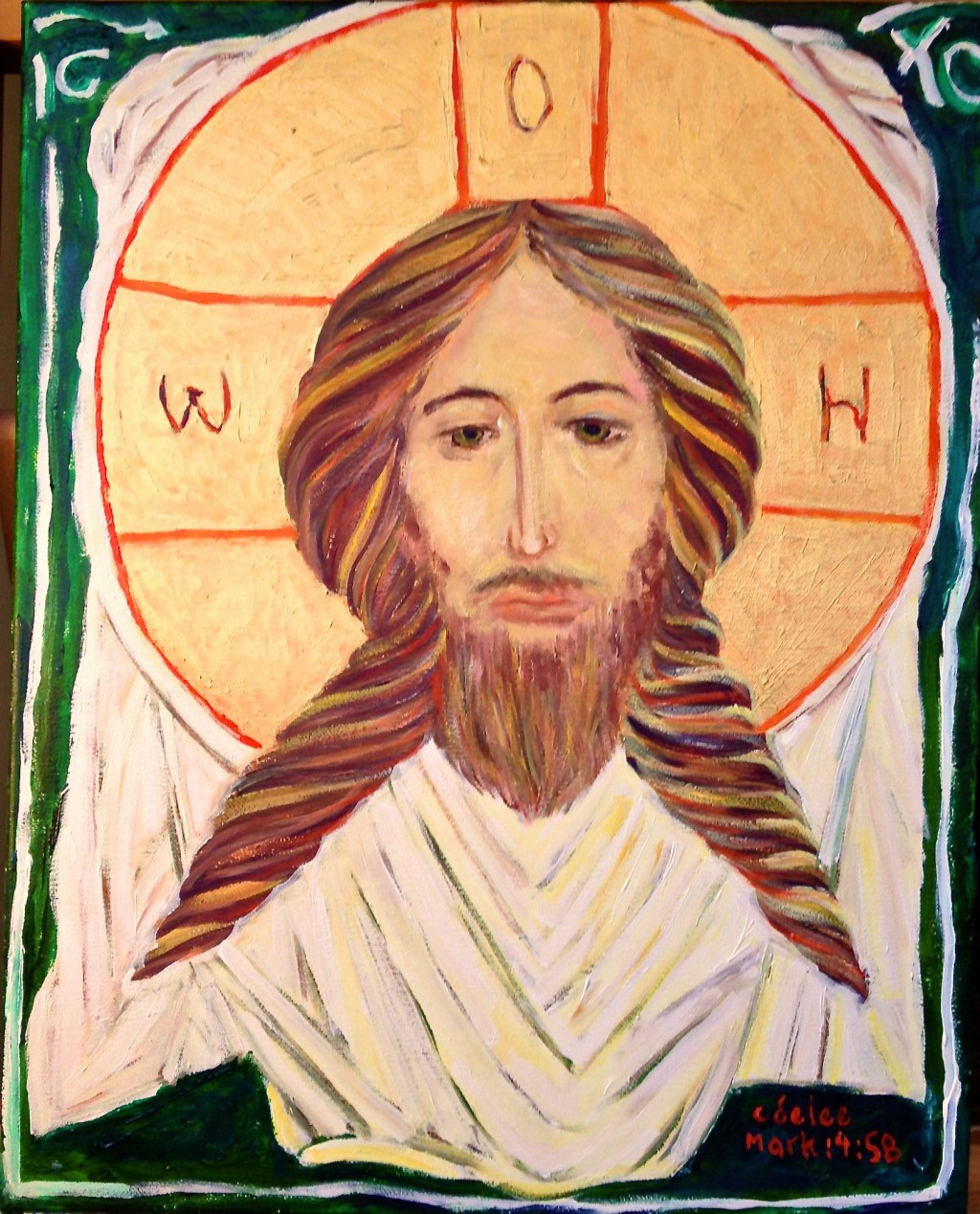
Pantocrator icon: Progress Report

Creativity, Holy Spirit, Icons, Imagination, Love, Meditation, Ministry, mystery, Prayer, purpose, Secrets, Spirituality, Uncategorized, vision, Work

20140721-130800-47280086.jpg

Progress: the 13th hour on the Pantocrator Icon.
Acrylic on gold primed canvas. 18″ x 24″.

Good things come to those who persevere.

Painting an icon is one of the ancient spiritual disciplines. The artist isn’t just copying by rote or filling in a design, as in a paint by numbers craft piece.

Instead, the artist is rendering a true copy of a window into heaven. As I focus on the image, the image is also focusing on me. As I seek to be faithful to the forms I see, in a mysterious manner unknown and unseen, the icon’s presence allows the Spirit of God to work within my heart and mind to transform me and bring me closer to God’s original image.

There are days in my life when I think I should paint more icons. There are days in this world when I wish all people honored and venerated the holy icons, or at least honored the call for peace within their own religious traditions. Perhaps that day will come in my lifetime, but if not, I can live in peace and not contribute to the warring nature of this world.

WOUNDS, HEALING AND LOVE: THE MYSTERY OF THE JOURNEY

Food, Forgiveness, Health, Icons, Imagination, Italy, Love, Meditation, Ministry, mystery, poverty, purpose, renewal, salvation, Spirituality, Strength, Travel, Uncategorized, vision, Work

20140317-091052.jpg

At dinner Friday night with some friends, I met a lady from their church. I remarked that I needed to find something on the Mexican restaurant’s menu that wouldn’t damage my wellness plan. I’ve been pre-diabetic for eight years now, but I’ve managed my condition with diet and exercise. I even have a Fitbit exercise monitor that links to my sparks people food record. “Gosh! That’s so much trouble” she said, “why do you worry with all that?” I looked at her and replied, “Because I have a family history of diabetes, I’m pre-diabetic, and my younger brother is insulin dependent and already had congestive heart failure. I don’t want to go there too.” “Been there, done that. It’s all part of life,” she said.

I have been on a healing journey for years. What, you say, are you just spiritually slow, recalcitrant, a backslider, sluggardly, or just too busy to take care of yourself? If our healing journeys are toward our recovery of our original image of divine creation, I’m not yet there, but I persist by the grace of God.

I don’t berate myself for not yet arriving, but the last few years I’ve had a hardness of my heart regarding others who have gone “so far, but no farther.” They have in effect become settlers and comfortable at some village located in a cozy hollow beside a pleasant stream. They have nice neighbors and maybe a few quaint nut cases to liven up the town gossip mills. I confess that as one who can hardly wait for the next adventure, the next project, or even the next day, I’m not big on being “settled.”

This is why I’ve had six careers in my working life: artist, real estate investor, art teacher, insurance sales, wife and mom, and ministry. Now that I’m in retirement, I’ve taken up writing and resurrected my artistic endeavors. I’m not settled enough to sit around, drink coffee and rehash my glory days or even talk about current events. I’m too involved in making current events!

This icon, “He Healed Others, Cannot He Heal Himself?” Is made of found objects which I picked up while walking around Mercy Hospital in Hot Springs, Arkansas. This 1.5 mile circuit from my local YMCA takes me from one healing place past many others: doctors’ offices, cancer treatment sites, home healthcare training schools, pharmacies, and clinics of every type. Across the street one can get food for the body. The busy roads and highways are a bountiful source for the castaway chunks of this human life.

As I picked up these assorted pieces of debris, I thought of the cast off people in this world: the hungry, the dying, the disabled, the terminally ill, the deaf, and the blind. The greatest healing sign was raising Lazarus from the dead! I had an old postcard from a trip to Italy I could use, along with some old embroidery hoops from the grandparent’s house that I’ll never use on a cloth, but I’ve “saved for the memories of their name.”

In the first three Gospels, the “chief priests also, along with the scribes and elders, were mocking him, saying, “He saved others; he cannot save himself. He is the King of Israel; let him come down from the cross now, and we will believe in him” (Matthew 27:41-42). To “save” is to heal, to preserve from harm, or to get well. We speak today of “being saved” as if it were a one and done, but in fact it is both an instantaneous and a long term process.

We want our wounds to be healed NOW! By golly, and don’t leave any visible scar as a sign of our past pain, but remove all signs of our imperfection from our hearts, minds, and souls. Just as the Son of a God took a human body to taste all of our peak and low experiences, even to the abandonment of death, I think God may have a purpose in leaving us with our scars as we continue on our journey.

The scars we bear are signs to others of the journey we’re still traveling, much like the stamps in our passports. They are the marks of our past pain and brokenness. If God were to wipe those identifying marks away, no one would know to seek us out as guides along their own journeys. God may be leaving these wounds open so that we can pour God’s love out through our brokenness into the lives of this hurting and hopeless world.

Our world is full of people that have been told that they need to get well before God will love them, but what they are really being told is “My wounds are covered over with a fake skin of perfection, so until you adopt your fake skin, find another place to worship.” Our open wounds that let God’s love flow through to all people, the wandering wounded and the settled saints both, is what will bring us closer to God as we come closer to our neighbor. Sometimes it’s easier to love a holy God than an unholy neighbor, but loving God’s creation should be a goal of our spiritual journey.

THE HOLY NODE AND THE FOUND BUTTERFLY

butterflies, Creativity, Health, Icons, Imagination, Meditation, Mental Illness, mystery, Physical Training, purpose, renewal, Strength, Travel, Uncategorized, vision

20140316-083445.jpg

I’m not a fast walker, for my first goal in walking isn’t to break any record for my usual 1.5 mile jaunt around Mercy Hospital here in Hot Springs, Arkansas. Neither do I stroll, for Bon Jovi and the Boss sing a strong striding cadence in my ear. I can manage the hills better in one direction than another, for at least one is nearly 45 degrees. I go up this hill once a week. It never gets less steep. The rest of the week I go down that hill. At my age, there’s no sense taking any more years off my life than necessary!

My goals as I walk are to be more conscious of my body, to care for it better, to build my body for endurance and health, to be outside in the sunlight (natural vitamin D), and to develop a better attitude (exercise releases endorphins that lift one’s mood). Walking also seems to clear my mind of worry and anxiety about others.

In that large hospital, I know that healing is going on. While some may be “losing the battle” against whatever dread disease has attacked them, they have “won the war” and received their final healing from God. We think our life is over when we close our eyes and breathe no more, but our life is just beginning in a newer and more wonderful way!

As I make my rounds about the hospital grounds, the wind blows through my hair, the sun falls on my face, and I see the sun shaped shadows of the pines and the pear trees. Even the ornamental lake reflects the colors of the sky and clouds. Heaven and earth are more connected here even though my path is just beside the eternally busy bypass of Highway 270.

There are nodes in space and time at which the intersection of heaven and earth seem to open up to one another. The Celtic tradition calls these “thin places.” All across the world we can find sites that were considered holy by one successive people & faith after another. When you walk into such a place, you can feel the years of prayers within the space.

This route I take, while short, has become a holy node for me. It was the reason for two found object works: The No Room Inn and The Healing Christ. I also did a landscape of that decorative pond. Now I am painting the various butterflies I have collected on my journeys. These are symbols of the new life to come because they wrap themselves in a cocoon (grave cloths). I think of them as an icon of the new life we live when we see the light of what is possible in Jesus Christ himself:

“I have come as light into the world, so that everyone who believes in me should not remain in the darkness.” — John 12:46

THE NO ROOM INN

at risk kids, Children, Evangelism, Fear, Holy Spirit, home, Icons, Imagination, Ministry, poverty, purpose, renewal, salvation, vision, Work

20140129-071055.jpg

Context is everything. In the real world of my daily hikes, the objects in this artwork are pieces of trash that I’ve found lying near the path that I walk. Put together with a fresh eye to shape and color, they become instead a nativity scene. I live in Hot Springs, Arkansas, a place known for its healing waters to the native peoples who once roamed these lands and now known as our nation’s first National Park. We have two large hospitals, a rarity for a town of only 35,500 people, but we also serve outlying rural counties. If you want healing, this is the place to come, for we have spas, bathhouses, great food, a beautiful lake and mountains.

The local YMCA is just down the road from the Mercy Hospital campus. If I leave the Y, I can get a 1.5 mile hike with varying grades and enough level spots to recover my wind and get the whole done in about 30 minutes. I’ve about trained the courtesy cart lady to wave at me and pass me by. At first I think I struggled enough that she would stop to offer me a lift.

When we speak about context in a work of art or context in a biblical verse, we mean that we need to look at the surroundings. The surroundings in an art work include the artist’s life experiences, as well as the image they were viewing. We artists pour the sum of who we are into the whole of the world as we see it.

Likewise with the biblical context, we ask: what was the writer’s intent, what do we know of his life experience, what seems to be his goal in writing as he does, what does his choice of words or images suggest, why are some stories unique and not repeated by other writers, and to what do the stories before and immediately after point?

In the New Testament, Luke is the only writer to mention that the birth of Jesus took place outside of an established lodging place. He uses the Greek word Kataluma, which means “lodging, inn, or guest room,” depending on the context. He is also the only one to mention the parable of the Good Samaritan. Healing takes place for the victim of bandits at the inn and for the whole world at the no room inn.

“And she gave birth to her firstborn son and wrapped him in bands of cloth, and laid him in a manger, because there was no place for them in the inn” –Luke 2:7

“He went to him and bandaged his wounds, having poured oil and wine on them. Then he put him on his own animal, brought him to an inn, and took care of him” –Luke 10:34

The No Room Inn Nativity has the standard imagery of the Holy Family: Joseph is the tall, blue, flattened paint can with the radiator head; Mary is is the crushed coca-cola can with the tin can head and screws for eyes; the angel on the left is a rain washed McDonald’s French fry container with a tin can lid for a head; and the baby Jesus is an orange plastic cross/halo resting in a VIP parking ticket from a NASCAR race I attended in November. Alone, these are just pieces of trash, but together on a gold background, this collage becomes an icon worthy of reminding us that the King of this world began his life in a No Room Inn.

This Jesus who came to heal the rift between God and humanity, began his human life on the outside. Those of us who feel like we aren’t meant for the inside need to realize that Jesus spent his whole life on the margins, healing the sick, feeding the hungry, and casting out demons, while at the same time afflicting the comfortable insiders who came for the show. Context is everything. Take your ministry out into the streets, find the broken bits of “trash” that have the potential to become new. Begin a healing ministry, not for those inside your comfortable inn, but for those who are told, “No room!”

Are we the Good Shepherd or Are We the Lost Sheep?

Children, Food, Health, Icons, Meditation, Physical Training, Prayer, purpose, renewal, salvation, sleep, Spirituality, Strength, Stress, Uncategorized, vision, Work

20140124-070913.jpg

Recently a male acquaintance of mine had the temerity to suggest that perhaps I might need one of those buttons that calls for help to a distant monitoring site. I had told him I’d been sick and he knew I lived alone. I was feeling much better by then and retorted, “As long as I can walk the around the 1.5 miles of Mercy Hospital, I don’t need a button that says I’ve fallen and can’t get up!” He escaped my wrath by a quick exit into the elevator. Indeed!

“I can do all things through him who strengthens me,” Paul said of Christ to the Philippians (4:13). Isaiah reminds us that God “gives power to the faint, and strengthens the powerless. Even youths will faint and be weary, and the young fall exhausted; but those that wait upon the LORD shall renew their strength, they shall mount up with wings like eagles, they run and not be weary, they shall walk and not be faint.” (40:29-31).

With verses like these ringing in our ears, well meaning people of faith do great harm to God’s gift, which is God’s own image, whether male or female (Genesis1:27). We run our precious images into the ground until they are flat exhausted, burnt out, overwhelmed, physically sick or plain old addicted to either the work, the adulation, or some other less desirable habit. We forget that the one person who is “the image of the invisible God, the firstborn of all creation” (Colossians 1:15) is also the same one of whom was said, “And the Word became flesh and lived among us” (John 1:14). John’s gospel alone mentions that “Jesus, tired out by his journey, was sitting by the well” (4:6). No other gospel author speaks of the Lord’s humanness as does John. If Jesus can get tired and need rest, why is it we who follow him cannot do the same thing?

We think we are being good shepherds by being always at work, always on call, always at work. I have clergy pals who feel they have to justify their exercise time as “prayer time or sermon preparation.” I have other friends that have worked themselves into the hospital with exhaustion, yet tried to leave against medical advice just to do someone’s funeral because they were jealous of another pastor coming into their church. The stress of disaster relief efforts in addition to all our other responsibilities can be the straw that breaks the camel’s back. Hurricane Gustave in 2008 put several of us in lower Arkansas into the hospital with stress related heart events. Fainting into your spaghetti at the community meal gets you a free ride to the local hospital, even if you go under protest!

I won’t begin to list the side effects of all this stress on our precious bodies, other than to say that when we put ourselves under this much stress, we eat more comfort foods, we exercise less and we sleep less. All these acts cause us to eat more comfort foods. If we really want to live a Jesus lifestyle, start walking! Give up your need to be a Ken or Barbie doll perfect person and tell your people you are going out to find the lost sheep.

The lost sheep is your identity as a child of God, not your calling as a pastor or your ministry in the church or the world. It isn’t how you make your money as a banker, a mechanic, a coder, or a salesperson. This isn’t you as a mom or a dad, but you as God’s own child. If you are feeling lost in the role of what you do, you are a lost sheep. This icon (image) of the Good Shepherd should point you to the only one who can find you and bring you home safely from the wilderness. If you are with him, you stand under the tree of life, whose leaves are used for healing. Your wounds will be healed and you will heal the wounds of others also.

For further reading, a classic spiritual text is Henri Nouwen’s THE WOUNDED HEALER

The Shining River

Creativity, Icons, Imagination, Italy, Ministry, mystery, photography, Prayer, Spirituality, Travel, Uncategorized, vision, vision, Work

“Then the angel showed me the river of the water of life, bright as crystal, flowing from the throne of God and of the Lamb through the middle of the street of the city. On either side of the river is the tree of life with its twelve kinds of fruit, producing its fruit each month; and the leaves of the tree are for the healing of the nations.”  ~~ Revelation 22:1-2

I have never visited a more beautiful city than Venice, Italy, with her

The river of God, flowing from the throne of God, with the tree of life bearing fruits in every month & leaves for the healing of the nations.

The river of God, flowing from the throne of God, with the tree of life bearing fruits in every month & leaves for the healing of the nations.

ancient mansions on the canals, her grand piazza opening up to the lovely Basilica of San Marco’s domes, and her delightful bridges, museums, and churches. Most tourists who visit here love to feed the pigeons, while I think they are a public nuisance. Then these birds take flight heavenward and I’m inclined to think of angels’ wings and brushes of glory.

With all these earthly visual delights, my eye still is drawn heavenward to the sky, for the clouds and the atmospheric haze of Venice give this city a unique ambience. If a painter were to lay the colors of the South Italian sky upon the watery bogscape of Venice, the discord would be marked immediately.  At dawn and twilight especially, travelers don’t need a GPS to recognize the location or even a town sign to mark their arrival, for the sky alone says, “Welcome to Venice, weary traveler! Rest your soul!”

Most of us are used to living on a city lot with trees and grass that is bounded by a concrete walkway, a grass “neutral ground,” and a street that separates us from a mirror image of our own property across that same road. Venetians live on canals in multistory buildings that double as homes and warehouses. The lower floors were for work, for the cargo hauling gondolas easily accessed these, while the upper floors were for the family retreat, since they were more private. Everything in Venice moves by some form of floating contraption, since the city was built on marshy land in the middle of a lagoon between several small islands.

Because there aren’t any motorcars, there is a different feeling to the city. On the larger canals, the big boats ferry people on the tourist routes and smaller motorboats act as taxis. The classic gondola with the human powered oarsman is a premium priced experience, much like a carriage ride in downtown Hot Springs or Eureka Springs, Arkansas.  Travelling to the nooks and crannies of this jeweled city is by foot over one of the many bridges and side paths, so it is a sightseer’s paradise.

This slower travel allows a visitor to feel the rhythm of the place, to smell the air, to note the patina on the marble facings of the homes, the worn indentations on the entry steps of the ancient homes, and the variety of colors in the handmade bricks. Walking down the narrow corridor between the homes doesn’t prepare the visitor for the sudden opening into a larger space and the overwhelming, all enveloping softness of lush rose, moist yellow, and puffy crème that make up the clouds of a Venetian sky. Perhaps someone else sees only a cerulean blue sky and a titanium white cloud, but I know what I see. I visited this beautiful city only once, some forty years ago, and I still remember images from those blessed days.

As I think about this crystal clear memory from my past, I wonder how we see our own world today and how we envision the world that is to come. Many of us have a very negative view of this world: the problems, the people, and the pains are all overwhelming. We have divided our world into an “us vs. them” place: rich or poor, black or white, Republican or Democrat, Developed world or Emerging world, Christian or Muslim, and the list of dualisms goes on and on.  Even in the Bible, folks were divided, until Paul set them straight, There is no longer Jew or Greek, there is no longer slave or free, there is no longer male and female; for all of you are one in Christ Jesus” (Gal 3:28).

We aren’t meant to separate ourselves from one another but to find a way to come closer to each other. “If only we were all Christians,” you say, “and everyone belonged to MY church/denomination.” I think that what Paul also means by “one in Christ Jesus” is that all human beings share the image of God, no matter what church they belong to, and no matter what God they call upon. No matter how different they look from you and me, they still hold the divine image and imprint within them. If we are to truly live out our call to be “the living image of God in the world,” just as Jesus Christ was the living image of God in the flesh as the Incarnated Son of God, then we have to take that incarnation in our lives and the recreation of this world seriously.

In the Celtic Tradition, heaven and earth are only three feet apart. The “thin places” where we feel the presence of God are even closer. What if God intended all creation to be a “thin place?” The Garden of Eden seemed to be such a spot, for Adam and Eve not only lived and cared for the land here, but they had daily walks with the LORD in the cool of the evening breezes (Genesis 2-3). Unfortunately, our spiritual forbears decided that equality with God was more desirable than companionship with God, so they lost their daily privilege of the presence (Gen 3:22-24). This is called “The Fall.”

Ever since this Fall, all of human kind has attempted to recover the intimate relationship with God and nature that we once had in the Garden. Today some focus only on their spiritual lives and separate their souls from their flesh. Both Christian and New Age groups will do this: we deny our body sleep, good nutrition, or healthy exercise. We also see it when a proponent of some “spiritual doctrine” proclaims that the body is unimportant, so that it can be treated either well or ill, or can be used by the cult leader for “higher purposes.”  Or we claim that since our bodies don’t matter, we can use them for any purpose we want, for only our soul matters.

Since God created us with both a body and a soul (Gen 2:7), both must be valued by God. Moreover if God sent his Son into the womb of a teenage Virgin, so that he might be born fully human (both body and soul) and fully divine (still the Son, still part of the Holy Trinity), then God distinctly values the human body, both female and male. God sent his Son in human form to the earth, not just to redeem humanity, but to set all creation free (Rom 8:21).

When we spend time in a thin place, most often we are isolated and silent. Most of us need that time away from the hustle and bustle of life to settle our minds so we can hear or feel the presence of God. We need a “Garden of Eden” that is our place to meet God daily until we are able to meet him in the midst of the fallen world in which we live. How can we learn to feel the presence of God while we are within the “maddening crowd?”

I practice times of “tuning out” or letting my mind drift. Some call this daydreaming or a failure to stay on task. Creative people are task slaves until their idea has fully formed well enough to get them excited about working and then you can’t tear them away from their fever until they drop from exhaustion or realize they are about to overwork their piece.  We know our own work habits, and it usually isn’t on anyone else’s time clock. The creative idea is their master, not the schedule, the calendar, or some outside influence.

I will be in the car at a red light and hear a voice in my inner mind prompting me to look up and photograph the sky. I do this for no particular reason, other than I feel impelled.  It’s not an actual voice of a person; it’s more of an intuitive feeling that now is the time to take this photo. Perhaps I’m just bored, or I have better peripheral vision, or I need something to occupy my time so I don’t go silly waiting at the back of this long line. I think of these moments as “intersections of heaven and earth,” for these are windows in which our everyday world opens up into a world in which God is present and touches our world and our space and our time.

The painting which graces the headline is from a photo of the street outside of my condominium, beyond the small creek, looking over into the wooded lot beyond. The old asphalt road has become the River of Life, bright as crystal. There are many trees there and the golden sky tells us that we are in the presence of the glory of God. I go in and out of this gate every day, into a world in which God is ever creating and recreating. I have a much better attitude toward all the ugliness I see out there when I know it is passing away before my very eyes.


Doing Battle With The Dragon

Children, Creativity, Fear, Health, Holy Spirit, Icons, Imagination, Mental Illness, mystery, purpose, purpose, renewal, Stress, Travel, Uncategorized, vision, Work

“The horse is made ready for the day of battle, 
but the victory belongs to the Lord.”  ~~ Proverbs 21:31

Mount Erciyes, Cappadocia, Turkey As I journeyed with my group along the Silk Road on the fourth day of our pilgrimage, we saw the twin peaked volcano Mount Erciyes, on which St. George of Cappadocia was said to have slain the dragon. As we made our 400 miles across the sunlit fields with poplar trees into the tufted fairy mountain volcanic formations, I had several conversations about art and artists with my fellow travelers. We had visited the Firca Ceramic Factory in the morning. The artisans there explained their apprentice program and the process of training to become a master potter. Not everyone makes the cut, of course, but they can still be employed at the level of tradesman or tourist ware producer.

For people who have no concept of the time, effort, sensibility or spirit that is necessary to produce a great work of art, this “educational session” went right over their heads. Others had their “consciousness raised,” as we used to say back in the old days. This latter group happily gave a fair price for the extraordinary works of these artists’ hands.  I myself brought home a small plate of colorful fish to remind me that I am always called to “fish and to catch the hearts, souls, minds, and bodies of others for the sake of Christ and his church” (Matt 4:19).

At lunch I visited with one of my new friends. She asked, “Why did it take Michelangelo so long to paint the Sistine Chapel?” Because it was fresco—fresh plaster. He could only work while the plaster was wet. Bodies with clothes and landscapes went quickly, but nudes and faces were painted more slowly. If we could get up close we could tell by the edges and lines how much he did in a sitting. “Oh. Everyone who saw the chapel on our tour was kind of bored with it all. Now I understand why it was so important.”

I realized it’s because not many of us make art anymore, just as most of us don’t can jams or jellies. We also don’t quilt, knit, crochet or embroider. We buy our clothes premade and our foods prepackaged. Cooking from “scratch” is a lost art. We don’t seem to want to dirty our hands any more with the creative process. Instead, we have lost the spirit that calls us to enter into battle with the raw materials. We are a people without faith that God is with us in these fights. It is as if we are afraid to risk losing the battle, so we do not enter the fray.

I have recently been teaching art to prekindergarten children. The first thing I had to teach their classroom teacher was that “failure in art is part of the process of learning how to succeed.” In other words, it’s not the finished product of polished perfection that we seek, but the child’s growth in using the tools correctly and their creative response to the imagination challenge of the day.

The second teaching principle was allowing the child to do his/her own work.  Many of our parents have “taken over” doing for our children so they can have a good outcome. These children will have poor motor skills and will not be self-sufficient when they grow older. They will be less independent and less confident.  However, they can master skills in art class that can give them a sense of self-esteem that comes from accomplishing a task, taking charge of their own work, and creating their own designs from their own fertile imaginations.

The third principle about art is joy, and I usually don’t have to teach this to the children.  They love to play and the colors, materials, textures, and tools are great ways to explore the world in play. For adults, however, art is about the finished product from the get-go, so we worry that our idea will not come across on the canvas or paper.  For the work to come alive, the artist must let go of that original idea and go with the image that begins to come to life on the canvas. Sticking with the old idea is like staying with the old battle plan when the lines of engagement begin to shift. We all know what happened to General Custer at Little Big Horn.  The same death will happen to our creative product if we don’t pay attention to the new information coming t us from the front lines.

Likewise, in our lives, we don’t listen to the battles going on in our hearts, minds and bodies. Some might call this our conscience, or that voice that whispers “this isn’t right for you.” That other voice that whispers so sweetly, “but everyone else is doing it…” is like St. George’s dragon, or the personification of evil. Flip Wilson’s character Geraldine used to say, “The Devil made me do it!”

We can go along with the “demon voice” of “everyone else is doing it” and discover that our moral standards are at the lowest common denominator, and we make decisions not on any ultimate truths or standards, but on conditional and relative criteria. The ground is always shifting under us, like a mountain about to erupt. If we refuse to fight this particular dragon and “go along to get along,” then either our mental health or our physical health will begin to fail us. We may intellectually marshal the arguments of reason for our refusal to do battle against this insidious dragon, but like the fiery beasts of the old tales, they will surely begin to ravish the countryside.  In this case, the country isn’t Cappadocia, but the heart and mind of the one who needs to gird the horse for battle.

Many of our modern illnesses are related to stress, which comes from having to reconcile two discordant tunes in one’s head. Only when we can fine that one tune to hear will we be both well and at peace.  Another image is trying to “spot paint a wall that was painted too many years ago.” Putting fresh paint over dull color will make this one spot stick out like a sore thumb.  One must paint the whole wall, and of course, the other three walls and the ceiling, for the rest will look too sad next to that freshly painted wall. The truth is we can’t just put a new piece of cloth on to an old garment; we must change out the whole thing. This is called a “make over” or a life style change, or the “new life in Christ.”

I myself have had a lifestyle change from the hectic, caring for the lives of others that is the life of a pastor to the new life of caring for myself in these years of being on incapacity leave.  These past four years others from my old life have pushed me to be “more involved and to do more ministry with and for others” in the hope that I will be able to return one day to full or part-time ministerial service.

As I listen to my body, I realize that the stresses of these activities aren’t for me anymore. I can do them on an occasional basis, but not on a weekly basis, and definitely not on a daily basis. I am healthier when I am in the solitude of my studio writing and painting. I need the quiet to stay well and avoid the stress that brings on the seizures. Here I can reflect on the battles between good and evil, the struggles we all have to live the full Christian life.

We all do battle against the dragon.  Some of us want to be at the heart of the action, to receive the affirmations of the people to be there for them and to touch their lives. We think if we can make a difference here, it will atone for our failures to make a difference somewhere else or in some one else. We will be at peace when we understand that while we may gird the horse and swing the sword, “the battle belongs to the LORD.”

As an artwork for spiritual reflection, find an icon of St. George and the Dragon. As you meditate upon it, write out the words of your particular “dragons.” These are the powers and principalities that you struggle against: pride, fear, self-doubt, worry, hopelessness, arrogance, anger, weakness, hate, etc.  You can make the words of any size or shape. Embellish them with wings, give them an elongated tail, scales and an open gaping mouth. Now draw a large sword, gleaming brightly in the light of day. Upon this sword write the words of power that come from scripture: “The battle belongs to the LORD!”

Keep this image near you this week and draw strength from it: God is at your right hand!

For photo & info on the volcano at Mt. Erciyes:  http://volcanocafe.wordpress.com/2012/03/29/cappadocia-upright-volcano-of-turkey/

For Illnesses related to Stress:  http://www.webmd.com/balance/stress-management/features/10-fixable-stress-related-health-problems

Crayola Crayons and the Secret of The Cross

Children, Creativity, Family, Fear, Forgiveness, home, Icons, Imagination, Love, Meditation, Ministry, mystery, Prayer, renewal, salvation, Secrets, Spirituality, Strength, Stress, Uncategorized, Work

“When I came to you, brothers and sisters, I did not come proclaiming the mystery of God to you in lofty words or wisdom. For I decided to know nothing among you except Jesus Christ and him crucified.”                                                    ~~ 1 Corinthians 2:1-2

When I was in kindergarten, I wanted more crayons in my 2012 time icondrawstring bag, so I put my little five year old hands into the darkness of this hidden place, found the larger crayons, and broke them in half.  I did this in secret, to have “more” when I spread them out on our table during coloring time. I didn’t understand that I didn’t have any more “colors,” but only had more pieces of crayons. This “mystery” of “numbers and more” was lost on my undeveloped five-year-old mind.

In the first grade, we had individual desks, so we kept our colors in their original boxes.  This is when I first noticed that while my teacher required us to have the Crayola standard eight color non rolling crayons, these magic colors came in boxes of many more colors! As soon as I was allowed to bring more than a set of eight colors to school, I begged my parents for the biggest box my teachers would allow. The beauty and secret joys of all the mysteries of the universe were there in all these colors as I opened my first large box.  It may have had only twenty-four colors, but I thought I had all the secret knowledge of heavens before me.

There are secrets and then there are mysteries. Secrets are things that can be known and understood, but for some reason we want to keep the information “sub rosa.” Mysteries, however, can’t be understood and are beyond knowing, so they are often hidden, even if they are in plain sight. Such is the mystery of God and the reality of the crucified Christ.  We cannot see the invisible God, but we can see his visible evidence in Christ’s broken body hanging on the cross: God’s abounding love, his radical forgiveness, and his amazing grace in the gift of his son’s life to bring us into a new life and a new relationship with the Father.

Death, especially a hideous and tortuous demise, doesn’t seem the avenue to life. A criminal execution isn’t noble or brave. The people around the cross jeered,  “Save yourself, as you saved others!” (Luke 23:35) But he did not.  This is a mystery to us, for he could have called 10,000 angels down at any time! Surely the heavenly host who filled the skies at his birth would have rescued him from this horrible fate at the last. This is why “the message of the cross is foolishness to those who are perishing, but to us who are being saved, it is the power of God” (1 Corinthians 1:18).

Lately secrets have been much bandied about. Our straight arrow University of Arkansas football coach seems to have had a secret life, one that only came to light after his motorcycle accident with a female passenger on board. This young university employee was in a “previous relationship” with the head coach. My gut tells me that the “previous” became “active” the moment the motorcycle went off the road, for the coach at first failed to mention to the University authorities that he had anyone with him. This lie and the multiple refusals to come clean over a period of time broke the bond of trust between him and his employers and supervisors. He was placed on administrative leave while others decided his fate.

Over the Easter weekend the true colors of our theology began to show. The Facebook page “Save Bobby Petrino” held a rally Easter Sunday. In the spirit of the season they said, “Jesus saved Bobby Petrino, now Jeff Long can save him too.”  Wow! Never thought that our Athletic Director would get elevated to the second person of the Holy Trinity! That’s usually reserved for winning football coaches like Petrino. “Forgive and Forget” for this crowd really means, “Let’s get back to winning games.”

I wonder how they would have reacted if Coach Nutt had been caught—oh wait! There was the text message scandal and the comely media lady.  This was the final straw, as I remember, that caused us to buy out a losing coach’s contract. It seems we treat the indiscretions of losers differently than those of winners.  In a like manner, consider the realm of politics and two men, both of whom “did their wives wrong.” One we continue to faun upon and the other we still love to hate. I speak of Bill Clinton and John Edwards. In truth, the first has redeemed himself and changed his ways, devoting his post presidential life to good works around the world. John Edwards is too fresh in our minds for his cover-up of his relationship with his pregnant mistress and paying hush money to her family while his own wife was battling cancer.

This sort of self-destructive behavior happens to people who rise to great power, have many “yes men” around them, and have pressures from all sides pushing them constantly. They become isolated from their families and from the ordinary world’s give and take. They live in an unreal universe in which they are the sun and everyone else is a mere planet that revolves around their light and glory. It can happen to doctors, lawyers, CEOs, clergy, teachers, managers, principals, or any one in supervision over another person.

What we forget is the “other woman,” the young “planetoid” that gets sucked into the gravitational pull of this bright shiny object. Some would say that she’s an adult and could say “no,” but when the power is unequal, and especially when the person is her boss, “yes” is more often what she will say.  Men of power usually survive, but the “other woman” is marked for life, especially in her home state.  “Why did you leave your last job?” Spin that one, honey. Ask Monica Lewinsky how life has treated her these last seventeen years: no steady job, no home of her own, no love life, people still taking her photo as “that girl,” and she still has the trophy black dress hidden at the back of her closet. She hasn’t exactly moved on and thrived.

We tend to respect power and strength. We want a winner at the helm, whether we are speaking of a football team, a church, a business, a family or a volunteer organization. We want a “messiah” who walks and talks like Tim Tebow and looks like him if possible! If he has the purity, power, and passion of Tim Tebow, that’s even better. What we don’t realize is that his character comes from understanding the mystery of God in Christ: power is found in weakness! Only when we set aside our human strength can the strength of God be brought to bear in the tough times of our lives. When we are standing on our own two feet in when we are at our weakest. When we are driven to our knees, when all our powers have fled, this is when God takes over! “I give up” means “God, take over.”

Any one of us would trade $1 for $10, an act that results in a1,000% no risk return.  Yet every day, people play the lottery in hopes of more payout with a lesser opportunity of result. Giving up our puny power for the power of the Almighty God is a no brainer trade! This is why Paul came knowing only Christ and him crucified. This is why the “tebowing” move is on one’s knees. It is the attitude of a humbled soul, who recognizes that while God’s mysteries may be beyond our understanding, the gift of Christ’s body on the cross, broken for us, is the key to unlocking all the wisdom and knowledge of God.

The ancient Jews practiced the “whole burnt offering” as a gift to God. Nothing was left for them to consume, enjoy or keep. As a practice of self-examination, we need to discern what we have kept hidden in the closets of our minds and in the secret places of our hearts. God already knows these things, but we are keeping them hidden from the world, from our friends, and our families. We don’t need to spill our guts to everyone, but we do need to admit these to ourselves and to God. Write your secret on a piece of paper: anger at (name) who raped me, my substance abuse, workaholism, fear, sadness, perfectionism, my idiot boss, etc.  Find a place on pavement, patio, or rock and set this paper on fire. As you burn this paper up, watch the smoke lift up to the sky above. Know that God is burning this pain from your life.  Pray that God strengthens you to live a new and intentional life, depending upon the love that held Christ to the cross.  When the road gets hard ahead, go down to your knees, and let the power of God hold you close, moment by moment.

You might have many hidden objects that you can’t get rid of because they have meaning to you. They are in boxes or drawers, tucked in the back of your jewelry box or in your storeroom or garage. One day you’ll get around to it, do something with them, but you just don’t know what yet.  I have many small crosses people have given me, some small pieces of broken jewelry that have lost their mates, and some odd items that I’ve found and for some reason I can’t throw away. I have seashells from the beach vacation I took 20 years ago and old necklaces that are no longer in style. I finally pulled these all out and made an icon of the cross from found objects.200? found object icon

Find an 8 X 10 inch frame at the craft store that you like and get rid of the glass carefully (wrap it in newspaper and throw it away). Cover the backing board with fabric or scrapbook paper. You can also use an 8 X 10 canvas panel painted gold.  Use gorilla glue or a glue gun to attach the objects, beginning from the center outward. Make sure to leave 1/4 inch or more outer margin so that the frame will fit! Do NOT lift the panel up to look at it or the heavy items will fall off! Leave panel flat to dry for 24 hours. Insert it into frame and display.

May your New Life be one of Joy and Peace, Cornelia

Twinkie Dust & The New Creation

Creativity, Holy Spirity, Icons, Imagination, Love, Prayer, purpose, purpose, renewal, salvation, Spirituality, Uncategorized, vision, vision

“Do not remember the former things, or consider the things of old. 

I am about to do a new thing; now it springs forth; do you not perceive it?” 

~~ Isaiah 43:18-19

My favorite time in Vacation Bible School was the plaster handprint. When I was a child in the 1950’s, we were given our choice of one color to paint “our hand to serve Jesus.” When my daughter went to VBS in the early 80’s, her little hand had a rainbow of colors exploding all over it!

Those ladies are the unsung heroes in every generation, for they mixed and poured plaster into recycled pie pans and let all of us children put our hands into that goop so we could bring our “helping hands” home to our parents. They also cleaned us up afterward.

One summer Art in the Park teacher brought some real turquoise and real silver wire to a bunch of hot and sweaty kids sitting at a picnic table. My 10-year old hands make a piece of “jewelry,” which I still sometimes wear.  My Saturday art teacher took me under her wing as soon as I was able to write my name in cursive. I also have to thank my Mom for driving me all over town so I could do what I love the most.

Each one of those teachers stretched me as a child, but none stretched me more than two of my teachers at Georgia State University: Mr. Sitton and Mr. Perrin.  One week the head of the department would stop by and ask, “Are you working for me or Mr. Sitton?” Each time I would only reply, “I’m working.” Not letting that noncommittal answer go by, Mr. Perrin would keep asking until I had had enough of being interrupted and I burst out, “Neither of you! I’m working for myself!” It was the answer he was waiting to hear.

I do remember how these two pushed me to strive beyond myself and to grow as an artist. They encouraged me to find my own voice, my own style, and to not be an imitator of others. I could learn from others and study them, but to become an artist, I had to discover my own true vision.  So I had to press on to the new thing as yet unseen, and let the old fall pieces away behind me.

This is easier said than done. It’s much more comfortable to repeat a form than to move onward to the next one. The old one feels safe because it is known; the new one has risks because it is as yet unbirthed and unseen. It may arrive still born, and the work will seem as if for nothing. However the effort expended isn’t wasted, since the artist now knows that this path is a dead end and can try another with more confidence.

So, why is it we spiritual people have a hard time living this new and different life once we make our profession of faith in Christ? The world calls us “hypocrites” because we seem to live the same old lives as we once did before we knew Christ. There seems to be no outward transformation to match our inward change of heart and relationship. We do not become magically and radically different, but instead progress slowly into a newer and more perfect life in love. No wonder we have a hard time attracting the unsaved into our new way of life or into our congregations.  They don’t see a visible witness that our faith in Christ has made a difference in the person we are or in what we do.  We might “steal a church member from another congregation,” because they already know the drill: show up, go through the motions, and maybe one day, I’ll change into a better person. People of faith are afflicted with chronic optimism, for we “walk by faith, not sight” (2 Cor 5:7).

Now if “going onto perfection in love” really operated in this manner, I could just go to the gym and laze around, anticipating that one day my body would magically become buff and lean.  Having spent the better part of two years on a mandatory lifestyle change that has included giving up junk food, processed foods, lattes, double dip ice cream cones, large pizzas, and learning how to cook from scratch, I can say that there is no magic Twinkie Dust for weight loss.  Going to the gym means sweating, not standing around posing and looking nice.  I’m not very pretty when I leave, but I now understand the meaning of “working out your own salvation” (Phil 2:12).

Our bodies do not magically transform themselves anymore than we become perfect Christians by a mere profession of faith. We need spiritual guides, just as I have a trainer and a physician who help me through the rough spots of my remaking of my health and my life.  If I want to lose more than the 50 pounds and the 6 dress sizes I’ve already lost, my dietitian friend says I have to cut my calories to 1500 per day because of my age and medical needs.  This will require discipline, persistence, courage, faith, and suffering. It is a biblical model:  “And not only that, but we also boast in our sufferings, knowing that suffering produces endurance, and endurance produces character, and character produces hope, and hope does not disappoint us, because God’s love has been poured into our hearts through the Holy Spirit that has been given to us” (Rom 5:3-5).

This might be a fun week to try out a new craft or a new theme in your art. You could try praying with the holy icons. I have an ICONS photo album on my Facebook page ARTANDICON that you can view on the computer or smart phone (they are for sale also). Spring is the time for renewing the Spirit!