I don’t don’t know about you, but I don’t willingly sign up for pain or suffering. Pollen season isn’t my friend. I could do without all this yellow and green stuff clogging my brain cells and my lungs. As I cough and die, swill decongestant tonics, and huff my asthma inhaler, I wonder if this particular cross bearing has to be on my things to do list every Lenten season.
Mid 10th CE ivory Deesis Icon, Metropolitan Museum of Art, NYC
As Jesus turned his face towards Jerusalem, he knew his fate was certain. His message began to change, as he told his followers in Luke 14:27, “Whoever does not carry the cross and follow me cannot be my disciple.” Of course, not all were ready to hear or to follow, for some had obligations at home, and others weren’t yet ready to live the itinerant life. Many today don’t answer the call to ministry because they can’t see the long unknown road ahead. Only those willing to walk by faith and not by sight will journey off, trusting in God’s providence, mercy and grace.
Earliest sculpture panel of the Crucifixion, Maskell Passion Ivories, 420-430 CE, one of four carved panels of a sarcophagus, British Museum, London.
I used to say, “Give me a few months and I can whittle any group down to size. I can prune with the best of gardeners—all I have to do is read actual scripture!” I figure if folks want to get mad, they should take it out on the original writers. Blaming the messenger is useless. As the apostle Paul says:
“For the message about the cross is foolishness to those who are perishing, but to us who are being saved it is the power of God.” (1 Corinthians 1:18)
The oldest icon of the Crucifixion of Christ, Greek Orthodox Holy Monastery of St. Catherine, Mount Sinai, 8th CE
The ancient crucifixion icons glorify the triumph of the Incarnate God and his victory over death, which is the consequence of our fall; that fatal moment in the garden of Eden when Adam and Eve chose to desire to be like God, even though they had only the image, but not the ability to be gods themselves. Icons of the crucifixion represent Christ who, fully human and fully divine, takes on death so humanity no longer has to die. Christ conquers death by being a suffering servant, he becomes a victorious king.
Mary from the Hagia Sophia Deesis mosaic
Most of us would rather jump to the Bible’s Victory story and skip its Victim sections because we live in an age which validates the strong and successful, while denying the worth of the weak and wounded. Easter and Palm Sunday are more triumphant celebrations than the sonorous and somber Foot-washing Maundy Thursday and Good Friday Vigils. Yet without suffering, would we have cause for rejoicing? Would we even know the meaning of joy without some pain in our lives? Everyone has some pain in their life, whether it’s the pain of an unrequited love, the loss of a child stillborn, a divorce, a war wound, a frenemy wound, or some other brokenness.
Stage one
Mary knew early on her child of destiny would bring her both joy and pain, as all mothers discover soon enough. Luke records in 2:34-35,
“Then Simeon blessed them and said to his mother Mary, “This child is destined for the falling and the rising of many in Israel, and to be a sign that will be opposed so that the inner thoughts of many will be revealed—and a sword will pierce your own soul too.”
Deesis. Top center front panel of the Harbaville Triptych. Ivory. Ca. 940-960 CE. Musée du Louvre, Paris.
Many today only want to show the happy times in their hyper-curated lives on social media. As a result, “Keeping up with the Joneses” gets harder all the time. With Facebook’s constant encouragement of “you may know algorithms,” we’re encouraged to add more friends to our circle. We’re exposed to too many families of that surname, when once we only knew a few who lived in our own neighborhoods. If all these Jones folks are always smiling widely for the camera, we might be tempted to ask, “Why don’t I feel like smiling also?”
I know people who don’t read newspapers, watch the news on television, or even listen to the snippets on the radio. “Too much bad news!” They too don’t want to hear of the suffering, the plight of the weak, or face their seeming impotence to do anything about it. We are weak people. We are not strong, no matter how often we quote passages like Philippians 4:13—
“I can do all things through him who strengthens me.”
Richard Rohr, in The Enneagram, A Christian Perspective, says, “It is the things that you cannot do anything about and the things that you cannot do anything with that do something with you.” Suffering and prayer are what truly transform us, if only we don’t waste time looking for someone to blame.
13th CE Hagia Sophia Mosaic, Istanbul, Turkey
So far, no one person has been able to stop the Russian invasion of the democratic nation of Ukraine, but plenty of people are holding up an aid package that would help this small country fight this battle at great cost to life and limb. The Ukrainians suffer and America dithers. We seem to think our leaders have infinite powers, as if they were gods, but we forget all people are only human and have only the image of god, but no huma has either the power or the glory of the true God.
Unknown Ukrainian Artist: The Deesis, Icon, Tempera, silvering on gesso-grounded two-piece fir-wood panel, engraving, carving; 1735, h 114, w 84, d 9, National Art Museum of Ukraine.
So far, no one person has been able to keep either Hamas or Israel from wreaking havoc on each other. My daddy used to say, “you can’t make a silk purse out of a sow’s ear.” After years of teaching and pastoring, I’d throw my two cents in: “we can lead a horse to water, but we can’t make it drink.” As long as people are invested in retribution, they will return suffering for suffering. The sad truth is people who have never processed their own suffering will cause suffering for others as well as for themselves. The children will cry. And the women will cry. But now the men are crying too.
Late Roman Magical gem; intaglio; green-brown jasper; oval; bevelled edge on side B, 2nd-3rd CE, British Museum, London.
No one has a magic wand to eliminate suffering or harm. In ancient times, the image of the crucified Christ was used as a magic charm to keep the wearer from harm. Some people today wear a cross for the same reason; it’s a fashion statement, a good luck charm, and a symbol of their faith. Instead of a charm, we offer acts of prayer and mercy.
Hagia Sophia Deesis Mary icon 2024, finished
We don’t just cry for the fact of the sufferings we endure, or for the sufferings of others, but we cry out in our suffering to the only one who can hear us, heal us and make whole our broken hearts and homes. We cry out to the God, who created all of us in God’s own image out of the dust of an obliterated and bombed out land. We cry out to the God who brings rains in their seasons to a land parched by climate change and ruined by reckless use of natural resources. We cry out to the God who raised God’s son from the dead, even as people everywhere bury their own dead sons and daughters from the wars fought by nations and non-state actors who wrestle for power in tiny slivers of contested territories.
Christ and the Apostles in the Heavenly Jerusalem, apse mosaic, early fifth century, Rome, Santa Pudenziana.
We can see in this image a dramatic transformation in the conception of Christ from the pre-Constantinian period. In the Santa Pudenziana mosaic, Christ is shown in the center seated on a jewel encrusted throne. He is surrounded by apostles, biblical women, and symbolic images of the four gospel writers. The ideal landscape is the New Jerusalem, or the Heavenly Kingdom. This image was created after Constantine’s victory and conversion to Christianity. Prior to this, Christian art repurposed Greco-Roman themes of the Good Shepherd and the Apollo Sun god.
Unknown Artist: Plaque with Christ flanked by the Virgin and Saint John, late 19th–early 20th century (Byzantine style), Cloisonné enamel, gold; 6 9/16 x 5 9/16 x 1/16 in. (16.6 x 14.1 x 0.1 cm); Metropolitan Museum of Art, NYC, Gift of the Estate of Mrs. Otto H. Kahn, 1952, Accession Number: 52.54.1
The Byzantine Empire was fond of the Deesis Icon, which has Christ in the center bounded by the Virgin Mary and the Precursor, John the Baptist, on either side. They both entreat the Lord in prayer. This was one of the most widespread middle Byzantine icon types. The name comes from the Greek δέησις or “supplication,” which in Byzantine art, describes a representation of Christ enthroned and flanked by supplicants, such as the Virgin Mary, St. John the Baptist, or other saints and/or angels. Images of the deesis often appear on an iconostasis, or the screen separating the altar from the people. The subject matter traditionally represents the first witnesses to Christ’s divinity, the Virgin and Saint John, who came to be seen as holy figures who would act as intercessors with him on behalf of humanity.
The Deesis. End of the 17th century. Northern Russia. Wood, gesso, tempera. Found from the village Nizhnyaya (Dolgovitsi), Tarnoga Raion, Vologda Oblast. Collection of Nikolai Kormashov.
Nikolai Kormashov, an Estonian artist and collector, who collected and restored a great collection of 15th-20th century Russian icons during his lifetime said, “That which is not destined to perish, announces itself again and again, to attest to elusive spiritual beauty and the light of truth.”
The truth is all people of every country and culture in every age will suffer, but God isn’t removed and distant from our pain. God, through the incarnation of the Son, has experienced our human suffering from the birth pangs of Christ’s birth to the hunger, thirst, and weariness of his itinerant earthly preaching. Not only this, but God through God’s Son knows the heartbreak of betrayal and insult, the sting of the whip, and the pain of death on a cross.
The light of truth for the Easter season is this: in the midst of darkness and death, God raised his Son to light and life, so we too might lose the chains of sin and death and live to light and love. As the people of prayer, we ask for the gift of hope to give light to those in darkness and a helping hand to those in need.
Joy and peace,
Cornelia
Relief plaque icon, depicting the Deesis Crucifixion with full-length figures of the Virgin on the left and St John on the right, Late Byzantine (13 thc). Materials: Steatite – Gold
Greek déēsis entreaty, equivalent to deē-, variant stem of déesthai to beg + -sis-sis
Leonid Ouspensky: The Meaning of Icons, revised edition, St. Vladimir’s Seminary Press, Crestwood, NY, 1999, p. 180.
Image— The oldest icon of the Crucifixion of Christ at the Greek Orthodox Holy Monastery of St. Catherine on Mount Sinai is an extraordinary testament to the intricate relationship between the Greco-Roman art heritage and early Christian iconography. This invaluable artifact offers a unique glimpse into the artistic and cultural milieu of the time, highlighting the exchange of ideas and the shared history that shaped the development of Christian art in 8th CE. See following link for comparison of early Roman and Christian art.
All things will renew themselves in good season, yet we have only the present moment before us. We can’t live in the past, nor can we control the future. We have to recognize even our present moments aren’t always in our control, as we witnessed in the big Super Bowl game last Sunday.
Random Actions Often Determine the Outcomes of Sporting Events
Who would ever believe a punt would hit a receiving teammate’s foot, and suddenly become a live ball? Then get recovered by the Chiefs for a quick touchdown? If you think you can control your circumstances or the actions of others, just watch the NASCAR races at Daytona this weekend. The wonder is they don’t wreck in every turn, but only occasionally during the 500 mile race on Sunday.
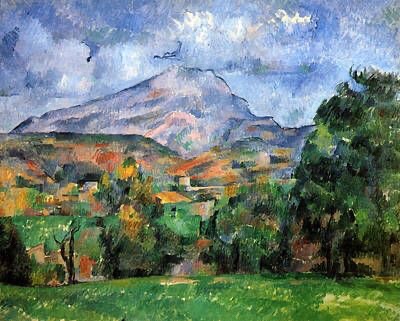
Watercolor is more difficult medium to manage than acrylic paints because it’s wetter and refuses to dry as quickly as we want to paint in that same area. It’s not being obnoxious; it’s just being its own true self. Cezanne used watercolors to think out his ideas beforehand, and then worked in oils. Often, he tossed aside the watercolor work, sometimes even leaving it out in the landscape which he’d just painted. He’d learned all he could from it and now was ready to paint his new image, but not a copy of the original painting. This mountain shows up in sixty of Cezanne’s artworks.
Paul Cézanne: La Montagne Sainte-Victoire, 1888, oil, The Stedelijk Museum, Amsterdam.
The stoic philosopher and Roman Emperor Marcus Aurelius wrote a series of meditations on life. In one he speaks of all life experiences as being the same. This attitude keeps him from getting too high or too low about what happens in his life. He takes it as it comes. Even death, which some fear as a loss, doesn’t bother him, for if he isn’t bothered about the present, he can’t be bothered about losing that too. Marcus Aurelius wasn’t a Christian, but his quest for equanimity is admirable. Take life as it comes and worry not:
“First, that all things in the world from all eternity, by a perpetual revolution of the same times and things ever continued and renewed, are of one kind and nature; so that whether for a hundred or two hundred years only, or for an infinite space of time, a man see those things which are still the same, it can be no matter of great moment. And secondly, that that life which any the longest liver, or the shortest liver parts with, is for length and duration the very same, for that only which is present, is that, which either of them can lose, as being that only which they have; for that which he hath not, no man can truly be said to lose.”
The Still Life in Our Classroom
When we work in watercolor, we have to take what the watercolor gives us. While we can plan, design, and control the outcomes to a certain extent, watercolor often goes its own way. If we work over the whole surface, rather than noodling around in one little space like a puppy sniffing a single spot while out on its morning constitutional walk, we get more done, just as the puppy is more likely to get its “business” done.
One of the reasons we work in a new medium is for the challenge. In school, when I was bored, I’d take notes in class by writing upside down. When that got too easy, I began using my left hand to write upside down. This was a true challenge! I didn’t have any ingrained pathways in my brain for left-handedness, much less the upside-down images. I was truly bored, however, so I struggled on until I got serviceable images. This was the year in which I went to art school as a midyear junior and was taking a freshman level history course.
Tim’s Painting
Tim has voluntarily switched to his left hand because he will have surgery on his right side, which will knock out his ability to use that arm for several months as he recovers. This is a good effort for his non dominant hand. You can tell he focused on the scoop, for it has the most detail. Training our alternate hand to do the work of our dominant hand requires resetting the brain to prefer the new hand. If you try brushing your teeth with your other hand, you’ll see exactly how strange it feels to use a different hand. This is because you have no well-worn pathways in your brain circuitry that makes this routine effort possible.
The fancy pants word for this is neuroplasticicy. We meet this concept with stroke survivors who do physical therapy to rewire their brain connections to make new pathways so they can speak, write, or walk. Everyone who tries a new game, learns a new language, or tries a new hobby also builds new pathways in their brains. Be learners for life, if you want to keep your mind healthy.
Gail’s Painting
Our still life was challenging today. It had solid shapes, a clear bottle, and a metal scoop. Not only were there multiple colors, but textures and transparency also. Gail has had several years of drawing under her belt, so she was able to render the perspective of the still life well. Note the clear blue bottle, which has a wonderful oval bottom. The lemons and limes are distinct also. The grey shape is an antique scoop, sans the handle.
In 2008, J.K. Rowling spoke at the Harvard commencement exercises, telling the graduates, “Talent and intelligence never yet inoculated anyone against the caprice of the Fates.” Because we don’t know what tomorrow will bring, taking care for today is the best preparation for the future. Rowling studied the Classics at Harvard, a subject most people would consider useless for this modern era. Yet after a divorce, as a single parent working for Amnesty International, she began writing her wizard novels. Harry Potter is now part of our cultural heritage.
As Jesus said in Luke 12:25-26–
“And can any of you by worrying add a single hour to your span of life? If then you are not able to do so small a thing as that, why do you worry about the rest?”
Worry is stressful, for sure, and it’s an example of “bad stress,” along with traumatic events, such as adverse childhood experiences (ACE), disease, divorce, and death of a loved one. We also endure “good stress,” as when we challenge ourselves to lift heavier weights, cook a new recipe, or learn a new language. As Ralph Waldo Emerson wrote in his 1841 essay Heroics, paragraph 14:
“The characteristic of a genuine heroism is its persistency. All men have wandering impulses, fits and starts of generosity. But when you have chosen your part, abide by it, and do not weakly try to reconcile yourself with the world. The heroic cannot be the common, nor the common the heroic. Yet we have the weakness to expect the sympathy of people in those actions whose excellence is that they outrun sympathy, and appeal to a tardy justice. If you would serve your brother, because it is fit for you to serve him, do not take back your words when you find that prudent people do not commend you.
“Adhere to your own act and congratulate yourself if you have done something strange and extravagant, and broken the monotony of a decorous age. It was a high counsel that I once heard given to a young person, —”Always do what you are afraid to do.”
When I was in high school, the ancient Latin teacher, who had taught my daddy when he went to school, tossed out the challenge, “No one has ever made 100% on my final Latin exam.”
I bit on that challenge like a starving dog bites on a bone, even if it has no scrap of flesh remaining on it. I made flash cards and studied for an hour every night before bed, I was so determined to be the exception to the rule. On the test, I got all the Latin correct, but lost ½ point for misspelling an English word. I never followed up on her retirement, but I fully expect her record remained unblemished. Also, I’m still spelling challenged. I’m thankful for SpellCheck in our writing apps.
Gail W.’s Painting
Gail W. paid attention to the still life and took care to lay down a close image in a pale wash before she began to add darker washes of color. Her left lime is most successful, with at least six shades of green and yellow in the shape. I also like the highlight on the central lemon. These two images capture the essence of the watercolor medium. Her perspective on the bottle bottom indicates it sits well on the cloth.
Failure teaches us what we don’t know, so we can improve the next time. This is what we call resilience. When I taught art, my students had to find three things they did well in their work before they named anything they needed help on. This was to build up their confidence. For some of them, just making a mark on the page was a start. If we fear making a mistake, we can sketch in a pale-yellow wash. This is very forgiving, like a whisper in the wind. If it’s not quite right, the next few marks may be nearer our desired outcome.
This Is Fine—Leave Me Alone, I’m Having a Crisis
Our mindset is what controls how we react to events in our lives. As one of my friends would remind me, “Not everything is a hair on fire moment.” Of course, when I was a young teen, the least slight or distress caused me to fling myself over my bed in a paroxysm of sobs, wailing loudly, “I’m going to die!” My parents would look at each other and shrug, “What boy is it now?” Fifteen minutes later I’d be in the kitchen looking for a snack, having cried my eyes out, and now I was on to the next thing. As I had more experiences, I learned to roll with the moment. Sometimes you need to wait for the next wave to rise before you take your ride. God’s timing is always right, for our experiences, both the failures and successes, prepare us for what comes next in our lives.
Cornelia’s Watercolor
I had some of the same perspective problems as everyone else, especially with the base of the bottle. Actually, it’s a challenge to get a “transparent three-dimensional object on a flat surface” to appear as if it’s actually sitting on a flat surface in two dimensions. Learning some shading techniques and remembering a round bottle bottom becomes an ellipse helps to bring off this sleight of hand. I got my paint too dark on the front of the bottle base and had to let it dry so I could come back in with some clear water and an almost dry brush to pick up the color. This gave me the highlight I needed.
Cornelia’s Drawing over the Watercolor
When I got home, I noticed my eyesight seems to be going amiss with my increased age. Lately I’ve not been careful to paint my verticals straight. Either I’m being lazy, or I’m tilting my head as I look at the subject. Maybe my neck injury has something to do with it. I duplicated the photo and used the Apple Pencil to straighten up the bottle and even up its symmetry. I also touched up a few of the lemons and limes. Maybe I’m still the puppy that likes to noodle around and sniff about until I can wrest all I can get from a work. This way I learn all I can from it. Like a kindergartner, if my work ends up a huge grey blob, I can say, “That was a great learning experience!”
My grandmother, who painted portraits and still lifes, kept a saying written on the back of an envelope, near her easel: “Ever tried. Ever failed. No matter. Try again.” She passed in 1970. Years later, Samuel Beckett, in his 1983 story, Worstword, Ho wrote:
We need to be like great artists and athletes, or the Michelin chefs who just keep trying, falling short, until they get close enough to qualify for their stars. Persistence makes all things possible, and if we “fail,” we’re only getting closer to perfection.
Aristotle said in his Poetics, “The aim of art is to represent not the outward appearance of things, but their inward significance, and this, and not the external manner and detail, is true reality.”
He spoke mainly about poetry, which was the highest art of his age, but his words also apply to the fine arts. Today, many people are still mesmerized by artists who practice various styles of realism, but they overlook the artists who show us the realities of emotion and inner vision.
The good news about art.
“Art enables us to find ourselves and lose ourselves at the same time,” said the spiritual writer, Thomas Merton. Some people use art as a cathartic exercise, and pour out their inner emotions on the canvas or their chosen media. Jackson Pollock’s drip paintings and Van Gogh’s late works are good examples of emotional expression. We all know folks who have a project going in their garage. They go work on “that worthless piece of junk” to focus their attention and energy on fixing something on which they can make a difference, instead of getting tied up in knots about things they can’t change and must accept. Gardening and knitting are also good hobbies for focusing this energy.
We know our nervous system grows to the modes in which it has been exercised. This is what we call building a habit over time. Just as a child doesn’t walk straight out of the womb, they have preparatory skills that must be acquired by stages as they grow. Exercising their muscles by rolling over also helps to strengthen their necks to hold their heads up. Crawling leads to pulling up, and that leads to letting go to learn balance.
Each time a child repeats these movements, he or she will simplify the movements required to achieve the needed result, make them more accurate, and diminish fatigue. In this, they’re building habits that bring them closer to walking. Rushing them to achieve “early” walking actually puts them behind cognitively.
Not only are there twenty five body parts in a baby’s body that are used in the crawl movement, but crawling also strengthens the hip sockets, so the baby will have a strong platform on which to stand. Crawling helps the corpus callosum, which is a band of nerve fibers between the hemispheres of the brain. Criss-cross crawling on the knees and hands stimulates the corpus callosum to develop in a balanced way, facilitating the hemispheres of the brain to communicate. These cross lateral movements work both sides of the body evenly and involve coordinated movements of the eyes, ears, hands, feet, and core muscles. This helps support cognitive function, problem solving, and ease of learning. Exploring the floor in a baby proofed home allows your baby to achieve his or her optimal potential.
Gail’s Painting
“Practice makes perfect” is only as true as the practice is directed in a true direction. This is where a teacher, a parent, a coach, or a spiritual guide comes into play. Only one who’s been led well can lead others with grace. We don’t tear down the learner, but ask questions, give guidance, help them see alternative paths, and allow them a safe place to explore their choices.
Art class isn’t brain surgery. No one will die if the painting isn’t successful, and no one’s salvation is at risk if the painting doesn’t come out the way we hoped it might. Art class is a safe place to take risks, unlike jumping from a tall tower without a parachute. Learning to accept failure on our canvases and coming back next time to try again is a mark of resilience and courage. Every time we fail closer to our target, we realize we’re gaining on it! We never say I CAN’T in art class.
Crawl before you Walk or Run
The sad reality is we can teach and expand the horizons of young people up til the age of 25 or 30. After that, they seem to lose energy and desire to learn more or to change. They “habitually” repeat their previous acts, for good or for ill. We’ve all heard the old saying, “You can’t teach an old dog new tricks.” Those of us who are no longer young have sometimes been accused of being set in our ways. Some of us are afraid we won’t excel at a new challenge, for we’ve always been held to a high standard of achievement. Since none of us will be the next Georgia O’Keefe or Leonardo da Vinci, we can set that worry aside. They both had more years to practice than we have left in front of us. Instead, we should give our remaining time our most focused attention, so we can get the most from our experience.
My high school chemistry book had the same information in it which my daddy’s college chemistry book covered. He was amazed I was learning “advanced” ideas at my young age. In 1982 R. Buckminister Fuller introduced the idea of the “knowledge doubling curve.” Up until 1900, knowledge doubled every century. By 1945, knowledge doubled every 25 years and by 1982, it doubled every year. Some say it’s now doubling twice a day! The newest computer we buy off the shelf today is already obsolete.
We can’t train our students for the jobs of today because these jobs likely won’t exist tomorrow. We need to train people to be lifetime learners instead. Luckily, we don’t have to know all things, but we do need the skills to find the knowledge and sort through the best sources for the best possible information.
1930-2006
Today, knowledge we acquire in high school, college, graduate school, and our last job may already be obsolete. (I’m one who still grieves the loss of Pluto as a planet; it exists but is a dwarf planet in the Kuiper Belt). This is especially true in fast moving fields like technology. As futurist Alvin Toffler wrote, “the illiterate of the 21st century will not be those who cannot read and write, but those who cannot learn, unlearn, and relearn.”
This means all of us will need to become lifelong learners or we’ll risk losing touch with an ever evolving world. Maybe we think our brains can’t handle something new, for we’ve heard about the effect of aging. Cognitive process studies with older brains show learning, memory, and problem-solving in humans are often less efficient in these areas.
However, it has recently been established that dogs show many of the same kind of age related changes that humans do. A study in Vienna showed that older dogs learned new tasks just as well as younger dogs, although they took longer to do so and required more repetitive corrections. This aptitude is also known as “resilience training.”
I think it’s also important to know why we want to keep our brains agile as we move into our later years. John Wesley was fond of repeating William Law’s summary from the Practical Treatise on Christian Perfection,
“Do all the good you can, to all you can, by any means you can, as long as you can.”
Because Wesley was better known than William Law, this quote is now attributed to Wesley alone. We Methodists have made it our own, however, and have carried its banner around the globe in our world wide mission efforts made possible by our Connectional ministries. Wesley thought enough of Law’s writing to reprint 19 editions of his work.
My late mother, at the age of eighty, learned how to use a laptop computer. She was motivated because she wanted to see emailed photos of her grandchildren, but then she realized she also could find recipes. When a child in her hometown needed a Mercy Flight, she used her new skills to get him transportation to an out of state hospital for treatment. I occasionally had to reteach her on how to double click quickly on her icons, rather than slowly, but she finally caught on.
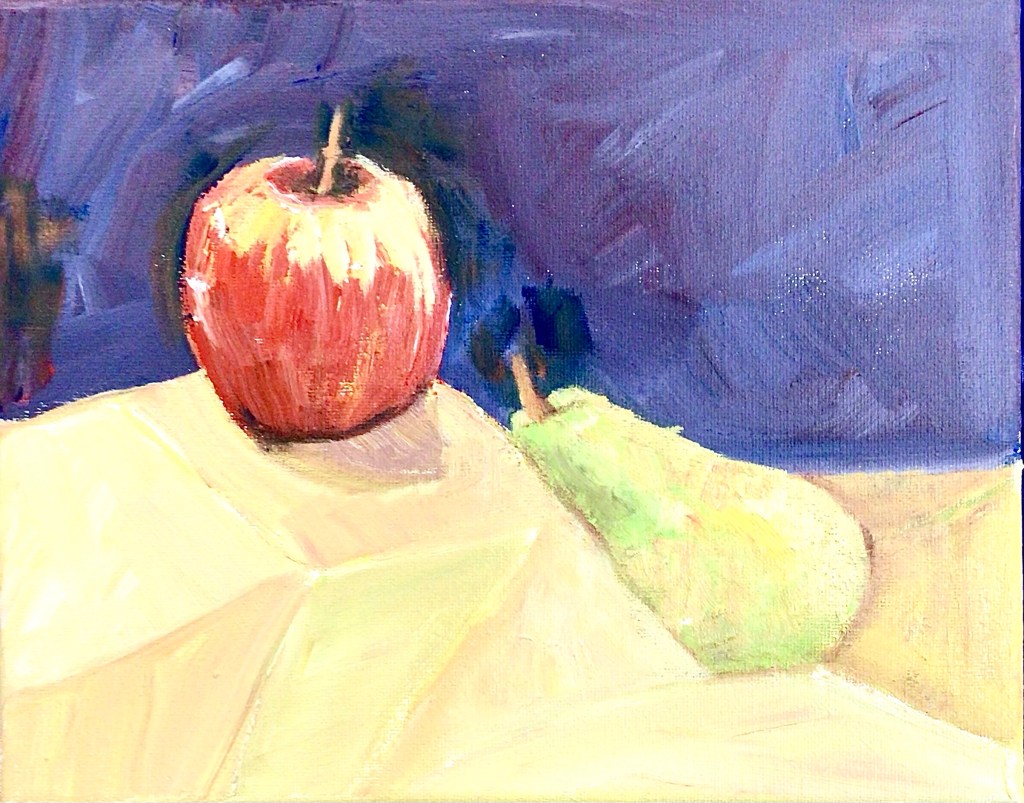
iPad drawing of pear and apple
If we want to keep our brains agile throughout our middle, silver, and golden years, we always need to try new things. Doing art challenges makes our brain build new neural pathways. Every time we look at a still life or a landscape, we have to make multiple decisions: what shapes do I see—circles, squares, triangles, or rectangles; how do these shapes relate to one another on the plane of our canvas; what is most important; what colors will I use; what emotions do I want to express; and where will I begin?
Eventually, we will find our “style.” We don’t find a style by copying another’s work, but we create enough works until our hand becomes one with our spirit. Since God has placed a special spark of God’s own creative Spirit within each of us, eventually we’ll experience the joy of being one with God when we are in our painting moments. As Paul said to the Romans (8:16):
“The Spirit Himself bears witness with our spirit that we are children of God.”
Last Friday we had a simple still life as our inspiration. Half our class was out sick with spring pollen troubles, but it was good to see those who could come after a two week hiatus. After a brief show and tell to get us inspired by other artists’ takes on the subject for the day, we got started. I reminded everyone not to make the fruit too tiny, so it wouldn’t get lost on the canvas. I believe everyone succeeded with this goal!
Mike’s painting
Mike painted his whole canvas with one brush. This gave the fruit a certain texture with contrasting colors, and the background, which was in a close value, didn’t show much brush strokes or texture. I like the perspective he chose, which brings the viewer in close to these fruit.
Gail tried a larger canvas with bolder colors than she normally uses. It was more dramatic and stronger in contrast than usual, while she kept her smooth strokes of paint as usual. She also took a view from above.
Cornelia’s Fruits
I stuck to a traditional rendering of the still life, since I do many abstract paintings in my own studio. I’d call these two Day and Night, for the Apple is quite awake and the Pear seems to need a little nap. It’s a study in contrasts: red and green, blue violet and yellow orange—a color wheel study masquerading as a still life.
Next week we’re in the season of Lent. As Christ turns his face towards Jerusalem, we’ll begin a study on the icons. This will be accessible and interesting. You’ll end up with your own icon for your personal worship center also.
“Heraclitus, I believe, says that all things pass and nothing stays, and comparing existing things to the flow of a river, he says you could not step twice into the same river.” Plato quoted an older Greek thinker about life’s being constantly in a state of flux or change. We can’t dive into our rabbit holes at every quivering leaf or shadow of every cloud passing over the sun. We rabbits know the world is changing all the time, even if we don’t like it, but we still have to venture outside of our den and hutches to find tasty carrots and spinach leaves.
Fear of Change—
Yet some rabbits have a fear of change or fear of changing the order of things. This goes by another Greek word, Metathesiophobia. This is a new word for this old rabbit, so I guess I’ve modified a few brain cells in learning this. In fact, when we learn new words, we actually get happier! There’s even science behind this. In a study, “increased subjective pleasantness ratings were also related to new-words remembered after seven days. These results suggest that intrinsic—potentially reward-related—signals, triggered by self-monitoring of correct performance, can promote the storage of new information into long-term memory through the activation of the SN/VTA-Hippocampal loop, possibly via dopaminergic modulation of the midbrain.”
Even if we don’t understand the scientific jargon of that sentence, we know learning new things gives us a feeling of pride and accomplishment. We feel good about ourselves when we accomplish a new trick or master a new skill. Repeating the same experiences over and over leads to dullness,even if we find safety in the predictably.
If we were small bunnies, we’d never find the refrigerators in our homes, since they’d be covered up in our latest glorious art project. Every rabbit parent raves about their genius offspring, if they’re raising them right. We always want to catch our small ones doing something right and praise them for it. We’ll get more cooperation than if we’re always telling them NO, and GO TO YOUR ROOM.
I ask you, which rabbit among us doesn’t want to be happier in this world? Currently we’re in the midst of the worst crisis most of us have ever experienced. We rabbits need to name it and face it, rather than deny it, for this pandemic isn’t not going away anytime soon. This causes some of our bunny friends to find a “boogeyman lurking in every dark corner.” When I was young, my parents scared me, or scarred my memories, over my messy closet.
Fancy Dress Up Clothes
“You’d better clean up that pile of clothes in there, young lady! If you don’t, a rat might come crawling out of those clothes piled up on the floor!”
EEEK! I was so frightened, I untwisted an old metal coat hanger and stood outside my closet while I fished out my dress up play clothes, one article at a time. If a rat were to come out with them, I wanted a running head start. I was on my own in art school over a decade later before I could sleep with the bedroom closet open. This was a long standing fear to shake. Not everyone can put aside their fears and coping mechanisms, however.
I’ve had rabbit friends who get up in the middle of the night to make sure their closets are neatly arranged, with all the shoes in the right boxes and all the clothes facing the same direction on the hangers. I have no such anxiety, for I hang my clothes up and don’t worry once I’ve done it. I have other tasks to tackle. Uninterrupted sleep is a worthy goal for rabbit health. Plus I have other creative tasks to engage me, and I’m learning new things every day. In any event, I know my salvation won’t be impaired by this failure to act on my part, just as it won’t be earned if I keep a perfect closet.
Change is moving swifter than the atmospheric river that’s currently dumping rain and mudslides on the Pacific coast and ice and snow on the Atlantic coast. Atmospheric rivers are long, narrow regions in the atmosphere—like rivers in the sky—that transport water vapor, according to the National Oceanic and Atmospheric Administration. Drastic swings from extremely wet to extremely dry and vice versa will be nearly twice as likely, occuring on average once every 25 years, by 2100. Dramatic swings are becoming more common and will continue to do so in the coming decades thanks to man-made climate change.
Presidents’ Day—
Of course climate change isn’t the only change we’re dealing with in February.
Today we have one holiday to celebrate Abraham Lincoln and George Washington. Back in this rabbit’s kitten days, we had two holidays for these two presidents, but the times change and the holiday became popularly known as Presidents’ Day after it was moved as part of 1971’s Uniform Monday Holiday Act, which was an attempt to create more three-day weekends for the nation’s workers.
At the time, Congress thought setting three day weekends would end employee absenteeism. Today the coronavirus pandemic has put most white collar workers out of the office and many blue collar workers out of a job. Until we get this pandemic behind us by vaccinating as many of our people as possible and continuing safe practices, we won’t get back to any semblance of normal any time soon. This virus hunts a host, and it’s sure to find a rabbit to use as its own personal Petri dish.
Super Bowl LV—Next Super Spreader Event?
On the first Sunday in February, the big game goes down. While the 7,500 health care workers who’ll be the stadium attendees will be following COVID protocols, the fans at home remain susceptible to infection. A recent Seton Hall Sports Poll collected answers from 1,522 adults spread all over the country from Jan. 22-25. That data shows 25% of respondents said they would gather with people outside of their home (defined as those who aren’t roommates or cohabitants) to watch the game. Sixty-four percent of respondents said they would not attend a gathering and 11% said they weren’t sure.
Among avid fans however, 40% of that group said they would indeed gather with members outside of their household. The CDC doesn’t recommend holding these types of gatherings, especially if they are inside and last for the duration of the game. The Super Bowl will be played in Raymond James Stadium in Tampa and is scheduled for Sunday, February 7, with a 6:30 p.m. ET kickoff, with an estimated game length of four hours, not counting the additional four hours of preliminary extravaganza programming.
Chocolate Strawberry Footballs
I’ve always gathered the various rabbits who live in my condo building for the game festivities. It’s a good opportunity for us to socialize and since everyone always waits for “someone to take charge,” I just step up. We won’t do it in person this year, however, for we rabbits can best observe safely the whole shebang from the comfort of our couches and Zoom or find other other media connections with our loved ones and friends so we can have a real party next year.
Super Bowl LV Firsts—
There are new changes to the Super Bowl this year. Amanda Gorman, the inaugural poet, will recite an original poem before Super Bowl LV, as part of both the in-stadium pregame ceremony and the TV broadcast. The poem will honor three everyday heroes who have been chosen as honorary game captains by the NFL. These people include Trimaine Davis, a Los Angeles teacher who fought to secure internet access and laptops for his students amid the pandemic; Suzie Dorner, a Tampa nurse who managed the COVID ICU at Tampa General Hospital; and James Martin, a Marine veteran who has helped veterans and their families connect virtually through the Wounded Warrior Project.
Gorman isn’t the only pregame excitement. Miley Cyrus will perform as part of the TikTok Tailgate event for the Health Care Heroes. This will also be televised. Then there’s the The Pepsi Super Bowl Halftime Show, which is the most-watched musical performance of the year, with more than 104 million viewers tuning in to last year’s show. The rhythm and blues artist known as The Weekend (Abel Makkonen Tesfaye) will be the featured performer.
The Weekend
“The Weeknd has introduced a sound all his own. His soulful uniqueness has defined a new generation of greatness in music and artistry,” said Shawn JAY-Z Carter. “This is an extraordinary moment in time and the Pepsi Super Bowl LV Halftime Show is going to be an extraordinary experience with an extraordinary performer.” This rabbit has been listening to his oeuvre on Apple Music, and I’m quite excited to hear the show. It ought to be a bang up program with no wardrobe malfunctions.
JAY-Z and his company, Roc Nation, have worked over the past year on the selection of artists playing the Super Bowl Halftime Show as the league’s official Live Music Entertainment Strategists. The partnership aims to “nurture and strengthen community” through music and support the NFL’s Inspire Change social justice initiative, and also has Roc Nation serving as a co-producer of the Super Bowl Halftime Show.
GRAMMY-nominated artists Eric Church and Jazmine Sullivan are set to pair up for the first time to sing the National Anthem as part of Super Bowl LV pregame festivities. Grammy-award winning artist, H.E.R., will join the pregame lineup with her rendition of America the Beautiful. In addition, on behalf of the National Association of the Deaf (NAD), Warren “Wawa” Snipe, acclaimed Deaf rapper and recording artist, will perform the National Anthem and America the Beautiful in American Sign Language. For Super Bowl LV, the National Anthem will be arranged and produced by Adam Blackstone.
Sarah Thomas
“Sarah Thomas will made history again as the first female Super Bowl official,” NFL EVP of football operations Troy Vincent said. “Her elite performance and commitment to excellence has earned her the right to officiate the Super Bowl. Congratulations to Sarah on this well-deserved honor.” She will be a down judge on a seven-person crew of distinguished game officials. You go girl!
This is just one more change for a world that spins 360 degrees daily and moves around the sun on its invisible circular river which it completes every 365 1/4 days. Our planet never stays in in one place as it courses through the unseen river of time in the heavens, but we see ourselves think we have a fixed place in the universe. If we observe nature, the rising and setting of the sun moves along the horizon line as the seasons change and it rises higher into the sky during the summer than the winter. These changes are part of our ordinary life, and give a structure and rhythm to our days and time upon this world.
Champions in a Championship Game
Speaking of firsts, the Chiefs are trying to become the first team in 16 years to win back-to-back Super Bowls. The last team to do it was Tom Brady’s 2003-04 New England Patriots. Tom Brady is set to become one offour quarterbacks to start a Super Bowl for multiple teams and he could join Peyton Manning, who is currently the only quarterback in NFL history to win a Super Bowl start with multiple teams. So while the seasoned champion with a brand new team goes against a young champion trying to make the magic happen two years in a row, we should have a good game, rather than watching it for the commercials.
In other firsts, the Super Bowl is almost always the top rated TV show for audience numbers. Only the final episodes of M.A.S.H. and Cheers have ever pushed it to number two. The commercials are first class also. CBS’s asking price of $5.5 million per 30-second spot is merely the cost of reserving the requisite airtime; after production expenses, ancillary social-media investments and agency fees are accounted for, the actual outlay for a single Super Bowl ad can swell to $20 million. That’s a lot of rabbit feed.
We won’t see the Budweiser Clydesdales for the first time in 37 years, for the company will be focusing on supporting Covid vaccine awareness education spots instead. Other companies related to restaurants may be missing due to lower sales and profits, but this gives other companies an opportunity to take their place. The pandemic has changed our economy in many ways. Avocados are in demand because we rabbits eat our salads at home, not in a restaurant. This is good for grocers, but bad for cooks, wait staff, and restaurant owners.
While parts of our economy are currently staggering along, the middle class and poor are lagging behind, as if they had chains and a huge millstone binding their bodies. Nearly 12 million renters will owe an average of $5,850 in back rent and utilities by January, Moody’s Analytics warns. People would go to work, but the businesses are either closed or the parent needs to stay home to school the child. Unpaid rents affect landlords, and roll on to the bankers who hold those notes.
The Census Bureau’s Household Pulse Survey, launched in April 2020, has provided nearly real-time weekly data on how the unprecedented health and economic crisis is affecting the nation. Nearly 24 million adults—11 percent of all adults in the country— reported that their household sometimes or often didn’t have enough to eat in the last seven days. Adults in households with children were likelier to report that the household didn’t get enough to eat: 15 percent, compared to 9 percent for households without children. Hunger in America or food insecurity is linked to a greater chance of cardiovascular mortality in counties throughout the U.S. Researchers believe if the pandemic goes on long enough, more people will begin to die of hunger or famine related circumstances than the disease itself.
Some want to spend a little and let it “trickle down,” but my grandmother rabbit always said that was “penny wise and pound foolish.” After WWII, American generosity rebuilt Germany, the home of the Nazi enemies. If we rebuilt the country of our enemies, I wonder what keeps us from rebuilding our own land? We need a Marshal Plan for America.
St. Valentine’s Day—
Be my valentine! XXOOXX
As a small bunny, I fondly remember classroom Valentines Day Parties, mostly because I got to decorate a shoebox as my “Valentine Mailbox” and enjoyed all the dime store paper valentines from my bunny friends. Mostly I really enjoyed the pink icing on the chocolate cupcakes and those Necco candy hearts with their pithy, saucy, love quotes. In this pandemic world of Zoom classrooms, gone are class parties, valentines for everyone, and a special gift for the teacher. As a former teacher, my hope is we can get our school teams vaccinated and get our little bunnykins back in a communal setting, so they can learn socialization skills as well as educational materials.
Ash Wednesday—
Some grieve about this year as if it’s lost year, and it’ll never be gotten back. This is true, however, there’re other great crises our little bunnies went through in our history, through no fault of their own. The Civil War was one, for it disrupted some youth we wouldn’t let have keys to a car today. One of my grandfather bunnies dropped out of school in the eighth grade to work on the railroad when his own father left home. He made sure his own little bunnies got their education, even if he didn’t get his.
Just because we have a twelve year program for public school doesn’t mean we have to finish it in that length of time. If we have a large monkey wrench thrown into our best laid plans, we might need to cram those twelve years into thirteen years. If we live to seventy-nine years, the average life span in America, this extra year is only 1/79 or 1% of our lives. We spend more time than this sleeping, since we spend about 33% of our lives asleep. No one seems to grieve about this broad swath of time in bed in fact, more of us rabbits are trying their best to get either more or better sleep! Perhaps we need to reframe then way we look at some of these problems to reduce our anxiety about them. Then we’d have more strength to cope with the day to day struggles, which are real and difficult.
Ash Wednesday is moveable feast day, so its date varies. It depends on when Easter is celebrated, and that too is dependent on the lunar calendar. My old daddy rabbit had this ancient piece of lore memorized: “Easter is always the first Sunday after the first full moon after the spring equinox.” While we may be able to move certain holidays around the calendar, Easter and its connected rituals of faith, Ash Wednesday and the forty days of Lent, move every year.
Because of coronavirus protocols, the hands on imposition of ashes by pastors, priests, or worship leaders will change in this pandemic year. Some churches will sprinkle ashes upon people’s heads, while others will give out packets of ashes for self imposition. The ashes are a traditional sign of humility. We may ask, if the ritual changes, is it as effective as it once was? The better question to ask is, “Does the ritual save us or does the power of God’s Holy Spirit flowing through the moment change us for the better?” Sometimes we put too much emphasis on the outward and visible elements, rather than the inward and invisible experience of God at work in us.
The Constant in the Midst of Change—
In the midst of a world intent on stoking our fears to a fever pitch, some of us rabbits find ourselves pulled down the proverbial rabbit hole into vast conspiracy theories, which purport to connect unlikely coincidences, but actually push anti-Semitic, far-right or white-supremacist ideology. Some of these ideas are as old as the Middle Ages, while others came from Russia and got passed into the American milieu during the first Red Scare in the 1920’s.
One of the worst examples is “The Protocols of the Learned Elders of Zion,” a classic of paranoid, racist literature. Taken by the gullible as the confidential minutes of a Jewish conclave convened in the last years of the nineteenth century, it has been heralded by anti-Semites as proof that Jews are plotting to take over the world. Since its contrivance around the turn of the century by the Russian Okhrana, or Czarist secret police, “The Protocols of the Learned Elders of Zion” has taken root in bigoted, frightened minds around the world.
When the world is in chaos, fearful rabbits look for a demonic figure to blame, when they should look instead to a positive source of power and strength. Fear paralyzes us, but the power of God sets us free to change our world for the better.
Bierstadt: Merced River, Yellowstone Valley
God is our refuge and strength,
a very present help in trouble.
Therefore we will not fear, though the earth should change,
though the mountains shake in the heart of the sea;
though its waters roar and foam,
though the mountains tremble with its tumult.
~~ Psalms 46:1-3
May you make enough small changes every day to get new wrinkles in your brain, rather than on your brow.
Joy and Peace,
Cornie
Intrinsic monitoring of learning success facilitates memory encoding via the activation of the SN/VTA-Hippocampal loop | eLife
Millions of Americans are heading into the holidays unemployed and over $5,000 behind on rent. Hefty bills will come due in early 2021 for rent and utilities. Economists warn many unemployed families won’t be able to pay without more stimulus aid from Congress. By Heather Long
“You totally (should) become his nature, deny his being apart from you; you should be he himself, not Christians, but Christ, otherwise you will be no use to the coming god.”
—C. G. Jung, The Red Book, p. 137.
“No one can be spared the way of Christ, since this way leads to what is to come. You should all become Christs, says C. G. Jung, in his Answer to Job. He goes on to explain in the divine indwelling of the Holy Spirit in humanity, “a christification of the many arises.” One of the great and simple prayers is “Come, Holy Spirit, fill the hearts of your faithful, and kindle in them in them the fire of your love.” When we ask for the indwelling third person of the Trinity, we also ask for the rest of the “family,” for the three are fellow travelers. The Father and the Son aren’t separate entities, even when the Spirit proceeds from the two, just as the Father and the Spirit aren’t off somewhere distant when the Son is suffering on the cross.
In the season of Lent, many people begin with ashes on their forehead as a sign of repentance and fasting for the forty days before Easter. Some give up bacon, others give up alcohol, and some give up social media. Perhaps this is our idea of suffering today, since most of us have our needs for shelter, food, and security met. Modern people tend to suffer emotionally instead, so this may be why we fast from social media. Unfortunately, we don’t have much deep Christian teaching around suffering, mostly because it’s not a happy subject. Nobody likes a downer sermon. Bible studies on Job and the prophets are unpopular too. We don’t like seeing our faces in a BCE Mirror.
I AM THE RESURRECTION AND THE LIFE
Who wants to suffer today? No one! Most of the Christian teaching around the cross concerns a variation on the substitution theory, or Jesus takes on our suffering so we no longer have to endure the agony ourselves. Of course, when we meet trouble in our daily life, we then call into question either the effectiveness of this work on the cross or our faith in his work on our behalf. Did Christ die for everyone else, but not for me? Are there other works besides my faith in Christ necessary for my salvation? Do I need to be a better person to earn my freedom from suffering?
If we understood the nature of the earthbound Christ life, rather than the resurrected Christ life, we’d grasp the essential nature of suffering bound up into this life of flesh and spirit. Christ knew hunger, thirst, loneliness, temptation, disappointments, weariness, rejection, and pain. Worst of all, he tasted the emptiness of death before he knew the fullness of the resurrection.
Should we protect our children from suffering? If we mean, should we do our best to feed, clothe, and shelter them, the answer is yes, of course! If we mean, do we protect them from the logical consequences of their acts, I’d say, most likely no. If a child won’t do their own homework, they should get the logical results for their refusal. Physical punishment isn’t a logical result. Poor grades, limits on sports or activities, or staying after school are consequences in line with the poor behavior. Small sufferings now will avoid larger sufferings later. (If they want to jump out of a third story window, that’s another matter. Put some locks on that, parents!)
Of course, to even call these “suffering” shows how far our modern world has moved from the ancient world. Sufferings once were the lot of slaves, who had no authority over their own lives, and could be bought and sold like cattle. They had no agency or control over their fortunes or lots in life. We modern folk are different, unless we buy into the idea we’re rudderless ships upon a stormy ocean. Then we’re merely chaff tossed about by external forces, so we might as well be slaves to our environment.
If we held the whole nature of Christ within us, we’d know both the Christ of suffering and the resurrected Christ of glory. While we ourselves have not yet ascended, we do hold fast to his promise,
“Beloved, we are God’s children now; what we will be has not yet been revealed. What we do know is this: when he is revealed, we will be like him, for we will see him as he is. And all who have this hope in him purify themselves, just as he is pure.” (1 John 3:2-3)
If we live with hope, we can rejoice, and be patient in suffering, while we persevere in prayer.
~~ Romans 12:12