It’s Not Under Control!

adult learning, art, Attitudes, bottles, brain plasticity, Cezanne, Creativity, failure, Family, Fear, Healing, Lent, Marcus Aurelius, Painting, perspective, Ralph Waldo Emerson, renewal, risk, samuel Beckett, shadows, Stress, Super Bowl

All things will renew themselves in good season, yet we have only the present moment before us. We can’t live in the past, nor can we control the future. We have to recognize even our present moments aren’t always in our control, as we witnessed in the big Super Bowl game last Sunday.

Random Actions Often Determine the Outcomes of Sporting Events

Who would ever believe a punt would hit a receiving teammate’s foot, and suddenly become a live ball? Then get recovered by the Chiefs for a quick touchdown? If you think you can control your circumstances or the actions of others, just watch the NASCAR races at Daytona this weekend. The wonder is they don’t wreck in every turn, but only occasionally during the 500 mile race on Sunday.

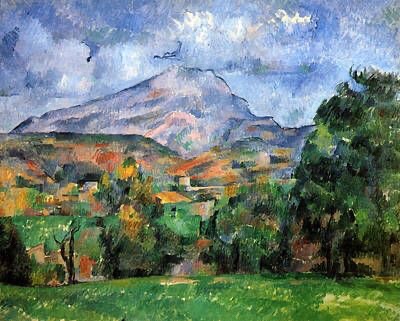
Cezanne Watercolor “Mont Sainte-Victoire (La Montagne Sainte-Victoire vue des Lauves)”( 1902–06) by Paul Cézanne. (The Museum of Modern Art, New York/Photo © 2021 MoMA, NY)

Watercolor is more difficult medium to manage than acrylic paints because it’s wetter and refuses to dry as quickly as we want to paint in that same area. It’s not being obnoxious; it’s just being its own true self. Cezanne used watercolors to think out his ideas beforehand, and then worked in oils. Often, he tossed aside the watercolor work, sometimes even leaving it out in the landscape which he’d just painted. He’d learned all he could from it and now was ready to paint his new image, but not a copy of the original painting. This mountain shows up in sixty of Cezanne’s artworks.

Paul Cézanne: La Montagne Sainte-Victoire, 1888, oil, The Stedelijk Museum, Amsterdam.

The stoic philosopher and Roman Emperor Marcus Aurelius wrote a series of meditations on life. In one he speaks of all life experiences as being the same. This attitude keeps him from getting too high or too low about what happens in his life. He takes it as it comes. Even death, which some fear as a loss, doesn’t bother him, for if he isn’t bothered about the present, he can’t be bothered about losing that too. Marcus Aurelius wasn’t a Christian, but his quest for equanimity is admirable. Take life as it comes and worry not:

“First, that all things in the world from all eternity, by a perpetual revolution of the same times and things ever continued and renewed, are of one kind and nature; so that whether for a hundred or two hundred years only, or for an infinite space of time, a man see those things which are still the same, it can be no matter of great moment. And secondly, that that life which any the longest liver, or the shortest liver parts with, is for length and duration the very same, for that only which is present, is that, which either of them can lose, as being that only which they have; for that which he hath not, no man can truly be said to lose.”

The Still Life in Our Classroom

When we work in watercolor, we have to take what the watercolor gives us. While we can plan, design, and control the outcomes to a certain extent, watercolor often goes its own way. If we work over the whole surface, rather than noodling around in one little space like a puppy sniffing a single spot while out on its morning constitutional walk, we get more done, just as the puppy is more likely to get its “business” done.

One of the reasons we work in a new medium is for the challenge. In school, when I was bored, I’d take notes in class by writing upside down. When that got too easy, I began using my left hand to write upside down. This was a true challenge! I didn’t have any ingrained pathways in my brain for left-handedness, much less the upside-down images. I was truly bored, however, so I struggled on until I got serviceable images. This was the year in which I went to art school as a midyear junior and was taking a freshman level history course.

Tim’s Painting

Tim has voluntarily switched to his left hand because he will have surgery on his right side, which will knock out his ability to use that arm for several months as he recovers. This is a good effort for his non dominant hand. You can tell he focused on the scoop, for it has the most detail. Training our alternate hand to do the work of our dominant hand requires resetting the brain to prefer the new hand. If you try brushing your teeth with your other hand, you’ll see exactly how strange it feels to use a different hand. This is because you have no well-worn pathways in your brain circuitry that makes this routine effort possible.

The fancy pants word for this is neuroplasticicy. We meet this concept with stroke survivors who do physical therapy to rewire their brain connections to make new pathways so they can speak, write, or walk. Everyone who tries a new game, learns a new language, or tries a new hobby also builds new pathways in their brains. Be learners for life, if you want to keep your mind healthy.

Gail’s Painting

Our still life was challenging today. It had solid shapes, a clear bottle, and a metal scoop. Not only were there multiple colors, but textures and transparency also. Gail has had several years of drawing under her belt, so she was able to render the perspective of the still life well. Note the clear blue bottle, which has a wonderful oval bottom. The lemons and limes are distinct also. The grey shape is an antique scoop, sans the handle.

In 2008, J.K. Rowling spoke at the Harvard commencement exercises, telling the graduates, “Talent and intelligence never yet inoculated anyone against the caprice of the Fates.” Because we don’t know what tomorrow will bring, taking care for today is the best preparation for the future. Rowling studied the Classics at Harvard, a subject most people would consider useless for this modern era. Yet after a divorce, as a single parent working for Amnesty International, she began writing her wizard novels. Harry Potter is now part of our cultural heritage.

As Jesus said in Luke 12:25-26–

“And can any of you by worrying add a single hour to your span of life? If then you are not able to do so small a thing as that, why do you worry about the rest?”

Worry is stressful, for sure, and it’s an example of “bad stress,” along with traumatic events, such as adverse childhood experiences (ACE), disease, divorce, and death of a loved one. We also endure “good stress,” as when we challenge ourselves to lift heavier weights, cook a new recipe, or learn a new language. As Ralph Waldo Emerson wrote in his 1841 essay Heroics, paragraph 14:

“The characteristic of a genuine heroism is its persistency. All men have wandering impulses, fits and starts of generosity. But when you have chosen your part, abide by it, and do not weakly try to reconcile yourself with the world. The heroic cannot be the common, nor the common the heroic. Yet we have the weakness to expect the sympathy of people in those actions whose excellence is that they outrun sympathy, and appeal to a tardy justice. If you would serve your brother, because it is fit for you to serve him, do not take back your words when you find that prudent people do not commend you.

“Adhere to your own act and congratulate yourself if you have done something strange and extravagant, and broken the monotony of a decorous age. It was a high counsel that I once heard given to a young person, —”Always do what you are afraid to do.”

When I was in high school, the ancient Latin teacher, who had taught my daddy when he went to school, tossed out the challenge, “No one has ever made 100% on my final Latin exam.”

I bit on that challenge like a starving dog bites on a bone, even if it has no scrap of flesh remaining on it. I made flash cards and studied for an hour every night before bed, I was so determined to be the exception to the rule. On the test, I got all the Latin correct, but lost ½ point for misspelling an English word. I never followed up on her retirement, but I fully expect her record remained unblemished. Also, I’m still spelling challenged. I’m thankful for SpellCheck in our writing apps.

Gail W.’s Painting

Gail W. paid attention to the still life and took care to lay down a close image in a pale wash before she began to add darker washes of color. Her left lime is most successful, with at least six shades of green and yellow in the shape. I also like the highlight on the central lemon. These two images capture the essence of the watercolor medium. Her perspective on the bottle bottom indicates it sits well on the cloth.

Failure teaches us what we don’t know, so we can improve the next time. This is what we call resilience. When I taught art, my students had to find three things they did well in their work before they named anything they needed help on. This was to build up their confidence. For some of them, just making a mark on the page was a start. If we fear making a mistake, we can sketch in a pale-yellow wash. This is very forgiving, like a whisper in the wind. If it’s not quite right, the next few marks may be nearer our desired outcome.

This Is Fine—Leave Me Alone, I’m Having a Crisis

Our mindset is what controls how we react to events in our lives. As one of my friends would remind me, “Not everything is a hair on fire moment.” Of course, when I was a young teen, the least slight or distress caused me to fling myself over my bed in a paroxysm of sobs, wailing loudly, “I’m going to die!” My parents would look at each other and shrug, “What boy is it now?” Fifteen minutes later I’d be in the kitchen looking for a snack, having cried my eyes out, and now I was on to the next thing. As I had more experiences, I learned to roll with the moment. Sometimes you need to wait for the next wave to rise before you take your ride. God’s timing is always right, for our experiences, both the failures and successes, prepare us for what comes next in our lives.

Cornelia’s Watercolor

I had some of the same perspective problems as everyone else, especially with the base of the bottle. Actually, it’s a challenge to get a “transparent three-dimensional object on a flat surface” to appear as if it’s actually sitting on a flat surface in two dimensions. Learning some shading techniques and remembering a round bottle bottom becomes an ellipse helps to bring off this sleight of hand. I got my paint too dark on the front of the bottle base and had to let it dry so I could come back in with some clear water and an almost dry brush to pick up the color. This gave me the highlight I needed.

Cornelia’s Drawing over the Watercolor

When I got home, I noticed my eyesight seems to be going amiss with my increased age. Lately I’ve not been careful to paint my verticals straight. Either I’m being lazy, or I’m tilting my head as I look at the subject. Maybe my neck injury has something to do with it. I duplicated the photo and used the Apple Pencil to straighten up the bottle and even up its symmetry. I also touched up a few of the lemons and limes. Maybe I’m still the puppy that likes to noodle around and sniff about until I can wrest all I can get from a work. This way I learn all I can from it. Like a kindergartner, if my work ends up a huge grey blob, I can say, “That was a great learning experience!”

My grandmother, who painted portraits and still lifes, kept a saying written on the back of an envelope, near her easel:  “Ever tried. Ever failed. No matter. Try again.” She passed in 1970. Years later, Samuel Beckett, in his 1983 story, Worstword, Ho wrote:

“Ever tried. Ever failed. No matter. Try again. Fail again. Fail better.”

We need to be like great artists and athletes, or the Michelin chefs who just keep trying, falling short, until they get close enough to qualify for their stars. Persistence makes all things possible, and if we “fail,” we’re only getting closer to perfection.

I hope for you a blessed Lent,

Joy and peace,

Cornelia


Emperor of Rome Marcus Aurelius: Meditations, XII   https://books.apple.com/us/book/meditations/id396136148

Neuroplasticity: re-wiring the brain | Stroke Association

https://www.stroke.org.uk/effects-of-stroke/neuroplasticity-rewiring-the-brain

10 Brain Exercises to Help Boost Memory

https://www.everydayhealth.com/longevity/mental-fitness/brain-exercises-for-memory.aspx

Neurobiological and Systemic Effects of Chronic Stress – PMC

https://www.ncbi.nlm.nih.gov/pmc/articles/PMC5573220/

​“Try Again. Fail Again. Fail Better”: Beckett’s unlikely Mantra – Goethe-Institut Los Angeles – USA

https://www.goethe.de/ins/us/en/sta/los/bib/feh/21891928.html


The Project Gutenberg eBook of Essays, by Ralph Waldo Emerson

https://www.gutenberg.org/files/16643/16643-h/16643-h.htm#HEROISM


Rabbit! Rabbit!

arkansas, art, autumnal equinox, Children, Christmas, Civil War, Constitution, Declaration of Independence, elections, Fall Equinox, Family, holidays, Imagination, inspiration, Labor Day, perfection, photography, rabbits, St. Patrick’s Day, summer vacation, texas, US Constitution

Rabbits under a Harvest Moon

September marks the return to order and organization, since the summer for most of us meant a relaxation of rules and schedules. “Vacay mode” of late mornings, pajama days, and snack meals are now a fading figment of our fevered frenzies. I remember these days all too well. My little girl threw a conniption fit one morning as I hurriedly dressed her so we wouldn’t be late for her pre-k class and my teaching assignment at the same school. We dashed out of the house, I locked her in the car seat, and flew to my workplace. I delivered her to the precare room and made a beeline for my art shack.

Two Types of Teachers

Later on at lunch, her teacher informed me I’d brought my fussy child to school without panties. Oops! Luckily, all the children were required to have a spare change of clothes “just in case of emergency.” Saved by those who are more organized than most. My art classroom always had the paint organized by rainbow colors, the scissors numbered, and shelves labeled. The moral of this annecdote is, “Innanimate objects are easy to organize; people not so much.” Murphy’s Law also comes to mind: “Anything that can go wrong will go wrong,” and Murphy’s First Corrollary: “It will cause the most damage possible.”

For Bunnies, maybe…

In the “No Pants Scandal,” of four decades ago, only my pride was injured. I’m not as organized or as perfect as I thought I was. This brings me to a little chat on appearances vs. our true selves. Our “false self” wants to appear organized, on top of things, spiritual, magnanimous, and virtuous. We’d like to be “perfect” in thought and deed. Yet the more we try to attain perfection or to act perfectly, the more likely dark, hateful, or mean thoughts arise from the depths of our hearts. We see this is our dualist world view, which divides our world into pure evil or pure good. The book of Proverbs reminds us, “Pride goes before destruction, and a haughty spirit before a fall” (16:18). It’s always better to admit, as I did, “I didn’t have a great morning and she wasn’t cooperative. I’m surprised we got here at all.”

Welcome to September 2023

Speaking about regular and organized, our earth is about to have another equinox on September 23, 2023, at 1:50 am CDT. The Fall Equinox happens yearly on or around September 22nd. The date of the fall equinox is variable because the 365 day Gregorian calendar doesn’t match up perfectly with the position of Earth in its orbit around the sun. When we add the leap year, the equinox date also changes. While the September equinox usually occurs on September 22 or 23, it can very rarely fall on September 21 or September 24. A September 21 equinox has not happened for several millennia. However, in the 21st century, it will happen twice—in 2092 and 2096. The last September 24 equinox occurred in 1931, the next one will take place in 2303. This rabbit won’t be around for any of these rare events, so don’t send me an invite.

Rabbits on the Playground

The September 29 full moon occurs at 4:57 AM CDT. It’s called the Harvest Moon in some years, or the Hunter’s Moon in other years. Technically, the Harvest Moon, which is the Anglo-Saxon name, is the Full Moon closest to the September equinox on September 22/23. The Harvest Moon is the only Full Moon name determined by the equinox rather than a month. Most years, it’s in September, but around every three years, it falls in October. We also know this September full moon as the Corn Moon from the Native American tribes harvesting their corn in this time. Other names for this month’s full moon are Celtic and Old English names: Wine Moon, Song Moon, and Barley Moon.

E. Irving Couse: Harvest Moon

Just as summer’s laissez-faire moments will give away to school and work routines, so the onset of autumn and the fall equinox herald another change. You might not yet recognize it over the insistent hum of your air conditioning system or feel it due to the heat waves rising from the black asphalt of your company’s parking lot, but autumn is just around the corner.

ERCOT Service Zones cover most of Texas

Don’t look at your utility bill just yet, and don’t pack your bags for Texas. I talked to my brother down there who has his AC set to “stun”—he said when the bill comes, “It will stun him a second time.” Texas doesn’t belong to the national energy grid, but to ERCOT, the Electric Reliability Council of Texas. It’s not connected to the two major electrical systems of the lower 48 states, but has its own grid to avoid federal regulation. When Thomas Edison started the first electric power plant in Manhattan in 1882, he set off a gold rush of independent power companies. During WWI, they began to unite and even more joined after WWII.

Don’t Mess With Texas

Texas takes seriously its “Don’t mess with Texas” rhetoric. Only on rare, catastrophic instances has it briefly joined either the American or Mexican utility grids. While Texas is a large state with rich energy resources, the USA is larger. When extreme weather events happen, energy costs rise. Rates can vary wildly as a result. The economic lesson is ERCOT is Dollar Store trying to outbid the Walmart of the national grids who can share energy with those in need.

Thomas Nast: The Lightening Speed of Honesty, 1877

Speaking of nations, on September 7, 1813, the United States got its nickname: Uncle Sam. Samuel Wilson from New York, a meat supplier to the US Army, stamped his barrels with US for United States. The soldiers began calling their rations “Uncle Sam’s,” a name the local newspaper noted, which began to spread and soon became the personification of the federal government. Thomas Nast (1840-1902) popularized the image of Uncle Sam. In Nast’s evolving works, Uncle Sam acquired the white beard and the stars-and-stripes suit we associate with the character today. The satirical cartoon of yesteryear’s dithering Congress is apropos of our modern chambers, which can’t seem to come a reasonable compromise to get the people’s business done by funding our country’s basic needs.

Columbia, The Gem of the Ocean

Over a century before Uncle Sam, Columbia was an idealized feminine figure that personified the new nation of America. She was created in 1697 when Chief Justice Samuel Sewall of the Massachusetts Bay Colony wrote a poem that suggested the American colonies be called Columbina, a feminized version of Christopher Columbus’ last name. Over 70 years later, the name evolved further when former slave, Phillis Wheatley, wrote an ode to George Washington invoking Columbia in 1775. Born around 1753, Phillis Wheatley was the first black poet in America to publish a book. She was listed among the enslaved persons at Mount Vernon. You can read her amazing poem here:

His Excellency General Washington by Phillis Wheatley— https://poets.org/poem/his-excellency-general-washington

Over time, the image of Columbia became a symbol for American ideals during wars, such as the American Revolution, the War of 1812, and World War I, as well as the subject of political cartoons and literary works. With her liberty cap and patriotic shield, Columbia stood as the spirit of the country. We even see her name, image, and likeness in modern industry in the Columbia Broadcasting System or CBS, as well as in the seat of our national government, the District of Columbia.

Well Done Labor Poster

Uncle Sam also has honored workers on Labor Day, which we celebrate on September 4th. Many rabbit families treat this three day weekend as the last hurrah of summer. Let’s remember those essential workers who serve and protect the rest of us while we barbecue in our backyards and national parks. The first Labor Day “parade” in 1882 was a strike. Workers marched en masse from New York City Hall to Union Square to protest terrible working conditions during the Industrial Revolution. Workers, including children as young as five years old, labored in unsafe factories, farms, mills and mines for 12 hours or more per day, seven days a week, often without breaks, fresh air or even clean water.

Credits: NASA’s Goddard Institute for Space Studies

This map shows global temperature anomalies for July 2023 according to the GISTEMP analysis by scientists at NASA’s Goddard Institute for Space Studies. Temperature anomalies reflect how July 2023 compared to the average July temperature from 1951-1980.

Only 5 States Provide Heat Relief Laws for Workers. Arkansas doesn’t protect workers from dangerous heat inside or outside.

Today, 141 years later, during the hottest July since 1880, some states are passing laws to prevent workers from getting “special treatment due to the heat” such as extra breaks for cooling or water. Currently only five states have protections for workers in these extreme conditions. According to the U.S. Bureau of Labor Statistics, between 1992 and 2019, extreme heat killed more than 900 workers and sickened tens of thousands more. Those numbers, however, are likely an undercount due to the lack of reporting by negligent employers or by workers who are worried about retaliation or deportation. In addition to the physical implications, time off from a job due to illness can lead to missed wages or the loss of a job altogether.

Bain photograph: LC-USZ62-49516: Four women strikers from Ladies Tailors union on picket line during the “Uprising of the 20,000,” garment workers strike, New York City, 1910 February, glass negative photo, Library of Congress.

As a rabbit who once endured a few days in an unairconditioned art shack at the beginning of school and then fainted from heat exposure, I have a heart for all workers in extreme circumstances. I made sure to take care of my people, since my bosses didn’t care about me. It’s never right to treat others poorly just because you were wronged.

Reading The Constitution Online is also an Option

In late September, we celebrate Constitution Week (Sept. 17-23). The Declaration of Independence, written in 1776, was a list of grievances against the king of England and intended to justify separation from British rule. The Constitution was written and signed in 1787. It was a charter of government ratified by the states, and continues to be the supreme law of the land. All members of the armed services and Congress take a vow to defend the constitution, as do the President and Vice President of our country.

We rabbits will all need to brush up on our civics lessons in the days to come, for the upcoming presidential candidates may be affected by their lack of appreciation for the constitution and the consequences as a result. As I always told my students, “Attitudes drive Behavior and Behavior leads to Consequences. You can choose the good or the negative. It’s all up to you. Try for a good attitude every day.”

Tales of a Bunny Who Went to School

The 14th Amendment, section 3, passed after the Civil War, or the last great insurrection by the southern secessionist states, forbids holding office in the US government by former office holders who then participate in insurrection or rebellion. This constitutional provision is currently being tested in the courts. September is back to school for all us rabbits. The last time I remember a civics lesson was the seventh grade in Mrs. Tampke’s class, but “ex post facto” might have been “non sequitur,” as I was passing notes rather than paying attention.

Mr. Flopsy’s Rabid Rabbit Pirate won’t be Messed with.

We rabbits can only take so much seriousnes in our short lives until we need a break. Thank you September 19th: International Talk Like a Pirate Day! Everyone can ARRGG their way MATIES through a Tuesday, and if Monday is a pain, who says we rabbits can’t Pirate on that day too? After all, pirates rob and steal, lawless vagabonds that they are. Let’s just take over the good ship Monday and drink our strong Pirate Coffee with vigor and daring.

The Bluebird of Happiness

National Bluebird of Happiness Day is September 24th. I love these little blue glass figurines. Dorothy in the Wizard of Oz sings, “If happy little bluebirds fly beyond the rainbow, why, oh, why can’t I?” Bluebirds uplift the heart into joy when we see them in nature. The blue glass iconic sculptures, made in Arkansas by the Ward family, have sold over 9 million birds, large and small. They’re no longer made due to concerns about climate change because the glass production process requires large amounts of natural gas and electricity. I treasure the blue bird in my possession and greet it daily. You might find one in a secondhand store.

God Please Keep My Children Safe, by Grayson Perry, 2005

Love Note Day is September 26, so I suggest you write a sweet letter to your beloved. This might be a spouse, significant other, parent, mentor, or even your own self. Share some affirmations to those who mean something to you. Don’t stop at one note of love, but make a whole symphony of blessings. In our world today, folks don’t hear many positive messages. You can help balance the scales for your recipients.

If the Sears Catalog were still a thing, we bunnies would be wishing

September 30, the last day of this month marks 92 days left in 2023. Where has this year gone?! Don’t ask this rabbit. I’ve already bought a couple of little Christmas gifts for my bunny friends. I’m never this organized. This means I’ll likely lose or misplace these items in the 86 days before Christmas Day. Then again, this is also enough time for this rabbit to find these packages once again! Live with optimism! Expect the best and work for it.


May the Blue Bird of Happiness bring you

Joy and Peace,


Cornelia


The September Equinox

https://www.timeanddate.com/calendar/september-equinox.html


Traditional Full Moon Names

https://www.timeanddate.com/astronomy/moon/full-moon-names.html


Why does Texas have its own power grid? | The Texas Tribune
https://www.texastribune.org/2011/02/08/texplainer-why-does-texas-have-its-own-power-grid/


How The United States Got its Nickname

https://www.history.com/this-day-in-history/united-states-nicknamed-uncle-sam


The lightning speed of honesty [Uncle Sam seated on snail “45th Congress” carrying Army and Navy payroll and money, with Resumption Act (of honesty) in his pocket] / Th Nast.
https://loc.getarchive.net/media/the-lightning-speed-of-honesty-uncle-sam-seated-on-snail-45th-congress-carrying


Database of Mount Vernon’s Enslaved Community · George Washington’s Mount Vernon
https://www.mountvernon.org/george-washington/slavery/slavery-database/


Heat Stress Is Killing Workers. States Can Protect Them.

https://www.nrdc.org/stories/heat-stress-killing-workers-states-can-protect-them


Short Summary—The Character to Lead: Republicans’ Fork in the Road Between Trump and the Constitution’s Eligibility Requirements for President

https://www.justsecurity.org/87750/the-character-to-lead-republicans-fork-in-the-road-between-trump-and-the-constitutions-eligibility-requirements-for-president/


Deep Dive— The Sweep and Force of Section Three. 172 U. PA. L. REV. (forthcoming 2024). William Baude & Michael Stokes Paulsen. https://deliverypdf.ssrn.com/delivery.php?ID=791101027092090122082025003064104018105084007031052035109090080088105005086003018089043050055106031007050097096000078089031112025019027055033023110008092018116067055086024100075002015088106075126126082029114024094102088002003074126075030067104090009&EXT=pdf&INDEX=TRUE

U.S. Senate: The Senate’s First Act—the Oath Act and 1862 Ironclad Oath
https://www.senate.gov/legislative/landmark-legislation/oath-act.htm

Arkansas Bluebird of Happiness – Encyclopedia of Arkansas. https://encyclopediaofarkansas.net/entries/arkansas-bluebird-of-happiness-3822/


Seeds of Dissent and a Harvest of Distrust

Ancestry, arkansas, art, Faith, Family, Forgiveness, greek myths, Holy Spirit, hope, incarnation, inspiration, john wesley, Love, Ministry, Painting, perfection, poverty, purpose, Ravenna Italy, renewal, Retirement, stewardship, Stress, United Methodist Church, vision

Christ Enthroned with the Angels
6th century Mosaic
Church of Sant’Apollinare Nuovo, Ravenna, Italy

Nothing springs full grown to life in an instant. Everything begins in a seed, which is planted, watered, and nourished into full growth. Only in myths or fantasies can an idea come into being instantly. Zeus had a very bad headache, a “splitting headache,” that birthed his daughter Athena, the goddess of wisdom. She leapt out in fully grown from his brow. We don’t take this myth to be scientifically true, but as a metaphor for the difficulty and struggles we undergo to obtain wisdom. As my daddy used to tell me after I’d learned some hard life lesson, “The school of experience is a rough master, and we all earn a costly degree in gaining its wisdom.”

Little Master Lip Painter Attributed to the Phrynos Painter: Birth of Athena, Attic Black Figure Ware, Kylix, Date ca. 555 – 550 B.C., Early Archaic Period,

Some of us will repeat the same lessons over and over, as if we expect to get a different result. The purpose of an education isn’t to regurgitate a right answer to pass a test, but to understand why the answer is right. That’s why math classes require showing the steps to the solution, rather than the “full blown adult answer” only. In matters of faith or ethics, many of us haven’t had the training to “set out the proof” for our final answer or deed. In fact, in one situation we may think or act one way, and quite differently in another.

The name for this behavior is “situational ethics.” Less kindly, it’s also known as spinelessness, shiftiness, being two faced, or dishonesty. Mostly it means people don’t have a true center or a plumb line by which they measure themselves. If we’re measuring our lives against other people, we’re measuring against other fallible human beings. Even our heroes have feet of clay, for none of us are gods. When I used to call my parents out on this character trait, they always told me, “Do as I say, not as I do.” This sets up a moral conflict for most people, even those raised in the church or in religious homes.

We need to have a moral center based on a higher authority than our individual or cultural conventions, one that includes or exceeds the ethics of the group to which we belong, and not just our individual beliefs and actions. Professional groups—physicians, lawyers, clergy, educators, and others—all have ethical standards for caring for those they serve, even if they morally disagree with the behaviors that bring them into their care. Who decides the ethics of the group? At the risk of making my favorite seminary professor, Billy Abraham, roll about in his still fresh grave, we United Methodists do have the so-called Wesleyan Quadrilateral of Scripture, Tradition, Reason, and Experience to guide us. Often we assign our personal life experience to this latter quadrilateral edge, but Wesley meant our Experience of the Assurance of God’s All Embracing and Adopting Love. As Wesley once said, “God is able to save all to the uttermost.”

The Good Samaritan by English School, (19th century)

Ethics and morals are often used as synonyms, but ethics refer to rules provided by an external source, e.g., codes of conduct in workplaces or principles in religions. Morals refer to an individual’s own principles regarding right and wrong. Ethics is a a late 17th century word derived from the Greek ēthos (disposition, character), in contrast to pathos (suffering). In Latin it means ‘character, depiction of character’, or (plural) ‘customs’.

Then we have the words moral and morals. The first is concerned with the principles of right and wrong behavior. The goodness or badness of human character is another concern. From these, people decide what behavior is considered right or acceptable in a particular society. We often say a person has morals if they conform to standards of behavior or beliefs concerning what is and is not acceptable for them to do. We can speak of “the corruption of public morals, “ or you can hear people talking as if “they believe addicts have no morals and can’t be trusted,” rather than understanding the disease and abuse bases which often underlie addictions.

These distinctions don’t change the negative consequences of the addict’s behaviors, yet the addicted person still has the same image of God and the same potential for wholeness each of us have, but perhaps with more suffering, or pathos. If we judge the morality of a person’s choices, and then refer that moral state to the individual’s worthiness, we can end up losing compassion for the person as well as losing the will to help them better their lives. This leads to hard heartedness and a lack of love. We reject our neighbors and make them strangers, unwelcome to our world. We forget our spiritual ancestors were once strangers in a strange land, wanderers without a home. How easily we forget our savior, who had no place to be born even in his ancestral home, and whose family fled religious persecution and certain death to live in Egypt, far from home. Strange how some Christians have no sympathy for others in the same fix today.

Moral is a word from the late Middle English by way of the Latin moralis, from mos, mor- ‘custom’, with the plural mores or ‘morals’. It refers to one having the property of being right or wrong, good or evil, or voluntary or deliberate, and therefore open to ethical appraisal. When we apply moral attributes to a person, it means “capable of moral action; able to choose between right and wrong, or good and evil.” Not until 1803 did moral come to mean “virtuous with regard to sexual conduct,” according to the Oxford English Dictionary.

As a noun, we meet the word in the Latin Moralia, the title of St Gregory the Great’s moral exposition of the Book of Job. Later it was applied to the works of various classical writers. All Methodists and the holiness denominations birthed from the seed of the great Methodist revival recognize the genius of John Wesley. We all quote him, but we also apply his wisdom through our own individual preconceived notions of what is “good, true, and noble.”

When John Wesley was asked, “What is that faith whereby we are sanctified?” he answered:

“First believe that God has promised to save you from all sin, and to fill you with all holiness; secondly, believe that He is able thus to save to the uttermost all that come unto God through him; thirdly, believe that He is willing, as well as able, to save you to the uttermost; to purify you from all sin, and fill up all your heart with love. Believe fourthly, that He is not only able, but willing to do it now! Not when you come to die; not at any distant time; not tomorrow, but today. He will then enable you to believe, it is done, according to His Word.”

In the old days, we said we were “going on to perfection,” not that we were so bold as to claim that we’d already arrived there or been perfected. Oh no, we allowed God could complete this for us and had the power to do it, as well as the will, but our human nature was still fallible. If a word comes up more than once in a text, writers go to the thesaurus for an alternative, but in reading scripture, we learned repetition was a sign of importance, a marker especially meant for those of us who are slow learners in the school of life.

Oliver O’Donovan in “Scripture and Christian Ethics” writes, “Moral theologians have a secret knowledge, apparently concealed from other kinds of theologians, especially those devoted to hermeneutics. They know that the most mysterious and most difficult question we ever have to answer is not, what does Scripture mean?, but, what does the situation we are facing mean?, where do we find ourselves existentially?”

We tend to speak as if our selves and our situations were known quantities, so that it only remains to choose out of Scripture whatever seems to fit our circumstances as we conceive them. Scripture has an uncanny way of shedding light on our self and our situation, to overcome our preconceptions about them. We don’t read about our situation directly in the Scriptures, yet it’s from the Scriptures we gain categories of understanding, which re-frame our view of our situation and ourselves. We can’t look for individual texts to guide our actions, but need to consider the whole of the revealed Scripture and God’s nature as we discern our path forward.

Carl Bloch: Monk Looking in a Mirror, 1875, oil on canvas, Nivaagaard Museum, Denmark.

In this sense, the Bible is a mirror which reflects our inner nature to us, convicting us of our failings and giving us grace and comfort in our times of need. We can learn much about ourselves from the verses we lean on, just as much as we can by the verses we ignore. There’s a reason we interpret texts by the whole of scripture, and not piecemeal. This is one way we understand the authority of scripture.

As an interesting aside, SWTX, my original conference, which approved my candidacy for the ministry, didn’t think I should attend seminary because I scored so low on the abstract reasoning tests I took. They didn’t think I would make 65, seminary’s passing grade, in my class work. It’s true I learn and process differently, but knowing this, I crammed a three year program into four years. If I’m slow to grasp the whole until I first understand the parts, this doesn’t reflect on my fitness for ministry or my intellectual ability. It merely reflects a different way of processing information. There’s more way to skin a cat, and many ways people learn.

When I taught art classes, I had to make sure I covered all the learning methods for all my students to have success. I talked about the project, I demonstrated the techniques, I had the steps written out, and for some few children, I had to place their hands in the optimum position to get them started. This covered ear and eye learning, visual reminders, and haptic or touch learning. Some students needed multiple types of learning throughout their working time on a project. Some needed reteaching every class period. Some just needed encouragement when they got stuck at a rough patch. Most all had to learn to talk in positive terms about themselves and their work, as well as about others and their creative process also.

I talk about this teaching method, for this is how we consciously or unconsciously teach those around us ethics and morals. As one youth asked me at a church I once served, “Why are you wearing your cross today? It’s not Sunday.”

“Because Jesus is important to me every day, not just on the day I lead church services.”

I realized even though her family was very active and faithful in our congregation, when they were out in the world of day to day folks, they didn’t stand out from the crowd. Maybe one day day this child will come to a time when wearing a cross becomes bearing a cross. Then again, how many people willingly choose suffering for the sake of the body of Christ? This suffering is often difficult for those of us who’ve committed our lives to Christ’s call, but we realize most laity won’t voluntarily submit to that kind of stress. Yet experience is a great teacher. We learn from others, even those who have differing opinions and choose different actions.

Wesley’s Sermon, “The Nature of Enthusiasm,” has some advice for us: “Beware you are not a fiery, persecuting enthusiast. Do not imagine that God has called you (just contrary to the spirit of Him you style your Master) to destroy men’s lives, and not to save them. Never dream of forcing men into the ways of God. Think yourself, and let think. Use no constraint in matters of religion. Even those who are farthest out of the way never compel to come in by any other means than reason, truth, and love.”

Jean Bondel: The fall of man—Adam and Eve eat from the Tree of Knowledge of Good and Evil, 1372, illustrated manuscript, National Library of the Netherlands.

As a further reminder from his all time classic Sermon, On Working Out Our Own Salvation, 1785: “By justification we are saved from the guilt of sin…by sanctification we are saved from the power and root of sin…”In modern terms, when we profess our faith, Christ saves us from the guilt of that first sin. Some say Adam and Eve were disobedient. They then emphasize rule keeping as their moral choice. There’s always a reason behind every behavior, however. Why were they disobedient? We hear the answer in the parable of the Tree of Wisdom:

“But the serpent said to the woman, “You will not die; for God knows that when you eat of it your eyes will be opened, and you will be like God, knowing good and evil.” (Genesis 3:4-5)

The man and the woman both heard the half truth, saw the shiny fruit, believed the promises of a creature rather than their creator, and ate the fruit they hoped would make them like gods. Instead they only gained knowledge of their nakedness and vulnerability. This first lesson of the school of life came with cost: fig leaves ooze irritating sap. They won’t choose this solution again. God’s providence replaced their poor choice with animal skin clothing even as God sent them out into the world. We might say the attitude of pride or greed drove their bad behavior and was the cause of their negative consequences.

As we grow in holiness and love of God and neighbor, the Holy Spirit destroys any remaining root of sin. One of the important sins, Wesley noted, was pride. Pride is that feeling of deep pleasure or satisfaction we get from our own achievements, or those of our family, tribe, nation, or other associated group. In matters of faith, we always have to remember Paul’s admonition to the Romans (10:9-13):

“because if you confess with your lips that Jesus is Lord and believe in your heart that God raised him from the dead, you will be saved. For one believes with the heart and so is justified, and one confesses with the mouth and so is saved. The scripture says, “No one who believes in him will be put to shame.” For there is no distinction between Jew and Greek; the same Lord is Lord of all and is generous to all who call on him. For, “Everyone who calls on the name of the Lord shall be saved.”

Paul reminds us of the unity of the Jews and the Gentiles, the clean and the unclean, the former masters and slaves, with the gulf now bridged between the former God worshippers and the idol worshiping strangers. Now there’s “no Jew nor Greek, no slave or free, no male or female, but all are one in Christ Jesus” (Galatians 3:28).

When we joined together into one annual conference in 2003, almost twenty years ago, we had good reasons to make one combined administrative body for our faith community. We had underfunded pension obligations, we were over heavy with administrators, and clergy didn’t have equity in retirement accumulation. Likewise, the conferences weren’t equally treated, since one didn’t fully fund pension needs, an act which caused clergy to seek appointments in the other conference, thus robbing the first of talents and gifts. These were the logical consequences of attitudes and behaviors, however.

Historic Souvenir—Can you drink this cup?

The logical person thought, “Let’s make Arkansas One Faith, One Focus, One Fellowship,” and this will solve all our problems. It may have looked good on paper, but our congregations had been used to a personal touch to remind them at least once a year they belonged to a greater whole. Their pride in showing off their home church and being a good host for the Superintendent was taken from them if they were just attendees at another group meeting. The moral choice of what’s better for me, a relaxing Sunday afternoon with my family or a meeting elsewhere, gets weighed and measured.

So now here we are, nearly twenty years into this optimistic marriage of the two annual conferences. The seeds for dissent and discontent were planted long ago, even before this joining. When I inventoried the historic memorabilia of the dead bishops at the SMU Bridwell Library, I saw how the chaos of the Vietnam War era and the sea changes our society were experiencing then affected our church in many ways. Some wanted to hold onto tradition more tightly, while others were ready to experiment with new wine in fresh wine skins. These were just “outer trappings,” however, for the message of “saved by faith, sanctified by faith, and made perfect in love by faith” never changes. This is Christ’s work, enabled by the Holy Spirit.

The past sixty years, as the last two decades, haven’t always been smooth sailing. We often have had trials, storms, and tribulations on our shared journeys. Sometimes we’re so far out to sea, we don’t see the land, and the skies are occluded, so we can’t take a bearing off the stars. Yet God’s spirit will blow us along, for even detours are within God’s providence. As James reminds us:

“Consider it pure joy, my brothers and sisters, whenever you face trials of many kinds, because you know that the testing of your faith produces perseverance. Let perseverance finish its work so that you may be mature and complete, not lacking anything.” (1:2-4)

Van Gogh: The Good Samaritan, after Delaquoix, 1890, oil on canvas, Kroller-Muller Museum, Netherlands

Today we also have powerful economic and political forces that are like wolves in sheep’s clothing. They purport to work for religion and democracy, but actually work against the stewardship of our earth ‘s resources and environment, fail to care for the poor and dispossessed, and support military interventions around the world. Moreover, some of them actively work to destabilize religious denominations with social justice callings, such as the UMC, the Presbyterian Church USA, and others. Some today think “things fall apart; the center will not hold.”

Two final words in summary: one is from the ancient wisdom tradition and the other from Paul’s paean of joy in the midst of suffering. Proverbs 22:1 reminds us, “A good name is to be chosen rather than great riches, and favor is better than silver or gold.” My dying grandfather spoke these words to me in his last hours. Ive always considered them a plumb line for my life.

Byzantine Mosaic, Ravenna, Italy

“Finally, brothers and sisters, whatever is true, whatever is noble, whatever is right, whatever is pure, whatever is lovely, whatever is admirable—if anything is excellent or praiseworthy—think about such things. Whatever you have learned or received or heard from me, or seen in me—put it into practice. And the God of peace will be with you.” — Philippians 4:8-9

Joy and Peace,

Cornelia

Oliver O’Donovan: Scripture and Christian Ethics
(This is a great read!)
https://biblicalstudies.org.uk/pdf/anvil/24-1_021.pdf

John Wesley: Repentance in Believers (Sermon 14), “Repent ye, and believe the gospel.” Mark 1:15. The Complete Works of John Wesley, vol. 1 of 3, Kindle ereader. Read on line here:
http://www.godonthe.net/wesley/jws_014.html

John Wesley’s Quotes – Seedbed
https://seedbed.com/on-john-wesley-quotes/

InterChurch Holiness Convention: a community project of various Wesleyan holiness denominations, with all male leadership
https://ihconvention.com/devotional/may-9-2/

On Patience: James 1:4–But let patience have her perfect work, that you may be perfect and entire, wanting nothing.
https://biblehub.com/sermons/auth/collyer/patience.htm

The Grammarphobia Blog: Ethics vs. morals
https://www.grammarphobia.com/blog/2012/02/ethics-vs-morals.html

The Second Coming by William Butler Yeats | Poetry Foundation https://www.poetryfoundation.org/poems/43290/the-second-coming

This is the Way

adult learning, art, beauty, change, Children, Creativity, Faith, Holy Spirit, Imagination, inspiration, ministry, mystery, nature, Painting, purpose, Reflection, risk, shadows, Socrates, Spirituality, vision

Are we our works? Are we valued by our works? Is work a noun or a verb? The child in me asks these questions until the parent in me wants to answer, “I don’t know. Go ask Alexa!”

Alexa Meme

We’ve all been there with the rug rats of our families and kinfolks. Children are curious and for this we’re grateful. This incessant questioning is their way of learning about the world. It’s altogether better than a puppy’s chewing on every new object it comes across. If families are to encourage their child’s interest, they get them a library card so they can have internet access and books to read, and they answer as many questions as possible. If they don’t know the answer, “Go look it up in Google or the encyclopedia.”

In ancient Greece, Socrates taught by asking his students questions, a technique we call the Socratic Method. Some of us teach art in this way also. When we see the student at a stopping point, we teachers ask, “Are you having a problem and not figuring out a solution?”

Raphael: School of Athens , Vatican City, 1509-11.

The student can usually point out what they want to change on their work, but they don’t have the experience or prior learning to drawn upon to solve it. For instance, if the flower petals all look flat because they’re painted in one color, the beginning student knows this doesn’t look right, but they need a trained eye to point out the variety of values in the petals. Once they see the gradation of light to dark, it’s never again unseen. We know it’s there.

Teachers can point out the range of values from dark to light that make up the visual vocabulary of shading a two dimensional image so it looks like a three dimensional shape. Students can learn this technique and master it over time. Mastery then becomes a matter of hand and eye coordination. In a sense, we have to lose ourselves in the subject matter so we can let its energies enter into our hearts and minds, and quicken our hands. The rest is a matter of practice and learning how our egos can quit controlling the outcome.

Old Farmland off Higdon Ferry Road

The spiritual writer and Jesuit priest Richard Rohr speaks of the three eyes in his book, The Naked Now. The first eye grasps what the senses can understand, the second eye understands the science and poetry, while the third eye is aware of all of the above, but especially how all things connect as part of God’s great mystery. When we enter into this “now,” we’re present not only to God, but to all creation, as well as our own selves. This is the contemplative spirit for which the artist strives, and not just for the mastery of the materials or for the rendering of the subject matter.

If we allow this energy to move our hands, does that mean our work also becomes part of us? If we baked a simple yellow cake out of a box, we might not ask that question. When we start decorating a cake made from scratch and adding frillies of frosting, then we start identifying with the cake. Should someone smash the cake enroute to the soirée, there’ll be hockey sticks to pay.

I remember almost fainting in Italy when I saw a glue blob on one of my delicate watercolor paintings, which had just been framed for an exhibition there. A stiff shot of some unknown alcohol brought me back to life. The framer made it good, for the glue was water soluble, so we could gently lift it up. I was more of a drama Queen in my 20’s also. I take things as they come these days. I also was more immature, for I didn’t separate my work from my identity.

Some say we are what we eat, so then are we what we create? Jesus had an answer in Mark 7:18-19 for those who thought certain foods were unclean, or forbidden to eat:

“He said to them, “Then do you also fail to understand? Do you not see that whatever goes into a person from outside cannot defile, since it enters, not the heart but the stomach, and goes out into the sewer?” (Thus he declared all foods clean.)”

That fancy dinner we ate two nights ago leaves us after a few cups of coffee in the morning. We don’t recognize it and most of us don’t even inspect it as we flush it down the toilet on its way out the sewage pipes to the sanitation station. Of course, only parents can get excited about their two year olds who manage to do their “business” in the toilet instead of in their diapers. I know I was one of those. If Facebook had been invented back in the day, I’m sure I’d have posted an update.

As we grow older, we enjoy making and crafting for the experience of the textures and the command of the materials. Children have fun pushing the paints, papers, and glue all around the surface of their artwork. Parents often look askance at the grey, scribbled messes their children excitedly present to them for the honored place on the refrigerator display, but these muddy creations are the result of a dramatic story of their child’s imagination. “Interesting, why don’t you tell me what’s going on here?” Is an adult’s best response in this situation.

Art Lesson: Cut a Snowman on the Fold

I’ve had kindergarten children meltdown because they had difficulty cutting a snowman on the fold. It’s hard to be five years old and live in a home in which the parents don’t want their children to make a mess. These children, as a result, have poor fine motor skills, have difficulty writing, and handling scissors. Even folding a piece of paper is tough. Then they miss the important information: hold the fold, and cut on the flaps. If they hold the flaps instead, they end up with two halves of a snowman. And a meltdown into tears.

“I’ll never be able to make a snowman! My snowman is cut in two pieces. Why can you make a perfect snowman and I can’t?”

Therapy Hat

This lesson always called for me to wear my therapy hat, and remind my five year old students I’d been making folded snowmen for a very long time and my first ones looked just like theirs did. There was hope for them. We just needed to go over the directions again and make one together. Sometimes we miss a step, and that’s ok. It’s just a piece of paper. It’s not like we took away recess from everyone forever.

Usually when we went over the directions again, I could remind them of the way to hold the fold and cut the flaps. Then they’d all be amazed at how easy the project was. “Everything is easier when you follow the directions.” They’d laugh and start decorating their snowman, all their meltdowns forgotten.

Most of us aren’t successful the first time we attempt a new experience. If we were all extraordinary artists right off the mark, none of us ever would get excited about Michelangelo, Rembrandt, or Picasso. If we could all pick up a musical instrument and play it well right off the bat, who’d have the need for civic symphonies or even bar bands? We’d all be happy making our own music. The truth is some of us not only have the interest and inclination, but also the will to spend not just hours, but years, honing our craft, until we sing our notes purely or paint with a master’s hand.

Woven Canvas: Greenway Park

If we all aren’t masters, we all can enjoy the journey if we learn to detach our egos from our products. When I wrote papers in seminary, before I opened up my graded work, I’d repeat the mantra, “I am not my grade. I am a daughter of the living God, chosen for God’s work.” Then I’d look at the markings on the inside. This helped me to remember who I was, whose I was, and what my purpose was. I was also two decades older than that fainting child in Italy.

As I would tell visitors to Perkins, “If your well-being is wrapped up in your grade average, you might want to rethink either that notion or choose another school.”
“Oh, really?”

“Yes, if you’re going on for a PhD, you’ll get over a 90 in your classes. The top grade for the Mdiv is 89. If you get any grade higher than that, the professor thinks you could do PhD level work.”
“That doesn’t seem right,” they said.

“It’s a curve. If you go elsewhere for a DMin, those schools know Perkins’ grading system. Think of it as an A at 89 and don’t worry about it.”

Some people can’t restructure their world so their 89 is an A, but if that’s the system they’re in, that’s how it is. If they have in their mind nothing less than a 95 will validate their worthiness, then if they do their degree work at Perkins, they’ll always be up against the immovable wall. When they go out into ministry, they’ll discover everyone they meet has a grading system. That can drive a person crazy, unless he or she decides the ultimate approval they seek comes from the one who says, “Well done, good and faithful servant.”

Likewise, if we’re beginners in art, we have to suspend our criticism of our imperfections in our work. Instead, we reframe our critiques into “areas which need improvement.” Even now, after decades of working in my studio, I’ll let a canvas rest near me in my living room. I’ll eye it in different lights, until I hear it call my name. I’ve totally repainted some of these, and others I’ve destroyed. A few I leave alone. All of us will keep learning something new, both from our “good paintings “ and our “need improvement works.” Most likely, artists quit painting when they they think they have nothing left to learn, or when they lose the courage to risk moving into the unknown mystery, as it’s written in 1 Corinthians 2:9—

“What no eye has seen, nor ear heard, nor the human heart conceived, what God has prepared for those who love him.”

Paul also writes in Romans 8:27-28,

“And God, who searches the heart, knows what is the mind of the Spirit, because the Spirit intercedes for the saints according to the will of God. We know that all things work together for good for those who love God, who are called according to his purpose.”

Poverty Point World Heritage Site, Louisiana

So we too ask the Spirit to work more in us and free us from attachment to our need to be loved and affirmed by our works, since God is already working for good for those who love God and who are called according to God’s purpose. As we drop our old ideas and preconceived notions of the good, we become open to God’s good and God’s purposes. Releasing control to God is an act of humbleness and faithfulness, both of which are contrary to our modern belief in self-actualization and autonomy. This is the way of the mystic, or the contemplative, and the inspired artist.

Gastrointestinal Transit: How Long Does It Take?
http://www.vivo.colostate.edu/hbooks/pathphys/digestion/basics/transit.html

The Naked Now: Learning to See as the Mystics See – Kindle edition by Rohr, Richard. Religion & Spirituality Kindle eBooks @ Amazon.com. (Also available in iBooks, for more money)
https://www.amazon.com/Naked-Now-Learning-See-Mystics-ebook/dp/B011H5IKU8/ref=sr_1_1?crid=2GSFR51RZ25BM&keywords=richard+rohr+naked+now+ebook&qid=1645568603&sprefix=richard+rohr+naked+now+ebook%2Caps%2C107&sr=8-1

Rabbit! Rabbit! Welcome to May!

Altars, apples, art, Civil War, coronavirus, exercise, Family, flowers, Food, greek myths, grief, Healing, Health, holidays, Holy Spirit, Love, Memorial Day, Ministry, ministry, pandemic, purpose, rabbits, renewal, Retirement, righteousness, shadows, sleep, Strength, Stress

We’ve made it to May, the official door to summer, picnics, swimming pools, backyard cookouts, and slower paced lives. Or so we hope, as the temperatures warm and the pandemic wanes. Of course, this last is dependent not just on our individual responses, or even on our citizens’ cooperative actions, but it also depends on the developed nations of our world sharing our expertise and resources with the larger world’s need. If we ever thought we could build a wall and isolate our people and economy from the outside, our need for imported goods and our desire to travel on cruise ships seems to trump our need for isolation. India’s ongoing coronavirus catastrophe results from an inadequate health care system and a lack of vaccines, oxygen, and PPE. Less than 10 percent of Indians have gotten even one dose, despite India being the world’s leading vaccine manufacturer.

Matisse: Swimming Pool, paper cutouts, 1952, MOMA

As we come out of our enforced hibernation, like bears we shed our winter coats and start foraging for foods in an ever widening territory. We’re looking for reasons to celebrate and tantalizing foods to taste. The yum factor and new environments suddenly become sirens singing irresistible songs, which have the opportunity to dash our small bark against the rocks if we’re not careful. Like Ulysses, the ancient Greek hero, we travel between Scylla and Charybdis, hoping not to wreck.

J. M. W. Turner: Ulysses Deriding Polyphemus, 1829, Tate Gallery, London.

Fictional heroes make a big splash in May. On May 1, 1939, Batman, the caped crusader, made his first appearance in Detective Comics Issue #27. Star Wars Day is “May the 4th be with you.” On May 5, 1895, Richard F. Outcault published the first ever cartoon, The Yellow Kid. Since all those years ago, cartoons have seeped into our lives through every media outlet possible. If it weren’t for The Yellow Kid all those years ago, we probably wouldn’t be watching Iron Man and Captain America slugging it out on the big-screen. May 25 is a tribute to author Douglas Adams, who wrote the famed novel, The Hitchhiker’s Guide to the Galaxy.

Quote from The Hitchhiker’s Guide to the Galaxy

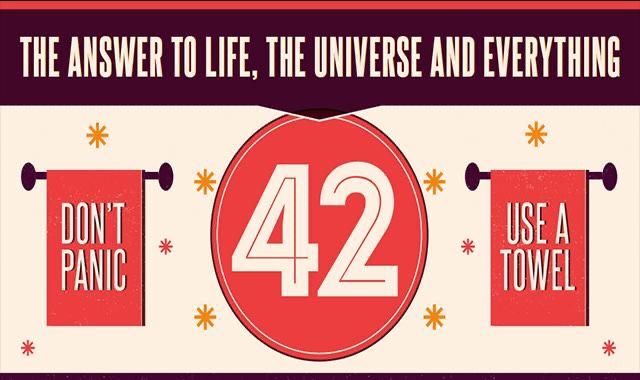
It’s a rather easy day to celebrate and it’s done by taking a towel with you wherever you go: to work, school, or just to the shops. This way you can celebrate such gems of wisdom as, “Nothing travels faster than the speed of light with the possible exception of bad news, which obeys its own special laws.” The only thing that’s truly important on this day is you don’t forget to bring a towel!

Don’t Panic: Carry a Towel

Oh, and the answer to the “Great Question of Life, the Universe and Everything” is “forty-two.” In the 1979 novel, the supercomputer Deep Thought takes 7.5 million years to calculate the answer to this ultimate question. The characters tasked with getting that answer are disappointed because it isn’t very useful. Yet, as the computer points out, the question itself was vaguely formulated. To find the correct statement of the query whose answer is 42, the computer will have to build a new version of itself. That, too, will take time. The new version of the computer is Earth. To find out what happens next, you’ll just have to read Adams’s books. For a math geek discussion of the significance of 42, read the link “For Math Fans” below.

Salad of spring greens and edible flowers

Having dispensed with heroes, we can move onto the significant May Days that truly appeal to me. “April showers bring May flowers” is a saying I’ve heard since my childhood ever so long ago. Historians believe this phrase may date back to a 1610 poem, which contained the lines, “Sweet April showers, do spring May flowers.” A longer phrase, “March winds and April showers bring forth May flowers,” has also been traced back to 1886. Of course, this tidbit of wisdom depends upon your geographic location, for folks inland and north may wait until what we southern folks call “early summer” before they get their “springtime.”

Rabbit and animals dancing around a Maypole

“The month of May was come, when every lust heart beginneth to blossom, and to bring forth fruit,” wrote Sir Thomas Malory in Le Morte d’Arthur. The early Greeks called this month Maia, after the goddess of fertility, many of the early May festivals relate to agriculture and renewal. May Day, celebrated on the first with the Maypole, is one such festive event that was more debauched in earlier times, but now survives as a chaste minuet of colorful ribbons woven around a tall pole by children dancing in an interweaving circle below it.

Maypole dance patterns

Other modern May festivities include No Pants Day on 5/1, originally an end of the college year prank at the University of Texas, Austin, which spread to other realms needing release, and World Laughter Day, celebrated on the first Sunday of May. This holiday helps raise awareness about the benefits of laughing and promotes world peace through laughter. Laughing can instantly help reduce stress and brings us closer to other people, as we share our happiness with them. Those who take part in World Laughter Day can help spread positivity and cheerfulness to help change the world for the better. As Ralph Waldo Emerson said, “What potent blood hath modest May.”

No Diet Day is May 6, a good day to remember our good health isn’t based on a scale number or a pant size. Instead, our health is dependent on nutritious foods, adequate exercise, and sufficient sleep. Extreme weight loss, except under a doctor’s supervision, usually leads to yo-yo weight gain, with the body gaining back the lost weight and more after severe deprivation. Slow, long term, weight loss is more likely to be permanent loss, since we aren’t “dieting,” but changing our habits. May 11th is Eat What You Want Day. I suggest we don’t follow Oscar Wilde’s habit: “My doctor told me to stop having intimate dinners for four, unless there are three other people.”

Speaking of breaking a fast, May 12th ends the month of Ramadan, the holy month of observance for Muslims. It was during Ramadan Muhammad, the prophet of Islam, received the revelations from angel Gabriel that allowed him to compile the holy book of Quran. Upon arriving in Medina, Muhammad announced Allah had established two days of celebrations for Muslims, Eid Al Fitr and Eid Al Adha. The purpose of Eid Al Fitr was to commemorate the end of the fasting of Ramadan, and mark the start of the Shawwal month, as well as to thank Allah for giving Muslims the perseverance to fast during Ramadan. The customary feast day greeting is “Eid Mubarak,” which translates to “blessed celebration” or “Happy Eid.”

Wayne Thiebaud: Bakery Counter, Oil on canvas, 1962, Private Collection,
© 2019 Wayne Thiebaud / Licensed by VAGA at Artists Rights Society (ARS), NY

The dessert of May is apple pie. Originally invented in England, the earliest apple pie recipe dates all the way back to 1381. The original recipe is very similar to the one we currently know, but it also included figs, raisins, pears, and saffron. The Dutch also created their own version of the apple pie, and the first recipe was published in a 1514 cookbook. This recipe is very similar to the apple pie we know and love today. Apple Pie Day is May 13th.

English and Dutch settlers brought the apple pie recipes into the colonies of what would become the United States, during the 17th and 18th centuries. They had to wait until the apple trees they planted grew and bore fruit, so at first apples were mainly used to make cider. It was only in the 18th century, when the first apple pie recipes were printed in America, that the dessert quickly grew in popularity. Following this came the 19th century Legend of Johnny Appleseed, whose real name was John Chapman. He crisscrossed the expanding American frontier to bring seeds for apple orchards for homesteaders. He also brought news and the gospel for fifty years.

Apple Pie 5 cents a slice and Homemade

Chapman, or Appleseed, lives on as a barometer of the ever-shifting American ideal. Some see him as a pacifist, others as an example of the White Noble Savage (so remembered long after the settlers drove indigenous peoples from the land), and others see a mere children’s book simpleton. Some see him as a frontier bootlegger, since he helped expand the hard cider industry. Others see Johnny Appleseed as the patron saint of everything from cannabis to evangelical environmentalism and creation care—everything, that is, but the flesh-and-blood man he really was.

Our heroes are too often cardboard cutouts, and we don’t spend much time reflecting on their shadow sides. Of course, much like a Flat Stanley, a two dimensional character doesn’t have enough density to cast much of a shadow, unless the light is just right. This is why continuing Bible study is so important: most of us stop in grammar school and never get an adult insight into the scriptures. When we meet grownup problems, we have to wrestle the questions of faith that we once easily accepted trustingly. Or we walk out the door and never come back.

A Single Rose in Memory

One of the most difficult sermons I ever preached was on the first Mother’s Day after my mother died. One of my best clergy pals, who was a mentor in my ministry, had arranged for a single rose to be on the pulpit beside me on that morning. It was a gift of grace and an empowering symbol, for roses were my mom’s favorite flower. Every time I thought I might cry, I held on tight to the polished oak wood and inhaled the fragrance of the rose. Even now, nearly two decades later, I can clearly see this rose and pulpit, and while I remember where I was, I recall the congregation’s faces were a blur on that day. It’s always the second Sunday in May.

I talk about my fresh grief from years ago, for during this current Pandemic too many of us have had present grief and stress, but either have no words for it, or perhaps have no safe place to express it. Then again, we may be “managing the grief of others,” and don’t have time for caring for our own needs. I call this Deferred Maintenance Grief. If you have an old, leaky faucet, you can keep turning the handle tighter for only so long. You can keep the leak stopped for a while, but soon you’ll strip out the insides of the faucet. Once it’s stripped down, it both streams steadily and needs a completely new fixture to replace it, instead of a minor repair.

I experienced this DMG once after a spate of ten deaths in a week, or maybe it was seven in ten days, followed by the death of one of the old, beloved black clergymen in my community. As I lay on the parsonage couch watching a rerun of Babylon 5, I was crying as if old E.D. were my own daddy. I then realized I’d been too busy caring for others and doing the “work I was called for,” to do the grief work I needed to do for myself. I needed to honor my loss and give myself dedicated spaces to deal with my feelings, so I could be present for others. That’s Deferred Maintenance Grief in a nutshell. If I were eating Cheetos by the bucketful, I’d be in a deep hole of DMG and digging it deeper!

Most of the churches I served had a “Don’t fix it unless it’s broke” policy. I grew up in a Depression Era family, so I was familiar with this attitude. However, these same people didn’t live this way in their own homes. We usually had a long list of deferred maintenance projects in the church property to finish in my time there. Then I’d go to the next place and do it all over again. “Always leave a place better than you found it, both structurally and theologically. Teach people the law of love. As we learn in Romans 13:8, “Owe no one anything, except to love one another; for the one who loves another has fulfilled the law.”

Most of us human beings have “deferred maintenance projects” also: days off, doctor visits, exercise, healthy meals, quiet times, and family times. Taking time for ourselves means we’re refreshed and eager to serve from the quickening power of the Spirit. Without this resting or love for our own embodied image of God, we end up working from the dying embers of our body’s frail resources—burnout calls our name.

When we get this broken, our families and our ministries both suffer along with us. We know better than to drive our vehicles with the gas gauge on empty past every filling station on the road of life. We aren’t called to die on the cross to prove our worth to Christ or to anyone else. He’s our savior and we claim his work on the cross. Anything else is workaholism or salvation by works. We need to name and claim this.

For clergy moving to a new appointment, this is an opportunity for a reset. For those who remain in place, I suggest a planning book. Mark off in advance quiet times, office hours, and visitation times. Take educational events, even if zoom is the only offering. Read for pleasure. Take a day off out of town. Don’t answer the phone after 9 pm unless it’s an emergency. Boundaries are blessings. I always told people up front, “I take my brain out of my head and put it inside a brain box at 9 pm. I put it back in at 9 am. If you call me between those hours, somebody better have died, be on the way to the ER, or the church is burning down.” They laugh, but I’ve had friends who wanted their pastor to be their bedtime Bible expositor. Boundaries keep us from burning out.

Speaking of burning, the official door to summer begins with Memorial Day Weekend. This holiday celebrates those who gave their lives in the great wars of our nation. It began after the Civil War in 1865 as a way to deal with the shared grief of a nation, which lost 750,000 people, or 2.5% of the population, in the struggle. If we were to translate this to today’s world, the number would equal 7,000,000 deaths. War is a pandemic all its own.

An engraving of The Dying Soldier – The last letter from home during the US civil war, circa 1864. (Photo by Kean Collection/Archive Photos/Getty Images)

As a parting commentary on Memorial Day, the Pandemic, and Extreme Care Giving, I leave you with a portion of the 1865 Walt Whitman poem, “The Wound Dresser,” which he wrote after serving as a hospital volunteer in the Civil War.

But in silence, in dreams’ projections,
While the world of gain and appearance and mirth goes on,
So soon what is over forgotten, and waves wash the imprints off the sand,
With hinged knees returning I enter the doors, (while for you up there,
Whoever you are, follow without noise and be of strong heart.)

Bearing the bandages, water and sponge,
Straight and swift to my wounded I go,
Where they lie on the ground after the battle brought in,
Where their priceless blood reddens the grass the ground,
Or to the rows of the hospital tent, or under the roof’d hospital,
To the long rows of cots up and down each side I return,
To each and all one after another I draw near, not one do I miss,
An attendant follows holding a tray, he carries a refuse pail,
Soon to be fill’d with clotted rags and blood, emptied, and fill’d again.

I onward go, I stop,
With hinged knees and steady hand to dress wounds,
I am firm with each, the pangs are sharp yet unavoidable,
One turns to me his appealing eyes—poor boy! I never knew you,
Yet I think I could not refuse this moment to die for you, if that would save you.

Remember to wear sunscreen to protect your skin if you plan outdoor activities on the first three day weekend of the summer and watch the temperature of the grill. We don’t want anything to burn if we can help it. Charred meat and burned skin are both indicated for cancer risks. Be safe and continue to mask up in public. Get vaccinated as an act of love for your family, your neighbors, and the world community. Since we’re all wound dressers, as well as the wounded also, we want to give as much care to healing our own wounds as we do to the wounds of others.

Joy and Peace,

Cornie

The Project Gutenberg eBook of The Wound Dresser, by Walt Whitman.
https://www.gutenberg.org/files/35725/35725-h/35725-h.htm
This contains first source material from Whitman’s era as well as his works from the Civil War period.

Do April Showers Really Bring May Flowers? | Wonderopolis
https://wonderopolis.org/wonder/do-april-showers-really-bring-may-flowers

As Covid-19 Devastates India, Deaths Go Undercounted
https://www.nytimes.com/2021/04/24/world/asia/india-coronavirus-deaths.html?referringSource=articleShare

For Math Fans: A Hitchhiker’s Guide to the Number 42 – Scientific American
https://www.scientificamerican.com/article/for-math-fans-a-hitchhikers-guide-to-the-number-42/

42 Of The Best Hitchhiker’s Guide to the Galaxy Quotes | Book Riot
https://bookriot.com/the-42-best-lines-from-douglas-adams-the-hitchhikers-guide-to-the-galaxy-series/

No Diet Day (6th May) | Days Of The Year
https://www.daysoftheyear.com/days/no-diet-day/

World Laughter Day | May 2
https://www.calendarr.com/united-states/world-laughter-day/

National Apple Pie Day | May 13 – Calendarr
https://www.calendarr.com/united-states/national-apple-pie-day/

Johnny Appleseed Planted Stories Of Myth, Adventure : NPR
https://www.npr.org/2011/04/17/135409598/johnny-appleseed-planted-stories-of-myth-adventure

Statistics From the Civil War | Facing History and Ourselves
https://www.facinghistory.org/resource-library/statistics-civil-war

Chemicals in Meat Cooked at High Temperatures and Cancer Risk – National Cancer Institute
https://www.cancer.gov/about-cancer/causes-prevention/risk/diet/cooked-meats-fact-sheet

Rabbit! Rabbit! Welcome to May!

arkansas, art, coronavirus, Faith, Family, flowers, grief, Healing, Health, holidays, Holy Spirit, Icons, Imagination, Ministry, ministry, nature, poverty, rabbits, renewal, Spirituality, Spring Equinox, Travel

Mother Bunny comforts Benjamin Bunny

April showers bring May flowers and Coronavirus containment orders. Everything we once knew about our worlds has been upended by the advent of this novel virus. Once we were proud of our abilities to master our planet and to wrest its unruly ways to our wills. Now we meet an invisible, but infinitely small agent that can weigh lay us from some hidden corner or passing person. I have friends who say they don’t want to go to the grocery store without their spouse or partner, for they don’t feel safe anymore. Then there’s the folks who run pell mell into the jaws of death, daring the virus to take them on.

Dr. Bunny Rabbit, MD

From my rabbit hole, I wonder if the virus doesn’t affect the nervous system and cause some of us to act more fearful and others to act more foolhardy. I think the stress of looking at our four walls of our various hutches, being cooped up with our rabbit families, and dealing with teaching our bunny children their lessons is getting to us all. Maybe raises for those teachers are due in the next go round, now that we understand what they go through every day. The stress is getting to all of us, and even to this rabbit, who’s used to organizing my own time.

People laughed at me back in my seminary days when I brought my appointment book to school, but I blocked off all my classes, set aside time for study, time for meals, and I only worked a half day on Saturday. Sunday I did church and watched the Cowboys, back when they really were America’s Team. I’m retired now, but I still keep a calendar of projects. Since my two art shows got cancelled, I started making masks for those who’ll be opening up shop again soon. I keep up on my pages, my sci-fi spiritual blog, and I started a new painting series, “Postcards from the Pandemic.” I’m down to working about 30 hours a week now, but I’m almost as old as the dinosaurs. The young rabbits can work the long hours and they’re welcome to them.

The world is topsy turvy these days

This May won’t be like any May we’ve ever had before. Whatever model or image you have of the “merry month of May,” you should toss it out the window and let it smash to smithereens like a precious crystal vase dropped from the top of the Leaning Tower of Pisa. We won’t be traveling there any time soon, but if you can find a high up window, your fantasies about May will crash with a resounding clash. Then you can have a good cry about it or a stiff drink, whatever suits your fancy.

Just get your rabbit mind wrapped around this idea: San Antonio has cancelled its Cinco de Mayo celebrations and the Kentucky Derby won’t run on May 4, but has deferred this premier horse race to September 5, 2020. The Indianapolis 500, a Memorial Day tradition for 104 years, has been rescheduled for Sunday, Aug. 23. These events haven’t been cancelled forevermore. They’ve merely been postponed to a future date. We can bury the small grief of our delayed gratification, and look forward to a better time in the future.

NASCAR will be the first major sport to return to television, but without fans in the stands. NASCAR will resume its season without fans starting May 17, at Darlington Raceway in South Carolina with the premier Cup Series racing four times in an 11-day span. The revised schedule for now will only race at tracks within driving distance of the Charlotte-based race teams and in states that have started reopening.

Drivers, start your engines!

Charlotte Motor Speedway will then host the Coca-Cola 600 on May 24 to mark 60 consecutive years of the longest race on the NASCAR schedule being held on Memorial Day weekend. The track in Concord, outside NASCAR’s home base of Charlotte, will then host a Wednesday race three days later. The teams won’t travel far, they won’t practice, they won’t qualify, they’ll wear face masks, practice social distancing, and the rules might be adjusted for pit stops, but when the green flag drops, those drivers will forget about these minor things because they have a race to win. Racing rabbits always go for the trophy, as in “Wreckers or Checkers! Baby, I’m using the chrome horn if you don’t get out of my way!”

Some holidays and celebrations won’t change, and we rabbits can be glad for this. I’ve often listed all the commercial holidays ginned up to advertise some food stuff or group, but not this May. My bunny nose sniffs a different wind in the air. In the interest of not working too hard, I’ve picked five good holidays and celebrations for May:

May 1—May Day—love and hope
May 4—Star Wars Day—May the force be with you
May 10—Mother’s Day—remember your mama!
May 25—Memorial Day—honor those who died serving the USA
May 25—Carry a Towel Day—homage to Douglas Adams’ Hitchhiker’s Guide to the Galaxy

May pole celebrations

Our age is seeking a new spring of life. May Day once marked the halfway point between darkness and light. It’s half way between the spring equinox and the summer solstice. In Ireland, the pre-Christian Celtic peoples divided the year into two main seasons: Winter and the beginning of the year, which fell on November 1, and the Midyear/Summer, which began on May 1. These two junctures were thought to be critical periods when the bounds between the human and supernatural worlds were temporarily erased.

Many of us have experienced thin times, when we feel the presence of God’s spirit with us more deeply than on other occasions. For me, this is more often when I’m in nature. The great dome of the sky, the clouds lit with the glow of the sun, and the liquid light overflowing and casting its glow on the land below. I can get lost in these thin moments and forget what I’m doing and where I am. If you meet a rabbit stopped for speeding on the highway, perhaps they were in a thin moment and not really a jerk.

There are also thin places, which are places of energy, or a place where the veil between this world and the eternal world is thin. A thin place is where one can walk in two worlds—the worlds are fused together, knitted loosely where the differences can be discerned or tightly where the two worlds become one. These are places which have been recognized over the ages as connected with the spiritual world. Often overlaid with the most recent god of the newest inhabitants, the place retains its spiritual energy. Many temples in the ancient world were built on the sites of even more ancient holy places, only to have churches built over them even later still.

In this era of Coronavirus, we might not be using our frequent travelers miles, so we could seek an alternative thin space. The holy icons are perfect for this, for since they’re a “window into heaven,” they’re by definition a “thin place.” They usually are given a designated place in the home, called the Red Corner, for the Russian word for red and beautiful are the same. Of course, we don’t pray to the icon, and the object isn’t worshipped, for that would be idolatry. We pray to the God of the saint represented, or to the Son of God, but not to the icon itself, which is merely an outward and visible reminder of the inward and invisible spirit which connects us all to what is good and holy and communal in our socially distancing world.

May the Fourth be with you!

On May 4th, we can say, “May the Fourth be with you,” and remember the “Force is always with us,” for every time and place can be a thin place if only we rabbits would become aware the greater power beyond us is also operating within us, for
“we have this treasure in jars of clay, to show that the surpassing power belongs to God and not to us” (2 Corinthians 4:7).

We all have Mothers, who gave birth to us. Some of us also have adopted mothers, mothers who raised us, mothers who formed us in the faith, or mothers who took us under their wing and taught us how to get along in the world. Mothers today don’t have to be women, but they do have to nurture and shelter. The church has been a great mother for centuries, nurturing the poor and the marginalized through the ministries of outreach to the neighborhood and the world. These ministries haven’t stopped just because of the coronavirus, but are increasing because of job losses, homelessness, and hunger. If you have the means to share with your local food pantry, please do. Hungry rabbits depend on us.

Memorial Day weekend was for a long time a pause to honor the nation’s war dead. Then it became a three day weekend for backyard barbecues and sporting events. As the toll from the novel coronavirus pandemic in America marches past the total of Americans killed in the Vietnam War, our holidays may take on a more somber nature. For other rabbits, who have an overripe case of cabin fever, a need to break loose in a wild debacle may override their common sense. I know my rabbit friends have good sense, so even if your state flings the doors wide open to “life as usual,” common sense and expert wisdom will prevail instead. Let others test the waters on this idea, and let them be the guinea pigs to see if the curve has actually flattened.

A cotton towel for a cotton tail would be best.

May 25 is also Carry a Towel Day, so if we have a towel, we won’t panic. As explained in the Hitchhiker’s Guide to the Galaxy, towels are “the most massively useful thing an interstellar hitchhiker can have.” A towel has both practical value, since it can be used for warmth, shelter, a weapon, and also strangely to dry one’s body. It also had psychological value, for if a non-Hitchhiker sees you with a towel, they’ll assume you’re fully stocked with other necessities as well. The lesson I take from this is while life is serious, I shouldn’t take myself too seriously. Humor will get a rabbit through the thickets and briars of this world better than struggling against the thorns and weeds. After all, angels fly because they take themselves lightly.

I will see you next month, when the June bugs fly. Until then,

Love, Joy and Peace,

Cornie

Recipe for CLASSIC MINT JULEP for a delayed Kentucky Derby, best consumed while wearing a fancy hat or elegant jacket. This recipe is adapted from “The 12 Bottle Bar,” a fun, informative cocktail recipe book by David Solmonson and Lesley Jacobs Solmonson. To make simple syrup, pour one cup of granulated sugar or Splenda into one cup of water and slowly heat on the stove, stirring until the sugar/Splenda is dissolved. Plus a Handful of fresh mint leaves,
1 oz. simple syrup (2 tablespoons), and 2 oz. bourbon or rye, your choice (1/4 cup or 4 tablespoons).

Put the mint in a cup, preferably one made out of silver or some other metal that will keep things nice and cold, and muddle it by pressing it gently against the sides and bottom of the cup for a few seconds (use that muddler you got as a wedding present or the handle of a wooden spoon). This rabbit would use a spoon.

DO NOT MASH THE MINT. You just need to release the mint’s oils, which does not require a strenuous effort. Over-muddling will result in an overly bitter drink. Add the simple syrup. Fill the cup with crushed ice and add the bourbon. Stir gently for 30 seconds or so, until frost forms on the side of the drink. Add more ice if needed and garnish with another sprig of mint. If you don’t have metal cups, make it in any cup cup you have. The metal is traditional, however.

This is a stay at home beverage, or a split between two persons, since it exceeds the recommended one ounce per day consumption of alcoholic beverages. Enjoy responsibly.

For more information on some of the subjects mentioned above:

Midsummer
https://www.britannica.com/topic/Beltane

Kentucky Derby: September 5, 2020
https://www.kentuckyderby.com/derbyweek

Thin Places
https://thinplacestour.com/what-are-thin-places/

Icons and The Red Corner
https://remstroybutik.ru/en/where-there-should-be-a-red-corner-in-the-apartment-red-corner-of-the-house/

Strawberry Mindfulness

art, garden, Healing, Medical care, Meditation, Mental Illness, Ministry, Painting, Prayer, renewal, Stress, Work

I read a wonderful journal, Psychiatric Times, which has a free subscription online. I began reading it because it helped me to understand the diseases of the mind, which cause people to be at dis-ease in their lives and to cause dis-ease in whatever community in which they belonged. In today’s modern world, our first choice to treat dis-ease is medication. However, the ancient practice of meditation is another choice, either as an adjunct treatment or as a stand alone, depending on the person’s need.

I recently read of some tech entrepreneurs who decided to shut off their phones, computers, and all other electronic devices for one day in every seven because they were over stimulated and never rested. Their creativity and original thinking were diminishing, and this was “hurting their brand.” Those of us in the spiritual world would say they needed to practice sabbath rest, and also to take time away on a daily basis also. If you feel “always on, 24/7/365,” you’ll wear down or burn down sooner or later. Even the Lord Jesus was given to finding secluded places to withdraw and restore his physical body and his spiritual energy. We often overlook these texts, in our rush to read the miracles and action of the salvation story.

Dr. John J. Miller, editor in chief of Psychiatric Times and founder of Brain Health, wrote this wonderful piece, which follows:

In our western culture, which values intellectual knowledge and material rewards, the concept of mindfulness is often initially difficult to grasp. Busy schedules, lengthy “to do” lists, commuting, work, family time, and group activities leave little time for self-reflection and inquiry into the nature of our minds.

In fact, all of these activities serve to keep us running on automatic pilot, and strengthen behavioral patterns previously learned that create efficiency when automatically enacted. An analogy I often use to explore the question of the potential benefits of practicing mindfulness is to ask which of the following two individuals is truly an expert on the experience of what a strawberry tastes like:

An individual who has studied the science of strawberries to the degree that he or she is considered to be the world’s expert—agriculture, botany, genetics, human taste receptors that send gustatory information that is decoded in the brain, digestion, visual responses to seeing a strawberry, and the author of over 100 books on all aspects of strawberries—but, has NEVER eaten a strawberry?

OR

An individual who is uneducated but has just paid close attention to all of the sensations and experiences of taking a fresh strawberry, looking at it, smelling it, placing it in his or her mouth, observing the taste and texture as he or she bites into it, and mindful of the plethora of the “here and now” strawberry experiences?

Bosch: The Garden of Earthly Delights

The answer is usually self-evident and conjures an image or feeling of the warm juice of a strawberry sloshing around in your mouth. Mindfulness is the practice of experiencing each moment like the strawberry.

Common mindfulness adventure
Broadly speaking, there are two subtypes of meditation: concentration and mindfulness. As a general principle, it is important to become proficient in concentration meditation before expanding into mindfulness. Concentration practice involves choosing an object, like the breath, a phrase, or a word that becomes an anchor for the mind’s attention.

The instructions are simple: watch the breath as it moves in and out of the body, choosing a spot to watch it that feels natural (the nose, mouth, lungs or movement of the abdomen). Inevitably, the mind’s attention will be distracted by some thought, feeling, sound, or emotion, and the mind starts to drift down an endless path of mind content. As soon as you are aware of having left the breath, without judging yourself, the task is simply to return to the breath. The same basic steps are followed if you are using a phrase or a word.

Here’s a common example:
awareness of the inbreath and the outbreath . . . inbreath and outbreath . . . inbreath and outbreath . . . you hear a car driving down your street, and your mind drifts to the thought of the car . . . my car . . . my car payment . . . bills to pay . . . do I have enough money saved to buy that new iPhone . . . images of the cool new camera on the iPhone 11 pro . . . wait a minute, I left my breath . . . inbreath and outbreath . . . inbreath and outbreath . . . inbreath and outbreath . . . the muscle in my left calf is starting to cramp up . . . I need to start stretching my muscles again . . . why did I stop stretching regularly . . . I should rejoin the gym . . . the last time I was at the gym I saw Tom . . . Tom was a great college roommate . . . college was such a great experience . . . maybe I’ll drive out there and take a walk on campus . . . college is so expensive these days . . . how will I pay for my child’s college tuition in a few years? . . . oh yeah, my breath . . . inbreath and outbreath . . . inbreath and outbreath . . . inbreath and outbreath . . . .

This is how much of the time practicing meditation is initially spent, and usually is so frustrating that most people stop meditating long before their attention is strengthened. With perseverance and practice the mind slowly develops the capacity to stay with the breath for extended periods of time. This commonly results in calmness, relaxation, mental clarity as well as an anti-fight or flight physiology.

Once the mind’s concentration has stability, that focused awareness can be intentionally refocused on the mind’s activity itself, and this is the beginning of mindfulness. A holding environment of sorts is created whereby impersonal and non-judgmental attention is watching the many mind states that come and go, the only task being to stay present and learn from what is observed with open acceptance. As mindfulness strengthens, the underlying themes and patterns that fill our mind automatically are seen clearer, and it becomes easier to disengage from them, remaining in the present moment with pure mindfulness. Like exercise, continued practice sustains the ability to be mindful, while lack of practice allows a regression to automatic patterns.

The practice of mindfulness
In our roles as clergy and clinicians, we recognize we always have more to learn, and more experience to be gained. Such is the case with mindfulness—it’s always patiently waiting for us to resume that selfless non-judgmental awareness of the present moment—with more to learn about the patterns and themes of our own mind, and continued opportunity to choose a different thought or behavior. As 2019 draws to an end, the practice of mindfulness is but a breath away, and is a worthy companion.

The Light of the Body: meditate on this verse

First century oil lamp

“No one after lighting a lamp puts it in a cellar, but on the lampstand so that those who enter may see the light. Your eye is the lamp of your body. If your eye is healthy, your whole body is full of light; but if it is not healthy, your body is full of darkness. Therefore consider whether the light in you is not darkness. If then your whole body is full of light, with no part of it in darkness, it will be as full of light as when a lamp gives you light with its rays.” ~~ Luke 11:33-36

https://www.psychiatrictimes.com/depression/mindfulness/page/0/1?rememberme=1&elq_mid=10101&elq_cid=1656322&GUID=95C4A97A-F3DF-48E9-82F6-955AEEB9B62B

RABBIT! RABBIT!

art, Attitudes, child labor, Children, Family, Habits, holidays, home, Imagination, poverty, purpose, rabbits, Reflection, shame, stewardship, Uncategorized, vision, Work

Welcome to September 2019

Elwood Palmer Cooper, Age 7 (1910)

My childhood memories of endless summers overlap with those of my first days at school, while I try to repress my more recent adult memories of an early September Monday when all I wanted to do was drink copious amounts of coffee and deal with the simple problem of a church van’s dead battery. It wasn’t to be so, for 18 years ago, airplanes were crashing into skyscrapers and people were dying on our soil. That was 2001, and all the September 11th memorials afterwards have been dedicated to first responders everywhere.

We as a nation have been “at war” for so long, we’ve begun to see any person who disagrees with us as an “enemy,” even if they’re our neighbor. It is time for us to learn to “make peace” again. To make peace is not to change someone else, but to allow change to happen within us. First we admit we’re not always right about everything. I personally have trouble with this hurdle. I study a lot and I’ve had a bunch of experiences, but there’s things I still don’t know. I sure didn’t sleep in a Holiday Inn last night.

Labor Day, September 2, is the unofficial end of meteorological summer. The Autumnal Equinox is when the Sun crosses the celestial equator, moving from north to south. This date, September 23, is considered to be the first day of astronomical Fall. Rather than argue when fall begins, I’m going to celebrate Fall often and early because I think we can’t party enough.

Labor Day weekend is the last big picnic weekend to get away from home. The lakes and mountains will be full of people, so drive carefully on the way home. Some folks like to do home repairs on this weekend—GIT ER DUN!

Back when my folks were young, children worked long hours, rather than going to school. Elwood Palmer Cooper, 7, had already worked for a year on this miller’s wagon in Wilmington, Delaware. He carried 25-pound bags of flour from the wagon to stores to earn 25 cents a week in spending money. (1910).

It took the Great Depression of the 1930’s to move the many unemployed adults into the children’s jobs before Americans became “ashamed of exploiting child labor.” Today we seem to prefer low prices, just as long as we don’t see the children overseas who make our clothes and shoes. The United Nations estimates 170 million children are engaged in child labor, out of the 260 million employed children around the world, the rest of whom do their work on family farms and in family enterprises. Cheap clothing, also known as “fast fashion,” is primarily responsible for the use of children in overseas factories, along with styles that change from year to year.

We can decide if we want to contribute to this cycle of perpetual poverty in these developing countries, or break the chains of ignorance and set the children free to get an education. It wasn’t but a century ago, only about 30% of American students graduated from high school, whereas now over a third of the population has a college degree. If we want to have a world with people who are more free and open, we would might do better to encourage them to grow, rather than to use them as servants or workers with no prospects for advancement.

Or we could go hang at Starbucks, where the friendly baristas have rolled out the pumpkins already. I tried the Pumpkin Cream Cold Brew, which is half the calories and carbs of the Pumpkin Spice Frappuccino. If we’re going to drink coffee, at least it’s responsibly sourced. We can’t do all things, but we can do some things. At least we can use the time to think about our money and our values. Also, now’s the time to begin planning your Halloween costume, but wait on the candy buying until it goes on sale.

Constitution Day, September 17, marks the signing of this unique American document in 1787, which established our current form of government and replaced the original Articles of Confederation. “We the People of the United States, in Order to form a more perfect Union, establish Justice, insure domestic Tranquility, provide for the common defense, promote the general Welfare, and secure the Blessings of Liberty to ourselves and our Posterity, do ordain and establish this Constitution for the United States of America.” If we’ve not lived up to this perfection yet, let’s go onto perfection in the days and years to come.

Get yerrr Pirate on!

One way we can all become one tribe again, and celebrate the joy of life is Talk Like a Pirate Day on September 19. Aye, matey, ye don’t have to wear a tricornered hat, or even an eye patch, but bonus points if ye do. Just speak pirate all day long, especially to your parrot. Take off early to look for buried treasure. Tell your boss, Captain Cornie said you could. And the boss should leave early also. Happy September, my bunny friends. See you in October.

Love, Joy, and Peace,

Cornie

Blackberry Eating

By Galway Kinnell – 1927-2014

I love to go out in late September

among the fat, overripe, icy, black blackberries

to eat blackberries for breakfast,

the stalks very prickly, a penalty

they earn for knowing the black art

of blackberry-making; and as I stand among them

lifting the stalks to my mouth, the ripest berries

fall almost unbidden to my tongue,

as words sometimes do, certain peculiar words

like strengths or squinched,

many-lettered, one-syllabled lumps,

which I squeeze, squinch open, and splurge well

in the silent, startled, icy, black language

of blackberry-eating in late September.

Porch Swing in September

By Ted Kooser – 1939-

The porch swing hangs fixed in a morning sun

that bleaches its gray slats, its flowered cushion

whose flowers have faded, like those of summer,

and a small brown spider has hung out her web

on a line between porch post and chain

so that no one may swing without breaking it.

She is saying it’s time that the swinging were done with,

time that the creaking and pinging and popping

that sang through the ceiling were past,

time now for the soft vibrations of moths,

the wasp tapping each board for an entrance,

the cool dewdrops to brush from her work

every morning, one world at a time.

From Flying at Night: Poems 1965-1985, by Ted Kooser, © 2005. Reprinted with permission of the University of Pittsburgh Press.

Edward Palmer Cooper, Age 7: Photo by Lewis Wickes Hine for the National Child Labor Committee/Library of Congress.

Child labour in the fashion supply chain:

https://labs.theguardian.com/unicef-child-labour/

Statistics: Education in America, 1860-1950 | Gilder Lehrman Institute of American History:

https://www.gilderlehrman.org/content/statistics-education-america-1860-1950

Americans with a college degree 1940-2018, by gender | Statista:

https://www.statista.com/statistics/184272/educational-attainment-of-college-diploma-or-higher-by-gender/

Now For Something Completely Different

adult learning, art, Creativity, Faith, Imagination, Love, Ministry, Painting, renewal, Spirituality, trees, vision

If we do the same thing over and over again, we’ll get the same results. Most of us will take the same road to our favorite restaurant, choose the same menu items, and call it a night at about the same hour. We are that predictable. A certain structure in our lives is necessary to keep us on an even keel. Mass marketing depends on people like us, since we have reliable and time tested tastes. Great art is different from the decorative arts, however, and it’s unlike the mass produced pieces which are good for covering a section of a wall in an office or residence.

Likewise, if we want to break through from the ordinary to the better, or if we want to improve upon our former work, we have to break our old habits and train ourselves in new habits. Why do world champion golfers reconstruct their swings in the middle of their careers? Their bodies are aging and changing. They can no longer swing with the abandon of younger and more limber persons. To continue playing at a high level, they must learn anew. This learning, forgetting and learning again is related to John 12:24–“Very truly, I tell you, unless a grain of wheat falls into the earth and dies, it remains just a single grain; but if it dies, it bears much fruit.”

DIANA—Painting with a Bell Pepper

In art classes, we’re always unlearning our yesterdays and starting over with fresh eyes and a renewed spirit in the morning. The day we start repeating ourselves, we’ve decided we’re good enough. We’ve settled, rather than continuing to push on to see how far we can go. Some of us will do this because we’re finally making a living. No one can fault this. Taking care of our families is important.

GAIL—Painting wit an Okra Pod

Yet if we fail to care for the artist within us, if we aren’t reaching deep within to wrestle with the challenge to risk trembling on the edges of beauty and chaos, we won’t be happy coloring canvases to satisfy the needs of those who see our art as an appendage to their furnishings rather than an object in its own right.

MIKE—Trees Painted with a Sweet Potato

The art class was somewhat nonplussed when I suggested we use sweet potato slices to print or paint with, as well as the big pretzel rods. Gail brought some large okra from her garden too, so we added this to the equation. If we always draw with the pencil and fill in with the paint brush, we get paintings which resemble coloring books. Then they came up with some original solutions. I knew they had it in them!

DUSTIN—Bowling Pins shaped like Sweet Potatoes

Mike used the actual potato as a paint tool, while Diana used the cut okras as textures and patterns. Dustin took the shape for bowling pins, and Gail doubled up sweet potatoes for mountains. I discovered the woven surface I was using wasn’t really conducive to the printing process, whereas the flat papers the class used worked fine. I got enough paint on it to get started and finished it at home.

CORNELIA—(Sweet Potato) Cloud on the Horizon

In Richard Rhor’s book, Immortal Diamond, he says, “Your True Self is that part of you that knows who you are and whose you are, although largely unconsciously. Your False Self is just who you think you are—but thinking doesn’t make it so.”

In art, we practice over and over again, until we can drop all the artifices of the False Self (the constructs which the world rewards) and work freely for the rewards which are pleasing to God. To do this, we need to allow ourselves to be freely loved by God and let ourselves freely love God’s entire creation. If nothing is outside God’s love and providence, then we too are called to love and care for God’s creation. This attitude will show in our art and heart.

In faith and art, we’re always dying to our old self and rising to our new self. Therefore we won’t be imitators of others, but we’ll be conformed instead to the image of God.

Do not lie to one another, seeing that you have stripped off the old self with its practices and have clothed yourselves with the new self, which is being renewed in knowledge according to the image of its creator.

~~ Colossians 3:9-10

Perfection in Life and Art

adult learning, art, Attitudes, Creativity, Faith, Habits, Holy Spirit, Imagination, Love, ministry, mystery, Painting, purpose, renewal, Spirituality, Stress, vision

The life of one who pursues Art and Faith has many overlapping points. One of these is the search for perfection. The French artist Marcel Duchamp quit painting to play chess, saying he couldn’t create a greater work. However, he was still working on one last piece in secret in his studio. Artists are driven toward this ultimate prize, just as people of faith are called to grow towards perfection in faith and love.

The difference between perfectionism and Christian perfection is huge! The first seeks flawlessness in self, others, and in all things. I know people who get up in the middle of the night to rearrange the shoes in their closets. Shoes must not dance! While I do alphabetize my spice rack, I can leave my closet’s contents to party at will while I sleep all night. I learned from experience early on not to concentrate in any one area of my artwork, since all my many teachers drilled this lesson into my head. Overworked areas of wet paint also get muddy, for the colors blend together into a sad grey. Experience is a good teacher.

DELEE, negative image & Modern Sculpture

Christian perfection is a heart so full of love of God and neighbor nothing else exists. By definition, our hearts would be also full of love for our own selves, since we are made in God’s image. This is why in art class we use ABC: attitude, behavior, and consequences. Positive ABC gets praise, and negative ABC gets redirected to a better place. If we can reframe our attitudes, we can change our behaviors, and then we’ll have different consequences. Sometimes we need an attitude adjustment.

Art classes aren’t easy, but neither is the Christian life. We need to face our limitations, and this is humbling. We aren’t strong or powerful, nor have we achieved anything close to perfection in any part of our own life. This doesn’t make us bad people, but it does make us drop the false mask we’ve been wearing in the world. The best art will come from an open heart, or from transparency to God and others. We’re so used to hiding our true self from others, we think we can hide it from God also. Art will reveal our true self, however.

In Philippians 3:12-16, Paul talks about Christian perfection, so I’ll add some notes about the search for artistic perfection. In class we drew the negative or empty spaces of a wooden dowel construction I rigged up for the center of the table. I tossed in an extension cord for good measure.

DIANA, negative image & abstract sculpture

Drawing the negative space is a new concept. Most of the time we’re outlining the object itself, but not focusing on the empty space. Then we wonder why our object looks cattywumpus. By drawing the emptiness, we end up with the positive figure. This is a backwards thought process. We’re so trained to look at the object, we forget the empty spaces are a design element also. Drawing the negative space helps us to find the true object in its actual location in three dimensions and translate this into a two dimensional space. This is a complex form of thinking, which is why age 9 or the ability to write in cursive has been the usual cutoff age for formal art training.

MIKE, negative image & DUFY, GATE

Not that I have already obtained this or have already reached the goal—by this Paul means Christian perfection, or having the full love of God and neighbor within our hearts. We artists will work all our lifetimes to achieve perfection. If we’re truly growing as artists, rather than just repeating variations on a theme, our style will change. Monet once destroyed multiple Waterlily canvases right before an exhibition, having deemed them inadequate for the show. We artists are our greatest critic. The day we’re satisfied is the day we begin to repeat ourselves.

GAIL, negative image & DUFY, Room with Window

but I press on to make it my own, because Christ Jesus has made me his own—of course, the Holy Spirit empowers this spiritual quest for complete love, or we’d never achieve this goal alone. I believe all persons have a creative spirit within them. If we’re made in the image of God, who is the creator and is creating all things new again, we must share this attribute in part. Moreover, I think of it as a spiritual gift, for we enter into the mystery of God when we let go of our ego’s organizational skills and allow a greater hand to move our own as we create.

Beloved, I do not consider that I have made it my own—the mark of a spiritually mature person is recognizing how far from the perfection of God all of creation will always be. Yet God can refine and renew any imperfection in our spiritual and physical lives. The consequences of our acts will stay with us, however.

At the end of a studio session, I sometimes tell myself, “I’ve learned all I can from this one. It’s time to go onto the next piece and do better.” I don’t expect a masterpiece every time. I do expect to learn from my mistakes. I own my mistakes! I’ll keep the work around for several months. If it doesn’t fall apart, I let it out to show. If it doesn’t sell in three years, I destroy it and move on. I can’t stay attached to it, although I once did. Now I see my work as an opportunity to share the beauty and joy of God’s inspiration with others. I’d be selfish to hoard it all to myself.

but this one thing I do—Paul stays focused on the ultimate prize, not just on the easy gains. “We have stress enough in our daily world, so why can’t we just come and be comfortable in our sanctuary or in our art class?”

If we were hot house tomatoes being prepared for the salsa factory, this might be an acceptable choice, but we’re human beings who’ll be tested and tried in the world beyond the security of our sacred spaces and quiet studios. We need controlled challenges, just beyond our reach, to strengthen us for the days ahead. Even the most famous artists will struggle with success, so having a goal beyond this world is important. The rest of us will struggle with failure and rejection, so we need to learn resilience and fortitude, and the strength of power available to us from on high.

forgetting what lies behind and straining forward to what lies ahead—most of us carry baggage from our earlier days when we made poor choices and did dumb stuff. If we don’t have several suitcases, we at least have a closet full of T-shirts from Been There Done That Land. In art, we eventually will make enough work to break out of our old patterns, or we can enter into a studio teaching environment and accelerate the process. The trained teacher gives positive criticism and guidance, just as we can give the keys to a novice driver with a licensed driver in the car. We could let the novice driver out on their own, but a cow pasture would be a safer choice for this unsupervised driving experience than a city street.

I press on toward the goal for the prize of the “heavenly” call of God in Christ Jesus.—the Greek word is “upward” call, or “higher” call. This call is more important than any other in our lives. If our only goal is to be a good person, but not loving person, we need a higher goal! Why are we satisfied with less when God is so much more of everything?

Let those of us then who are mature be of the same mind;—just as our challenge in faith is to always grow in grace and love, so our goal in life is to always grow and learn. What we fail to use will atrophy and die. If we don’t love from the depths of God’s inpouring and abundant love, our own ability to love will wither and die. Burnout is a spiritual condition first, then it becomes a physical problem. The ancient icon painters prayed as they “wrote” the images of Christ. If we offer up our time in the studio as a prayer to God, we will better connect to God’s deep well of hope and compassion, which can recreate our lives and the world.

and if you think differently about anything, this too God will reveal to you.—I happen to be a slow learner, but better a slow learner than one who never learns at all. Some of us need repeated lessons before the scales drop from our eyes, but once we see clearly, we’re zealous to convert the rest of the world. Once the flame of love burns brightly, it wants to spread and replicate itself. One light wants to set the other coals aflame. Still not everyone wants to set themselves on fire! They’re perfectly willing to watch someone else burn brightly and bask in their glow.

Price’s Law is a good example in real life. Price’s law describes unequal distribution of productivity in most domains of creativity. The square root of the number of people in a domain do 50% of the work. In a group of 100, 10 do 50% of the work and 90 do the other 50%. This seems to hold true in business and in volunteer groups. Some Elijahs love to work, but don’t know how to replicate their Elishas. They rob the future Elishas of the blessings of service.

In art everyone has to do their own work, and some have difficulty if the work doesn’t look as good as their neighbor’s efforts. Since everyone begins at a different point, each person improves from that beginning. Each has to be considered as an individual. No one is compared to anyone else, even in a graded system. Art is the best class of all, for if you work the whole class, turn in all your work on time, and meet the criteria of the project, you get an A. There is a “works righteousness” in the studio, even if we’re saved by grace in faith.

Only let us hold fast to what we have attained.—I find many folks want to quote this verse only, but not the whole of the Philippians text. They use it as an excuse to stand still without reflecting on their faith, which they inherited from their ancestors. Worse, they don’t read the Bible with a heart or mind open to the fresh winds of the Holy Spirit. Then they wonder why joy and peace are merely limited gifts in their lives. We prosper, not by material wealth, but in our relationships with one another and with God.

In art, we’d rather copy our teacher’s example and match it to the best of our ability, instead of coming up with solutions unique and personal to our own spirit. Thinking uses energy, but it also builds resourcefulness and new cognitive pathways, as well as increasing confidence.

The former is the standard teaching technique in most departments of education, but it has nothing to do with engaging creativity. Instead it assumes a single right answer, but the history of art is replete with multitudes of many answers and solutions to the questions of the moment. When we ask, “What is beauty, truth, and good in art,” we answer, “Across the years and with different artists in different cultures, it varies.”

With this in mind, as artists and people of faith, we can hold certain truths across all the years, artists, and cultures, but other truths may be variable. Certainly overworking the person and the painting hold true everywhere. Many of us hunger for approval from human sources, and work ourselves sick trying to please too many masters.

In art school I had several master teachers. One day I was drawing in an empty classroom. The department head came by and asked, “Who are you working for, me or Mr. Sitton?”

“I’m drawing,” was my noncommittal answer.

He returned a short while later to ask the same question and I gave the same answer. Not long after that, he popped his head into the door, pointed his pipe at me, and asked again, “Who are you working for, me or Mr. Sitton?”

By this time I was irritated to no end. I’d been polite twice, but this third time was too much! I snapped around on the stool and snarled, “ I’m working for myself, thank you! Now quit bothering me so I can draw in peace!”

He laughed as if I’d finally passed some rite of passage. “That’s what I wanted to hear you say the first time!” Some art lessons aren’t given in a class, and they aren’t about design and color, but about your calling and your purpose.

Who are you working for in this world: the praises of ordinary people, or the eternal voice of the master, who paints the dawn and sunset from a palette of glorious colors?