Solid Geometric Perspective

adult learning, art, Attitudes, Creativity, Faith, Holy Spirit, Leonardo da Vinci, Love, Ministry, Painting, perfection, perspective, picasso, shadows

Steps in drawing a Geometric Still Life: sketch, refined sketch, shadows, intense shadows and cast shadows

We are back in art class again on Friday mornings at Oakland United Methodist Church. Our first lesson is in solid geometry, but it’s not a math class. Art is more like learning a visual two-dimensional language to be able to render three dimensional objects on a flat plane. This isn’t as easy as you might think, but once you learn to see in perspective, you never can unsee it again. Art class is like an old fashioned one room schoolhouse, in which a teacher has students of varying ages and experience levels to instruct. I provide one lesson and modify it for each student according to their needs.

Gail S.—Pencil Drawing of Solid Geometry

The first day of class, I had three brand new students and one who has done this exercise at least three times before. Two others were out doing family obligations, just as I was missing in action last week due to attending my niece’s graduation ceremony for her MBA in Business Administration. Life and family watershed events are always important to make our presence known. The life of the artist is as important as the art itself. We aren’t just people who make beautiful objects for others, but people who make life beautiful by being present at their most important moments.

Vermeer: The Art of Painting, 1666-1668.

When we look at the painted floor in the Vermeer painting above, we know in our minds these stand for black and white square tiles. If we take a moment to closely observe them, we realize these are more like diamond shapes. This optical illusion is the result of perspective. Perspective comes in multiple forms. Linear perspective has one-point, two-point, three-point, and multi-point vanishing points. Aerial or atmospheric perspective uses color, clarity, and value as objects overlap each other and recede into the background. There’s also reverse perspective in which objects are larger as they grow more distant and foreshortening, in which nearby objects are emphasized.

Pop Tarts from the Pop Tarts Bowl Toaster Trophy in 2024

 Can we teach all of this knowledge in a single two-hour lesson? Absolutely not. Michangelos aren’t turned out like pop tarts from a toaster. In the Renaissance era, a family would place a youth between the age of 7 to 14 with a master artist to learn the trade. This child would do the chores of the studio and learn to grind the pigments and mix paint. Then they would progress to drawing and composition. After a training time, they might get to do the backgrounds of the paintings or the landscape. After eight years, if they were any good, they would be entrusted with an entire commission. Then they would venture out on their own or take over from their master’s studio.

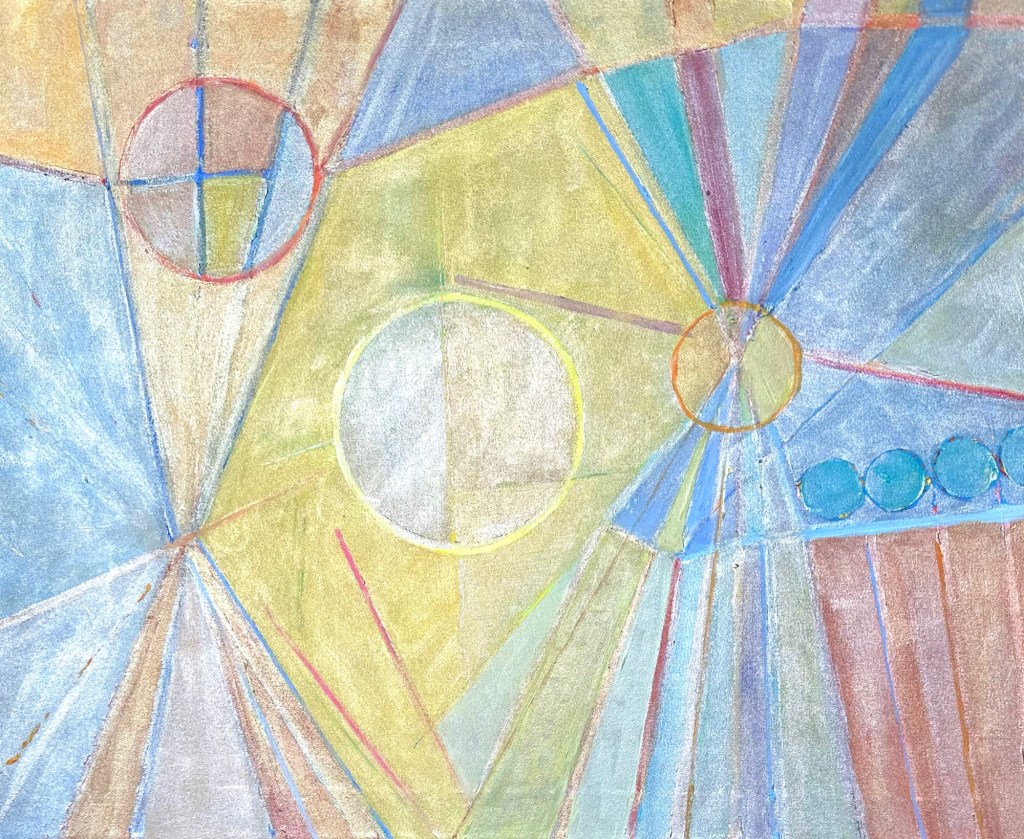
Cornelia—Purple Geometric Forms

I started taking art lessons when I was eight years old from the city parks and recreation art teacher on Saturday mornings, and then after school from a former art teacher in town. My grandmother was a portrait and still life painter. I have been taking or teaching classes for over seven decades. Art is not a skill or a product a person can ever perfect. It is more like a journey of faith, one in which we are always going on to perfection, but by the grace of God, will only be completed at our last day. Even at my age, I have more than a few “needs improvement works” left to create.

Tonya—Black and white Geometric Forms

The more you know, the more room for improvement you can find. I always ask students to first find three positive critiques of their work to praise before they begin to talk about their “improvement areas.” In this lesson, if they drew all three shapes, used two distinct colors for light and dark, and used up the space on the canvas, rather than drawing an inch tall image, those are positive points. Then they can point out their troubles.There’s enough negativity in this world. We need to overcome that in our own lives. What we learn on this canvas will carry over to the next one. Then we will find new opportunities for improvement yet again!

Marilyn—Geometric Forms in Aqua

No one who gets a significant health condition finds making a wholesale change overnight easy or achievable. This is why people who try extreme diets like Whole 30 that restrict too many foods discover they can’t stick with it or must continually start over. People looking to make lasting, healthy changes must start small and focus on progress over perfection, according to nutrition coach Brady von Niessen. “You start feeling so good about them that you can’t even imagine not doing them.” The same principle applies in art. Over time, a student’s skills will improve if they trust the process. Rome wasn’t built in a day!

Jeanne—Geometric Forms

Another important aspect of art class is relationships. Pierre Teilhard de Chardin said, “The most empowering relationships are those in which each partner lifts the other to a higher possession of their own being.” As a teacher, I try to help each person find their own creative voice, rather than trying to copy an idea of what “good art should look like.” Beginners in tennis don’t get to play on the same courts as Wimbledon or the US Open, or at least not at the same time as those who claimed the trophies! As Picasso once said, “It took me my whole life to learn to draw like a child.”

I consider this first class a success for each student. First, I got to hear some of their stories, which helps to build relationships. I got to hear their fears about not being perfect—none of us are perfect, but as United Methodists we are all going on to perfection in love by God’s grace and that’s the only perfection we concern ourselves with in art class. Can we love ourselves and give ourselves the grace to come up short? As the great Leonardo da Vinci said, “Art is never finished, only abandoned.”

I look forward to next week when we mix colors for the color wheel for the first time students. The returning students will get a lesson that uses geometry and mixed colors also. The more seasoned students project is a step up because they have more experience, so they have a greater challenge.

The one room art schoolhouse meets at 10 am on Friday mornings. It’s never to late to join.

Joy and peace,

Cornelia


Pillars of Creation

art, cosmology, Creativity, Holy Spirit, Israel, Israel, Painting, Silence, Spirituality

The Bible has many creation narratives. We’re familiar with Genesis 1 and 2, but our scriptures also include creation stories in Job 38-41, Psalm 104, Proverbs 8:22-31, Ecclesiastes 1:2-11 and 12:1-7, and excerpts from Isaiah 40-55. Some believe God created the world and all of creation in seven 24-hour periods. Others believe God had nothing to do with creation, but nature alone birthed itself in a great explosion. Some believe God created the world and left it to its own purposes. For these deists, God isn’t involved in human affairs in this current world.

 We don’t have to pick a side in this argument, or throw in our lot with “God alone” or “no god at all.” We can read the scriptures with modern science in our minds and faith in our hearts. In this, I’d say “we’re better off together” than we are separated into different groups. The love of God shed abroad into our hearts can bind us in this unity. Our human, fallen condition is the anvil on which we break apart into our separate sections and groups.

God is the creator of original unity and the recreator of the coming unity of the new heaven and the new earth, which will restore the unity of our fallen and broken world. In Psalms 104:5-9, the writer speaks of God’s process of creation:

“You set the earth on its foundations,

so that it shall never be shaken.

You cover it with the deep as with a garment;

the waters stood above the mountains.

At your rebuke they flee;

at the sound of your thunder they take to flight.

They rose up to the mountains, ran down to the valleys

to the place that you appointed for them.

You set a boundary that they may not pass,

so that they might not again cover the earth.”

Later, the same author notes God is always at work in the world: “When you send forth your spirit, they are created; and you renew the face of the ground.” (Psalms 104:30)

This renewing Spirit, which proceeds from the heart of God, allows us to live in hope, even when we see brutal wars decimating innocent civilians. When nations deprive their marginalized populations of equal rights, we trust that God’s spirit will move to bring a renewing justice for those who are denied their legal rights. When famine and destruction strike, the ones who suffer have hope that those who hear God’s voice will have compassion for them and will come to relieve them.

Of course, if we believe “the voice of God is rarely heard in our land anymore,” or “God helps those who helps themselves,” we are admitting our disbelief in a living and involved deity who is willing to interfere in the affairs of human life.


HERCULES AND THE WAGGONER. A Waggoner was once driving a heavy load along a very muddy way. At last he came to a part of the road where the wheels sank half-way into the mire, and the more the horses pulled, the deeper sank the wheels. So the Waggoner threw down his whip, and knelt down and prayed to Hercules the Strong. “O Hercules, help me in this my hour of distress,” quoth he. But Hercules appeared to him, and said: “Tut, man, don’t sprawl there. Get up and put your shoulder to the wheel.”
The gods help them that help themselves

The God we see revealed in the Old and New Testament helps those who can’t help themselves. This God has done this very thing throughout all of human history! Otherwise, God would have chosen the strongest instead of the least to carry out God’s mighty purposes. Instead, God always chooses the least, the last, the lost, the lonely, and the “losers” of our world to lift up. This is why you will not find anything like “God helps those who help themselves” in the Bible. It is found in Aesop’s fable, “Hercules and the Waggoner,” where the moral of the story is “the gods help them that help themselves.” The modern variant, “God helps those who help themselves,” was purportedly coined by the English political theorist Algernon Sidney (17th CE) and later popularized by Benjamin Franklin (18th CE) in Poor Richard’s Almanac.

Pillars of Creation, strings and under painting

In the studio, the artist is always listening for the creative spirit to speak. If I’m sitting before a blank canvas and have no idea whatsoever what to do, I make a mark. I make another mark in relation to the first, for now the two need to speak and relate to one another. As I pick up some more paint to make the third mark, this one must relate to the other two, and so on I go, adding marks and colors.

Once I get some shapes defined, I begin blocking in some colors. Here too, these must speak to one another. One mark can’t shout or be overbearing, while the others fade into the background. I think of warm and cool, opaque and transparent, as well as flat and shaded. Once I get a base layer on the canvas, I remove the strings which I tied to make the shapes. I give it a rest and let my mind rest also. I can come back with fresh eyes tomorrow.

The “Pillars of Creation,” an area of intense star formation, was photographed by the Near-Infrared Camera of NASA’s James Webb Space Telescope.

Inspiration, or listening for the spirit of creation, is especially important to move a work past “coloring in the lines” into a work of art. The “Pillars of Creation,” an area of intense star formation, was photographed by the Near-Infrared Camera of NASA’s James Webb Space Telescope. In the Old Testament, the pillars of creation held up the earth itself, while the dome of the firmament (the sky) was above. The ancient, unscientific age was a limited world, with an unlimited divine being. Today we live in an unlimited universe, but too many people have a god too small to do mighty things beyond our poor capabilities.

DeLee: Pillars of Creation

When I add the silver and gold paints, the number of layers and the directions of my brush strokes determine how much of the under painting will show through. I don’t do this haphazardly, but once again I listen to that still, sheer sound of silence that once called Elijah from his cave. Elijah knew God wasn’t in the wind, earthquake, or fire, but in the sound of sheer silence (1 Kings 19). I may have music playing in the background, but I don’t hear it at all. I’m in another realm entirely. I only hear the silence.

I’m enjoying this current theme and exploration. It combines my love of space and nature. I’m a firm believer in the providence of God: if God cared enough to create all there is, God will not forsake God’s creation. God will provide, and as God’s faithful people, we’ve been entrusted with the care for God’s world. Therefore, we must join God to keep the foundations of creation stable and the resources of our world available for future generations.

Joy and Peace,

Cornelia


William P. Brown: The Seven Pillars of Creation: The Bible, Science, and the Ecology of Wonder, 1st Edition, Oxford University Press, 2010.

Does the Bible say, “God helps those who help themselves?”
https://aaronarmstrong.co/everyday-theology-god-helps-those-who-help-themselves/

The “Pillars of Creation,” an area of intense star formation, has been captured by the Near-Infrared Camera of NASA’s James Webb Space Telescope.

NASA/ESA/CSA/STScI


Weaving a Life Story

Academy for Spiritual Formation, adult learning, art, Creativity, Faith, Holy Spirit, Icons, inspiration, Ministry, Nativity, renewal, righteousness, Silence, suffering, vision

Weaving is a metaphor for our life’s story and journey. We envision the weaver in charge of the colors, designs, and textures of the finished fabric. The weaver’s goal is to produce a beautiful product. We often think we are in charge of our own destiny, as “The Weaving Song” by Carolyn Hester, in which an old 1960’s era folk singer would sing:

Choose the right color And push the right tread

Throw through the shuttle And peg down the thread

Work is all laid Before your start

To make your own pallet Of bright hue or dark

The loom of life is moving The weaving is all your own

Choose the right color And push the right tread

Throw through the shuttle And peg down the thread

Rainbow of colors Is at your command

Choose all the right shades Offered in the stand

The loom of life is moving The weaving is all your own

Life’s but a grey And heavy with care

May blooms scarlet With couragе rare

The loom of life is moving Thе weaving is all your own.

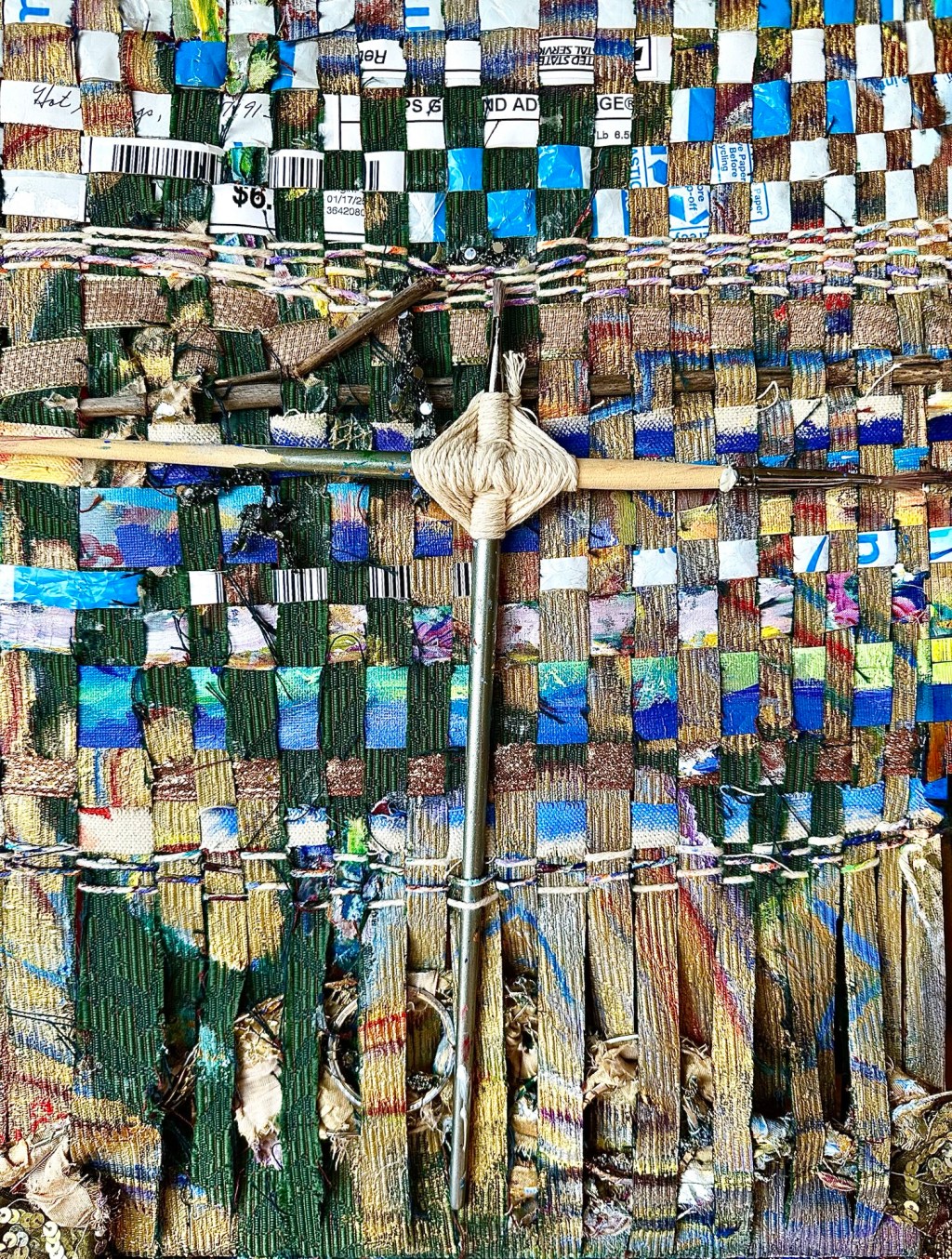
DeLee: God’s Eye and Cross, woven canvas, branch, string, paint brushes, fabric scraps, wire, packing materials, 16” x 20”, 2025.

Yet life doesn’t always work out the way we thought it would. The Bible says Job was the most righteous person of his era, and Job complains after losing everything and everyone:

  “My days are swifter than a weaver’s shuttle and come to their end without hope.” (7:6)

This wisdom text reminds us sometimes the righteous suffer, even while the wicked prosper, but God is still God, and we will understand this mystery of God when we see God face to face. We call this “theodicy,” (from Greek theos, “god”; dikē, “justice”), or our explanation of why a perfectly good, almighty, and all-knowing God still permits evil to exist.

God gives human beings free will. We make our own choices in life, just as everyone else does. Since we don’t live in a universe of one, other people’s choices impact our choices. Imagine a pingpong ball tossed into a room filled with mousetraps all loaded with other pingpong balls. If one ball hits a loaded trap, it sets that ball off into motion and those balls set more balls into motion until chaos ensues! If more than one person is involved, some sort of disagreement is sure to follow. Some of us are even at odds with our own selves!

As the old joke goes, a solitary man was rescued from a desert island. On this island were several structures. When asked, he said, “That one was my house and that one was my church.” And the other building? “That was the church I used to go to!”

Louise Bourgeois: Spider, metal, National Gallery of Canada, in Ottawa, Ontario. Her mother mended tapestries, like a spider spins a web.

When life is chaotic, creative people find solace in the quiet of their chosen deserts: the studio, the workshop, or their favorite writing chair. While we artists have the illusion we can control the images we produce or the songs which bubble up from our hearts, in truth, what we create is a shared product with our heart, mind, and the creating spirit. If we begin to lose our humility about this shared process, we lose the creative energy underwriting our works.

Louise Bourgeois: Metal Spider wrapped in yarn, Japan

We know this emotion as “pride,” and the ancient cultures warned against it. Throughout history, legendary and mythological figures have been used as examples of either virtue or a moral failing. The story of Arachne and Minerva is no different.

Attributed to Amasis Painter, 6th BCE, Greece, clay, Metropolitan Museum of Art, New York.

A 6th BCE Attic Black Figure Lekythos storage vessel attributed to the Amasis Painter shows the type of standing loom and the various shuttles of different threads a weaver would use for a fabric. Today we think of weavers sitting at their looms, but the ancients stood at their work.

Arachne was a mortal who excelled in the weaving arts: spinning her own yarn and selecting the correct colors to produce the beautiful images for the finished fabric. Minerva, the goddess of handicrafts and the Roman correlate to the Greek goddess Athena, had heard of Arachne’s prowess and her pride. Disguised as an old woman, Minerva visited Arachne to warn her not to disparage the gift of the gods. Arachne rebuffed her, and held her ground, even when Minerva revealed her true identity.

Minerva (Athena) and Arachne by René-Antoine Houasse (1706), Versailles

When the weaving contest began, both were even in technique and design. Minerva’s image was of the pantheon of the gods, but Arachne told the stories of the god’s mishaps with humanity. This angered Minerva, who struck Arachne with a weaver’s shuttle. Embarrassed, Arachne took a rope to hang herself, but Minerva had pity on her and changed her into a spider instead. We call spiders, ever weaving their gossamer webs, “arachnids” in her memory.

Spider Web

In Christian art, the theme of listening beside a well or spring is connected both to the angel’s annunciation to the Virgin Mary and to her weaving curtains for the Temple. The third-century Dura-Europos church baptistery has a fresco of a woman drawing water from a well, which Yale theologian Michael Peppard believes represents the Annunciation to Mary at a well, from a scene from the gnostic writing, Protevangelium-18.

Woman drawing water at the well. Possibly the Virgin hearing the Angel’s voice. Dura Europa.

Others think it represents the Samaritan woman at the well or Rebecca from the Old Testament. Because the fresco doesn’t include Jesus, the empty space instead represents “the bodiless voice” that Mary hears in the Protevangelium. Also, a five-pointed star appears on the woman’s torso, which could symbolize the new child in her womb. The star in later iconography was repositioned to the shoulder of her mantle, and the water vessel survives all the way into the Renaissance art as a vase with flowers.

Icon of Virgin at Well with Angel

From The Protoevangelium of James, section 11: And she took the pitcher, and went out to fill it with water. And, behold, a voice saying:

“Hail, you who hast received grace; the Lord is with you; blessed are you among women!” (Luke 1:28) And she looked round, on the right hand and on the left, to see whence this voice came. And she went away, trembling, to her house, and put down the pitcher; and taking the purple, she sat down on her seat, and drew it out. And, behold, an angel of the Lord stood before her, saying: “Fear not, Mary; for you have found grace before the Lord of all, and you shall conceive, according to His word.” And she hearing, reasoned with herself, saying: “Shall I conceive by the Lord, the living God? And shall I bring forth as every woman brings forth?” And the angel of the Lord said: “Not so, Mary; for the power of the Lord shall overshadow you: wherefore also that holy thing which shall be born of you shall be called the Son of the Most High. And you shall call His name Jesus, for He shall save His people from their sins.” And Mary said: “Behold, the servant of the Lord before His face: let it be unto me according to your word.”

This apocryphal Greek text, which was first written in the 2nd CE, with Syrian revisions into the 5th CE, is important because it increases our insights into women’s history, the childhood history of Jesus, Jewish-Christian relations, and the impact of Christian apocrypha on Islamic origins. This text, which contains the infancy narratives of the Virgin Mary, John (the Baptist), and Jesus is the source many of the Western Catholic and Eastern Orthodox religious feast days. Moreover, it’s also the origin for the icons representing the birth of Jesus in a cave.

Duccio: The Nativity with the Prophets Isaiah and Ezekiel, tempera and gold on panel, 1308-1311, National Gallery of Art, Washington D. C. Part of a series of the Life of Christ, the rest of which are in Sienna, Italy. 

A similar Marian birth narrative, The Gospel of Pseudo-Matthew, gives more details on the life of the Virgin, the miracles surrounding her marriage and the birth of Christ. It also tells the story of the Annunciation in two visits rather than one. The angel’s first greeting is beside a fountain and the second is inside while Mary is weaving the curtains for the Temple.

DeLee: Freeform Weaving while Listening

When I was on a recent Five-Day Academy for Spiritual Formation retreat, one of our hands on projects was a small weaving. Our package had a small loom, some yarn to weave with, and beads to attach. Of course I had to use a second packet to finish out my weaving because I tightened the horizontal rows more tightly than the organizers thought the regular attendees would do with their yarns and ribbons.

I also had my eye on a nice lichen covered branch to use as a hanging support. When I picked it up, it had red ants on it. I had to do some mad shaking to get them off! Anything for art! During one of our quiet reflection sessions, I sat beside a small lake under a pavilion to let my hands work. I’ve always needed a quiet space to process the flood of ideas and the rush of emotions when meeting new people and hearing new ideas. I operate as an extrovert, but when I get full to overflowing, I need quiet to recreate and recharge. I find new power in the admonition of Psalm 46:1-6—

God is our refuge and strength,
a very present help in trouble.
Therefore we will not fear, though the earth should change,
though the mountains shake in the heart of the sea;
though its waters roar and foam,
though the mountains tremble with its tumult.
Selah
There is a river whose streams make glad the city of God,
the holy habitation of the Most High.
God is in the midst of the city; it shall not be moved;
God will help it when the morning dawns.
The nations are in an uproar, the kingdoms totter;
he utters his voice, the earth melts.
The LORD of hosts is with us;
the God of Jacob is our refuge.

Diedrick Brackens, “prodigal” (2023), cotton and acrylic yarn

When my hands touch the different textures of the threads, and I let my spirit work with the creating Spirit of the word and world, I can shed all the strain and stress of being on a different schedule from traveling, having nerve pain in my neck from a bulging disk, and more interaction than I’m used to since I no longer work.

I always fought to carve out quiet times when I was in active ministry, for listening to God is the first calling of any leader worth their salt. I knew I wouldn’t hear God’s voice in the pell mell rush and cacophony of our world. The disembodied voice is more likely to come to us when we’re alone or in a receptive moment. It’s important to note Mary was one of the virgins of the House of David chosen to weave the curtains for the Temple in Jerusalem, according to The Protoevangelium of James, section 10. She was busy, but working for her God. It was when she took a break to draw water from a life giving well that she heard the messenger from God.

Bruce Conner, Arachne, 1959, mixed media: nylon stockings, collage, cardboard, 65 3⁄4 x 48 3⁄4 x 4 1⁄4 in. (167.0 x 123.8 x 10.7 cm), Smithsonian American Art Museum, Bequest of Edith S. and Arthur J. Levin, 2005.5.12

When I was appointed to a church, I always had a list of tasks to do, but I often never completed them because God would send “interruptions” to my well laid plans for the day. After several years, I began to understand these interruptions were my real tasks of ministry for the day. We have plans, but God has a better plan.

The prayer in my weaving supplies was appropriate for me on this retreat:

Teach us to listen, O Lord. 

Quiet the noise of our lives

so we can hear your voice. Amen.

After several weeks, I’ve come back to finish this blog. In the meantime I’ve had anterior cervical discectomy and fusion for my neck pain and numb fingers. It’s for the bulging neck disk that causes pressure on the spinal cord. If this happens in the lower back, a person gets sciatica and numbness in the legs. In the neck,the same condition affects the arm and hands. I feel better than I did before, so I’m thankful for all healing mercies. I have to be careful not to overdo my activities. The instructions “Don’t do housework!” were gladly received.

I hope you seek out your quiet spaces and quiet moments to hear the sheer, still sounds of silence, the inaudible voice of our God.

Joy and peace,

Cornelia


 NOTES:

Carolyn Hester: The Weaving Song, Track 10 on At Town Hall, One, Produced by Norman Petty, 1965.

Troubadour: Weaving Song: similar words to Hester coffee house ballad above. https://music.apple.com/us/album/weaving-song/400303687?i=400303767

Myth of Arachne https://www.worldhistory.org/Arachne/

Ally Kateusz: Mary and Early Christian Women: Hidden Leadership,1st ed., 2019, Kindle Edition 


Annunciation or Samaritan Woman, Dura-Europos Baptistery
https://www.christianiconography.info/Wikimedia%20Commons/annunciationDura.html

Charles Bertram Lewis:”The Origin of the Weaving Songs and the Theme of the Girl at the Fountain,” PMLA, Jun., 1922, Vol. 37, No. 2 (Jun., 1922), pp. 141-18, Modern Language Association. http://www.jstor.com/stable/457

Susan B. Matthews: Dura Europos—The Ancient City and The Yale Collection, Yale University Art Gallery, 1982, Yale University Printing Service. https://artgallery.yale.edu/sites/default/files/publication/pdfs/ag-doc-2378-0002-doc.pdf

Camille Leon Angelo and Joshua Silver: “Debating the domus ecclesiae at Dura-Europos: the Christian Building in context,” Journal of Roman Archaeology 37 (2024), 264–303, doi:10.1017/S1047759424000126. https://www.cambridge.org/core/services/aop-cambridge-core/content/view/E76ED3AD86D09A74893368840DEDFA6A/S1047759424000126a.pdf/debating-the-domus-ecclesiae-at-dura-europos-the-christian-building-in-context.pdf

The Protoevangelium of James, section 11. https://www.newadvent.org/fathers/0847.htm

The Gospel of Pseudo-Matthew, section 9.  https://www.newadvent.org/fathers/0848.htm

Horn, C. (2018). The Protoevangelium of James and Its Reception in the Caucasus: Status Quaestionis. Scrinium, 14(1), 223-238. https://doi.org/10.1163/18177565-00141P15

The Iconography of the Nativity

Alexander the Great, Apocalypse, art, Bethlehem, Faith, Icons, Imagination, incarnation, inspiration, Nativity, Painting, Ravenna Italy, Savonarola, vision

What Makes a Nativity Scene?

The gospels remind us the story of Christ’s birth isn’t necessary for our salvation. Only our faith in Christ’s saving work for us on the cross is necessary “to transform our humble body that it may be conformed to the body of his glory, by the power that also enables him to make all things subject to himself.” (Philippians 3:21, alternate translation). Mark has no infancy narrative at all, while John’s gospel speaks of the Greek Logos (Word), who is present with God at creation and as co-creator.

Luke and Matthew both have birth stories. Matthew gives us the ancestry of Jesus, the Wise Men or Magi from the East, and the massacre of the innocents. John the Baptist also figures large in Matthew’s text. Luke brings in the shepherds, the host of angels, and the angel’s annunciation to Mary of her impending birth of a savior.

Luke 2:6-7 notes this point about the birth of the Christ child: “While they were there, the time came for her to deliver her child. And she gave birth to her firstborn son and wrapped him in bands of cloth, and laid him in a manger, because there was no place for them in the inn.”

Gail W. painted a simple nativity in one class session.

This bit of text sets the scene for all the artists of every era to exercise their imagination. What does a first century CE manger look like? What animals would be there? Would the visitors come by day or night? Who would visit a woman who got pregnant while she was still “betrothed?” In every age, gossip travels fast, even without the internet. Traveling traders and business people carried news from town to town.

After all, word had spread how Joseph, “being a righteous man and unwilling to expose her to public disgrace, planned to dismiss her quietly.” (Matthew 1:19). No wonder there was no room for them at the inn. No respectable place would have them. Or we could be generous to the local folk and say Mary and Joseph travelled slowly because her imminent due date was the cause of frequent stops. A donkey ride might not be the most comfortable ride in one’s late trimester. Either way, if they were late arriving, the rooms may have been booked full already.

The Church of the Nativity, which dates to the 4th CE, was built over the cave in Bethlehem where early Christians believed Christ was born. From Apocryphal sources we learn the traditions of the cave and the stable. The Infancy Gospel of James (chapter 18) also places the Nativity in a cave, but the Gospel of Pseudo-Matthew combines the two locations, explaining that on the third day after the birth “Mary went out of the cave and, entering a stable, placed the child in the manger” (chapter 14).

Roman Sarcophagus of Stilicho. It’s found today beneath the pulpit of Sant’Ambrogio basilica in Milan, Italy.

The earliest images of the nativity which currently exist are from 3rd CE sarcophagus panels. The earliest Nativity scene in art was carved into a sarcophagus lid once thought to be for a Roman general, Stilicho, who died in 408 CE. The ox and the ass and two birds are the only figures that appear in addition to Jesus, swaddled in his manger. Our typical cast of characters, including Mary and Joseph, do not appear may be because this sculpture illustrates a prophecy from the Old Testament. Isaiah 1:3 reads, “The ox knows its master, the donkey its owner’s manger…” This Nativity also has relevance to the Eucharist because believers are nourished by the “fodder” of Christ’s flesh, just as the animals receive their sustenance from the manger’s hay. The animals aren’t mentioned in the New Testament, but from the Apocryphal sources mentioned above.

Tim’s Nativity: simplicity rules here—only the lights of the great star, the light of the Christ child, and the minor lights of the heavens.

Nativity with Flight to Egypt in the upper part—from the 4th and 5th centuries, Athens, from before the Middle Ages, and technically “Roman” art. (often referred to as “Early Christian”).

Next added were the shepherds, during the 4th and 5th CE, such as this example from the Palazzo Massimo. We find it on the sarcophagus Marcus Claudianus, on the upper tier, on the left. This dates from around 350 CE, found today in the Museo Nazionale Romano, Palazzo Massimo alle Terme, Rome.

Sarcophagus of Marcus Claudianus (Rome, Italy), Palazzo Massimo: Early Christian art is interesting because it can be hard to spot the stories as you know them. Except it seems, the Nativity, in the upper left corner, 330-335CE.

The sculptor carved the sarcophagus in the style called “continuous frieze” because all the figures line up and their heads are of equal height. The appearance of grape harvest imagery on the lid is ambiguous; it appears on both pagan/secular and Christian sarcophagi with identical elements. From left to right on the lid: nativity scene of Jesus, sacrifice of Isaac, an inscription naming the deceased, an image of the deceased as scholar, and a grape harvest scene.

Carvings on the front of the Marcus Claudianus sarcophagus include: Arrest of Peter, miracle of water and wine (with a possible baptism reference), an orant or praying figure, miracle of loaves, healing a man born blind, prediction of Peter’s denial, resurrection of Lazarus and supplication of Lazarus’ sister.

This stone relief carving depicts the detail of the Nativity from the 4th and 5th centuries from the Palazzo Massimo, on the Sarcophagus of Marcus Claudianus (Rome, Italy).

A Carolingian Era (751-887) Nativity scene from the British Museum

Eastern Orthodox icons retain the cave imagery while the Western art traditions use a stable or ruins of a classical structure in the nativity scenes. The first is according to tradition and the western imagery reminds the viewer the ancient past with its many gods is no longer ascendant.

The one change we see in the 6th century is the inclusion of Mary lying on a mattress type bed. It may have appeared earlier in art, but we have no surviving example to date an earlier occurrence. Later, we see more actors in the drama appearing, but often they don’t arrive all at once. The wise men visit, or the shepherds visit, but not in the same artwork.

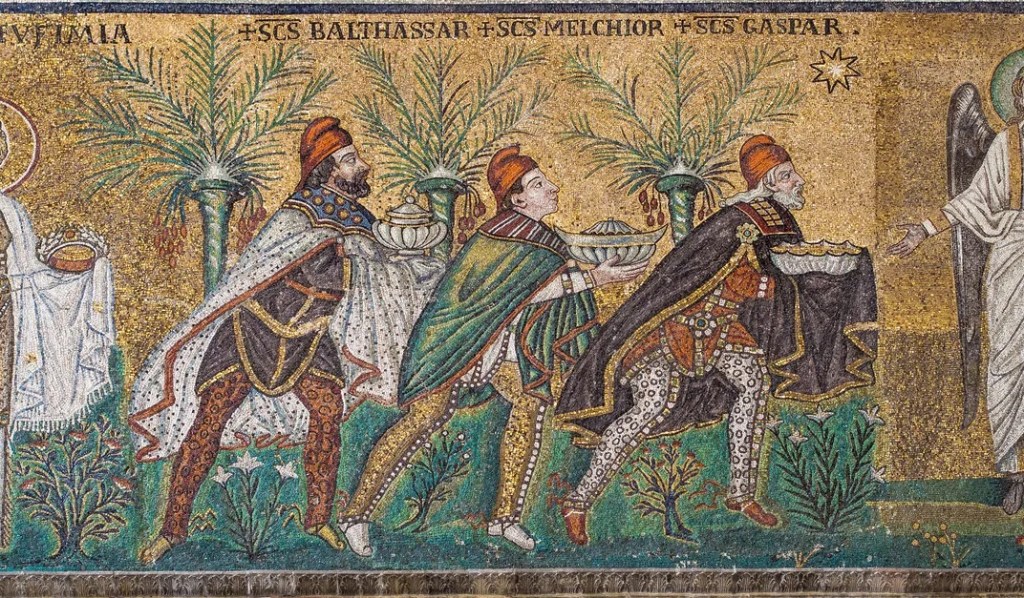
Wise Men Visiting the Birth of Christ, 6th CE
A 10th century ivory panel from Trier, still very much following the now 700+ year old Roman models;
things changed much more slowly in the Middle Ages than they do now.

By the time of the 11th CE, the nativity scene was becoming more elaborate , but was not yet in full flower. By the 13th CE, the magnificent portal of the St. Lawrence cathedral, in Trogir, Croatia, by the Master Radovan and his associates has a strong narrative of the many parts of the nativity story. The city of Trogir, a World Heritage Site since 1997, is known as one of the best-preserved Romanesque-Gothic cities, the core of which consists of forts, religious and secular buildings, with the Rector’s Palace and the City Loggia standing out. Its Romanesque churches are supplemented with Renaissance and Baroque edifices.

Romanesque style portal of the St. Lawrence cathedral, in Trogir, Croatia, by the Master Radovan and his associates

The detail of the portal is worth a closer look. In the center, in between the curtained “bunkbeds,” the Virgin and Child rest on the upper tier. The animals also look on in this section. Below the manger scene is a ritual bath. In my Christian world view, I called this the “baptism of Jesus.” In his Hebrew life, he would have undergone a ritual cleansing immersion bath before going to the temple for his circumcision. This ritual would mark him as a covenant member of the nation and people of God. The two elderly people on the left of this scene are most likely Simeon and Anna, prophets who speak to the child’s fulfillment of scripture.

Details of Romanesque style Portal of St Lawrence cathedral in Trogir, Croatia.

Above all this at the center top are the star, with the angels on the left and on the right. Filling the space on the left side of the portal are the shepherds and their herds, while the Magi and their steeds occupy the right side. The Magi ride horses, unlike our modern nativities which have camels.

Sixth-century CE mosaic at the Basilica of Sant’Apollinare Nuovo in Ravenna, Italy

In England, the Venerable Bede (d. 735) wrote the Magi were symbols of the three parts of the world—Asia, Africa, and Europe. They signified the three sons of Noah, who fathered the races of these three continents (Genesis, chapter 10). By the late Middle Ages, this idea found expression in art, and artists began to depict one of the kings as a black African. The kings sometimes have their retinues, which include animals from their presumed places of origin: camels, horses, and elephants are the most common. As with the shepherds, the artists often represented the three kings in the various stages of life: young, middle aged, and old age.

Gentile da Fabriano’s Adoration of the Magi, 1423

Artists added more exotic animals to the nativity scenes in the 15th CE when trade and travel were expanding beyond the continent. Gentile da Fabriano’s Adoration of the Magi (painted in 1423) presents a remarkable range of animals. Alongside the traditional ox, donkey, sheep (and a couple of dogs thrown in for good measure), the chaotic scene includes a camel, cheetah (or leopard), hawks and monkeys.

“Cabinet of Curiosities”
Engraving from Ferrante Imperato, Dell’Historia Naturale (Naples 1599)

The inclusion of animals which were not native to Europe helped Gentile da Fabriano to emphasize the three wise men’s journey from the Far East, but also to impress viewers with its exoticism and visual richness. This would have reflected very well on the painting’s patron, the rich Florentine banker Palla Strozzi, as it reinforced his connections to foreign lands. In this era, many rich citizens had a collection of exotic animals and imported wares, just as wealthy people today have collections of art, yachts, or sports cars to showcase their riches.

Sandro Botticelli, “Mystic Nativity” (1500), oil on canvas, 42.7 × 29.5 inches (108.5 × 74.9 cm) (image via Wikimedia Commons), now in National Gallery of London.

An even more elaborate nativity comes from the hand of Botticelli, who worked in the wealthy merchant city of Florence, Italy, in 1500. Savonarola was a fanatical preacher who aimed to morally reform the city of Florence, which had a global reputation for artistic output and lavish lifestyles. Savonarola condemned secular art and literature, decried the city as a corrupt and vice-ridden place bloated with material wealth, and, after warning of a great scourge approaching, saved the Florentines by convincing the French king and military to deoccupy and recede during the Italian War of 1494–98.

The people thought of him as a prophet and came from miles around just to hear him preach his apocalyptic message. He preached a sermon telling the people of Florence they could become the new Jerusalem “if only its civilians would part with and burn their luxuries, opulent fineries, and give up their pagan or secular iconographies.”

Botticelli fell under Savonarola’s influence during this time, for his art changed from decorative to religious. The 12 angels at the base of the composition each hold a ribbon that the artist inscribed with the 12 privileges or virtues of the Virgin Mary, which came from a sermon Savonarola delivered about a vision he once experienced. Another unusual aspect is that the three kings welcome Jesus empty-handed, rather than with gold, frankincense, and myrrh — influenced by Savonarola’s sermon, though it could be their ultimate gifts are their prayers and devotion.

Mike brought his good humor to class with a Grinch portrait

Sometimes it’s impossible to know whether the artist was inspired by a non-biblical element or by an apocryphal text in a Nativity scene or if the artistic depiction came first. In their book, Art and the Christian Apocrypha, David R. Cartlidge and J. Keith Elliott contend in the making of early Christian art, written and visual sources are interdependent. “The developing consensus is that oral traditions, texts (rhetorical arts) and the pictorial arts all interact so that all the arts demonstrate the church’s ‘thinking out loud’ in both rhetorical and pictorial images” (2001, xv).

Gail W.’s open perspective nativity inspired by the renaissance artists

When we artists imagine the nativity today, we add to the basic scripture text all of the Hollywood movies we’ve seen, the stories we’ve heard around the fireplaces and altars of our instruction, and every Christmas card and artwork we’ve ever seen. Our memories of Christmas are often more important than Christmas itself. This is because we have an idea of how Christmas is supposed to BE, but the birth of Christ wasn’t what either Mary or Joseph thought it was going to be. Just as most of us, they hoped to be at home and near family, not “away in a manger, no crib for a bed.”

Cornelia worked in the geometry of the scene. I might rework the sky.

God brought the Savior of all into our world into a humble setting, not to a royal palace. God brought to the birthplace of Christ strangers from distant lands and marginalized people from their homeland to have the first opportunity to worship the newborn king. God excluded the political rulers because they were out to destroy this unusual king.

We are part of the Christian community now, so we sometimes miss the disruptive nature of Christ’s birth. As part of the in/dominant group today, we might have a tough time reading the Bible’s challenges to self-satisfaction and complacency.

Birth of Alexander the Great, mosaic, Roman villa near Baalbek, Lebanon, 4th CE

We often forget while these depictions of the Nativity were evolving, the segment of the Roman Empire that was still pagan were also representing famous births, that predate the standard depictions of the Nativity of Christ. For example, in a Roman villa near Baalbek, Lebanon a fourth century mosaic of the Birth of Alexander the Great at first sight almost exactly resembles what later became a standard depiction of the Nativity of Christ. This mosaic, today in the National Museum of Beirut, shows the newborn Alexander the Great being bathed in a circular fluted basin by a female figure labelled ‘Nymphe’, while his mother Olympias reclines on a bed watched by an attendant.

Compare this with the icon of the Wise Men Visiting the Birth of Christ, from the 6th CE pictured above. In the lower right corner of this nativity scene, we see a small depiction of the Christ child being bathed, with water being poured over his head. (Obviously a United Methodist, but a precursor since John Wesley wasn’t born yet!) Our Christian iconography is derived from pagan sources. By this I mean we reimagined the pagan iconography and repurposed it for our own spiritual practices and purposes.

One of our other challenges is the calendar. We in the West use the Gregorian calendar, from the 16th CE, while the Orthodox Church still follows the Julian calendar, which was in use during the time of Christ. This is why the Orthodox community still celebrates Christmas and Easter on different dates than the Western churches. In the Orthodox Church, they celebrate Epiphany as the baptism of Jesus rather than the arrival of the Magi (Three wise men), which the Western Church celebrates on 6 January. On the Gregorian calendar, this Orthodox Epiphany celebration is January 19th. They celebrate this date as the Baptism of Jesus, rather than the arrival of the wise men. Their Epiphany is located in the baptism rather than the nativity. That’s a whole other theological discussion beyond the iconography of the nativity!

DeLee: The No Room Inn, mixed media, private collection

I mention this fact of the two calendars because I’m always “calendar challenged.” It’s not a senior citizen thing, because this was my problem even when I was in my twenties also. Sometimes I put too many commitments on my calendar, and other times I underestimate the time to complete my tasks. Then again, there’s always the unexpected interruptions. Always the interruptions. I came to understand in my ministry my list of tasks to do were not my actual work, but instead these interruptions were the opportunities which God would bring to me to do God’s chosen ministry.

So, I’m a few days late on the Western calendar for the visit of the Three Kings, having missed January 6th, and I’m a few days early for the Orthodox calendar. As Goldilocks said, “Not too hot, not too cold, but just right!”

Mike’s impression of the Nativity

The last art pieces our class made in 2024 before the holidays and the snowstorms were our nativity paintings. I asked each person to use their imagination and to bring the essence of the nativity to their creative process. Some of us quickly realized our images and used our second meeting to do a personal project or another version of the nativity scene. Others of us took both sessions to perfect our one image. I blame the Christmas cookies and our lack of hand and mouth coordination. Sometimes it’s hard to chew and paint at the same time!

Our first class of 2025 was an instance of “calendar challenge”—I thought we were having it, but the group didn’t. The next week, a major snow storm canceled class every where for everyone. Friday, January 17, should be a good day to begin a new project! We’re going to do some mixed media, along with weaving projects in the days and weeks to come. You don’t need skills, but a willingness to try.

Joy, peace, and a hope for better weather!

Cornelia


The Magi and the Manger: Imaging Christmas in Ancient Art and Ritual – The Yale ISM Review

The Nativity Tympanum on the Sarcophagus of Stilicho

https://www.christianiconography.info/Wikimedia%20Commons/nativitySarcophagusStilicho.html

UNESCO monuments in the Croatian Academy of Sciences and Arts Glyptotheque

https://gliptoteka.hazu.hr/unesco/en/trogir.html

The Apocryphal Gospels—PseudoMatthew—has Latin text and translation
https://www.google.com/books/edition/The_Apocryphal_Gospels/Cmbtm4ZZXF0C?hl=en&gbpv=1&dq=M.+Berthold+has+argued+that+Pseudo-Matthew&pg=PA75&printsec=frontcover

The Infancy Gospel of James (2nd century) |http://www.ccel.org/ccel/schaff/anf08.vii.iv.html

The Arabic Infancy Gospel (5th-6th century) http://www.ccel.org/ccel/schaff/anf08.vii.xi.html

The Gospel of Pseudo-Matthew (8th or 9th century) http://www.ccel.org/ccel/schaff/anf08.vii.v.i.html

Web Gallery of Art, searchable fine arts image database

https://www.wga.hu/frames-e.html?/support/zearly/1/1sculptu/sarcopha/1/9claudi2.html

Nativity – Visual Elements in the Nativity — Glencairn Museum

https://www.glencairnmuseum.org/nativity-visualelements

Johann International: Search results for Nativity  http://johanninternational.blogspot.com/search?q=Nativity

Revisiting Botticelli’s Evocative “Mystic Nativity”  https://hyperallergic.com/978201/revisiting-botticelli-evocative-mystic-nativity/

ORTHODOX CHRISTIANITY THEN AND NOW: Origins of the Icon of the Nativity of Christ
https://www.johnsanidopoulos.com/2018/12/origins-of-icon-of-nativity-of-christ.html


Picasso’s African Masks and Inner Mysteries

adult learning, art, Creativity, cubism, elections, Imagination, inspiration, Painting, picasso, renewal, The Lord of The Rings, Thomas Merton, vision

What is the key to open the door to the hidden mysteries? For Frodo and his fellow travelers in The Lord of the Rings trilogy, they needed to know the elvish answer to the riddle, “Speak friend and enter.” Gandalf knows this language, so they enter with ease. For years, the Egyptian hieroglyphics were unintelligible because we had no living person who knew the ancient language. After the discovery of the Rosetta Stone in Egypt with its three languages depicting the same text, the race was on to translate the pictographic writing.

Rosetta Stone, British Museum

In art school my fellow students and I worked in our shared studio classes daily, but sometimes we never made any progress. Then the day would come when the light bulb clicked on in one of our brains. When we took a break, instead of giving everyone’s work a cursory glance before going out for a snack, we would linger and take in the special magic of a unique vision. Where does this special insight come from? Is it a visitation from above? Or a piercing of the soul by divine artistic insight? Sometimes I think the rare and the strange shock us out of our ease and complacency.

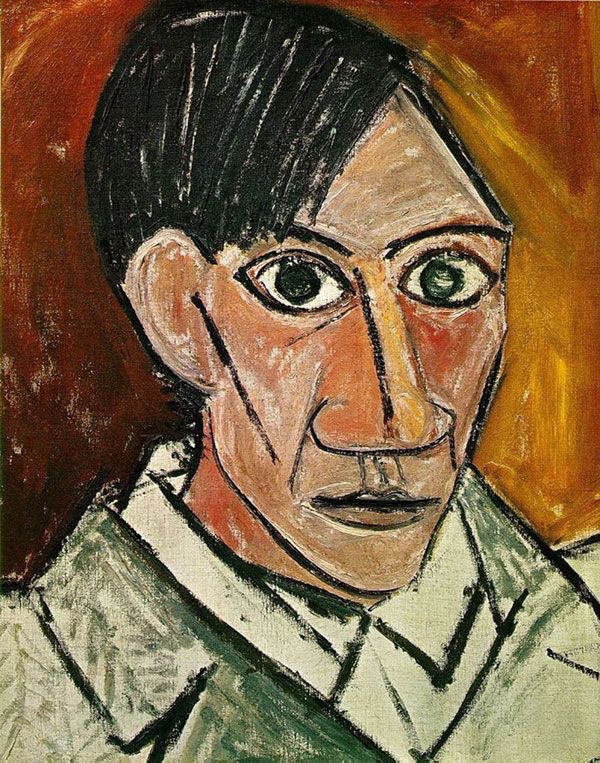
Picasso: Self Portrait, oil on canvas, 1907.

Art historians divide Picasso’s early periods into his Blue Period (1901-1904), the Rose Period (1905-1907), the African-influenced Period (1908-1909), and Cubism (1909-1919). Some art historians call Picasso’s African Period his “Proto-Cubist” or primitive period. It lasted from 1907 to 1909. Picasso was 24 years old when he saw an exhibit of African art at the ethnographic museum at Palais du Trocadéro. He experienced a “revelation” and began to explore African art further. African masks and sculptures strongly influenced Picasso’s art for several years, when he began to paint in sculptural forms, earth tones, and in flattened sharpened shapes.


Pablo Picasso in his Montmartre Studio,1908, via The Guardian

Picasso had first seen an African mask at Gertrude Stein’s home. Recalling his visit to the Trocadéro Museum of Ethnology (now the Musée de l’Homme), Picasso said of the museum:

“A smell of mould and neglect caught me by the throat. I was so depressed that I would have chosen to leave immediately. But I forced myself to stay, to examine these masks, all these objects that people had created with a sacred, magical purpose, to serve as intermediaries between them and the unknown, hostile forces surrounding them, trying in that way to overcome their fears by giving them color and form. And then I understood what painting really meant. It’s not an aesthetic process; it’s a form of magic that interposes itself between us and the hostile universe, a means of seizing power by imposing a form on our terrors as well as on our desires. The day I understood this, I had found my path.”

That path led Picasso to what he called his “periode nègre” (black period) or African period. It lasted only a few years, to 1909, but it turned Picasso into an avid collector of African art, masks, and sculptures that inspired him for the rest of his career.

Picasso: Woman with joined hands, 1907, Paris.

In our art class we chatted about how these masks inspired Picasso. Picasso used a palette of earthy tones, overlapping browns, and yellows with dark reds. By using Cubism, he explored a simplified geometry and the redefinition of perspectives. He tried to reveal objects from a different vantage point—from the mind, not only how the eyes perceive them. His Les Demoiselles d’Avignon signified a radical break from the naturalism that had defined Western art since the Renaissance, derailing former notions of what art was supposed to look like.

Picasso: Les Demoiselles d’Avignon (1907), oil on canvas.

People criticized Picasso’s two-dimensional women as unfeminine, for their confrontational demeanor was a complete departure from the traditional depiction of female beauty. Artists and critics alike received the work negatively and saw its menacing sex workers as promiscuous and unfit for Paris salons. Picasso rolled up the canvas, considered scandalous even amongst his innermost circle, and stored it in his studio for years to come. Yet this groundbreaking painting influenced his future works.

As Thomas Merton wrote in No Man Is an Island:

“In an aesthetic experience, in the creation or the contemplation of a work of art, the psychological conscience is able to attain some of its highest and most perfect fulfillments. Art enables us to find ourselves and lose ourselves at the same time.”

Picasso broke through the accepted boundaries of Western culture and discovered his true spirit in through the voices of the ancestors speaking from the African past. He met the other and found himself. By bringing the African masks into his studio, Picasso lived out the message of Hebrews 13:2—

“Do not neglect to show hospitality to strangers, for by doing that some have entertained angels without knowing it.”

As artists today, who seek to find their own true self and unique voice, we must both find ourselves and lose ourselves. We must lose our preconceived notions of who we should be and discover our true selves. Some artists use this as license to be caricatures of an artist, but actual artists have work ethics because they have obligations to galleries and clients. Looking like an artist and being an artist are two different things. Finding our true selves is not only a task for creatives, but also a lifetime journey for all people engaged in spiritual growth. We all can recover the image of God, which is our true self, by both God’s grace and our cooperation in doing good to all.

We artists are not here to make pretty pictures, but to break down the boundaries between our walls that keep us estranged from God and neighbor. We are not as bold as Picasso! Most of us are not risk takers. Willingness to leap out in faith is what marks a famous artist. That same riskiness is what marks the prophets of the Bible. Prophets never praise the status quo, but remind the people of the nature of their God:

“For the LORD your God is God of gods and Lord of lords, the great God, mighty and awesome, who is not partial and takes no bribe, who executes justice for the orphan and the widow, and who loves the strangers, providing them food and clothing.” (Deuteronomy 10:17-18)

Isaiah 1:17 reminded the people of his day, “learn to do good; seek justice, rescue the oppressed, defend the orphan, and plead for the widow.” Jesus will pick up this same voice in Matthew 25:40, “And the king will answer them, ‘Truly I tell you, just as you did it to one of the least of these who are members of my family, you did it to me.’”

So how will we find our unique voice and creative expression today? The more we steep our heart and mind in the great spiritual writings of the ages, particularly those of whom have come through great suffering or difficulties, the closer we will come to understanding our own challenges in life. These hardships are not hurdles or barriers to our progress, but refiners of any weakness that needed to be strengthened.

As my teachers always said, “We test you, not to see how ignorant you are, but to see what we failed to teach well.”

I always liked their attitude better! I did not feel so dumb when I missed the right answer on their tests. I always liked art better, for more than one answer could be correct. If we work within the parameters of the assignment, we can interpret the art with our own vision and style.

Our recent class with the African masks was a big diversion from our usual method of working. First, the masks are from a different culture. They are as much of a culture shock to us as they were to Picasso. He had the privilege of buying them in the Parisian curio shops, so they sat around in his environment. We only had images. The mystery of these objects might not connect to us as they did to him.

Mike’s Mask

Mike brought several masks from his home collection. He decided to paint one that spoke to him. Like Picasso, he had an emotional connection to this mask. He made a successful rendering of the object before him. Unfinished, he would bring it back to the next class.

Tim’s First Layers

Tim worked on a mask representing his wife. He first painted his background with a dark wash, then began drawing a lighter design on top of it. The contrast of the dark and light without the middle tone was difficult for me to look at, but he seemed to be enjoying getting the big shapes down. I often let people work without jumping into change their activity. I figure they will learn more from going down a dead-end road by themselves than if I stop them before they go there. They will ask about this, and we will talk about it. They will not do it again. A little suffering leads to learning if we do no harm to the body.

Gail’s First Layets

Gail S. understood the concept of simplifying the faces into a mask. She chose a photo of herself and her granddaughter. With two mask shapes, she had multiple decisions to make. As with the others, her work was unfinished at the end of class.

This was a difficult and challenging lesson for everyone. Asking students to make an emotional connection and render the object also was aspirational. It also gave me an opportunity to see where they were on this learning journey. I will not issue this sort of challenge again for a while. I was afraid I had been boring them, but maybe not. I may need to bring brownies next Friday to make up to them. For some, they may be “grief snacks,” while for others, they will be “encouragement food.” If my bunged-up shoulder permits, I will indulge in grief baking. Otherwise, I will just eat the chocolate ice cream in my freezer, and ask for understanding.

Cornelia’s Trump Portrait

I painted a Trump mask to get my emotions out and not have them bottled up inside. If we dislike an attribute in another person, it is because we have that attribute in our own life. I can get incredibly angry, but I bottle it up and it hurts me. I do not often let anyone else see it, so it can make me sick from holding it in. Whenever someone calls you a name, I remember the old song my parents taught me when I was a child:

“Sticks and stones may break my bones, but words will never hurt me.”

Anger is a difficult emotion for many people, especially for women. It is a “culturally unacceptable behavior,” for we have always expected strong emotions from men, but this expectation is changing over the generations. Proverbs 14:29 reminds all of us,

“Whoever is slow to anger has great understanding, but one who has a hasty temper exalts folly.”

The Old Testament often speaks of God’s anger, but this is because God’s people keep finding other gods to worship instead of the one true God. Psalms 145:8-9 reminds us of God’s true nature:

“The LORD is gracious and merciful, slow to anger and abounding in steadfast love.

The LORD is good to all, and his compassion is over all that he has made.”

The hidden mystery is in plain sight. It is the word of hope we hear:  We are not sinners in the hand of an angry God. We are all beloved and God’s everlasting grace is redeeming us always. When things fall apart, God works to reframe and renew, even if we have difficulty recognizing God’s new creation or wanting to take part in God’s plans for the new heaven and the new earth.

Joy, peace, and recovery,

Cornelia


Historical Influence of African Art in the Modern Art Movement – ARTDEX

Pablo Picasso – Artists – Mnuchin Gallery

https://www.mnuchingallery.com/artists/pablo-picasso#:~:text=Picasso’s%20early%20work%20can%20be,Cubism%20(1909%2D1919)

Stealing beauty | Art | The Guardian

https://www.theguardian.com/artanddesign/2006/mar/15/art

Historical Influence of African Art in the Modern Art Movement – ARTDEX

Sticks And Stones May Break My Bones – Meaning & Origin of The Phrase

https://www.phrases.org.uk/meanings/sticks-and-stones-may-break-my-bones.html


art, Attitudes, Creativity, Faith, Fear, generosity, hope, Icons, Imagination, inspiration, Israel, Light of the World, Ministry, Painting, poverty, renewal, Spirituality, suffering, Sun, United Methodist Church, vision

The first bright light of creation must have been an awesome sight. Of course, only God was there to see it or hear it. The earth was a formless void, and darkness covered the face of the deep. Genesis 1:3 tells us, “Then God said, “Let there be light;” and there was light.”

John Martin: The Creation of Light, Mezzotint, 1825, Royal Collection of the Arts, London.

I have often wondered if God’s creation of light was accomplished with sound. If at one time only darkness existed, then suddenly light appeared, would this sudden change happen like an atomic bomb flash? Not with the bomb’s destructive evil and force, but with the creative and life-giving energy of God’s power and love. While scripture tells us we hear God’s voice in the sheer silence (1 Kings 19:11-12), this is after God has created everything which we humans might worship instead of God. When God first created light, what was the power behind God’s words?

George Richmond: The Creation of Light, Tempera, gold, and silver on mahogany, 1826, support: 480 × 417 mm, frame: 602 × 539 × 66 mm, Tate Gallery, London.

Maybe no one cares, for if no one is in a forest to hear a mighty oak fall, can we say it ever made a sound? Just because human beings weren’t created yet does not mean the light did not come into existence or make a noise. We might as well say bombs are not leveling towns in Ukraine and Gaza merely because we are not running from the falling bricks and dust. Yet, we can see the pictures on television and know these facts as true.

We are in a trickier situation when we try to find information to prove the existence of the creation of the first light and the facts of its origin. We are certain light was created, for light now exists. Tracking light’s history to its birth story is the challenge!

The Creation of Day and Night, by Francisco de Holanda, De Aetatibus Mundi Imagines, 1543.

When the Old Testament says God created light, the ancient readers understood this word to mean a special light, not the light of the sun, moon, or the stars. God created these lesser lights on a later day, so they possess a different form of light from the first light. The early Hebrew philosophers distinguished between chomer, matter, and tzurah, the form or function of an object. A raw material has chomer, matter, but once it’s made into an object, it acquires the form or tzurah.

Michelangelo’s The Separation of Light from Darkness, (c. 1512), the first of nine central panels that run along the centre of the Sistine Chapel ceiling.

At the beginning of creation, nothing had form. It was all matter. Then God created the Ohr Ha-Ganuz, or the Hidden Light. This special light played a critical role in Creation. Just as regular light allows us to see and relate to our surroundings, the Hidden Light enabled the different elements of creation to interact with one another. It dispelled the initial state of darkness when all objects were isolated and disconnected from one another. Through this special light, the universe’s myriad objects acquired purpose and function and were able to work together towards a common goal.

About 13.8 billion years ago, our universe ballooned outward at an incredible speed. Everything we see today, which was once packed tightly together, expanded in a roiling mass of light and particles. It took 380,000 years for this hot, dense soup to thin and cool enough to allow light to travel through it. This first light, dating back to the formation of early atoms, we call the cosmic microwave background and we can still detect it today.

Creation: Bright Beam, stage 1

The Advanced Simons Observatory in the Atacama Desert in Chile is on the forefront of research for detecting cosmic microwave background radiation to give us a better picture of the early universe, its evolution, and the many phenomena within it. Beyond the cosmic microwave background, they will hunt for and study the birthplaces of distant stars, the contents of interstellar dust, exo-Oort clouds—spherical shells of ice and dust at the edges of solar systems—and several other phenomena. But, given the unique capabilities of this observatory, they are also open to finding some unexpected and unexplained puzzle pieces in the universe that we did not know we were missing.

Creation: Bright Beam, stage 2

Before there were any stars or galaxies, 13.8 billion years ago, our universe was just a ball of hot plasma—a mixture of electrons, protons, and light. Sound waves shook this infant universe, triggered by minute, or “quantum,” fluctuations happening just moments after the big bang that created our universe. The question we first asked, “Did the creation of light make an audible sound?” is related to the “cosmic wave background radiation” that the observatory in the Chilean desert is seeking.

Although scientists call this moment the Big Bang, it was not a loud explosion. Instead, it was more like an imperceptible humming because this first moment happened when the universe was denser than the air on Earth and sound waves could travel through it. This covered the first 100,000 to 700,000 years. As the universe cooled and expanded, the sound waves grew longer and and the sounds lower. As the universe continued to expand, the wavelengths became so long the sounds became inaudible to the human ear.

NASA Sound File Magnified of Big Bang Microwave Radiation

For this sound file, the patterns in the sky the Planck Observatory observed were translated to audible frequencies. This sound mapping represents a 50-octave compression, going from the actual wavelengths of the primordial sound waves (around 450,000 light-years, or around 47 octaves below the lowest note on the piano), to wavelengths we can hear.

Creation: Bright Beam, stage 3 in the studio

Maybe as you read this, you wonder, why do artists have an interest in science? This is an attribute of artists from Leonardo in the Renaissance down through the Impressionists who studied the play of light and atmospheres on surfaces in the 19th century. Today we know the speed of light means we are always seeing a “late arriving sunbeam.” The speed of light gives us an amazing tool for studying the universe. Because light only travels a mere 300,000 kilometers per second, when we see distant objects, we’re always looking back in time. If we the universe clock backwards, right to the beginning, and you get to a place that was hotter and denser than it is today. So dense that the entire universe shortly after the Big Bang was just a soup of protons, neutrons, and electrons, with nothing holding them together.

Lentil and ancient grains pasta soup, held together by melted cheese—metaphor for the early universe

The moment of first light in the universe, between 240,000 and 300,000 years after the Big Bang, is known as the Era of Recombination. The first time that photons could rest for a second, attached as electrons to atoms. It was at this point that the universe went from being opaque, to transparent. The earliest possible light astronomers can see is the cosmic microwave background radiation. Because the universe has been expanding over the 13.8 billion years from then until now, those earliest photons were stretched out, or red-shifted, from ultraviolet and visible light into the microwave end of the spectrum.

Today we have tools unavailable to the 15th or 19th centuries, but what we have in common is the human mind. Because we are created in the image of God, we have the same desire to create and shape our world and to understand our place in it. For some people, they find placing their trust in God’s absolute power over all creation and events as a way of understanding the problem of good and evil in the world. This justifies suffering and allows them to ignore the plight of the poor. Prosperity religion, which preaches the good prosper and the bad suffer, is a classic example of this theological belief. We United Methodists believe in doing good to all people, as often as possible, with all the means we can. As the gospel says in Matthew 25:37-40—

Then the righteous will answer him, ‘Lord, when was it that we saw you hungry and gave you food, or thirsty and gave you something to drink? And when was it that we saw you a stranger and welcomed you, or naked and gave you clothing? And when was it that we saw you sick or in prison and visited you?’ And the king will answer them, ‘Truly I tell you, just as you did it to one of the least of these who are members of my family, you did it to me.’

We know Jesus as the Light of the World (John 8:12)—

Jesus spoke to them, saying, “I am the light of the world. Whoever follows me will never walk in darkness but will have the light of life.”

Perhaps this ancient light of creation has not yet reached everyone who reads these words. I can only guess they ignore even the voice of the Old Testament prophet Isaiah (58:10):

“If you offer your food to the hungry and satisfy the needs of the afflicted, then your light shall rise in the darkness and your gloom be like the noonday.”

The sun will always shine when we help others. The light of Christ will burn bright in us to burn away our gloom and despair when we give a hand to others who are in need. Their lives will be brighter in turn. We often turn away from people in hard circumstances because we do not want to face the prospect that we one day might need a hand up. This strikes at our self image of invincibility and self sufficiency. We keep remembering “God loves a cheerful giver.” If we think only of this part of the verse outside of its context, we might think God only loves the giver. God also must love the one in need to provide the blessing for the giver. As we read in 2 Corinthians 9:7-8—

Cornelia DeLee: Creation: Bright Beam, acrylic on canvas, 16” x 20”, 2024.

“Each of you must give as you have made up your mind, not reluctantly or under compulsion, for God loves a cheerful giver. And God is able to provide you with every blessing in abundance, so that by always having enough of everything, you may share abundantly in every good work.”

As an old mentor of mine taught me, “Don’t do all the work for your people. You’ll rob them of the blessing of serving the Lord.” None of us can replace the eternal light of Christ, which has been traveling to us since the dawn of time, although the Light has been with God since before time began. This Light is even now permeating the universe, in a prevenient journey to the furthest distances of creation. There is no place the Light will not go before us. Even as we attempt a return to the moon and hope to go to Mars in the future, the light of Christ has already gone before us.

If this does not give you hope in what many think is a dark and despairing world, refocusing on the Light with us instead of the darkness that always seems so near might help to change your attitude.

Joy, peace, and light,

Cornelia


What Did the Big Bang Sound Like? | HowStuffWorks

https://science.howstuffworks.com/what-did-big-bang-sound-like.htm

Breishit: The Hidden Light of Creation

https://www.ravkooktorah.org/BREISHIT_67.htm

The science illuminated by the first light in the universe | Stanford Report

https://news.stanford.edu/stories/2023/07/science-illuminated-first-light-universe

When was the first light in the universe?

https://phys.org/news/2016-11-universe.html

The Creation of Light: William Blake and Francisco de Holanda/thehumandivinedotorg

https://thehumandivine.org/2022/02/27/the-creation-of-light-william-blake-and- francisco-de-holanda/


Learning Creativity

adult learning, art, brain plasticity, Children, Creativity, Painting, photography, renewal

Is creativity innate or can we learn creativity? From my experience, children are creative up until about age eight, at which time peer pressure begins to suppress their imagination and willingness to experiment and exercise their own inner truths. About this age, children acquire an understanding of the “real world,” as opposed to the worlds of their imagination. This is when they want to draw “realistic images.” Their skies begin to meet the earth, rather than being a single ribbon of blue across the top of the page. They often attempt textures of clothing and realistic renderings of hair and facial details in their artwork.

This is part of their artistic growth, but not every child grows at the same pace. Because adults often praise these early achievements, those children whose brains haven’t matured often begin to give up on their creative endeavors. We can’t rush brain development. Therefore, we shouldn’t disparage children who don’t progress as quickly. Children all go through predictable stages, but the environment and their innate nature determines how quickly they progress through these levels, or if they quit at some point.

This nature and nurture process is part of what we call “neuroplasticity.” This is a fancy $2 word meaning the brain has the “ability to reorganize pathways, create new connections, and, in some cases, even create new neurons.” At birth, every neuron in the cerebral cortex has an estimated 2,500 synapses. By the age of three, this number has grown to a whopping 15,000 synapses per neuron! Yet the adult brain has only about half that number of synapses. This is because as we gain new experiences, synaptic pruning strengthens some connections in our brains, while others are eliminated. Those we don’t use, we lose.

This is why as we age, we should learn something new everyday. As Mary Oliver, the Pulitzer Prize winning poet said: “Instructions for living a life. Pay attention. Be astonished. Tell about it.”

We are building new brain synapses. Getting out to socialize is also important. While people used to believe the brain became fixed after a certain age, newer research has revealed our brains never stop changing in response to learning. In this sense we are always able to learn, even if we’re a little slower than younger people. As I age, I realize I don’t move as fast, but I’ve never quit waking up and looking forward to the challenge of the day.

The day might come when we have a stroke, or damage to the brain. At that time, a belief in the ability of our brain to rebuild itself will be important, for recovery of speech or the ability to walk or feed ourselves will be our goal. Art class helps us face small challenges in non-consequential situations and prepares us to have courage and confidence to meet with optimism the greater challenges of life. Art, like life, is a growth process. Because art is a creative experience, we always are working with God’s help, and not by our own power:

“So neither the one who plants nor the one who waters is anything, but only God who gives the growth.” —1 Corinthians 3:7

SCRIBBLE STAGE

The scribble stage is a critical part of early childhood because it helps children develop their hand-eye coordination and fine motor skills. This age is from the child’s ability to hold a crayon to around 4 years old. Characteristics of this initial stage are:

  1. Random scribbling
  2. Purposeful scribbling
  3. Naming scribbles

The best way to encourage these young artists is to ask, “Can you tell me more about this?” This allows children to share all the things they enjoy about their work. Make sure the supplies you use are easy to control, like thick tempera paint, unwrapped crayons, washable markers, and chalk. Children use their imagination, rather than looking at things to copy. Copying is frustrating and confusing for children.

Tadpole People of the Pre Schematic Stage

PRE-SCHEMATIC STAGE

This a stage beginning from 3 1/2 years old to 7 years old. Children begin to make patterns in their drawings and label it as a representation of the things they know in their world. They begin to draw human figures by merging the circle with lines. Initially, these figures look like “tadpoles” or “head feet” symbols. Often children’s first figures are unrealistic or lack body parts. Yet this is an important stage in which helps children develop their own sense of identity by allowing them to explore different self-images before they arrive at a satisfactory one. Art plays an important part in defining who we are at this stage. We can encourage our children by asking them to tell us about the stories behind their artworks and not requiring them to match the reality we see.

Schematic Stage, age 7-9

SCHEMATIC STAGE

Between age 7 to 9, children develop their own symbols for each object they’re trying to create. Their drawings follow a specific pattern: the sky is a strip across the top of the page, just as the ground is a strip across the bottom. Objects no longer float in the middle space, but are attached to the ground. The most important objects are larger than the less important ones. Perspective doesn’t follow any one rule. We can encourage children to look at their environment more closely, but without correcting their artwork. Any corrective actions we make to get our child to progress more quickly than they are capable will just set them back.

Pre Realism drawing by young girl

PRE-REALISM STAGE

The child’s inner critic awakens between age 8 to 12 years old. They still create images according to their own symbols , but begin to overlap them. They still use flat coloring, but add more details. They begin to care what others think about their work. We can encourage them best by showing them how to do things and not trying to push them into skills beyond their ability.

Young artist, pseudo realism: note everything is a pattern or symbolic representation of reality, but the overall image is flat, rather than three dimensional.

PSEUDO REALISM STAGE

Between 11 to 14 years old, children begin to add shadows and try realistic perspective in their artwork. They look more intentionally at their environment and at individuals, while they attempt to record these details in their art projects. They’re also more critical of their product. Therefore, they need more positive feedback. My rule in middle school art class was, “Say three positive statements about your work before you tell me three negative criticisms.” This helped my students know they had succeeded on some levels before they looked at the areas that needed improvement.

Learning and exploring new art methods are a wonderful way to keep these youths engaged. Not all these youths are ready for perspective, but they can learn to see simple stacked boxes and draw them.


Period of Decision (Ages 14-17)

DECISION MAKING STAGE

Beyond the age of 14 is a critical time, for young people will make the decision to continue with art or drop it altogether. Their inner critic combined with the judgement of outsiders (parents, teachers, other influencers) confirms their belief art is a pointless exercise. A few others, who have been rewarded with positive reinforcement, will decide to continue with their art experience by mastering skills, learning perspective, and developing their own personal style. We can encourage all students at this age by reminding them art is important in their everyday lives. When we expose students to art history, we expand not only their cultural awareness, but also show them the possibilities of artistic expression and creativity. We also have to offer opportunities for both visual and haptic (hands on) learners.

As a result, many adults come to art classes at the Pseudo Realism Stage. This isn’t an insult to them, as if saying they’re at “arrested development,” but if they haven’t had training beyond this age, this is a realistic assessment of their skill level. This is why we go through lessons on color mixing, perspective and drawing skills. Each person looks at the image from their own viewpoint and tries to translate their best impression of the three-dimensional world on to a two-dimensional canvas. This skill is the equivalent of translating German into Italian by an English speaker. It’s a learned skill, but one can practice it and develop it over time with repetitive exercises.

The brain actively uses its thinking processes to create a work of art. We always need to remember, this art work isn’t a representation of a thing, but of our experiences with the thing. Our choices of color, line, size, weight, and value all speak volumes of our emotions as we relate to the subject matter. When we look at an artwork that seems dead, but is technically proficient, we know the artist had no emotional connection to the subject matter. Likewise, we can see a more primitive painter who put their heart and soul into their artwork and judge this work to be “fine.” What we artists try to do is keep an open and tender heart and stay emotionally invested in our subject matter so we can allow our work to come alive.

As a teacher, I always hope to discern where each adult student is in their artistic development. The old saying, “Rome wasn’t built in a day,” also applies to building our art skills. The more we work and get positive critiques on how to improve our work (this criticism involves what we did well also), the faster we usually progress. In fact, when we critique our own work, we see what we did well and what we could improve. Our next experience builds on that learning.

One thing I always underestimate is the length of time students take to do a project. Children fly through projects, but many adults have an inner critic who second guesses their decisions. I often say, “Just dab some colors on the tip of your brush and dab them on those trees for leaves. Pretend like you’re the god of your painting, and “let there be leaves!” They laugh at me, but I’m just trying to keep them from painting every single leaf individually. We see trees as a mass of leaves, not as individuals, especially if we look from a distance.

Sometimes I look over at someone working and suggest, “Maybe you might want to work in a different area. Your wet brush is just picking up the paint on your canvas now. Let that area dry and come back later.” Some of my students have been around long enough to have this lesson ingrained in them. If we hit this wall often enough, we learn how futile this behavior is. My old daddy always said, “Experience is the best teacher.” In truth, if we make a mistake often enough, we’ll learn that’s not the right fork in the road to take. Thankfully, we’re not working with electricity.

Our paintings from these two weeks were from photographs which we edited in our phones using the available digital tools. We weren’t trying to work towards a good photograph, but toward an image we could use as a photographic sketch for our painting. Gail S. took two images and blended them together. This is a challenge because each image had a different light and perspective. She solved it by placing the wall behind the tree, rather than using the actual photo image of the wall itself. We also used the color wheel to find a good grey color for the wall. Gail got some good details in the leaf mass. She is more used to creating her images from life.


Gail W. had a spring forest image with a footpath through it. She changed that footpath to a stream. She spent the second session putting shadows and highlights on the trees, as well getting the leaf masses to cover the timber stand. She even used a thin marker to get some dark shadows when she didn’t have a thin enough brush to make those details. Our two Gail’s are putting these lessons to effective use.

Black and white photo of retreat area

I used a photo I took on a recent retreat at Mount Eagle. A photo records everything before it. An artist can use the tools of the camera and the developing room to bring out the best qualities of the scene. My iPhone editing software did its best.

Then I made my painting from it. The great benefit of art is the maker’s decision to include only those parts of the image which stand out. We don’t have to draw every tree in the forest. We only have to paint those who call out to us to be remembered. This decision making action is part of making new neural pathways. Each new experience is a challenge and every challenge is a fresh opportunity for new growth.

The most important achievement we can make at any age is rewriting our brains. Neuroplasticity is the brain’s ability to reorganize itself by forming new neural pathways throughout life and in response to experiences. While the brain usually does this itself in response to injury or disease, when humans focus their attention enough, they can slowly rewire these pathways themselves. We can also do this intentionally by engaging in learning a new language, writing in a journal, doing creative art projects, quilting, woodworking, dancing, or creating new recipes. Anything we do to try a new experience helps to rewire our brains.

After all, we want to be around for many days to say with the writer of Psalms 90:14—

“Satisfy us in the morning with your steadfast love,

so that we may rejoice and be glad all our days.”

Joy and peace,

Cornelia


Neuroplasticity: How Experience Changes the Brain

https://www.verywellmind.com/what-is-brain-plasticity-2794886


Victor Lowenfeld: Creative and Mental Growth, 3rd edition, copyright 1957, The Macmillan Company, New York.


Cosmic Rainbow

Apocalypse, art, beauty, cosmology, Creativity, Faith, hope, inspiration, John Ruskin, Leonardo da Vinci, nature, Painting, purpose, sleep, Spirituality, Van Gogh, vision, William Blake

In times of cultural change and uncertainty, some faith-based communities turn to apocalyptic literature to find meaning, if not solace, for their suffering. Other communities of faith look forward to a future of hope and joy, even though they live in the same circumstances.

Apocalyptic literature is a genre of writing that appeared during times of crisis or persecution. It often presents a vision of the end times and the ultimate triumph of good over evil. Apocalyptic literature has several major characteristics:

“The supreme manifestation of Satan in this world is war.” By William Blake, 1805, apocalyptic painting with
tempera, gum, glue, and chalks, Tate Galleries, London.
  1. Dualism: Apocalyptic literature often portrays a cosmic battle between good and evil forces, highlighting the struggle between light and darkness.
  2. Symbolism: Deeper meanings and abstract concepts are represented by symbolic language and imagery.
  3. Eschatology: Apocalyptic literature focuses on the end times (Greek eschatos last, farthest) and the ultimate judgment of humanity, exploring themes of divine justice and the afterlife.
  4. Pseudonymity: Many apocalyptic texts attribute their authorship to famous figures from the past, using pseudonyms or false names.
  5. Visions and Dreams: Apocalyptic literature often includes visionary experiences and dreams as a means of conveying divine messages and revelations.
  6. The future is fixed and decided in apocalyptic literature, whereas with prophecy, people can change their future by repentance and restoring their relationship with God.

Since John was already in exile, “The Revelation to John” doesn’t bother to hide his authorship for his safety. He does claim it’s a vision of Christ mediated by an angel. It also checks the boxes of good vs evil, symbolism, the end times, and a fixed future. The actual date of this future isn’t revealed, however.

An interpretive mistake many make is to take this letter written to encourage the persecuted churches of the first century and project its message into our modern-day society. The symbols which were meaningful to John’s audience are for that historical context alone. Reinterpretations of these signs to make them relevant to our current geopolitical situation is bad scriptural interpretation.

Plate 12, First book of Urizen, by William Blake

What we can do is ask, “What can persecuted communities or suffering societies of the past teach us about resilience, hope, and faith?” Some will focus on God’s destructive forces to eradicate evil and harm. Belief in God’s power to overcome evil is a source of deep comfort for people without power. These are often the ones who feel excluded from the halls of power, but also those who believe their privilege and place is slipping away.

God’s fridge would be covered with photos!

Both these groups forget they are beloved of God, just as God loves all God’s children. Sometimes we forget God’s refrigerator is large enough to have the photographs of all the people of the world on its door, along with all our latest art works also. If that’s a humongous refrigerator, then that gives us an idea of the expansive reach of God’s love, mercy, and grace for all creation.

The First Day of Creation, by Francisco de Holanda (1545), with caption, “Let there be light.”

A negative outcome of this dualist, apocalyptic belief is extremist beliefs about the end times. Unfortunately, some extremist pastors have convinced their followers to end their lives to meet their predicted apocalyptic end of the world. The leader creates the fiction of an evil out-group to bind the members more closely to their cult and proclaims apocalyptic themes to brainwash their members. Numerous mass suicides worldwide have occurred as a result, including 914 people of Jim Jones’ People’s Temple. In 1997, 39 members of the Heaven’s Gate cult in San Diego, California, committed mass suicide by poisoning to coincide with the arrival of the Hale-Bopp comet, considering this a signal for their exit from Earth. Others have given away their entire nest eggs to apocalyptic cults because “no one will need money in the new creation.”

Paul Klee: Clarification, 1932, Oil on canvas, 27 3/4” × 37 7/8” (70.5 × 96.2 cm), The Berggruen Klee Collection, 1984 Accession Number: 1984.315.54

Some of us prefer to focus on The New Heaven and the New Earth instead, as found in Revelation 21:1-4—

Then I saw a new heaven and a new earth; for the first heaven and the first earth had passed away, and the sea was no more. And I saw the holy city, the new Jerusalem, coming down out of heaven from God, prepared as a bride adorned for her husband.

And I heard a loud voice from the throne saying,

“See, the home of God is among mortals. He will dwell with them; they will be his peoples, and God himself will be with them; he will wipe every tear from their eyes. Death will be no more; mourning and crying and pain will be no more, for the first things have passed away.”

Stage 1—strings and base colors

What a day that will be! The last time God destroyed the earth with a great flood, God placed a rainbow in the sky as a promise the earth would never be destroyed again by water.

Leonardo da Vinci said, “Where the spirit does not work with the hand there is no art.” For some people, the only “good art” is representational art, or art which faithfully describes a landscape, portrait, or still life. With abstract art, colors carry emotions and shapes to form pleasing patterns for the viewer. What will the new heaven and the new earth look like? Revelation 21:11 says “It has the glory of God and a radiance like a very rare jewel, like jasper, clear as crystal.”

Stage 2—addition of gold and silver washes

While many today think of heaven as an earthly paradise, this concept is a Persian idea of an enclosed garden, much like the original garden of Eden. We tend to imagine a heaven as being a better place than the world we know, but imagining an altogether different world is next to impossible! Luke 20:27-38 is Jesus’ answer to the law-abiding Sadducees about how relationships work in heaven, and a reminder to us heaven isn’t just a perfect earth.

When I think of the providence of God, which is grounded in creation and is always recreating the face of the earth, I remember God’s promise to Noah in Genesis 9:11-13—

“I establish my covenant with you, that never again shall all flesh be cut off by the waters of a flood, and never again shall there be a flood to destroy the earth….This is the sign of the covenant that I make between me and you and every living creature that is with you, for all future generations: I have set my bow in the clouds, and it shall be a sign of the covenant between me and the earth.”

Stage 3—Added circles and more gold and silver washes

It is this cosmic rainbow of colors, the spiritual energies which most of us cannot see for the overwhelming ordinariness of daily life. We race from chore to chore, dash from task to task, and drop exhausted at the end of our days. We long for a better life, but we’re stuck on a galloping treadmill trying to keep our feet under us. I long to walk rather than run through my days. When I was younger, older people told me to slow down. As I hit middle age, I heard I would soon start slowing down. Now that I’m inching closer to 80, slowing down is finally becoming a reality!

Vincent Van Gogh said, “Paintings have a life of their own that originate in the soul of the artist.” We cannot see the new heaven and new earth unless we stop our busywork and allow God to attend to the business of our spiritual life. When we see the first glimmers of the new heaven and the new earth, we’ll realize how imperfect our world is and begin to help change it for the better, one small act of kindness at a time. This is soul work.

Sometimes that kindness first means being kind to ourselves, when we admit we can’t say YES to everything and everyone. When we admit we actually need eight hours of sleep for our health and a daily quiet time, and we can stop to study the flowers in the cultivated gardens of our neighborhoods and in our parks.

Cosmic Rainbow—acrylic on canvas, 24” x 30”, 2024.

Then we can be a beautiful rainbow, God’s light in this world for good, and bring the hope and joy of the end times to these times. We then will bring the radiance of the new heaven and the new earth to this present age and to these yearning people.

Joy, peace, and rainbows,

Cornelia


 what are the five major characteristics of apocalyptic literature – brainly.com

https://brainly.com/question/35289093

World’s most chilling cults

https://www.france24.com/en/live-news/20230424-world-s-most-chilling-cults

Paradise Definition & Meaning – Merriam-Webster

https://www.merriam-webster.com/dictionary/paradise

 Middle English paradis, paradise “the Garden of Eden, heaven,” borrowed from Anglo-French paradis, borrowed from Late Latin paradīsus, borrowed from Greek parádeisos “enclosed park or pleasure ground” (Xenophon), “the Garden of Eden” (Septuagint), “the abode of the blessed, heaven” (New Testament), borrowed from an Iranian word (perhaps Median *paridaiza-) cognate with Avestan pairidaēza- “enclosure,” nominal derivative of pairidaēz- “build a barrier around,” from pairi- “before, around” (going back to Indo-European *per-i, whence also Sanskrit pári “around, about,” Greek péri “around, in excess”) + -daēza- “heap up, build” (occurring only with prefixes), going back to Indo-European *dhoi̯ǵh-éi̯e-, iterative derivative of *dhei̯ǵh- “knead, shape” — more at PERI-, FEIGN

NOTE: As an independent derivative of the verb, Avestan daēza- “heap, pile (of earth, stones)” has been compared with Greek teîchos (neuter s-stem) “wall, fortification,” toîchos (masculine) “wall of a house or enclosure,” Sanskrit dehaḥ “body,” dehī́ “wall, embankment,” Oscan feíhúss (accusative plural) “walls.” For a Germanic derivative from the same verbal base with a different sense, see DOUGH.

OAKLAWN FRIDAY ART CLASS

adult learning, art, Attitudes, brain plasticity, change, cognitive decline, Creativity, hope, renewal, summer vacation, Uncategorized, United Methodist Church

WE’RE BACK!!!

The older I get, the faster time flies! When I was a child, summers were long and lazy times. I actually got so bored, by the first of August I’d start to play school. I’d line up my brothers and the neighborhood children and pretend to teach them.  It was our way of “playing ourselves into a new reality.”

Art has many right answers!

Children practice life lessons during their play experiences. We can also play our way into learning a new skill in art class. All we need is a “beginner’s mind.” The Japanese Zen term shoshin translates as ‘beginner’s mind’ and refers to a paradox: the more you know about a subject, the more likely you are to close your mind to further learning. As the Zen monk Shunryu Suzuki put it in his book Zen Mind, Beginner’s Mind (1970): “In the beginner’s mind there are many possibilities, but in the expert’s there are few.” 

Jerzy Nowosielski: Landscape with a vision of the Sun, oil on canvas, 1965, National Museum of Krakow, Poland. 

In a similar vein, Picasso once said, “When I was young, I could paint like Raphael, but it took me my whole life to learn to draw like a child.” Part of our art class experience is to learn to suspend our adult ego’s need to constantly be ranking, besting, and giving into our competitive natures. We learn more when we give up our egos and our needs to protect our false selves, and allow our true selves to learn. This story in Luke 9:46-48 on “True Greatness” speaks to this:

“An argument arose among them as to which one of them was the greatest. But Jesus, aware of their inner thoughts, took a little child and put it by his side, and said to them, “Whoever welcomes this child in my name welcomes me, and whoever welcomes me welcomes the one who sent me; for the least among all of you is the greatest.”

Mary Delaney, Xanthium Spinosum, from an album (Vol.IX, 98). 1778. Collage of coloured papers, with bodycolour and watercolour, on black ink background
© The Trustees of the British Museum

Our first meeting will be Friday, September 6, at 10 am in the old Oaklawn UMC fellowship hall. Bring your own acrylic paints, brushes, and a canvas or canvas panel to paint on. We begin with a short visual inspiration from some great art works, so that we can wonder and be filled with awe at some great artists’ works. 

Basic 2 point perspective

I’ll give some direction on the skill we’ll work on in the session, and then everyone is free to bring their own unique expression to their paintings. We don’t copy my work and judge how well a person can match it. Instead, we learn from the masters or from real life. We can learn to stretch our own skills to create something new. 

That’s US!

Of course, making great art isn’t our first purpose. As we age, the harsh truth is we will lose our ability to learn new skills until we lose our memory of what we just ate for breakfast or how to work the tv remote. Challenging our brains is one of the best ways to keep our brain cells firing and “chatting with one another.” We can actually grow new neurons as we grow older. Our brains don’t have to shrink like a cotton shirt washed in hot water. Socialization and encouragement also helps to keep our brains young. Teaching this class helps me stay young! We help each other in this matter. 

That goes for children of any age!

Of course, making art means we have to give up our desire to be perfect. Children always have a “beginner’s mind,” so they are free to explore and experiment. Artists quickly learn perfection comes from practice, or working at it. Every baby stumbles and falls as they learn to walk, but we dotting adults still encourage every trembling step. This is what art teachers also do. I’ve always had a rule in my classes, especially when I taught in middle school: 

“No Negative Talking about People or Art.”

This includes a student’s own art works. My students always had to give at least three positive comments about their work before they spoke about the negative. “My work needs improvement” is better than saying, “My work stinks!” After all, this way of thinking is more positive than negative and helps to build confidence in a person. 

God would post your art on Heaven’s Refrigerator

Of course, we’ve all grown up and worked in environments where negativity is the rule. Art class is a place of grace because this is how life should be. If we can transform a blank canvas into a field of color, why can’t we transform our communities and our world into fields of hope, joy, and love? 

The Light overcomes the Darkness

Perhaps because we try to make everyone copy/fit into our idea of the proper end product, rather than allow everyone discover their own creative response to the given subject of the day. The museums of our world are richer and more vibrant because artists have listened to the Spirit of the Creating God. We might do well to realize God’s creative energies are varied and vibrant also, just as Isaiah wrote about his vision of God’s Glorious New Creation: 

“For I am about to create new heavens and a new earth; 

the former things shall not be remembered or come to mind.

But be glad and rejoice forever in what I am creating;

for I am about to create Jerusalem as a joy, and its people as a delight.”  (65:17-18)


I hope to see you there. I don’t charge for the class sessions, since this is one of my ministries as a retired elder in the United Methodist Church. As John Wesley once said, “The World is my Parish.” When we grow in confidence in the joys of creating, we find more beauty in the created world. Optimism is one of the side benefits of the creative life, not fame or riches, and sometimes not even accomplishment. Just the act of being a co-creator with the creating God helps us to find more peace in life.

Joy and Peace,

Pastor Cornelia 

How to foster ‘shoshin’ | Psyche Guides

https://psyche.co/guides/how-to-cultivate-shoshin-or-a-beginners-mind

The Creating God

art, Attitudes, change, Creativity, Evangelism, Faith, garden, Healing, Holy Spirit, hope, Imagination, incarnation, inspiration, john wesley, Light of the World, Ministry, Painting, purpose, Reflection, renewal, shadows, Spirituality, vision, Work

In the dead heat of summer, our gardens aren’t putting forth the fruit of our planting. Maybe the animals of our neighborhood have made their too frequent nightly visitations, so our harvest is skimpy. We can forget God is a both a creating god and a recreating god as well. The first words of the alternate NRSV translation of the Bible’s first book Genesis (a word meaning “origin”) are—

First stage: string, fabric scraps, and under painting

 “When God began to create…”

In the old KJV, Genesis 1:1 readsIn the beginning, God created the heaven and the earth.”

I appreciate even more the next verse from Genesis 1:2—

“The earth was a formless void and darkness covered the face of the deep, while a wind from God swept over the face of the waters.”

Alternate translations read— “while the spirit of God or while a mighty wind” swept over the face of the waters. This reminds us nothingness and darkness aren’t problems for God, who is able to bring glorious light to any situation.

Psalms 139:12 speaks of the nature of God:

“Even the darkness is not dark to you; the night is as bright as the day, for darkness is as light to you.”

I’ve lived for over half a century with chronic depression, so I can recognize darkness, not only in my own life, but also in the lives of others. Most of my ministry and even my secular work was done with a calling to bring others to the light of hope and confidence that anything was possible.

In art classes, I asked my students to trust in ABC—Attitude, Behavior, and Consequences. If they had a Positive Attitude, they would have Positive Behavior and work on their assignments. If they worked, they would see Positive Consequences or Improvement over time. Asking people who’ve been told they can’t do art to believe they can learn even if they aren’t “talented” is a big ask, but if they have faith in this promise, they discover it’s true.

When I sold insurance, I asked people to trust in the idea of making a small sacrifice now to prevent a greater loss later. Also, if they had no loss, they shared in a community to underwrite the group losses and keep the cost of protecting their own property low. Not everyone has the light to see this benefit of community, but for those who do, I could help keep their consequences from being a disaster.

Second stage: overpainting, printed circles, and added ruler lines

When I entered the ministry, I discovered congregations who had lost their faith in the God who could make something out of nothing This began with the creation story, the choosing of the nation of Israel to be God’s people (even though they were once no one’s people), and feeding them in the extended wilderness wandering before they arrived at the promised land. The Bible is full of examples of God’s providing more when people have too little to sustain them: Elijah and the widow of Zarephath, the feeding of the crowds with a few fish and loaves, and the water turned into wine. These modern people didn’t have a “recreating faith” that God could work in their lives today, just as God had once worked in the lives of others in the days of Christ.

That is what we call a “dead faith,” or as John Wesley put it in his notes on the New Testament at 2 Timothy 3:5— “An appearance of godliness, but not regarding, nay, even denying and blaspheming, the inward power and reality of it.”

It’s dead, because the Spirit isn’t at work in it. I used to tell my beloved evangelism professor, the late Dr. Billy Abraham, the first place we needed to do evangelism was in the local church, because folks hadn’t heard the good news. If they weren’t excited enough to have a living faith, they wouldn’t go out and spread the good news to others.

I’ve never been a cheerleader, although I did have some time in my high school pep squad. I was more often involved in making the football banners and pep posters for the other sports activities. Also debate team took up much of my time. One of the best practices I learned in debate was positive points sell better than negative ones. Also, it’s better to make the same point over and over with different facts and examples.

When I say our God is a creating and recreating God, I can point to the beautiful verses of John 1:1-5—

“In the beginning was the Word, and the Word was with God, and the Word was God. He was in the beginning with God. All things came into being through him, and without him not one thing came into being. What has come into being in him was life, and the life was the light of all people. The light shines in the darkness, and the darkness did not overcome it.”

In the beginning was the Word

 As believers in the Holy Trinity, the Word made flesh is Christ, so he was co-creating with God the Father and God the Holy Spirit from the beginning. By virtue of the incarnation, Christ takes on our flesh to redeem us and make us whole again. This comes to completion through the cross. When we place our faith in Christ’s act of love for all creation, we are made one with Christ, and one with God. The Holy Spirit brings us ever closer to the true nature of Christ, until we’re perfected in love of God and neighbor.

I painted on unprimed canvas, just to see what would happen. Also, because I knew the paint surface would be different than the usual texture on the primed canvas. After I painted several different colors in blocks with the scrap pieces of cut canvas used as “masking tape,” I decided to use a mix of iridescent gold and silver acrylic paints to glaze over the under painting. I also added some circles and straight lines. I’ve collected a few jar tops recently, I used some string elements, and I had a school ruler left from my last teaching job back in the 1980’s. (Yes, I keep things. They are tools of the trade. My Sears Craftsman staple gun from art school finally died after half a century of use.)

I’ll be working some more of these experiments for a while. Creating and recreating our lives is what keeps us new every morning. As someone who has been renewed and recreated more than one time can attest, along with the prophet Jeremiah,

“For surely I know the plans I have for you, says the LORD, plans for your welfare and not for harm, to give you a future with hope.” (29:11)

Joy and peace,

Cornelia


John Wesley’s Notes on The New Testament, 1755:

2 Timothy 3:5—“holding to the outward form of godliness but denying its power. Avoid them!”