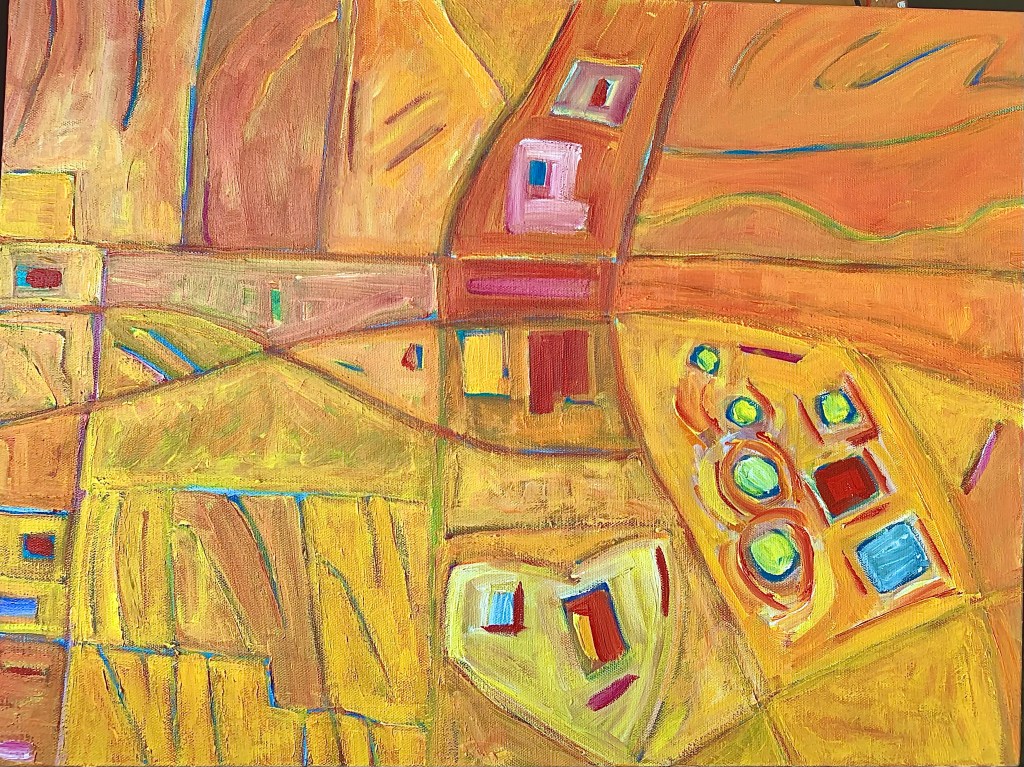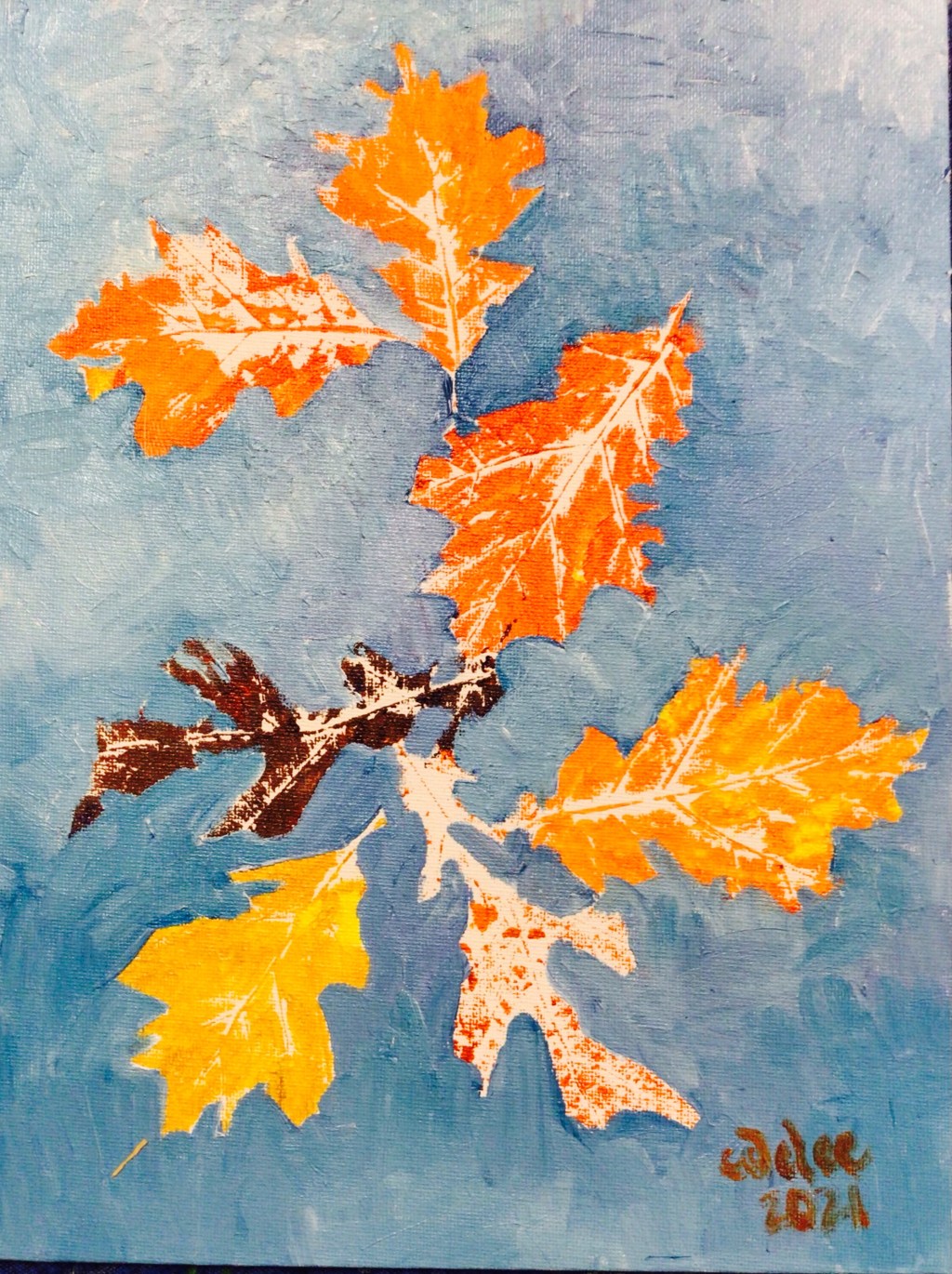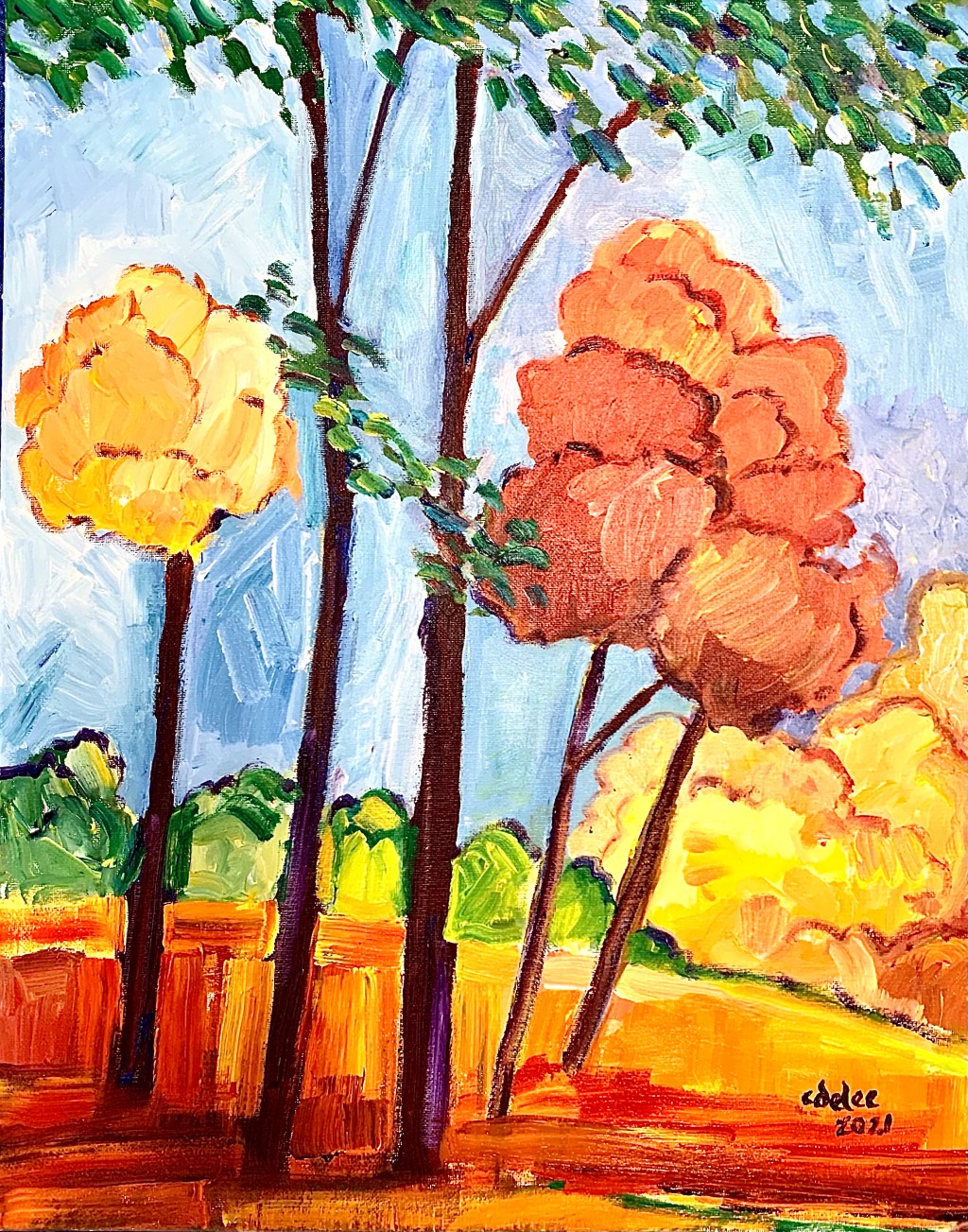
I returned from a spiritual retreat at Mount Eagle, at which we studied the Enneagram. This is our United Methodist camp site dedicated to holy listening. Of the nine spiritual personality types, I happen to be a Four: The Creative. I’m “The Sensitive, Introspective Type: Expressive, Dramatic, Self-Absorbed, and Temperamental.” Fours are self-aware, sensitive, and reserved. They’re emotionally honest, creative, and personal, but also can be moody and self-conscious. Fours sometimes feel vulnerable and defective, so they’ll withdraw from others, and they can also feel disdainful and exempt from ordinary ways of living. A Four typically has problems with melancholy, self-indulgence, and self-pity; but at their best, they’re inspired and highly creative, and they’re able to renew themselves and transform their experiences.
One of the things I’ve learned over my years of teaching art is every student is unique. They all aren’t Creative Fours, even if they have an interest in art. When I taught in schools, some of the students didn’t even have an interest in art at all. It was a requirement, and they were unwilling prisoners, who were set on rebellion because they knew they wouldn’t succeed. In most education classes, this would be true. Art education classes teach young teachers how to make lesson plans with distinct outcomes and a list of steps. This makes grading easy: did the student follow the steps and how close did their product match the model?
I don’t teach art this way. Children learn to walk by crawling, but they have to roll over and pull up first. Each step is an improvement over the first one. As long as a student keeps working and learning, their work will improve. We adults have to silence the judgmental voices in our heads that tells us, “You aren’t any good.” Instead, let’s listen to that inner voice of joy which says, “Wow, we’re having fun playing with the colors and making shapes appear—it’s like magic!”
We first looked at a few images of leaf paintings to get some ideas. Often by Friday morning, my brain needs some extra caffeine as well as extra jolts of creative input to get an inspired thought to percolate through the fog. We don’t all learn just by listening, but by seeing also. Sometimes students need a demonstration or hands-on experience to figure out the best way to use the materials. I always try to let them manipulate the materials themselves, since the best way to learn is by doing. This isn’t brain surgery, so we won’t harm anyone. We also won’t lose our salvation if the paint gets out of hand. We can always save our old works and say, “Look where I started from!”
Yayoi Kusama: Leaf painting (1990)
Tim was entranced by the Yayoi Kusama Leaf painting (1990), so he began to work on drawing a leaf in this manner. He’s recovering from carpal tunnel surgery, so smaller movements are better therapy for his hand.
Tim: Leaf drawing in progress
Not everyone is focused on details. Milton Avery is a modern colorist who simplifies the landscape into its essential elements. His trees often look like large leaves.
Milton Avery: Landscape with Trees
The bright colors of the autumn leaves in the landscape provided Mike’s color scheme for his one brilliant tree. Mike has exuberance in all he does.
Mike: Tree Aflame
Henri Rousseau was famed for his jungle scenes. These were green in every shade possible. He visited the botanical gardens in Paris for his inspiration.
Van Gogh favored yellow and orange, especially in his later years. The Mulberry Tree from 1889 is a lovely example.
Norton Simon Art Foundation, Pasadena, CA
Gail went outside to grab an actual leaf, rather than work from her imagination. She has a direct connection with nature, maybe because of her years with the national parks.
A leaf against our painting cloth
Repeating this leaf shape, she covered the canvas with it, allowing it to overlap in some areas and run off the edges in others. Using a monochromatic color scheme, she gave the illusion of shadows and light.
Gail’s Golden Leaves
Matisse sought to reunify humans with each other and with nature. As the great painter said, “What I dream of is a balanced, pure and quiet art which can avoid the trouble of frustrating subjects. This kind of art gives everyone’s mind peace and comfort, like a comfortable chair where they can have a rest when tired.”
Matisse: The Dance, 1909-1910
Viewers in Matisse’s day thought his brightly colored painting of dancers was quite daring, but today we can appreciate his work as an ode to life, joy and nature.
Cornelia: Dancing Leaves
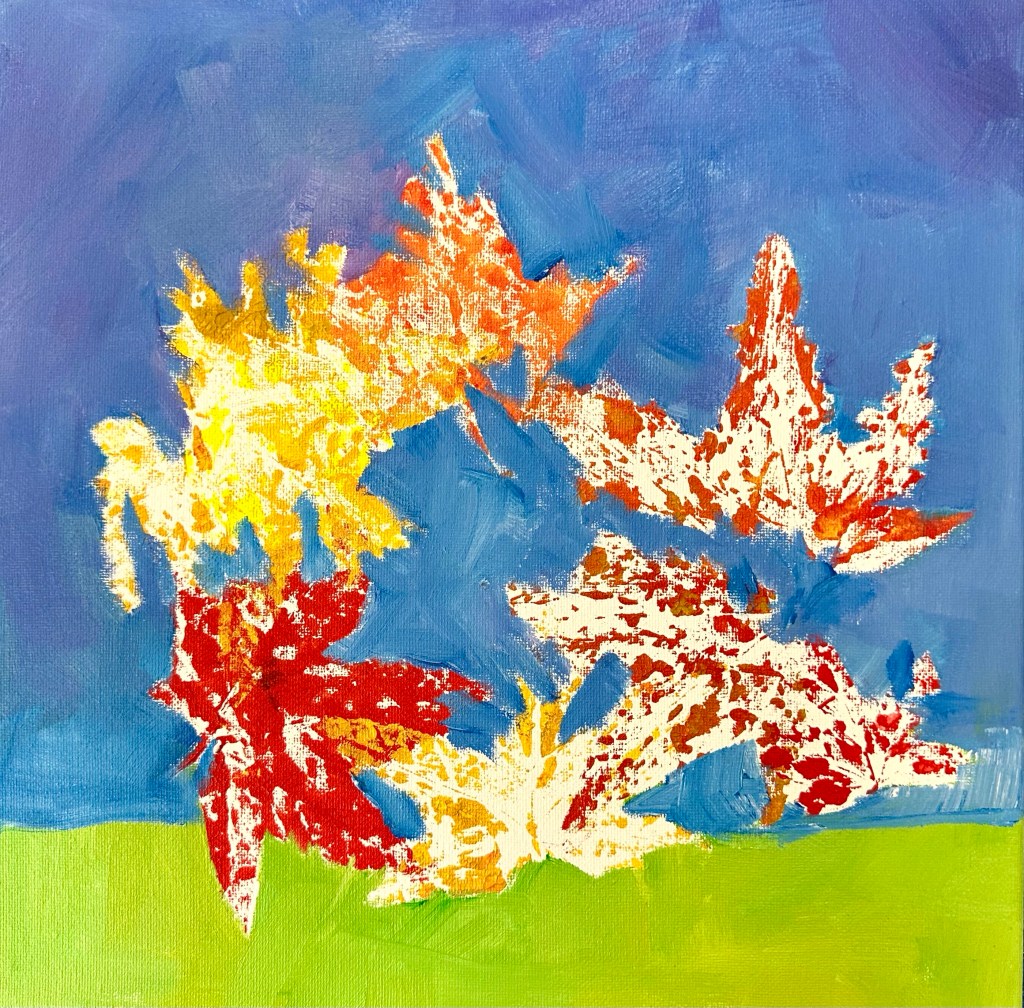
As I’ve been watching the brisk winds blow the gold and red leaves from the trees this fall, I’ve also watched them dance against the bright cerulean sky. When the sun shines on these dancers, they glow even brighter than before. They don’t have a care for tomorrow, much less for today. Now and this moment is enough for them. They remind me of the Lord’s advice to us on the Sermon on the Mount in Matthew 6:34—
“So do not worry about tomorrow, for tomorrow will bring worries of its own. Today’s trouble is enough for today.”
I painted the back side of the leaves with a thin coat of acrylic paint and laid them one by one down on the white surface of the canvas. Then I gently hand rubbed the top of each leaf until I thought I’d transferred the paint. The hansa yellow was least successful as a print color, so I over printed it at the end. I mixed the green ground with the cerulean blue and two yellows. The sky has cerulean, violet, Ultramarine, and white. These I mixed as I painted, so the sky wasn’t an even color. (All skies change color due to atmosphere and distance: they get lighter toward the horizon).
Next Friday we’re going to make stamp prints. You may have cut your own design in a potato once upon a time in scouts or used vegetables to make prints. We can also use leaves, natural materials, metal objects, or found objects to create prints. Art is a time to explore and experiment. We’ll find out what works and what doesn’t!! Curiosity and the willingness to experiment and explore are all aspects of creativity. We can all learn to stretch our boundaries and learn resilience, which are experiences that help us address the stresses and challenges of daily life.
I learn something new every day. Today I learned a starfish has a brain that covers its entire body. Its whole body is made up of brain nodes! There are days I wish I were a starfish: I would have loads of brain cells!
Joy, peace, and happiness to everyone!
Cornelia
Type Four: The Individualist — The Enneagram Institute
My parents would often say, “Time flies when you’re having fun.” If this is so, I’ve had a one whale of a time in 2023. I don’t know where the time has gone, for I’d swear I just woke up in the bright new year of 2023, and now this year has grown a beard of some length. Indeed, the ground was bare, awaiting the warm breath of spring, and now it has experienced its first freeze.
Autumn is a time of transitions. Not only do the trees change colors, and then lose their wardrobe altogether, but we rabbits go from Halloween’s sugar high on October 31st to overstuffing ourselves and the roast beast at the Thanksgiving feast on the Fourth Thursday of this new month. Then we segue into Christmas somnolence with yet more cookies and egg nog (spiked and plain). On occasion we tramp out to decorate the house or scour the woods for greenery, but those days are long gone for most urban dwellers. We’re going to buy from local providers or have it delivered online.
Some of us on the first day of November will still have some of the 35 million pounds of candy corn which are still produced each year. That’s about 9 billion pieces — over a billion more than there are people on Earth. As far as this bunny is concerned, this is 8,999,999,999 pieces of candy corn too many. I’m not a lover of this form of sugar; give me dark chocolate any day. Fortune reported the “dangerous” amount of sugar consumed by kids on Halloween — three cups of sugar in 7,000 calories of candy. For context: That’s 675 grams of sugar, or the same as chomping down almost 169 standard sugar cubes, according to a Fortune article published in 2017.
A Young Bunny
When I was a young bunny, sugar was so restricted in our home, my friends and I would escape our parents’ notice during fellowship time at church to go to the empty adult Sunday school classrooms. We knew where they kept the wonderful Domino Pure Cane sugar cubes for the coffee the grownups drank. We didn’t care for coffee, which was already gone, but the sugar we fell upon like pirates on buried treasure. We didn’t ever consume 169 cubes at once, since that would’ve destroyed the entire stash.
If these had been the 35 million pounds of candy corn, which are still produced each year for Halloween, neither I nor my bunny friend would have ever touched them. The idea about 9 billion pieces — over a billion more than there are people on Earth—are still produced today is incomprehensible to my bunny brain. I think the texture of corn syrup and gelatin isn’t my first choice.
Of course, when the weather turns colder, our bunny bodies sense the need to stoke our internal fires. We do this by consuming more calories, especially the quick acting carbohydrates we find in the sugars and starches that provide the instant “heat” boost our bodies crave. Actually, any food will heat us up, but fruits and vegetables don’t have the same appeal as warm, savory, and fatty foods do in colder weather. The shorter days and the decrease of light in the winter cause problems with our body’s biological clock and lower the levels of the brain chemical serotonin. Plus, many of us reduce our physical activity, so our exercise induced levels of serotonins drop.
Healthy Eating includes More Fiber
We can overcome this loss by planning to be outside during the daytime and making sure to exercise at least 30 minutes daily. Having protein rich snacks and fiber rich soups with complex carbohydrates will help control our hunger spikes. Perhaps this transition time into longer nights and shorter days is why the First Wednesday in November is always National Eating Healthy Day (November 1). If we do only one new healthy choice per week, and add a new healthy option each week thereafter, we can transition our lifestyle into “Eating Healthy.” As a bunny, I remind my friends, it’s also National Vinegar Day—have compassion on yourself and on others. We can love ourselves and others into a better life with kindness rather than harshness. As my grandfather Bunny always said, “You catch more flies with honey than vinegar.”
Day of the Dead Skull
All Saints Day and Dia de los Muertos both are celebrated on November 1. Both recognize the departed loved ones. All Saints recognizes both those who have worked miracles as well as those ordinary saints who have lived among us and given quiet witness to their faith. Dia de los Muertos, the Day of the Dead, is a three-day festival to remember the ancestors and friends who predeceased us. People decorate altars with marigold flowers, photos, and skulls in memory of the dead. They make special food offerings in their honor also.
All Soul’s Day on November 2 is a Catholic holiday to pray for the souls which aren’t yet in heaven, but are in purgatory. Protestants don’t believe in purgatory, so we don’t attend upon this day as holy.
Cookie Monster: “Me want COOKIES!”
Many of us do celebrate Cookie Monster Day on November 2, because who doesn’t like cookies?! The same goes for National Sandwich Day on November 3, for hot or cold, almost anything can be slapped between two slices of bread and get slathered with avocado or mayonnaise, and it’s good to go.
Sandwiches first appeared in American cookbooks in 1816. The fillings were no longer limited to cold meat, but the recipes called for a variety of things: cheese, fruit, shellfish, nuts and mushrooms. After the Civil War sandwich consumption increased and were sold both in high-class lunch rooms and in working-class taverns. A typical turkey sandwich in the 1980s contained about 320 calories, according to a report from the National Heart, Lung and Blood Institute. Twenty years later, a turkey sandwich contained about 820 calories. Choose whole grain bread if possible.
We seniors have more than time on our hand
“Fall Back” on Sunday, November 5, when Daylight Savings Time Ends. We get another hour of sleep on this day when the clocks go back 1 hour at 2 am. I won’t be awake to notice it, but I suggest those of you who aren’t good sleepers begin to look at your evening routines. Set a wind down time on your clock, watch, or mobile device. Let it remind you to turn on quiet music, read inspirational books, or begin your bedtime routine. Sometimes taking off our outside clothes and wearing our “at home” clothes is a signal to our mind to let go of the cares of the world.
Fighting over Van Gogh Pokémon Gifts at the Museum
Go to an Art Museum Today Day and National Chaos Never Dies Day are both celebrated on November 9 this year. I don’t normally consider chaos and art museums as being in the same category, but Disney has made several Night at the Museum movies that revolve around the trope of ancient Egyptian gods awakening to cause havoc. Actual chaos recently erupted at the Van Gogh Museum in Amsterdam when visitors realized the gift shop had already sold out of the Pikachu with Grey Felt Hat promo card, which was modeled on the Vincent self-portrait. Evidently a small group of fans descended on the gift shop, causing a ruckus, and buying out the merchandise. It’s now for sale on eBay.
2023 Veterans Day Poster
Armistice Day marks the November 11,1918 anniversary of World War I, a war which began in August 1914, that few expected to last beyond Christmas. In 1921, an unknown soldier was buried in Arlington National Cemetery. This First World War was “the war to end all wars,” but we’re an overly optimistic nation. We’ve had a Second World War since then, plus many a regional conflict. Every time our battle ships show the flag somewhere, people think it’s going to be WWIII. Fear mongering doesn’t help the nation. We’re better and stronger than that. Plus, we have the moral duty of leadership: our country needs to show the world there’s a better way.
As I recall, both the North and the South expected the great Civil War to last just a short while, just as Putin entered Ukraine believing his army would roll into Kiev in mere weeks. Yet WWI lasted four years, WWII was six years (the US was involved only the four years from 1941-1945), and our Civil War was another 4-year slog. Wars aren’t so much “won” as lost by attrition: one side loses more men, materiel, and willpower so they surrender to the other. War is the most brutal way to settle our differences.
Armistice Day now is Veterans’ Day, November 11, but observed a day earlier (10th) this year. We celebrate our veterans who do the difficult and challenging work of using judicious force against enemy combatants, rather than civilian populations. All of our enlisted personnel take the same oath to protect and to defend our Constitution against all enemies, foreign and domestic:
I, (state name of enlistee), do solemnly swear (or affirm) that I will support and defend the Constitution of the United States against all enemies, foreign and domestic; that I will bear true faith and allegiance to the same; and that I will obey the orders of the President of the United States and the orders of the officers appointed over me, according to regulations and the Uniform Code of Military Justice. (So help me God).”
The US Constitution, 1787
We are an unusual people, we Americans, for our loyalty isn’t to a party, a president, or a person. We are loyal to the constitution, which protects our democratic institutions, values, and freedoms. We can be thankful for those who were inspired to write it, heard the prophetic call to amend it, and have the wisdom to keep us on the straight and narrow.
National Hunger and Homeless Awareness Week is November 11-19 this year. While the economy is recovering, the loss of pandemic assistance funds Is hurting lower income households. They are making hard choices: food or rent, medicine or food. The number of homeless veterans has decreased, but so has the overall population of veterans. The bad news is veterans are still overrepresented in the homeless population. As you prepare for your own feast this year, I hope you remember the hungry in your community. The best way to help is with a financial donation to the local food bank. The bank can purchase food from the warehouse food bank at greatly reduced prices, thereby providing more food per dollar than individuals can purchase on their own.
World Diabetes Day is November 14. Diabetes is a disease on the increase in the world today. In the US alone, over 37 million people have this disease and over 8.5 million have it but are undiagnosed. Over 96 million US adults have prediabetes, a condition in which their insulin doesn’t take the sugar out of the bloodstream well. Switching to whole grains, less processed foods, and adding more fiber to the diet usually helps lower the blood sugar. So does daily moderate exercise.
National Clean Out Your Refrigerator Day is November 15. This is a good day to practice this task, since you’ll be filling it up with excess foods if you’re hosting the feast, or you’ll be traveling away from home. If the latter, you don’t want to return home to spoiled food if the power goes off for any length of time. Ugh: I won’t regale you with the story of stench of the refrigerator in the garage which didn’t power back on after a power outage. Those outlets need to be reset manually because they’re in a “might get wet” zone. The refrigerator inside will come back on automatically. (This turned out to be a get rid of the refrigerator day.)
National Stuffing Day is November 21. If you bake your bread mixture outside of the great bird, it’s called dressing, but if you cram it into the bird, it’s stuffing. It’s safer to cook the bird without stuffing, also quicker. When baking stuffing inside a turkey, it can get get wet and mushy. If you make a flavorful stock from the turkey neck and giblets, you can make your stuffing moist and flavorful without turning it into mush.
If you live in a giant pumpkin, buy a smaller pumpkin for your pie
Pumpkin Pie Day is also November 21, so you can prepare this ahead of time if you wish. You can make a handmade crust or use a store-bought crust from the grocery. Pre bake it and fill it with the pumpkin mixture.
National Cranberry Relish Day is November 22. You can easily make your own with the juice of an orange, some sugar to taste, and cinnamon combined with a package of rinsed cranberries. Heat over medium in a saucepan, stirring frequently to keep from sticking. When the berries burst, reduce heat to simmer and reduce the liquid. Taste and adjust the seasoning. Take off the heat and put into container for icebox. Chill overnight to let seasonings combine. Serve cold as side dish.
Thanksgiving Day is Thursday, November 23. You’ve baked the turkey, and it smells amazing! Let me introduce you to pan gravy from the drippings. You need a little flour, about 2 Tbs; some pepper, about ½ cup of drippings, and 1 cup of hot water. Put the drippings in a heavy saucepan or skillet, add the flour, stirring constantly over medium high heat until flour turns caramel color. This is a medium roux. Slowly add hot water, stirring so no lumps form. Keep stirring till smooth, reducing heat. Add more water slowly if gravy thickens too much. Pepper and salt if necessary.
The idea of “thanksgiving” for the harvest is as old as time, with records from the Egyptians, Greeks, and Romans. Native Americans in North America celebrated harvest festivals for centuries long before Europeans appeared on their soil and before Thanksgiving was formally established in the United States.
In the 1600s, settlers in Massachusetts and Virginia had feasts to thank for surviving, fertile fields, and their faith. The Pilgrims in Plymouth, Massachusetts, had their infamous Thanksgiving feast in 1621 with the Wampanoag Native Americans. The three-day feast consisted mainly of meat: wild fowl procured by the colonists and five deer brought to the feast by the Wampanoag. A a stew called sobaheg was most likely served as a side dish to the main course. It was an easy way to make use of seasonal ingredients, for the stew often included a mixture of beans, corn, poultry, squash, nuts and clam juice. All are used in the traditional dish today, and all would have been available in 1621.
Potatoes weren’t around in 17th-century New England, but corn was plentiful. Natalija Sahraj
Corn and cornmeal were the main carbohydrates on the first thanksgiving meal. The first New England crop of potatoes was grown in Derry, New Hampshire in 1722, so no mashed potatoes were on the menu. Corn bread, corn mush, and corn puddings abounded, since the Native Tribes had shown the colonists how to plant beans, squash, and corn together to maximize growth of all three. The harvest of 1621 likely included beans, squash, onions, turnips and greens such as spinach and chard. All could have been cooked at length to create a green, pulpy sauce that later became a staple in early New England homes. Sweet dishes concocted from sugar or maple syrup weren’t on the menu, nor were honey sweetened deserts. At least, the Pilgrims didn’t have to save room for pie.
After the Pilgrims, for more than two centuries, individual colonies and states celebrated days of thanksgiving. The first national celebration of Thanksgiving was observed for a slightly different reason than a celebration of the harvest—it was in honor of the creation of the new United States Constitution! In 1789, President George Washington issued a proclamation designating November 26 of that year as a ”Day of Publick Thanksgivin” to recognize the role of providence in creating the new United States and the new federal Constitution. During the Civil War, President Lincoln called for a national Thanksgiving Day on the last Thursday of November after the Battle of Gettysburg. In the Great Depression President Franklin Roosevelt moved Thanksgiving Day to the next to last Thursday in November. After two years of public unhappiness, Congress passed a law in 1941 setting Thanksgiving on the fourth Thursday of November.
Thanksgiving, 1858, by Winslow Homer, Boston Public Library
During the week of Thanksgiving, from November 19-25 or 26, we have the holidays of Church/State Separation Week and National Bible Week. If you haven’t been giving thanks for your blessings up to this time, take a break, breathe, and rejoice that you are alive. Give thanks for your hands, your food, your breath, and your heart of love. Share this thanksgiving with someone else. If each of us gives a bit of hope to someone else, we can help others have something to be thankful about.
Chocolate answers all questions.
After the rush of Thanksgiving, some of us bunnies may need medicinal chocolate. November 29 is Chocolate Day. Depending on your personality, you can buy fancy chocolate to share, or you can enjoy it by yourself along with a good book and some lavender tea. If Thanksgiving Day was really overwhelming, National Personal Space Day on November 30 might be calling your name. We all have times in our lives when we don’t need hugs, either because of physical or emotional distress. Besides, we bunnies need to catch our breath before we dash into the Christmas season.
I’m thankful for each of you who read and share my stories.
This week as I recovered from cataract surgery, a memory from my childhood finally surfaced. In the late 1950’s in my hometown, I had met an artist who could barely see to paint anymore because of her vision loss due to cataracts. Doctors hadn’t yet invented the modern replacement lenses and use of small incisions for implantation. Complications back then were common, rather than rare. I can still remember my dad’s response to my desire for contact lens, “What? Put a foreign object in your eye? You’re asking for an infection!” Perhaps this was why I worried myself to exhaustion while waiting for my first surgery.
Unknown Artist: Inlay in the Form of an Eye, Glass and gypsum, Egypt
As it turns out, I can now see my television set without my glasses and I read my iPad with my untreated eye. I’ve always had my glasses within arm’s reach of my bed or my chair for over sixty years. It feels strange not to put them on first thing in the morning.
If there were things I could not see before, I could always feel them if I were still enough to notice their subtle movements. Most of the time I, as many others do, stress over what “might happen,” instead of being present to the moment in which the important stuff is actually happening.
Luke Howard: Graph of wind, rain, and temperatures from 1815-1832
After I worried myself into an exhausted heap on my couch, I woke up in a different mood. I realized I’d been going “from house to house” to borrow a cup of trouble for a cake I didn’t need to bake or eat. It was going to be a decadent cake with multiple layers and a. rich icing. If it were autumn, I’d probably get first prize in the cake competition at the state fair.
Wayne Thiebaud, Cakes, 1963
But no one needs a Trouble Cake. I saw all my ingredients were as nothing, for I had a great doctor, people who would care for me, and this was a new age in medicine. Moreover, the Spirit of God would sustain me in my recovery and remind me my wellbeing depends on following my doctor’s instructions. As we read in John 3:5-8 NRSV—
Jesus answered, “Very truly, I tell you, no one can enter the kingdom of God without being born of water and Spirit. What is born of the flesh is flesh, and what is born of the Spirit is spirit. Do not be astonished that I said to you, ‘You must be born from above.’ The wind blows where it chooses, and you hear the sound of it, but you do not know where it comes from or where it goes. So it is with everyone who is born of the Spirit.”
Sometimes we need to feel the wind and not try to know from whence it comes or why it goes, but merely thank it for arriving to be with us in this present moment.
Utagawa Hiroshige: Yokkaichi: Mie River, 1833-34
Who Has Seen the Wind? by Christina Rossetti
Who has seen the wind? Neither I nor you: But when the leaves hang trembling, The wind is passing through.
Who has seen the wind? Neither you nor I: But when the trees bow down their heads, The wind is passing by.
Sometimes we need a fresh wind blowing through our hearts and minds to get a new outlook on life. We can’t be wedded to the past like the old farmer who said of the new fangled plow he saw at the farm supply store, “My daddy plowed with a two pronged plow, so a two pronged plow is good enough for me.” He never bought the new and improved three pronged plow.
Bernard Evans: Cannock Chase – ‘When the sweet wind did gently kiss the trees, and they did make no noise’, circa 1885
Much like the church that can’t recognize the fresh movement of the Spirit moving through the world today, if we can’t feel that wind, maybe cataract surgery would help us see the movement in the leaves.
Joy and Peace,
Cornelia
NOTE: The Greek word for Spirit and wind are the same: πνεῦμά. Strong’s Greek Concordance 4151 pneúma – properly, spirit (Spirit), wind, or breath. The most frequent meaning (translation) of 4151 (pneúma) in the NT is “spirit” (“Spirit”). Only the context determines which sense(s) is meant. When used with Holy, the word is Holy Spirit, not holy breath!
Utagawa Hiroshige: Yokkaichi: Mie River (Yokkaichi, Miegawa), from the series “Fifty-three Stations of the Tokaido (Tokaido gojusan tsugi no uchi),” also known as the Hoeido Tokaido, wood block print, 1833-34, Art Institute of Chicago.
Luke Howard: Graph detailing prevailing wind directions, rain depth, and mean temperature over a period of eighteen years, 1815-1832, in London. The Royal Society.
Bernard Evans: Cannock Chase – ‘When the sweet wind did gently kiss the trees, and they did make no noise’, circa 1885, watercolor. Art Gallery of New South Wales, Sidney, Australia.
Unknown Artist: Inlay in the Form of an Eye, Glass and gypsum, Egypt, (9/16 × 1 13/16 × 3/8 in.), 1540–1070 BCE, J. Paul Getty Museum, Los Angeles, CA.
Wayne Thiebaud, Cakes, 1963, National Gallery of Art, Washington D. C.
Are we our works? Are we valued by our works? Is work a noun or a verb? The child in me asks these questions until the parent in me wants to answer, “I don’t know. Go ask Alexa!”
Alexa Meme
We’ve all been there with the rug rats of our families and kinfolks. Children are curious and for this we’re grateful. This incessant questioning is their way of learning about the world. It’s altogether better than a puppy’s chewing on every new object it comes across. If families are to encourage their child’s interest, they get them a library card so they can have internet access and books to read, and they answer as many questions as possible. If they don’t know the answer, “Go look it up in Google or the encyclopedia.”
In ancient Greece, Socrates taught by asking his students questions, a technique we call the Socratic Method. Some of us teach art in this way also. When we see the student at a stopping point, we teachers ask, “Are you having a problem and not figuring out a solution?”
Raphael: School of Athens , Vatican City, 1509-11.
The student can usually point out what they want to change on their work, but they don’t have the experience or prior learning to drawn upon to solve it. For instance, if the flower petals all look flat because they’re painted in one color, the beginning student knows this doesn’t look right, but they need a trained eye to point out the variety of values in the petals. Once they see the gradation of light to dark, it’s never again unseen. We know it’s there.
Teachers can point out the range of values from dark to light that make up the visual vocabulary of shading a two dimensional image so it looks like a three dimensional shape. Students can learn this technique and master it over time. Mastery then becomes a matter of hand and eye coordination. In a sense, we have to lose ourselves in the subject matter so we can let its energies enter into our hearts and minds, and quicken our hands. The rest is a matter of practice and learning how our egos can quit controlling the outcome.
Old Farmland off Higdon Ferry Road
The spiritual writer and Jesuit priest Richard Rohr speaks of the three eyes in his book, The Naked Now. The first eye grasps what the senses can understand, the second eye understands the science and poetry, while the third eye is aware of all of the above, but especially how all things connect as part of God’s great mystery. When we enter into this “now,” we’re present not only to God, but to all creation, as well as our own selves. This is the contemplative spirit for which the artist strives, and not just for the mastery of the materials or for the rendering of the subject matter.
If we allow this energy to move our hands, does that mean our work also becomes part of us? If we baked a simple yellow cake out of a box, we might not ask that question. When we start decorating a cake made from scratch and adding frillies of frosting, then we start identifying with the cake. Should someone smash the cake enroute to the soirée, there’ll be hockey sticks to pay.
I remember almost fainting in Italy when I saw a glue blob on one of my delicate watercolor paintings, which had just been framed for an exhibition there. A stiff shot of some unknown alcohol brought me back to life. The framer made it good, for the glue was water soluble, so we could gently lift it up. I was more of a drama Queen in my 20’s also. I take things as they come these days. I also was more immature, for I didn’t separate my work from my identity.
Some say we are what we eat, so then are we what we create? Jesus had an answer in Mark 7:18-19 for those who thought certain foods were unclean, or forbidden to eat:
“He said to them, “Then do you also fail to understand? Do you not see that whatever goes into a person from outside cannot defile, since it enters, not the heart but the stomach, and goes out into the sewer?” (Thus he declared all foods clean.)”
That fancy dinner we ate two nights ago leaves us after a few cups of coffee in the morning. We don’t recognize it and most of us don’t even inspect it as we flush it down the toilet on its way out the sewage pipes to the sanitation station. Of course, only parents can get excited about their two year olds who manage to do their “business” in the toilet instead of in their diapers. I know I was one of those. If Facebook had been invented back in the day, I’m sure I’d have posted an update.
As we grow older, we enjoy making and crafting for the experience of the textures and the command of the materials. Children have fun pushing the paints, papers, and glue all around the surface of their artwork. Parents often look askance at the grey, scribbled messes their children excitedly present to them for the honored place on the refrigerator display, but these muddy creations are the result of a dramatic story of their child’s imagination. “Interesting, why don’t you tell me what’s going on here?” Is an adult’s best response in this situation.
Art Lesson: Cut a Snowman on the Fold
I’ve had kindergarten children meltdown because they had difficulty cutting a snowman on the fold. It’s hard to be five years old and live in a home in which the parents don’t want their children to make a mess. These children, as a result, have poor fine motor skills, have difficulty writing, and handling scissors. Even folding a piece of paper is tough. Then they miss the important information: hold the fold, and cut on the flaps. If they hold the flaps instead, they end up with two halves of a snowman. And a meltdown into tears.
“I’ll never be able to make a snowman! My snowman is cut in two pieces. Why can you make a perfect snowman and I can’t?”
Therapy Hat
This lesson always called for me to wear my therapy hat, and remind my five year old students I’d been making folded snowmen for a very long time and my first ones looked just like theirs did. There was hope for them. We just needed to go over the directions again and make one together. Sometimes we miss a step, and that’s ok. It’s just a piece of paper. It’s not like we took away recess from everyone forever.
Usually when we went over the directions again, I could remind them of the way to hold the fold and cut the flaps. Then they’d all be amazed at how easy the project was. “Everything is easier when you follow the directions.” They’d laugh and start decorating their snowman, all their meltdowns forgotten.
Most of us aren’t successful the first time we attempt a new experience. If we were all extraordinary artists right off the mark, none of us ever would get excited about Michelangelo, Rembrandt, or Picasso. If we could all pick up a musical instrument and play it well right off the bat, who’d have the need for civic symphonies or even bar bands? We’d all be happy making our own music. The truth is some of us not only have the interest and inclination, but also the will to spend not just hours, but years, honing our craft, until we sing our notes purely or paint with a master’s hand.
Woven Canvas: Greenway Park
If we all aren’t masters, we all can enjoy the journey if we learn to detach our egos from our products. When I wrote papers in seminary, before I opened up my graded work, I’d repeat the mantra, “I am not my grade. I am a daughter of the living God, chosen for God’s work.” Then I’d look at the markings on the inside. This helped me to remember who I was, whose I was, and what my purpose was. I was also two decades older than that fainting child in Italy.
As I would tell visitors to Perkins, “If your well-being is wrapped up in your grade average, you might want to rethink either that notion or choose another school.” “Oh, really?”
“Yes, if you’re going on for a PhD, you’ll get over a 90 in your classes. The top grade for the Mdiv is 89. If you get any grade higher than that, the professor thinks you could do PhD level work.” “That doesn’t seem right,” they said.
“It’s a curve. If you go elsewhere for a DMin, those schools know Perkins’ grading system. Think of it as an A at 89 and don’t worry about it.”
Some people can’t restructure their world so their 89 is an A, but if that’s the system they’re in, that’s how it is. If they have in their mind nothing less than a 95 will validate their worthiness, then if they do their degree work at Perkins, they’ll always be up against the immovable wall. When they go out into ministry, they’ll discover everyone they meet has a grading system. That can drive a person crazy, unless he or she decides the ultimate approval they seek comes from the one who says, “Well done, good and faithful servant.”
Likewise, if we’re beginners in art, we have to suspend our criticism of our imperfections in our work. Instead, we reframe our critiques into “areas which need improvement.” Even now, after decades of working in my studio, I’ll let a canvas rest near me in my living room. I’ll eye it in different lights, until I hear it call my name. I’ve totally repainted some of these, and others I’ve destroyed. A few I leave alone. All of us will keep learning something new, both from our “good paintings “ and our “need improvement works.” Most likely, artists quit painting when they they think they have nothing left to learn, or when they lose the courage to risk moving into the unknown mystery, as it’s written in 1 Corinthians 2:9—
“What no eye has seen, nor ear heard, nor the human heart conceived, what God has prepared for those who love him.”
Paul also writes in Romans 8:27-28,
“And God, who searches the heart, knows what is the mind of the Spirit, because the Spirit intercedes for the saints according to the will of God. We know that all things work together for good for those who love God, who are called according to his purpose.”
Poverty Point World Heritage Site, Louisiana
So we too ask the Spirit to work more in us and free us from attachment to our need to be loved and affirmed by our works, since God is already working for good for those who love God and who are called according to God’s purpose. As we drop our old ideas and preconceived notions of the good, we become open to God’s good and God’s purposes. Releasing control to God is an act of humbleness and faithfulness, both of which are contrary to our modern belief in self-actualization and autonomy. This is the way of the mystic, or the contemplative, and the inspired artist.
Cities are growing organisms, each having their central growth from their place of origin. Some begin on a waterfront, as a place of trade. Other communities began along a creek, where people would meet to connect, trade, and settle differences in peace. These were safe spaces, welcoming places, but they existed only so long as everyone acknowledged them.
In our cities today, safe spaces are rare. Some reasons are we don’t know everyone anymore, since our populations are so large. We don’t know who to trust, so we trust no one. If we’re anonymous, we think can do what we want, since no one knows who we are and we don’t know whom we harm. Of course, this is absurd, for if we do harm to another, we aren’t living out our best life, not to mention we’re not living out the wisdom of “Do unto others what you want done unto yourself.”
“Who knows what lurks in the heart of man?” the old radio program asked. “The Shadow knows,” was the answer. Most of what we know as the city is hidden behind the layers of paint, wallpaper, and various accretions of dust in our historic district. In Hot Springs, we can eat hamburgers in buildings where mobsters would hang out, walk the streets where old time baseball players strolled, and take hot baths where our ancestors took the “cure” for every disease known to humankind. They got clean, but the cure didn’t take.
Autumn Facade, Downtown Hot Springs
We have a civic interest in renewing our old buildings, for they attract tourists and provide incomes for owners and workers in our restaurants, shops, and hotels of all sizes and qualities. We have dive bars and first-class accommodations within a mile of each other. This is a sure sign of a community in transition. I won’t name either, but if Hot Springs were to be the setting of an old-time radio show, it wouldn’t lack for interesting characters or venues.
During this pandemic era, for it’s stretched long enough now to be called such a lengthy time, I’ve been working on a group of cognitive maps. A cognitive map is any visual representation of a person’s (or a group’s) mental model for a given process or concept. Cognitive maps have no visual rules they need to obey. There’s also no restriction on how the concepts and the relationships between them are visually represented. If we were to take a number of people to the same place, we’d most likely end up with the same number of maps. Some parts might overlap, but everyone would notice different aspects of the landscape.
My own cognitive maps start with a screen shot of a google map of a place I’ve been prepandemic, and work in process through sketches, then several layers of paint, and finally, the end product. This last stopping point sometimes comes only after I think I’ve finished the painting, but I leave it sitting out where I can look at it some more. In the looking, I discover, I’m not ready to release this image out to the world. It lacks unity, power, focus, or some other defining quality I can’t put words to. I only know I am unhappy with it the longer I look at it.
When I cook a recipe, I have a certainty if I follow the directions, I measure correctly, and my oven is true to temperature, I’ll come out with a good approximation of the original recipe. Afterall, I’m recreating someone else’s process and instructions. Making something new, from the imagination is part of the creative process. Sometimes the end product arrives easily, but other times, its birth is a struggle, and the child arrives crying to beat the band.
Creekside Landscape, Hot Springs, 2021 springtime
Most of us are used to seeing the landscape from our upright view, for we walk through our world with our head up every day as we reconnoiter along our daily paths. Some of us keep our heads buried in our phones, so we depend on the good nature of others to keep us from bumping into them, or these people must have particularly good side vision to avoid collisions with other walkers. We don’t have the bird’s eye view of the city, so we don’t see how the streets connect or how they follow the elevation changes. We also don’t get to see the patterns of tree growth, or the hidden waterways. Mostly we have a patchwork vision of just the immediate areas we inhabit, but not a vision of the whole.
Greenway Park Map: Apple Pencil Drawing on Google Map
I saved a screenshot to my iPad so I could draw on it. Color for me has emotional energy, so as I drew, I over laid the first colors with others. The changes the drawing went through prepared me for the changes through which the painting would transition. This pandemic has certainly been a time of change, but life has always been changing. One of my old friends always said, “Human beings are meant to change. We’re brand-new people every 27 days! That’s how often we get a whole new skin.”
I spent many years in the church, an organization not noted for changing. It’s not the organization that doesn’t want to change, but the people. We find those same people resistant to change in NASCAR fans, football fans, and any other group you want to name. As one wag said, “It was the 56th Super Bowl and they finally had rap music in Los Angeles, and NASCAR had Pit Bull at the LA Coliseum for the Clash for the first time in 43 years. If you have a point, it’s time to make it.” If we don’t like change, we should quit washing our bodies, since we’re just hurrying those dead skin cells off to their final demise.
First Stage of Greenway Park Map Painting
Artists must embrace change, however, for the moment we put a mark on a canvas or tap a stone with a chisel and hammer, we’ve changed the surface before us. We can’t be afraid to go into the emptiness or the unknown, for there we’ll find the beauty of the unspoken or the hope of the silence in which we work.
This stage of the painting adheres closely to the drawn image. The blue streets define the city blocks and a few building shapes are notated. It’s a complicated street map from one of our older sections of town.
Second Stage of Greenway Park Map Painting
On this repainting, I balanced the colors better, but kept the greens and oranges. I signed it, for I thought I was “finished.” I set it down in my living room to observe it for a while. I often do this with my work, for if it still looks good after six months, I think it’ll survive for a year. If it lasts a year, I think it’ll last longer. If I look at it three years later and it doesn’t survive, I’ll destroy it. This was painted during the winter, with the worst low light of the season. No wonder it looked grim under the brightening light of the returning sun.
Final Stage Greenway Map
Some sunshine has come into my life here in the middle of February. I’m very sensitive to the transition of light across the seasons, so when it begins to leave in October, I start shutting down. When the light begins to return again, I awake, as if from a hibernation. Perhaps this is the reason I took all my yellows and reds and overpainted the other colors on the canvas. Now my canvas is almost monochromatic, except for small streaks and blobs of color in places. You can still see the city blocks and streets, but now the over all feeling is less of a map and more of an energy record of the city area.
This is the city as it grows, as it lives, and as it changes. The dynamics and life blood of the city move and pulse as it transforms. Hot Springs is unique in that we keep as much of our old as possible and build new when we must. I’m thankful for this city, for its love of the arts, and its honor of its history, as well as its embrace of the future.
After all, that’s all any of us can do, is remember who we are, whose we are, and give thanks to the one whose steadfast love remains forever.
As the days grow shorter, the pile of leaves grows larger. This is Einstein’s equation for autumn. I know “Energy equals Mass times the speed of Light squared” isn’t really congruent with all those bags of leaves accumulating on the edge of the streets of the front yards in your neighborhood. It just seems that way. When I bought my first little stucco, flat roofed house back in my hometown, the former owners reminded me at closing, “Be sure and rake the roof every autumn.”
Of course I forgot about this, until the twenty something major trees around my little flat roofed house dumped all their leaves on my roof. How did I know? When it rained, those leaves blocked the drainage holes, so water came inside the ceiling light fixtures of my kitchen in the back of the house. As soon as the rain quit, I had the ladder out and was filling the big, black garbage bags with soggy leaves. If you only fill them half way, they’ll stay intact when tossing them over the parapet. I was younger then, and trainable. I didn’t forget when autumn came the next year.
Gail’s Leaves floating on Water
I’ve always thought leaves “fell” off the trees or the wind blew them off, but I asked Mr. Google, “Why do leaves fall?” Turns out, the trees cut them off with scissor cells. The leaves are only useful for making food for the tree. They are the seasonal kitchen staff, so the tree lets them go for the winter and brings in a new crew in the spring. The changing light and cooler temperatures triggers a hormone that makes this happen.
The scissor cells are stained red and mark the boundary between the branch (left) and the leaf stalk. University of Wisconsin Plant Image Teaching Collection
If the leaves stayed on the tree, they’d wake up during a winter warm spell, start their food production work, and then get frozen when the cold inevitably returns. The tree knows the lifespan of the leaf, and this is the natural course of the life cycle. New growth will come in the spring, after a period of rest and recovery.
Lauralei’s Memories of The Leaves that Were
Our holiday season coincides with darkening days and marketing excess. Most of the commercials show happy families with lots of presents in heavily decorated holiday environments. Statistics show 25% of people are estranged from their families, and one out of every 463 Americans alive at the beginning of 2020 has since died of covid-19, the disease caused by the novel coronavirus. About 1 in 8 Americans say that a member of their family died of the virus; another fifth say that they lost a close friend, according to YouGov polling. These are staggering numbers, for in the US alone, 779,293 people have lost their lives as of November 30, 2021. One too many Thanksgiving tables had an empty place setting for a loved one no longer among us, and this will be a blue Christmas for many families.
If this were a war, maybe folks would get all excited and consider good health practices such as mask wearing , hand washing, and vaccinations their patriotic duty. Instead, they throw themselves into the breach of a thousand tiny viruses as if they were seeking the congressional gold medal for valor, and end up leaving their families with nothing but medical bills, grief, and the loss of their presence. Into this weary season comes Omicron, yet another variant, but an expected event due to the lack of worldwide access to vaccines and the virus’s ability to mutate in immunocompromised individuals. The enemy keeps evolving and the battles continue, whether we’re weary of the struggle or not.
“The Falling Leaves,” by Margaret Postgate Cole of England, is one of the first anti-war poems from a woman’s perspective. It was written in November 1915, during the First World War, when from 1914 to 1918, Flanders Fields was a major battle theatre on the Western Front. A million soldiers from more than 50 different countries were wounded, missing or killed in action there. Entire cities and villages were destroyed, their population scattered across Europe and beyond. The tradition of poppies on Veterans Day came from the red flowers given life from the blood spilled on this battlefield. COVID today is exacting it’s own cruel battle toll, with children left orphaned and spouses left without their mates. The adverse affects on this generation may be equal to those who went through the great flu pandemic of 1918 or the Great Depression.
War may be necessary in some instances, but it’s never to be glorified. There’s always a sadness related to the loss of life, regret over the great expense poured out that might have been used to build rather than destroy, and the cruelties that attend actions when we make others into evil enemies and refuse to see them as human as we are. Her poem speaks poignantly to this human loss:
Today, as I rode by, I saw the brown leaves dropping from their tree In a still afternoon, When no wind whirled them whistling to the sky, But thickly, silently, They fell, like snowflakes wiping out the noon; And wandered slowly thence For thinking of a gallant multitude Which now all withering lay, Slain by no wind of age or pestilence, But in their beauty strewed Like snowflakes falling on the Flemish clay.
Source: Margaret Postgate’s Poems (1918)
If we want to treat these end of year days as “days of denial” of all that’s grim in the world to focus only on the good and the light, we’s be like people who claim we have no shadow. Carl Jung believed the shadow included everything in the unconscious mind, good or bad. Also, the shadow might include only the part of the personality that you don’t want to identify as self, but still is a part of your unconscious mind. This dark side of your personality contains everything your conscious mind can’t admit about itself.
When we read the birth story of Jesus, we often focus on the angels and the gifts of the magi. We forget these heavenly hosts are God’s armies and the magi came to meet the new king. These were revolutionary acts that caused King Herod to feel insecure and threatened, so he slaughtered the innocent babies born at this time. The Bible never forgets this shadow side of life, for this is why Christ came into our world:
“to give light to those who sit in darkness and in the shadow of death, to guide our feet into the way of peace.” ~ Luke 1:79
The saying is true: “If nothing ever changed, there’d be no butterflies.” Yet how hard do we humans hold to the past, even if we need to move on into the future? As an artist, I’ve always been caught between my desire to honor the traditions of the past, but also to move into the the unknown realms of the future. Artists already have a vocabulary and boundaries to describe the works of the past, so we can tell if our current works “meet the criteria for excellence.”
Found Object Butterfly: roadside debris, wire, scrap cloth, and metallic beads
When we go beyond this known world into the uncharted territories, we’re like Columbus, who landed in the Caribbean islands, but thought he was on the continent of North America. I wonder if the monarch butterfly, just emerging from the cocoon, has any idea it soon will begin a 3,000 mile migration to its ancestral winter home in Mexico. The butterfly has the innate ability to navigate this path, whereas we humans are like Abram, for we’re going to a land our God will show us. We have no idea where we’ll end up, but we do know we’ll travel by stages and God’s guiding inspiration will always be with us.
During this current protracted COVID pandemic, with cases beginning in mid December 2019, we’ve now lost over 766,206 persons in the US alone and over 47,390,239 individuals have had COVID. Worldwide, the numbers are far greater: over 5 million have died and nearly 255 million have contracted COVID, mostly because vaccines and health care services aren’t available to the extent they are in America and the European Community. Not only has our world as a whole suffered a great grief, but each of us individually have lost friends, neighbors, or loved ones. This adds to our collective grief.
Airport Road at MLK Hwy Intersection, empty lots
When we see the rest of our world changing around us, we feel another loss, and this becomes the grief leading to the death of a thousand tiny cuts. Just as in our workplaces, when the ideas of the young, the female, and the ethnic individuals aren’t valued, their dismissal leads to devaluation of their perspectives as well as their personhood. When we devalue nature and treat creation as an arena for humanity to restructure for our purposes alone, we can fall into the trap of thinking only for our immediate future, but not for the generations to follow. This is why building lots inside the city get cleaned off and offered as a blank slate, since this makes them valuable to the greatest number of buyers.
Death by a thousand cuts was supposedly a form of torture in ancient China. It was reserved for the most heinous crimes, such as matricide, patricide, treason, and the like. From all the tiny slices, the accused finally bled to death. It was a cruel and unusual punishment, rather like flogging the back of a law breaker until the flesh was raw, but this punishment was intended to cause death because the executioner kept at it until he succeeded.
Most of us are blissfully unaware of the loss of a few trees here and there in our neighborhoods. Sometimes we even want to cut down the trees on our own property because we’re tired of raking leaves every fall, or if we have a magnolia tree, we’re tired of our year round duty of leap reaping. Of course, if you want a high strung, classy tree to show off in your front yard, you also need to sign onto the high maintenance these trees require. “Those that wears the fancy pants has to take care of those fancy pants,” my mother always reminded me.
Yard work is a type of infrastructure most of us can understand. With Thanksgiving just around the corner, those of us hosting the feast are also getting the house and yard ready for family and friends to visit. Infrastructure has been in the news lately also, with politicians debating whether soft or hard infrastructure deserves the most funding.
In Hot Springs, we have “Green Infrastructure,” which includes all the natural assets that make the city livable and healthy: trees, parks, streams, springs, lakes and other open spaces. These assets are ‘infrastructure’ because they support peoples’ existence. For example, tree canopy keeps the city cooler while also absorbing air pollutants and mitigating flooding. The Hot Springs National Park forest area is also an important resource for a variety of reasons. The mountain area is in the recharge zone for the hot springs and the forest provides other important ecosystem services.
Hot Springs is Very Green
In urban areas, we can evaluate the landscape on a smaller scale, so even small patches of green space become important, since together they can make a greater large cumulative impact. Smaller urban spaces, such as linear stream valleys, or even pocket parks, can add up to a connected green landscape. When evaluating the ecological health of an urban area, urban tree canopy is a key green asset. For instance, Hot Springs has 57% tree canopy coverage and an additional 12% green space coverage. This adds to our quality of life, for this isn’t only pleasing to the eye, but the trees and grass convert carbon dioxide to oxygen, thus improving the air we breathe.
Cities are beginning to recognize the importance of their urban trees because they provide tremendous dividends. For example, city trees are a strategic way to reduce excess stormwater runoff and flooding. Even one tree can play an important role in stormwater management. For example, estimates for the amount of water a typical street tree can intercept in its crown range from 760 gallons to 4000 gallons per tree per year, depending on the species and age. Taken city-wide, the trees within the city provide an annual stormwater interception of 1.2 to 1.5 million gallons which equates to 7 to 9 million dollars in benefits. The loss of one tree is worth so much money, replanting our tree cover is an investment in our future wellbeing.
I often heard an old proverbial poem growing up, which may not be repeated much today:
For want of a nail the shoe was lost. For want of a shoe the horse was lost. For want of a horse the rider was lost. For want of a rider the battle was lost. For want of a battle the kingdom was lost. And all for the want of a horseshoe nail.
My nanny would remind me of the same principle in other words, “A stitch in time saves nine.” My daddy was from the school of “If it ain’t broke, don’t fix it.” While those two schools of thought still persist today, I think making a small, inexpensive repair, rather than a costly replacement, is a better choice, but too many of us live in a throwaway society.
Wisterias among the Trees
When we lose one small thing, we brush it off as no matter, but after a thousand small losses, we just can’t take it any longer. We look around and wonder what happened to our world, why didn’t we take action sooner, and now we might be in a hole so deep we can’t see the top. When I first painted the trees on this vacant lot, the little coffee kiosk had closed shop and moved on. It was springtime and the violet wisteria vines were bright against a sunlit cerulean sky.
As I was taking a few photos with my iPhone last spring, the local policeman pulled into the circular drive to check on me. We chatted a bit, but he wanted to make sure I was OK. I’m at that age when silver alerts go out for others, but I’m not there yet. I guess “old gal taking photographs of trees” still looks suspicious in my small town. I’m thankful my town is this quiet.
When I told the officer, “These trees called to me,” he might have had second thoughts about my state of mind. Then he realized he was talking to an artist. I was rescued when his radio called him off to take care of some real trouble. I find I do my best work when I feel called to a subject, for I have a spiritual connection with it.
That was this past April, and here at year’s end, this lot is up for auction, with a commercial use zoning. It has easy access to the bypass and would be good for a food place or a fuel stop. Things change and we can’t hold back progress. I know people who buy a vacation home to visit while they still work, but as soon as they retire to this same place, they grouse about all the weekenders who come and spoil their solitude. They put up with it a year or so, griping daily, and then sell and move on. Life changed for them and they didn’t adjust to their new normal. I wonder why they never realized Hot Springs was a vacation destination. We think we need an infrastructure just for the 38,500 people who live here year round, but we actually need an infrastructure to support the over two million visitors to whom we offer the hospitality of our hot springs, our hotels, our fine dining, our attractions, and our natural beauty.
When I saw the trees were gone and the lots had been plowed level, I wondered if the trees had a swift death, or if they had brief dreams and fantasies while the saws pierced their outer skins. I thought of the butterflies encased in their cocoons, and the deep sleep of their transformation. Do butterflies dream in this stage, or do they even dream like we do? I wondered if next April I would see wisteria growing near the ground, for as a weed, it’s hard to kill. I always hope, for I’ve learned over time, if I’m a prisoner of hope, this is better than seeing only the loss.
Stage One
After traveling and recovering from an autumn sinus infection, I decided to destroy an old mobile sculpture of a butterfly made from found materials and attach it to a canvas. I took some scraps of cloth from some mask projects, and glued the whole to the canvas. Maybe I crammed more than I should have onto the small surface, but I was going with it. This work might be more catharsis than art, or more process and possibility than success. It doesn’t matter, for sometimes art is more therapeutic than anything else.
The first layer held all the colors and shapes of the original Google map. The second layer began to make sense of the shapes and textures, for I started to pull together the small areas into larger spaces. By the third layer, I’d lost most of the color areas and turned them instead into linear shapes. The primary colors of the background I subdued beneath an overall gold tone. The lines now are like an automatic writing or glyphic writing, which might be the language spoken either by the trees or the butterflies, or by all natural living beings.
Stage Two
When we confront suffering in nature, in our lives, or in the world, we often ask, “Where is God in all of this?” In the days past when I suffered, I held on to the words of the Apostle Paul to the Romans:
“I consider that the sufferings of this present time are not worth comparing with the glory about to be revealed to us. For the creation waits with eager longing for the revealing of the children of God; for the creation was subjected to futility, not of its own will but by the will of the one who subjected it, in hope that the creation itself will be set free from its bondage to decay and will obtain the freedom of the glory of the children of God.” (8:18-21)
Dreams of Trees and Butterflies
Often we suffer because we can’t change our past, or we think we can’t affect our future. At some point in our lives, we come to accept our suffering. We don’t have to continue to suffer, of course, but we need to accept that what happened to us is over. We can forgive ourselves for not leaving a bad relationship earlier, or being too young to know we were being harmed. Some of us may have survivor guilt from our nation’s wars, and suffer moral injuries from acts of war. Only good and decent human beings would feel this guilt, and they can heal with Christ’s forgiveness. We can be changed and then begin to change the world, even if we begin only with our own selves.
After all, the Psalms promise us God is faithful both to us and to the creation also: “When you send forth your spirit, they are created; and you renew the face of the ground.” (104:30)
Robert Frost, in his poem “Nothing Gold Can Stay,” speaks to the transitory nature of fall colors:
Nature’s first green is gold, Her hardest hue to hold. Her early leaf’s a flower; But only so an hour. Then leaf subsides to leaf. So Eden sank to grief, So dawn goes down to day.
Nothing gold can stay.
When I was in North Carolina recently, I was a tad early for the best colors of autumn, but I didn’t miss the Apple Festival in Waynesville, where I bought a half peck of apples fresh from a local orchard. Every time I encounter the word peck, it it brings back memories of my dad and his older brother schooling us children on the tongue twisters they learned in school. Back in the Stone Age, proper elocution was emphasized, along with cursive writing. To this day, l still hear their dulcet duet:
Peter Piper picked a peck of pickled peppers;
A peck of pickled peppers Peter Piper picked;
If Peter Piper picked a peck of pickled peppers,
Where’s the peck of pickled peppers Peter Piper picked?
Don’t get me started on sister Suzy’s seaside seashells or the amount of wood a woodchuck could chuck if a woodchuck could chuck wood. I’d much rather talk about autumn leaves!
Here in Arkansas, our colors up north are about spent, but near and south of the I-40 corridor, peak leaf change generally takes place in early November. The colors usually don’t last long because as soon as the leaves change, strong cold fronts tend to knock off the leaves quickly as we head toward Thanksgiving.
Of course, with climate change, our first frosts are occurring later in the season. In fact, some climate scientists think we could be on the path to two main seasons—winter and summer—with transitional short shoulders of temperate weather we once knew as fall and spring. This will affect not only agriculture’s growing seasons, but also insect populations, flower blooms, and the wildlife dependent upon them, not to mention our utility bills.
Waynesville, NC Trees
After a three week hiatus from art class, I was excited to return. While I was gone, Gail has had many sleepless nights helping with the new grand babies and Mike has been extra busy, as is his normal usual. I was glad to see Erma and catch up with her to give condolences in the passing of her dear husband. COVID has kept us apart and out of touch, so I was late to know this. Others were sick or out of town, so Mike, Gail, and I looked over some art works for inspiration.
Georgia O’Keefe: Leaves, 1925
The Georgia O’Keefe Leaf painting treated these single shapes as unique objects, a radical idea in its day. This allowed her to limit her color palette and focus her design on the positive and negative spaces. A somewhat similar painting is Norman Black’s surrealist Autumn Leaves. It differs in feeling because the individual leaves are isolated, floating in space, rather than being layered one upon the other like cozy coverlets.
Norman Black: Autumn Leaves
One of the aspects in painting we often overlook is the source of light. Light is what gives our work sparkle, just as the light makes the world visible. As we wake to darkness now, we’ll appreciate the light more and more when we come home in the dark, for the days gradually grow shorter. Most artists pick one direction as the source for their light in the painting. This allows them to control the shadows of the objects in their canvases. They prefer the afternoon or morning light, not just because the sun is lower in the sky, but also because these times have distinctive temperatures. The morning has cooler colors, while the afternoon has warmer colors.
Paige Smith-Wyatt: Autumn Sunset
We looked in our cell phones for images of autumn leaves. This is when we discovered our phone search systems aren’t all created equal. While my phone will turn up every single yellow, red, or orange tree or leaf photo, plus a few pumpkins thrown in for good measure, other peoples’ phones list photos by month and date. Technology frustrated us right off the bat. Rather than waste half our class time looking for an image, Gail and I decided on one.
Sometimes the perfect is sacrificed in favor of the good when the time is short. Perfection is a goal, not the necessity to begin the journey. This is why we Methodists say we’re “going onto perfection,” rather than we’ve already arrived.
Gail’s Red Leaves
Mike chose the first one that popped up in his phone. He went straight to work. Gail likes to find the best before she starts. Sometimes we need to accept what is before us and make the best of what we have. The perfect isn’t always available. Also, she was working on too little sleep. Newborn babies will do that to grandmas. We can take a halfway good image from our phone and use it as an inspiration or jumping off point. We don’t have to recreate the image.
Beacon Manor Landscape Photoshopped
When working from a photo, it’s good to crop the image to the same scale as the canvas. This helps you get the proportions of the subject true to form. I also photoshop the colors, sharpness, and contrast. This preparatory work helps the mind sort out the important shapes. Once these decisions are made, drawing the basic shapes on the canvas starts and colors start happening.
Cornelia’s Autumn Landscape
Mike got out of the class to get back to the office before I could set a photo of his tree, but I recall it was an overall image with multicolored leaves. I worked from an old autumn photo from the grounds of my condo. I’d pushed the colors past realism in my computer software program, so it was already bold. I eliminated much of the extraneous details and painted just the simplest elements of the landscape. This is called “artistic license.” We don’t have to paint every leaf, but we can paint the shape of all the leaves in the mass together.
Artists and poets both seek to strike a chord in the hearts of their audience: one uses colors, light, shape, and form, while the other creates their images and emotions through word and metaphors.
Song for Autumn by Mary Oliver
If we remember nothing about this glorious autumn, let’s remember John 8:12, in which we hear Jesus proclaimed as the Light of the World:
Again Jesus spoke to them, saying, “I am the light of the world. Whoever follows me will never walk in darkness, but will have the light of life.”
USGCRP, 2018: Impacts, Risks, and Adaptation in the United States: Fourth National Climate Assessment, Volume II [Reidmiller, D.R., C.W. Avery, D.R. Easterling, K.E. Kunkel, K.L.M. Lewis, T.K. Maycock, and B.C. Stewart (eds.)]. U.S. Global Change Research Program, Washington, DC, USA, 1515 pp. doi: 10.7930/NCA4.2018.
Every nation has its Golden Age. Usually, it’s a bye gone time, located in the dim past, and remembered faintly only by the oldest of the old. My Golden Age is my childhood, for I spent much unfettered time out in nature, whether it was in the backyard, the neighborhood, or at camp. I was so excited about camp, I would lay out my clothes for day camp, and pack my dad’s old army duffle bag a whole month in advance for week long camp. Mother would see this overstuffed cylinder, and laugh, “What are you planning on wearing between now and then?” My excitement and my planning didn’t always get all the facts together.
Going out into nature has always revived my soul, even as a child. Walking under trees, beside a lake, and sleeping with the sounds of the wild places instead of civilization has always appealed to me. If I have a choice between traveling on a major highway or on a back road, I often choose the back road. Today with GPS, we know how far the next gasoline station or rest stop will be. The back roads often have the most interesting sites and sights. The main highways are efficient, but the little roads retain their charm.
The Great Goat Encounter in Efland, NC
Whenever I longed for the gentler days and the healing powers of nature, I would seek out the back roads of Arkansas. Sometimes I would get into my car and drive until I found the solace of the natural world. If I got lost, it didn’t matter, for I had no particular place to go. I would find the place I was meant to discover, as Aldous Huxley, the English writer said, “The goal in life is to discover that you’ve always been where you were supposed to be.”
I’ve always trusted the word of the prophet Isaiah (58:11):
The LORD will guide you continually,
and satisfy your needs in parched places,
and make your bones strong;
and you shall be like a watered garden,
like a spring of water,
whose waters never fail.
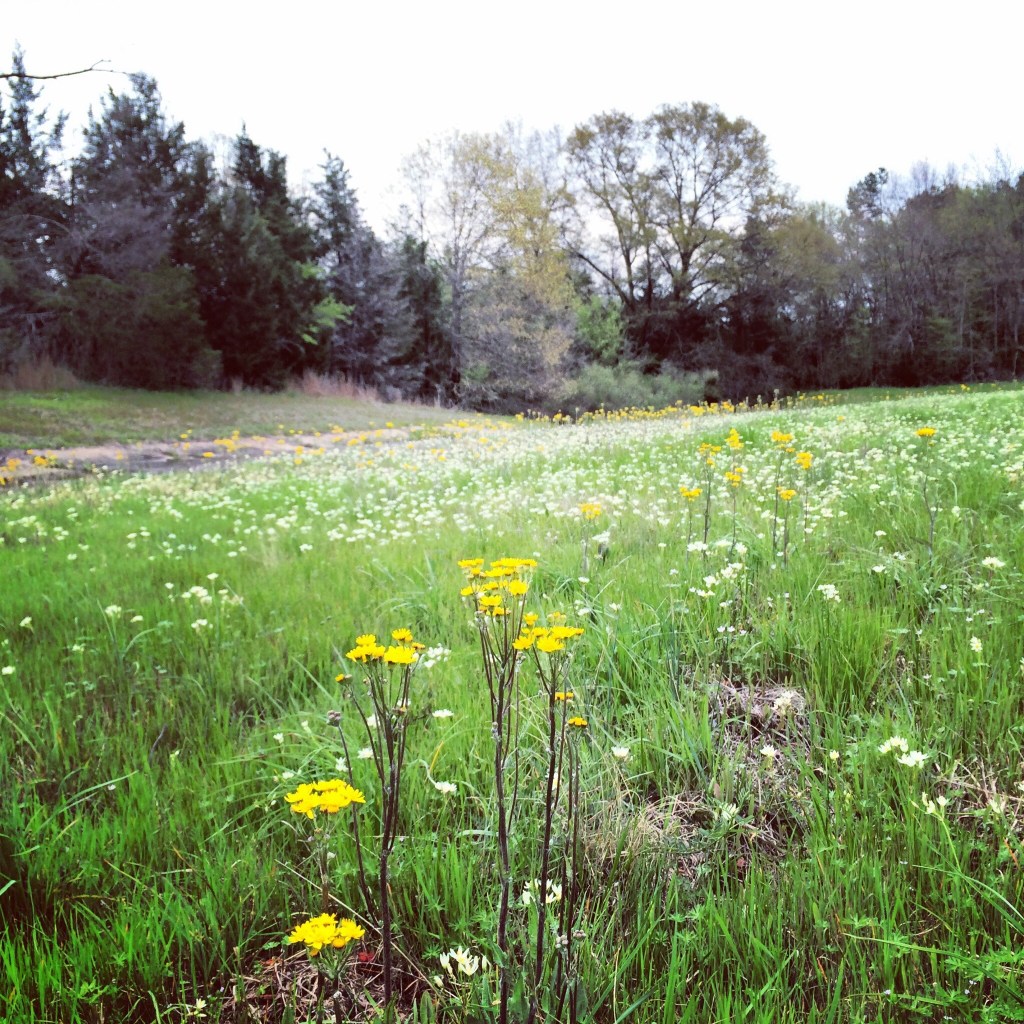
Of course, those who know my navigating skills might question how I ever found my way anywhere. The secret is all small roads lead to a larger road. Also, if I ever grew concerned, I’d stop and ask for directions back to the big highway. I’ve met some interesting folks by getting lost, just as I’ve found some beautiful landscapes. I’ve never been in such a hurry I can’t stop and take a photo. These images I use for inspiration for future paintings. I took this photo by the roadside off interstate 30 west, near Texas 44 west, near Simms, Texas, in 2014.
DeLee: Wildflowers near Simms, Texas
While the flowers by the side of this road were only yellow, I decided to add in notable reds and blues, since those are well known colors from Texas also. These primary colors represent lazy Susans, Indian paintbrush, and bluebells. The wind and light in the trees were beginning to freshen up, a true sign of spring on the plains. The whole is full of light and has the promise of the new life and hope, which every spring brings to those who find renewal in nature. William Allingham, an English Poet of the 19th century, wrote a poem called “Wayside Flowers.”
DeLee: Texas Wildflowers
Pluck not the wayside flower,
It is the traveller’s dower;
A thousand passers-by
Its beauties may espy,
May win a touch of blessing
From Nature’s mild caressing.
The sad of heart perceives
A violet under leaves
Like sonic fresh-budding hope;
The primrose on the slope
A spot of sunshine dwells,
And cheerful message tells
Of kind renewing power;
The nodding bluebell’s dye
Is drawn from happy sky.
Then spare the wayside flower!
It is the traveller’s dower.
When we speak of a dower, this is a treasure or endowment gifted to a future visitor who passes by. Because of this, all travelers should respect the wildflowers and leave them in situ. All living organisms need to reproduce. Digging up wildflowers, picking wildflowers, or collecting their seed will reduce a plant’s ability to reproduce and will adversely affect its long-term survival in that location. Removing wildflowers from the wild can have a detrimental affect on pollinators and other animals that depend on that species for food and cover. Removing wildflowers from our national forests and grasslands prevents other visitors from enjoying our natural heritage. Most wildflowers when dug from their natural habitat do not survive being transplanted.
Every nation has its Golden Age, an idyllic past in which all her citizens were supremely confident, filled with energy and enthusiasm and utterly convinced that their country provided the heights of artistic, scientific, and civic achievement for all. The Greeks had their Golden Age after the Persian Wars with the building of the great architectural monuments on the Acropolis, the morality and philosophy of Socrates, Plato, and their followers, as well as the physician Hippocrates, who’s considered the father of western medicine. “Future ages will wonder at us, as the present age wonders at us now,” remarked Pericles, the Greek statesman, orator and general of Athens during the Golden Age.
The Parthenon on the Acropolis of Athens
America had her Golden Age also, that period time we know as the post-World War II economic boom when manufacturing and employment were at their peak. Many people my age wonder why these present times don’t continue the past prosperity, but most forget our world economy has changed, especially since the 1980’s. To give an example, I had friends in the oil business back in Louisiana. They let the roughnecks go and they went out into the fields to take their place. At the same time, when oil prices were so low, the private school where I taught art let me go, since they considered my subject an elective. The art classroom was the only place some students could achieve and find positive affirmation during the school day, but the school would oversee the increased discipline needs. Even during this decade, employers were cutting jobs and asking employees to do the work of two people. Labor has taken a beating in the decades since.
In the forty years since, our whole life has changed. When I was young, a high school education was sufficient for many entry level jobs. Back in 1941, less than half the U.S. population age 25 and older had a high school diploma, while today, 90 percent has that achievement. When my dad was a young man, an 8th grade education was more than sufficient for blue collar jobs. Today at least two years at a community college is the new “Union Card” for employment. Why is this, you ask? Our young people need to know more than we did! Our adults also need to keep learning! This is why I keep teaching myself new things, going to seminars, and writing blogs that require research.
I’m very proud of our class members who attend the Friday Art Experience at Oaklawn UMC. Work can sometimes take a priority over this enrichment experiment, and we went on hiatus for part of the pandemic. One of the goals I gave the group was to find their own voice and not to copy mine or someone else’s. We can learn from each other, for we all have a unique perspective on life and how we interact with the world. When we stretch ourselves, we create new pathways in our brains, a process called brain plasticity. A new activity that forces you to think and learn, plus require ongoing practice can be one of the best ways to keep the brain healthy, since eventually our cognitive skills will wane. Thinking and memory will be more challenging, so we need to build up our reserves.
Much research has found that creative outlets like painting and other art forms, learning an instrument, doing expressive or autobiographical writing, and learning a language also can improve cognitive function. A 2014 study in Gerontologist reviewed 31 studies that focused on how these specific endeavors affected older adults’ mental skills and found that all of them improved several aspects of memory like recalling instructions and processing speed.
I don’t know about you, but I was born with only two brain cells and one of them seems to travel regularly to the planet Pluto. I need to be in the studio as often as possible if I’m to call that wandering cell back from its journey elsewhere. Art for me is life, just as a walk among the trees or beside a creek renews my soul. As the Psalmist writes in Psalm 19:1, The heavens are telling the glory of God; and the firmament proclaims his handiwork.
Artist’s logarithmic scale conception of the observable universe.
Gail was the only one attending this week. Graduations, which were happening in various academic settings, kept others away. She brought a photo of a field of yellow flowers, with a house up on a hill. In the middle ground was a pond and on the crest of the hill were a windrow of cedars. We discussed the formal elements for a bit. I showed a series of wildflower ideas as a slideshow to give a sense of the varied way artists across history have approached this subject.
Then we got down to work. Note the sense of light and air in Gail’s painting. The windrow of trees shows the direction of the sun and we can sense the breeze coming from the same side. This is an unfinished painting, so we can’t tell if the yellow meadow will have more varied colors, but the first layers of the wildflowers in the foreground give us the sense it might.
Gail’s unfinished wildflower painting
Sometimes we can finish a painting in one sitting, but other times, even a small work takes another session. Life is a work in progress. We can’t hurry it. When we finish a work, we often find flaws in it. This is because we’ve learned new skills, and we judge our work by our new abilities, rather than by those skills we had when we began. Artists aren’t like those who look to the past for a Golden Age. Instead, they look to the future.
Benjamin Franklin said, “The Golden Age was never the present age.” Usually the Golden Age is a fondly remembered past, but only the best parts of it are treasured by those who benefited most by it. We need to remember, as William James, the American philosopher reminds us, “There are two lives, the natural and the spiritual, and we must lose the one before we can participate in the other.”
Or as 2 Corinthians 5:17-20, so aptly puts it:
So if anyone is in Christ, there is a new creation: everything old has passed away; see, everything has become new! All this is from God, who reconciled us to himself through Christ, and has given us the ministry of reconciliation; that is, in Christ God was reconciling the world to himself, not counting their trespasses against them, and entrusting the message of reconciliation to us. So we are ambassadors for Christ, since God is making his appeal through us; we entreat you on behalf of Christ, be reconciled to God.
If we do this, we can bring the Golden Age into the present for all people.
Picasso is often thought to have said, “Art washes away from the soul the dust of everyday life.” However, just as we tend to view anything on the internet as true, along comes a meme from Abraham Lincoln reminding us of the exact opposite proposition. As one of my old debate team mentors in high school used to say, “Consider the source. Use a verified source. Use a trusted source. Use a legitimate source. Facts, not opinions, count in the argument.” This is the flag we raised, put a light on it, and saluted every day in speech class. This also limited my library quest, for my search engine of choice in those low technology days was the card catalog at my neighborhood library and rummaging through whatever national news magazines came on subscription there.
Abraham Lincoln said it, so it must be True!
As much as I love this quote, “Art washes away from the soul the dust of everyday life,” and resonate with it, it doesn’t sound like Picasso. He’s also purported to be the source of “Others have seen what is and asked why. I have seen what could be and asked why not.” It’s not too different from “Some men see things as they are and say why? I dream things that never were and say why not?” This latter is a famous line paraphrasing George Bernard Shaw’s play Back To Methuselah, and was spoken at Robert F. Kennedy, Jr’s funeral elegy.
Perhaps it doesn’t matter we aren’t original thinkers, but only that we stretch our thinking beyond what we already know. In 1982, futurist and inventor R. Buckminster Fuller estimated that up until 1900, human knowledge doubled approximately every century, but by 1945 it was doubling every 25 years. By 1982, knowledge doubled every 12-13 months. Today, knowledge doubles about every 12 hours! For some people, this is absolutely too much to bear, and for others, it’s a reason to yearn for simpler times. However, I’m not willing to give up the GPS and maps in my vehicle, for I have a tendency to be chronically lost. I do find some interesting backroads along the detours I take in error. I just get lost less often than I once did.
Art and other creative ventures are the means by which we deal with our anxieties of this world, for if we have pain and troubles there, we can either create a world of beauty to balance our struggles or we can let all that pent up energy out so it doesn’t eat us up from the inside out. If we’re making landscapes, we might have butterflies or forest fires, depending on how we process our soul journeys.
Margaret’s Butterfly Landscape
Margaret’s landscape has the breeze blowing through the trees and flowers. The clouds are also carried along by these same winds. She was wanting to paint a flittering butterfly, and wondered out loud “How does a butterfly fly?”
I didn’t know exactly, and wasn’t into acting out my inner butterfly, but Apple Music has a wonderful tune by Ludovico Einaudi called “Day 1: Golden Butterflies.”
I found it on my phone and played it for her. Art class calls upon all the senses, just as reading a biblical text does. How can we get into a mood or intention of a writer or an artist if we don’t use every one of the senses the good Lord gifted us with? Art isn’t just for the eyes, but we should appreciate the textures even if we don’t actually touch them.
In our Friday art class, I always show examples of how other artists have approached our theme for the day. I collect them in my Pinterest account. For Spring Trees, the goal is to use the cool side of the palette, with a variety of greens, and add spring colored flowers of white, pink, or yellows. Blues and violets also show up with wisteria and bluebells. As I showed the group about a dozen different artists’ works, I reminded them: “You can’t go wrong! Every one of these artists solved spring trees in a different way. Some painted only the tree, some painted just the reflection in the water, others painted the whole landscape. Some focused on the people more than the trees. If your colors stay cool, if we can tell these shapes are trees, and if you use your own ideas to elaborate on this basic format, you’ll do a great job! We can always improve on the next one.”
People are so worried about pleasing others, or not measuring up to some standard. What standard are we setting for ourselves anyway? If we want to shoot baskets like LeBron James or Stephen Curry, we’d better be prepared to work. Curry shoots around 2,000 shots a week: He takes a minimum of 250 a day, plus another 100 before every game. It’s a counterintuitive fact that a player with the supplest shot in the NBA, whose overarching quality is feel, has the hands and work habits of a woodchopper. Likewise, LeBron works out even on his “off day,” with only Sunday as a day of rest. Check out this workout. This is why he’s called the “King.”
LeBron’s Workout
If we were writing poetry, would we fail to start because we couldn’t produce from our heart and hand the words which move us, as do the passionate lines of Shakespeare’s pen? He had to start somewhere, for sure. “While salvation is by faith,” I always tell folks, “proficiency in arts and crafts usually comes from works.” The more we practice, the better we become. Some of excellence results from acquiring good eye hand coordination, or fine motor control, but also we begin to learn what our media can do and what it won’t do. We enter into a friendship and then into a love affair with it. We begin to anticipate where it will go, just as we often can finish our best friend’s sentences for them. Take a break and read Shakespeare’s 18th sonnet out loud for a moment:
Shall I compare thee to a summer’s day? Thou art more lovely and more temperate: Rough winds do shake the darling buds of May, And summer’s lease hath all too short a date;
Sometime too hot the eye of heaven shines, And often is his gold complexion dimm’d; And every fair from fair sometime declines, By chance or nature’s changing course untrimm’d;
But thy eternal summer shall not fade, Nor lose possession of that fair thou ow’st; Nor shall death brag thou wander’st in his shade, When in eternal lines to time thou grow’st:
So long as men can breathe or eyes can see, So long lives this, and this gives life to thee.
“The artist is a receptacle for emotions that come from all over the place: from the sky, from the earth, from a scrap of paper, from a passing shape, from a spider’s web,” Picasso told Alfred H. Barr, Jr. Just as everything is grist for the poet’s mill, so we bring all that we are to our art experiences. If we’re glad, sad, angry, or any other emotion, this gets poured out into our work through the colors we choose, the subject matter, or the way we use the media. This pandemic will be remembered not only for its cruel loss of life, but also for its neurological complications for the post COVID survivors, since a high percentage have mood and anxiety trouble diagnoses for the first time within six months of their infection. This is how we know COVID isn’t just a bad flu.
I omit the state of depression, for if one feels blue, one can work, but true depression takes away the will to work, to get out of bed, get dressed, or have the energy to brush one’s teeth. No one gets out of that state alone. Help and intervention are needed. I’ve been a chronic depressive for over half a century, and “snapping out of it” isn’t possible for people with this health condition. If I have a sunny and positive outlook on life, it’s because I’ve learned to think optimistically and I’m medicated properly. Plus I attend counseling sessions so I can keep a good perspective on life. If life is getting you down now, please seek help from a trusted medical provider or a pastor. Jesus meant it when he said, “I came that they may have life, and have it abundantly” (John 10:10). Faith healing also comes from ordinary means.
Jesus Icon
Our art class gives our group a safe place to stretch their minds, to take self care time, and to try a new skill that won’t kill anyone. It’s not like chainsaw juggling , where if you miss, you get a free ride to the ER or the funeral home. We don’t do that sort of thing. That’s more excitement than I can stand. I used to teach middle school art classes, so I had days, when the moon was full, that I sometimes thought I was juggling chain saws. Juggling plastic spoons is more my style today.
Gail is supervising home schooling during the pandemic. I don’t know how all the other parents and grandparents are doing in this particular time, but I remember the chaos which ensued one spring break as the pink eye ran amuck through the elementary school at which I taught. The headmaster gave everyone an extra week for spring break, an act which caused my students’ parents to call me in a panic, “What am I going to DO with my child for a WHOLE WEEK?!”
I laughed and said, “Keep them away from children who have pink eye.” I suppose I didn’t commiserate with them, as they thought I should. These people are now grandparents and I hope that one week back then showed them they could manage a whole pandemic today.
Gail’s Recycled Trees
Gail’s trips to fuel her caffeine need causes her to visit different coffee shops. The cup sleeves come in different patterns of corrugated cardboard. Of course, this paper product originally came from a tree, so she brought them in to be recycled and repurposed into an art piece about spring trees. Since she worked for the forest service, this is right in line with her love of nature and concern for stewardship of our natural resources. Gail also likes to plan and think her way through a theme.
Mike’s Trees and Stream
Mike gets his idea in a big, global whole. Then he seems to boil it down to a manageable size in a few moments, as he mentally discards the least workable parts. In a few minutes, he’s ready to paint a scene from memory or from his imagination. He applies lessons learned from other classes. For instance, painting in the background first is easier than trying to paint up to foreground details. This painting began with the stream, the green trees, the white trees, and then the popping pink trees for an accent.
Cornelia’s Start
I was painting trees with wisteria vines from a photograph I took near my home. The coffee spot at the Airport and MLK Freeway had moved, so when I turned in that driveway, I came to the notice of one of Hot Springs Finest. As he rolled down his window, I turned around and smiled.
“Hello, I’m just taking photographs of the wisteria in the trees.”
“I saw your car and thought you might be in trouble.”
“Not this time, but thanks for checking on me. I often stop to take pictures of our beautiful city.”
Wisteria in the Urban Forest
While we were talking, his radio went off and he had to go help someone else. Life interrupts our time together, and we don’t know how much time we have on this side of heaven. Many of the things we fight over will be meaningless in the great arc of history. When we meet each other on the other side, we won’t care about these things, for our whole attention will be God and the Lamb who sits upon the throne. If on this side of heaven, we learn to love more and forgive better, we’ll all be going on to perfection, whether we are in life or art.
Elizabeth Cowling, Pablo Picasso (2002). “Picasso: style and meaning”, Phaidon Press. Also quoted in Alfred H. Barr Jr., Picasso: Fifty Years of his Art (1946).
6-month neurological and psychiatric outcomes in 236 379 survivors of COVID-19: a retrospective cohort study using electronic health records – The Lancet Psychiatry