What’s the Point of Suffering?

art, city, Creativity, inspiration, Israel, Megiddo, Painting, righteousness, Solomon’s Temple, suffering

I’ve visited the Holy Land twice, and I’m always surprised how small this country is. So much history and events of our faith happened here, yet the land isn’t much bigger than Vermont. This land is a place of great suffering, marked by the historic sites of Masada, Megiddo, and Golgotha. It’s also the place of great joy, as evidenced in the Church of the Nativity in Bethlehem, the Church of the Holy Sepulcher in Jerusalem, and the Western Wall of the Temple in Jerusalem.

Map Painting: Temple Mount of Jerusalem

When we speak of the Holy Land, we include the ancient kingdoms of Judea and Israel, as well as modern day Palestine. The modern state of Israel was formed in 1948, as a homeland for diaspora Jews, who are the ones whom conquering foreign nations had exiled from their homeland over the centuries.

The history of the Hebrew people has been marked by suffering. As Deuteronomy relates, they are a “people holy to the LORD your God; the LORD your God has chosen you out of all the peoples on earth to be his people, his treasured possession. It was not because you were more numerous than any other people that the LORD set his heart on you and chose you—for you were the fewest of all peoples” (7:6-7).

They endured slavery in Egypt, wandering in the wilderness until they entered the promised land, and then were at the mercy of stronger nations who wanted to control the trade routes, which intersected inside the borders of Israel.

The earliest diaspora was the Babylonian exile in 586 BCE, plus a later exile to Alexandria, Egypt, in the 1st century BCE. That first exile was marked by the trauma of the Jews’ loss of Solomon’s Temple and their residency in the holy city. They’d always depended on these two as permanent and a source of God’s special protection. However, their failure to honor God completely negated this protection. In the exile, the people learned how to live as God’s chosen people by studying God’s word, keeping the law, and separating themselves from the Gentiles.

About five million Jews lived outside of Palestine during the Roman era, but most of them lived within the confines of the Roman Empire. Even before the destruction of the Jerusalem Temple in 70 CE, diaspora Jews outnumbered those who lived within the bounds of the territory of the Holy Land.

Western Wall of Temple, Men’s prayer area nearby and Women’s area in distance, 2019

After World War II, with the Nazi massacre of over 6,000,000 Jewish individuals of all ages and sexes, this Holocaust ignited the desire within those others who shared with Jews the same values they represented in the world. Social justice and compassionate assistance to the weak stood in the way of Hitler’s regime, for he believed Jews opposed the Nazi natural order, which was the powerful exercise unrestrained power on behalf of the superior white race. In Hitler’s view, any restraint on the exercise of white power would inevitably lead to the weakening, even the defeat, of this master race. (We hear echoes of this heretical view in the current replacement conspiracy, which claims migrants are poisoning the blood of our nation.)

Harvard Center for Geographic Analysis: Comparative Size of Israel and Occupied Territories to State of Vermont (11,200 square miles to 9,200 square miles)

An entire book in the Old Testament is dedicated to the question of suffering, especially the question of do the righteous suffer. Under the retribution theory of justice, a good person should not suffer, and a sinful person deserves suffering. However, all of us know infants born with dread physical conditions, who obviously haven’t had a chance to sin. In the Old Testament view, his parents’ sin would have caused his suffering, but Jesus reminds us in John 9:3–

“Neither this man nor his parents sinned; he was born blind so that God’s works might be revealed in him.”

Ossip Zadkine’s The Destroyed City (1951) is a man without a heart and is dedicated to the city of Rotterdam, destroyed by the Nazi Luftwaffe.

The book of Job reminds us suffering happens to all of us, and how we react to it is evidence of our transformation into the image of God. Do we seek mere retribution, or will we let suffering transform us? This is a moral question for us today, especially in our suffering adverse society. Yet, we’ll let those on the margins suffer, while we avoid suffering ourselves. The 31st chapter of Job lists the acts of a righteous man who cares for the widows, orphans, and strangers in his land, yet he suffers. But Job is no quitter, even if he is a complainer. He asks God, “Why do the righteous suffer?”

The Gaza Strip, where all the fighting between the Israeli army and the Hamas militants is currently ongoing, is slightly more than twice the size of Washington, DC., our nation’s Capitol. The Capitol is 68.35 square miles, while the Gaza Strip is just shy of 139 square miles. As a comparison, Little Rock, Arkansas, is 123 square miles in area. Little Rock has a 2024 population of 200,546. Compare this with the two million people live in the Gaza Strip. After living in rural Arkansas most of my ministry, I find Little Rock crowded. The Gaza Strip is 10 times more crowded than our state capital.

September Megiddo Painting 2023

Why do I mention this? When a tornado rips through a town or a city in Arkansas, it causes damage on a large scale to those people in that area. Because we don’t have densely populated areas, our suffering is limited to a few. This doesn’t discount their particular suffering, but it does mean suffering is limited, for which we can be thankful. When 2,000 pound bombs drop on high rise dwellings, numerous people are made homeless, and the possibility of injuries is high. Perhaps we don’t see this suffering because it’s in a distant land, or because some of the injured call god by another name. If we can’t recognize human suffering as the suffering of another child of God, we’re losing our ability to see the world as God sees God’s world.

The famous Banksy’s Armored Dove of Peace, the painting of a peace dove wearing a flak jacket. The dove is painted on a wall near the separation wall between Bethlehem (Palestinian Territories) and Israel. Nov. 18, 2023

Rebuilding Gaza will be a massive undertaking because Israel’s bombardment has caused mass destruction. Current estimates are at least a half million Palestinians in the enclave won’t have a home to return to when the war ends, according to the UN aid office. By the end of 2023, about 1.9 million people had been displaced, or nearly the entire population, some more than once, as people moved in search of safety. Because of bombing, by the end of 2023, about 65,000 housing units across Gaza Strip have been destroyed or rendered uninhabitable. In addition, over 290,000 housing units had been damaged, according to the Government Media Office in Gaza. Officials estimate many more will be unable to return immediately due to the level of damage to surrounding infrastructure, as well as the risk posed by of Explosive Remnants of War.

The Greek Orthodox Church of Saint Porphyrius in Gaza, believed to be the third oldest church in the world, was hit by missiles as hundreds of Palestinians sought shelter there during a Israeli missile strike in its war against Hamas.

Currently residents in Gaza are facing famine, for the existing World Food Program ready-to-eat food options are falling short of meeting people’s crucial caloric needs. Bread, made from fortified flour, holds the potential to address some of the unmet requirements for essential vitamins and minerals, which the current ready-to-eat baskets fail to provide. Moreover, providing bread as a no-cook food option is crucial when households lack the means to cook meals. Thus, incorporating bread into aid provisions is not only as a practical solution, but also is a key strategy to fulfill immediate nutritional needs.

Children try to get food relief in the southern Gaza Strip city of Rafah, on December 31, 2023.

I first visited the Holy Land in 2000, just before the intifada of 2001. At the time, the Gaza Strip was under Israeli control. Following the 1948 Arab-Israeli War, Egypt administered the newly formed Gaza Strip; Israel captured it in the Six-Day War in 1967. Under a series of agreements known as the Oslo Accords signed between 1993 and 1999, Israel transferred to the newly created Palestinian Authority (PA) security and civilian responsibility for many Palestinian-populated areas of the Gaza Strip as well as the West Bank.

After June 2007, when HAMAS took over the Gaza Strip, Israel and Egypt have enforced tight restrictions on movement and access of goods and individuals into and out of Gaza. Fatah, another political movement, and HAMAS have since reached a series of agreements aimed at restoring political unity between the Gaza Strip and the West Bank but have struggled to enact them. Therefore, Egypt and Israel have maintained border control over the Gaza Strip, determining who and what enters or leaves.

Since Hamas’ surprise attack on the music festival and the settlement nearby, not only have the Jewish people suffered harm due to 1,200 immediate deaths but also the continued terror of those held captive by the Hamas terrorists. Some say Christ suffers only for those who go on to have faith in his saving work on the cross. I was asked once on an Emmaus walk, “Are we saved when we profess our faith in Christ, or when Christ died on the cross for us?”

Byzantine Mosaic apsidal, San Clemente, Rome

They were surprised when I answered, “Yes.” It’s not an either-or question. After all, Christ died once, for all, as an act of saving grace. God raised him from the dead to make him the first of many to cast off the chains of sin and death. When we, centuries later, profess our faith in Christ, we accept his suffering on our behalf and his resurrection as our promise of a life to come. As Christians, we often base our world view on our claim to the promises of God, but we forget Christ’s death and resurrection is a promise to all people, even to those who haven’t professed faith in Christ. As the writer of Hebrews (1:8-9) once said:

“Now in subjecting all things to them, God left nothing outside their control. As it is, we do not yet see everything in subjection to them, but we do see Jesus, who for a little while was made lower than the angels, now crowned with glory and honor because of the suffering of death, so that by the grace of God he might taste death for everyone.”

Red Megiddo Cross

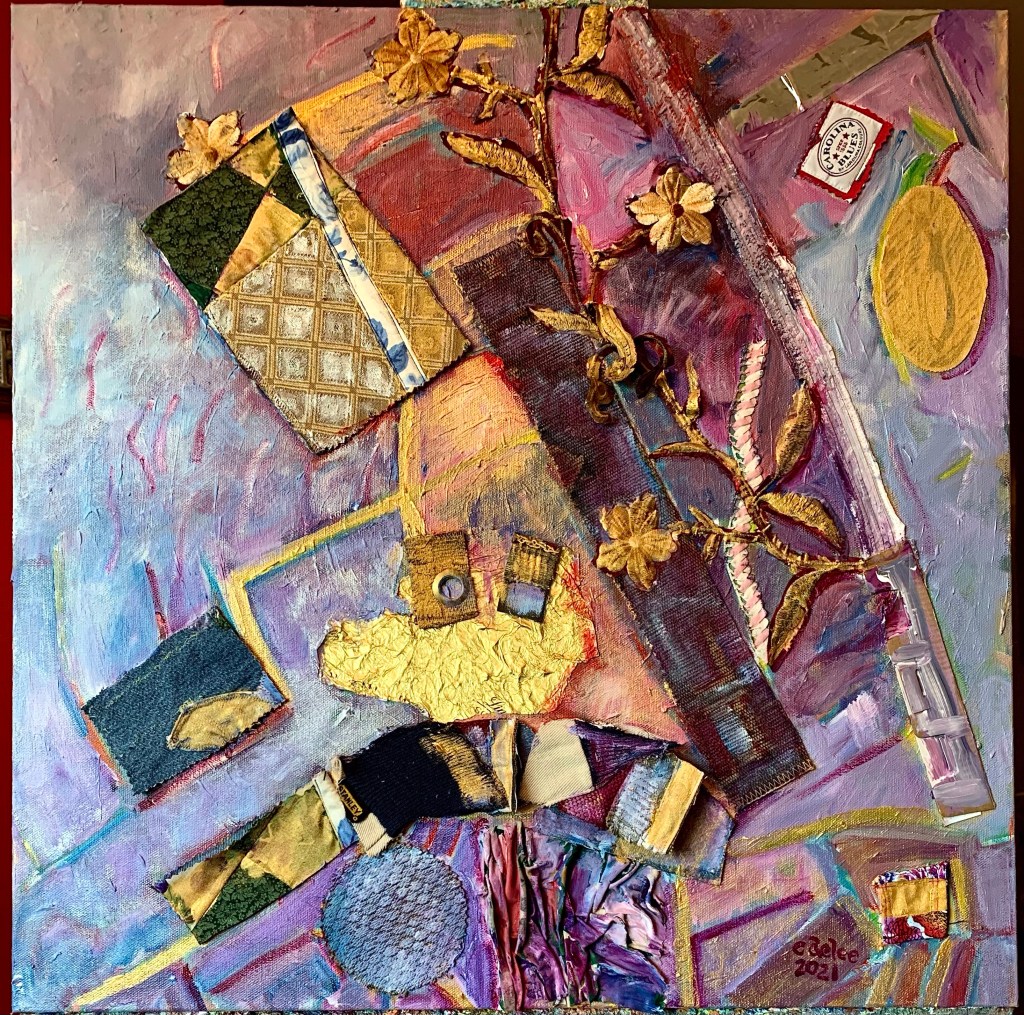
As I worked on my painting, it went through several iterations. First it stayed close to the map of the ruins of Megiddo, which I painted in yellows. Megiddo is the site of the battle to end all battles, and the place where the forces of good meet the forces of evil. Because Israel is on the crossroads of many trade routes, nations have always met there to contest for dominance. I left many scar scribbles on the canvas to represent the destroyed walls of the ancient city. As is my usual practice, I hung up my canvas to live with it awhile, but the longer my painting hung on my wall, the more unsatisfied I was. I can always tell when my inner vision isn’t meshing with finished work. When I took the work down, I flipped it 180 degrees and repainted it in red, for the bloodshed of this most recent war. As I painted out most of the scribbles, I saw the cross appear out of the image. By destroying the remnants of destruction, I had simplified the image down to its essence.

In all things, the cross is crucial. We moderns don’t understand suffering or pain. We deny it, reject it or medicate it with something that keeps us from feeling it. My personal medicinal choices are ice cream and chocolate. If I can combine them in one substance, so much the better! A recent bout with the shingles this past December had me consuming both foods for medicinal relief. Other people use wine, TikTok, or another medication of choice to escape from emotional or physical pain.

The winter of my discontent, brought by Mayhem

Revenge is is a dish best served cold because if we take revenge in the heat of the moment, we’ll over do our response and won’t know when to stop. If we wait, cooler heads will prevail, and a more limited response will likely be our action. Less damage, and less mayhem, but we humans don’t seem to be built this way. Those who have suffered will often return suffering in kind as a “hair of the dog cure.” This is why abuse and family violence is generational. The ancient Hebrews practiced the BAN, or a primitive religious practice of dedicating for destruction an entire group of people and their possessions to the LORD. This was done to cleanse the land and keep the Hebrew people pure from idolatry. Paul had Deuteronomy in mind when he wrote in Romans 12:19—

“Beloved, never avenge yourselves, but leave room for the wrath of God; for it is written, “Vengeance is mine, I will repay, says the Lord.”

While the western world has the crusade mentality, which is similar to the extreme ban, we also have the just war theory. Modern wars are fought by democracies mostly with this mindset, for the international community is in agreement the ends should justify the means. Unfortunately, terrorists don’t agree and fight according to their own extremist beliefs. We have to ask ourselves what happens to us when we adopt their policies and inflict extreme suffering on civilians to the point of causing starvation and homelessness by destroying their homeland. If we act the same as those whom as we despise, have we become them instead? We lose the moral high ground when this happens. It’s time to draw back and reconsider our motives and our methods: how can we be just, compassionate, and holy, as God is holy? Otherwise, we’re suffering for nothing or causing others to suffer meaninglessly.

When we read scripture, God’s Holy Spirit should work in our hearts and minds to make a change in us to confront and conform us into God’s holy nature. If no change happens, we need to ask God to open our hearts and minds to be conformed to God’s Holy Spirit. If it’s painful to read scripture, remember Christ suffered for us. Many of us can’t read the scriptures to be transformed, for change is difficult and painful. However, staying the same is also difficult and painful. (Maybe this is why only 10% of Americans read their Bible daily.) I find God has compassion on those who suffer, especially those who do so while “working out their own salvation in fear and trembling.”

Remember God has compassion and is near to the broken hearted,

Joy and Peace,

Cornelia

Gaza Strip – The World Factbook
https://www.cia.gov/the-world-factbook/countries/gaza-strip/

Hostilities in the Gaza Strip and Israel | Flash Update #85 | United Nations Office for the Coordination of Humanitarian Affairs – occupied Palestinian territory
https://www.ochaopt.org/content/hostilities-gaza-strip-and-israel-flash-update-85

Holocaust | Definition, Concentration Camps, History, & Facts | Britannica
https://www.britannica.com/event/Holocaust

Little Rock, Arkansas Population 2024
https://worldpopulationreview.com/us-cities/little-rock-ar-population

Ban – Encyclopedia of The Bible – Bible Gateway
https://www.biblegateway.com/resources/encyclopedia-of-the-bible/Ban

Report: 26 Million Americans Stopped Reading the Bible Reg…… | News & Reporting | Christianity Today https://www.christianitytoday.com/news/2022/april/state-of-bible-reading-decline-report-26-million.html

Rabbit! Rabbit!

art, butterflies, Family, Fathers Day, greek myths, Helios, holidays, inspiration, Memorial Day, Ovid, Phaeton, rabbits, renewal, summer solstice, summer vacation

Welcome to June 2023

Since we’re now past Memorial Day, the unofficial beginning of summer has arrived. Yet the summer solstice, which is astronomical summer won’t be here until Wednesday, June 21, 2023 at 9:57 AM CDT. Weathercasters use this alternative meteorological definition: “seasons begin on the first day of the months that include the equinoxes and solstice.” Since June 1 is National Go Barefoot Day, we rabbits, who never wear shoes on either our lucky foot or our three other feet, can rejoice and celebrate with our human friends as we share the delights of bare-footing across the park lawn.

Barefoot Weather

Summer is the season of picnics, patios, porches, and other alfresco dining activities. I remember mayonnaise sandwiches, butter and sugar sandwiches, plus the always delicious peanut butter and jelly sandwiches. Mama stirred the jelly into the peanut butter so it didn’t dribble out as it melted in our hot Southern summers.

June is Picnic Weather

June has International Picnic Day on June 18, but we rabbits don’t need a special day to have a feast in a field. In fact, we eat outside every single day. We are picnic aficionados. I’m not sure if June has an exceptional amount of national food days, for I haven’t paid attention lately due to my loss of vision from cataracts. Now that I’ve had surgery on both eyes, I’m just amazed at what all I’ve been missing!

June has 46—boy howdy—special days celebrating foods. We rabbits would have to eat at least 1.5+ of the following daily, all the while remembering the admonition of Eat Flexitarian Day: eat more fruit, whole grains, and vegetables, but eat less meat and fish. The Flexitarian Diet is second only to the Mediterranean Diet for overall ranking because it’s simple, healthy, and a straight forward way of eating. Some foods to incorporate and celebrate are Fresh Fruit and Vegetables, Cucumber, Lemon, and Mango.

Okazaki Shrine, Kyoto dedicated to Rabbits

I like to organize, a trait that used to drive my dear old rabbit mother crazy. I’d put all the drinking glasses of the same size together on the same shelf, while she’d put them up willy nilly, even though they wouldn’t all fit on one shelf if all of them were clean. This is just another example of mother rabbits being realistic, since they know their thirsty rabbit kits will dirty up another glass before the dishwashing is done. I also like to arrange my paint palette in rainbow order, but don’t talk to me about my desk. It’s a mess. At least my spices are in alphabetical order.

Milk and Doughnuts

June’s menu celebrates World Milk Day. An ice cold glass of milk will go well with any of these National Day Foods: Donuts, Hazelnut Cake, Chocolate Macaroons, Applesauce Cake, German Chocolate Cake, Peanut Butter Cookies, Apple Strudel, Chocolate Eclairs, Fudge, and Cherry Tarts.

Or maybe you’d rather have your sweet treat with some form of ice cream. June celebrates the National Days of Rocky Road and Chocolate Ice Cream, not to mention Ice Cream Cake Day. You can swill your ice cream in a soft drink on Ice Cream Soda Day or enjoy a Black Cow Day: root beer and vanilla ice cream float. Of course if you’re a rabbit who wants your ice cream straight up, but sipped, National Vanilla Milkshake Day was meant for you.

National Iced Tea Day is June 10, but down south, every day is Iced Tea Day. June also covers the menu with national days for eggs, cheese, and veggie burgers. You can make a whole meal out of the national days of corn on the cob, catfish, and onion rings. Please make sure to observe Eat Your Vegetables Day, with Herbs and Spices, and try a Meal Prep Day while you’re at it.

The Original Night Food Truck

Since America is a great melting pot of many peoples, we have many food cultures. June celebrates several culinary traditions:
Egg Roll Day, Falafel Day, Tapas Day, Sushi Day, Smoothie Day, and Food Truck Day. Get your passport stamped as you leave the cafeteria and please don’t remove your shoes on the way to the dessert counter.

For dessert there’s nothing like seasonal foods. Enjoy National Strawberry Shortcake and Strawberry Parfait Days, or my all time, any time, National Chocolate Pudding Day, or try a new Candy during June or Frozen Yogurt. For a milder taste, go with National Tapioca Day. You also can try the famous Japanese Bubble Tea drink, which has sweet tapioca bubbles as an ingredient. This isn’t like regular iced tea, for the resistant starch of the tapioca bubbles needs time to digest. You don’t want to be famous for “X-ray of stomach shows mass of 100 undigested boba balls.” (Google it!)

How To Make Tapioca Pearls At Home – Experiences

Listen to this rabbit so you don’t have to double up on National Prune Day for a reason, but enjoy then for their sweetness, fiber, antioxidants and minerals. Mostly they keep you “regular as clockwork,” with no straining or efforts. This is a good thing if you’ve overindulged on Detroit-Style Pizza Day or under hydrated on National Martini and Olive Days.

But enough of foods! This rabbit hasn’t eaten this much since well, Memorial Day weekend! My family always took any and every gathering as an excuse to feast. I don’t know if it was because my rabbit mom and dad survived the Great Depression or because the generations of my extended family were all Methodists, but if food was available, we were there. And we brought a covered dish if we were traveling to somewhere else. Folks brought food to us when we hosted, but that was how life was when I was a young rabbit. Sharing was our caring.

The Master Chef

My dad was a master chef, as long as he stood over the back yard grill. He had charcoal briquettes and lighter fluid down to a science. Never ever did he squirt fluid onto the hot coals—that was asking for his own burnt flesh. Mr. Safety was his other name. He wielded the fork in his right hand and an empty ketchup bottle filled with water in his left hand. If the grease drippings flared up, the repurposed water bottle went into action with a well focused stream to knock it down. He never hit it so hard the fire went out.

Dad even cooked on Father’s Day, because he was The Grill Master. Even when the family bought a gas grill for my birthday, I kid you not, daddy was thrilled because he’d be able to cook for his favorite girl rabbit when I came home from college. Fathers show their love in many different ways. We children can’t design how our fathers show love or order their behaviors. Dads aren’t Burger King hamburgers with cheese, no salt, and no tomatoes. We can’t have them our way.

My dad certainly had a way of cheering me up when I was sure my world was falling apart when I was young. “Cheer up, it could be worse,” he’d say.

“Yeah? How much worse?” I was given to catastrophic thinking as a young rabbit. Everything was a “hair on fire” moment. (In hindsight, most of these weren’t even singed eyebrow moments.)

“Put a bit of this in your mouth,” he said, handing me a bite of his chewing tobacco.

I put it in my mouth and began to chew. As my saliva mixed with the cut tobacco, a bitter taste flooded my mouth. My face twisted every which way possible without leaving my skull.

“Oh, whatever you do, don’t swallow the juice!” He admonished.
“You do this for fun?” I asked.
He laughed, “There are always worse things in life you’ve yet to experience. You can spit it out in the cup now if you want.”

Oh, and spit now I did want. I’m certain nothing is worse than a mouthful of acrid tobacco juice. If I can take that, I can take anything. But I don’t have to endure punishment willingly. I can choose not to suffer. I share this gnostic wisdom, known only to a few, and passed down by word and mouth, literally. I don’t recommend you try it for yourself.

The school of hard knocks is an expensive degree. My daddy had many words of wisdom, not all of which I heeded. “Always have a job before you leave the job you’re in,” is the one I never paid attention to until I became an itinerant minister. Then sometimes I was sent away before I was ready to leave, and sometimes I stayed when people were ready to see me go. Such is life in the Methodist appointment system.

One of my “fathers in the faith” reminded me and others, “You will meet the same people on your way up in ministry as you will on your way down. Consider this as you take your leave of one place and go to another. Don’t forget from where you came. You’ll go back there one day.”

I thought about this one day when one of my church members told me the two largest attendance days were the first and last Sundays of every pastor their church had. When I asked why, he replied, “Because folks first come to see if the preaching is any good and then come to hear how terrible they’ve been.”

Perhaps others continued that pattern after me, but I saw no reason to continue it. Every rabbit, even the most wayward or recalcitrant, will grow gradually in three years. If I couldn’t see evidence of spiritual growth and changes of heart in their lives, I wasn’t worth my salt. I left them in tears, reminding them of who they were and what they had become. I also spoke of the power that would be with them always as they continued their upward path to greater things yet to come.

Attic Black Figure Ware Attributed to the Phrynos Painter:
Kylix, Little Master Lip, Early Archaic Period, ca. 555 – 550 B.C., British Museum, London.

Since ancient times, fathers have always given their children sage advice. Even the Greek gods of myth and time, before the age of philosophers and kings, believed in fathers as the source of wisdom. Athena, the goddess of wisdom, sprang full grown from the head of Zeus, the King of all the gods on Mount Olympus. Perhaps the Greeks were onto something, for wisdom is acquired by those who survive their rash youthful learning experiences.

Some father figures would keep their children from all harm by never allowing a child take appropriate, age level risks and not preparing them gradually for these rites of passage. We don’t throw a new born child into the deep end of a pool and expect them to swim. Instead, we bathe them, wade them, let them kick as we pull them around the shallow end of the pool, and finally we get their faces underwater to blow bubbles so they can learn to breathe correctly. Finally we’ll teach them how to use their arms in coordination with their feet and breathing so they can travel across the pool.

If we let them on a motorized vehicle, a child is safer on a sanctioned go cart track than on a neighborhood street. This is because he or she would be racing in smaller horse powered carts, with age similar racers. As a wise parent, you’d have to decide if your child has the maturity, focus, and discipline to handle not only her own car, but to be aware of his position relative to other carts on the track. Also, does your child have his emotions under control and is she willing to learn from her mistakes?

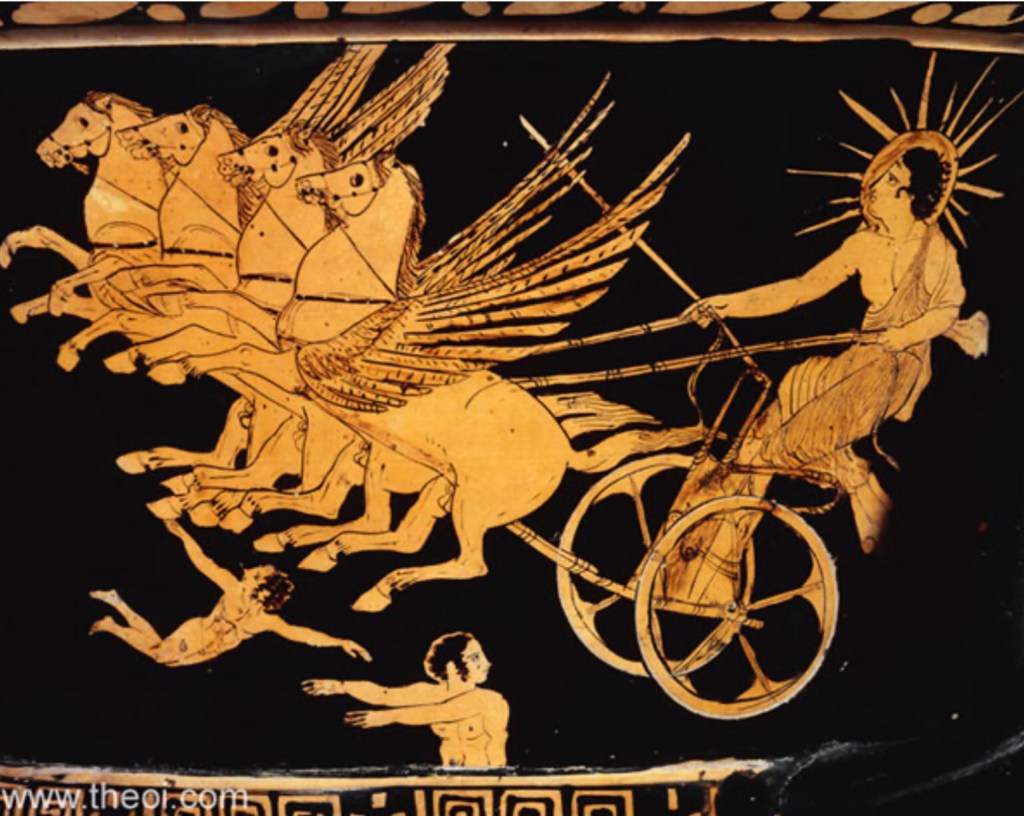
Greek mythology has an instructive story of Helios, the sun god, who couldn’t say no to his son Phaeton’s request to drive the sun carriage drawn by the fiery steeds. In Ovid, Metamorphoses 1. 750 ff, Helios instructs his son:

Chariot of Helios, the Sun God

“Keep to this route; my wheeltracks there show plain. Press not too low nor strain your course to high; too high, you’ll burn heaven’s palaces; too low, the earth; the safest course lies in between. And neither rightwards towards the twisting Anguis (Snake) nor leftwards swerve to where the Ara (Altar) lies. Hold in the midst! To fortune I resign the rest to guide with wiser wit than yours. See, dewy Nox (Night) [Nyx] upon the Hesperian shore even while I speak has reached her goal. No more may we delay; our duty calls; the day dawns bright, all shadows fled. Come take the reins!

Or take, if yet your stubborn heart will change, my counsel, not my chariot, while you may, while still on firm foundations here you stand before you mount between my chariot wheels, so ignorant, so foolish!–and let me give the world light that you may safely see.”

Fall of Phaeton Sarcophagus

As in all Greek myths, this didn’t end well for Phaeton, for he couldn’t control the high spirited steeds. As the chariot ricocheted too near the earth, scorching it, and too high in the sky, burning the stars, Zeus blasted the boy with a thunderbolt to save the earth from harm and placed him among the stars in the constellation The Charioteer. His body fell to earth into the river Po. Once again it’s a reminder the middle path is safest and best.

Canadian soldiers on D-Day read message on their plane

As we polish off the last of the leftovers from Memorial Day, we celebrate D-Day, which commemorates June 6, 1944, the day the Allies invaded Normandy from England during World War II. Every military order has had a day and hour designation since 1918, but this battle on the five French beaches was so large and so difficult to organize, it’s the one we know as “D-Day.” Not only was there a need for a long day, a day near a full moon to guide ships/airborne troops, and strong tides for an amphibious assault, but the Allies had to coordinate politically and militarily to get everyone on board. Eisenhower’s personal notes give us an inkling of the troubles of this endeavor (link below). To date it remains the largest amphibious invasion in history and marked the beginning of the end of World War II. It also marked the end of the Nazi regime led by Hitler, which was responsible for the death of over 6 million Jews.

Two roses and two U.S. flags on Omaha Beach in Saint-Laurent-sur-Mer, Normandy, on June 5, 2019.

As a small rabbit, who’s startled at any sharp noise and frightened by even the shadows of passing clouds, since it might be a hungry predator, the thoughts of wars set me to trembling, trembling, trembling, like the lyrics of the old slave spiritual, “Steal Away:”

“Green trees are bending, poor sinners stand trembling; The trumpet sounds it in my soul, I ain’t got long to stay here.”

Yet appeasing tyrants never ends well, as Winston Churchill noted: “Each one hopes that if he feeds the crocodile enough, the crocodile will eat him last. All of them hope that the storm will pass before their turn comes to be devoured. But I fear greatly that the storm will not pass. It will rage and it will roar ever more loudly, ever more widely.”

Speaking of storms, the Atlantic hurricane season runs from June 1 to November 30, and we can expect the first named storm to form in mid to late June. We rabbits who enjoy a beach vacation always need to keep a weather eye out. Not only do we need to be aware of the intense sun, especially for our baby rabbits, but if the city officials issue evacuation orders for extreme weather, we ought to leave, even if we give up vacation days. While we’re at the beach, or the lake or poolside this summer, we can read or listen to books. June is audiobook appreciation month, but books with pages are more likely better suited to beaches, since high heat and small grains of sands can adversely affect expensive cellphones, tablets, and readers.

Alzheimer’s disease is the most common form of dementia

Another way we can pass our summer and stretch our minds is to try new experiences. June is Alzheimer’s and Brain Awareness Month. If we only exercise the same brain paths, but fail to build new ones, our brains become “clogged up.” This is rabbit speak for what doctors call Tau protein tangles. Dementia seldom only causes Alzheimer’s-related changes in the brain. Any number of vascular issues—problems that affect blood vessels, such as beta-amyloid deposits in brain arteries, atherosclerosis (hardening of the arteries), and mini-strokes—may also be at play. Vascular problems may lead to reduced blood flow and oxygen to the brain, as well as a breakdown of the blood-brain barrier, which usually protects the brain from harmful agents while allowing in glucose and other necessary factors.

My dad, a brilliant doctor, had Alzheimer’s disease in his later life. While he remembered all of his medical training, he knew none of his family in his later years. He also confused my large poster of Captain Picard I had taped on the parsonage back door with an actual person. I kept “Picard” there as a reminder to MAKE IT SO, but daddy thought I had a strange balding man standing in my laundry room.

Make it so—said the strange man in my laundry room

In someone with Alzheimer’s, a faulty blood-brain barrier prevents glucose (energy) from reaching the brain and prevents the clearing away of toxic beta-amyloid and tau proteins. This results in inflammation, which adds to vascular problems in the brain. Because it appears that Alzheimer’s is both a cause and consequence of vascular problems in the brain, researchers are seeking interventions to disrupt this complicated and destructive cycle. All the more reason for us to eat more plants, less fried foods, more complex carbohydrates, and fewer animal fats.

Baked chicken, roasted veggies and corn on the cob

June is also Professional Wellness Month and National Men’s Health Month. America workers tend to get about 11 days of paid vacation and 6 paid holidays per year, but more than half of these reported not using all their days off. Even those energizer bunnies who have unlimited paid time off tend to take only 10 days of vacation, and nearly half of them work at some point in time during their vacation.

When I went on vacation, I told my church secretary to call me if the church burned down or someone died. They should be able to handle most anything else. Most of what I was going to do from some distant location was encourage them and help arrange a substitute if I couldn’t get back in time. God may be available all the time, but small rabbits and vulnerable humans must rest and restore their energies to be ready for the next excitement that’s sure to come.

Rabbit and Butterfly

If you haven’t yet planned your summer vacation, you’re in luck. June is Great Outdoors Month and National Camping Month. You can take your rabbit family to the Oceans or to the Rivers, or you can visit a Zoo and an Aquarium. It’s also Women’s Golf Month, but you can take the rest of the rabbit family with you and have a good time on the links. If you want to stick closer to home, remember June is a fine time to enjoy the exercise in the dirt. It’s Perennial Gardening Month and National Rose Month. Do a service for your garden during National Pollinators Month. Plant basil and dill alongside your tomato plants to discourage hornworms. The scents also attract pollinators like butterflies and other beneficial insects.

On a personal note, I’m looking forward to a summer full of crisp lettuce and tomato sandwiches on toasted whole wheat bread with avocado slices. In fact, that sounds so good, I may have to have one now, since I don’t have time to make a hazelnut cake. Here’s to books, beaches, and the bronzed bodies of summer.

Joy and peace,

CORNELIA

June Holidays and Observances 2023: Full Calender
https://www.today.com/life/holidays/june-holidays-and-observances-rcna76138

2023 NCAHM Official Book List – CaribbeanReads
https://www.caribbeanreads.com/2023-ncahm-book-list/

When is the first day of summer? Summer solstice dates explained.
https://www.usatoday.com/story/news/2023/04/07/when-is-first-day-summer/11556538002/

Season Definition: When Do They Start?
https://www.timeanddate.com/calendar/aboutseasons.html

What Is the Flexitarian Diet? – Cleveland Clinic
https://health.clevelandclinic.org/what-is-the-flexitarian-diet/

NATIONAL BLACK COW DAY – June 10, 2023 – National Today
https://nationaltoday.com/national-black-cow-day/

How To Make Tapioca Pearls At Home – Experiences
https://experiences.japancrate.com/blogs/news/how-to-make-tapioca-pearls-at-home

Creamy Coleslaw with Prunes (Ready in 5 Minutes!) – Ignite Nutrition
https://ignitenutrition.ca/blog/unlock-the-power-of-prunes/

Should I Let My Kid Drive a Go-Kart? – Our Definitive Guide | Utah Motorsports Campus
https://www.utahmotorsportscampus.com/should-i-let-my-kid-drive-a-go-kart-our-definitive-guide/

PHAETHON – Son of the Sun-God of Greek Mythology
https://www.theoi.com/Titan/Phaethon.html

Unknown Artist: Fall of Phaeton, Greek marble Roman sarcophagus, Ca. 150-170 AD., Height: 62 cm; length 220 cm.,
Florence, Galleria degli Uffizi.

Eisenhower Library: Conditions in Normandy
https://www.eisenhowerlibrary.gov/sites/default/files/research/online-documents/d-day/1944-06-03-conditions-in-normandy.pdf

Steal Away Lyrics
https://www.cusd80.com/cms/lib6/AZ01001175/Centricity/Domain/1509/Steal%20Away%20Steal%20Away%20song%20lyrics.pdf

An Appeaser Is One Who Feeds a Crocodile, Hoping It Will Eat Him Last – Quote Investigator®
https://quoteinvestigator.com/2016/04/18/crocodile/

Tropical Cyclone Climatology
https://www.nhc.noaa.gov/climo/

What Happens to the Brain in Alzheimer’s Disease? | National Institute on Aging
https://www.nia.nih.gov/health/what-happens-brain-alzheimers-disease

Average PTO In USA & Other PTO Statistics (2023) – Forbes Advisor
https://www.forbes.com/advisor/business/pto-statistics/

10 Tips for Building a Pollinator Garden | The Old Farmer’s Almanac
https://www.almanac.com/building-pollinator-garden

Rabbit! Rabbit! Welcome to May!

art, beauty, Civil War, inspiration, King Charles of England Coronation, Lassen Volcanic National Park, Memorial Day, Mother’s Day, Painting


If April showers bring May flowers, your bunny buddy now lives in a blooming greenhouse. Yes, record rainfall and stupendous snowfall are causing even the deserts to bloom. For years, the long-term drought in California has caused a lack of wildflowers. With the recent floods and deep snow in the mountains, the full extent of this year’s super bloom in California won’t be clear until peak bloom hits places like Lassen Volcanic National Park in the northern part of the state. Peak bloom is expected there in June or July, after all the snow there has thawed.

Lassen National Park Wildflowers

However, the second week of May is National Wildflower Week. The wildflowers growing by the side of public roads and in national parks are protected. Don’t pick wildflowers or their seed heads there. On private property, ask permission before picking them. Obtain seeds from reliable sources that cultivated the flowers for their seeds. When choosing flowering plants that aren’t wild or naturalized in your area, mimic their growing conditions. You may have to supplement rainfall with occasional watering and/or fertilizing. While we’ve had a good rain this year, xeriscaping or planting your lawn with wildflowers or local plants is a great way to save on water. It won’t look like a manicured carpet, however. Maybe your flowerbeds can get wider each year until the carpet is gone.

Lassen Volcano Cone

I visited the Lassen Volcanic National Park last October when I journeyed out west to visit the grand rabbits. While I could have flown over all this great land we call America, I decided to travel by car. We have too many beautiful natural treasures which we protect and conserve in our national parks. Also, after several years of confinement due to the pandemic, I had some pent up travelling in my blood. The park is 166 square miles large and contains the world’s largest plug volcano, which was first active 27,000 years ago. It last erupted in 1917 when the park was set aside.

DeLee: Great Dixie Fire, mixed media and acrylic paint

This is also the site of the great 2021 Dixie Fire, which started on July 13, and burned for 104 days. Five California counties and 963,276 acres burned. Why would anyone outside of the immediate area care about this? The forests in Lassen Volcanic National Park can store almost as much carbon as 600,000 Americans emit in one year. Unfortunately, park forests are dying from a combination of threats: increased drought, wildfire, and pathogens like beetles and blister rust. Lassen Volcanic Park rangers are working to protect vulnerable tree species through monitoring, research, and management actions whenever necessary and appropriate.

As a rabbit of faith, I live on this earth, and as long as I live here, I’m called to care for it, to do no harm to it, and to heal it where it’s hurting. This is the same calling I have for our fellow creatures, for the same God created us all and cares for us all equally. I love the wildflowers so much, I even stop on the roadside to take a selfie among them. The Highway Patrol in Liberty, North Carolina doesn’t take kindly to strangers taking selfies among their precious poppies. I was “checked out” and asked to “move along.” Perhaps they’re not used to rabbits with cameras? I do seem to attract the attention of the local law whenever I’m out photographing.

Selfie in Field of Poppies: May 8, 2014

Other weekly celebrations we rabbits can enjoy in May are:

Week One—Be Kind to Animals Week and Nurse’s Week
Week Three—National Bike Week and National Police Week
Week Four—Emergency Medical Services Week

Some celebrations get the entire month of May. Among them are:

Asian American and Pacific Islander Heritage Month
Older Americans and Foster Care Month
Gifts from the Garden and National Salad Month
Lupus Awareness and National Blood Pressure Month
National Barbecue and National Hamburger Month
Date Your Mate and National Photograph Month
National Bike Month

May 3–World Press Freedom Day Rabbit Writer

In 1993, the UN General Assembly proclaimed May 3rd each year to be World Press Freedom Day. This is a UN Sponsored annual event. A free press is a bedrock necessity for democracy to thrive. When ruling powers control the messages which the rabbit population gets to hear, we rabbits only hear one side of the story. This discourages freedoms of thought and expression of opinion. While democracy sometimes seems messy, the voices of the majority will ultimately prevail. Yet the voices of the marginalized must be recognized and respected, for their rights can’t be curtailed to please the majority. A free press brings both voices to light.

AI Image: Rabbit with Light Saber

May 4–The National Day of Prayer always happens on the first Thursday of May. This year it coincides with “May the Fourth Be with You” day. Each of these celebrations speaks to the deep need within the rabbit heart for a connection to a power greater than ourselves. At some point in time, each one of us will realize our ego self is really a false self or mask of bravado and competence. When we cast off this mask, we might feel naked toward the world, but God or the Force can finally fill our emptiness. Most rabbits will never take off this false mask, however, for being naked in God’s or the Force’s presence is unimaginable to us.

“Rabbit Handstand” wood sculpture by Teresita Gonzalez

May 5–Cinco de Mayo is always on May 5th. I was playing cards with some rabbit friends the other night. One has a grand baby born on Cinco de Mayo. “What day is Cinco de Mayo?” he asked. “It’s always May 5th, silly.”

“Why is that?” All the card players answered, “Because Cinco de Mayo is a date, like Christmas is a date, when something important happened.”

This is a group of white rabbits, as you may have gathered, but some of us have spent time in Hispanic communities. The Mexican army defeated the French army at the Battle of Puebla on May 5, 1862. This single military battle signified the defeat of a European colonial power, a victory for the Mexican people, and is the root of Cinco de Mayo. Mexican Independence Day is September 15th. We can celebrate along with our brother and sister rabbits by sharing Mexican food and drink, enjoying music, and dancing. And what rabbit doesn’t love the excuse for a party?

St. Edward crown for May 6–Coronation of King Charles of England has over $4.5B worth of jewels in it.

While we American rabbits cast off our colonial bonds back in the 18th century, some of us have never lost our fascination with the royal family and their sagas. Plus we’re always up for a celebration if it means drink and cake. After the death of Queen Elizabeth, her son Charles became King of England. His official coronation ceremony will be smaller in many respects than Elizabeth’s: only 2,000 guests rather than 8,000 and business or military attire will be worn, but no tiaras or ermines allowed.

Since 1066, Westminster Abbey has been the site for regal coronations , beginning with William the Conqueror on Christmas Day. The St. Edwards Crown weighs in at 5 pounds, so the new monarch will live out the saying, “Uneasy lies the head that wears a crown,” (Shakespeare, Henry IV. Part II, 1597). While the Crown Jewels are considered priceless, a 2019 study found in total, the coronation crown would cost $4, 519, 719. That would buy a bunch of carrots and then some!

Coronation chair with the Stone of Scone

The Stone of Destiny (also known as the Stone of Scone) is an ancient sandstone block weighing 336 pounds, which was used for centuries in the coronation of Scottish kings before being seized in 1296 by King Edward I, who had it built into a throne at Westminster Abbey. There it lay until Christmas Day 1950, when, in an audacious caper, four Scottish nationalist students tried to steal it and take it back north of the border. Eventually, in 1996, the stone was returned to Scotland. Now, top-secret and high-security preparations are being made to take it back down to Westminster Abbey for the coronation.

King Bugs Bunny wears Ermine and a Crown

If the rabbit ears on your Telly are angled just right, and your alarm clock goes off in time, you can watch special coverage from Saturday, May 6, from 5 to 10 a.m. ET on your local ABC station. If you have a BBC streaming service, they’ll definitely carry the public events, including the concert on the day after. This will be a public holiday in Great Britain, of course. Both Apple and Spotify have official playlists (link below).

Secretariat Wins Triple Crown, Jockey Ron Turcotte Looks Back at 31 Length Victory in 1973 Belmont Stakes

After the early morning British crowd, if you’ve swilled enough caffeine and nibbled enough scones (the pastry kind, not the stones) you can chill with a mint julep and the Kentucky Horse Royalty congregating at the Derby’s 149th Run for the Roses. This year, of the twenty horses lined up for the opening bell, eight have a pedigree traced to the Triple Crown winner of 50 years ago, Secretariat. No horse has ever matched his magnificence or personality. To watch him pull away from the pack and leave them in his dust was a wonder to behold. He’d be waiting for those stragglers in the winner’s circle when they finally crossed the finish line, and be looking at their sweating, huffing hulks, as if he were thinking, “What took you guys so long?” One of a kind, Secretariat won the 1973 Derby, coming from last to first, and five decades later, he’s still the Derby record holder at 1:59 2/5.

Kentucky Derby Hats are Extraordinary

If you attend in person, the dress code is “Business Casual:” Jackets and blazers, vests, shirts with collars, sweaters, dresses, pantsuits, slacks and capri pants are appropriate. Hats are expected. If watching from your rabbit den, anything goes. Coverage is on NBC from 12 noon to 7:30 pm ET. The race itself goes off at 6:57 pm ET. That’s a lot of mint juleps, so pace your imbibing or you’ll miss the actual race itself.

May 14–Mother’s Day

On May 8, 1908 the US Senate voted against Mother’s Day! WHAT WERE THEY THINKING? Afterall, at that time, only men could vote and all the holidays honored men. Maybe those senators realized what side their bread was buttered on. A day to honor the Grandpaws might have passed with votes to spare. The women behind this cause weren’t to be denied. Even before the ratification of the 19th ammendment giving them the right to vote in August of 1920, President Woodrow Wilson proclaimed the second Sunday in May as a perpetual memorial day of honor to mothers everywhere.

We rabbits today can’t even imagine any of our elected officials treating us as less than our brothers before the law, disrespecting the 14th Amendment of our Constitution:

“No State shall make or enforce any law which shall abridge the privileges or immunities of citizens of the United States; nor shall any State deprive any person of life, liberty, or property, without due process of law; nor deny to any person within its jurisdiction the equal protection of the laws.”

Mr. Peabody’s WABAC Machine

Today some of our legislators seem to live in a distant century, having traveled there with the cartoon Sherman in Mr. Peabody’s WABAC (way-back) machine. I sometimes wish this way-back machine had enough power to transport its passengers back to the earliest days of creation. Maybe having a front row seat and hearing God’s voice in God’s act of creating the first human beings would work a mighty change in their hearts and minds:

So God created humankind in his image,
in the image of God he created them;
male and female he created them.

~~ Genesis 1:27

May 25—Carry a Towel Day

May 25–Carry a Towel Day. If you are at loss to understand this holiday, please read The Hitchhiker’s Guide to Understanding The Galaxy. When the earth is moments away from demolition by aliens so they can construct an intergalactic highway, Ford Perfect saves young Arthur Dent. Together they travel across space and time to find the meaning of the universe and return to save earth. If you aren’t into this holiday, the good news is it’s also National Wine Day. Splurge on a fine vintage, invite a friend or two over to share the conversation and discuss the meaning of life.

Memorial Day Celebration rooted in memories of our Civil War

Memorial Day will be celebrated on Monday, May 29, for the 3 day federal and state holiday. The banks will also close. Some of my Southern rabbit cousins still refuse to recognize Monday as Memorial, because “It ought to be on the 31st, like it was in granddaddy’s day.” I note they still attend the family picnics and shoot off firecrackers over the weekend. They are old bunnies and have gotten somewhat crotchety as the years have put a kink in their hop. I find myself getting older also, but I keep reminding myself each new day is a blessing and an opportunity for growth. I try to keep learning new things so my brain will keep adjusting to new challenges.

As the calendar passes from May to June, the weather will beckon us to spend more time outdoors, so let’s remember these words written in 1848 from the Rev. Charles Kingsley, also known as Parson Lott:

Attributed to Henry Peacham: Tinted drawing of Book 2, Emblem X: Cum severitate lenitas (Severity with Mercy), British Library, London.

“Never lose an opportunity of seeing anything beautiful. Beauty is God’s hand-writing—a way-side sacrament; welcome it in every fair face, every fair sky, every fair flower, and thank for it Him, the fountain of all loveliness, and drink it in, simply and earnestly, with all your eyes; it is a charmed draught, a cup of blessing.”

Or as the ancient manuscript illuminator wrote, Cum severitate lenitas (Even in harshness, there is mercy.).

Until June, I leave you with joy, peace, and rainbows,

Cornelia

King Charles Coronation Playlist https://www.townandcountrymag.com/society/tradition/a43399168/king-charles-coronation-playlist-spotify/

More May Holidays
https://www.holidayinsights.com/moreholidays/may.htm

Dixie Fire Statistics
https://www.fire.ca.gov/incidents/2021/7/13/dixie-fire/

Lassen Volcano National Park
https://www.nps.gov/lavo/learn/nature/climate-change.htm

Westminster Abbey Stone of Scone
https://www.westminster-abbey.org/about-the-abbey/history/the-coronation-chair

A Coronation F.A.Q.
https://www.nytimes.com/interactive/2023/style/king-charles-coronation.html?smid=nytcore-ios-share&referringSource=articleShare

2023 Kentucky Derby
https://www.courier-journal.com/story/sports/horses/kentucky-derby/2023/04/27/secretariat-descendants-2023-kentucky-derby-field-at-churchill-downs/69992169007/

Beauty is God’s Handwriting
https://quoteinvestigator.com/2014/05/21/beauty/

How Much is the British Coronation Crown Worth? https://britishheritage.com/history/edwards-coronation-crown-worth

Reflections on America

Arches National Park, art, beauty, elections, Grand Canyon, Imagination, inspiration, nature, photography, renewal, Travel, US Constitution, vision, Walt Whitman

Today marks one week since our most recent election. Many races have been decided, while some are due for an automatic recount due to the close vote. At least one senate race will have a runoff between the top two candidates (Georgia), as some races haven’t been decided at all, since the vote counters took Veteran’s Day and Sunday off. Then we have all the legal, but late arriving mail-in ballots from the military and overseas residents. These too need counting. We’ll know the final, final results sometime after December 6th, when Georgia results are in.

Grand Canyon

Pundits on the left and right can give you commentary ad nauseam for the duration with breaking news alerts or standing up for what’s right(wing). They’ll talk demographics, policies, and statistics, but you won’t get that commentary here. I’m more interested in the deep derivations of the arcana of the day. Arcana is that mysterious or specialized knowledge, language, or information accessible or possessed only by the initiate —usually used in plural. The singular arcanus, is from the Latin, arca, chest. It was first used in the 15th century.

El Capitan, Yosemite National Park

Of course, the conspiracy mongers among us are busy weaving tales of hanky panky. As an aside, my spell check wants to make this phrase “hanky pancakes.” I’ll check in with Cornie’s Kitchen to see if there’s any special ingredient for making hanky panky pancakes. Hanky pank once referred to any of the various carnival games in which contestants might win small prizes for the exercise of simple skills (such as dart throwing). State Fair enthusiasts who succumbed to the barkers of carnival games might, if they were lucky, grab a few of these prizes, but as in casino betting, the wise player remembers the house usually wins. It’s an old word, dating from the 1840’s, maybe related to Hokey Pokey. Both these words referred to trouble making bordering on the illegal, if not out right against the law.

This is why your parents warned you not to run away and join a traveling circus or side show, as “There’s hanky panky going on there, child, and you’ll come to no good!” Not that I ever tied a peanut butter sandwich up in a bandana and walked away from home, or at least I got as far as that sandwich took me, which was to the end of the city block. Hot summer days can change a child’s mind about running away from home.

Big Oak Road, Yosemite National Park

Those trading in false tales were known as mongers, from which we get the word “costermongers,” or apple sellers. In the 1510s, “itinerant apple-seller” was formed from coster (a type of apple ) + monger (“to traffic in, deal in,” often implying a petty or disagreeable traffic, by 1897). The sense extended from “apple-seller” to “hawker of fruits and vegetables,” to any salesman who plied his wares from a street-cart. Contemptuous use is as old as Shakespeare: “Virtue is of so little regard in these coster-monger times, that true valour is turn’d bear-herd” (2 Henry IV), but the reason for it is unclear.

Arches National Park

But I come not to bury America, but to praise her, especially the American democratic project, which so far has earned the distinction of having the world’s longest surviving written charter of government. It was written in 1787, ratified in 1788, and has been in operation since 1789. We’ve celebrated 233 years of our unique brand of representational democracy. We aren’t ruled by mobs/anarchy, nor by a wealthy few/oligarchy, or even by one/autocracy, but by all who vote/democracy. As Whitman writes, we must be careful to distinguish between the “chosen” and the “act of choosing.” It’s not the winning candidate which represents the “heart”of our democratic achievement, but rather the “quadriennial choosing” itself.

Arches National Park

If you follow my musings, you’ve probably guessed Whitman is a favorite poet, and the varied landscape is a renewing and inspiring source of reconnecting with a creator God. I recently took a vacation to California and photographed some of our great national parks in the month I took off to see America. On my journey, I met generous, kind, and decent people everywhere I went. May God bless America and use her bounty and her people to bring peace and prosperity to the nations of the world. I hope my images do justice to Whitman’s words.

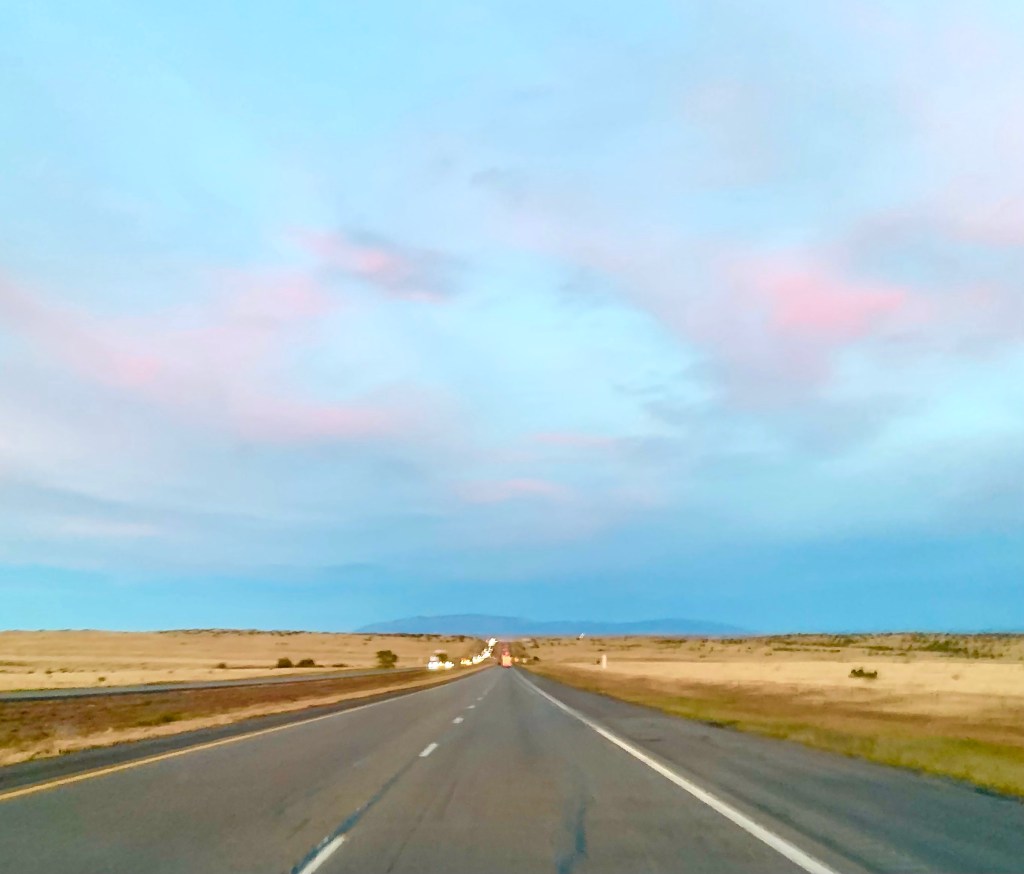
Headed to Albuquerque

Election Day, November, 1884
By Walt Whitman

If I should need to name, O Western World, your powerfulest scene and show,
‘Twould not be you, Niagara—nor you, ye limitless prairies—nor your huge rifts of canyons, Colorado,
Nor you, Yosemite—nor Yellowstone, with all its spasmic geyser-loops ascending to the skies, appearing and disappearing,
Nor Oregon’s white cones—nor Huron’s belt of mighty lakes—nor Mississippi’s stream:
—This seething hemisphere’s humanity, as now, I’d name—the still small voice vibrating—America’s choosing day,
(The heart of it not in the chosen—the act itself the main, the quadriennial choosing,)
The stretch of North and South arous’d—sea-board and inland—Texas to Maine—the Prairie States—Vermont, Virginia, California,
The final ballot-shower from East to West—the paradox and conflict,
The countless snow-flakes falling—(a swordless conflict,
Yet more than all Rome’s wars of old, or modern Napoleon’s:) the peaceful choice of all,
Or good or ill humanity—welcoming the darker odds, the dross:
—Foams and ferments the wine? it serves to purify—. while the heart pants, life glows:
These stormy gusts and winds waft precious ships,
Swell’d Washington’s, Jefferson’s, Lincoln’s sails.

Joy and Peace,

Cornelia

Walt Whitman: Election Day November 1884
https://poets.org/poem/election-day-november-1884

What does Hanky Panky mean?
https://writingexplained.org/idiom-dictionary/hanky-panky

Words related to monger
https://www.etymonline.com/word/monger/related

Shakespeare: Julius Caesar Speech, spoken by Marc Antony
https://www.poetryfoundation.org/poems/56968/speech-friends-romans-countrymen-lend-me-your-ears

NOTES: Whitman’s Election Day, 1884 https://pubs.lib.uiowa.edu/wwqr/article/26076/galley/134444/view/

Rabbit! Rabbit!

adult learning, at risk kids, brain plasticity, Children, city, Dreamscape, Faith, Family, flowers, Healing, holidays, Icons, Love, mandala, Mandylion, Ministry, ministry, nature, Prayer, purpose, rabbits, Reflection, renewal, risk, school shootings, shame, Spirituality, Stonehenge, summer solstice, texas, Uncategorized

Welcome to June! I’ve found my sunshades and my flip flops, so this rabbit is ready for a summer vacation. Old school teachers never die, they just take the summer off. And teachers, as well as students, will need a summer off, along with some intensive counseling, to get them ready to return in a healthy frame of mind next fall.

Summer Solstice Mandala

In my early years in ministry, I served in a certain county where many people were caught up in despair. I often complained to my district superintendent of my desire to pour mood elevators into the public water supply.

“You do know drugging the water supply isn’t exactly an acceptable activity for a Methodist minister?”

“Oh, yeah, but it sure would make my job easier.”

Rabbits Love One Another

Remember, June 3 is Love Conquerors All Day. I need to remind myself of this on occasion when I want to take the easy road. As Jesus reminds us in Matthew 7:13—

“Enter through the narrow gate; for the gate is wide
and the road is easy that leads to destruction,
and there are many who take it.”

Taking the easy way out isn’t always the best choice, but it’s the one we rabbits most often choose. We rabbits don’t like to rock the boat, and we like to make all the other rabbits happy if at all possible. The only problem is if we please A, B gets upset. If we please B, A gets upset. We don’t even try to please C, since C is so cranky, even the good Lord Jesus couldn’t fry an egg to please them. We set our hearts and minds on pleasing God, as best we can, and hope to hear the words, “Well done, good and faithful servant, enter into the joy of your master.”

Make Mine Chocolate Ice Cream Day

Chocolate ice cream brings me joy any day of the year, but June 7 is a day dedicated to this frozen delight. Don’t worry about frying eggs, but keep it frozen. I like mine plain, but fresh strawberries or peaches are a nice addition, plus some chopped nuts. Always go for complex, unless you just can’t wait. Then grab a spoon and eat it straight from the pint. (Mark it with your name, since you ate from it.)

Often we cut the Gordian Knot and go for the shortcut to our complex problems. Sometimes this is a good solution, for the shortest distance between two points is a straight line. My daughter used to call my vacation navigation shortcuts “the long cuts,” since I’m directionally challenged. Most of the time, that straight line went through swamp land and alligators. I can hear her voice now, “NOOOOO!!!” I’m known for taking the scenic route, so I often see America’s less known sights, which are off the beaten path.

In the gospel of Luke (14:34), Jesus quotes a proverbial saying:

“Salt is good; but if salt has lost its taste, how can its saltiness be restored?”

Another translation of the latter portion of this verse is “how can it be used for seasoning?”

When I think of loss, I think of a life snuffed out. Some people are burned out, so we can say they’ve lost their seasoning ability. There’s no vim or vigor in them. Other lives are cut short and aren’t able to fulfill their purpose to season the great soup of our community. Our past month was marked by 47 mass shooting incidents in May alone. A mass shooting incident is defined as one in which at least four people are injured or killed, not including the shooter. Suicides aren’t included.

Suicides are also a public health problem. They are the “deaths of despair” that leave ripples of grief and hopelessness in the survivors. They’re the ultimate shortcut solution to a problem, the placing of a period where life has placed a comma or a semicolon. My daughter once attempted suicide by downing half a bottle of aspirin. I noticed the open bottle and pills scattered across the floor. She said the “dog ate it.”

“That’s too bad, I’m going to miss that dog. She won’t be long for this world. We’ll need to make burial plans for her.”

“Well, actually, I’m the one who ate the aspirin.”

“Then we’re going to the hospital. You aren’t going to like getting your stomach pumped, but it’s better than being dead. You want to have a chance to grow up and have a good life. A dog we can replace. You—not so much.”

It was a rough time in her life, and mine too. But God was with us. And we had support from counselors, friends, family, and our church family. My work family and my clients supported me too. I must be the most extroverted rabbit in the patch, because I asked everyone for help. It turned out my problem was shared by everyone else. I discovered I wasn’t alone, but was the most ordinary of rabbits around.

This is a humbling experience, especially when you’re a first child and the only girl. I admit to being spoiled, but don’t let my brother rabbits hear me say this. I’ll deny it to my last breath: I’m like every other rabbit I know. I want to think I’m someone special, even when I’m just as fluffy as every other bunny out there on Gods green earth.

June 21—Summer Solstice

Unfortunately, half the suicides today are committed with a gun, not aspirins. When looking at overall gun deaths, roughly two-thirds are attributed to suicides—a proportion that is consistent across most states. Gun suicides are on the rise and data also indicates men, white Americans, older people, and individuals living in rural areas present higher rates of gun suicides. Another group presenting a unique risk for suicide is current and former members of the armed forces, especially those with PTSD.

Compared with the general population, current and former military members have significantly higher rates of gun ownership. According to a 2015 study, nearly 50% of U.S. veterans own a gun. In contrast, studies suggest that only about 22% of the general U.S. population owns firearms. Similarly, the age groups of 50 to 64 years old and 65 and older have the highest rates of gun ownership, according to a 2017 Pew Research Center study. This can further explain the high rates of suicide among older veterans.

According to data from the U.S. Department of Veterans Affairs (VA), in 2019, close to 4,332 veterans died by gun suicide in the United States, representing close to 18 percent of the total number of gun suicides reported by the Centers for Disease Control and Prevention (CDC) during that year. Perhaps more alarming is the fact this figure shows a veteran is killed by gun suicide every two hours. In 2019, active duty military members committed suicide by gun 64% of the 498 total (318), almost one gun suicide per day.

Why isn’t anyone speaking about this? For all the lip service our politicians give to the flag and to the armed service members, they seem to forget them once they’re no longer useful to fight their wars or march in their parades. Perhaps because Congress won’t devote any money to study the effects of gun violence on the citizens of our Beautiful America, so we have to fund private studies here and there to piece together a patchwork of facts of this scourge on the peace of our people.

My young neighbor, only 8 years old, was in a panic as he knocked on my door the other day. His parents hadn’t come straight up the elevator, as they’d said they would. He was crying to beat the band and was sure something bad had happened to them. I invited him inside and left the door open so we could see them come past. He was so worked up, he couldn’t sit down. I suggested a call to his daddy, but they came walking past just at that moment.

June 19—Father’s Day

We don’t realize what terror these school shootings put our children through. There’s no safe place for them any more, no matter how “hardened” we make the buildings. Some person always breaks the shell at the most inopportune moment.

Some rabbits will have empty seats at their family reunion tables because someone decided to act impulsively. Father’s Day (June 19) won’t be a celebration without the son or daughter to give Dad the tie, the golf balls, or breakfast in bed.

I think back to my own childhood. We worried in the 1950’s more about the urban legends of Halloween candy poisoning, when we were more likely to get killed crossing Highway 1, a four lane highway running through our town. My mother rabbit would wait for me to ride the trolley home from school. She would wait until the near lane of traffic cleared before she walked out to the center median and time this so the far lane’s cars would finish passing so she could walk across the newly empty lanes to meet me on the other side. We held hands and crossed in the same manner on the way back to our home.

This was our routine from the start of school until sometime in the autumn. Mother was delayed one day, so I sat down to wait for her and opened my book to read. I was wearing a brown jacket against the early cool spell, and my dirty blonde hair blended in with the pile of dry leaves on the ground. Intent on my book, I failed to see her come outside. She overlooked me and went inside thinking I’d missed my ride.

A bit later, I decided if she wasn’t coming for me, I’d come to her. Gathering up my possessions, I stood on the curbside. I watched the comings and goings of the quickly moving traffic. Once I saw the break in the pattern, I walked out into the clearing, waited at the median, and crossed behind the trailing traffic of the second lane. When I walked inside, my mother had a conniption fit. After this, I began riding my bicycle to school, and my brother got to come with me.

Brain Functions

Not everyone is mature enough to cross a four lane busy highway by themselves when they’re in the fourth grade, which is the same age as the children who lost their lives at Robb Elementary in Uvalde, Texas. . Some people still need to be supervised at work even in their 20’s. The brain keeps maturing past age 21, as the frontal lobes, which are home to key components of the neural circuitry underlying “executive functions” (such as planning, working memory, and impulse control) are among the last areas of the brain to mature; they may not be fully developed until halfway through the third decade of life. Although neuroscience has been called upon to determine adulthood, there is little empirical evidence to support age 18, the current legal age of majority, as an accurate marker of adult capacities.

Since May 24, the date of this tragedy in Uvalde, Texas, the gunviolencearchive.org has recorded 16 mass shootings in six days, with 79 killed or wounded. Some of these are high school graduation parties where uninvited guests arrived and gunfire broke out, others are the result of young people wandering about in the late hours and getting into trouble with guns. During my time of ministry, youth, alcohol, and firearms were usually a recipe for trouble. Maybe parental rabbits’ brains are still developing too, if they aren’t able to put their rabbit foot down and tell the junior rabbits to leave their weapons at home. Visiting Jack Rabbit in jail for accidental death or intentional use of a firearm will throw a curve into your best laid plans for your progeny.

Rabbits in Cars Going for a Joyride

Instead, cities may have to reinstitute curfews after dark to curtail the opportunities for gun violence. Or they could raise the age to buy a weapon and require a longer waiting time and a more thorough background check. I wouldn’t be opposed to a training class and a test to see if the owner knows how to use the weapon safely. After all, we do this for the 2 ton weapon of mass destruction known as the family automobile. So what if the founding fathers never had autos; they also never had automatic pistols or large magazine weapons, modeled on the ones used in combat.

Did I mention June is National Safety Month? Its emphasis is workplace safety, but as a former teacher, this old rabbit reminds you, between 2009 and 2020, teachers’ workplaces are in schools, which is where 30% of mass shootings occurred in public places (schools, malls, or bars), while 61% of mass shootings occurred entirely in the home and another 9% occurred partially in a home and partially in a public location. The common factor in these is the gun and the presence of domestic violence. In at least 53 percent of mass shootings between 2009 and 2020, the perpetrator shot a current or former intimate partner or family member during the rampage.

Richard Small seen posing with his rifle before turning it over to police.
(Joshua Lott/The Washington Post)

I know y’all usually expect a bright and cheery note from me at the beginning of the month, but my heart is broken. Thoughts and prayers are nice, but they don’t stop the carnage. We need to make some changes. At least one man has turned in his assault weapon to his local police station, so it doesn’t fall into the wrong hands. He couldn’t bear the thought of it being used to perpetrate a similar crime if he were to sell it. If we parents don’t say no to our children, if we keep voting for politicians who are doing nothing, then we get to keep the distinction of having the highest rate of violent gun deaths for any of the developed countries.

That’s not the American Exceptionalism I believe in. We can do better. These are crimes against the common good and against the innocent. The shooter shares the primary blame, but everyone who does nothing to change our society for the better also shares the blame and shame for the next group of victims. At the rate we’re going, we’re having about one mass shooting per day. Eventually this scourge will come to YourTown, USA, and your small town police force will be just as flabbergasted as poor Uvalde’s. How could this happen in our little corner of the world?

I cry along with Jeremiah ( 8:21-22):

For the hurt of my poor people I am hurt,
I mourn, and dismay has taken hold of me.
Is there no balm in Gilead?
Is there no physician there?
Why then has the health of my poor people
not been restored?

Time Magazine Cover from 2019 with all the Mass Shooting Locations Named

Sometimes we go along with the attributes of cultural Christianity, rather than practicing the Christianity of Jesus Christ. Romans 12:2 reminds us

“Do not be conformed to this world, but be transformed
by the renewing of your minds, so that you may discern
what is the will of God—what is good and acceptable and perfect.”

Joy, peace, and balm for hurting souls,

Rev. Cornelia

Deadly Dreams: What Motivates School Shootings? – Scientific American
https://www.scientificamerican.com/article/deadly-dreams/

You can view a report of any 2022 mass shooting incident by visiting the list on the Gun Violence Archive’s website:
https://www.gunviolencearchive.org/reports/mass-shooting

Poisoned Halloween Candy | Snopes.com
https://www.scientificamerican.com/article/deadly-dreams/

Mass Shootings in America | Everytown Research & Policy | Everytown Research & Policy
https://everytownresearch.org/maps/mass-shootings-in-america/

Adolescent Maturity and the Brain: The Promise and Pitfalls of Neuroscience Research in Adolescent Health Policy – PMC
https://www.ncbi.nlm.nih.gov/pmc/articles/PMC2892678/

Guns and Mass Shootings: Data Show Why US Is Outlier on Deaths From Firearms
https://www.bloomberg.com/graphics/2022-us-gun-violence-world-comparison/

Texas romance with guns tested by Uvalde school shooting – The Washington Post
https://www.washingtonpost.com/nation/2022/05/30/uvalde-shooting-guns/

Golden Leaves on a Silver Breeze

arkansas, art, autumnal equinox, beauty, cognitive maps, Creativity, Dreamscape, Faith, flowers, Holy Spirit, hope, Imagination, inspiration, ministry, mystery, nature, Painting, Retirement, Spirituality, Travel

Autumn is just around the corner: I know this in my heart of hearts. My friends, who have lost hope in this endless pandemic, tell me, “It’s heat stress, nothing more.” I persist in my belief the bright yellow leaves scattered among the green canopies and the orange and red tinged foliage are the harbingers of the cool breezes of fall.

When the thermometer kisses 100 F and the heat factors have blown past that number like a NASCAR driver taking a hot lap for the pole position, my body only wants to swill decaf iced tea and stay close to the air conditioning. When I taught art back in Louisiana, my art rooms were in an old wooden shotgun shack. It wasn’t air conditioned because “it’s tradition, so it won’t be air conditioned, no matter how much you ask for it.” Private schools have their “traditions,” some of which aren’t healthy for either the teachers or the students.

Two days into the school year, I fainted from the heat. A visit to the nurse’s station got me glasses of sugary iced tea and cold compresses, plus it was air conditioned. I thought I’d died and gone to heaven. Someone drove me to my dad’s office in the Medical Arts building across from the hospital. I got the once over and was sent home to rest, drink plenty of fluids, and not go outside. My couch never looked so good to me. Mom and dad even kept my little girl so I could rest.

I learned later I had a brush with death. Passing out with other people there allowed me to be helped. People who are alone in the heat aren’t so fortunate. Heat can kill a person. The hurricane Ida is already taking out the utilities in south Louisiana, which means they might not be back for weeks. The hospitals full of Covid patients hope to have ten days of power and food, but that’s just to get them through until relief supplies can roll in.

Dreamscape: Airport

I actually repainted this canvas a second time, since I wasn’t thoroughly pleased with it on the first go round. The Airport image above is the first incarnation of this painting. While I don’t mind the colors in the ground, the overall texture of the work didn’t appeal to my senses and the runway with its numeral stuck out like a sore thumb. It was either going into the trash bin of my work, or I’d leave it alone long enough to find the inspiration to cure it.

Painting is a journey in itself, as the white canvas disappears under the brushstrokes of color. We can think of a pristine sand beach in the early morning, and its well marked surface erased by the high tide under the moonlight, only to be marked again when the sun rises. As Benjamin Disraeli, the British Prime Minister in the 19th century once said:

“Like all great travellers, I have seen more than I remember, and remember more than I have seen.”

Sometimes we can better solve a problem by ignoring it, for the the problem will find its own solution. Trying to impose our solution upon it just leads to more death, but not to life. Letting the painting come into being in its own time is a better choice, for it can’t be born before its time. In the spiritual life, kairos time is God’s time, while chronos is human time. When we work on deadlines or punch a clock, we operate on chronological, human time, but if we wait for the inspiration from the divine energy, we’re operating in the God moment, or the propitious moment for decision or action.

Golden Leaves on a Silver Breeze

Along my life journey, I’ve made some unique handmade preaching stoles. When I decided I no longer had use for them in retirement, I decided to cut them up. This is why some of the pieces are the same rectangular size, such as the gold and silver diamonds pattern with the blue and white diagonal stripe in the upper left corner. Some of the pieces are the backings, and others are deconstructed sections. I incorporated several types of gold: acrylic paint, embroidery thread, and a metallic candy wrapper. I also used multiple textures of lace and fabric, some of which I overpainted. All of these come from recycled fabrics. In life, nothing is wasted.

Perhaps this no longer looks like a map of an airport, but more like a place remembered in a dream, when one wants to travel on the whiff of a breeze, which has brought a half remembered smell of a time in the past or a love long lost. Autumn can bring those memories to mind, as well as our hopes for a more beautiful future, for just as a leaf flutters free from its tree, our thoughts can fly away: golden leaves on silver breezes.

Look for the golden leaves, my friends, and let them call to mind those of fond memory and the dreams of journeys yet to come.

Joy and Peace,

Cornelia

Rabbit, Rabbit, Welcome to June!

arkansas, art, Astrology, change, Children, coronavirus, Faith, Family, Forgiveness, Healing, hope, Mental Illness, pandemic, photography, renewal, Stonehenge, summer solstice, Travel

Road Trip, anyone?

Can you believe we’re almost halfway through 2021? My how time flies when you’re having fun! And to think only a year or so ago, we thought our lives were going to be locked up behind closed doors forever and a day! Amazing how following good hand washing practices, not congregating in large groups, and wearing masks managed to stem the larger transmission of this deadly pandemic in most areas, until we could begin getting shots in people’s arms. Now that about half of Americans are vaccinated, the summer months are looking “like the good ole summertime” of memory.

Folks are going en masse on vacation and indulging their pent up travel bug by plane, car, and train, as well as bus and cruise ship. I live in a tourist town, so a goodly number of the 34 million people who kicked off the summer vacation season by traveling in a car are jamming our city streets. We’re thankful for them, however, for they spend money at the local hotels and restaurants, and that means the folks who work there can support their families. The City of Hot Springs has 38,468 people, while Garland County has 96,371. We have year round visitors, with more enjoying our hospitality in the spring and summer. Annually over 2.1 million people visit us to hold conventions, reunions, weddings, and vacations in our fair, historic town. Some days you can’t stir them with a stick. You’d think this was Times Square in New York City, or a rabbit farm.

But I digress. Those who visit us here in the Ozarks seem to be better mannered than those who travel elsewhere. Perhaps because they drive here, they refrain from alcohol until they arrive, unlike the airline passengers who’ve gained their fifteen minutes of infamy on social media and a lifetime ban from traveling on the friendly skies of the major airlines. No one will miss these bad actors on airplanes in these early days of recovering from the pandemic. Instead, we might want to recover some “good old summertime events and activities” in their place.

Vacation Bible School

One of my fondest memories from childhood was Vacation Bible School. I looked forward to it each year for the arts and crafts projects, the singing, and the snacks. I might have remembered the teachings, but I liked being with my friends from across town, who went to other schools. We could see more of each other during VBS. Children who attended my home church always created a traditional craft, the plaster hand cast. I made one in the 1950’s when I put my right hand into a pie plate full of quickset plaster. After it dried, I was allowed to pick one color to paint it. In the 1980’s, my daughter made the same craft, but she could paint it any way she wanted; she always fancied rainbows.

The Helping Hand

Rainbows and Joy

If I learned anything in Bible School, it’s we’re called to give our hands to God’s service for good for all, especially for the weak and defenseless. Also, no hand is too small to serve God. The good news is even if VBS isn’t able to be held inside at one place with the usual songs, skits, and crafts, it could always be held in a park, in a parking lot, or by traveling from backyard to backyard in carpools, or “car pods” as we call them today.

Sidewalk Entrepreneurs

Another fond memory is the neighborhood lemonade or Kool-Aid stand. As I recall, this endeavor was never profitable, but it kept us out of trouble for at least an entire afternoon. If we kids managed to keep our noses clean that long, it was likely a world record. Our parents were glad for the peace and quiet, and the opportunity for adult conversation. We kids worked together to solve our own problems and overcome any obstacles to our sales project. Of course, my brothers usually retorted to my suggestions, “You’re not the boss of me!” To which I’d reply, “But I’m older and I know better!” We’d hash it out and find a middle way.

Sometime in the middle of summer I’d get a break from those ornery brothers and get to go to camp. At first it was YWCA Day Camp, then Church Camp at an old Works Project Administration lake, and on to tent camping with the Girl Scouts. While the water might taste like iron in places, if I were thirsty, I’d drink it gladly. Some places we built our own tables with tree limbs and ropes. I learned knot tying and cooperation out in the woods. I also learned how to cook an entire meal in the coals of a fire by wrapping it in tinfoil. As my daddy would say, “There’s more than one way to skin a cat.”

Father Rabbit

Speaking of Fathers, a major holiday for all rabbits is Father’s Day on June 20th. We all have a father who has guided us in the good paths of life, even if this person wasn’t our birth or adoptive father. Often it’s another outside the family unit, such as a teacher, a coach, a pastor or lay leader in our faith tradition. For those rabbits among us who had distressing experiences with their fathers, this is a fraught day, for our past memories can color current events and relationships. If we cannot change our past, we can change how the past affects our present and our future. This is part of the healing process by which we face the pains of the past and gain power over the memories so we can have a better future not only for ourselves, but also for the next generation. Otherwise, our pain can become an unwelcome generational inheritance.

D-Day Invasion of Europe, World War II, June 6 US troops of the 4th Infantry Division “Famous Fourth” land on ‘Utah Beach’ as Allied forces storm the Normandy beaches on D-Day.

Just as soldiers returning from wars have to put aside the mental and physical wounds of wartime with medical and psychological help, anyone who has suffered abuse at the hands of a father figure also needs healing. PTSD help available through the VA for everyone. They have apps available at the link below anyone can access, but nothing takes the place of a human professional. Your health care provider or clergy person can refer you.

Of course, for fathers, the meaning of “manhood” is always in question, as American historian Timothy Marr wrote in American Masculinities: A Historical Encyclopedia (Sage Reference Publication 1st edition) that in the holiday’s early decades, men ‘scoffed at the holiday’s sentimental attempts to domesticate manliness with flowers and gift giving, or they derided the proliferation of such holidays as a commercial gimmick to sell more products — often paid for by the father himself.'” We usually gave Dad a necktie, or handkerchiefs. These are gifts going the way of the dodo bird, so my guess today’s equivalent is sports equipment or tech wearables.

National Iced Tea Day

The 1904 World’s Fair

We have the hot summer of the 1904 St. Louis World’s Fair to thanks for the popularity of iced tea. In fact, if you believe the tales, more new American foods were invented at the 1904 World’s Fair in St. Louis, Missouri, than during any other single event in history. The list includes the hamburger, the hot dog, peanut butter, iced tea, the club sandwich, cotton candy, and the ice cream cone, to name just a few.

Art Nouveau Gilt Glasses from Austria, mouth blown, 1910

By the First World War, Americans were buying tall glasses, which became commonly known as iced-tea glasses, long spoons suitable for stirring sugar into taller glasses and lemon forks. Prohibition, which ran from 1920 to 1933, helped boost the popularity of iced tea as Americans looked at alternatives to drinking beer, wine and hard liquor, which were made illegal during this period.
Cold tea first appeared in the early nineteenth century when cold green tea punches spiked with booze gained in popularity. Recipes for “punches” began appearing in English and American cookbooks, and called for green tea, rather than the black tea consumed by most Americans today.  

Early Iced Tea Recipe

In 2003, Georgia State Representative John Noel introduced a House Bill proposing that all Georgia restaurants that serve tea be required to serve sweet tea. It was done apparently as an April Fool’s Day joke. Noel is said to have acknowledged that the bill was an attempt to bring humor to the Legislature, but wouldn’t mind if it became law. This is certainly better legislation than some of the recent laws Georgia and other southern states have passed recently to combat the imaginary boogeyman of a stolen election and voter fraud, although there were zero instances of voter fraud in Georgia in 2020, and only 20 total instances in the conservative Heritage Center Voter Fraud Data Base. The ancient, well worn wisdom is “Don’t fix what ain’t broke.”

Summer Solstice

Stonehenge under Snow, 1947, Bill Brandt. Credit: the Museum of Modern Art – MoMa, New York.

We meet the middle of our astrological year on the summer solstice, which will occur on June 20, at 10:32 pm CDT in the USA. The most famous solstice site is certainly Stonehenge, in England. The stone settings at Stonehenge were built at a time of “great change in prehistory,” says English Heritage, “just as new styles of ‘Beaker’ pottery and the knowledge of metalworking, together with a transition to the burial of individuals with grave goods, were arriving from Europe. From about 2400 BC, well furnished Beaker graves such as that of the Amesbury Arche are found nearby”.

The Cyclone, Coney Island: Roller Coaster Thrills, Nat Norman, 1962

Perhaps in American society we’re at a turning point, just as the days are approaching the summer solstice. It’s as if we’ve been on a roller coaster carnival ride on the ups and downs, and now we’ve chugged our way up to the very heights. We’re ready to throw our hands up over our heads and scream all the way home and get off the ride ready to go again. We can’t forget the rest of the world beyond our shores, for if we don’t defeat the virus abroad, it will come back to carry us on the roller coaster ride again. Besides, the generosity of the American spirit calls us to heal the nations of the world, for the good of all.

Sons who are Fathers and Grandfathers now.

The summer solstice is the longest day of the year of the year, so all good bunnies should remember to reapply sunscreen every few hours if you’re playing in pools or running through sprinklers or enjoying the waves on a sandy beach. A hat is also good. Don’t forget to drink lots of water, for the warm breezes can dry you out, the activity can tire you out, and then you get cranky in the afternoon. Take a nap in the afternoon, or just rest inside in a cool place and read a book. Don’t wait till August to do your whole summer reading program. You’ll thank your old teacher rabbit for this suggestion, as the days begin to dwindle down again and routines require relearning.

Summer Solstice

I’m in the middle of a condo renovation, so I’ve got very busy rabbits coming and going, with hammering and banging noises all day long. We’re down to the bathroom now, so sometimes I have water and sometimes I don’t, but at least I live near others who can open their homes to me. We’ve all been isolated for the past year, so some of us may take time to lower the walls and learn to once again to trust one another. Not everyone should get the welcome mat, especially unvaccinated persons. Yet hope is on the horizon, for two of the main vaccines have sought full approval from the FDA, and children 12 and above can get the vaccine now.

De Gray Lake Resort: a sunset so magnificent I had to stop and photograph it.

As we rabbits always say,
“Sing praises to the LORD, O you his faithful ones,
and give thanks to his holy name.
For his anger is but for a moment;
his favor is for a lifetime.
Weeping may linger for the night,
but joy comes with the morning.”

~~ Psalms 30:4-5

May your sunrises and sunsets always be glorious,

Joy and Peace,
Cornelia

PTSD help available through the VA for everyone: apps for mindfulness and information at this site, plus links to Veterans Administration
https://maibergerinstitute.com/june-is-national-ptsd-awareness-month/

Face Masks for Children
https://www.healthychildren.org/English/health-issues/conditions/COVID-19/Pages/Cloth-Face-Coverings-for-Children-During-COVID-19.aspx

The 1904 World’s Fair: A Turning Point for American Food
https://www.seriouseats.com/food-history-1904-worlds-fair-st-louis

American Masculinities: A Historical Encyclopedia (Sage Reference Publication): Carroll, Bret: 9780761925408: Amazon.com: Books
https://www.amazon.com/American-Masculinities-Historical-Encyclopedia-Publication/dp/0761925406

Celebrating Iced Tea Day
https://www.nationalicedteaday.com/celebrating-iced-tea-day.html#.YLbJ5y08L4A

Heritage Center Voter Fraud Data Base
https://www.heritage.org/voterfraud/search?state=GA&combine=&year=&case_type=All&fraud_type=All&page=0

History Extra: Stonehenge
https://www.historyextra.com/period/stone-age/10-facts-about-stonehenge/

Springtime Is A Golden Age

adult learning, arkansas, art, beauty, brain plasticity, change, cosmology, Creativity, Evangelism, Faith, flowers, Health, Ministry, nature, Painting, pandemic, photography, quilting, renewal, shadows, Travel, trees, vision

Every nation has its Golden Age. Usually, it’s a bye gone time, located in the dim past, and remembered faintly only by the oldest of the old. My Golden Age is my childhood, for I spent much unfettered time out in nature, whether it was in the backyard, the neighborhood, or at camp. I was so excited about camp, I would lay out my clothes for day camp, and pack my dad’s old army duffle bag a whole month in advance for week long camp. Mother would see this overstuffed cylinder, and laugh, “What are you planning on wearing between now and then?” My excitement and my planning didn’t always get all the facts together.

Going out into nature has always revived my soul, even as a child. Walking under trees, beside a lake, and sleeping with the sounds of the wild places instead of civilization has always appealed to me. If I have a choice between traveling on a major highway or on a back road, I often choose the back road. Today with GPS, we know how far the next gasoline station or rest stop will be. The back roads often have the most interesting sites and sights. The main highways are efficient, but the little roads retain their charm.

The Great Goat Encounter in Efland, NC

Whenever I longed for the gentler days and the healing powers of nature, I would seek out the back roads of Arkansas. Sometimes I would get into my car and drive until I found the solace of the natural world. If I got lost, it didn’t matter, for I had no particular place to go. I would find the place I was meant to discover, as Aldous Huxley, the English writer said, “The goal in life is to discover that you’ve always been where you were supposed to be.”

 I’ve always trusted the word of the prophet Isaiah (58:11):

The LORD will guide you continually,

and satisfy your needs in parched places,

and make your bones strong;

and you shall be like a watered garden,

like a spring of water,

whose waters never fail.

Of course, those who know my navigating skills might question how I ever found my way anywhere. The secret is all small roads lead to a larger road. Also, if I ever grew concerned, I’d stop and ask for directions back to the big highway. I’ve met some interesting folks by getting lost, just as I’ve found some beautiful landscapes. I’ve never been in such a hurry I can’t stop and take a photo. These images I use for inspiration for future paintings. I took this photo by the roadside off interstate 30 west, near Texas 44 west, near Simms, Texas, in 2014.

DeLee: Wildflowers near Simms, Texas

While the flowers by the side of this road were only yellow, I decided to add in notable reds and blues, since those are well known colors from Texas also. These primary colors represent lazy Susans, Indian paintbrush, and bluebells. The wind and light in the trees were beginning to freshen up, a true sign of spring on the plains. The whole is full of light and has the promise of the new life and hope, which every spring brings to those who find renewal in nature. William Allingham, an English Poet of the 19th century, wrote a poem called “Wayside Flowers.”

DeLee: Texas Wildflowers

Pluck not the wayside flower,

It is the traveller’s dower;

A thousand passers-by

Its beauties may espy,

May win a touch of blessing

From Nature’s mild caressing.

The sad of heart perceives

A violet under leaves

Like sonic fresh-budding hope;

The primrose on the slope

A spot of sunshine dwells,

And cheerful message tells

Of kind renewing power;

The nodding bluebell’s dye

Is drawn from happy sky.

Then spare the wayside flower!

It is the traveller’s dower.

When we speak of a dower, this is a treasure or endowment gifted to a future visitor who passes by. Because of this, all travelers should respect the wildflowers and leave them in situ. All living organisms need to reproduce. Digging up wildflowers, picking wildflowers, or collecting their seed will reduce a plant’s ability to reproduce and will adversely affect its long-term survival in that location. Removing wildflowers from the wild can have a detrimental affect on pollinators and other animals that depend on that species for food and cover. Removing wildflowers from our national forests and grasslands prevents other visitors from enjoying our natural heritage. Most wildflowers when dug from their natural habitat do not survive being transplanted.

Every nation has its Golden Age, an idyllic past in which all her citizens were supremely confident, filled with energy and enthusiasm and utterly convinced that their country provided the heights of artistic, scientific, and civic achievement for all. The Greeks had their Golden Age after the Persian Wars with the building of the great architectural monuments on the Acropolis, the morality and philosophy of Socrates, Plato, and their followers, as well as the physician Hippocrates, who’s considered the father of western medicine. “Future ages will wonder at us, as the present age wonders at us now,” remarked Pericles, the Greek statesman, orator and general of Athens during the Golden Age.

The Parthenon on the Acropolis of Athens

America had her Golden Age also, that period time we know as the post-World War II economic boom when manufacturing and employment were at their peak. Many people my age wonder why these present times don’t continue the past prosperity, but most forget our world economy has changed, especially since the 1980’s. To give an example, I had friends in the oil business back in Louisiana. They let the roughnecks go and they went out into the fields to take their place. At the same time, when oil prices were so low, the private school where I taught art let me go, since they considered my subject an elective. The art classroom was the only place some students could achieve and find positive affirmation during the school day, but the school would oversee the increased discipline needs. Even during this decade, employers were cutting jobs and asking employees to do the work of two people. Labor has taken a beating in the decades since.

In the forty years since, our whole life has changed. When I was young, a high school education was sufficient for many entry level jobs. Back in 1941, less than half the U.S. population age 25 and older had a high school diploma, while today, 90 percent has that achievement. When my dad was a young man, an 8th grade education was more than sufficient for blue collar jobs. Today at least two years at a community college is the new  “Union Card” for employment. Why is this, you ask? Our young people need to know more than we did! Our adults also need to keep learning! This is why I keep teaching myself new things, going to seminars, and writing blogs that require research.

I’m very proud of our class members who attend the Friday Art Experience at Oaklawn UMC. Work can sometimes take a priority over this enrichment experiment, and we went on hiatus for part of the pandemic. One of the goals I gave the group was to find their own voice and not to copy mine or someone else’s. We can learn from each other, for we all have a unique perspective on life and how we interact with the world. When we stretch ourselves, we create new pathways in our brains, a process called brain plasticity. A new activity that forces you to think and learn, plus require ongoing practice can be one of the best ways to keep the brain healthy, since eventually our cognitive skills will wane.  Thinking and memory will be more challenging, so we need to build up our reserves.

Much research has found that creative outlets like painting and other art forms, learning an instrument, doing expressive or autobiographical writing, and learning a language also can improve cognitive function. A 2014 study in Gerontologist reviewed 31 studies that focused on how these specific endeavors affected older adults’ mental skills and found that all of them improved several aspects of memory like recalling instructions and processing speed.

I don’t know about you, but I was born with only two brain cells and one of them seems to travel regularly to the planet Pluto. I need to be in the studio as often as possible if I’m to call that wandering cell back from its journey elsewhere. Art for me is life, just as a walk among the trees or beside a creek renews my soul. As the Psalmist writes in Psalm 19:1, The heavens are telling the glory of God; and the firmament proclaims his handiwork.

Artist’s logarithmic scale conception of the observable universe.

Gail was the only one attending this week. Graduations, which  were happening in various academic settings, kept others away. She brought a photo of a field of yellow flowers, with a house up on a hill. In the middle ground was a pond and on the crest of the hill were a windrow of cedars. We discussed the formal elements for a bit. I showed a series of wildflower ideas as a slideshow to give a sense of the varied way artists across history have approached this subject.

Then we got down to work. Note the sense of light and air in Gail’s painting. The windrow of trees shows the direction of the sun and we can sense the breeze coming from the same side. This is an unfinished painting, so we can’t tell if the yellow meadow will have more varied colors, but the first layers of the wildflowers in the foreground give us the sense it might.

Gail’s unfinished wildflower painting

Sometimes we can finish a painting in one sitting, but other times, even a small work takes another session. Life is a work in progress. We can’t hurry it. When we finish a work, we often find flaws in it. This is because we’ve learned new skills, and we judge our work by our new abilities, rather than by those skills we had when we began. Artists aren’t like those who look to the past for a Golden Age. Instead, they look to the future.

Benjamin Franklin said, “The Golden Age was never the present age.” Usually the Golden Age is a fondly remembered past, but only the best parts of it are treasured by those who benefited most by it. We need to remember, as William James, the American philosopher reminds us, “There are two lives, the natural and the spiritual, and we must lose the one before we can participate in the other.”

Or as 2 Corinthians 5:17-20, so aptly puts it:

So if anyone is in Christ, there is a new creation: everything old has passed away; see, everything has become new! All this is from God, who reconciled us to himself through Christ, and has given us the ministry of reconciliation; that is, in Christ God was reconciling the world to himself, not counting their trespasses against them, and entrusting the message of reconciliation to us. So we are ambassadors for Christ, since God is making his appeal through us; we entreat you on behalf of Christ, be reconciled to God.

If we do this, we can bring the Golden Age into the present for all people.


Ethics and Native Plants

https://www.fs.fed.us/wildflowers/ethics/index.shtml

The Golden Age of Greece

https://www.historymuseum.ca/cmc/exhibitions/civil/greece/gr1050e.html

Train your brain – Harvard Health

https://www.health.harvard.edu/mind-and-mood/train-your-brain


Energies of the Labyrinth

art, change, Chartres Cathredral, coronavirus, Creativity, Faith, garden, greek myths, Imagination, labryinth, Meditation, pandemic, Reflection, Spirituality, Travel, vision

The word labyrinth comes from the Greek labyrinthos and describes any maze-like structure with a single path through it. It’s different from an actual maze, which may have multiple paths intricately linked. Etymologically the word is linked to the Minoan labrys or ‘double axe’, which is the symbol of the Minoan mother goddess of Crete. The actual word is Lydian in origin and most likely came to Crete from Anatolia (Asia Minor) through trade. Labyrinths and labyrinthine symbols have been dated to the Neolithic Age in regions as diverse as modern-day Turkey, Ireland, Greece, and India among others.

Labyrinths or mazes may have served to help the ones who walked them to find their spiritual path by purposefully removing them from their common understanding of linear time and direction between two points. As one traveled through the labyrinth, one would become increasingly lost in reference to the world outside and, in doing so, might unexpectedly discover one’s true path in life.

On New Year’s Day, I was reading my Twitter feed and came across this image of a seaside labyrinth. The comment was, “My #oneword for 2021 is downwind. After walking the labyrinth today with turns both against & with strong wind, I realized how limitless 2021 can be with the help of those who push me forward and not the wind pushing against me. This year, I’ll ride the momentum downwind.”

Twitter photo—My #oneword for 2021 is downwind

The theme of the labyrinth leading to one’s destiny is intricately linked to the Greek myth of Theseus and the Minotaur. The Minotaur lived at the heart of the labyrinth on the island of Crete, whose king required the people of Athens to send a tribute of fourteen youths annually. Once they entered the Minotaur ‘s labyrinth, they never returned. Theseus defeats the beast and saves his people, but loses his father to suicide because he fails to remember to change the color of his sails on his return trip as a sign of his victory. There’s even more dysfunctional family relationships, but that’s a story for another day. Suffice it to say, the ancient gods were wont to interfere with the lives of arrogant humans who failed to defer to the gods and instead acted as if they were masters of their own destiny.

Theseus and the Minotaur: Attributed to the Tleson Painter, ca 550 B.C., Attic Black Figure Kylix, Toledo Museum of Art, Toledo

Greek tragedy deals with the sweeping themes of love, loss, pride, the abuse of power and the fraught relationships between humanity and the gods. Typically the main protagonist of a tragedy committed some terrible crime without realizing how foolish and arrogant she or he had been. After slowly realizing the error, the world crumbles around the hero. The tragic hero must be essentially admirable and good. The fall of a scoundrel or villain evokes applause rather than pity. Audiences cheer when the bad guy goes down. We feel compassion for someone we admire when that character is in a difficult situation. The nobler and more admirable the person is, the greater our anxiety or grief at his or her downfall.

This idea survives to this day in the proverb, “The bigger they come, the harder they fall.” In the 5th C BCE, in the founding work of history known as the Histories of Herodotus, we find the statement: “It is the gods’ custom to bring low all things of surpassing greatness.” An earlier expression, “Pride goes before destruction, and a haughty spirit before a fall,” is found in the Proverbs (16:18). These date from 700 BCE to the fourth century BCE (1:1-9:18).

In a true tragedy, the hero’s demise must come as a result of some personal error or decision. The tragic or fatal error, or fatal flaw of the protagonist that eventually leads to the final catastrophe is known as hamartia, or missing the mark. It’s a metaphor from archery, and literally refers to a shot that misses the bullseye. There’s no such thing as an innocent victim in a tragedy, nor can a genuinely tragic downfall ever be purely a matter of blind accident or bad luck. The tragic hero must always bear at least some responsibility for his or her own doom. In Greek tragedy, the gods may interfere, but they don’t determine our destiny. Likewise, human events and actors may put detours across our path, but though the gods may intervene on our behalf, we can still snatch defeat from the jaws of victory in a true Greek tragedy.

Theseus killing the Minotaur of the Cretan labyrinth. Ariadne, possibly, looks on from the right. Attic black figure vase, Late 6th, early 5th century BCE. (Archaeological Museum, Milan).

The labyrinth is a symbol for change, for it’s the place of transformation. In the myth, Theseus must enter a maze no one knows how to navigate, slay a flesh eating monster, and return to the world above. Theseus accomplishes this, but still retains his youthful flaws until he is changed by his father’s death and he’s forced to grow up and assume adult responsibility. His experience in the labyrinth offered him an opportunity to change and grow but, like many people, Theseus resisted until change was forced upon him.

The medieval labyrinth is a unicursal labyrinth, with a single, circuitous but clearly delineated path. It’s an image encompassing both shared and individual experience, for we don’t walk the path alone, but we share it with fellow travelers. The unicursal labyrinth is distinguished from a multicursal labyrinth (or maze) by having only a single (though winding) path to its center. While a maze may have little or no symmetry and may not even have a center, a medieval labyrinth usually has both. The great medieval labyrinth on the floor of France’s Chartres Cathedral is one of the most famous unicursal labyrinths.

Chartres Cathedral Labyrinth from Above

Carl Jung, the famous Swiss psychologist, saw the similarity between medieval, Christ-centered mandalas in manuscripts and rose windows, the mandalas of his patients, and the mandalas he created. Jung believed his own mandalas “helped him maintain his psychic equilibrium” and believed “everything points toward the center,”so that he found “stability” and “inner peace” even during the war era.

Jung: Mandela

Medieval labyrinths, and all their variations, including the classical design of which the medieval style is an outgrowth, now appear across the United States in settings ranging from churches and parks to hospitals and museums; they may be painted, tiled, paved, woven into a carpet, constructed of canvas, or cut into a lawn. They’re usually designed to be walked on. Over the last quarter century, the medieval labyrinth has entered public consciousness as a “blueprint for transformation” rather than “an oddity,” as it was at one time. I can remember at least one of my fellow clergy asking if “this wasn’t so kind of new age hooey I was getting into.” Moreover, labyrinths aren’t limited to meditative and ritual use; they also appear in secular and recreational settings and are often noteworthy for their ornamental or artistic value.

Lavender Garden Labyrinth

While each one of us walks the same path, no one has the same experience on the labyrinth. We’re all on the same journey, but we’re traveling on a different part of the path. We entered at a different time, or we came to the labyrinthine journey at a different period of our spiritual journey. Some of us will move slowly, while others will hustle along the way. If we came with troubles and worries, we may have been looking for THE ANSWER. The labyrinth isn’t a one armed bandit. We don’t put our money in, pull the handle, and get a payout. The walking is instead an opportunity for reflection, a time to give our selves to the service of God, and set aside our pride.

We enter into the community of faith on the path

I’ve walked on the labyrinth on different occasions and had different experiences, since I’ve been “residing in different inns along my spiritual journey” during the years as I make my rounds about the sun while I live on this planet earth. I’ve been to the holy land twice, and been to Greece and Turkey to walk in the footsteps of Paul to see the churches he planted across the Mediterranean. I spent a summer in Italy during art school, while living in a small town and taking field trips to see the historic sites nearby. I took an interterm during graduate school to visit London and visit all the museums I could devour in that short time, along with some excursions to the seaside. Still, I’ve yet to see Stonehenge, and I’ve not seen Paris.

The question is, do we walk the labyrinth as a tourist going to a destination, expecting to stamp our passports, bring back photos, and buy souvenirs, or do we go expecting to meet Christ along the way? On the tour groups, folks sort themselves fairly soon into subgroups. The ones who want to go quickly to the site, give it a once over, take a few photos, and hit the souvenir shops before they have a coffee or a drink, will find each other and share their daily haul as they relax and wait for the stragglers to roll in. The stragglers come in two groups: the ones who took their time, and the ones who took the wrong turn and got lost. Thankfully, I didn’t get lost as I often do here at home! My notorious ability to take the wrong turn and my poor map reading skills are legend. The virtue of group travel is we leave no one behind.

While each person enters the labyrinth alone, others may also be on the path also. When we meet another, we perform a silent dance of giving way, first one to another, then the other to the one. Two can’t be in the same lane at the same time, but we can “dosie do” to let one another pass on by. This is life in community, where we share the spaces and the journey. When we walk the path of the Labyrinth, we enter a space/time/continuum. This is where up/down, left/right, and forward/backward all exist in one time dimension. Time passes differently inside the Labyrinth, for the twisting path appears to take us first directly toward the center, but just as we approach it, we are forced to follow the path directly away from the center instead. Then we wander around the outer edges of the labyrinth until suddenly, we arrive at the center. If we think we’ll never reach the promised land, we’ll find ourselves suddenly cast upon its shores as a Jonah spewed from the belly of a big fish. What seems like three days of darkness in a labyrinth may only be thirty minutes. Clock time gives way to God time on the journey.

Energies of the Labyrinth

Thus we enter into the timeless paths of all the pilgrims walking before us, those who never made their way to the holy land, but found the holy in the land in which they lived. The labyrinth has a way of uniting all the time of the past, the future, and the now into one dimension. In this way, when we walk the labyrinth, we enter into the kairos time of God, as opposed to the chronos time of humanity. No longer are “on the clock,” but we walk in the appointed and opportune time for us to experience the holy.

If we’re surprised, and emotionally disconcerted as we walk these twisting paths, it’s because we discovered we had no control over how soon we could get to our destination. We can stay in the center and be humbled by this awareness, but often we act like tourists instead. We get our passports stamped after an appropriate rest, and head back home. As heroes who’ve been to the center, we journey back to the outer world as changed people, ready to bring new truths and understanding back to the world. If we are like the Greek heroes of old, however, our tragic flaw will be living for ourselves only and forgetting to do good to all.

The energies of the labyrinth aren’t self-contained to the paths or to those who walk it. It is a holy space, so like the energies of space time, in which space and time are relative, observations depend on the viewer’s speed. If we rush through the labyrinth, we don’t have the same opportunity to meet Christ on the road to Damascus, as Paul did, and have an opportunity to change our lives. We need to drag our feet a bit, as the grieving disciples did on the road to Emmaus, so we might have the privilege of recognizing Christ in the central act of blessing the bread when they invited him to stay with them at the end of the journey.

The hurried life isn’t for the contemplative person, so even those whose lives are given over to getting many things done can benefit from a quiet time now and then. Otherwise, we can become the heroic Theseus who depends upon his own power, rather than giving credit to the powers of the gods, for all his great deeds. This is why his arrogance and pride is his undoing, even though he had a transformative experience in the labyrinth. Not until much later did he process this experience and grow from it.

When I began my painting, I started out with the actual forms, in homage to the many walks I’d participated in over the years. Soon I thought of burying the image, and uncovering parts of it, as if it were an archeological dig in process, but I only buried the outer edges. Then the idea of energies of the innumerable pilgrim walks percolated up into my consciousness and I began to paint the intersecting colored arcs. While I lost the paths, I was painting my emotional experience of the walking. I’ve been on quite a journey this past year, even though I’ve gone nowhere, due to the covid pandemic. Confined to home, I’ve longed to journey elsewhere, but the labyrinth is a journey anyone can take safely without fear of a monster who devours human tributes. I’m looking forward to the new year and new works, and perhaps some actual journeys. God bless everyone. Thanks for reading this.

Joy and Peace,

Cornelia

Labyrinth – Ancient History Encyclopedia by Joshua J. Mark
https://www.ancient.eu/Labyrinth/

Elements of greek tragedy and the tragic hero
https://www.slideshare.net/cafeharmon/elements-of-greek-tragedy-and-the-tragic-hero

Mary Hackworth—“The One and the Many: The Significance of the Labyrinth in Contemporary America,” Journal of Jungian Scholarly Studies Vol. 9, No. 3, 2014
https://jungianjournal.ca/index.php/jjss/article/download/44/37/74

The Labyrinth Society: The Labyrinth Society: Directions to Make a Labyrinth
https://labyrinthsociety.org/make-a-labyrinth

How to Make a Canvas Labyrinth for $200
https://pinkpaganpriestess.wordpress.com/2012/11/30/how-to-make-a-canvas-labyrinth-for-200/

Histories of Herodotus
https://www.gutenberg.org/files/2707/2707-h/2707-h.htm

What is Space Time?
https://www.livescience.com/space-time.html

Rabbit! Rabbit! Welcome to December!

arkansas, art, Children, Christmas, Civil War, coronavirus, Faith, Food, generosity, grief, Hanukkah, holidays, Israel, ministry, poverty, rabbits, righteousness, Travel

Bunnykins Christmas Plate

December has snuck up on me like a racoon stalking a rabbit. Perhaps I ate too much of the Thanksgiving Feast, or maybe it was the homemade Italian Cheesecake dressed with cranberry sauce and maple pecans that did me in. It thankfully wasn’t the covid, for I had an appropriately socially distanced meal via Zoom, thanks to my niece in New Orleans and her mother in Texarkana. I’ve driven to New Orleans before, and it’s a hard eight hour trip, so I’ve always done it in two legs and made it into an easy jaunt instead. I spent the night in Vicksburg, Mississippi, to see the great Civil War battlefield there, and pay homage to those who fought to preserve the unity of the nation, even if my ancestors fought to keep other human beings enslaved. I also saw some of the grand plantation homes, which were built by slave labor. We don’t think of this history much, and I wasn’t taught it growing up, but it’s time for all of us to acknowledge all the hands who built this nation we call home.

My Decembers as a child growing up in the South were a time of waiting. I couldn’t make the clock hurry up no matter how hard I stared at it. My mother would remind me, “A watched pot never boils.” I’d grind my teeth. Hurry used to be my middle name. Now I seem to putter all day and never worry about it. I may be an aging rabbit, or maybe just a great-grandmother rabbit. Or I may have learned the wisdom of waiting, which is the lesson of the Advent season.

All small children endure the waiting at the end of the year, for the end of the year is full of holidays for many faiths. Today we’re all waiting for more normal times to return, so we can hug one another, kiss each other on the lips, and drink from the same cup without worrying about a dread disease. Waiting was so difficult for me and my brothers, we’d beg and cajole our parents to “Please, pretty please, just let us open one gift before Christmas!” We were the fortunate ones, for when our parents were children in the era of the Great Depression, they knew better than to ask for much. My daddy asked Santa Clause for an orange, boxing gloves, and a book for his older brother. Most of us today think we’d be bad parents if we gave our children only two items, but in the era of covid, when nearly 30 million people are out of work, we might need to readjust our priorities. Keeping a roof over our heads and food on the table could take priority, unless angels bring the gifts instead.

Christmas Crepes and Coffee

Today, I’m listening to Mannheim Steamroller play Christmas music. Tomorrow is the first day of meteorological winter and the Winter Solstice will be December 21. It’s a quiet time in the condo, for I’m alone with my decaf coffee and the furnace is keeping me cozy. One small joy I always look forward to is the opportunity to use my Christmas themed mugs for a whole month. I’ve put up the ordinary dishware and pulled down my collection of red, green, gold, and white cups. When I was young, I looked forward to the gumdrop tree and the Christmas cookies. Decorating and baking every weekend kept mother busy in the kitchen and me helping or getting my fingers in the icing bowl. I learned to share by helping my mom. I never liked her candied fruitcake recipe, however, or the fruitcake cookies. You can keep that to yourself. I think some traditions may need to die, and fruitcake is one of them, but my tastebuds don’t cater to sugared fruit anymore. Her pecan sandies were to die for, however.

If we approach the coming holiday season with anticipation for the small joys it brings, rather than thinking of the losses we’ve suffered, this December will be better for us by far. By this I mean, the tree isn’t the most important thing, for if it were, we’d worship the tree. We don’t worship the lights shining brightly, but the light which shines in the darkness. The presents aren’t the most important part of Christmas, for we don’t worship the gifts, but the gift from God.

Christmas Lights, Hot Springs, Arkansas

While light has been central to many religions across the centuries, it becomes very important toward the end of the year when the days grow short. The Romans originally celebrated Saturnalia as a harvest festival, but then moved it to the middle of December, and changed its focus to a celebration of light, knowledge, and truth. They would gift dolls and treats of fruit, and light bonfires. It began as a home holiday, but became a public feast holiday in 217 BCE.

Another religious festival is the Jewish festival of Hanukkah, which celebrates the miracle of the oil and its burning for eight days, when only enough for one day was found. Jewish people celebrate their faith by lighting a menorah with nine candles: one is the helper or attendant, and the others represent the days of the ancient miracle of rededication of the Temple after the Maccabean Revolt. Families always place the menorah in a window, so everyone will see it. As a special treat, families eat foods fried in oil, such as potato pancakes and doughnuts.

Menorah

The tradition is one should spend time in close proximity to the Chanukah lights for, “We must listen carefully to what the candles are saying.” The flickering flames may be telling us the following:

1. Never be afraid to stand up for what’s right. Judah Maccabee and his band faced daunting odds, but that didn’t stop them. With a prayer on their lips and faith in their heart, they entered the battle of their lives—and won. We can do the same.

2. Always increase in matters of goodness and Torah-observance. Sure, a single flame was good enough for yesterday, but today needs to be even better.

3. A little light goes a long way. The Chanukah candles are lit when dusk is falling. Perched in the doorway, they serve as a beacon for the darkening streets. No matter how dark it is outside, a candle of G‑dly goodness can transform the darkness itself into light.

4. Take it to the streets. Chanukah is unique in that its primary mitzvah is observed in public. It’s not enough to be a Jew at heart, or even at home. Chanukah teaches us to shine outwards into our surroundings with the G‑dly glow of mitzvahs.

5. Don’t be ashamed to perform mitzvahs (individual act of human kindness), even if you will feel different. Rather, be like a menorah, proudly proclaiming its radiant uniqueness for all to see.

My daddy died one year and my mother died the next. I didn’t much feel like Christmas in my heart. When the Salvation Army representative came calling to the church office, I really didn’t have the energy to help reorganize another messed up program. Then the words of my mother entered my mind: “If you want to feel better about your situation, you should do something for someone in more need than you are.” I can’t say I grieved any less, but I felt better about that Christmas, for I knew I was called to share my blessings with others. I could talk to all the service clubs in town and get them to ring the bells, including the high school service clubs. We made many people in that community able to pay their utilities and rent in hard times.

December 6 is Saint Nicholas’ feast day, the saint who most people know as Santa Clause. Saint Nicholas was the Bishop of Myra and endured the persecution of Emperor of Diocletian, who put so many priests, bishops, and deacons into prison, there wasn’t room for actual criminals. After his release, Nicholas attended the Council of Nicaea in 325 CE, before his death in 343. His generosity was legend, as was his concern for children, the poor, and anyone in need. Europeans celebrated the saint’s day and reserved the day of Christ’s birth for more sober, religious experiences.

Saint Nicholas the Gift Giver

Many people consider Christmas to be quintessential American holiday. When my daughter and I hosted a French exchange student chaperone, she raved about the American Christmas. “The English do the season well, but the Americans are the very best of all. I only wish I could be here in December!”

I laughed. I had too many memories of being up all night assembling Strawberry Shortcake Doll Houses or putting together my daughter’s new bicycle. I’ve always been directionally challenged when it comes to maps, but also when it comes to reading set up plans. I’ve never understood it, since I seem to be able to follow a recipe just fine, but mechanical things are a stumbling block to me. My memories of Christmas are from participation, not from observation.

The first Colonists, who were primarily Puritans and other Protestant reformers, didn’t bring the Nicholas traditions to the New World. As we celebrate the Christmas of today, we have a hard time thinking of the Puritan tradition which ignored Christmas altogether. Back in the 18th and 19th centuries, once the work was done, people would drink and become rowdy. Drunken mobs would roam the streets and scare the genteel classes afterwards. Even in the mid 19th century, Christmas was a regular workday. Christmas didn’t become a federal holiday until June 26, 1870, under President Ulysses S. Grant.

After the American Revolution, New Yorkers remembered with pride their colony’s nearly-forgotten Dutch roots. In 1773, New York non-Dutch patriots formed the Sons of St. Nicholas 1, primarily as a non-British symbol to counter the English St. George societies, rather than to honor St. Nicholas. John Pintard, the influential patriot and antiquarian, who founded the New York Historical Society in 1804, was the first to promote St. Nicholas as patron saint of both society and the city. 

In January 1809, Washington Irving joined the society and on St. Nicholas Day that same year, he published the satirical fiction, Knickerbocker’s History of New York, with numerous references to a jolly St. Nicholas character. This was not the saintly bishop, but rather an elfin Dutch burgher with a clay pipe. These delightful flights of imagination are the source of the New Amsterdam St. Nicholas legends: the first Dutch emigrant ship had a figurehead of St. Nicholas; St. Nicholas Day was observed in the colony; the first church was dedicated to him; and St. Nicholas comes down chimneys to bring gifts. Irving’s work was regarded as the “first notable work of imagination in the New World.”

Another work of the American imagination is the “Visit from Saint Nicholas,” or “The Night Before Christmas,” a poem which still holds our interest. This poem centers around the family and the safe toys for the good little girls and boys, which Santa and his reindeer will bring to each snug and cozy house. This poem is in the public domain, so it’s available on the internet. 

Christmas for many of us in years past has been like the Bunny 500: racing about the countryside as fast as we can to get as many of our to-do lists done. This covid Christmas, we might exchange our tradition of mass consumption for hot chocolate and communication. I’ve always enjoyed reading Dylan Thomas’ A Child’s Christmas in Wales. After two decades of ministry and multiple Christmas Eve candlelight services, I’ve always appreciated the quiet of the parsonage afterwards and the descriptive words rolling off this poet’s tongue. If the poem harkens back to a simpler time, it also reminds us of our lives before we were isolated from one another. As one who rarely saw snow on Christmas, I always enjoyed reading about the snowball fight against Mr. Prothero’s fire, and the Uncles and the Aunts at the meal. After a big day, Thomas said some words to the close and holy darkness and then he slept. 

The light will come into the darkness and the darkness won’t overcome it. Two thousand years ago, even the parents of the holy child could find no place to spend the night but in a cave with animals. They had no crib for their child, but placed him instead in the manger. Their families in town didn’t come to visit, but angels announced his birth to shepherds in a field nearby. Strangers brought gifts from far away, but no one from his family was around to celebrate.

Banksy: Manger, Bethlehem’s Walled Off Hotel

Maybe this is Christmas at its best, when we recognize the one who lives on the margin and isn’t included in the center of the social experiences. If your Christmas today isn’t what it’s always been, perhaps the gift of this Christmas present is the one you need.

May you and your bunnies celebrate this season of light and be a light in the darkness for those who think the dawn can’t come soon enough.

Joy and Peace,

Cornelia

Audio Blessings and Latkes Recipe Link

https://www.chabad.org/holidays/chanukah/article_cdo/aid/103874/jewish/Blessings-on-the-Menorah.htm

How the Pandemic is Affecting Supply Chains

https://www.wbur.org/hereandnow/2020/11/24/coronavirus-supply-chains

Dylan Thomas: A Child’s Christmas in Wales

http://gutenberg.net.au/ebooks07/0701261h.html