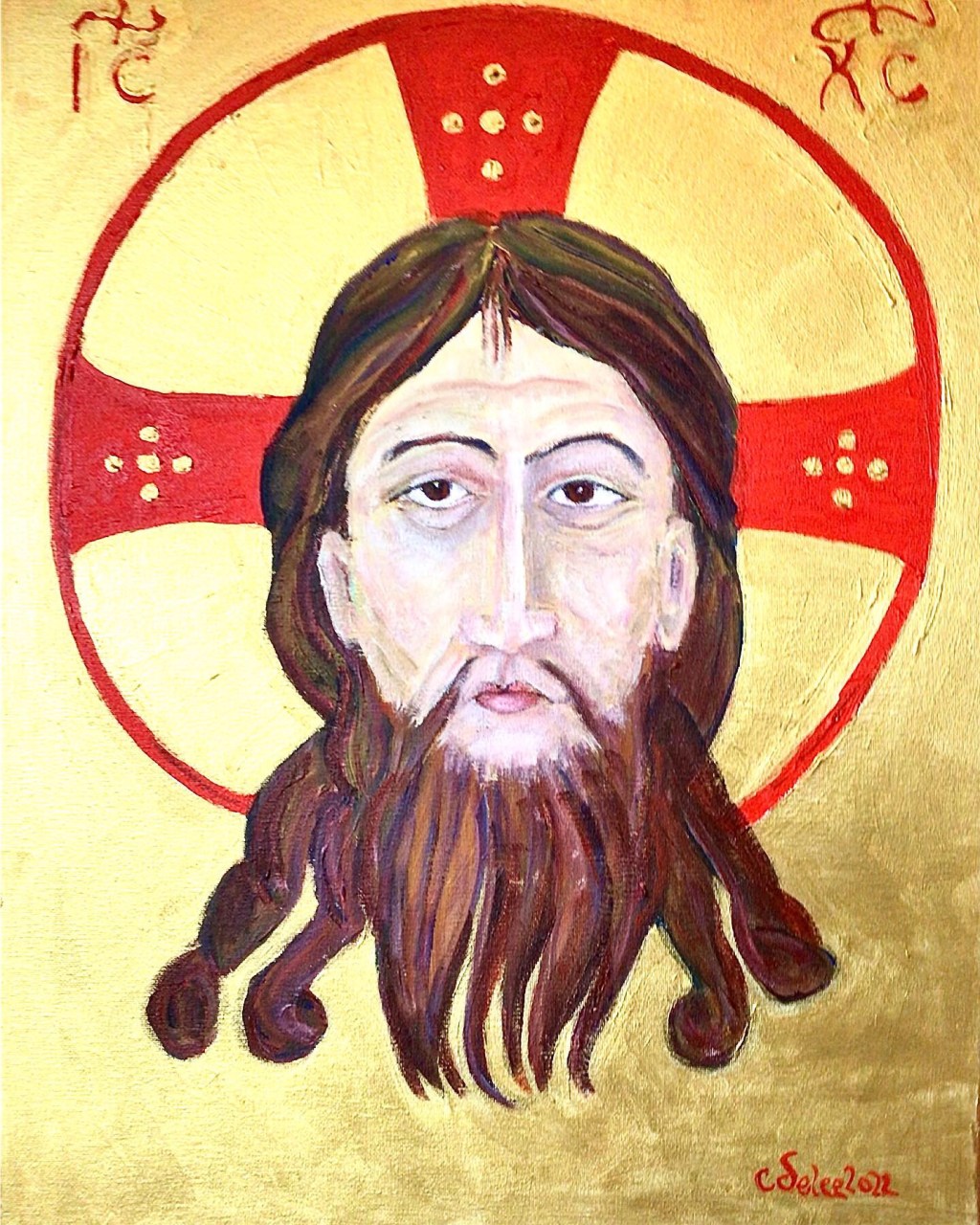
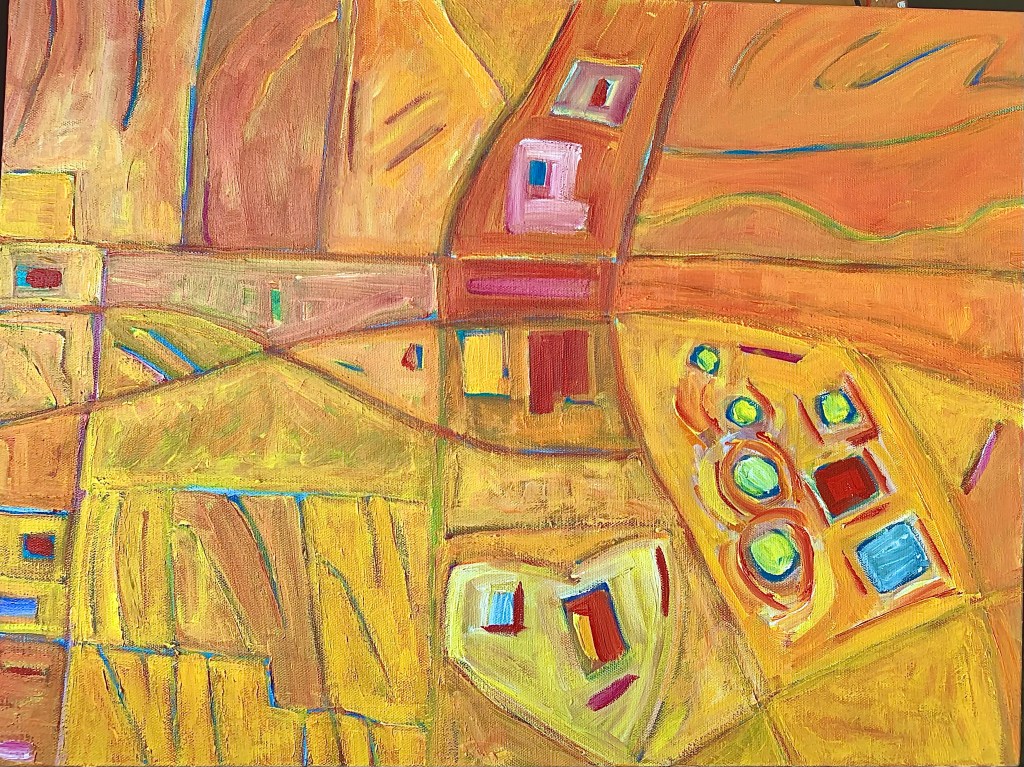
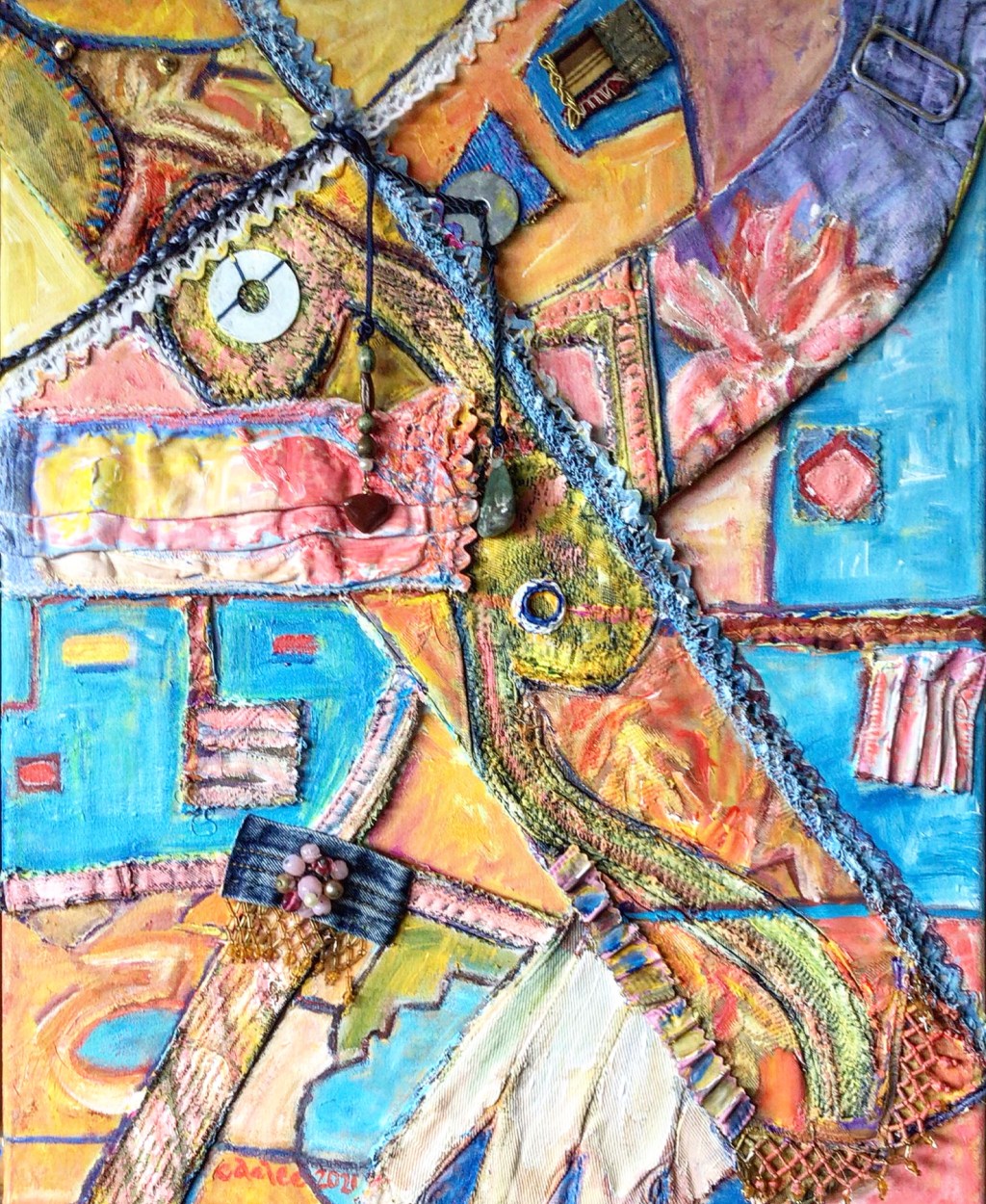
Rabbit! Rabbit! Welcome to May 2022

art, coronavirus, Faith, flowers, generosity, greek myths, Holy Spirit, inspiration, Love, nature, Painting, poverty, purpose, rabbits, Spirituality, Turkey, Ukraine, vision

May your garden grow.

This rabbit isn’t ready for May. Even as I say “Rabbit, Rabbit,” on this prime morning, I realize time already is too quickly flying past. I knew this day would eventually come, but surely I thought, not yet. When my rabbit parents were long of tooth—I think they were over forty—they said they had a longer “to do list” than their day was long. I think this was the time they were sending me the golden “round tuit” so I would get my own to do list done. Parental units in every generation have always projected their problems onto their offspring, or perhaps their offspring inherit or imitate the adults’ tendencies.

A Round Tuit

May is a good time for spring cleaning. Every rabbit hutch or den can use a bit of freshening up after a long winter and a cold spring. May 17th is Pack Rat Day, an opportunity to touch those items once and for all as you decide whether they belong in a Distribute, Donate, or Dump Box. If you just touch and can’t decide, you may be one of the 15 million hoarders in the United States. The days are getting warmer with more daylight and global warming adding to the elevated temperatures. We can’t do anything about the length of days, as these are determined by our planet’s oribit and inclination toward the sun. As we move toward summer, the Northern Hemisphere tilts toward the sun and gets warmer. In the Southern Hemisphere, the opposite happens and their Christmas is warmer than their springtime.

Eid Mu Barak

May marks the end of Ramadan, the month long Islamic fast recognizing the gift of the Quran to the prophet Mohammed. In most communities in the United States, Eid begins at sundown on Monday, May 2, and lasts one to three days, depending on cultural tradition. Eid al-Fitr, which means “festival of breaking the fast,” comes after a month of abstaining from food and drink from sunrise to sunset in observance of Ramadan. This is a time of renewal, wearing a new outfit, giving charity to the poor, and resuming the everyday rhythms of life.

Some of us finally get our gardens planted, in honor of the Ancient Greek and Roman goddesses of May. The word May entered the English language in the 1050’s, developing from the Old English Maius, which was borrowed directly from the Latin Maius, short for Maius mēnsis, “Maia’s month.” The Greek goddess Maia was one of the Pleiades, who were the companions of Artemis, the goddess of the hunt. This Maia was the mother of Hermes, the messenger of the Gods. But the Romans had yet another goddess named Maia, who just happened to share her name with the Greek goddess. When later generations conflated the Greek Maia with the Roman Maia, a goddess of fertility and spring, we now celebrate May for growth and increase in the natural world.

Victory Gardens were in vogue during wartime due to shortages at home caused by food supplies diverted to soldiers fighting on the front. Original “supply chain problems.”

If we want to “go green,” in our gardens, we can practice composting our lawn clippings along with any brand of manure. This will enrich our earth with earthworms and organic materials. We can also practice “crop rotation.” This means we plant our tomatoes ina different plot every year so we don’t deplete the soil of certain nutrients or invite nematodes to eat the roots. As a spiritual practice, gardening calms the mind, for it connects us to the earth and the source of our food. Our forebears supplemented their menus in the hard times in days of old with fresh food from home gardens. Community gardens serve the public in urban areas.

An April Bunny’s Bad Hair, Don’t Care Day

Spring reminds us the seasons of the year are balanced, for we have a cold winter and a hot summer, just as we have a middling spring and autumn. I say “middling,” but I might have said “muddling,” for these two seasons in my corner of Rabbitville are marked by rain and mud. Torrents of rain, drenches of rain, and sometimes mere drizzles of rain. Some of us rabbits may have bad hair days, but I hear all this moisture is good for the face and the skin.

In our world, the great powers also attempt to maintain balance and influence. Two world wars will push nations into this choice, but nations rise and fall. Once Great Britain was the world’s great super power, but after these great wars, it was greatly diminished, while the United States, which was the source of Britain’s war materials, prospered. Germany, was cut off from international trade due to its war mongering, became dependent on itself. American industries prospered, so that by the end of the first world war, America became the creditor nation to these former belligerents.

America Feeds the World: after the World Wars, hunger was rife in Europe and Russia. American farmers sent our surplus to feed the continent’s populations.

Moreover, we began to feed the world. This rabbit would like to think our government is more generous than Mr. McGregregor, who is always chasing us hungry bunnies out of his precious garden, but poverty and hunger lead to unrest among the world’s people, and that destabilizes governments. Stable governments, which don’t oppress their people, are more welcome on the world stage than dictatorships that exist to serve only a small group of privileged individuals.

As the United States and the Soviet Union struggled to reach a balance of power during the Cold War that followed World War II, President Harry S. Truman outlined what became known as the Truman Doctrine in a speech to a joint session of Congress on March 12, 1947. He emphasized the broader consequences of a failure to protect the democracies in Greece and Turkey by saying:

“The United Nations is designed to make possible lasting freedom and independence for all its members. We shall not realize our objectives, however, unless we are willing to help free peoples to maintain their free institutions and their national integrity against aggressive movements that seek to impose upon them totalitarian regimes. This is no more than a frank recognition that totalitarian regimes imposed on free peoples, by direct or indirect aggression, undermine the foundations of international peace and hence the security of the United States.”

Seventy-five years later, some of us rabbits have abandoned our national vision of democratic ideals, and have turned our back on our historic uniqueness among the nations of the world. While we may have aspired to grand ideals, but haven’t yet achieved them, this shouldn’t stop us from helping others continue their own difficult journey toward perfection. Once again, we have a bellicose dictatorship attempting to overthrow the will of Ukraine, a democratic nation, with the potential to continue such destabilizing activities in neighboring countries. What’s worse, Ukrainian agricultural products feed the world’s poorest countries, so without their harvests being replaced by American grain, people might go hungry. Hungry people are at risk for strong men with bad intentions.

Journeys aren’t ever easy. Any rabbit who tells you the road is easy, wide, and well marked on the way to their destination, has never heard the call of God saying, “Go to a land I will show you.” Those who think their path is sure, certain, and easy might want to remember this word from Matthew 7:13—

“Enter through the narrow gate; for the gate is wide and the road is easy that leads to destruction, and there are many who take it.”

This is why we admire heroes, for their journeys aren’t ever easy, but usually require some difficult and demanding task, which transforms them into a new person. They become more than they ever were before. Yet, perhaps, they were always a hero, and they only needed the auspicious moment to bring forth their true character.

The Guardian of Stuff

I remember the young man I met at a NASCAR event at Texas Motor Speedway. I asked him what he did under the stands while the race was going on.

He shrugged, “I just stand here and make sure nobody takes the other worker’s things.”

“Oh, like you’re the guardian of stuff!”
“I never thought of it like that.”

“Strike a hero pose. I’m going to take your picture .”

Everyone has a hero within, but not everyone has someone who affirms that hero. We all need to discover the hero within us, just as Jesus heard at his own baptism (Luke 3:22)—

“and the Holy Spirit descended upon him in bodily form like a dove. And a voice came from heaven, “You are my Son, the Beloved; with you I am well pleased.”

My dear rabbit mother gifted this to me years ago

We rabbits can’t fail to recognize the heroes who gave us life and brought us into this world. I speak of our mothers, of course. My own dear mother was ready to move mountains and call in every personal favor to come be by my side when I was in an Italian hospital while I was on a summer student art program. My dear daddy had to calm her jets and remind her, “Honey, it’s just a bit of food poisoning. It’s not like major surgery.” Our mothers will do anything to protect their offspring, and that makes them heroes in my eyes. I was released in three days, so it would have been a futile trip for my sweet mother. Make sure you recognize your hero mom on May 8, for without her, you wouldn’t be here.

Speaking of hospitals, May 12th is the birthday of Florence Nightingale, whose service as a volunteer nurse during the 1854 British war against Russia in Crimera. Because of her service, dedication to her call, and the innovations she brought to her vocation, we now celebrate the women and men who follow her in the nursing profession. Back in Victorian times, nursing wasn’t a respectable job, and women of the upper classes were expected to remain at home to care for the family’s affairs. Those who hear God’s call don’t worry about cultural expectations, but follow the solitary path of the heroes who went before them. Remember the nurses of today who’ve had to put themselves into harm’s way to care for people with a disease that now can be prevented from the worst complications and death in most people with immunizations and ordinary remedies like masks, hand washing, and avoiding crowds.

All us rabbits can celebrate Sally Ride Day on May 26, which was the birthday of the first American woman in space. While our national space program seems to have lost its energy and will as we’ve outsourced its efforts to the private sector, we have to ask if giving millionaires the ride of their lifetimes benefits a democratic society more than when we funded the space program by a community of citizens who sent the most highly trained and vetted astronauts into space. But then, I’m only one rabbit and I can remember the thrill, excitement, and joy when I saw our first astronauts exiting from their bobbing capsules. I saw these events on a small screen, black and white television in my school room. Afterwards, all we could talk about in our classrooms was the heroic journey of these brave individuals and the team that helped them circumnavigate our planet at such heights.

Finally, all rabbits of every stripe can celebrate Memorial Day Weekend. For some of us, this holiday has been reduced to a three day picnic at the lake or the racetrack. Others will decorate the graves of fallen soldiers from one of our many wars, participate in a patriotic parade, or watch a plethora of auto racing events around the world. Memorial Day weekend is the busiest weekend in motorsports, with Formula 1 racing in Monoco, NASCAR at Charlotte, the 100th running of the Indianapolis 500, and Lucus Oil Pro Motocross Championship from California. This rabbit will be in heaven. You could spend your tax refund on a new Television, many of which will go on sale over the weekend, or you could open a savings account for emergencies. A wise rabbit always has a little something extra stashed away for lean times. One never knows when Mr. McGregor will lock down his garden, since he doesn’t practice the ethics of Isaiah 58:10—

“if you offer your food to the hungry
and satisfy the needs of the afflicted,
then your light shall rise in the darkness
and your gloom be like the noonday.”

Self Portrait of the Artist as Wonder Woman

My old mother rabbit always reminded me if I was feeling down, all I needed to do was help someone less fortunate than me. It would get me out of my funk by focusing on helping another, as well as reminding me my problems were shared by others. Her message was a key to unlock the hero within me, without which I wouldn’t have done half the good I visited upon this world. My hope for each of you rabbits is to find the hero within you. If you allow God to accomplish deeds of courage through you, whether they be great or small, you’ll be transformed.

Joy, Peace, and May Flowers,

Cornelia

Truman Doctrine | Definition & Facts | Britannica
https://www.britannica.com/event/Cold-War

May 17 Is National Pack Rat Day! Here’s How to Celebrate.
https://ourcommunitynow.com/lifestyle/may-17-is-national-pack-rat-day-heres-how-to-celebrate

The Real Story of How America Became an Economic Superpower – The Atlantic
https://www.theatlantic.com/international/archive/2014/12/the-real-story-of-how-america-became-an-economic-superpower/384034/

Origin Of The Month of May’s Name | Dictionary.com
https://www.dictionary.com/e/may/

To Be or Not To Be

Alexander the Great, art, city, Civil War, cognitive maps, Creativity, Faith, Forgiveness, Healing, Holy Spirit, hope, inspiration, Painting, picasso, Reflection, renewal, Spirituality, vision

Hamlet’s famous soliloquy begins with these very words,”To be, or not to be: that is the question.” In seminary I learned one of those big fifty cent words I often had to check my dictionary for its meaning. Ontological is a word we don’t throw around in ordinary conversations. I never used it in a sermon, for its strangeness would have been a stumbling block to folks without similar training. Who am I kidding? It was often a stumbling block when I tripped over it in my reading. I finally understood it after my first year of Greek. I needed to know its meaning fully and completely to comprehend it.

Current events, however, make an auspicious teaching moment for this weird word. Ontology is a branch of metaphysics concerned with the nature and relations of being. Ontology is the the branch of philosophy which deals with abstract entities. It’s concerned with the nature of being or the kinds of things that have existence, but are outside objective experience. It deals with the first principles of things, including abstract concepts such as being, knowing, substance, cause, identity, time, and space. Our word essence carries the meaning well, for it means “the permanent as contrasted with the accidental elements of being.”

An example of an ontological statement in scripture is the discussion Jesus has in John 8:56-58 with some of the Jews who opposed him:

“Your ancestor Abraham rejoiced that he would see my day; he saw it and was glad.”

Then the Jews said to him, “You are not yet fifty years old, and have you seen Abraham?”

Jesus said to them, “Very truly, I tell you, before Abraham was, I am.”

In Shakespeare’s play of the same name, Hamlet’s whole soliloquy is about his existence, and whether he should live or die:

Whether ’tis nobler in the mind to suffer
The slings and arrows of outrageous fortune,
Or to take arms against a sea of troubles,
And by opposing end them? To die: to sleep;
No more; and by a sleep to say we end
The heart-ache and the thousand natural shocks
That flesh is heir to, ’tis a consummation
Devoutly to be wish’d. To die, to sleep;

Ontology comes from the Greek root ontos, ōn, which is the present participle of einai, of the verb to be. As I’ve watched the unfolding horror of this “Russian special exercise” on Ukrainian soil, I’m struck by the sense of Hamlet’s description of the struggles of life:

To sleep: perchance to dream: ay, there’s the rub;
For in that sleep of death what dreams may come
When we have shuffled off this mortal coil,
Must give us pause: there’s the respect
That makes calamity of so long life;
For who would bear the whips and scorns of time,
The oppressor’s wrong, the proud man’s contumely,
The pangs of despised love, the law’s delay,
The insolence of office and the spurns
That patient merit of the unworthy takes,
When he himself might his quietus make
With a bare bodkin?

“To be” is the ontological insistence for the Ukrainians, for they desire to exist as a free people in a free nation. They resist occupation and occupiers. Dictatorship isn’t in their five year plan, or in their distant future, if they can help it. The surrounding nations have suddenly come alive in their recognition of Russia’s unfortunate foray into this breadbasket of Europe.

Yet even as the Ukrainian people are being killed in their streets, for no reason other than their citizenship; and their homes, hospitals, museums, and public buildings are reduced to smithereens by cluster bombs and artillery fire; they fight for their land and their freedom. I watch for one hour on the evening news, for I believe our world must stand witness to this horror.

Yes, some will turn away, for they have too much trauma in their own lives to bear the pain of others. Others will watch and say this isn’t our problem. If we remember our scripture, the chosen disciples abandoned Jesus in his hour of pain and need, but the women stayed by his side until his last breath. Then they came to dress his dead body’s wounds, but found an empty grave, while the men were holed up in a locked room for fear of the Jews (John 20:19).

Humanity is always our concern and when inhumane acts or conditions prevail, the human responsibility is to bear witness and to share the burden. As Paul writes in Galatians 6:2—

“Bear one another’s burdens, and in this way you will fulfill the law of Christ.”

Hamlet muses on, dithering as contemplates taking his own life, but he takes no action for fear of what awaits him in the world beyond.

who would fardels (burdens) bear,
To grunt and sweat under a weary life,
But that the dread of something after death,
The undiscover’d country from whose bourn (boundary)
No traveller returns, puzzles the will
And makes us rather bear those ills we have
Than fly to others that we know not of?
Thus conscience does make cowards of us all;
And thus the native hue of resolution
Is sicklied o’er with the pale cast of thought,
And enterprises of great pith and moment
With this regard their currents turn awry,
And lose the name of action.

While none of us know with certainty what lies beyond this world, for no one has ever returned with souvenirs, people of faith have trusted God to be always with them, even in the worst of times. As Paul writes in Romans 8:35, 37-39—

“Who will separate us from the love of Christ? Will hardship, or distress, or persecution, or famine, or nakedness, or peril, or sword?…No, in all these things we are more than conquerors through him who loved us. For I am convinced that neither death, nor life, nor angels, nor rulers, nor things present, nor things to come, nor powers, nor height, nor depth, nor anything else in all creation, will be able to separate us from the love of God in Christ Jesus our Lord.”

Battle of Issus Mosaic, Detail: Portrait of Alexander the Great

Artists across the centuries have responded to the horrors of war, if they aren’t held in thrall to the purveyors of such deeds. Those who exist to magnify the glories of battle are there as servants of powerful leaders, not as representatives of the fragility of the human condition. Think of Alexander the Great and his route to deification, first as a glorious leader, then as a god.

The Alexander Mosaic depicts a moment of victory in Battle of Issus in which Alexander has broken through to Darius of Persia, whom he defeated and shocked, before Darius was at the verge of fleeing. The mosaic is as great as Alexander himself, for it’s about 9 feet by 17 feet in size and contains over 1.5 million individual blocks of color, or tesserae. This Roman copy of an original Greek fourth century BCE painting dates from the second century BCE and is in the Museo Nazionale, Naples, Italy.

Goya: The 3rd of May 1808 in Madrid, or “The Executions”, oil on canvas, 1814, Prado Museum, Spain.

Here we see Goya painting the horrors of war and its impact on humanity. His inspiration comes from the French army’s assassination of a group of Spanish patriots during the 1808 rebellion. The Spanish heroes are illuminated by the intense light, but their faceless enemies aren’t easily visible in the darkness from which they operate. Not only does the design make plain Goya’s feelings, but his psychological understanding of the scene as well.

As Matthew writes in Jesus’ teaching kernel known as “The Sound Eye,”

“The eye is the lamp of the body. So, if your eye is healthy, your whole body will be full of light; but if your eye is unhealthy, your whole body will be full of darkness. If then the light in you is darkness, how great is the darkness!” (6:22-23)

Picasso: Guernica

Probably the best known war painting of our modern era is Picasso’s Guernica. He painted it in response to the Nazi bombing of Guernica, a Spanish town in the Basque region during the Spanish Civil War. At about 16:30 on Monday, 26 April 1937, warplanes of the German Condor Legion, commanded by Colonel Wolfram von Richthofen, bombed Guernica for about two hours. Germany, at this time led by Hitler, had lent material support to the Nationalists and were using the war as an opportunity to test out new weapons and tactics. Later, intense aerial bombardment became a crucial preliminary step in the Blitzkrieg tactic.

Guernica, Picasso’s most important political painting, has remained relevant as a work of art and as a symbol of protest. It has kept the memory of the Basque town’s nightmare alive. While Picasso was living in Nazi-occupied Paris during World War II, one German officer allegedly asked him, upon seeing a photo of Guernica in his apartment, “Did you do that?” Picasso responded, “No, you did.”

Käthe Kollwitz, Woman with Dead Child, 1903, etching on paper. Courtesy: © Getty Research Institute, Los Angeles and Artists Rights Society (ARS), New York

Lest we forget, while wars are often started by those in power, it’s the mothers who suffer when young soldiers are killed in action. Some are fortunate enough to have the body of their loved one to hold, but it’s a sad consolation prize. How heart rending it must be for the families whose children were left behind as casualties of war. As the old Cold War era 1985 Sting song about nuclear war reminds us—

There’s no such thing as a winnable war
It’s a lie we don’t believe anymore…
We share the same biology, regardless of ideology
But what might save us, me and you
Is if the Russians love their children too.

The great sadness of this brutal war foisted on the Ukrainian people is while we’re free to see and own the pain inflicted on others, too many of us will turn away. Then again, we often have difficulty acknowledging our own pain and weakness, for we prefer to see ourselves as whole, strong, and unconquerable. All of us have a weak place and we all have an emptiness that needs to be filled. Some of us fill this emptiness by seeking power and control, while others choose various substances or activities to overuse. A few will let God’s Spirit fill us, as Paul writes in 2 Corinthians 4:7—

“But we have this treasure in clay jars, so that it may be made clear that this extraordinary power belongs to God and does not come from us.”

Cornelia DeLee: Obliterated Ukrainian Landscape, Maxar Satellite Image, Apple Pencil, 2022.

When I see the satellite imagery of the obliterated Ukrainian towns, I recall my childhood memories of the old ones in my family repeating their ancestors’ stories of the troubled times during the Civil War. I can easily imagine in Ukraine, for several generations to come, all the stories of pain, survival, and resilience that will be told as they rebuild their nation from the ground up. In the midst of this ongoing disaster, they’re already thinking “How can we build back better?”

This is a great lesson for all of us. If our life hits a major roadblock, we can either give up, scale the wall, or find a way around the wall. Another option is to make peace with the wall and find a way to be happy there. Since Putin is tearing down all the walls for the Ukrainian people, they’ve decided to double down on being Ukrainian. “To be me” is “to be free” and that means “to be Ukrainian.” As their land lies in ashes about them, those who once also spoke Russian, a similar language to Ukrainian, now find that language dead as ashes in their mouths.

Cornelia DeLee: Ukrainian Town Reduced to Ashes, acrylic on canvas, 2022.

To win friends and influence people requires a gentle hand, not the ham-fist of a dictator. I only wonder if the Russian people will ever understand this. But they may have been slaves of their state for so long, they don’t know the sweet taste of freedom. Perhaps only those who believe in a forgiving God, who allows God’s people the freedom to make mistakes and gives them through the reconciling grace of renewed fellowship, are able to come through such disasters. Those who are “sinners in the hands of an angry god” must think their fate is destiny and accept it.

So the questions remain:

  1. What IS the nature of YOUR God?
  2. How does God’s nature affect your understanding of human nature?
  3. Does your view of humanity reflect your image of God or do you see humanity through “God’s eyes?”
  4. Read the Prodigal Son in Luke 15:11-30 and answer the questions again

Some days I AM Joy and Peace,
Cornelia

Hamlet, Act III, Scene I [To be, or not to be] by William Shakespeare
https://poets.org/poem/hamlet-act-iii-scene-i-be-or-not-be

Why is the Alexander mosaic significant?
https://www.rampfesthudson.com/why-is-the-alexander-mosaic-significant/

The 3rd of May 1808 in Madrid, or “The Executions” – The Collection – Museo Nacional del Prado
https://www.museodelprado.es/en/the-collection/art-work/the-3rd-of-may-1808-in-madrid-or-the-executions/5e177409-2993-4240-97fb-847a02c6496c

Pablo Picasso: Guernica
https://www.pablopicasso.org/guernica.jsp

Rabbit! Rabbit! Welcome to April 2022

adult learning, art, Carl Jung, Creativity, Easter, Faith, holidays, hope, Ministry, mystery, nature, Painting, rabbits, renewal, shadows, trees

Ukrainian Psyanky Easter Eggs

What a difference a month makes! Only a few weeks ago, I was speaking with a rabbit pal, who was ground down by her constant caregiving in this pandemic world. She cares for elderly rabbits in a nursing home, a vulnerable population, plus she’s grieved the passing of several of her own family members lost to COVID.

“I’m not getting another shot,” she said. “I’m so tired of COVID, I could scream.”
“I know,” I replied, “but this isn’t over. As long as we have hosts—those who either can’t or won’t get vaccinated—COVID is going to mutate and stick around.”

“Oh, don’t tell me that! We’ve been through alpha, beta, and gamma. We’re on omicron now. What’s next?”

I laughed. “It doesn’t matter. It could be gigatron, megaton, or atragon—they’re all monsters and we’ll have to cross that bridge when we come to it. We’ll do what ever it takes to beat those monsters, just like in the Japanese movies.”

Booster Shots Meme

Her mood lifted somewhat, for in these hard times a friend has to be a support. I was only returning the favor, for she’s been my rock when I’ve been down.

Speaking of monsters, I love Japanese films. I once had a boyfriend in college who had a fondness for Japanese films.

“Oh, me too!” I exulted.
“What’s your favorite ?” he asked.
“I really like Mothra and Godzilla,” I replied to his frozen face.

Mothra and Godzilla

He favored more arcane fare, such as The Burmese Harp, Rashomon, and others with samurai military themes. We did share a common love of pasta, but his military service took him elsewhere, and my artistic sensibilities took me to a different place also.

We rabbits like to escape from reality when life gets too real at times, as it has this past month. The Bible speaks of “the spring of the year, the time when kings go out to battle,” in 2 Samuel 11:1. When the sap rises and the light gets brighter, some circadian rhythm must kick in that sets off a power struggle amongst the powers that be. When I taught school back in the day, all my rabbit students were wild as hares from April Fool’s Day until the last day of school in May. During my first year teaching, we got an extra week of spring break, since we didn’t use any of our snow days.

My old daddy found me crying on that Monday morning.
“What’s wrong, honey?”

I sobbed, “We only have one more week of vacation before school starts again!”
“It’s all downhill from here, honey. You can do this,” he said, encouragingly. “Dry those tears and let’s share a cup of coffee at the breakfast room table.”

Life is always better with coffee, and with an older bunny to talk some sense back into you. At least my daddy was always willing to listen to my tales of woe. I must have been a real drama queen back when I was young, but surviving those “bad old days” meant I could take my turn later on and help other young rabbits through their peaks and valleys. As the apostle Paul wrote in 2 Corinthians 12:10—

“Therefore I am content with weaknesses, insults, hardships, persecutions, and calamities for the sake of Christ; for whenever I am weak, then I am strong.”

Atragon, Monster of the Mu Empire

One of the ways I would escape reality was to watch those Japanese monster movies. They weren’t always long on plot or character development, but you could count on lots of action. Atragon, a huge monster of the Mu empire, an underwater civilization that was supposedly extinct, resurfaced in one movie to declare war against all nations. The sole hope of humanity seemed to lie on Captain Hachiro Jinguji, who refused to surrender, and his atomic super-submarine, the Gotengo. When the Mu and their evil Queen kidnapped his daughter, he decided to attack them. Earthquakes and battles between submarines and the great sea monster ensued.

Demon Brand

I’ve always found watching monster movies and the concomitant destruction they cause easier than watching the actual mayhem reported on the evening news, but then I grew up in the Vietnam era. I always had difficulty with the people my parents’ age who wanted to “bomb the North Vietnamese back to the Stone Age.” Now when I see a Russian dictator doing this very deed to Ukraine, an independent nation, I have even more distaste for this activity. I’m reminded how easy it is for us to project a demonic nature on those who do terrible, unprovoked, and unimaginable deeds on others.

Krampus: The Punisher of Bad Children at Christmas

In the years after the United States dropped atomic bombs on Hiroshima and Nagasaki, the Japanese worked out their fears of another nuclear horror or the after effects of that first one with their mutated monsters by atomic radiation. Today, we have movies which deal with our fears of robots taking over the world or artificial intelligence throwing over its creators.

1939 Attack of The Robots

These aren’t new themes, of course, for Greek mythology tells of the early Titan king Chronos, who swallowed all his children, so none would fulfill the prophecy of taking his throne. When Zeus was born, his mother spirited him away. When he grew up, he came home, caused his father to vomit up his siblings, and together they defeated him. This is how the gods came to rule the heavens, the oceans, and the underworld. These gods were made in the image of human kind, so while they were more beautiful, stronger, and immortal, they were also given to the same passions and consequences as those besetting humanity.

The Greeks and Romans were always in a contest of power, whether between the gods, gods and humans, or humans alone. Nothing was ever in a steady state. Their great leaders were known both for their military successes as well as their political prowess. They were leaders both in peace and war. The Ancient Greek philosopher
Heraclitus said, “War is both king of all and father of all, and it has revealed some as gods, others as men; it has made some slaves, others free” (no. 22 fragment B53).

Wolf image

Native American tribes have a story of the warring nature we each carry within us. It’s commonly known as “the two wolves” or “the grandfather story.”

“I have a fight going on in me,” the old man said. “It’s taking place between two wolves. One is evil – he is anger, envy, sorrow, regret, greed, arrogance, self-pity, guilt, resentment, inferiority, lies, false pride, superiority, and ego.”

The grandfather looked at the grandson and went on. “The other embodies positive emotions. He is joy, peace, love, hope, serenity, humility, kindness, benevolence, empathy, generosity, truth, compassion, and faith. Both wolves are fighting to the death. The same fight is going on inside you and every other person, too.”

The grandson took a moment to reflect on this. At last, he looked up at his grandfather and asked, “Which wolf will win?”

The old Cherokee gave a simple reply. “The one you feed.”

We each have a wolf or a Godzilla within ourselves, but sometimes we fail to notice it. Instead we see it only in the outsiders, in our enemies, or those whom we’ve excluded from our privileged circle. How we manage this “darkness” within us, how we the battle the “enemy within,” is the great work Jung spoke to when he proposed the presence of the Shadow within each of us.

The Shadows we all carry

When the world is falling apart, we too feel unmoored. When a dictator attempts to redraw the borders of another country, our cognitive maps also fall apart. If that part of the world isn’t safe, is our world at risk also? Even though we know change is inevitable, will the apple cart be set on fire or just dumped over? We rabbits aren’t the bravest animals, so we can borrow trouble from the morrow, as well as from the next half hour. Somehow we have to revision our old lives, shed our old cocoons, and renew our selves for the new world to which we find ourselves awakening.

A hundred years ago, T. S. Elliott wrote these opening lines of his famous poem, The Waste Land. In the days after the end of World War I, his wife was suffering from mental illness and his marriage was falling apart because she was having an affair with another man. He too was suffering from the shared grief of the loss of so many in the Great War, as well as his own personal relationship problems. He wrote this poem at a sanatorium, where he was taking a “cure” for his own mental health.

April Lilacs on Hwy 7S to Arkadelphia

April is the cruelest month, breeding
Lilacs out of the dead land, mixing
Memory and desire, stirring
Dull roots with spring rain.
Winter kept us warm, covering
Earth in forgetful snow, feeding
A little life with dried tubers.

If we’re ever to understand the great mysteries of faith, we have to meet the darkness within us. That’s what is symbolized by the suffering, death and resurrection of Christ. The loneliness in the garden of Gethsemane, the descent into the grave, and the rising back to life once again. If ever we’ve had this loneliness, emptiness, and sense of rebirth, we’re participating in the Easter mystery. Once we die to our old selves, we can live the Christ life, not just a life assenting to the doctrines of the Christian faith.

Sea Bass by Paul Summer: recycled antique and modern tin, riveted to a hand-carved pinewood base, forming colorful scales

No one will be able to call us rabbits April Fools, even if they call us fools for Christ. Let’s celebrate this month some of the great faith holidays, and don’t forget your taxes are due. That perhaps is “the cruelest” event of April.

April 3—Ramadan begins—revelation of the Koran to Muhammad
April 10–Palm Sunday
April 14–Maundy Thursday
April 15–Good Friday & Income Tax Day
April 16–Passover & Holy Saturday Vigil
April 17–Easter
April 18–Easter Monday (Emmaus Monday)
April 24–Orthodox Easter
April 28–Holocaust Remembrance Day
April 29–Laylat al Qadr is the day in Ramadan that observes the night when the Prophet Mohammad received the first verses of the Koran

Joy, peace, and mysteries,

Cornelia

Atragon (Ishiro honda, 1963)—underwater monster takes Tokyo.

The Burmese Harp
https://en.wikipedia.org/wiki/The_Burmese_Harp_(1956_film)

The Waste Land by T. S. Eliot | Poetry Foundation
https://www.poetryfoundation.org/poems/47311/the-waste-land

The waste land : a facsimile and transcript of the original drafts, including the annotations of Ezra Pound / T. S. Eliot ; edited by Valerie Eliot. – British Library
http://explore.bl.uk/primo_library/libweb/action/dlDisplay.do?vid=BLVU1&afterPDS=true&institution=BL&docId=BLL01010067643&_ga=2.6871095.423095881.1648426637-1262842970.1648307341

Justice and the Justification of War in Ancient Greece: Four Authors
Tristan K . Husby
http://digitalcommons.conncoll.edu/classicshp/1?utm_source=digitalcommons.conncoll.edu%2Fclassicshp%2F1&utm_medium=PDF&utm_campaign=PDFCoverPages

Writing a Holy Icon

adult learning, Altars, art, crucifixion, Faith, Holy Spirit, Icons, inspiration, john wesley, Love, Mandylion, mystery, Painting, Pantocrator, salvation, Spirituality, St. Athanasius, Stations of the Cross, United Methodist Church

Cartoon for an Icon of the Resurrection

In art class, I taught our group the time honored technique of using a cartoon to transfer an image to another surface. Of course, their first reaction was, “Are we watching Saturday morning cartoons today?”

“No, it’s Friday. We’re going to make our own carbon paper,” I said, as I showed them how artists of old would rub graphite on the back of their drawings and then outline the major lines onto the wall or the canvas to transfer the image. The J. Paul Getty Museum has a great video on YouTube explaining this process.

“You mean we’re going to paint by number?”
“Not a chance. You still have to make your own color decisions and shading choices.” Really, by now you’d think they know my opinion on the easy way. As Jesus says in Matthew 7:13—

“Enter through the narrow gate; for the gate is wide and the road is easy that leads to destruction, and there are many who take it.”

Reverse of Crucifixion Icon with Graphite over Outlines

I didn’t bring any complicated images of the holy icons. I brought only ones with simple outlines. I knew this project wasn’t going to be as easy as people first thought. It’s not as simple as coloring within the lines.

An icon is an image of a holy person, but it isn’t a mere representation of the individual. When we make photographs or even painted portraits, we seek to make “likenesses” of the individual, and capture their outward details and idiosyncrasies. If we can also capture their inner spirit, we take the image to a master level. Icons, however, are more concerned with representing the inner, spiritual nature of the person, rather than their outward nature. After all, we don’t have any images of how the holy ones from the earliest days of faith actually looked. We only have their acts and the symbols connected with them, so in the iconography we can identify them by these qualities. The word iconography comes from the Greek: eikōn ‘likeness’ and -graphia ‘writing’, so when we paint, we’re actually “writing a likeness” of the holy image.

Dusty spent his day off on the Pantocrator Icon

In the iconographic tradition, all of the faces are broad across the brow, to represent the holy wisdom of God residing in the saints, just as their elongated figures and extremities accent this holiness. The eyes, windows into the soul, are large compared to a natural face, while the mouth is small. The small mouth indicates the saint has conquered bodily passions. There’s always an ear open on an icon, for the icon needs to “hear our prayers.” Not that the icon is alive, but it’s more like an open window into heaven. Therefore, the saint’s ear is the open window through which our prayers flow into the golden light of the mysterious world beyond this material one in which we dwell both in shadows and light.

Freehand drawing of Mandylion Icon

The color in icons also plays an important role. Red belongs to martyrs. Blue stands for wisdom. White symbolizes paradise and chastity. Green is the color of the Venerable Fathers. Gold symbolizes sanctity.

The icon painter and teacher of St. Tikhon’s Orthodox University, Svetlana Vasyutina once described an experience before the iconostasis or screen of images of the saints in the church. “A while ago, I was tortured by the question why it is golden. Once I was standing at a church, looking at the iconostasis. Suddenly, they turned off the electric lights, and only candles before the icons were burning. The golden traces were shining, giving back the light. It was as if, not the candles, but the halos, were radiating light. I was amazed; the light seemed not material, not as comes from a candle or a lamp. The golden color shows the person painted in the icon was granted a different kind of light.”

According to St. Paul, glory (doxa) appears where the form and the idea of God, which inhabits it, become one. This is especially true where form becomes a place of theophany (a visible manifestation to humankind of God or a god), where the body becomes the temple of the Holy Spirit. This glory is represented by the nimbus or halo of the saints. We hear Paul speak of this power in Philippians 3:21—

“He will transform our humble bodies that they may be conformed to the body of his glory, by the power that also enables him to make all things subject to himself.”

The disciples first saw this glory descending upon Christ on the Mount of the Transfiguration, as recorded in Matthew 17:2—

Icon of the Transfiguration

“And he was transfigured before them, and his face shone like the sun, and his clothes became dazzling white.”

To become completely transformed by the Holy Spirit wasn’t only a special gift given only to the saints alone, but it was meant for all believers. As Paul mentions in 2 Corinthians 4:7 (American Standard Version)—

“But we have this treasure in earthen vessels, that the exceeding greatness of the power may be of God, and not from ourselves.”

A famous story in the Eastern Orthodox Monastic tradition follows:

Abba Lot went to see Abba Joseph and said to him, “Abba, as far as I can I say my little office, I fast a little, I pray and meditate, I live in peace and as far as I can, I purify my thoughts. What else can I do?” Then the old man stood up and stretched his hands towards heaven. His fingers became like ten lamps of fire and he said to him, “If you will, you can become all flame.”

Mike’s Icon of the Via Dolorosa

Many of us are barely alight with the fire of Christ, and we wonder why the glory of God doesn’t shine through us. Others of us hide our light under a bushel so we don’t stand out from the crowd. If we wonder why we aren’t going onto Christian Perfection in love of God and neighbor, or being a witness to Jesus Christ for others to follow, then we might need to read Abba Joseph’s recommendation once again:
“If you will, you can become all flame.”

When we paint an icon, we participate in a spiritual endeavor in which we are coworkers with the Holy Spirit. We enter into a kairos time, or God’s creating time, and are no longer only working only in human, chronological time. This is a mystery, not to be understood in ordinary terms, even if we begin at 10:15 in the morning and stop to cleanup at 11:45. Like the golden background, time has no meaning while we paint the icon. Our cares and concerns of this world can be given to the icon, and thus to God.

Gail’s Icon of the Crucifixion

We make our prayer gifts in two ways: we hope to become more conformed to the image of God and we hope our images conform better to the icon before us. We’re going on to perfection, one bit at a time. In faith, we expect to be made perfect in love in this life, by the power of the Holy Spirit, or at the moment of our death, as the classic Wesleyan teaching states. The Orthodox doctrine of theosis, union with God, from which our Methodist teaching of sanctification derives, teaches we can have real union with God, just as Jesus had, being fully human and fully divine. We don’t become gods, but we participate in the full image of God, in which we were first created.

Sally’s Crucifixion Icon

We can contemplate these beautiful words of St. Athanasius of Alexandria (+373), in his treatise On The Incarnation, against the Arian heresy:

‘God became “sacrophore”—bearer of our flesh—so that mankind might become “pneumatophore—bearer of the Holy Spirit.’” (Michael Quenot, THE ICON, p 55)

When we keep our heart set on the image of Christ, we remember his undying love for all creation. Then we learn the meaning of the faith of a loving son or daughter, in comparison to that of an unwilling servant. This is how John Wesley saw his own conversion at Aldersgate:

“I felt my heart strangely warmed. I felt I did trust in Christ, Christ alone for salvation; and an assurance was given me that He had taken away my sins, even mine, and saved me from the law of sin and death.”

Mandylion Icon—Towel with Image of Christ

Once we realize the law of sin and death no longer holds us in chains, we can freely live in life and love, now and always, if we conform our image to Christ.

Joy, peace, and divine light,

Cornelia

Paul Evdokimon, translation by Fr. Steven Bigman, The Art of the Icon: A Theology of Beauty, Oakwood Publications, Pasadena, CA.
https://kyl.neocities.org/books/%5BSPI%20EVD%5D%20the%20art%20of%20the%20icon.pdf

Sharing in the tabor light | New Camaldoli Hermitage
https://www.contemplation.com/sharing-in-the-tabor-light/

The Icon: Window on the Kingdom Hardcover – Import, March 19, 1992
by Michael Quenot (Author), A Carthusian monk

John Wesley Quotes, Oxford Reference
https://www.oxfordreference.com/view/10.1093/acref/9780191843730.001.0001/q-oro-ed5-00011419

John Wesley’s Quotes – Seedbed
https://seedbed.com/on-john-wesley-quotes/

John Wesley: Journal of John Wesley – Christian Classics Ethereal Library
May 24, 1738– I Felt My Heart Strangely Warmed
https://ccel.org/ccel/wesley/journal/journal.vi.ii.xvi.html

The Heart of the City

arkansas, art, change, city, cognitive maps, Creativity, Historic neighborhood, hope, Imagination, mystery, Painting, trees

Cities are growing organisms, each having their central growth from their place of origin. Some begin on a waterfront, as a place of trade. Other communities began along a creek, where people would meet to connect, trade, and settle differences in peace. These were safe spaces, welcoming places, but they existed only so long as everyone acknowledged them.

In our cities today, safe spaces are rare. Some reasons are we don’t know everyone anymore, since our populations are so large. We don’t know who to trust, so we trust no one. If we’re anonymous, we think can do what we want, since no one knows who we are and we don’t know whom we harm. Of course, this is absurd, for if we do harm to another, we aren’t living out our best life, not to mention we’re not living out the wisdom of “Do unto others what you want done unto yourself.”

“Who knows what lurks in the heart of man?” the old radio program asked. “The Shadow knows,” was the answer. Most of what we know as the city is hidden behind the layers of paint, wallpaper, and various accretions of dust in our historic district. In Hot Springs, we can eat hamburgers in buildings where mobsters would hang out, walk the streets where old time baseball players strolled, and take hot baths where our ancestors took the “cure” for every disease known to humankind. They got clean, but the cure didn’t take.

Autumn Facade, Downtown Hot Springs

We have a civic interest in renewing our old buildings, for they attract tourists and provide incomes for owners and workers in our restaurants, shops, and hotels of all sizes and qualities. We have dive bars and first-class accommodations within a mile of each other. This is a sure sign of a community in transition. I won’t name either, but if Hot Springs were to be the setting of an old-time radio show, it wouldn’t lack for interesting characters or venues.

During this pandemic era, for it’s stretched long enough now to be called such a lengthy time, I’ve been working on a group of cognitive maps. A cognitive map is any visual representation of a person’s (or a group’s) mental model for a given process or concept. Cognitive maps have no visual rules they need to obey. There’s also no restriction on how the concepts and the relationships between them are visually represented. If we were to take a number of people to the same place, we’d most likely end up with the same number of maps. Some parts might overlap, but everyone would notice different aspects of the landscape.

My own cognitive maps start with a screen shot of a google map of a place I’ve been prepandemic, and work in process through sketches, then several layers of paint, and finally, the end product. This last stopping point sometimes comes only after I think I’ve finished the painting, but I leave it sitting out where I can look at it some more. In the looking, I discover, I’m not ready to release this image out to the world. It lacks unity, power, focus, or some other defining quality I can’t put words to. I only know I am unhappy with it the longer I look at it.

When I cook a recipe, I have a certainty if I follow the directions, I measure correctly, and my oven is true to temperature, I’ll come out with a good approximation of the original recipe. Afterall, I’m recreating someone else’s process and instructions. Making something new, from the imagination is part of the creative process. Sometimes the end product arrives easily, but other times, its birth is a struggle, and the child arrives crying to beat the band.

Creekside Landscape, Hot Springs, 2021 springtime

Most of us are used to seeing the landscape from our upright view, for we walk through our world with our head up every day as we reconnoiter along our daily paths. Some of us keep our heads buried in our phones, so we depend on the good nature of others to keep us from bumping into them, or these people must have particularly good side vision to avoid collisions with other walkers. We don’t have the bird’s eye view of the city, so we don’t see how the streets connect or how they follow the elevation changes. We also don’t get to see the patterns of tree growth, or the hidden waterways. Mostly we have a patchwork vision of just the immediate areas we inhabit, but not a vision of the whole.

Greenway Park Map: Apple Pencil Drawing on Google Map

I saved a screenshot to my iPad so I could draw on it. Color for me has emotional energy, so as I drew, I over laid the first colors with others. The changes the drawing went through prepared me for the changes through which the painting would transition. This pandemic has certainly been a time of change, but life has always been changing. One of my old friends always said, “Human beings are meant to change. We’re brand-new people every 27 days! That’s how often we get a whole new skin.”

I spent many years in the church, an organization not noted for changing. It’s not the organization that doesn’t want to change, but the people. We find those same people resistant to change in NASCAR fans, football fans, and any other group you want to name. As one wag said, “It was the 56th Super Bowl and they finally had rap music in Los Angeles, and NASCAR had Pit Bull at the LA Coliseum for the Clash for the first time in 43 years. If you have a point, it’s time to make it.” If we don’t like change, we should quit washing our bodies, since we’re just hurrying those dead skin cells off to their final demise.

First Stage of Greenway Park Map Painting

Artists must embrace change, however, for the moment we put a mark on a canvas or tap a stone with a chisel and hammer, we’ve changed the surface before us. We can’t be afraid to go into the emptiness or the unknown, for there we’ll find the beauty of the unspoken or the hope of the silence in which we work.

This stage of the painting adheres closely to the drawn image. The blue streets define the city blocks and a few building shapes are notated. It’s a complicated street map from one of our older sections of town.

Second Stage of Greenway Park Map Painting

On this repainting, I balanced the colors better, but kept the greens and oranges. I signed it, for I thought I was “finished.” I set it down in my living room to observe it for a while. I often do this with my work, for if it still looks good after six months, I think it’ll survive for a year. If it lasts a year, I think it’ll last longer. If I look at it three years later and it doesn’t survive, I’ll destroy it. This was painted during the winter, with the worst low light of the season. No wonder it looked grim under the brightening light of the returning sun.

Final Stage Greenway Map

Some sunshine has come into my life here in the middle of February. I’m very sensitive to the transition of light across the seasons, so when it begins to leave in October, I start shutting down. When the light begins to return again, I awake, as if from a hibernation. Perhaps this is the reason I took all my yellows and reds and overpainted the other colors on the canvas. Now my canvas is almost monochromatic, except for small streaks and blobs of color in places. You can still see the city blocks and streets, but now the over all feeling is less of a map and more of an energy record of the city area.

This is the city as it grows, as it lives, and as it changes. The dynamics and life blood of the city move and pulse as it transforms. Hot Springs is unique in that we keep as much of our old as possible and build new when we must. I’m thankful for this city, for its love of the arts, and its honor of its history, as well as its embrace of the future.

After all, that’s all any of us can do, is remember who we are, whose we are, and give thanks to the one whose steadfast love remains forever.

Joy and Peace,

Cornelia

How Often Does the Epidermis Renew?
https://www.webmd.com/beauty/cosmetic-procedures-overview-skin

Dreams of Trees and Butterflies

arkansas, art, butterflies, coronavirus, Creativity, Faith, Forgiveness, grief, Healing, Historic neighborhood, holidays, hope, Imagination, inspiration, nature, pandemic, renewal, vision

The saying is true: “If nothing ever changed, there’d be no butterflies.” Yet how hard do we humans hold to the past, even if we need to move on into the future? As an artist, I’ve always been caught between my desire to honor the traditions of the past, but also to move into the the unknown realms of the future. Artists already have a vocabulary and boundaries to describe the works of the past, so we can tell if our current works “meet the criteria for excellence.”

Found Object Butterfly: roadside debris, wire, scrap cloth, and metallic beads

When we go beyond this known world into the uncharted territories, we’re like Columbus, who landed in the Caribbean islands, but thought he was on the continent of North America. I wonder if the monarch butterfly, just emerging from the cocoon, has any idea it soon will begin a 3,000 mile migration to its ancestral winter home in Mexico. The butterfly has the innate ability to navigate this path, whereas we humans are like Abram, for we’re going to a land our God will show us. We have no idea where we’ll end up, but we do know we’ll travel by stages and God’s guiding inspiration will always be with us.

During this current protracted COVID pandemic, with cases beginning in mid December 2019, we’ve now lost over 766,206 persons in the US alone and over 47,390,239 individuals have had COVID. Worldwide, the numbers are far greater: over 5 million have died and nearly 255 million have contracted COVID, mostly because vaccines and health care services aren’t available to the extent they are in America and the European Community. Not only has our world as a whole suffered a great grief, but each of us individually have lost friends, neighbors, or loved ones. This adds to our collective grief.

Airport Road at MLK Hwy Intersection, empty lots

When we see the rest of our world changing around us, we feel another loss, and this becomes the grief leading to the death of a thousand tiny cuts. Just as in our workplaces, when the ideas of the young, the female, and the ethnic individuals aren’t valued, their dismissal leads to devaluation of their perspectives as well as their personhood. When we devalue nature and treat creation as an arena for humanity to restructure for our purposes alone, we can fall into the trap of thinking only for our immediate future, but not for the generations to follow. This is why building lots inside the city get cleaned off and offered as a blank slate, since this makes them valuable to the greatest number of buyers.

Death by a thousand cuts was supposedly a form of torture in ancient China. It was reserved for the most heinous crimes, such as matricide, patricide, treason, and the like. From all the tiny slices, the accused finally bled to death. It was a cruel and unusual punishment, rather like flogging the back of a law breaker until the flesh was raw, but this punishment was intended to cause death because the executioner kept at it until he succeeded.

Most of us are blissfully unaware of the loss of a few trees here and there in our neighborhoods. Sometimes we even want to cut down the trees on our own property because we’re tired of raking leaves every fall, or if we have a magnolia tree, we’re tired of our year round duty of leap reaping. Of course, if you want a high strung, classy tree to show off in your front yard, you also need to sign onto the high maintenance these trees require. “Those that wears the fancy pants has to take care of those fancy pants,” my mother always reminded me.

Yard work is a type of infrastructure most of us can understand. With Thanksgiving just around the corner, those of us hosting the feast are also getting the house and yard ready for family and friends to visit. Infrastructure has been in the news lately also, with politicians debating whether soft or hard infrastructure deserves the most funding.

In Hot Springs, we have “Green Infrastructure,” which includes all the natural assets that make the city livable and healthy: trees, parks, streams, springs, lakes and other open spaces. These assets are ‘infrastructure’ because they support peoples’ existence. For example, tree canopy keeps the city cooler while also absorbing air pollutants and mitigating flooding. The Hot Springs National Park forest area is also an important resource for a variety of reasons. The mountain area is in the recharge zone for the hot springs and the forest provides other important ecosystem services.

Hot Springs is Very Green

In urban areas, we can evaluate the landscape on a smaller scale, so even small patches of green space become important, since together they can make a greater large cumulative impact. Smaller urban spaces, such as linear stream valleys, or even pocket parks, can add up to a connected green landscape. When evaluating the ecological health of an urban area, urban tree canopy is a key green asset. For instance, Hot Springs has 57% tree canopy coverage and an additional 12% green space coverage. This adds to our quality of life, for this isn’t only pleasing to the eye, but the trees and grass convert carbon dioxide to oxygen, thus improving the air we breathe.

Cities are beginning to recognize the importance of their urban trees because they provide tremendous dividends. For example, city trees are a strategic way to reduce excess stormwater runoff and flooding. Even one tree can play an important role in stormwater management. For example, estimates for the amount of water a typical street tree can intercept in its crown range from 760 gallons to 4000 gallons per tree per year, depending on the species and age. Taken city-wide, the trees within the city provide an annual stormwater interception of 1.2 to 1.5 million gallons which equates to 7 to 9 million dollars in benefits. The loss of one tree is worth so much money, replanting our tree cover is an investment in our future wellbeing.

I often heard an old proverbial poem growing up, which may not be repeated much today:

For want of a nail the shoe was lost.
For want of a shoe the horse was lost.
For want of a horse the rider was lost.
For want of a rider the battle was lost.
For want of a battle the kingdom was lost.
And all for the want of a horseshoe nail.

My nanny would remind me of the same principle in other words, “A stitch in time saves nine.” My daddy was from the school of “If it ain’t broke, don’t fix it.” While those two schools of thought still persist today, I think making a small, inexpensive repair, rather than a costly replacement, is a better choice, but too many of us live in a throwaway society.

Wisterias among the Trees

When we lose one small thing, we brush it off as no matter, but after a thousand small losses, we just can’t take it any longer. We look around and wonder what happened to our world, why didn’t we take action sooner, and now we might be in a hole so deep we can’t see the top. When I first painted the trees on this vacant lot, the little coffee kiosk had closed shop and moved on. It was springtime and the violet wisteria vines were bright against a sunlit cerulean sky.

As I was taking a few photos with my iPhone last spring, the local policeman pulled into the circular drive to check on me. We chatted a bit, but he wanted to make sure I was OK. I’m at that age when silver alerts go out for others, but I’m not there yet. I guess “old gal taking photographs of trees” still looks suspicious in my small town. I’m thankful my town is this quiet.

When I told the officer, “These trees called to me,” he might have had second thoughts about my state of mind. Then he realized he was talking to an artist. I was rescued when his radio called him off to take care of some real trouble. I find I do my best work when I feel called to a subject, for I have a spiritual connection with it.

That was this past April, and here at year’s end, this lot is up for auction, with a commercial use zoning. It has easy access to the bypass and would be good for a food place or a fuel stop. Things change and we can’t hold back progress. I know people who buy a vacation home to visit while they still work, but as soon as they retire to this same place, they grouse about all the weekenders who come and spoil their solitude. They put up with it a year or so, griping daily, and then sell and move on. Life changed for them and they didn’t adjust to their new normal. I wonder why they never realized Hot Springs was a vacation destination. We think we need an infrastructure just for the 38,500 people who live here year round, but we actually need an infrastructure to support the over two million visitors to whom we offer the hospitality of our hot springs, our hotels, our fine dining, our attractions, and our natural beauty.

When I saw the trees were gone and the lots had been plowed level, I wondered if the trees had a swift death, or if they had brief dreams and fantasies while the saws pierced their outer skins. I thought of the butterflies encased in their cocoons, and the deep sleep of their transformation. Do butterflies dream in this stage, or do they even dream like we do? I wondered if next April I would see wisteria growing near the ground, for as a weed, it’s hard to kill. I always hope, for I’ve learned over time, if I’m a prisoner of hope, this is better than seeing only the loss.

Stage One

After traveling and recovering from an autumn sinus infection, I decided to destroy an old mobile sculpture of a butterfly made from found materials and attach it to a canvas. I took some scraps of cloth from some mask projects, and glued the whole to the canvas. Maybe I crammed more than I should have onto the small surface, but I was going with it. This work might be more catharsis than art, or more process and possibility than success. It doesn’t matter, for sometimes art is more therapeutic than anything else.

The first layer held all the colors and shapes of the original Google map. The second layer began to make sense of the shapes and textures, for I started to pull together the small areas into larger spaces. By the third layer, I’d lost most of the color areas and turned them instead into linear shapes. The primary colors of the background I subdued beneath an overall gold tone. The lines now are like an automatic writing or glyphic writing, which might be the language spoken either by the trees or the butterflies, or by all natural living beings.

Stage Two

When we confront suffering in nature, in our lives, or in the world, we often ask, “Where is God in all of this?” In the days past when I suffered, I held on to the words of the Apostle Paul to the Romans:

“I consider that the sufferings of this present time are not worth comparing with the glory about to be revealed to us. For the creation waits with eager longing for the revealing of the children of God; for the creation was subjected to futility, not of its own will but by the will of the one who subjected it, in hope that the creation itself will be set free from its bondage to decay and will obtain the freedom of the glory of the children of God.” (8:18-21)

Dreams of Trees and Butterflies

Often we suffer because we can’t change our past, or we think we can’t affect our future. At some point in our lives, we come to accept our suffering. We don’t have to continue to suffer, of course, but we need to accept that what happened to us is over. We can forgive ourselves for not leaving a bad relationship earlier, or being too young to know we were being harmed. Some of us may have survivor guilt from our nation’s wars, and suffer moral injuries from acts of war. Only good and decent human beings would feel this guilt, and they can heal with Christ’s forgiveness. We can be changed and then begin to change the world, even if we begin only with our own selves.

After all, the Psalms promise us God is faithful both to us and to the creation also: “When you send forth your spirit, they are created; and you renew the face of the ground.” (104:30)

Joy and peace,

Cornelia

Vegetation Community Monitoring at Hot Springs National Park, Arkansas, 2007–2014
Natural Resource Data Series NPS/HTLN/NRDS—2017/1104
https://www.nps.gov/articles/upload/HOSP_VegCommunity2007_2014r-508.pdf

GREEN INFRASTRUCTURE LANDSCAPE STUDY AND PLAN
City of Hot Springs, AR
Green Infrastructure Committee
https://www.cityhs.net/DocumentCenter/View/6245/Hot-Springs-AR-GI-Study-and-Plan-Final?bidId=

Hot Springs General Information: Hot Springs National Park Arkansas
https://www.hotsprings.org/pages/general-information/

Art Inspired by the Covid Blues

art, at risk kids, beauty, cognitive maps, coronavirus, Creativity, Faith, Family, generosity, greek myths, Healing, Holy Spirit, Imagination, Painting, pandemic, picasso, renewal, The Odyssey, vision

After the initial burst of summer excitement, my community is not only sweltering in a heat wave, but we’re also smack dab in the midst of the third wave of this Covid-19 pandemic. We might be more than halfway through 2021, but at the rate my home state of Arkansas is pursuing vaccinations, it’ll be years before we reach the holy grail of herd immunity, estimated to be at 80% immunity. Only 37% of our people are fully immunized, with Alabama and Mississippi pulling up the rear nationally with 35% and the states of Louisiana and Wyoming tied with us at 37%.

@rdaily—Arkansas hospital bed availability. Getting nearly impossible to find an ICU bed again. Many really sick patients being held in ER beds all over the state.

Like the old gal who’s always worn a certain size shoe or dress, my state now tries to fit an increasing number of Covid patients into a fixed set of ICU beds in our state. My days of a size seven shoe or skirt are a dim memory, as are the days of empty medical facilities.

“We have nowhere to send COVID-19 patients within the State of Arkansas. There is limited bed capacity at trauma centers increasing pressure on the time-sensitive healthcare system,” said Jeff Tabor, program director for the COVIDComm system, which helps match covid-19 patients with hospitals.

Tabor said the one COVID ICU bed which is available is located in southern Arkansas. There are five hospitals, also in southern Arkansas, showing limited COVID bed space. Tabor said some COVID-19 patients are so critical at rural Arkansas hospitals that they cannot be transferred to other hospitals because the patient is too critical and because of bed space.

Recently our state legislature adjourned a special session without amending their misguided law mandating no masks ever in public schools or government agencies. Act 1002, by Sen. Trent Garner, R-El Dorado, prohibits state and local governments, including public schools, from requiring people to wear masks. Act 1002 became effective on July 28.

The state’s largest school district, joined by a small district already suffering from Covid quarantine attendance problems in its early opening days, filed suit in court to stop this law from going into effect. The judge issued a temporary restraining order. The reasons for this aren’t political, but are found in the Arkansas constitution.

LRSD and MSD are likely to succeed on the merits. Act 1002 violates the Education Article of the Arkansas Constitution, Article 14, § 1, which requires that “the State shall ever maintain a general, suitable and efficient system of free public schools and shall adopt all suitable means to secure to the people the advantages and opportunities of education.” A suitable and efficient system of public education would not require students to risk their health and their lives to get the education promised to them in the Arkansas Constitution, especially when the State is required to “adopt all suitable means” to provide them “the advantages and opportunities of education”.

An affidavit provided by Dr. Glen Fenter, the superintendent of the Marion School District, said that incentives, including gift certificates, groceries, and even big-screen televisions, didn’t entice many local citizens to take the vaccine. Only one out of every three students in the district has acceptable home internet service, making remote learning difficult; even then, “very few” students who did “participate in the virtual education option last year achieved an acceptable level of academic progress,” the affidavit said.

The Marion superintendent said that his district was forced to “quarantine over 500 students and employees” based on CDC and state health department guidance after the second week of school. The school year in Marion began July 27, 2021. This rural system has only 3,325 students enrolled for the 2021-22 school year. Their math proficiency score averages 22% and reading averages 31%, compared to the statewide averages of 47% and 45%.

The broader lawsuit argues that the Act violates an education clause of the state constitution, the equal protection clause of the state constitution, and that certain federal laws preempt the state from enforcing the Act. It also argues that the Act violates separation of powers principles, conflicts with a subsequent state law, and violates the premise of Jacobson v. Commonwealth of Mass., the 1905 U.S. Supreme court case during the smallpox scourge, which allowed mandatory vaccination policies — and penalties for those who refused to comply — to stand.

On another front, the mayor of Little Rock, Frank Scott, Jr., said the capitol city’s covid-19 task force had recommended to him that “masks be worn again in public spaces for which the city is responsible.” He strongly exhorted businesses to follow suit. Scott made note of the many children who visit city parks and community centers and who will be returning to school later this month, adding that “right now, they don’t have the ability to mask up.”

“The Lotus Eaters” by James Dromgole Linton

In the middle of all this stress, I ponder these questions: “What inspires a work of art? In our search for beauty in this world, do we have to forget our pain and become as the lotus eaters of the ancient myths?”

Edward Marle: The Lotus Eaters, 1970, Glasgow Museum

Worn out from the years of the Trojan war fought in a foreign land and tired from an unending journey full of trials and tribulations on the way home, Odysseus found his men succumbing to the hypnotic lure of the magic flower. When eaten, it caused people to forget both their troubles and also their future plans. In the words of the hippies of yore, they were content to “get high and get by.”

Alfred Lord Tennyson’s poem, The Lotus Eaters, inspired Robert S. Duncanson, an African American landscape painter, prior to the Civil War:

Hateful is the dark-blue sky,

Vaulted o’er the dark-blue sea.

Death is the end of life; ah, why

Should life all labour be?

Let us alone. Time driveth onward fast,

And in a little while our lips are dumb.

Let us alone. What is it that will last?

All things are taken from us, and become

Portions and parcels of the dreadful past.

Let us alone. What pleasure can we have

To war with evil? Is there any peace

In ever climbing up the climbing wave?

All things have rest, and ripen toward the grave

In silence; ripen, fall and cease:

Give us long rest or death, dark death, or dreamful ease.

Robert S. Duncanson, Land of The Lotus Eaters, 1861

Odysseus had to bodily carry his men back to the ship and tie them to their seats to keep them rowing on a straight course for home. Today we’re treated to videos of airline passengers taped to their seats because of their unruly behaviors. Rage flying has taken the place of rage driving. Neither the roads, the post offices, nor the skies are friendly anymore. “Going postal” has almost lost its meaning when no workplace is safe these days.

In the midst of the record deaths of despair, come now the increasing deaths of our most precious inheritance—our children. The number of children contracting Covid-19 has increased fivefold since the end of June, with a “substantial” 84% jump in the last week alone, according to a new report from the American Academy of Pediatrics. This number comes as numerous states report upticks in child hospitalizations amid the ongoing delta surge. In Arkansas, we’ve had three children die from Covid.

Picasso: The Weeping Woman, 1937 (Portrait of Dora Maar)

Some would say this is an “acceptable loss or trade off to allow others to have freedom.” I find this line of reasoning heartless at best and cruel in reality. I wonder what these folks would say if their child had lost their life instead. It seems not too long ago some of these same persons were advocating for the elderly to accept a shortened lifespan, since their productive lifetimes were expended. They seem to value people only for their economic ability, rather than for their humanness or for their lived experience. Allowing the “weak” to die in this part of the pandemic also devalues those who aren’t yet ready to produce economic gain for the big machine. (Yet, they fail to recognize the loss of future gain of these young “production units.”)

I would rage blog at the inhumanity of our legislators, who couldn’t find an giant acorn in the midst of an empty football field, even if they had the scales removed from their eyes, but then there’s always the hope they might learn the lesson of Job, for whom suffering brought new understanding of God. Then they’d call themselves back into session and amend their own misbegotten law so it’s flexible enough to meet our current, extreme circumstances. Who knows, they might even rescind this unconscionable law, for persons who truly have the capacity to lead with courage also have the ability to change their minds. Some say it’ll never happen, but I’ve always been afflicted with incurable optimism.

Google Map of National Park Medical Centet

In the meantime, I paint and pray. Even this dire event can inspire a work of art. One of our local hospitals has already canceled elective surgeries in order to concentrate on Covid care. The other hospital has very limited intensive care unit availability. Right now, no one in our tourist town needs to get sick and we certainly don’t need a mass casualty incident. Of course, I could live in a rural county and my nearest medical facility with a trauma unit could be hours away. I remember my early years of ministry when I reminded people, “If I’m ever unconscious, please just have them stabilize me and send me off to the big hospital in Little Rock or Memphis.”

Photo Sketch on Google Map

Today I blog about another painting based on a Google map of my adopted city, so it’s another “cognitive map.” I used scraps of an old preaching stole. I made the stole from odd pieces of fabric, plus an old pair of overalls, and a garden glove. I deconstructed the stole, since I’m no longer preaching in my retirement years, and added a few worn out face masks, in which I sewed small pleats. I took some of my grandmother’s old crochet and rickrack trim to mark some of the roads, but let the three dimensional shapes mark the other directional lines. My mother made Belgian lace collars for my young daughter’s dresses, so I’d used these for masks.

Layout on Raw Canvas of Primary Fabric Elements

I too wore these masks until I was tired of them. I was hopeful when those who know more than I do believed the virus had subsided and we were safe to shed our face coverings. One day in early July at Kroger I had an hour long conversation with a young man who was also glad to be shed of the mask, just to see people’s smiles. We talked for a while and I learned he was just a few weeks past a suicide attempt. This pandemic has been hard on him. We talked some more, for I’ve been in the dark place before too.

Cognitive Map: Search for Healing

I don’t need a preaching stole anymore, for preaching isn’t what I do best in this season of my life. God sets people in my path who need an encouraging or healing word. The world, in its beauty or its sadness, inspires me to paint a new vision of the world as it could be, for I don’t think I’ve ever painted what was ever “real.”

People ask, “Why don’t you make a painting that looks like real life?”

I answer, “We have cameras today for this. In any event, how do we know this ordinary world we see today is what God intended? This could be the fallen world, and not the original world of colors and joy, which God originally created.”

Perhaps we need to rethink our cognitive maps or how we view our world. If we consider all persons to be made in the image of God, then caring for them becomes important also. We can’t separate the Spirit of God from the body in which it resides. We also have to recognize God works through extraordinary events as well as through ordinary events. If we are to reject the inspiration and special providence of God in the matter of scientific discovery, then we’re going to go back to living in caves for a long time.

Posted on Homes to Warm of Highly Transmissible Disease

I remember when my daddy came home from his medical office with a small vial and a special double pronged needle. The windows were open, so it wasn’t yet the heat of summer. He stood next to the light, as he always did in his office when he worked, and gave us children the smallpox vaccine.

“Let’s put a little light on the subject, shall we?” I laughed as I proffered my left arm. He washed it with a cotton swab and alcohol, in his usual calm way. I went first because I was the oldest. Also, I was a role model for my brothers, but I was used to this because of my birth order. I knew to trust my daddy and to show my brothers the way forward. A few tiny pin pricks later, a bandaid, and I was good to go. My brothers followed suit, and we were all told, “Hands off.” We were restricted from playing with our friends because of our parents’ fear we’d end up with a limp or in an iron lung. Polio was eradicated in the USA in 1979, but it still occurs in war torn and poverty areas worldwide.

Finally, while some will write off as heartless idiots the ones using the tired canard of freedom of choice (the ones who fail to protect our vulnerable children), I remind them we require measles, mumps and rubella vaccines to enter schools because medical professionals deem it important for the children’s health and welfare. Of course this same group throws back to us the name “liberal whackdoodles” in return. Maybe we’d all be better off if we thought less of our own egos and territory, and cared more about the welfare of our future generations.

We could then fulfill the promise of God in Isaiah 57:19—

“Peace, peace, to the far and the near, says the LORD;

and I will heal them.”

God is full of grace and love, given to offering gifts of healing to those who are both close to us—our neighbors—and those who are far from us—the strangers. If only we humans could love one another as God loves us all.

Changing the way we see our world, one map at a time, brings

Joy and Peace,

Cornelia

More Poetry By W. H. Auden: Funeral Blues

https://allpoetry.com/funeral-blues

Stop all the clocks, cut off the telephone,
Prevent the dog from barking with a juicy bone,
Silence the pianos and with muffled drum
Bring out the coffin, let the mourners come.

Let aeroplanes circle moaning overhead
Scribbling on the sky the message ‘He is Dead’.
Put crepe bows round the white necks of the public doves,
Let the traffic policemen wear black cotton gloves.

He was my North, my South, my East and West,
My working week and my Sunday rest,
My noon, my midnight, my talk, my song;
I thought that love would last forever: I was wrong.

The stars are not wanted now; put out every one,
Pack up the moon and dismantle the sun,
Pour away the ocean and sweep up the wood;
For nothing now can ever come to any good.

What Percentage of Arkansas is Vaccinated? | Arkansas Vaccine Tracker | USAFacts

https://usafacts.org/visualizations/covid-vaccine-tracker-states/state/arkansas

UPDATE: ADH announces additional COVID ICU beds after hospitals reached limited availability | KARK
https://www.kark.com/news/health/coronavirus/the-perfect-storm-rural-hospitals-facing-critical-situation-as-covid-icu-beds-fall-to-only-one-available-in-arkansas/

Legislators Who Voted for Act 1002 — Arkansas Citizens First Congress

http://www.citizensfirst.org/act-1002

Little Rock mayor reinstates city mask mandate in defiance of state law

https://www.arkansasonline.com/news/2021/aug/06/little-rock-mayor-reinstates-city-mask-mandate-in/

LINK TO COURT DOCUMENTS HERE:

Arkansas Judge Blocks Statewide Ban on Mask Mandates

https://lawandcrime.com/covid-19-pandemic/arkansas-judge-blocks-statewide-ban-on-mask-mandates-the-law-cannot-be-enforced-in-any-shape-fashion-or-form/

Jacobson v. Massachusetts :: 197 U.S. 11 (1905) :: Justia US Supreme Court Center

https://supreme.justia.com/cases/federal/us/197/11/

Are Vaccine Mandates Constitutional? | The National Constitution Center

https://constitutioncenter.org/interactive-constitution/podcast/are-vaccine-mandates-constitutional

Covid Cases Among Children Jumped 84% Last Week—Here Are The States Where Kid Hospitalizations Are Increasing

https://www.forbes.com/sites/jemimamcevoy/2021/08/04/covid-cases-among-children-jumped-84-last-week-here-are-the-states-where-hospitalizations-are-increasing/

Marion School District 2021 Review

https://www.publicschoolreview.com/arkansas/marion-school-district/509390-school-district


Maps of My World

arkansas, art, at risk kids, brain plasticity, Children, cognitive maps, coronavirus, cosmology, Creativity, Faith, Healing, Health, Historic neighborhood, Icons, Imagination, Israel, Painting, pandemic, renewal, Spirituality, Travel, vision

A cognitive map is a representative expression of an individual’s knowledge about the spatial and environmental relations of geographic space. Everyone has a unique relationship to his or her own environment, so each person’s cognitive map is different. I learned this the hard way back before the advent of GPS. Folks would give me directions to their homes in the days when I would make sales calls or later on when I’d make a pastoral visit. It didn’t help that some gave me landmarks like “go past the barn that used to be green,” or “turn left where the old trailer used to be.” I’d clear my throat and reply, “What color is that barn now and what took the place of the old trailer?” Often they couldn’t say, for their internal map was based on old programming and not the latest update. Some people still use their old flip phones, like Mark Harmon on NCIS, but that’s his quirk. They can get around, but it’s hard to get others to come on board with these old ideas.

DeLee: Hot Springs Downtown Historic District

Everyone’s map is different, for sure, but for some of us, the landmarks can change, but our memories aren’t replaced. Some people are like me, who get lost in a tea cup, so I’m unsure of where I am at any given time. This may be why I give some the impression I’m a tad “spacey.” Others can steer a sure and certain course at any time of the day or night to make their way home, like a carrier pigeon with an important message for those who await their arrival. Once I was riding with the men from the West Helena Church to the Methodist Camp for a meeting. I always liked the Methodist Men’s meetings, for they had steaks and other real food, not dainty salads like the women’s groups. Night was coming on and rural roads in the Arkansas Delta look much like one another in the gloom. Our driver could tell I was uncomfortable.

“What’s the matter, preacher?”
“I’ve only been to the camp in the daytime. This doesn’t feel right to me, somehow.”

“You know we all grew up hunting in these woods and rice fields. We know these places like the back of our hands.”
“I know. I also know I always get lost every time I go somewhere by myself.”

“Well, you don’t have to worry about getting lost tonight! We’ll get you there and back.”
“It’s probably better you’re driving, since we don’t want to miss supper.”

They laughed. They all had a much better cognitive map of their home county than I did, since they had spent their whole lives there and I’d only spent three years. Of course I grew up in my home town and even there I still managed to get confused about places, so I’m not sure my living anywhere longer would have filled out my cognitive map with more details.

Characteristics of Cognitive Maps:

  1. Diverse in nature and purpose. Cognitive mapping is used in a broad range of disciplines for a variety of purposes. Cognitive maps are the most general type of mental-model visualization.
  2. No restrictions on structure or form. Cognitive maps don’t have to adhere to a specific format. Thus, they’re often abstract and have no consistent hierarchy. They’re flexible and can accommodate a wide set of concepts or situations that need to be represented.

I usually get lost in a teacup, and my typical travel technique is to drive in the general direction of my goal and then circle it until I have it surrounded. I once drove to Springfield, Missouri to find the hospital there. Once I saw the blue H sign, I took the highway exit, and drove until I began to see a multitude of fast food shops along with drug stores and medical uniform shops. Once I saw physicians’ offices, I knew I was close. Then the height of the hospital building was unmistakable. I knew it would be located in this area, for my cognitive map of every city told me “this is how a hospital district is arranged.”

Google Satellite Map of Springfield, Missouri

I’m not a direct point to point person, a fact which drives most of my friends crazy. They also insist on driving when we go places, so I guess they don’t like my usual scenic route. I’m well aware most people’s minds aren’t like mine, so I design my sermons so they can be understood by the greatest number, most of whom are logical or literal thinkers, who like one point to build upon another. This has always been a growth area for me, much like navigating directly to a destination. Yet I’ve always arrived (to everyone’s amazement) and somehow I’ve also found a sermon that didn’t put everyone to sleep. (Those who stayed out all night at the drag races sometimes gave me a challenge to preach in between their intermittent snores, but I digress.)

Clippy’s Sermon Prep Service never made it past Beta

For instance, when I used to prepare my sermons, I often put notes on a legal pad throughout the week. Other ideas would percolate up to my consciousness and I would jot those down too. I would write some clarifying remarks out to the side and connect them to an idea already on the page. Sometimes I’d draw a circle around an idea, or enclose it in a box to make sure I’d emphasize it. Later in the week I’d number those ideas as to their prominence or order of presentation. This would go on throughout the week as I blindly drew the cognitive map of my sermon for Sunday from the depths of my heart and mind.

I couldn’t bring it in this form for my congregation, however, so I’d have to sit down to make sense of it. In other words, I needed to produce a map or outline of such clarity, a blind person could find their way to the main point of the sermon with ease. Once I got it in this form, it was a strong enough armament to hang a sermon upon. I could elaborate these points with Bible verses and illustrations from life. Then I’d sometimes chop a few limbs off, just to keep from driving in circles, but this is how I mapped out my sermons every week to get people from point A to point B without getting lost along the way. I never learned this direct method to travel in a car, however.

T and O World Map

One of the earliest extant maps is the T and O map, first created by Isidore of Seville in 600 AD. It was an early attempt to envision the world on paper. The T in the circle represents the Mediterranean Sea, which partitioned the 3 continents Asia, Africa and Europe.

Most of us are more familiar with maps of city streets, state highways and byways, as well as world maps. If we visit the museums, or do a Google search, we can find interesting antique maps of how our ancestors viewed the world. The British Library has some of the oldest maps in its collection These images are surrounded by water, since people hadn’t sailed across the ocean yet. This world map comes from a beautifully illuminated copy of Beatus of Liébana’s ‘Commentary on the Apocalypse of St John’, a religious text from the 8th century held in high esteem by medieval Christians. This copy was made at the Spanish Monastery of San Domingo de Silos in 1106, a time when the monastery’s scriptorium was producing some of its finest work.

Copy of Beatus of Liébana’s ‘Commentary on the Apocalypse of St John’ (1106)

In this old map, Adam and Eve are shown with the serpent against a dark green background representing the verdant Garden of Eden. It’s a picture of a world centered round the Mediterranean Sea virtually unchanged since the 8th century and reflects an even older world-view inherited from Roman times. Beyond the Red Sea is a hint of an undiscovered fourth continent that some ancient thinkers, such as Pliny, the 1st-century Roman author, had suggested must exist in order to balance the known land masses of Europe, Asia and Africa.

DeLee: Sunrise Over Lake Hamilton

In my mixed media cognitive maps, I’ve kept the primary city streets, but selected only the geographic and architectural details which had meaning for me. I’ve used left over fabrics from the Covid masks I’ve made, old needlepoint seat covers from my parent’s garage, and antique crochet my grandmother made that she never sewed onto a pillowcase. I’ve often said, I’m going to “get around to it” and do something with these souvenirs from my ancestors, but this pandemic might not last that long. Also, I have other more pressing and exciting projects to pursue.

Kathryn Clark: Foreclosure Quilt, Washington DC

The pandemic has tossed my well conceived notions of how I live my life right out the window. Confined to my home, I longed to travel and to wander the city streets as I did in the days before Covid. While I had the grounds of my condominium property to explore, it wasn’t enough. When I began to look at the Google maps of the sites I’d painted before, I noticed I liked the patterns of the satellite views. Sketching out colors and shapes on the images saved from my iPad, I started making some preliminary works. Then I found some old paintings that no longer pleased me and began to rework them with maps of places which have meaning for me.

DeLee: Condominium and Boat Docks at Lake Hamilton

Now we’re a year and a half into the Covid emergency, but for some of us, our cognitive maps haven’t yet changed. Goldman Sacs estimates the United States would save $1 trillion in healthcare costs with a nationwide mask mandate, whereas hospitalizations nationwide cost $24 billion. We could save many lives, especially those of our vulnerable, youngest children. We also will need to vaccinate the whole world, for this plague knows no boundaries. Until all are safe, no one is safe.

DeLee: Hot Springs Airport

I don’t have the type of mind that can conceive of a worldview in which I abdicate my responsibilities toward my neighbor. I’m too steeped in the biblical worldview, in which God calls Cain to account for killing his brother Abel, but Cain answers, “Am I my brother’s keeper?” God’s answer is “Absolutely!” The Hebrew ancestors once trusted in their Temple to protect them, rather than God. When the Babylonians took them into exile, they had to get a new vision, or a new cognitive map, of who they were as God’s people, for they had once tied God to the land of Israel only.

Ezekiel had a vision in which God spoke to him in a desert valley of dried bones:

“Prophesy to these bones, and say to them: O dry bones, hear the word of the LORD. Thus says the Lord GOD to these bones: I will cause breath to enter you, and you shall live. I will lay sinews on you, and will cause flesh to come upon you, and cover you with skin, and put breath in you, and you shall live; and you shall know that I am the LORD.” (37:4-6)

DeLee: Old Fairgrounds, Now a Shopping Center

When our world changes, we either have to live in exile and despair or we can live in the power and presence of God. If we have a hope to return to our ancestral home, in our case, “the precovid era,” we have to survive this uncertain time. When this crisis passes, we’ll discover on our return the Temple needs rebuilding, the infrastructure of the city needs repairs, and the houses need care to become homes again. We’ll need communities to care for one another, especially for the weakest and the least of our brothers and sisters who live on the margins of society. Perhaps we shouldn’t go back to how “things used to be,” but use this crisis as an opportunity to create new visions for new maps, the maps which represent a better world for all humanity.

DeLee: Medieval Icon of Christ Blessing the World

Joy and peace,

Cornelia

The New BauHaus
https://youtu.be/Efz67zwDU6k

The Hidden Costs of Covid Hospitalizations
https://www.forbes.com/sites/leahrosenbaum/2020/10/30/the-hidden-costs-of-coronavirus-hospitalizations/

Steven M. Weisberg, Nora S. Newcombe: Cognitive Maps: Some People Make Them, Some People Struggle, 2018
https://journals.sagepub.com/doi/10.1177/0963721417744521

Memories and Forgiveness

arkansas, art, brain plasticity, butterflies, Carl Jung, change, cognitive decline, Creativity, Faith, Family, Fear, Forgiveness, garden, Healing, Holy Spirit, hope, Imagination, Love, Ministry, Painting, Philosophy, Reflection, renewal, salvation, shame, Spirituality, trees, vision

Does God, who knows all things, also have a memory, or can God choose to forget?

I often wonder about such ideas, for when we ordinary folk experience horrific traumas, we often say, “This is going to be with me for the rest of my life. I’ll never get over it.” In some cases this may be true, especially if the person doesn’t seek long term counseling and faith support to deal with the soul damaging harm. With assistance, one can heal from the pain, even while remembering the injury, just as a broken bone can be mended over time.

Those who’ve been wounded and healed can go on to help others heal from their pain and brokenness. The memories of the wound remain, just like a scar on the skin, but they don’t interfere with living a positive and productive life. For those whom Henri Nouwen called “wounded healers,” and who find meaning in their suffering, their lives are a model for others to emulate, for their memories don’t destroy them.

If we look at the nature of God—the one who is, the one who will be, and the one always becoming—we can understand better the discussion between Jesus and the Temple authorities in John 8:56-59–

“Your ancestor Abraham rejoiced that he would see my day; he saw it and was glad.”

Then the Jews said to him, “You are not yet fifty years old, and have you seen Abraham?”

Jesus said to them, “Very truly, I tell you, before Abraham was, I am.”

So they picked up stones to throw at him, but Jesus hid himself and went out of the temple.

Moses and the Burning Bush

Jesus made the claim to the I AM name and being of God, an act of blasphemy, which the devout Jews found outrageous, since it made him equal to God. Their memories of Moses meeting God in the burning bush are to this day a seminal recollection of their liberation story from their Egyptian captivity:

But Moses said to God, “If I come to the Israelites and say to them, ‘The God of your ancestors has sent me to you,’ and they ask me, ‘What is his name?’ what shall I say to them?”

God said to Moses, “I AM WHO I AM.” He said further, “Thus you shall say to the Israelites, ‘I AM has sent me to you.’ ” (Exodus 3:13-14)

Can one who always lives in the present have a memory of the past, or envision the future? I met a lady at Sam’s Club in the days before the July 4th weekend. She was standing in the center of the entrance while folks were pushing baskets quickly past on either side of her. I thought she looked like the choose cone at a NASCAR restart. Bewildered and worried, she was looking for someone who wasn’t to be found. I asked her if she needed help, and she was even uncertain about this request. I suggested we walk over to customer service. On the way, I discovered her name and that her people had walked off to shop without waiting for her. She didn’t know their names, but she did know hers.

I thought about my own daddy, who had Parkinson’s and Alzheimer’s diseases. He progressively lost the memory of our family members: first my younger brothers, then me, and finally my mother became “the lady who came to kiss him every afternoon at 4 o’clock.” However, he could remember every bit of his medical training, even when he slipped and fell. On entry to the ER, he began ordering the medical staff about as if he were in charge. They tried to shush him up, until they realized he was running the accustomed intake drill.

Map Landscape of Hot Springs

Memories are like this, for we keep some which we find necessary and yet lose some very important ones we’d really like to hold onto. We also keep painful memories longer than happy memories, perhaps as a survival instinct. We won’t touch that hot stove again! This doesn’t bode well for our overall optimism, however, if we end up seeing the world as a fraught and dangerous place. How we imprint the emotions on our memories is still debated, for we tend to assign positive or negative emotions to events of our past. Then these affect our future experiences. This is why some of us fear dogs, while others of us approach them with respect, allowing the animal to sniff us out and accept us before we interact with them. We can change our future reactions to old memories, but this is a work in process.

God never gets old, even though God is eternal. If God is always I AM, or I AM WHAT I AM or I WILL BE WHAT I WILL BE, then God is a very present god and as well as a God of the future. If the past is also the present for God, then perhaps the past may be also as the future. In fact, for all we humans know time, as we understand it, may have no meaning for God, and what we think of as past, present, and future, God may experience as the eternal NOW. This may be how we understand Hebrews 13:8— “Jesus Christ is the same yesterday and today and forever.”

Recently I’ve been finding old mementos, souvenirs of my youth. Some are faded newspaper clippings, others are letters from old boyfriends, and then there’s the strange and esoteric memorabilia that somehow survived over half a century in storage along the various stages of my journey. My people are genetically predisposed to collecting. Did I ever mention my grandmother’s ball of tinfoil she kept on the kitchen window sill next to the sweet potato plant she was growing in the old mason jar? I come by this habit through my maternal line.

As I’ve been going through these, I had no difficulty throwing away utility bills from the early 2000’s, but then I found the college freshman beanie from my childhood boyfriend. He lived thirteen houses down the street from me. We had a thing for each other all through junior high and high school. For some reason, he gifted it to me. That motive is lost to the fog of memory now. Perhaps as Isaiah 43:18 says:

“Do not remember the former things,
or consider the things of old.
I am about to do a new thing;
now it springs forth, do you not perceive it?”

Memories of a Landscape

When I picked up this ancient cap of shame, for that’s exactly what it is, since it marks its wearer out as the low man on the totem pole, I marveled at how small the hat was. I don’t remember my beloved having a pinhead! In fact, I mooned and pined over his handsome and athletic form. Then again, I was young. As I held it in my hands, I felt the need to recreate something new from it. I had a landscape painting which had gone poorly because I was ill. I decided to paint over it, using the hat as the central tree structure, and adding some cut fabric trees to balance it. I also found some printed butterflies I cut out for embellishment. Once I glued those shapes on the canvas, I could repaint the canvas.

As I destroyed the old canvas and remade it into a new creation, the words from the prophet Isaiah (43:25) came to mind:

“I, I am He, who blots out your transgressions for my own sake, and I will not remember your sins.”

God is a forgiving god, but more importantly, God is a forgetting god. How many times do we say, “I’ll forgive, but I won’t forget?” We might as well say, “I’m not forgiving or forgetting, because I’m going to carry this wound or harm or slight FOREVER.” So much for our going onto perfection in love, or learning to love as God loves.

The cornerstone of all forgiveness is self-forgiveness. Too many of us believe the verse from John 3:16 only applies to the world, but not to themselves individually—

“For God so loved the world that he gave his only Son, so that everyone who believes in him may not perish but may have eternal life.”

If we can’t forgive the darkness within us, or the mistakes we’ve made, or allow God to forgive us, how are we to forgive others? In fact, if we tell God our sins are too great for God to forgive, we’ve set ourselves above God’s authority to forgive sins. This is pride, authority, and idolatry all wrapped into one. We’ve made ourselves into a god, rejecting God. The Pharisees of old rejected Jesus for this very reason.

Who was the most forgiving person in all of scripture? Jesus, of course, for he claimed authority to forgive sins just as God did, as when Jesus healed the paralytic whose friends let him down through the roof (Luke 5:20-24). Those who were nearby wondered at his boldness, but he asked, “What’s easier, forgiving sins or saying stand up and walk?” If we’re going to claim the name of Christ, we too are going to be forgiving people. Forgiving is an act that heals not only the other, but also ourselves. If we can’t forgive, we’ll never be able to forget, or transform our painful memory into one which God can use for the healing of others.

Map of Hot Springs: Airport

In a sense, we make a new map in our minds and hearts of our old landscapes of pain and sorrow. What once were places of despair can become fertile fields, if not gardens of delight. Our wounds become the tender points which open us up to the suffering of others, and allow us to minister to their needs. Our healing is part of God’s steadfast love. As Jeremiah reminds us:

“No longer shall they teach one another, or say to each other, “Know the LORD,” for they shall all know me, from the least of them to the greatest, says the LORD; for I will forgive their iniquity, and remember their sin no more.” (31:34)

When I think of the faithfulness of God, I also believe in the timelessness of God. When Jesus meets his disciples in Galilee to give them the Great Commission in Matthew 28:20, he says, “And remember, I am with you always, to the end of the age.” When this present age ends and God renews the heavens and the earth, how will we experience time in the new creation? Surely, if God is making all things new, we won’t be in this same world anymore and the rules it follows won’t be the same. We aren’t thinking boldly enough or big enough if we limit God to only recreating only the current fallen and broken world we have now.

Maybe if more of us began to think on the world a forgiving and loving God could create, we could begin to remake this present world into the new creation. If we were to make acts of love and forgiveness more prominent in our daily lives, we might restore our neighbor to fellowship and community. We can forgive even those who don’t seek it, for they’re the ones who’re most in need of forgiveness. With a forgiving and loving God’s help, we can do this.

Joy and Peace,

Cornelia

How memories form and fade: Strong memories are encoded by teams of neurons working together in synchrony – ScienceDaily
https://www.sciencedaily.com/releases/2019/08/190823140729.htm

Rabbit! Rabbit! Welcome to July!

art, cognitive decline, Creativity, Faith, holidays, Holy Spirit, Independence Day, john wesley, Love, Ministry, Painting, poverty, purpose, rabbits, Racism, Spirituality, trees, vision, Work

Here in this Common Era of 2021, we Americans are now 245 years into this project we call democracy, having declared our independence from the British crown on July 4, 1776. We didn’t effectively become an organized, constitutional nation until June 21, 1788, when nine out of the thirteen existing states ratified the United States Constitution, thus officially establishing the country’s independence and a new form of government. Based on the date of our constitution, which is still in place, the United States is the oldest continuous democracy in the world.

I realize some of y’all rabbits might disagree with my description of the USA as “organized,” but I may have a higher tolerance for disorder than some of you. Then again, I taught art in kindergarten, so that probably explains a lot. When we make a mess in art class, we always clean it up. That’s just part of the lesson plan. Art, as in life, isn’t always neat, but the end product is worthwhile. In art we learn from our failures as often as from our successes. This takes courage and resilience, two life skills any rabbit can use in this fast changing world.

Antique German Rabbit Candy Container with Uncle Sam Rider, c. 1910

The preamble of the Declaration boldly states:

“We hold these truths to be self-evident, that all men are created equal,
that they are endowed by their Creator with certain unalienable rights,
that among these are Life, Liberty and the Pursuit of happiness.”

In our modern era, this is the section of the Declaration of Independence which we rabbits so dearly cherish, for it suits our individualism to a T. The next statement which follows complicates life, as King George discovered in 1776:

“That to secure these rights, Governments are instituted among Men, deriving their just powers from the consent of the governed,
—That whenever any Form of Government becomes destructive of these ends, it is the Right of the People to alter or to abolish it,
and to institute new Government, laying its foundation
on such principles and organizing its powers in such form,
as to them shall seem most likely to effect their Safety and Happiness.”

Way back in the 18th century, the practice of slavery still allowed others to profit off the the lives of human beings as if they were livestock, women couldn’t vote or own property, and states often excluded from the voting rolls certain classes of men for religious reasons or lack of property. The American Revolution changed the landscape of voting rights to some degree. Once the constitution was enacted on September 17, 1787, it created a new, federal layer of government, in which there was absolute freedom of religion—and no religious test that might prevent a Jew from serving in Congress or even as president—without removing the religious tests that existed in many individual states.

Rabbit Power of the Vote recognized by Uncle Sam

The Freedom to Vote came by Stages

Most of the states wrote new state constitutions in the 1770s, and some softened or removed their existing religious tests, but some did not. The real work of abolishing religious tests for suffrage was done at the state level, largely in the half-century after the American Revolution. Not until 1870, when Congress passed the the 15th and last of the three of the so-called Reconstruction Amendments, which stated that voting rights could not be “denied or abridged by the United States or by any state on account of race, color, or previous condition of servitude,” did African Americans get the right to vote, if their local communities did not make it impossible due to Jim Crow laws.

John Lewis: Civil Rights Icon

Doctrine of Original Meaning

Today, voting rights are under attack once again, not against religious minorities, but against racial and economic minorities. It makes this old rabbit wonder why the “doctrine of original meaning” by the founders has any worth when our 21st century world of today is so drastically different from the 18th century times of yore. Also, if “original meaning” is seen only through the eyes of our white founders, how can we be a nation for all people “created equal(ly)… endowed by their Creator with certain unalienable rights, that among these are Life, Liberty and the Pursuit of happiness?”

Scholars agree the original framers actually were more intent on the Declaration’s first paragraph, for only the Declaration of Independence officially proclaims the new American nation’s assumption of a “separate and equal station “among the “powers of the earth:”

“The unanimous Declaration of the thirteen united States of America, When in the Course of human events, it becomes necessary
for one people to dissolve the political bands which have connected them with another, and to assume among the powers of the earth,
the separate and equal station to which the Laws of Nature
and of Nature’s God entitle them, a decent respect
to the opinions of mankind requires that they should declare
the causes which impel them to the separation.”

Medieval Manuscript: Rabbits Rebelling Against Humanity

As we rabbits know, if we plan to start a tussle, good manners suggest we tell why we’re fixing to throw the first punch. If there’s no honor among thieves, at least we rebellious rabbits have the good form to stand up in the pure light of day and list our grievances before we overthrow a bad king. Only the uncouth sucker punch the unwitting. The reason this American Democratic experiment has persisted for nearly two and a half centuries is the vast majority of us have freely chosen to change our leaders through the ballot box, rather than revolution.

Only the past unpleasantness of the Civil War in the 1860’s has marked this unbroken transfer of power by the vote, until the assault on the US Capitol and the Houses of Congress on January 6, 2021, by a motley crew of domestic terrorists, QAnon supporters, and admirers of the former President. Because they violently assaulted the police guarding the building and public servants inside, and interfered with the duties of duly elected government officials attempting to exercise their public duty to certify the electoral college vote, the Department of Justice has charged them and they’ll have their day in court. You can read all their names and cases at the link below. Maybe you’ll find a friend or neighbor there. As Mother rabbit always warned Peter Rabbit, “Don’t go into the garden; Farmer McGregor will get you!”

Farmer McGregor Chases Peter Rabbit

What exactly did the signers of the Declaration of Independence mean when when they wrote “all men are free and equal?” Abraham Lincoln said, “The men who signed the Declaration did not mean to say that men were “equal in all respects. They did not mean to say,” he said, that “all were equal in color, size, intellect, moral developments, or social capacity. They defined with tolerable distinctness, in what respects they did consider all men created equal.”‘ Men were equal in having “‘certain inalienable rights, among which are life, liberty and the pursuit of happiness.’ This they said, and this [they] meant.”

Lincoln Monument, Washington D. C.

This quote comes from Lincoln’s 1857 argument on the Dred Scott case before the Supreme Court, which decided against him, with Head Justice Roger Taney, who became best known for writing the final majority opinion in Dred Scott v. Sandford, which said “all people of African descent, free or enslaved, were not United States citizens” and therefore “had no right to sue in federal court.” In addition he wrote, “the Fifth Amendment protected slave owner rights because enslaved workers were their legal property.” Taney’s reputation was vilified for this decision during his lifetime, for it contributed to the growing divisions between the north and the south. The U. S. House of Representatives voted in 2021, to remove Taney’s statue and replace it with a statue in honor of the first African American Supreme Court justice, Thurgood Marshall.

Dred Scott Newspaper Announcement

The big holiday in July is Independence Day. While we rabbits lounge about the waterside or in our backyards, eating our favored picnic and cookout foods at the nation’s birthday party, not many of us will be thinking on a biblical text. Instead, we’ll be eyeing our paper plates and hoping they’re substantial enough to make it to the table before they collapse from the excess helpings of foods we’ve piled on them. A special bunny secret: you can go back for seconds, and laugh at everyone when you say, “I just want to make sure all you little piggies get your fill—oink, oink!” Don’t let them bother you, since you made sure everyone who came late would have something to eat by not taking it all at once.

In 2 Corinthians 3:17-18, Paul writes:
Now the Lord is the Spirit, and where the Spirit of the Lord is, there is freedom. And all of us, with unveiled faces,
seeing the glory of the Lord as though reflected in a mirror,
are being transformed into the same image
from one degree of glory to another;
for this comes from the Lord, the Spirit.

In Essentials, Unity; In Non-Essentials, Liberty; In All Things, Love

Have you ever wondered why some groups are so strictly homogeneous, while others are a kaleidoscope of differences? Some rabbits feel safer when everyone is more like them and differences are kept to a minimum. Other rabbits seem to thrive in the creative intermixing of unusual and unique personalities. I know when I entered the ministry, my parents’ friends were amazed I went into the faith I’d been birthed into, rather than some new age, air fluff religion. Oddly enough, I related more to the historic beliefs of Wesleyan Methodism better than my contemporary generation. In that sense, I had faith in a “different religion” than my friends. Yet we all saw ourselves as “being transformed into the same image from one degree of glory to another; for this comes from the Lord, the Spirit.”

This marked a freedom of thought, but it required an understanding we were all on the same journey and were progressing toward the same end. I admit I have the type of mind that wants the idea to lead to the behavior and then the consequences. In art class I called it Attitude, Behavior, and Consequences. If the first attitude was positive, the rest followed suit, but if a student had a bad attitude, they weren’t going to work, and then they had the negative outcomes of poor efforts, sad projects, and little improvement. While in life we’re saved by faith, in art we’re saved by works, for work will bring rewards.

It’s as Easy as ABC

One way for all good rabbits to be free is to have no regrets, or worries about what might have been. As my mother often said, “That’s water under the bridge.” The River of life has moved on and the choices we’ve made have gone downstream also. She believed in living in the now. The third Saturday in July recognizes Toss Away the “Could Haves” and “Should Haves” Day. In short, don’t go through life with regrets.

Created by author and motivational speaker Martha J. Ross-Rodgers, this day is intended for us rabbits to let go of our past and live for the present. The first step to participating in this day is to find a pen and paper. Then write down our “could haves” and “should haves” on the paper.

Finally, throw away the list and make the following resolution:
“From this day forward, I choose not to live in the past. The past is history that I can not change. I can do something about the present; therefore, I choose to live in the present.”

As I’m going through boxes in my storage unit, I’m coming across souvenirs from my high school and college years. Some of us are sentimentally attached to the memories imbued within these objects, but they’re merely memories, not the actual people. My parents and grandparents saved things, for they experienced hard times. I make new art every week, so if a painting doesn’t hold up to my critique after six months, it goes into a pile to get destroyed and remade.

DeLee: The Springtimes of My Life: Memories of Yesterday and Today

Now, take care of yourself and your health by living for now. Do your best and make the best of each and every day! Strike a power pose and smile when you do this. You’d be surprised how much energy flows through your body, I kid you not.

A final word for all rabbits who want to live in truth and freedom: we have only one God given life, so let’s live with joy and peace. We aren’t promised tomorrow, but only today. Now is the time to care for the broken, to right the wrongs of the world, and to make a difference, no matter how small.

Charles Derber, in Welcome to the Revolution: Universalizing Resistance for Social Justice and Democracy in Perilous Time, says: “Resistance can be symbolic, but at its core it must also be empowering and even shocking, in the sense of awakening the people to the evils of the system and the terrifying end-result if we allow business as usual to continue. Resistance is rage at injustice and at the insanity of institutions that kill and exploit for money and power. Melding that rage with love is the art of activism.”

Now that I walk more slowly in this world, this old rabbit has found I notice people whom everyone else hurries past, even if these folks are standing in the middle of a store entryway and are obviously lost. I stopped today at Sam’s to ask if this older woman needed help. Right away I realized she had trouble processing words, so she might have memory problems. I asked where her people were, but she didn’t know. We went over to customer service, since I knew they could use the announcement system to call for them to come get her. At least she knew her name. I was sad they had hurried off without her, especially in her condition, but I prayed with her before I left. The service staff got her a chair and made sure she was safely seated.

Lady Liberty

I hope as the holiday approaches, you don’t find yourselves so busy getting your celebration together that you overlook the ones in need who are right in front of you. Once we cared for one another in communities, but now we look after only ourselves. We wouldn’t have become a nation 245 years ago if every man had tried to take on the king’s men alone.

Be the spark that starts the fire of love and joy,

Cornie

10 Oldest Democracies in The World (Updated 2021) | Oldest.org
https://www.oldest.org/politics/democracies/

Could Jews Vote in Early America?
https://momentmag.com/could-jews-vote-in-early-america/

French Declaration of the Rights of Man—1789
http://www.columbia.edu/~iw6/docs/decright.html

Capitol Breach Cases | USAO-DC | Department of Justice
https://www.justice.gov/usao-dc/capitol-breach-cases

Pauline Maier, The Strange History of “All Men Are Created Equal”, 56 Wash. & Lee L. Rev. 873 (1999), https://scholarlycommons.law.wlu.edu/wlulr/vol56/iss3/8

https://scholarlycommons.law.wlu.edu/cgi/viewcontent.cgi?article=1547&context=wlulr

Maier quotes The Dred Scott Decision: Speech at Springfield, Illinois (June 26, 1857), in ABRAHAM Lincoln: His SPEECHES AND writings 352,360 (Roy P. Basler ed., 1946). 68. Id. at360-61.

Dred Scott Case – Decision, Definition & Impact – HISTORY
https://www.history.com/topics/black-history/dred-scott-case