Four Pears Still Life

art, Cezanne, Creativity, failure, nature, Painting, Pompeii, Transfiguration

We painted a still life of four pears and a handmade blue bowl in our recent Friday art class. After looking at some art prompts and reminding the class, “Pears are just variations on spheres piled on top of each other,” we got down to business. In art class this means spending some time looking. Unless we’re designing an abstract creation, we usually have a desire to make our images reflect what we see. Yet each of us sees from a unique perspective and we each have a special creative use of color and line. This is our creative genius which lives within each of us. My goal as a teacher is to lead this genius out of each person and set it free to feel confident to exercise its own voice.

Pompeii Genius mural, House of Lares

The genius is a Greco Roman idea like our guardian angel, in that each person has a guardian spirit. The Romans put the father at the head of the family, so the genius was the spirit of the male head of the household. In the family altar areas lares, (guardians of the family, who protect the household from external threats) stand on either side of the genius, who wears a toga and makes a sacrifice. Beneath them all is a serpent. The murals often depict snakes in the lararia because the Romans believed they were also guardian spirits of the family and as well as messengers to the underworld.

The poet Horace half-seriously said only the genius knows what makes one person so different from another, adding the genius is a god who is born and dies with each one of us. Individuals worshipped their own individual genii, especially on their own birthdays. Today we use the term genius to mean “gifted or special,” but each of us has special abilities of our own genius, just by the grace of God at birth. As Romans 12:6 reminds us,

“We have gifts that differ according to the grace given to us: prophecy, in proportion to faith; ministry, in ministering; the teacher, in teaching; the exhorter, in exhortation; the giver, in generosity; the leader, in diligence; the compassionate, in cheerfulness.”

Some of us may be rich in gifts, and some of us may be letting our gifts lie fallow, but we can all work at increasing the gift we have. Some of us may discover a hitherto unknown gift! None of us would ever want to be like the third servant who received the one talent and promptly buried it out in the back yard in a coffee can, only to return it to the master without even added interest. He was so afraid of failure and loss, and worried about future punishment, that he did not even loan the money out at interest. (Matthew 25:24ff)

Samuel Beckett in in Westward Ho (1983), said:

“Ever tried. Ever failed. No matter. Try Again.

Fail again. Fail better.”

This quote was written on the back of a envelope in my grandmother’s art studio up on the second floor of the big wooden Victorian home my granddaddy built for them when he was promoted to conductor on the railroad. He had an eighth grade education, but made sure his boys had more. My grandmother was not going to let anything stop them.

Failure is how we learn what we don’t know. Then we learn some more things and discover we still don’t know everything! We become lifetime learners because the world is always changing, whether we want it to or not. We too will transform, because this is the truth of the Christian life.

Test of Vanguard launch vehicle for U.S. International Geophysical Year (IGY) program

Most of life in the art studio is a process of failing upward. Most people think failing is always a negative activity, but children always fall before they can consistently walk. We give them joy, cookies, and hugs. I am old enough to remember rocket ships blowing up on the launchpad more often than streaking into the great beyond. NASA had a few kinks to work out before we sent chimpanzees or humans into space. Even then, space has claimed its heroes. We don’t call NASA a failed organization. These sacrifices taught us much. We are infinitely more careful and do not want to move so fast that we break humanity. Break the technology but care for the humanity.

In my own work, I can learn so much on one painting, I will look at it a month later and want to “fix it.” I realized long ago I needed to let that feeling go. If I were to work with new insights on the old work, I would have to totally repaint it. I would be better off beginning all over. I’m now in a new place and have new skills. My individual genius is ready for a new challenge. I will learn so much on the new work, I will be eager to start on the next one.

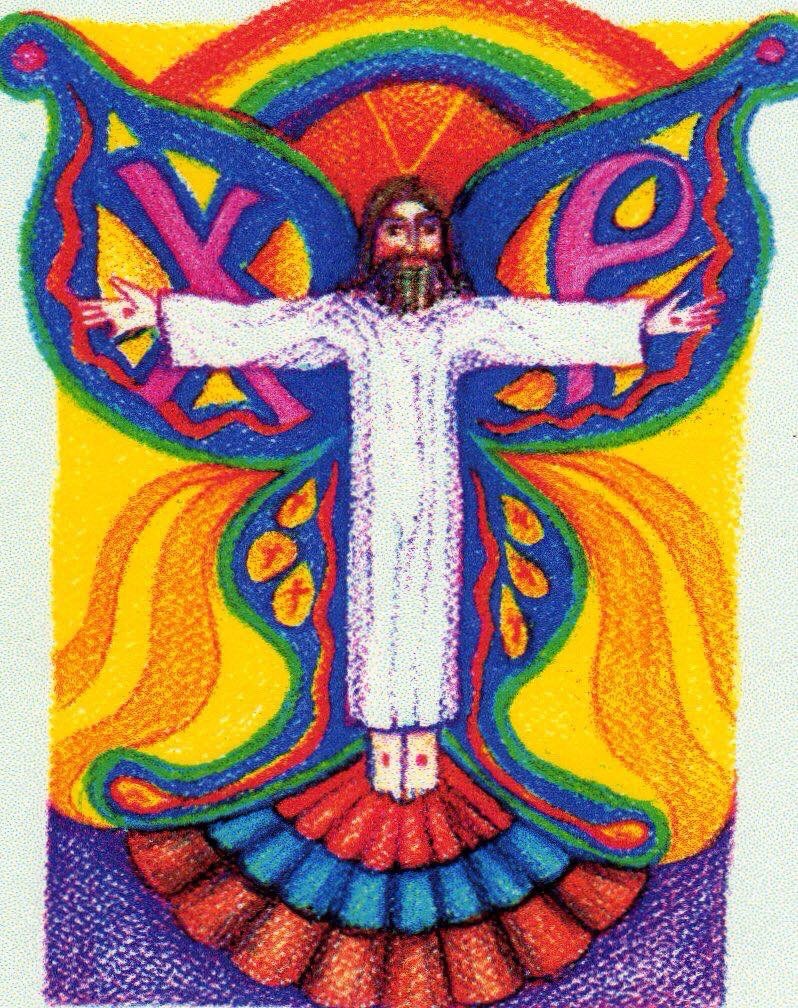
Transfiguration Icon

Art is like life. We get a new day to do better and another opportunity to do better. There are cynics among us who believe people cannot do better, or they will never change. Those of us, who afflicted with incurable optimism, believe change is possible and a better life awaits. We would have no teachers, healers, or community leaders, much less no clergy of any faith, if we didn’t believe in transformation or think we have no part in bringing it to fruition. I am not one to settle for chaos and despair. I keep saying this world has enough negativity, and I will not contribute to that excess.

Henri Rousseau: Pears, Apples, and Teapot, c.1910, oil on canvas, private collection

Simplifying what we see before us is a first step in drawing from life. The KISS Principle works in art class too: “Keep It Simple Silly.” Most of us try to eat the elephant all at once. We look at a houseful of boxes and collapse: where to start? After years of itinerating, I can say with certainty, “The one nearest to you at the moment.” If it took three weeks to pack, expect the same amount of time to unpack. Hooray, you get to eat out until you find the kitchen gear. Likewise with a painting, we make a mark with a light-colored wash. If it is in the wrong place or the wrong size, we can overpaint it. No one will ever know.

Our Four Pears: One View

Mike kept his pear painting simple. He made a study of the one pear which called his name. Just because I brought four pears and a blue bowl didn’t mean he felt the need to paint the whole still life. This is his unique genius. In his work life he can find the primary truths and key facts to support his clients’ cases. Those same attributes will show up in his artwork. At the end of the class, he was unhappy, however.

“Use your words,” I always say, “or at least point to where you are unhappy with your work.”

Pointing to the waistline of the pear, he said, “This section here looks wrong.”

“That’s where you quit looking at the pear and were just putting paint on the canvas.”

“OK, I thought that was what was bothering me about this, but I didn’t know why.”

Mike: Four Pears are The One Pear

“We have to keep looking at the objects while painting. Our memories aren’t that good to keep the image in mind for long.” We can train our memories by the technique of blind drawing, which is the technique of only looking at the objects, but never at our drawing. This trains our hand to connect to our eye. Our first drawings are very lopsided because the right side usually won’t match up to the left side. Yet with practice, these blind drawings will look somewhat realistic.

Gail S: Four Pears

Gail S has a more reflective and introspective approach, so she will dissect the major elements of the still life before she makes a mark on the canvas. Some people can imagine three dimensional objects as two dimensional patterns without making marks visible. I consider this a particular form of genius, for they also can usually access their thoughts without having to write them down, which is what extroverted thinkers need to do. This is another example of how different people approach art from their own specific genius: if we all were all alike, we would produce indistinguishable results as if from a factory. Art class isn’t a factory production line, but an experience and opportunity to get in touch with our creative selves.

Cornelia: Four Pears

I managed to catch the personality of the different pear species. I was painting on a raw, unprimed canvas, so my first layers of paint soaked into the weave. The successive layers built up the colors. I ignored the drapery and the busy background of the actual setting, but I added the rainbow clouds of my own. The violet grey of the tablecloth might read to some eyes as a mountain. Then the size context of the pears and the bowl becomes questionable. Are they normal sized pears on a table or giant-sized pears on a mountain? The tension is part of the painting.

Rembrandt: The Night Watch, 1642

Once the artist makes their work, they give it a title for what it is meant to say to others. That is its “birth name.” Much like a sermon, once the word or image gets out into the public, people interpret it according to their own lived experiences and prejudices. As an example, historians have misinterpreted Rembrandt’s Night Watch, which wasn’t its original title.

Contrary to popular myth, the commissioners did not reject painting, but it has suffered many indignities in its almost 400 year history. In 1715, the townspeople pared it down to fit between two doors in Amsterdam’s Town Hall, and its current name arrived at the end of the 18th century on account of varnish and dirt that had darkened it into a nighttime scene. The action takes place at dawn’s first light, a fact revealed after a recent 2013 cleaning.

Paul Cézanne: Still Life with Apples and Pears, ca. 1891–92, Oil on canvas, 17 5/8 x 23 1/8 in. (44.8 x 58.7 cm), Metropolitan Museum of Art, New York, NY.

The same goes with any spoken word or sermon. If we wonder how so many people can get so many different meanings from a preacher’s sermon, or how people can read the same Bible, but produce wildly different interpretations of the claim Christ has on their lives from the same holy word, it might be because we all come from differing perspectives, environments, cultures, and therefore have unique “geniuses.”

In the seminary we try our best to strip all our preconceived notions away from our hearts and minds and hear the texts as the authors originally spoke to those who wrote them down. Then we ask, “What meaning do they have for us today? What is Christ calling us to be? What are we to do to bring God’s kingdom one step closer?” If the scripture cannot touch us, transform us, and call us to action, we will be as John Wesley once feared, only “almost Christians.” To be fully Christian we need to have not only the outward appearance of the Christian life but also have “the love of God and neighbor shed abroad in our hearts.” That is the mark of the “altogether Christian,” rather than the one who is only just as good as the “honest heathen.”

Wesley never minced his words, as you can read in his sermon, “The Almost Christian.” When our toes tingle, we might want to give some thought to our strongly held beliefs. If scripture contradicts them, then we might want to look deeper into the background of that text and see if the rest of the Bible speaks with the same voice. We also might want to consider if this word has meaning for today (for instance, we no longer make animal sacrifices to God, since Christ made that need irrelevant by his gift on the cross).

Cezanne: Still life with three pears, Pencil and watercolor on paper, 1880-82, 12.6 x 20.8 cm, Museum Boijmans Van Beuningen, Rotterdam, Koenigs Collection

When we struggle in learning a new art technique, we are also undergoing a transformation. We sometimes must unlearn an old comfortable habit to learn a better one. Anyone who has played a sport knows the difficulty of making a swing change or adjusting their throwing motion. We are creatures of habit and want to take the well traveled path. We fear any disruption from the ordinary. Yet it’s in the challenge of the new where we learn. Iron sharpens iron. We never hear the metaphor, “Wool sharpens steel.”

We will do Day of the Dead T shirts next and turban pumpkins after that. It is always an interesting time in Friday Art Class. You can join us and begin at your level. Bring your own acrylic paints, brushes, and a small canvas or canvas panel.

Joy and peace,

Cornelia


Genius | Ancient Beliefs & Practices

https://www.britannica.com/topic/genius-Roman-religion

Revealing the Secret History of Rembrandt’s ‘The Night Watch’

https://news.artnet.com/art-world/secrets-of-rembrandt-the-night-watch-2627404

BBC – History – Ancient History in depth: Pompeii Art and Architecture Gallery

https://www.bbc.co.uk/history/ancient/romans/pompeii_art_gallery_08.shtml

Wesley’s Sermon Reprints: The Almost Christian | Christian History Magazine

https://christianhistoryinstitute.org/magazine/article/wesleys-sermon-reprints-almost-christian

Test of Vanguard launch vehicle for U.S. International Geophysical Year (IGY) program to place satellite in Earth orbit to determine atmospheric density and conduct geodetic measurements. Malfunction in first stage caused vehicle to lose thrust after two seconds and Mission Control destroyed the vehicle.


Learning, Growing and Thriving

adult learning, art, Athanasius, brain plasticity, Christmas, Civil War, cognitive decline, Creativity, crucifixion, Faith, Imagination, incarnation, john wesley, Love, mystery, nature, renewal, Spirituality, St. Athanasius, United Methodist Church, Valentine’s Day, Valentine’s Day

In most adults, learning and thinking plateaus and then begins to decline after age 30 or 40. The old adage, “Don’t trust anyone over thirty” takes on new meaning in regards  to creativity. People after this age start to perform worse in tests of cognitive abilities such as processing speed, the rate at which someone does a mental task. The slide becomes even steeper after 60 years of age. We also notice a similar learning decline in children after summer vacation, which results in the fall semester becoming a “reteaching opportunity.”

As one who is also “growing long in tooth,” I have passed this yardstick by a mile. I notice I have a “slower processing speed” in my creative writing. I don’t consider it a reason to quit, but a reason to better organize my other time-wasting behaviors (social media, newsletters, newspapers, etc.). I can always ignore cleaning the condominium! Creativity before housework, is my motto.

Housecleaning Meme

We often think older adults are on a downward slope with unrecoverable loss. “Use it or lose it,” the saying goes. Recent research suggests we need to apply a more hopeful mindset and vocabulary when discussing older people—much like that used for childhood or early adulthood. Decline, as we so often see it, may not be inevitable. In fact, learning a new skill and practicing it for three months has shown benefits beyond the the practice time.

Adults often have limited time or resources, so if we encourage learning a new skill, this may help them step out of their comfort zones. In people’s later years, many personal and societal changes—such as moving out of state to be closer to family members, switching jobs or coping with physical distance from loved ones—make learning new skills necessary to adapt and succeed.

For example, taking a class to improve technological skills could aid seniors’ success in an increasingly digital world, such as helping them use Telehealth or online banking platforms. Learning new skills in an art class allows a person to express their feelings and solve problems in creative ways. Each person can find their own path to success in artistic practice.

Potholder Loom, just like the one I had back in the day.

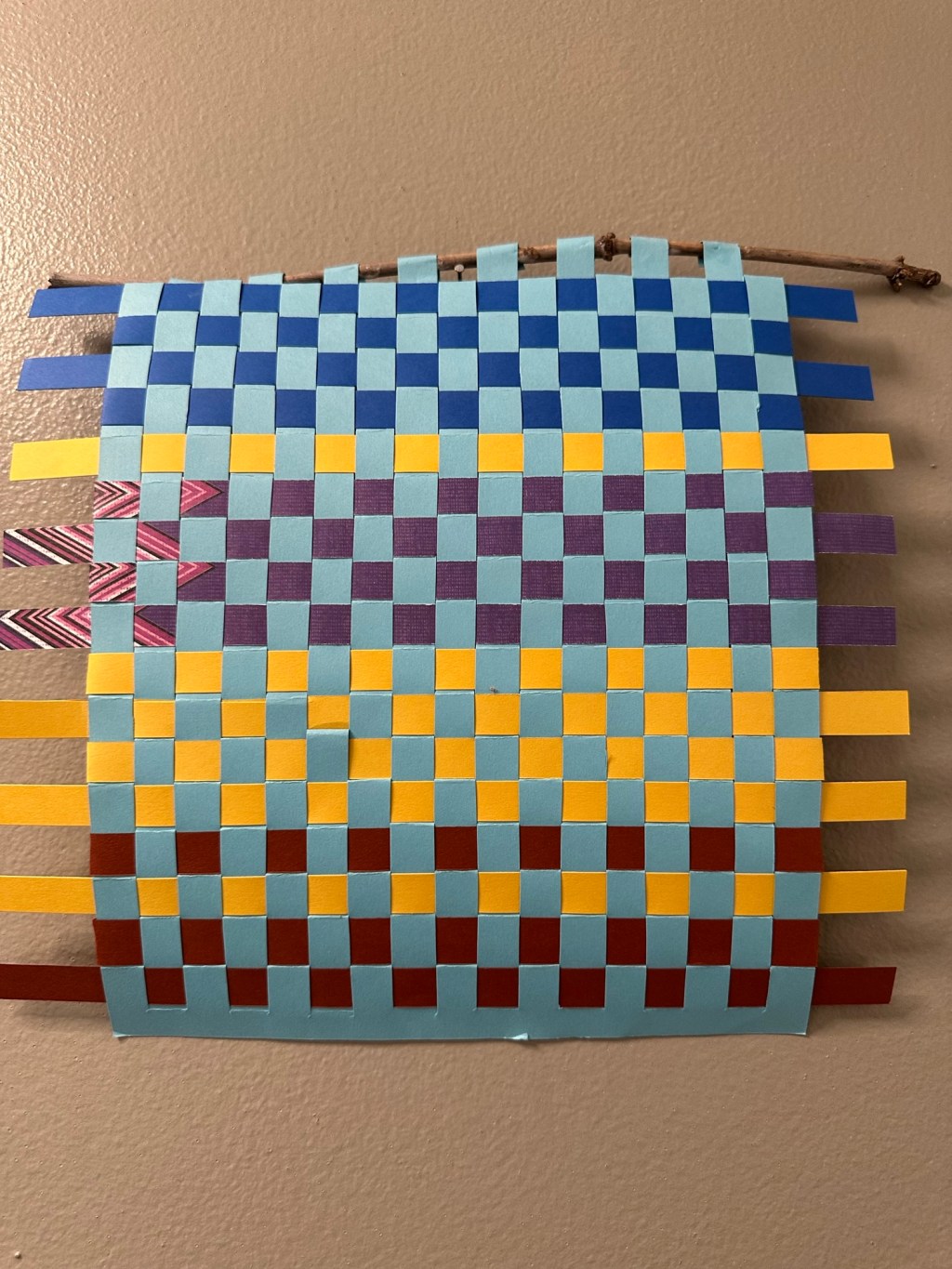
Our art class is trying a new thing: weaving. We have been painting for quite a while, so this is really a hands-on project. Some of us had the benefit of making woven potholders as children, or weaving newspaper “sit-upons” at summer camp. The technique isn’t unknown, but making a creative design interpretation is how we take our basic skill forward into a stimulating and creative brain challenge.

DeLee: Woven Paper on a Stick (Earth and Sky)

We could just repeat what we already know, but this doesn’t build us new neurons in our brains. If we keep the same old paths and don’t create new ones, we aren’t flexible when we meet new situations. Since we live in a rapidly changing world, building a brain capable of rapidly adapting is important to live independently and vibrantly for as long as possible.

I remember how my Daddy could only use the old tv remote to change the channel for the original non cable stations. When “Murder, She Wrote” came on the cable channel, my Mother had to use the cable remote to change the station for him. His Alzheimer’s disease prevented him from learning new skills, but he remembered all of his previous medical training and could diagnose his condition and boss the emergency room doctors when he was admitted to the hospital for a fall. Our brains are a mystery indeed.

Mike jumped the gun on Valentine’s Day and created a woven heart. These were big in the Danish and German communities and very popular in the 19th century in America. During the Civil War, soldiers made many of these in elaborate forms to send to their loved ones back home.

Unknown Artist: Affirmation Weaving

The brain is a fantastic and mysterious organ. If we make a habit of learning something new every day, of whatever interests us, we have the opportunity to keep our lucidity for a longer time. We also we meet the quickening changes of modern life with a steadfast heart and mind. We stress less when we know we can adapt and change in our own lives. We don’t have to be the people who say, “You can’t teach an old dog new tricks.” We can teach and we can learn, but we might need to be more patient with the old dog. In some corners, we call that “grace.”

I watched my Granddaughter’s Daddy Daughter Dance

Our group was in and out during the several weeks devoted to this project. One of us was sick, one was grieving the death of a beloved pet, another had pressing work issues, and the teacher went to Florida to see her granddaughter get married. Amazingly, life goes on. People dropped in for spiritual support, which is a side benefit of the community of art class. I managed to get mine mostly done, and Gail S. finished hers completely. Sometimes life interrupts our best intentions and we move on. We will learn new lessons on the next project.

Gail S’s “Eye of God” weaving

 Gail S’s “Eye of God” weaving incorporates yarns from two different mop heads, some sticks, and a bird feather. Gail almost always keeps a realist focus in her works, so her eye of God has a bird feather to mark the pupil. The upper field of grey and white mop yarns represent the cloudy sky, while the blue yarn stands for the water and the brown for the land. God watches over all of God’s creation. Gail S’s love of the outdoors and all of nature is evident in all her work.

Cornelia’s Cross on a Hill (unfinished)

I also recycled some old paintings and cords which I’d used in the preparatory work of other paintings. In addition, I used some recycled strips of Amazon shipping parcels as well as a wire shape which once belonged to a butterfly wing. In repurposing these items into the weaving along with two old brushes bound together with a God’s eye, I invoke the renewal of life after death.

We people of faith have two opportunities for a renewal of life after death. The first is by our profession of faith in Christ and his life, death, and resurrection on our behalf for our salvation. This gives us a living faith in this world. The second renewal is for the resurrection from death itself. This gives us a life beyond this world. Our faith is worthless if it doesn’t change us for our walk upon this world. If we don’t have the heart and mind of Christ within us, and if we aren’t earnestly seeking to be made perfect in the love of Christ daily, our United Methodist heritage tells us we’ve not yet been converted.

Yet Christ desires to save all, as John records in 12:32,  Jesus tells the crowd,

“And I, when I am lifted up from the earth, will draw all people to myself.”

Not just some people, or only the best, or even just us United Methodists, but ALL people. Most of us aren’t able to understand such a wide ranging love, for we live in a world of tribal loyalties. If we look at creation, which is God’s first work, God loves that which God created. God loves everything God created. We humans are the ones who choose sides and introduce boundaries and hate into God’s singular creation. The world or Kosmos is the creation first and then the people in it.

Today we tend to ascribe “world” to the “culture,” or secular society in general, but its plain meaning is creation and the human presence, for good or ill. The ancient Greeks and Romans divided the world into the material (bad) and the spiritual or mind (good), but the Jewish theology conceived the unity of both as part of God’s gift to humankind.

In the fifty-fourth chapter of On the Incarnation, St. Athanasius of Alexandria wrote a sentence that has echoed down through the centuries even into our own time as a brilliant summary of the Gospel. He wrote this: “God became man so that man might become god” (54:3).

This doctrine is called theosis or acquiring the whole nature of God. We United Methodists call this state Christian Perfection, or “a heart so full of love of God and neighbor that nothing else exists.” Our Wesleyan heritage was influenced by the Wesley brothers’ deep love for the Greek Orthodox fathers of the early church. To focus only on fallen nature is to deny the power of God to redeem us and all creation and to make all things new. We humans and nature aren’t more powerful than God!

If we cut off part of our God given self, we deny the incarnation of Christ, who became human for us that we might become divine. We need to remember what John 3:16 so succinctly states:

“For God so loved the world that he gave his only Son, so that everyone who believes in him may not perish but may have eternal life.”

Art is a way to open our eyes and hearts to a new way of seeing spiritual truths. Art is also reflective of the artist’s soul and spirit. A sensitive viewer can read the tale of trauma or the struggle for survival in an artist’s body of work. More than this, we can listen for their voices straining to be heard. Most people have been silenced and conformed to the “cause no trouble, don’t get out of step” mantra of the public school system training our youth for the workplace.

In art class, we can lose our fear of being different because being different gets rewarded! Being original gets an attaboy or attagirl.  I find such joy helping people find new courage and creativity they didn’t know existed within themselves. My students keep me young too. I feel blessed beyond measure.

Joy and peace,

Cornelia


To Stay Sharp as You Age, Learn New Skills | Scientific American

https://www.scientificamerican.com/article/to-stay-sharp-as-you-age-learn-new-skills/

That Man Might Become God — Fr. Andrew Stephen Damick
https://blogs.ancientfaith.com/asd/2015/01/22/man-might-become-god/

Creating a Picasso Still Life

art, brain plasticity, Cezanne, change, Creativity, Habits, Healing, Imagination, inspiration, Painting, perspective, picasso, purpose, renewal, Spirituality, vision, war

Einstein never said, “If we do the same thing every time, but expect a different result, this is the definition of insanity.” So why do artists return over and over to the still life? For that matter, why do preachers repeatedly use the same scripture texts for their sermons? Some of my former congregation members might have said I was overly fond of certain verses. The scalawags among them might have thought I did not get my point across the first five times I preached a version of the sermon text. As Jesus was wont to say in Luke 14:34-35 about Salt:

Picasso: Self Portrait, 1907, oil on canvas, National Gallery of Prague

“Salt is good; but if salt has lost its taste,

how can its saltiness be restored?

It is fit neither for the soil nor for the manure pile;

they throw it away.

Let anyone with ears to hear listen!”

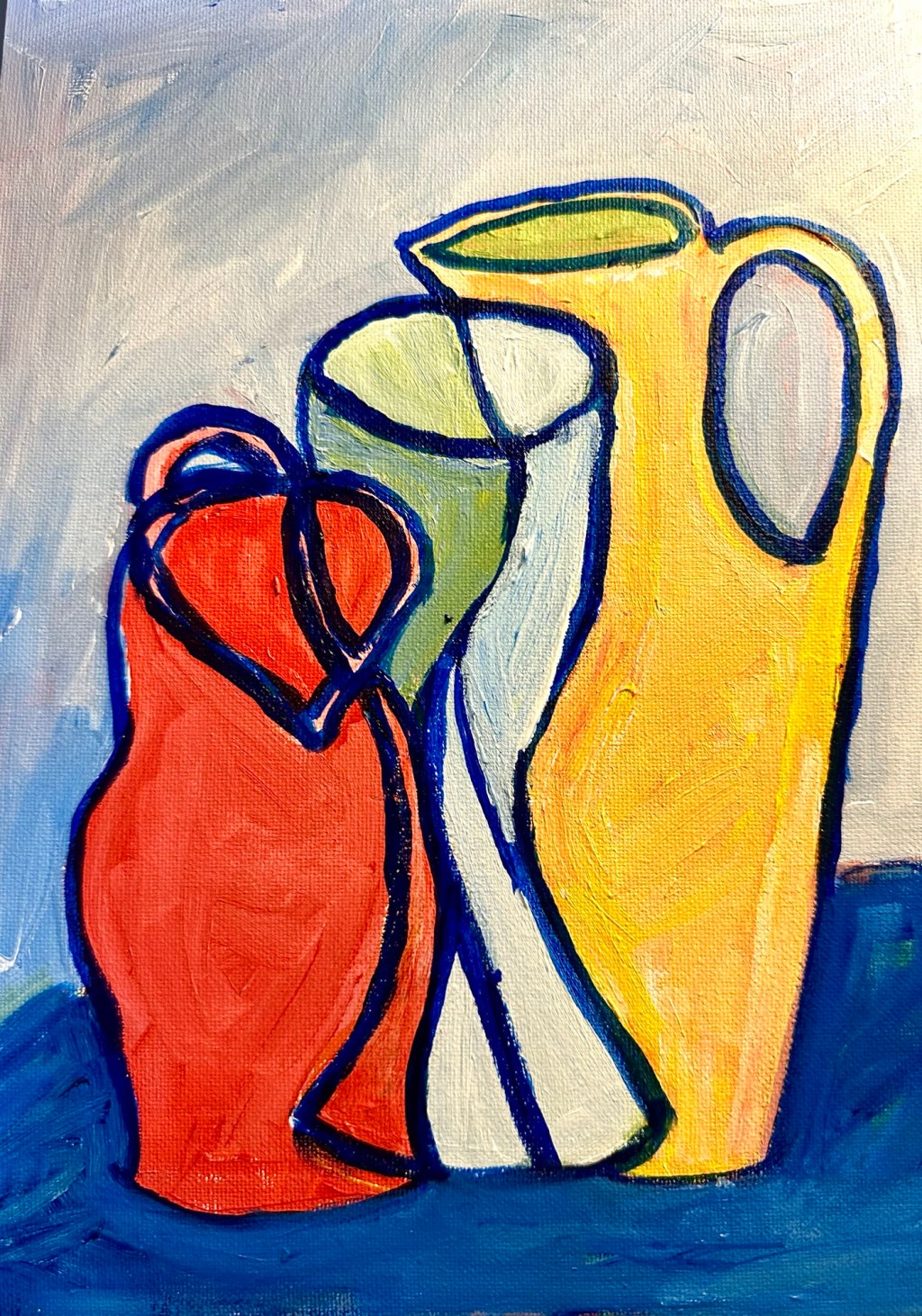
Three Sacramental Vessels

I always kept my sermon notes just in case I had a difficult week and might need a backup sermon, but I never used these notes. I wrote each of those sermons for a time and a place, but they were never useful for the current time or the present location. Likewise, an artist brings their emotions and experiences of the present time to each working session in the studio. Sometimes an artist is chock full of energy and power, full of joy and life. Their paintings or works exude these same emotions. At other times, the cares and chaos of the world intrude into the otherwise peaceful precincts of the artist’s workplace. These emotions and troubles will also be visible in their work, for artists are in tune with their times.

Picasso: Still Life with Dead Pigeon, oil on canvas, 1941, Nagasaki Prefectural Art Museum

This year in the adult art class I’m teaching at Oaklawn UMC, the students are getting lessons not only on how to paint, but on awakening their individual creative voice. These lessons are part art history and part “thinking like an artist” by painting in another artist’s style. The week before, we worked on a typical still life painting. For this session, we worked on what we saw in front of us, but tried to make an emotional connection with the objects. When most of our energy is going to getting proportions in proper order, shadows cast in the right direction, following the shape of the objects, and the colors correct, putting our emotions into the work comes in a distant fifth or last.

Morandi still life: he painted the same vessels so often, they became as friends who shared their innermost secret thoughts with him.

To be sure, our class is still analyzing the containers as physical objects more than feeling or experiencing the vessels as objects with personality. We have not yet become friends with the objects, or really gotten to know them on a deep and intimate level. This is also a problem in our society today. We are not willing to know others too deeply, and we aren’t likely to let many others know us too deeply either.

Gail S in the first week: realism

This isn’t a problem confined to older people. For my own demographic, meeting new people seems a mite risky these days in the online world because we never know who is behind that chatbot or Facebook account who seems so charming. For younger people, who sometimes never seem to come up for air from the online world, this online reality can seem more real than the three-dimensional world in which we live. (I was today old years when I learned the latest online AI fad is personalizing your own chatbot companion. I wonder if these chatbots have Asimov’s 3 Laws of Robotics ingrained in their program guardrails.)

Gail W in the first week: realism

Having empathy with inanimate objects is difficult. Artists bring into their own studio the objects which interest them. A teacher brings in objects her students can approach, given their skill level. I will blow that concept out of the water this Friday with some crazy Halloween pumpkins but, if the subject matter is consistently too difficult, many students will give up if the challenge is too far out of reach.

Picasso Still Life, oil on canvas, 1937, private collection.

In the second session when our class saw these same liturgical vessels, we chatted about Picasso and cubism. Cubism had several different forms of expression, but we focused on synthetic cubism, a later phase of the cubist style dating from about 1912 to 1914. It had simpler shapes and brighter colors. Synthetic cubist works also often include collaged real elements such as newspapers and cardboard. These works have interesting designs, such as multiple points of view (perspective), overlapping shapes which make their own patterns, and linear outlines. This style is an outgrowth of the work of Cézanne, who said: “A work of art which did not begin in emotion is not art.”

Gail S. took a cubist vision to our same three pots

If you’ve ever tried to put on your socks in the morning beginning with a different foot than normal, you can begin to appreciate how difficult it is to imagine how to create an artwork in a fresh style. If we were to ever have a stroke or a traumatic brain injury, relearning how to do simple tasks is much the same.

Tim’s first effort. He was one week out from surgery. His body was devoted to recovery, not to thinking about cubism.

Our brains can handle the rebuilding project, but we will feel strange doing it! This is because we are building new neural circuits and pathways in our brains. Going to work or the grocery store by taking a different route also feels strange, as does a golfer trying to reconstruct their swing pattern.

Tim took a second week to elaborate on his still life. It’s a better solution! Amazing what happens when our bodies have extra energy to give to creative projects.

As a comparison, we can look at the great hurricane which came through North Carolina recently and took out the big interstate highway that runs through the mountains and valleys. The sooner the highway construction engineers can come inspect the ground, the better. They must decide if the land is safe for rebuilding and then check the infrastructure also. They may need to redesign the road to current standards and also the underlying roadbed. When the great 1900 hurricane hit Galveston, rebuilding the city took twelve years. People were still living there, and life was going on, but the city began a process of raising the land levels and building a sea wall that took that extensive time.

Cornelia’s overlapping shapes and shifting perspectives

Change doesn’t happen overnight. Every sales or leadership training session I’ve been in has emphasized the idea “Three weeks are necessary to build a habit.” The origin of this myth has nothing to do with habit formation. Instead it comes from a 1960 self-help book Psycho-Cybernetics, in which plastic surgeon Maxwell Maltz wrote how his patients took about 21 days to become used to their new appearance after surgery.

He did no double blind, peer reviewed study to verify this, but his book applied this 21-day timeline to many other wide-ranging aspects of self-transformation in life. He also believed three weeks was the time people needed to adapt to a new house or change their mind about their beliefs. (He also didn’t live with a preteen girl child who enjoyed rearranging the living room every night just to see how her mom negotiated a new obstacle pattern in the dark when she came home from a sales call.)

If artists want to make paintings which are technically proficient and resemble the objects they see, they are only halfway to creating a good painting. They must also bring who they are and allow the voice of God to speak through their hand to make a masterpiece. In this way we separate artists into the good and the great, the ordinary and the masters. Not all of us will be prophets who listen to God’s word, but all of us can and should silence our hearts and minds of the world’s chatter and claims so the word of God can pierce our hearts.

Picasso: Guernica, 1937, 11’ x 25.5’,
Museo Nacional Centro de Arte Reina Sofía (MNCARS), Madrid, Spain

Rabbi Nahum Ward-Lev describes how the ancient prophets listened for God’s liberating word: 

“At its heart, the prophetic witness was a way of listening, listening beyond the social norms of the day, listening to the word of the liberating God. The prophets urged the people to listen to God’s word because the discourse of the king, princes, and wealthy landowners was too narrow and was limited to the interests of these elites. This conversation did not include the voices of suffering people. The prophets, in God’s name, offered a much broader discourse, a conversation that listened to and addressed the needs of the poor and the disadvantaged….

The prophetic listening tradition is alive today to inspire people to listen beyond the established conversation. The prophetic tradition challenges us to listen especially to the cries of those who suffer and to listen to the voice of alternative possibility, to the voice of God.”

Picasso: Still Life—fruits and pitcher, oil and enamel on canvas, 10 3/4 x 16 1/8 inches, Guggenheim Art Museum, NYC.

Making a painting is quite different from making a work of art. This is why house painters aren’t called artists. They may cover a surface with color and not make a mess, but their heart and soul isn’t in their work. Learning to risk our vulnerability and emotional expression is also part of art class, just as much as learning what colors to mix to make orange or green. Picasso, quoted in Alfred H. Barr Jr.’s Picasso: Fifty Years of his Art (1946), understood this:

“The artist is a receptacle for emotions that come from all over the place: from the sky, from the earth, from a scrap of paper, from a passing shape, from a spider’s web.”

We have these same experiences also, but we don’t realize these are part of the artist’s toolbox. These ordinary moments of life are also the extraordinary means of God speaking to us, if only we have ears to hear and a heart and hands ready to be used by God for God’s good purposes.

Joy, peace, and prophecy,

Cornelia


Quote Origin: Insanity Is Doing the Same Thing Over and Over Again and Expecting Different Results—Quote Investigator®. The origin of the quote is misattributed to Albert Einstein, but it originated in the 12-Step Anonymous groups in the 1980’s.

https://quoteinvestigator.com/2017/03/23/same/

Isaac Asimov’s “Three Laws of Robotics”:

  1. A robot may not injure a human being or, through inaction, allow a human being to come to harm.
  2. A robot must obey orders given it by human beings except where such orders would conflict with the First Law.
  3. A robot must protect its own existence as long as such protection does not conflict with the First or Second Law.

https://webhome.auburn.edu/~vestmon/robotics.html#:~:text=A%20robot%20may%20not

How Long Does It Really Take to Form a Habit? | Scientific American

https://www.scientificamerican.com/article/how-long-does-it-really-take-to-form-a-habit/

Nahum Ward-Lev, The Liberating Path of the Hebrew Prophets: Then and Now (Maryknoll, NY: Orbis Books, 2019), 133, 134, 135–136.                         

https://cac.org/daily-meditations/living-presence-liberating-journey/

 Meet My AI Friends, by Kevin Roose, NYTimes gift article

https://www.nytimes.com/2024/05/09/technology/meet-my-ai-friends.html?unlocked_article_code=1.Uk4.9sLW.VYS9bW4dc3ib&smid=nytcore-ios-share&referringSource=articleShare

Pablo Picasso – Oxford Reference
https://www.oxfordreference.com/display/10.1093/acref/9780191826719.001.0001/q-oro-


Cosmic Rainbow

Apocalypse, art, beauty, cosmology, Creativity, Faith, hope, inspiration, John Ruskin, Leonardo da Vinci, nature, Painting, purpose, sleep, Spirituality, Van Gogh, vision, William Blake

In times of cultural change and uncertainty, some faith-based communities turn to apocalyptic literature to find meaning, if not solace, for their suffering. Other communities of faith look forward to a future of hope and joy, even though they live in the same circumstances.

Apocalyptic literature is a genre of writing that appeared during times of crisis or persecution. It often presents a vision of the end times and the ultimate triumph of good over evil. Apocalyptic literature has several major characteristics:

“The supreme manifestation of Satan in this world is war.” By William Blake, 1805, apocalyptic painting with
tempera, gum, glue, and chalks, Tate Galleries, London.
  1. Dualism: Apocalyptic literature often portrays a cosmic battle between good and evil forces, highlighting the struggle between light and darkness.
  2. Symbolism: Deeper meanings and abstract concepts are represented by symbolic language and imagery.
  3. Eschatology: Apocalyptic literature focuses on the end times (Greek eschatos last, farthest) and the ultimate judgment of humanity, exploring themes of divine justice and the afterlife.
  4. Pseudonymity: Many apocalyptic texts attribute their authorship to famous figures from the past, using pseudonyms or false names.
  5. Visions and Dreams: Apocalyptic literature often includes visionary experiences and dreams as a means of conveying divine messages and revelations.
  6. The future is fixed and decided in apocalyptic literature, whereas with prophecy, people can change their future by repentance and restoring their relationship with God.

Since John was already in exile, “The Revelation to John” doesn’t bother to hide his authorship for his safety. He does claim it’s a vision of Christ mediated by an angel. It also checks the boxes of good vs evil, symbolism, the end times, and a fixed future. The actual date of this future isn’t revealed, however.

An interpretive mistake many make is to take this letter written to encourage the persecuted churches of the first century and project its message into our modern-day society. The symbols which were meaningful to John’s audience are for that historical context alone. Reinterpretations of these signs to make them relevant to our current geopolitical situation is bad scriptural interpretation.

Plate 12, First book of Urizen, by William Blake

What we can do is ask, “What can persecuted communities or suffering societies of the past teach us about resilience, hope, and faith?” Some will focus on God’s destructive forces to eradicate evil and harm. Belief in God’s power to overcome evil is a source of deep comfort for people without power. These are often the ones who feel excluded from the halls of power, but also those who believe their privilege and place is slipping away.

God’s fridge would be covered with photos!

Both these groups forget they are beloved of God, just as God loves all God’s children. Sometimes we forget God’s refrigerator is large enough to have the photographs of all the people of the world on its door, along with all our latest art works also. If that’s a humongous refrigerator, then that gives us an idea of the expansive reach of God’s love, mercy, and grace for all creation.

The First Day of Creation, by Francisco de Holanda (1545), with caption, “Let there be light.”

A negative outcome of this dualist, apocalyptic belief is extremist beliefs about the end times. Unfortunately, some extremist pastors have convinced their followers to end their lives to meet their predicted apocalyptic end of the world. The leader creates the fiction of an evil out-group to bind the members more closely to their cult and proclaims apocalyptic themes to brainwash their members. Numerous mass suicides worldwide have occurred as a result, including 914 people of Jim Jones’ People’s Temple. In 1997, 39 members of the Heaven’s Gate cult in San Diego, California, committed mass suicide by poisoning to coincide with the arrival of the Hale-Bopp comet, considering this a signal for their exit from Earth. Others have given away their entire nest eggs to apocalyptic cults because “no one will need money in the new creation.”

Paul Klee: Clarification, 1932, Oil on canvas, 27 3/4” × 37 7/8” (70.5 × 96.2 cm), The Berggruen Klee Collection, 1984 Accession Number: 1984.315.54

Some of us prefer to focus on The New Heaven and the New Earth instead, as found in Revelation 21:1-4—

Then I saw a new heaven and a new earth; for the first heaven and the first earth had passed away, and the sea was no more. And I saw the holy city, the new Jerusalem, coming down out of heaven from God, prepared as a bride adorned for her husband.

And I heard a loud voice from the throne saying,

“See, the home of God is among mortals. He will dwell with them; they will be his peoples, and God himself will be with them; he will wipe every tear from their eyes. Death will be no more; mourning and crying and pain will be no more, for the first things have passed away.”

Stage 1—strings and base colors

What a day that will be! The last time God destroyed the earth with a great flood, God placed a rainbow in the sky as a promise the earth would never be destroyed again by water.

Leonardo da Vinci said, “Where the spirit does not work with the hand there is no art.” For some people, the only “good art” is representational art, or art which faithfully describes a landscape, portrait, or still life. With abstract art, colors carry emotions and shapes to form pleasing patterns for the viewer. What will the new heaven and the new earth look like? Revelation 21:11 says “It has the glory of God and a radiance like a very rare jewel, like jasper, clear as crystal.”

Stage 2—addition of gold and silver washes

While many today think of heaven as an earthly paradise, this concept is a Persian idea of an enclosed garden, much like the original garden of Eden. We tend to imagine a heaven as being a better place than the world we know, but imagining an altogether different world is next to impossible! Luke 20:27-38 is Jesus’ answer to the law-abiding Sadducees about how relationships work in heaven, and a reminder to us heaven isn’t just a perfect earth.

When I think of the providence of God, which is grounded in creation and is always recreating the face of the earth, I remember God’s promise to Noah in Genesis 9:11-13—

“I establish my covenant with you, that never again shall all flesh be cut off by the waters of a flood, and never again shall there be a flood to destroy the earth….This is the sign of the covenant that I make between me and you and every living creature that is with you, for all future generations: I have set my bow in the clouds, and it shall be a sign of the covenant between me and the earth.”

Stage 3—Added circles and more gold and silver washes

It is this cosmic rainbow of colors, the spiritual energies which most of us cannot see for the overwhelming ordinariness of daily life. We race from chore to chore, dash from task to task, and drop exhausted at the end of our days. We long for a better life, but we’re stuck on a galloping treadmill trying to keep our feet under us. I long to walk rather than run through my days. When I was younger, older people told me to slow down. As I hit middle age, I heard I would soon start slowing down. Now that I’m inching closer to 80, slowing down is finally becoming a reality!

Vincent Van Gogh said, “Paintings have a life of their own that originate in the soul of the artist.” We cannot see the new heaven and new earth unless we stop our busywork and allow God to attend to the business of our spiritual life. When we see the first glimmers of the new heaven and the new earth, we’ll realize how imperfect our world is and begin to help change it for the better, one small act of kindness at a time. This is soul work.

Sometimes that kindness first means being kind to ourselves, when we admit we can’t say YES to everything and everyone. When we admit we actually need eight hours of sleep for our health and a daily quiet time, and we can stop to study the flowers in the cultivated gardens of our neighborhoods and in our parks.

Cosmic Rainbow—acrylic on canvas, 24” x 30”, 2024.

Then we can be a beautiful rainbow, God’s light in this world for good, and bring the hope and joy of the end times to these times. We then will bring the radiance of the new heaven and the new earth to this present age and to these yearning people.

Joy, peace, and rainbows,

Cornelia


 what are the five major characteristics of apocalyptic literature – brainly.com

https://brainly.com/question/35289093

World’s most chilling cults

https://www.france24.com/en/live-news/20230424-world-s-most-chilling-cults

Paradise Definition & Meaning – Merriam-Webster

https://www.merriam-webster.com/dictionary/paradise

 Middle English paradis, paradise “the Garden of Eden, heaven,” borrowed from Anglo-French paradis, borrowed from Late Latin paradīsus, borrowed from Greek parádeisos “enclosed park or pleasure ground” (Xenophon), “the Garden of Eden” (Septuagint), “the abode of the blessed, heaven” (New Testament), borrowed from an Iranian word (perhaps Median *paridaiza-) cognate with Avestan pairidaēza- “enclosure,” nominal derivative of pairidaēz- “build a barrier around,” from pairi- “before, around” (going back to Indo-European *per-i, whence also Sanskrit pári “around, about,” Greek péri “around, in excess”) + -daēza- “heap up, build” (occurring only with prefixes), going back to Indo-European *dhoi̯ǵh-éi̯e-, iterative derivative of *dhei̯ǵh- “knead, shape” — more at PERI-, FEIGN

NOTE: As an independent derivative of the verb, Avestan daēza- “heap, pile (of earth, stones)” has been compared with Greek teîchos (neuter s-stem) “wall, fortification,” toîchos (masculine) “wall of a house or enclosure,” Sanskrit dehaḥ “body,” dehī́ “wall, embankment,” Oscan feíhúss (accusative plural) “walls.” For a Germanic derivative from the same verbal base with a different sense, see DOUGH.

OAKLAWN FRIDAY ART CLASS

adult learning, art, Attitudes, brain plasticity, change, cognitive decline, Creativity, hope, renewal, summer vacation, Uncategorized, United Methodist Church

WE’RE BACK!!!

The older I get, the faster time flies! When I was a child, summers were long and lazy times. I actually got so bored, by the first of August I’d start to play school. I’d line up my brothers and the neighborhood children and pretend to teach them.  It was our way of “playing ourselves into a new reality.”

Art has many right answers!

Children practice life lessons during their play experiences. We can also play our way into learning a new skill in art class. All we need is a “beginner’s mind.” The Japanese Zen term shoshin translates as ‘beginner’s mind’ and refers to a paradox: the more you know about a subject, the more likely you are to close your mind to further learning. As the Zen monk Shunryu Suzuki put it in his book Zen Mind, Beginner’s Mind (1970): “In the beginner’s mind there are many possibilities, but in the expert’s there are few.” 

Jerzy Nowosielski: Landscape with a vision of the Sun, oil on canvas, 1965, National Museum of Krakow, Poland. 

In a similar vein, Picasso once said, “When I was young, I could paint like Raphael, but it took me my whole life to learn to draw like a child.” Part of our art class experience is to learn to suspend our adult ego’s need to constantly be ranking, besting, and giving into our competitive natures. We learn more when we give up our egos and our needs to protect our false selves, and allow our true selves to learn. This story in Luke 9:46-48 on “True Greatness” speaks to this:

“An argument arose among them as to which one of them was the greatest. But Jesus, aware of their inner thoughts, took a little child and put it by his side, and said to them, “Whoever welcomes this child in my name welcomes me, and whoever welcomes me welcomes the one who sent me; for the least among all of you is the greatest.”

Mary Delaney, Xanthium Spinosum, from an album (Vol.IX, 98). 1778. Collage of coloured papers, with bodycolour and watercolour, on black ink background
© The Trustees of the British Museum

Our first meeting will be Friday, September 6, at 10 am in the old Oaklawn UMC fellowship hall. Bring your own acrylic paints, brushes, and a canvas or canvas panel to paint on. We begin with a short visual inspiration from some great art works, so that we can wonder and be filled with awe at some great artists’ works. 

Basic 2 point perspective

I’ll give some direction on the skill we’ll work on in the session, and then everyone is free to bring their own unique expression to their paintings. We don’t copy my work and judge how well a person can match it. Instead, we learn from the masters or from real life. We can learn to stretch our own skills to create something new. 

That’s US!

Of course, making great art isn’t our first purpose. As we age, the harsh truth is we will lose our ability to learn new skills until we lose our memory of what we just ate for breakfast or how to work the tv remote. Challenging our brains is one of the best ways to keep our brain cells firing and “chatting with one another.” We can actually grow new neurons as we grow older. Our brains don’t have to shrink like a cotton shirt washed in hot water. Socialization and encouragement also helps to keep our brains young. Teaching this class helps me stay young! We help each other in this matter. 

That goes for children of any age!

Of course, making art means we have to give up our desire to be perfect. Children always have a “beginner’s mind,” so they are free to explore and experiment. Artists quickly learn perfection comes from practice, or working at it. Every baby stumbles and falls as they learn to walk, but we dotting adults still encourage every trembling step. This is what art teachers also do. I’ve always had a rule in my classes, especially when I taught in middle school: 

“No Negative Talking about People or Art.”

This includes a student’s own art works. My students always had to give at least three positive comments about their work before they spoke about the negative. “My work needs improvement” is better than saying, “My work stinks!” After all, this way of thinking is more positive than negative and helps to build confidence in a person. 

God would post your art on Heaven’s Refrigerator

Of course, we’ve all grown up and worked in environments where negativity is the rule. Art class is a place of grace because this is how life should be. If we can transform a blank canvas into a field of color, why can’t we transform our communities and our world into fields of hope, joy, and love? 

The Light overcomes the Darkness

Perhaps because we try to make everyone copy/fit into our idea of the proper end product, rather than allow everyone discover their own creative response to the given subject of the day. The museums of our world are richer and more vibrant because artists have listened to the Spirit of the Creating God. We might do well to realize God’s creative energies are varied and vibrant also, just as Isaiah wrote about his vision of God’s Glorious New Creation: 

“For I am about to create new heavens and a new earth; 

the former things shall not be remembered or come to mind.

But be glad and rejoice forever in what I am creating;

for I am about to create Jerusalem as a joy, and its people as a delight.”  (65:17-18)


I hope to see you there. I don’t charge for the class sessions, since this is one of my ministries as a retired elder in the United Methodist Church. As John Wesley once said, “The World is my Parish.” When we grow in confidence in the joys of creating, we find more beauty in the created world. Optimism is one of the side benefits of the creative life, not fame or riches, and sometimes not even accomplishment. Just the act of being a co-creator with the creating God helps us to find more peace in life.

Joy and Peace,

Pastor Cornelia 

How to foster ‘shoshin’ | Psyche Guides

https://psyche.co/guides/how-to-cultivate-shoshin-or-a-beginners-mind

The Creating God

art, Attitudes, change, Creativity, Evangelism, Faith, garden, Healing, Holy Spirit, hope, Imagination, incarnation, inspiration, john wesley, Light of the World, Ministry, Painting, purpose, Reflection, renewal, shadows, Spirituality, vision, Work

In the dead heat of summer, our gardens aren’t putting forth the fruit of our planting. Maybe the animals of our neighborhood have made their too frequent nightly visitations, so our harvest is skimpy. We can forget God is a both a creating god and a recreating god as well. The first words of the alternate NRSV translation of the Bible’s first book Genesis (a word meaning “origin”) are—

First stage: string, fabric scraps, and under painting

 “When God began to create…”

In the old KJV, Genesis 1:1 readsIn the beginning, God created the heaven and the earth.”

I appreciate even more the next verse from Genesis 1:2—

“The earth was a formless void and darkness covered the face of the deep, while a wind from God swept over the face of the waters.”

Alternate translations read— “while the spirit of God or while a mighty wind” swept over the face of the waters. This reminds us nothingness and darkness aren’t problems for God, who is able to bring glorious light to any situation.

Psalms 139:12 speaks of the nature of God:

“Even the darkness is not dark to you; the night is as bright as the day, for darkness is as light to you.”

I’ve lived for over half a century with chronic depression, so I can recognize darkness, not only in my own life, but also in the lives of others. Most of my ministry and even my secular work was done with a calling to bring others to the light of hope and confidence that anything was possible.

In art classes, I asked my students to trust in ABC—Attitude, Behavior, and Consequences. If they had a Positive Attitude, they would have Positive Behavior and work on their assignments. If they worked, they would see Positive Consequences or Improvement over time. Asking people who’ve been told they can’t do art to believe they can learn even if they aren’t “talented” is a big ask, but if they have faith in this promise, they discover it’s true.

When I sold insurance, I asked people to trust in the idea of making a small sacrifice now to prevent a greater loss later. Also, if they had no loss, they shared in a community to underwrite the group losses and keep the cost of protecting their own property low. Not everyone has the light to see this benefit of community, but for those who do, I could help keep their consequences from being a disaster.

Second stage: overpainting, printed circles, and added ruler lines

When I entered the ministry, I discovered congregations who had lost their faith in the God who could make something out of nothing This began with the creation story, the choosing of the nation of Israel to be God’s people (even though they were once no one’s people), and feeding them in the extended wilderness wandering before they arrived at the promised land. The Bible is full of examples of God’s providing more when people have too little to sustain them: Elijah and the widow of Zarephath, the feeding of the crowds with a few fish and loaves, and the water turned into wine. These modern people didn’t have a “recreating faith” that God could work in their lives today, just as God had once worked in the lives of others in the days of Christ.

That is what we call a “dead faith,” or as John Wesley put it in his notes on the New Testament at 2 Timothy 3:5— “An appearance of godliness, but not regarding, nay, even denying and blaspheming, the inward power and reality of it.”

It’s dead, because the Spirit isn’t at work in it. I used to tell my beloved evangelism professor, the late Dr. Billy Abraham, the first place we needed to do evangelism was in the local church, because folks hadn’t heard the good news. If they weren’t excited enough to have a living faith, they wouldn’t go out and spread the good news to others.

I’ve never been a cheerleader, although I did have some time in my high school pep squad. I was more often involved in making the football banners and pep posters for the other sports activities. Also debate team took up much of my time. One of the best practices I learned in debate was positive points sell better than negative ones. Also, it’s better to make the same point over and over with different facts and examples.

When I say our God is a creating and recreating God, I can point to the beautiful verses of John 1:1-5—

“In the beginning was the Word, and the Word was with God, and the Word was God. He was in the beginning with God. All things came into being through him, and without him not one thing came into being. What has come into being in him was life, and the life was the light of all people. The light shines in the darkness, and the darkness did not overcome it.”

In the beginning was the Word

 As believers in the Holy Trinity, the Word made flesh is Christ, so he was co-creating with God the Father and God the Holy Spirit from the beginning. By virtue of the incarnation, Christ takes on our flesh to redeem us and make us whole again. This comes to completion through the cross. When we place our faith in Christ’s act of love for all creation, we are made one with Christ, and one with God. The Holy Spirit brings us ever closer to the true nature of Christ, until we’re perfected in love of God and neighbor.

I painted on unprimed canvas, just to see what would happen. Also, because I knew the paint surface would be different than the usual texture on the primed canvas. After I painted several different colors in blocks with the scrap pieces of cut canvas used as “masking tape,” I decided to use a mix of iridescent gold and silver acrylic paints to glaze over the under painting. I also added some circles and straight lines. I’ve collected a few jar tops recently, I used some string elements, and I had a school ruler left from my last teaching job back in the 1980’s. (Yes, I keep things. They are tools of the trade. My Sears Craftsman staple gun from art school finally died after half a century of use.)

I’ll be working some more of these experiments for a while. Creating and recreating our lives is what keeps us new every morning. As someone who has been renewed and recreated more than one time can attest, along with the prophet Jeremiah,

“For surely I know the plans I have for you, says the LORD, plans for your welfare and not for harm, to give you a future with hope.” (29:11)

Joy and peace,

Cornelia


John Wesley’s Notes on The New Testament, 1755:

2 Timothy 3:5—“holding to the outward form of godliness but denying its power. Avoid them!”

The Witness of the Cross

art, Creativity, crucifixion, Faith, Holy Spirit, Holy Spirit, Imagination, inspiration, john wesley, Love, mandala, nature, Painting, perfection, Rumi, Spirituality, suffering, Sun, United Methodist Church, vision

Mosaic Crucifixion, with Mary and John.

We are a people who follow Jesus, “the pioneer and perfecter of our faith, who for the sake of the joy that was set before him endured the cross, disregarding its shame, and (who) has taken his seat at the right hand of the throne of God,” as the writer of Hebrews 12:2 reminds us. The suffering servant motif of Christ was once a model all early Christians expected to inherit and emulate.  

The Suffering Servant

Paul spoke to this suffering model in his letter to the Romans:

“…How can we who died to sin go on living in it? Do you not know that all of us who have been baptized into Christ Jesus were baptized into his death? Therefore, we have been buried with him by baptism into death, so that, just as Christ was raised from the dead by the glory of the Father, so we too might walk in newness of life. For if we have been united with him in a death like his, we will certainly be united with him in a resurrection like his.” (6:2-5)

Paul’s first sentence is perceptive because he recognizes many who call on the name of Christ nevertheless go on living an unchristlike life. In the early Christian centuries, many didn’t get baptized until they were near death because they weren’t ready to change their wicked ways. The early Christian habit of hyper-delayed baptism is well attested by the later fourth century. Apparently, the reasoning behind waiting until fairly late in life was the belief baptism cleansed sin once and only once. Consequently, any meaningful sin after baptism could leave one in a serious lurch in the economy of salvation. We have the well-known example of the early 4th CE Emperor Constantine who delayed baptism until his deathbed.

Of course, this is a misunderstanding of the Holy Spirit’s work of perfecting our human nature, but it took many centuries to work this out. We can thank John Wesley for our understanding the works of grace in the ongoing process of Christian Perfection. Baptism washes us from the stain of original sin, which is common to all humanity. Baptism also anoints us with the Holy Spirit to be continually with us and bring us to know God’s saving love in Jesus Christ.

As we grow in faith and the Spirit of God calls us to give our lives to Christ, we are justified from past sins. Some faith communities stop here, so they need over and over justification. They have no ongoing theology of sanctifying grace. We United Methodists do have this great gift, which we can give to the world. When we aren’t going on to perfection in love quite as fast as our neighbors wish we were, it’s because we’re being stubborn and resisting God’s grace.

W. H. Auden says it best:

“We would rather be ruined than changed, 

We would rather die in our dread 

Than climb the cross of the moment 

And let our illusions die.” 

The Cross and Self-Denial

The cross is ever a witness to our willingness or unwillingness to bear the cross of Christ. As Jesus told his disciples:

“If any want to become my followers, let them deny themselves and take up their cross and follow me. For those who want to save their life will lose it, and those who lose their life for my sake will find it. For what will it profit them if they gain the whole world but forfeit their life? Or what will they give in return for their life? (Matthew 16:24-26)

Often we interpret this verse in terms of giving up material possessions, but we can never give up outward things unless we’re first willing to give up our false images of ourselves. We might want to be large and in charge, or soft and sweet. Perhaps our self image is invested in being holy and serious. We may even be the class clown. These are only masks behind which we hide our truths and vulnerabilities.

Jesus spoke a parable in John 12:24-25—

“Very truly, I tell you, unless a grain of wheat falls into the earth and dies, it remains just a single grain; but if it dies, it bears much fruit. Those who love their life lose it, and those who hate their life in this world will keep it for eternal life.”

If we want to be changed, we must die to our ordinary selves, and then rise as a new creation. If we remain the same, we won’t be much, but if we’re willing to take on the image of Christ, we can be a new creation of the first order.

How The Witness was made

Ukrainian children’s hospital bombed by Russia

This is how art gets made. I saw an image of a bombed-out children’s hospital in Ukraine. Because the photographer had cropped it in a certain way, I saw an image of a cross on the brickwork. Those rectangular bricks contrasted with the diamond shaped wire work in the darkened areas in the four outer quadrants. I usually weave the whole painting surface, but this time I wove only the cross area. That was a challenge. I had to invent a new way to secure the woven canvas strips on the wooden stretcher strips.

Weaving two paintings together

As I painted the first layer, I made all the contrast of bright colors in the cross and dark blues and reds in the outer quadrants. The next day, I added a gold wash over the cross squares and painted diamond line patterns over the dark quadrants. I came back to add silver into the diamond shapes and to touch up the diagonal lines. I also painted the sides of the canvas to unify it.

Adding blocks of color to the cross of witness

I began with a gritty black and white image, but ended up with bright colors, silver and gold. This too is a metaphor for for the change which we undergo when we die to old selves and begin our transformation into the wholeness of the new creation in Christ. As Paul wrote to the Corinthians:

Gold cross and diamond shapes in the dark quadrants

“So if anyone is in Christ, there is a new creation: everything old has passed away; see, everything has become new! All this is from God, who reconciled us to himself through Christ, and has given us the ministry of reconciliation; that is, in Christ God was reconciling the world to himself, not counting their trespasses against them, and entrusting the message of reconciliation to us.” (2 Corinthians 5:17-19)

Finished painting: Cross of Witness

The cross isn’t a means to divide us from one another, just because we hold varying views on baptism, holy communion, pastoral authority, and scriptural authority or interpretation. The cross stands as a witness to all who are willing to give up their identities to their old egos and claim the only one uniting all persons every day.

Unity through the Cross

This is the Christ, whose love was so great for all creation, he was willing to be lifted up on the cross to draw all humankind unto himself. As Jesus said in John 12:32-33—

“And I, when I am lifted up from the earth, will draw all people to myself.” (He said this to indicate the kind of death he was to die.)

We want to have our Big Mac and Eat it too.

Delusional Mathematics

As we self interested people today have difficulty with many of the words of Christ, we resort to our cafeteria style of choosing which bites we want to enjoy. If a dish in the line is too expensive or not on our diet plan, we can ignore it. The problem with Christ is how we can ignore one claim upon our faith, reject another, and keep another. As a dieter from way back days, I splurged on many a Big Mac or Whopper and large fries, which I washed down with a giant Diet Coke. Unfortunately, my body didn’t follow the same mathematical logic of my mind. I was practicing delusional math.

“Cheeseburger and fries, with a side of Diet Coke.”

“This is my commandment, that you love one another as I have loved you. No one has greater love than this, to lay down one’s life for one’s friends. You are my friends if you do what I command you” (John 15:12-14). John Wesley, in his sermon, The Almost Christian, talks about those who have the outward form of Christianity, but not the inward being. They can be recognized by their attendance at Sunday services, their good deeds, and their attention to the outward shows of ritual. Inside, however, their hearts aren’t filled with love, but with anger, spite, or mere duty instead. They lack sincerity, which is a classic characteristic of one who wears a false mask.

The Last Presidential Assassination

When Ronald Regan was shot by a would-be assassin, his diary recorded his thoughts on his excruciating experience.

“Getting shot hurts. Still my fear was growing because no matter how hard I tried to breathe it seemed I was getting less & less air. I focused on that tiled ceiling and prayed. But I realized I couldn’t ask for God’s help while at the same time I felt hatred for the mixed-up young man who had shot me. Isn’t that the meaning of the lost sheep? We are all God’s children & therefore equally beloved by him. I began to pray for his soul and that he would find his way back to the fold.”

 The Altogether Christian

To be a Christian in the true sense, Wesley says the “Altogether Christian” requires us both to “love God and neighbor in our hearts until nothing else exists.” This means even our enemies. I personally find this the most difficult part. I can hold a grudge with the best of the nonbelievers. Yet I don’t find myself calling those people evil or deranged, like so many others who seek to find a reason for their scapegoating.

I can still see people, even myself, as part of flawed and fallen humanity. 

Christian Perfection

Wesley defines the pure faith: “Now, whatsoever has this faith, which purifies the heart, (by the power of God, who dwelleth therein,) from pride, anger, desire, from all unrighteousness, from all filthiness of flesh or spirit; which fills it with love stronger than death, both to God and to all mankind; love that doth the works of God, glorying to spend and be spent for all men, and that endureth with joy, not only the reproach of Christ, the being mocked, despised, and hated of all men, but whatsoever the wisdom of God permits the malice of men or devils to inflict: whosoever has this faith, thus working by love is not almost only, but altogether a Christian.”

Under John Wesley’s exacting standards, we may all be “almost Christians,” but the good news is we can always hope in the one who gave his life to begin a new life in us and others. If we pray for our enemies’ faults, which we spot so easily because they are our own, God will help to heal both them and us.

Mending Broken Hearts

The Cross Supplants Division

An ancient wisdom story told among the rabbis says the students were questioned on the difference between night and day. All their answers marked divisions: some prayers are said only at certain hours, or there isn’t enough light to distinguish one field or a house from another. The rabbi grew frustrated and cut them off. “You only know how to divide! Daylight begins when you can look on your neighbor’s face and see a friend, not an enemy.”

In this time of division, the witness of the cross reminds us Christ died for all humanity, so no one is outside the love of Christ. If we’re to love our neighbor as ourselves, caring for the poor and marginalized should be a priority for the people of faith. Our neighbors don’t stop at our borders, for our world is interconnected.

Migrations were a fact back in Abraham’s day, when Egypt was the land of opportunity. We ought to treat immigrants better than the Pharaohs treated the Hebrew people. Moreover, in our current political landscape, we might want to quit name calling and playing to the lowest denominator of our bases. Policy statements won’t get sound bites on television, but that’s a good thing. Sound bites play to our false selves and not to our true selves in Christ Jesus.

DeLee: Sun Mandala, 2022, private collection

 I can close with a poem from the Persian poet Rumi:

I only speak of the Sun
because the Sun is my Beloved 
I worship even the dust at His feet.

I am not a night-lover and do not praise sleep
I am the messenger of the Sun !
Secretly I will ask Him and pass the answers to you.

Like the Sun I shine on those who are forsaken
I may look drunk and disheveled but I speak the Truth.

Tear off the mask, your face is glorious,
your heart may be cold as stone but
I will warm it with my raging fire.

No longer will I speak of sunsets or rising Moons,
I will bring you love’s wine
for I am born of the Sun
I am a King !

Joy, peace, and sacrificial love,


Cornelia


—W. H. Auden, The Age of Anxiety: A Baroque Eclogue (Princeton, NJ: Princeton University Press, 2011), 105.


Baptismal Trajectories in Early Christianity, Part III: Toward an Explanation – Ad Fontes
https://adfontesjournal.com/church-history/baptismal-trajectories-in-early-christianity-


Wesley’s Sermon Reprints: The Almost Christian | Christian History Magazine
https://christianhistoryinstitute.org/magazine/article/wesleys-sermon-reprints-almost-


The Regan Diaries—

 https://www.amazon.com/Reagan-Diaries-Ronald/dp/006087600X?_encoding=UTF8&qid=&sr=&linkCode=sl1&tag=jeffjaccom-20&linkId=472649155c0e042b8192d46f0dbbfcb8&language=en_US&ref_=as_li_ss_tl

 Rumi: Ghazal (Ode) 1621
Translated by Azima Melita Kolin and Maryam Mafi
Rumi: Hidden Music, HarperCollins Publishers Ltd, 2001

Anne Frank’s Last Birthday Cake

Anne Frank, art, Auschwitz, beauty, Children, Creativity, Faith, Family, Holocaust, hope, inspiration, Ministry, Painting, perspective, shadows, suffering, vision

Anne Frank’s Last Birthday Cake, acrylic on canvas, mixed media, 18” x 20,” 2024.

We never know when the tides of time will change. Most of us aren’t creatures of change, but prefer instead the well-worn and familiar paths. As a United Methodist pastor, I moved every two or three years during my ministry, so one thing I kept was my telephone company. I know some people like to switch providers almost as often as they switch their underwear, but that’s not me. Having to switch utility companies, banks, and hairdressers was more than enough agony for me. I signed up for this life, however, so I kept my moving boxes and made a spreadsheet for notifying all my address changes.

I talk about this because I only lived in three homes as a child. I never had to leave in the middle of the night to escape bad debts, the law, or a hateful Nazi regime. I have no way to imagine Anne Frank’s life, except when I was also 13 years old, I read her wonderful diary. Anne kept her diary, beginning at the same age, during the two years she spent in hiding while the Germans occupied her homeland during World War II. She had received a red, cream, and beige checkered cloth notebook diary for her 13th birthday on June 12, 1942. The underground Dutch radio station had encouraged people to keep diaries so future generations would know what the conditions were under the German occupation.

Because of the Nazi purity rules, Jews weren’t allowed to mix with non-Jewish persons. According to the Nazis, Jews were not Aryans or the Master Race. They thought Jews belonged to a separate race that was inferior to all other races. The Nazis believed that the presence of Jews in Germany threatened the German people. They believed they had to separate Jews from other Germans to protect and strengthen Germany. Their Nuremberg Laws were an important step towards achieving this goal. 

We hear this same sentiment today from the neo-Nazi movement groups who say, “Jews shall not replace us,” and “Immigrants are poisoning the blood of our nation.” As a result, only Anne’s Jewish friends could come to her birthday party. Her father set up a movie projector to show “Rin Tin Tin,” the famous Hollywood dog film star. The chairs were set up in rows like a movie theater. The family went all out for their Anne. Her mom had baked cookies for her classroom to share, since they couldn’t come to the party, but she baked a strawberry cream cake for this party attended by her Jewish friends. This was early June and the strawberries would be juicy, fresh, and in season.

Anne and Hanna playing before the Frank family fled into hiding.

Two weeks after her 13th birthday, Anne and the Frank family had disappeared from the neighborhood. They left no forwarding address. Her best friend of eight years, Hannah Pick-Goslar, didn’t see her again until they were both in the same concentration camp. Hannah survived. Anne did not, but the enduring story of her life in hiding continues through her diary.

When I was painting this, I used a large doily as the “cake.” I’d been saving it for a halo for a saint painting, but it works great for a cake top too. My viewpoint is from above, and I omitted the 95 candles. No need to burn the house down! The cream color was a bit pink, but if I were a young teen girl, I’d want it more pink than just white. I painted the background as a blue sky, because young people almost always have hope and optimism. The left side of the canvas has the storm clouds approaching, as well as the grey soot soiling the sky from the overworked crematoriums at the concentration camps where so many Jewish people lost their lives in the Holocaust.

If we can learn anything from one small girl who ate strawberries on an early summer day, I hope it will be to appreciate the beauty of this brief moment and to love one another deeply. Also, life is too short to hate anyone just because they are in someway different from you. Celebrate their differences as part of God’s creative generosity to this world. Also as Mary Oliver reminds us about the importance of keeping a journal:

“Instructions for living a life. Pay attention. Be astonished. Tell about it.”

Joy and Peace,

Cornelia


Remembering Anne Frank’s Last Birthday Party | TIME
https://time.com/6284557/anne-frank-birthday-party-hannah-pick-goslar/

What Hannah Pick-Goslar’s Memoir Reveals About Anne Frank | TIME

https://time.com/6282024/anne-frank-friend-hannah-pick-goslar-memoir-

The Nuremberg Race Laws | Holocaust Encyclopedia
https://encyclopedia.ushmm.org/content/en/article/the-nuremberg-race-laws


Total Eclipse of the Heart

adult learning, arkansas, art, Astrology, cosmology, Creativity, Faith, Great American Eclipse, Imagination, inspiration, Light of the World, Love, mystery, nature, Painting, photography, shadows, Spirituality, Travel, Uncategorized, vision

In the Bonnie Tyler song, “Total Eclipse of the Heart,” her rock and roll soul pines for a young man as she sings:

“Every now and then

I know there’s no one in the universe

As magical and wondrous as you.”

Love struck teen heart ballads tend to elevate the beloved to a high pedestal, while hymns lift the praises of God to the highest heavens. If we look at John Wesley’s Notes on the New Testament, one of the doctrinal standards of the United Methodist Church, his commentary on 2 Corinthians 4:6 (KJV) is instructive:

“For God, who commanded the light to shine out of darkness, hath shined in our hearts, to give the light of the knowledge of the glory of God in the face of Jesus Christ.”

We might be more familiar with this verse in the NRSV, a more modern translation, which wasn’t available in the middle of the 18th century:

For it is the God who said, “Let light shine out of darkness,” who has shone in our hearts to give the light of the knowledge of the glory of God in the face of Jesus Christ.

Bailey’s Ring, from an earlier total eclipse over the South Pacific Ocean

Wesley’s commentary in his Notes on this text is succinct:

  1. For God hath shined in our hearts—The hearts of all those whom the God of this world no longer blinds.
  2. God who is himself our light; not only the author of light, but also the fountain of it.
  3. To enlighten us with the knowledge of the glory of God—Of his glorious love, and of his glorious image.
  4. In the face of Jesus Christ—Which reflects his glory in another manner than the face of Moses did.

What do the Total Eclipse of the Heart and Paul’s words to the Corinthian community have to do with art and faith? We’ve just experienced, what was for most of us, was a once in a lifetime experience. The last time a total solar eclipse was visible across the entire continent was in June 1918, when a total solar eclipse was visible from Washington to Florida, according to the US parks service. Nearly 100 years passed until this present Great American Eclipse.

At the 1878 total eclipse, Maria Mitchell led the Vassar College eclipse party, an all-female expedition from that pioneering women’s institution, which came to Denver in an era when science was a male bastion. Even higher education was deemed risky for the “fairer sex.” In 1873, the prominent Boston physician Edward H. Clarke had warned in an incendiary book titled “Sex in Education,” that the recent push for female colleges and coeducation could undermine women’s health by taxing their brains and causing their reproductive organs to atrophy — leading to “a dropping out of maternal instincts, and an appearance of Amazonian coarseness and force.” Nearly 150 years later some men still concern themselves with outmoded and 19th century views on women’s health concerns.

Eclipse as seen through the hands

I drove over four hundred miles to Kentucky in 2017 for the prior Great American Eclipse and got to stay home to see this second Great American Eclipse in my own front yard. Some folks couldn’t have been bothered about this current grand event, while others were convinced God was informing America of her impending doom. Moreover, multiple conspiracy theories abounded, none of which came true, of course. For instance, the world didn’t come to an end and our cell phones still work. Even the electric grid held up, even though the sun didn’t shine for all of a few minutes as the shadow traveled at over 1,600 miles per hour as it raced along the path of totality. This wasn’t even Y2K, which we all remember was a nonstarter at least and a dud at best.

Eclipse over Niagara Falls, 2024

In art class Friday Tim and I talked about the experience of this celestial event. We humans often elevate our own importance when we measure ourselves against one another and the works of our hands. When we go out into nature, we’re faced with the grandeur of God’s creation, especially when we visit the Grand Canyon or Niagara Falls. In Psalms 19:1, we read:

The heavens are telling the glory of God; and the firmament proclaims his handiwork.”

We see the beauty of nature and feel a warmth in our hearts. Our spirits soar. This intimacy with nature is one of the reasons we send our children to our United Methodist Church Camps, not just because they’ll have a great Christian experience, but because they’ll have that faith experience in nature with trusted leaders. I still remember my adventures and experiences in nature at those camps as part of my spiritual journey.

Towering Cumulus Clouds

Even in seminary, when I was having difficulty with some of my courses, I could go for a walk on the campus under the tree lined walks and search the skies for hopeful signs. Sometimes I saw the towering cumulus clouds in the Texas sky as a sign God was with me “in the cloud by day.” In those times of difficulty, even the cloistered realm of preparation seemed like a wilderness journey, but I was glad for a guide.

Bill Maxey, from Nebraska, taken at Hot Springs, AR.

When I was actively serving as a pastor, sometimes I just had to get away. I’d drive until I found some nature, a national park, national forest, or some fields outside of town. If it was a hot summer, I looked for some deep woods and cool shade to shelter me. In the cool spring, I drove until I found flowers. Maybe this is why I retired to a lake in a national park. I don’t need a big house, since I’d rather go out into nature instead.

Totality on Lake Hamilton, with sunset in the west, outside the path of totality

It was the heat of summer in 2017, so you’d think I’d remember the temperature drop right before the eclipse was halfway through. This year I was on Lake Hamilton, and the breeze off the lake combined with the cooler air was decidedly noticeable. When we entered totality, the lights on the Highway 70 bridge and at Bubba Brews automatically came on. The distant sky in the southwest, outside the path of totality, looked like a summer sunset. My neighbors and our visitors from afar were cheering.

Bill Maxey: multiple exposure of the Great American Eclipse, 2024

Not everyone can make an artwork that expresses their emotions as well as the shapes of the image. We can learn the rules of perspective and color, but then we have to learn to let our heart rule our head. This is what I call an “artistic leap of faith.” When we were young, we accepted the basic ideas of Christianity. As we got older, life happened, and we might have begun to struggle with our childhood beliefs not being equal to our adult needs. If we keep our childlike faith, we risk losing our faith. If we are able to wrestle with our faith and find a new and more mature faith, we can handle the major challenges of later life. As Paul says in 1 Corinthians 13:11-12—

“When I was a child, I spoke like a child, I thought like a child, I reasoned like a child; when I became an adult, I put an end to childish ways. For now we see in a mirror, dimly, but then we will see face to face. Now I know only in part; then I will know fully, even as I have been fully known.”

Tim’s Partial Eclipse painting using red, blue and brown to build the sky

Tim experimented with mixing colors to get richer depth. Using the Prang watercolor palette, he mixed the red, blue, and brown to get the black sky of the eclipse event. The red orange of the sun has some brown in it too. He layered the colors with multiple strokes, with a nod to Van Gogh. He worked from a photograph I brought. I pulled many of them off the internet, and many of my friends sent me some too.

Cornelia: Total Eclipse of the Sun

I worked on an image I’d taken from my iPhone. I had placed one of my eclipse glasses over the lens and was wearing another pair. It wasn’t that easy to get the sun lined up with all that blocking! My image looked a lot like a fried egg or an eyeball. I used several jar lids to get the circles painted cleanly. My dark sky is red, blue, and violet. The shape of the corona was not distinct, due to the quality of my camera. NASA has a very high-resolution image, which breath taking. Our tax dollars at work are bringing great scientific research and development to benefit us in everyday life, such as solar panels and heart implants.

NASA: High Resolution Image of the Total Eclipse

Thomas Merton, in No Man is an Island, in a chapter called “Being and Doing,” wrote—

“We cannot be happy if we expect to live all the time at the highest peak of intensity. Happiness is not a matter of intensity but of balance and order and rhythm and harmony. Music is pleasing not only because of the sound but because of the silence that is in it: without the alternation of sound and silence there would be no rhythm.”

I was a bit exhausted after all the excitement of this big event. I’d met new people from three different states, visited around our patio, and been gifted crystals that had been dug from Mt. Ida and “energized by the eclipse.” I’m not a crystal person, but I understand from those that are these crystals are “special.” I was feeling every bit of my new age as the calendar flipped over for another year.

Bourbon Codex: Aztec priestly document recording astronomical observations: eclipse

But today is another day, I had a night to sleep, and we had fun in art class. As long as we find joy in life, we know we’re alive. Our joys aren’t just collections of peak experiences, but some are the joy of the assurance of God’s enduring presence in our later lives when our youthful vigor has left us. We need to remember just as the moon eclipses the sun, once it passes, it also reveals the sun’s glory. One day this Bible verse from Philippians 3:21 will be true for each one of us, who has a heart full of love for God and neighbor:

“He will transform our humble bodies that they may be conformed to his glorious body, by the power that also enables him to make all things subject to himself.”

Joy and peace,

Cornelia


Bonnie Tyler – Total Eclipse Of The Heart Lyrics | AZLyrics.com

https://www.azlyrics.com/lyrics/bonnietyler/totaleclipseoftheheart.html

John Wesley: Explanatory Notes on the New Testament (With Active Table of Contents) [Kindle Edition], first published 1757

John Wesley: Wesley’s Notes on the Bible – Christian Classics Ethereal Library—online free edition of this book

https://ccel.org/ccel/wesley/notes/notes.toc.html

The Solar Eclipse Is the Super Bowl for Conspiracists | WIRED

https://www.wired.com/story/solar-eclipse-conspiracies/

Solar Eclipse 2017: Sun and moon put on celestial performance – CBS News

https://www.cbsnews.com/news/2017-eclipse-dazzles-million-watch-celestial-performance-sun-moon/

Thomas Merton—“No Man is an Island” in a chapter called “Being and Doing” [TMHI]: 1955

 A Woman in Eclipse: Maria Mitchell and the Great Solar Expedition of 1878

https://undark.org/2017/08/17/wilo-maria-mitchell-astronomer-eclipse/

NASA: Benefits Stemming from Space Exploration

https://www.nasa.gov/wp-content/uploads/2015/01/benefits-stemming-from-space-exploration-2013-tagged.pdf?emrc=ca90d1#:~:text=Overcoming%20the%20challenges%20of%20working,information%20technology%2C%20and%20industrial%20productivity


What’s the Point of Suffering?

art, city, Creativity, inspiration, Israel, Megiddo, Painting, righteousness, Solomon’s Temple, suffering

I’ve visited the Holy Land twice, and I’m always surprised how small this country is. So much history and events of our faith happened here, yet the land isn’t much bigger than Vermont. This land is a place of great suffering, marked by the historic sites of Masada, Megiddo, and Golgotha. It’s also the place of great joy, as evidenced in the Church of the Nativity in Bethlehem, the Church of the Holy Sepulcher in Jerusalem, and the Western Wall of the Temple in Jerusalem.

Map Painting: Temple Mount of Jerusalem

When we speak of the Holy Land, we include the ancient kingdoms of Judea and Israel, as well as modern day Palestine. The modern state of Israel was formed in 1948, as a homeland for diaspora Jews, who are the ones whom conquering foreign nations had exiled from their homeland over the centuries.

The history of the Hebrew people has been marked by suffering. As Deuteronomy relates, they are a “people holy to the LORD your God; the LORD your God has chosen you out of all the peoples on earth to be his people, his treasured possession. It was not because you were more numerous than any other people that the LORD set his heart on you and chose you—for you were the fewest of all peoples” (7:6-7).

They endured slavery in Egypt, wandering in the wilderness until they entered the promised land, and then were at the mercy of stronger nations who wanted to control the trade routes, which intersected inside the borders of Israel.

The earliest diaspora was the Babylonian exile in 586 BCE, plus a later exile to Alexandria, Egypt, in the 1st century BCE. That first exile was marked by the trauma of the Jews’ loss of Solomon’s Temple and their residency in the holy city. They’d always depended on these two as permanent and a source of God’s special protection. However, their failure to honor God completely negated this protection. In the exile, the people learned how to live as God’s chosen people by studying God’s word, keeping the law, and separating themselves from the Gentiles.

About five million Jews lived outside of Palestine during the Roman era, but most of them lived within the confines of the Roman Empire. Even before the destruction of the Jerusalem Temple in 70 CE, diaspora Jews outnumbered those who lived within the bounds of the territory of the Holy Land.

Western Wall of Temple, Men’s prayer area nearby and Women’s area in distance, 2019

After World War II, with the Nazi massacre of over 6,000,000 Jewish individuals of all ages and sexes, this Holocaust ignited the desire within those others who shared with Jews the same values they represented in the world. Social justice and compassionate assistance to the weak stood in the way of Hitler’s regime, for he believed Jews opposed the Nazi natural order, which was the powerful exercise unrestrained power on behalf of the superior white race. In Hitler’s view, any restraint on the exercise of white power would inevitably lead to the weakening, even the defeat, of this master race. (We hear echoes of this heretical view in the current replacement conspiracy, which claims migrants are poisoning the blood of our nation.)

Harvard Center for Geographic Analysis: Comparative Size of Israel and Occupied Territories to State of Vermont (11,200 square miles to 9,200 square miles)

An entire book in the Old Testament is dedicated to the question of suffering, especially the question of do the righteous suffer. Under the retribution theory of justice, a good person should not suffer, and a sinful person deserves suffering. However, all of us know infants born with dread physical conditions, who obviously haven’t had a chance to sin. In the Old Testament view, his parents’ sin would have caused his suffering, but Jesus reminds us in John 9:3–

“Neither this man nor his parents sinned; he was born blind so that God’s works might be revealed in him.”

Ossip Zadkine’s The Destroyed City (1951) is a man without a heart and is dedicated to the city of Rotterdam, destroyed by the Nazi Luftwaffe.

The book of Job reminds us suffering happens to all of us, and how we react to it is evidence of our transformation into the image of God. Do we seek mere retribution, or will we let suffering transform us? This is a moral question for us today, especially in our suffering adverse society. Yet, we’ll let those on the margins suffer, while we avoid suffering ourselves. The 31st chapter of Job lists the acts of a righteous man who cares for the widows, orphans, and strangers in his land, yet he suffers. But Job is no quitter, even if he is a complainer. He asks God, “Why do the righteous suffer?”

The Gaza Strip, where all the fighting between the Israeli army and the Hamas militants is currently ongoing, is slightly more than twice the size of Washington, DC., our nation’s Capitol. The Capitol is 68.35 square miles, while the Gaza Strip is just shy of 139 square miles. As a comparison, Little Rock, Arkansas, is 123 square miles in area. Little Rock has a 2024 population of 200,546. Compare this with the two million people live in the Gaza Strip. After living in rural Arkansas most of my ministry, I find Little Rock crowded. The Gaza Strip is 10 times more crowded than our state capital.

September Megiddo Painting 2023

Why do I mention this? When a tornado rips through a town or a city in Arkansas, it causes damage on a large scale to those people in that area. Because we don’t have densely populated areas, our suffering is limited to a few. This doesn’t discount their particular suffering, but it does mean suffering is limited, for which we can be thankful. When 2,000 pound bombs drop on high rise dwellings, numerous people are made homeless, and the possibility of injuries is high. Perhaps we don’t see this suffering because it’s in a distant land, or because some of the injured call god by another name. If we can’t recognize human suffering as the suffering of another child of God, we’re losing our ability to see the world as God sees God’s world.

The famous Banksy’s Armored Dove of Peace, the painting of a peace dove wearing a flak jacket. The dove is painted on a wall near the separation wall between Bethlehem (Palestinian Territories) and Israel. Nov. 18, 2023

Rebuilding Gaza will be a massive undertaking because Israel’s bombardment has caused mass destruction. Current estimates are at least a half million Palestinians in the enclave won’t have a home to return to when the war ends, according to the UN aid office. By the end of 2023, about 1.9 million people had been displaced, or nearly the entire population, some more than once, as people moved in search of safety. Because of bombing, by the end of 2023, about 65,000 housing units across Gaza Strip have been destroyed or rendered uninhabitable. In addition, over 290,000 housing units had been damaged, according to the Government Media Office in Gaza. Officials estimate many more will be unable to return immediately due to the level of damage to surrounding infrastructure, as well as the risk posed by of Explosive Remnants of War.

The Greek Orthodox Church of Saint Porphyrius in Gaza, believed to be the third oldest church in the world, was hit by missiles as hundreds of Palestinians sought shelter there during a Israeli missile strike in its war against Hamas.

Currently residents in Gaza are facing famine, for the existing World Food Program ready-to-eat food options are falling short of meeting people’s crucial caloric needs. Bread, made from fortified flour, holds the potential to address some of the unmet requirements for essential vitamins and minerals, which the current ready-to-eat baskets fail to provide. Moreover, providing bread as a no-cook food option is crucial when households lack the means to cook meals. Thus, incorporating bread into aid provisions is not only as a practical solution, but also is a key strategy to fulfill immediate nutritional needs.

Children try to get food relief in the southern Gaza Strip city of Rafah, on December 31, 2023.

I first visited the Holy Land in 2000, just before the intifada of 2001. At the time, the Gaza Strip was under Israeli control. Following the 1948 Arab-Israeli War, Egypt administered the newly formed Gaza Strip; Israel captured it in the Six-Day War in 1967. Under a series of agreements known as the Oslo Accords signed between 1993 and 1999, Israel transferred to the newly created Palestinian Authority (PA) security and civilian responsibility for many Palestinian-populated areas of the Gaza Strip as well as the West Bank.

After June 2007, when HAMAS took over the Gaza Strip, Israel and Egypt have enforced tight restrictions on movement and access of goods and individuals into and out of Gaza. Fatah, another political movement, and HAMAS have since reached a series of agreements aimed at restoring political unity between the Gaza Strip and the West Bank but have struggled to enact them. Therefore, Egypt and Israel have maintained border control over the Gaza Strip, determining who and what enters or leaves.

Since Hamas’ surprise attack on the music festival and the settlement nearby, not only have the Jewish people suffered harm due to 1,200 immediate deaths but also the continued terror of those held captive by the Hamas terrorists. Some say Christ suffers only for those who go on to have faith in his saving work on the cross. I was asked once on an Emmaus walk, “Are we saved when we profess our faith in Christ, or when Christ died on the cross for us?”

Byzantine Mosaic apsidal, San Clemente, Rome

They were surprised when I answered, “Yes.” It’s not an either-or question. After all, Christ died once, for all, as an act of saving grace. God raised him from the dead to make him the first of many to cast off the chains of sin and death. When we, centuries later, profess our faith in Christ, we accept his suffering on our behalf and his resurrection as our promise of a life to come. As Christians, we often base our world view on our claim to the promises of God, but we forget Christ’s death and resurrection is a promise to all people, even to those who haven’t professed faith in Christ. As the writer of Hebrews (1:8-9) once said:

“Now in subjecting all things to them, God left nothing outside their control. As it is, we do not yet see everything in subjection to them, but we do see Jesus, who for a little while was made lower than the angels, now crowned with glory and honor because of the suffering of death, so that by the grace of God he might taste death for everyone.”

Red Megiddo Cross

As I worked on my painting, it went through several iterations. First it stayed close to the map of the ruins of Megiddo, which I painted in yellows. Megiddo is the site of the battle to end all battles, and the place where the forces of good meet the forces of evil. Because Israel is on the crossroads of many trade routes, nations have always met there to contest for dominance. I left many scar scribbles on the canvas to represent the destroyed walls of the ancient city. As is my usual practice, I hung up my canvas to live with it awhile, but the longer my painting hung on my wall, the more unsatisfied I was. I can always tell when my inner vision isn’t meshing with finished work. When I took the work down, I flipped it 180 degrees and repainted it in red, for the bloodshed of this most recent war. As I painted out most of the scribbles, I saw the cross appear out of the image. By destroying the remnants of destruction, I had simplified the image down to its essence.

In all things, the cross is crucial. We moderns don’t understand suffering or pain. We deny it, reject it or medicate it with something that keeps us from feeling it. My personal medicinal choices are ice cream and chocolate. If I can combine them in one substance, so much the better! A recent bout with the shingles this past December had me consuming both foods for medicinal relief. Other people use wine, TikTok, or another medication of choice to escape from emotional or physical pain.

The winter of my discontent, brought by Mayhem

Revenge is is a dish best served cold because if we take revenge in the heat of the moment, we’ll over do our response and won’t know when to stop. If we wait, cooler heads will prevail, and a more limited response will likely be our action. Less damage, and less mayhem, but we humans don’t seem to be built this way. Those who have suffered will often return suffering in kind as a “hair of the dog cure.” This is why abuse and family violence is generational. The ancient Hebrews practiced the BAN, or a primitive religious practice of dedicating for destruction an entire group of people and their possessions to the LORD. This was done to cleanse the land and keep the Hebrew people pure from idolatry. Paul had Deuteronomy in mind when he wrote in Romans 12:19—

“Beloved, never avenge yourselves, but leave room for the wrath of God; for it is written, “Vengeance is mine, I will repay, says the Lord.”

While the western world has the crusade mentality, which is similar to the extreme ban, we also have the just war theory. Modern wars are fought by democracies mostly with this mindset, for the international community is in agreement the ends should justify the means. Unfortunately, terrorists don’t agree and fight according to their own extremist beliefs. We have to ask ourselves what happens to us when we adopt their policies and inflict extreme suffering on civilians to the point of causing starvation and homelessness by destroying their homeland. If we act the same as those whom as we despise, have we become them instead? We lose the moral high ground when this happens. It’s time to draw back and reconsider our motives and our methods: how can we be just, compassionate, and holy, as God is holy? Otherwise, we’re suffering for nothing or causing others to suffer meaninglessly.

When we read scripture, God’s Holy Spirit should work in our hearts and minds to make a change in us to confront and conform us into God’s holy nature. If no change happens, we need to ask God to open our hearts and minds to be conformed to God’s Holy Spirit. If it’s painful to read scripture, remember Christ suffered for us. Many of us can’t read the scriptures to be transformed, for change is difficult and painful. However, staying the same is also difficult and painful. (Maybe this is why only 10% of Americans read their Bible daily.) I find God has compassion on those who suffer, especially those who do so while “working out their own salvation in fear and trembling.”

Remember God has compassion and is near to the broken hearted,

Joy and Peace,

Cornelia

Gaza Strip – The World Factbook
https://www.cia.gov/the-world-factbook/countries/gaza-strip/

Hostilities in the Gaza Strip and Israel | Flash Update #85 | United Nations Office for the Coordination of Humanitarian Affairs – occupied Palestinian territory
https://www.ochaopt.org/content/hostilities-gaza-strip-and-israel-flash-update-85

Holocaust | Definition, Concentration Camps, History, & Facts | Britannica
https://www.britannica.com/event/Holocaust

Little Rock, Arkansas Population 2024
https://worldpopulationreview.com/us-cities/little-rock-ar-population

Ban – Encyclopedia of The Bible – Bible Gateway
https://www.biblegateway.com/resources/encyclopedia-of-the-bible/Ban

Report: 26 Million Americans Stopped Reading the Bible Reg…… | News & Reporting | Christianity Today https://www.christianitytoday.com/news/2022/april/state-of-bible-reading-decline-report-26-million.html