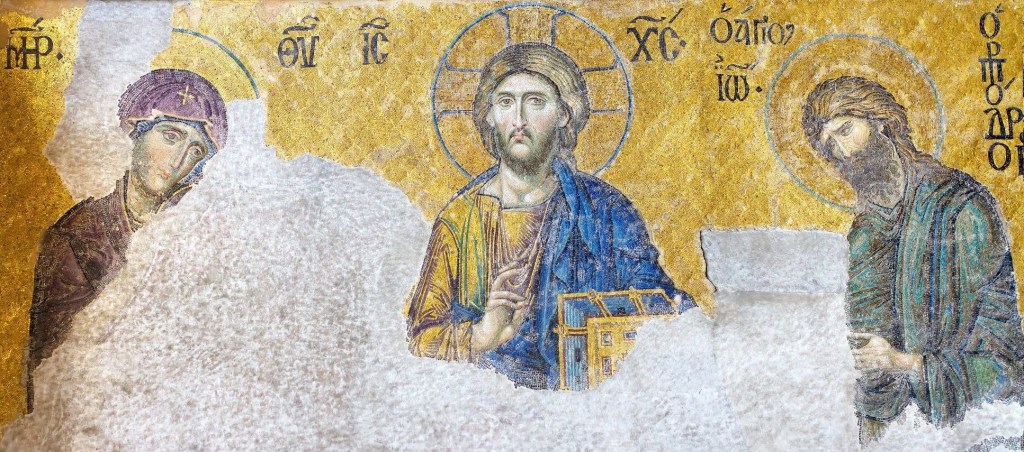
When does an image become a meme? Or an icon, an idol, or a shibboleth? I ask those questions, and then have go about defining them. We all know what an image is—a representation of something which actually exists. An icon is the Greek word for image, but to become a venerable image, it must bring the viewer into the spiritual realm, rather than leave the viewer only in this earthly world.

An idol is an inert representation of a god, but isn’t a god at all, for the god is invisible and spiritual. Praying to a golden calf or a carved wooden statue will get no response since it has no power or animation. The same can be said for shibboleth, which is a word or saying used by adherents of a party, sect, or belief and usually regarded by others as empty of real meaning. If the Ten Commandments are held up as mere words, idolized, but not kept in their hearts and lives, then they are as empty of power as golden calves. They also aren’t to be worshipped, but the God who gave them is.
Are the Ten Commandments now a meme? Memes are an amusing or interesting item (such as a captioned picture or video) or genre of items that are spread widely online especially through social media. Because this version of the Ten Commandments had its origin in the Charlton Heston movie, “The Ten Commandments,” which we see every single Easter and Passover season, it’s definitely in the public sphere. I’m of the opinion it’s fast becoming a meme—devoid of actual meaning and held up to ridicule.

The version in the Louisiana law matches the wording on the Ten Commandments monolith that stands outside of the Texas State Capitol in Austin. It was given to the state in 1961 by the Fraternal Order of Eagles, a more than 125-year-old, Ohio-based service organization with thousands of members. In 2005, a divided U.S. Supreme Court ruled it did not violate the constitution and could stay.
The Eagles organization notes on its website that it distributed about 10,000 Ten Commandments plaques in 1954. The organization also partnered with the creators of “The Ten Commandments” to market the film, spreading public displays of the list around the country.
“It’s significant that the Louisiana law uses the same text created for ‘The Ten Commandments’ movie promotions by the Fraternal Order of Eagles and Paramount Pictures because it reminds us that this text isn’t one found in any Bible and isn’t one used by any religious faith,” Kruse said via email. “Instead, it’s a text that was crafted by secular political actors in the 1950s for their own ends.” Kevin M. Kruse is the author of “One Nation Under God: How Corporate America Invented Christian America” and a history professor at Princeton University.

The actual biblical Ten Commandments are spiritual and can bring us closer to understanding God’s relationship with God’s chosen people during their wilderness journey. We can learn about boundaries, justice and mercy. Also we learn God wants us to be imitators of God’s nature, something that’s missing in the movie version of the Ten Commandments. The movie commandments are a Reader’s Digest version of the Biblical commandments and miss the grace of God entirely.
For Benjamin Marsh, a North Carolina pastor watching the Louisiana law, his primary concern is people’s spiritual formation, so altering the Ten Commandments is worrisome to him. “The problem with changing the text of the Ten Commandments is you rob the spiritual implications of the actual biblical text. So you’re giving some vague likeness to the Ten Commandments that isn’t the real thing,” said Marsh. He leads First Alliance Church Winston-Salem, which is part of a conservative evangelical denomination.
So I offer these two versions below for you to read. I believe the placing of the Ten Commandments in the schools in these states has less to do with “religion” than with culture wars, which these politicians hope to use to their advantage. If we see these in our communities, we should ask for comparative religions to be taught, or none at all. I find the misuse of scripture abusive. This isn’t what we should be doing to vulnerable children. We should give them a God who loves, cares for, and provides for their needs. The Ten Commandments in the school houses is like having a cop in the classrooms.
FROM THE MOVIE, “The Ten Commandments:”
The Ten Commandments I AM the LORD thy God. Thou shalt have no other gods before me. Thou shalt not make to thyself any graven images. Thou shalt not take the Name of the Lord thy God in vain. Remember the Sabbath day, to keep it holy. Honor thy father and thy mother, that thy days may be long upon the land which the Lord thy God giveth thee. Thou shalt not kill. Thou shalt not commit adultery. Thou shalt not steal. Thou shalt not bear false witness against thy neighbor. Thou shalt not covet thy neighbor’s house. Thou shalt not covet thy neighbor’s wife, nor his manservant, nor his maidservant, nor his cattle, nor anything that is thy neighbor’s.
FROM KJV: Exodus 20:2-17
I am the LORD thy God, which have brought thee out of the land of Egypt, out of the house of bondage. Thou shalt have no other gods before me. Thou shalt not make unto thee any graven image, or any likeness of any thing that is in heaven above, or that is in the earth beneath, or that is in the water under the earth: Thou shalt not bow down thyself to them, nor serve them: for I the LORD thy God am a jealous God, visiting the iniquity of the fathers upon the children unto the third and fourth generation of them that hate me; And shewing mercy unto thousands of them that love me, and keep my commandments. Thou shalt not take the name of the LORD thy God in vain; for the LORD will not hold him guiltless that taketh his name in vain. Remember the sabbath day, to keep it holy. Six days shalt thou labour, and do all thy work: But the seventh day is the sabbath of the LORD thy God: in it thou shalt not do any work, thou, nor thy son, nor thy daughter, thy manservant, nor thy maidservant, nor thy cattle, nor thy stranger that is within thy gates: For in six days the LORD made heaven and earth, the sea, and all that in them is, and rested the seventh day: wherefore the LORD blessed the sabbath day, and hallowed it.
Honour thy father and thy mother: that thy days may be long upon the land which the LORD thy God giveth thee. Thou shalt not kill. Thou shalt not commit adultery. Thou shalt not steal. Thou shalt not bear false witness against thy neighbour. Thou shalt not covet thy neighbour’s house, thou shalt not covet thy neighbour’s wife, nor his manservant, nor his maidservant, nor his ox, nor his ass, nor any thing that is thy neighbour’s.
Joy, peace, and time to read your Bible,
Cornelia
Louisiana Ten Commandments law raises preferential treatment concerns | AP News
Fraternal Order of the Eagles
