Four Pears Still Life

art, Cezanne, Creativity, failure, nature, Painting, Pompeii, Transfiguration

We painted a still life of four pears and a handmade blue bowl in our recent Friday art class. After looking at some art prompts and reminding the class, “Pears are just variations on spheres piled on top of each other,” we got down to business. In art class this means spending some time looking. Unless we’re designing an abstract creation, we usually have a desire to make our images reflect what we see. Yet each of us sees from a unique perspective and we each have a special creative use of color and line. This is our creative genius which lives within each of us. My goal as a teacher is to lead this genius out of each person and set it free to feel confident to exercise its own voice.

Pompeii Genius mural, House of Lares

The genius is a Greco Roman idea like our guardian angel, in that each person has a guardian spirit. The Romans put the father at the head of the family, so the genius was the spirit of the male head of the household. In the family altar areas lares, (guardians of the family, who protect the household from external threats) stand on either side of the genius, who wears a toga and makes a sacrifice. Beneath them all is a serpent. The murals often depict snakes in the lararia because the Romans believed they were also guardian spirits of the family and as well as messengers to the underworld.

The poet Horace half-seriously said only the genius knows what makes one person so different from another, adding the genius is a god who is born and dies with each one of us. Individuals worshipped their own individual genii, especially on their own birthdays. Today we use the term genius to mean “gifted or special,” but each of us has special abilities of our own genius, just by the grace of God at birth. As Romans 12:6 reminds us,

“We have gifts that differ according to the grace given to us: prophecy, in proportion to faith; ministry, in ministering; the teacher, in teaching; the exhorter, in exhortation; the giver, in generosity; the leader, in diligence; the compassionate, in cheerfulness.”

Some of us may be rich in gifts, and some of us may be letting our gifts lie fallow, but we can all work at increasing the gift we have. Some of us may discover a hitherto unknown gift! None of us would ever want to be like the third servant who received the one talent and promptly buried it out in the back yard in a coffee can, only to return it to the master without even added interest. He was so afraid of failure and loss, and worried about future punishment, that he did not even loan the money out at interest. (Matthew 25:24ff)

Samuel Beckett in in Westward Ho (1983), said:

“Ever tried. Ever failed. No matter. Try Again.

Fail again. Fail better.”

This quote was written on the back of a envelope in my grandmother’s art studio up on the second floor of the big wooden Victorian home my granddaddy built for them when he was promoted to conductor on the railroad. He had an eighth grade education, but made sure his boys had more. My grandmother was not going to let anything stop them.

Failure is how we learn what we don’t know. Then we learn some more things and discover we still don’t know everything! We become lifetime learners because the world is always changing, whether we want it to or not. We too will transform, because this is the truth of the Christian life.

Test of Vanguard launch vehicle for U.S. International Geophysical Year (IGY) program

Most of life in the art studio is a process of failing upward. Most people think failing is always a negative activity, but children always fall before they can consistently walk. We give them joy, cookies, and hugs. I am old enough to remember rocket ships blowing up on the launchpad more often than streaking into the great beyond. NASA had a few kinks to work out before we sent chimpanzees or humans into space. Even then, space has claimed its heroes. We don’t call NASA a failed organization. These sacrifices taught us much. We are infinitely more careful and do not want to move so fast that we break humanity. Break the technology but care for the humanity.

In my own work, I can learn so much on one painting, I will look at it a month later and want to “fix it.” I realized long ago I needed to let that feeling go. If I were to work with new insights on the old work, I would have to totally repaint it. I would be better off beginning all over. I’m now in a new place and have new skills. My individual genius is ready for a new challenge. I will learn so much on the new work, I will be eager to start on the next one.

Transfiguration Icon

Art is like life. We get a new day to do better and another opportunity to do better. There are cynics among us who believe people cannot do better, or they will never change. Those of us, who afflicted with incurable optimism, believe change is possible and a better life awaits. We would have no teachers, healers, or community leaders, much less no clergy of any faith, if we didn’t believe in transformation or think we have no part in bringing it to fruition. I am not one to settle for chaos and despair. I keep saying this world has enough negativity, and I will not contribute to that excess.

Henri Rousseau: Pears, Apples, and Teapot, c.1910, oil on canvas, private collection

Simplifying what we see before us is a first step in drawing from life. The KISS Principle works in art class too: “Keep It Simple Silly.” Most of us try to eat the elephant all at once. We look at a houseful of boxes and collapse: where to start? After years of itinerating, I can say with certainty, “The one nearest to you at the moment.” If it took three weeks to pack, expect the same amount of time to unpack. Hooray, you get to eat out until you find the kitchen gear. Likewise with a painting, we make a mark with a light-colored wash. If it is in the wrong place or the wrong size, we can overpaint it. No one will ever know.

Our Four Pears: One View

Mike kept his pear painting simple. He made a study of the one pear which called his name. Just because I brought four pears and a blue bowl didn’t mean he felt the need to paint the whole still life. This is his unique genius. In his work life he can find the primary truths and key facts to support his clients’ cases. Those same attributes will show up in his artwork. At the end of the class, he was unhappy, however.

“Use your words,” I always say, “or at least point to where you are unhappy with your work.”

Pointing to the waistline of the pear, he said, “This section here looks wrong.”

“That’s where you quit looking at the pear and were just putting paint on the canvas.”

“OK, I thought that was what was bothering me about this, but I didn’t know why.”

Mike: Four Pears are The One Pear

“We have to keep looking at the objects while painting. Our memories aren’t that good to keep the image in mind for long.” We can train our memories by the technique of blind drawing, which is the technique of only looking at the objects, but never at our drawing. This trains our hand to connect to our eye. Our first drawings are very lopsided because the right side usually won’t match up to the left side. Yet with practice, these blind drawings will look somewhat realistic.

Gail S: Four Pears

Gail S has a more reflective and introspective approach, so she will dissect the major elements of the still life before she makes a mark on the canvas. Some people can imagine three dimensional objects as two dimensional patterns without making marks visible. I consider this a particular form of genius, for they also can usually access their thoughts without having to write them down, which is what extroverted thinkers need to do. This is another example of how different people approach art from their own specific genius: if we all were all alike, we would produce indistinguishable results as if from a factory. Art class isn’t a factory production line, but an experience and opportunity to get in touch with our creative selves.

Cornelia: Four Pears

I managed to catch the personality of the different pear species. I was painting on a raw, unprimed canvas, so my first layers of paint soaked into the weave. The successive layers built up the colors. I ignored the drapery and the busy background of the actual setting, but I added the rainbow clouds of my own. The violet grey of the tablecloth might read to some eyes as a mountain. Then the size context of the pears and the bowl becomes questionable. Are they normal sized pears on a table or giant-sized pears on a mountain? The tension is part of the painting.

Rembrandt: The Night Watch, 1642

Once the artist makes their work, they give it a title for what it is meant to say to others. That is its “birth name.” Much like a sermon, once the word or image gets out into the public, people interpret it according to their own lived experiences and prejudices. As an example, historians have misinterpreted Rembrandt’s Night Watch, which wasn’t its original title.

Contrary to popular myth, the commissioners did not reject painting, but it has suffered many indignities in its almost 400 year history. In 1715, the townspeople pared it down to fit between two doors in Amsterdam’s Town Hall, and its current name arrived at the end of the 18th century on account of varnish and dirt that had darkened it into a nighttime scene. The action takes place at dawn’s first light, a fact revealed after a recent 2013 cleaning.

Paul Cézanne: Still Life with Apples and Pears, ca. 1891–92, Oil on canvas, 17 5/8 x 23 1/8 in. (44.8 x 58.7 cm), Metropolitan Museum of Art, New York, NY.

The same goes with any spoken word or sermon. If we wonder how so many people can get so many different meanings from a preacher’s sermon, or how people can read the same Bible, but produce wildly different interpretations of the claim Christ has on their lives from the same holy word, it might be because we all come from differing perspectives, environments, cultures, and therefore have unique “geniuses.”

In the seminary we try our best to strip all our preconceived notions away from our hearts and minds and hear the texts as the authors originally spoke to those who wrote them down. Then we ask, “What meaning do they have for us today? What is Christ calling us to be? What are we to do to bring God’s kingdom one step closer?” If the scripture cannot touch us, transform us, and call us to action, we will be as John Wesley once feared, only “almost Christians.” To be fully Christian we need to have not only the outward appearance of the Christian life but also have “the love of God and neighbor shed abroad in our hearts.” That is the mark of the “altogether Christian,” rather than the one who is only just as good as the “honest heathen.”

Wesley never minced his words, as you can read in his sermon, “The Almost Christian.” When our toes tingle, we might want to give some thought to our strongly held beliefs. If scripture contradicts them, then we might want to look deeper into the background of that text and see if the rest of the Bible speaks with the same voice. We also might want to consider if this word has meaning for today (for instance, we no longer make animal sacrifices to God, since Christ made that need irrelevant by his gift on the cross).

Cezanne: Still life with three pears, Pencil and watercolor on paper, 1880-82, 12.6 x 20.8 cm, Museum Boijmans Van Beuningen, Rotterdam, Koenigs Collection

When we struggle in learning a new art technique, we are also undergoing a transformation. We sometimes must unlearn an old comfortable habit to learn a better one. Anyone who has played a sport knows the difficulty of making a swing change or adjusting their throwing motion. We are creatures of habit and want to take the well traveled path. We fear any disruption from the ordinary. Yet it’s in the challenge of the new where we learn. Iron sharpens iron. We never hear the metaphor, “Wool sharpens steel.”

We will do Day of the Dead T shirts next and turban pumpkins after that. It is always an interesting time in Friday Art Class. You can join us and begin at your level. Bring your own acrylic paints, brushes, and a small canvas or canvas panel.

Joy and peace,

Cornelia


Genius | Ancient Beliefs & Practices

https://www.britannica.com/topic/genius-Roman-religion

Revealing the Secret History of Rembrandt’s ‘The Night Watch’

https://news.artnet.com/art-world/secrets-of-rembrandt-the-night-watch-2627404

BBC – History – Ancient History in depth: Pompeii Art and Architecture Gallery

https://www.bbc.co.uk/history/ancient/romans/pompeii_art_gallery_08.shtml

Wesley’s Sermon Reprints: The Almost Christian | Christian History Magazine

https://christianhistoryinstitute.org/magazine/article/wesleys-sermon-reprints-almost-christian

Test of Vanguard launch vehicle for U.S. International Geophysical Year (IGY) program to place satellite in Earth orbit to determine atmospheric density and conduct geodetic measurements. Malfunction in first stage caused vehicle to lose thrust after two seconds and Mission Control destroyed the vehicle.


Creativity Challenge

adult learning, art, beauty, coronavirus, Creativity, Faith, Icons, inspiration, Ministry, Painting, Pantocrator, Philosophy, photography, Plato, purpose, Reflection, Spirituality, vision

I was an art major before I attended seminary at Perkins, where I had the great privilege to take Philosophy from Dr. Billy Abraham. Of course this privilege was extended to me because I failed my one and only philosophy class in undergraduate school. I had taken it pass fail, but hit a terrible depression after my art teacher died. I had no energy to even hand in a paper with my name on it, even though the professor offered this as an act of grace to pass me.

“I’ve not done the work, I’m in over my head, and I haven’t understood any of these concepts in this class,” I said. “I don’t deserve to pass.”

“It’s a pass fail class. It doesn’t count toward a grade average, but it can count against you. Just turn in the paper,” he pleaded.

It didn’t seem appropriate to me, or honorable to take this option, but that could have been my depression coloring my decision making process. Still, I wasn’t raised to take credit for haphazard efforts, and providence ensured my F didn’t count against me when I transferred to art school the next semester, so that F didn’t affect my ultimate grade average after all.

Raphael: School of Athens, Vatican City

I speak about this because in seminary, Billy Abraham daily stretched the brains of every one of us first year students. First we heard one Greek philosopher say this was “true and real.” Then the philosopher who was his student came along and directly contradicted his old master, saying, “No, instead, something else is true and real.”

We all were in hair pulling mode, not to mention Dr. Abraham’s favorite description, “getting our underwear tied into knots.” I’ve always heard there’s a Rosetta Stone, which can unlock the meaning of an unknown language for those who have the eyes to see it. Perhaps only the creative ones, those who can see the patterns and the similarities, or what the mathematicians call the “sets” and the biologists call the “modules,” can suddenly see the key in plain sight.

Rosetta Stone

I admit I too was floundering until I had the eye opening realization I already held the key in my hand. I’d met this same question before in my art studio and history classes: “What is beautiful and what is truly art?” This definition had changed over the centuries, so why should the ideas of what is “reality and truth” remain fixed? This is a great example of “transfer of learning,” a well known educational concept, which resulted in my “lightbulb moment.”

Leonardo: Mona Lisa

As I explained to a fellow student, “Think of these as distinct historical ideas, not as your individual truth. It’s like looking at a fashion show from the ancient times to the present: no one expects those clothes to look like what we wear today. Just memorize what each of these styles look like. You don’t have to wear a toga to know what these Greeks thought. We just have to know how these old ideas influence later trends of thought fashions.” This is teaching by analogy, which is familiar to Bible readers as “parables.”

Coffee Bean Madonna

Most people can get over that intellectual hump. Seminary is designed so persons who aren’t agile thinkers will reconsider their educational choices. Philosophy and theology will winnow those who need to be told what to think, rather that learning how to think and understand deeply. Biblical studies will sort out those who aren’t able to interact with more than one voice of biblical interpretation. Then the internships and clinical pastoral settings will further sort those who don’t play well in groups. Finally the supervisory process we all go through toward our ordination into one of the orders of the annual conference is a long period of discernment, for all concerned.

The good news we can all do ministry, for we’re ordained by our baptism into the priesthood of all believers, not only reflect the Christ who lives in us, but to be the Christ in service to our neighbors. As we read 1 Peter 2:9—

But you are a chosen race, a royal priesthood, a holy nation, God’s own people, in order that you may proclaim the mighty acts of him who called you out of darkness into his marvelous light.

Minion Madonna

This is why it’s important we consider such concepts as truth, beauty, and the good. The Greek adjective kalon only approximates English for “beautiful.” Kalon has more of an ethical tone, but doesn’t mean the same thing as agathon or the “good, ” but rather is a special complement to goodness. At times kalon narrowly means “noble,” or “admirable.”

What was true for Plato were the forms, and everything here on earth were mere reflections or imitations of these ultimate truths. The true beauty and the good existed beyond this world, but everything and everyone could aspire to that ideal. Plato thought art and poetry were the arenas of greatest beauty, as Simonides, the Greek poet, drew an explicit analogy: “Painting is silent poetry and poetry is painting that speaks.”

While some say, “Imitation is the sincerest form of flattery,” for Plato imitation is found in the appearance of things, rather than in reality (the forms, which exist in an ideal world elsewhere), so judged on its own terms, the product of imitation has an ignoble pedigree (Republic 603b). Therefore, the imitative arts direct a soul toward appearances and away from proper objects of inquiry, which are the forms. While a mirror reflection might prompt you to turn around and look at the thing being reflected, an imitation keeps your eyes on the copy alone. Imitation has a base cause and baser effects.

Festival Madonna

Plato also believed poets created their works under irrational conditions, with inspiration arriving sometimes spontaneously, as if it were from the gods, a “divine madness,” as it were. Even today, people think creative types are more likely to be mentally ill, but science doesn’t bear out this romantic notion. Illness isn’t a prerequisite for creativity, even though many artists have suffering in their life histories.

Another Coffee Madonna

Creativity of any kind—making a collage, taking photographs, or publishing in a literary magazine—tends to make individuals more open-minded, curious, persistent, positive, energetic, and intrinsically motivated by their activity. Those who score high in everyday creativity also reported feeling a greater sense of well-being and personal growth compared to those who engage less in everyday creative behaviors. Creating can also be therapeutic for those who are already suffering. For instance, research shows that expressive writing increases our immune system functioning, and the emerging field of post traumatic growth is evidence we can turn adversity into growth.

Realism was the primary purpose of painting until the 19th century, when the invention of photography took over this task. This freed painters to engage in the higher search for what is beautiful and what is true, rather than to limit a painting to reproducing a likenesses or the mere imitation of nature. Yet many people still judge a work of art by how close it resembles the natural world. Of course, we also say the say the same about the embalmer’s art as we view the deceased in the casket: “My, doesn’t so and so look natural! So lifelike, as if they were asleep.”

Source

For our first lesson back in art class, we worked on seeing the familiar in a fresh way. This isn’t as easy as it sounds. We’re so used to recognizing faces in the ordinary way, to see them in a different way is a struggle. Take the Mona Lisa, by Leonardo Da Vinci. It’s an icon or representative image of the renaissance portrait. No matter what an artist does to it, we still recognize it as the Mona Lisa. Our goal was to take a photo of of someone we know, and push the limits of the facial expression and shapes so it wasn’t like the image we worked from originally.

Mike’s Painting

Mike copied the cover of the Bad Girls of The Bible, and made a good likeness. In between calls from work, he focused on replicating an image he could see. After several years of sincere efforts to paint what he sees, it’s hard to break this habit and paint something beyond his vision.

We’ll take a shot at this again. I a similar lesson early in the group’s existence and I remember it was distressing to them to draw without seeing. We were feeling the objects inside bags, and they didn’t like not looking. Bring out of control was disconcerting.

Gail’s grandchild isn’t really a zombie

Gail took her grandchild’s photo and stretched it into another dimension by treating the image as if it were a Night of the Living Dead character or the Scream from the German artist Munch. She had the most success of any of us in terms of breaking the norms of “portrait.”

Sally’s painting

Sally, new to our group, began a lyrical study of a woman’s head. I confess I never saw the image from which she drew her inspiration. It’s her first try, and we’re glad she got paint on the canvas. We’ll keep working on it together. All art, as is life, a work in progress.

Russian Icon of the Pantocrator

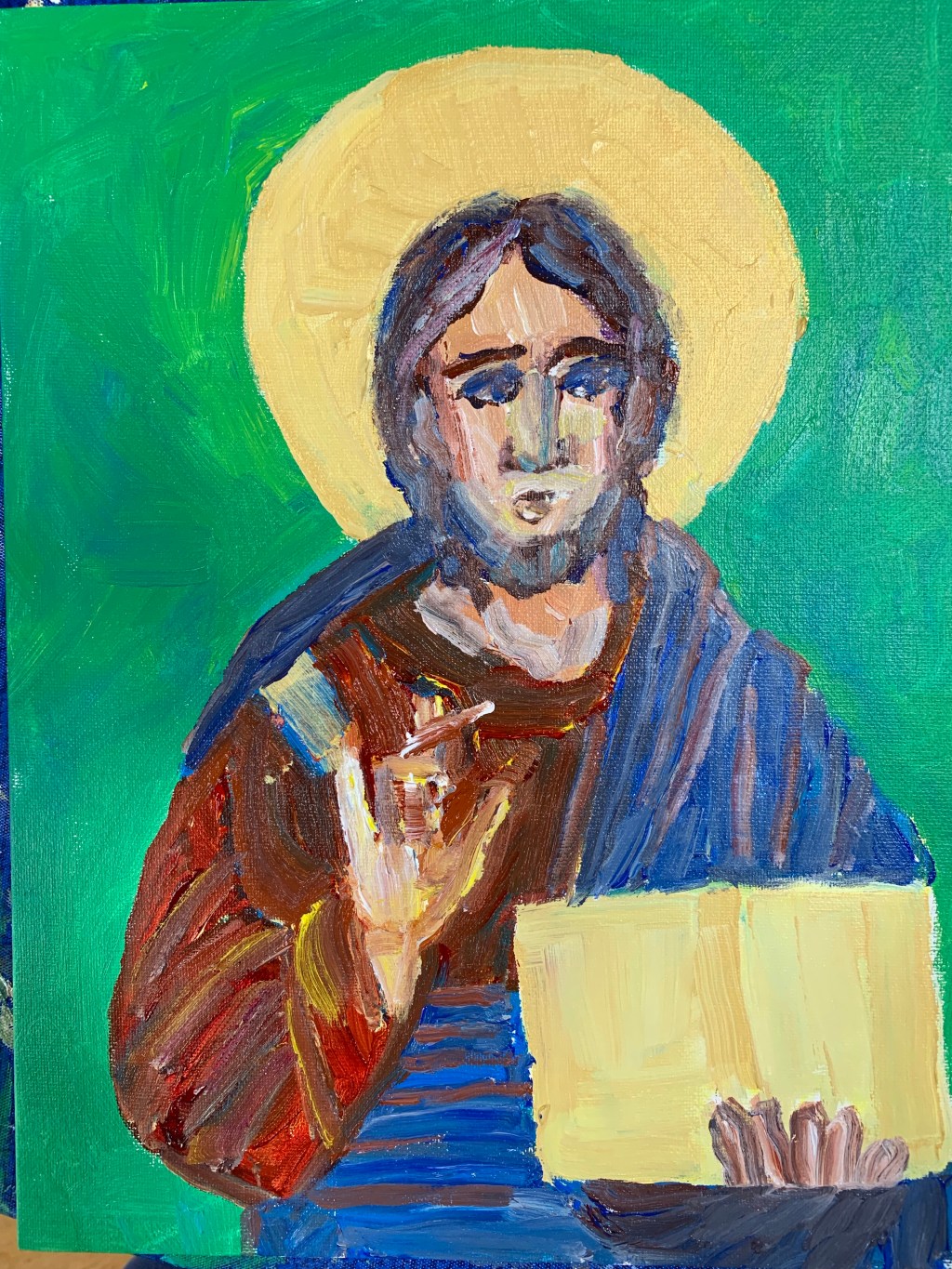
I worked from an icon of Jesus, which I knew would test me to break the form I saw before me. As it turned out, I too couldn’t break it on this first day. When the Platonic Ideal Form exerts its pull on the mind and hand, the artist keeps making the reflection of that form as a work, which exists as an imitation or a window into the true reality where the Holy is found.

Low Blood Sugar Painting

After a long summer break with all the Covid isolation a person could stand, I quite forgot how much energy teachers expend in explaining new concepts and in the excitement of the first day back. I noticed about 11 am I was struggling for words and not making good choices with my brush, but I ignored it in the thrill of being back with people. After cleaning up, I always check my blood sugar before I drive home. It was 45. I’d never seen it that low, but I was paying attention to other people, not to my body. I ate the crackers I always carry for just such an emergency.

The Wisdom of Solomon (7:26) speaks about God’s Wisdom personified:
“For she is a reflection of eternal light, a spotless mirror of the working of God, and an image of his goodness.”

In Hebrews (1:3), the writer describes The Christ:
“He is the reflection of God’s glory and the exact imprint of God’s very being, and he sustains all things by his powerful word.”

This long discussion on Plato, the true forms elsewhere and the imitations and reflections here help us to realize how much debt Christian spiritually and art history have to Greek thought. Art isn’t just “I know what I like and that’s all that counts.” We can all experience making art and enjoy it on any level. Having the depth of understanding to see how art connects us across the human community will give us a greater appreciation for our common spirit.

I promise I’ll bring a healthy snack to eat during class next Friday! I’ve learned my lesson on this, if nothing else! We’ll work on faces for two more weeks, then we’ll take a short break and come back in October and decorate cookies one week for Day of the Dead and paint an autumn themed subject for the other week.

Joy and Peace,

Cornelia

Simonides on poetry and painting—Plutarch: The Glory of the Athenians 3.1, 346f-347a.

Plato’s Aesthetics (Stanford Encyclopedia of Philosophy)
https://plato.stanford.edu/entries/plato-aesthetics/

Creativity and Rationality on JSTOR
The Journal of Aesthetics and Art Criticism
Vol. 70, No. 3 (SUMMER 2012), pp. 259-270 (12 pages)
https://www.jstor.org/stable/43496511

Mathematical Biology Modules Based on Modern Molecular Biology and Modern Discrete Mathematics
https://www.ncbi.nlm.nih.gov/pmc/articles/PMC2931670/

The Real Link Between Creativity and Mental Illness – Scientific American Blog Network
https://blogs.scientificamerican.com/beautiful-minds/the-real-link-between-creativity-and-mental-illness/