Dreams of Trees and Butterflies

arkansas, art, butterflies, coronavirus, Creativity, Faith, Forgiveness, grief, Healing, Historic neighborhood, holidays, hope, Imagination, inspiration, nature, pandemic, renewal, vision

The saying is true: “If nothing ever changed, there’d be no butterflies.” Yet how hard do we humans hold to the past, even if we need to move on into the future? As an artist, I’ve always been caught between my desire to honor the traditions of the past, but also to move into the the unknown realms of the future. Artists already have a vocabulary and boundaries to describe the works of the past, so we can tell if our current works “meet the criteria for excellence.”

Found Object Butterfly: roadside debris, wire, scrap cloth, and metallic beads

When we go beyond this known world into the uncharted territories, we’re like Columbus, who landed in the Caribbean islands, but thought he was on the continent of North America. I wonder if the monarch butterfly, just emerging from the cocoon, has any idea it soon will begin a 3,000 mile migration to its ancestral winter home in Mexico. The butterfly has the innate ability to navigate this path, whereas we humans are like Abram, for we’re going to a land our God will show us. We have no idea where we’ll end up, but we do know we’ll travel by stages and God’s guiding inspiration will always be with us.

During this current protracted COVID pandemic, with cases beginning in mid December 2019, we’ve now lost over 766,206 persons in the US alone and over 47,390,239 individuals have had COVID. Worldwide, the numbers are far greater: over 5 million have died and nearly 255 million have contracted COVID, mostly because vaccines and health care services aren’t available to the extent they are in America and the European Community. Not only has our world as a whole suffered a great grief, but each of us individually have lost friends, neighbors, or loved ones. This adds to our collective grief.

Airport Road at MLK Hwy Intersection, empty lots

When we see the rest of our world changing around us, we feel another loss, and this becomes the grief leading to the death of a thousand tiny cuts. Just as in our workplaces, when the ideas of the young, the female, and the ethnic individuals aren’t valued, their dismissal leads to devaluation of their perspectives as well as their personhood. When we devalue nature and treat creation as an arena for humanity to restructure for our purposes alone, we can fall into the trap of thinking only for our immediate future, but not for the generations to follow. This is why building lots inside the city get cleaned off and offered as a blank slate, since this makes them valuable to the greatest number of buyers.

Death by a thousand cuts was supposedly a form of torture in ancient China. It was reserved for the most heinous crimes, such as matricide, patricide, treason, and the like. From all the tiny slices, the accused finally bled to death. It was a cruel and unusual punishment, rather like flogging the back of a law breaker until the flesh was raw, but this punishment was intended to cause death because the executioner kept at it until he succeeded.

Most of us are blissfully unaware of the loss of a few trees here and there in our neighborhoods. Sometimes we even want to cut down the trees on our own property because we’re tired of raking leaves every fall, or if we have a magnolia tree, we’re tired of our year round duty of leap reaping. Of course, if you want a high strung, classy tree to show off in your front yard, you also need to sign onto the high maintenance these trees require. “Those that wears the fancy pants has to take care of those fancy pants,” my mother always reminded me.

Yard work is a type of infrastructure most of us can understand. With Thanksgiving just around the corner, those of us hosting the feast are also getting the house and yard ready for family and friends to visit. Infrastructure has been in the news lately also, with politicians debating whether soft or hard infrastructure deserves the most funding.

In Hot Springs, we have “Green Infrastructure,” which includes all the natural assets that make the city livable and healthy: trees, parks, streams, springs, lakes and other open spaces. These assets are ‘infrastructure’ because they support peoples’ existence. For example, tree canopy keeps the city cooler while also absorbing air pollutants and mitigating flooding. The Hot Springs National Park forest area is also an important resource for a variety of reasons. The mountain area is in the recharge zone for the hot springs and the forest provides other important ecosystem services.

Hot Springs is Very Green

In urban areas, we can evaluate the landscape on a smaller scale, so even small patches of green space become important, since together they can make a greater large cumulative impact. Smaller urban spaces, such as linear stream valleys, or even pocket parks, can add up to a connected green landscape. When evaluating the ecological health of an urban area, urban tree canopy is a key green asset. For instance, Hot Springs has 57% tree canopy coverage and an additional 12% green space coverage. This adds to our quality of life, for this isn’t only pleasing to the eye, but the trees and grass convert carbon dioxide to oxygen, thus improving the air we breathe.

Cities are beginning to recognize the importance of their urban trees because they provide tremendous dividends. For example, city trees are a strategic way to reduce excess stormwater runoff and flooding. Even one tree can play an important role in stormwater management. For example, estimates for the amount of water a typical street tree can intercept in its crown range from 760 gallons to 4000 gallons per tree per year, depending on the species and age. Taken city-wide, the trees within the city provide an annual stormwater interception of 1.2 to 1.5 million gallons which equates to 7 to 9 million dollars in benefits. The loss of one tree is worth so much money, replanting our tree cover is an investment in our future wellbeing.

I often heard an old proverbial poem growing up, which may not be repeated much today:

For want of a nail the shoe was lost.
For want of a shoe the horse was lost.
For want of a horse the rider was lost.
For want of a rider the battle was lost.
For want of a battle the kingdom was lost.
And all for the want of a horseshoe nail.

My nanny would remind me of the same principle in other words, “A stitch in time saves nine.” My daddy was from the school of “If it ain’t broke, don’t fix it.” While those two schools of thought still persist today, I think making a small, inexpensive repair, rather than a costly replacement, is a better choice, but too many of us live in a throwaway society.

Wisterias among the Trees

When we lose one small thing, we brush it off as no matter, but after a thousand small losses, we just can’t take it any longer. We look around and wonder what happened to our world, why didn’t we take action sooner, and now we might be in a hole so deep we can’t see the top. When I first painted the trees on this vacant lot, the little coffee kiosk had closed shop and moved on. It was springtime and the violet wisteria vines were bright against a sunlit cerulean sky.

As I was taking a few photos with my iPhone last spring, the local policeman pulled into the circular drive to check on me. We chatted a bit, but he wanted to make sure I was OK. I’m at that age when silver alerts go out for others, but I’m not there yet. I guess “old gal taking photographs of trees” still looks suspicious in my small town. I’m thankful my town is this quiet.

When I told the officer, “These trees called to me,” he might have had second thoughts about my state of mind. Then he realized he was talking to an artist. I was rescued when his radio called him off to take care of some real trouble. I find I do my best work when I feel called to a subject, for I have a spiritual connection with it.

That was this past April, and here at year’s end, this lot is up for auction, with a commercial use zoning. It has easy access to the bypass and would be good for a food place or a fuel stop. Things change and we can’t hold back progress. I know people who buy a vacation home to visit while they still work, but as soon as they retire to this same place, they grouse about all the weekenders who come and spoil their solitude. They put up with it a year or so, griping daily, and then sell and move on. Life changed for them and they didn’t adjust to their new normal. I wonder why they never realized Hot Springs was a vacation destination. We think we need an infrastructure just for the 38,500 people who live here year round, but we actually need an infrastructure to support the over two million visitors to whom we offer the hospitality of our hot springs, our hotels, our fine dining, our attractions, and our natural beauty.

When I saw the trees were gone and the lots had been plowed level, I wondered if the trees had a swift death, or if they had brief dreams and fantasies while the saws pierced their outer skins. I thought of the butterflies encased in their cocoons, and the deep sleep of their transformation. Do butterflies dream in this stage, or do they even dream like we do? I wondered if next April I would see wisteria growing near the ground, for as a weed, it’s hard to kill. I always hope, for I’ve learned over time, if I’m a prisoner of hope, this is better than seeing only the loss.

Stage One

After traveling and recovering from an autumn sinus infection, I decided to destroy an old mobile sculpture of a butterfly made from found materials and attach it to a canvas. I took some scraps of cloth from some mask projects, and glued the whole to the canvas. Maybe I crammed more than I should have onto the small surface, but I was going with it. This work might be more catharsis than art, or more process and possibility than success. It doesn’t matter, for sometimes art is more therapeutic than anything else.

The first layer held all the colors and shapes of the original Google map. The second layer began to make sense of the shapes and textures, for I started to pull together the small areas into larger spaces. By the third layer, I’d lost most of the color areas and turned them instead into linear shapes. The primary colors of the background I subdued beneath an overall gold tone. The lines now are like an automatic writing or glyphic writing, which might be the language spoken either by the trees or the butterflies, or by all natural living beings.

Stage Two

When we confront suffering in nature, in our lives, or in the world, we often ask, “Where is God in all of this?” In the days past when I suffered, I held on to the words of the Apostle Paul to the Romans:

“I consider that the sufferings of this present time are not worth comparing with the glory about to be revealed to us. For the creation waits with eager longing for the revealing of the children of God; for the creation was subjected to futility, not of its own will but by the will of the one who subjected it, in hope that the creation itself will be set free from its bondage to decay and will obtain the freedom of the glory of the children of God.” (8:18-21)

Dreams of Trees and Butterflies

Often we suffer because we can’t change our past, or we think we can’t affect our future. At some point in our lives, we come to accept our suffering. We don’t have to continue to suffer, of course, but we need to accept that what happened to us is over. We can forgive ourselves for not leaving a bad relationship earlier, or being too young to know we were being harmed. Some of us may have survivor guilt from our nation’s wars, and suffer moral injuries from acts of war. Only good and decent human beings would feel this guilt, and they can heal with Christ’s forgiveness. We can be changed and then begin to change the world, even if we begin only with our own selves.

After all, the Psalms promise us God is faithful both to us and to the creation also: “When you send forth your spirit, they are created; and you renew the face of the ground.” (104:30)

Joy and peace,

Cornelia

Vegetation Community Monitoring at Hot Springs National Park, Arkansas, 2007–2014
Natural Resource Data Series NPS/HTLN/NRDS—2017/1104
https://www.nps.gov/articles/upload/HOSP_VegCommunity2007_2014r-508.pdf

GREEN INFRASTRUCTURE LANDSCAPE STUDY AND PLAN
City of Hot Springs, AR
Green Infrastructure Committee
https://www.cityhs.net/DocumentCenter/View/6245/Hot-Springs-AR-GI-Study-and-Plan-Final?bidId=

Hot Springs General Information: Hot Springs National Park Arkansas
https://www.hotsprings.org/pages/general-information/

No One is an Island

art, cognitive maps, Creativity, Faith, flowers, Healing, inspiration, Ministry, nature, Painting, Spirituality, vision

If we watch the evening news on television, read a newspaper, or check our Twitter feed, bad news seems to fill the whole of it. Sometimes it gets to be too much, and we turn it all off, for we can’t cope with the next straw; it will break our camel’s back and we won’t be able to go on. Or we may already be broken by all the grief and pain, wounded by the wounds we can’t heal or by those wounded ones who wound others, rather than seek healing. I often thought I spent 50% of my pastoral care on 10% of my congregation, the “broken” ones.

After a while, we can feel like Elijah, who was worn out from doing great things for the LORD, and felt “I alone am left.” God comes to remind him he’s not alone. John Donne was very ill when he wrote this famous meditation. The artists all are from the margins, or made their art during a time of suffering. Yet, what beauty they found in this time. Artists often find their way back into the unity of all things by joining in the creating spirit of God.

Sam Doyle: Untitled (Rambling Rose), paint on metal, Smithsonian Institute.

Sam Doyle, who was on born and died St. Helena Island, SC (1906-1985), was a self taught Gullah artist, who painted the local stories of his community on anything he could find. He covered the walls of his home, as well as scraps of metal and wood with iconic figures of his people. You can read about this richly talented primitive artist at https://www.soulsgrowndeep.org/artist/sam-doyle

Hilda Wilkinson Brown: Third and Rhode Island, Washington DC, oil on canvas, 1930-40, Smithsonian Institute

Hilda Wilkinson Brown was born in Washington, DC 1894 and died there in 1981. She was an African American artist and art educator who brought her love of education and creativity to everything she did. Her work was mostly “under the radar,” except for in her own community. Yet she persisted. As a teacher, she’s best remembered for introducing individual creativity as a goal, rather than having students mimic the teacher’s model. Unfortunately, art education classes are still teaching mimicry.

Myrna Báez: Platanal, acrylic on canvas, 1974, Smithsonian Institute.

Myrna Báez of Puerto Rico (1931-2018), painted this lush field of plantain trees, a crop long wedded to concepts of Puerto Rican identity and sovereignty. She depicted the crop’s large leaves as they reflect the tropical sun and delighted in her manipulation of paint on unprimed canvas. Báez’s belief in Puerto Rican independence manifests in her impulse to look, depict, and therefore possess the island’s landscape on her own terms. Puerto Rico is currently an unincorporated territory of the United, in which the people are American citizens, but have no vote, unless they move to the mainland.

Georgia O’Keeffe: Hibiscus with Plumeria, oil on canvas, 1939, Smithsonian Institute

Georgia O’Keeffe, who was born in Sun Prairie, WI in 1887 and died in Santa Fe, NM in 1986, painted this exquisite “Hibiscus with Plumeria,” (oil on canvas, 1939, Smithsonian Institute). Intrigued by the opportunity to paint tropical flora, O’Keeffe accepted an offer from the Dole Pineapple Company for an all-expenses paid trip to the state of Hawaii to create a painting for the company’s 1939 advertising campaign. It was a perfect escape from the stress of her husband, Alfred Stieglitz’s ongoing affair with Dorothy Norman, the beautiful young wife of an heir to the Sears, Roebuck & Co fortune.

She visited Maui, O’ahu, Hawai’i, and Kaua’i, painting the islands’ dramatic gorges, waterfalls, and tropical flowers, among them Hibiscus with Plumeria. Pink and yellow petals towering against a clear blue sky transform the delicate blossoms into a joyous monumentality. But of the twenty canvases of Hawaii she completed, none showed a pineapple. Only after Dole had one flown to New York did she finally, if reluctantly, paint the desired fruit.

George Bellows: Vine Clad Shore–Monhegan Island, oil on canvas, 1913, Smithsonian Institute

George Bellows was born in Columbus, OH in 1882 and died when his appendix ruptured at the age of 42 in New York City in 1925. He’s best known for his “outsider” subject matter: tenement life, New York street scenes, and boxing subjects. While Bellows was famous for his fight scenes, he recovered his soul in the landscape, such as this Vine Clad Shore on Monhegan Island, Maine.

Frank Wilbert Stokes: The Eighth of March–Island Ice, Greenland, 1894, Peary and Party near 6 p.m., oil on canvas, 1893, Smithsonian Institute.

Frank Wilbert Stokes (born Nashville, TN 1858-died New York City 1955) was the artist member of Robert Edwin Peary’s Greenland Expeditions. He did small works such as this one on site as a record of the journey. Stokes spent eight weeks in the Arctic, the first painter to work on the ice fields, where he had to learn a method as he went, mixing kerosene into his pigments to stop them freezing and sketching outdoors through indistinguishable Arctic days and nights. Based in his studio at Bowdoin Bay, Stokes would spend fourteen months in all working in this extraordinary Arctic environment:

The outside winter temperature was frequently forty degrees below zero Fahrenheit. The lowest temperature experienced was frequently sixty-five degrees below zero. In order to prevent his colours from freezing, [Stokes] mixed them with petrol and poppy oil and kept his colour box in a deerskin bag. Lieutenant Peary’s general orders forbade any member of the party to go more than a quarter of a mile from the main camp. This restriction was relaxed in the case of Mr. Stokes, who frequently went four or five miles in moonlight or starlight, during the polar night, to study effects which he had declared to be indescribable in words, but which are shown by his pictures.

Thomas James Delbridge: Lower Manhattan, oil on canvas, 1934, Smithsonian Institute

Thomas James Delbridge (born Atlanta, GA 1894-died Long Island, NY 1968) painted this view of Lower Manhattan, an oil on canvas, in 1934, which is now in the Smithsonian Institute. It was part of the Federal Work Projects Administration, which gave support to “starving artists” during the Great Depression. Lower Manhattan’s glorious skyscrapers inspired all New Yorkers, including the city’s artists, through the worst hardships of the Great Depression.

Looking from the dock of a harbor island, Thomas Delbridge showed the dark mouths of Manhattan’s ferry terminals; above them ever taller buildings climb out of red shadows into gold and white sunshine. The crisply outlined forms evoke such famous structures as the Woolworth Building to the left and the Singer Building to the right without placing the buildings precisely or describing specific details. The skyscraper at the center suggests the mighty Empire State Building as it had stood incomplete before its triumphant opening on May 1, 1931. Even as the stock market foundered and thousands were thrown out of work, New Yorkers had gathered in excited throngs to watch their tallest tower rise. The Manhattan skyscrapers in the painting appear to be pushing back dark clouds, creating an oasis of brilliant blue around the island. (1934: A New Deal for Artists exhibition label)

DeLee: How Many Times Must Paradise Burn?

Does art come only from the mind, or does it come from the greater depths of our souls and our hearts or guts? If we reduce art to only its analytical forms and colors, we may rob ourselves of the deeper experiences of the art itself. Likewise, if we put on our false face of “I’m fine,” but in fact we’re falling apart inside, pretty soon our facade will crack open too. Then folks will say, “What happened there?” And perhaps we’ll be too ashamed by then to speak of it, for we lied about our truth too long.

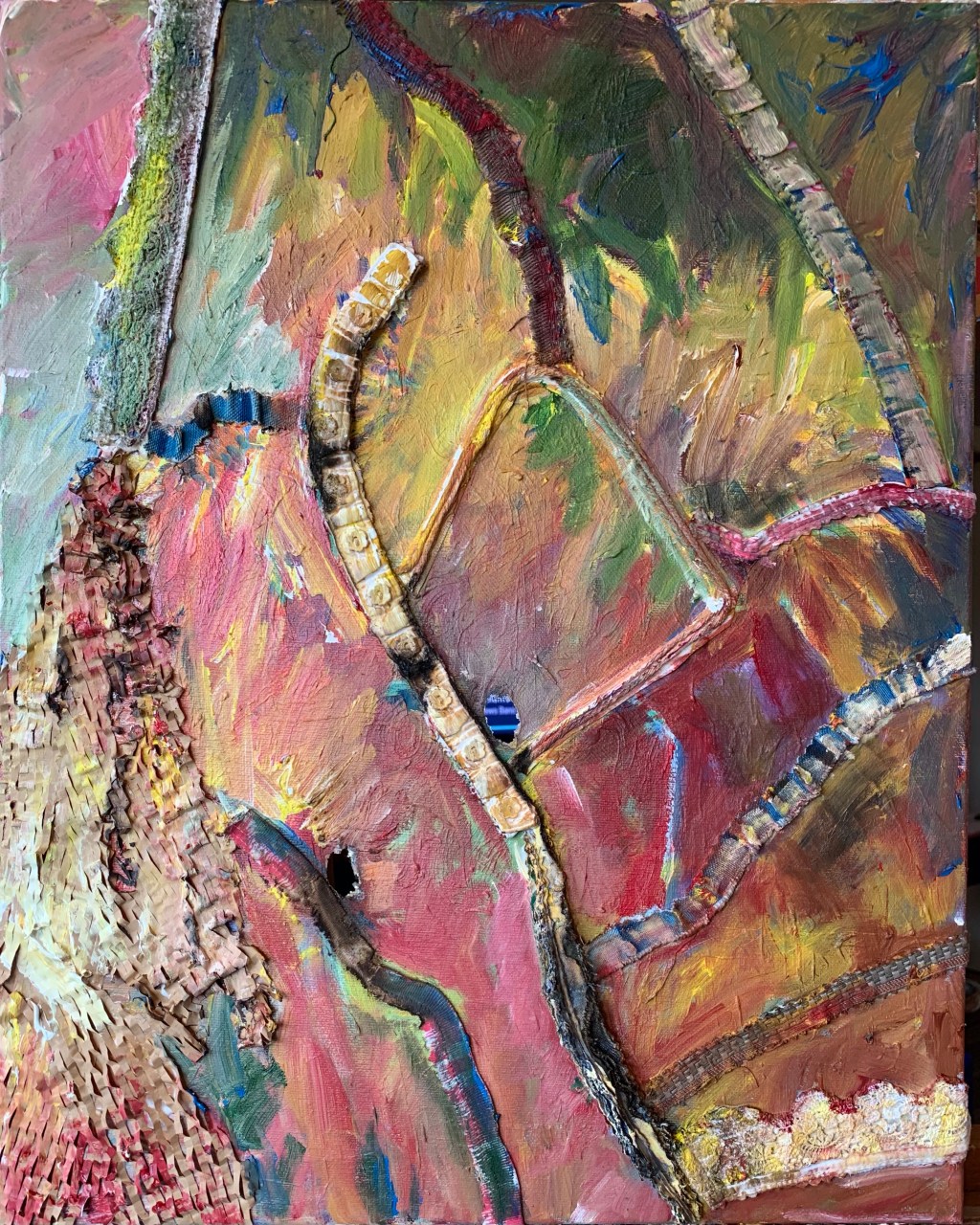
My recent canvas is another cognitive map, for it deals with the changing landscape and our changing climate. It uses paper scraps, lace trims, the button row of an old outfit, and old blue jean seams all glued on the canvas in the proximate place of the main roads of the Dixie Fire out in California. I painted flame colors over the surface, but left some greens for where the fire hadn’t yet spread. Then I took out my handy Bic torch lighter to sear some of the cloth additions. Even acrylic paints, if overheated, will combust, as I soon discovered, for I burned two holes in the painting. They look like the black holes of outer space or the dark night of the soul in our spiritual lives.

When I think of all the needless deaths from the coronavirus since we’ve have the introduction of our current safe and effective vaccines, I feel very sad for every life lost. Even with nearly 4.4 million deaths worldwide and almost 639,000 deaths in the USA alone, I’m not so inured to the loss of my brothers and sisters that I can just shrug it off. I know very few of those Covid has taken from us, but the world is a lesser place without those millions.

And so I leave you with this famous meditation. Donne didn’t know if he was on his deathbed or not when he wrote it. I’m pretty sure I won’t leave behind such immortal words when I think my end is near.

No man is an island,
entire of itself;
every man is a piece of the continent,
a part of the main.
If a clod be washed away by the sea,
Europe is the less,
as well as if a promontory were.
as well as if a manor of thy friend’s
or of thine own were.
Any man’s death diminishes me,
because I am involved in mankind;
and therefore never send to know for whom the bell tolls;
it tolls for thee.

~~ John Donne, “Meditation 17,” (1623, transcribed into modern English)

“It was fitting that God, for whom and through whom all things exist, in bringing many children to glory, should make the pioneer of their salvation perfect through sufferings. For the one who sanctifies and those who are sanctified all have one Father. For this reason Jesus is not ashamed to call them brothers and sisters.” —Hebrews 2:10-11 NRSV

About Hilda Rue Wilkinson Brown: African American artist and teacher who lived in Washington, D.C. (1894 – 1981) | Biography, Facts, Career, Wiki, Life
https://peoplepill.com/people/hilda-rue-wilkinson-brown

George Bellows | The Metropolitan Museum of Art
https://www.metmuseum.org/exhibitions/listings/2012/bellows

The Project Gutenberg eBook of My Arctic Journal, by Josephine Diebitsch-peary. https://www.gutenberg.org/files/64549/64549-h/64549-h.htm

Art Inspired by the Covid Blues

art, at risk kids, beauty, cognitive maps, coronavirus, Creativity, Faith, Family, generosity, greek myths, Healing, Holy Spirit, Imagination, Painting, pandemic, picasso, renewal, The Odyssey, vision

After the initial burst of summer excitement, my community is not only sweltering in a heat wave, but we’re also smack dab in the midst of the third wave of this Covid-19 pandemic. We might be more than halfway through 2021, but at the rate my home state of Arkansas is pursuing vaccinations, it’ll be years before we reach the holy grail of herd immunity, estimated to be at 80% immunity. Only 37% of our people are fully immunized, with Alabama and Mississippi pulling up the rear nationally with 35% and the states of Louisiana and Wyoming tied with us at 37%.

@rdaily—Arkansas hospital bed availability. Getting nearly impossible to find an ICU bed again. Many really sick patients being held in ER beds all over the state.

Like the old gal who’s always worn a certain size shoe or dress, my state now tries to fit an increasing number of Covid patients into a fixed set of ICU beds in our state. My days of a size seven shoe or skirt are a dim memory, as are the days of empty medical facilities.

“We have nowhere to send COVID-19 patients within the State of Arkansas. There is limited bed capacity at trauma centers increasing pressure on the time-sensitive healthcare system,” said Jeff Tabor, program director for the COVIDComm system, which helps match covid-19 patients with hospitals.

Tabor said the one COVID ICU bed which is available is located in southern Arkansas. There are five hospitals, also in southern Arkansas, showing limited COVID bed space. Tabor said some COVID-19 patients are so critical at rural Arkansas hospitals that they cannot be transferred to other hospitals because the patient is too critical and because of bed space.

Recently our state legislature adjourned a special session without amending their misguided law mandating no masks ever in public schools or government agencies. Act 1002, by Sen. Trent Garner, R-El Dorado, prohibits state and local governments, including public schools, from requiring people to wear masks. Act 1002 became effective on July 28.

The state’s largest school district, joined by a small district already suffering from Covid quarantine attendance problems in its early opening days, filed suit in court to stop this law from going into effect. The judge issued a temporary restraining order. The reasons for this aren’t political, but are found in the Arkansas constitution.

LRSD and MSD are likely to succeed on the merits. Act 1002 violates the Education Article of the Arkansas Constitution, Article 14, § 1, which requires that “the State shall ever maintain a general, suitable and efficient system of free public schools and shall adopt all suitable means to secure to the people the advantages and opportunities of education.” A suitable and efficient system of public education would not require students to risk their health and their lives to get the education promised to them in the Arkansas Constitution, especially when the State is required to “adopt all suitable means” to provide them “the advantages and opportunities of education”.

An affidavit provided by Dr. Glen Fenter, the superintendent of the Marion School District, said that incentives, including gift certificates, groceries, and even big-screen televisions, didn’t entice many local citizens to take the vaccine. Only one out of every three students in the district has acceptable home internet service, making remote learning difficult; even then, “very few” students who did “participate in the virtual education option last year achieved an acceptable level of academic progress,” the affidavit said.

The Marion superintendent said that his district was forced to “quarantine over 500 students and employees” based on CDC and state health department guidance after the second week of school. The school year in Marion began July 27, 2021. This rural system has only 3,325 students enrolled for the 2021-22 school year. Their math proficiency score averages 22% and reading averages 31%, compared to the statewide averages of 47% and 45%.

The broader lawsuit argues that the Act violates an education clause of the state constitution, the equal protection clause of the state constitution, and that certain federal laws preempt the state from enforcing the Act. It also argues that the Act violates separation of powers principles, conflicts with a subsequent state law, and violates the premise of Jacobson v. Commonwealth of Mass., the 1905 U.S. Supreme court case during the smallpox scourge, which allowed mandatory vaccination policies — and penalties for those who refused to comply — to stand.

On another front, the mayor of Little Rock, Frank Scott, Jr., said the capitol city’s covid-19 task force had recommended to him that “masks be worn again in public spaces for which the city is responsible.” He strongly exhorted businesses to follow suit. Scott made note of the many children who visit city parks and community centers and who will be returning to school later this month, adding that “right now, they don’t have the ability to mask up.”

“The Lotus Eaters” by James Dromgole Linton

In the middle of all this stress, I ponder these questions: “What inspires a work of art? In our search for beauty in this world, do we have to forget our pain and become as the lotus eaters of the ancient myths?”

Edward Marle: The Lotus Eaters, 1970, Glasgow Museum

Worn out from the years of the Trojan war fought in a foreign land and tired from an unending journey full of trials and tribulations on the way home, Odysseus found his men succumbing to the hypnotic lure of the magic flower. When eaten, it caused people to forget both their troubles and also their future plans. In the words of the hippies of yore, they were content to “get high and get by.”

Alfred Lord Tennyson’s poem, The Lotus Eaters, inspired Robert S. Duncanson, an African American landscape painter, prior to the Civil War:

Hateful is the dark-blue sky,

Vaulted o’er the dark-blue sea.

Death is the end of life; ah, why

Should life all labour be?

Let us alone. Time driveth onward fast,

And in a little while our lips are dumb.

Let us alone. What is it that will last?

All things are taken from us, and become

Portions and parcels of the dreadful past.

Let us alone. What pleasure can we have

To war with evil? Is there any peace

In ever climbing up the climbing wave?

All things have rest, and ripen toward the grave

In silence; ripen, fall and cease:

Give us long rest or death, dark death, or dreamful ease.

Robert S. Duncanson, Land of The Lotus Eaters, 1861

Odysseus had to bodily carry his men back to the ship and tie them to their seats to keep them rowing on a straight course for home. Today we’re treated to videos of airline passengers taped to their seats because of their unruly behaviors. Rage flying has taken the place of rage driving. Neither the roads, the post offices, nor the skies are friendly anymore. “Going postal” has almost lost its meaning when no workplace is safe these days.

In the midst of the record deaths of despair, come now the increasing deaths of our most precious inheritance—our children. The number of children contracting Covid-19 has increased fivefold since the end of June, with a “substantial” 84% jump in the last week alone, according to a new report from the American Academy of Pediatrics. This number comes as numerous states report upticks in child hospitalizations amid the ongoing delta surge. In Arkansas, we’ve had three children die from Covid.

Picasso: The Weeping Woman, 1937 (Portrait of Dora Maar)

Some would say this is an “acceptable loss or trade off to allow others to have freedom.” I find this line of reasoning heartless at best and cruel in reality. I wonder what these folks would say if their child had lost their life instead. It seems not too long ago some of these same persons were advocating for the elderly to accept a shortened lifespan, since their productive lifetimes were expended. They seem to value people only for their economic ability, rather than for their humanness or for their lived experience. Allowing the “weak” to die in this part of the pandemic also devalues those who aren’t yet ready to produce economic gain for the big machine. (Yet, they fail to recognize the loss of future gain of these young “production units.”)

I would rage blog at the inhumanity of our legislators, who couldn’t find an giant acorn in the midst of an empty football field, even if they had the scales removed from their eyes, but then there’s always the hope they might learn the lesson of Job, for whom suffering brought new understanding of God. Then they’d call themselves back into session and amend their own misbegotten law so it’s flexible enough to meet our current, extreme circumstances. Who knows, they might even rescind this unconscionable law, for persons who truly have the capacity to lead with courage also have the ability to change their minds. Some say it’ll never happen, but I’ve always been afflicted with incurable optimism.

Google Map of National Park Medical Centet

In the meantime, I paint and pray. Even this dire event can inspire a work of art. One of our local hospitals has already canceled elective surgeries in order to concentrate on Covid care. The other hospital has very limited intensive care unit availability. Right now, no one in our tourist town needs to get sick and we certainly don’t need a mass casualty incident. Of course, I could live in a rural county and my nearest medical facility with a trauma unit could be hours away. I remember my early years of ministry when I reminded people, “If I’m ever unconscious, please just have them stabilize me and send me off to the big hospital in Little Rock or Memphis.”

Photo Sketch on Google Map

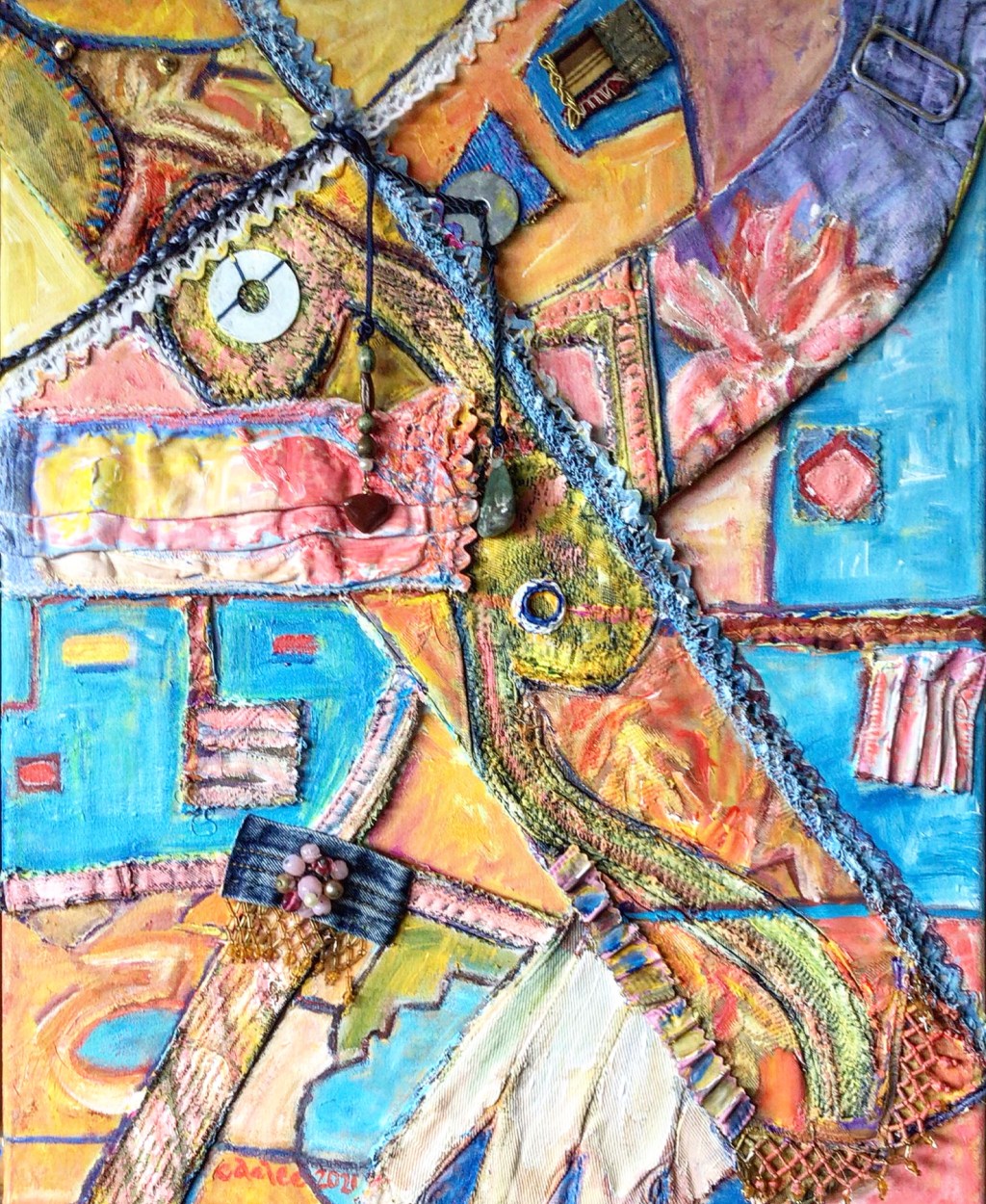
Today I blog about another painting based on a Google map of my adopted city, so it’s another “cognitive map.” I used scraps of an old preaching stole. I made the stole from odd pieces of fabric, plus an old pair of overalls, and a garden glove. I deconstructed the stole, since I’m no longer preaching in my retirement years, and added a few worn out face masks, in which I sewed small pleats. I took some of my grandmother’s old crochet and rickrack trim to mark some of the roads, but let the three dimensional shapes mark the other directional lines. My mother made Belgian lace collars for my young daughter’s dresses, so I’d used these for masks.

Layout on Raw Canvas of Primary Fabric Elements

I too wore these masks until I was tired of them. I was hopeful when those who know more than I do believed the virus had subsided and we were safe to shed our face coverings. One day in early July at Kroger I had an hour long conversation with a young man who was also glad to be shed of the mask, just to see people’s smiles. We talked for a while and I learned he was just a few weeks past a suicide attempt. This pandemic has been hard on him. We talked some more, for I’ve been in the dark place before too.

Cognitive Map: Search for Healing

I don’t need a preaching stole anymore, for preaching isn’t what I do best in this season of my life. God sets people in my path who need an encouraging or healing word. The world, in its beauty or its sadness, inspires me to paint a new vision of the world as it could be, for I don’t think I’ve ever painted what was ever “real.”

People ask, “Why don’t you make a painting that looks like real life?”

I answer, “We have cameras today for this. In any event, how do we know this ordinary world we see today is what God intended? This could be the fallen world, and not the original world of colors and joy, which God originally created.”

Perhaps we need to rethink our cognitive maps or how we view our world. If we consider all persons to be made in the image of God, then caring for them becomes important also. We can’t separate the Spirit of God from the body in which it resides. We also have to recognize God works through extraordinary events as well as through ordinary events. If we are to reject the inspiration and special providence of God in the matter of scientific discovery, then we’re going to go back to living in caves for a long time.

Posted on Homes to Warm of Highly Transmissible Disease

I remember when my daddy came home from his medical office with a small vial and a special double pronged needle. The windows were open, so it wasn’t yet the heat of summer. He stood next to the light, as he always did in his office when he worked, and gave us children the smallpox vaccine.

“Let’s put a little light on the subject, shall we?” I laughed as I proffered my left arm. He washed it with a cotton swab and alcohol, in his usual calm way. I went first because I was the oldest. Also, I was a role model for my brothers, but I was used to this because of my birth order. I knew to trust my daddy and to show my brothers the way forward. A few tiny pin pricks later, a bandaid, and I was good to go. My brothers followed suit, and we were all told, “Hands off.” We were restricted from playing with our friends because of our parents’ fear we’d end up with a limp or in an iron lung. Polio was eradicated in the USA in 1979, but it still occurs in war torn and poverty areas worldwide.

Finally, while some will write off as heartless idiots the ones using the tired canard of freedom of choice (the ones who fail to protect our vulnerable children), I remind them we require measles, mumps and rubella vaccines to enter schools because medical professionals deem it important for the children’s health and welfare. Of course this same group throws back to us the name “liberal whackdoodles” in return. Maybe we’d all be better off if we thought less of our own egos and territory, and cared more about the welfare of our future generations.

We could then fulfill the promise of God in Isaiah 57:19—

“Peace, peace, to the far and the near, says the LORD;

and I will heal them.”

God is full of grace and love, given to offering gifts of healing to those who are both close to us—our neighbors—and those who are far from us—the strangers. If only we humans could love one another as God loves us all.

Changing the way we see our world, one map at a time, brings

Joy and Peace,

Cornelia

More Poetry By W. H. Auden: Funeral Blues

https://allpoetry.com/funeral-blues

Stop all the clocks, cut off the telephone,
Prevent the dog from barking with a juicy bone,
Silence the pianos and with muffled drum
Bring out the coffin, let the mourners come.

Let aeroplanes circle moaning overhead
Scribbling on the sky the message ‘He is Dead’.
Put crepe bows round the white necks of the public doves,
Let the traffic policemen wear black cotton gloves.

He was my North, my South, my East and West,
My working week and my Sunday rest,
My noon, my midnight, my talk, my song;
I thought that love would last forever: I was wrong.

The stars are not wanted now; put out every one,
Pack up the moon and dismantle the sun,
Pour away the ocean and sweep up the wood;
For nothing now can ever come to any good.

What Percentage of Arkansas is Vaccinated? | Arkansas Vaccine Tracker | USAFacts

https://usafacts.org/visualizations/covid-vaccine-tracker-states/state/arkansas

UPDATE: ADH announces additional COVID ICU beds after hospitals reached limited availability | KARK
https://www.kark.com/news/health/coronavirus/the-perfect-storm-rural-hospitals-facing-critical-situation-as-covid-icu-beds-fall-to-only-one-available-in-arkansas/

Legislators Who Voted for Act 1002 — Arkansas Citizens First Congress

http://www.citizensfirst.org/act-1002

Little Rock mayor reinstates city mask mandate in defiance of state law

https://www.arkansasonline.com/news/2021/aug/06/little-rock-mayor-reinstates-city-mask-mandate-in/

LINK TO COURT DOCUMENTS HERE:

Arkansas Judge Blocks Statewide Ban on Mask Mandates

https://lawandcrime.com/covid-19-pandemic/arkansas-judge-blocks-statewide-ban-on-mask-mandates-the-law-cannot-be-enforced-in-any-shape-fashion-or-form/

Jacobson v. Massachusetts :: 197 U.S. 11 (1905) :: Justia US Supreme Court Center

https://supreme.justia.com/cases/federal/us/197/11/

Are Vaccine Mandates Constitutional? | The National Constitution Center

https://constitutioncenter.org/interactive-constitution/podcast/are-vaccine-mandates-constitutional

Covid Cases Among Children Jumped 84% Last Week—Here Are The States Where Kid Hospitalizations Are Increasing

https://www.forbes.com/sites/jemimamcevoy/2021/08/04/covid-cases-among-children-jumped-84-last-week-here-are-the-states-where-hospitalizations-are-increasing/

Marion School District 2021 Review

https://www.publicschoolreview.com/arkansas/marion-school-district/509390-school-district


Memories and Forgiveness

arkansas, art, brain plasticity, butterflies, Carl Jung, change, cognitive decline, Creativity, Faith, Family, Fear, Forgiveness, garden, Healing, Holy Spirit, hope, Imagination, Love, Ministry, Painting, Philosophy, Reflection, renewal, salvation, shame, Spirituality, trees, vision

Does God, who knows all things, also have a memory, or can God choose to forget?

I often wonder about such ideas, for when we ordinary folk experience horrific traumas, we often say, “This is going to be with me for the rest of my life. I’ll never get over it.” In some cases this may be true, especially if the person doesn’t seek long term counseling and faith support to deal with the soul damaging harm. With assistance, one can heal from the pain, even while remembering the injury, just as a broken bone can be mended over time.

Those who’ve been wounded and healed can go on to help others heal from their pain and brokenness. The memories of the wound remain, just like a scar on the skin, but they don’t interfere with living a positive and productive life. For those whom Henri Nouwen called “wounded healers,” and who find meaning in their suffering, their lives are a model for others to emulate, for their memories don’t destroy them.

If we look at the nature of God—the one who is, the one who will be, and the one always becoming—we can understand better the discussion between Jesus and the Temple authorities in John 8:56-59–

“Your ancestor Abraham rejoiced that he would see my day; he saw it and was glad.”

Then the Jews said to him, “You are not yet fifty years old, and have you seen Abraham?”

Jesus said to them, “Very truly, I tell you, before Abraham was, I am.”

So they picked up stones to throw at him, but Jesus hid himself and went out of the temple.

Moses and the Burning Bush

Jesus made the claim to the I AM name and being of God, an act of blasphemy, which the devout Jews found outrageous, since it made him equal to God. Their memories of Moses meeting God in the burning bush are to this day a seminal recollection of their liberation story from their Egyptian captivity:

But Moses said to God, “If I come to the Israelites and say to them, ‘The God of your ancestors has sent me to you,’ and they ask me, ‘What is his name?’ what shall I say to them?”

God said to Moses, “I AM WHO I AM.” He said further, “Thus you shall say to the Israelites, ‘I AM has sent me to you.’ ” (Exodus 3:13-14)

Can one who always lives in the present have a memory of the past, or envision the future? I met a lady at Sam’s Club in the days before the July 4th weekend. She was standing in the center of the entrance while folks were pushing baskets quickly past on either side of her. I thought she looked like the choose cone at a NASCAR restart. Bewildered and worried, she was looking for someone who wasn’t to be found. I asked her if she needed help, and she was even uncertain about this request. I suggested we walk over to customer service. On the way, I discovered her name and that her people had walked off to shop without waiting for her. She didn’t know their names, but she did know hers.

I thought about my own daddy, who had Parkinson’s and Alzheimer’s diseases. He progressively lost the memory of our family members: first my younger brothers, then me, and finally my mother became “the lady who came to kiss him every afternoon at 4 o’clock.” However, he could remember every bit of his medical training, even when he slipped and fell. On entry to the ER, he began ordering the medical staff about as if he were in charge. They tried to shush him up, until they realized he was running the accustomed intake drill.

Map Landscape of Hot Springs

Memories are like this, for we keep some which we find necessary and yet lose some very important ones we’d really like to hold onto. We also keep painful memories longer than happy memories, perhaps as a survival instinct. We won’t touch that hot stove again! This doesn’t bode well for our overall optimism, however, if we end up seeing the world as a fraught and dangerous place. How we imprint the emotions on our memories is still debated, for we tend to assign positive or negative emotions to events of our past. Then these affect our future experiences. This is why some of us fear dogs, while others of us approach them with respect, allowing the animal to sniff us out and accept us before we interact with them. We can change our future reactions to old memories, but this is a work in process.

God never gets old, even though God is eternal. If God is always I AM, or I AM WHAT I AM or I WILL BE WHAT I WILL BE, then God is a very present god and as well as a God of the future. If the past is also the present for God, then perhaps the past may be also as the future. In fact, for all we humans know time, as we understand it, may have no meaning for God, and what we think of as past, present, and future, God may experience as the eternal NOW. This may be how we understand Hebrews 13:8— “Jesus Christ is the same yesterday and today and forever.”

Recently I’ve been finding old mementos, souvenirs of my youth. Some are faded newspaper clippings, others are letters from old boyfriends, and then there’s the strange and esoteric memorabilia that somehow survived over half a century in storage along the various stages of my journey. My people are genetically predisposed to collecting. Did I ever mention my grandmother’s ball of tinfoil she kept on the kitchen window sill next to the sweet potato plant she was growing in the old mason jar? I come by this habit through my maternal line.

As I’ve been going through these, I had no difficulty throwing away utility bills from the early 2000’s, but then I found the college freshman beanie from my childhood boyfriend. He lived thirteen houses down the street from me. We had a thing for each other all through junior high and high school. For some reason, he gifted it to me. That motive is lost to the fog of memory now. Perhaps as Isaiah 43:18 says:

“Do not remember the former things,
or consider the things of old.
I am about to do a new thing;
now it springs forth, do you not perceive it?”

Memories of a Landscape

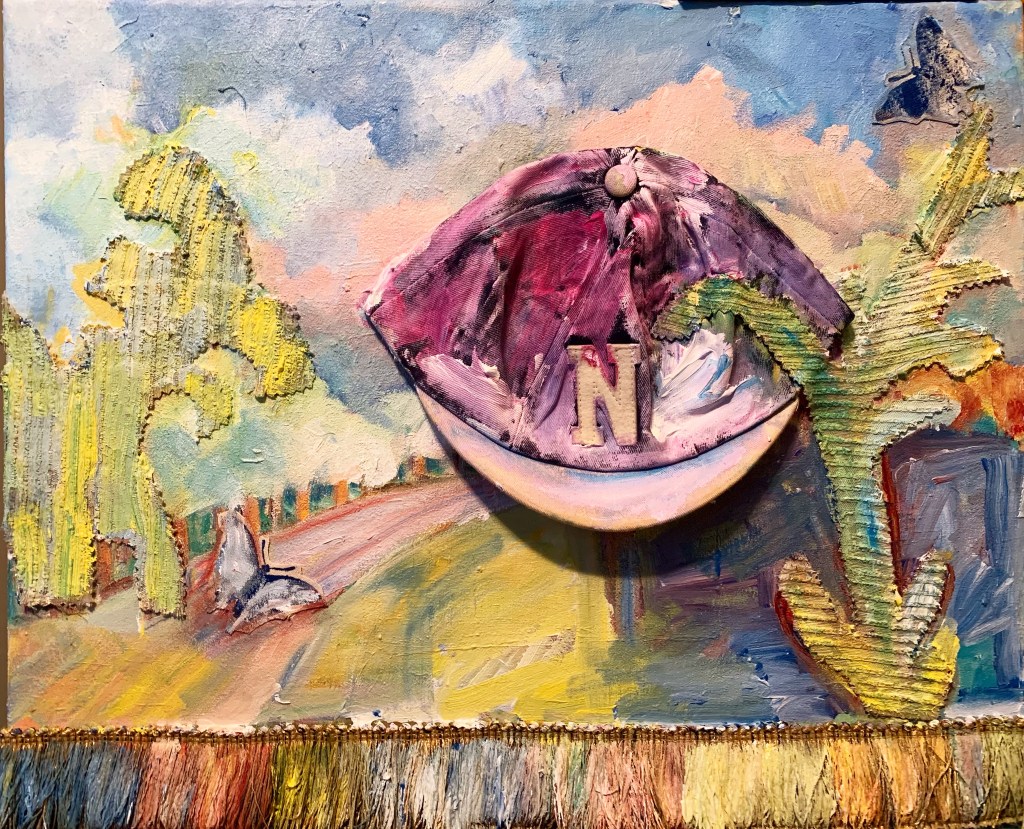
When I picked up this ancient cap of shame, for that’s exactly what it is, since it marks its wearer out as the low man on the totem pole, I marveled at how small the hat was. I don’t remember my beloved having a pinhead! In fact, I mooned and pined over his handsome and athletic form. Then again, I was young. As I held it in my hands, I felt the need to recreate something new from it. I had a landscape painting which had gone poorly because I was ill. I decided to paint over it, using the hat as the central tree structure, and adding some cut fabric trees to balance it. I also found some printed butterflies I cut out for embellishment. Once I glued those shapes on the canvas, I could repaint the canvas.

As I destroyed the old canvas and remade it into a new creation, the words from the prophet Isaiah (43:25) came to mind:

“I, I am He, who blots out your transgressions for my own sake, and I will not remember your sins.”

God is a forgiving god, but more importantly, God is a forgetting god. How many times do we say, “I’ll forgive, but I won’t forget?” We might as well say, “I’m not forgiving or forgetting, because I’m going to carry this wound or harm or slight FOREVER.” So much for our going onto perfection in love, or learning to love as God loves.

The cornerstone of all forgiveness is self-forgiveness. Too many of us believe the verse from John 3:16 only applies to the world, but not to themselves individually—

“For God so loved the world that he gave his only Son, so that everyone who believes in him may not perish but may have eternal life.”

If we can’t forgive the darkness within us, or the mistakes we’ve made, or allow God to forgive us, how are we to forgive others? In fact, if we tell God our sins are too great for God to forgive, we’ve set ourselves above God’s authority to forgive sins. This is pride, authority, and idolatry all wrapped into one. We’ve made ourselves into a god, rejecting God. The Pharisees of old rejected Jesus for this very reason.

Who was the most forgiving person in all of scripture? Jesus, of course, for he claimed authority to forgive sins just as God did, as when Jesus healed the paralytic whose friends let him down through the roof (Luke 5:20-24). Those who were nearby wondered at his boldness, but he asked, “What’s easier, forgiving sins or saying stand up and walk?” If we’re going to claim the name of Christ, we too are going to be forgiving people. Forgiving is an act that heals not only the other, but also ourselves. If we can’t forgive, we’ll never be able to forget, or transform our painful memory into one which God can use for the healing of others.

Map of Hot Springs: Airport

In a sense, we make a new map in our minds and hearts of our old landscapes of pain and sorrow. What once were places of despair can become fertile fields, if not gardens of delight. Our wounds become the tender points which open us up to the suffering of others, and allow us to minister to their needs. Our healing is part of God’s steadfast love. As Jeremiah reminds us:

“No longer shall they teach one another, or say to each other, “Know the LORD,” for they shall all know me, from the least of them to the greatest, says the LORD; for I will forgive their iniquity, and remember their sin no more.” (31:34)

When I think of the faithfulness of God, I also believe in the timelessness of God. When Jesus meets his disciples in Galilee to give them the Great Commission in Matthew 28:20, he says, “And remember, I am with you always, to the end of the age.” When this present age ends and God renews the heavens and the earth, how will we experience time in the new creation? Surely, if God is making all things new, we won’t be in this same world anymore and the rules it follows won’t be the same. We aren’t thinking boldly enough or big enough if we limit God to only recreating only the current fallen and broken world we have now.

Maybe if more of us began to think on the world a forgiving and loving God could create, we could begin to remake this present world into the new creation. If we were to make acts of love and forgiveness more prominent in our daily lives, we might restore our neighbor to fellowship and community. We can forgive even those who don’t seek it, for they’re the ones who’re most in need of forgiveness. With a forgiving and loving God’s help, we can do this.

Joy and Peace,

Cornelia

How memories form and fade: Strong memories are encoded by teams of neurons working together in synchrony – ScienceDaily
https://www.sciencedaily.com/releases/2019/08/190823140729.htm

Rabbit! Rabbit! Welcome to July!

art, cognitive decline, Creativity, Faith, holidays, Holy Spirit, Independence Day, john wesley, Love, Ministry, Painting, poverty, purpose, rabbits, Racism, Spirituality, trees, vision, Work

Here in this Common Era of 2021, we Americans are now 245 years into this project we call democracy, having declared our independence from the British crown on July 4, 1776. We didn’t effectively become an organized, constitutional nation until June 21, 1788, when nine out of the thirteen existing states ratified the United States Constitution, thus officially establishing the country’s independence and a new form of government. Based on the date of our constitution, which is still in place, the United States is the oldest continuous democracy in the world.

I realize some of y’all rabbits might disagree with my description of the USA as “organized,” but I may have a higher tolerance for disorder than some of you. Then again, I taught art in kindergarten, so that probably explains a lot. When we make a mess in art class, we always clean it up. That’s just part of the lesson plan. Art, as in life, isn’t always neat, but the end product is worthwhile. In art we learn from our failures as often as from our successes. This takes courage and resilience, two life skills any rabbit can use in this fast changing world.

Antique German Rabbit Candy Container with Uncle Sam Rider, c. 1910

The preamble of the Declaration boldly states:

“We hold these truths to be self-evident, that all men are created equal,
that they are endowed by their Creator with certain unalienable rights,
that among these are Life, Liberty and the Pursuit of happiness.”

In our modern era, this is the section of the Declaration of Independence which we rabbits so dearly cherish, for it suits our individualism to a T. The next statement which follows complicates life, as King George discovered in 1776:

“That to secure these rights, Governments are instituted among Men, deriving their just powers from the consent of the governed,
—That whenever any Form of Government becomes destructive of these ends, it is the Right of the People to alter or to abolish it,
and to institute new Government, laying its foundation
on such principles and organizing its powers in such form,
as to them shall seem most likely to effect their Safety and Happiness.”

Way back in the 18th century, the practice of slavery still allowed others to profit off the the lives of human beings as if they were livestock, women couldn’t vote or own property, and states often excluded from the voting rolls certain classes of men for religious reasons or lack of property. The American Revolution changed the landscape of voting rights to some degree. Once the constitution was enacted on September 17, 1787, it created a new, federal layer of government, in which there was absolute freedom of religion—and no religious test that might prevent a Jew from serving in Congress or even as president—without removing the religious tests that existed in many individual states.

Rabbit Power of the Vote recognized by Uncle Sam

The Freedom to Vote came by Stages

Most of the states wrote new state constitutions in the 1770s, and some softened or removed their existing religious tests, but some did not. The real work of abolishing religious tests for suffrage was done at the state level, largely in the half-century after the American Revolution. Not until 1870, when Congress passed the the 15th and last of the three of the so-called Reconstruction Amendments, which stated that voting rights could not be “denied or abridged by the United States or by any state on account of race, color, or previous condition of servitude,” did African Americans get the right to vote, if their local communities did not make it impossible due to Jim Crow laws.

John Lewis: Civil Rights Icon

Doctrine of Original Meaning

Today, voting rights are under attack once again, not against religious minorities, but against racial and economic minorities. It makes this old rabbit wonder why the “doctrine of original meaning” by the founders has any worth when our 21st century world of today is so drastically different from the 18th century times of yore. Also, if “original meaning” is seen only through the eyes of our white founders, how can we be a nation for all people “created equal(ly)… endowed by their Creator with certain unalienable rights, that among these are Life, Liberty and the Pursuit of happiness?”

Scholars agree the original framers actually were more intent on the Declaration’s first paragraph, for only the Declaration of Independence officially proclaims the new American nation’s assumption of a “separate and equal station “among the “powers of the earth:”

“The unanimous Declaration of the thirteen united States of America, When in the Course of human events, it becomes necessary
for one people to dissolve the political bands which have connected them with another, and to assume among the powers of the earth,
the separate and equal station to which the Laws of Nature
and of Nature’s God entitle them, a decent respect
to the opinions of mankind requires that they should declare
the causes which impel them to the separation.”

Medieval Manuscript: Rabbits Rebelling Against Humanity

As we rabbits know, if we plan to start a tussle, good manners suggest we tell why we’re fixing to throw the first punch. If there’s no honor among thieves, at least we rebellious rabbits have the good form to stand up in the pure light of day and list our grievances before we overthrow a bad king. Only the uncouth sucker punch the unwitting. The reason this American Democratic experiment has persisted for nearly two and a half centuries is the vast majority of us have freely chosen to change our leaders through the ballot box, rather than revolution.

Only the past unpleasantness of the Civil War in the 1860’s has marked this unbroken transfer of power by the vote, until the assault on the US Capitol and the Houses of Congress on January 6, 2021, by a motley crew of domestic terrorists, QAnon supporters, and admirers of the former President. Because they violently assaulted the police guarding the building and public servants inside, and interfered with the duties of duly elected government officials attempting to exercise their public duty to certify the electoral college vote, the Department of Justice has charged them and they’ll have their day in court. You can read all their names and cases at the link below. Maybe you’ll find a friend or neighbor there. As Mother rabbit always warned Peter Rabbit, “Don’t go into the garden; Farmer McGregor will get you!”

Farmer McGregor Chases Peter Rabbit

What exactly did the signers of the Declaration of Independence mean when when they wrote “all men are free and equal?” Abraham Lincoln said, “The men who signed the Declaration did not mean to say that men were “equal in all respects. They did not mean to say,” he said, that “all were equal in color, size, intellect, moral developments, or social capacity. They defined with tolerable distinctness, in what respects they did consider all men created equal.”‘ Men were equal in having “‘certain inalienable rights, among which are life, liberty and the pursuit of happiness.’ This they said, and this [they] meant.”

Lincoln Monument, Washington D. C.

This quote comes from Lincoln’s 1857 argument on the Dred Scott case before the Supreme Court, which decided against him, with Head Justice Roger Taney, who became best known for writing the final majority opinion in Dred Scott v. Sandford, which said “all people of African descent, free or enslaved, were not United States citizens” and therefore “had no right to sue in federal court.” In addition he wrote, “the Fifth Amendment protected slave owner rights because enslaved workers were their legal property.” Taney’s reputation was vilified for this decision during his lifetime, for it contributed to the growing divisions between the north and the south. The U. S. House of Representatives voted in 2021, to remove Taney’s statue and replace it with a statue in honor of the first African American Supreme Court justice, Thurgood Marshall.

Dred Scott Newspaper Announcement

The big holiday in July is Independence Day. While we rabbits lounge about the waterside or in our backyards, eating our favored picnic and cookout foods at the nation’s birthday party, not many of us will be thinking on a biblical text. Instead, we’ll be eyeing our paper plates and hoping they’re substantial enough to make it to the table before they collapse from the excess helpings of foods we’ve piled on them. A special bunny secret: you can go back for seconds, and laugh at everyone when you say, “I just want to make sure all you little piggies get your fill—oink, oink!” Don’t let them bother you, since you made sure everyone who came late would have something to eat by not taking it all at once.

In 2 Corinthians 3:17-18, Paul writes:
Now the Lord is the Spirit, and where the Spirit of the Lord is, there is freedom. And all of us, with unveiled faces,
seeing the glory of the Lord as though reflected in a mirror,
are being transformed into the same image
from one degree of glory to another;
for this comes from the Lord, the Spirit.

In Essentials, Unity; In Non-Essentials, Liberty; In All Things, Love

Have you ever wondered why some groups are so strictly homogeneous, while others are a kaleidoscope of differences? Some rabbits feel safer when everyone is more like them and differences are kept to a minimum. Other rabbits seem to thrive in the creative intermixing of unusual and unique personalities. I know when I entered the ministry, my parents’ friends were amazed I went into the faith I’d been birthed into, rather than some new age, air fluff religion. Oddly enough, I related more to the historic beliefs of Wesleyan Methodism better than my contemporary generation. In that sense, I had faith in a “different religion” than my friends. Yet we all saw ourselves as “being transformed into the same image from one degree of glory to another; for this comes from the Lord, the Spirit.”

This marked a freedom of thought, but it required an understanding we were all on the same journey and were progressing toward the same end. I admit I have the type of mind that wants the idea to lead to the behavior and then the consequences. In art class I called it Attitude, Behavior, and Consequences. If the first attitude was positive, the rest followed suit, but if a student had a bad attitude, they weren’t going to work, and then they had the negative outcomes of poor efforts, sad projects, and little improvement. While in life we’re saved by faith, in art we’re saved by works, for work will bring rewards.

It’s as Easy as ABC

One way for all good rabbits to be free is to have no regrets, or worries about what might have been. As my mother often said, “That’s water under the bridge.” The River of life has moved on and the choices we’ve made have gone downstream also. She believed in living in the now. The third Saturday in July recognizes Toss Away the “Could Haves” and “Should Haves” Day. In short, don’t go through life with regrets.

Created by author and motivational speaker Martha J. Ross-Rodgers, this day is intended for us rabbits to let go of our past and live for the present. The first step to participating in this day is to find a pen and paper. Then write down our “could haves” and “should haves” on the paper.

Finally, throw away the list and make the following resolution:
“From this day forward, I choose not to live in the past. The past is history that I can not change. I can do something about the present; therefore, I choose to live in the present.”

As I’m going through boxes in my storage unit, I’m coming across souvenirs from my high school and college years. Some of us are sentimentally attached to the memories imbued within these objects, but they’re merely memories, not the actual people. My parents and grandparents saved things, for they experienced hard times. I make new art every week, so if a painting doesn’t hold up to my critique after six months, it goes into a pile to get destroyed and remade.

DeLee: The Springtimes of My Life: Memories of Yesterday and Today

Now, take care of yourself and your health by living for now. Do your best and make the best of each and every day! Strike a power pose and smile when you do this. You’d be surprised how much energy flows through your body, I kid you not.

A final word for all rabbits who want to live in truth and freedom: we have only one God given life, so let’s live with joy and peace. We aren’t promised tomorrow, but only today. Now is the time to care for the broken, to right the wrongs of the world, and to make a difference, no matter how small.

Charles Derber, in Welcome to the Revolution: Universalizing Resistance for Social Justice and Democracy in Perilous Time, says: “Resistance can be symbolic, but at its core it must also be empowering and even shocking, in the sense of awakening the people to the evils of the system and the terrifying end-result if we allow business as usual to continue. Resistance is rage at injustice and at the insanity of institutions that kill and exploit for money and power. Melding that rage with love is the art of activism.”

Now that I walk more slowly in this world, this old rabbit has found I notice people whom everyone else hurries past, even if these folks are standing in the middle of a store entryway and are obviously lost. I stopped today at Sam’s to ask if this older woman needed help. Right away I realized she had trouble processing words, so she might have memory problems. I asked where her people were, but she didn’t know. We went over to customer service, since I knew they could use the announcement system to call for them to come get her. At least she knew her name. I was sad they had hurried off without her, especially in her condition, but I prayed with her before I left. The service staff got her a chair and made sure she was safely seated.

Lady Liberty

I hope as the holiday approaches, you don’t find yourselves so busy getting your celebration together that you overlook the ones in need who are right in front of you. Once we cared for one another in communities, but now we look after only ourselves. We wouldn’t have become a nation 245 years ago if every man had tried to take on the king’s men alone.

Be the spark that starts the fire of love and joy,

Cornie

10 Oldest Democracies in The World (Updated 2021) | Oldest.org
https://www.oldest.org/politics/democracies/

Could Jews Vote in Early America?
https://momentmag.com/could-jews-vote-in-early-america/

French Declaration of the Rights of Man—1789
http://www.columbia.edu/~iw6/docs/decright.html

Capitol Breach Cases | USAO-DC | Department of Justice
https://www.justice.gov/usao-dc/capitol-breach-cases

Pauline Maier, The Strange History of “All Men Are Created Equal”, 56 Wash. & Lee L. Rev. 873 (1999), https://scholarlycommons.law.wlu.edu/wlulr/vol56/iss3/8

https://scholarlycommons.law.wlu.edu/cgi/viewcontent.cgi?article=1547&context=wlulr

Maier quotes The Dred Scott Decision: Speech at Springfield, Illinois (June 26, 1857), in ABRAHAM Lincoln: His SPEECHES AND writings 352,360 (Roy P. Basler ed., 1946). 68. Id. at360-61.

Dred Scott Case – Decision, Definition & Impact – HISTORY
https://www.history.com/topics/black-history/dred-scott-case

Rabbit, Rabbit, Welcome to June!

arkansas, art, Astrology, change, Children, coronavirus, Faith, Family, Forgiveness, Healing, hope, Mental Illness, pandemic, photography, renewal, Stonehenge, summer solstice, Travel

Road Trip, anyone?

Can you believe we’re almost halfway through 2021? My how time flies when you’re having fun! And to think only a year or so ago, we thought our lives were going to be locked up behind closed doors forever and a day! Amazing how following good hand washing practices, not congregating in large groups, and wearing masks managed to stem the larger transmission of this deadly pandemic in most areas, until we could begin getting shots in people’s arms. Now that about half of Americans are vaccinated, the summer months are looking “like the good ole summertime” of memory.

Folks are going en masse on vacation and indulging their pent up travel bug by plane, car, and train, as well as bus and cruise ship. I live in a tourist town, so a goodly number of the 34 million people who kicked off the summer vacation season by traveling in a car are jamming our city streets. We’re thankful for them, however, for they spend money at the local hotels and restaurants, and that means the folks who work there can support their families. The City of Hot Springs has 38,468 people, while Garland County has 96,371. We have year round visitors, with more enjoying our hospitality in the spring and summer. Annually over 2.1 million people visit us to hold conventions, reunions, weddings, and vacations in our fair, historic town. Some days you can’t stir them with a stick. You’d think this was Times Square in New York City, or a rabbit farm.

But I digress. Those who visit us here in the Ozarks seem to be better mannered than those who travel elsewhere. Perhaps because they drive here, they refrain from alcohol until they arrive, unlike the airline passengers who’ve gained their fifteen minutes of infamy on social media and a lifetime ban from traveling on the friendly skies of the major airlines. No one will miss these bad actors on airplanes in these early days of recovering from the pandemic. Instead, we might want to recover some “good old summertime events and activities” in their place.

Vacation Bible School

One of my fondest memories from childhood was Vacation Bible School. I looked forward to it each year for the arts and crafts projects, the singing, and the snacks. I might have remembered the teachings, but I liked being with my friends from across town, who went to other schools. We could see more of each other during VBS. Children who attended my home church always created a traditional craft, the plaster hand cast. I made one in the 1950’s when I put my right hand into a pie plate full of quickset plaster. After it dried, I was allowed to pick one color to paint it. In the 1980’s, my daughter made the same craft, but she could paint it any way she wanted; she always fancied rainbows.

The Helping Hand

Rainbows and Joy

If I learned anything in Bible School, it’s we’re called to give our hands to God’s service for good for all, especially for the weak and defenseless. Also, no hand is too small to serve God. The good news is even if VBS isn’t able to be held inside at one place with the usual songs, skits, and crafts, it could always be held in a park, in a parking lot, or by traveling from backyard to backyard in carpools, or “car pods” as we call them today.

Sidewalk Entrepreneurs

Another fond memory is the neighborhood lemonade or Kool-Aid stand. As I recall, this endeavor was never profitable, but it kept us out of trouble for at least an entire afternoon. If we kids managed to keep our noses clean that long, it was likely a world record. Our parents were glad for the peace and quiet, and the opportunity for adult conversation. We kids worked together to solve our own problems and overcome any obstacles to our sales project. Of course, my brothers usually retorted to my suggestions, “You’re not the boss of me!” To which I’d reply, “But I’m older and I know better!” We’d hash it out and find a middle way.

Sometime in the middle of summer I’d get a break from those ornery brothers and get to go to camp. At first it was YWCA Day Camp, then Church Camp at an old Works Project Administration lake, and on to tent camping with the Girl Scouts. While the water might taste like iron in places, if I were thirsty, I’d drink it gladly. Some places we built our own tables with tree limbs and ropes. I learned knot tying and cooperation out in the woods. I also learned how to cook an entire meal in the coals of a fire by wrapping it in tinfoil. As my daddy would say, “There’s more than one way to skin a cat.”

Father Rabbit

Speaking of Fathers, a major holiday for all rabbits is Father’s Day on June 20th. We all have a father who has guided us in the good paths of life, even if this person wasn’t our birth or adoptive father. Often it’s another outside the family unit, such as a teacher, a coach, a pastor or lay leader in our faith tradition. For those rabbits among us who had distressing experiences with their fathers, this is a fraught day, for our past memories can color current events and relationships. If we cannot change our past, we can change how the past affects our present and our future. This is part of the healing process by which we face the pains of the past and gain power over the memories so we can have a better future not only for ourselves, but also for the next generation. Otherwise, our pain can become an unwelcome generational inheritance.

D-Day Invasion of Europe, World War II, June 6 US troops of the 4th Infantry Division “Famous Fourth” land on ‘Utah Beach’ as Allied forces storm the Normandy beaches on D-Day.

Just as soldiers returning from wars have to put aside the mental and physical wounds of wartime with medical and psychological help, anyone who has suffered abuse at the hands of a father figure also needs healing. PTSD help available through the VA for everyone. They have apps available at the link below anyone can access, but nothing takes the place of a human professional. Your health care provider or clergy person can refer you.

Of course, for fathers, the meaning of “manhood” is always in question, as American historian Timothy Marr wrote in American Masculinities: A Historical Encyclopedia (Sage Reference Publication 1st edition) that in the holiday’s early decades, men ‘scoffed at the holiday’s sentimental attempts to domesticate manliness with flowers and gift giving, or they derided the proliferation of such holidays as a commercial gimmick to sell more products — often paid for by the father himself.'” We usually gave Dad a necktie, or handkerchiefs. These are gifts going the way of the dodo bird, so my guess today’s equivalent is sports equipment or tech wearables.

National Iced Tea Day

The 1904 World’s Fair

We have the hot summer of the 1904 St. Louis World’s Fair to thanks for the popularity of iced tea. In fact, if you believe the tales, more new American foods were invented at the 1904 World’s Fair in St. Louis, Missouri, than during any other single event in history. The list includes the hamburger, the hot dog, peanut butter, iced tea, the club sandwich, cotton candy, and the ice cream cone, to name just a few.

Art Nouveau Gilt Glasses from Austria, mouth blown, 1910

By the First World War, Americans were buying tall glasses, which became commonly known as iced-tea glasses, long spoons suitable for stirring sugar into taller glasses and lemon forks. Prohibition, which ran from 1920 to 1933, helped boost the popularity of iced tea as Americans looked at alternatives to drinking beer, wine and hard liquor, which were made illegal during this period.
Cold tea first appeared in the early nineteenth century when cold green tea punches spiked with booze gained in popularity. Recipes for “punches” began appearing in English and American cookbooks, and called for green tea, rather than the black tea consumed by most Americans today.  

Early Iced Tea Recipe

In 2003, Georgia State Representative John Noel introduced a House Bill proposing that all Georgia restaurants that serve tea be required to serve sweet tea. It was done apparently as an April Fool’s Day joke. Noel is said to have acknowledged that the bill was an attempt to bring humor to the Legislature, but wouldn’t mind if it became law. This is certainly better legislation than some of the recent laws Georgia and other southern states have passed recently to combat the imaginary boogeyman of a stolen election and voter fraud, although there were zero instances of voter fraud in Georgia in 2020, and only 20 total instances in the conservative Heritage Center Voter Fraud Data Base. The ancient, well worn wisdom is “Don’t fix what ain’t broke.”

Summer Solstice

Stonehenge under Snow, 1947, Bill Brandt. Credit: the Museum of Modern Art – MoMa, New York.

We meet the middle of our astrological year on the summer solstice, which will occur on June 20, at 10:32 pm CDT in the USA. The most famous solstice site is certainly Stonehenge, in England. The stone settings at Stonehenge were built at a time of “great change in prehistory,” says English Heritage, “just as new styles of ‘Beaker’ pottery and the knowledge of metalworking, together with a transition to the burial of individuals with grave goods, were arriving from Europe. From about 2400 BC, well furnished Beaker graves such as that of the Amesbury Arche are found nearby”.

The Cyclone, Coney Island: Roller Coaster Thrills, Nat Norman, 1962

Perhaps in American society we’re at a turning point, just as the days are approaching the summer solstice. It’s as if we’ve been on a roller coaster carnival ride on the ups and downs, and now we’ve chugged our way up to the very heights. We’re ready to throw our hands up over our heads and scream all the way home and get off the ride ready to go again. We can’t forget the rest of the world beyond our shores, for if we don’t defeat the virus abroad, it will come back to carry us on the roller coaster ride again. Besides, the generosity of the American spirit calls us to heal the nations of the world, for the good of all.

Sons who are Fathers and Grandfathers now.

The summer solstice is the longest day of the year of the year, so all good bunnies should remember to reapply sunscreen every few hours if you’re playing in pools or running through sprinklers or enjoying the waves on a sandy beach. A hat is also good. Don’t forget to drink lots of water, for the warm breezes can dry you out, the activity can tire you out, and then you get cranky in the afternoon. Take a nap in the afternoon, or just rest inside in a cool place and read a book. Don’t wait till August to do your whole summer reading program. You’ll thank your old teacher rabbit for this suggestion, as the days begin to dwindle down again and routines require relearning.

Summer Solstice

I’m in the middle of a condo renovation, so I’ve got very busy rabbits coming and going, with hammering and banging noises all day long. We’re down to the bathroom now, so sometimes I have water and sometimes I don’t, but at least I live near others who can open their homes to me. We’ve all been isolated for the past year, so some of us may take time to lower the walls and learn to once again to trust one another. Not everyone should get the welcome mat, especially unvaccinated persons. Yet hope is on the horizon, for two of the main vaccines have sought full approval from the FDA, and children 12 and above can get the vaccine now.

De Gray Lake Resort: a sunset so magnificent I had to stop and photograph it.

As we rabbits always say,
“Sing praises to the LORD, O you his faithful ones,
and give thanks to his holy name.
For his anger is but for a moment;
his favor is for a lifetime.
Weeping may linger for the night,
but joy comes with the morning.”

~~ Psalms 30:4-5

May your sunrises and sunsets always be glorious,

Joy and Peace,
Cornelia

PTSD help available through the VA for everyone: apps for mindfulness and information at this site, plus links to Veterans Administration
https://maibergerinstitute.com/june-is-national-ptsd-awareness-month/

Face Masks for Children
https://www.healthychildren.org/English/health-issues/conditions/COVID-19/Pages/Cloth-Face-Coverings-for-Children-During-COVID-19.aspx

The 1904 World’s Fair: A Turning Point for American Food
https://www.seriouseats.com/food-history-1904-worlds-fair-st-louis

American Masculinities: A Historical Encyclopedia (Sage Reference Publication): Carroll, Bret: 9780761925408: Amazon.com: Books
https://www.amazon.com/American-Masculinities-Historical-Encyclopedia-Publication/dp/0761925406

Celebrating Iced Tea Day
https://www.nationalicedteaday.com/celebrating-iced-tea-day.html#.YLbJ5y08L4A

Heritage Center Voter Fraud Data Base
https://www.heritage.org/voterfraud/search?state=GA&combine=&year=&case_type=All&fraud_type=All&page=0

History Extra: Stonehenge
https://www.historyextra.com/period/stone-age/10-facts-about-stonehenge/

Point of View

adult learning, arkansas, art, Attitudes, Creativity, Easter, Faith, Good Friday, Healing, holidays, hope, Imagination, Love, Ministry, ministry, Painting, renewal, Right Brain, Spirituality, vision

Christ Reigns

It’s a matter of perspective.

The point of view determines the perspective of a work of art. One’s point of view, or preconceived bias, can determine how one sees the world and the decisions they make about the information that comes to them. If we think the world is a scary place, resources are few and won’t be enough for everyone, then, we’ll operate from fear and hoarding. If we believe God’s promises are faithful and God will indeed provide for our needs, then we’ll live in trust and hope, even as we order our lives to want less and enjoy simpler pleasures.

I always find it strange how the people in the Bible who have the greatest riches also have the most difficulty following Jesus. Matthew in 16:24-26 speaks to this topic in the section on “The Cross and Self-Denial:”

Then Jesus told his disciples, “If any want to become my followers, let them deny themselves and take up their cross and follow me. For those who want to save their life will lose it, and those who lose their life for my sake will find it. For what will it profit them if they gain the whole world but forfeit their life? Or what will they give in return for their life?

“Here is your Son“

Of course, even in the 1st century AD, people wanted to have material possessions, a good income, and wealth stored up for the future. When Jesus said, “whoever does not take up the cross and follow me is not worthy of me,” (Matthew 10:38), he invited his followers to enter a despicable journey.

The Via Dolorosa isn’t named the Way of Grief for nothing. People walked it, bearing a heavy cross beam, on the way to an undignified death, a punishment reserved for criminals.

Crucified On Crosses

Yet Jesus transformed this ancient punishment into a means of redemption. He took a symbol of death and made it into a hope for new life. Because of this , the author of Hebrews 12:2 could write, “Looking to Jesus the pioneer and perfecter of our faith, who for the sake of the joy that was set before him endured the cross, disregarding its shame, and has taken his seat at the right hand of the throne of God.”

Cross Icon by Gail

Now we can live the Easter promise written in Ephesians 2:12-18:

“Remember that you were at that time without Christ, being aliens from the commonwealth of Israel, and strangers to the covenants of promise, having no hope and without God in the world. But now in Christ Jesus you who once were far off have been brought near by the blood of Christ. For he is our peace; in his flesh he has made both groups into one and has broken down the dividing wall, that is, the hostility between us. He has abolished the law with its commandments and ordinances, that he might create in himself one new humanity in place of the two, thus making peace, and might reconcile both groups to God in one body through the cross, thus putting to death that hostility through it. So he came and proclaimed peace to you who were far off and peace to those who were near; for through him both of us have access in one Spirit to the Father.”

Multimedia icon by Lorilee

So we who live on this side of the resurrection have a joy to celebrate every day. For us the cross is a sign of victory over sin and death, and the evidence of new life and love God has for God’s world and God’s peoples. As we read in Colossians 1:19-20—

“For in him all the fullness of God was pleased to dwell, and through him God was pleased to reconcile to himself all things, whether on earth or in heaven, by making peace through the blood of his cross.”

Work in progress by Mike: Stained Glass Design

Charlie Brown Clay Stars

adult learning, arkansas, art, Astrology, CharlieBrown, coronavirus, cosmology, Creativity, Faith, Family, grief, Healing, holidays, Imagination, Israel, Ministry, ministry, nature, pandemic, Spirituality

“Close Encounters of the Third Kind” might best describe my and Gail’s latest adventure at the Oaklawn art class. Pinterest Fail is another synonym for our latest escapade. If my daddy were to describe the result, he’d say, “Close, but no cigar.” That’s a quintessential American expression, which is little used elsewhere in the English-speaking world. The first recorded use of “close, but no cigar” in print was in Sayre and Twist’s publishing of the script of the 1935 film version of Annie Oakley: “Close, Colonel, but no cigar!” I’m very fond of these ancient phrases, which are daily passing from the common parlance, even as new words are invented. These were our first attempts at this craft, so our learning curve resembled the same disastrous, steep ascent of the daily Covid infection chart.

The 1977 movie title “Close Encounters “ was derived from a classification of close encounters with aliens as set forth by the American UFO researcher J. Allen Hynek. Close Encounters of the First Kind refer to the sighting of a UFO. Physical evidence of a UFO are classed as Close Encounters of the Second Kind. Actual contact with an alien is a Close Encounter of the Third Kind. Therefore, our air dried cornstarch, salt, and baking soda clay objects, which should have looked neat, crisp, and clean, instead came out more like visitors from another planet, whose embodied boundaries were disintegrating in an inhospitable atmosphere.

Yes, I blame the recipes, which said “warm water,” rather than naming an actual temperature. Just as science projects and recipes for bread need accurate measurements and temperatures for success, so does cornstarch clay. Gail mentioned her clay began to heat up under her hands as she worked it. Mine never did, but I had to add rock salt to my mix because I ran out of table salt. Don’t do this! The salt crystals won’t melt and I had chunks in my finished pieces. The proportions of the recipe I used are equal amounts of each ingredient, so if you have just a limited amount of one, measure it and give the others to the main bowl in the same amount.

Bowl with Ingredients

Once the dough looks like mashed potatoes, don’t eat it. Instead, turn it out on parchment or waxed paper and knead it a bit. Then use a rolling pin to get the dough about ¼ inch thick. Use cookie cutters to get your shapes. Put them on a clean, flat surface, such as the back of a sheet pan. Take a plastic straw to put a hole in the upper part of the cutout. This works best if the shape is a touch dry, since the damp dough will close up. The hole is for the string hanger. The rolling pin might need flouring with corn starch if it sticks to the clay.

I also took some leaves and twigs from the bushes on the church property to use as embossing. I put these down on the cutouts, gave them a rolling pin once over or twice, maybe three, and made sure not to over flatten the shape. You could also use a decorative rolling pin as the last roll to make an all over pattern if you like that idea. A patterned doily or a scrap of lace would make a good pattern also.

Natural Decorations

When class was over, we cleaned our mess up with hot water and paper towels. I let the water run in the sink to make sure any small remains were washed far down the pipes. All the big scraps should be thrown in the trash. When I got home, I wasn’t in the mood to let these air dry for days and days. They already looked like they belonged on Charlie Brown’s Christmas tree, so I put them in the oven at 200F.

Water boils at 212F, so at 200F these shapes would be slowly drying out. I baked them on a cookie sheet for 30 minutes on each side. I did notice a bit of toasting in places, but I planned on painting these, so I don’t think it matters. I did lose the points off a few stars, but in this year of the Pandemic, perhaps some of us may be able to identify with the brokenness and vulnerability of these imperfect objects. We may want everything and everyone to be perfectly normal, but standard operating procedure isn’t on the menu for this year’s Thanksgiving or Christmas. We’re all suffering in one way or another, just like these ornaments.

Broken Stars

I didn’t preheat the oven, for the clay objects don’t need to be shocked into a different temperature. We don’t preheat a kiln before we fire clay pottery, but raise the whole to the same temperature at one time. Of course, if you’re making a recipe with flour, yeast, or eggs, and you need your concoction to rise, you do need a preheated oven. Otherwise, just put the food into a cold oven and let your nose tell you when it’s done. Preheating is a waste of energy if you don’t need it for the recipe. These clay pieces will be hot when you remove them from the oven. Let them cool until you can pick them up without dropping them like a hot potato (a metaphor from the 1800’s).

Painted Star and Bells

I did take a sharp paring knife to the edges to smooth them out. Yes, I didn’t like the raggedy look. You can’t do this cleanup roughly or with big whacks. This is the fine tuning of your shape. I used to help a porcelain doll maker back in my home town. I would sand the final shape of the doll baby’s faces, hands, and feet for her to paint. She appreciated my work because I would keep the anatomical details correct and give the little faces individual personalities. Portraits in porcelain aren’t that easy, but I wouldn’t rush to finish. If we’re always on to the next task, we might miss the opportunity to meet God in the work we’re doing in the moment.

Right now in this current crisis, most of us are limiting our time out and about. If we go to the grocery store, we find our goods and get out. I do the self check out or scan and go wherever I am so I don’t have to stand in lines. I do miss the interaction and chats I used to have with folks. I decided recently even if I were masked, I would begin to speak to others. So far on each outing, at least one person has shared their feelings of grief or loss, which are a result of this pandemic. Because we are forced to limit our contacts, we’ve also lost our opportunities to share our daily joys and our challenges. If we don’t use our words, we’ll lose them. We need time to share our lives and be a community for one another, since we’re all in this together. These are God moments in which we can be a blessing to others, as well as to receive a blessing from them.

This loss of conversation will be even grimmer if our loved ones pass on during this pandemic, for their memories will cease to be available to the younger generation, and their stories will no longer be shared. As these old ones age, and their frailties become like the imperfect points on my Charlie Brown stars, we realize we won’t have them much longer. Even more so, we’ve come to realize this pandemic spares neither the young nor the full of life, as more and more of our friends are struck by this disease. Any one of us could become a Charlie Brown Christmas star at any moment. I have family members who’ve had it, friends who’ve died from it, and my heart goes out to all who suffer with it, especially those who have lost their incomes because of it.

Those who now deal with the persisting side effects of this disease don’t get near the encouragement or assistance they need in their recovery, since the rest of us are too worn down from self care and from caring for those who’re newly ill. Even the health care workers, first responders, and essential workers who have to keep the rest of us safe, well fed, and secure are struggling under the long term stressors of this pandemic. We have a responsibility to care for them so they can keep going under duress. All these folks need a sign from us that they aren’t forgotten.

Christmas Tree Star

Unique stars have always been a herald or sign of unusual events to follow. The gospel of Matthew (2:1-2) records the visit of the magi, astrologers from the east, to King Herod:

In the time of King Herod, after Jesus was born in Bethlehem of Judea, wise men from the East came to Jerusalem, asking, “Where is the child who has been born king of the Jews? For we observed his star at its rising, and have come to pay him homage.”

These foreigners recognized the sea change about to happen in the world, for soon earthly kingdoms would recede in importance, and the powerful would lose their sway. If they could see this sign in the sky, we have to wonder why no one in Israel was considering what the star’s arrival signified. Perhaps the learned priests knew, but didn’t want to tell King Herod the bad news:

Thus says the LORD,
who gives the sun for light by day
and the fixed order of the moon and the stars for light by night,
who stirs up the sea so that its waves roar—
the LORD of hosts is his name:
If this fixed order were ever to cease
from my presence, says the LORD,
then also the offspring of Israel would cease
to be a nation before me forever.
(Jeremiah 31:35-36)

Of course, today most of us no longer believe the stars and planets affect our daily lives, nor are we “born under a bad sign,” as the blues players sing. Once we clean up the Thanksgiving meal, many of us will turn our thoughts to the holiday season. I’ll remove the last of the autumnal gourds and bring out a few winter seasonal objects every week until New Year’s. As the seasons change, we note the changes in our world. If the days are growing shorter and darker, we ourselves can still be lights in the world, as Paul wrote to the Philippians (2:14-15):

Do all things without murmuring and arguing, so that you may be blameless and innocent, children of God without blemish in the midst of a crooked. and perverse generation, in which you shine like stars in the world.

Multiple Layers of Gold and Silver Acrylic Paint on the Ornaments

Even if we’re Charlie Brown stars, our lights will be a beacon of hope for all the world to see.

Joy and Peace,
Cornelia

Air Dry Clay Recipe Using More Baking Soda (better recipe)
https://mamapapabubba.com/2016/02/16/homemade-air-dry-modelling-clay-aka-baking-soda-clay/

Reasons to Preheat the Oven
https://www.epicurious.com/expert-advice/do-i-really-need-to-preheat-the-oven-article

Rabbit! Rabbit! Welcome to October

All Saints Day, art, Children, coronavirus, Creativity, Faith, Family, Fear, grief, Halloween, Healing, holidays, Imagination, Israel, pandemic, rabbits

The Pandemic killed Halloween Then and Now

Nearly a century ago, no one had “Pandemic Shuts Down Halloween “ on their bingo card. The Great Influenza Pandemic griped the nation back in 1918, so most Halloween celebrations were cancelled due to quarantines. At least 195,000 people had died of this novel disease in America by October, 1918. The CDC estimates about 500 million people—or a third of the world’s population—had come down with this killer virus. By the1920’s, at the end of the Pandemic, at least 50 million people died, with 675,000 victims in the United States alone.

USA Red Cross volunteers in 1918 flu epidemic
APIC / Getty Images

At the time, we had no vaccines to protect against influenza and no antibiotics to treat secondary bacterial infections. Many doctors and nurses were serving in World War I, so the civilian medical professionals around the world tried to control infections with nonpharmaceutical interventions such as isolation, quarantine, good personal hygiene, masks, use of disinfectants and limitations of public gatherings. An interesting side note is all the flu pandemics which have happened since — 1957, 1968, 2009 — are derivatives of the 1918 flu, according to scientists at the National Institutes of Health.

The world back then was falling apart on two fronts from the first world war and disease. People at home were dropping like flies. Bodies were stacking up like cordwood and were placed in mass graves. Then, as now, we rabbits, like people, can only take so much stress before we need to release it. Many of us are pots with tight fitting lids: as soon as we reach the boiling point, our lid begins to rattle and clatter. If the cook doesn’t remove the lid and stir down the goo inside, we’ll be an over flowing volcanic mess, much like my morning oatmeal I’ve neglected when I’ve had too little coffee. Then Halloween, with its ghouls, goblins, witches, and other demons of the dark, arrives like Washington Irving’s ghost of the Headless Horseman, which we meet in The Legend of Sleepy Hollow, written in 1820.

The Headless Horseman Pursuing Ichabod Crane (1858) by John Quidor

Flu Pandemic Inspired Fiction

H. P. Lovecraft was one of the great horror writers, famous for his zombies, which may have been inspired by the grisly experiences of the influenza pandemic. Providence, Rhode Island, Lovecraft’s hometown, wasn’t spared the pandemic’s ghastly atmosphere.

As one local witness remembered, “all around me people were dying… [and] funeral directors worked with fear… . Many graves were fashioned by long trenches, bodies were placed side by side.” The pandemic, the witness laments, was “leaving in its wake countless dead, and the living stunned at their loss” (letter by Russell Booth; Collier Archives, Imperial War Museum, London).

White Zombie: First Zombie Movie, 1932

Lovecraft channeled this existential horror into his stories of the period, producing corpse-filled tales with infectious atmospheres from which sprang lurching, flesh-eating invaders who left bloody corpses in their wake.

In his 1922 story “Herbert West: Reanimator,” Lovecraft created a ghoulish doctor intent on reanimating newly dead corpses. A pandemic arrives that offers him fresh specimens. This echoes the flu scenes of mass graves, overworked doctors and piles of bodies. When the head doctor of the hospital dies in the outbreak, Dr. West reanimates him, producing a proto-zombie figure that escapes to wreak havoc on the town. The living dead doctor lurches from house to house, ravaging bodies and spreading destruction, a monstrous, visible version of what the flu virus had done worldwide. Lovecraft wrote about a zombie super-spreader even before we knew such a thing existed. Who says “life sometimes doesn’t imitate art?”

Thriller: Zombie Dancers backing up Michael Jackson, 1983

Infection, Prejudice and the Viral Zombies

In other episodes and stories, Lovecraft’s proto-zombies suggest an additional thread of prejudice that runs through the zombie tradition, one fueled by widespread fears of contagion during the pandemic. Even before the outbreak, Lovecraft believed that foreign hordes were infecting the Aryan race generally, weakening the bloodlines. These xenophobic anxieties weave their way into his stories, as contagion and pandemic-soaked atmospheres blend into racist fears of immigrants and nonwhite invaders. We hear these same themes repeated today in our pandemic times by white supremacists and far right groups who want a sovereign nation within the land of the free.

Indeed, many of Lovecraft’s stories are unwitting templates for how prejudicial fears may be problematically amplified at moments of crisis. Such fears are evoked and often critiqued in later depictions of viral zombie hordes, such as the infectious monsters of Romero’s 1968 movie, “Night of the Living Dead” and the film’s subtle commentary on race, as when the white police force mistakes the main African American character for a viral zombie. Amazing how systemic racism persists in making “walking while black equate to viral zombie” even today.

Small Rabbits Fear Large Monsters

Lovecraft’s proto-zombies also provided a strange compensation for some of the pandemic’s worst memories. Like the covid-19 virus of today and the flu of the last century, these monsters consumed the flesh of the living, spread blood and violence, and acted without cause or explanation. Lovecraft assures his readers that these monsters are far worse than anything they saw in World War I or in the pandemic, the twin defining tragedies of his era. Unlike the virus, though, these literary monsters could be seen, stopped, killed, and reburied. Every decade seems to need its own monster or zombie, and Lovecraft offered his readers a version that spoke deeply to the anxieties of his moment.

Modern Fears Birth Modern Monsters

Our modern monsters are more in tune with the unimaginable horrors of our present world. In the 1950’s we had nuclear terrors, so our monsters were Godzilla and the Creature From The Black Lagoon. In the 1990’s, cloning was a scientific advance we knew could go amiss, so we had dinosaurs run amuck in Jurassic Park. Aliens have always been the most foreign of foreigners, so whether it’s the Thing from Outer Space or Invasion of the Body Snatchers, we can scream into our popcorn all afternoon long. If we don’t scream, everyone will know we’re one of the “pod people.” Even before cinema took over entertainment, Orson Welles’s radio broadcast of the H.G. Wells novel War of the Worlds caused mass panic among listeners who believed Earth really had been invaded by Martians on October 30, 1938.

Image Invasion of the Body Snatchers, 1956

Dangers of Dualistic Thinking

Maybe this is why we rabbits need structured experiences which bring us up to the edge of fear, but in a safe environment. We need to learn to deal with our feelings and emotions as they threaten to overwhelm us. We need reassurance we can handle the frightening experience. We don’t need to be thrown off a cliff, but tested appropriately. If we don’t deal with our inner fears, we’ll see a ghoul in every dark shadow. This is why movies today have ratings for age groups.

When I was young, I was certain monsters lived under my bed and in my closet. I couldn’t sleep unless my closet door was shut. I was in art school before I could leave that door open. Something clicked in my mind, or I realized I was now at the age of responsibility. If this were so, I needed to give up this childish fear of invisible monsters. It was time for me to be the monster slayer in real life.

My daddy had a fear of monsters all his life—he called them communists. As a member of the now discredited John Birch Society, he claimed there was a “commie in every breadbox.” We’re no different today, for we rabbits seem to need our own monsters in the world beyond us. If we can’t deal with the brokenness or fears within us, we’ll project it outward onto an outside “other” group. Just as we too often put certain rabbits on a pedestal and are shocked when they fall, we also put some rabbits in a pit and wonder why they can’t get out of it. We tell ourselves “they don’t try hard enough” or “they aren’t worthy enough,” but neither of these statements are true. People are individuals, so we can’t make conclusions about them as a group.

Mischief Abounds All Night

By the 1920s, Halloween in America had become synonymous with mischief, which young people used as an excuse to break windows or damage property. Mischief comes from the Middle English word meschief, or “misfortune,” which itself derives from the Old French meschever, “to end up badly.” In the U.S., mischief has a legal definition: “Criminal mischief” includes true vandalism, such as the defacement or destruction of property, but also includes fully reversible pranks, like toilet-papering a house. In some states, it covers even vanishingly minor annoyances, like ding-dong-ditch, or ringing the doorbell and running off before the homeowner can answer the door. In 1923, the police chief commissioner in Omaha, Nebraska, went so far as to designate the “city’s worst boys” as junior police officers on October 31 and relied on them to report criminal behavior in an attempt to curb vandalism.

The first known printed reference to “trick-or-treat” appeared in the Alberta Canada Herald on Nov. 4, 1927, according to the Smithsonian.

Modern Mischief Makers

I met two of my young students dressed in black garbage bags as my daughter and I returned from trick or treating one Halloween night. Their too guilty grins as they said hello and hid their hands underneath their costumes was a dead giveaway they were the likely culprits for the artistically draped toilet paper on my giant live oak tree. I let them pass on by and got my car keys to go visit their home, which was just up the street. After a drink and a chat with the parents, we agreed the boys would clean up my tree. My parents also were visited with this “sign of endearment” more than they liked when I was young. I imagine it’s still going on today.

Image of Other Outstanding Mischievous Vandals and Toilet Paper Trees

Reflections on a Non Traditional Halloween

While we grownup rabbits think our little bunnies are going to miss Halloween traditions, the smallest ones don’t know what is tradition yet and the older ones can understand why this year will be different. Trick or treating began in the USA after WWII, as a way to discourage mischief, for if the kids get candy, they’ll be less likely to wreck havoc. As far as long term memories go, I’ve stretched mine, and can remember only one neighborhood walk about. I was slowed by my Carmine Miranda costume, while my brothers ran two houses ahead. I was delayed by holding my fruited headdress on my head.

Another Halloween we had a party at home with apple bobbing, snack making, and games. This was probably due to a fear of poison or pins in candy bars. This fear comes around every year, but it seems to be an urban legend. I also remember attending a school haunted house and walking through the dark and spooky cloakroom. There I touched all sorts of icky, gooey substances purporting to be “brains, eyeballs, and assorted body parts.” I do remember I did everything I could to not be banished to that same cloakroom for bad behavior the rest of year. No sense tempting fate, for sure, my eight year old mind reasoned.

If this holiday is for four year olds to twelve year olds, I can only remember one third of the years. In the short run it seems important, but in the long life of a person, only a few extraordinary moments will rise to peak memory. If this isn’t a year for house to house galavanting, or trunk to trunk acquisitions of treasure, then we’ll use our creativity to make it special, for that’s what we do.

Carmen Miranda Fruit Hat

This Is Not the Apocalypse

We rabbits live in a world of apocalyptic scenarios, yet we have safer, healthier, and longer lives than people in any other point in history. Still we constantly imagine our whole world could all fall apart in a heartbeat. We take our worries and translate a lot of our anxiety into fears about our children. If we listen to the new or hang out on social media, we might get caught up in “doom scrolling.” This is the internet version of rubbernecking at a gory traffic accident. Halloween began as the dark and terrifying compliment to the following bright and glorious All Saints Day celebration of November 1st, when the faithful remembered the saints, martyrs, and ordinary believers who have touched the lives of all the living.

The World of the Living and the Dead Meet

In both these festivals, the world of the living and the dead is permeable and fluid. These two days help us meet our fears about death, the uncertainty of our world, and our inability to control the seeming chaos of a world spinning out of control. We look to fallible individuals today for the change we seek, forgetting that we ourselves need to become the change we want to happen. Moreover, we forget the power of faith and the purpose of our combined faith communities called to work for a just and better world, which reflects the heavenly world to come.

The prophet Isaiah (65:17-18) speaks of God’s glorious new creation:

For I am about to create new heavens
and a new earth;
the former things shall not be remembered
or come to mind.
But be glad and rejoice forever
in what I am creating;
for I am about to create Jerusalem as a joy,
and its people as a delight.

The promises for the Hebrew people in exile belong also to us today, for we find ourselves living in “exile from the life we once knew.” If we live in the past, we’ll always live in exile from the present. Perhaps we should choose to live in hope for a better future and spend our time in this now making that promise come true.

Carve a Bunny Pumpkin for Halloween

Pumpkin Dance
https://www.youtube.com/watch?v=v4IC7qaNr7I&app=desktop

Herbert West: Reanimator
https://www.hplovecraft.com/writings/texts/fiction/hwr.aspx

Vintage Halloween – What Halloween Was Like the Year You Were Born
https://www.countryliving.com/entertaining/g460/vintage-halloween/

The Sinister History of Halloween Pranks
https://www.theatlantic.com/national/archive/2012/10/a-sinister-history-of-halloween-pranks/264127/

American College of Emergency Physicians// 1918 Influenza Pandemic: A United States Timeline
https://www.acep.org/how-we-serve/sections/disaster-medicine/news/april-2018/1918-influenza-pandemic-a-united-states-timeline/

The Myth of Poisoned Halloween Candy
https://www.vox.com/science-and-health/2018/10/31/18047794/halloween-candy-poisoned-needles-pins-razors

‘The 1918 flu is still with us’: The deadliest pandemic ever is still causing problems today
The pandemic ended in the early 1920s, but the virus left its mark for the next 100 years.
By Teddy Amenabar
https://www.washingtonpost.com/history/2020/09/01/1918-flu-pandemic-end/

Your Halloween zombie costume may have its roots in the 1918 flu that killed 20,000 Philadelphians
https://www.inquirer.com/health/zombies-1918-flu-pandemic-philadelphia-20191030.html

The American Influenza Epidemic of 1918: A Digital Encyclopedia – Browse newspaper clippings
https://quod.lib.umich.edu/f/flu/browse/titles/h.html

Open Air Police Court, San Francisco, California, 1918 Flu Pandemic
https://www.cdc.gov/flu/pandemic-resources/1918-commemoration/historical-images.htm

Truth in Art

9/1/11, adult learning, art, beauty, cosmology, Creativity, Faith, Forgiveness, grief, Healing, Meditation, ministry, Painting, Philosophy, renewal, shame, Spirituality, vision

What is Real? What is True? What has Meaning for our shared lives in community? Is there an Authority for any of these questions, or are we all on our own when we try to figure out how to make sense of our world? The ancient Greeks were onto these questions long before the fateful day when Pilate asked Jesus, “What is truth?”

Today we have a branch of philosophy which studies how we know things. It’s called epistemology. The word comes from the Greek words episteme and logos. Episteme can be translated as knowledge, understanding, or acquaintance, while logos is often translated as account, argument, or reason. Logos also means word, saying, speech, discourse, thought, proportion, ratio, and reckoning. In some strains of Greek thought, the Logos was the rational principle which governed and developed the universe. In early Christianity, the Christ was the Logos or Divine Word through which God created and ordered the universe.

Normally, in ordinary conversation, we don’t throw around these fifty cent words, but prefer instead the nickel and dime ones of our fast food conversations. “How was your day?” We answer, “Fine,” but don’t pull up the deeper words of our emotions to share with the ones we love the most. Eventually we come to a quiet acceptance of togetherness, but perhaps also an inherent loneliness also. The isolation of this Pandemic has cut us off from sharing with others, so now we may feel this inner pain more acutely.

I personally miss the brief give and takes between the random strangers whom I meet in the grocery store or at the coffee shop. Just the opportunity to compliment a stranger or to help an elderly shopper find a product makes me feel good. Likewise, if someone does the same for me, I also feel better about myself. Making connections gives us a sense of community and unity in this trying time.

Some folks actually dress up to grocery shop

If we put on a brave face, smile, and say, “I’m fine,” are we being Real, True, or merely hiding behind what society has determined is the appropriate response to this time and place in which we find ourselves? Artists find themselves in this position every single time they approach a blank canvas, a lump of clay or a block of stone. “Am I going to do what all the artists before me have also done, or will I look at this in a new light and make an entirely new expression?” When the first Cubist paintings went on exhibit in France in 1911 at the Salon of the Independents, the people who attended were outraged, for the artists had broken every rule of “good painting,” which the attendees could see first hand in the other exhibits.

Braque: Still Life with Banderillas
1911

Cubism broke the plane of the canvas into an overall fractured space, rather than an attempt to render a three dimensional subject on a flat surface. It presented multiple viewpoints of the objects at once, rather than a single view. Picasso and Braque challenged the accepted representation of art: does art have to represent the world as we see it? Do we instead carry the ability to disassemble reality and reassemble it in a way that’s not limited to the dimensions of the real world? These artists were groundbreaking because they actively deconstructed the real form to illustrate the chaotic and puzzling side of the real world. For cubists, artists aren’t just people who paint beautiful things, but people who give others the chance to think about the world they’re living in through artistic expression.

Traumatic events like September 11th and this Pandemic also “disassemble our reality” and may cause us to reject it outright, hide from it, deny its impact, or find a way to make sense of a fallen and broken world. We can either become wounded healers or we can become wounded people who keep on wounding others. Nothing can take away the losses we’ve suffered, but we can learn to make use of our grief to help others get to better places in their own lives.

Art often serves as therapy for traumatized persons, as does journaling. This is because both are physical means of expression and both require focused breathing. I find I can’t paint when I’m agitated, but if I do a little cleaning of my palette and preparing of my work area, I begin to calm down enough to concentrate. With writing, I like using old fashioned pen and ink on paper to let the good ideas flow, but I can also tap, tap on the iPad if I have a well conceived idea beforehand.

Spider lilies are popping out all over

If we let the thoughts inside of us come up to the surface, we can become aware of them and deal with them. Sometimes we don’t like these painful images that arise, for they remind us of old trauma and grief, which may depress or anger us. We need to look these feelings in the face for what they are: emotions only, but they aren’t the definition of our eternal Truth. These are mere moments in time, not forever moments, unless we choose them to be. As a person living with chronic depression, I had to learn how to think positively and stay appropriately medicated, as well as to do the healthy self care behaviors to enhance my ability for an optimistic outlook on life. We can be survivors, not victims. If I ruminated on my sad thoughts or anxious feelings, I wouldn’t be able to take positive steps forward. Learning how to refocus my thoughts took time and practice, but the effort was worth it.

Art pushes our boundaries outward, so we are more resilient when we meet struggles in the world. If we struggle and fail on a painting, we still learn from our work some lessons to apply on the next one. Art is a series of building up of failures until you get competency surrounded. One day your hand, eye, heart, and mind all click into one circuit. Suddenly your art looks like you seem to know what you’re doing. It has a voice unique to you and begins to speak to the world beyond. This is the moment when your inner spirit and emotions are at work, for you have enough technical ability to get the meaning across.

Gail’s painting broke the space up into design elements and patterns

How long does this take before your work takes on its own personality? We all have it from the beginning, for we each have our own unique insight into the world built up from our past experiences. The better question we ask is “when does our work look good?” At this point we’re asking, “Is it Beautiful, Technically Competent, Engaging, or Appealing?” Sometimes we’re asking, is it commercially viable, or will someone buy it? If the test of great art is someone will purchase it, Rembrandt’s later works and most of Van Gogh’s oeuvre don’t make the cut. Yet, history proves these are museum worthy paintings. This means we don’t need to concern ourselves with this question, but we shouldn’t quit our day job anytime soon.

Mike used multiple the viewpoints of Cubism in his painting

A recent study found if a family has an annual income of $100,000, a child is twice as likely to become an artist, actor, musician or author than a would-be creative with a family income of $50,000. Raise the annual income to $1 million and $100,000, respectively, and the stakes become even higher, with members of the first household nearly 10 times more likely to choose a creative profession than those from the second. Overall, for every additional $10,000 in total income, or pre-tax earnings of immediate family members, a person is two percent more likely to enter a creative field. This is why we see so few persons of color in the art world today, for historically their art was not only disparaged in early American history, but today people of color have lower median incomes than whites, partly due to systemic racism resulting from inequalities in education, but also lack of entry into home ownership due to redlining.

Art is like ministry: we don’t do it to get rich. We do it to live our best life. We do it because we have a need to express the deeper voice which we hear in the depths of our hearts and mind. It isn’t the call of the world, but the mysterious calling of the Divine Word, which we remember from John 1:1-5, was “The Word Became Flesh:”

In the beginning was the Word, and the Word was with God, and the Word was God. He was in the beginning with God. All things were made through him, and without him was not any thing made that was made. In him was life, and the life was the light of men. The light shines in the darkness, and the darkness has not overcome it.

Cornelia: least “cubist” influence, most emotional energy.

When we make art of any kind, we reassemble a new reality, for we proclaim we’re living in the power of the creating God. We know we aren’t a god, but we share God’s image and God’s work of creation. Because of this, we can rebuild the broken world, heal the broken people, and show love and compassion to all we meet. For many of us who grieve or judge ourselves harshly, maybe self compassion and self love is the first reconstruction of our world we should work on. If we aren’t painting or sculpting, we can bake pies or cookies, keep gardens, grow flowers or veggies, or do any other life giving endeavors.

Art gives us an safe space and an opportunity to build a new world. If it doesn’t hang together, we can always paint over it and try again. Or we can start afresh on a brand new canvas. How many of us wish we could wipe yesterday from our memories? Or come to tomorrow clean and new? We can have hope, as Jeremiah 29:11 reminds us:

For I know the plans I have for you, declares the LORD, plans for welfare and not for evil, to give you a future and a hope.

NOTES:

A New Study Shows Most Artists Make Very Little Money, With Women Faring the Worst
https://news.artnet.com/market/artists-make-less-10k-year-1162295

Wealth Is a Strong Predictor of Whether an Individual Pursues a Creative Profession | Smart News | Smithsonian Magazine
https://www.smithsonianmag.com/smart-news/wealth-strong-predictor-whether-individual-pursues-creative-profession-180972072/