Art for the Inner Child

adult learning, Apocalypse, art, Christmas, Creativity, Enneagram, Faith, Holy Spirit, hope, Imagination, inspiration, Light of the World, Ministry, Painting, perfection, purpose, salvation, Spirituality, vision

Discovery is exciting

What is the purpose of an art class? Why does anyone learn to speak a foreign language or take up a craft or sport they’ve never attempted before? We must want to explore some unknown universe or get out of our comfort zone, or as my old favorite television series would announce weekly, “to boldly go where no one has gone before.”

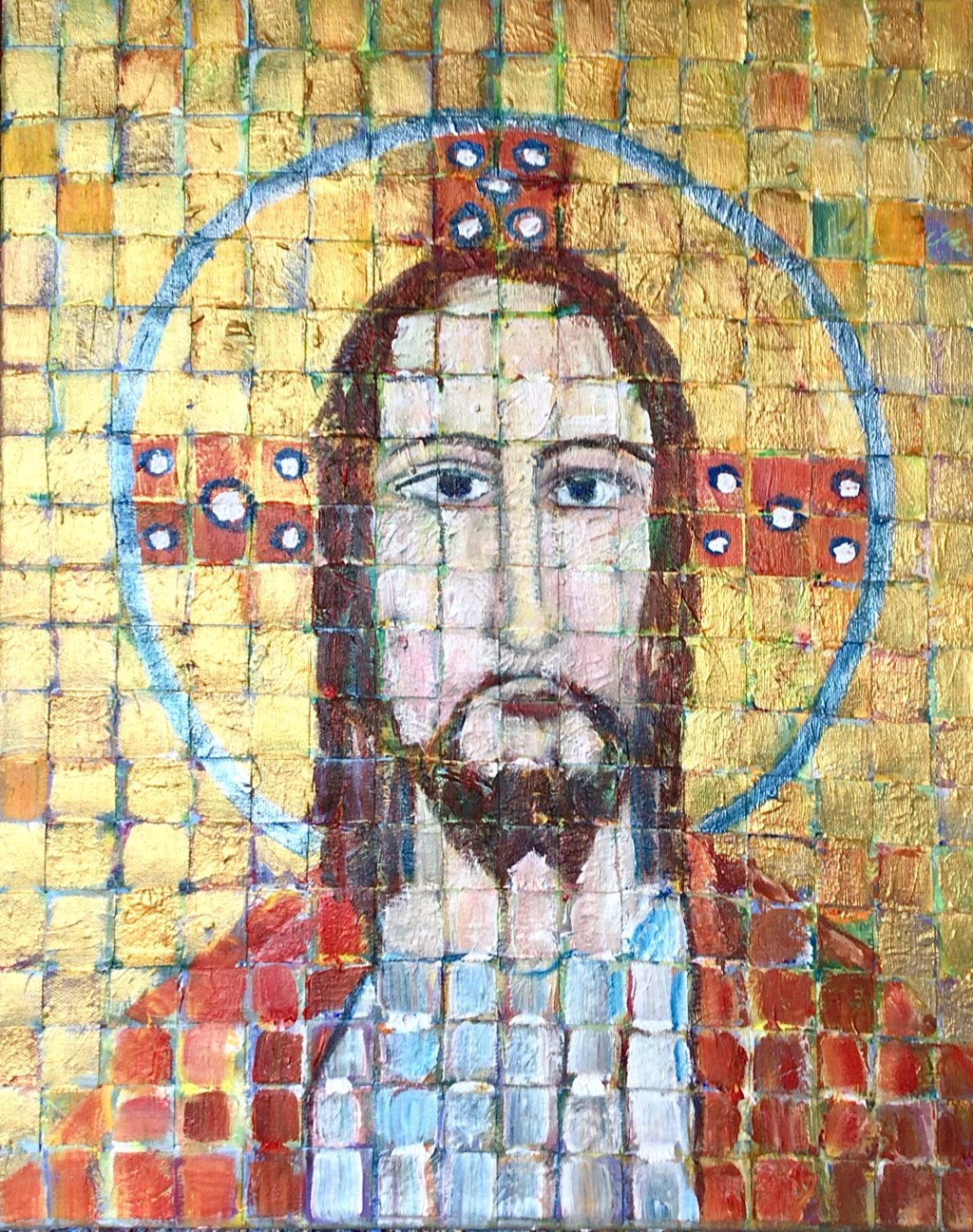
Light of the World Icon: Stencil effect

There are art classes and then there are Art Classes. Just as we shouldn’t make up our minds about a subject or a food until we experience it directly, we can have an open mind about a novel event, rather than rejecting it out of hand. Many of us have lived our lives under judgmental circumstances, dealing with rejection and disappointment at not being the best. “Talladega Nights: The Ballad of Ricky Bobby,” the NASCAR themed film of redemption and finding one’s purpose in life, stars Will Ferrell, whose father crippled him with this tragic life message:

“If you ain’t first, you’re last. You know, you know what I’m talking about?”

Near the end of the movie, Ricky Bobby learns this all was just crazy talk:

Ricky Bobby: Wait, Dad. Don’t you remember the time you told me “If you ain’t first, you’re last”?
Reese Bobby: Huh? What are you talking about, Son?
Ricky Bobby: That day at school.
Reese Bobby: Oh hell, Son, I was high that day. That doesn’t make any sense at all, you can be second, third, fourth… hell you can even be fifth.
Ricky Bobby: What? I’ve lived my whole life by that!

According to Baseball Reference, Ruth’s 183.1 career WAR — combining his value as a hitter and pitcher — is the highest all time, well ahead of Walter Johnson’s 164.8. For reference, the highest mark among active players is Albert Pujols’ 99.6 WAR.

We call this living out a “bad script” our ancestors have written for us. We see it all the time in the movies and on television. We read about it in novels and in comic books. For the most part, people don’t change their wicked ways, but get the consequences they’re due. The bad suffer and the good prosper. Or we read fairy tales in which the good little children get rewarded, or the unjustly treated ones are raised up, like Cinderella. These are the popular stories, but not the biblical tales. The book of Job calls this “retribution theology” into question, as does Jesus in the New Testament.

Annie French (1872 – 1965) Scottish: Cinderella and the Ugly Sisters, About 1900 – 1910, Pen and ink, watercolour and gold paint on vellum paper, 23.50 x 21.50 cm, Scottish National Gallery of Art.

In the Bible, God sends prophets, not only to call the people to account (critique their actions or behavior), but to offer the hope of a better future if they return to God and God’s ways (positive changes in behavior). In this way, a good art teacher is like a biblical prophet, who offers both positive and negative critique on the artwork. The teacher also offers “hope” or suggestions on how to improve the work. Teachers aren’t telling the person they don’t measure up, only that they need more time invested in making art to be able to bring their own artistic vision into reality.

Mike on Being the Light in the World

If we expected babies to chew steak from the moment of birth, the world would be a lonely place. If we expected these same babies to get up right away and “bring home the bacon” to buy their own steak and potatoes, they’d starve. Babies aren’t meant to walk before they crawl, nor or they chewing meat before they drink milk or pablum for a year or two.

Bacon Cake: Oh, Baby! I hope that’s REAL BACON!!

Someone who comes to art class should always come to learn something more, no matter how much they already know. I’m always learning new ideas and techniques. The act of making art is always an act of exploring new territories. We also grow by sharpening one another. Folks in the class are always excited to see how each other approaches the subject each week.

Mike’s May 2022 class work shows he’s been learning some things.

Only the apocalyptic writers in Scripture had a fixed view of the future. For them, God had given up on humanity. We humans were too far gone, too broken, and had destroyed God’s world beyond our weak means to repair it. Their only hope was for God to create “a new heaven and a new earth, for the first heaven and the first earth had passed away, and the sea was no more.” (Revelation 21:1)

Gail went the extra mile with Cri-Cut lettering

Of course, this isn’t a prediction of a certain time, but it’s a future hope for all times. It’s the hope all we creative people have every time we face a blank canvas, a pile of found objects, or a bag of scrap cloths. We also do this when we pull together a dinner before we go to the grocery store, and we take some of this and that which we have in our cupboards and refrigerators. We’re going to make something new! We do hope the Spirit of God descends to make this an inspired concoction! And if it doesn’t work out, we always know our salvation isn’t at stake over a single random supper creation. If I’m hungry enough, I’ll eat anything. Or there’s always peanut butter and jelly sandwiches.

Leftover Doughnuts and Sausage Bread Pudding Bunt Cakes

I was reading Richard Rohr’s Enneagram commentary on the American people. He says America is a nation of Threes: competitive, striving, always looking for success and improvement. When we hit a down cycle, and economics tells us we always have ups and downs in our economy, Americans act like we’ve been insulted. This doesn’t happen to us—to others maybe—but not to us! We’ll look both for a scapegoat and a savior, but never realize these conditions are a natural part of life.

Always be the best YOU. There’s never going to be another one just like YOU.

Likewise in groups, we’re always judging who got more, who has the most status, who’s preferred, and who’s on the out. We’re even liable to self-select to be on the outer group if we believe we won’t measure up, just to spare ourselves the shame of being found wanting. Joyce Rupp has a great poem about this very topic:

WE CAN LOVE THE IMPERFECT SELF
If I wait to be perfect
before I love myself
I will always be
unsatisfied
and ungrateful.

if I wait until
all the flaws, chips,
and cracks disappear
I will be the cup
that stands on the shelf
and is never used.

Magic Teacup Cake from Alice in Wonderland

If we’re faithful scripture readers, we know God never chooses the best persons to do God’s work. When we were children, we saw these characters as heroic figures, just as we saw our parents as great and invincible. The Old Testament records how Moses was a murderer, Joshua was afraid, Amos was a lowly shepherd, and David was an adulterer. Not exactly Perfect Role Models, but transformed people can do God’s mighty deeds if they let God work God’s purpose through their lives.

This word doesn’t mean what the headline writer thinks it does.

In Art Class, we don’t reject “poor work.” We aren’t a factory producing widgets. We have other goals: art appreciation, learning about colors, learning to see more clearly, developing a creative mind, and developing drawing skills. Art is a unique visual language, so learning how to render a three-dimensional form onto a two-dimensional surface takes some time and practice. Developing our own voice is the step beyond mastering the basics of artistic vocabulary. As I used to tell my parents at back-to-school night, just enjoy whatever your child brings to you! If you leave your “critical parent” at home, and bring your “inner child” to Art Class, life is way more fun!

Mike’s Christmas Card Collage

We’re currently on holiday sabbatical at Oaklawn UMC, but classes will return in the new year. We meet in the old Fellowship Hall at 10 am to noon. We always have coffee, and on occasional days, a tasty treat. Our class will begin working in watercolor beginning on January 5, 2024. I don’t charge for the class instruction, but each person should bring their own supplies. Supplies needed are:

Prang Oval 8 watercolor paint set with brush
  1. Prang Oval 8 watercolor paint set (containing brush)—on line at Walmart and Amazon. This has best color and pigments. I found a prime deal on Amazon for $3 each if you buy 3, free shipping.
  2. Watercolor paper pad 9” x 12” or larger (90 lb or heavier)
  3. Tall plastic container for water (iced tea glass size plus)
  4. Your inner child

Joy and peace,

Cornelia

MERRY CHRISTMAS, PEACE ON EARTH, GOOD WILL TO ALL

Talladega Nights: The Ballad of Ricky Bobby https://www.imdb.com/title/tt0415306/quotes/?item=qt0425224

Babe Ruth’s Top 10 career statistics— Shohei Ohtani produced 9.1 total WAR during his spectacular two-way campaign in 2021. Even he maintained that level of performance for 20 consecutive seasons, he would still be 1.1 WAR short of matching Ruth. https://www.mlb.com/news/babe-ruth-s-top-10-career-statistics-c163792958

Texture Paintings

adult learning, Aristotle, art, autumn leaves, beauty, brain plasticity, cognitive decline, Creativity, flowers, Holy Spirit, Imagination, Leonardo da Vinci, Painting, renewal, Uncategorized, vision

Leaf Textures

I don’t do wine painting classes. Since I teach in a United Methodist Church, our Wesleyan temperance tradition holds sway: we serve no alcohol. However, out in the world beyond there are classes where everyone drinks wine and paints the same image. They’re out for fellowship purposes more than for art, but these classes serve to get people started in the basic techniques of the media. Students copy the teacher’s model painting, often working along as the teacher instructs the class. This is the “show and tell” style of teaching, which usually results in most students’ works approximating the teacher’s example.

Wine painting classes: One Lion to Rule Them All

College art education classes often are taught this way, but art classes in art schools are never taught like this. Why you might ask? Because art schools exist to help students find their own voice, for they know copying another’s style only diminishes a student’s true voice. The creative spirit within each of us is unique,
breathed into us by a holy God. Ecclesiastes 12:7 reminds us at our end, “the breath (Spirit) returns to God who gave it.” If art students are copying any art works, their teachers are humble enough to send their students to the masters first, or to life itself.

Laguna College of Art and Design art class

Art, like golf, is a humbling experience. In both we’re always playing against our handicap: we want to be “Perfect,” but we weren’t given the means to accomplish this goal without God’s grace. We go on to perfection by degrees, with the help of God, if we don’t get lazy and take the shortcuts, as the Adam and Eve, Prodigal Son, and many other great stories tell. As Jesus reminds his followers in Matthew 23:11-12—

“The greatest among you will be your servant. All who exalt themselves will be humbled, and all who humble themselves will be exalted.”

Why is it difficult to draw from life? Or for that matter, to really look hard at a painting to copy it? From an early age, most of us are taught it’s impolite to stare. In some cultures, even looking directly into the eyes of another person as you speak is unacceptable behavior. I know my parents taught me to look at them when I was in trouble, even when I wanted to look down in shame. I had to face their anger. While I didn’t enjoy it as a child, it prepared me as a teen for hateful comments from my peers, and as an adult for discrimination in the workplace. I could look people in the eye and call them out. This is likely why our early teenage children roll and flutter their eyes at us when we call them to account. They “look at us” without “looking.” And why we say, “Look me in the eye!”

19th century humorous postcard: The Artist’s Studio

We also have thoughts running through our heads: our to do lists, our concerns about our friends and loved ones, as well as the woes of the world stage. The more we learn to focus on the present moment in which we find ourselves, the better off we are. I find when I can pay attention to my colors, patterns, and how they come together on the canvas, I forget everything else.

I have some artist friends who always have a glass of wine in the studio, since it helps them relax. I think they just like wine. I’m a coffee lover, but too much caffeine makes my hand jittery, and too much wine would make my hand sloppy. I personally believe in moderation in all things, but then I’m sold on Aristotle’s “golden mean,” or the “Goldilocks zone,” where

“at the right times, about the right things, towards the right people, for the right end, and in the right way, is the intermediate and best condition, and this is proper to virtue.”

We barely avoided the 15th government shutdown since 1981, but we now have a House majority without a Leader due to a few extremist members. These Republican Party members who are “pirates who take no prisoners and make no compromises” might want to catch up on their ancient philosophical reading before chaos ensues. Sometimes life imitates art: if you have MAX, you can watch Michael Cain in “Our Flag Means Death.”

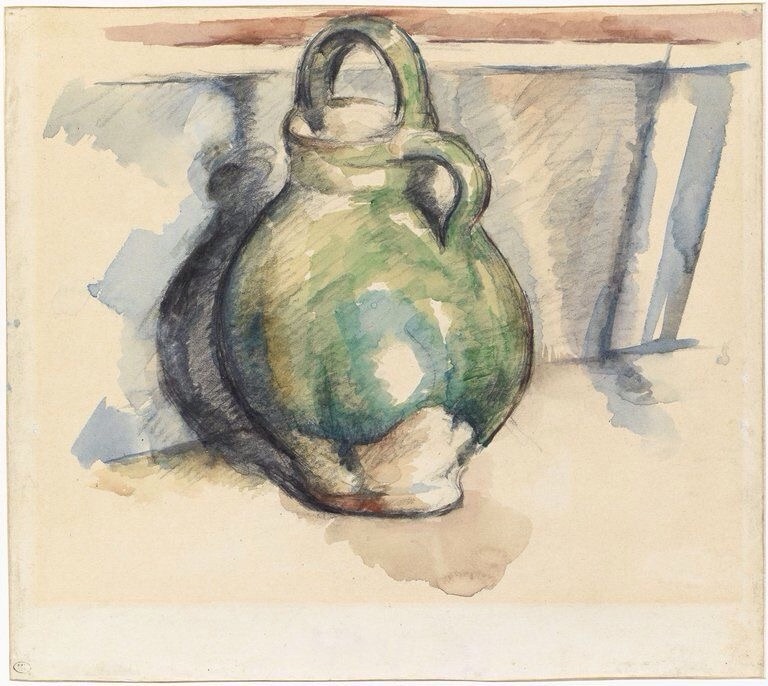
Little Vase of Flowers

All creativity improves with either time or wine. Both allow you to loosen up and not control what happens but go with the flow of what happens on the canvas, instead of forcing the paint to go where you want it to be. I have canvases which began in one direction and ended up in quite another. I can only say my original idea was rejected by the painting in progress, for I had to “listen to what the painting wanted to become.” As Psalms 104:30 says:

“When you send forth your spirit, they are created;
and you renew the face of the ground.”

In case you’re wondering, the “ground” of a canvas is the white primer, so it’s not a stretch to say, God’s Spirit works through us to renew the face of the “ground.” Some texts translate this as the “earth,” and God’s Spirit also works through us to restore and renew our planet to health after all the damage from industrial pollution and man made climate changes.

Leonardo da Vinci, the Renaissance genius, claimed, “There are three classes of people: Those who see. Those who see when they are shown. Those who do not see.” We can all learn to see. How we learn to see takes time and effort. This is why I always talk about some examples of good art before we begin our work. I know most people haven’t seen the masters, so getting images in mind is important. A little art history lesson never hurt anyone. Then I explain the project and we get to work. Stephen King, the noted author, says this about the creative experience: “Amateurs sit and wait for inspiration, the rest of us just get up and go to work.”

Tim’s Flower

In class we were using the flower arrangement which had been residing in the kitchen fridge for the past several weeks. I don’t know who to thank for it, but we put it back where we found it. Our group was given the key to use patterns and textures in the work.
Tim wants to learn to draw from life better, but he was struggling to get his proportions to scale. I showed him the trade skill of using a pencil or part of his hand to measure part of the object and compare its size to another part.

We give away our secret sauce recipe all the time! Everyone knows how to multiply with a ruler for a scale drawing, but that idea often doesn’t occur to them if they aren’t using it on a flat plane. If they have no real ruler, the idea of using an ordinary object as a measuring device also doesn’t enter our brains. This is normal, but once upon a time, we used our bodies to measure the work in progress: a cubit was the distance from the elbow to the middle fingertip and a hand-width was just that: the width of the four fingers. Over the years these were standardized to 18 inches and 4 inches. Horses are still measured in hands today, but we moderns measure in feet and meters rather than cubits.

Gail’s Texture Painting

Gail lined out some lovely patterns on her canvas and made good progress on her painting. She always gets a good plan and executes it.

Mike was glad to be back after doing renewal work/manual labor. This creative exercise of moving bold colors and strong patterns around his canvas was a welcome respite after all that physical activity. A mental challenge seemed welcome to him.

Mike’s Flowers

I had done a pattern piece in the week before, so I enjoyed painting the still life, and may use it as a study for something larger later.

Late 1800’s Levi Strauss advertisement

We finished up our works on the second session. Tim reworked the pumpkin drawing from an earlier time and Gail finished up her texture painting of the flowers. Mike dropped in with Van Gogh books before going out on an errand of mercy to rescue a young client. He was impressed with the amount of blue clothing the people wore in Van Gogh’s paintings. I reminded him the very denim jeans we wear first came from Nimes, France. We call these “jeans,” because the weavers in France were trying to imitate the techniques of Genoa, Italy, but failed, and made instead the sturdy fabric that’s blue outside and white inside. Hence, “jeane de Nimes.”

“I did not know that!” He exclaimed.

Art is for wondering, for seeing new things, for opening up our minds to new realities and new possibilities. Whenever we go beyond what we already know, we open a new brain pathway and create new connections between the neurons. This keeps our minds agile and staves off the worst aspect of aging: the pessimistic belief that nothing is new under the sun. If we keep the optimism of a child, for whom everything is the newest and best, we’ll keep a youthful heart and spread joy wherever we go.

Joy and Peace,

Cornelia

The ‘Golden Mean’: Aristotle’s Guide to Living Excellently —Philosophy Break
https://philosophybreak.com/articles/the-golden-mean-aristotle-guide-to-living-excellently/

Weights & Measures
https://www.jewishvirtuallibrary.org/weights-measures

History of Denim & the Origin of Jeans
https://www.hawthornintl.com/history-of-denim

OAKLAWN FRIDAY ART CLASS

adult learning, art, Creativity, Faith, Holy Spirit, Imagination, inspiration, Ministry, Painting, perfection, purpose, renewal, vision

WE’RE BACK!!!

Ready or not, the creative juices must be stirred. If the brain has lain fallow all summer, or it’s been overworked keeping the youngsters occupied, now you can find your own groove again.

Our first meeting will be Friday, September 8, at 10 am in the old fellowship hall. Bring your own acrylic paints, brushes, and a canvas or canvas panel to paint on. We begin with a short visual inspiration from some great art works, I give some direction on the skill we’ll work on in the session, and then everyone is free to bring their own unique expression to their paintings. We don’t copy my work and judge how well a person can match it. Instead, we learn from others and stretch our own skills to create something new.

Paul Klee: Houses

Making great art isn’t our first purpose. As we age, we will lose our ability to learn new skills until we lose our memory of what we just ate for breakfast. Challenging our brains is one of the best ways to keep our brain cells firing and “chatting with one another.” Socialization and encouragement also helps to keep our brains young.

Frank Lloyd Wright: Stained Glass Design

Making art means we also will have to give up our desire to be perfect. Artists quickly learn perfection comes from practice, or working at it. Every baby stumbles and falls as they learn to walk, but dotting adults encourage every trembling step. This is what art teachers also do. I’ve always had a rule in my classes, especially when I taught in middle school:

No Negative Talking about People or Art.

This includes a student’s own art works. They always had to give at least three positive comments about their work before they spoke about the negative. “My work needs improvement” is a better way to say “My work stinks!”

Of course, we’ve all grown up and worked in environments where negativity is the rule. Art class is a place of grace because this is how life should be. If we can transform a blank canvas into a field of color, why can’t we transform our communities and our world into fields of hope, joy, and love?

Blue Monochromatic Study of the City

Perhaps because we often try to make everyone copy/fit into our idea of the proper end product, rather than allow everyone discover their own creative response to the given subject of the day. Finding our own voice and our own expression is important. Even beginners will have their own unique voice and vision, if they only allow the creating spirit of God work through them. The museums of our world are richer and more vibrant because artists have listened to the Spirit of the Creating God. We might do well to realize God’s creative energies are varied and vibrant also, just as Isaiah wrote about his vision of God’s Glorious New Creation:

“For I am about to create new heavens and a new earth;

the former things shall not be remembered or come to mind.

But be glad and rejoice forever in what I am creating;

for I am about to create Jerusalem as a joy, and its people as a delight.” (65:17-18)

James Wyper: City of Dreams

I hope to see you in art class. I don’t charge for the class sessions, since this is one of my ministries as a retired elder in the United Methodist Church. As John Wesley once said, “The World is my Parish.”

Joy and Peace,

Pastor Cornelia

I See the Icon—The Icon Sees Me

art, beauty, Faith, Holy Spirit, Icons, Imagination, incarnation, inspiration, Love, Mandylion, mystery, Painting, Pantocrator, Plato, renewal, salvation, St. Athanasius, vision

The icons of Christ radiate a sense of calm, a spiritual experience created countless times by various artists over the ages. Each one channels the spiritual force which lies outside of language, mystery, and mysticism. Over the years, we’ve come to understand the icon serves as a window into the world beyond our own. In this world we think of dualities: good and evil, winning and losing, ours and theirs. In the world beyond ours, everything belongs to God, we are all one, and no one lacks for anything. The heavenly banquet table is a never ending feast for everyone and no one is reduced to begging for the crumbs that fall from it. No one hungers or thirsts in this land of the unclouded sky.

Jesus is the Bread of Life

The icon represents to us the world we yearn to be. In this respect, it’s a “wormhole” from the fully perfected world to this world, which is still going onto perfection. The New Heaven and the New Earth promised in Revelation 21:1-4 speaks to this very event:

Then I saw a new heaven and a new earth; for the first heaven and the first earth had passed away, and the sea was no more. And I saw the holy city, the new Jerusalem, coming down out of heaven from God, prepared as a bride adorned for her husband. And I heard a loud voice from the throne saying, “See, the home of God is among mortals. He will dwell with them; they will be his peoples, and God himself will be with them; he will wipe every tear from their eyes. Death will be no more; mourning and crying and pain will be no more, for the first things have passed away.”

The Good Shepherd

Until that time comes, we have the icons gazing upon us to remind us of this promise, as well as of our calling to be coworkers with God in bringing this world into fruition. If we see with spiritual eyes, we’ll be able to look beyond the paint and canvas, beyond the image and likeness, and beyond material truth to see the spiritual truth of the icon before us.

To understand the icon better,we ought to take a trip in the WayBack machine to Ancient Greece to visit Plato and study up on his philosophy. This is important because whether they know it or not, artists of every stripe and measure participate in this “not yet, but yearning for a better world” as they make their art. In the 4th C BCE, Plato believed the true reality was in the ideal forms which existed in a world outside of this one which we daily experience. Every form we see on earth is merely a copy of the ideal form, but not the “truth.” Plato’s truth existed in this realm of ideas, rather than in the senses. This is the opposite of how most modern people look for “truth,” especially scientific or observational evidence based truths.

Christ Enthroned

For Plato, the ideals of good and truth had to exist as a form in the eternal world so we could recognize them in our transitory world. All things, even virtue, justice, love, and beauty, must have an ideal form in this realm beyond our sensibilities. Where we get into trouble is believing this world’s representations of the ideal forms must follow the pattern exactly. The examples we consider beautiful can change over the centuries, but the idea of beauty as the highest ideal of loveliness never changes. This is why we don’t keep repeating Greek and Roman Classical themes for our public buildings in the modern era.

James 1:17 says of God: “Every generous act of giving, with every perfect gift, is from above, coming down from the Father of lights, with whom there is no variation or shadow due to change.”

The Golden Christ

When we say “God doesn’t change,” we mean God never quits loving us, always wants to save us, and always wants to work for good for those who love the Lord and are called according to God’s purposes. God does change God’s mind when we give up our wayward ways and return to godly ways. The Old Testament is full of times God had a change of heart. Maybe some of these events were the people having a heart change and coming back to God. God does seem absent when we turn away, while God seems near when we turn towards God.

Coptic Jewel Icon

But I digress, and I plead the hot weather. Plato’s perfect forms are the subject, especially the form of the Good. For Plato, only the soul or the mind can know the true forms, while the sensible body is suspect. Plato’s philosophy is a form of dualism, which elevates the spiritual over the physical. This is an important concept for early Christianity, since they had to hash out an understanding of the incarnation of Christ. For some, Jesus was purely divine, while for others he was purely human.

Variation on the Christ Not Made by Hands Icon

The traditional interpretation of Jesus Christ is he is both fully human and fully divine, as Athanasius so succinctly said in his treatise On the Incarnation: “for God became man so that man might become god” (54:3). This theology of theosis, or perfection in love, always boggles the mind of those of us who are used to 1 + 1 = 2, or the sensible and mathematic physical reality of this world. One of the rallying cries back in those days was “There never was a time when the Son wasn’t the Son.” People marched in the streets to proclaim this belief: the Son of God never gave up his divinity even when he became human for the sake of our salvation. It was necessary for him to become human to save all of us and only if he were completely God would he be able to save us entirely.

Christ Pantocrator

For the icon painters, Athanasius also is informative when he writes about the Incarnation: “and He manifested Himself by a body that we might receive the idea of the unseen Father; and He endured the insolence of men that we might inherit immortality.”

As Jesus says in John 14:7, “If you know me, you will know my Father also. From now on you do know him and have seen him.” Like Phillip, we can only believe in what we’ve seen. Many of us are doubting Thomases, who need to touch and hold onto physical proof before we can be convinced. The icons remind us that Jesus is

“the image of the invisible God, the firstborn of all creation; for in him all things in heaven and on earth were created, things visible and invisible, whether thrones or dominions or rulers or powers—all things have been created through him and for him” (Colossians 1:15-16).

What image is the Christ icon? That depends on the time and place where the icon was created, but all images share certain qualities. The eyes are prominent, the mouth is small, the forehead is broad, and the lower jaw is small. Most of the icons of Christ look like a philosopher, rather than a warrior king, which was the original meaning of the Jewish messiah. All icons have at least one ear visible to hear the prayers of the faithful.

These letters form the present participle, ὤν, of the Greek verb to be, with a masculine singular definite article, ὁ. A literal translation of Ὁ ὬΝ would be “the being one,” which does not mean much. “He who is” is a better translation

The backgrounds are gold and represent a timeless, eternal spiritual space. Today, yesterday, and tomorrow are all the same for God, who is known by the name I AM. In John 8:58, Jesus got into an argument with some of the Pharisees over who were the true children of Abraham. When he told them, “Very truly, I tell you, before Abraham was, I am,” they were ready to stone him  for claiming to be god. Moreover, as the author of Hebrews reminds us, “Jesus Christ is the same yesterday and today and forever” (13:8).

Roman Icon, 12th CE, oil on wood panel, Vatican Museum

The icon itself isn’t holy, but the image it represents is holy. This is why icons are venerated , while Christ is worshipped. The image isn’t holy, but the person represented is holy. In this sense, every icon points to the ideal form of Christ in the spiritual world beyond us and the icon acts as a window or a wormhole opening so that spiritual world can enter into our sensible and material world here. The more we live with an icon, the more our hearts and minds are tuned to the silent harmonics of the hymns of joy, peace, love, beauty, generosity, and compassion. This is because we become open to the truth of Christ in a mystical way which supersedes our own personal beliefs and experiences. We lose our attachment to the world of dualisms and enter into the world of union with the divine. We are undergoing theosis. Theosis is more than just salvation and divine pardon, but is  rather the process of spiritual transformation that culminates in mystical union with God. It is a cooperative work of the Holy Spirit and the believer that results in this union.

After 12th Century Vatican Icon

Art has a way of affecting the energies of a human being. It’s well known how certain colors affect mood, so designers use these techniques to create appropriate spaces in buildings. Public art adds to the charm of a city and likewise, destroying green spaces can render a city to grimness. Having art in one’s home or office elevates it above the ordinary.

Even artists who aren’t painting icons, but are making landscapes or abstractions can be said to be seeking a platonic form, one which only they may see in their own mind’s eye. We keep looking for the next challenge, the creation which comes closest to our imagination. We artists keep on going, however, for each new work not only refines our imagination, but it also moves us closer to our desired goal. We’re like long distance runners who always seek a new personal best!

Resurrection Christ

The icon makes a claim on our lives as we return its gaze. In the silence, Christ asks, “Are you going onto perfection in the love of God and neighbor?” We take a silent stock of our lives and our interactions in prayer. Most days we agree with the apostle Paul in his letter to the Philippians (3:12):

“Not that I have already attained this—that is, I have not already been perfected— but I strive to lay hold of that for which Christ Jesus also laid hold of me (NET).”

Joy and peace,

Cornelia

Plato
https://www.webpages.uidaho.edu/engl257/classical/platonic%20idealism.htm

Early Christian Heresies
http://webspace.ship.edu/cgboer/heresies.html

CHURCH FATHERS: On the Incarnation of the Word (Athanasius) 54:3. https://www.newadvent.org/fathers/2802.htm


Rabbit! Rabbit!

art, butterflies, Family, Fathers Day, greek myths, Helios, holidays, inspiration, Memorial Day, Ovid, Phaeton, rabbits, renewal, summer solstice, summer vacation

Welcome to June 2023

Since we’re now past Memorial Day, the unofficial beginning of summer has arrived. Yet the summer solstice, which is astronomical summer won’t be here until Wednesday, June 21, 2023 at 9:57 AM CDT. Weathercasters use this alternative meteorological definition: “seasons begin on the first day of the months that include the equinoxes and solstice.” Since June 1 is National Go Barefoot Day, we rabbits, who never wear shoes on either our lucky foot or our three other feet, can rejoice and celebrate with our human friends as we share the delights of bare-footing across the park lawn.

Barefoot Weather

Summer is the season of picnics, patios, porches, and other alfresco dining activities. I remember mayonnaise sandwiches, butter and sugar sandwiches, plus the always delicious peanut butter and jelly sandwiches. Mama stirred the jelly into the peanut butter so it didn’t dribble out as it melted in our hot Southern summers.

June is Picnic Weather

June has International Picnic Day on June 18, but we rabbits don’t need a special day to have a feast in a field. In fact, we eat outside every single day. We are picnic aficionados. I’m not sure if June has an exceptional amount of national food days, for I haven’t paid attention lately due to my loss of vision from cataracts. Now that I’ve had surgery on both eyes, I’m just amazed at what all I’ve been missing!

June has 46—boy howdy—special days celebrating foods. We rabbits would have to eat at least 1.5+ of the following daily, all the while remembering the admonition of Eat Flexitarian Day: eat more fruit, whole grains, and vegetables, but eat less meat and fish. The Flexitarian Diet is second only to the Mediterranean Diet for overall ranking because it’s simple, healthy, and a straight forward way of eating. Some foods to incorporate and celebrate are Fresh Fruit and Vegetables, Cucumber, Lemon, and Mango.

Okazaki Shrine, Kyoto dedicated to Rabbits

I like to organize, a trait that used to drive my dear old rabbit mother crazy. I’d put all the drinking glasses of the same size together on the same shelf, while she’d put them up willy nilly, even though they wouldn’t all fit on one shelf if all of them were clean. This is just another example of mother rabbits being realistic, since they know their thirsty rabbit kits will dirty up another glass before the dishwashing is done. I also like to arrange my paint palette in rainbow order, but don’t talk to me about my desk. It’s a mess. At least my spices are in alphabetical order.

Milk and Doughnuts

June’s menu celebrates World Milk Day. An ice cold glass of milk will go well with any of these National Day Foods: Donuts, Hazelnut Cake, Chocolate Macaroons, Applesauce Cake, German Chocolate Cake, Peanut Butter Cookies, Apple Strudel, Chocolate Eclairs, Fudge, and Cherry Tarts.

Or maybe you’d rather have your sweet treat with some form of ice cream. June celebrates the National Days of Rocky Road and Chocolate Ice Cream, not to mention Ice Cream Cake Day. You can swill your ice cream in a soft drink on Ice Cream Soda Day or enjoy a Black Cow Day: root beer and vanilla ice cream float. Of course if you’re a rabbit who wants your ice cream straight up, but sipped, National Vanilla Milkshake Day was meant for you.

National Iced Tea Day is June 10, but down south, every day is Iced Tea Day. June also covers the menu with national days for eggs, cheese, and veggie burgers. You can make a whole meal out of the national days of corn on the cob, catfish, and onion rings. Please make sure to observe Eat Your Vegetables Day, with Herbs and Spices, and try a Meal Prep Day while you’re at it.

The Original Night Food Truck

Since America is a great melting pot of many peoples, we have many food cultures. June celebrates several culinary traditions:
Egg Roll Day, Falafel Day, Tapas Day, Sushi Day, Smoothie Day, and Food Truck Day. Get your passport stamped as you leave the cafeteria and please don’t remove your shoes on the way to the dessert counter.

For dessert there’s nothing like seasonal foods. Enjoy National Strawberry Shortcake and Strawberry Parfait Days, or my all time, any time, National Chocolate Pudding Day, or try a new Candy during June or Frozen Yogurt. For a milder taste, go with National Tapioca Day. You also can try the famous Japanese Bubble Tea drink, which has sweet tapioca bubbles as an ingredient. This isn’t like regular iced tea, for the resistant starch of the tapioca bubbles needs time to digest. You don’t want to be famous for “X-ray of stomach shows mass of 100 undigested boba balls.” (Google it!)

How To Make Tapioca Pearls At Home – Experiences

Listen to this rabbit so you don’t have to double up on National Prune Day for a reason, but enjoy then for their sweetness, fiber, antioxidants and minerals. Mostly they keep you “regular as clockwork,” with no straining or efforts. This is a good thing if you’ve overindulged on Detroit-Style Pizza Day or under hydrated on National Martini and Olive Days.

But enough of foods! This rabbit hasn’t eaten this much since well, Memorial Day weekend! My family always took any and every gathering as an excuse to feast. I don’t know if it was because my rabbit mom and dad survived the Great Depression or because the generations of my extended family were all Methodists, but if food was available, we were there. And we brought a covered dish if we were traveling to somewhere else. Folks brought food to us when we hosted, but that was how life was when I was a young rabbit. Sharing was our caring.

The Master Chef

My dad was a master chef, as long as he stood over the back yard grill. He had charcoal briquettes and lighter fluid down to a science. Never ever did he squirt fluid onto the hot coals—that was asking for his own burnt flesh. Mr. Safety was his other name. He wielded the fork in his right hand and an empty ketchup bottle filled with water in his left hand. If the grease drippings flared up, the repurposed water bottle went into action with a well focused stream to knock it down. He never hit it so hard the fire went out.

Dad even cooked on Father’s Day, because he was The Grill Master. Even when the family bought a gas grill for my birthday, I kid you not, daddy was thrilled because he’d be able to cook for his favorite girl rabbit when I came home from college. Fathers show their love in many different ways. We children can’t design how our fathers show love or order their behaviors. Dads aren’t Burger King hamburgers with cheese, no salt, and no tomatoes. We can’t have them our way.

My dad certainly had a way of cheering me up when I was sure my world was falling apart when I was young. “Cheer up, it could be worse,” he’d say.

“Yeah? How much worse?” I was given to catastrophic thinking as a young rabbit. Everything was a “hair on fire” moment. (In hindsight, most of these weren’t even singed eyebrow moments.)

“Put a bit of this in your mouth,” he said, handing me a bite of his chewing tobacco.

I put it in my mouth and began to chew. As my saliva mixed with the cut tobacco, a bitter taste flooded my mouth. My face twisted every which way possible without leaving my skull.

“Oh, whatever you do, don’t swallow the juice!” He admonished.
“You do this for fun?” I asked.
He laughed, “There are always worse things in life you’ve yet to experience. You can spit it out in the cup now if you want.”

Oh, and spit now I did want. I’m certain nothing is worse than a mouthful of acrid tobacco juice. If I can take that, I can take anything. But I don’t have to endure punishment willingly. I can choose not to suffer. I share this gnostic wisdom, known only to a few, and passed down by word and mouth, literally. I don’t recommend you try it for yourself.

The school of hard knocks is an expensive degree. My daddy had many words of wisdom, not all of which I heeded. “Always have a job before you leave the job you’re in,” is the one I never paid attention to until I became an itinerant minister. Then sometimes I was sent away before I was ready to leave, and sometimes I stayed when people were ready to see me go. Such is life in the Methodist appointment system.

One of my “fathers in the faith” reminded me and others, “You will meet the same people on your way up in ministry as you will on your way down. Consider this as you take your leave of one place and go to another. Don’t forget from where you came. You’ll go back there one day.”

I thought about this one day when one of my church members told me the two largest attendance days were the first and last Sundays of every pastor their church had. When I asked why, he replied, “Because folks first come to see if the preaching is any good and then come to hear how terrible they’ve been.”

Perhaps others continued that pattern after me, but I saw no reason to continue it. Every rabbit, even the most wayward or recalcitrant, will grow gradually in three years. If I couldn’t see evidence of spiritual growth and changes of heart in their lives, I wasn’t worth my salt. I left them in tears, reminding them of who they were and what they had become. I also spoke of the power that would be with them always as they continued their upward path to greater things yet to come.

Attic Black Figure Ware Attributed to the Phrynos Painter:
Kylix, Little Master Lip, Early Archaic Period, ca. 555 – 550 B.C., British Museum, London.

Since ancient times, fathers have always given their children sage advice. Even the Greek gods of myth and time, before the age of philosophers and kings, believed in fathers as the source of wisdom. Athena, the goddess of wisdom, sprang full grown from the head of Zeus, the King of all the gods on Mount Olympus. Perhaps the Greeks were onto something, for wisdom is acquired by those who survive their rash youthful learning experiences.

Some father figures would keep their children from all harm by never allowing a child take appropriate, age level risks and not preparing them gradually for these rites of passage. We don’t throw a new born child into the deep end of a pool and expect them to swim. Instead, we bathe them, wade them, let them kick as we pull them around the shallow end of the pool, and finally we get their faces underwater to blow bubbles so they can learn to breathe correctly. Finally we’ll teach them how to use their arms in coordination with their feet and breathing so they can travel across the pool.

If we let them on a motorized vehicle, a child is safer on a sanctioned go cart track than on a neighborhood street. This is because he or she would be racing in smaller horse powered carts, with age similar racers. As a wise parent, you’d have to decide if your child has the maturity, focus, and discipline to handle not only her own car, but to be aware of his position relative to other carts on the track. Also, does your child have his emotions under control and is she willing to learn from her mistakes?

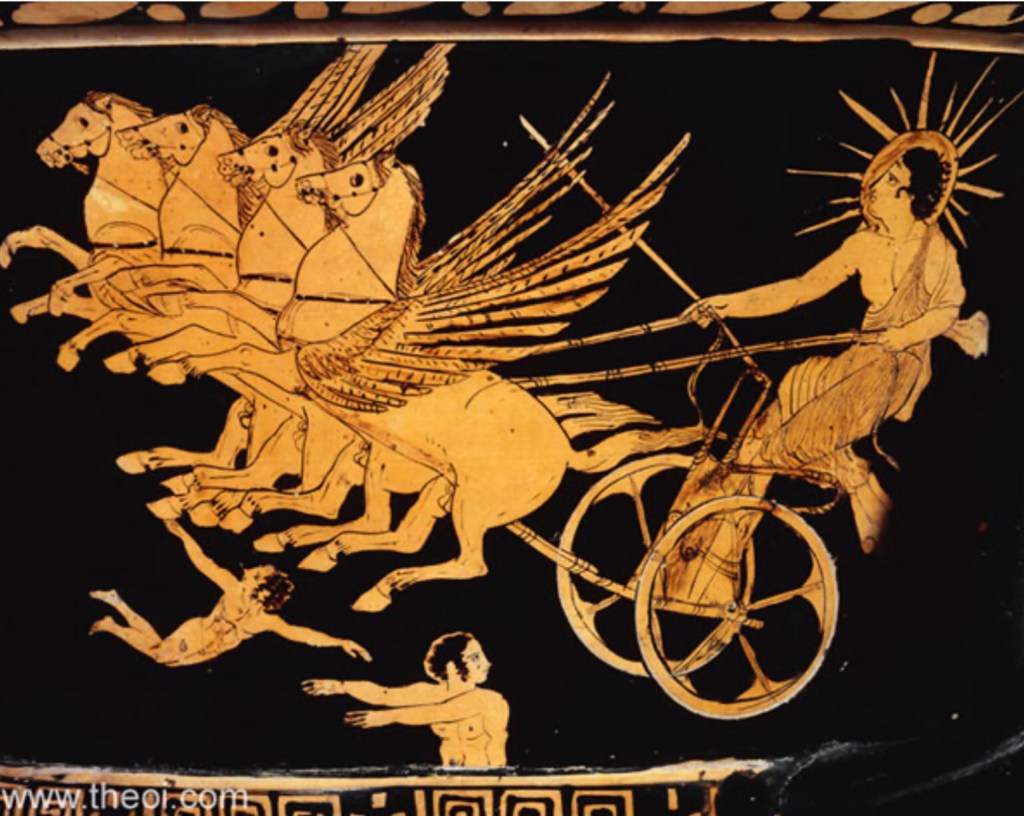
Greek mythology has an instructive story of Helios, the sun god, who couldn’t say no to his son Phaeton’s request to drive the sun carriage drawn by the fiery steeds. In Ovid, Metamorphoses 1. 750 ff, Helios instructs his son:

Chariot of Helios, the Sun God

“Keep to this route; my wheeltracks there show plain. Press not too low nor strain your course to high; too high, you’ll burn heaven’s palaces; too low, the earth; the safest course lies in between. And neither rightwards towards the twisting Anguis (Snake) nor leftwards swerve to where the Ara (Altar) lies. Hold in the midst! To fortune I resign the rest to guide with wiser wit than yours. See, dewy Nox (Night) [Nyx] upon the Hesperian shore even while I speak has reached her goal. No more may we delay; our duty calls; the day dawns bright, all shadows fled. Come take the reins!

Or take, if yet your stubborn heart will change, my counsel, not my chariot, while you may, while still on firm foundations here you stand before you mount between my chariot wheels, so ignorant, so foolish!–and let me give the world light that you may safely see.”

Fall of Phaeton Sarcophagus

As in all Greek myths, this didn’t end well for Phaeton, for he couldn’t control the high spirited steeds. As the chariot ricocheted too near the earth, scorching it, and too high in the sky, burning the stars, Zeus blasted the boy with a thunderbolt to save the earth from harm and placed him among the stars in the constellation The Charioteer. His body fell to earth into the river Po. Once again it’s a reminder the middle path is safest and best.

Canadian soldiers on D-Day read message on their plane

As we polish off the last of the leftovers from Memorial Day, we celebrate D-Day, which commemorates June 6, 1944, the day the Allies invaded Normandy from England during World War II. Every military order has had a day and hour designation since 1918, but this battle on the five French beaches was so large and so difficult to organize, it’s the one we know as “D-Day.” Not only was there a need for a long day, a day near a full moon to guide ships/airborne troops, and strong tides for an amphibious assault, but the Allies had to coordinate politically and militarily to get everyone on board. Eisenhower’s personal notes give us an inkling of the troubles of this endeavor (link below). To date it remains the largest amphibious invasion in history and marked the beginning of the end of World War II. It also marked the end of the Nazi regime led by Hitler, which was responsible for the death of over 6 million Jews.

Two roses and two U.S. flags on Omaha Beach in Saint-Laurent-sur-Mer, Normandy, on June 5, 2019.

As a small rabbit, who’s startled at any sharp noise and frightened by even the shadows of passing clouds, since it might be a hungry predator, the thoughts of wars set me to trembling, trembling, trembling, like the lyrics of the old slave spiritual, “Steal Away:”

“Green trees are bending, poor sinners stand trembling; The trumpet sounds it in my soul, I ain’t got long to stay here.”

Yet appeasing tyrants never ends well, as Winston Churchill noted: “Each one hopes that if he feeds the crocodile enough, the crocodile will eat him last. All of them hope that the storm will pass before their turn comes to be devoured. But I fear greatly that the storm will not pass. It will rage and it will roar ever more loudly, ever more widely.”

Speaking of storms, the Atlantic hurricane season runs from June 1 to November 30, and we can expect the first named storm to form in mid to late June. We rabbits who enjoy a beach vacation always need to keep a weather eye out. Not only do we need to be aware of the intense sun, especially for our baby rabbits, but if the city officials issue evacuation orders for extreme weather, we ought to leave, even if we give up vacation days. While we’re at the beach, or the lake or poolside this summer, we can read or listen to books. June is audiobook appreciation month, but books with pages are more likely better suited to beaches, since high heat and small grains of sands can adversely affect expensive cellphones, tablets, and readers.

Alzheimer’s disease is the most common form of dementia

Another way we can pass our summer and stretch our minds is to try new experiences. June is Alzheimer’s and Brain Awareness Month. If we only exercise the same brain paths, but fail to build new ones, our brains become “clogged up.” This is rabbit speak for what doctors call Tau protein tangles. Dementia seldom only causes Alzheimer’s-related changes in the brain. Any number of vascular issues—problems that affect blood vessels, such as beta-amyloid deposits in brain arteries, atherosclerosis (hardening of the arteries), and mini-strokes—may also be at play. Vascular problems may lead to reduced blood flow and oxygen to the brain, as well as a breakdown of the blood-brain barrier, which usually protects the brain from harmful agents while allowing in glucose and other necessary factors.

My dad, a brilliant doctor, had Alzheimer’s disease in his later life. While he remembered all of his medical training, he knew none of his family in his later years. He also confused my large poster of Captain Picard I had taped on the parsonage back door with an actual person. I kept “Picard” there as a reminder to MAKE IT SO, but daddy thought I had a strange balding man standing in my laundry room.

Make it so—said the strange man in my laundry room

In someone with Alzheimer’s, a faulty blood-brain barrier prevents glucose (energy) from reaching the brain and prevents the clearing away of toxic beta-amyloid and tau proteins. This results in inflammation, which adds to vascular problems in the brain. Because it appears that Alzheimer’s is both a cause and consequence of vascular problems in the brain, researchers are seeking interventions to disrupt this complicated and destructive cycle. All the more reason for us to eat more plants, less fried foods, more complex carbohydrates, and fewer animal fats.

Baked chicken, roasted veggies and corn on the cob

June is also Professional Wellness Month and National Men’s Health Month. America workers tend to get about 11 days of paid vacation and 6 paid holidays per year, but more than half of these reported not using all their days off. Even those energizer bunnies who have unlimited paid time off tend to take only 10 days of vacation, and nearly half of them work at some point in time during their vacation.

When I went on vacation, I told my church secretary to call me if the church burned down or someone died. They should be able to handle most anything else. Most of what I was going to do from some distant location was encourage them and help arrange a substitute if I couldn’t get back in time. God may be available all the time, but small rabbits and vulnerable humans must rest and restore their energies to be ready for the next excitement that’s sure to come.

Rabbit and Butterfly

If you haven’t yet planned your summer vacation, you’re in luck. June is Great Outdoors Month and National Camping Month. You can take your rabbit family to the Oceans or to the Rivers, or you can visit a Zoo and an Aquarium. It’s also Women’s Golf Month, but you can take the rest of the rabbit family with you and have a good time on the links. If you want to stick closer to home, remember June is a fine time to enjoy the exercise in the dirt. It’s Perennial Gardening Month and National Rose Month. Do a service for your garden during National Pollinators Month. Plant basil and dill alongside your tomato plants to discourage hornworms. The scents also attract pollinators like butterflies and other beneficial insects.

On a personal note, I’m looking forward to a summer full of crisp lettuce and tomato sandwiches on toasted whole wheat bread with avocado slices. In fact, that sounds so good, I may have to have one now, since I don’t have time to make a hazelnut cake. Here’s to books, beaches, and the bronzed bodies of summer.

Joy and peace,

CORNELIA

June Holidays and Observances 2023: Full Calender
https://www.today.com/life/holidays/june-holidays-and-observances-rcna76138

2023 NCAHM Official Book List – CaribbeanReads
https://www.caribbeanreads.com/2023-ncahm-book-list/

When is the first day of summer? Summer solstice dates explained.
https://www.usatoday.com/story/news/2023/04/07/when-is-first-day-summer/11556538002/

Season Definition: When Do They Start?
https://www.timeanddate.com/calendar/aboutseasons.html

What Is the Flexitarian Diet? – Cleveland Clinic
https://health.clevelandclinic.org/what-is-the-flexitarian-diet/

NATIONAL BLACK COW DAY – June 10, 2023 – National Today
https://nationaltoday.com/national-black-cow-day/

How To Make Tapioca Pearls At Home – Experiences
https://experiences.japancrate.com/blogs/news/how-to-make-tapioca-pearls-at-home

Creamy Coleslaw with Prunes (Ready in 5 Minutes!) – Ignite Nutrition
https://ignitenutrition.ca/blog/unlock-the-power-of-prunes/

Should I Let My Kid Drive a Go-Kart? – Our Definitive Guide | Utah Motorsports Campus
https://www.utahmotorsportscampus.com/should-i-let-my-kid-drive-a-go-kart-our-definitive-guide/

PHAETHON – Son of the Sun-God of Greek Mythology
https://www.theoi.com/Titan/Phaethon.html

Unknown Artist: Fall of Phaeton, Greek marble Roman sarcophagus, Ca. 150-170 AD., Height: 62 cm; length 220 cm.,
Florence, Galleria degli Uffizi.

Eisenhower Library: Conditions in Normandy
https://www.eisenhowerlibrary.gov/sites/default/files/research/online-documents/d-day/1944-06-03-conditions-in-normandy.pdf

Steal Away Lyrics
https://www.cusd80.com/cms/lib6/AZ01001175/Centricity/Domain/1509/Steal%20Away%20Steal%20Away%20song%20lyrics.pdf

An Appeaser Is One Who Feeds a Crocodile, Hoping It Will Eat Him Last – Quote Investigator®
https://quoteinvestigator.com/2016/04/18/crocodile/

Tropical Cyclone Climatology
https://www.nhc.noaa.gov/climo/

What Happens to the Brain in Alzheimer’s Disease? | National Institute on Aging
https://www.nia.nih.gov/health/what-happens-brain-alzheimers-disease

Average PTO In USA & Other PTO Statistics (2023) – Forbes Advisor
https://www.forbes.com/advisor/business/pto-statistics/

10 Tips for Building a Pollinator Garden | The Old Farmer’s Almanac
https://www.almanac.com/building-pollinator-garden

Winter Solstice 2022

arkansas, art, Faith, Food, hope, inspiration, Light of the World, Ministry, New Year, shadows, Spirituality, Stonehenge, trees, winter solstice

This shortest day of the year is the Winter Solstice, which is on Wednesday, December 21, at 4:48 P.M. EST, in the Northern Hemisphere. Some think of this as the Longest Night, but I’m a person of the light, not the darkness. I always prefer to look to the light, no matter how dim or feeble it may seem.

Be the Light

Yet darkness is a necessary experience in our lives. We do not yet live in the land of the “unclouded sky” or the heavenly realm:

“And the city has no need of sun or moon to shine on it, for the glory of God is its light, and its lamp is the Lamb.” —Revelation 21:23

Kindness is a warm fire

In the darkness, growth often happens: germination and rooting are two types of unseen activity that help produce the plant we see above ground. Without adequate light, the visible plant won’t thrive. So both darkness and light are at work to produce fruit in our lives.

“We know that all things work together for good for those who love God, who are called according to his purpose.” —Romans 8:28

Rejoice! The days will get brighter soon!

The Winter Solstice in Hot Springs is at 3:48 pm CST on Wednesday, December 21, 2022. In terms of daylight, this day is 4 hours, 37 minutes shorter than the June solstice. In most locations north of the equator, the shortest day of the year is around this date. The good news about the Winter Solstice is the days will begin to lengthen, although imperceptibly at first: one minute, four minutes, seven minutes, ten minutes, thirteen minutes, sixteen minutes, and so on.

In Scandinavia, the Norse celebrated Yule from December 21, the winter solstice, through January. In recognition of the sun’s return, fathers and sons would bring home large logs, which they would set on fire. The people would feast until the log burned out, which could take as many as 12 days. Today we recognize the source of the “Twelve Days of Christmas” song in this festival. The Norse believed that each spark from the fire represented a new pig or calf that would be born during the coming year. Prosperity for all in the New Year!

In this present darkness, a small light still shines brightly

In this time of stress and strain, grief and gripes, let’s look to the in-breaking light, and the renewal of life and love. Here’s a “Winter Solstice Chant” by Annie Finch, for your pleasure:

Vines, leaves, roots of darkness, growing, now you are uncurled and cover our eyes with the edge of winter sky leaning over us in icy stars Vines, leaves, roots of darkness, growing, come with your seasons, your fullness, your end.

Rice Krispy Stonehenge

Of course, if you can’t get your travel plans together at the last minute to visit Stonehenge, England for the winter solstice celebration, you can always make Rice Krispies Bars in the shape of the ancient monument. The recipe link is at the bottom of the page. Hint: don’t turn the heat up high or your treats will be hard. Due to high carbohydrate count, one “pillar” of Stonehenge Krispies is actually two servings.

Modern Yule Log

Joy and peace and a Good Yule log,

CORNELIA

Annie Finch, “Winter Solstice Chant” from Calendars, published by Tupelo Press. Copyright © 2003 by Annie Finch. Reprinted by permission of the author.

Sunrise and sunset times in Hot Springs https://www.timeanddate.com/sun/@4115412

The Original Rice Krispies Treats™ Recipe https://www.ricekrispies.com/en_US/recipes/the-original-treats-recipe.html

Change and Tradition

arkansas, art, at risk kids, butterflies, change, disaffiliation, Faith, holidays, Holy Spirit, Homosexuality, inspiration, john wesley, Love, Ministry, Prayer, renewal, Spirituality, United Methodist Church, vision

WABAC Machine

One of my favorite Saturday morning cartoons was Rocky and Bullwinkle. I loved Mr. Peabody and Sherman, who would climb into the WABAC machine after setting the controls to a time and place of historical importance. That a bow tie wearing dog had adopted a human boy never crossed my mind as being strange. It was a cartoon, after all. In the 1960’s we didn’t take cartoons as real life. We knew they were fantasy.

Votive relief. Pentelic marble. Found in the sanctuary of Eleusis.

In times of change we always want to hold on to traditions: our rituals, our places of worship, our routines. I think the newly minted Christians in the first century, who had friendships and business relationships tied up in the pagan temple sacrificial banquets, most likely had this problem too. The temples were where they ate food sacrificed to the pagan gods, drank to celebrate new deals or cement old relationships, and soon one thing would lead to another. It was the “another” that Paul had words about, for In sharing these meals, Christians were also indulging in the sexual activities that resulted from the feast. (1 Corinthians 8)

Monarch Metamorphosis

If Christians were to live a new life and their lifestyles were to reflect this newness, they needed to make an outward change to reflect the inward transformation of their hearts. We don’t keep the old but take on a newness of heart that transforms our outer life. Consider the caterpillar. It only knows how to be a caterpillar, but it has an inner drive to spin a cocoon. Once inside, it rests, reflects, and directs its energy to becoming a new creation. Then it breaks free to become what its new and true self is meant to be. If it remains bound in a cocoon, it won’t fulfill the wonderful design of God’s best hopes and dreams for its life.

We too have to reimagine and revision our spiritual lives. I’ve always based my vision for ministry on John Wesley’s doctrine of Christian Perfection: “A heart so full of love for God and neighbor that nothing else can exist.” Like the lawyer in the parable, many of us ask, “Who is my neighbor?” Jesus and Wesley say “Everybody is our neighbor.” I’d add, even those we’re most upset with, even if they’ve part of our family and we have disagreements with them.

Most of us have a Bible, but we don’t all read the same translation and we also have major disagreements on how to interpret this holy book. A particularly fraught scripture is 1 Corinthians 6:9-11:

“Do you not know that wrongdoers will not inherit the kingdom of God? Do not be deceived! Fornicators, idolaters, adulterers, male prostitutes, sodomites, thieves, the greedy, drunkards, revilers, robbers—none of these will inherit the kingdom of God. And this is what some of you used to be. But you were washed, you were sanctified, you were justified in the name of the Lord Jesus Christ and in the Spirit of our God.” (NRSV)

Wesley wrote in his Notes on the New Testament on 1 Corinthians 6:9—

“Idolatry is here placed between fornication and adultery, because they generally accompanied it. Nor the effeminate—Who live in an easy, indolent way; taking up no cross, enduring no hardship. But how is this? These good-natured, harmless people are ranked with idolaters and sodomites! We may learn hence, that we are never secure from the greatest sins, till we guard against those which are thought the least; nor, indeed, till we think no sin is little, since every one is a step toward hell.”

In Wesley’s Notes on The Entire Bible, of which his Notes on the New Testament is part of our United Methodist Doctrinal standards, he also reminds us, “ Fornication—The original word implies criminal conversation of any kind whatever.” (1 Corinthians 6:9)

That was Wesley in 1754, or the mid 18th century, but most modern Wesleyans today would be shocked at that interpretation of this text. Interestingly, Wesley departed from the KJV in over 12,000 instances in his Notes on the NT. Wesley valued the Authorised Version of the Bible (KJV), but he always preferred to study the Scriptures in their original languages over any and all translations. If we’re traditionalists, we need to remember Wesley was a radical in his time. As Albert Outler was always keen to remind Methodists, Wesley looked better without his halo.

A later day hero was my dear friend and mentor, Dr. Billy Abraham. As his research assistant at Perkins, I had the wonderful opportunity to learn from his thought and appreciate the early church fathers and mothers. Through him I was privileged to meet and learn from Dr. Roberta Bondi, a noted expert on early church history. I learned from Billy about differing views of scriptural authority and from Roberta how a heart of love and mercy helps us live in community.

I decided I’d go with Wesley’s view: “The Bible contains everything necessary for salvation.” This meant I didn’t have to get into creationist arguments because that’s not going to interfere with anyone’s salvation. Of course, that was the big issue a quarter century ago. Even our disagreements change over time. I learned to pray from Dr. Bondi, “Help us to love one another as God loves us.”

When we read scripture in translation, we read from the vantage point of our times and our context. We don’t have a 1960’s Rocky and Bullwinkle WABAC machine to visit the historical people who wrote the Bible. (If only we could time travel!) Only by studying the life and times of that era can we read with a clearer mind what the original authors meant. Even then, we’re caught up in the translation, for we don’t have many full copies of the holy books from the earliest times. Our earliest complete New Testament dates from the 4th century, long after Christ and the first apostles walked these rocks and clods we call earth.

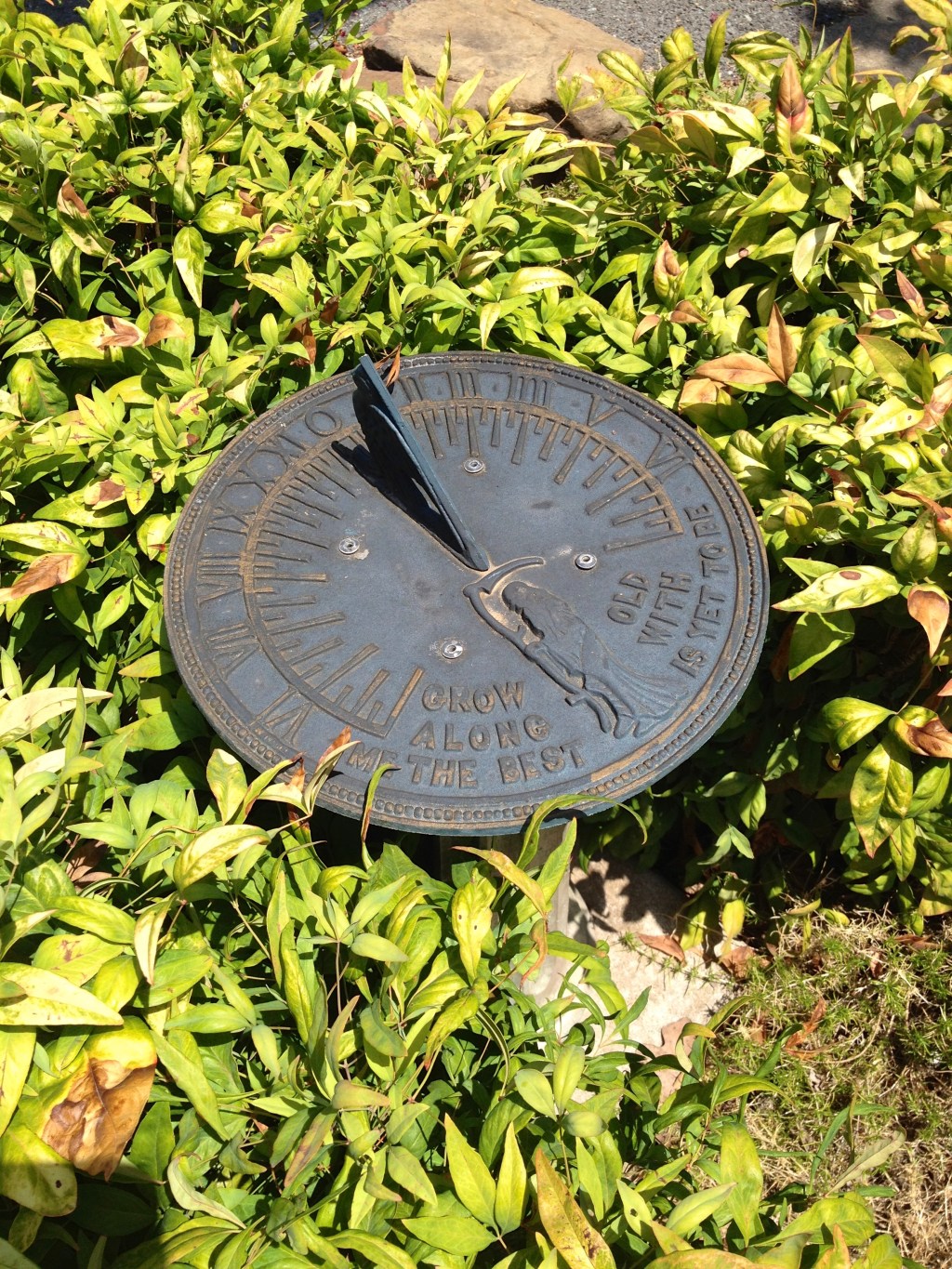
Sundial at Mt. Sequoyah

Then too, we have concepts today which ancient people hadn’t yet conceived. In Roman times, which is the time of the earliest New Testament writings, the day was divided into watches or hours. We think of those hours as having 60 minutes each, but they had no mechanical clocks for precision time keeping. The sundial kept the hour count, so a summer day had long watch hours, while a winter day had shorter ones. Since everyone was on the same system, everyone was on time, or they were late if they were my ancestors.

We all read the same Bible, but we have different translations in our hands. I choose the NRSV because it’s a modern translation that’s as literal as possible and as free as necessary, unlike the NIV, which is a dynamic translation or one that seeks to make the best readable sense of the text. Those translators have to make decisions on how to render rare words in the text. For instance, the word “arsenokoitai,” which shows up in two different verses in the bible, wasn’t translated to mean “homosexual” until 1946. It appears in the RSV, whereas in the KJV, the word gets translated as “nor abusers of themselves with mankind” (or to put it less delicately—trigger warning—masturbation).

Douris: Drinking cup (kylix) depicting an erotic scene of Eros and a youth

How was the word translated previously? It referred to the common Greek practice of pederasty: adult male love for younger boys, which everyone today would be opposed to and disgusted by this cultural practice once common in Greek society. Abuse of youths by adults is something all of us can dislike because that experience isn’t a relationship of equals. One has too much power, authority, and dominance over the other. For the same reason we object to other unequal sexual relationships: clergy and laity, counselors and campers, teachers and students, bosses and employees, and so on.

Circle of Euthymides: Two-handled storage jar (pelike) depicting young athletes jumping

This particular word shows up exactly two times in the whole Bible. It’s now translated as “sodomites.” This too is an unfortunate translation, since the sin of Sodom wasn’t homosexuality, but the townspeople’s failure to respect the laws of hospitality. When the visitors came under Lot’s protection in his home, the townies gathered outside his door and begged to have their sport with his guests. We’re horrified Lot would offer up his own daughters, but in that day and time, protecting the honor of the patriarch’s offer of hospitality to strangers was more important than anything that happened to the women of the household. We don’t have to like the culture as it was back then to get the lesson of “entertaining angels unawares.” This is an instance we’re glad fathers today have respect both for their guests and their daughters. Cultures change and we’re very glad for that.

The word “μαλακός” or Malakos refers to something soft and effeminate. It could refer to silk clothing or to an adult man who shaved his beard or grew long hair. In the Ancient Greek society, once a boy grew a beard, he was no longer subjected to pederastic abuse. Instead, he passed “the gift on” to the next generation. We’re well aware today how child abuse is generational. This is what Paul railed about in this text.

When the holidays crank up, the greedy, drunkards, and maybe a few adulterers and fornicators will go to town. The angry criticizers will probably be driving the bus and the swindlers (robbers: ἅρπαγες) will be grifting the unsuspecting flock as they barrel along. We don’t have any temples with male prostitutes as the ancient Greek cities once had. There were also women prostitutes serving at these temples, so everyone had their pick when visiting with a celebrant for an intercession with the gods. I’m really glad our current clergy orders don’t include this ritual as part of “pastoral care.” Culture changes. Maybe today’s clergy body is glad this duty isn’t added to their holiday activities.

It’s good the culture has changed from that of Rome and Athens of the first century. In fact, culture keeps on changing all the time. This is why Jesus spoke of “new wine in new wine skins.” We’re no longer a first century church, but some principles still apply. We can’t pour the new wine into an old skin, or the fermentation will burst open the weak old skin. This is why we are a new and changing church, for just as butterflies break out of their cocoons, we too have to break free from what has bound us in a past time. The Holy Spirit keeps refreshing and invigorating a living community, whether it worships in a tent, a rented room, or in a set place.

Now we look forward, to a new land, a new existence, and new possibilities. If we hear the voice of God, we hear the calling: “Go to the land I will show you.” God has always led God’s people in every place and in every time. God has brought God’s people through good times and bad, through war and peace, and in exile to the promised land. We can trust God to be faithful once again.

Joy, peace, and hope,

Cornelia

Drinking cup (kylix) depicting an erotic scene of Eros and a youth
Signed by: Douris: clay, Greek, made in Attica, Athens, Late Archaic Period, about 490–485 B.C., Museum of Fine Arts, Boston, MA.

Two-handled storage jar (pelike) depicting young athletes jumping
Circle of Euthymides (Greek), Archaic Period, about 520–515 B.C., Museum of Fine Arts, Boston, MA.

Drinking cup (kylix) depicting pentathletes
Onesimos: Greek, Late Archaic Period, about 500–490 B.C., Museum of Fine Arts, Boston, MA.

NOTES:
(PDF) Canon, criterion and circularity: An analysis of the epistemology of canonical theism of Billy Abraham
https://www.researchgate.net/publication/328641188_Canon_criterion_and_circularity_An_analysis_of_the_epistemology_of_canonical_theism

Crossing the Threshold of Divine Revelation: Abraham, William J.
Here Abraham argues for divine revelation as another leg of understanding and interpretation of church traditions and scripture.

Canon and Criterion in Christian Theology: From the Fathers to Feminism
by William J. Abraham
This is a seminary textbook and historical overview.

“John Wesley’s Notes On The Entire Bible” by John Wesley (1754)
Start reading it for free: https://a.co/3UKifSG

Has ‘Homosexual’ Always Been in the Bible? – United Methodist Insight
https://um-insight.net/perspectives/has-“homosexual”-always-been-in-the-bible/

The Use and Misuse of John Wesley on the Authority of Scripture |
Glen O’Brien – Academia.edu
https://www.academia.edu/5946863/The_Use_and_Misuse_of_John_Wesley_on_the_Authority_of_Scripture

Michael Roberts: Connected in Christ—great discussion on this topic
https://connectedinchrist.net/2022/07/14/wesley-on-human-sexuality-and-his-commentary-on-often-cited-verses/

Strong’s NT 3120: https://biblehub.com/greek/3120.htm

Strong’s 733: https://biblehub.com/greek/733.htm

Strong’s 727: https://biblehub.com/greek/727.htm

NOTES ON μοιχοὶ οὔτε μαλακοὶ οὔτε ἀρσενοκοῖται—

STRONGS NT 3120: μαλακός
μαλακός, μαλακή, μαλακον, soft; soft to the touch: ἱμάτια, Matthew 11:8 R G L brackets; Luke 7:25 (ἱματίων πολυτελῶν καί μαλακων, Artemidorus Daldianus, oneir. 1, 78; ἐσθής, Homer, Odyssey 23, 290; Artemidorus Daldianus, oneir. 2, 3; χιτών, Homer, Iliad 2, 42); and simply τά μαλακά, soft raiment (see λευκός, 1): Matthew 11:8 T Tr WH.

Like the Latin mollis, metaphorically, and in a bad sense: effeminate, of a catamite, a male who submits his body to unnatural lewdness, 1 Corinthians 6:9 (Dionysius Halicarnassus, Antiquities 7, 2 under the end; ((Diogenes Laërtius 7, 173 at the end)).

Strong’s Exhaustive Concordance: effeminate, soft. Of uncertain affinity; soft, i.e. Fine (clothing); figuratively, a catamite — effeminate, soft.

Thayer’s Greek Lexicon, STRONGS NT 733: ἀρσενοκοίτης
733 arsenokoítēs (from 730 /árrhēn, “a male” and 2845 /koítē, “a mat, bed”) – properly, a man in bed with another man; a homosexual.
ἀρσενοκοίτης, ἀρσενοκοιτου, ὁ (ἄρσην a male; κοίτη a bed), one who lies with a male as with a female, a sodomite: 1 Corinthians 6:9; 1 Timothy 1:10. (Anthol. 9, 686, 5; ecclesiastical writings.)

Holiday Gifts and Traditions

art, Creativity, Family, Hanukkah, Imagination, inspiration, knitting, purpose, Thanksgiving, Travel


In my family, we didn’t break out the seasonal decorations or fashions until Thanksgiving Day. My mother put her knitting hobby to good use one year and made Christmas sweaters for all of us. She practiced on mine, so I got the baggy sleeves and an oversized middle. At least she got her stitch gauge down pat on my “ugly sweater.”

I wore it every Thanksgiving, while she still lived, just for her, for without my mother I wouldn’t be the person I am today. If there were a sweater made for her, it would be this one I found at my local Wally World: “Gonna Lay Under The Tree To Remind My Family I Am A Gift.”

I Am A Gift

We all have holiday traditions, whether these belong to Kwanzaa, Hanukkah, or Christmas. These bind us together, as a family and as a community. This year I decided to buy my holiday stamps with Kwanzaa illustrations on them. I admit, my cataracts are bad enough now I thought I was looking at a black Angel with lighted candles. I wondered why the postal clerk was questioning my choice. Why can’t I have Kwanzaa stamps? Maybe I need to go back in and buy the blue and silver stamps also.

Kwanzaa Forever Stamp

This might be a year to make some new traditions, especially if during the past few years some of us have lost someone near and dear to us. Also, the economy has had a big impact, so focusing on togetherness rather than on materialism is a good choice. In the Great Depression, my dad asked only for a book for himself and his brother, and a fresh orange, if possible.

My mother, crafty lady that she was, made me this cross stitch one year for my birthday. All of us are gifted, even if not all of us have the same gifts or in the same amount. What we do with our gifts is the more important matter. A very gifted person who wastes their gift will benefit the world less than an average gifted person who works hard and has good people skills. Sometimes these are called under achievers and over achievers. As a former teacher, I don’t believe in the concept of “over achieving.” I do believe most of us underperform because we are afraid to fail.

Menorah

Failing is how we discover what doesn’t work. Unless we’re playing with dynamite, failure won’t kill us. In sales, every time someone says NO to a presentation, the salesperson is another step closer to a YES. We think we’re too young, too old, or too something else to do what we really want to do in life. Sometimes the people around us tell us we can’t do the greater things we dream about. That was not my mother, or my dad. Daddy might have had reservations, but mother always said, “Honey, you should go for it.”

I drove alone to California last month without an advance plan for where I’d spend each night. I made reservations around lunchtime when I knew how far I’d journey that day. I have all the apps, just like the young people. I hiked in national parks, saw volcanoes, got caught in a snow storm, and paid through the nose for gasoline in the Nevada desert. I saw sea otters in the Pacific Ocean, hugged my grand kids, and learned I can do this. Yes, I wanted to go now, for driving nearly 7,000 miles is hard on the body. Full disclosure: I took a week to recuperate! Or maybe it was getting a month’s worth laundry done which finally did me in. I was glad to do it, and especially glad I didn’t let anyone talk me out of it.

The Gift

I hope you choose to be a gift to others. If you don’t have a parent who encourages you to be more than others think you are, I offer my mother as a gift to you. I can share her with the world, for I keep sharing her wisdom here and there. Whatever you choose, l hope you choose to be a gift that gives to others.

Joy and peace,

Cornelia

Rabbit! Rabbit!

art, Attitudes, autumn leaves, autumnal equinox, brain plasticity, cognitive decline, Faith, Imagination, ministry, nature, Painting, perfection, poverty, pumpkins, rabbits, renewal, Rosh Hoshanah

Welcome to September

On September 5, we celebrate Labor Day, and our kids are already back in school. We’re once again slowing down in school zones in the morning and afternoon, and setting an extra plate at the kitchen table for our absent college freshman. We might even see the first fall colors when the Fall Equinox comes around at the end of the month.

Edwardian Summer Gown, 1905

September is when we set aside our summer white clothes and shoes to change our closet over for darker colors and longer lengths. My dear mother had a rule of never wearing white past Labor Day. This quaint fashion principle dates from before Memorial Day, which was instituted in 1868 after the Civil War. This rule helped to separate the old money families, who summered in the country and at the seashore, from those who stayed to struggle on in the grimy cities, which were polluted by coal fired engines. These urban families usually wore dark clothes year round, as the rich did when they returned to their city residence.

Air conditioning has changed this now, but wearing starched, white cotton still reminds people you either have money to send your clothes to the cleaners or hire laborers to do it for you. Or, you might just work extra hard to look like one of the first two. This bunny has reached the age of dripping dry all those cotton clothes. I actually do more ironing when I do a craft project, such as quilting, since those seams need to be pressed open to make a good square. As this bunny has aged, I’ve changed my mind about what I think is important enough to worry about.

Rabbit Ironing

September is also a time to reassess the three core myths which animate much of American life. These myths are we can give 100% to our work, 100% to our family, and 100% to our personal health. I don’t know about you, but I’ve never been able to do this type of higher math without going bananas or feeling significant amounts of guilt that I’m not doing enough in one of those areas. Eventually I learned I was only Wonder Woman in my fantasies, but not in real life. I also realized other people who managed better than I hired help for the housework to free themselves up for family time.

My Wonder Woman Fantasy

Somewhere along the line we’ve bought into the myth of the “ideal worker,” who “has no competing obligations that might get in the way of total devotion to the workplace.” The second myth is the “perfect parent,” who “always puts family first.” The last myth is the “ultimate body,” which is cultivated through diligent dieting and exercise, and doesn’t deteriorate with age.

The authors of Dreams of the Overworked, note in the digital age, when people can post curated images of their best lives, “Achieving even one of these myths would be impossible, but achieving all three is ludicrous.” If your daily stress has increased and you feel like everything you do isn’t enough, I suggest deep breathing with your eyes closed (unless you’re driving a vehicle!). Once you get some extra oxygen to your brain, you’re in a position to calmly reconsider your situation. Not all situations are hair on fire, unless you’re a two year old with separation anxiety. Most of us beyond this age have experience and memories which can guide our future behaviors. An ancient proverb is “Experience is the mother of wisdom,” or as my folks used to say, “The school of hard knocks is the most expensive degree you’ll ever pay for.” Live and learn. With age comes wisdom.

Now that you’re calmer, you can decide, “Do I have options? Do I have a support system with people who can help me discern my way? Can I lay down my false self image of competence so I can ask for help? Can I triage my priorities to say NO to the less important ones, even if it means not pleasing everyone in my social circle?”

Google it, Ask friends for recommendations, and Breathe!

Speaking of options, women are primarily responsible for housework and childcare, not only in America, but also across the pond. About 91% of women with children spend at least an hour per day on housework, compared with 30 % of men with children. The latest available data shows that employed women spend about 2.3 hours daily on housework; for employed men, this figure is 1.6 hours. Gender gaps in housework participation are the largest among couples with children, at 62 p.p., demonstrating an enduring imbalance in unpaid care responsibilities within families. This leads to women taking lower and slower career paths.

Animated Map of 2022 Fall Color Change

September 22 is the Fall Equinox. We’re already seeing signs of seasonal leaf color changes, due to heat stress and drought. Some call this “False Fall,” but I call it a sign of hope. Trees will drop their leaves in order to survive in extreme conditions. Although some claim plants are sentient, they don’t have a brain or consciousness that we can recognize. They do interact and react to their environments. Their first priority is survival.  Photosynthesis and the subsequent leaf abscission after changing color is part of this process. I always look for the change of light which precedes this event. One morning last week, I noted the color of the morning light had turned cooler, and wasn’t the warm yellow of summer. I also had a spark of energy I hadn’t had before. I look forward to more daylight.

This bunny is very fond of September, since I’ve always been eager to start fresh and new. I always got new pencils and a new manilla paper writing pad when I started elementary school. Later on, as I progressed up in grades, ink pens with cartridges were a special treat. Even to this day, I keep my journals with hand written ink in good paper books. I love the feel of these materials in my hands. I probably would have stayed in school my whole life if possible. The day our brains quit learning something new is the day our minds begin to die.

School Bunnies and Friends

That leads me to remind my bunny friends that Alzheimer’s disease is the 7th leading cause of death in the USA and it’s the most common cause of dementia in persons over 65. While most of you may not be baby boomers, you young bunnies have grandparents or parents of that age. Today, about 6.5 million Americans have Alzheimer’s disease, but that number is expected to almost double to 12.7 million by 2050. Perhaps beginning September with World Alzheimer’s Day is a good reminder for all of us to be proactive about our health choices, so we can live independently as long as possible into our senior years.

Talk Like a Pirate

I also like Positive Thinking Day, since reframing negative thoughts into positive ones changes our attitude, our behaviors, and then we get better outcomes as a result. If you don’t feel like being Batman on the 17th, you can ARRRGUH yourself about, MATEY, as you Talk Like a Pirate on the 19th. Bonus points if you wear an eye patch, earring, and tricorne hat or bandana on your head.

The Jewish New Year of Rosh Hashanah begins at sunset on the 25th. It’s one of the four “new year” celebrations in their religious calendar. This one recalls God’s creation of humanity, as well as the legal new year. On this one night in September, when the faithful eat apples dipped in honey or other sweet sauces, they remember how God originally created humans in a sinless state and wish each other a good year to come.

Magic Bacon Carpet Ride

Did I forget International Bacon Day? How can any rabbit forget bacon? Someone will cut my carrot rations for the future, I fear. But if I remember to keep the coffee pot full, I’ll probably get out of the rabbit hoosegow before National Coffee Day on the 29th.

Some interesting holidays we can celebrate this month are: Better Breakfast Month (I suggest bacon, eggs, and pancakes on the weekend and old fashioned oatmeal during the week). There’s also Hispanic Heritage Month and National Sewing Month. Finally, every year on September 30th is National Love People Day. The purpose of the day is to show love to everyone—no exceptions. National Love People Day offers us the opportunity to show unconditional love, which many have never experienced. When we genuinely love our neighbors and express it with kind words and thoughtful deeds, we make our world a better place. This the true meaning of “love your neighbor as yourself.”

Maybe one meaning of loving your neighbor is offering a meal to them. Food insecurity is increasing once again, this time due to increased rents and costs of transportation. Consider a weekly meal service from your church building or organization’s meeting place. It doesn’t need to be fancy, but calories and nutrition would help hungry people have the strength to move on from their current situations. Joining with other groups to cover all the days of the week would be a bonus to your community, not only for the hungry, but also for the smaller groups who could team up to share in the blessing of loving their neighbors.

Until the spice is on the pumpkin, I wish all my bunny friends

Joy, peace, and Bacon,

Cornelia

America’s Ideal of Working Parents Has Become Unattainable – The Atlantic
https://www.theatlantic.com/family/archive/2020/06/working-parents-impossible/613429/

Beckman and Mazmanian: Dreams of the Overworked: Living, Working, and Parenting in the Digital Age

Gender differences on household chores entrenched from childhood | European Institute for Gender Equality https://eige.europa.eu/publications/gender-equality-index-2021-report/gender-differences-household-chores

Debunking a myth: plant consciousness | SpringerLink. https://link.springer.com/article/10.1007/s00709-020-01579-w

September Monthly Observances – National Day Calendar
INTERNATIONAL CHOCOLATE DAY – September 13, 2022 – National Today

Home – National Love People Day – National Love People Day

Alzheimer’s Facts and Figures Report | Alzheimer’s Association
https://www.alz.org/alzheimers-dementia/facts-figures


The Mosaic Christ

art, Creativity, Faith, Historic neighborhood, Holy Spirit, hope, Icons, incarnation, inspiration, Italy, mystery, Painting, perfection, Ravenna Italy, Reflection, renewal, Spirituality, Travel, vision

The Body of Christ is All of Us

The Body of Christ represents the perfection of all humanity as the image of God. The body of Christ we know as the church is made of many individuals, just as a mosaic design is constructed of many pieces to make a whole. I think of these as the “two bodies of Christ,” even though the literalists among us might think Jesus has only one body. The mysterious body of Christ is what Paul speaks about in his letter to the Romans:

“For as in one body we have many members, and not all the members have the same function, so we, who are many, are one body in Christ, and individually we are members one of another” (12:4-5).

I Am the Bread of Life: Macaroni Christ Icon

Since each one of us is made in the image of God, but of ordinary materials, together we become a mosaic of the whole Body of Christ, going onto his perfection as we encounter and encourage one another within and without the church. After all, the body of Christ isn’t limited to the walls of our buildings, for Christ said in Matthew 25:40—

“And the king will answer them, ‘Truly I tell you, just as you did it to one of the least of these who are members of my family, you did it to me.’”

I have a penchant for recycling canvases and paintings which no longer please me. I’m willing to destroy them and make something new. They die and are reborn into a new life. I learned something from that former experience, but now it’s time to move on. When I read my Bible, I’m always getting new inspiration and ideas from the same verses. I have texts I’ve preached on at least a dozen times, but I always came at it from a different angle. This is how we know the Bible is a living document and the Holy Spirit is always at work in us to reveal what we need to hear for our time and place.

Basilica of Sant’ Apollinaire: The Good Shepherd

We Christians in the Western world have tended to limit God’s self revelation to the spoken word and, to a lesser degree, to the Eucharistic elements in the Institution of the Lord’s Supper:

“While they were eating, he took a loaf of bread, and after blessing it he broke it, gave it to them, and said, “Take; this is my body.” (Mark 14:22).

Unfortunately, when we emptied the world of images of God, we also emptied the created world of God. This is why art is so important and necessary to bring us back to appreciate not only creativity, but also the creating God.

Likewise, images in art are beautiful and inspiring. Some which I’ve had the privilege to see in person over the years have made a difference in my artistic and spiritual journeys. These are a few which have inspired me: Byzantine mosaics in Ravenna, Pompeiian artifacts buried by Vesuvius, and the sacred treasures of the Vatican.

Emperor Justinian

I’ll focus only on the mosaics in Ravenna, which is the site of the Mausoleum of Theoderic (c.520) and the Basilica of Sant’ Apollinaire Nuovo (500-514), both built by Theodoric the Great (454-526). Here too is the Basilica of San Vitale (c.527-546), begun by Queen Amalasuntha (495-535), Theodoric’s daughter; and the Basilica of Sant’ Apollinare in Classe (c.535-549), built by the Greek banker Julianus Argentarius, who also financed the church of San Vitale. These were all very important people of their time.

San Vitale, Ravenna

Although many of Ravenna’s surviving structures have been heavily restored, the city remains the most important site of Byzantine art outside Constantinople, notably for its exquisite decorative art, including mosaics, relief sculpture, mural pictures, ceramic art, maiolica, ivory carving, marble inlays, goldsmithing, ornamented sarcophagi and much more. This treasure house of art objects made Ravenna a must see on our itinerary during my summer in Italy.

My parents gave me the choice of a car or a trip to Italy with the University Systems of Georgia for my college graduation present. Of course, I took the trip. Cars are everywhere and I could get my own one day or ride the bus if I needed to get somewhere. Italy was a trip of a lifetime, for we’d spend a whole summer in the studios in Cortona, and travel about the countryside on day trips during the session. I even got good enough with my Italian to hold small conversations with native speakers. People even invited into their homes for lunch, where I got my first taste of rabbit. These animals were sold live in the farmer’s market in Cortona’s town square on Saturdays.

At every site we visited, I stood amazed in the presence of some ancient and inspiring work of art. In the historic churches, the best artists and craftspeople of the era had the opportunity to put their skills to good use, for they were not only working for notable patrons, but also for God. Money wasn’t an object either, for extravagance for God was considered a good work worthy of a heavenly reward.

Of course, seeing the art works and experiencing the spiritual impact of the works in their setting are two entirely different things. On a tour, when huge groups of people are tramping in and out of the sanctuary, tour leaders raise their flags, signs, or ubiquitous water bottles to quiet their group before they give a lecture, and then they turn en mass like a flock of ducks, everyone exiting together to clamber onto the bus or to walk to the next place to view some sacred site.

Golden Mosaics in San Vitale

As a person on a spiritual pilgrimage, this experience can be quite jarring unless you prepare yourself in advance. Even though in that period of my life I wasn’t a believer in a personal god, nevertheless I was still seeking the mysterious experience of the presence of God. I found if I took a few moments of personal quiet to put my spirit in a receptive mode before I entered the holy spaces, I was able to ignore the chaos around me. No longer did I focus on the comings and goings of the people around me, but I looked up instead at the beautiful artworks and the glory the ancient artists wanted to give to God as they rendered the images on the walls or sculpted the images.

These mosaics are fantastic works of art, with each image made of thousands of tiny pieces of stone and glass. In the early morning light, the golden tesserae shimmer and reflect the sunlight streaming inside. When viewed in this light, the figures would see to float in a heavenly light.

6th-century apse mosaic of Sant’Apollinare in Classe.

The icons of Christ always have an other worldly look about them, as Jesus said,

“My kingdom is not from this world.” (John 18:36).

We always see in the icon the resurrected body of Christ, the heavenly body of Christ, not merely the physical body of Christ. As Paul reminds us in 1 Corinthians 15:44—

“It is sown a physical body, it is raised a spiritual body. If there is a physical body, there is also a spiritual body.”

This is why the icons have elongated faces, small mouths, and large eyes. Their facial proportions are not “realistic “according to “actual proportions.” In western art, representation of physical reality with perspective, foreshortening, and shading gives us a sense of earthly realism. Icon “writers” reject perspective, and other cues of reality to give their works a sense of “other worldliness.”

Mosaic Christ Painting

In other words, we see what we are going on to be, rather than what we are now. The icons are a window into the spiritual or heavenly world. If we have an icon in our home, it is a conduit to that heavenly world, much like a wormhole is a conduit to another point in space. Christ’s eyes have a far away look, as if he sees beyond this moment of now, in which we so firmly fix ourselves, to see the future hope of which the prophet Jeremiah speaks in 29:11—

“For surely I know the plans I have for you, says the LORD, plans for your welfare and not for harm, to give you a future with hope.”

This Mosaic Christ woven canvas art work has a light coat of gold acrylic paint over the multi colored background, so the colors show through. Because the brushstrokes don’t cover the whole square, the grid colors show up as colored mortar. The shape of the face and the hair aren’t treated subtly as in a painting, but take on the look of a mosaic.

When I paint an icon, I lose all sense of time. I enter into that holy time in which God IS, and where Jesus is when he says, “Very truly, I tell you, before Abraham was, I AM.” (John 8:58) In other words, I lose all concept of chronological time and enter into the kairos time of God: the right and opportune time, which is known only to God. I stop painting when I sense I’m taking back control of the brush, for then I’ve left kairos time and reentered chronological time.

I look at the clock and think, “Snack time.” It’s time to stop, take care of my physical body, until I’m once again able to renter that spiritual space where time has no meaning, for I’m at home with God. Painting a holy icon is a truly spiritual experience, for those who make their hearts open to the opportunity to experience the holy encroaching into this world. I hope your eyes now are more opened to seeing the holy image of God in-breaking into this earthly realm.

Joy, peace, and sugar cookies,

Cornelia