Rabbit! Rabbit!

art, Attitudes, autumn leaves, autumnal equinox, brain plasticity, cognitive decline, Faith, Imagination, ministry, nature, Painting, perfection, poverty, pumpkins, rabbits, renewal, Rosh Hoshanah

Welcome to September

On September 5, we celebrate Labor Day, and our kids are already back in school. We’re once again slowing down in school zones in the morning and afternoon, and setting an extra plate at the kitchen table for our absent college freshman. We might even see the first fall colors when the Fall Equinox comes around at the end of the month.

Edwardian Summer Gown, 1905

September is when we set aside our summer white clothes and shoes to change our closet over for darker colors and longer lengths. My dear mother had a rule of never wearing white past Labor Day. This quaint fashion principle dates from before Memorial Day, which was instituted in 1868 after the Civil War. This rule helped to separate the old money families, who summered in the country and at the seashore, from those who stayed to struggle on in the grimy cities, which were polluted by coal fired engines. These urban families usually wore dark clothes year round, as the rich did when they returned to their city residence.

Air conditioning has changed this now, but wearing starched, white cotton still reminds people you either have money to send your clothes to the cleaners or hire laborers to do it for you. Or, you might just work extra hard to look like one of the first two. This bunny has reached the age of dripping dry all those cotton clothes. I actually do more ironing when I do a craft project, such as quilting, since those seams need to be pressed open to make a good square. As this bunny has aged, I’ve changed my mind about what I think is important enough to worry about.

Rabbit Ironing

September is also a time to reassess the three core myths which animate much of American life. These myths are we can give 100% to our work, 100% to our family, and 100% to our personal health. I don’t know about you, but I’ve never been able to do this type of higher math without going bananas or feeling significant amounts of guilt that I’m not doing enough in one of those areas. Eventually I learned I was only Wonder Woman in my fantasies, but not in real life. I also realized other people who managed better than I hired help for the housework to free themselves up for family time.

My Wonder Woman Fantasy

Somewhere along the line we’ve bought into the myth of the “ideal worker,” who “has no competing obligations that might get in the way of total devotion to the workplace.” The second myth is the “perfect parent,” who “always puts family first.” The last myth is the “ultimate body,” which is cultivated through diligent dieting and exercise, and doesn’t deteriorate with age.

The authors of Dreams of the Overworked, note in the digital age, when people can post curated images of their best lives, “Achieving even one of these myths would be impossible, but achieving all three is ludicrous.” If your daily stress has increased and you feel like everything you do isn’t enough, I suggest deep breathing with your eyes closed (unless you’re driving a vehicle!). Once you get some extra oxygen to your brain, you’re in a position to calmly reconsider your situation. Not all situations are hair on fire, unless you’re a two year old with separation anxiety. Most of us beyond this age have experience and memories which can guide our future behaviors. An ancient proverb is “Experience is the mother of wisdom,” or as my folks used to say, “The school of hard knocks is the most expensive degree you’ll ever pay for.” Live and learn. With age comes wisdom.

Now that you’re calmer, you can decide, “Do I have options? Do I have a support system with people who can help me discern my way? Can I lay down my false self image of competence so I can ask for help? Can I triage my priorities to say NO to the less important ones, even if it means not pleasing everyone in my social circle?”

Google it, Ask friends for recommendations, and Breathe!

Speaking of options, women are primarily responsible for housework and childcare, not only in America, but also across the pond. About 91% of women with children spend at least an hour per day on housework, compared with 30 % of men with children. The latest available data shows that employed women spend about 2.3 hours daily on housework; for employed men, this figure is 1.6 hours. Gender gaps in housework participation are the largest among couples with children, at 62 p.p., demonstrating an enduring imbalance in unpaid care responsibilities within families. This leads to women taking lower and slower career paths.

Animated Map of 2022 Fall Color Change

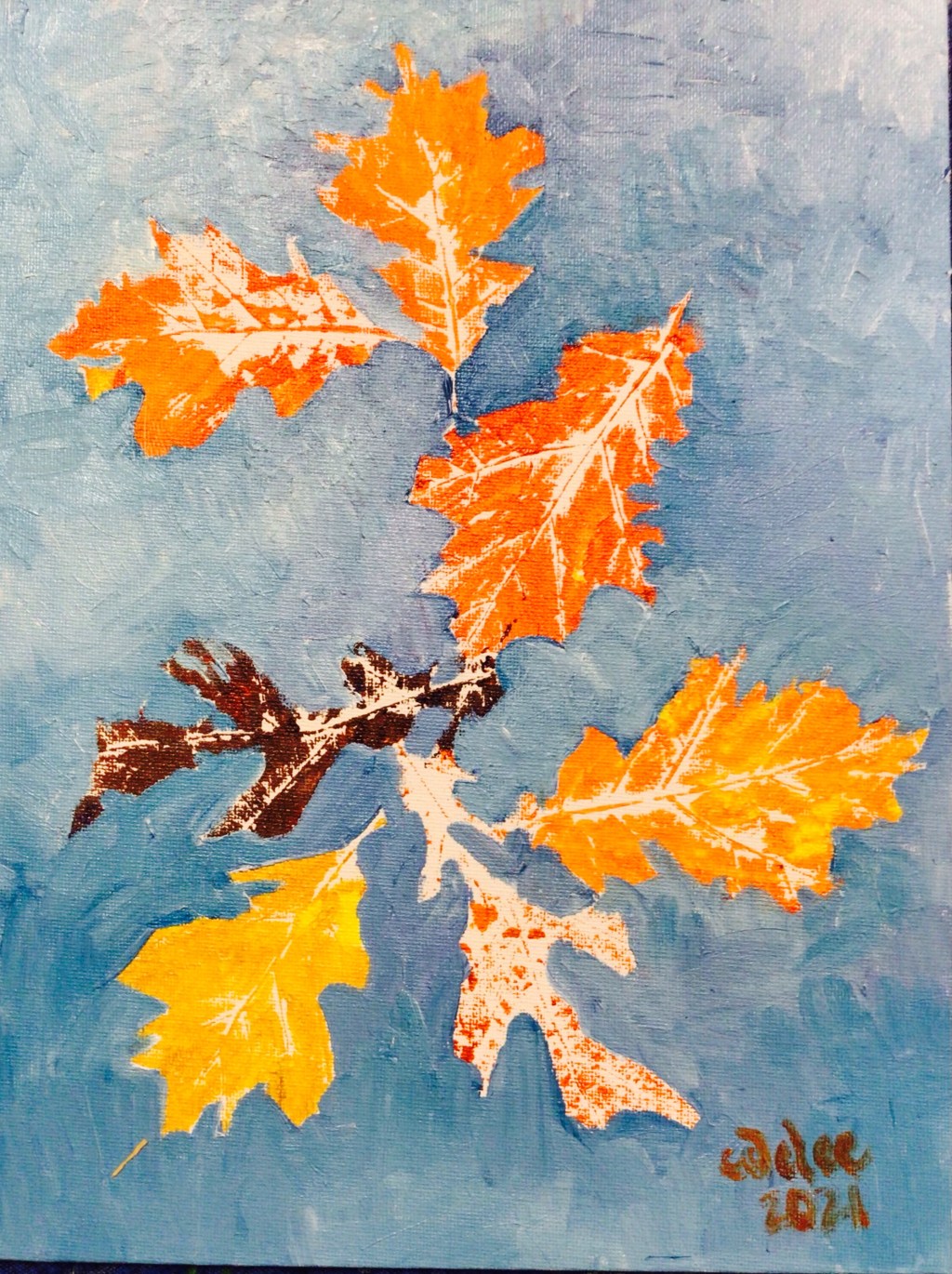
September 22 is the Fall Equinox. We’re already seeing signs of seasonal leaf color changes, due to heat stress and drought. Some call this “False Fall,” but I call it a sign of hope. Trees will drop their leaves in order to survive in extreme conditions. Although some claim plants are sentient, they don’t have a brain or consciousness that we can recognize. They do interact and react to their environments. Their first priority is survival.  Photosynthesis and the subsequent leaf abscission after changing color is part of this process. I always look for the change of light which precedes this event. One morning last week, I noted the color of the morning light had turned cooler, and wasn’t the warm yellow of summer. I also had a spark of energy I hadn’t had before. I look forward to more daylight.

This bunny is very fond of September, since I’ve always been eager to start fresh and new. I always got new pencils and a new manilla paper writing pad when I started elementary school. Later on, as I progressed up in grades, ink pens with cartridges were a special treat. Even to this day, I keep my journals with hand written ink in good paper books. I love the feel of these materials in my hands. I probably would have stayed in school my whole life if possible. The day our brains quit learning something new is the day our minds begin to die.

School Bunnies and Friends

That leads me to remind my bunny friends that Alzheimer’s disease is the 7th leading cause of death in the USA and it’s the most common cause of dementia in persons over 65. While most of you may not be baby boomers, you young bunnies have grandparents or parents of that age. Today, about 6.5 million Americans have Alzheimer’s disease, but that number is expected to almost double to 12.7 million by 2050. Perhaps beginning September with World Alzheimer’s Day is a good reminder for all of us to be proactive about our health choices, so we can live independently as long as possible into our senior years.

Talk Like a Pirate

I also like Positive Thinking Day, since reframing negative thoughts into positive ones changes our attitude, our behaviors, and then we get better outcomes as a result. If you don’t feel like being Batman on the 17th, you can ARRRGUH yourself about, MATEY, as you Talk Like a Pirate on the 19th. Bonus points if you wear an eye patch, earring, and tricorne hat or bandana on your head.

The Jewish New Year of Rosh Hashanah begins at sunset on the 25th. It’s one of the four “new year” celebrations in their religious calendar. This one recalls God’s creation of humanity, as well as the legal new year. On this one night in September, when the faithful eat apples dipped in honey or other sweet sauces, they remember how God originally created humans in a sinless state and wish each other a good year to come.

Magic Bacon Carpet Ride

Did I forget International Bacon Day? How can any rabbit forget bacon? Someone will cut my carrot rations for the future, I fear. But if I remember to keep the coffee pot full, I’ll probably get out of the rabbit hoosegow before National Coffee Day on the 29th.

Some interesting holidays we can celebrate this month are: Better Breakfast Month (I suggest bacon, eggs, and pancakes on the weekend and old fashioned oatmeal during the week). There’s also Hispanic Heritage Month and National Sewing Month. Finally, every year on September 30th is National Love People Day. The purpose of the day is to show love to everyone—no exceptions. National Love People Day offers us the opportunity to show unconditional love, which many have never experienced. When we genuinely love our neighbors and express it with kind words and thoughtful deeds, we make our world a better place. This the true meaning of “love your neighbor as yourself.”

Maybe one meaning of loving your neighbor is offering a meal to them. Food insecurity is increasing once again, this time due to increased rents and costs of transportation. Consider a weekly meal service from your church building or organization’s meeting place. It doesn’t need to be fancy, but calories and nutrition would help hungry people have the strength to move on from their current situations. Joining with other groups to cover all the days of the week would be a bonus to your community, not only for the hungry, but also for the smaller groups who could team up to share in the blessing of loving their neighbors.

Until the spice is on the pumpkin, I wish all my bunny friends

Joy, peace, and Bacon,

Cornelia

America’s Ideal of Working Parents Has Become Unattainable – The Atlantic
https://www.theatlantic.com/family/archive/2020/06/working-parents-impossible/613429/

Beckman and Mazmanian: Dreams of the Overworked: Living, Working, and Parenting in the Digital Age

Gender differences on household chores entrenched from childhood | European Institute for Gender Equality https://eige.europa.eu/publications/gender-equality-index-2021-report/gender-differences-household-chores

Debunking a myth: plant consciousness | SpringerLink. https://link.springer.com/article/10.1007/s00709-020-01579-w

September Monthly Observances – National Day Calendar
INTERNATIONAL CHOCOLATE DAY – September 13, 2022 – National Today

Home – National Love People Day – National Love People Day

Alzheimer’s Facts and Figures Report | Alzheimer’s Association
https://www.alz.org/alzheimers-dementia/facts-figures


OAKLAWN FRIDAY ART CLASS

adult learning, art, Attitudes, brain plasticity, cognitive decline, Creativity, Faith, Imagination, inspiration, john wesley, Ministry, Painting, perfection, purpose, Retirement, United Methodist Church, vision

WE’RE BACK!!!

Ready or not, the creative juices must be stirred. If the brain has lain fallow all summer, or it’s been overworked keeping the youngsters occupied, now you can find your own groove again. Yes, it’s time for Adult Art Class at Oaklawn UMC.

Our first meeting will be Friday, September 9, at 10 am in the old fellowship hall. Bring your own acrylic paints, brushes, and a canvas or canvas panel to paint on. We begin with a short visual inspiration from some great art works, I’ll give some direction on the skill we’ll work on in the session, and then everyone is free to bring their own unique expression to their paintings. We don’t copy my work and judge how well a person can match it. We learn from the great masters and stretch our own skills to create something new.

Walter Nowatka: Abstract Ferris Wheel

Of course, making great art isn’t our first purpose. As we age, we will lose our ability to learn new skills until we lose our memory of what we just ate for breakfast. Challenging our brains is one of the best ways to keep our brain cells firing and “chatting with one another.” Our brains have the immensely powerful ability to remodel themselves because each of us have 1,000 trillion synapses, which are constantly being modified every second of every day. Socialization and encouragement also helps to keep our brains young.

Frank Lloyd Wright: March of Balloons

Of course, we have to give up our desire to be perfect. Perfection comes from practice, or working at it. Every baby stumbles and falls when they learn to walk, but dotting adults encourage every trembling step. This is what art teachers also do. I’ve always had a rule in my classes, especially when I taught in middle school: No Negative Talking about People or Art. This included a student’s own art works. They always had to give at least three positive comments about their work before they spoke about the negative. “My work needs improvement” became the replacement phrase for “My work stinks!”

De Fem. Titel saknas, 1908. HAK 1274. Kat. 12. 52,5 x 62,8 cm

Of course, we’ve all grown up and worked in environments where negativity is the rule. Art class is a place of grace because this is how life should be. If we can transform a blank canvas into a field of color, why can’t we transform our communities and our world into fields of hope, joy, and love? Perhaps because we try to make everyone copy/fit into our idea of the proper end product, rather than allow everyone discover their own creative response to the given subject of the day. The museums of our world are richer and more vibrant because artists have listened to the Spirit of the Creating God. We might do well to realize God’s creative energies are varied and vibrant also, just as Isaiah wrote about his vision of God’s Glorious New Creation:

“For I am about to create new heavens and a new earth;
the former things shall not be remembered or come to mind.
But be glad and rejoice forever in what I am creating;
for I am about to create Jerusalem as a joy, and its people as a delight.” (65:17-18)

James Wyper: City of Dreams

I hope to see you there. I don’t charge for the class sessions, since this is one of my ministries as a retired elder in the United Methodist Church. As John Wesley once said, “The World is my Parish.”

Joy and Peace,

Pastor Cornelia

Wes Ely: How long covid reshapes the brain — and how we might treat it

https://www.washingtonpost.com/outlook/2022/08/25/long-covid-brain-science-fog-recovery/

The Mosaic Christ

art, Creativity, Faith, Historic neighborhood, Holy Spirit, hope, Icons, incarnation, inspiration, Italy, mystery, Painting, perfection, Ravenna Italy, Reflection, renewal, Spirituality, Travel, vision

The Body of Christ is All of Us

The Body of Christ represents the perfection of all humanity as the image of God. The body of Christ we know as the church is made of many individuals, just as a mosaic design is constructed of many pieces to make a whole. I think of these as the “two bodies of Christ,” even though the literalists among us might think Jesus has only one body. The mysterious body of Christ is what Paul speaks about in his letter to the Romans:

“For as in one body we have many members, and not all the members have the same function, so we, who are many, are one body in Christ, and individually we are members one of another” (12:4-5).

I Am the Bread of Life: Macaroni Christ Icon

Since each one of us is made in the image of God, but of ordinary materials, together we become a mosaic of the whole Body of Christ, going onto his perfection as we encounter and encourage one another within and without the church. After all, the body of Christ isn’t limited to the walls of our buildings, for Christ said in Matthew 25:40—

“And the king will answer them, ‘Truly I tell you, just as you did it to one of the least of these who are members of my family, you did it to me.’”

I have a penchant for recycling canvases and paintings which no longer please me. I’m willing to destroy them and make something new. They die and are reborn into a new life. I learned something from that former experience, but now it’s time to move on. When I read my Bible, I’m always getting new inspiration and ideas from the same verses. I have texts I’ve preached on at least a dozen times, but I always came at it from a different angle. This is how we know the Bible is a living document and the Holy Spirit is always at work in us to reveal what we need to hear for our time and place.

Basilica of Sant’ Apollinaire: The Good Shepherd

We Christians in the Western world have tended to limit God’s self revelation to the spoken word and, to a lesser degree, to the Eucharistic elements in the Institution of the Lord’s Supper:

“While they were eating, he took a loaf of bread, and after blessing it he broke it, gave it to them, and said, “Take; this is my body.” (Mark 14:22).

Unfortunately, when we emptied the world of images of God, we also emptied the created world of God. This is why art is so important and necessary to bring us back to appreciate not only creativity, but also the creating God.

Likewise, images in art are beautiful and inspiring. Some which I’ve had the privilege to see in person over the years have made a difference in my artistic and spiritual journeys. These are a few which have inspired me: Byzantine mosaics in Ravenna, Pompeiian artifacts buried by Vesuvius, and the sacred treasures of the Vatican.

Emperor Justinian

I’ll focus only on the mosaics in Ravenna, which is the site of the Mausoleum of Theoderic (c.520) and the Basilica of Sant’ Apollinaire Nuovo (500-514), both built by Theodoric the Great (454-526). Here too is the Basilica of San Vitale (c.527-546), begun by Queen Amalasuntha (495-535), Theodoric’s daughter; and the Basilica of Sant’ Apollinare in Classe (c.535-549), built by the Greek banker Julianus Argentarius, who also financed the church of San Vitale. These were all very important people of their time.

San Vitale, Ravenna

Although many of Ravenna’s surviving structures have been heavily restored, the city remains the most important site of Byzantine art outside Constantinople, notably for its exquisite decorative art, including mosaics, relief sculpture, mural pictures, ceramic art, maiolica, ivory carving, marble inlays, goldsmithing, ornamented sarcophagi and much more. This treasure house of art objects made Ravenna a must see on our itinerary during my summer in Italy.

My parents gave me the choice of a car or a trip to Italy with the University Systems of Georgia for my college graduation present. Of course, I took the trip. Cars are everywhere and I could get my own one day or ride the bus if I needed to get somewhere. Italy was a trip of a lifetime, for we’d spend a whole summer in the studios in Cortona, and travel about the countryside on day trips during the session. I even got good enough with my Italian to hold small conversations with native speakers. People even invited into their homes for lunch, where I got my first taste of rabbit. These animals were sold live in the farmer’s market in Cortona’s town square on Saturdays.

At every site we visited, I stood amazed in the presence of some ancient and inspiring work of art. In the historic churches, the best artists and craftspeople of the era had the opportunity to put their skills to good use, for they were not only working for notable patrons, but also for God. Money wasn’t an object either, for extravagance for God was considered a good work worthy of a heavenly reward.

Of course, seeing the art works and experiencing the spiritual impact of the works in their setting are two entirely different things. On a tour, when huge groups of people are tramping in and out of the sanctuary, tour leaders raise their flags, signs, or ubiquitous water bottles to quiet their group before they give a lecture, and then they turn en mass like a flock of ducks, everyone exiting together to clamber onto the bus or to walk to the next place to view some sacred site.

Golden Mosaics in San Vitale

As a person on a spiritual pilgrimage, this experience can be quite jarring unless you prepare yourself in advance. Even though in that period of my life I wasn’t a believer in a personal god, nevertheless I was still seeking the mysterious experience of the presence of God. I found if I took a few moments of personal quiet to put my spirit in a receptive mode before I entered the holy spaces, I was able to ignore the chaos around me. No longer did I focus on the comings and goings of the people around me, but I looked up instead at the beautiful artworks and the glory the ancient artists wanted to give to God as they rendered the images on the walls or sculpted the images.

These mosaics are fantastic works of art, with each image made of thousands of tiny pieces of stone and glass. In the early morning light, the golden tesserae shimmer and reflect the sunlight streaming inside. When viewed in this light, the figures would see to float in a heavenly light.

6th-century apse mosaic of Sant’Apollinare in Classe.

The icons of Christ always have an other worldly look about them, as Jesus said,

“My kingdom is not from this world.” (John 18:36).

We always see in the icon the resurrected body of Christ, the heavenly body of Christ, not merely the physical body of Christ. As Paul reminds us in 1 Corinthians 15:44—

“It is sown a physical body, it is raised a spiritual body. If there is a physical body, there is also a spiritual body.”

This is why the icons have elongated faces, small mouths, and large eyes. Their facial proportions are not “realistic “according to “actual proportions.” In western art, representation of physical reality with perspective, foreshortening, and shading gives us a sense of earthly realism. Icon “writers” reject perspective, and other cues of reality to give their works a sense of “other worldliness.”

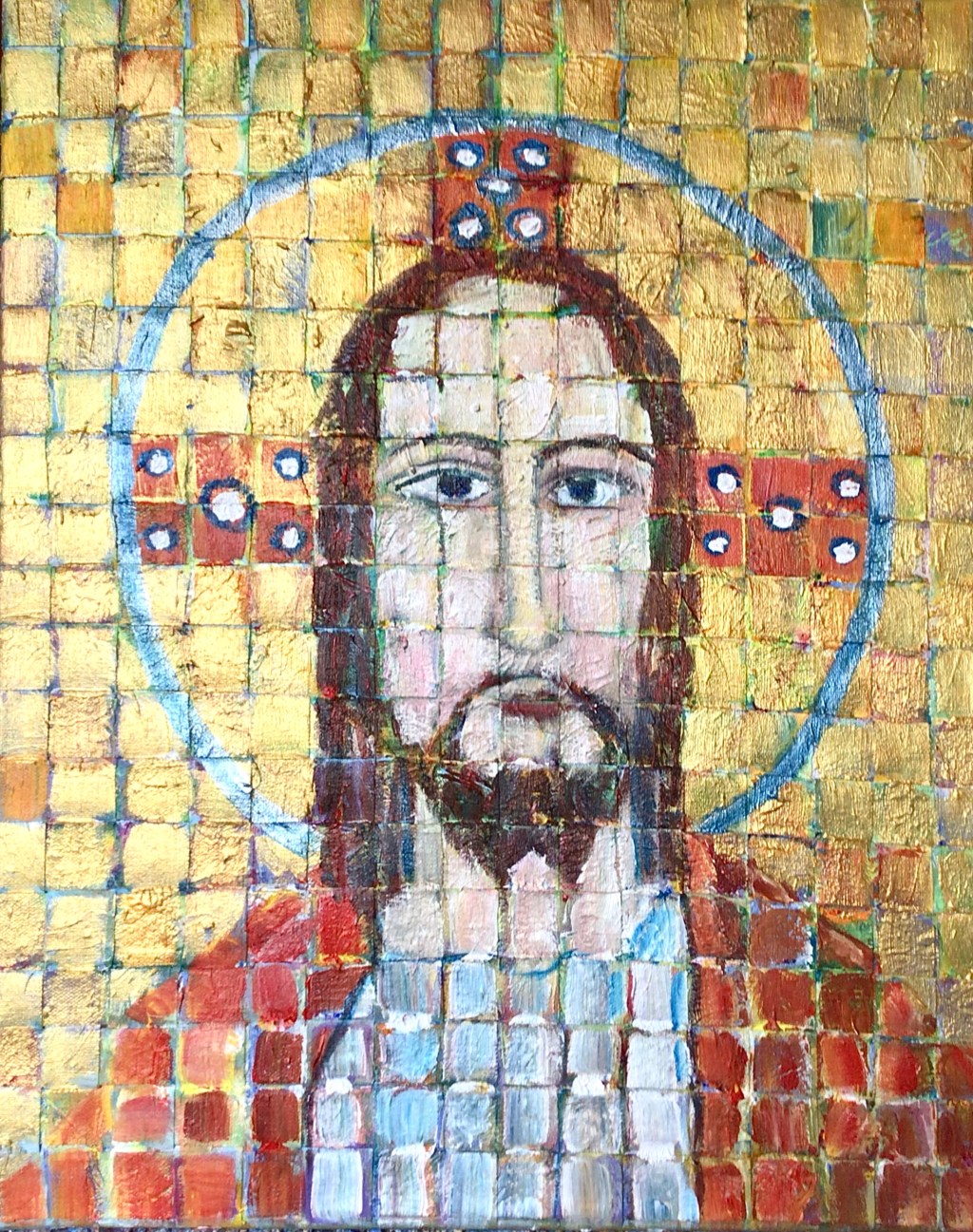
Mosaic Christ Painting

In other words, we see what we are going on to be, rather than what we are now. The icons are a window into the spiritual or heavenly world. If we have an icon in our home, it is a conduit to that heavenly world, much like a wormhole is a conduit to another point in space. Christ’s eyes have a far away look, as if he sees beyond this moment of now, in which we so firmly fix ourselves, to see the future hope of which the prophet Jeremiah speaks in 29:11—

“For surely I know the plans I have for you, says the LORD, plans for your welfare and not for harm, to give you a future with hope.”

This Mosaic Christ woven canvas art work has a light coat of gold acrylic paint over the multi colored background, so the colors show through. Because the brushstrokes don’t cover the whole square, the grid colors show up as colored mortar. The shape of the face and the hair aren’t treated subtly as in a painting, but take on the look of a mosaic.

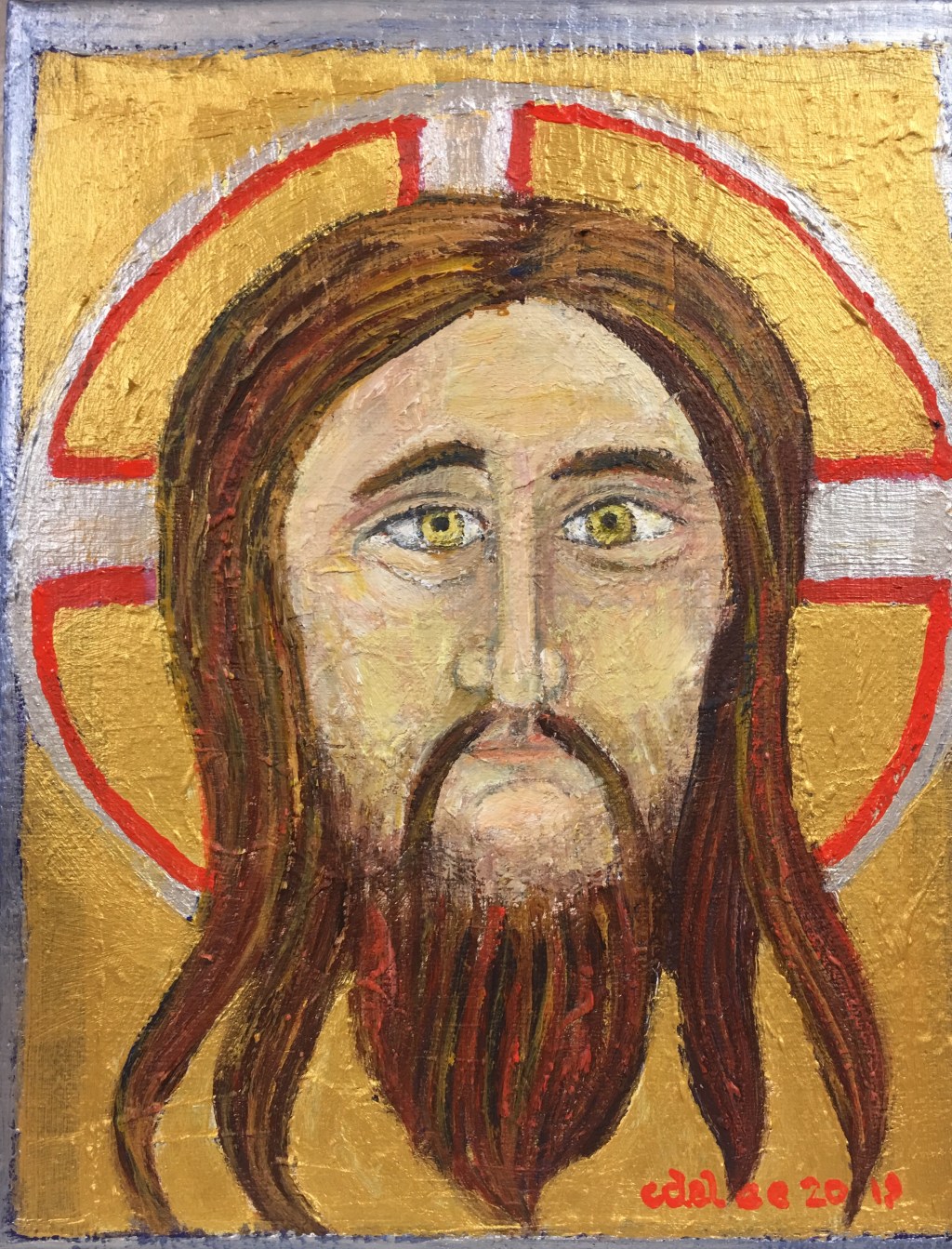
When I paint an icon, I lose all sense of time. I enter into that holy time in which God IS, and where Jesus is when he says, “Very truly, I tell you, before Abraham was, I AM.” (John 8:58) In other words, I lose all concept of chronological time and enter into the kairos time of God: the right and opportune time, which is known only to God. I stop painting when I sense I’m taking back control of the brush, for then I’ve left kairos time and reentered chronological time.

I look at the clock and think, “Snack time.” It’s time to stop, take care of my physical body, until I’m once again able to renter that spiritual space where time has no meaning, for I’m at home with God. Painting a holy icon is a truly spiritual experience, for those who make their hearts open to the opportunity to experience the holy encroaching into this world. I hope your eyes now are more opened to seeing the holy image of God in-breaking into this earthly realm.

Joy, peace, and sugar cookies,

Cornelia

Faith is a Gift from God

arkansas, art, beauty, change, Evangelism, Faith, Fear, generosity, Healing, Holy Spirit, hope, Icons, inspiration, john wesley, Love, Mandylion, Ministry, Painting, perfection, purpose, renewal, Spirituality, United Methodist Church, Van Gogh, vision

In the “late unpleasantness” which has some of our Methodist congregations in turmoil, many have their reasons for going or staying. As one born into the Methodist Church, who spent a portion of my life looking for a “better god” before God called me back home, I have some experience with faith. I’ve had it, lost it, and received it once again. My privilege in seminary to work along side the Wesley librarian allowed me to touch authentic Wesley letters. I also had the blessing of being the late Dr. Billy Abraham’s assistant for the Evangelism Chair. When I think of faith, Romans 12:3 comes to mind:

“For by the grace given to me I say to everyone among you not to think of yourself more highly than you ought to think, but to think with sober judgment, each according to the measure of faith that God has assigned.”

Here Paul’s word for faith is the Greek word pistis, which is always a gift from God, never something that can be produced by people. In short, faith for the believer is always “God’s divine persuasion” and therefore distinct from confidence or human belief. The Spirit continuously births faith in the yielded believer so they can know God’s will (1 Jn 5:4).

The former UMC Bishop Mike Lowery wrote in his notice of withdrawal from the Council of Bishops as he surrendered his elder’s orders: “I believe “We are in a fight for the faith delivered once for all.” (Jude 3, CEB).

Resurrection Christ

I’m not picking on the former bishop. I knew him from my Emmaus community days in Southwest Texas. But his posted letter, which can be read at the link below, charges the United Methodist Church has lost her Wesleyan understanding of Christianity. This piqued my interest, so I decided to focus my own thoughts, as well as to inform others, on this matter of faith.

Faith as Doctrine of Assent vs Doctrine of Assurance:

Today we often think of faith as a set of beliefs, or the Doctrine of Assent. In Wesley’s time, he understood faith as the Doctrine of Assurance, a unique gift to the Christian church, whereby believers can know with certainty they are truly beloved of God with a steadfast love which endures forever.

This love is unconditional and saves us from the tragic consequences of the law of sin and death by bringing us into the law of life and love through Jesus Christ’s life, death, and resurrection. That descriptive mouthful is John Wesley’s heartwarming experience he had at Aldersgate in 1738 on the fateful evening when he attended a meeting very unwillingly, yet had the heart changing event that set his life on a different path.

Christ Surrounded by Angels

Historic Wesleyan Faith is a Gift of Grace

We need to ask, “What is the historic Wesleyan understanding of the Christian faith, anchored in the Holy Trinity and welded to Christ as Lord and Savior?” Is it located in regeneration, aka the new birth, or is it located in human morality as proof of righteousness in Jesus Christ? This probably means nothing to people in the pews, but if we’re going to claim the mantle of John Wesley, or the argument from tradition, we must get Wesley’s understanding of faith down pat. We find Wesley’s thoughts in his Notes on the New Testament and in his Standard Sermons, both of which are part of our Methodist teaching.

In the sermon OF EVIL ANGELS, Wesley reminds us faith is “our evidence of things unseen.”

“Faith is the life of the soul; and if ye have this life abiding in you, ye want no marks to evidence it to yourself: but [elencos pneumatos/Spirit control] that divine consciousness, that witness of God, which is more and greater than ten thousand human witnesses,” is Wesley’s explanation of faith in AWAKE, O SLEEPER.

Faith as the Spirit of Adoption

Another way of saying this is Romans 8:15-17,

“When we cry Abba! Father! It is that very Spirit bearing witness with our spirit that we are children of God, and if children, then heirs, heirs of God and joint heirs with Christ.”

For Wesley, faith is a gift of salvation, our trust in the saving work of Christ. As he says in the sermon AWAKE OH SLEEPER:

“Awake, and cry out with the trembling jailer, ‘What must I do to be saved?’ And never rest till thou believest on the Lord Jesus, with a faith which is His gift, by the operation of His Spirit.”

Then Wesley gives his altar call:
“In what state is thy soul? Was God, while I am yet speaking to require it of thee, art thou ready to meet death and judgement? Canst thou stand in His sight, who is of ‘purer eyes than to behold iniquity’? Art thou ‘meet to be partaker of the inheritance of the saints in light’? Hast thou ‘fought a good fight, and kept the faith’? Hast thou secured the one thing needful? Hast thou recovered the image of God, even righteousness and true holiness? Hast thou put off the old man, and put on the new? Art thou clothed upon with Christ?”

“Hast thou oil in thy lamp? grace in thy heart? Dost thou ‘love the Lord thy God with all thy heart, and with all thy mind and with all thy soul, and with all thy strength’? Is that mind in thee, which was also in Christ Jesus? Art thou a Christian indeed that is, a new creature? Are old things passed away, and all things become new?”

Mandylion: Image Not Made by Human Hands

Faith comes as a Gift. Our good works respond to Christ’s work.

Most of us are in agreement Wesley’s initial understanding of FAITH having to do with accepting Christ’s work for us as the only precondition for our salvation. There is no good deed or accumulation of good deeds needed to earn our salvation from God. What many of us have difficulty is accepting we also don’t earn our perfection in holiness by our own power.

Our Christian perfection is always a cooperative work of the Holy Spirit and our own spirit. As the Spirit works in us, we respond to work toward the complete renewal into the original image of God in which we were created. While it’s possible we might attain this perfect state in this lifetime, most Christians will attain completion in the purity of love of God and neighbor at the moment of death by God’s work, not by our own accomplishments.

Do the Born Again Christians Sin?

In Wesley’s sermon, “The Great Privilege of Those That Are Born of God,” he quotes 1 John 3:9—

“Whosoever is born of God doth not commit sin.”

The Golden Bridge—Ba Na Hills, Vietnam

Wesley admits people who are born again can err or make mistakes, but they don’t sin. That’s a bridge too far for many to accept today, for many of us are prone to judging others. We have a dysfunctional understanding of “perfection.” We think it’s like a Martha Stewart design, forgetting she has a whole staff of helpers to carry out her ideas. As one of my professors once explained it, “Once you’ve been to Waxahachie, you’ve always been to Waxahachie.”

If you don’t know Waxahachie, it’s a midsized Texas town about the size of Hot Springs, Arkansas. It was known for cotton in its hey day, and now hosts a crepe myrtle festival. Once you’ve been there, you can’t lose that experience. In the same way, you can’t lose your status of new birth. It’s a gift of the Holy Spirit, given by faith through Christ.

But some of us will try to throw it away anyhow. Wesley wrote in that same sermon, The Great Privilege, “Some sin of omission, at least, must necessarily precede the loss of faith; some inward sin: But the loss of faith must precede the committing outward sin.”

The Outward Appearance vs. The Inward Attributes

So, one who has faith doesn’t sin, since we have to lose faith in God to sin. In other words, we have to reject the gift freely given to us without price. As he also says in his great sermon on Christian Perfection, “Every one of these can say, with St. Paul, “I am crucified with Christ: Nevertheless I live; yet not I, but Christ liveth in me:” [Gal 2:20]— Words that manifestly describe a deliverance from inward as well as from outward sin.”

Van Gogh: The Good Samaritan

Christian Perfection

For Wesley, the goal of Christian perfection, or the recovery of the image of God, was to love God and neighbor with one’s whole heart until nothing else could exist inside. No favoritism for a group, no exclusion for a group, no yearning to be better than others, no desiring a better place at the table, no hoarding of resources for selfish purposes, no fear of tomorrow, nor any other anxiety that strikes the human heart.

We give our resources away so we can have room for new blessings. God always provides for those who give with generous hearts. We open our doors to the least, the last, the lost, and the unloved, because Jesus and Wesley went out into the fields and met the people where they were. Those are our people out there, and they aren’t “living moral lives,” any more than the imperfect people within our churches are. But we all can and do live lives of faith. We all can learn to trust a savior who loves every sinew of our wounded and broken bodies. We can love a God who never gives up on us even if we’ve given up on ourselves.

Homeless Jesus Statue, Timothy Schmaltz

We United Methodists might be messy, but we surely can love God and neighbor. Moreover, we’re all going on to perfection, even if some of us are moving more slowly than others. We’re still a community of faith, a people who trust God’s grace and one another to get through this thing called life together. We’ll bring each other along, for we’re not leaving anyone behind. We include in the great worldwide Body of Christ the body of Christ whom we meet outside our doors. After all, the race isn’t to the swift, but to the ones who help their brothers and sisters to the finish line, where we have a finishing medal for everyone, along with a big potluck dinner with enough food for folks to take home leftovers. That’s the never ending banquet table to which we invite all who hunger and thirst for community—both spiritual and personal.

The Word of God holds the Scripture of Salvation

Trusting Faith for a Risky Love in Unsettled Times

All we have to do is ask ourselves in this unsettled time: “Do I have Wesley’s trusting faith to live this risky love? Are these the people with whom I want to experience God’s steadfast love and share the grace of Christ? This is our heritage in the United Methodist Church, for we’re a people of faithfulness, who believe the “Bible has everything sufficient for salvation.”

I can only hope for those who leave, whether they become global Methodists, independents, or community congregations, that they will provide a large enough tent for our big God and big Christ, for the Spirit always is seeking people and places to fill completely with the gift of God’s extraordinary love and power.

Why not become all aflame with the fire of God’s redeeming love?

My prayer is our United Methodist churches will receive a fresh rush of the Spirit to become even more of what we are today, for

“Who will separate us from the love of Christ?“

Joy, peace, and faith,

Cornelia

Strong’s Greek: 4102. πίστις (pistis) — faith, faithfulness
https://biblehub.com/greek/4102.htm

Crossing the Rubicon: A Bishop Says Goodbye to the United Methodist Church
https://firebrandmag.com/articles/crossing-the-rubicon-a-bishop-says-goodbye-to-the-united-methodist-church

Of Evil Angels, sermon by John Wesley
http://wesley.nnu.edu/john-wesley/the-sermons-of-john-wesley-1872-edition/sermon-72-of-evil-angels/

Awake, Thou that Sleepest, sermon by John Wesley
http://wesley.nnu.edu/john-wesley/the-sermons-of-john-wesley-1872-edition/sermon-3-awake-thou-that-sleepest/

The Great Privilege of those that are Born of God, sermon by John Wesley
http://wesley.nnu.edu/john-wesley/the-sermons-of-john-wesley-1872-edition/sermon-19-the-great-privilege-of-those-that-are-born-of-god/

“Our standards affirm the Bible as the source of all that is “necessary” and “sufficient” unto salvation (Articles of Religion) and “is to be received through the Holy Spirit as the true rule and guide for faith and practice” (Confession of Faith).”
Theological Guidelines: Scripture
https://www.umc.org/en/content/theological-guidelines-scripture

On Christian Perfection, sermon by John Wesley
http://wesley.nnu.edu/john-wesley/the-sermons-of-john-wesley-1872-edition/sermon-40-christian-perfection/

NOTE: For a longer discussion on “Love thy neighbor,” see—
Kierkegaard, D. Anthony Storm’s Commentary on—Works Of Love
http://sorenkierkegaard.org/works-of-love.html

John Wesley’s Notes on the Old and New Testaments. http://bible.christiansunite.com/wesindex.shtml

Sermons of John Wesley, 1872 edition
http://wesley.nnu.edu/john-wesley/the-sermons-of-john-wesley-1872-edition/

The Chair

adult learning, art, Creativity, Forgiveness, Holy Spirit, hope, Imagination, incarnation, inspiration, john wesley, ministry, Painting, perfection, photography, picasso, purpose

The everyday objects around us are like so much white noise: we know they’re present, but after a while, we tend to ignore them. A running joke among the clergy is “Never move anything at the new appointment for six months because you don’t know what objects are the sacred cows.” I learned this the hard way in my first full time appointment when I suggested we rid ourselves of an aging, olive green, velvet curtain hanging on the back wall of the fellowship hall stage, since “It was just hanging there for no purpose.” Oh, the outcries of rage! Little did I know this was the one and only curtain to survive the fire which destroyed the old church building. The people saw this ragged banner as a symbol of hope for the church they were rebuilding for the future. They had invested spiritual meaning into this curtain, even though it no longer served a spiritual purpose.

Picasso: The Chair, 1946

In the same way, we treat our Bibles as holy objects because they contain the inspired writings handed down over the centuries. We recognize they tell us important truths about God, humanity, and our relationship with the God whose steadfast love for God’s creation never wavers. In worship, we often say after reading from scripture, “The word of God for the people of God.” When many read John 1:1—

“In the beginning was the Word, and the Word was with God, and the Word was God.”

These same readers connect the “word of God” with the ”Word and the Word (who) was with God, and the Word was God.” The English translation of LOGOS to WORD derives from the Greek principle of Logos, or divine reason and creative order, which is identified in the Gospel of John with the second person of the Trinity incarnate in Jesus Christ. This is how the early Christian writers argued for the preexistence of Christ and for the existence of the Holy Trinity. When we refer to the Logos/Word of God, we are speaking of Christ. If we read the Old Testament, we’re speaking of the one God who has spoken through the ages, but only revealed God’s Son to humanity during the New Testament era. The Spirit has been active always.

This reminds us to honor the Bible for revealing the Incarnate Christ through inspired words, but not to idolize the Bible as a object greater than the God it reveals. After all, over the centuries, the Bible has been interpreted differently by various schools of thought. This brings up the question of how do we know what we know. There’s a whole body of philosophy dedicated to how we know what we know, called epistemology. There are various kinds of knowing:

  1. Sensory perception or observation of facts
  2. Reason or logic
  3. Authority of tradition or common wisdom
  4. Intuition, revelation, or inspiration

Some of us use one way more than others, but each has both good and bad points. In the case of the authority of tradition or common wisdom, for instance, some have been time tested across the ages, but deference to authority without critical thinking can be a mark of intellectual laziness on our part.

Wesleyan Quadrilateral

John Wesley’s famous understanding of what we now call the Quadrilateral comes from Albert Cook Outler’s discussion on how Wesley understood authority. When challenged for Wesley’s authority on any question, Wesley’s first appeal was to the Holy Bible. Even so, he was well aware that Scripture alone had rarely settled any controversial point of doctrine. Thus, though never as a substitute or corrective, he would also appeal to ‘the primitive church’ and to the Christian Tradition at large as competent, complementary witnesses to ‘the meaning’ of this Scripture or that.

However, Scripture and Tradition would not suffice without the good offices (positive and negative) of critical Reason. Thus, he insisted on logical coherence and as an authorized referee in any contest between contrary positions or arguments. And yet, this was never enough. It was, as he knew for himself, the vital Christian Experience of the assurance of one’s sins forgiven that clinched the matter.

Anglican Meme

In reality, Wesley’s diagram for how we know is really a triangle— consisting of Scripture, Tradition, and Reason—which leads to the Christian Experience of being a Child of God, forgiven for our sins. It’s based on the Anglican tripod of the faith: scripture, reason, and tradition. Wesley took the tripod and added the firm “seat of experience” of God’s loving mercy to forgive all our sins. This insight came out of Wesley’s life changing Aldersgate experience, which he recorded in his journal on May 24, 1738.

“In the evening, I went very unwillingly to a society in Aldersgate Street, where one was reading Luther’s preface to the Epistle to the Romans. About a quarter before nine, while he was describing the change which God works in the heart through faith in Christ, I felt my heart strangely warmed. I felt I did trust in Christ, Christ alone for salvation, and an assurance was given me that he had taken away my sins, even mine, and saved me from the law of sin and death.”

Wesley understood he could spend his whole life learning about God, reading about God, and even serving God to the best of his ability, but he was in his words, an “almost Christian” because he didn’t have the faith of a son or daughter who served God out of love, but had instead the faith of a slave or a servant, who served only from fear of punishment. One of Wesley’s Standard Sermons is the “Almost Christian,” which you can read in its 18th century glorious English at the link below. Most of us would be glad to be accounted in the “almost” category, but Wesley asks, why don’t we go farther and become “altogether Christian?”

In Methodist terms, this is “entire sanctification,” or “going on to perfection.” We don’t talk much about this any more, but it’s the purpose of our Christian life to be conformed to the image of God. We aren’t trying to be like Beyoncé, JayZ, Taylor Swift, or Jake Owen. Instead we have the promise in Romans 8:29—

“For those whom he foreknew he also predestined to be conformed to the image of his Son, in order that he might be the firstborn within a large family.”

David Hockney: Walking Past Two Chairs

We don’t do this on our own, but with the assistance of the Holy Spirit. That’s why the Spirit is called a helper, for it’s a coworker in the process of perfection or sanctification. This epistemology for knowing is useful for art classes also. Some of us believe we need to be perfect from the get go and can’t accept our raggedy messes we produce as we learn the techniques of color mixing and shading, much less the fine motor coordination required to connect our thoughts with our hand movements. If we aren’t able to endure the rough edges of imperfection as we “go on to perfection,” we won’t last long in art class. Just learning how to see the three dimensional world and translate it onto a two dimensional surface is a Mount Everest accomplishment in itself. Some days we have no energy to cope, and that’s when we need to come for support and encouragement.

Last Friday we painted chairs. Every artist’s work we viewed for inspiration had a different take on the chair. We no longer have to make a photographic rendering of an object because we have cameras for this purpose. We can use the chair as a reason to break up the picture plane and organize the spaces. I found a funny little poem called “The Chair,” by Theodore Roethke:

A Funny Thing about a Chair:
You Hardly Ever Think it’s There.
To Know a Chair is Really It,
You Sometimes have to Go and Sit.

Sally’s Chair

As the class went on, Sally decided she wanted to copy one of the inspiration images. She’s new, so she was practicing color mixing with her limited palette. When she couldn’t get the bright turquoise color, I brought my manganese blue over and mixed it with her titanium white. The color she wanted came popping out, much to her delight. “I’m going to buy me some of that color.” Sometimes all we need is the right materials.

Lauralei’s Shower Chair

Lauralei’s humor takes the cake with her shower chair. She can imagine the model chairs in a new environment. She doesn’t let the reality limit her options.

Gail’s Chairs

Gail divided up the canvas into various planes of colors, which sing for joy. I think she had fun. As the only one of our group who took the challenge of the entire scene, Mike took a bird’s eye view of the table and chairs. I hear he may be traveling again, or at least yearning to fly away from the day to day grind of full time work to something closer to retirement.

Mike’s Chairs and Table

I can understand that feeling. After years of teaching school, I look forward to summer vacation. We’ll have art class on the last two Fridays of May, and then take the summer off. Our current plan is to return on September 9, the first Friday after Labor Day. In the meantime, if you want to know how God really is,

“Be still, and know that I am God!” ~~ Psalms 46:10

A fun summertime activity is building a chair fort or a chair cave. All you have to do is turn over a couple of chairs on the floor and throw a sheet or blanket over them. This provides a quiet place for a child of any age to have a “time out” alone during a long summer. I recommend a quiet place for children of all ages, even those who’re long of tooth.

Cornelia’s Chairs

Joy, peace, and a quiet place,

Cornelia

Experience in the so-called “Wesleyan Quadrilateral” | Kevin M. Watson
https://kevinmwatson.com/2013/05/13/experience-in-the-so-called-wesleyan-quadrilateral/

The Wesleyan Theological Heritage: Essays of Albert C. Outler: Albert Cook Outler, Thomas C. Oden, Leicester R. Longden: 9780310754718: Books
https://www.amazon.com/gp/product/0310754712/ref=as_li_ss_tl?ie=UTF8&camp=1789&creative=390957&creativeASIN=0310754712&linkCode=as2&tag=deeplcommi-20

Sermon—The Almost Christian by John Wesley via Words Of Wesley Quotes
http://www.wordsofwesley.com/libtext.cfm?srm=2&

Great Blog by Adam Hamilton on biblical authority and how we read the Bible in different eras
https://www.adamhamilton.com/blog/the-bible-homosexuality-and-the-umc-part-one/

This is the Way

adult learning, art, beauty, change, Children, Creativity, Faith, Holy Spirit, Imagination, inspiration, ministry, mystery, nature, Painting, purpose, Reflection, risk, shadows, Socrates, Spirituality, vision

Are we our works? Are we valued by our works? Is work a noun or a verb? The child in me asks these questions until the parent in me wants to answer, “I don’t know. Go ask Alexa!”

Alexa Meme

We’ve all been there with the rug rats of our families and kinfolks. Children are curious and for this we’re grateful. This incessant questioning is their way of learning about the world. It’s altogether better than a puppy’s chewing on every new object it comes across. If families are to encourage their child’s interest, they get them a library card so they can have internet access and books to read, and they answer as many questions as possible. If they don’t know the answer, “Go look it up in Google or the encyclopedia.”

In ancient Greece, Socrates taught by asking his students questions, a technique we call the Socratic Method. Some of us teach art in this way also. When we see the student at a stopping point, we teachers ask, “Are you having a problem and not figuring out a solution?”

Raphael: School of Athens , Vatican City, 1509-11.

The student can usually point out what they want to change on their work, but they don’t have the experience or prior learning to drawn upon to solve it. For instance, if the flower petals all look flat because they’re painted in one color, the beginning student knows this doesn’t look right, but they need a trained eye to point out the variety of values in the petals. Once they see the gradation of light to dark, it’s never again unseen. We know it’s there.

Teachers can point out the range of values from dark to light that make up the visual vocabulary of shading a two dimensional image so it looks like a three dimensional shape. Students can learn this technique and master it over time. Mastery then becomes a matter of hand and eye coordination. In a sense, we have to lose ourselves in the subject matter so we can let its energies enter into our hearts and minds, and quicken our hands. The rest is a matter of practice and learning how our egos can quit controlling the outcome.

Old Farmland off Higdon Ferry Road

The spiritual writer and Jesuit priest Richard Rohr speaks of the three eyes in his book, The Naked Now. The first eye grasps what the senses can understand, the second eye understands the science and poetry, while the third eye is aware of all of the above, but especially how all things connect as part of God’s great mystery. When we enter into this “now,” we’re present not only to God, but to all creation, as well as our own selves. This is the contemplative spirit for which the artist strives, and not just for the mastery of the materials or for the rendering of the subject matter.

If we allow this energy to move our hands, does that mean our work also becomes part of us? If we baked a simple yellow cake out of a box, we might not ask that question. When we start decorating a cake made from scratch and adding frillies of frosting, then we start identifying with the cake. Should someone smash the cake enroute to the soirée, there’ll be hockey sticks to pay.

I remember almost fainting in Italy when I saw a glue blob on one of my delicate watercolor paintings, which had just been framed for an exhibition there. A stiff shot of some unknown alcohol brought me back to life. The framer made it good, for the glue was water soluble, so we could gently lift it up. I was more of a drama Queen in my 20’s also. I take things as they come these days. I also was more immature, for I didn’t separate my work from my identity.

Some say we are what we eat, so then are we what we create? Jesus had an answer in Mark 7:18-19 for those who thought certain foods were unclean, or forbidden to eat:

“He said to them, “Then do you also fail to understand? Do you not see that whatever goes into a person from outside cannot defile, since it enters, not the heart but the stomach, and goes out into the sewer?” (Thus he declared all foods clean.)”

That fancy dinner we ate two nights ago leaves us after a few cups of coffee in the morning. We don’t recognize it and most of us don’t even inspect it as we flush it down the toilet on its way out the sewage pipes to the sanitation station. Of course, only parents can get excited about their two year olds who manage to do their “business” in the toilet instead of in their diapers. I know I was one of those. If Facebook had been invented back in the day, I’m sure I’d have posted an update.

As we grow older, we enjoy making and crafting for the experience of the textures and the command of the materials. Children have fun pushing the paints, papers, and glue all around the surface of their artwork. Parents often look askance at the grey, scribbled messes their children excitedly present to them for the honored place on the refrigerator display, but these muddy creations are the result of a dramatic story of their child’s imagination. “Interesting, why don’t you tell me what’s going on here?” Is an adult’s best response in this situation.

Art Lesson: Cut a Snowman on the Fold

I’ve had kindergarten children meltdown because they had difficulty cutting a snowman on the fold. It’s hard to be five years old and live in a home in which the parents don’t want their children to make a mess. These children, as a result, have poor fine motor skills, have difficulty writing, and handling scissors. Even folding a piece of paper is tough. Then they miss the important information: hold the fold, and cut on the flaps. If they hold the flaps instead, they end up with two halves of a snowman. And a meltdown into tears.

“I’ll never be able to make a snowman! My snowman is cut in two pieces. Why can you make a perfect snowman and I can’t?”

Therapy Hat

This lesson always called for me to wear my therapy hat, and remind my five year old students I’d been making folded snowmen for a very long time and my first ones looked just like theirs did. There was hope for them. We just needed to go over the directions again and make one together. Sometimes we miss a step, and that’s ok. It’s just a piece of paper. It’s not like we took away recess from everyone forever.

Usually when we went over the directions again, I could remind them of the way to hold the fold and cut the flaps. Then they’d all be amazed at how easy the project was. “Everything is easier when you follow the directions.” They’d laugh and start decorating their snowman, all their meltdowns forgotten.

Most of us aren’t successful the first time we attempt a new experience. If we were all extraordinary artists right off the mark, none of us ever would get excited about Michelangelo, Rembrandt, or Picasso. If we could all pick up a musical instrument and play it well right off the bat, who’d have the need for civic symphonies or even bar bands? We’d all be happy making our own music. The truth is some of us not only have the interest and inclination, but also the will to spend not just hours, but years, honing our craft, until we sing our notes purely or paint with a master’s hand.

Woven Canvas: Greenway Park

If we all aren’t masters, we all can enjoy the journey if we learn to detach our egos from our products. When I wrote papers in seminary, before I opened up my graded work, I’d repeat the mantra, “I am not my grade. I am a daughter of the living God, chosen for God’s work.” Then I’d look at the markings on the inside. This helped me to remember who I was, whose I was, and what my purpose was. I was also two decades older than that fainting child in Italy.

As I would tell visitors to Perkins, “If your well-being is wrapped up in your grade average, you might want to rethink either that notion or choose another school.”
“Oh, really?”

“Yes, if you’re going on for a PhD, you’ll get over a 90 in your classes. The top grade for the Mdiv is 89. If you get any grade higher than that, the professor thinks you could do PhD level work.”
“That doesn’t seem right,” they said.

“It’s a curve. If you go elsewhere for a DMin, those schools know Perkins’ grading system. Think of it as an A at 89 and don’t worry about it.”

Some people can’t restructure their world so their 89 is an A, but if that’s the system they’re in, that’s how it is. If they have in their mind nothing less than a 95 will validate their worthiness, then if they do their degree work at Perkins, they’ll always be up against the immovable wall. When they go out into ministry, they’ll discover everyone they meet has a grading system. That can drive a person crazy, unless he or she decides the ultimate approval they seek comes from the one who says, “Well done, good and faithful servant.”

Likewise, if we’re beginners in art, we have to suspend our criticism of our imperfections in our work. Instead, we reframe our critiques into “areas which need improvement.” Even now, after decades of working in my studio, I’ll let a canvas rest near me in my living room. I’ll eye it in different lights, until I hear it call my name. I’ve totally repainted some of these, and others I’ve destroyed. A few I leave alone. All of us will keep learning something new, both from our “good paintings “ and our “need improvement works.” Most likely, artists quit painting when they they think they have nothing left to learn, or when they lose the courage to risk moving into the unknown mystery, as it’s written in 1 Corinthians 2:9—

“What no eye has seen, nor ear heard, nor the human heart conceived, what God has prepared for those who love him.”

Paul also writes in Romans 8:27-28,

“And God, who searches the heart, knows what is the mind of the Spirit, because the Spirit intercedes for the saints according to the will of God. We know that all things work together for good for those who love God, who are called according to his purpose.”

Poverty Point World Heritage Site, Louisiana

So we too ask the Spirit to work more in us and free us from attachment to our need to be loved and affirmed by our works, since God is already working for good for those who love God and who are called according to God’s purpose. As we drop our old ideas and preconceived notions of the good, we become open to God’s good and God’s purposes. Releasing control to God is an act of humbleness and faithfulness, both of which are contrary to our modern belief in self-actualization and autonomy. This is the way of the mystic, or the contemplative, and the inspired artist.

Gastrointestinal Transit: How Long Does It Take?
http://www.vivo.colostate.edu/hbooks/pathphys/digestion/basics/transit.html

The Naked Now: Learning to See as the Mystics See – Kindle edition by Rohr, Richard. Religion & Spirituality Kindle eBooks @ Amazon.com. (Also available in iBooks, for more money)
https://www.amazon.com/Naked-Now-Learning-See-Mystics-ebook/dp/B011H5IKU8/ref=sr_1_1?crid=2GSFR51RZ25BM&keywords=richard+rohr+naked+now+ebook&qid=1645568603&sprefix=richard+rohr+naked+now+ebook%2Caps%2C107&sr=8-1

The Heart of the City

arkansas, art, change, city, cognitive maps, Creativity, Historic neighborhood, hope, Imagination, mystery, Painting, trees

Cities are growing organisms, each having their central growth from their place of origin. Some begin on a waterfront, as a place of trade. Other communities began along a creek, where people would meet to connect, trade, and settle differences in peace. These were safe spaces, welcoming places, but they existed only so long as everyone acknowledged them.

In our cities today, safe spaces are rare. Some reasons are we don’t know everyone anymore, since our populations are so large. We don’t know who to trust, so we trust no one. If we’re anonymous, we think can do what we want, since no one knows who we are and we don’t know whom we harm. Of course, this is absurd, for if we do harm to another, we aren’t living out our best life, not to mention we’re not living out the wisdom of “Do unto others what you want done unto yourself.”

“Who knows what lurks in the heart of man?” the old radio program asked. “The Shadow knows,” was the answer. Most of what we know as the city is hidden behind the layers of paint, wallpaper, and various accretions of dust in our historic district. In Hot Springs, we can eat hamburgers in buildings where mobsters would hang out, walk the streets where old time baseball players strolled, and take hot baths where our ancestors took the “cure” for every disease known to humankind. They got clean, but the cure didn’t take.

Autumn Facade, Downtown Hot Springs

We have a civic interest in renewing our old buildings, for they attract tourists and provide incomes for owners and workers in our restaurants, shops, and hotels of all sizes and qualities. We have dive bars and first-class accommodations within a mile of each other. This is a sure sign of a community in transition. I won’t name either, but if Hot Springs were to be the setting of an old-time radio show, it wouldn’t lack for interesting characters or venues.

During this pandemic era, for it’s stretched long enough now to be called such a lengthy time, I’ve been working on a group of cognitive maps. A cognitive map is any visual representation of a person’s (or a group’s) mental model for a given process or concept. Cognitive maps have no visual rules they need to obey. There’s also no restriction on how the concepts and the relationships between them are visually represented. If we were to take a number of people to the same place, we’d most likely end up with the same number of maps. Some parts might overlap, but everyone would notice different aspects of the landscape.

My own cognitive maps start with a screen shot of a google map of a place I’ve been prepandemic, and work in process through sketches, then several layers of paint, and finally, the end product. This last stopping point sometimes comes only after I think I’ve finished the painting, but I leave it sitting out where I can look at it some more. In the looking, I discover, I’m not ready to release this image out to the world. It lacks unity, power, focus, or some other defining quality I can’t put words to. I only know I am unhappy with it the longer I look at it.

When I cook a recipe, I have a certainty if I follow the directions, I measure correctly, and my oven is true to temperature, I’ll come out with a good approximation of the original recipe. Afterall, I’m recreating someone else’s process and instructions. Making something new, from the imagination is part of the creative process. Sometimes the end product arrives easily, but other times, its birth is a struggle, and the child arrives crying to beat the band.

Creekside Landscape, Hot Springs, 2021 springtime

Most of us are used to seeing the landscape from our upright view, for we walk through our world with our head up every day as we reconnoiter along our daily paths. Some of us keep our heads buried in our phones, so we depend on the good nature of others to keep us from bumping into them, or these people must have particularly good side vision to avoid collisions with other walkers. We don’t have the bird’s eye view of the city, so we don’t see how the streets connect or how they follow the elevation changes. We also don’t get to see the patterns of tree growth, or the hidden waterways. Mostly we have a patchwork vision of just the immediate areas we inhabit, but not a vision of the whole.

Greenway Park Map: Apple Pencil Drawing on Google Map

I saved a screenshot to my iPad so I could draw on it. Color for me has emotional energy, so as I drew, I over laid the first colors with others. The changes the drawing went through prepared me for the changes through which the painting would transition. This pandemic has certainly been a time of change, but life has always been changing. One of my old friends always said, “Human beings are meant to change. We’re brand-new people every 27 days! That’s how often we get a whole new skin.”

I spent many years in the church, an organization not noted for changing. It’s not the organization that doesn’t want to change, but the people. We find those same people resistant to change in NASCAR fans, football fans, and any other group you want to name. As one wag said, “It was the 56th Super Bowl and they finally had rap music in Los Angeles, and NASCAR had Pit Bull at the LA Coliseum for the Clash for the first time in 43 years. If you have a point, it’s time to make it.” If we don’t like change, we should quit washing our bodies, since we’re just hurrying those dead skin cells off to their final demise.

First Stage of Greenway Park Map Painting

Artists must embrace change, however, for the moment we put a mark on a canvas or tap a stone with a chisel and hammer, we’ve changed the surface before us. We can’t be afraid to go into the emptiness or the unknown, for there we’ll find the beauty of the unspoken or the hope of the silence in which we work.

This stage of the painting adheres closely to the drawn image. The blue streets define the city blocks and a few building shapes are notated. It’s a complicated street map from one of our older sections of town.

Second Stage of Greenway Park Map Painting

On this repainting, I balanced the colors better, but kept the greens and oranges. I signed it, for I thought I was “finished.” I set it down in my living room to observe it for a while. I often do this with my work, for if it still looks good after six months, I think it’ll survive for a year. If it lasts a year, I think it’ll last longer. If I look at it three years later and it doesn’t survive, I’ll destroy it. This was painted during the winter, with the worst low light of the season. No wonder it looked grim under the brightening light of the returning sun.

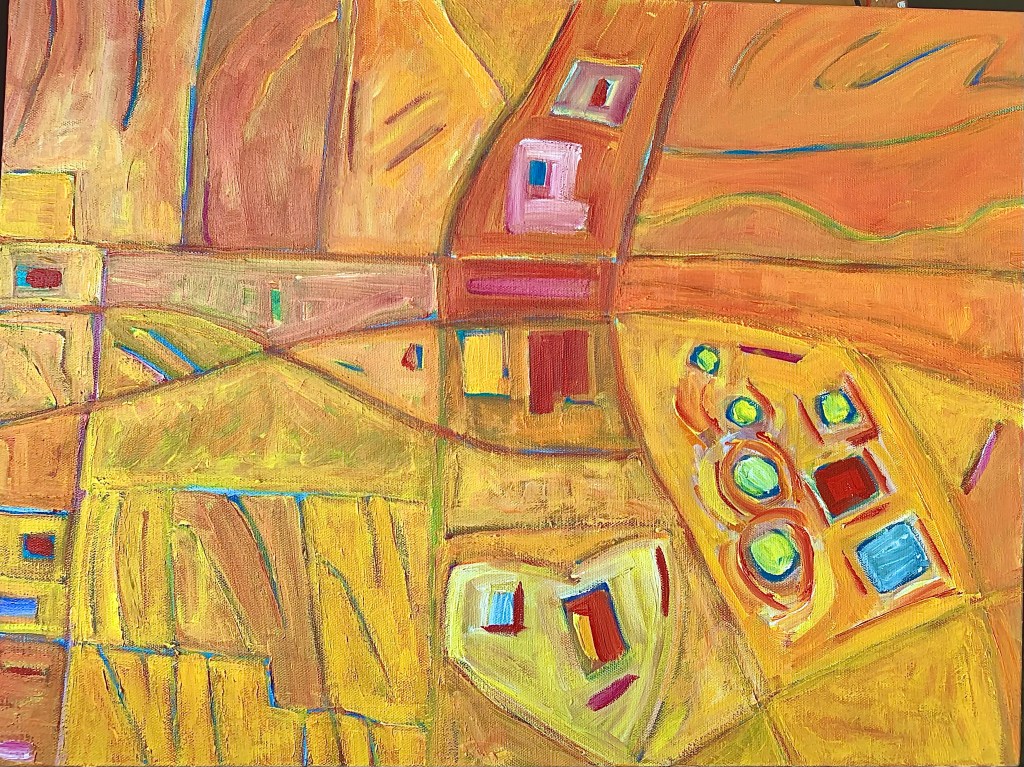
Final Stage Greenway Map

Some sunshine has come into my life here in the middle of February. I’m very sensitive to the transition of light across the seasons, so when it begins to leave in October, I start shutting down. When the light begins to return again, I awake, as if from a hibernation. Perhaps this is the reason I took all my yellows and reds and overpainted the other colors on the canvas. Now my canvas is almost monochromatic, except for small streaks and blobs of color in places. You can still see the city blocks and streets, but now the over all feeling is less of a map and more of an energy record of the city area.

This is the city as it grows, as it lives, and as it changes. The dynamics and life blood of the city move and pulse as it transforms. Hot Springs is unique in that we keep as much of our old as possible and build new when we must. I’m thankful for this city, for its love of the arts, and its honor of its history, as well as its embrace of the future.

After all, that’s all any of us can do, is remember who we are, whose we are, and give thanks to the one whose steadfast love remains forever.

Joy and Peace,

Cornelia

How Often Does the Epidermis Renew?
https://www.webmd.com/beauty/cosmetic-procedures-overview-skin

Simplify, Simplify, Simplify

adult learning, art, bottles, butterflies, Creativity, Faith, flowers, Icons, Imagination, nature, Painting, pre-diabetes, purpose, risk, Stress

When faced with a complicated task, what’s the first thing we need to do? I usually vote to have a cup of coffee and sit down to think about it. Some may call this procrastination, but I call it contemplation. I need to settle my mind, focus my senses, and discern the most important parts of my task. This is necessary, for if I were cutting off a limb from a tree, I’d sure want to get my body placed on the part of the tree that wasn’t going to fall. Keep the most important thing the first thing in mind is always the best practice.

Manet: Chrysanthemums and Clematis

Once our youth group from church went to the Appalachian Mountains for a mission work project. Most of our kids came from poor homes and we arrived in a single church bus, which for some reason the license plate hadn’t got renewed. The group even let me be the navigator. Only by the grace of God did we arrive, for I’m known to be directionally challenged among all my friends.

The other group who attended this session with us came with another truck, complete with all their own tools. Our children were despondent at first, for they felt they couldn’t “compete.” Our adult team leaders reminded them, “We’re here to do the work God has called us to do. This isn’t a contest. Everyone has value and all our work counts toward the greater good.”

Cross Stitch Motto from my Mother

That big, well provisioned group got the job of replacing a front porch and a roof. They divided up into a porch and roof team. The porch team finished first, but then they got mad when the roof team had to destroy their work to put the roof on right. They had failed to talk out an overall plan first. If the roofers had started on the porch end, then the porch team could come behind them and work would progress along properly.

This is called team work in groups. Our small group was experienced in talking out the process before we began working, so we knew the consequences of our actions. “If…then” is always an important consideration, especially in our artistic endeavors.

If we’re familiar with the work of Dr. Stephen R. Covey, he talks about putting first things first by organizing and executing around our most important priorities. We live and are driven by the principles we value most, not by the agendas and forces which surround us. Pleasing others isn’t God’s purpose for us, but to do God’s work of loving all and serving the least of God’s people.

Spider Plants in the Classroom

When we look at a landscape, we have to select the primary image to emphasize, and relate the other forms around this important image. In the still life, we might drive ourselves crazy trying to paint every single petal, pistil, and leaf of some flowers in a vase, or we could find the most important shapes, which give us enough visual cues to let the viewer say, “Yes, this is a flower painting.” Not every leaf needs to be given the same attention, since our goal is to make a painting, not a rendering of the subject before us.

Cornelia’s Spider Plant Painting, 2020

Some might ask, “Why do we return to this well worn theme from time to time?” The best answer is we continue to learn from our repeated exposure to this theme. For another, our drawing skills improve over time, so we can see our progress. Also, our ability to handle the paint gets better, so we are more comfortable with mixing our colors and planning our composition. Besides, the great artists over the centuries have found this discipline fruitful, so if it benefited them, most likely we’ll get some good from it also. My nanny’s wisdom comes clear here: “What’s sauce for the goose is sauce for the gander.”

Beauty Berry Plant

When faced with so many shapes of leaves, a central stem, and a glass vase with ridges and reflections, our untrained brain wants to explode. We have to catch our breath, inhale, and exhale to cleanse our nerves. This is the point we begin our first simplification. If we note the proportions, the leaves are about the same height as the vase, and we can set the vase on a plane (the table) so it has depth. We can mark these off on the bare canvas with light pencil or a light wash of yellow paint. We’ll paint over it later.

Cornelia’s Beauty Berry Painting, 2020

The next step of simplification is to get the basic lines and shapes down. These don’t have to be perfect, but give you an idea of where you’re going to paint. If you do this in a pale wash, you can paint over it with the heavier colors in the more exact form. In sculpture, Michelangelo was known for chipping away from the stone everything that didn’t look like his subject. In painting, we add color, tint, and shade until it looks like our subject.

Cornelia’s False Wild Indigo

The final stage of simplification is to get the background in. Here you can paint up close to the individual shapes and “clean up the edges.” You can add highlights in places to bring out the foreground shapes, and add a shadow in the background for variety. By this time, the vase ought to be dry enough to put highlights on it also. Notice the leaves aren’t all the same color and they don’t bend the exact same way. Nothing in nature is perfect, for each part grows according to the amount of sun, shade, and nutrients it receives. As one of my old teachers reminded me, “Nature has no straight lines, so you never have to worry about that.”

Daffodils from 2019

To show you how sustained effort and intentional looking over time can helps student’s work improve, I offer the following examples from February, 2019, and September, 2020. One was the spider plants and the other the daffodils. I’m not sure who did these, so I won’t identify them.

Daffodils from 2019

I merely throw these in here because Gail and Mike have been working with me for several years. If practice hasn’t yet made perfect, it certainly has made improvements, and that’s all anyone can ask for. After all, we’re not asked to be perfect, but to go on to perfection (in love of God and neighbor).

Spider Plants from 2020

For history buffs a side note. Wild indigo is in the genus Baptisia, which derives from the Greek word, βάπτω, which means “to dip” or “immerse,” just as our baptism (βαπτίζω) does. North American indigenous peoples and early settlers would extract yellow, brown, and green dyes from the leaves and stems of wild indigo, notably blue false indigo (Baptisia australis) and other species. Indigo dye was extracted from yellow wild indigo (Baptisia tinctoria), but it proved to be an inferior source compared to the treasured true indigo (Indigofera species).

For years, wild indigo remained an obscure historical relic, its ornamental and ecological contributions undiscovered and under appreciated. Yet, in the springtime, wild indigo produces tall spikes of pea-like flowers that rise above the gray- to blue-green three-lobed leaves to provide nearly a month long display of color. The flowers sustain bumblebees and other winged pollinators, while the leaves feed the larvae of a variety of butterflies that include the wild indigo duskywing, frosted elfin, eastern tailed-blue, silver-spotted skipper, and various sulphurs. If you want to encourage butterflies in your garden, this is a hardy, drought tolerant, and deer resistant plant.

Gail’s Wild Indigo

Gail found the plants with their unique seed heads on a hike last week. This subject matter was received with more joy than my suggestion of apples. Evidently, what was good enough for the great master Cezanne is an acquired taste for my students. I might need to bring apple pie to soften them up. I’m not above bribery for a good cause. Besides, pie would be a great still life. Gail got a very detailed drawing of the leaves, the vase, and the grouping’s placement on the table. She sketched in the counterbalanced stick with its mossy growth. This was the quickest I’ve seen her work, for she’s usually very deliberate in her choices.

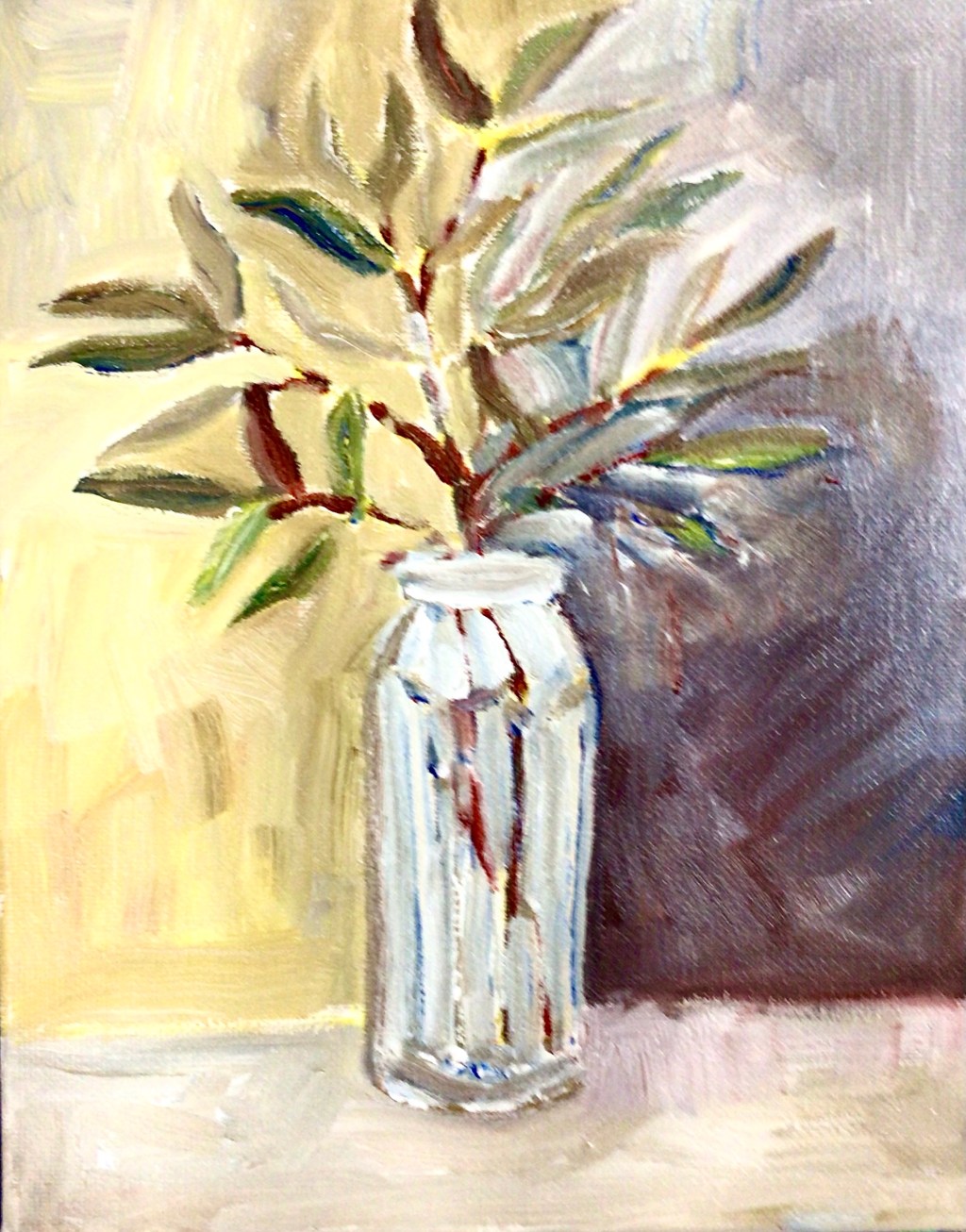
Mike’s Vase of Leaves

We had a full house last Friday, so Mike sat at a different table. He had to paint with the added burden of looking over his shoulder periodically to check his work. He began to paint more from emotions than from sight, which isn’t a bad choice. As long as his work carries enough of the vocabulary of the image to speak its message, he’s good with it. It’s the energy, the experience of painting, and using his mind to solve a problem in his own creative way that engages his interest. So if his painting looks “less real” than Gail’s, it doesn’t mean it’s less successful. He began from a different place, so his destination is also different.

Sally’s Vase of Leaves

A new member of our group, Sally is experimenting with techniques and tools, as well as the paint itself. This week she came with heavy body Liquitex paints, the professional quality paint, which has more pigment than binder. She was so used to the thin bodied paints, however, she watered down these excellent colors. When she asked why they weren’t working like she thought, I pointed out, “You’re supposed to use them straight out of the tube, thick.” This is why we have a group session, so we can learn together. Sally also had a new fan brush, which she used to make brown decorative marks all over her canvas. “I just wanted to try it!” Now that she knows, maybe she’ll plan ahead. I really like the swaying energies of her leaves. They’re happy and full of life. If this were in bright colors, Matisse would be proud.

Lauralei’s Vase

Lauralei brought an interesting solution to our subject this past week. The clear vase was a little intimidating, so she, like several others, colored it solid. When we first learn to swim, we want the security of water wings or the proximity of the edge of the pool. We all take small steps before we take bigger steps. She got the stick and fringed moss down and the many leaves of the plant.

Making all these decisions takes a lot of energy. Our brains use about 20% of our calories, so if we’re engaged in a new challenge, our blood sugar can dip if we’re not careful. If we aren’t aware of this, we can run out of energy or make careless choices. As someone who has prediabetes, I get low blood sugar easily. Stress and excitement can cause my blood sugar to dip. I always bring a small snack as well as eat a good breakfast with whole grain complex carbohydrates, like old fashioned oats. That snack is important, since I test my blood sugar before I drive home.

I’ve learned the hard way if my blood glucose reading is under 80, it’s falling and my driving skills will be going south too. I usually know I’m having trouble, for I can’t string two thoughts together and I begin to overwork my painting. I can’t make the good decision to stop while I’m ahead. Not everyone has this problem, but learning to recognize when you’re tired or just painting with no purpose in mind, is also an acquired skill. Taking care of our bodies so we can fully enjoy exploring a new adventure is a gift we can give ourselves. We only have one body in which to live out God’s purpose for our lives.

Dusty’s Icon of Vase and Leaves

Dusty concentrates well and gets a good shape on his canvas before he sets out to paint. I can’t read his mind, but it seems as he draws, the steps he needs to paint his image come into his mind. This is contemplating at a deep level. It’s not surface thinking, but an inner, deep knowledge that percolates up from within. I mention it’s an icon, for the tablecloth is tipped upward as if it were a background, not a flat plane on which the vase sits. This isn’t something he did by choice, since we haven’t done a lesson on perspective together. In the language of icons, the four cornered shape represents the world and its cardinal directions, or all creation. So we have one plant and all creation, as Paul said to the Romans (8:19-21):

“For the creation waits with eager longing for the revealing of the children of God; for the creation was subjected to futility, not of its own will but by the will of the one who subjected it, in hope that the creation itself will be set free from its bondage to decay and will obtain the freedom of the glory of the children of God.”

We’ll take Friday, February 4, off due to the frozen roads. On February 11, we’ll do paper Valentine collages. Y’all stay warm and safe. Eat hearty soups and enjoy the beauty of the snow.

Joy and peace,

Cornelia

Manet: Chrysanthemums and Clematis in a Crystal Vase, 1882, oil on canvas, Musée d’Orsay, Paris, France.

The 7 Habits of Highly Effective People®: Habit 3 – FranklinCovey
https://www.franklincovey.com/habit-3/

Wild or False Indigo | Home & Garden Information Center
https://hgic.clemson.edu/wild-or-false-indigo/

Autumn Leaf Prints

adult learning, art, autumn leaves, Carl Jung, Christmas, coronavirus, Creativity, Faith, grief, holidays, inspiration, nature, Painting, renewal, shadows, Spirituality, trees, vaccinations, vision

As the days grow shorter, the pile of leaves grows larger. This is Einstein’s equation for autumn. I know “Energy equals Mass times the speed of Light squared” isn’t really congruent with all those bags of leaves accumulating on the edge of the streets of the front yards in your neighborhood. It just seems that way. When I bought my first little stucco, flat roofed house back in my hometown, the former owners reminded me at closing, “Be sure and rake the roof every autumn.”

Of course I forgot about this, until the twenty something major trees around my little flat roofed house dumped all their leaves on my roof. How did I know? When it rained, those leaves blocked the drainage holes, so water came inside the ceiling light fixtures of my kitchen in the back of the house. As soon as the rain quit, I had the ladder out and was filling the big, black garbage bags with soggy leaves. If you only fill them half way, they’ll stay intact when tossing them over the parapet. I was younger then, and trainable. I didn’t forget when autumn came the next year.

Gail’s Leaves floating on Water

I’ve always thought leaves “fell” off the trees or the wind blew them off, but I asked Mr. Google, “Why do leaves fall?” Turns out, the trees cut them off with scissor cells. The leaves are only useful for making food for the tree. They are the seasonal kitchen staff, so the tree lets them go for the winter and brings in a new crew in the spring. The changing light and cooler temperatures triggers a hormone that makes this happen.

The scissor cells are stained red and mark the boundary between the branch (left) and the leaf stalk.
University of Wisconsin Plant Image Teaching Collection

If the leaves stayed on the tree, they’d wake up during a winter warm spell, start their food production work, and then get frozen when the cold inevitably returns. The tree knows the lifespan of the leaf, and this is the natural course of the life cycle. New growth will come in the spring, after a period of rest and recovery.

Lauralei’s Memories of The Leaves that Were

Our holiday season coincides with darkening days and marketing excess. Most of the commercials show happy families with lots of presents in heavily decorated holiday environments. Statistics show 25% of people are estranged from their families, and one out of every 463 Americans alive at the beginning of 2020 has since died of covid-19, the disease caused by the novel coronavirus. About 1 in 8 Americans say that a member of their family died of the virus; another fifth say that they lost a close friend, according to YouGov polling. These are staggering numbers, for in the US alone, 779,293 people have lost their lives as of November 30, 2021. One too many Thanksgiving tables had an empty place setting for a loved one no longer among us, and this will be a blue Christmas for many families.

If this were a war, maybe folks would get all excited and consider good health practices such as mask wearing , hand washing, and vaccinations their patriotic duty. Instead, they throw themselves into the breach of a thousand tiny viruses as if they were seeking the congressional gold medal for valor, and end up leaving their families with nothing but medical bills, grief, and the loss of their presence. Into this weary season comes Omicron, yet another variant, but an expected event due to the lack of worldwide access to vaccines and the virus’s ability to mutate in immunocompromised individuals. The enemy keeps evolving and the battles continue, whether we’re weary of the struggle or not.

“The Falling Leaves,” by Margaret Postgate Cole of England, is one of the first anti-war poems from a woman’s perspective. It was written in November 1915, during the First World War, when from 1914 to 1918, Flanders Fields was a major battle theatre on the Western Front. A million soldiers from more than 50 different countries were wounded, missing or killed in action there. Entire cities and villages were destroyed, their population scattered across Europe and beyond. The tradition of poppies on Veterans Day came from the red flowers given life from the blood spilled on this battlefield. COVID today is exacting it’s own cruel battle toll, with children left orphaned and spouses left without their mates. The adverse affects on this generation may be equal to those who went through the great flu pandemic of 1918 or the Great Depression.

War may be necessary in some instances, but it’s never to be glorified. There’s always a sadness related to the loss of life, regret over the great expense poured out that might have been used to build rather than destroy, and the cruelties that attend actions when we make others into evil enemies and refuse to see them as human as we are. Her poem speaks poignantly to this human loss:

Today, as I rode by,
I saw the brown leaves dropping from their tree
In a still afternoon,
When no wind whirled them whistling to the sky,
But thickly, silently,
They fell, like snowflakes wiping out the noon;
And wandered slowly thence
For thinking of a gallant multitude
Which now all withering lay,
Slain by no wind of age or pestilence,
But in their beauty strewed
Like snowflakes falling on the Flemish clay.

Source: Margaret Postgate’s Poems (1918)

If we want to treat these end of year days as “days of denial” of all that’s grim in the world to focus only on the good and the light, we’s be like people who claim we have no shadow. Carl Jung believed the shadow included everything in the unconscious mind, good or bad. Also, the shadow might include only the part of the personality that you don’t want to identify as self, but still is a part of your unconscious mind. This dark side of your personality contains everything your conscious mind can’t admit about itself.

When we read the birth story of Jesus, we often focus on the angels and the gifts of the magi. We forget these heavenly hosts are God’s armies and the magi came to meet the new king. These were revolutionary acts that caused King Herod to feel insecure and threatened, so he slaughtered the innocent babies born at this time. The Bible never forgets this shadow side of life, for this is why Christ came into our world:

“to give light to those who sit in darkness and in the shadow of death, to guide our feet into the way of peace.” ~ Luke 1:79

Joy and Peace,

Cornelia

Why Leaves Really Fall Off Trees : Krulwich Wonders… : NPR
https://www.npr.org/templates/story/story.php?storyId=114288700

The Depths Of Estrangement: Why Family Rifts Happen And How To Heal
https://www.wbur.org/hereandnow/2020/12/24/family-estrangement-holidays

[The Washington Post] Analysis | A third of Americans say close friends or family have died of covid-19
https://www.washingtonpost.com/politics/2021/10/13/third-americans-say-close-friends-or-family-have-died-covid-19/

Visit Flanders Fields | VISITFLANDERS
https://www.visitflanders.com/en/themes/flanders_fields/

KISS Principle and The Six Degrees of Hydrangeas

adult learning, art, Bartram’s Nursery, brain plasticity, butterflies, Creativity, Faith, flowers, garden, inspiration, Ministry, nature, Painting, purpose, renewal, righteousness, risk, Spirituality, Travel

These dried hydrangeas, a gift from North Carolina, traveled home with me from my vacation back east to see my youngest nephew marry the love of his life. My childhood friend cut them from the bushes in front of her beautiful retirement home in the Blue Ridge Mountains near Lake Junaluska, the famed Methodist Retreat Center. Her home is about an hour away from the Biltmore Estate, America’s largest home. I’ve now been to both historic places, known for their hospitality, and enjoyed the hospitality of two friends’ homes, who live not an hour apart. I knew both of these gals growing up back home, and now they know each other through me.

Hydrangeas and Coffee on a Cloudy Carolina Morning

Hydrangeas are native to America. Two well-known hydrangea species, among others, grow wild in North America — the H. aborescens (smooth leaf) and H. quercifolia (oak leaf). Their actual cultivation began in the 1700s. An historic trifecta of our forefathers’ estates is proof: Mount Vernon, Monticello, and Montpelier all cultivated these hydrangeas.

Bartram’s Garden, possibly drawn by a young William Bartram

William Bartram, of Bartram’s Nursery in Philadelphia, provided the seeds and plants for these historic homes. James Madison’s home, Montpelier, in Vermont, still has the creamy white heads of H. arborescens as a border for his garden wall. The Bartram Gardens were a natural history project begun by his father John Bartram and continued through the generations, with William’s love of travel and exploration leading to a four-year collecting trip to the American Southeast and the publishing of an account of his travels in 1791. It became a classic text in the history of American science and literature.

Documents from Mount Vernon record how in 1792, George Washington planted a native hydrangea, H. arborescens, on the bowling green at his home. Nearby, when Thomas Jefferson was designing his gardens and walkways at Monticello, he also included these new shrubs. Today, gardeners can purchase heirloom H. quercifolia seeds from the Thomas Jefferson Center for Historic Plants in Monticello.

The notion everyone is connected by just six stages of separation gained popularity in the early 2000’s based on scientific studies done in the 1960’s. The game Six Stages of Kevin Bacon was based on this idea. Today, due to social media and the internet, some people have only 3 or 4 stages of separation. Our founding fathers ran in the same circles, so their stages of separation were small.

Hydrangeas also come from Japan, where they’re the subject of many brush and ink paintings. The flowers hold a solid role in Japanese culture. The Japanese celebrate the hugely popular Ajisai (hydrangea) festivals in the blooming seasons of late spring and summer. Pink hydrangeas are given on the fourth wedding anniversary. Hydrangea gardens often grace the grounds of sacred Buddhist temples. People enjoy amacha, or tea from heaven, on April 8, Buddha’s birthday. Amacha is brewed from leaves of the Hydrangea serrata.

Steps ascending to Meigetsu-in Temple

While western churches are sited in lawns, as if they were sheepfolds to shelter the sheep within and protect them from the outer world, eastern Buddhist temples incorporate nature into their design and sites. This reminds us everything is one. As Father Richard Rohr reminds us in his book, The Universal Christ, the author of Colossians 1:19-20, puts this idea plainly:

“For in him all the fullness of God was pleased to dwell, and through him God was pleased to reconcile to himself all things, whether on earth or in heaven, by making peace through the blood of his cross.”

A classic example is the Buddhist Meigetsu-in Temple, which was founded in 1160 as a Rinzai Zen temple of the Buddhist Kenchō-ji school. Located in Kamakura, Japan, its nickname is the hydrangea temple, for from the end of May through July, thousands of hydrangeas bloom during the rainy season. The temple is a Japanese national historic site.

When I first brought in the dried flowers to class, the first reactions I heard were, “Wow! You brought those all the way from North Carolina intact?” and “This is gonna be hard!” I’ll let you figure out who said what!

My answer was, “Sure, I’m an old art teacher, and I’m prepared for anything. I had a travel box in my SUV trunk, so they nestled quietly there on the journey home. As for hard to paint, remember what I always tell you, don’t paint the eyelashes before you get the shape of the face. The KISS principle always applies.”

“You mean keep it simple, stupid?”

“Mike, the one who wants to learn and stretch their mind is never stupid. KISS stands for KEEP IT SIMPLE, STUDENTS.”

They all laughed. Most of us can’t see the big forest because we’re looking at all the individual trees. If we step back and get a sense of the whole first, we can see how the parts relate to one another. This helps us put the basic sketch onto the surface of our work. It also gives us a moment to observe the subject before us and catch that moment of interest, which we can then emphasize.

Image Ball in Shadow and Light

As I reminded folks, “This looks difficult, but the basic shape here is a big ball. We’ve already done geometric balls. You thought those were boring, but they had a purpose. You needed that skill to be able to see the same shape in nature and recognize the same pattern of light and dark shadows.”

They nodded their heads. Teaching often is just reminding people what they already know or reinforcing previous skills from a different viewpoint. We went on to the slide show. It helps to see how other artists have handled the subject of the day. I’ve always enjoyed show and tell time, for it gives us inspiration and education both. Every time we learn something new, we have a new wrinkle in our brains. At a certain age, this is the only place we want to get wrinkles!

Inuzuka Taisui: Butterfly and Hydrangea, 1930, Woodblock print

This lovely Japanese woodblock print is from the era when Japan moved from its historic monarchy into the beginning of its new democratic government. The old emperor was confined to the palace due to illness, so the western educated prince regent Hirohito was the default leader. During this time, the people favored western art styles, such as this romanticized Shin-hanga print, instead of the older artists’ works of the floating world, or Ukiyo-e. The Japanese continued to prefer the works of the floating worlds, with the dancers, actors, musicians, and tea houses.

Of course, Taisui and the other artists of the Shin-hanga movement were producing for a distant audience, who may never have set foot upon the island of Japan. What we think we know of a place is one thing, but until we experience it first hand, we won’t know its truth and its power, except by word of mouth. Taisui was active for only a decade, as far as we know, from 1920 to 1930, but he made numerous prints of plants, insects, and birds, which still bring joy to us today.

T. Adams: Hydrangeas and Lilacs, palette knife technique

I found this painting on Pinterest. I pointed out how the artist didn’t paint every single flower petal, but still got the message of “hydrangeas” across. This is a palette knife work, so it builds up the shapes from back to front. An artist can’t just throw paint on the canvas like some piece of spaghetti against the wall and hope it sticks. We always have to put our thinking cap on and build up the shapes from back to front and from dark to light. We also have to pay attention to the direction of the light if we’re doing a realistic image.

Allison Chambers: Yesterday (Hydrangeas), oil on canvas, c. 2017-21

This second rough image by Allison Chambers is another example of not painting all the minute details, but getting the main idea across (KISS). This is why billboards don’t use small print and politicians use sound bites. We’re moving too fast on the highway to read the fine print and our attention spans now are less than a goldfish! Sad but true, a goldfish can focus for nine seconds, but the average human only for eight seconds.

We can blame phones, social media, and our desire to be connected all the time. Once we were content to call once a day, but now we have to check in twice a day or more. Some of us find that much contact interferes with getting things done, but then self starters don’t need anyone checking up on them. These folks tend to think frequent callers need to find another hobby to fill their time. Everyone needs a purpose in life, so those who’re trying to micromanage others might need to spend that energy helping the poor with food distribution or expending that excess energy doing good elsewhere. Then again, maybe those frequent callers are just lonely. They might need to use those dialing fingers for good as part of a community prayer chain. Then they can connect in prayer and feel useful too.

Doris Joa: Hydrangea with Ivy, watercolor on paper, 2015

This last image does have many details. It’s a watercolor built up in thin layers of washes to get the desired result. When working with washes, we have to have time and patience, and channel our inner goldfish, so we can manage our attention spans. Our first inclination is to work wet in wet, over and over, but that just muddies up our colors in that space. We need to let that spot dry, move to a new spot, paint it, and keep painting and moving, until we get the whole first layer done. Then we can come back and lay in darker tones in certain areas, once again moving about the canvas, for if we repaint too soon, we’ll just lift up the underpainting.

This takes focus and intent, as well as the ability to reserve judgement on our work, since it takes time for it to come into being. This isn’t a simple skill, for delayed gratification isn’t practiced often today. Even when we work our plan and execute our technique to the best of our ability, the end result may seem lacking. Yet, we’ve grown, or else we wouldn’t realize our struggle didn’t meet our expectations. When we want more, we can see how far short our efforts fall. This should encourage us to continue the challenge.

As Philippians 3:12-14 reminds us about the spiritual life:

“Not that I have already obtained this or have already reached the goal; but I press on to make it my own, because Christ Jesus has made me his own. Beloved, I do not consider that I have made it my own; but this one thing I do: forgetting what lies behind and straining forward to what lies ahead, I press on toward the goal for the prize of the heavenly call of God in Christ Jesus.”

After show and tell, we sat down to paint. We’d done enough talking and presenting of models. We had enough to chew on for the short time our class meets. If we have two hours, we use the first 15 minutes on presentation and the last 15 minutes on cleanup. This gives us about 90 minutes to paint. We don’t make large works, but sometimes we take an extra day to finish what we started. I’d call most of our work “studies,” since they’re quickly done.

Gail’s Hydrangeas

Gail chose to do color exploration and deeper, more saturated applications of paint, rather than her usual washes. This was a bold experiment for her. Art is a risky business. We can’t always control what the brush will do. Most of us have been trained since childhood to “color within the lines.” Once the paint gets loose, we’re in uncharted waters, sailing out into the deep ocean and out of sight of familiar landmarks. We can either turn back and hug the safe shore, or sail out to discover the unknown land. Taking risks is how we grow.

Mike’s Hydrangeas

Mike’s love of texture is apparent in his painting, as well as a variety of color. While the colors aren’t natural to the subject, he chose the colors which made him feel good. His is an emotional response to the beauty of the flowers. He wasn’t happy with the opening of the vase, but he got so carried away with the flowers, he forgot his perspective principles.

We might need to reteach that lesson once again. Some lessons need reteaching multiple times. This is why Jesus spoke in the gospels about God 264 times and love 44 times. Money rated 24 mentions, riches 2, the neighbor 10, and the poor 25. If we ever wondered what Jesus was focused on, we might look at what he emphasized in his ministry.

Cornelia’s Hydrangeas

I noticed we each gave our flower pots a different look when we painted our canvases. None of us are dedicated copyists. My color scheme tilts toward the red-orange, yellow-green, and blue-violet. This is a secondary triad, rather than a primary triad of red, yellow, and blue. The mixed colors give the flowers their muted look.

Secondary Triad on Cornelia’s Hydrangeas

By adding white to some of the brush strokes, and darker tones to others, I was able to suggest individual flowers as well as shapes. It’s just a quick sketch, a work I would do in preparation for a larger painting. Doing this would help me get some ideas down and help me solve some problems in advance, as if I were training for a competition. I would know if my color scheme was working, or if I needed to change the values or tints. I might want to choose a deeper color, or certainly a larger canvas.

So we come back for another day and another try. We can “see the promised land,” but like Moses, we don’t know if we’ll ever reach it. Artists have to be incurable optimists, for they keep trying again and again, even though we know human perfection in art will always be out of reach. Yet as Paul reminds us in Romans 3:21-24, if perfection in art eludes us, we can still have “Righteousness through Faith:”

“But now, apart from law, the righteousness of God has been disclosed, and is attested by the law and the prophets, the righteousness of God through faith in Jesus Christ for all who believe. For there is no distinction, since all have sinned and fall short of the glory of God; they are now justified by his grace as a gift, through the redemption that is in Christ Jesus.”

May we all go onto perfection, with God’s help—
Joy and Peace,

Cornelia

Hydrangeas: A History
http://thehouseandhomemagazine.com/culture/hyndrangeas-a-history/

Taisho Democracy in Japan: 1912-1926
https://www.facinghistory.org/nanjing-atrocities/nation-building/taisho-democracy-japan-1912-1926

William Bartram – History of Early American Landscape Design
https://heald.nga.gov/mediawiki/index.php/William_Bartram

Kamakura’s Famous Hydrangea Temple: Walk Among Flowers in Japan’s Ancient Capital
https://livejapan.com/en/in-tokyo/in-pref-kanagawa/in-kamakura/article-a0001996/

Science: You Now Have a Shorter Attention Span Than a Goldfish
https://time.com/3858309/attention-spans-goldfish/

The Science Behind Six Degrees
https://hbr.org/2003/02/the-science-behind-six-degrees