Our art class has worked in acrylic paint for several years, but toward the end of last year, they expressed an interest in learning about watercolors. I said, “Sure, we’ll do that. It’ll build on the color theory you already know, but you’re going to have to learn to plan ahead and learn not to rush to overwork one area. Transparencies are the mark of watercolor, so leaving your painting underworked is better than overdoing it.”
Transparent Watercolor Model
I was met with silence. Then laughter. “What the heck! We’re up for it! Bring it on!”
I love this group. They’re always up for a challenge. I think they’ve bought into my philosophy we aren’t going to be perfect, but we’re always going to learn from everything we do. As a teacher, I reminded parents their children wanted to engage with the medium to learn how far they can mix the colors before the image becomes a dark gray smudge. Then they might even push it even further until it’s solidly black. If you ask a child about their story, they might say, “The family took shelter in the house, but the storm came and blew it all away.” The story would evolve as they pushed the medium to the maximum. They learned the limitations on that day and wouldn’t go as far the next day. The process, not the product, is important.
Young children aren’t ready to draw subject matter from life but prefer illustrating stories from their imagination. They use symbols, rather than attempt to construct two dimensional designs to represent three dimensional objects. Somewhere around age 11 to 14, children begin to try to construct a realistic world in their art. While their drawings at this stage display the use of value, perspective, and light, children are extremely critical of their own success. They consider their drawing only as good as the level of realism they achieve, and they’re easily frustrated. Most people quit making art works about this age, so even as adults, their “functional artistic age” is somewhere between 11 and 14.
When my mother was teaching ceramic classes at her church, she once complained to me how her students, all senior citizens, were like “spoiled children, who each needed to have their own fresh jar of glaze to paint from.”
I asked if she was putting all the new paint jars out in the workroom, or if she kept them hidden in the supply closet. You might have thought I’d just pulled the clouds back from the sun from the way her face lit up.
“Of course! I should have thought of that! I’ll just pour out the colors they need and tell them that’s how it’s going to be. They can share.”
Paul Cézanne: The Park of the Chateau Noir with Well, 1904, graphite and watercolour, Private Collection
The old masters didn’t teach their students light, dark, shading, values, perspective, color mixing, temperature, or any other aspect of the art trade until the apprentice reached around age 10 or so. The rule when I was growing up was a child had to be able to write in cursive. That rule won’t work today, but another hand-eye coordination achievement will take its place.
It takes a while for me to know a new student’s nature, so I can give them the appropriate nurture. Some of my students will go ahead and do exactly what they want to do anyway because they have to see for themselves. They have a high tolerance for “learning,” and “experimentation.” Other students need to be kept from these excesses, because they can’t stand “failures.” Some students need to creep up to the edges of failure in order to progress, since they are so fond of being in control. Gaining the confidence to let go and let the medium have its way will be a growth opportunity which watercolor offers. Other students I can leave well enough alone, and come over when I sense they’re at a struggle point. I can recognize this when they quit working or begin to sigh loudly as they push back from their work area.
Cutting on the Fold
I’ve actually had some grownups in art classes cry because they couldn’t master a technique on the first go around. I always expected at least one child in my kindergarten class to shed a few tears when they were first learning to cut on the fold, but didn’t “hold the fold” when it was time to cut. I can repeat this rhyme, ask them to check, and then cut, but at least one will hold the open edges, which leads to two half pieces. I always have to remind them I’ve been practicing this skill longer than they’ve been alive. One day they’ll get good at it also. Effort will pay off. The same encouragement goes for adults, though most of them are too proud to shed tears.
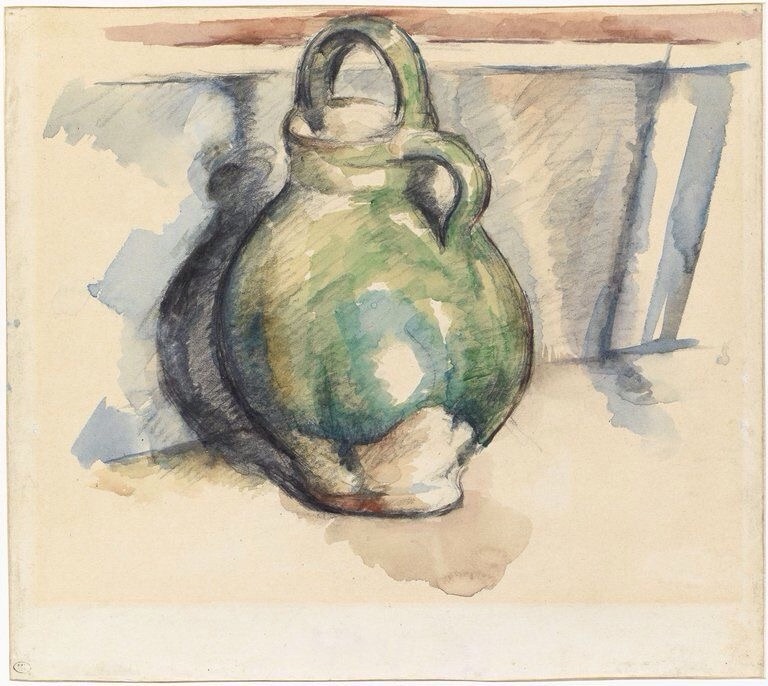
For our first class, belated as it was due to the recent weather and my brief hospitalization for a small blood clot at the turn of the year, we chatted about the difference between acrylic and watercolor painting. Acrylic painting is more forgiving, since we can paint over our less precise marks. We saw some Cezanne watercolor landscapes to see how a real master draws and paints.
Paul Cezanne: Le cruchon vert, watercolor, 1885/1887, Louvre, Paris.
Watercolor’s luminosity depends on the sheet on which it is painted, for its brilliance is a balance between transparent washes of pigment and the light bouncing off the bright paper back to the viewer’s eyes. At first, Cézanne worked much as he did in his oil painting, applying the watercolor densely, filling in underlying pencil outlines, covering the paper completely, and highlighting with white gouache. Later he thinned his watercolor and laid down veils of color, incorporating blank paper for highlights. He often applied watercolor to dry, semi-absorbent paper, creating layers of crisply defined brushstrokes with ridges of pigment at their edges.
Our class, because they are used to the dense pigments of the acrylic paints, painted much like the early Cezanne gouache works. It takes a while to learn a new medium, especially one so radically different from their prior experiences. But just as it takes time to learn, it also takes time to unlearn! Ask my golf coach about changing my swing sometime. We’ll get the hang of it eventually.
After checking out the master, we then worked on mixing the secondary and tertiary colors from the primary colors from our Prang 8 Color palettes on our 140-pound watercolor paper (not sketchbook paper, which is thinner and will buckle under the slightest bit of water).
Cornelia’s psychedelic mushroom rainbow
I was still on painkillers for my shingles, so my painted circle never quite closed itself. Instead, it was more of a rainbow, an image of hope after all this rain and my health troubles. My secondary colors looked like rainbow mushrooms popping up from the rainbow. The wetness of some areas bled into some of the colors, giving me the tertiary colors. I had a bit more success working the wet in wet in the blue grey cloudy sky.
Gail W’s Flower
One of our new students, Gail W., imagined her color wheel as a flower in a field. Tim W. focused on the colors as patterns. I had the sense I was looking at a portion of a quilt in progress. While we had the color wheel as an image, we weren’t bound to recreate a wheel.
Tim W’s quilt patterns
Tim B. Always has a unique viewpoint, so his color wheel is moving through space. Mike used some pastel colors in addition to the Prang colors to experiment with the difference between them. He’s used to thick paint with his acrylics, so allowing more water to flood the surface and allow the light to bounce back through the paint will allow his painting to glow more brightly.
Tim B’s flying color wheel
Gail S. finished out her wheel in good form. She has good transparency of paint and mixing of colors of the three sets of colors on the wheel. Gail typically paints with thinner washes in acrylics, so her technique in that medium passes over easily to watercolors.
Gail S’s transparent color wheel
As a first start, we’re on the way. Next week we’ll try a small still life. I hope to be in less pain, so I’ll have more of my brain cells available, or at least they’ll be within hailing distance. I have some great Cezanne still life watercolors to share. A still life will test our drawing skills and our painting skills both. The Victorian art critic John Ruskin said, “No good work whatever can be perfect; and the demand for perfection is always a sign of a misunderstanding of the ends of art.”
Mike’s color wheel with Prang and opaque watercolors
We aren’t being graded, so when I say “test,” no one ever fails. We only find out what we’ve learned and what we need to improve upon. Trust me, “we’re all going on to perfection, by the grace of God.” After all, this is a United Methodist art class. If I may quote Ruskin again, “The highest reward for a person’s toil is not what they get for it, but what they become by it.” By this he means, art changes us. Art also opens new horizons, allows us to overcome challenges, imagine new solutions, eases our stress, finds companionship, learn resilience, appreciate culture, and develop new skills. At every age, art builds confidence, teaches us compassion for ourselves and others who try new things, and helps us keep an optimistic attitude. I personally believe art keeps our inner child alive and well. May God renew you daily in joy.
Rabbit! Rabbit! Welcome to 2023! This old bunny may not see the clock strike midnight, but I’m recovering from a bad cold. Rest is more important than ringing in the New Year. Every year has its own character.
Live with Optimism, even when the nights are long.
Zeitgeist is a word that comes straight from German — zeit means “time” and geist means spirit, so the “spirit of the time” is what’s going on culturally, religiously, or intellectually during a certain period. When it comes to the turn of the New Year, we bunnies wonder if our new broom will sweep clean or if the old broom will leave the same mess as always in our cozy rabbit dens.
Always use a New Broom on the New Year for Good Luck.
Are we filled with hope or with foreboding? Do these dark days and deep nights of winter fill us with a gloomy spirit? Or do the imperceptibly lengthening minutes of daytime give hope to the shadows the cold of winter has left in the depths of our souls? Or have the coastal grandmother bunnies among us learned to ignore all this stum and drang by blending their afternoon tea time into early evening wine tasting?
Everything a culture considers taboo, evil, or immoral typically ends up being proscribed or “consigned to the outer darkness.” From there it ends up inside us in what Carl Jung called “the Shadow,” or our inner “Satan,” as it were. Repressed and inhibited, it festers and rages in the darkness of our “unconscious.” Even in extreme cases, it takes on a quasi-autonomous existence of its own, occasionally intruding as the famous “voices in the head” or even as a multiple personality.
Dr. Jeckyll and Mr. Hyde is a famous light and dark shadow character from fiction, but too often in real life we rabbits point out our own dark shadows in the lives of those we so easily demonize. As my wise old granddaddy rabbit would reprimand me, “When you point out the faults of others, you have three fingers pointing back at you.”
Luke 6:41 “Why do you see the speck in your neighbor’s eye, but do not notice the log in your own eye?”
I always find life more refreshing on the first day of the year, perhaps because I don’t over indulge in strong drink as I once did in my wayward bunny youth. We bunnies all have a wayward youth, for how else would we know what the immature among us are getting into? My old daddy rabbit believed, “Experience was the greatest teacher of all time, as well as its most costly tutor.” Indeed, we remember the costliest lessons best of all. The young ones today say, “Go big or go home.” My grannie would say, “If you’re in for a penny, you might as well be in for a pound.” After all, everyone who participated, either in a small or large way, would be held accountable.
Janus: Bloodstone intaglio of Roman god of transition, passages, and new beginnings.
As I look back on old 2022, grizzled and worn out by conflicts both at home and abroad, I can understand why the ancients thought of Janus, for whom January’s named, as a two faced god. One face, which looked backwards, was lined, bearded, and craggy featured, while the forward looking face of the new year was youthful, smooth, and clean shaven. Every new year is fresh and clean as a beardless youth’s face, as well as untroubled by any recollection of pains or past memories. Most of us bunnies also have short memories, for we tend to repeat the same mistakes over and over. Rabbits have short term memories of around 4 minutes, but can remember bad experiences for longer periods, just as humans can.
Unknown Roman Artisan: Soldier’s Brooch in the Form of a Rabbit, 100–300 CE, Copper alloy with champlevé enamel, found in Britain, Metropolitan Museum of Art, NYC.
In Ancient Rome, as the poets Ovid and Horace recount, Janus was the god of war and peace. They differ as to whether the Temple of Janus was a prison for peace or war, but they both agree the prison was meant to maintain PAX ROMANA, or the great Roman Peace. If peace were impounded, peace would be guaranteed to the nation. If war were imprisoned, it wouldn’t rampage about to destroy the countryside. Just as Janus had two faces, Roman religion was open to multiple interpretations and meanings. Perhaps today, they’d be known as “freethinkers,” as opposed to “literalists” or “strict constructionists” in their interpretation of their ancient stories.
Seeing the Night Skies through Bunny Eyes
Maybe in 2023 we bunnies might want to look at different ways of thinking, instead of one fixed way. There’s a difference between a straight and narrow path and a rut. On the path we can still see other twists and turns, which might change the outcome of our experience and existence. In a rut we’re stuck for life, with no where out, until it becomes our grave. If the world is changing more quickly than is comfortable for us, I give the example of my old granddaddy again. He pushed a button to turn on one of the first electric lights in his home town and lived to see men walk on the moon. Be resilient, be adaptable, and embrace change. After all, we’re always changing, so the option of never changing is death.
Ancient Greek Black Figure Vase, Wasps Attacking Men Robbing Zeus’ Bee Hives for Honey, c. 540 BCE, British Museum, London.
Romans would celebrate January 1 by giving offerings to Janus in the hope of gaining good fortune for the new year. They believed their acts set the stage for the coming year, so it was a common practice to make a positive start to the year. Not only did they exchange well wishes and sweet gifts of figs and honey with one another, but according to the poet Ovid, most Romans also chose to work for at least part of New Year’s Day because they saw idleness as a bad omen for the rest of the year. If 1st century Romans were to drop into some of our 21st century celebrations by means of Dr. Who’s traveling blue Police Box, they would wonder how the barbarians, who sacked Rome in 455 CE, had managed to take over our modern New Year.
Some days I need to be in two places at once.
We toga wearing bunnies, who are long of tooth, know from experience the barbarians are always at the gate of our safe little gardens. Sometimes they’re even inside the gardens of delight, as Peter Rabbit and his Cottontail friends perpetually discover when Mr. McGregror chases them with a rake. If we cast a look back on 2022 with our rheumy eyes, we saw Russia attack Ukraine, an outrageous act which sent millions of people to emigrate from their the destroyed cities and ravaged countryside, with the hope of finding safe haven in another European country.
Mr. McGregor thinks Peter is a Barbarian, who has slipped through his impenetrable garden gate.
Across the pond, on our southern border, thousands of migrants have fled disaster and violence in their homelands, but even though the US economy is hurting for workers in our entry level jobs, they have difficulty getting in. Are these people actually “barbarians at the gate?” Or have we projected our Shadow Fears upon them because they are foreigners? We did this with the Japanese, who m we placed into Internment Camps in World War II, much to our disgrace. This bunny asks us to search our hearts in 2023 to see if our three fingers are pointing back at our own selves.
Think about how Woodstock symbolized the 1960s: Woodstock was part of the Zeitgeist of the 1960s. Whatever seems particular to or symbolic of a certain time is likely part of its Zeitgeist. I came home from college one Christmas wearing a necklace of tiny black and white seed beads, only to be greeted by my old fashioned daddy, “Are you a hippy now?” For him, any one thing represented the whole, for he grew up with the ancient bunny wisdom, “One bad apple spoils the bushel.” We were only reconciled when he realized I hadn’t lost my fondness for his beloved Cowboys football team.
If we can find one common interest in this strange and fraught world with those with whom we would be at war, then we might be able to come to peace with them. If we insist on all or nothing, no bunny will get anything. We all want to have endless days of peace and joy, but the life of a bunny also has days of struggle and sorrow.
Earth as seen from Space
Carl Jung, the great psychologist once said, “There are as many nights as days, and the one is just as long as the other in the year’s course. Even a happy life cannot be without a measure of darkness, and the word ‘happy’ would lose its meaning if it were not balanced by sadness.”
We also have this promise from 1 Corinthians 10:13—
“No testing has overtaken you that is not common to everyone. God is faithful, and he will not let you be tested beyond your strength, but with the testing he will also provide the way out so that you may be able to endure it.”
Many of my southern bunny kinfolks will eat a variety of this New Year’s Day meal: black eyed peas, ham, greens, and cornbread. We think every pea consumed equals another day of good luck. Of course, we’re not the only superstitious clan.
Our cousins in Japan, celebrating Ōmisoka, or New Year’s Eve, gather together to eat long noodles to cross over from one year to the next. At midnight, many visit shrines or temples for Hatsumōde. Shinto shrines prepare amazake, a sweet low alcohol drink, to pass out to crowds and most Buddhist temples have large cast bells that are struck once for each of the 108 earthly desires believed to cause human suffering.
Year of the Rabbit
I found some interesting New Year’s good luck traditions, which are practiced around the world. In Greece, folks hang onions outside on their front doors to ward off evil. On New Year’s Eve, Colombian households have a tradition, called agüero, of placing three potatoes under each family member’s bed—one peeled, one not, and the last one only partially. At midnight each person, with eyes closed, grabs for one. Depending on the potato they select, they can either expect a year of good fortune, financial struggle, or a mix of both.
Ruined House (suspected fruitcake damage)
In Ireland, people bang Christmas bread against the walls of their house for good luck. If any of you bunnies have a Christmas fruitcake still lying around, please choose another loaf to prevent damage to your walls. Good contractors are backed up and hard to find, especially around the holidays.
The Danes chunk plates at their friends’ doorsteps for good luck on New Year’s Eve. Perhaps all that darkness from the winter solstice makes my northern relatives harebrained, but we love them just the same. I suppose every bunny has some weird relatives.
New Year’s Eve Weather Predictions
Old bunny weather lore says, “The first 12 days of January foretell the weather for each month of the year.” Another way to forecast the weather for the coming year depends on the wind. The old bunnies are at odds as to when this poem should be recited, with some advocating for sunset on New Year’s Eve and others at the break of dawn on New Year’s Day. This bunny notes the poem mentions New Year’s Eve, and since none of our ancient bunnies had time traveling abilities, I’d think we are safe to practice this on the Eve at sunset, then go out to do our responsible reveling.
If New Year’s Eve the wind blows south It betokens warmth and growth. If west, much milk and fish in the sea. If north, cold and storms there will be. If east, the trees will bear much fruit. If north east, then flee it, man and brute. Then throw your new year wishes to the wind!
GOOD HEALTH AND JOY FOR EVERY BUNNY
My New Year’s wish for 2023 is for each and every one of my bunny friends to have a better year than last year. And especially to know deep in your hearts, each of you are God’s own beloved children. Remember this good word from Romans 8:28—
“We know that all things work together for good for those who love God, who are called according to his purpose.”
Joy, peace, and love each and every day in 2023,
CORNELIA
Multiple Interpretation of the Opening and Closing of the Temple of Janus: A Misunderstanding of Ovid “Fasti” by S.J. Green, 1.281 on JSTOR https://www.jstor.org/stable/4433099
This shortest day of the year is the Winter Solstice, which is on Wednesday, December 21, at 4:48 P.M. EST, in the Northern Hemisphere. Some think of this as the Longest Night, but I’m a person of the light, not the darkness. I always prefer to look to the light, no matter how dim or feeble it may seem.
Be the Light
Yet darkness is a necessary experience in our lives. We do not yet live in the land of the “unclouded sky” or the heavenly realm:
“And the city has no need of sun or moon to shine on it, for the glory of God is its light, and its lamp is the Lamb.” —Revelation 21:23
Kindness is a warm fire
In the darkness, growth often happens: germination and rooting are two types of unseen activity that help produce the plant we see above ground. Without adequate light, the visible plant won’t thrive. So both darkness and light are at work to produce fruit in our lives.
“We know that all things work together for good for those who love God, who are called according to his purpose.” —Romans 8:28
Rejoice! The days will get brighter soon!
The Winter Solstice in Hot Springs is at 3:48 pm CST on Wednesday, December 21, 2022. In terms of daylight, this day is 4 hours, 37 minutes shorter than the June solstice. In most locations north of the equator, the shortest day of the year is around this date. The good news about the Winter Solstice is the days will begin to lengthen, although imperceptibly at first: one minute, four minutes, seven minutes, ten minutes, thirteen minutes, sixteen minutes, and so on.
In Scandinavia, the Norse celebrated Yule from December 21, the winter solstice, through January. In recognition of the sun’s return, fathers and sons would bring home large logs, which they would set on fire. The people would feast until the log burned out, which could take as many as 12 days. Today we recognize the source of the “Twelve Days of Christmas” song in this festival. The Norse believed that each spark from the fire represented a new pig or calf that would be born during the coming year. Prosperity for all in the New Year!
In this present darkness, a small light still shines brightly
In this time of stress and strain, grief and gripes, let’s look to the in-breaking light, and the renewal of life and love. Here’s a “Winter Solstice Chant” by Annie Finch, for your pleasure:
Vines, leaves, roots of darkness, growing, now you are uncurled and cover our eyes with the edge of winter sky leaning over us in icy stars Vines, leaves, roots of darkness, growing, come with your seasons, your fullness, your end.
Rice Krispy Stonehenge
Of course, if you can’t get your travel plans together at the last minute to visit Stonehenge, England for the winter solstice celebration, you can always make Rice Krispies Bars in the shape of the ancient monument. The recipe link is at the bottom of the page. Hint: don’t turn the heat up high or your treats will be hard. Due to high carbohydrate count, one “pillar” of Stonehenge Krispies is actually two servings.
While some are counting the days until Christmas, some of us are are counting the remaining days left in the old year of 2022. Somehow I always get a cleaning burst of energy around the end of the year. Maybe I hear my mother’s voice urging me, “Let’s get the house straightened up, so Santa will find it neat and clean. There’s no way the jolly old man can find the tree when the house is in this much mess!”
My mother’s idea of a mess was a line not perpendicular to its base, or a fragment of paper left on the table. She mostly cleaned to the grooves while my grandmother was alive, for she slacked off after Nannie passed on. The Christmas tree was ensconced in the NONO ROOM, also known as the living room. It acquired the NONO nickname because our parents never let us into it, for we weren’t allowed to touch anything inside it. We lived in the den, like the pack of wild animals we were. We weren’t raised by wolves, but our parents were never able to wring the wolf out of their brood.
I confess I still organize my large spices by size on one shelf and the smaller ones alphabetically on another shelf. I can’t understand anyone who sets their spices on the shelf willy nilly, so they have to search for them every time. Then again, I sort my paints by color and temperature. Organization is one thing I did learn from my folks, even if I didn’t inherit an obsession for daily cleaning.
However, with less than two weeks before Santa comes to visit and Christmas Eve services will bring the birth of Christ to mind once more., my inner mother began to notice strange flecks of dust on the high cabinet doors, as well as dust bunnies rolling out from behind the sofa. Some people have visits from the Ghosts of Christmas Past. My mother comes to visit me. At least I can still climb ladders.
While I’m cleaning up the house, I should catch up on some art works our Oakland UMC art class has been doing. I took off for a month to visit California, came down with a couch bug that made me so congested I couldn’t think, paint, or do doodly. For some reason, Mike moved faster than I could get my camera out, so I don’t have all his photos. Also, sometimes he was tied up in court doing good for others. I promise to do better in the New Year.
Delaunay: View of Paris, Eiffel Tower
The following three paintings began with the idea of circles and lines. As usual, I showed a few different examples from well known artists whose work hangs in museums. This quality inspiration helps students come up with better ideas.
Gail’s Circles
Gail combined her lines with her change of colors. Those boundary lines set up a line which carried through the subtle colors of the background. Limiting her color scheme helps to define these lines. She likes to plan her ideas out in her head first, imagine how they will look, and then paint.
Mike’s circles and lines in the image below reflect his more exuberant personality. Using both the compass and the ruler, he came up with a variety of circles and lines. Mike paints as the spirit moves him. Whatever feels good, that’s where he goes next. He’ll adjust as he goes.
Mike’s Circles
Either of these methods are fine. If one doesn’t get you down the road to the place you want to go, then maybe it’s time try a different route. I never force anyone down a particular fork in the road. I let them explore in one direction until they learn all they can or hit a dead end. Then they can follow the “road not taken.” Everyone gets to try both roads eventually, and learn the ancient wisdom, “All roads lead to Rome.”
This Road May Lead To Rome Eventually
In the art world, “Rome is the fullest experience of both order and emotion.” Some of us prefer one over the other, just as I prefer order in my spice rack, but I’m willing to throw the spices into the soup by sight and not by measuring spoons. We can get too organized or too exuberant, as the Greeks were fond of saying, “The middle path is safest and best.”
Klee: In the Beginning
During this time, the Russian attack on the largest nuclear power plant in Europe was ongoing. Not only was the electricity at the plant cut, an act which blacked out Ukraine and much of Eastern Europe, but it also threatened the stability of the nuclear reactors there. The Ukrainian engineers at the plant were prisoners of foreign soldiers, who knew nothing about the dangers of their stronghold. The world held its breath as fighting broke out around this sensitive target.
Cornelia’s Ukrainian Power-plant Under Attack
Thanks to satellite imagery, today we can see via the internet, what we waited to see in newsreels at the theater, the last time we fought on European soil. We had to wait until the evening news to see film from Vietnam. Now cable news breaks every half hour with the same old news and we might get an update if we’re lucky. Not all can afford to send reporters to distant lands anymore.
By the grace of God, that power plant still stands. However, Europe and Ukraine will have a cold and costly winter. We should not complain if our prices rise, for it’s a small price to pay for democracy and freedom. There are still nations who would oppress smaller countries, just as the Roman Empire did back in the time of Christ’s birth. As we remember in Matthew’s story of The Visit of the Wise Men (2:1-2):
In the time of King Herod, after Jesus was born in Bethlehem of Judea, wise men from the East came to Jerusalem, asking, “Where is the child who has been born king of the Jews? For we observed his star at its rising, and have come to pay him homage.”
This information led Herod to kill all the innocents, the children under two years old in and around the town of Bethlehem (Matthew 2:16-18). Brutality and mass executions aren’t a recent invention of despots desperate to retain power at any cost. The ethical term is utilitarianism, where one uses others as means to gain their own ends. The test question for this type of ethics is “Does the end justify the means?” At what point can you excuse bad or corrupt behavior to get good results?” A moral person answers, “I prefer good means for good ends and will use those unless I’m in a life or death situation.”
I returned, no worse for wear, from my vacation and texted the group to bring a vacation landscape photo to work from. Of course, Gail brought her latest vacation dream destination and Mike brought several island maps to combine into one image. It was the same island where he and his wife had vacationed, but one had tourist attractions, another was history, and the other natural beauty. He has a flair for combining things. Unfortunately, his busy life gets in the way of keeping all his art supplies in one place, so between his work chaos and organizing chaos, plus my slow phone draw, I failed to get his interesting map. It was a good idea.
Gail’s Mars Elevation
The new Mars rover has been sending back some awesome images. The folks at NASA must be over the moon, without a rocket. Gail worked on this elevation image for two weeks, with colors representing different heights in the landscape. It’s a good copy of the image. In the new year we need to go back to three dimensional work again, but we have had fun with color mixing and texture.
Cornelia’s Western Landscape
While out west, I visited as many national parks as I could manage. I did see many volcanoes and convened in a cave, plus I visited Roswell, NM, but wasn’t abducted by aliens. I was impressed with Arches National Park, and hiked about it most of a day. It’s a stark place, with strong rock formations jutting into a brilliant blue sky. The bright sunshine makes strong patterns of light and dark across the landscape. Most of what grows out in the desert is short grasses or a scrub brush, but on occasion, I would find a gnarled tree in dark shade.
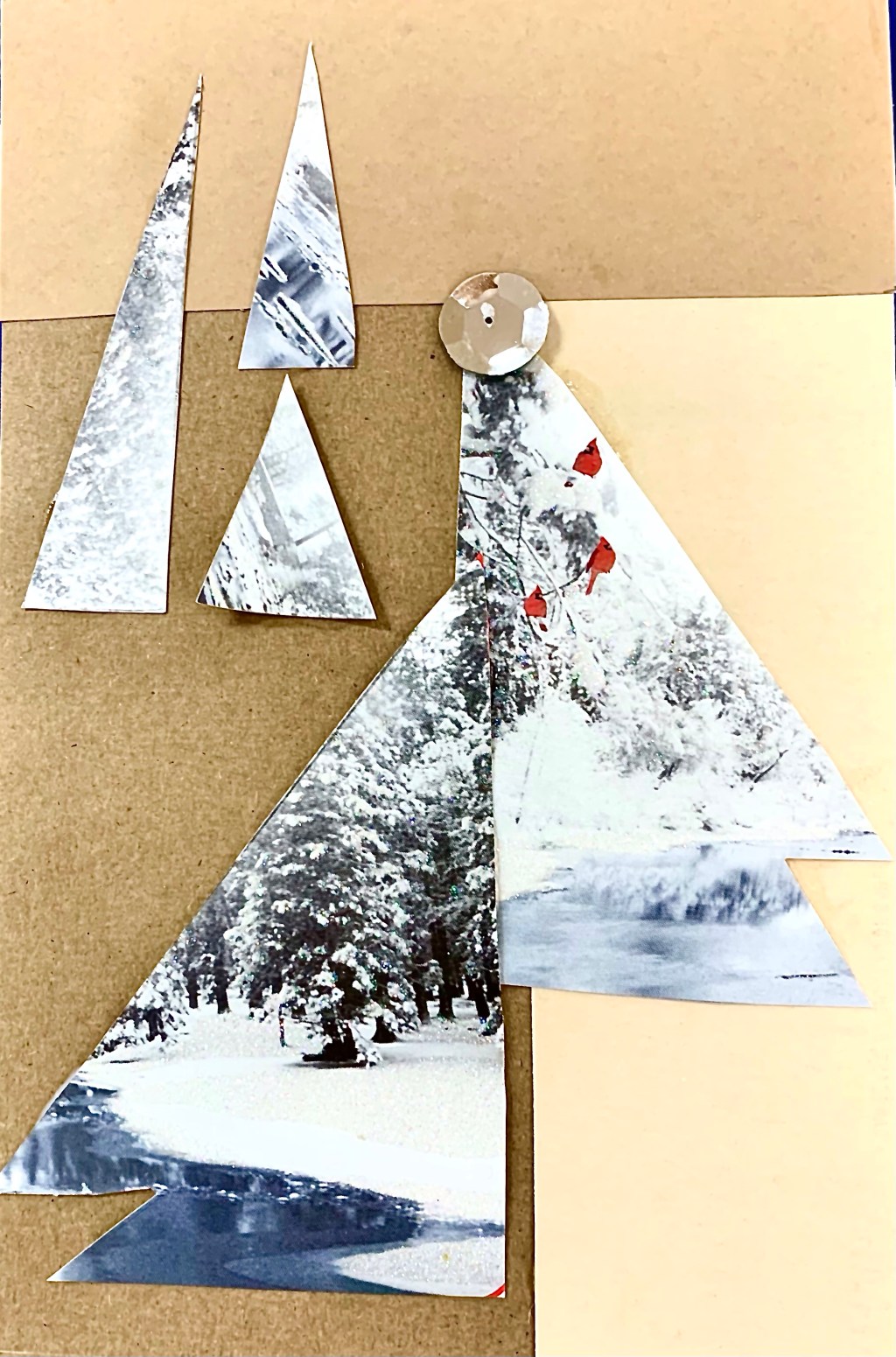
Gail’s Christmas Tree
At Mike’s request, we made Christmas cards, but he had to work that day. Probably helping someone with legal matters, because that’s his calling. Gail and I had fun working on the cut paper cards. I was thankful she brought me a coffee. Whatever bug I had took a while to clear my system. Caffeine helped. She rearranged these triangles several different ways on a horizontal plane and never felt satisfied with the way they looked. Because she was wise enough not to glue them down first, she could see her ideas weren’t hitting her happy place.
Then she turned everything straight up, and organized the design on a perpendicular. Now her tree has its happy red birds, a sequin star, and little trees in the background.
Cornelia’s Card
I brought one of my many boxes of colored paper from my scrapbook stash. I know the Christmas colors are red and green, but I made an Advent Tree. This is why it’s violet and pink and blue. Anyway, we don’t have to follow the rules for Christmas trees. If we want a pale purple tree, we can have one. It’s our tree. Santa will still put a present under it, and the color of our tree doesn’t impair our salvation. A nativity set looks just fine under any color tree.
I know we have at least one more class in December on the 16th. Depending on if my plumber is coming over on the 23rd, we might not meet that day. He said he’s behind, so I don’t know. I’ll be on vacation on the 30th, so we’ll see each other in the New Year of 2023!
I always say, “if I ever get totally organized, the world is coming to an end.” Maybe it’s the providence of God that I always bite off more than I can chew, because I’m never totally organized! But I am going on to organization.
On September 5, we celebrate Labor Day, and our kids are already back in school. We’re once again slowing down in school zones in the morning and afternoon, and setting an extra plate at the kitchen table for our absent college freshman. We might even see the first fall colors when the Fall Equinox comes around at the end of the month.
Edwardian Summer Gown, 1905
September is when we set aside our summer white clothes and shoes to change our closet over for darker colors and longer lengths. My dear mother had a rule of never wearing white past Labor Day. This quaint fashion principle dates from before Memorial Day, which was instituted in 1868 after the Civil War. This rule helped to separate the old money families, who summered in the country and at the seashore, from those who stayed to struggle on in the grimy cities, which were polluted by coal fired engines. These urban families usually wore dark clothes year round, as the rich did when they returned to their city residence.
Air conditioning has changed this now, but wearing starched, white cotton still reminds people you either have money to send your clothes to the cleaners or hire laborers to do it for you. Or, you might just work extra hard to look like one of the first two. This bunny has reached the age of dripping dry all those cotton clothes. I actually do more ironing when I do a craft project, such as quilting, since those seams need to be pressed open to make a good square. As this bunny has aged, I’ve changed my mind about what I think is important enough to worry about.
Rabbit Ironing
September is also a time to reassess the three core myths which animate much of American life. These myths are we can give 100% to our work, 100% to our family, and 100% to our personal health. I don’t know about you, but I’ve never been able to do this type of higher math without going bananas or feeling significant amounts of guilt that I’m not doing enough in one of those areas. Eventually I learned I was only Wonder Woman in my fantasies, but not in real life. I also realized other people who managed better than I hired help for the housework to free themselves up for family time.
My Wonder Woman Fantasy
Somewhere along the line we’ve bought into the myth of the “ideal worker,” who “has no competing obligations that might get in the way of total devotion to the workplace.” The second myth is the “perfect parent,” who “always puts family first.” The last myth is the “ultimate body,” which is cultivated through diligent dieting and exercise, and doesn’t deteriorate with age.
The authors of Dreams of the Overworked, note in the digital age, when people can post curated images of their best lives, “Achieving even one of these myths would be impossible, but achieving all three is ludicrous.” If your daily stress has increased and you feel like everything you do isn’t enough, I suggest deep breathing with your eyes closed (unless you’re driving a vehicle!). Once you get some extra oxygen to your brain, you’re in a position to calmly reconsider your situation. Not all situations are hair on fire, unless you’re a two year old with separation anxiety. Most of us beyond this age have experience and memories which can guide our future behaviors. An ancient proverb is “Experience is the mother of wisdom,” or as my folks used to say, “The school of hard knocks is the most expensive degree you’ll ever pay for.” Live and learn. With age comes wisdom.
Now that you’re calmer, you can decide, “Do I have options? Do I have a support system with people who can help me discern my way? Can I lay down my false self image of competence so I can ask for help? Can I triage my priorities to say NO to the less important ones, even if it means not pleasing everyone in my social circle?”
Google it, Ask friends for recommendations, and Breathe!
Speaking of options, women are primarily responsible for housework and childcare, not only in America, but also across the pond. About 91% of women with children spend at least an hour per day on housework, compared with 30 % of men with children. The latest available data shows that employed women spend about 2.3 hours daily on housework; for employed men, this figure is 1.6 hours. Gender gaps in housework participation are the largest among couples with children, at 62 p.p., demonstrating an enduring imbalance in unpaid care responsibilities within families. This leads to women taking lower and slower career paths.
Animated Map of 2022 Fall Color Change
September 22 is the Fall Equinox. We’re already seeing signs of seasonal leaf color changes, due to heat stress and drought. Some call this “False Fall,” but I call it a sign of hope. Trees will drop their leaves in order to survive in extreme conditions. Although some claim plants are sentient, they don’t have a brain or consciousness that we can recognize. They do interact and react to their environments. Their first priority is survival. Photosynthesis and the subsequent leaf abscission after changing color is part of this process. I always look for the change of light which precedes this event. One morning last week, I noted the color of the morning light had turned cooler, and wasn’t the warm yellow of summer. I also had a spark of energy I hadn’t had before. I look forward to more daylight.
This bunny is very fond of September, since I’ve always been eager to start fresh and new. I always got new pencils and a new manilla paper writing pad when I started elementary school. Later on, as I progressed up in grades, ink pens with cartridges were a special treat. Even to this day, I keep my journals with hand written ink in good paper books. I love the feel of these materials in my hands. I probably would have stayed in school my whole life if possible. The day our brains quit learning something new is the day our minds begin to die.
School Bunnies and Friends
That leads me to remind my bunny friends that Alzheimer’s disease is the 7th leading cause of death in the USA and it’s the most common cause of dementia in persons over 65. While most of you may not be baby boomers, you young bunnies have grandparents or parents of that age. Today, about 6.5 million Americans have Alzheimer’s disease, but that number is expected to almost double to 12.7 million by 2050. Perhaps beginning September with World Alzheimer’s Day is a good reminder for all of us to be proactive about our health choices, so we can live independently as long as possible into our senior years.
Talk Like a Pirate
I also like Positive Thinking Day, since reframing negative thoughts into positive ones changes our attitude, our behaviors, and then we get better outcomes as a result. If you don’t feel like being Batman on the 17th, you can ARRRGUH yourself about, MATEY, as you Talk Like a Pirate on the 19th. Bonus points if you wear an eye patch, earring, and tricorne hat or bandana on your head.
The Jewish New Year of Rosh Hashanah begins at sunset on the 25th. It’s one of the four “new year” celebrations in their religious calendar. This one recalls God’s creation of humanity, as well as the legal new year. On this one night in September, when the faithful eat apples dipped in honey or other sweet sauces, they remember how God originally created humans in a sinless state and wish each other a good year to come.
Magic Bacon Carpet Ride
Did I forget International Bacon Day? How can any rabbit forget bacon? Someone will cut my carrot rations for the future, I fear. But if I remember to keep the coffee pot full, I’ll probably get out of the rabbit hoosegow before National Coffee Day on the 29th.
Some interesting holidays we can celebrate this month are: Better Breakfast Month (I suggest bacon, eggs, and pancakes on the weekend and old fashioned oatmeal during the week). There’s also Hispanic Heritage Month and National Sewing Month. Finally, every year on September 30th is National Love People Day. The purpose of the day is to show love to everyone—no exceptions. National Love People Day offers us the opportunity to show unconditional love, which many have never experienced. When we genuinely love our neighbors and express it with kind words and thoughtful deeds, we make our world a better place. This the true meaning of “love your neighbor as yourself.”
Maybe one meaning of loving your neighbor is offering a meal to them. Food insecurity is increasing once again, this time due to increased rents and costs of transportation. Consider a weekly meal service from your church building or organization’s meeting place. It doesn’t need to be fancy, but calories and nutrition would help hungry people have the strength to move on from their current situations. Joining with other groups to cover all the days of the week would be a bonus to your community, not only for the hungry, but also for the smaller groups who could team up to share in the blessing of loving their neighbors.
Until the spice is on the pumpkin, I wish all my bunny friends
Welcome to September, my rabbit friends! For most all of the bunny world, this means books, pens, pencils, and papers are now our daily tools of the trade instead of our preferred recreational plaything. Even the bunny parents are on the education time table. As I was exiting a lane in the store, I almost crashed my grocery cart into a lady who was racing to finish so she could pick up her darlings when school closed for the day.
Indeed, except for a brief break for Labor Day on Monday, September 6, we’re now living in what we working bunnies call “normal time.” The chronologists may have standard and daylight savings time, the meteorologists their seasonal times, but old school teacher rabbits know the only true time which counts is classroom time. Of course, the best teachers recognize teaching happens all the time, for the best classrooms have no walls and no fixed time for learning. Once rabbits quit learning, they begin to die.
I’ve always pitied the poor rabbit students who thought they could learn everything they needed to know to get them through the rest of their lives after they left the classroom. “Do you think the world is going to stand still just for your benefit?” Often they’d try to argue they didn’t need to know more because they could get a job right of school. They never think about the possibility their jobs might be phased out due to automation or irrelevance.
All we rabbits need are pencils
Then again, perhaps I value education more than the average rabbit. My grandfather worked for fifty years on the railroad, beginning at the tender age of fifteen. Why did he begin so early? His father had abandoned the family, so he worked to help his mother raise the baby rabbits left at home. When his own bunny sons were growing up, he made sure they got an excellent education. They both became doctors. My mother was a teacher and one of my several careers was art teacher.
We live in a time when history is being made daily, but no one seems to remember yesterday because the news media obsess over the latest hot button story. The next day they might have a new focus to fill the hours of coverage and keep our rabbit eyes fixated on the glowing screen. We don’t have to do this, for every tv has a remote to switch the channel and an off button. As a back to school exercise, I thought we might travel back in time when we colonists were in rebellion against the King of England in our War for Independence. So buckle your seatbelts, bunnies, we’re throwing the wayback machine into full reverse. Next stop, 1776 and the War for American Independence.
Most people know our Declaration of Independence was signed on July 4, 1776, but after that, our historical memories are iffy. In fact, the British had been fighting the colonists since 1775 in various skirmishes, and continued with greater frequency in 1776-1777, with neither side gaining much headway.
In our first war, our fledgling army had lost 6,800 men in battles and another 17,000 to disease. It wasn’t a good time for health care or sanitation. The British captured our young nation’s capital of Philadelphia in September, 1776, but the army and the state militias kept on fighting. The British moved their war efforts to the southern half of their colonies, thinking they’d find loyal supporters there, but none were found.
Washington crossed the Delaware River, December, 1776
By December 19, 1777, Washington had decamped to Valley Forge with what was left of his ragtag army. From there, he wrote letters to every state except Georgia to plead for supplies and reinforcements, for without these, he was certain the war would be lost.
General Washington and the Army winter over at Valley Forge
This was the first large, prolonged winter encampment the Continental Army endured—nine thousand men were quartered at Valley Forge for a six-month period. During that time, some two thousand American soldiers died from cold, hunger, and disease. About 22% didn’t survive that terrible winter. Perhaps we’re fortunate we didn’t have a 24 hour news cycle to keep a body count, or we’d remember this event as a catastrophe, instead of a “heroic perseverance and endurance under harsh conditions, which only made the survivors stronger.”
It was during this hard time of close confinement, the future president of our country had all the Continental Regular Troops inoculated against the smallpox virus. At the time, 90% of the war casualties were due to disease, so Washington took the bold move to vaccinate the troops. The British troops were already safe from this contagion, and this leveled the playing field.
In 1781, Lord Cornwallis surrendered at Yorktown after a siege of three weeks, during which the town took heavy bombardment from American and French troops. After six years, both sides were tired of fighting, plus the British had another war back on the continent to deal with. Two years of negotiations later, the United States of America had its recognition among the governments of the world.
“Jungkook As Bunnies” Is the only Easy Winner of the Internet any day.
If any rabbit tells you winning is easy, and anyone can do it, they aren’t paying attention to history. Yet, we overcame many obstacles, adjusted our courses of action, somehow survived, and became a nation. It’s significant that our nation was founded by people with the historical tradition of a parliamentary form of government. In 1215, King John agreed to Magna Carta, which stated the right of the barons to consult with and advise the king in his Great Council. That’s a full 500 years of shared representation, from which our government takes its form of checks and balances.
The World Trade Center Memorial seen from space
Our heroic image was bruised and bloodied over two centuries after the War for Independence when the twin towers fell on 9/11, and the Pentagon was hit by a falling airplane. The only reason we didn’t also lose the White House is because the ordinary passengers of an everyday airline flight suddenly reached down deep and found the hero who lives inside each and every one of us. Some say rabbits are meek and weak, but they don’t know the true heart of the one who will give up his or her life for the sake of another.
We rabbits like our chaos neatly packaged and tied up neatly with a bow. The beginning of every school year has its own chaos, for suddenly rabbit families have to once again be on time, have all their paperwork together, and make sure they don’t leave their brains at home as they rush out the door. After a long lazy summer, we rabbits aren’t in the mood to be reminded of how fragile life can be.
Afghan child safely sleeping under American Air Force jacket during Evacuation efforts.
When we watch the scenes unfolding in Afghanistan as people try to emigrate to the United States, we share the collective trauma along with the ones who actually experience it. Add that to our own stress about the unknowns of our current pandemic, our griefs for the losses of those who died, the fears we have for our loved ones, and the extra burdens of cleaning, masking, washing, and scheduling this Covid world now requires, and well, (breathe) it gets a bit much.
But we rabbits have risen to the occasion from time immemorial: we pull together as one, for the good of all. If we live in families, and live in neighborhoods, and live in communities, we find we need to lend a helping hand to others from time to time. Likewise, we band together to protect the vulnerable, whether those are our children, our elderly, or our less abled friends. This is what we call our civic duty, or our moral obligation to do unto others as we’d have them to do for us, or the “golden rule.”
Sometimes we don’t want to work for the common good, but work for our own interests only. We like to win, because it suits our belief about our invincible self. Most of us have been taught a “heroic myth” about our founding fathers, so we aren’t aware of the struggles they endured to wrest our independence from the British. They didn’t do it alone, but together. If the French had not entered the war for independence on our behalf, we might still be singing “Hail to the Queen.” If we’re going through a rough patch now, we have to get our act together and work to make life better for all.
Positive thinking brings about positive results.
In my bunny life, when I taught art, I soon learned the beginning of school was the time I would lose my car keys, and I wouldn’t be organized enough to cook dinner. Once I raced out of the house without putting underpants on my little girl. Young mother bunnies don’t have access to their entire brain in the first week of school, but at least the kindergarten had a change of clothes for her. By the second week, I usually found the other half of my brain, and life went much smoother. Life is always a roller coaster, so when ever we make a big change, we need to give ourselves some grace until we get adjusted to that ride.
“This too shall pass,” an apocryphal phrase from the mid 1800’s, seems applicable to this era also, for we’re now on the cusp of autumn. That heat stress driving us to crank up our air conditioning has turned some leaves on our lakefront trees to yellow, so they gleam like lemons against the bright green canopy. The Autumn Equinox will occur on Wednesday, September 22, 2021, at 2:21 pm CDT. Of course, my late rabbit mother would have me retire all my light colored summer clothes by Labor Day, for “no self respecting child of mine should wear white in the fall.” Autumn in the South is just another word for summer. My fall clothes were still light weight cotton, but in darker shades.
No time like the present to wipe the slate clean and begin a new year.
Rosh Hashanah on September 6, beginning at sunset, is the celebration of the Jewish New Year, and the creation of the world. It’s one of the holiest days of the Jewish year. Ten days later is “Yom Kippur” or the “Day of Atonement.” This is a day set aside to atone for sins, with prayer, fasting, and attending the synagogue. No work is done on this day, which is one of the most important days in the Jewish calendar. During Yom Kippur, people seek forgiveness from God, and seek to give and receive forgiveness and reconciliation with others.
Mid Autumn Festival
September 21 is the Chinese Moon Festival, a harvest celebration which dates from about 1000 BCE. The early emperors offered sacrifices to the moon, believing this would result in good harvests the following year. During the Tang Dynasty four centuries later, the noble classes and wealthy merchants imitated the emperor, while the citizens prayed to the moon. Beginning around 1000 CE, the festival took on general acceptance.
Rabbit Moon Cake
Moon cakes arrived in the 14th C, and have retained their popularity. This is not only a family celebration, but a community ritual for connection of relationships. While the cakes themselves aren’t costly, the packaging makes the gift impressive. People can say more by the wrapping’s elegance than by the contents. Moon cakes aren’t for individual consumption, but are meant to be shared, much like life’s joys and sorrows.
The fourth Saturday in this month is International Rabbit Day. Rabbits are the third most popular family pets, after dogs and cats. The care and feeding of a small animal requires attention, patience, and affection, not to mention consistency. How we treat our pets tells the world how we treat humanity. As Mother Teresa once said:
“The hunger for love is much more difficult to remove than the hunger for bread.”
The deep love of God overflows through our hearts into the world.
I recommend for your September reading homework The Universal Christ, by the Franciscan priest Richard Rohr. Drawing on scripture, history, and spiritual practice, Rohr articulates a transformative view of Jesus Christ as a portrait of God’s constant, unfolding work in the world. “God loves things by becoming them,” he writes, and Jesus’s life was meant to declare that humanity has never been separate from God—except by its own negative choice.
When we recover this fundamental truth, faith becomes less about proving Jesus was God, and more about learning to recognize the Creator’s presence all around us, and in everyone we meet. Until October, my bunny friends, I wish each of you may find in the present moment God’s
George Washington and the First Mass Military Inoculation (John W. Kluge Center, Library of Congress) Amy Lynn Filsinger, Georgetown University & Raymond Dwek, FRS, Kluge Chair of Technology and Society. Dr. Dwek is Professor of Glycobiology on leave from Oxford University. https://www.loc.gov/rr/scitech/GW&smallpoxinoculation.html
9/11/2001—Attack on The World Trade Towers and The Pentagon
10/7/2001—“Operation Enduring Freedom”—Beginning of Afghan War with attacks against terrorist groups in Afghanistan
5/2003—Donald Rumsfeld announces the end of major military operations. The USA and NATO begin nation building and restoration of the poor country, which had gone through two wars and a foreign occupation.
Although there were early successes, such as women’s access to education and entry to politics and jobs, corruption was a way of life, so the money never flowed through the government out into the cities and countryside to help the people.
5/2011—Osama Ben Laden killed in Pakistan by Navy SEAL team
12/31/2014—President Obama decides to end major military action in favor of training the local Afghan army
2/2020—Trump administration negotiates a deal with the Taliban in which they promised to cut ties with terrorist groups, reduce violence, and negotiate with the current government. Unfortunately, there were no sanctions to enforce it.
9/2021—Today—The best laid plans of Mice and Rabbits usually end up in chaos
The word labyrinth comes from the Greek labyrinthos and describes any maze-like structure with a single path through it. It’s different from an actual maze, which may have multiple paths intricately linked. Etymologically the word is linked to the Minoan labrys or ‘double axe’, which is the symbol of the Minoan mother goddess of Crete. The actual word is Lydian in origin and most likely came to Crete from Anatolia (Asia Minor) through trade. Labyrinths and labyrinthine symbols have been dated to the Neolithic Age in regions as diverse as modern-day Turkey, Ireland, Greece, and India among others.
Labyrinths or mazes may have served to help the ones who walked them to find their spiritual path by purposefully removing them from their common understanding of linear time and direction between two points. As one traveled through the labyrinth, one would become increasingly lost in reference to the world outside and, in doing so, might unexpectedly discover one’s true path in life.
On New Year’s Day, I was reading my Twitter feed and came across this image of a seaside labyrinth. The comment was, “My #oneword for 2021 is downwind. After walking the labyrinth today with turns both against & with strong wind, I realized how limitless 2021 can be with the help of those who push me forward and not the wind pushing against me. This year, I’ll ride the momentum downwind.”
Twitter photo—My #oneword for 2021 is downwind
The theme of the labyrinth leading to one’s destiny is intricately linked to the Greek myth of Theseus and the Minotaur. The Minotaur lived at the heart of the labyrinth on the island of Crete, whose king required the people of Athens to send a tribute of fourteen youths annually. Once they entered the Minotaur ‘s labyrinth, they never returned. Theseus defeats the beast and saves his people, but loses his father to suicide because he fails to remember to change the color of his sails on his return trip as a sign of his victory. There’s even more dysfunctional family relationships, but that’s a story for another day. Suffice it to say, the ancient gods were wont to interfere with the lives of arrogant humans who failed to defer to the gods and instead acted as if they were masters of their own destiny.
Theseus and the Minotaur: Attributed to the Tleson Painter, ca 550 B.C., Attic Black Figure Kylix, Toledo Museum of Art, Toledo
Greek tragedy deals with the sweeping themes of love, loss, pride, the abuse of power and the fraught relationships between humanity and the gods. Typically the main protagonist of a tragedy committed some terrible crime without realizing how foolish and arrogant she or he had been. After slowly realizing the error, the world crumbles around the hero. The tragic hero must be essentially admirable and good. The fall of a scoundrel or villain evokes applause rather than pity. Audiences cheer when the bad guy goes down. We feel compassion for someone we admire when that character is in a difficult situation. The nobler and more admirable the person is, the greater our anxiety or grief at his or her downfall.
This idea survives to this day in the proverb, “The bigger they come, the harder they fall.” In the 5th C BCE, in the founding work of history known as the Histories of Herodotus, we find the statement: “It is the gods’ custom to bring low all things of surpassing greatness.” An earlier expression, “Pride goes before destruction, and a haughty spirit before a fall,” is found in the Proverbs (16:18). These date from 700 BCE to the fourth century BCE (1:1-9:18).
In a true tragedy, the hero’s demise must come as a result of some personal error or decision. The tragic or fatal error, or fatal flaw of the protagonist that eventually leads to the final catastrophe is known as hamartia, or missing the mark. It’s a metaphor from archery, and literally refers to a shot that misses the bullseye. There’s no such thing as an innocent victim in a tragedy, nor can a genuinely tragic downfall ever be purely a matter of blind accident or bad luck. The tragic hero must always bear at least some responsibility for his or her own doom. In Greek tragedy, the gods may interfere, but they don’t determine our destiny. Likewise, human events and actors may put detours across our path, but though the gods may intervene on our behalf, we can still snatch defeat from the jaws of victory in a true Greek tragedy.
Theseus killing the Minotaur of the Cretan labyrinth. Ariadne, possibly, looks on from the right. Attic black figure vase, Late 6th, early 5th century BCE. (Archaeological Museum, Milan).
The labyrinth is a symbol for change, for it’s the place of transformation. In the myth, Theseus must enter a maze no one knows how to navigate, slay a flesh eating monster, and return to the world above. Theseus accomplishes this, but still retains his youthful flaws until he is changed by his father’s death and he’s forced to grow up and assume adult responsibility. His experience in the labyrinth offered him an opportunity to change and grow but, like many people, Theseus resisted until change was forced upon him.
The medieval labyrinth is a unicursal labyrinth, with a single, circuitous but clearly delineated path. It’s an image encompassing both shared and individual experience, for we don’t walk the path alone, but we share it with fellow travelers. The unicursal labyrinth is distinguished from a multicursal labyrinth (or maze) by having only a single (though winding) path to its center. While a maze may have little or no symmetry and may not even have a center, a medieval labyrinth usually has both. The great medieval labyrinth on the floor of France’s Chartres Cathedral is one of the most famous unicursal labyrinths.
Chartres Cathedral Labyrinth from Above
Carl Jung, the famous Swiss psychologist, saw the similarity between medieval, Christ-centered mandalas in manuscripts and rose windows, the mandalas of his patients, and the mandalas he created. Jung believed his own mandalas “helped him maintain his psychic equilibrium” and believed “everything points toward the center,”so that he found “stability” and “inner peace” even during the war era.
Jung: Mandela
Medieval labyrinths, and all their variations, including the classical design of which the medieval style is an outgrowth, now appear across the United States in settings ranging from churches and parks to hospitals and museums; they may be painted, tiled, paved, woven into a carpet, constructed of canvas, or cut into a lawn. They’re usually designed to be walked on. Over the last quarter century, the medieval labyrinth has entered public consciousness as a “blueprint for transformation” rather than “an oddity,” as it was at one time. I can remember at least one of my fellow clergy asking if “this wasn’t so kind of new age hooey I was getting into.” Moreover, labyrinths aren’t limited to meditative and ritual use; they also appear in secular and recreational settings and are often noteworthy for their ornamental or artistic value.
Lavender Garden Labyrinth
While each one of us walks the same path, no one has the same experience on the labyrinth. We’re all on the same journey, but we’re traveling on a different part of the path. We entered at a different time, or we came to the labyrinthine journey at a different period of our spiritual journey. Some of us will move slowly, while others will hustle along the way. If we came with troubles and worries, we may have been looking for THE ANSWER. The labyrinth isn’t a one armed bandit. We don’t put our money in, pull the handle, and get a payout. The walking is instead an opportunity for reflection, a time to give our selves to the service of God, and set aside our pride.
We enter into the community of faith on the path
I’ve walked on the labyrinth on different occasions and had different experiences, since I’ve been “residing in different inns along my spiritual journey” during the years as I make my rounds about the sun while I live on this planet earth. I’ve been to the holy land twice, and been to Greece and Turkey to walk in the footsteps of Paul to see the churches he planted across the Mediterranean. I spent a summer in Italy during art school, while living in a small town and taking field trips to see the historic sites nearby. I took an interterm during graduate school to visit London and visit all the museums I could devour in that short time, along with some excursions to the seaside. Still, I’ve yet to see Stonehenge, and I’ve not seen Paris.
The question is, do we walk the labyrinth as a tourist going to a destination, expecting to stamp our passports, bring back photos, and buy souvenirs, or do we go expecting to meet Christ along the way? On the tour groups, folks sort themselves fairly soon into subgroups. The ones who want to go quickly to the site, give it a once over, take a few photos, and hit the souvenir shops before they have a coffee or a drink, will find each other and share their daily haul as they relax and wait for the stragglers to roll in. The stragglers come in two groups: the ones who took their time, and the ones who took the wrong turn and got lost. Thankfully, I didn’t get lost as I often do here at home! My notorious ability to take the wrong turn and my poor map reading skills are legend. The virtue of group travel is we leave no one behind.
While each person enters the labyrinth alone, others may also be on the path also. When we meet another, we perform a silent dance of giving way, first one to another, then the other to the one. Two can’t be in the same lane at the same time, but we can “dosie do” to let one another pass on by. This is life in community, where we share the spaces and the journey. When we walk the path of the Labyrinth, we enter a space/time/continuum. This is where up/down, left/right, and forward/backward all exist in one time dimension. Time passes differently inside the Labyrinth, for the twisting path appears to take us first directly toward the center, but just as we approach it, we are forced to follow the path directly away from the center instead. Then we wander around the outer edges of the labyrinth until suddenly, we arrive at the center. If we think we’ll never reach the promised land, we’ll find ourselves suddenly cast upon its shores as a Jonah spewed from the belly of a big fish. What seems like three days of darkness in a labyrinth may only be thirty minutes. Clock time gives way to God time on the journey.
Energies of the Labyrinth
Thus we enter into the timeless paths of all the pilgrims walking before us, those who never made their way to the holy land, but found the holy in the land in which they lived. The labyrinth has a way of uniting all the time of the past, the future, and the now into one dimension. In this way, when we walk the labyrinth, we enter into the kairos time of God, as opposed to the chronos time of humanity. No longer are “on the clock,” but we walk in the appointed and opportune time for us to experience the holy.
If we’re surprised, and emotionally disconcerted as we walk these twisting paths, it’s because we discovered we had no control over how soon we could get to our destination. We can stay in the center and be humbled by this awareness, but often we act like tourists instead. We get our passports stamped after an appropriate rest, and head back home. As heroes who’ve been to the center, we journey back to the outer world as changed people, ready to bring new truths and understanding back to the world. If we are like the Greek heroes of old, however, our tragic flaw will be living for ourselves only and forgetting to do good to all.
The energies of the labyrinth aren’t self-contained to the paths or to those who walk it. It is a holy space, so like the energies of space time, in which space and time are relative, observations depend on the viewer’s speed. If we rush through the labyrinth, we don’t have the same opportunity to meet Christ on the road to Damascus, as Paul did, and have an opportunity to change our lives. We need to drag our feet a bit, as the grieving disciples did on the road to Emmaus, so we might have the privilege of recognizing Christ in the central act of blessing the bread when they invited him to stay with them at the end of the journey.
The hurried life isn’t for the contemplative person, so even those whose lives are given over to getting many things done can benefit from a quiet time now and then. Otherwise, we can become the heroic Theseus who depends upon his own power, rather than giving credit to the powers of the gods, for all his great deeds. This is why his arrogance and pride is his undoing, even though he had a transformative experience in the labyrinth. Not until much later did he process this experience and grow from it.
When I began my painting, I started out with the actual forms, in homage to the many walks I’d participated in over the years. Soon I thought of burying the image, and uncovering parts of it, as if it were an archeological dig in process, but I only buried the outer edges. Then the idea of energies of the innumerable pilgrim walks percolated up into my consciousness and I began to paint the intersecting colored arcs. While I lost the paths, I was painting my emotional experience of the walking. I’ve been on quite a journey this past year, even though I’ve gone nowhere, due to the covid pandemic. Confined to home, I’ve longed to journey elsewhere, but the labyrinth is a journey anyone can take safely without fear of a monster who devours human tributes. I’m looking forward to the new year and new works, and perhaps some actual journeys. God bless everyone. Thanks for reading this.
John Wesley wrote extensively to teach the Methodists of his day the tenets of the faith. We teach seminarians the historic doctrines, but many think these are “dead ideas of a long ago world.” Wesley gave us 52 Standard Sermons and the Notes on the New Testament, both of which are part of our doctrinal standards. Today many believe as long as they can justify an idea by scripture, reason, tradition, and experience, they can believe anything they want regardless of our standards. Of course, Wesley himself believed scripture, reason, and tradition led to the experience of being a child of God, but that’s another story for another day.
The first tract I ever wrote expressly on this subject was published in the latter end of this year. That none might be prejudiced before they read it, I gave it the indifferent title of “The Character of a Methodist.” In this I described a perfect Christian, placing in the front, “Not as though I had already attained.” Part of it I subjoin without any alteration: —
Loves the Lord with All the Heart “A Methodist is one who loves the Lord his God with all his heart, with all his soul, with all his mind, and with all his strength. God is the joy of his heart, and the desire of his soul, which is continually crying, ‘Whom have I in heaven but thee? and there is none upon earth whom I desire besides thee.’ My God and my all! ‘Thou art the strength of my heart, and my portion for ever.’ He is therefore happy in God; yea, always happy, as having in him a well of water springing up unto everlasting life, and over-flowing his soul with peace and joy. Perfect love living now cast out fear, he rejoices evermore. Yea, his joy is full, and all his bones cry out, ‘Blessed be the God and Father of our Lord Jesus Christ, who, according to his abundant mercy, hath begotten me again unto a living hope of an inheritance incorruptible and undefiled, reserved in heaven for me.’
Good is the Will of the Lord “And he, who hath this hope, thus full of immortality, in everything giveth thanks, as knowing this (whatsoever it is) is the will of God in Christ Jesus concerning him. From him therefore he cheerfully receives all, saying, ‘Good is the will of the Lord;’ and whether he giveth or taketh away, equally blessing the name of the Lord. Whether in ease or pain, whether in sickness or health, whether in life or death, he giveth thanks from the ground of the heart to Him who orders it for good; into whose hands he hath wholly committed his body and soul, ‘as into the hands of a faithful Creator.’ He is therefore anxiously ‘careful for nothing,’ as having ‘cast all his care on Him that careth for him;’ and ‘in all things’ resting on him, after ‘making’ his ‘request known to him with thanksgiving.’
Prays Without Ceasing “For indeed he ‘prays without ceasing;’ at all times the language of his heart is this, ‘Unto thee is my mouth, though without a voice; and my silence speaketh unto thee.’ His heart is lifted up to God at all times, and in all places. In this he is never hindered, much less interrupted, by any person or thing. In retirement or company, in leisure, business, or conversation, his heart is ever with the Lord. Whether he lie down, or rise up, ‘God is in all his thoughts:’ He walks with God continually; having the loving eye of his soul fixed on him, and everywhere ‘seeing Him that is invisible.’
Loves the Neighbor as the Self “And loving God, he ‘loves his neighbour as himself;’ he loves every man as his own soul. He loves his enemies, yea, and the enemies of God. And if it be not in his power to ‘do good to them that hate’ him, yet he ceases not to ‘pray for them,’ though they spurn his love, and still ‘despite. fully use him, and persecute him.’
Pure in Heart “For he is ‘pure in heart.’ Love has purified his heart from envy, malice, wrath, and every unkind temper. It has cleansed him from pride, whereof ‘only cometh contention;’ and he hath now ‘put on bowels of mercies, kindness, humbleness of mind, meekness, long-suffering.’ And indeed all possible ground for contention, on his part, is cut off. For none can take from him what he desires, seeing he ‘loves not the world, nor any of the things of the world;’ but ‘all his desire is unto God, and to the remembrance of his name.’
Does the Will of God “Agreeable to this his one desire, is this one design of his life; namely, ‘to do, not his own will, but the will of Him that sent him.’ His one intention at all times and in all places is, not to please himself, but Him whom his soul loveth. He hath a single eye; and because his ‘eye is single, his whole body is full of light. The whole is light, as when the bright shining of a candle doth enlighten the house.’ God reigns alone; all that is in the soul is ‘holiness to the Lord.’ There is not a motion in his heart but is according to his will. Every thought that arises points to him, and is in ‘obedience to the law of Christ.’
Tree Known by Fruits “And the tree is known by its fruits. For, as he loves God, so he ‘keeps his commandments;’ not only some, or most of them, but all, from the least to the greatest. He is not content to ‘keep the whole law and offend in one point,’ but has in all points ‘a conscience void of offence towards God, and towards man.’ Whatever God has forbidden, he avoids; whatever God has enjoined, he does. ‘He runs the way of God’s commandments,’ now He bath set his heart at liberty. It is his glory and joy so to do; it is his daily crown of rejoicing, to ‘do the will of God on earth, as it is done in heaven.’
Keeping the Commandments “All the commandments of God he accordingly keeps, and that with all his might; for his obedience is in proportion to his love, the source from whence it flows. And therefore, loving God with all his heart, he serves him with all his strength; he continually presents his soul and ‘body a living sacrifice, holy, acceptable to God;’ entirely and without reserve devoting himself, all he has, all he is, to his glory. All the talents he has, he constantly employs according to his Master’s will; every power and faculty of his soul, every member of his body.
Doing All to the Glory of God “By consequence, ‘whatsoever he doeth, it is all to the glory of God.’ In all his employments of every kind, he not only aims at this, which is implied in having a single eye, but actually attains it; his business and his refreshments, as well as his prayers, all serve to this great end. Whether he ‘sit in the house, or walk by the way,’ whether he lie down, or rise up, he is promoting, in all he speaks or does, the one business of his life. Whether he put on his apparel, or labour, or eat and drink, or divert himself from too wasting labour, it all tends to advance the glory of God, by peace and good-will among men. His one invariable rule is this: ‘Whatsoever ye do, in word or deed, do it all in the name of the Lord Jesus, giving thanks to God, even the Father, through him.’
Running the Race, Not as the World Runs “Nor do the customs of the world at all hinder his ‘ running the race which is set before him.’ He cannot therefore ‘lay up treasures upon earth,’ no more than he can take fire into his bosom. He cannot speak evil of his neighbour, any more than he can lie either for God or man. He cannot utter an unkind word of any one; for love keeps the door of his lips. He cannot ‘speak idle words; no corrupt conversation’ ever ‘comes out of his mouth;’ as is all that is not ‘good to the use of edifying,’ not fit to ‘minister grace to the hearers.’ But ‘whatsoever things are pure, whatsoever things are lovely, whatsoever things are’ justly ‘of good report,’ he thinks, speaks, and acts, ‘adorning the doctrine of God our Saviour in all things.'”
Lovely, Pure, Clean
Christian Perfection is Wesley’s Theme These are the very words wherein I largely declared, for the first time, my sentiments of Christian perfection. And is it not easy to see, (1.) That this is the very point at which I aimed all along from the year 1725; and more determinately from the year 1730, when I began to be +homo unius libri,+ “a man of one book,” regarding none, comparatively, but the Bible? Is it not easy to see, (2.) That this is the very same doctrine which I believe and teach at this day; not adding one point, either to that inward or outward holiness which I maintained eight-and- thirty years ago? And it is the same which, by the grace of God, I have continued to teach from that time till now; as will appear to every impartial person from the extracts subjoined below.
Wesley goes on for some length, in his 18th century fondness for expositions. He’s not a modern blogger, but wrote for people who had time and leisure to read extensively. What I find most important for us Methodists today is his teaching about sin in believers, which is one of the points he makes strongly in the following sections.
Christian Perfection Explained 1.) In what sense Christians are not, (2.) In what sense they are, perfect.
“(1.) In what sense they are not. They are not perfect in knowledge. They are not free from ignorance, no, nor from mistake. We are no more to expect any living man to be infallible, than to be omniscient. They are not free from infirmities, such as weakness or slowness of understanding, irregular quickness or heaviness of imagination. Such in another kind are impropriety of language, ungracefulness of pronunciation; to which one- might add a thousand nameless defects, either in conversation or behaviour. From such infirmities as these none are perfectly freed till their spirits return to God; neither can we expect till then to be wholly freed from temptation; for ‘the servant is not above his master.’ But neither in this sense is there any absolute perfection on earth. There is no perfection of degrees, none which does not admit of a continual increase.
Christian Perfection means Sins Are Not Committed “(2.) In what sense then are they perfect? Observe, we are not now speaking of babes in Christ, but adult Christians But even babes in Christ are so far perfect as not to commit sin. This St. John affirms expressly; and it cannot be disproved by the examples of the Old Testament. For what, if the holiest of the ancient Jews did sometimes commit sin? We cannot infer from hence, that ‘all Christians do and must commit sin as long as they live.’
Christians have the Holy Spirit “The privileges of Christians are in nowise to be measured by what the Old Testament records concerning those who were under the Jewish dispensation; seeing the fulness of time is now come, the Holy Ghost is now given, the great salvation of God is now brought to men by the revelation of Jesus Christ. The kingdom of heaven is now set up on earth, concerning which the Spirit of God declared of old time, (so far is David from being the pattern or standard of Christian perfection,) ‘He that is feeble among them, at that day, shall be as David, and the house of David shall be as the angel of the Lord before them.’ (Zech. 12:8.)
Christ Cleanses Us from Unrighteousness But St. John himself says, ‘If we say that we have no sin, we deceive ourselves;’ and, ‘If we say we have not sinned, we make him a liar, and his word is not in us.’
“I answer,
1.) The tenth verse fixes the sense of the eighth: ‘If we say we have no sin,’ in the former, being explained by, ‘If we say we have not sinned,’ in the latter, verse.
2.) The point under consideration is not, whether we have or have not sinned heretofore; and neither of these verses asserts that we do sin, or commit sin now.
3.) The ninth verse explains both the eighth and tenth: ‘If we confess our sins, he is faithful and just to forgive us our sins, and to cleanse us from all unrighteousness.’ As if he had said, ‘I have before affirmed, The blood of Christ cleanseth from all sin.’ And no man can say, ‘I need it not; I have 110 sin to be cleansed, from.’ ‘If we say, we have no sin, that ‘we have not sinned, we deceive ourselves,’ and make God a liar: But ‘if we confess our sins, he is faithful and just,’ not only ‘to forgive us our sins,’ but also ‘to cleanse us from all unrighteousness,’ that we may ‘go and sin no more.’ In conformity, therefore, both to the doctrine of St. John, and the whole tenor of the New Testament, we fix this conclusion: A Christian is so far perfect, as not to commit sin.
Good Trees don’t Produce Evil Fruits “This is the glorious privilege of every Christian, yea, though he be but a babe in Christ. But it is only of grown Christians it can be affirmed, they are in such a sense perfect, as, Secondly, to be freed from evil thoughts and evil tempers. First, from evil or sinful thoughts. Indeed, whence should they spring? ‘Out of the heart of man,’ if at all, ‘proceed evil thoughts.’ If, therefore, the heart be no longer evil, then evil thoughts no longer proceed out of it: For ‘a good tree cannot bring forth evil fruit.’
Christ Lives in the Heart “And as they are freed from evil thoughts, so likewise from evil tempers. Every one of these can say, with St. Paul, ‘I am crucified with Christ; nevertheless I live; yet not I, but Christ liveth in me;’ – – words that manifestly describe a deliverance from inward as well as from outward sin. This is expressed both negatively, ‘I live not,’ my evil nature, the body of sin, is destroyed; and positively, ‘Christ liveth in me,’ and therefore all that is holy, and just, and good. Indeed, both these, ‘Christ liveth in me,’ and, ‘I live not,’ are inseparably connected. For what communion hath light with darkness, or Christ with Belial?
Wesley was fond of quoting his brother Charles’ hymns in his writings: “He walks in glorious liberty, To sin entirely dead:
The Truth, the Son hath made him free, And he is free indeed.”
Lessons for Methodists Today Do we Methodists today understand this classic teaching on Christian Perfection overriding the ancient concept of justification over and over again? That idea implied we’re always in a state of corruption, so we constantly needed a sacrifice to make us right with God. Wesley taught justification by Christ, followed by the Spirit helping to refine us until we were entirely sanctified to be as Christ. This could happen in this life if we expected it and cooperated with the Spirit, but more likely the state came at the moment of death.
If we Methodists actually agreed on living out the “heart so full of love of God and neighbor that nothing else exists” motto, we’d not be listing the sins of others we find distasteful, but looking instead to shed God’s love abroad in the world.
Instead, we still attempt to keep the old laws, rather than the law of Christ’s faith, which proceeds from God’s love for the world. As Wesley writes,
Christ is the End of the Old Laws “For Christ is the end of the Adamic, as well as the Mosaic, law. By his death, he hath put an end to both; he hath abolished both the one and the other, with regard to man; and the obligation to observe either the one or the other is vanished away. Nor is any man living bound to observe the Adamic more than the Mosaic law. [I mean, it is not the condition either of present or future salvation.]
“In the room of this, Christ hath established another, namely, the law of faith. Not every one that doeth, but every one that believeth, now receiveth righteousness, in the full sense of the word; that is, he is justified, sanctified, and glorified.”
Love is the Fulfillment of the Law Q. 4. Is love the fulfilling of this law?
“A. Unquestionably it is. The whole law under which we now are, is fulfilled by love. (Rom. 13:9, 10.) Faith working or animated by love is all that God now requires of man. He has substituted (not sincerity, but) love, in the room of angelic perfection.
“Q. 5. How is ‘love the end of the commandment?’ (1 Tim. 1:5.)
“A. It is the end of every commandment of God. It is the point aimed at by the whole and every part of the Christian institution. The foundation is faith, purifying the heart; the end love, preserving a good conscience.
“Q. 6. What love is this?
“A. The loving the Lord our God with all our heart, mind, soul, and strength; and the loving our neighbour, every man, as ourselves, as our own souls.
DeLee: Resurrection Icon
Thoughts on the Future The question for me is, how do we as Methodists retain our classical teachings and interpret them for our modern world? While some in fear want to move toward the exclusionary teachings of other faiths, Methodists have never lived in fear, for “perfect love drives out fear.” Yet some persist in excluding some for the sake of “the law,” as if the breaking of one law were more heinous than all the others.
Today in our congregations we have persons who’ve had serial divorces or cohabitate, plus those who gamble, drink excessively, mismanage personal funds, have babies out of wedlock, and are a public nuisance. You know who I’m talking about, but we love these folks and pray for them just the same. This isn’t right to include folks whose infirmities are in the straight world, but to exclude those who have the same problems just because they have a different sexual orientation. It’s not a choice for anyone who they love. It’s not a disease to be straight or gay. It is a problem if our hearts are closed and the love of God for all our neighbors isn’t filling our hearts to overflowing.
Wesley once said, “if your heart be as my heart, then give me your hand.” In a manner of speaking, we’re saying, if your experience is the same as my experience, let’s be partners. We think too much separates us, or there’s a rat between or among us, so no one extends their hand in fellowship. We distrust what we fear, for we don’t live in perfect love, but live instead according to the ways of the world.
The QuadrilateralDoesn’t Exist
But Scripture and tradition would not suffice without the good offices (positive and negative) of critical reason. Thus, he insisted on logical coherence and as an authorized referee in any contest between contrary positions or arguments. And yet, this was never enough. It was, as he knew for himself, the vital Christian experience of the assurance of one’s sins forgiven that clinched the matter. (24)
Scripture Alone is Not Enough
When challenged for his authority, on any question, his first appeal was to the Holy Bible… Even so, he was well aware that Scripture alone had rarely settled any controverted point of doctrine… Thus, though never as a substitute or corrective, he would also appeal to ‘the primitive church’ and to the Christian tradition at large as competent, complementary witnesses to ‘the meaning’ of this Scripture or that…
Doctrine of Assurance This is Methodism’s gift to the world and the reason we can live in perfect love, which casts out all fear. We have the assurance of the forgiveness of sins and our adoption as sons and daughters of God, so that we are the joint heirs with Christ to all the innumerable riches of God’s inheritance. This isn’t just for a few, but for all who give themselves to Christ.
We humans aren’t allowed to say whom God forgives or who is worthy to be forgiven. That would put us smack onto the throne of god and make us a god. Then we would be worshipping our own selves, an act which would be the highest form of idolatry and worshipping the creature. God forbid we Methodists fall into this trap!
The new year is always full of hope and promise. If we only look backward, we see what was unfulfilled and unfinished. When I sold insurance, I always had a calendar with my name and phone number printed on it, as a promise to my clients I would be there for them in the coming year. When I taught art, my lesson planner was a guide for the school term. I could plan assignments, each of which would build the skills necessary to complete later and more difficult art projects. Some things you can’t rush. Teaching a child to cut on a fold doesn’t come easy. First they have to handle scissors, then cut on a line, and then be sure to hold the fold in their non cutting hand. It’s not a nursery school achievement, but a five year old should handle it with practice.
Even grownup artists should always be pushing their talents out to the frontiers of the unknown. Of course, when we do this, we’re like golfers who deconstruct their golf swing. It can get ugly for a while, but we have to have faith in the process and the promise of the better outcome on the other side. If we’re chained to the approval of the crowd and need the affirmation of sales or positive critiques, we might take the easy path and continue our “style.”
I could tell I was on the verge of a transformational moment last year, but I was physically run down, suffering from a low grade sinus and bronchial infection. I blame part of it on my inability to accept the image of myself as a sick person, who needs to rest. Also, I don’t want to admit I’m not Wonder Woman, even if I want to maintain this delusion as a fantasy. The golden lasso of truth appeals to me: I should be able to use this on anyone, to know their inner truth. Instead, I depend on the gift of spiritual discernment, which only works efficiently if one stays bound to the God who sends the Spirit into our hearts and minds.
Self Portrait as Wonder Woman
I can tell a real difference in works done when I’m sick and those done when I’m well. I labor over the brush strokes, I paint and repaint, and the results are staid and wooden. The dark evening clouds of my first painting this year belong to this group. This painting is most likely going to become one of the “woven works,” for it’s not satisfying my eye the longer I look at it. If it can’t last a month under my gaze, it’s definitely not ready for prime time.
Evening Sky
About ten days later, I painted the rainbow clouds over the lake. The medicine and my willingness to rest finally have had a positive effect. A sense of joy and delight pervades this canvas. If I could give a rainbow sky to everyone, I think we’d all be much happier.
Rainbow Sky
This little square painting is from an arial view of Hot Springs, at the Cornerstone Shopping Center. While it’s not an exact highway and street rendition, it does represent the green spaces near the roads and the mall. Since I do a lot of landscapes, I’m interested in the amount of green spaces our city has. Some people see these empty lots as potential sites for future real estate development, but Hot Springs can keep its health conscious reputation by conserving some of these green areas to keep our air clean.
Hot Springs: Cornerstone Shopping Center
I hope to stay well in the new year and to focus on my art more. If we are to “Love our neighbors as ourselves,” perhaps we need to truly learn to love ourselves more, so we can better love the neighbors and our neighborhoods.
Happy New Year to everyone! I like nothing better than putting an old year down for the count, cleaning off my desk, and starting fresh. While I may be the same old gal, at least I have good intentions of improving myself over the next year. Since we have an extra day in 2020, I might meet my goal! My first act in the studio was to clean my palette, since it had an accumulation of color layers. I find the old colors distracting when I want to paint a new color scheme.
Gail: Oranges
I was glad to meet some new students at Oaklawn UMC, where I volunteer to teach an art class for adults on Fridays. In addition to Gail and Mike, who’ve learned my own language and now need minimal guidance, I’m blessed with some new folks who’ll get an opportunity to get out of their houses and into the creative spirit.
Erma: Floating Planets
Exploring the creative process is a wonderful way to come close to the God who created us in God’s own image. Since God is always creating, we who’re made in this image are also creating. Sometimes we make art, design homes, style our clothing choices, or plant gardens. Also we’re making families, cooking meals, or building birdhouses. Even in our sleep, we create a dreamworld unlike anything anyone else can imagine. We’re all artists, but most people quit thinking they can “do art” about the age of eight. This Is a sad commentary on peer pressure, but it also reflects our society’s preference for professional specialists. We tend to identify talent early and track students accordingly.
Glenn: Hearts and Flowers in a Circle
The practice of making art is beneficial at any age. Our goal doesn’t have to become the next Picasso or Michelangelo. In art class we learn new skills and put them to use in our own unique solution. This bolsters problem-solving skills and satisfaction that we can take into everyday life. I always tell my classes, “I expect everyone to find a different solution, since you’re all different personalities.” They never disappoint me!
Tatiana: Balloons
Art class gets us out of the house, so we’re not looking at our own four walls. It can help alleviate boredom and keep our minds busy, and may even help prevent feelings of depression. It also helps with hand-eye coordination, cognitive abilities, and concentration.
Pam: Midnight Moon
I’ve always subscribed to the “works righteousness” school of teaching art: those who work will improve more than those don’t. If we keep on working, over time, we’ll show improvements. This will foster self-esteem and self-awareness and cultivate emotional resilience. We have to trust the process.
Mike: I Dream of the Moon
When we critique a work, it’s not to criticize or only to give negative feedback. A work always has positive aspects, those parts which meet the goals of the day, and negative aspects, or room for improvement. Approached in this manner, students can grow in their skills because the critique reduces and resolves conflicts and distress, which comes from being judged, and it helps to promote insight into their work for the future. As an aside, it might even enhance social skills, if they begin to speak this way in their own conversations outside of class.
Art class isn’t about being the best artist in the room. It’s about the connections between creative choices we make and our inner life. Too many of us are so busy taking care of others, we haven’t time to listen to God or to ourselves. If we take two hours on a Friday to do this, we can touch the part of us that yearns to speak within the silence, and give voice to the creative spirit within our lives.
I hope I assigned the correct name to each person’s art. I may be old and could claim “sometimer’s disease,” but I have the school teacher’s DNA which causes me to mangle my students’ names for the first month. I’ve done this since I was in my 20’s, so I might be incurable. I can edit this, however, if I’ve accused folks wrongly. Doing Art is wonderful, for we learn from our mistakes, so they bring us closer to perfection, rather than diminishing our goodness.