The Iconography of the Nativity

Alexander the Great, Apocalypse, art, Bethlehem, Faith, Icons, Imagination, incarnation, inspiration, Nativity, Painting, Ravenna Italy, Savonarola, vision

What Makes a Nativity Scene?

The gospels remind us the story of Christ’s birth isn’t necessary for our salvation. Only our faith in Christ’s saving work for us on the cross is necessary “to transform our humble body that it may be conformed to the body of his glory, by the power that also enables him to make all things subject to himself.” (Philippians 3:21, alternate translation). Mark has no infancy narrative at all, while John’s gospel speaks of the Greek Logos (Word), who is present with God at creation and as co-creator.

Luke and Matthew both have birth stories. Matthew gives us the ancestry of Jesus, the Wise Men or Magi from the East, and the massacre of the innocents. John the Baptist also figures large in Matthew’s text. Luke brings in the shepherds, the host of angels, and the angel’s annunciation to Mary of her impending birth of a savior.

Luke 2:6-7 notes this point about the birth of the Christ child: “While they were there, the time came for her to deliver her child. And she gave birth to her firstborn son and wrapped him in bands of cloth, and laid him in a manger, because there was no place for them in the inn.”

Gail W. painted a simple nativity in one class session.

This bit of text sets the scene for all the artists of every era to exercise their imagination. What does a first century CE manger look like? What animals would be there? Would the visitors come by day or night? Who would visit a woman who got pregnant while she was still “betrothed?” In every age, gossip travels fast, even without the internet. Traveling traders and business people carried news from town to town.

After all, word had spread how Joseph, “being a righteous man and unwilling to expose her to public disgrace, planned to dismiss her quietly.” (Matthew 1:19). No wonder there was no room for them at the inn. No respectable place would have them. Or we could be generous to the local folk and say Mary and Joseph travelled slowly because her imminent due date was the cause of frequent stops. A donkey ride might not be the most comfortable ride in one’s late trimester. Either way, if they were late arriving, the rooms may have been booked full already.

The Church of the Nativity, which dates to the 4th CE, was built over the cave in Bethlehem where early Christians believed Christ was born. From Apocryphal sources we learn the traditions of the cave and the stable. The Infancy Gospel of James (chapter 18) also places the Nativity in a cave, but the Gospel of Pseudo-Matthew combines the two locations, explaining that on the third day after the birth “Mary went out of the cave and, entering a stable, placed the child in the manger” (chapter 14).

Roman Sarcophagus of Stilicho. It’s found today beneath the pulpit of Sant’Ambrogio basilica in Milan, Italy.

The earliest images of the nativity which currently exist are from 3rd CE sarcophagus panels. The earliest Nativity scene in art was carved into a sarcophagus lid once thought to be for a Roman general, Stilicho, who died in 408 CE. The ox and the ass and two birds are the only figures that appear in addition to Jesus, swaddled in his manger. Our typical cast of characters, including Mary and Joseph, do not appear may be because this sculpture illustrates a prophecy from the Old Testament. Isaiah 1:3 reads, “The ox knows its master, the donkey its owner’s manger…” This Nativity also has relevance to the Eucharist because believers are nourished by the “fodder” of Christ’s flesh, just as the animals receive their sustenance from the manger’s hay. The animals aren’t mentioned in the New Testament, but from the Apocryphal sources mentioned above.

Tim’s Nativity: simplicity rules here—only the lights of the great star, the light of the Christ child, and the minor lights of the heavens.

Nativity with Flight to Egypt in the upper part—from the 4th and 5th centuries, Athens, from before the Middle Ages, and technically “Roman” art. (often referred to as “Early Christian”).

Next added were the shepherds, during the 4th and 5th CE, such as this example from the Palazzo Massimo. We find it on the sarcophagus Marcus Claudianus, on the upper tier, on the left. This dates from around 350 CE, found today in the Museo Nazionale Romano, Palazzo Massimo alle Terme, Rome.

Sarcophagus of Marcus Claudianus (Rome, Italy), Palazzo Massimo: Early Christian art is interesting because it can be hard to spot the stories as you know them. Except it seems, the Nativity, in the upper left corner, 330-335CE.

The sculptor carved the sarcophagus in the style called “continuous frieze” because all the figures line up and their heads are of equal height. The appearance of grape harvest imagery on the lid is ambiguous; it appears on both pagan/secular and Christian sarcophagi with identical elements. From left to right on the lid: nativity scene of Jesus, sacrifice of Isaac, an inscription naming the deceased, an image of the deceased as scholar, and a grape harvest scene.

Carvings on the front of the Marcus Claudianus sarcophagus include: Arrest of Peter, miracle of water and wine (with a possible baptism reference), an orant or praying figure, miracle of loaves, healing a man born blind, prediction of Peter’s denial, resurrection of Lazarus and supplication of Lazarus’ sister.

This stone relief carving depicts the detail of the Nativity from the 4th and 5th centuries from the Palazzo Massimo, on the Sarcophagus of Marcus Claudianus (Rome, Italy).

A Carolingian Era (751-887) Nativity scene from the British Museum

Eastern Orthodox icons retain the cave imagery while the Western art traditions use a stable or ruins of a classical structure in the nativity scenes. The first is according to tradition and the western imagery reminds the viewer the ancient past with its many gods is no longer ascendant.

The one change we see in the 6th century is the inclusion of Mary lying on a mattress type bed. It may have appeared earlier in art, but we have no surviving example to date an earlier occurrence. Later, we see more actors in the drama appearing, but often they don’t arrive all at once. The wise men visit, or the shepherds visit, but not in the same artwork.

Wise Men Visiting the Birth of Christ, 6th CE
A 10th century ivory panel from Trier, still very much following the now 700+ year old Roman models;
things changed much more slowly in the Middle Ages than they do now.

By the time of the 11th CE, the nativity scene was becoming more elaborate , but was not yet in full flower. By the 13th CE, the magnificent portal of the St. Lawrence cathedral, in Trogir, Croatia, by the Master Radovan and his associates has a strong narrative of the many parts of the nativity story. The city of Trogir, a World Heritage Site since 1997, is known as one of the best-preserved Romanesque-Gothic cities, the core of which consists of forts, religious and secular buildings, with the Rector’s Palace and the City Loggia standing out. Its Romanesque churches are supplemented with Renaissance and Baroque edifices.

Romanesque style portal of the St. Lawrence cathedral, in Trogir, Croatia, by the Master Radovan and his associates

The detail of the portal is worth a closer look. In the center, in between the curtained “bunkbeds,” the Virgin and Child rest on the upper tier. The animals also look on in this section. Below the manger scene is a ritual bath. In my Christian world view, I called this the “baptism of Jesus.” In his Hebrew life, he would have undergone a ritual cleansing immersion bath before going to the temple for his circumcision. This ritual would mark him as a covenant member of the nation and people of God. The two elderly people on the left of this scene are most likely Simeon and Anna, prophets who speak to the child’s fulfillment of scripture.

Details of Romanesque style Portal of St Lawrence cathedral in Trogir, Croatia.

Above all this at the center top are the star, with the angels on the left and on the right. Filling the space on the left side of the portal are the shepherds and their herds, while the Magi and their steeds occupy the right side. The Magi ride horses, unlike our modern nativities which have camels.

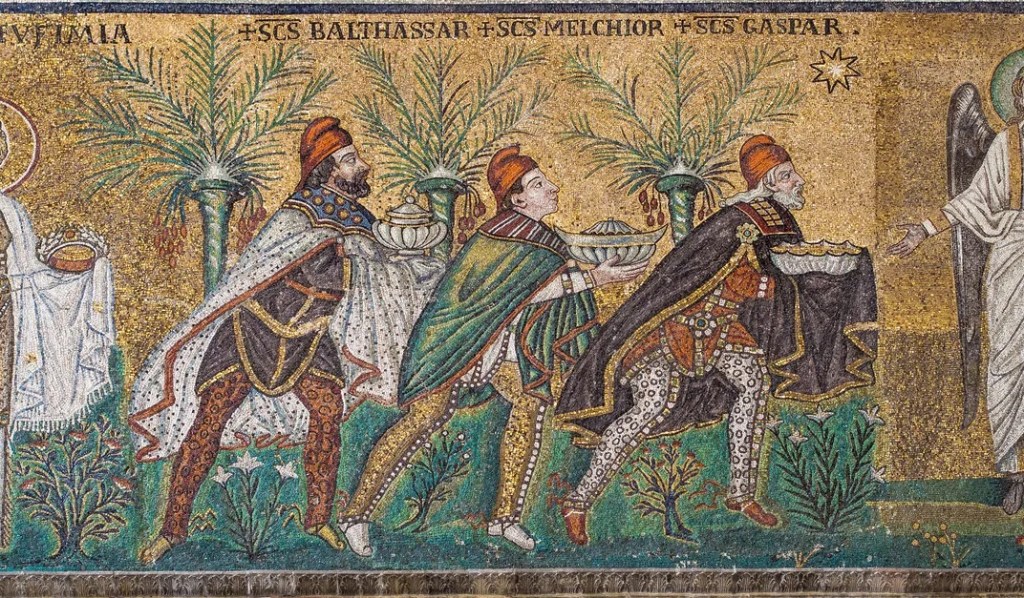
Sixth-century CE mosaic at the Basilica of Sant’Apollinare Nuovo in Ravenna, Italy

In England, the Venerable Bede (d. 735) wrote the Magi were symbols of the three parts of the world—Asia, Africa, and Europe. They signified the three sons of Noah, who fathered the races of these three continents (Genesis, chapter 10). By the late Middle Ages, this idea found expression in art, and artists began to depict one of the kings as a black African. The kings sometimes have their retinues, which include animals from their presumed places of origin: camels, horses, and elephants are the most common. As with the shepherds, the artists often represented the three kings in the various stages of life: young, middle aged, and old age.

Gentile da Fabriano’s Adoration of the Magi, 1423

Artists added more exotic animals to the nativity scenes in the 15th CE when trade and travel were expanding beyond the continent. Gentile da Fabriano’s Adoration of the Magi (painted in 1423) presents a remarkable range of animals. Alongside the traditional ox, donkey, sheep (and a couple of dogs thrown in for good measure), the chaotic scene includes a camel, cheetah (or leopard), hawks and monkeys.

“Cabinet of Curiosities”
Engraving from Ferrante Imperato, Dell’Historia Naturale (Naples 1599)

The inclusion of animals which were not native to Europe helped Gentile da Fabriano to emphasize the three wise men’s journey from the Far East, but also to impress viewers with its exoticism and visual richness. This would have reflected very well on the painting’s patron, the rich Florentine banker Palla Strozzi, as it reinforced his connections to foreign lands. In this era, many rich citizens had a collection of exotic animals and imported wares, just as wealthy people today have collections of art, yachts, or sports cars to showcase their riches.

Sandro Botticelli, “Mystic Nativity” (1500), oil on canvas, 42.7 × 29.5 inches (108.5 × 74.9 cm) (image via Wikimedia Commons), now in National Gallery of London.

An even more elaborate nativity comes from the hand of Botticelli, who worked in the wealthy merchant city of Florence, Italy, in 1500. Savonarola was a fanatical preacher who aimed to morally reform the city of Florence, which had a global reputation for artistic output and lavish lifestyles. Savonarola condemned secular art and literature, decried the city as a corrupt and vice-ridden place bloated with material wealth, and, after warning of a great scourge approaching, saved the Florentines by convincing the French king and military to deoccupy and recede during the Italian War of 1494–98.

The people thought of him as a prophet and came from miles around just to hear him preach his apocalyptic message. He preached a sermon telling the people of Florence they could become the new Jerusalem “if only its civilians would part with and burn their luxuries, opulent fineries, and give up their pagan or secular iconographies.”

Botticelli fell under Savonarola’s influence during this time, for his art changed from decorative to religious. The 12 angels at the base of the composition each hold a ribbon that the artist inscribed with the 12 privileges or virtues of the Virgin Mary, which came from a sermon Savonarola delivered about a vision he once experienced. Another unusual aspect is that the three kings welcome Jesus empty-handed, rather than with gold, frankincense, and myrrh — influenced by Savonarola’s sermon, though it could be their ultimate gifts are their prayers and devotion.

Mike brought his good humor to class with a Grinch portrait

Sometimes it’s impossible to know whether the artist was inspired by a non-biblical element or by an apocryphal text in a Nativity scene or if the artistic depiction came first. In their book, Art and the Christian Apocrypha, David R. Cartlidge and J. Keith Elliott contend in the making of early Christian art, written and visual sources are interdependent. “The developing consensus is that oral traditions, texts (rhetorical arts) and the pictorial arts all interact so that all the arts demonstrate the church’s ‘thinking out loud’ in both rhetorical and pictorial images” (2001, xv).

Gail W.’s open perspective nativity inspired by the renaissance artists

When we artists imagine the nativity today, we add to the basic scripture text all of the Hollywood movies we’ve seen, the stories we’ve heard around the fireplaces and altars of our instruction, and every Christmas card and artwork we’ve ever seen. Our memories of Christmas are often more important than Christmas itself. This is because we have an idea of how Christmas is supposed to BE, but the birth of Christ wasn’t what either Mary or Joseph thought it was going to be. Just as most of us, they hoped to be at home and near family, not “away in a manger, no crib for a bed.”

Cornelia worked in the geometry of the scene. I might rework the sky.

God brought the Savior of all into our world into a humble setting, not to a royal palace. God brought to the birthplace of Christ strangers from distant lands and marginalized people from their homeland to have the first opportunity to worship the newborn king. God excluded the political rulers because they were out to destroy this unusual king.

We are part of the Christian community now, so we sometimes miss the disruptive nature of Christ’s birth. As part of the in/dominant group today, we might have a tough time reading the Bible’s challenges to self-satisfaction and complacency.

Birth of Alexander the Great, mosaic, Roman villa near Baalbek, Lebanon, 4th CE

We often forget while these depictions of the Nativity were evolving, the segment of the Roman Empire that was still pagan were also representing famous births, that predate the standard depictions of the Nativity of Christ. For example, in a Roman villa near Baalbek, Lebanon a fourth century mosaic of the Birth of Alexander the Great at first sight almost exactly resembles what later became a standard depiction of the Nativity of Christ. This mosaic, today in the National Museum of Beirut, shows the newborn Alexander the Great being bathed in a circular fluted basin by a female figure labelled ‘Nymphe’, while his mother Olympias reclines on a bed watched by an attendant.

Compare this with the icon of the Wise Men Visiting the Birth of Christ, from the 6th CE pictured above. In the lower right corner of this nativity scene, we see a small depiction of the Christ child being bathed, with water being poured over his head. (Obviously a United Methodist, but a precursor since John Wesley wasn’t born yet!) Our Christian iconography is derived from pagan sources. By this I mean we reimagined the pagan iconography and repurposed it for our own spiritual practices and purposes.

One of our other challenges is the calendar. We in the West use the Gregorian calendar, from the 16th CE, while the Orthodox Church still follows the Julian calendar, which was in use during the time of Christ. This is why the Orthodox community still celebrates Christmas and Easter on different dates than the Western churches. In the Orthodox Church, they celebrate Epiphany as the baptism of Jesus rather than the arrival of the Magi (Three wise men), which the Western Church celebrates on 6 January. On the Gregorian calendar, this Orthodox Epiphany celebration is January 19th. They celebrate this date as the Baptism of Jesus, rather than the arrival of the wise men. Their Epiphany is located in the baptism rather than the nativity. That’s a whole other theological discussion beyond the iconography of the nativity!

DeLee: The No Room Inn, mixed media, private collection

I mention this fact of the two calendars because I’m always “calendar challenged.” It’s not a senior citizen thing, because this was my problem even when I was in my twenties also. Sometimes I put too many commitments on my calendar, and other times I underestimate the time to complete my tasks. Then again, there’s always the unexpected interruptions. Always the interruptions. I came to understand in my ministry my list of tasks to do were not my actual work, but instead these interruptions were the opportunities which God would bring to me to do God’s chosen ministry.

So, I’m a few days late on the Western calendar for the visit of the Three Kings, having missed January 6th, and I’m a few days early for the Orthodox calendar. As Goldilocks said, “Not too hot, not too cold, but just right!”

Mike’s impression of the Nativity

The last art pieces our class made in 2024 before the holidays and the snowstorms were our nativity paintings. I asked each person to use their imagination and to bring the essence of the nativity to their creative process. Some of us quickly realized our images and used our second meeting to do a personal project or another version of the nativity scene. Others of us took both sessions to perfect our one image. I blame the Christmas cookies and our lack of hand and mouth coordination. Sometimes it’s hard to chew and paint at the same time!

Our first class of 2025 was an instance of “calendar challenge”—I thought we were having it, but the group didn’t. The next week, a major snow storm canceled class every where for everyone. Friday, January 17, should be a good day to begin a new project! We’re going to do some mixed media, along with weaving projects in the days and weeks to come. You don’t need skills, but a willingness to try.

Joy, peace, and a hope for better weather!

Cornelia


The Magi and the Manger: Imaging Christmas in Ancient Art and Ritual – The Yale ISM Review

The Nativity Tympanum on the Sarcophagus of Stilicho

https://www.christianiconography.info/Wikimedia%20Commons/nativitySarcophagusStilicho.html

UNESCO monuments in the Croatian Academy of Sciences and Arts Glyptotheque

https://gliptoteka.hazu.hr/unesco/en/trogir.html

The Apocryphal Gospels—PseudoMatthew—has Latin text and translation
https://www.google.com/books/edition/The_Apocryphal_Gospels/Cmbtm4ZZXF0C?hl=en&gbpv=1&dq=M.+Berthold+has+argued+that+Pseudo-Matthew&pg=PA75&printsec=frontcover

The Infancy Gospel of James (2nd century) |http://www.ccel.org/ccel/schaff/anf08.vii.iv.html

The Arabic Infancy Gospel (5th-6th century) http://www.ccel.org/ccel/schaff/anf08.vii.xi.html

The Gospel of Pseudo-Matthew (8th or 9th century) http://www.ccel.org/ccel/schaff/anf08.vii.v.i.html

Web Gallery of Art, searchable fine arts image database

https://www.wga.hu/frames-e.html?/support/zearly/1/1sculptu/sarcopha/1/9claudi2.html

Nativity – Visual Elements in the Nativity — Glencairn Museum

https://www.glencairnmuseum.org/nativity-visualelements

Johann International: Search results for Nativity  http://johanninternational.blogspot.com/search?q=Nativity

Revisiting Botticelli’s Evocative “Mystic Nativity”  https://hyperallergic.com/978201/revisiting-botticelli-evocative-mystic-nativity/

ORTHODOX CHRISTIANITY THEN AND NOW: Origins of the Icon of the Nativity of Christ
https://www.johnsanidopoulos.com/2018/12/origins-of-icon-of-nativity-of-christ.html


Nativities Then and Now

Altars, Apocalypse, beauty, Bethlehem, Christmas, Creativity, Faith, Holy Spirit, Icons, Imagination, incarnation, inspiration, Israel, mystery, Nativity, righteousness, Savonarola, vision

Every Christmas, my family would put up a beautiful tree and decorate it to the nines. My dad would always tie this living sculpture to the nearest window frame so the tree wouldn’t topple over. He was well aware at least one of his three curious and rambunctious children would no doubt be crawling under the lowest branches to reach the brightly wrapped presents hidden far back in the corner under the tree.

We kids most desired and sought after these hidden gifts, while those near the front always got a cursory glance and shake. If it were hidden, it had to be desired! Package shaking in the hidden, tight quarters could cause a tree to collapse and that would be more drama than our frazzled mother wanted at this time of year. My dad was wise enough, or trained by experience, to know messing with “Mother Nature” wasn’t a great idea.

Mother’s Nativity with other additions from family and friends

Under this tinsel draped tree, with its 1950’s glowing bubble lights, we always had a nativity scene. In our early childhood, it was solid and childproof, but as we aged, and got too large to crawl under the tree, a better quality nativity came to live under the tree. By my college years, my brothers were also grown enough for mom to exercise her creative genius. She hand-painted her own ceramic nativity group. This masterpiece also got its own special display site. Up until this time, we children had no idea our mother had any artistic talent, for she’d spent her days transporting us to our multiple after school activities. Between my brothers’ sports teams and my hobbies, it’s a wonder she found time to do anything else in the afternoon hours.

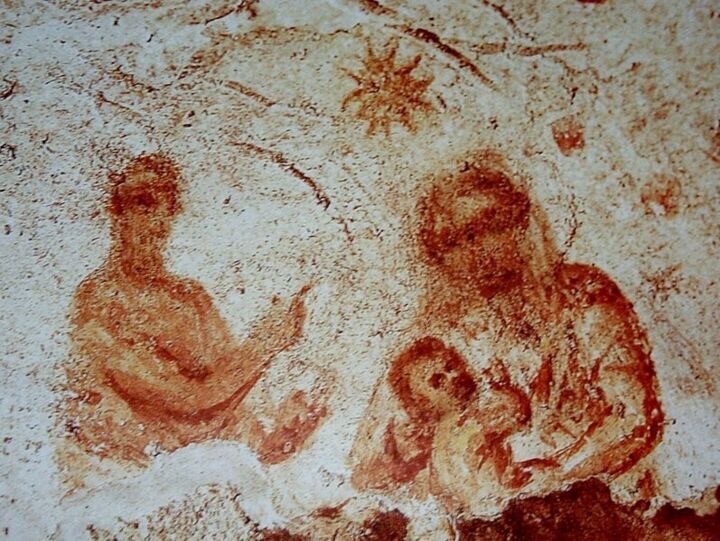
Nativity, Adoration of the Magi, 3rd century. Fresco, Rome: catacombs of Priscilla, 3rd Century CE

The 3rd century fresco shows the scene of Adoration of the Magi on the the arch dividing the room in the Greek Chapel in the Catacombs of Priscilla, Rome. In depictions of ancient Greek and Roman gift-giving practices, the act and choice of gift were important. They furnish information about both giver and recipient. The wise men adopt the same postures used in Roman imperial ceremony for the worship of an Emperor or other ruler. Roman art has always provided a pictorial model for the representation of the Magi. By identifying with or recognizing such an outward act of homage, the viewer could enter into the Nativity story through the wise visitors, worshipping the God manifest on earth in the Child.

This is why the earliest Christian art is found in the catacombs of Rome, in the hidden places, since worshipping Jesus wasn’t an approved religious practice in the Empire. Only the Divine Emperor alone was worthy of reverence and worship, not some dying and rising god of a far-off province. Today in America we sometimes forget we’re a nation founded on the principle of freedom to practice our religion as we see fit, or not to practice a religion at all, as the case may be. No government can compel the privilege of one religion above another or set one as the official religion.

Tympanum of the right side of the cast of so-called Sarcophagus of Stilicho, sculpted around 385 AD (the original piece of art is in Sant’Ambrogio basilica in Milan, Italy), Detail Nativity scene, Museo della civiltà romana a Roma (Eur), Room 15 (Christianity).

Another early depiction of the nativity isn’t in a Christmas context, but is found on a late 4th C Roman sarcophagus for a high ranking military official and his wife. The unknown artisan rendered the Christ child, wrapped in binding clothes, and lying in a manger, between the ox and the ass, to fulfill the prophecy of Isaiah 1:3—

“The ox knows its owner, and the donkey its master’s crib;
but Israel does not know, my people do not understand.”

As accustomed as we are today to manger scenes with all kinds of animals present, the scriptures don’t name them. These are left up to our imaginations. Even the elements derived directly from the gospel narratives of Matthew and Luke were slow to appear in visual renderings. Between those early scriptural accounts and the formation of even a basic manger scene lie some centuries during which Christian devotion and depiction developed. Likewise, the celebration of Christmas was slow to develop, but by the 4th century it was well along.

Nativity Fresco in Santa Maria Foris Portas, Castelseprio, Italy, 9th CE

In the ninth century, after the iconoclastic period, when the images of holy persons were forbidden and destroyed, a fresh wave of religious activity began in the arts. In Italy. In the church dedicated to Mary Outside the Gates in Castelprio, Italy, an entire series of paintings covered the interior walls. The church was located on an important trade route and the site was once a Roman fort. The theme honored Mary as the Bride of Christ, thus making her the spiritual equivalent of the Church, which is the Bride of Christ in scripture. In every tableau, Mary is the largest or most significant figure. Over the centuries, the area lost its importance, these paintings were whitewashed over, but after many years and much restoration, they’re now protected as a UNESCO World Heritage Site.

Today Protestant believers have a Christo-centric faith, often ignoring the other persons of the Holy Trinity. When we focus on the nativity, we forget God’s plan was to use humanity to save the fallen creation. This includes Mary and Joseph both, as well as God’s own Son, as Paul so well reminds us in Philippians 2:5-8—

Let the same mind be in you that was in Christ Jesus,
who, though he was in the form of God,
did not regard equality with God
as something to be exploited,
but emptied himself,
taking the form of a slave,
being born in human likeness.
And being found in human form,
he humbled himself
and became obedient to the point of death—
even death on a cross.

Giotto di Bodone, Nativity of Jesus, 1303-1305. Fresco, 200 x 185 cm. Padua: Scrovegni Chapel

Giotto’s frescos in the Padua Chapel are some of the most important works of art because he brought the Holy Family into ordinary human life. The blue skies replace the gold of the traditional icons, which stood for the infinite and eternal spiritual world. In Giotto’s painting, people hunger and thirst, while in the world of the icons, all suffering is transformed and any passion is disciplined.

Duccio di Buoninsegna, Nativity between the prophets Isaiah and Ezekiel, 1308-1311. Tempera on panel, 43.8 × 111 cm. Washington: National Gallery of Art

Duccio painted in his studio all the individual sections of the great altarpiece of the church in Sienna, Italy. On completion in 1311, the townspeople held a grand parade as they carried the paintings to the cathedral. They were installed in a magnificent framework with some of the works facing the congregation and the rest facing the church officials. The altarpiece remained intact until until 1506 when it was partially dismantled, relegated to side chapels and replaced by a 15th-century bronze tabernacle.

In 1771, the church fathers hired a carpenter to saw up the old wooden altarpiece into seven vertical pieces, and then saw each of those pieces in half laterally to separate the front scenes from the back. He then reassembled the different pieces to form new scenes. Most of the individual paintings stayed together, but others were sold to private collectors or museums. This Nativity between the prophets Isaiah and Ezekiel was purchased by the Museum Kaiser Wilhelm Friedrich in Berlin and remained on display there until 1938. At that time, a Nazi-appointed Museum director purged most non-Teutonic art from the collection. Through a trade, this Nativity came to our National Gallery of Art in Washington, D. C.

Duccio: Maesta Reconstructed Altarpiece. Front (L) and Back (R)

When we think about hidden meanings in art works, sometimes the journey a work takes to its exhibition home is part of its meaning. The Nazi purge of non-Teutonic art from the collection was based on their idea of a pure race for their homeland, with which they shared a special mystical bond. It meant they would purge or purify all who didn’t meet this white supremacist ideal. I personally am glad America is an open society, which welcomes all kinds of art and artists. When we think of the journey of the Holy Family, they made an arduous trip to Bethlehem while Mary was about to give birth and then had to head out on the lam because king Herod was out to kill all the boy babies. When we look at beautiful nativity scenes, we forget Jesus was born into a troubled world. Indeed, these beautiful works make us forget our own troubles.

Sandro Botticelli, Mystical Nativity, 1501. Tempera on canvas, 108.5 × 75 cm. London: National Gallery.

One of the most unusual nativity paintings is the Mystical Nativity by Botticelli. Painted with egg tempera on canvas, the artist writes in the upper section how he painted this “at the end of the year 1500, in the troubles of Italy…in the half after the time, during the fulfillment of the eleventh chapter of St. John in the second woe of the apocalypse…”

The monk Savonarola was actively preaching at this time, and scholars believe he influenced Botticelli. During the time of the Medici rule, Florence prospered with trade and the city’s alliance with France made for a time of peace. Lorenzo d’Medici died in 1492, relations with France broke off, and the French army ran amuck in the Italian countryside. Florence lost her former glory, trade dried up, and a political vacuum allowed for new voices to rise. Savonarola preached repentance and austerity, even going so far to burn luxurious items and artworks. He burned all kinds of vanities: cosmetics, mirrors, veils, and books.

People followed him because he was charismatic, and his words seemed to match their circumstances. Florence under his rule was an example of theocracy, the government of a state by immediate divine guidance or by officials who are regarded as divinely guided. Under this system, the people prosper if they care for one another and live godly lives, but they fail to thrive if they cheat the poor so the rich can live in luxury.

Prosperity religion teaches the good thrive and the sinners suffer. It’s not a new idea: retribution and reward appeal to people, but sometimes the good suffer and the evil prosper. The book of Job is a counter argument to this worldview. The life of Christ also shows the best of us will be sacrificed on a cross by those who don’t know what they’re doing. From birth to death, Jesus and his family were under duress from the powers of state and religion. He was a new voice of love and acceptance, of grace and forgiveness, of a righteousness by faith, not works. This new voice would upend the world as people knew it then.

Douce Apocalypse – Bodleian Ms180 – p.042 Woman Clothed in the Sun, Oxford University, London, c. 1265-70

The Mystic Nativity is a combination of the Nativity and the Last Judgment. On top, the angels hold hands in a circle, the center is the birth of Christ on earth, and the lower third is the vanquishing devils due to the Christian’s reunification with God. The number twelve represents the twelve gates of the new Jerusalem, the City of God. Twelve are also the number of stars in the crown of the woman in the apocalypse linked to the Virgin Mary. Other symbols also occur, but the overall meaning is Botticelli painted to deal with his fears about the end of the world.

Sometimes we make a cursory glance or reading of a painting, only to see its surface meaning. If we were to take this path with Botticelli’s Mystical Nativity, we might only see pretty angels and lovely ribbons. It looks like a homecoming at a sorority weekend with all the hugging and kissing. But Botticelli was painting during a time when the theological ideas of the monk Savonarola were in ascendance. He believed, “The more creatures approach and participate in the beauty of God, the more are they themselves beautiful, just as the beauty of the body is in proportion to the beauty of the soul.”

Virtuvian Man by Leonardo da Vinci, 1490, pen, brown ink, and watercolor on paper, Gallerie dell’Accademia, Venice, Italy.

As an interesting aside, about contemporary with Botticelli’s work in Florence, while Leonardo da Vinci was in Milan in 1490, he drew his Virtuvian Man, considered one of the greatest scientific and humanist works of the early Renaissance. Da Vinci used Vitruvius’ classical treatise on architecture as the source for his drawing. Notes from his translation are written in his famed mirror script below the image. This artwork is now so fragile, it never travels and only copies are shown.

While his outer world may be falling apart, and prosperity has left his vicinity, Botticelli still had hope for a better world. His faith was grounded in the birth of the savior, the son of God, who came in flesh to make all flesh divine. We forget this crucial message of the nativity, which is to make holy all flesh. More often we focus on the magi’s gifts brought to the child: riches fit for a king, or the gifts of presence, from the poor shepherds. The true gift is the one in the manger, for Christ is God’s gift to us. He came to make us all At-One with God, the very best atonement possible. At the Last Judgment, all who are at one with God’s purposes will be separated from the rest.

Banksy, “The Scar of Bethlehem” (2019) (courtesy Bisher Qassis), located in The Walled in Hotel in Bethlehem, closed since 12/12/23, due to fighting against Hamas

How can we practice seeing past the surface of everyday life? Sometimes we have to be shocked. Modern nativities bring us again and again to confront the same world of challenges and discord into which the young Christ child was born. If we wrap ourselves in warm swaddling clothes so we too won’t cry over the lack of a Christmas in Bethlehem this year, we lose sight of the common humanity of all God’s people. The extremists will take retribution on everyone, but those who take the middle path punish only those who did wrongs. Is there hope for those who take the “my way or the highway?” Or do we need to join the Holy Family and become refugees to avoid King Herod’s slaughter of the innocents?

Vatican City public nativity

This 2020 nativity was created as a public art project by ceramics students in Castelli, Abruzzo, Italy, a region known for its ceramics. It had nineteen figures including an astronaut and a Darth Vader figure, whose creation predated the Star-Wars series and represented a generic “sinner” figure. In modern nativity scenes, artists often integrate characters not mentioned in the gospel accounts, in order to bring the interests of contemporary audiences into the biblical story. As you can imagine, it created quite a buzz. Some said it lacked “beauty,” while others thought it was a joke. Some thought it disrespectful to the honor of the Holy See, the Church, and to the good Lord himself. It’s a truism “beauty is in the eye of the beholder.” Also, “we’ve never done it that way” still has a strong hold on people’s hearts and minds.

Sinner and Astronaut: Large Ceramic Nativity at the Vatican, 2020

Seeing deeper meanings in art or scripture is no more complicated than seeing a deeper understanding of a literary experience, such as a book or poem. In art, we do have the hurdle of acquiring some visual background and “visual language.” Just as we can’t understand a foreign language without learning some phrases, we need to know some art history and styles. We can only understand in part at first, but later we’ll understand as if we were old friends. No one is a savant right away. If we pause as we read a scripture, let the words sink into our deeper minds, and let the Holy Spirit open up new insights into God’s word, we can do the same with art works.

Bread Nativity

After all, bread is just bread: ordinary flour, yeast, oil, and water. Once we bless the bread and invite the Holy Spirit to transform it, we understand these same ordinary materials to be signs of the extraordinary presence of the Body of Christ, as recorded in Luke 22:19 at the Last Supper—

Then he took a loaf of bread, and when he had given thanks, he broke it and gave it to them, saying, “This is my body, which is given for you. Do this in remembrance of me.”

Baby Jesus Bread Rolls

We’re always surrounded by the mysteries of hidden meanings, if only we have eyes to see and ears to hear. May you know God more deeply in the days and years to come.

The Christ Child in the Rubble, Nativity in Bethlehem, Palestine, West Bank, 2023

Joy and peace,

Cornelia.

Featured image—Nativity, 3rd century. Stucco, Rome: catacombs of Priscilla.

Category: Sarcophagus of Stilicho in Sant’Ambrogio (Milan) – Wikimedia Commons
https://commons.wikimedia.org/wiki/Category:Sarcophagus_of_Stilicho_in_Sant%27Ambrogio_(Milan)

Duccio, The Nativity with the Prophets Isaiah and Ezekiel, 1308-1311
https://www.nga.gov/collection/highlights/duccio-the-nativity-with-the-prophets-isaiah-and-ezekiel.html

Botticelli’s’ Mystic Nativity: Symbolism, Savonarola and a Reflection of an Era | Renee Farina – Academia.edu
https://www.academia.edu/1262474/Botticellis_Mystic_Nativity_Symbolism_Savonarola_and_a_Reflection_of_an_Era

Leveto, Paula D. “The Marian Theme of the Frescoes in S. Maria at Castelseprio.” The Art Bulletin, vol. 72, no. 3, 1990, pp. 393–413. JSTOR. Free account to access. https://doi.org/10.2307/3045748. Accessed 24 Dec. 2023.

Katarína Šimová: The Fresco Cycle of Santa Maria foris portas, MASARYK UNIVERSITY! FACULTY OF ARTS, DEPARTMENT OF ART HISTORY, 2021. Open source
https://is.muni.cz/th/ufv2u/castelseprio_frescoes.pdf

Significance of Leonardo da Vinci’s Famous ‘Vitruvian Man’ Drawing
https://mymodernmet.com/leonardo-da-vinci-vitruvian-man/

Baby Jesus Bread Buns · How To Bake A Roll Or Bun · Baking on Cut Out + Keep
https://www.cutoutandkeep.net/projects/baby-jesus-bread-buns

The Adoration of the Magi: Mosaic in S. Maria Maggiore https://www.christianiconography.info/staMariaMaggiore/epiphanyArch.html

The Magi and the Manger: Imaging Christmas in Ancient Art and Ritual – The Yale ISM Review https://www.ismreview.yale.edu/volume-3-1-fall-2016/the-magi-and-the-manger-imaging-christmas-in-ancient-art-and-ritual

The Fairy Nativity: A Simple Christmas

Creativity, home, Imagination, photography, purpose, renewal, Uncategorized, vision

“There are winds created for vengeance and in their anger they can dislodge mountains. On the day of reckoning they will pour out their strength and calm the anger of their Maker.” ~~ Ecclesiasticus 39: 28 

Seventeen days and counting to Christmas: Grey Thursday, Black Friday holy family and the Great Christmas Sales are upon us. Wal-Mart is covered up with people like the great ski slopes in the mountains should be covered with snow at this time of year. The Salvation Army bell ringers are out, but their friendly jingles and smiles aren’t making much of a dent into the general mood with Fiscal Cliffadedron, Egyptian Meltdown, Iranian Idiots, or Syrian Chemical Weapon threats weighing heavy in the air.

People aren’t much in the mood for Christmas this year, perhaps because our expectations are too high. We wanted a “Good Thanksgiving” with a happy family all gathered around the table, but the drunk uncle made his appearance once again and the kids all wanted to text the entire meal, while Dad wanted the food served in the “media room” so he wouldn’t miss any of the game.  This didn’t make any of the lady folks happy after baking and cooking for two days for the thirty-minute meal. So the gals took the credit cards and maxed them out on the early deals Thursday afternoon.

Now we have the incessant commercials of increasing expectations berating us on the TV: moving up to a bigger car, a bigger diamond, or giving your stepchild a diamond just like the one you gave her Mom (this is outrageous, children shouldn’t get diamonds until they are grownups! They need to have something to look forward to!). But most of our lives today aren’t like this, for we are more like the 99% and less like the 1%.

I was recently in Turkey in the region of Cappadocia. There is an area called the Fairy Mountains that has unusual stone pillars and shapes that have been worn away by the wind, rain, and blowing sand.  One such

fairy mountains cappadocia

fairy mountains Cappadocia

shape is a camel, and another grouping of three is known as the “holy family.” This Nativity Scene makes me think of all the precious sculptures I’ve seen. Most of them are highly sophisticated, brightly colored, and “clean” for that is truly how we view holiness.  This isn’t the world the Christ Child was brought into by his parents, however.

Mary was a young teenager when the angel came to tell her she would bring the Christ into the world without benefit of a husband, that is, it would be a virgin birth. Folks in the village soon began to talk, and Joseph was going to break off their engagement, but an angel told him in a dream it would all work out ok.  When Mary began to show, however, she needed to leave town, so she went to see her older cousin Elizabeth who was also with child.  These two were alike in that they were “outsiders:” Elizabeth was alone because her husband wasn’t able to speak because he doubted the Lord was at work in his wife’s pregnancy and Mary was alone because her family and town doubted her story.

When the census time came, everyone had to go to their ancestral hometown. Mary and Joseph went to Bethlehem, the city of David, but no one would let them stay in their inn. The text says there was no room for them in the inn, but Joseph wasn’t a stupid or slow man.  He didn’t wait until the last minute to take his very pregnant wife on this trip, so that all the hotels and motels were already full. People back then are just like people now: they talk, they make judgments, and folks decide that out of wedlock babies are unwelcome in their nice establishments.  One innkeeper did take pity upon them and gave the family a place in the stable among the animals. The baby was born there; the king of the world had a manger for his throne, and the animals for his court.  Angels proclaimed the Savior’s birth to shepherds, outcast persons on the margins of society because they were not clean. They were the first to honor him. Strangers from the east came to worship him and give him gifts, aliens and nonbelievers rather than the Jews themselves.  His mother  “…treasured all these words and pondered them in her heart” (Luke 2:19).

The King and the priests heard the strangers from the east ask: “Where is the child who has been born king of the Jews? For we observed his star at its rising, and have come to pay him homage” (Matthew 2:2).  They conspired among themselves to murder all the newborn baby boys when they didn’t find out the one name. Joseph took Mary and Jesus in the middle of the night out into Egypt, for he was warned in a dream that the child was in danger.

This Christ Child knows the pains of the world from the very beginning of conception, for he knows the loneliness of the poor and the isolated, the rejected and the misunderstood. He knows that if the king of the world will be rejected and despised, so will all we lesser human beings. If we are persecuted in this world, we are in good company, since he was singled out from birth and many innocents died on his behalf (Matt 2:13-33). His family fled with the clothes on their backs, but they carried the gold, frankincense and myrrh gifts he received as gifts for his ministry and burial.

Most people don’t read the Nativity Story this way, but when I look at the way the wind wears away the stone, I have to think that these figures are the strength that is left after the winds have torn away the soft parts. The hard parts, that core that remains, is the true part that is the inner strength that comes from the inner spirit of a person.  The winds may move mountains and reveal a new shape, but that is just God’s recreating power at work.

The biblical word for wind and spirit are the same, so the Holy Spirit can be the rushing wind that changes our hearts and minds into the new shape God has in mind for us.  The American Bible Society says that each American home has 4.3 bibles in it in 2012. However, most people aren’t reading it, for 46% couldn’t tell the difference between the Koran, the Bible, or the Book of Mormon.  What’s worse, 50% of Americans, including Christians, couldn’t name ANY of the four gospels (Matthew, Mark, Luke, & John). The Bible’s oral traditions have been around for 6,000 years, and it’s been written down for 4,000 years.  Surely that is a testimony to its robustness: the winds of other ideas may blow against it, but its inner strength stands firm against all the storms.

As a spiritual art project, make your own nativity from found objects, the more humble the better.  If you go on a nature walk, find rocks or pine cones and paint them with minimal decoration so that they are recognizable as “figure” or “animal”. If you make them from toilet paper rolls, use construction paper and simplify the figure drapery.  These should be fun because you need to quit thinking “perfect” and allow yourself to “enjoy Christmas for a change!”  Have yourself a Merry Simple Christmas!