Steps in drawing a Geometric Still Life: sketch, refined sketch, shadows, intense shadows and cast shadows
We are back in art class again on Friday mornings at Oakland United Methodist Church. Our first lesson is in solid geometry, but it’s not a math class. Art is more like learning a visual two-dimensional language to be able to render three dimensional objects on a flat plane. This isn’t as easy as you might think, but once you learn to see in perspective, you never can unsee it again. Art class is like an old fashioned one room schoolhouse, in which a teacher has students of varying ages and experience levels to instruct. I provide one lesson and modify it for each student according to their needs.
Gail S.—Pencil Drawing of Solid Geometry
The first day of class, I had three brand new students and one who has done this exercise at least three times before. Two others were out doing family obligations, just as I was missing in action last week due to attending my niece’s graduation ceremony for her MBA in Business Administration. Life and family watershed events are always important to make our presence known. The life of the artist is as important as the art itself. We aren’t just people who make beautiful objects for others, but people who make life beautiful by being present at their most important moments.
Vermeer: The Art of Painting, 1666-1668.
When we look at the painted floor in the Vermeer painting above, we know in our minds these stand for black and white square tiles. If we take a moment to closely observe them, we realize these are more like diamond shapes. This optical illusion is the result of perspective. Perspective comes in multiple forms. Linear perspective has one-point, two-point, three-point, and multi-point vanishing points. Aerial or atmospheric perspective uses color, clarity, and value as objects overlap each other and recede into the background. There’s also reverse perspective in which objects are larger as they grow more distant and foreshortening, in which nearby objects are emphasized.
Pop Tarts from the Pop Tarts Bowl Toaster Trophy in 2024
Can we teach all of this knowledge in a single two-hour lesson? Absolutely not. Michangelos aren’t turned out like pop tarts from a toaster. In the Renaissance era, a family would place a youth between the age of 7 to 14 with a master artist to learn the trade. This child would do the chores of the studio and learn to grind the pigments and mix paint. Then they would progress to drawing and composition. After a training time, they might get to do the backgrounds of the paintings or the landscape. After eight years, if they were any good, they would be entrusted with an entire commission. Then they would venture out on their own or take over from their master’s studio.
Cornelia—Purple Geometric Forms
I started taking art lessons when I was eight years old from the city parks and recreation art teacher on Saturday mornings, and then after school from a former art teacher in town. My grandmother was a portrait and still life painter. I have been taking or teaching classes for over seven decades. Art is not a skill or a product a person can ever perfect. It is more like a journey of faith, one in which we are always going on to perfection, but by the grace of God, will only be completed at our last day. Even at my age, I have more than a few “needs improvement works” left to create.
Tonya—Black and white Geometric Forms
The more you know, the more room for improvement you can find. I always ask students to first find three positive critiques of their work to praise before they begin to talk about their “improvement areas.” In this lesson, if they drew all three shapes, used two distinct colors for light and dark, and used up the space on the canvas, rather than drawing an inch tall image, those are positive points. Then they can point out their troubles.There’s enough negativity in this world. We need to overcome that in our own lives. What we learn on this canvas will carry over to the next one. Then we will find new opportunities for improvement yet again!
Marilyn—Geometric Forms in Aqua
No one who gets a significant health condition finds making a wholesale change overnight easy or achievable. This is why people who try extreme diets like Whole 30 that restrict too many foods discover they can’t stick with it or must continually start over. People looking to make lasting, healthy changes must start small and focus on progress over perfection, according to nutrition coach Brady von Niessen. “You start feeling so good about them that you can’t even imagine not doing them.” The same principle applies in art. Over time, a student’s skills will improve if they trust the process. Rome wasn’t built in a day!
Jeanne—Geometric Forms
Another important aspect of art class is relationships. Pierre Teilhard de Chardin said, “The most empowering relationships are those in which each partner lifts the other to a higher possession of their own being.” As a teacher, I try to help each person find their own creative voice, rather than trying to copy an idea of what “good art should look like.” Beginners in tennis don’t get to play on the same courts as Wimbledon or the US Open, or at least not at the same time as those who claimed the trophies! As Picasso once said, “It took me my whole life to learn to draw like a child.”
I consider this first class a success for each student. First, I got to hear some of their stories, which helps to build relationships. I got to hear their fears about not being perfect—none of us are perfect, but as United Methodists we are all going on to perfection in love by God’s grace and that’s the only perfection we concern ourselves with in art class. Can we love ourselves and give ourselves the grace to come up short? As the great Leonardo da Vinci said, “Art is never finished, only abandoned.”
I look forward to next week when we mix colors for the color wheel for the first time students. The returning students will get a lesson that uses geometry and mixed colors also. The more seasoned students project is a step up because they have more experience, so they have a greater challenge.
The one room art schoolhouse meets at 10 am on Friday mornings. It’s never to late to join.
I had Anterior Cervical Discectomy and Fusion (ACDF) neck surgery at the end of March to correct a damaged disk. A very fine surgeon removed it, replaced it with a new one, and fused it for strength. Two days in the hospital and I went home to recover. I was tired for several weeks, but I soon felt well enough to start painting again. Each week thereafter I could see improvements in my hand steadiness and mental focus as the pain left my body and my healing progressed. I had been through physical therapy and shots in the neck for a year since my original injury.
The old saying about boiling a frog by raising the temperature of the water gradually also applies to pain: if it rises incrementally, you don’t realize how much you’re tolerating. I feel like a new creation, for I have a new lease on life. Most importantly, I have my sense of humor back. I know this is true, for one morning a friend sent me a funny meme. I laughed so loudly, my Apple Watch gave me a High Decibel Warning alert! Silly watch, you’ve never heard my joy.
As part of my ongoing creation series in the studio, I’ve been working with the imagery from the beginning of Genesis (1:6-8)—
And God said, “Let there be a dome in the midst of the waters, and let it separate the waters from the waters.” So God made the dome and separated the waters that were under the dome from the waters that were above the dome. And it was so. God called the dome Sky. And there was evening and there was morning, the second day.
I also had in mind the creation imagery of The Gospel According to John (1:1-5)—
“In the beginning was the Word, and the Word was with God, and the Word was God. He was in the beginning with God. All things came into being through him, and without him not one thing came into being. What has come into being in him was life, and the life was the light of all people. The light shines in the darkness, and the darkness did not overcome it.”
Hildegard of Bingen: Scivias III.1; The One upon the throne, Rupertsberg MS, fol. 122v, manuscript illumination, 12th CE.
These two texts, one from the Old and one from the New Testament, remind us the Triune God has always been creating our universe and our earth. From this we understand what the Trinity has created, it will be by the same love, desire, and compassion the Trinity will sustain creation and renew creation in the proper time. Humanity is a cocreator of beauty alongside the Holy Trinity. While our works aren’t infinite or perfect, we humans hold the desire to create and surpass our best works, even as the Creator of all things saw all the work before the creation of the first human beings as “good,” but the creation of humans in God’s image as “very good.”
Too often our Christian theology hinges on some form of “sinners in the hands of an angry God,” rather than the doctrine of “God so loved the world.” This dualist contrast of sin/redemption versus love/renewal is a difference of viewpoint between those who focus on judgment and those who focus on grace. The old story of “God loves me in spite of my fallen and wicked ways” doesn’t make sense to a new generation who has gotten affirmations for all their efforts. As part of the old generation, that traditional story barely made sense even to me and my generation. Between 2000 and 2020, Gallup reported church attendance for people born before 1946 declined 11%, attendance for Baby Boomers declined 9%, attendance for Gen X declined 12%, and the facts aren’t in yet for the Millennials or Gen Z. Moreover, speaking only to “personal salvation” is not on most younger people’s minds. They are more interested in the great causes of justice for the weak and the oppressed, and in liberation for the unjustly imprisoned, just as Jesus read from the scroll of Isaiah (4:8-9):
“The Spirit of the Lord is upon me,
because he has anointed me
to bring good news to the poor.
He has sent me to proclaim release to the captives
and recovery of sight to the blind,
to let the oppressed go free,
to proclaim the year of the Lord’s favor.”
Hildegard of Bingen is a good person to help straddle this dilemma. After all, Hildegard is one of the only four women whom the Catholic Church has recognized as a Doctor of the Church. Only thirty-six other figures in the history of the church have earned his great honor, which Hildegard belatedly received rom Pope Benedict XVI in 2012. This title recognizes the outstanding contribution a person has made to the understanding and interpretation of the sacred Scriptures and the development of Christian doctrine. Only four on the list are women (Catherine of Siena, Teresa of Avila, Therese of Lisieux, and Hildegard of Bingen). The definition of the term “Doctor of the Church” is based on the three requirements a person must fulfill to merit inclusion in the ranks of the “Doctors of the Catholic Church”:
1) holiness that is truly outstanding, even among saints;
2) depth of doctrinal insight; and
3) an extensive body of writings which the church can recommend as an expression of the authentic and life-giving Catholic Tradition.
Born the tenth child in an era where a family practiced tithing or giving a tenth of everything to God in every aspect of their life, Hildegard was ‘given to God’ and taken to live in an abbey, as a nun. There she learned faith and healing, and studied medicine, natural science, music, and writing. She wrote ten books, two volumes of which are well known: Physica, a book on natural science, and Causae et Curae, a book of medicine and remedies. These two works hold most of Hildegard’s musings on the relationship between science and faith, along with her scientific observations and medicinal remedies. Scivias, Hildegard’s main theological work, stands for “Scito vias Domini,” meaning “know the ways of the Lord.”
Her knowledge came from visions of light, what today some have called debilitating migraines, which confined her to her bed for days. Hildegard spoke of her visions of light, just as migraine sufferers often report an extreme sensitivity to light, or seeing strange light patterns, in the middle of an episode. Her science was advanced for the 12th CE, but we don’t study Hildegard for her scientific truths. She is more important for her theology and spirituality about creation and God’s love for all life.
When God created the world, God pronounced God’s creation “good.” The world in which we now live is obviously corrupt and fallen, so many people have given up on it. The same was also true back in Hildegard’s time. The secular and religious empires of the West were at war. The Crusades tried to wrest the Holy Land from the Arabs in great battles resulting in mass carnage. The growth of cities’ merchant classes also threatened the established order of the powerful.
It was an uneasy time for all the people, just as it is today when the cultures of the east and the west are wrestling for dominance, great powers still try to expand their territories, and technocrats challenge governments worldwide for power. Once again it is “the times, they (were) are a changing,” as Bob Dylan, the prophet of our age sings for every age.
Hildegard speaks of God not only creating, but also being in the world. This is what we call Panentheism, which comes from the Greek words pan/all + en/in +theos/God. Panentheism considers God and the world to be inter-related with the world being in God and God being in the world. Panentheism affirms both divine transcendence and immanence. We can both experience God through the natural world, while God is also beyond our normal experience. Hildegard experienced God in both the world around her, even though she lived a secluded life, and she also experienced God through her visions. (This is not pantheism, which makes creation into the god or accepts the equality of many gods.)
Hildegard von Bingen: The universe (or the Cosmic Egg), from Scivias, an illustrated work by Hildegard von Bingen, completed in 1151 or 1152, describing 26 religious visions she experienced. Liber Scivias (Sci vias Domini = Know the ways of the Lord). The book, Codex Rupertsberg, disappeared during WW II. Transparencies are from a faksimile, copied by hand by some nuns from 1927 to 1933. (Plate 4 fol-14r—The universe (or the Cosmic Egg)
“I, the fiery life of divine wisdom,
I ignite the beauty of the plains, I sparkle the waters,
I burn in the sun and the moon, and the stars.
With wisdom I order all rightly.
Above all I determine truth.
I am the one whose praise echoes on high.
I adorn all the earth.
I am the breeze that nurtures all things green.
I encourage blossoms to flourish with ripening fruits.
I am led by the Spirit to feed the purest streams.
I am the rain coming from the dew
that causes the grasses to laugh with the joy of life.
I call forth tears, the aroma of holy work.
I am the yearning for good.
Invisible life that sustains all,
I awaken to life everything In every waft of air.
The air is life, greening and blossoming.
The waters flow with life. The sun is lit with life.
All creation is gifted with the ecstasy of God’s light.
In doing good, the illumination of a good conscience
is like the light of the earthly sun.
If they do not see me in that light,
how can they see me in the dark of their hearts?
I am for all eternity the vigor of the Godhead.
I do not have my source in time.
I am the divine power
through which God decided and sanctioned
the creation of all things.
With my mouth I kiss my own chosen creation.
I uniquely, lovingly, embrace every image
I have made out of the earth’s clay.”
I resonate with Hildegard not only because her theology speaks of God’s love for everything God created, but also because God desires for all creation and humanity alike to come to a state of perfection. Even when I was a nonbeliever, creation always called my name. I’ve always felt a peace and wholeness when I looked upon nature. The beauty of the sky, the changing colors of the seasons, and cloud patterns fascinate me to this day. Now I can read Psalm 19:1 with a heart of faith:
“The heavens are telling the glory of God; and the firmament (dome) proclaims his handiwork.”
Hildegard of Bingen’s final and greatest visionary work was the Liber Divinorum Operum, the “Book of Divine Works.” Each of her recorded visions elaborates the dynamic Word of God, present before and within Creation. The Word first became a human being to bring the Work of God—humanity and by extension all creation—to perfection. This grand vision is the culmination of Hildegard’s entire theological project and represents her most mature formulation of the themes central to her thought.
Hildegard believed the fundamental human vocation was to understand both ourselves and all creation as the work of God, and our place as cooperative agents of that work. Also in this “Book of Divine Works,” Hildegard considers rational understanding as the means to know our Creator and properly fulfill the work for which we were created; the relationship between humanity and the rest of creation as microcosm and macrocosm; and the eternal predestination of the incarnate Word of God irrupting into and unfolding through time, as revealed in both Scripture and the life of the Church. Our Library of Congress has a fully digitized copy of Hildegard’s final tome of 353 magnificently illustrated pages, which is accessible at the link at the bottom of this post.
DeLee: Christ Offers the Word, acrylic on canvas, 8” x 10”, 2025
Nature has always revealed the presence of God to me, not just the in the act of creation and the beauty of nature, which I see presented daily from sunrise to sunset, but also in the transits of the stars in the night skies. From the myths of our ancestors trying to make sense of their world to our current search for the mysterious ninth planet (sorry, Pluto, I still love you, even if you’ve been demoted to a dwarf planet), and to the great nebulas and galaxies beyond our Milky Way, we humans have experienced God among these other mysteries.
While we believe one day we can know all the unknowns, we nevertheless awake to discover we stand on the precipice of yet more mysteries and the need to refine our former truths. The more we know, the more we discover we’ve barely scratched the surface of the depths of what can be known. This search for knowledge is what keeps the curious alive and ever on the quest for the outer boundaries.
Hildegard: Scivias III.1: The One upon the throne. Rupertsberg MS, fol. 122v.
The creative mind believes a heart touched by God’s creative spirit has unique insights to give to the world, which needs beauty to confront the mess we can see outside our doorsteps and on our nightly newscasts. Creating an icon is one way to pray and enter a holy space. The circle stands for the halo, but also to identify the image portrayed as a holy or important figure. When I need to recenter myself, I always paint an icon. I pray twice—once in the act of painting and again in observing and meditating upon the image of the icon. This icon has not only the halo of Christ, but the cruciform halo, which serves to differentiate the Trinity from the non-divine saints, dignitaries, and angels. It appears on images of God the Father and the Hand of God, Christ and the Lamb of God, and the Dove of the Holy Spirit.
Rebecca Boyle describes the science of creation in “The Universe’s First Light Could Reveal Secrets of the Cosmic Dawn:”
Everything started in the tremendous burst of energy known as the big bang. Within a few seconds the universe cooled enough for the first protons, neutrons, electrons, and photons to spark into existence, and within a few minutes those building blocks came together to form the first nuclei of hydrogen and helium. After about 380,000 years, the universe was sufficiently cool for those protons and neutrons to grab free-flying electrons and form the first electrically neutral atoms. For the first time, photons stopped colliding with free electrons and were able to flow through the universe. This process, confusingly called recombination—it was actually the first true combination of atomic components—released the cosmic microwave background (CMB) light that pervades all of space. The most detailed map of this background is from the Planck satellite, a European space observatory that launched in 2009 to study this light.
DeLee: “All things came into being through him, and without him not one thing came into being.” —John 1:3
I made this second creation painting during this healing time by intuitively wrapping strings around the stretched canvas. Then I took assorted sizes of plastic lids which I couldn’t recycle, but I was “needing to find a use for them” before I relocated them to the trash heap. I belong to the generation of “waste not, want not.” (Yes, my nannie had the famed ball of string and one of tinfoil also.)
As I placed the various sized circles around the canvas, I thought of the many hours my childhood friends and I would pass the leisure of our hot summertime days with scribble challenges. One of us would make random marks on a paper for the other to decorate or to discover a magical creature of our imagination. As we grew older, these became more developed into different textures and patterns. As I painted the circles and straight lines, I saw the bright cross amid the heat of the great power of creation, with all the elements created in that first burst of light.
Hildegard: Liber Divinorum Operum II.1: The Parts of the Earth: Living, Dying, and Purgatory. Biblioteca Statale di Lucca, MS 1942, fol. 88v (early 13th CE.).
As Hildegard reminds us, “Humankind, full of all creative possibilities, is God’s work. God calls humankind alone to assist God. Humankind are co-creators. With nature’s help, humankind can set into creation all that is necessary and life-sustaining.”
One of our last days in the art class I teach at a local church to adults who are willing to pursue the challenge of treading beyond their comfort zones, I was fooling around with a compass and a straight edge. It wasn’t a ruler, but I found the center of the canvas with the compass intersections instead. I used a piece of cardboard as my straight edge. I ended up with multiple intersecting lines, all of which I left on the surface.
When I got home, I found them interesting. These I pursued, but not all of them. The art is in deciding which ones to ignore! While painting, I reflected on God’s creation. The Holy Trinity has always existed and has always shared the work of creation. Also, there is no such entity as a “Holy Binity” or just the Father and Spirit only. The Son has always existed and has always shared the work of the entire Godhead, which we often refer in a shorthand as “God.”
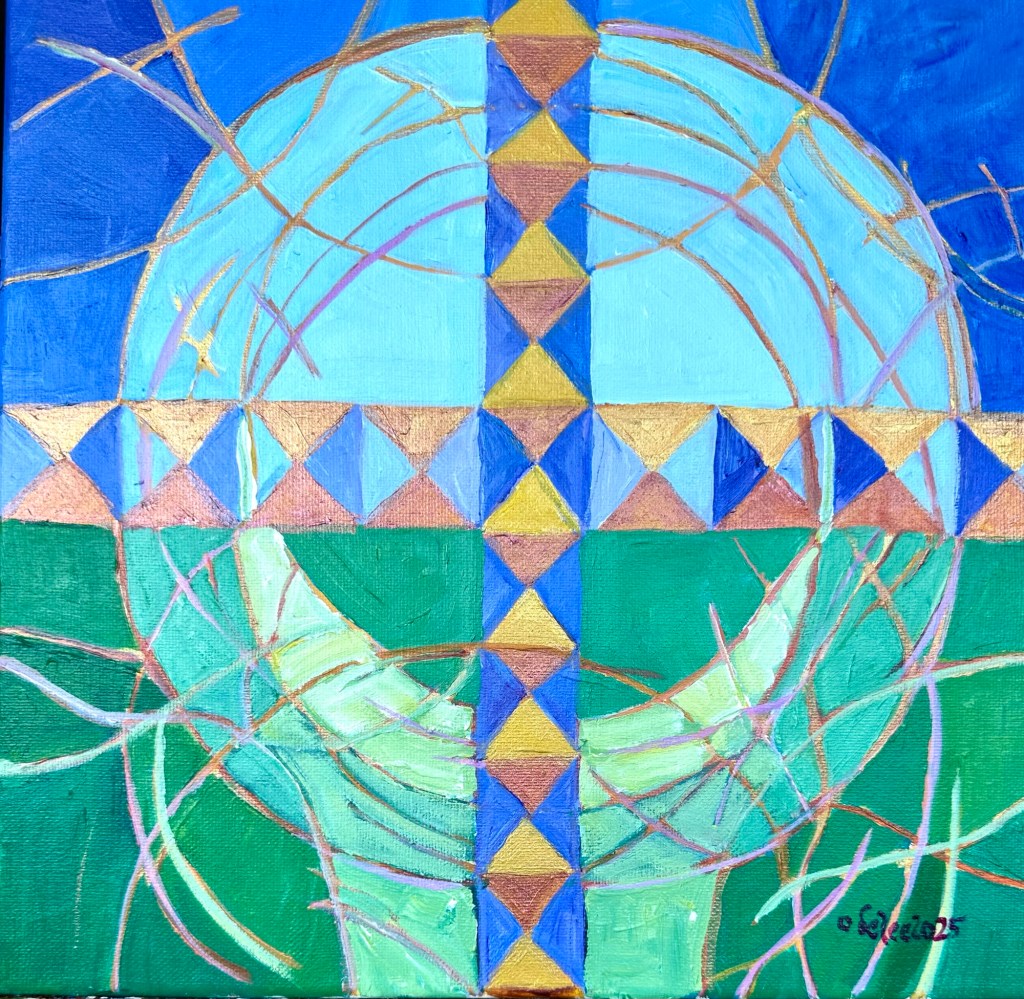
DeLee: The Dome of the Waters, acrylic on canvas, 10” x 10”, 2025
And God said, “Let there be a dome in the midst of the waters, and let it separate the waters from the waters.” So God made the dome and separated the waters that were under the dome from the waters that were above the dome. And it was so. God called the dome Sky. And there was evening and there was morning, the second day. —Genesis 1:6-8
As I painted more, the dark blues above the light blue represented the waters above the “firmament” of the pale cerulean sky. When it rains, the holes in the dome of the sky let the water leak out, or so I’ve heard the old folks say. I never heard their explanation for why it doesn’t rain all the time, but perhaps “angels are involved.” They might be busy plugging the holes in the dome with their fingers, but God must have many angels working hard on our behalf.
The area below is in greens for all the growing and thriving things. There is an upside-down dome, or a Cheshire Cat smile pale green eighth moon shape for the underground water sources. All the intersecting compass marks are the energy signatures, which God’s power unleashes when God makes a new thing or renews an old thing. If we are sensitive to God’s creative spirit, we cannot help but be in awe of the magic and mystery of not only the minutiae of nature, but also the grandeur of the cosmos.
The great landscape photographer Ansel Adams was one of the voices of those who found inspiration in nature, especially our national parks. He spoke the same sensible words for our age: “As the fisherman depends upon the rivers, lakes and seas, and the farmer upon the land for his existence, so does mankind in general depend upon the beauty of the world about him for his spiritual and emotional existence.” (From a speech to the Wilderness Society, May 9, 1980).
The natural world is meant for humankind to care for, tend, and enjoy with respect, just as we would care for a beloved partner. Not everyone sees the world with the eyes of God, who so loved the world—both the humans, the creatures, and the earth itself—God gave God’s only Begotten son to save the world, “For God did not send his Son into the world (kosmon|κόσμον) to condemn the world (kosmon|κόσμον), but so that the world (kosmos|κόσμος) might be saved through him.” (John 3:17) What God created, God loves and will sustain. Can we do anything less and still be faithful to God’s calling on our hearts?
Joy and peace,
Cornelia
U.S. Church Membership Falls Below Majority for First Time
Trans. by Nathaniel Campbell, from the Latin text of Hildegard of Bingen, Liber Divinorum Operum, ed. A. Derolez and P. Dronke, in CCCM 92 (Turnhout: Brepols, 1996), pp. 47-9. (Musical Score)
International Society of Hildegard von Bingen Studies: Karitas habundat
The Book of Divine Works. | Library of Congress: Fully digitized copy of Hildegard’s final tome of 353 magnificently illustrated pages, late 12th century CE.
In most adults, learning and thinking plateaus and then begins to decline after age 30 or 40. The old adage, “Don’t trust anyone over thirty” takes on new meaning in regards to creativity. People after this age start to perform worse in tests of cognitive abilities such as processing speed, the rate at which someone does a mental task. The slide becomes even steeper after 60 years of age. We also notice a similar learning decline in children after summer vacation, which results in the fall semester becoming a “reteaching opportunity.”
As one who is also “growing long in tooth,” I have passed this yardstick by a mile. I notice I have a “slower processing speed” in my creative writing. I don’t consider it a reason to quit, but a reason to better organize my other time-wasting behaviors (social media, newsletters, newspapers, etc.). I can always ignore cleaning the condominium! Creativity before housework, is my motto.
Housecleaning Meme
We often think older adults are on a downward slope with unrecoverable loss. “Use it or lose it,” the saying goes. Recent research suggests we need to apply a more hopeful mindset and vocabulary when discussing older people—much like that used for childhood or early adulthood. Decline, as we so often see it, may not be inevitable. In fact, learning a new skill and practicing it for three months has shown benefits beyond the the practice time.
Adults often have limited time or resources, so if we encourage learning a new skill, this may help them step out of their comfort zones. In people’s later years, many personal and societal changes—such as moving out of state to be closer to family members, switching jobs or coping with physical distance from loved ones—make learning new skills necessary to adapt and succeed.
For example, taking a class to improve technological skills could aid seniors’ success in an increasingly digital world, such as helping them use Telehealth or online banking platforms. Learning new skills in an art class allows a person to express their feelings and solve problems in creative ways. Each person can find their own path to success in artistic practice.
Potholder Loom, just like the one I had back in the day.
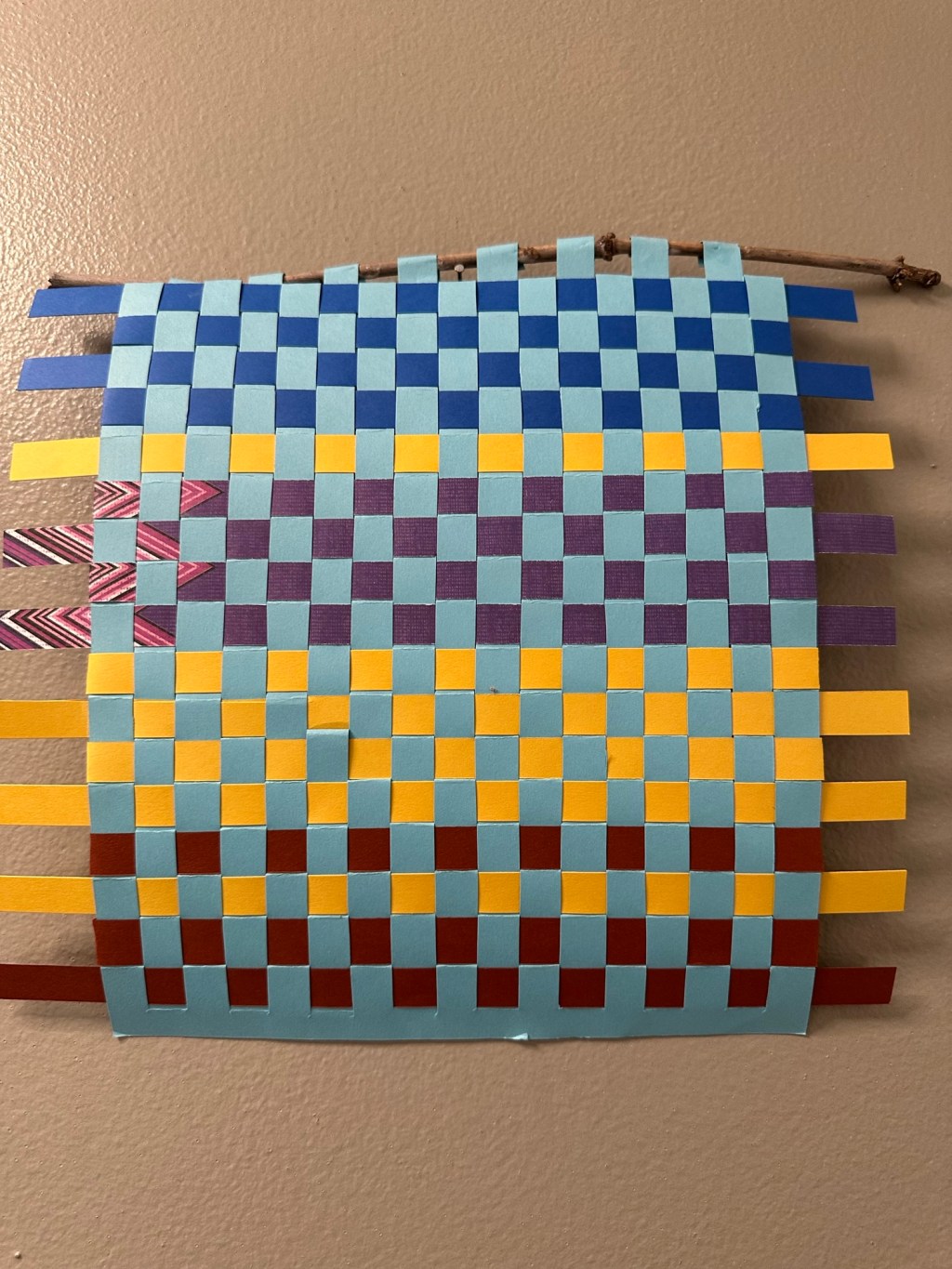
Our art class is trying a new thing: weaving. We have been painting for quite a while, so this is really a hands-on project. Some of us had the benefit of making woven potholders as children, or weaving newspaper “sit-upons” at summer camp. The technique isn’t unknown, but making a creative design interpretation is how we take our basic skill forward into a stimulating and creative brain challenge.
DeLee: Woven Paper on a Stick (Earth and Sky)
We could just repeat what we already know, but this doesn’t build us new neurons in our brains. If we keep the same old paths and don’t create new ones, we aren’t flexible when we meet new situations. Since we live in a rapidly changing world, building a brain capable of rapidly adapting is important to live independently and vibrantly for as long as possible.
I remember how my Daddy could only use the old tv remote to change the channel for the original non cable stations. When “Murder, She Wrote” came on the cable channel, my Mother had to use the cable remote to change the station for him. His Alzheimer’s disease prevented him from learning new skills, but he remembered all of his previous medical training and could diagnose his condition and boss the emergency room doctors when he was admitted to the hospital for a fall. Our brains are a mystery indeed.
Mike jumped the gun on Valentine’s Day and created a woven heart. These were big in the Danish and German communities and very popular in the 19th century in America. During the Civil War, soldiers made many of these in elaborate forms to send to their loved ones back home.
Unknown Artist: Affirmation Weaving
The brain is a fantastic and mysterious organ. If we make a habit of learning something new every day, of whatever interests us, we have the opportunity to keep our lucidity for a longer time. We also we meet the quickening changes of modern life with a steadfast heart and mind. We stress less when we know we can adapt and change in our own lives. We don’t have to be the people who say, “You can’t teach an old dog new tricks.” We can teach and we can learn, but we might need to be more patient with the old dog. In some corners, we call that “grace.”
I watched my Granddaughter’s Daddy Daughter Dance
Our group was in and out during the several weeks devoted to this project. One of us was sick, one was grieving the death of a beloved pet, another had pressing work issues, and the teacher went to Florida to see her granddaughter get married. Amazingly, life goes on. People dropped in for spiritual support, which is a side benefit of the community of art class. I managed to get mine mostly done, and Gail S. finished hers completely. Sometimes life interrupts our best intentions and we move on. We will learn new lessons on the next project.
Gail S’s “Eye of God” weaving
Gail S’s “Eye of God” weaving incorporates yarns from two different mop heads, some sticks, and a bird feather. Gail almost always keeps a realist focus in her works, so her eye of God has a bird feather to mark the pupil. The upper field of grey and white mop yarns represent the cloudy sky, while the blue yarn stands for the water and the brown for the land. God watches over all of God’s creation. Gail S’s love of the outdoors and all of nature is evident in all her work.
Cornelia’s Cross on a Hill (unfinished)
I also recycled some old paintings and cords which I’d used in the preparatory work of other paintings. In addition, I used some recycled strips of Amazon shipping parcels as well as a wire shape which once belonged to a butterfly wing. In repurposing these items into the weaving along with two old brushes bound together with a God’s eye, I invoke the renewal of life after death.
We people of faith have two opportunities for a renewal of life after death. The first is by our profession of faith in Christ and his life, death, and resurrection on our behalf for our salvation. This gives us a living faith in this world. The second renewal is for the resurrection from death itself. This gives us a life beyond this world. Our faith is worthless if it doesn’t change us for our walk upon this world. If we don’t have the heart and mind of Christ within us, and if we aren’t earnestly seeking to be made perfect in the love of Christ daily, our United Methodist heritage tells us we’ve not yet been converted.
Yet Christ desires to save all, as John records in 12:32, Jesus tells the crowd,
“And I, when I am lifted up from the earth, will draw all people to myself.”
Not just some people, or only the best, or even just us United Methodists, but ALL people. Most of us aren’t able to understand such a wide ranging love, for we live in a world of tribal loyalties. If we look at creation, which is God’s first work, God loves that which God created. God loves everything God created. We humans are the ones who choose sides and introduce boundaries and hate into God’s singular creation. The world or Kosmos is the creation first and then the people in it.
Today we tend to ascribe “world” to the “culture,” or secular society in general, but its plain meaning is creation and the human presence, for good or ill. The ancient Greeks and Romans divided the world into the material (bad) and the spiritual or mind (good), but the Jewish theology conceived the unity of both as part of God’s gift to humankind.
In the fifty-fourth chapter of On the Incarnation, St. Athanasius of Alexandria wrote a sentence that has echoed down through the centuries even into our own time as a brilliant summary of the Gospel. He wrote this: “God became man so that man might become god” (54:3).
This doctrine is called theosis or acquiring the whole nature of God. We United Methodists call this state Christian Perfection, or “a heart so full of love of God and neighbor that nothing else exists.” Our Wesleyan heritage was influenced by the Wesley brothers’ deep love for the Greek Orthodox fathers of the early church. To focus only on fallen nature is to deny the power of God to redeem us and all creation and to make all things new. We humans and nature aren’t more powerful than God!
If we cut off part of our God given self, we deny the incarnation of Christ, who became human for us that we might become divine. We need to remember what John 3:16 so succinctly states:
“For God so loved the world that he gave his only Son, so that everyone who believes in him may not perish but may have eternal life.”
Art is a way to open our eyes and hearts to a new way of seeing spiritual truths. Art is also reflective of the artist’s soul and spirit. A sensitive viewer can read the tale of trauma or the struggle for survival in an artist’s body of work. More than this, we can listen for their voices straining to be heard. Most people have been silenced and conformed to the “cause no trouble, don’t get out of step” mantra of the public school system training our youth for the workplace.
In art class, we can lose our fear of being different because being different gets rewarded! Being original gets an attaboy or attagirl. I find such joy helping people find new courage and creativity they didn’t know existed within themselves. My students keep me young too. I feel blessed beyond measure.
Joy and peace,
Cornelia
To Stay Sharp as You Age, Learn New Skills | Scientific American
“The light shines in the darkness, and the darkness did not overcome it.” —John 1:5.
Work in progress: Light Shines in the Darkness
Some of us can hear these words with hope, two thousand years after John’s gospel was first written. These words come as a ray of hope, like a flashlight’s beam bursting into a collapsed mine to let imprisoned workers know help and life-giving oxygen is on the way. For the people in the first century who lived under the Pax Romana—the peace of Rome—not everyone had the same rights and privileges as the citizens of Rome. The conquered lands, including the nation of Israel, were under military occupation and suffered brutal taxation and unfair application of the laws.
More importantly, obedience to the emperor and the empire was required, which for the Jewish people meant making a sacrifice in honor of the emperor. Because this act would acknowledge a human being as a god, the Jews were between a rock and a hard place. If they denied the emperor, they were unpatriotic. If they sacrificed to him, they committed blasphemy against their God. After all, we find one of the great commandments in Exodus 20:2-3:
“I am the LORD your God, who brought you out of the land ofEgypt, out of the house of slavery; you shall have no other gods before me.”
We take religious freedom and expression as a given here in the United States, since the first European settlers to these shores came here with the express purpose of worshipping God in their own way. Unfortunately, they also persecuted the next groups who arrived and who worshipped differently. After gaining independence from England, America has been one of the few nations of the world in that one of its core values is to honor every faith tradition and allow each person to worship freely (or not) God as they want.
Insisting on the priority or preference for one religion isn’t historical or grounded in our constitution. We find this in both Article VI of our Constitution, which prohibited religious tests for federal office holders, and in Article I of the Bill of Rights:
“Congress shall make no law respecting an establishment of religion, or prohibiting the free exercise thereof; or abridging the freedom of speech, or of the press; or the right of the people peaceably to assemble, and to petition the Government for a redress of grievances.”
In this present time, when certain groups of Christians (Christian Nationalists) want to claim an alternative history of our national origin and our national destiny, they also are trying to rewrite our history to make it fit their purposes. This elevates their religious group above others and gives them preference over other Christian denominations as well as other faiths and nonbelievers. When these other groups become persecuted or marginalized, the whole suffers, while a few prosper.
The situation was much the same back in the first century CE, when tax farming was a corrupt practice in the Roman provinces. A family bought the rights to a tax area, collected whatever they wanted, and gave the due to Rome. The rest they kept as profit. No wonder folks hated the local tax collectors: they were not only greedy, but they colluded with the occupation. The priests in the temple made sure they never rocked the boat, so they could keep up their rituals and practices of the law, both scriptural and secular.
Therefore the people yearned for a savior, a messiah. In every age, in the stillness of the night, in the darkness of despair, when hope was flickering to an ember, a voice of a prophet would arise. These prophetic voices weren’t often heard, but occasionally one voice would pierce the gloom like a bright light in a dark cave. When a prophet speaks a true word from God, people recognize it as true because it speaks the truth of God, reminds people they belong to God, calls the people back to God, and tells them the consequences of their resulting behavior. Prophecy isn’t just about fortune telling.
Poets are often the prophets of their age. The first stanza of William Butter Yeats’ Ode speaks both toward that first century past and to the second coming:
“Turning and turning in the widening gyre The falcon cannot hear the falconer; Things fall apart; the centre cannot hold; Mere anarchy is loosed upon the world, The blood-dimmed tide is loosed, and everywhere The ceremony of innocence is drowned; The best lack all conviction, while the worst Are full of passionate intensity.”
Final State: The Light Shines in the Darkness
If we lose hope, if we give up on the hope of redeeming our world and ourselves, we will fall into despair and nihilism. These emotions are not good. We won’t listen for the still small voice of God in the dark and quiet spaces anymore. We won’t hear the voice of God in the weed growing in the crack in the pavement of the sidewalk as we go about our daily tasks. We will fail to hear the promises of new hope and new strength when the crocuses pop through the snow next spring.
Art and poetry keep us connected to the magic and mystery of the Spirit of God. A steady diet of news and television is a soul killer. If you find your attitude going south, I recommend you limit your news consumption to two hours or less per day. Replace those other hours with sunlight, exercise, cooking, a new hobby, fiction reading, journaling, or whatever. If you keep getting drawn back into the distressing activity, remember to let go, and return to a better activity. Optimism and a sense of hope will carry us further than negativity will. As Isaiah 6:13 says,
“Even if a tenth part remain in it, it will be burned again, like a terebinth or an oak whose stump remains standing when it is felled. The holy seed is its stump.”
Or as my daddy always said, “Don’t let the bad guys grind you down.” Of course, this sentiment had some bad medical school Latin he and his friends translated when the going got tough and the sleep got short in his younger days. “While I breathe, I hope,” is “Dum spiro spero,” in Latin. It’s been one of my favorite sayings. Night doesn’t last forever, and morning will come. Dawn will break! There will be a new day and a fresh opportunity to do at least one thing better. To make a difference in one person’s life, to make a difference for the good for someone, somewhere. I may be just baking cookies to bring to overworked volunteers somewhere, who are doing good for others, but I can bring a bright light to someone’s day today. I don’t have to save the entire world.
If I can be a ray of light for someone today, I might give them hope. Hope is a gift. We should share it freely. Then hope would grow and “The people who walked in darkness have seen a great light; those who lived in a land of deep darkness—on them light has shined.” (Isaiah 9:2).
Joy, peace, and light,
Cornelia
Faith of Our Forefathers (May 1998) – Library of Congress Information Bulletin
We are a people who follow Jesus, “the pioneer and perfecter of our faith, who for the sake of the joy that was set before him endured the cross, disregarding its shame, and (who) has taken his seat at the right hand of the throne of God,” as the writer of Hebrews 12:2 reminds us. The suffering servant motif of Christ was once a model all early Christians expected to inherit and emulate.
The Suffering Servant
Paul spoke to this suffering model in his letter to the Romans:
“…How can we who died to sin go on living in it? Do you not know that all of us who have been baptized into Christ Jesus were baptized into his death? Therefore, we have been buried with him by baptism into death, so that, just as Christ was raised from the dead by the glory of the Father, so we too might walk in newness of life. For if we have been united with him in a death like his, we will certainly be united with him in a resurrection like his.” (6:2-5)
Paul’s first sentence is perceptive because he recognizes many who call on the name of Christ nevertheless go on living an unchristlike life. In the early Christian centuries, many didn’t get baptized until they were near death because they weren’t ready to change their wicked ways. The early Christian habit of hyper-delayed baptism is well attested by the later fourth century. Apparently, the reasoning behind waiting until fairly late in life was the belief baptism cleansed sin once and only once. Consequently, any meaningful sin after baptism could leave one in a serious lurch in the economy of salvation. We have the well-known example of the early 4th CE Emperor Constantine who delayed baptism until his deathbed.
Of course, this is a misunderstanding of the Holy Spirit’s work of perfecting our human nature, but it took many centuries to work this out. We can thank John Wesley for our understanding the works of grace in the ongoing process of Christian Perfection. Baptism washes us from the stain of original sin, which is common to all humanity. Baptism also anoints us with the Holy Spirit to be continually with us and bring us to know God’s saving love in Jesus Christ.
As we grow in faith and the Spirit of God calls us to give our lives to Christ, we are justified from past sins. Some faith communities stop here, so they need over and over justification. They have no ongoing theology of sanctifying grace. We United Methodists do have this great gift, which we can give to the world. When we aren’t going on to perfection in love quite as fast as our neighbors wish we were, it’s because we’re being stubborn and resisting God’s grace.
W. H. Auden says it best:
“We would rather be ruined than changed,
We would rather die in our dread
Than climb the cross of the moment
And let our illusions die.”
The Cross and Self-Denial
The cross is ever a witness to our willingness or unwillingness to bear the cross of Christ. As Jesus told his disciples:
“If any want to become my followers, let them deny themselves and take up their cross and follow me. For those who want to save their life will lose it, and those who lose their life for my sake will find it. For what will it profit them if they gain the whole world but forfeit their life? Or what will they give in return for their life? (Matthew 16:24-26)
Often we interpret this verse in terms of giving up material possessions, but we can never give up outward things unless we’re first willing to give up our false images of ourselves. We might want to be large and in charge, or soft and sweet. Perhaps our self image is invested in being holy and serious. We may even be the class clown. These are only masks behind which we hide our truths and vulnerabilities.
Jesus spoke a parable in John 12:24-25—
“Very truly, I tell you, unless a grain of wheat falls into the earth and dies, it remains just a single grain; but if it dies, it bears much fruit. Those who love their life lose it, and those who hate their life in this world will keep it for eternal life.”
If we want to be changed, we must die to our ordinary selves, and then rise as a new creation. If we remain the same, we won’t be much, but if we’re willing to take on the image of Christ, we can be a new creation of the first order.
How The Witness was made
Ukrainian children’s hospital bombed by Russia
This is how art gets made. I saw an image of a bombed-out children’s hospital in Ukraine. Because the photographer had cropped it in a certain way, I saw an image of a cross on the brickwork. Those rectangular bricks contrasted with the diamond shaped wire work in the darkened areas in the four outer quadrants. I usually weave the whole painting surface, but this time I wove only the cross area. That was a challenge. I had to invent a new way to secure the woven canvas strips on the wooden stretcher strips.
Weaving two paintings together
As I painted the first layer, I made all the contrast of bright colors in the cross and dark blues and reds in the outer quadrants. The next day, I added a gold wash over the cross squares and painted diamond line patterns over the dark quadrants. I came back to add silver into the diamond shapes and to touch up the diagonal lines. I also painted the sides of the canvas to unify it.
Adding blocks of color to the cross of witness
I began with a gritty black and white image, but ended up with bright colors, silver and gold. This too is a metaphor for for the change which we undergo when we die to old selves and begin our transformation into the wholeness of the new creation in Christ. As Paul wrote to the Corinthians:
Gold cross and diamond shapes in the dark quadrants
“So if anyone is in Christ, there is a new creation: everything old has passed away; see, everything has become new! All this is from God, who reconciled us to himself through Christ, and has given us the ministry of reconciliation; that is, in Christ God was reconciling the world to himself, not counting their trespasses against them, and entrusting the message of reconciliation to us.” (2 Corinthians 5:17-19)
Finished painting: Cross of Witness
The cross isn’t a means to divide us from one another, just because we hold varying views on baptism, holy communion, pastoral authority, and scriptural authority or interpretation. The cross stands as a witness to all who are willing to give up their identities to their old egos and claim the only one uniting all persons every day.
Unity through the Cross
This is the Christ, whose love was so great for all creation, he was willing to be lifted up on the cross to draw all humankind unto himself. As Jesus said in John 12:32-33—
“And I, when I am lifted up from the earth, will draw all people to myself.” (He said this to indicate the kind of death he was to die.)
We want to have our Big Mac and Eat it too.
Delusional Mathematics
As we self interested people today have difficulty with many of the words of Christ, we resort to our cafeteria style of choosing which bites we want to enjoy. If a dish in the line is too expensive or not on our diet plan, we can ignore it. The problem with Christ is how we can ignore one claim upon our faith, reject another, and keep another. As a dieter from way back days, I splurged on many a Big Mac or Whopper and large fries, which I washed down with a giant Diet Coke. Unfortunately, my body didn’t follow the same mathematical logic of my mind. I was practicing delusional math.
“Cheeseburger and fries, with a side of Diet Coke.”
“This is my commandment, that you love one another as I have loved you. No one has greater love than this, to lay down one’s life for one’s friends. You are my friends if you do what I command you” (John 15:12-14). John Wesley, in his sermon, The Almost Christian, talks about those who have the outward form of Christianity, but not the inward being. They can be recognized by their attendance at Sunday services, their good deeds, and their attention to the outward shows of ritual. Inside, however, their hearts aren’t filled with love, but with anger, spite, or mere duty instead. They lack sincerity, which is a classic characteristic of one who wears a false mask.
The Last Presidential Assassination
When Ronald Regan was shot by a would-be assassin, his diary recorded his thoughts on his excruciating experience.
“Getting shot hurts. Still my fear was growing because no matter how hard I tried to breathe it seemed I was getting less & less air. I focused on that tiled ceiling and prayed. But I realized I couldn’t ask for God’s help while at the same time I felt hatred for the mixed-up young man who had shot me. Isn’t that the meaning of the lost sheep? We are all God’s children & therefore equally beloved by him. I began to pray for his soul and that he would find his way back to the fold.”
The Altogether Christian
To be a Christian in the true sense, Wesley says the “Altogether Christian” requires us both to “love God and neighbor in our hearts until nothing else exists.” This means even our enemies. I personally find this the most difficult part. I can hold a grudge with the best of the nonbelievers. Yet I don’t find myself calling those people evil or deranged, like so many others who seek to find a reason for their scapegoating.
I can still see people, even myself, as part of flawed and fallen humanity.
Christian Perfection
Wesley defines the pure faith: “Now, whatsoever has this faith, which purifies the heart, (by the power of God, who dwelleth therein,) from pride, anger, desire, from all unrighteousness, from all filthiness of flesh or spirit; which fills it with love stronger than death, both to God and to all mankind; love that doth the works of God, glorying to spend and be spent for all men, and that endureth with joy, not only the reproach of Christ, the being mocked, despised, and hated of all men, but whatsoever the wisdom of God permits the malice of men or devils to inflict: whosoever has this faith, thus working by love is not almost only, but altogether a Christian.”
Under John Wesley’s exacting standards, we may all be “almost Christians,” but the good news is we can always hope in the one who gave his life to begin a new life in us and others. If we pray for our enemies’ faults, which we spot so easily because they are our own, God will help to heal both them and us.
Mending Broken Hearts
The Cross Supplants Division
An ancient wisdom story told among the rabbis says the students were questioned on the difference between night and day. All their answers marked divisions: some prayers are said only at certain hours, or there isn’t enough light to distinguish one field or a house from another. The rabbi grew frustrated and cut them off. “You only know how to divide! Daylight begins when you can look on your neighbor’s face and see a friend, not an enemy.”
In this time of division, the witness of the cross reminds us Christ died for all humanity, so no one is outside the love of Christ. If we’re to love our neighbor as ourselves, caring for the poor and marginalized should be a priority for the people of faith. Our neighbors don’t stop at our borders, for our world is interconnected.
Migrations were a fact back in Abraham’s day, when Egypt was the land of opportunity. We ought to treat immigrants better than the Pharaohs treated the Hebrew people. Moreover, in our current political landscape, we might want to quit name calling and playing to the lowest denominator of our bases. Policy statements won’t get sound bites on television, but that’s a good thing. Sound bites play to our false selves and not to our true selves in Christ Jesus.
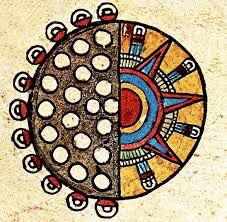
DeLee: Sun Mandala, 2022, private collection
I can close with a poem from the Persian poet Rumi:
I only speak of the Sun because the Sun is my Beloved I worship even the dust at His feet.
I am not a night-lover and do not praise sleep I am the messenger of the Sun ! Secretly I will ask Him and pass the answers to you.
Like the Sun I shine on those who are forsaken I may look drunk and disheveled but I speak the Truth.
Tear off the mask, your face is glorious, your heart may be cold as stone but I will warm it with my raging fire.
No longer will I speak of sunsets or rising Moons, I will bring you love’s wine for I am born of the Sun I am a King !
Joy, peace, and sacrificial love,
Cornelia
—W. H. Auden, The Age of Anxiety: A Baroque Eclogue (Princeton, NJ: Princeton University Press, 2011), 105.
Anne Frank’s Last Birthday Cake, acrylic on canvas, mixed media, 18” x 20,” 2024.
We never know when the tides of time will change. Most of us aren’t creatures of change, but prefer instead the well-worn and familiar paths. As a United Methodist pastor, I moved every two or three years during my ministry, so one thing I kept was my telephone company. I know some people like to switch providers almost as often as they switch their underwear, but that’s not me. Having to switch utility companies, banks, and hairdressers was more than enough agony for me. I signed up for this life, however, so I kept my moving boxes and made a spreadsheet for notifying all my address changes.
I talk about this because I only lived in three homes as a child. I never had to leave in the middle of the night to escape bad debts, the law, or a hateful Nazi regime. I have no way to imagine Anne Frank’s life, except when I was also 13 years old, I read her wonderful diary. Anne kept her diary, beginning at the same age, during the two years she spent in hiding while the Germans occupied her homeland during World War II. She had received a red, cream, and beige checkered cloth notebook diary for her 13th birthday on June 12, 1942. The underground Dutch radio station had encouraged people to keep diaries so future generations would know what the conditions were under the German occupation.
Because of the Nazi purity rules, Jews weren’t allowed to mix with non-Jewish persons. According to the Nazis, Jews were not Aryans or the Master Race. They thought Jews belonged to a separate race that was inferior to all other races. The Nazis believed that the presence of Jews in Germany threatened the German people. They believed they had to separate Jews from other Germans to protect and strengthen Germany. Their Nuremberg Laws were an important step towards achieving this goal.
We hear this same sentiment today from the neo-Nazi movement groups who say, “Jews shall not replace us,” and “Immigrants are poisoning the blood of our nation.” As a result, only Anne’s Jewish friends could come to her birthday party. Her father set up a movie projector to show “Rin Tin Tin,” the famous Hollywood dog film star. The chairs were set up in rows like a movie theater. The family went all out for their Anne. Her mom had baked cookies for her classroom to share, since they couldn’t come to the party, but she baked a strawberry cream cake for this party attended by her Jewish friends. This was early June and the strawberries would be juicy, fresh, and in season.
Anne and Hanna playing before the Frank family fled into hiding.
Two weeks after her 13th birthday, Anne and the Frank family had disappeared from the neighborhood. They left no forwarding address. Her best friend of eight years, Hannah Pick-Goslar, didn’t see her again until they were both in the same concentration camp. Hannah survived. Anne did not, but the enduring story of her life in hiding continues through her diary.
When I was painting this, I used a large doily as the “cake.” I’d been saving it for a halo for a saint painting, but it works great for a cake top too. My viewpoint is from above, and I omitted the 95 candles. No need to burn the house down! The cream color was a bit pink, but if I were a young teen girl, I’d want it more pink than just white. I painted the background as a blue sky, because young people almost always have hope and optimism. The left side of the canvas has the storm clouds approaching, as well as the grey soot soiling the sky from the overworked crematoriums at the concentration camps where so many Jewish people lost their lives in the Holocaust.
If we can learn anything from one small girl who ate strawberries on an early summer day, I hope it will be to appreciate the beauty of this brief moment and to love one another deeply. Also, life is too short to hate anyone just because they are in someway different from you. Celebrate their differences as part of God’s creative generosity to this world. Also as Mary Oliver reminds us about the importance of keeping a journal:
“Instructions for living a life. Pay attention. Be astonished. Tell about it.”
One of my favorite icons is the Rublev Trinity of 1411, which represents the three angelic visitors who came to Abraham and Sarah’s tent in the wilderness. They stopped there on the way to Sodom and Gomorrah, two cities known for their lack of hospitality to strangers, so the largess Abraham showed by preparing a feast for them in the wilderness was notable in contrast. Of course, while Abraham couldn’t see these strangers’ wings and halos, nevertheless we should “not neglect to show hospitality to strangers, for by doing that some have entertained angels without knowing it” (Hebrews 13:2).
Rublev’s Trinity: Original egg tempera on wood panel, Tretyakov Museum, Moscow, 1411-1425 CE
Rublev’s Trinity is a classic icon. It’s the prototype for all the Holy Trinity icons. Three figures are seated at table, under an oak tree and in the vicinity of a large house, the home of Abraham and Sarah, at Mamre in the wilderness. These figures represent the Three Persons in One God, or The Holy Trinity. The icon underlines the sameness of the three figures by using a single identical image, repeated three times but robed differently to suggest three different qualities of the three Angels—the Three Aspects of God.
The central figure represents the Son, who blesses the cup on the table. The right figure in blue is the Holy Spirit, while the rose-colored robed figure represents the Father. The Oak of Mamre stands for the cross of Christ. Even the symbolic wilderness mountain dips its peak in reverence to the holy visitors. Rublev imagined the patriarchs living in a house, but they were tent dwellers who followed herds and pastures.
Jerusalem Temple Mount, from an antique map, acrylic on canvas, 2023
I actually repainted this icon over a map of the ancient city of Jerusalem. Wars have been much in the news lately, not just in the last few months, but the last few years. Russia’s invasion into Ukraine has devastated their land and people, not to mention making a negative impact on hunger worldwide and even the price of food here at home. The Sacred Mount in Jerusalem has always been contested, so much so that the three monotheistic religions fight over that territory. Even the holiest Christian sites are often guarded by Islamic families to keep them open for everyone.
Holy Trinity, stage One
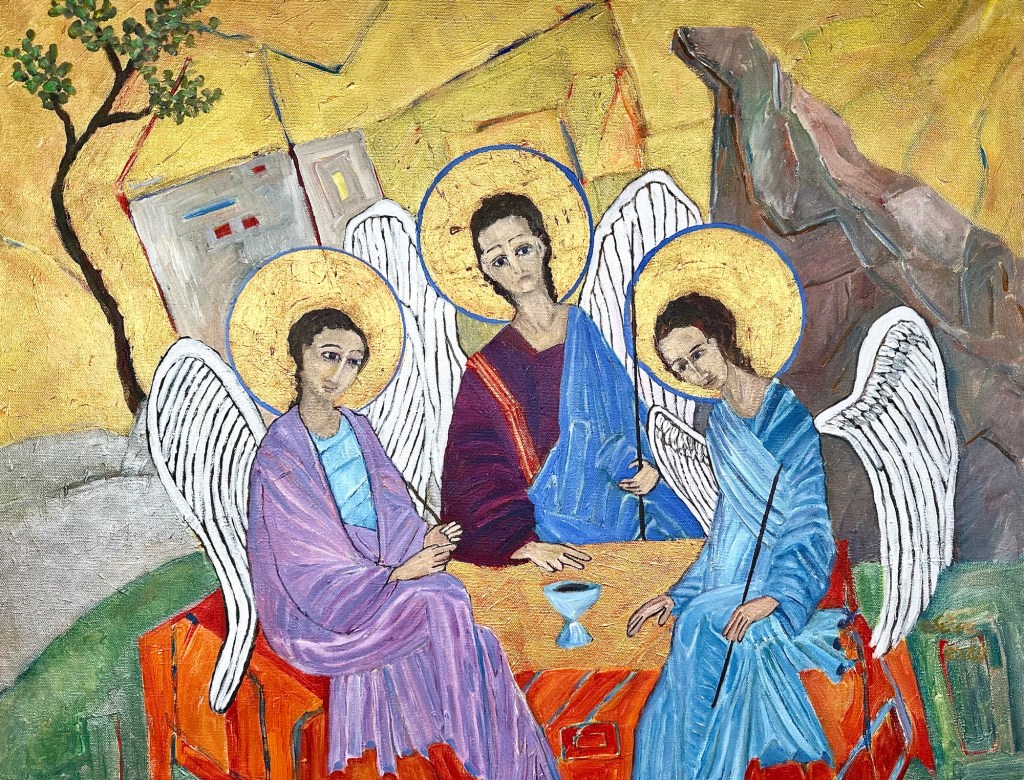
Once I chose this base, the mountain, tree, and the house wrote themselves. I found the table easily in the underlying shapes and the three visitors also. This isn’t a faithful copy of the Holy Trinity Icon, but a spiritual copy of the icon. I kept the colors and the ideas, but I wrote something new. As I painted, I had these thoughts about our faith and our life.
Holy Trinity, stage two
Not In My Backyard, Not In My Neighborhood, Not in My Church—how often do we hear these words? Sometimes we even hear them spoken in our own estranged families of origins. This isn’t a recent phenomenon. Our scripture is full of broken families: Cain and Able were the first; plus, Abraham’s children, Isaac and Ishmael and their descendants, have had sibling rivalry and struggles from the beginning. The house of David certainly had its problems even if David was a “man after God’s own heart.” In the New Testament, the Jews wanted the gentile believers to convert to their religion first, and then to keep the law, the food rules, and celebrate the festivals in order to be a “good Christian.” The leaders had to compromise on their beliefs before everyone could fully share Christian hospitality at the table together.
Holy Trinity, stage three
Paul has a dire warning for the congregations about The Works of the Flesh in Galatians 5:16-21—
Live by the Spirit, I say, and do not gratify the desires of the flesh. For what the flesh desires is opposed to the Spirit, and what the Spirit desires is opposed to the flesh; for these are opposed to each other, to prevent you from doing what you want. But if you are led by the Spirit, you are not subject to the law.
Now the works of the flesh are obvious: fornication, impurity, licentiousness, idolatry, sorcery, enmities, strife, jealousy, anger, quarrels, dissensions, factions, envy, drunkenness, carousing, and things like these. I am warning you, as I warned you before: those who do such things will not inherit the kingdom of God.
Our modern world has a problem with idolatry. We often put our work, our family, our possessions, or our politics above God. We often choose our church because of our political beliefs, when we should let the overwhelming love and grace of God for all God’s creation imbue our political choices. We forget as Christians we are grafted into the nation of Israel, as the writer of Ephesians 2:12 reminds us:
“Remember that you were at that time without Christ, being aliens from the commonwealth of Israel, and strangers to the covenants of promise, having no hope and without God in the world.”
Christ came to those who were near and to those who were far, broke down the dividing wall between the two and brought them together to eat at one table. Before they were enemies, but with Christ, they became one people. Divisions should not exist in the body of Christ, just as no one should be excluded from fellowship. The near in those days were the Israelites and the far were the Greeks, Romans and other pagan communities. In Christ, however, they were one.
DeLee: Holy Trinity after Rublev, acrylic on canvas,
Abraham knew the reputation of Sodom and Gomorrah, since Lot was his kinsman. When Abraham negotiated with God to spare those twin cities of iniquity, he managed to bargain God down to the hope of finding at least ten honest people, righteous in their ways with God. That was as low as God would go. Lot, with his two daughters, his wife, and the two would be husbands made six, but the men didn’t want to flee. That left only four and so the two cities were doomed for their lack of hospitality to strangers.
People today often think that sexual behavior doomed these cities, but lack of care for the stranger was a higher priority in a dangerous and unforgiving landscape. Offering food, water, and shelter meant life to travelers. Four thousand years ago, our spiritual ancestors remembered the stories of Abraham. In Deuteronomy 26:5, when the people brought their offerings to God, they were instructed to make this response before the LORD your God:
“A wandering Aramean was my ancestor; he went down into Egypt and lived there as an alien, few in number, and there he became a great nation, mighty and populous.”
No longer are we a wandering people. Instead, we are mostly a nation of settlers, people who have been in one place for awhile. We no longer are a nation of immigrants who are wresting a new nation out of the raw materials of the land and becoming a melting pot of different cultures which have settled it. We look with suspicion upon someone who moves into our neighborhood, especially if they don’t look or act like us. If they don’t speak our language or eat our food, we tend to shun them. We don’t show hospitality. We don’t add their flavor into our soup, and try to keep them from melting into our pot.
No one likes change. I think of the old joke about “how many United Methodists does it take to change a lightbulb?” The answer is “none—that lightbulb was given as a memorial to my Aunt Harriet’s dead husband, and it cannot be changed!”
Hospitality requires us to change the lightbulb, however, for bringing light to a dark stairway will make it safer for people of all ages to traverse. Hospitality asks us to open our pews to people who don’t think like us, so we can wrestle with the theology of God and the calling of our faith for this present age, not just our yesterdays. Hospitality calls us to serve as a respite and refuge for the aliens, the immigrants, the homeless, and the newcomers who arrive in our communities.
Unfortunately, too many of us have bought into tribal thinking, which is a form of all or nothing thinking. Gang behavior is tribal thinking, for if you don’t kowtow to the group think, you will likely be dead. Excommunication from the church is a form of punishment for wrong thinking or wrong acts, and secession or rebellion is action against authority you no longer respect or recognize. Our church has just gone through a sad time of people cutting ties because they no longer share the understanding of Abraham, who offered sustenance and protection to strangers in the midst of the barren wilderness. In ancient times, those who received this gift were bound to mutual respect and protection. Food and water in the wilderness saves a life. Our hospitality to strangers in an uncertain world can save their lives and souls. Maybe we once again need to see afresh with ancient eyes our sacred texts, instead of with our current political and cultural blinders on our eyes. Then we could truly entertain angels unawares. And we would be blessed for this.
As the writer of the letter to the Ephesians closed out his third chapter (Ephesians 3:20-21):
“Now to him who by the power at work within us is able to accomplish abundantly far more than all we can ask or imagine, to him be glory in the church and in Christ Jesus to all generations, forever and ever. Amen.”
After the Great American Eclipse, I’m reminded once again how great and wide is the love of our God. We say, “Our God,” as if we could own or possess the one who holds us, since God is beyond our knowing or possession. We can own a boat, a house, or a work of art. In the bad old days before the Civil War in America, people once owned other human beings. We fought a mighty conflict so our nation could be made up of free people, all of whom have equal rights. Unfortunately, not all have equal opportunity.
Patriotic Sunglasses
In America, we are so privileged, we often look at most everything through red, white, and blue lenses. We don’t take off our “American eyes” to see as God sees. To make this point, the Great American Eclipse actually began over the Pacific Ocean, so perhaps whales and sea birds would have been the first to experience it. When the eclipse reached land in Mexico, those in Mazatlán saw it before anyone in Texas did. I have lived in Texas, so I know they like to be the “first, best, and biggest” in everything, so they’ll ignore the fact this eclipse actually was seen by others first.
Eclipse Path: you are here
We don’t need to be first or best to deserve God’s love and providence. God proves God’s love for us every day the sun rises and sets. God gives us the rain in its season and grass for the herds to feed upon. We don’t have to exclude others to get God’s love, for God’s love is wide enough to include all. A God, who can call an entire universe into being with just a word, has the infinite resources to love all fully and completely. We are the finite ones, having limited resources and understanding, who find the need to limit God’s love to a few.
We tend to think in human terms of competition, in which one person gets a blue ribbon or a trophy and everyone else is a “loser.” That’s the Rickey Bobby of Talladega Nights school of theology. God made the entire universe, even tiny Pluto, which our astronomers demoted from planet status to a dwarf planet in the Kuiper Belt. Just because we relegated Pluto to a minor status doesn’t mean God diminishes God’s love, care, and concern for God’s creation.
Bill Maxey: Total Eclipse at Hot Springs AR
When we have the opportunity to view an awesome event of creation, such as a total eclipse of the sun, we have to consider ourselves privileged to be alive and part of God’s care. When the moon fully covers the sun and darkness falls upon the face of the earth where you stand, the cool air touches your skin, and your heart burns within. The excitement and rush of energy is so great I had to shout! I’ve heard some people cry. I guess I’m an exuberant sort.
Nana’s Poem: typed from memory
On 20 August 1892, “The Times” published an article by Kipling, “Half-a-Dozen Pictures”: it was one of a series of travel articles called From Tideway to Tideway. The article described a visit to an art gallery and Kipling’s reflections on the failure of most painters to match the beauty and vitality of the world around them. He offered some attractive verbal sketches of his own, though it wasn’t part of his purpose to contrast the approaches to nature of writers and painters. His main concern was to urge artists of all kinds to get out and see the world for themselves: (Letters of Travel 1892-1913 p. 40):
Now, disregarding these things and others – wonders and miracles all – men are content to sit in studios and, by light that is not light, to fake subjects from pots and pans and rags and bricks that are called “pieces of color”. Their collection of rubbish costs in the end quite as much as a ticket, a first-class one, to new worlds where the “props” are given away with the sunshine. (Letters of Travel 1892-1913 p.77).
Eight days later, the same article was published in the New York Sun. This time it closed with the untitled poem ‘When Earth’s Last Picture is Painted…’ which changed the article’s emphasis from an exhortation to artists to become travelers and pioneers, to what sounds very much like a manifesto for realism in art:
“And only Rembrandt shall teach us, and only Van Dyck shall blame:
And no one shall work for money, and no one shall work for fame,
But each for the joy of working, and each, in his separate star,
Shall draw the Thing as he sees It for the God of Things as They are!”
Four years later, Kipling changed the first line of that stanza to:
“And only the Master shall praise us, and only the Master shall blame,”
Kipling, the son of an artist, knew the true joy in life comes from one’s dedication to whatever work is in hand, and the task of the Artist is to convey to others the excitement and wonder of an expanding world. By changing the last line from artists’ names to the Master, Kipling heightened the spirituality of his poem. The artist’s task isn’t merely to render a faithful image of the landscape or person before them, but to bring forth all the inner energies and personality they see and feel.
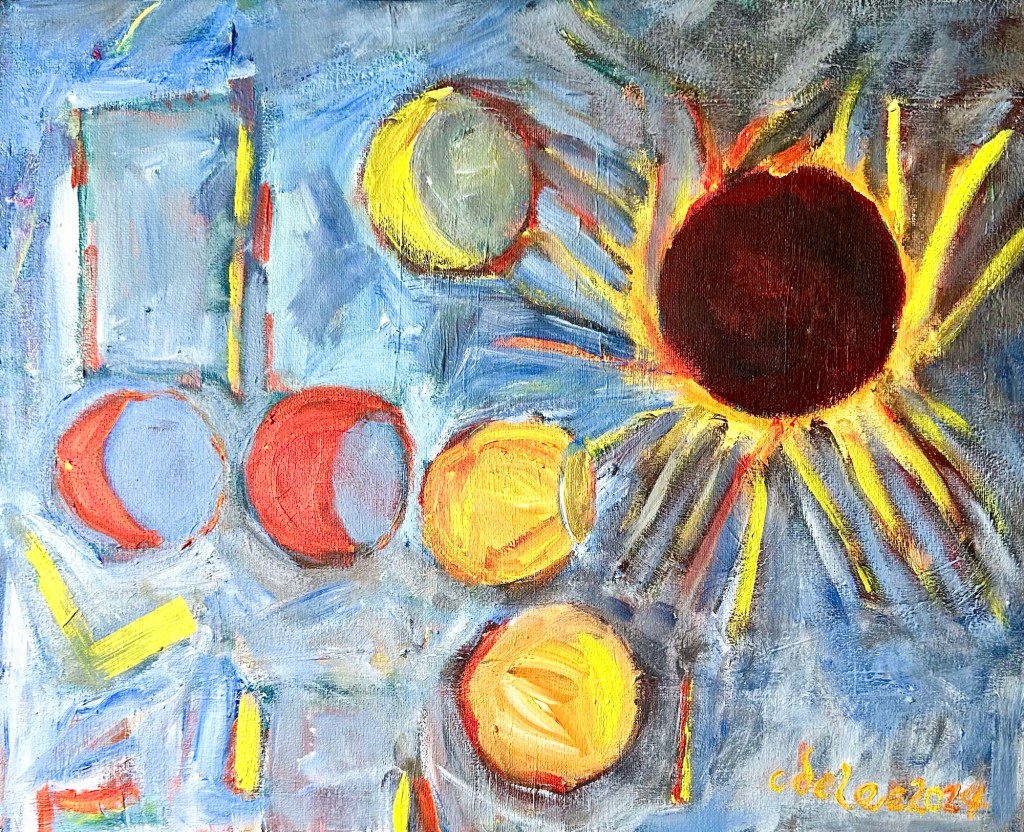
Cornelia DeLee: Memory of the Last Great Eclipse, acrylic on canvas, 12” x 24”
This is why we don’t copy nature, since it’s three dimensional and we have a two-dimensional surface on which we make our marks to represent what we see. Perspective is our visual language to fool the eye into believing our flat surface has depth. Often we paint abstract shapes and colors because these are the best means to convey our emotions about an experience. Photography captures one way of seeing, but painting can render emotions with brush strokes and colors.
Cornelia DeLee: Door to Another Reality in the Eclipse, acrylic on canvas, 18” x 24”
I subscribe to a wonderful poetry series by Steve Garnaas-Holmes, which I receive daily. This poem’s theme of universal love spoke to me as I felt the in-flooding joy of God’s creating power during the Great American Eclipse:
I have other sheep that do not belong to this fold. I must bring them also, and they will listen to my voice. —John 10.16
We think we’re being open-minded when we include “all of us,” Protestant and Catholic, Orthodox and Coptic, as if we see the whole landscape. But the pasture and the Shepherd are far greater than that. Believer, unbeliever and other-believer alike are all shepherded, each in their own language. And still there are more, and more other, sheep. Like, well, sheep. Do not the deer and otter, whale and fungus follow the Shepherd faithfully? Is not the bird migrating its continents shepherded as well? Christ is not the partisan figurehead of a religion, Christ is the infinite embodied grace of God, the Shepherd of all Creation, who leads rivers to the sea and winter into spring and each of us into life. So there are still other, and more “other,” sheep. For Copernicus isn’t done with us yet: we admit the sun doesn’t revolve around the earth, but we still think God does. No, little one: we are in a small corner. Yet even the far galaxies, the trillion trillions of stars and their planets, and yes, their doubtless forms of life, are also under the calm eye of the Shepherd, and follow the Shepherd’s voice. All of us, Baptist and Sufi, fish, bug and bird, earthling and alien, village and nebula, all are one flock. One. And, behold, even on the remotest planet in the farthest flung galaxy—like ours— or the most desolate spot in a life like yours, under the loving gaze of the Shepherd who seeks out the one, there is no one who is not at the center.
May you each find joy in your working, each in your separate stars, and draw the Thing as you see It, for the God of Things as They are!
Not only can God watch the sparrow, but also all the many suns and planets of creation.
Joy and peace,
Cornelia
When Earth’s last picture is painted – The Kipling Society
What is the purpose of an art class? Why does anyone learn to speak a foreign language or take up a craft or sport they’ve never attempted before? We must want to explore some unknown universe or get out of our comfort zone, or as my old favorite television series would announce weekly, “to boldly go where no one has gone before.”
Light of the World Icon: Stencil effect
There are art classes and then there are Art Classes. Just as we shouldn’t make up our minds about a subject or a food until we experience it directly, we can have an open mind about a novel event, rather than rejecting it out of hand. Many of us have lived our lives under judgmental circumstances, dealing with rejection and disappointment at not being the best. “Talladega Nights: The Ballad of Ricky Bobby,” the NASCAR themed film of redemption and finding one’s purpose in life, stars Will Ferrell, whose father crippled him with this tragic life message:
“If you ain’t first, you’re last. You know, you know what I’m talking about?”
Near the end of the movie, Ricky Bobby learns this all was just crazy talk:
Ricky Bobby: Wait, Dad. Don’t you remember the time you told me “If you ain’t first, you’re last”? Reese Bobby: Huh? What are you talking about, Son? Ricky Bobby: That day at school. Reese Bobby: Oh hell, Son, I was high that day. That doesn’t make any sense at all, you can be second, third, fourth… hell you can even be fifth. Ricky Bobby: What? I’ve lived my whole life by that!
According to Baseball Reference, Ruth’s 183.1 career WAR — combining his value as a hitter and pitcher — is the highest all time, well ahead of Walter Johnson’s 164.8. For reference, the highest mark among active players is Albert Pujols’ 99.6 WAR.
We call this living out a “bad script” our ancestors have written for us. We see it all the time in the movies and on television. We read about it in novels and in comic books. For the most part, people don’t change their wicked ways, but get the consequences they’re due. The bad suffer and the good prosper. Or we read fairy tales in which the good little children get rewarded, or the unjustly treated ones are raised up, like Cinderella. These are the popular stories, but not the biblical tales. The book of Job calls this “retribution theology” into question, as does Jesus in the New Testament.
Annie French (1872 – 1965) Scottish: Cinderella and the Ugly Sisters, About 1900 – 1910, Pen and ink, watercolour and gold paint on vellum paper, 23.50 x 21.50 cm, Scottish National Gallery of Art.
In the Bible, God sends prophets, not only to call the people to account (critique their actions or behavior), but to offer the hope of a better future if they return to God and God’s ways (positive changes in behavior). In this way, a good art teacher is like a biblical prophet, who offers both positive and negative critique on the artwork. The teacher also offers “hope” or suggestions on how to improve the work. Teachers aren’t telling the person they don’t measure up, only that they need more time invested in making art to be able to bring their own artistic vision into reality.
Mike on Being the Light in the World
If we expected babies to chew steak from the moment of birth, the world would be a lonely place. If we expected these same babies to get up right away and “bring home the bacon” to buy their own steak and potatoes, they’d starve. Babies aren’t meant to walk before they crawl, nor or they chewing meat before they drink milk or pablum for a year or two.
Bacon Cake: Oh, Baby! I hope that’s REAL BACON!!
Someone who comes to art class should always come to learn something more, no matter how much they already know. I’m always learning new ideas and techniques. The act of making art is always an act of exploring new territories. We also grow by sharpening one another. Folks in the class are always excited to see how each other approaches the subject each week.
Mike’s May 2022 class work shows he’s been learning some things.
Only the apocalyptic writers in Scripture had a fixed view of the future. For them, God had given up on humanity. We humans were too far gone, too broken, and had destroyed God’s world beyond our weak means to repair it. Their only hope was for God to create “a new heaven and a new earth, for the first heaven and the first earth had passed away, and the sea was no more.” (Revelation 21:1)
Gail went the extra mile with Cri-Cut lettering
Of course, this isn’t a prediction of a certain time, but it’s a future hope for all times. It’s the hope all we creative people have every time we face a blank canvas, a pile of found objects, or a bag of scrap cloths. We also do this when we pull together a dinner before we go to the grocery store, and we take some of this and that which we have in our cupboards and refrigerators. We’re going to make something new! We do hope the Spirit of God descends to make this an inspired concoction! And if it doesn’t work out, we always know our salvation isn’t at stake over a single random supper creation. If I’m hungry enough, I’ll eat anything. Or there’s always peanut butter and jelly sandwiches.
Leftover Doughnuts and Sausage Bread Pudding Bunt Cakes
I was reading Richard Rohr’s Enneagram commentary on the American people. He says America is a nation of Threes: competitive, striving, always looking for success and improvement. When we hit a down cycle, and economics tells us we always have ups and downs in our economy, Americans act like we’ve been insulted. This doesn’t happen to us—to others maybe—but not to us! We’ll look both for a scapegoat and a savior, but never realize these conditions are a natural part of life.
Always be the best YOU. There’s never going to be another one just like YOU.
Likewise in groups, we’re always judging who got more, who has the most status, who’s preferred, and who’s on the out. We’re even liable to self-select to be on the outer group if we believe we won’t measure up, just to spare ourselves the shame of being found wanting. Joyce Rupp has a great poem about this very topic:
WE CAN LOVE THE IMPERFECT SELF If I wait to be perfect before I love myself I will always be unsatisfied and ungrateful.
if I wait until all the flaws, chips, and cracks disappear I will be the cup that stands on the shelf and is never used.
Magic Teacup Cake from Alice in Wonderland
If we’re faithful scripture readers, we know God never chooses the best persons to do God’s work. When we were children, we saw these characters as heroic figures, just as we saw our parents as great and invincible. The Old Testament records how Moses was a murderer, Joshua was afraid, Amos was a lowly shepherd, and David was an adulterer. Not exactly Perfect Role Models, but transformed people can do God’s mighty deeds if they let God work God’s purpose through their lives.
This word doesn’t mean what the headline writer thinks it does.
In Art Class, we don’t reject “poor work.” We aren’t a factory producing widgets. We have other goals: art appreciation, learning about colors, learning to see more clearly, developing a creative mind, and developing drawing skills. Art is a unique visual language, so learning how to render a three-dimensional form onto a two-dimensional surface takes some time and practice. Developing our own voice is the step beyond mastering the basics of artistic vocabulary. As I used to tell my parents at back-to-school night, just enjoy whatever your child brings to you! If you leave your “critical parent” at home, and bring your “inner child” to Art Class, life is way more fun!
Mike’s Christmas Card Collage
We’re currently on holiday sabbatical at Oaklawn UMC, but classes will return in the new year. We meet in the old Fellowship Hall at 10 am to noon. We always have coffee, and on occasional days, a tasty treat. Our class will begin working in watercolor beginning on January 5, 2024. I don’t charge for the class instruction, but each person should bring their own supplies. Supplies needed are:
Prang Oval 8 watercolor paint set with brush
Prang Oval 8 watercolor paint set (containing brush)—on line at Walmart and Amazon. This has best color and pigments. I found a prime deal on Amazon for $3 each if you buy 3, free shipping.
Watercolor paper pad 9” x 12” or larger (90 lb or heavier)
Tall plastic container for water (iced tea glass size plus)
Babe Ruth’s Top 10 career statistics— Shohei Ohtani produced 9.1 total WAR during his spectacular two-way campaign in 2021. Even he maintained that level of performance for 20 consecutive seasons, he would still be 1.1 WAR short of matching Ruth. https://www.mlb.com/news/babe-ruth-s-top-10-career-statistics-c163792958
NOTE: This extraordinary story comes from Arguable by Jeff Jacoby, an opinion writer for the Boston Globe, on December 12, 2023. I’m sharing it with all of you because even in the worst of times, even with the least of resources, if we have faith in God, we can be a light unto the world.
In his transcendent prison memoir, “Fear No Evil,” Natan Sharansky tells the story of his nine years in the Soviet gulag, a fate to which he was sentenced for the crime of wanting to emigrate to Israel. Even now, 35 years after it was published, it is an amazing read, a great narrative by a great man who refused to be intimidated by his captors. The more the KGB tried to berate or punish him for his Jewish pride and Zionist yearning, the more joyfully and fearlessly Sharansky embraced them.
To mark this week of Hanukkah, consider this extraordinary incident recounted in “Fear No Evil.”
Davis Stark Design, Architectural Digest 2017
Sharansky was in the Siberian prison camp of Perm 35 and Hanukkah was drawing near. Intent on observing the holiday as best he could, Sharansky had a menorah constructed from some wooden scraps. A few candles were found, and each evening Sharansky lit his menorah, reciting the blessing, and describing to his fellow prisoners — none of them Jewish — the story of the Maccabee rebellion long ago. On the sixth night of Hanukkah, the authorities confiscated his menorah and candles. When he demanded to know why, a prison guard claimed that the menorah was made from “state materials” and therefore illegal.
Sharansky declared a hunger strike. “In a statement to the procurator general,” he recounts, “I protested against the violation of my national and religious rights, and against KGB interference in my personal life.”
Two days later, Sharansky was summoned by Major Osin, the prison camp warden. Osin wanted the refusenik to call off his protest before the expected arrival of an inspection committee. In that case, Sharansky said, “Give me back the menorah, as tonight is the last evening of Hanukkah.” He promised to end his hunger strike if he was allowed to light the candles.
Davis Stark Design, Architectural Digest 2017
But a protocol for its confiscation had already been drawn up, and Osin couldn’t back down in front of the entire camp. . . . I was seized by an amusing idea.
“Listen,” I said, “I’m sure you have the menorah somewhere. It’s very important to me to celebrate the last night of Hanukkah. Why not let me do it here and now, together with you. You’ll give me the menorah, I’ll light the candles and say the prayer, and if all goes well I’ll end the hunger strike.”
Osin thought it over and promptly the confiscated menorah appeared from his desk.
When Sharansky said he needed eight candles, Osin took a knife and cut the candle into eight stubs. Then, with amazing audacity, Sharansky said that the ceremony required everyone present to stand with head covered, listen to the blessing, and answer “Amen.”
Osin complied. He stood behind his desk, donned his major’s cap, watched as Sharansky kindled his eight candle stubs, and then waited for his prisoner to recite the blessing. Speaking in Hebrew — which Osin, of course, did not understand — Sharansky recited a blessing he had composed himself: “Blessed are you, O God, for allowing me to light these candles. May you allow me to light the Hanukkah candles many times in your city, Jerusalem, with my wife, Avital, and my family and friends.”
Then he had a brainstorm.
Inspired by the sight of Osin standing meekly at attention, I added: “And may the day come when all our enemies, who today are planning our destruction, will stand before us and hear our prayers and say ‘Amen.’ ”
“Amen,” Osin echoed back. He sighed with relief, sat down, and removed his hat.
Sharansky writes that he returned to his barracks “in a state of elation.” Who can doubt it? What magnificent chutzpah! What a triumph of the spirit! And what an uplifting reminder that even in the depths of the gulag — even in a time and place filled with the enemies of Jewish faith and freedom — those who refuse to fear can turn the table on their oppressors and dispel the darkness with a candle’s light.
From Book Blurb: For anyone with an interest in human rights—and anyone with an appreciation for the resilience of the human spirit— he illuminates the weapons with which the powerless can humble the powerful: physical courage, an untiring sense of humor, a bountiful imagination, and the conviction that “Nothing they do can humiliate me. I alone can humiliate myself.”
Hachette Books: Use HOLIDAY23 for 20% off site wide until 12/31. (Order by 12/13 to get your gift under the tree!)
This link also has links to other retailers. Price is set by publisher.
Nativity at Night by Geertgen tot Sint Jans, c. 1490, after a composition by Hugo van der Goes of c. 1470; sources of light are the infant Jesus, the shepherds’ fire on the hill behind, and the angel who appears to them