Season of Light

art, Astrology, Christmas, Civil War, Faith, Family, Hanukkah, holidays, hope, Israel, Light of the World, Love, Saturnalia, Spirituality, Ukraine

The damaged Drobytsky Yar memorial near Kharkiv, Ukraine after reportedly being hit by Russian artillery fire, on March 26, 2022

As the days grow shorter and the nights lengthen, the chill air adds to the darkness of our world. We can give into this dour outlook, especially this year with devastating wars in Ukraine and Gaza, or we can light a candle against the gathering gloom. Cultures across history have seen the time before year end as an opportunity for reflection, concern, or fear. Others have found reasons to rejoice.

Rainbow Menorah

Hanukkah (inauguration) is the eight-day Festival of Lights, which occurs in 2023 from sunset December 7 to December 15. It’s a moveable festival, for in 2024 the holiday will occur from December 25 to January 2. The Jewish calendar is a lunar calendar, not a solar calendar. This holiday celebrates the rededication of the Second Temple after the victory of the Maccabees over the Seleucid Greeks in 164 BCE. On discovering in the temple a vial of unpolluted oil, with only enough to light the candle for one day, this oil kept the candle burning for eight days. To commemorate this miracle, faithful Jews now light a special menorah with nine candles. The ninth candle is called the “helper” or “shammash” candle. The root word is from the Hebrew for “servant.”

Helping Hand Menorah

While not everyone is Jewish, all persons can learn from the menorah and the shammash candle. We may have only a little to give, but with God’s help it can be multiplied many times over. We can all be a helper candle, and bring a light to the candles who need a light. Many in this season experience a loss of some kind. Some are mourning a loved one, others have broken relationships, or have lost jobs or status. We are not our jobs and we aren’t our paychecks, but we are the beloved children of God. God will love us when everyone else turns aside. God will remember us when others forget we are alive.

Perhaps these darkening days at the end of the year are why people in all parts of the world have brought fire and light to this time of the year. The Yule Festival in German and Scandinavian countries was part of the pagan festival incorporated into Christianity’s Christmas celebrations. It likely began as a winter solstice or year-end celebration. “Yule” became a name for Christmas about the 9th century, and in many languages yule and its cognates are still used to describe that holiday.

Father Christmas and the Yule Log

The burning in a giant fireplace of a large Yule log until it’s reduced to cinders is one of my favorite mythic memories of the season. Alas, growing up in the Deep South, gas logs were the closest fireplace equivalent, and these were the same yesterday, today, and tomorrow. We rarely turned on the flickering colors of these blue flames because cold nights were few and far between.

By 336 CE, the Christian church in Rome celebrated Christmas on December 25, which coincided with the Roman winter equinox festival of Saturnalia. In medieval England, Christmas was a 12-day festival involving all kinds of revelry, from plays to wild feasts to pageants celebrating Jesus’ birth. Music, gift giving, and decorations all became the norm. Anyone who’s been in a choir singing “The Twelve Days of Christmas” with its repetitive “and a partridge in a pear tree” has those ancestors of ours to thank. Some traditions never die!

Our family stitched and sequined one exactly like this.

Christmas is better known for decorated trees, however. The use of evergreen trees and wreaths in religious ceremonies dates from ancient Roman times, if not earlier. However, the first documented use of a tree in a winter Christmas celebration wasn’t until 1510. In that year, members of a merchant’s guild in Riga, Latvia, placed a tree in the town square. They decorated it with flowers, ribbons, and dried fruit. After the festivities—which included the singing of songs and dancing—were concluded, they burned the tree as a great bonfire to close out the celebrations.

The Grinch Torches Whoville’s Christmas Tree into a Bonfire

Christmas trees gained popularity in Germany and other parts of northern Europe by the 1700s, but the practice of decorating a pine or fir tree during the holiday season remained virtually unknown in the English-speaking world prior to the 19th century. When Queen Victoria married her German cousin Prince Albert in 1840, the Christmas tree became widely accepted and practiced throughout the British Isles.

1836 edition of The Stranger’s Gift: A Christmas and New Year’s Present

In the United States, the practice of placing a decorated tree inside the family home was most likely introduced by German immigrants who arrived soon after the Revolution. The otherwise unassuming volume seen above, the 1836 edition of The Stranger’s Gift: A Christmas and New Year’s Present, is significant for it’s the first book printed in the Americas containing an image of a Christmas tree. Franklin Pierce in 1856 was the first president to erect a tree in the White House. In the United States, Christmas wasn’t celebrated with much gusto until after the Civil War, which reinforced for many the importance of home and family. In 1870, after the war’s end, Congress made Christmas one of nation’s first federal holidays.

Franklin Pierce in 1856 was the first president to erect a tree in the White House.

Light has always been a part of winter festivals, with their signature long, dark nights. Electric Christmas lights are a modern spin-off of the old-fashioned candles that Germans and Scandinavians placed on their trees. Thomas Edison, inventor of the lightbulb, also invented the first strand of lights and hung them outside his Menlo Park, New Jersey laboratory in 1880. In 1882 his business partner, Edward H. Johnson, created the first Christmas tree illuminated with colored lights. In 1895, President Grover Cleveland placed multi-colored electric lights on the White House tree. Since electricity wasn’t available except to the wealthy, most people didn’t have electric lights on their trees at home. Not until the end of the 1920s were electric lights affordable for the average family.

Fast forward to the 1950’s and the postwar period of rural electrification and large family gatherings, colored electric lights of every kind were readily available to the middle classes, not just the wealthy. This was the era of big bulbs and bubble lights, but in a few years, inexpensive miniature colored and white lights imported from China would become popular. Now even single parent households could decorate both the house and tree to their hearts’ content.

Untitled (Lux in tenebris inest—Light in the darkness)
Elisa Sighicelli 2003/2003

The lights bring out our hope of what’s good and wonderful in this world. Christmas and Hanukkah are times when the light burns bright, even when the days are dark. If these holidays didn’t exist, we would need to invent them, for we need the reminders of what is light and good in the world. As Baruch prophesied (5:9):

“For God will lead Israel with joy, in the light of his glory, with the mercy and righteousness that come from him.”

While we don’t know exactly what the Christmas star was, one theory is it was a conjunction of Jupiter, Regulus and Venus. Another possibility includes a set of conjunctions of the planets Jupiter and Venus, and the bright star Regulus. In this case, the mythologies associated with the objects become important. Jupiter in Hebrew is known as ‘Sedeq’, which is often translated as meaning righteousness. Jupiter is also often viewed as being the ‘king’ of the planets. Regulus is Latin for ‘prince’ or ‘little king’, and Venus is often viewed as a symbol of love, fertility and birth. Therefore, the combination of these objects close in the sky could have led to the interpretation of the birth of the ‘King of Kings.’ We do know Matthew records the visit to King Herod:

“After Jesus was born in Bethlehem in Judea, during the time of King Herod, Magi from the east came to Jerusalem and asked, “Where is the one who has been born king of the Jews? We saw his star when it rose and have come to worship him.”
(2:1-2 NIV)

Gerrit Dou: Astronomer by Candlelight, oil, late 1650s, J. Paul Getty Museum

The magi were astrologers, those who studied the heavens for the star signs of rising and falling influences in the ancient world. Herod died soon after their visit, but not before he tried to consolidate his power. He meant his dire deeds to benefit himself, but God spared his son by sending a message to Joseph in a dream to flee to Egypt with Mary and Jesus. The magi were warned not to return to Herod also.
This one who John wrote about in the opening chapter of his gospel (1:5):

“The light shines in the darkness, and the darkness has not overcome it.”

Gerardo Dottori: Nativity, 1930/1930, Museum of modern art

As we celebrate the holidays of light this year, remember to be a “shammash”, or a servant of light, and don’t let this present darkness overwhelm you. Your one light shining may be the brightness that brings someone safely home. Today I wore my bright pink exercise pants, even though I’m sinusy and achy all over. I made at least one person’s day when I said, “They’re stretchy, so I can eat more Christmas cookies!” We spread the joy even when the Grinch has stolen ours. This is a way of taking the darkness back, by making others feel better.

God bless and shine 🕯️on,

Joy and peace,

Cornelia

Jewish Festivals |Britannica
https://www.britannica.com/topic/Jewish-festivals

Shammash | Judaism | Britannica
https://www.britannica.com/topic/shammash

Yule Festival | Britannica
https://www.britannica.com/topic/Yule-festival

O Tannenbaum: Or, a Brief History of the Christmas Tree | The New York Public Library
https://www.nypl.org/blog/2016/12/12/christmas-trees-arrival

Who Invented Electric Christmas Lights |
https://www.eei.org/en/delivering-the-future/articles/who-invented-electric-christmas-lights

A Look Back: 100 Years of Christmas Tree Trends

https://www.bhg.com/100-years-christmas-trees-6751023

STARS AND THE WINTER SOLSTICE

adult learning, art, Astrology, chocolate, Christmas, cosmology, Creativity, Faith, Family, greek myths, grief, holidays, hope, Icons, Imagination, incarnation, Marcus Aurelius, Ministry, nature, Painting, Philosophy, poverty, Spirituality, Stonehenge, trees, winter solstice

Stonehenge at Winter Solstice

This is a time of year when we look to the night sky for a sign. It’s not for nothing the depths of darkness are the beginnings of hope and our desire for the return of the healing light. People around the world and over the generations of time have celebrations of feasting, family reunions, and honoring their culture’s gods on the darkest day, or the Winter Solstice. The term solstice derives from the Latin word “sōlstitium”, meaning “the Sun stands still”. On the Winter Solstice, the sun reaches its southern-most position, shines directly on the Tropic of Capricorn, and seems to stand still there.

We’re all familiar with Stonehenge, a Neolithic stone monument in England built about 4,500 years ago to track important moments in the solar year. A later custom is the blazing Yule Log, a Norse tradition. The family would drag a huge piece of wood into their house, set it into the main fireplace, and let it burn for several days. It was a type of sympathetic magic to encourage the distant and faint sun to return, reinvigorated. The family often wrote down their desires for the new year as an offering to the gods. These were then burned in the fire. Afterwards, the family scattered ashes from the fire in the corners of every room in the house for good luck.

Hiroshige: The Sixty-nine Stations of the Kiso Kaidō

The Chinese also have a Winter Solstice festival, which once was a new year’s festival. The family gathers to eat traditional foods, and they honor their ancestors, as well as the old ones still living among them. This poem by Ruan Yue, in the late Northern Song Dynasty speaks of this:

罗袜新成,更有何人继后尘。
The socks for elders are newly woven;
the custom should be handed down.

A later poet of the Song Dynasty, Fan Chengda, had a more optimistic outlook on the dreary and dark days before the Winter Solstice, or perhaps he was using “positive pep talk to reframe his grumpy mind.”

休把心情关药裹,但逢节序添诗轴。
Don’t be thinking about medicines all the time;
write a new poem at the solar term.

I can relate to Fan Chengda, for I find I have difficulty waking up without the sun streaming into my bedroom windows. I’m also more irritable and mopey on these dark days. It’s probably Seasonal Affective Disorder, which is a form of depression related to the lack of light in this season. I tend to think dark thoughts, feel more pain, and lose my appetite, except for medicinal chocolate, which I consume under the Tim Allen mantra, “If some is good, more should be better!”

For Medicinal Purposes Only

When I get this type of mood on, the commercial Christmas we see on television and in the movies strikes a discordant note in my soul. I think about the ancient text, which reminds us when the parents of Jesus went to Bethlehem to be counted in the census: “And she gave birth to her firstborn son and wrapped him in bands of cloth, and laid him in a manger, because there was no place for them in the inn.” (Luke 2:7)

What most of us glide right over is Joseph had kinfolks galore in this town, but none of them opened their home to Mary, for she was pregnant before he married her. The innkeepers in town weren’t going to risk their reputations for these two either. Only one innkeeper took pity on them and let them stay with the animals in the stable. This marks the birth of the Christ child as an outsider to his whole extended family, the House of David.

Botticelli: Nativity, 1475

The Magi, or Wise Men, came from the East to visit King Herod, asking, “Where is the child who has been born king of the Jews? For we observed his star at its rising, and have come to pay him homage.”( Matthew 2:2)

Herod was worried he would be deposed, so he sent the Magi to find this child, then return and report to him. The Magi followed the star until it stopped over the place where the family was staying. They offered their gifts and returned home, without telling Herod where the baby was. Jesus was an outsider to the Roman occupation which propped up the local kings. He was a threat to the way governments rule the world.

Shepherds are the epitome of outsiders in the Bible, for they live outdoors among sheep and goats, neither of which are clean. In fact, anyone who’s gone camping knows how hard staying clean is. Glamping isn’t camping, and neither is RVing. My youthful experiences in Girl Scout camps of pitching tents and digging rain gutters is the closest I’ve ever been to living on the land. Even then, we had outhouses and cold water showers. The biblical city folk who could keep the ritual rules of cleanliness looked down on the shepherds as a lower class group, or outside of society.

Imagine a group of shepherds sitting around a nighttime fire, eating a simple meal, and chatting about their day or their families at home. Then an angel of the Lord stood before them, and the glory of the Lord shone around them, and they were terrified (Luke 2:9). I’d be terrified also, as I imagine you would be too! There’s a good reason the first words out of angels’ mouths are “Do not be afraid!”

But the angel said to them, “Do not be afraid; for see—I am bringing you good news of great joy for all the people: to you is born this day in the city of David a Savior, who is the Messiah, the Lord. This will be a sign for you: you will find a child wrapped in bands of cloth and lying in a manger.” (Luke 2:10-12)

Giotto: Nativity at Padua

If ever the outcasts of the world needed good news, if ever the hopeless needed a savior, if ever the least of all needed one just like them, it was these lowly shepherds, who went to find a newborn child lying in an animal’s feeding stall. No fancy crib for the newborn king, no royal robes or golden crown, just ordinary swaddling clothes. He looked just like any other child, except his birth was proclaimed by angels, honored by Magi from afar, and given a place through the grace of a kind innkeeper.

Those of us who will celebrate Christmas with our families, our extended friends, and our relations in a wild, chaotic buzz of coming and going, feasting and drinking, and perhaps exchanging of gifts, don’t know the quiet and holy night when the light of the world entered “to give light to those who sit in darkness and in the shadow of death, to guide our feet into the way of peace.” (Luke 1:79)

We keep our homes lit inside and out with megawatts of electric lights, both colored and white. Some of us even cue our lights to blink to seasonal music. Those of us who live beyond the great urban areas, can better see the stars at night, since there’s no light pollution. This is one reason we need to keep our national parks as close to nature as possible, for one day, these may be the only places people can marvel at the bright stars against the dark canopy of the sky above.

Gail: Stars across the Sky

Gail brings her love of the outdoors and her experience as a park ranger to her work. Over the trees, a floating band of stars become a pathway across the night sky.

Mike: Sun, Moon, and Stars

Even if our assignment was stars, that never means “only stars.” After all, the sun is a star, which is very close to us, astronomically speaking. If you’re going to have the sun and stars, you might as well have the moon also. I always say, “Why not?” The Tim Allen rule sometimes applies in art class: “More power!” When you go too far on the Tim Allen scale, that’s when his sidekick Al reminds him, “Sometimes less is more.” Mike certainly captures the energy and joy of the celestial bodies in this painting through the bold colors and strong brush strokes.

Sally: The Cosmos

Sally had an idea in her mind, but no image to look at. She wanted to show the cosmos in motion, as if God were looking down upon it. In her mind’s eye, she imagined this from memory. As she worked on the small canvas, she’d add more paint into the areas which weren’t quite dry and got somewhat frustrated at the paint not bending to her will. As a matter of technique, painting into a dry area is better than continuing to add color to a wet area, since the wet brush picks up the wet layers below that. Mike and Gail, having many sessions under their belts, have already crossed this particular bridge. She also learned something significant. It’s easier to paint something when you can look at it. I think it’s a good start and it holds promise: “There is one glory of the sun, and another glory of the moon, and another glory of the stars; indeed, star differs from star in glory” (1 Corinthians 15:41).

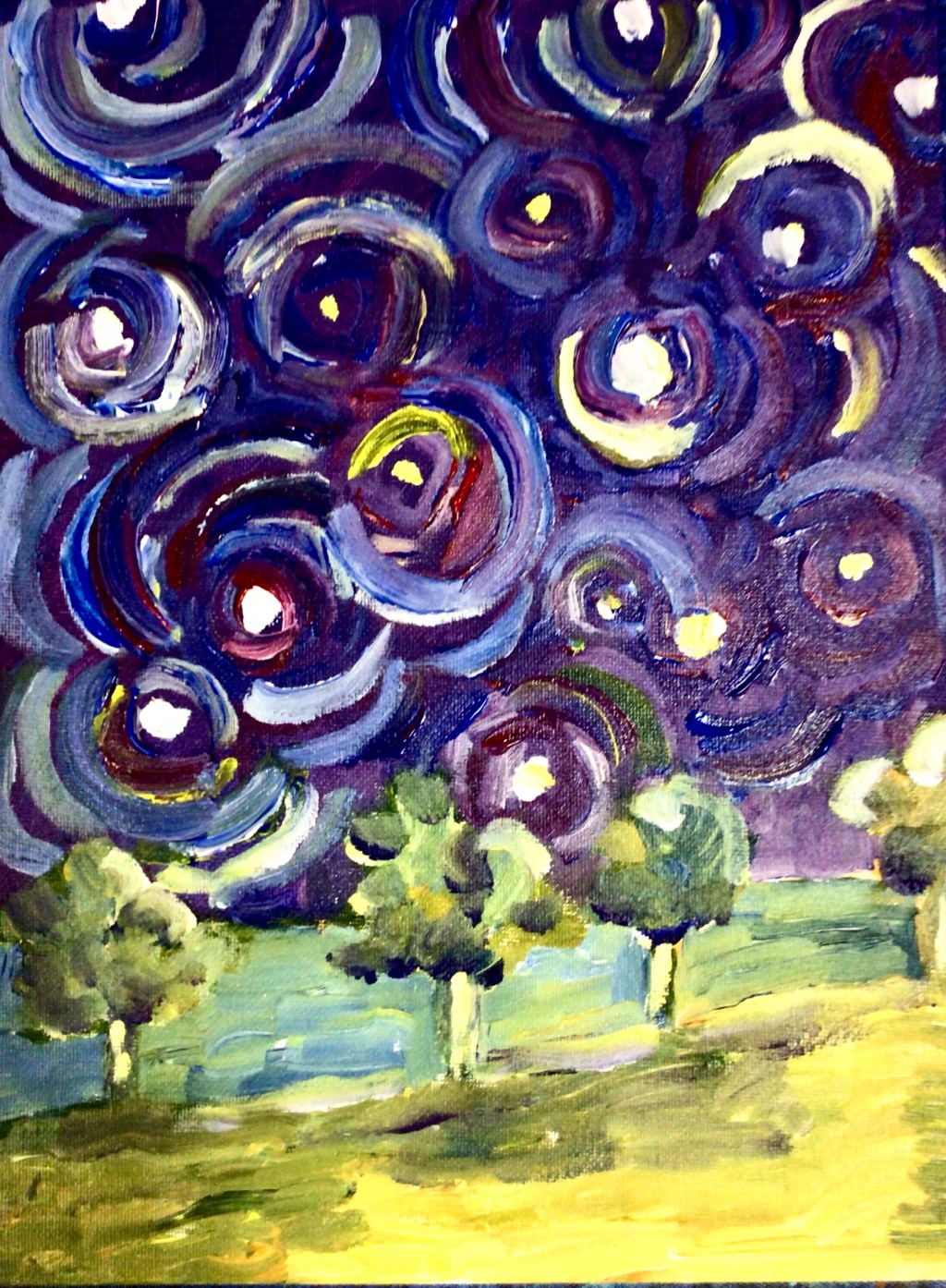
Cornelia: Starry Night

I’m not a fast walker, nor do I get down the road quickly. I’m too busy noting the color of the sky, thinking what colors to mix to get the grey trees of a late December day, or how to paint the towering cumulus clouds of summer. I file these thoughts away in the treasure house of my mind, for one day I’ll need them. I look at the shadows of the leaf clumps on trees, but not at each leaf alone. The tree leaves are communities, not individuals. They exist as groups, so the artist treats them as such.

I’m not sure about others, but many walkers are fixed on their personal best speed, or going a half mile longer. Some people drive to the grocery store and make their list in their head as they go. In the store, they make a new to do list for the home, and once that’s done, they make another list for the next day. The cycle starts all over again. They never once raise their eyes to greet the stars, to note the cycles of the moon, to enjoy the sunset colors, or the sunrise either. They’re probably more productive than I am, but I take time to reflect deeply on the “why of things” rather than repeating the same rhythms over and over. Most people like the familiar rhythms, however, while I question if they still have meaning in today’s world.

Today I saw the Winter Solstice Dawn

In ancient times, the Greeks and Romans thought the stars had a power and energy to determine the fates of human beings. Marcus Aurelius, a Roman emperor and stoic philosopher of the 2nd century, wrote in his Meditations: “Dwell on the beauty of life. Watch the stars, and see yourself running with them.” From his privileged location, he could identify with the heroic persons in the astrological figures of mythology.

Some people are “born under a bad sign,” or are unlucky in life. Of course, some say we make our own luck, but people born into harsh circumstances lack the same resources to make choices for good. The deck is stacked against them, from living in trauma filled neighborhoods to a lack of quality foods due to a paucity of grocery stores. As Albert King, the great blues artist once sang, “If it weren’t for bad luck, I wouldn’t have no luck at all.”

The good news is the bright light of the Christmas star points to the new light, which has come into the world. We hear, amidst the cacophony of commercials and piped in musical carols, the words of the prophet Isaiah: “Arise, shine; for your light has come, and the glory of the LORD has risen upon you” (60:1).

As a gift, you can listen to the great Albert King sing “Born Under a Bad Sign,” by copying the link below to your browser.
https://music.youtube.com/watch?v=F2IqJtBL6yk&list=OLAK5uy_kRTT9VaZ7Ht_pjIoBhtqhS_99sMi_D5a4

Our art class returns Friday, January 4, 2022, at 10 am. I hope to bring pomegranates, if I can still find them in the store. We’ll make a fresh start in the New Year, so if you want to join, you’ll start where you are. We are a “one room schoolhouse,” so there’s no grade levels with us. We’re all learning and improving from where we are at the moment.

Joy and peace,

Cornelia

How to Make a Yule Log
https://www.learnreligions.com/make-a-yule-log-2563006

5 Most Beautiful Chinese Winter Solstice Poems to Appreciate
https://www.travelchinaguide.com/essential/holidays/winter-solstice-poems.htm

The New World Atlas of Artificial Sky Brightness | CIRES
https://cires.colorado.edu/Artificial-light