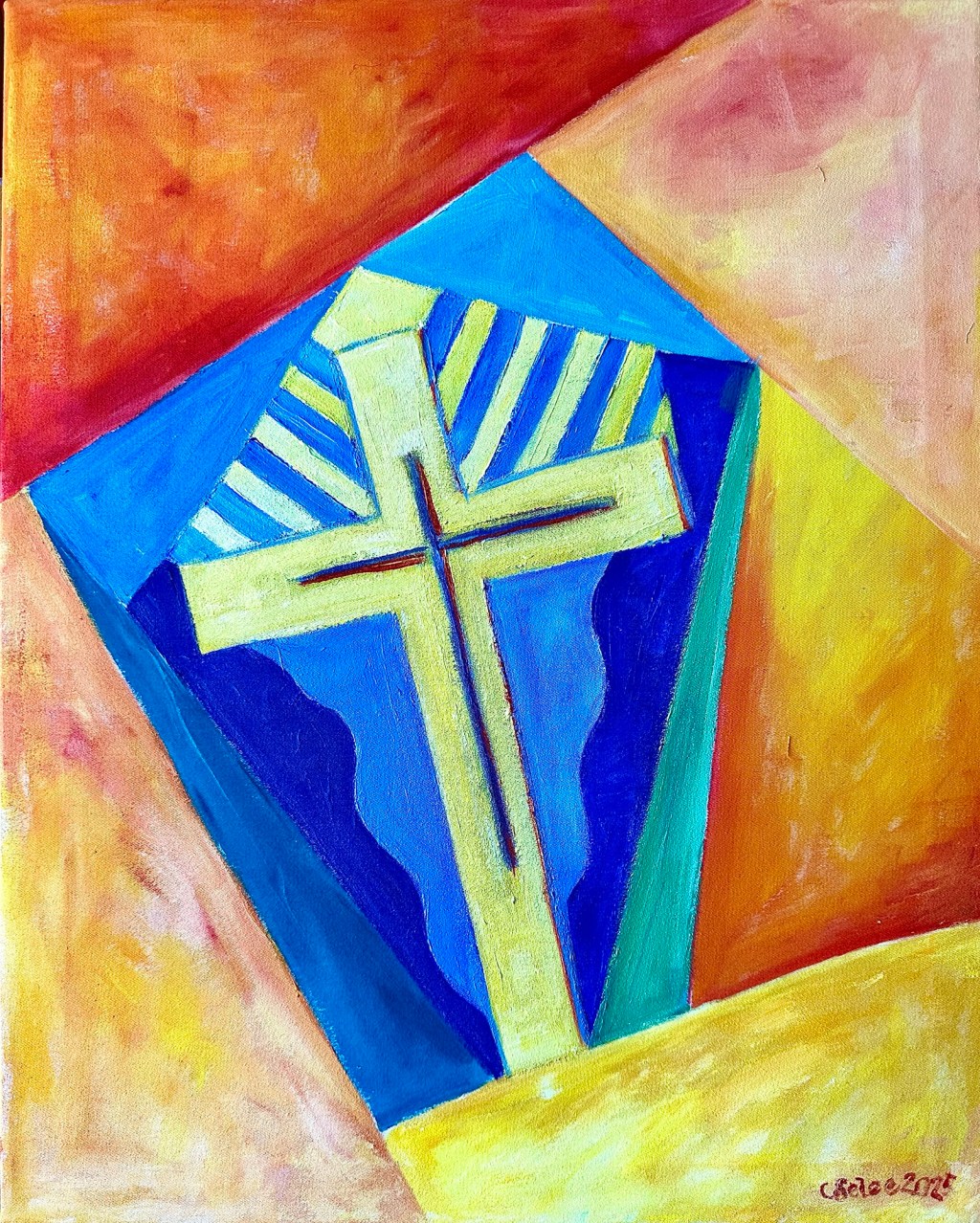
Never surrender!

Altars, art, Carl Jung, Creativity, crucifixion, Easter, Easter, Faith, Garden of Gethsemane, Good Friday, Healing, Holy Spirit, Holy Thursday, incarnation, inspiration, Ministry, Painting, suffering

“Never give up! Never surrender!”

This is my favorite quote from the 1999 sci-fi parody film Galaxy Quest. As a fan of Star Trek, I love the heroics of the storylines and the movie’s devoted fans. What sets this spoof story apart is how an alien culture has modeled its entire identity on the “historical documents,” or the weekly tv series videos. The aliens arrive on earth and spirit away the crew to fight against their enemies. The actors protest, but discover their true selves through this challenging situation. They not only play heroes, but they become heroes. They have to surrender to their former false selves to become the best and the truest of who others have known them to be.

We are not a people who believe in surrender. If our back is against the wall, our inclination is to fight all the more. Most of us believe in climbing upwards, not in moving downward. Taking a lateral move is just as bad as a demotion for most people’s egos. If you talk to any clergy person during appointment season, many are hoping for a church with a bigger steeple. While if you talk to their congregations, they’re hoping for preachers who wants to stay for a while. Obviously between moving and staying, someone is going to be disappointed. Someone will need to surrender to a greater plan.

I remember in my early days I got my nose bent out of shape because my church asked for a new pastor. My bishop at the time was frank with me: “I don’t have anyone to send here. You need to suck up your feelings and make sure this church is ready for next year!” Elders vow to be ready to pray, preach, move, or die at a moment’s notice in the United Methodist Church. We also vow to stay if necessary. I didn’t want to surrender to my bishop’s authority, but I decided to make sure when appointment season rolled around again, she could send any average pastor in my place.

I also knew other experienced clergy had thought I’d been “over appointed” straight out of seminary. They had told my superintendent they “deserved that appointment” where I was. My answer was often on some days, “I’ll trade you straight across, no question.” Those were the suffering days, but then would come the days of joy and grace, and I’d forget my rash willingness to hand over my charge to another sight unseen. I was truly glad for the nearby presence of an older, more experienced clergy person who would buy me a coffee and doughnut. He helped me keep the perspective of the long view, rather than the immediate moment.

DeLee: The Cross Upsets Earthly Powers

In this Holy Week—the time between joys of Palm Sunday and Easter Sunday—we find the events of Holy Thursday’s foot washing, Good Friday’s Crucifixion, Holy Saturday’s Vigil, and Easter Sunday’s Resurrection. In between Thursday and Friday, we find the stories of Jesus praying in the Garden of Gethsemane, Peter’s denials, and other tales of suffering.

Modern folks don’t usually like suffering. We want to treat a slight cold virus with an antibiotic, even though antibiotics only work against bacterial infections. All we end up doing is causing more suffering by creating antibiotic resistance. In worship services, “to save time,” we omit the third verse of the old hymns, which most often contain the sacrifice and blood of Jesus on the cross. People who visit churches on the Sundays during Holy Week go from the Palms proclamation of Jesus as messiah to the risen Christ on Easter. They avoid all the turmoil, suffering and drama of the week in between.

Tim: three crosses at sunset

In real life, because we avoid dealing with our dark sides and personal brokenness, we often project those same bad qualities onto others, which we then “other and marginalize.” All the “isms” of the world have scapegoats that represent their own dark side. The work of “identifying and accepting one’s shadow” is the process of assimilating “the thing a person has no wish to be” [Collected Works of Carl Jung: CW16, para 470].

Jung saw quite clearly that failure to recognize, acknowledge and deal with shadow elements is often the root of problems between individuals and within groups and organizations. It is also what fuels prejudice between minority groups or countries and can spark off anything between an interpersonal row and a major war. This certainly speaks to the time in which we now live.

Post surgery photo: still groggy

I recently had anterior cervical fusion surgery on my neck due to a herniated disc that was causing numbness in my arm and fingers. It also was causing pain, but I wasn’t aware of how much pain I was experiencing. The story of boiling a frog by gradually turning up the water it’s in is true. If your pain gradually increases by fractions, you think it’s just a 3 on the 10-point scale. However, I was having difficulty doing my ordinary work, exercising, and making decisions. Writing, which was once easy, became a chore. A concrete brain full of pain signals effectively blocked my ability to think creatively. I was trying to think through a sludge of cold molasses.

My scar is healing nicely 25 days post surgery.

The good news is after surgery I have my former brain back, such as it was. I also have a set of plates and screws in my neck, so I hope I don’t set off the TSA scanners in the airport the next time I fly somewhere. I also have a scar on my neck, so I guess I’ll trade in my Wonder Woman costume for a pirate costume for Halloween. At least I’ll have an authentic scar for the day.

Mike: suffering heart pierced by cross

The prophet Isaiah reminds us Jesus is the suffering servant,

“He was despised and rejected by others; a man of suffering and acquainted with infirmity; and as one from whom others hide their faces he was despised, and we held him of no account. Surely he has borne our infirmities and carried our diseases; yet we accounted him stricken, struck down by God, and afflicted. But he was wounded for our transgressions, crushed for our iniquities; upon him was the punishment that made us whole, and by his bruises we are healed.” (53:3-5)

The Jewish people hoped for a messiah king, who would be a warrior hero in the style of King David. They hoped to restore the independence of Israel as a nation faithful to God and free from outside rule. Jesus was an unlikely messiah, as Paul tells us in 1 Corinthians 21:22-24–

“For Jews demand signs and Greeks desire wisdom, but we proclaim Christ crucified, a stumbling block to Jews and foolishness to Gentiles, but to those who are the called, both Jews and Greeks, Christ the power of God and the wisdom of God.”

Even today this apparent weakness in the face of power is a message popular society doesn’t grasp. Even the people closest to Jesus, the early disciples first sought power and status in the coming kingdom, until Jesus disabused them of that notion and said,

“Truly I tell you, unless you change and become like children, you will never enter the kingdom of heaven. Whoever becomes humble like this child is the greatest in the kingdom of heaven.” (Matthew 18:3-4)

Olive Tree from Gethsemane

The best example of suffering in Holy Week is Jesus praying in the Garden of Gethsemane. There under the twisted trunks of olive trees, Jesus wrestled with his will and his mission. Being fully human, he would not choose to die on the cross. Being fully divine, he could only fulfill his Father’s purpose. Perhaps in this struggle he thought back to his wilderness experience before he set off to preach good news to the poor and release to the captives:

“Again, the devil took him to a very high mountain and showed him all the kingdoms of the world and their splendor; and he said to him, “All these I will give you, if you will fall down and worship me.” Jesus said to him, “Away with you, Satan! for it is written, ‘Worship the Lord your God, and serve only him.’” Then the devil left him, and suddenly angels came and waited on him.” (Matthew 4:8-11)

Gail W: watercolor of Palm Sunday

Our temptations come in many forms, but mostly we can sort them into three general categories: money, sex, and power. I personally think power is the overriding category and the others are mere subsets. Anything that knocks us off kilter or disrupts our sense of security is a threat to our feeling of power and control. This is likely why Palm Sunday and Easter Sunday are popular attendance days, while Good Friday doesn’t seem very “good” to the average person’s mind.

Matthias Grünewald, Isenheim Altarpiece (closed), c. 1512–16, oil and tempera on limewood panels, 376 x 668 cm (Unterlinden Museum, Colmar, France; formerly in a monastery hospital treating skin diseases).

As the apostle Paul wrote to the Philippians (2:5-11):

“Let the same mind be in you that was in Christ Jesus, who, though he was in the form of God, did not regard equality with God as something to be exploited, but emptied himself, taking the form of a slave, being born in human likeness. And being found in human form, he humbled himself and became obedient to the point of death—even death on a cross. Therefore God also highly exalted him and gave him the name that is above every name, so that at the name of Jesus every knee should bend, in heaven and on earth and under the earth, and every tongue should confess that Jesus Christ is Lord, to the glory of God the Father.”

Grunewald: Isenheim Altarpiece, 1512-1515, Resurrection of Christ—part of the same altar.

May your Easter season be blessed and you find ways to meet Christ in the poor among us,

Cornelia


Can Antibiotics Treat My Cold

https://www.webmd.com/cold-and-flu/antibiotics-colds

The Jungian Shadow – Society of Analytical Psychology


Meditation with Mandalas

adult learning, architecture, art, beauty, Carl Jung, Chartres Cathredral, Creativity, Faith, Holy Spirit, incarnation, inspiration, mandala, Meditation, Ministry, Notre Dame de Paris, Painting, perfection, Spirituality

The mandala is a geometric design representing the universe in Hindu and Buddhist symbolism. It generally has a circular form and can be varied in any number of ways, but it’s always balanced. In the Hindu and Buddhist traditions, mandalas are objects of meditation to aid in one’s spiritual development. The imagery depicts the universe and the symbols represent one’s spiritual journey, the cycles of birth-life-death, and the interconnectedness of all living things.

The Hindu tradition focuses on the realization of the self as one with the divine. Whereas in the Buddhist tradition, the emphasis is on the potential for enlightenment (Buddha-nature) and the pictures within the mandalas illustrate the obstacles that one has to overcome in order to cultivate compassion and wisdom. Drawing mandalas in this tradition follows strict rules.

Castle Mandala by Carl Jung, from the Red Book

Carl J. Jung was the Swiss psychiatrist who introduced to the West the practice of creating mandalas for self-expression, discovery, and healing. He discovered the shapes, colors, and symbols of his mandalas reflected his mental, emotional, and spiritual well-being at the time that he created them. He noticed his mandala drawings changed as his mental and emotional states changed. Reflecting on these mandala drawings, Jung concluded our subconscious and conscious selves are always seeking balance. When Jung worked with his clients, he would have them draw mandalas. He observed through creating mandalas, his patients experiencing chaotic psychological states could regain balance and calm. Jung also identified universal patterns and archetypes that reoccurred in his and his clients’ mandalas.

Celtic Cross Knot: Everything is Connected

As in other cultures, the round shape in Christianity represents the universe, and therefore, is seen as a way to connect the earthly and spiritual realms. Whether in the form of windows in a church or as a rosary, mandalas are used to take the time to contemplate the self and the divine. Perhaps the most iconic representation of the Christian mandala is in the majestic stained glass windows that decorate many churches and cathedrals. While some of these are on a far grander scale than others, the stained glass window is often made up of a central point – often the figure or scene being depicted – which is surrounded by a design that is inherently geometric due to the fact that it’s made up of hard-edge pieces of glass.

Some of the world’s oldest cathedrals are home to rose windows. The rose window is one of the most classic examples of the mandala in Christianity, and their origins trace back to the Roman oculi. These windows are created using geometric segments, and can contain extremely intricate patterns made from different colors of glass, all of which extend out from a central starting point in the middle of the circle.

South Rose Window, Notre Dame, Paris
Photo: Getty Images/Julian Elliott Photography

Aside from its famous French Gothic architecture, this venerable cathedral contains some of the most iconic stained glass in the world. Pictured here is the South Rose Window—a gift from King Louis IX of France—which was designed by Jean de Chelles and Pierre de Montreuil. Installed in 1260, the window is 42 feet in diameter and contains 84 panes divided into four circles. It serves as a counterpoint to the window on the north side, which was completed a decade prior.

Notre Dame, North Rose Window, Two views after the fire of 2019

Of course, we can also see balance and symmetry in architectural designs around and above us, even if they weren’t meant meant to be “symbols of the universe or creation.” We have to ask ourselves, “How do we feel when we enter a space of a particular design?” The architect uses forms, voids, lines, and heights to imbue in us certain emotions, as well as to make the building practical for its intended use. I always know I’ve found my home when I’m house hunting because the place will “call me by name.” I’ll feel at ease when I walk in. It won’t matter how badly the current owners have decorated it, the place will call to me.

Gran Hotel Ciudad de México, Mexico City
Photo: Courtesy of Nick Mafi

This 1899 upmarket department store with a soaring Tiffany-stained-glass ceiling in the lobby was transformed into a luxury hotel in anticipation of the 1968 Olympic Games. The ceiling, which evokes the country’s Mesoamerican heritage with a lively palette of turquoise and gold, was designed by French artisan Jacques Gruber and also features a Louis XV–style chandelier. The domes in the center have a geometric, mandala design.

Chicago Cultural Center, Chicago
Former Chicago Public Library
Photo: Alamy

The Louis Comfort Tiffany dome at the Chicago Cultural Center measures 38 feet in diameter, making it one of the largest stained-glass domes in the world. Held together by an ornate cast-iron frame that features some 30,000 pieces of glass shaped like fish scales, the dome was finished in 1897, the same year the building opened as the city’s first public library. The dome underwent a meticulous restoration in 2008 and is now lighted electrically. Tiffany pushed the art of stained glass to the extreme, but this dome certainly has the wow factor the citizens of that era expected, for Chicago was a world class city experiencing tremendous growth, while attracting such luminaries as Frank Lloyd Wright and hosting the World’s Colombian Exhibition in 1893.

Palau de la Música Catalana, Barcelona
Photo: Alamy


Completed by Catalan Art Nouveau architect Lluís Domènech i Montaner in 1908, this steel-framed concert hall boasts a stained-glass skylight featuring a three-dimensional depiction of the sun. Named a UNESCO World Heritage Site in 1997, the music hall contains countless other artworks, including the busts of Anselm Clavé and Beethoven flanking the stage. It’s also the only European concert hall to be illuminated only by natural light. The impressive stained-glass ceiling and the way it’s designed allows the Palau de la Música to use only natural light to illuminate the main concert hall during the day.

Dome, Salzburg Cathedral

Designed by Italian architect, Santino Solari, the Salzburg Cathedral in Austria stands out in a city already filled with stunning architecture. Built in the 17th century, the cathedral was the site of Wolfgang Amadeus Mozart’s baptism. In the center of the dome is a sunburst behind a descending dove of the Holy Spirit. The hexagonal shape repeats down through the dome, with window openings ending at the four trapezoid shapes at the column junctions, which contain paintings of the four gospel authors. It is peaceful and serene, ordered and mathematically precise, much like a Mozart composition. It’s said Mozart wrote his pieces almost without correction, as if they came to life fully born, like Athena, who sprang to life in full adult form from Zeus’ forehead when he had a terrible headache.

Sally’s Flower Inspired Mandala

Our class has painted mandalas before, but this was before Sally had joined us, so it was a novel idea to her. Still, she decided to go for it, using her new favorite color, Manganese blue. The growing and expanding flower shapes show her love and connection to the natural world. She can paint faster than her decision making can override her energy. This takes time to learn the discipline to hold back the hand, or one can choose to paint on a larger canvas to spread that energy around. Sometimes we have to get our tools fitted to our personalities so we can make the art best suited to our energy and creative imagination. Then our work will begin to “speak to others and call to them with the unique artistic voice of the creator.”

Mike’s Mandala

Mike’s mandala balances dark and light, circles and squares, and various sizes of triangles. I get a sense it’s a representation of the creation of earth, but I didn’t get a chance to confirm this with him. Mike typically sits down to paint and doesn’t talk much during class. This is his quiet place, his meditation place, and his medicine for his very busy life. The only thing that will get him talking is “Did you hear about those SEC coaches calling each other out? That’s gonna be some kind of hoodoo when they get together.”

Cornelia’s Sunflower Mandala

I got started on another creation mandala: the plants and vegetation. I’m basing it on the sunflower, but I’ve only just begun. I have the graphite underdrawing, and part of the central image painted. I’m just a bit irritated at the graphite, since it mixes into the paint and grays it out. This is why I usually sketch my initial image in a pale yellow wash, which I can easily paint over.

Jung wrote in Memories, Dreams and Reflections, “The mandala is an archetypal image whose occurrence is attested throughout the ages. It signifies the wholeness of the Self. This circular image represents the wholeness of the psychic ground or, to put it in mythic terms, the divinity incarnate in man” ( Pages 334-33). As Philippians 3:21 promises,

“He will transform our humble bodies so that they may be conformed to his glorious body, by the power that also enables him to make all things subject to himself.”

Those of us who spend time in meditation don’t do this practice merely to feel better or to relieve stress, but to become one with the creator of the universe. As we come closer to God and Christ, we also become closer to the people for whom Christ gave his birth, life, death, and resurrection. As he said,

“And I, when I am lifted up from the earth, will draw all people to myself.” ~~ John 12:32

The unity of those for whom Christ lived, died, and was resurrected, is all encompassing. It’s not for a selected few, or for some who look like us or believe like us, but for “all people.” It’s a common fault among human beings to ask, like the lawyer in the parable of the Good Samaritan, “But who is my neighbor?” Jesus led him to understand the one who showed mercy to the hurt one was the true neighbor, even if Samaritans normally were shunned.

If drawing mandalas brings us to understand our Bible, our faith, and our God in a deeper way, I’m all for it. If all we’re doing is making pretty patterns on a blank surface, without contemplating the generous Providence of the God who created and sustains our universe, we might as well be mumbling the Apostles Creed on a Sunday morning without giving a thought to any of the words we say. Both of these can be time fillers, mere mind numbing activities, that keep us from having the inner form of Christ, while we give the outward appearance of Christianity. This would be a waste of time, and as the ancient word concerning the law says,

“Circumcise, then, the foreskin of your heart, and do not be stubborn any longer. For the LORD your God is God of gods and Lord of lords, the great God, mighty and awesome, who is not partial and takes no bribe, who executes justice for the orphan and the widow, and who loves the strangers, providing them food and clothing. You shall also love the stranger, for you were strangers in the land of Egypt.” ~~ Deuteronomy 10:16-19

Next week is our last class for the spring, to let this old teacher have a summer break. We’ll start up again in the fall after Labor Day. If you’ve never painted before, this a one room Art School. Everyone proceeds at their own pace. You only have to give up your competitive spirit and your desire for immediate gratification and perfection. It’s art, not microwave pop tarts. You won’t be Michelangelo and that’s a good thing. He’s dead. We want you to be alive and growing in Christ.

Joy, peace, and mandalas,

Cornelia

What is a Mandala? | How to Draw Mandalas and the 100 Mandalas Challenge with Kathryn Costa
https://100mandalas.com/what-is-a-mandala/

Beautiful Stained-Glass Windows Around the World | Architectural Digest
https://www.architecturaldigest.com/gallery/stained-glass-windows

Carl Jung: Ten Quotations about Mandalas – Jung Currents
http://jungcurrents.com/carl-jung-ten-quotations-about-mandalas

Palau de la Música Catalana: Barcelona’s most amazing concert hall – MAKESPAIN https://makespain.com/listing/palau-de-la-musica-catalana/

Rabbit! Rabbit! Welcome to April 2022

adult learning, art, Carl Jung, Creativity, Easter, Faith, holidays, hope, Ministry, mystery, nature, Painting, rabbits, renewal, shadows, trees

Ukrainian Psyanky Easter Eggs

What a difference a month makes! Only a few weeks ago, I was speaking with a rabbit pal, who was ground down by her constant caregiving in this pandemic world. She cares for elderly rabbits in a nursing home, a vulnerable population, plus she’s grieved the passing of several of her own family members lost to COVID.

“I’m not getting another shot,” she said. “I’m so tired of COVID, I could scream.”
“I know,” I replied, “but this isn’t over. As long as we have hosts—those who either can’t or won’t get vaccinated—COVID is going to mutate and stick around.”

“Oh, don’t tell me that! We’ve been through alpha, beta, and gamma. We’re on omicron now. What’s next?”

I laughed. “It doesn’t matter. It could be gigatron, megaton, or atragon—they’re all monsters and we’ll have to cross that bridge when we come to it. We’ll do what ever it takes to beat those monsters, just like in the Japanese movies.”

Booster Shots Meme

Her mood lifted somewhat, for in these hard times a friend has to be a support. I was only returning the favor, for she’s been my rock when I’ve been down.

Speaking of monsters, I love Japanese films. I once had a boyfriend in college who had a fondness for Japanese films.

“Oh, me too!” I exulted.
“What’s your favorite ?” he asked.
“I really like Mothra and Godzilla,” I replied to his frozen face.

Mothra and Godzilla

He favored more arcane fare, such as The Burmese Harp, Rashomon, and others with samurai military themes. We did share a common love of pasta, but his military service took him elsewhere, and my artistic sensibilities took me to a different place also.

We rabbits like to escape from reality when life gets too real at times, as it has this past month. The Bible speaks of “the spring of the year, the time when kings go out to battle,” in 2 Samuel 11:1. When the sap rises and the light gets brighter, some circadian rhythm must kick in that sets off a power struggle amongst the powers that be. When I taught school back in the day, all my rabbit students were wild as hares from April Fool’s Day until the last day of school in May. During my first year teaching, we got an extra week of spring break, since we didn’t use any of our snow days.

My old daddy found me crying on that Monday morning.
“What’s wrong, honey?”

I sobbed, “We only have one more week of vacation before school starts again!”
“It’s all downhill from here, honey. You can do this,” he said, encouragingly. “Dry those tears and let’s share a cup of coffee at the breakfast room table.”

Life is always better with coffee, and with an older bunny to talk some sense back into you. At least my daddy was always willing to listen to my tales of woe. I must have been a real drama queen back when I was young, but surviving those “bad old days” meant I could take my turn later on and help other young rabbits through their peaks and valleys. As the apostle Paul wrote in 2 Corinthians 12:10—

“Therefore I am content with weaknesses, insults, hardships, persecutions, and calamities for the sake of Christ; for whenever I am weak, then I am strong.”

Atragon, Monster of the Mu Empire

One of the ways I would escape reality was to watch those Japanese monster movies. They weren’t always long on plot or character development, but you could count on lots of action. Atragon, a huge monster of the Mu empire, an underwater civilization that was supposedly extinct, resurfaced in one movie to declare war against all nations. The sole hope of humanity seemed to lie on Captain Hachiro Jinguji, who refused to surrender, and his atomic super-submarine, the Gotengo. When the Mu and their evil Queen kidnapped his daughter, he decided to attack them. Earthquakes and battles between submarines and the great sea monster ensued.

Demon Brand

I’ve always found watching monster movies and the concomitant destruction they cause easier than watching the actual mayhem reported on the evening news, but then I grew up in the Vietnam era. I always had difficulty with the people my parents’ age who wanted to “bomb the North Vietnamese back to the Stone Age.” Now when I see a Russian dictator doing this very deed to Ukraine, an independent nation, I have even more distaste for this activity. I’m reminded how easy it is for us to project a demonic nature on those who do terrible, unprovoked, and unimaginable deeds on others.

Krampus: The Punisher of Bad Children at Christmas

In the years after the United States dropped atomic bombs on Hiroshima and Nagasaki, the Japanese worked out their fears of another nuclear horror or the after effects of that first one with their mutated monsters by atomic radiation. Today, we have movies which deal with our fears of robots taking over the world or artificial intelligence throwing over its creators.

1939 Attack of The Robots

These aren’t new themes, of course, for Greek mythology tells of the early Titan king Chronos, who swallowed all his children, so none would fulfill the prophecy of taking his throne. When Zeus was born, his mother spirited him away. When he grew up, he came home, caused his father to vomit up his siblings, and together they defeated him. This is how the gods came to rule the heavens, the oceans, and the underworld. These gods were made in the image of human kind, so while they were more beautiful, stronger, and immortal, they were also given to the same passions and consequences as those besetting humanity.

The Greeks and Romans were always in a contest of power, whether between the gods, gods and humans, or humans alone. Nothing was ever in a steady state. Their great leaders were known both for their military successes as well as their political prowess. They were leaders both in peace and war. The Ancient Greek philosopher
Heraclitus said, “War is both king of all and father of all, and it has revealed some as gods, others as men; it has made some slaves, others free” (no. 22 fragment B53).

Wolf image

Native American tribes have a story of the warring nature we each carry within us. It’s commonly known as “the two wolves” or “the grandfather story.”

“I have a fight going on in me,” the old man said. “It’s taking place between two wolves. One is evil – he is anger, envy, sorrow, regret, greed, arrogance, self-pity, guilt, resentment, inferiority, lies, false pride, superiority, and ego.”

The grandfather looked at the grandson and went on. “The other embodies positive emotions. He is joy, peace, love, hope, serenity, humility, kindness, benevolence, empathy, generosity, truth, compassion, and faith. Both wolves are fighting to the death. The same fight is going on inside you and every other person, too.”

The grandson took a moment to reflect on this. At last, he looked up at his grandfather and asked, “Which wolf will win?”

The old Cherokee gave a simple reply. “The one you feed.”

We each have a wolf or a Godzilla within ourselves, but sometimes we fail to notice it. Instead we see it only in the outsiders, in our enemies, or those whom we’ve excluded from our privileged circle. How we manage this “darkness” within us, how we the battle the “enemy within,” is the great work Jung spoke to when he proposed the presence of the Shadow within each of us.

The Shadows we all carry

When the world is falling apart, we too feel unmoored. When a dictator attempts to redraw the borders of another country, our cognitive maps also fall apart. If that part of the world isn’t safe, is our world at risk also? Even though we know change is inevitable, will the apple cart be set on fire or just dumped over? We rabbits aren’t the bravest animals, so we can borrow trouble from the morrow, as well as from the next half hour. Somehow we have to revision our old lives, shed our old cocoons, and renew our selves for the new world to which we find ourselves awakening.

A hundred years ago, T. S. Elliott wrote these opening lines of his famous poem, The Waste Land. In the days after the end of World War I, his wife was suffering from mental illness and his marriage was falling apart because she was having an affair with another man. He too was suffering from the shared grief of the loss of so many in the Great War, as well as his own personal relationship problems. He wrote this poem at a sanatorium, where he was taking a “cure” for his own mental health.

April Lilacs on Hwy 7S to Arkadelphia

April is the cruelest month, breeding
Lilacs out of the dead land, mixing
Memory and desire, stirring
Dull roots with spring rain.
Winter kept us warm, covering
Earth in forgetful snow, feeding
A little life with dried tubers.

If we’re ever to understand the great mysteries of faith, we have to meet the darkness within us. That’s what is symbolized by the suffering, death and resurrection of Christ. The loneliness in the garden of Gethsemane, the descent into the grave, and the rising back to life once again. If ever we’ve had this loneliness, emptiness, and sense of rebirth, we’re participating in the Easter mystery. Once we die to our old selves, we can live the Christ life, not just a life assenting to the doctrines of the Christian faith.

Sea Bass by Paul Summer: recycled antique and modern tin, riveted to a hand-carved pinewood base, forming colorful scales

No one will be able to call us rabbits April Fools, even if they call us fools for Christ. Let’s celebrate this month some of the great faith holidays, and don’t forget your taxes are due. That perhaps is “the cruelest” event of April.

April 3—Ramadan begins—revelation of the Koran to Muhammad
April 10–Palm Sunday
April 14–Maundy Thursday
April 15–Good Friday & Income Tax Day
April 16–Passover & Holy Saturday Vigil
April 17–Easter
April 18–Easter Monday (Emmaus Monday)
April 24–Orthodox Easter
April 28–Holocaust Remembrance Day
April 29–Laylat al Qadr is the day in Ramadan that observes the night when the Prophet Mohammad received the first verses of the Koran

Joy, peace, and mysteries,

Cornelia

Atragon (Ishiro honda, 1963)—underwater monster takes Tokyo.

The Burmese Harp
https://en.wikipedia.org/wiki/The_Burmese_Harp_(1956_film)

The Waste Land by T. S. Eliot | Poetry Foundation
https://www.poetryfoundation.org/poems/47311/the-waste-land

The waste land : a facsimile and transcript of the original drafts, including the annotations of Ezra Pound / T. S. Eliot ; edited by Valerie Eliot. – British Library
http://explore.bl.uk/primo_library/libweb/action/dlDisplay.do?vid=BLVU1&afterPDS=true&institution=BL&docId=BLL01010067643&_ga=2.6871095.423095881.1648426637-1262842970.1648307341

Justice and the Justification of War in Ancient Greece: Four Authors
Tristan K . Husby
http://digitalcommons.conncoll.edu/classicshp/1?utm_source=digitalcommons.conncoll.edu%2Fclassicshp%2F1&utm_medium=PDF&utm_campaign=PDFCoverPages