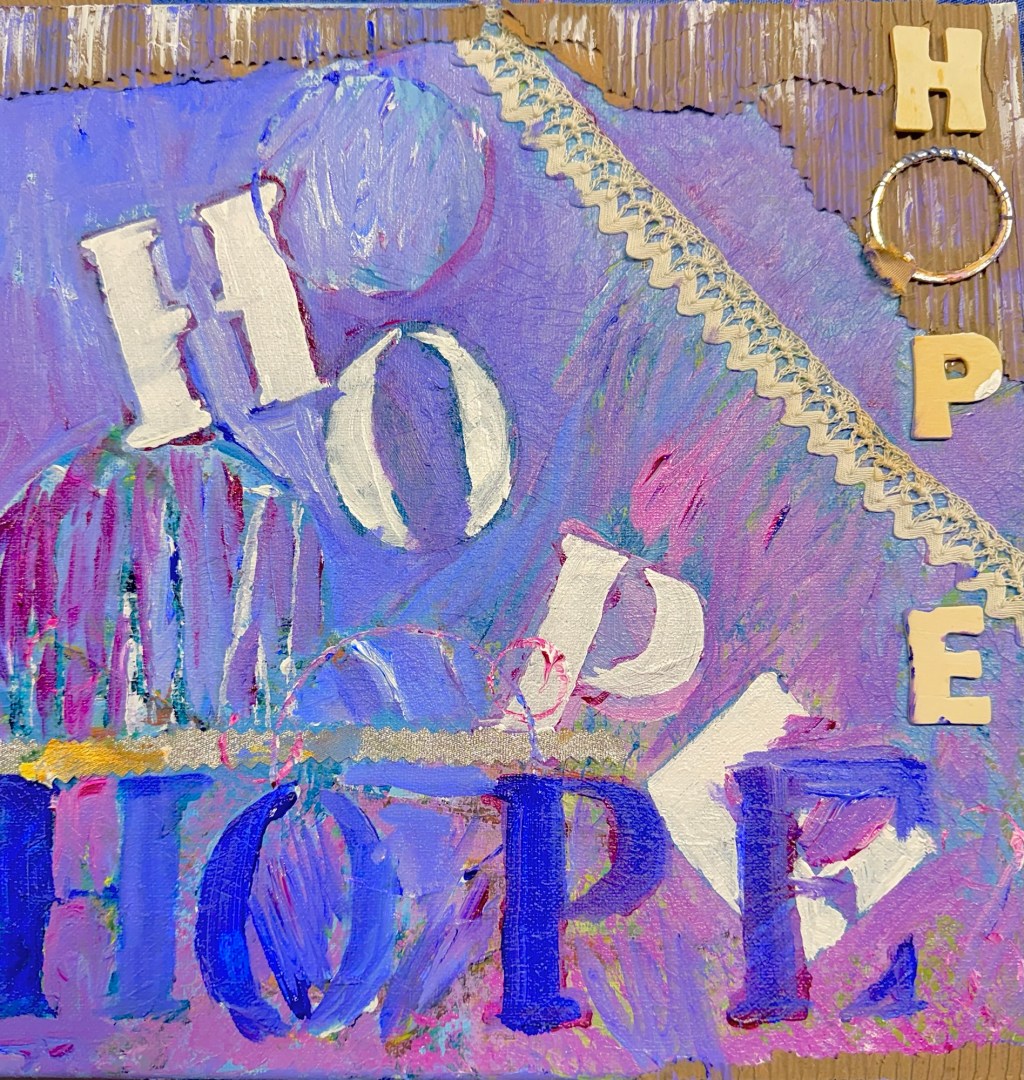
A Life of Mystery and Hope

adult learning, arkansas, art, brain plasticity, Creativity, Faith, hope, Icons, Israel, mystery, Painting, Spirituality, suffering, vision

Our weather is changeable. Last week I had the heat turned on, but this weekend I have gone back to ceiling fans and my air conditioner. I was so ready for cooler temperatures, but I am not in charge of the thermostat outside, only the one inside. Of course, while the calendar may say it is autumn and the northern states may get their first snows, we southern folks should know better than to put away all our lightweight clothing just because we have had a first frost. That first frost freeze is just a tease, since an eighty-degree day or two will soon follow.

I talk about the mysteries of our weather because when we try a new art medium for the first time, we sometimes think, “Oh, this has some similarities to a prior experience.” Then we get into it and come to the “unknown land”—the place where we realize we are lost and have no idea which way to turn. We cannot go back, we do not know how to go forward, and we think if we stay in this place, we might starve to death.

We are like Abraham, who heard God’s call to “go to a land I will show you” (Genesis 12:1), but we have no idea how long that journey will take or where we will end up. We go from our safe place as an act of faith, travel in faith, and meet every obstacle and detour with the faith God will bring us through. Every artist is an Abraham in their heart, for they are always on a spiritual journey. Even when we reach the promised land, we always are moving spiritually “from Dan to Beersheba” as we hone our craft, just as Abraham and his family followed their flocks to the seasonal pastures. Like the ancient Jews, we too can confess:

“A wandering Aramean was my ancestor…” (Deuteronomy 26:5).

If we wander, we need a guide. Beginning artists have always sought more experienced artists as their guides and teachers. For the basics, we more experienced persons act as teachers by giving instruction and directions. Some teachers give their students works to copy so each person produces an approximation of the teacher’s image. Since this method does not encourage creativity or intense attention, I have always taught people to use their own eyes to see the image, rather than have me prescribe and define it for them. That would take the greater part of the “seeing and imagining” work away from the students. This would build my neurons but not do all that much for theirs. The more difficult task challenges us and keeps our brains from becoming numb from disuse. Art is one of the best exercises for stimulating the brain.

Marie Woods: Seeking Serendipity II, Mixed media on birch panel, 12″ x 12″, 13″ x 13″ overall, Framed in a tray frame

To start the class, I showed some multi-media art works using words and found objects. Because everyone has a different learning style, I find showing images for visual learners helps those who learn through sight, while talking about these examples helps those who are auditory or hearing learners. I sometimes need to take the tools in hand to show the haptic or hands on learners. No style is “better” or more “advanced” than another, but our unique style of learning has to do with the design of our brains. We can train our brains to work in a different fashion, but our preference will always be easier.

I had begun working on a piece the week before when Mike and Gail were in class. Mike had to go away to handle a work emergency and Gail wanted to finish a pumpkin painting. Since they had known what we would work on, and we had a week off, they were ready with a fleshed-out idea. These two also have experimented with other media in the past also. Gail’s granddaughter brought a variety of materials to work with and already had an idea. Marilyn had a promising idea, but needed technical help to bring it to life.

This is where we become those who say, “we walk by faith, not by sight” (2 Corinthians 5:7). We might look at our canvas, the paint we have put on it, the gauze we tied to it, and say to ourselves: “Well, this is a fine mess I’ve gotten myself into!” This is when a call for help, the lack of activity, or the smoking of a brain working overtime makes me look up from my own work and ask, “You need some help?”

I do not read minds, but my old schoolteacher skills never really die. If the room gets too quiet, someone is either in trouble or fixing to cause trouble. In our Friday art class, we do not have the latter. When I went to help Marilyn, she was at a decision point over what to do with her image without the netting. To begin with, she had tied it on tightly and did not have scissors on hand. In our class, we are willing to share, so no one has any need. As the writer of Hebrews 13:16 reminds us,

“Do not neglect to do good and to share what you have, for such sacrifices are pleasing to God.”

My scissors broke when one of our group tried to cut a cork, so I borrowed Gail’s X-acto knife. Plan A was not available so we moved to Plan B. First the blade fell out, but I put it back in. Marilyn may have been wondering if we ever were going to find a working tool to cut away her netting. She had tied it very securely on the canvas board. Once we got it off, we could look at the paint texture on her board. There was always plan C—arm wrestle the netting off the canvas by sheer force of will, but Plan D would have been better: use the shears in the kitchen. Nothing stops us when we are going to make art. We will find a way.

Marilyn: Continental Drift

“Talk to me about your goals here,” I said.

“I was trying to get some green here, like a green ground.”

“You have plenty of green colors on your palette. Do you want solid greens or washes, like transparent greens?”

“More like transparent greens.”

“So, use your big brush and water.”

“I did not bring my big brushes. Just my small ones.”

“You can borrow mine.”

This is how the art studio life goes. We chat things out for a bit until we get over a hump, and then we let a person explore on their own some more. Some things they will discover for themselves. The more water you put into a color, the thinner it is on the canvas. The more paint put on your brush, the more opaque it is. If you want transparency, you thin your paint with a medium or water, but if you want to cover an area, you paint straight out of the tube. Keeping your brushes clean by changing the water often is also important. Otherwise, you are dragging colored water into your other colors. None of your other colors will be true colors, but will take on the color of your water.


Jimmie Durham: “Still Life with Spirit and Xitle”, car being crushed by a volcanic boulder with a comical smiley face painted on it.

When we journey, we sometimes need to take a detour along our well-planned route because a boulder has rolled down into the middle of the road or a recent flood has washed out the bridge. My map reading skills before GPS were so suspect, my daughter was frightened whenever I announced, “I’ve found a shortcut to save us some time.”

“Oh, no! Not the long cut!” She would wail. Unfortunately, she was usually correct. The shortcut might have been true, but my map reading skills always turned these short trips into long journeys. I do get to see the “unknown lands” off the beaten path of the scenic tours of whatever place I visit. “Oh, the places I have been!”

Dr. Seuss is a prophet

Learning how to paint, create art, make pottery, play a musical instrument, or any other creative activity does require attention, practice, critiquing, and patience. We must be pilgrims on a journey, knowing the long walk is part of the spiritual process of becoming the person we want to be. Our works will reflect our inner journey as we get closer to our destination. An artist never quits learning, so the artist’s journey never ends until they can no longer create physical works here on earth. As Anselm Kiefer, a modern German multimedia artist says,

“Art is longing. You never arrive, but you keep going in the hope that you will.”

Anselm Kiefer: Feld (Field), 2019-20, Emulsion, oil, and acrylic on canvas, 110¼x149% inches (280 x 380 cm)

Gail tried laying her paint on with a painter’s spackling knife. Normally she thins her paint out with water and treats it like a watercolor painting. She will build up layers to add depth and color. She also has a good clean edge to these works. She brought none of that vision to this painting, but laid on the three primary colors so thickly, they glistened. She tried printing the words with a rubbery shelf paper, but they did not stand out enough. I asked, “Do you think those words would read better in a different color?”

Gail: Elusive Peace

Her reply, “Peace is elusive these days. It is hard to find.”

“Form follows function” is a design principle, so Gail must be on to the metaphor of her theme word.

My Heart is on the Sea

Harper came to visit and made an ocean with sea foam bubble wrap and a heart floating on the water. She also brought her latest fancy bead bracelets.

Michael’s Cross and Crown

Mike was making up for missing art. He sat down with all his materials and worked his background in paint. After listening to my intro, he returned to cut up his purple cloth, arrange it on the canvas, and set the two pieces of scrap wood into a cross shape. Then he used spray fixative to hold the lot together. I saw him trying to get the wood to stick, so I suggested putting spray on both surfaces. This way the two would bond together. That piece of information was a technical revelation.

“I just need it to stick together long enough to get it home,” he said, “and then I can glue it for real.”

Aurora Across Arkansas 11/11/25

I noted his background colors reflected the unusual auroras which graced our evening skies this past week.

Eternal Hope

I had started my small canvas the week before when I was half sick. My hand, heart, and mind never feel quite connected when I feel bad, but I still work anyway. The beauty of acrylics is I can paint over them later. In fact, this is a repurposed canvas. If a work does not “speak to me” after a few months, I either cut it up to reweave it or paint it over entirely. I always think I will find hope for it in another form, but it may need to take its own journey to find its best self.

Jeremiah once said to the Jewish exiles in Babylon,

“For surely I know the plans I have for you, says the LORD, plans for your welfare and not for harm, to give you a future with hope.” (29:11)

When we have forgotten what our home looks like, God still remembers where we once lived. When we have lost our memories of the ancient Temple practices, God still knows the rituals. God will remind God’s faithful of our service. If we have lost our knowledge of how to walk with God, God will send us teachers once more. God always provides us with what we need.

Christ the Redeemer, 16th CE, Gallery of Art, Skopje.

Hope is part of our GrecoRoman heritage also. “Dum spiro spero” is Latin for “While I breathe, I hope.” Some form of this saying has been around since the 3rd century BCE. My grandmother sewed her antique crochet trim onto pillowcases for wedding gifts. This is a scrap I found in her sewing kit. I stenciled the letters HOPE and glued down the wooden letters H, P, and E. I used an old metal circle for the O. Torn corrugated paper added a touch of texture, as did a few string prints. Sometimes hope appears to slide away or seems raw and unvarnished. The colors are blue and violet because Advent is the great season of Hope. Matthew quotes the Servant Song from Isaiah in 12:18-21—

“Here is my servant, whom I have chosen,

my beloved, with whom my soul is well pleased.

I will put my Spirit upon him,

and he will proclaim justice to the Gentiles.

He will not wrangle or cry aloud,

nor will anyone hear his voice in the streets.

He will not break a bruised reed

or quench a smoldering wick

until he brings justice to victory.

And in his name the Gentiles will hope.”

This is the Messiah of Hope of Israel and the Anointed Christ in whom we hope today. We can best share the hope of this Christ to our suffering world by serving the suffering, the grieving, the hungry, and the overlooked.

Joy, peace, and hope,

Cornelia


Solid Geometric Perspective

adult learning, art, Attitudes, Creativity, Faith, Holy Spirit, Leonardo da Vinci, Love, Ministry, Painting, perfection, perspective, picasso, shadows

Steps in drawing a Geometric Still Life: sketch, refined sketch, shadows, intense shadows and cast shadows

We are back in art class again on Friday mornings at Oakland United Methodist Church. Our first lesson is in solid geometry, but it’s not a math class. Art is more like learning a visual two-dimensional language to be able to render three dimensional objects on a flat plane. This isn’t as easy as you might think, but once you learn to see in perspective, you never can unsee it again. Art class is like an old fashioned one room schoolhouse, in which a teacher has students of varying ages and experience levels to instruct. I provide one lesson and modify it for each student according to their needs.

Gail S.—Pencil Drawing of Solid Geometry

The first day of class, I had three brand new students and one who has done this exercise at least three times before. Two others were out doing family obligations, just as I was missing in action last week due to attending my niece’s graduation ceremony for her MBA in Business Administration. Life and family watershed events are always important to make our presence known. The life of the artist is as important as the art itself. We aren’t just people who make beautiful objects for others, but people who make life beautiful by being present at their most important moments.

Vermeer: The Art of Painting, 1666-1668.

When we look at the painted floor in the Vermeer painting above, we know in our minds these stand for black and white square tiles. If we take a moment to closely observe them, we realize these are more like diamond shapes. This optical illusion is the result of perspective. Perspective comes in multiple forms. Linear perspective has one-point, two-point, three-point, and multi-point vanishing points. Aerial or atmospheric perspective uses color, clarity, and value as objects overlap each other and recede into the background. There’s also reverse perspective in which objects are larger as they grow more distant and foreshortening, in which nearby objects are emphasized.

Pop Tarts from the Pop Tarts Bowl Toaster Trophy in 2024

 Can we teach all of this knowledge in a single two-hour lesson? Absolutely not. Michangelos aren’t turned out like pop tarts from a toaster. In the Renaissance era, a family would place a youth between the age of 7 to 14 with a master artist to learn the trade. This child would do the chores of the studio and learn to grind the pigments and mix paint. Then they would progress to drawing and composition. After a training time, they might get to do the backgrounds of the paintings or the landscape. After eight years, if they were any good, they would be entrusted with an entire commission. Then they would venture out on their own or take over from their master’s studio.

Cornelia—Purple Geometric Forms

I started taking art lessons when I was eight years old from the city parks and recreation art teacher on Saturday mornings, and then after school from a former art teacher in town. My grandmother was a portrait and still life painter. I have been taking or teaching classes for over seven decades. Art is not a skill or a product a person can ever perfect. It is more like a journey of faith, one in which we are always going on to perfection, but by the grace of God, will only be completed at our last day. Even at my age, I have more than a few “needs improvement works” left to create.

Tonya—Black and white Geometric Forms

The more you know, the more room for improvement you can find. I always ask students to first find three positive critiques of their work to praise before they begin to talk about their “improvement areas.” In this lesson, if they drew all three shapes, used two distinct colors for light and dark, and used up the space on the canvas, rather than drawing an inch tall image, those are positive points. Then they can point out their troubles.There’s enough negativity in this world. We need to overcome that in our own lives. What we learn on this canvas will carry over to the next one. Then we will find new opportunities for improvement yet again!

Marilyn—Geometric Forms in Aqua

No one who gets a significant health condition finds making a wholesale change overnight easy or achievable. This is why people who try extreme diets like Whole 30 that restrict too many foods discover they can’t stick with it or must continually start over. People looking to make lasting, healthy changes must start small and focus on progress over perfection, according to nutrition coach Brady von Niessen. “You start feeling so good about them that you can’t even imagine not doing them.” The same principle applies in art. Over time, a student’s skills will improve if they trust the process. Rome wasn’t built in a day!

Jeanne—Geometric Forms

Another important aspect of art class is relationships. Pierre Teilhard de Chardin said, “The most empowering relationships are those in which each partner lifts the other to a higher possession of their own being.” As a teacher, I try to help each person find their own creative voice, rather than trying to copy an idea of what “good art should look like.” Beginners in tennis don’t get to play on the same courts as Wimbledon or the US Open, or at least not at the same time as those who claimed the trophies! As Picasso once said, “It took me my whole life to learn to draw like a child.”

I consider this first class a success for each student. First, I got to hear some of their stories, which helps to build relationships. I got to hear their fears about not being perfect—none of us are perfect, but as United Methodists we are all going on to perfection in love by God’s grace and that’s the only perfection we concern ourselves with in art class. Can we love ourselves and give ourselves the grace to come up short? As the great Leonardo da Vinci said, “Art is never finished, only abandoned.”

I look forward to next week when we mix colors for the color wheel for the first time students. The returning students will get a lesson that uses geometry and mixed colors also. The more seasoned students project is a step up because they have more experience, so they have a greater challenge.

The one room art schoolhouse meets at 10 am on Friday mornings. It’s never to late to join.

Joy and peace,

Cornelia


Intuitive Color Wheels

adult learning, art, at risk kids, cognitive decline, color Wheel, Creativity, Imagination, inspiration, Lost Cause, Ministry, Painting, renewal, vision

The great and wonderful part of art is exercising imagination and discovering new ways to solve problems. One of my favorite memories in art school was the day our professor came to class with a single red clay brick. Our first thought was this is going to be the most boring drawing class ever, but then he asked us, “How many uses can you find for a brick?”

Thick as a Brick

After we quickly named multiple uses for a single brick—doorstop, paperweight, weapon, counterweight, and bookend—we were at a loss to name much more. As we scratched our heads, our teacher prompted us, “Did I restrict you to a single brick?” And we were off to the races! Wall, fireplace, house, road, sidewalk, planter, sculpture, picnic table, bookshelf, and more. I can’t remember if this was an early morning class or we were just dense, but I’ve come to believe we can teach creativity. At the very least, we need to give people permission to accept “multiple art answers can be true” and give them the opportunity to consider “other possibilities.”

Canvas bound in strings

When I taught art years ago, children who were troublemakers in regular classrooms were usually well behaved in art class. I attribute this outcome to their ability to express their own individuality in solving the weekly art assignments. Math always has a right answer; there is no “alternative fact” to 2 + 2 = 4. History is the same: the Confederacy seceded from the Union to keep their economic system of enslavement. There was no “states rights movement,” no matter what the Lost Cause proponents pushed in our state approved textbooks. All we had to do was look at the original source documents from the 1860’s.

Simple Color Wheel

Adults usually conform to socially acceptable norms. Helping adults with creative thinking is important because the creative process is more important than the tangible result. Most adults give up the idea they will ever paint the Sistine Chapel ceiling, while children are humble enough to realize they need many more years of practice before they get that kind of opportunity. Also, what we know about creativity can’t be applied in the same way to all creative endeavors because they involve different subjective decisions and processes.


Gino Severini: Expansion of Light. (Centrifugal and Centripetal), ca. 1913 – 1914, Oil on Canvas. 65 x 43.3 cm
Museo Nacional Thyssen-Bornemisza, Madrid

Creative insight depends in part on new combinations of existing ideas, concepts, and perceptions that the brain has stored over time. This is why we begin each class looking at famous art works. We need good art influences and inspiration to “prime our creative pumps” so we can draw up from the pure wellsprings of our own creativity. Just as we need spiritual food for our soul, we need beauty for our creative ideas.

First stage

Last year we worked on copying the color wheel and matching it. That is an intellectual skill. To make this into a creative, intuitive activity, we took strings and wrapped our canvases. This made multiple shapes for our colors. Using the primary colors—red, yellow, and blue, plus white—we mixed various combinations and surprised ourselves with the results.

Gail W’s first stage

Our first class was lightly attended, due to doctor appointments and vacations, so we still have room for anyone else who wants to come. All skill levels are welcome, for I’ve taught from K-5 to adults. Everyone progresses from their own level, so the longer you sit and think you wish you were good enough for lessons is merely time wasted when you could be working with a practiced teacher! Anyway, the lessons are free; you bring your materials and discover your unknown abilities and gifts. We journey with fellow travelers. Plus it keeps your brain young.

We will continue to work on this project next Friday at 10 am.

 Joy and peace,

Cornelia

National Endowment for the Arts: Creativity and the Brain

https://www.arts.gov/sites/default/files/how-creativity-works-in-the-brain-report.pdf

Anne Frank’s Last Birthday Cake

Anne Frank, art, Auschwitz, beauty, Children, Creativity, Faith, Family, Holocaust, hope, inspiration, Ministry, Painting, perspective, shadows, suffering, vision

Anne Frank’s Last Birthday Cake, acrylic on canvas, mixed media, 18” x 20,” 2024.

We never know when the tides of time will change. Most of us aren’t creatures of change, but prefer instead the well-worn and familiar paths. As a United Methodist pastor, I moved every two or three years during my ministry, so one thing I kept was my telephone company. I know some people like to switch providers almost as often as they switch their underwear, but that’s not me. Having to switch utility companies, banks, and hairdressers was more than enough agony for me. I signed up for this life, however, so I kept my moving boxes and made a spreadsheet for notifying all my address changes.

I talk about this because I only lived in three homes as a child. I never had to leave in the middle of the night to escape bad debts, the law, or a hateful Nazi regime. I have no way to imagine Anne Frank’s life, except when I was also 13 years old, I read her wonderful diary. Anne kept her diary, beginning at the same age, during the two years she spent in hiding while the Germans occupied her homeland during World War II. She had received a red, cream, and beige checkered cloth notebook diary for her 13th birthday on June 12, 1942. The underground Dutch radio station had encouraged people to keep diaries so future generations would know what the conditions were under the German occupation.

Because of the Nazi purity rules, Jews weren’t allowed to mix with non-Jewish persons. According to the Nazis, Jews were not Aryans or the Master Race. They thought Jews belonged to a separate race that was inferior to all other races. The Nazis believed that the presence of Jews in Germany threatened the German people. They believed they had to separate Jews from other Germans to protect and strengthen Germany. Their Nuremberg Laws were an important step towards achieving this goal. 

We hear this same sentiment today from the neo-Nazi movement groups who say, “Jews shall not replace us,” and “Immigrants are poisoning the blood of our nation.” As a result, only Anne’s Jewish friends could come to her birthday party. Her father set up a movie projector to show “Rin Tin Tin,” the famous Hollywood dog film star. The chairs were set up in rows like a movie theater. The family went all out for their Anne. Her mom had baked cookies for her classroom to share, since they couldn’t come to the party, but she baked a strawberry cream cake for this party attended by her Jewish friends. This was early June and the strawberries would be juicy, fresh, and in season.

Anne and Hanna playing before the Frank family fled into hiding.

Two weeks after her 13th birthday, Anne and the Frank family had disappeared from the neighborhood. They left no forwarding address. Her best friend of eight years, Hannah Pick-Goslar, didn’t see her again until they were both in the same concentration camp. Hannah survived. Anne did not, but the enduring story of her life in hiding continues through her diary.

When I was painting this, I used a large doily as the “cake.” I’d been saving it for a halo for a saint painting, but it works great for a cake top too. My viewpoint is from above, and I omitted the 95 candles. No need to burn the house down! The cream color was a bit pink, but if I were a young teen girl, I’d want it more pink than just white. I painted the background as a blue sky, because young people almost always have hope and optimism. The left side of the canvas has the storm clouds approaching, as well as the grey soot soiling the sky from the overworked crematoriums at the concentration camps where so many Jewish people lost their lives in the Holocaust.

If we can learn anything from one small girl who ate strawberries on an early summer day, I hope it will be to appreciate the beauty of this brief moment and to love one another deeply. Also, life is too short to hate anyone just because they are in someway different from you. Celebrate their differences as part of God’s creative generosity to this world. Also as Mary Oliver reminds us about the importance of keeping a journal:

“Instructions for living a life. Pay attention. Be astonished. Tell about it.”

Joy and Peace,

Cornelia


Remembering Anne Frank’s Last Birthday Party | TIME
https://time.com/6284557/anne-frank-birthday-party-hannah-pick-goslar/

What Hannah Pick-Goslar’s Memoir Reveals About Anne Frank | TIME

https://time.com/6282024/anne-frank-friend-hannah-pick-goslar-memoir-

The Nuremberg Race Laws | Holocaust Encyclopedia
https://encyclopedia.ushmm.org/content/en/article/the-nuremberg-race-laws


Total Eclipse of the Heart

adult learning, arkansas, art, Astrology, cosmology, Creativity, Faith, Great American Eclipse, Imagination, inspiration, Light of the World, Love, mystery, nature, Painting, photography, shadows, Spirituality, Travel, Uncategorized, vision

In the Bonnie Tyler song, “Total Eclipse of the Heart,” her rock and roll soul pines for a young man as she sings:

“Every now and then

I know there’s no one in the universe

As magical and wondrous as you.”

Love struck teen heart ballads tend to elevate the beloved to a high pedestal, while hymns lift the praises of God to the highest heavens. If we look at John Wesley’s Notes on the New Testament, one of the doctrinal standards of the United Methodist Church, his commentary on 2 Corinthians 4:6 (KJV) is instructive:

“For God, who commanded the light to shine out of darkness, hath shined in our hearts, to give the light of the knowledge of the glory of God in the face of Jesus Christ.”

We might be more familiar with this verse in the NRSV, a more modern translation, which wasn’t available in the middle of the 18th century:

For it is the God who said, “Let light shine out of darkness,” who has shone in our hearts to give the light of the knowledge of the glory of God in the face of Jesus Christ.

Bailey’s Ring, from an earlier total eclipse over the South Pacific Ocean

Wesley’s commentary in his Notes on this text is succinct:

  1. For God hath shined in our hearts—The hearts of all those whom the God of this world no longer blinds.
  2. God who is himself our light; not only the author of light, but also the fountain of it.
  3. To enlighten us with the knowledge of the glory of God—Of his glorious love, and of his glorious image.
  4. In the face of Jesus Christ—Which reflects his glory in another manner than the face of Moses did.

What do the Total Eclipse of the Heart and Paul’s words to the Corinthian community have to do with art and faith? We’ve just experienced, what was for most of us, was a once in a lifetime experience. The last time a total solar eclipse was visible across the entire continent was in June 1918, when a total solar eclipse was visible from Washington to Florida, according to the US parks service. Nearly 100 years passed until this present Great American Eclipse.

At the 1878 total eclipse, Maria Mitchell led the Vassar College eclipse party, an all-female expedition from that pioneering women’s institution, which came to Denver in an era when science was a male bastion. Even higher education was deemed risky for the “fairer sex.” In 1873, the prominent Boston physician Edward H. Clarke had warned in an incendiary book titled “Sex in Education,” that the recent push for female colleges and coeducation could undermine women’s health by taxing their brains and causing their reproductive organs to atrophy — leading to “a dropping out of maternal instincts, and an appearance of Amazonian coarseness and force.” Nearly 150 years later some men still concern themselves with outmoded and 19th century views on women’s health concerns.

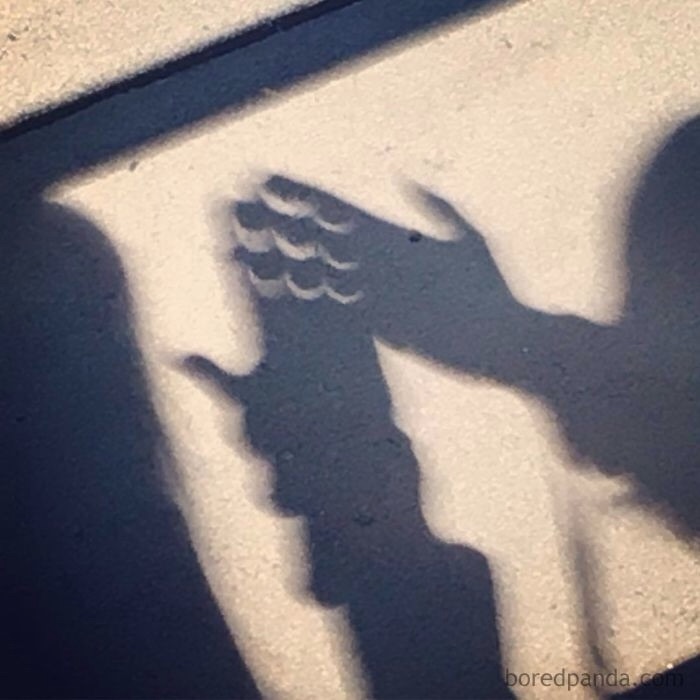
Eclipse as seen through the hands

I drove over four hundred miles to Kentucky in 2017 for the prior Great American Eclipse and got to stay home to see this second Great American Eclipse in my own front yard. Some folks couldn’t have been bothered about this current grand event, while others were convinced God was informing America of her impending doom. Moreover, multiple conspiracy theories abounded, none of which came true, of course. For instance, the world didn’t come to an end and our cell phones still work. Even the electric grid held up, even though the sun didn’t shine for all of a few minutes as the shadow traveled at over 1,600 miles per hour as it raced along the path of totality. This wasn’t even Y2K, which we all remember was a nonstarter at least and a dud at best.

Eclipse over Niagara Falls, 2024

In art class Friday Tim and I talked about the experience of this celestial event. We humans often elevate our own importance when we measure ourselves against one another and the works of our hands. When we go out into nature, we’re faced with the grandeur of God’s creation, especially when we visit the Grand Canyon or Niagara Falls. In Psalms 19:1, we read:

The heavens are telling the glory of God; and the firmament proclaims his handiwork.”

We see the beauty of nature and feel a warmth in our hearts. Our spirits soar. This intimacy with nature is one of the reasons we send our children to our United Methodist Church Camps, not just because they’ll have a great Christian experience, but because they’ll have that faith experience in nature with trusted leaders. I still remember my adventures and experiences in nature at those camps as part of my spiritual journey.

Towering Cumulus Clouds

Even in seminary, when I was having difficulty with some of my courses, I could go for a walk on the campus under the tree lined walks and search the skies for hopeful signs. Sometimes I saw the towering cumulus clouds in the Texas sky as a sign God was with me “in the cloud by day.” In those times of difficulty, even the cloistered realm of preparation seemed like a wilderness journey, but I was glad for a guide.

Bill Maxey, from Nebraska, taken at Hot Springs, AR.

When I was actively serving as a pastor, sometimes I just had to get away. I’d drive until I found some nature, a national park, national forest, or some fields outside of town. If it was a hot summer, I looked for some deep woods and cool shade to shelter me. In the cool spring, I drove until I found flowers. Maybe this is why I retired to a lake in a national park. I don’t need a big house, since I’d rather go out into nature instead.

Totality on Lake Hamilton, with sunset in the west, outside the path of totality

It was the heat of summer in 2017, so you’d think I’d remember the temperature drop right before the eclipse was halfway through. This year I was on Lake Hamilton, and the breeze off the lake combined with the cooler air was decidedly noticeable. When we entered totality, the lights on the Highway 70 bridge and at Bubba Brews automatically came on. The distant sky in the southwest, outside the path of totality, looked like a summer sunset. My neighbors and our visitors from afar were cheering.

Bill Maxey: multiple exposure of the Great American Eclipse, 2024

Not everyone can make an artwork that expresses their emotions as well as the shapes of the image. We can learn the rules of perspective and color, but then we have to learn to let our heart rule our head. This is what I call an “artistic leap of faith.” When we were young, we accepted the basic ideas of Christianity. As we got older, life happened, and we might have begun to struggle with our childhood beliefs not being equal to our adult needs. If we keep our childlike faith, we risk losing our faith. If we are able to wrestle with our faith and find a new and more mature faith, we can handle the major challenges of later life. As Paul says in 1 Corinthians 13:11-12—

“When I was a child, I spoke like a child, I thought like a child, I reasoned like a child; when I became an adult, I put an end to childish ways. For now we see in a mirror, dimly, but then we will see face to face. Now I know only in part; then I will know fully, even as I have been fully known.”

Tim’s Partial Eclipse painting using red, blue and brown to build the sky

Tim experimented with mixing colors to get richer depth. Using the Prang watercolor palette, he mixed the red, blue, and brown to get the black sky of the eclipse event. The red orange of the sun has some brown in it too. He layered the colors with multiple strokes, with a nod to Van Gogh. He worked from a photograph I brought. I pulled many of them off the internet, and many of my friends sent me some too.

Cornelia: Total Eclipse of the Sun

I worked on an image I’d taken from my iPhone. I had placed one of my eclipse glasses over the lens and was wearing another pair. It wasn’t that easy to get the sun lined up with all that blocking! My image looked a lot like a fried egg or an eyeball. I used several jar lids to get the circles painted cleanly. My dark sky is red, blue, and violet. The shape of the corona was not distinct, due to the quality of my camera. NASA has a very high-resolution image, which breath taking. Our tax dollars at work are bringing great scientific research and development to benefit us in everyday life, such as solar panels and heart implants.

NASA: High Resolution Image of the Total Eclipse

Thomas Merton, in No Man is an Island, in a chapter called “Being and Doing,” wrote—

“We cannot be happy if we expect to live all the time at the highest peak of intensity. Happiness is not a matter of intensity but of balance and order and rhythm and harmony. Music is pleasing not only because of the sound but because of the silence that is in it: without the alternation of sound and silence there would be no rhythm.”

I was a bit exhausted after all the excitement of this big event. I’d met new people from three different states, visited around our patio, and been gifted crystals that had been dug from Mt. Ida and “energized by the eclipse.” I’m not a crystal person, but I understand from those that are these crystals are “special.” I was feeling every bit of my new age as the calendar flipped over for another year.

Bourbon Codex: Aztec priestly document recording astronomical observations: eclipse

But today is another day, I had a night to sleep, and we had fun in art class. As long as we find joy in life, we know we’re alive. Our joys aren’t just collections of peak experiences, but some are the joy of the assurance of God’s enduring presence in our later lives when our youthful vigor has left us. We need to remember just as the moon eclipses the sun, once it passes, it also reveals the sun’s glory. One day this Bible verse from Philippians 3:21 will be true for each one of us, who has a heart full of love for God and neighbor:

“He will transform our humble bodies that they may be conformed to his glorious body, by the power that also enables him to make all things subject to himself.”

Joy and peace,

Cornelia


Bonnie Tyler – Total Eclipse Of The Heart Lyrics | AZLyrics.com

https://www.azlyrics.com/lyrics/bonnietyler/totaleclipseoftheheart.html

John Wesley: Explanatory Notes on the New Testament (With Active Table of Contents) [Kindle Edition], first published 1757

John Wesley: Wesley’s Notes on the Bible – Christian Classics Ethereal Library—online free edition of this book

https://ccel.org/ccel/wesley/notes/notes.toc.html

The Solar Eclipse Is the Super Bowl for Conspiracists | WIRED

https://www.wired.com/story/solar-eclipse-conspiracies/

Solar Eclipse 2017: Sun and moon put on celestial performance – CBS News

https://www.cbsnews.com/news/2017-eclipse-dazzles-million-watch-celestial-performance-sun-moon/

Thomas Merton—“No Man is an Island” in a chapter called “Being and Doing” [TMHI]: 1955

 A Woman in Eclipse: Maria Mitchell and the Great Solar Expedition of 1878

https://undark.org/2017/08/17/wilo-maria-mitchell-astronomer-eclipse/

NASA: Benefits Stemming from Space Exploration

https://www.nasa.gov/wp-content/uploads/2015/01/benefits-stemming-from-space-exploration-2013-tagged.pdf?emrc=ca90d1#:~:text=Overcoming%20the%20challenges%20of%20working,information%20technology%2C%20and%20industrial%20productivity


Time Travel and Iconography Experiments

adult learning, art, Creativity, Faith, Hagia Sophia, Holy Spirit, hope, Icons, Imagination, inspiration, Leonardo da Vinci, Medical care, Painting, Pantocrator, renewal, Spirituality, Turkey, vision

Every once in a while, I like to go on journeys. Sometimes they’re actual trips, such as my recent vacation over spring break to visit family down in Texas, but other times I like to “time travel.” The best way to time travel today, since I don’t have access to a DeLorean, is to study history. Buckle your seatbelts, we’re in for a ride through Christian and art history.

Right before spring break, our art class tried some experimental techniques with chalk, watercolor pencils, and pan watercolor with brushes. I also brought some images from the beautiful church of Hagia Sophia of the ancient capital of Constantinople, which I brought home from a pilgrimage I made several years ago.

The church was sponsored by the first Christian emperor Constantine, so it has exceptional mosaics and frescoes decorating all its surfaces. We each chose an image to use as a starting off place and went from there. Inspiration comes not only from what we see, but from the materials we use. Combining new images with new materials can bring new directions.

Desis Icon, Hagia Sophia, Constantinople, Turkey

Our primary images were the archangel Michael, the enthroned Christ, the decorative jewel designs, and the cross. All of these designs figure in prominence in Hagia Sophia or the Basilica of Holy Wisdom, the primary seat of Christianity in the Eastern Church during the Byzantine era.

Unknown Artist: Moschophoros, The Calf Bearer, 165 cm high, Limestone, 570-560 BCE, Acropolis Museum, Athens, Greece.

Early Christian art took its themes from contemporary Greco-Roman subject matter, but repurposed it for its own religious significance.


The Good Shepherd, the Catacomb of Priscilla, Rome, Italy, 250–300 CE, adopts the standard form of Apollo statues.

The archangel Michael was connected in the 4th CE with Constantine as a divine messenger and intermediary between heaven and earth. Michael was not only the guardian angel of the nation of Israel, but other nations have adopted his protection also. In this same century one of the doctors of the early church, St. Basil of Caesarea, known as “the Great,” said:

“Beside each believer stands an angel as protector and shepherd, leading him to life.”

Constantine felt the presence of the mediating angelic hand in his vision of the cross in the sky at the Milvian Bridge, at his baptism, and in his role as Emperor of the Eastern Christian Empire. Constantine was actually baptized twice: once to cure him from leprosy and again on his death bed. In the early days of Christianity, various sects prevailed and the doctrine of one baptism as sufficient for all times hadn’t yet taken hold. After all, it’s not the water, the place, the church, the location, or the priest that makes a baptism effective, but the work of God through the Holy Spirit. As Ephesians 4:4-6 says,

“There is one body and one Spirit, just as you were called to the one hope of your calling, one Lord, one faith, one baptism, one God and Father of all, who is above all and through all and in all.”

Constantine’s Vision of the Cross: Bibliothèque nationale de France, Illustrated painted parchment Greek manuscript (879-883 AD) of the homilies of Gregory of Nazianzus in the Bibliothèque nationale de France.
(BnF MS grec 510) folio 440r.
https://gallica.bnf.fr/ark:/12148/btv1b84522082/f891

Constantine’s first cross apparition took place at the beginning of his military campaign in Italy. The young emperor realized that the tyrant Maxentius, who controlled Rome at that time, had set a trap at the Milvian Bridge over the Tiber. Fearing his rival’s machinations, Constantine had sought the aid of the God worshiped by his father, Constantius Chlorus (r. 305–6). While he marched on to a field together with his troops, he saw the sign of the cross revealed in the afternoon sky, shinning brighter that the sun, alongside an exhortation inscribed “by means of a starry form: By this you shall conquer, Constantine!”

Mike’s Cross Painting

Note the use of common materials in Mike’s work. The circle is the same size as a foam plate, the cross from the table decorations fits just inside it, and he embellished the outer and inner spaces with a bilateral and balanced design. He’s getting more skilled to “eyeball those proportions” from across the room. Plus, he enjoys making these designs.

The ancient writers Eusebius and Euthymios both mention the emperor’s troops also witnessed this miracle. The significance of the vision was subsequently clarified by Christ, who appeared to Constantine in a dream advising him to carry a cross-shaped banner before his armies in order to defeat Maxentius.

Byzantine hagiographical works, or the writings about the lives of saints, name this apparition of the cross as a decisive step toward Constantine’s conversion to Christianity. This first episode is part of a faith narrative, which runs through the tale of Constantine’s leprosy and his miraculous healing through his first baptism, which was officiated by Pope Silvester.

The depiction of Pope Sylvester in the church decoration, a leading figure in the iconography of Roman popes in Byzantine art, deserves special comment. Sylvester was born in Rome and was pope between 314 and 335, succeeding pope Miltiades. Both the Latin and Orthodox rites honor Silvester as a saint and the patriarchate of Constantinople commemorates him on 2 January. The fictional account of his life, Actus Silvestri, written in the 4th-5th century, records the story of his curing Constantine of leprosy and then baptizing him.

Baptism of Constantine

It was during this first baptism Constantine had another vision which converted him to Christ. Constantine’s baptism is narrated in the Greek Life of Silvester in a verbatim translation of the story by Zonaras. Having recovered his health by means of the sacramental bath, the now Christian basileus (king) donned a bright garment and “said to the bystanders that he had felt a hand: It had stretched out from above and touched me while I was descending into the font.”

Baptism of Constantine

The visualization of St. Michael’s involvement in Constantine’s baptism has no direct precedent in Byzantine and Balkan iconography. Similar descriptions appear in the shorter ninth-century vita of the hierarch and in the lives of Constantine. In the “Guidi” legend, the emperor’s confession is specifically addressed to the pope: “Servant of God, as I was standing in [the water] of the holy baptism, I felt a hand touching me and cleaning the sickness of the flesh.”

Unlike the hagiographical account by Zonaras, this fragment from the “Guidi” vita is not attested in the manuscript culture of the East-Carpathian environment. Even if it doesn’t include this passage in the section on Constantine’s baptism, the encomium (eulogy) by Patriarch Euthymios contains an allusion to the motif of God’s hand:

Upon waking up from the dream in which SS Peter and Paul offered him the cure of baptism, the emperor dismissed the pagan healer ( ) who attended him and said that: “(…) from now on, I need no human help, for the hand of God Almighty ( ) helped me.” Although it anticipates the king’s baptism, this statement is merely a symbolic reference to the divine power which came to Constantine’s aid, not a description of a miracle occurring during the ceremony.

The Slavonic translation of the Life of Silvester by Zonaras remains the only account that constitutes a plausible narrative background for St. Michael’s involvement in the scenes at the Romanian churches of Rădăuți and Bălinești. We don’t know if these fresco designers used a specific copy somehow related to the manuscript at the Neamț monastery. Yet once it had been integrated into the liturgy, the legend of Pope Silvester might have developed an independent circulation through storytelling. Perhaps the local audience interpreted Constantine’s confession about the divine hand that touched him in the water as a sign of the ethereal presence of the Archangel as pictured in the compositions of Constantine’s baptism.

Creation: The Nuremberg Chronicles (1493), written by Hartmann Schedel and illustrated with woodcuts by Michael Wolgemut

Perhaps these tales seem strange to our modern scientific minds, colored as we are by notions of “pictures, or it didn’t happen!” We want proof, repeatable and documented evidence, not just some such nonsensical woo-woo about visions and dreams. After all, we are more likely to think these voices could be drug induced or anxiety provoked, but we aren’t so familiar with God speaking to mortals, as it was back in the days when the boy Samuel was ministering to the LORD under Eli:

“The word of the LORD was rare in those days;
visions were not widespread.” (1 Samuel 3:1)

We aren’t big on either voices or angels, but God does still work in supernatural ways. While some may see prayer as supernatural healing, others may see God’s healing hand at work in guiding doctors, nurses, and caregivers to bring people to get the medical attention that brings them to better health. God gives us the heart for healing and compassion for the suffering, which then sets us out to discover new medicines and treatments for dread diseases. These wonderful advances would appear as magic to those from a century ago, or even a few decades before.

Take the miracle of cystic fibrosis advances. In the 1980’s, the life expectancy for a CF patient in the United States was only 12 years and 20 years in Canada. By 2017, with new medications and therapies, the median life expectancy for CF patients was 47. Because new medications and improved treatment of respiratory infections and other complications have extended the predicted life expectancy of CF patients to almost 50 years, some are now living well into their sixth and seventh decades. I call this a miracle, even if others call it mere “science.” It means I have a grand nephew who likely will have a full lifetime and even enjoy his own children.

Humanists will give all the glory to the human creature. They are self-made men and women in love with their own creation. People of faith will give all the glory to God for the gifts of their hearts, minds, bodies, and spirits. We have been given much, so we give much to others.

Nike of Samothrace

Just as the earliest Christian art works repurposed secular and mythological Roman themes, so later Christian art used Greco-Roman mythological imagery. The angels are based on the female winged victories, such as the famous Nike of Samothrace. In the early fourth century, angels suddenly appeared as figures in Christian iconography, usually without feet and dressed in garments of a white pallium over a tunic. This was a large rectangular cloak worn over a tunic, as worn by Greek philosophers and religious teachers. In the earliest Christian art works, angels were depicted as wingless, but wings became normative by the fifth century. By the High Middle Ages, angels were more elegantly garbed (depending on their station in the hierarchies) and appeared to be androgynous.

The first known Christian depiction of winged angels does not appear until this splendid 4th century marble ‘Prince’s Sarcophagus’. It was discovered after a fire in Sariguzel, near Istanbul in the 1930s

The word for Angel, mal’akh in Hebrew and angelos in Greek, simply means messenger, which is the job description of the Angel, who acts as an intermediary between humans and God. The Bible never says angels have wings, but we all imagine angels with wings. Perhaps we assign them wings because angels can travel from the “heavens above to the earth below.”

Egypt’s Red Monastery, The church of Anba Bishay and Anba Bigol

The church of Anba Bishai and Anba Bigol, known as the Red Monastery, is the most important extant early Christian monument in Egypt’s Nile Valley. It’s one of the most significant historical sites of the period in the Mediterranean region. Created in the 4th and 5th CE, this fine painted Coptic Christian image of Christ surrounded by angels has survived multiple restorations of the church building.

Leonardo da Vinci: Annunciation, 1472, oil on canvas, Uffizi Gallery, Florence, Italy.

Although the principle of angels being sexless continued, later renaissance artists presented them as male figures with fashionably delicate facial features and long hair, dressed in contemporary garments (making them more approachable to the common era). As the lines between the angelic spheres became blurred, along with the renaissance adaptation of classical Greco-Roman art, plump little children with wings began showing up in Christian art. We know these as cherubs.

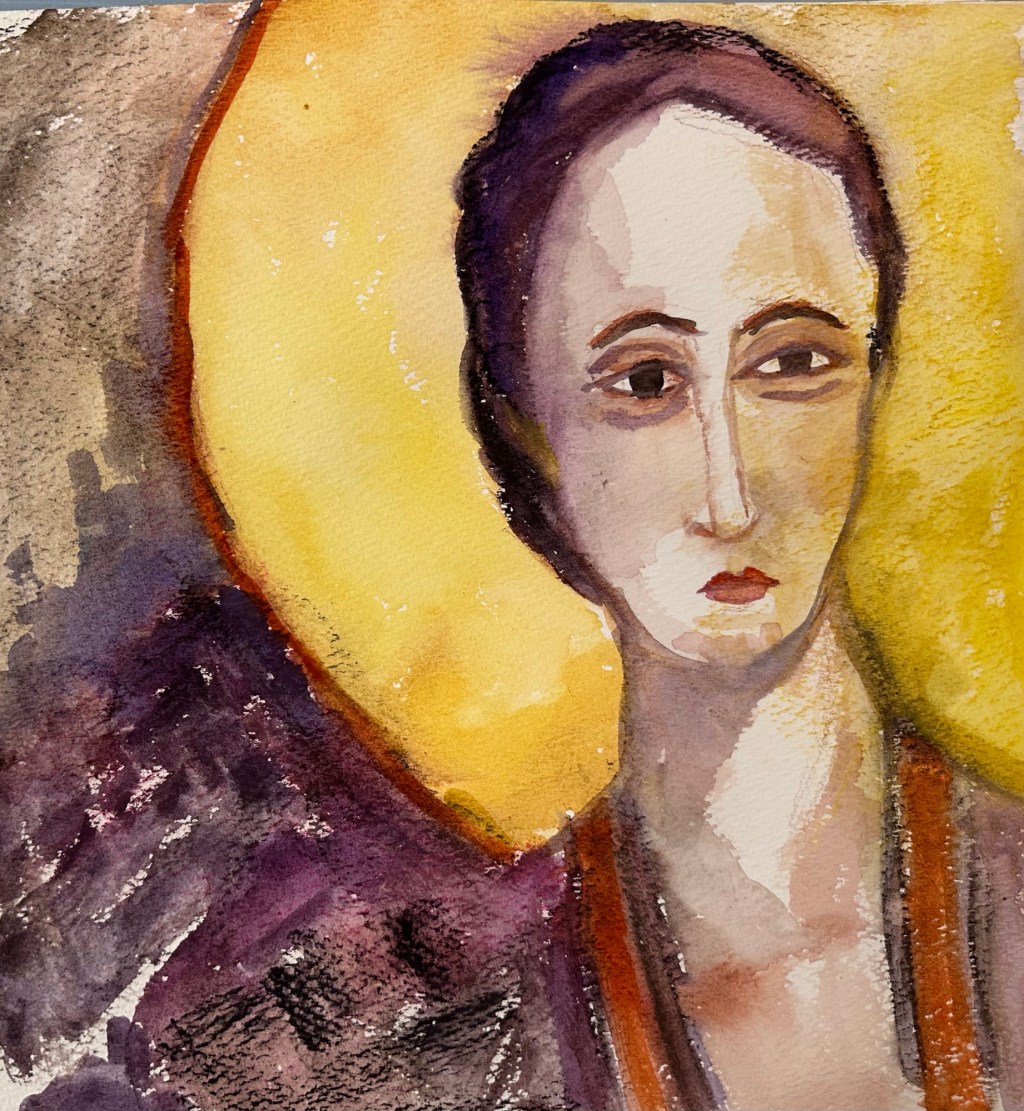
Cornelia’s Watercolor Angel from Hagia Sophia

I used a mix of pastels and watercolor on this painting, working from a 1.5-inch square image of the Archangel Michael. The contrast of light and dark shows up in the naturalist wings and hair, with the glowing and reflective gold mosaic pieces.

Angel from Hagia Sophia

Regarding his rank in the celestial hierarchy, opinions vary. St. Basil in his homily Angels, as well as other fathers, place St. Michael over all the angels. They say he is called “Archangel” because he is the prince of the other angels. Christian tradition gives St. Michael four offices:

  1. To fight against Satan.
  2. To rescue the souls of the faithful, from the power of the enemy, especially at the hour of death.
  3. To be the champion of God’s people, the Jews in the Old Law, the Christians in the New Testament.
  4. Therefore, he was the patron Saint of the Church; he is considered to be the protector of Christians against the devil.
Christ between St. Peter and St. Paul, Catacomb of Sts. Marcellinus and Peter on the Via Labicana, Rome, 4th CE.

This image of Christ on the Throne, dating to the 4th century, shows Michael between St. Peter and St. Paul. It was painted in the Catacomb of Sts. Marcellinus and Peter on the Via Labicana in Rome, located near a villa that used to belong to Emperor Constantine. Below the main figures of the painting—Jesus, Peter and Paul—we find Gorgonius, Peter, Marcellinus, and Tiburtius, four martyrs who had been buried in that catacomb, and are depicted as they point to the Lamb of God on his heavenly altar.

Zeus: Archaeological Park of Campi Flegrei at the Castle of Baiae on the Gulf of Naples, Italy


The enthroned Christ follows the thematic form of Zeus, king of the gods, seated on his throne. A good example is statue from the Archaeological Park of Campi Flegrei at the Castle of Baiae on the Gulf of Naples. This statue of Zeus Enthroned is a 29-inch-high marble statue dating to the 1st century B.C. and is likely of Greek manufacture.

It was inspired by the colossal gold and ivory statue of the god at the temple of Zeus at Olympia made by sculptor Pheidias in 430 B.C. It was one of the Seven Wonders of the ancient world. Just as the angels were repurposed from the Nike victory statues, so the Christ Enthroned statues were re-envisioned from the ruler of the gods and humans statues. Art and artists can be put to work for whoever is in power at the moment. We need to eat and pay bills in every age.

Zeus: fresco, 62-79 CE, Casa dei Dioscuri, Pompeii (VI, 9, 6-7, atrio corinzio 37), Museo Archeologico Nationial, Italy.

A lovely fresco from Pompeii, found in the House of the twins, has a glowing red background and shows Jupiter or Zeus, the king of the gods, seated on his throne. A sphere lies beside him, an eagle at his feet, and a rectangular base is at his feet. In the same manner, the icon of the enthroned Christ places his feet on a rectangular base, representing his lordship over the four corners of the world.Gail W used the pastels in the clothing and background.

Gail W’s Enthroned Christ watercolor


From one of the royal figures, Gail S chose one of the jeweled embellishments for her focus. Gail enjoys ordered designs, so finding an image with a regular pattern was right up her alley. The outer circle with an inner square is divided along the diagonals by red lines, as if the cross were tilted on its side. The circle and square give unity to the design, as does the monochrome cross. The triangles are balanced by colors. The outer blue rim holds it all together. Gail tried the watercolor pencils out along with the pan watercolor washes.

Gail S inspiration and creation

While nothing is ever new in art, we artists keep reimagining the old patterns in new ways. After all, the basic elements of design never change, but we see the world with fresh eyes in every generation. Using our hands to create restores us and recreates us by reducing our anxieties and giving us a sense of accomplishment. We each serve the God of beauty and joy as God reveals God’s self to each of us. Doing any creative work with our hands is good for the mind, spirit and soul.

As our hand grows in competency with the media and our eye is better able to discern shape and patterns, we come under the Holy Spirit’s inspiration of creating power and we make art! We may start from the ancient wisdom, but then we go onto find the wisdom for today. After all, God is always in a rebuilding mode, for that which God created, God will preserve:


“When you send forth your spirit, they are created;
and you renew the face of the ground.” ~~ Psalms 104:30

Joy and Peace,

Cornelia

Diane Apostolos-Cappadocia : Why Ukraine Calls Upon Michael the Archangel, Christianity Today, April 12, 2022, https://www.christianitytoday.com/ct/2022/april-web-only/michael-archangel-ukraine-kyiv-patron-saint.html

Saint Mamas at Exeles: An Unusual Case of Ritual Piety on Karpathos
Katsioti, Angeliki; Mastrochristos, Nikolaos.  Arts; Basel Vol. 12, Iss. 4, (2023): 176. DOI:10.3390/arts12040176
Saint Mamas at Exeles: An Unusual Case of Ritual – ProQuest https://www.proquest.com/docview/2856776246?sourcetype=Scholarly%20Journals

The Historical Evolution of CF Treatments and Understanding
https://cysticfibrosisnewstoday.com/news/cf-treatments/

Life Expectancy with Cystic Fibrosis (CF)
https://www.nationaljewish.org/conditions/cystic-fibrosis-cf/life-expectancy

ARCHANGELS MICHAEL AND GABRIEL
https://www.stjohnarmenianchurch.org/archangels-michael-and-gabriel/

Archangel Michael
https://www.etd.ceu.edu/2023/dumitrescu_andrei.pdf

Art for the Inner Child

adult learning, Apocalypse, art, Christmas, Creativity, Enneagram, Faith, Holy Spirit, hope, Imagination, inspiration, Light of the World, Ministry, Painting, perfection, purpose, salvation, Spirituality, vision

Discovery is exciting

What is the purpose of an art class? Why does anyone learn to speak a foreign language or take up a craft or sport they’ve never attempted before? We must want to explore some unknown universe or get out of our comfort zone, or as my old favorite television series would announce weekly, “to boldly go where no one has gone before.”

Light of the World Icon: Stencil effect

There are art classes and then there are Art Classes. Just as we shouldn’t make up our minds about a subject or a food until we experience it directly, we can have an open mind about a novel event, rather than rejecting it out of hand. Many of us have lived our lives under judgmental circumstances, dealing with rejection and disappointment at not being the best. “Talladega Nights: The Ballad of Ricky Bobby,” the NASCAR themed film of redemption and finding one’s purpose in life, stars Will Ferrell, whose father crippled him with this tragic life message:

“If you ain’t first, you’re last. You know, you know what I’m talking about?”

Near the end of the movie, Ricky Bobby learns this all was just crazy talk:

Ricky Bobby: Wait, Dad. Don’t you remember the time you told me “If you ain’t first, you’re last”?
Reese Bobby: Huh? What are you talking about, Son?
Ricky Bobby: That day at school.
Reese Bobby: Oh hell, Son, I was high that day. That doesn’t make any sense at all, you can be second, third, fourth… hell you can even be fifth.
Ricky Bobby: What? I’ve lived my whole life by that!

According to Baseball Reference, Ruth’s 183.1 career WAR — combining his value as a hitter and pitcher — is the highest all time, well ahead of Walter Johnson’s 164.8. For reference, the highest mark among active players is Albert Pujols’ 99.6 WAR.

We call this living out a “bad script” our ancestors have written for us. We see it all the time in the movies and on television. We read about it in novels and in comic books. For the most part, people don’t change their wicked ways, but get the consequences they’re due. The bad suffer and the good prosper. Or we read fairy tales in which the good little children get rewarded, or the unjustly treated ones are raised up, like Cinderella. These are the popular stories, but not the biblical tales. The book of Job calls this “retribution theology” into question, as does Jesus in the New Testament.

Annie French (1872 – 1965) Scottish: Cinderella and the Ugly Sisters, About 1900 – 1910, Pen and ink, watercolour and gold paint on vellum paper, 23.50 x 21.50 cm, Scottish National Gallery of Art.

In the Bible, God sends prophets, not only to call the people to account (critique their actions or behavior), but to offer the hope of a better future if they return to God and God’s ways (positive changes in behavior). In this way, a good art teacher is like a biblical prophet, who offers both positive and negative critique on the artwork. The teacher also offers “hope” or suggestions on how to improve the work. Teachers aren’t telling the person they don’t measure up, only that they need more time invested in making art to be able to bring their own artistic vision into reality.

Mike on Being the Light in the World

If we expected babies to chew steak from the moment of birth, the world would be a lonely place. If we expected these same babies to get up right away and “bring home the bacon” to buy their own steak and potatoes, they’d starve. Babies aren’t meant to walk before they crawl, nor or they chewing meat before they drink milk or pablum for a year or two.

Bacon Cake: Oh, Baby! I hope that’s REAL BACON!!

Someone who comes to art class should always come to learn something more, no matter how much they already know. I’m always learning new ideas and techniques. The act of making art is always an act of exploring new territories. We also grow by sharpening one another. Folks in the class are always excited to see how each other approaches the subject each week.

Mike’s May 2022 class work shows he’s been learning some things.

Only the apocalyptic writers in Scripture had a fixed view of the future. For them, God had given up on humanity. We humans were too far gone, too broken, and had destroyed God’s world beyond our weak means to repair it. Their only hope was for God to create “a new heaven and a new earth, for the first heaven and the first earth had passed away, and the sea was no more.” (Revelation 21:1)

Gail went the extra mile with Cri-Cut lettering

Of course, this isn’t a prediction of a certain time, but it’s a future hope for all times. It’s the hope all we creative people have every time we face a blank canvas, a pile of found objects, or a bag of scrap cloths. We also do this when we pull together a dinner before we go to the grocery store, and we take some of this and that which we have in our cupboards and refrigerators. We’re going to make something new! We do hope the Spirit of God descends to make this an inspired concoction! And if it doesn’t work out, we always know our salvation isn’t at stake over a single random supper creation. If I’m hungry enough, I’ll eat anything. Or there’s always peanut butter and jelly sandwiches.

Leftover Doughnuts and Sausage Bread Pudding Bunt Cakes

I was reading Richard Rohr’s Enneagram commentary on the American people. He says America is a nation of Threes: competitive, striving, always looking for success and improvement. When we hit a down cycle, and economics tells us we always have ups and downs in our economy, Americans act like we’ve been insulted. This doesn’t happen to us—to others maybe—but not to us! We’ll look both for a scapegoat and a savior, but never realize these conditions are a natural part of life.

Always be the best YOU. There’s never going to be another one just like YOU.

Likewise in groups, we’re always judging who got more, who has the most status, who’s preferred, and who’s on the out. We’re even liable to self-select to be on the outer group if we believe we won’t measure up, just to spare ourselves the shame of being found wanting. Joyce Rupp has a great poem about this very topic:

WE CAN LOVE THE IMPERFECT SELF
If I wait to be perfect
before I love myself
I will always be
unsatisfied
and ungrateful.

if I wait until
all the flaws, chips,
and cracks disappear
I will be the cup
that stands on the shelf
and is never used.

Magic Teacup Cake from Alice in Wonderland

If we’re faithful scripture readers, we know God never chooses the best persons to do God’s work. When we were children, we saw these characters as heroic figures, just as we saw our parents as great and invincible. The Old Testament records how Moses was a murderer, Joshua was afraid, Amos was a lowly shepherd, and David was an adulterer. Not exactly Perfect Role Models, but transformed people can do God’s mighty deeds if they let God work God’s purpose through their lives.

This word doesn’t mean what the headline writer thinks it does.

In Art Class, we don’t reject “poor work.” We aren’t a factory producing widgets. We have other goals: art appreciation, learning about colors, learning to see more clearly, developing a creative mind, and developing drawing skills. Art is a unique visual language, so learning how to render a three-dimensional form onto a two-dimensional surface takes some time and practice. Developing our own voice is the step beyond mastering the basics of artistic vocabulary. As I used to tell my parents at back-to-school night, just enjoy whatever your child brings to you! If you leave your “critical parent” at home, and bring your “inner child” to Art Class, life is way more fun!

Mike’s Christmas Card Collage

We’re currently on holiday sabbatical at Oaklawn UMC, but classes will return in the new year. We meet in the old Fellowship Hall at 10 am to noon. We always have coffee, and on occasional days, a tasty treat. Our class will begin working in watercolor beginning on January 5, 2024. I don’t charge for the class instruction, but each person should bring their own supplies. Supplies needed are:

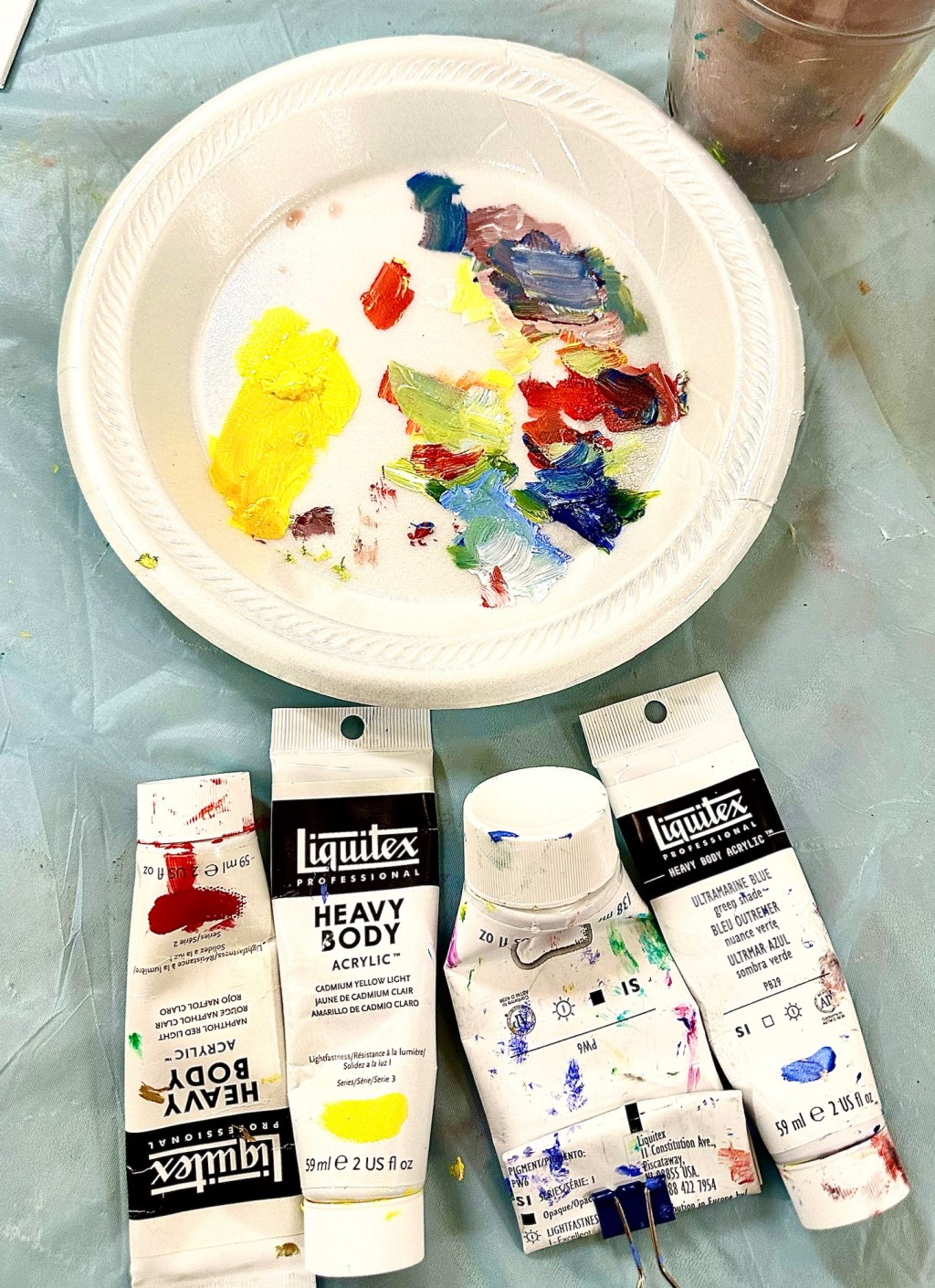
Prang Oval 8 watercolor paint set with brush
  1. Prang Oval 8 watercolor paint set (containing brush)—on line at Walmart and Amazon. This has best color and pigments. I found a prime deal on Amazon for $3 each if you buy 3, free shipping.
  2. Watercolor paper pad 9” x 12” or larger (90 lb or heavier)
  3. Tall plastic container for water (iced tea glass size plus)
  4. Your inner child

Joy and peace,

Cornelia

MERRY CHRISTMAS, PEACE ON EARTH, GOOD WILL TO ALL

Talladega Nights: The Ballad of Ricky Bobby https://www.imdb.com/title/tt0415306/quotes/?item=qt0425224

Babe Ruth’s Top 10 career statistics— Shohei Ohtani produced 9.1 total WAR during his spectacular two-way campaign in 2021. Even he maintained that level of performance for 20 consecutive seasons, he would still be 1.1 WAR short of matching Ruth. https://www.mlb.com/news/babe-ruth-s-top-10-career-statistics-c163792958

Rabbit! Rabbit! Welcome to December 2023

Apocalypse, architecture, art, Bethlehem, Christmas, Civil War, Faith, Family, Healing, holidays, Holy Spirit, hope, inspiration, Israel, Light of the World, Love, Ministry, poverty, rabbits, shame, Spirituality, Stress, trees

Bunny in Bed

“Gloom begets gloom,” my daddy always said, “so if you wake up on the wrong side of the bed, it’s best to go back and get out on the other side.” Some folks today don’t have much of the Christmas or holiday spirit, for they’re only looking at the dark side of world events or at the shrinking purchasing power of their dollar.

Unemployed people sold apples on the street corner in the Great Depression

Since the Civil War, the United States has endured thirteen depressions or recessions large enough to get noticed by those who study such things (see list below). This is an average of one about every dozen years. Of course, those of us who experience these events don’t have to study them, for we directly participate in the event. As the old saying goes, “If my neighbor loses his job, it’s a recession, but if I lose my job, we’re in a depression.” Instead, we plan for them and expect the good times won’t last forever.

Because we human beings are wont to think “our situation is unique,” we’re also great at forgetting the lessons of history. The first lesson is life is cyclical and what goes up will come down. The second lesson is what goes down will eventually go back up. My long experience suggests when folks are in the “down cycle,” they forget upward progress is possible. In college we used to joke, “been down so long, it looks like up to me!”

It’s always darkest before the dawn.

Some say recessions are “necessary” in economic cycles to remove excess, reprice assets, and tame risky behavior. None of these negative factors would exist except for human greed. When Mary and Joseph went to Bethlehem to register for the census, they were also enrolling for the purpose of taxation. The Romans practiced tax farming in their provinces. Whoever had the account had to raise a certain amount for the empire, but could keep whatever excess they raised for themselves. Excessive taxation on the conquered land and people stoked their hopes for a messiah to rid them of this evil. No wonder the signs and wonders attending the birth of Jesus were fulfilling the ancient prophecies, as Matthew wrote (2:6):

‘And you, Bethlehem, in the land of Judah,
are by no means least among the rulers of Judah;
for from you shall come a ruler
who is to shepherd my people Israel.’

Church of the Nativity, Bethlehem. Star over the Grotto

In the times of darkness, we always look to the light as a reason to hope. As the magi saw a star rising in the east and believed an important person would arise in the land of Israel, we today look for glimmers of light to give us hope for the day to come. Some people see the wars, earthquakes, and crookedness of people and think we’re entering the end times. Churches and radio preachers are making hay with the Book of Revelation, forgetting it was a specific book written for a unique audience and time. We have been in the “end times” since Christ arose from the dead. As Matthew (28:20) records his words to the disciples in Galilee:

“And remember, I am with you always, to the end of the age.”

Since we’re always with Christ, we will always have his light, as Zechariah prophesied in Luke 1:78-79–

“By the tender mercy of our God,
the dawn from on high will break upon us,
to give light to those who sit in darkness and in the shadow of death,
to guide our feet into the way of peace.”

The famous Banksy’s Armored Dove of Peace, the painting of a peace dove wearing a flak jacket. The dove is painted on a wall near the separation wall between Bethlehem (Palestinian Territories) and Israel. Nov. 18, 2023.

In the midst of wars in the Ukraine and in Gaza, where people are suffering and dying, we can lose sight of the vision of light and peace, while we focus on darkness and death. The Christian community in Palestine, which usually hosts hordes of Christmas pilgrims in Bethlehem Square, won’t be celebrating this holy season this year in solidarity with Palestinians in Gaza. Instead, they’ll set up a small nativity scene covered with rubble. It’s a reminder when the Christ child came into a suffering world over two thousand years ago, his birth was a hope for the oppressed and the poor. Every Christmas we have the opportunity to care for those who struggle to make ends meet.

Great Depression family at mealtime

In the Great Depression, families lost homes, farms, and lived in shantytowns called Hoovervilles. President Hoover spoke of a childhood Christmas memory:

“I do vividly recollect a Christmas upon that farm when the sole resources of joy were popcorn balls, sorghum, and hickory nuts; when for a flock of disappointed children there were no store toys, no store clothes; when it was carefully explained that because of the hard times everything must be saved for the mortgage. The word ‘mortgage’ became for me a dreaded and haunting fear from that day to this.”

1950’s Christmas Tree: we kids were Team Tinsel, but the folks were Team Ornaments. Our tree never looked like this!

I have some ancient memories of the cyclic hard times experienced by my family. I recall the late 50’s Eisenhower influenza recession dimly because it was the only time I ever saw my daddy cry. We had a brand-new Ford station wagon, but couldn’t afford to drive it except on Sundays. My dad brought money home daily from his office, so mother and we kids would walk to the local grocery to buy food the next day. He cried because he kept his office full of patients, but half of them couldn’t pay for his services. Mother was very practical and reminded him, “This too would pass. Trouble is only temporary.” In the fall, she took a schoolteacher position to help out. That Christmas we hand decorated sequins on felt shapes the “Twelve Days of Christmas” for a tree skirt. I passed this extravagance on to a nephew when I downsized my home.

We decorated the early days more than the later days. Time management wasn’t our best gift, but we had a great time doing this together.

I also remember the 1970’s economic slowdown very well. I got married during this time. After my husband and I bought our silver wedding rings, we had $16 left in our pocket. I was certain we had jumped off a height with no parachute, but we somehow managed day to day. To keep up “appearances,” we gave away some of our wedding gifts as Christmas gifts to other family members. I thought it was wrong, but now I realize I don’t care about those items today. I was more concerned about “saving face,” since someone might recognize we were regifting. We managed with food from our organic garden and meat from a deer my husband harvested in the autumn. But I no longer eat tuna casserole, having lost my taste for this staple of my poverty years. Gifts aren’t important, but people are.

The 1980’s had a slump related to the oil embargo. When oil money dries up, art teachers lose their jobs, as do all the other “frivolous employees” elsewhere. I got an insurance sales position, with a guaranteed six-week paycheck. I was amazed I had a talent for sales, but I was good at discovering needs and matching products to people’s ability to pay. My best sales close was, “If you’re not here to provide for your family, how will they be able to keep their current lifestyle?”

Having a simpler Christmas this year? Consider an alternative tree…

I lost my house to foreclosure during the 1990’s subprime mortgage crisis. I lost my credit cards and almost lost my daughter to suicide. I learned some things are more important than achievements or possessions. In the depths of the worst of times, gifts aren’t necessary. Being a light for others, helping others, giving yourself to those who need hope in these seemingly hopeless times is important. During this time, I drew hope from God’s words to Nathan in 2 Samuel 7:5-6—

“Go and tell my servant David: Thus says the LORD: Are you the one to build me a house to live in? I have not lived in a house since the day I brought up the people of Israel from Egypt to this day, but I have been moving about in a tent and a tabernacle.” I drew hope, for if God didn’t need a permanent home, but stayed with God’s people, then if I had no home title, God would still go with me wherever I laid my head.

Christmas Lights on Church Street

As a people, we always want to tie God to a place or to locate the Spirit to a site, but God is always bigger than our imagination and our attempts to circumscribe God’s existence. We want to restrict God’s love to a few, but God insists on loving those from whom we look away and exclude. In the midst of the chaos of my losses and suffering, I discovered God was calling me to the ministry.

Gislebertus: Flight into Egypt, 1120-1130, Stone Capitals at St Lazare, Autun, France.

Why does God call the least, the last, or the losers to God’s work? God wants to be glorified, not the person who does the work. God needs people who understand suffering and have been seasoned by it, rather than hardened by it. The wounded know the wounds of others, but they also know the path to healing. This is why we find the Christ child in a stable, not in a palace; and have shepherds and foreigners come to visit, but not his family or friends. It’s also why the Holy Family flees to Egypt as refugees to avoid Herod’s death sentence for the Jewish newborns. If we’re having a less than “perfect” holiday this year, perhaps we’re only having a bad hair day in comparison to the suffering of that first Christmas.

When I get to struggling, for the aches and pains of age are catching up to me, I can get in a low mood thinking, “I used to pop out of bed and do 12 things before lunch.” Now I need six cups of coffee to get my lunch going! Of course, I’m past my platinum anniversary and my hair color matches my age. On days like this, I look to Paul’s admonition in 1 Thessalonians 5:16-18, which rings across the ages as a clarion call:

Rejoice always, pray without ceasing, give thanks in all circumstances;
for this is the will of God in Christ Jesus for you.

I wish each and every one of you a Merry Christmas and a Wonderful New Year. I plan to take a sabbatical from my Rabbit-Rabbit series in 2024, since I’ve neglected my sci-fi blog and my pandemic project quilt needs stitching together. I’m going to work on my art more and write about the spiritual intersections of the creative life.

Merry Christmas and Happy New Year

Joy and Peace,
Cornelia

You can keep up with my other writing and thoughts:

SOULJOURNIES: sci-fi spiritual formation blog
https://souljournieswordpress.wordpress.com/author/artandicon/

ARTANDICON: blog on the intersection of art and faith
Www.Artandicon.com

CORNIE’S KITCHEN: blog on healthy eating and spirituality
http://www.cornieskitchen.wordpress.com

List of depressions and recessions since the Civil War:

  1. the Panic of 1873,
  2. the Great Depression when 13 million people were out of work,
  3. a recession after WWII,
  4. another after the Korean War,
  5. the Eisenhower influenza recession in 1957-58,
  6. a recession in the auto industry in 1960-61,
  7. and another year long recession in 1970-71 under Nixon.
  8. In 1973, OPEC quadrupled oil prices, and that shock along with the stock market crash sent the world economy into recession.
  9. In 1980, energy prices continued to rise, so when the Federal Reserve raised interest rates to curb rising prices, the economy contracted. Once again, unemployment rose to 11% and business output suffered.
  10. We had a recession in the Gulf War from 1990-91, and then maintained the longest period of economic growth in American history up until
  11. the Dot Com Bubble in 2001. The tech-heavy NASDAQ ended up losing nearly 77% of its value and took over 15 years to recover its losses. September 11, 2001 wasn’t a sunny day for the stock market or for America. Many people have had a pessimistic outlook on life from this date forward. It changed how we see ourselves.
  12. In 2008-2009 another recession hit hard, making it the longest economic downturn since World War II and the deepest prior to
  13. the following COVID-19 Recession of 2020. The former was triggered by the subprime mortgage market collapse, while the latter was the quickest and steepest of them all. While more than 24 million people lost their jobs in the US the first three weeks of April 2020, this shock was quickly ameliorated by government interventions, such as zero interest, income payments and other supplements.

Christmas During the First “Great Depression” – Hoover Heads
https://hoover.blogs.archives.gov/2020/12/16/christmas-during-the-first-great-depression/

Milestones: 1921–1936 – Office of the Historian
https://history.state.gov/milestones/1921-1936/great-depression#:~:text=The%20U.S.%20stock%20market%20crash,cause%20a%20global%20financial%20crisis.

Understanding America’s Labor Shortage | U.S. Chamber of Commerce
https://www.uschamber.com/workforce/understanding-americas-labor-shortage

Major Financial Crisis History
https://nationalarchives.nic.in/sites/default/files/new/Final_Major_Financial_Crisis-i_0.pdf

A Brief History of U.S. Recessions – Weatherly Asset Management
https://www.weatherlyassetmgt.com/a-brief-history-of-u-s-recessions/

How One of the World’s Biggest Ships Jammed the Suez Canal – The New York Times
https://www.nytimes.com/2021/07/17/world/middleeast/suez-canal-stuck-ship-ever-given.html

Megiddo: Marks and Memories

Altars, art, city, Creativity, Degas, Faith, Forgiveness, Healing, Holy Spirit, Israel, Megiddo, Monet, Painting, perfection, Prayer, risk, salvation, Spirituality, Travel, United Methodist Church, vision

Study for Megiddo Memories

My most recent studio work explores my memories of my pilgrimage to the ancient ruins of Tel Megiddo. Why am I interested enough to make an entire series of drawings and paintings of this site, which I visited over two decades ago? First, the city was continuously occupied from the 7th or 6th millennium BCE, with the ancient tel generally left untouched and intact since its decline and subsequent abandonment around the 4th century BCE. The tels at Megiddo, Hazor, and Beer Sheba all have retained their authenticity and each have acquired the characteristic conical shape with a flattish top, protruding above the surrounding countryside. These three tels are now UNESCO Heritage Sites.

Megiddo: Marks and Memories

Excavations at Tel Meggido have uncovered about 26 layers of settlements dating back to the Chalcolithic period, or the early Bronze Age, about 5,000 years ago. Other sources say 30 layers exist at Tel Megiddo. The first four layers have been identified. This site was a Canaanite city, an Egyptian fortress, a Chariot City during Biblical times, and a prominent Assyrian and Persian city. King Solomon ruled the city in its prime in the 10th century BCE.

Megiddo: First Recorded Battle in History

The city has seen more battles than any other location in the world because of its location at the crossroads of the ancient world. The first written reference to Megiddo also happens to be the first recorded battle in history: a detailed account of the 1479 B.C.E. invasion of the Egyptian Pharaoh Thutmose III. When King Thutmose III of Egypt conquered Megiddo 3,500 years ago, the pharaoh left with, among other things: 1,929 head of cattle, 2,000 goats, 20,500 sheep, 204 horses, 200 army uniforms, and 502 bows. Megiddo is also the first recorded use of the composite bow and the first body count. All details of the battle come from Egyptian sources — primarily the hieroglyphic writings on the Hall of Annals in the Temple of Amun-Re at Karnak, Thebes (now Luxor), by the military scribe Tjaneni. Megiddo is also the site of a large chariot stable complex, called Solomon’s Stables, even though we now know they were built by Solomon’s successor King Ahab during the 9th century B.C.E.

Megiddo: Blue Version, Motions and Moods

Fortress cities sit on the 10 acre summit of Megiddo Hill or Tel Megiddo, rising 21.33 meters (about 70 feet) above the valley. Megiddo is located in the Lower Galilee region of northern Israel. Its critical location dominated the Aruna Pass (Wadi Ara or Megiddo Pass), which was the entrance to one of the few passes through the Carmel Mountains. Megiddo controlled the Via Maris, the main route between Egypt and Mesopotamia, also known as the Egyptian Way of the Sea. Christians regard this area as “Armageddon,” where the final Biblical battle between good and evil will occur.

Circular altar-like shrine from the Early Bronze Age at Megiddo. (Credit: Hanay)

The early Bronze Age temple compound at Megiddo is unparalleled for its number of temples, the continuity of cult activity and the record of ritual activity. The late Bronze Age palace is the most elaborate in Israel, and one of the best in the Levant. For the Iron Age remains, the elaborate orthogonal town plan of Megiddo has few parallels in the Levant. All three tels have impressive remains of their underground water catchments systems, which demonstrate sophisticated and geographically responsive engineering solutions to water storage. Megiddo is significant because the entire sequence of the Bronze Age and Iron Age is not only represented and excavated, but radiocarbon dated.

Megiddo: Moonlight Cityscape

Those are the travelogue statements. When on pilgrimage, one place full of stones begins to look like another after many days on the bus. Even though I was keeping notes of my journey in my paper journal, by the second week, I was hitting information overload. Each and every place was of the utmost importance, but my body was feeling the stress of constant traveling on a bus as well as the lack of good sleep from a different bed in a new hotel every single night.

Only strong coffee, lots of water, and eating three good meals a day were keeping me going. I was so excited during my pilgrimage, I was in an altered state of mind for weeks after my return home. Time slowed down and I could see more clearly for a long time. I would swear I could see individual oxygen molecules in the air, even though in my rational mind I knew this wasn’t possible. Pilgrimage is a spiritual journey, not a tourist trip of checking off various sites to say “I’ve been there and done that.” Even when surrounded by a “great cloud of witnesses” both physical and immaterial, I always knew I was walking on holy ground.

Megiddo: Motions and Moods, number 2

What does it mean to walk in the places where people have lived and died? Especially where they have clashed violently in war? The last time Americans fought a war on our home front was the Civil War. That internecine conflict was a horrific wound on our nation, an injury that hasn’t yet healed for some. I know my own daddy still carried the scars of his ancestors who fought on the battlefield to preserve slavery. He never understood why I thought that was a bad choice and why I worked to undo the damage of the war’s legacy on all Americans.

Cannon at Shiloh National Military Park

While traveling back home from viewing the Great American Eclipse, I met a man at Shiloh National Military Park, a Civil War memorial battle field. He visits these historic sites to pray for the deceased. He was from New Orleans, Louisiana, and believed those who died a violent death still wandered about, since their souls weren’t at peace. I don’t know if I believe this, but it gave him comfort to pray for the release of the hate and violence people can store up in their bodies and spirits and cause them to war upon one another.

I can say on that autumn day while I walked those killing fields, I felt the somber mystery of death and life, dignity and indignity as I walked about the silent hills and valleys. No longer do we hear the crack of the rifle or the thunder of the cannons. Rain has washed away the blood from the grassy knolls and pastures. Sunlight has dressed the wildflowers in beauty. If not for the explanatory signage, I’d never know about the extraordinary happenings at Shiloh National Military Park.

Perhaps I’m painting these historic sites of conflict because we are in a time of strife, not only abroad but at home. The actual shooting wars are going on beyond our shores, but conflicts at home are no less serious. I’m heartbroken by the devastation of the Ukrainian homeland by the Russian aggressors, and remember the ongoing tussle over the Temple Mount by the various faiths of the world. If there’s conflict beyond us, likely there’s conflict within our our own groups. The outer world usually reflects our inner world.

The stress of our United Methodist Church becoming the “Untied Methodist Church” has been rough on me. I’m carrying my stress in my neck and shoulders so much I’ve pinched the nerve to my pinky and ring fingers. They are now numb. I’m now in physical therapy for this. Medication and relaxation exercises will certainly help. One of my condo residents prayed for a “miracle cure” for me. My theology typically considers “miracles” to be reserved for situations beyond the usual care of physicians, but I know lay people use “miracles” more loosely than we clergy. Nevertheless, I appreciated their well meaning prayer for my healing. After all, God cares for both small and large problems, as Jesus reminds us in Luke 12:24,

“Consider the ravens: they neither sow nor reap, they have neither storehouse nor barn, and yet God feeds them. Of how much more value are you than the birds!”

Moonlight over Megiddo, number 1

I look at that second painting and compare it to the first painting I completed. While I attempted to keep the surface flat, I got involved in the recreation of the old city in my imagination. I connected the moonlight outside with the lamplight inside. I also added an abstract figure in the foreground. The red marks don’t work for me anymore,so I’m likely to destroy this art work. The second one I may keep, only because I learned some new colors and was brave enough to experiment with colors I don’t normally use.

Megiddo #3

In this final work, I chose only a portion of the satellite image. This allowed me to eliminate the areas which were causing me problems in the earlier works, especially the large, repeating curves. Although I’m back to my favorite yellow—I confess to being a Van Gogh fan—I used a greater variety of tints, rather than painting straight from the tubes.

Pablo Picasso once said, “Painting is just another way of keeping a diary.” If our outer world is in conflict, this drama will wash over into our inner world. It will show up in our dreams, our health, our relationships, and in other parts of our lives. If we think the late pandemic and current politics have broken relationships or distressed families, imagine what this has done to our churches. Most people go to church as an escape from this drama, hoping to find a sacred place where everyone is Imitating Christ’s Humility:

“If then there is any encouragement in Christ, any consolation from love, any sharing in the Spirit, any compassion and sympathy, make my joy complete: be of the same mind, having the same love, being in full accord and of one mind. Do nothing from selfish ambition or conceit, but in humility regard others as better than yourselves” (Philippians 2:1-3).

Unfortunately, all people bring their imperfect selves to Christ. Although Christ forgives our old sins, our sin habits remain. Most of us forget this. As an artist, I understand better than anyone the process of “going on to perfection” is both a gift of the Holy Spirit and our own work. While God could gift perfection completely, most often it’s a cooperative endeavor. This is why the studio product is sometimes a thrill, but other times a disappointment. Yet even in the disappointments, we can learn from our mistakes. We might need to “mistake a bunch of times” until we get focused on a new direction. We have to trust the process. Canvas is cheap. It can be reused or recycled. Plus, our salvation isn’t impaired by our detours in the studio.

Yet too often we’re hung up on the product as a reflection of our personal value or worth. If we are hurt, damaged, ill, broken,or harmed in any way, art is a therapeutic exercise for us. Monet tied the brushes to his hands when his arthritis made holding the brush too difficult. His later paintings also had freer brushwork. He could have quit, but he adjusted his expectations and his style to keep creating. As Monet once said, “I’m never finished with my paintings; the further I get, the more I seek the impossible and the more powerless I feel.” Degas was fond of saying, “Only when he no longer knows what he is doing does the painter do good things.”

If we’re in the safe, but shallow waters of certainty, we’re unlikely to grow to the deeper depths of either the spiritual or artistic realms. Most of us are afraid to cast off the anchors that keep us bound close to well known shores. We want to hear the praise of the crowd, and if we sail off for the unknown horizon, we will leave those familiar voices of the crowd’s approval behind. We can only discover the new world by leaving the old one behind, by risking a journey in faith others are not willing to undertake. Sometimes we may need to get out of the boat and risk walking across the water to meet Jesus who calls us to meet us in the midst of the strong winds and high waves.

I don’t worry about these feelings anymore, for I know they will come up, I’ll meet them, and then I’ll let them go. Our feelings of the moment are not the feelings of forever. Only one is the same yesterday, today and forever—the Lord Jesus Christ. The rest of us are still a work in progress.

Joy and peace,

Cornelia

Chalcolithic Period – an overview | ScienceDirect Topics. https://www.sciencedirect.com/topics/social-sciences/chalcolithic-period

The Battle of Megiddo – Ancient Egyptian culture https://www.donsmaps.com/egypt2cb.html

Megiddo https://www.jewishvirtuallibrary.org/vie-megiddo

Armageddon Time: How Discoveries at Megiddo Retell the Story of Ancient Israel – Archaeology – Haaretz.com https://www.haaretz.com/archaeology/2023-01-22/ty-article-magazine/armageddon-time-how-discoveries-at-megiddo-retell-the-story-of-ancient-israel/00000185-d960-d2d9-ab95-ffe0729e0000

Kingdoms of the Levant—Megiddo (Canaan)—date contested. https://www.historyfiles.co.uk/KingListsMiddEast/CanaanMegiddo.htm

Megiddo – Tourist Israel https://www.touristisrael.com/megiddo/9448/

Biblical Tels – Megiddo, Hazor, Beer Sheba – UNESCO World Heritage Centre https://whc.unesco.org/en/list/1108/

20 Quotes from Claude Monet | Denver Art Museum

20 Quotes from Edgar Degas | Denver Art Museum

Rabbit! Rabbit!

arkansas, art, autumnal equinox, Children, Christmas, Civil War, Constitution, Declaration of Independence, elections, Fall Equinox, Family, holidays, Imagination, inspiration, Labor Day, perfection, photography, rabbits, St. Patrick’s Day, summer vacation, texas, US Constitution

Rabbits under a Harvest Moon

September marks the return to order and organization, since the summer for most of us meant a relaxation of rules and schedules. “Vacay mode” of late mornings, pajama days, and snack meals are now a fading figment of our fevered frenzies. I remember these days all too well. My little girl threw a conniption fit one morning as I hurriedly dressed her so we wouldn’t be late for her pre-k class and my teaching assignment at the same school. We dashed out of the house, I locked her in the car seat, and flew to my workplace. I delivered her to the precare room and made a beeline for my art shack.

Two Types of Teachers

Later on at lunch, her teacher informed me I’d brought my fussy child to school without panties. Oops! Luckily, all the children were required to have a spare change of clothes “just in case of emergency.” Saved by those who are more organized than most. My art classroom always had the paint organized by rainbow colors, the scissors numbered, and shelves labeled. The moral of this annecdote is, “Innanimate objects are easy to organize; people not so much.” Murphy’s Law also comes to mind: “Anything that can go wrong will go wrong,” and Murphy’s First Corrollary: “It will cause the most damage possible.”

For Bunnies, maybe…

In the “No Pants Scandal,” of four decades ago, only my pride was injured. I’m not as organized or as perfect as I thought I was. This brings me to a little chat on appearances vs. our true selves. Our “false self” wants to appear organized, on top of things, spiritual, magnanimous, and virtuous. We’d like to be “perfect” in thought and deed. Yet the more we try to attain perfection or to act perfectly, the more likely dark, hateful, or mean thoughts arise from the depths of our hearts. We see this is our dualist world view, which divides our world into pure evil or pure good. The book of Proverbs reminds us, “Pride goes before destruction, and a haughty spirit before a fall” (16:18). It’s always better to admit, as I did, “I didn’t have a great morning and she wasn’t cooperative. I’m surprised we got here at all.”

Welcome to September 2023

Speaking about regular and organized, our earth is about to have another equinox on September 23, 2023, at 1:50 am CDT. The Fall Equinox happens yearly on or around September 22nd. The date of the fall equinox is variable because the 365 day Gregorian calendar doesn’t match up perfectly with the position of Earth in its orbit around the sun. When we add the leap year, the equinox date also changes. While the September equinox usually occurs on September 22 or 23, it can very rarely fall on September 21 or September 24. A September 21 equinox has not happened for several millennia. However, in the 21st century, it will happen twice—in 2092 and 2096. The last September 24 equinox occurred in 1931, the next one will take place in 2303. This rabbit won’t be around for any of these rare events, so don’t send me an invite.

Rabbits on the Playground

The September 29 full moon occurs at 4:57 AM CDT. It’s called the Harvest Moon in some years, or the Hunter’s Moon in other years. Technically, the Harvest Moon, which is the Anglo-Saxon name, is the Full Moon closest to the September equinox on September 22/23. The Harvest Moon is the only Full Moon name determined by the equinox rather than a month. Most years, it’s in September, but around every three years, it falls in October. We also know this September full moon as the Corn Moon from the Native American tribes harvesting their corn in this time. Other names for this month’s full moon are Celtic and Old English names: Wine Moon, Song Moon, and Barley Moon.

E. Irving Couse: Harvest Moon

Just as summer’s laissez-faire moments will give away to school and work routines, so the onset of autumn and the fall equinox herald another change. You might not yet recognize it over the insistent hum of your air conditioning system or feel it due to the heat waves rising from the black asphalt of your company’s parking lot, but autumn is just around the corner.

ERCOT Service Zones cover most of Texas

Don’t look at your utility bill just yet, and don’t pack your bags for Texas. I talked to my brother down there who has his AC set to “stun”—he said when the bill comes, “It will stun him a second time.” Texas doesn’t belong to the national energy grid, but to ERCOT, the Electric Reliability Council of Texas. It’s not connected to the two major electrical systems of the lower 48 states, but has its own grid to avoid federal regulation. When Thomas Edison started the first electric power plant in Manhattan in 1882, he set off a gold rush of independent power companies. During WWI, they began to unite and even more joined after WWII.

Don’t Mess With Texas

Texas takes seriously its “Don’t mess with Texas” rhetoric. Only on rare, catastrophic instances has it briefly joined either the American or Mexican utility grids. While Texas is a large state with rich energy resources, the USA is larger. When extreme weather events happen, energy costs rise. Rates can vary wildly as a result. The economic lesson is ERCOT is Dollar Store trying to outbid the Walmart of the national grids who can share energy with those in need.

Thomas Nast: The Lightening Speed of Honesty, 1877

Speaking of nations, on September 7, 1813, the United States got its nickname: Uncle Sam. Samuel Wilson from New York, a meat supplier to the US Army, stamped his barrels with US for United States. The soldiers began calling their rations “Uncle Sam’s,” a name the local newspaper noted, which began to spread and soon became the personification of the federal government. Thomas Nast (1840-1902) popularized the image of Uncle Sam. In Nast’s evolving works, Uncle Sam acquired the white beard and the stars-and-stripes suit we associate with the character today. The satirical cartoon of yesteryear’s dithering Congress is apropos of our modern chambers, which can’t seem to come a reasonable compromise to get the people’s business done by funding our country’s basic needs.

Columbia, The Gem of the Ocean

Over a century before Uncle Sam, Columbia was an idealized feminine figure that personified the new nation of America. She was created in 1697 when Chief Justice Samuel Sewall of the Massachusetts Bay Colony wrote a poem that suggested the American colonies be called Columbina, a feminized version of Christopher Columbus’ last name. Over 70 years later, the name evolved further when former slave, Phillis Wheatley, wrote an ode to George Washington invoking Columbia in 1775. Born around 1753, Phillis Wheatley was the first black poet in America to publish a book. She was listed among the enslaved persons at Mount Vernon. You can read her amazing poem here:

His Excellency General Washington by Phillis Wheatley— https://poets.org/poem/his-excellency-general-washington

Over time, the image of Columbia became a symbol for American ideals during wars, such as the American Revolution, the War of 1812, and World War I, as well as the subject of political cartoons and literary works. With her liberty cap and patriotic shield, Columbia stood as the spirit of the country. We even see her name, image, and likeness in modern industry in the Columbia Broadcasting System or CBS, as well as in the seat of our national government, the District of Columbia.

Well Done Labor Poster

Uncle Sam also has honored workers on Labor Day, which we celebrate on September 4th. Many rabbit families treat this three day weekend as the last hurrah of summer. Let’s remember those essential workers who serve and protect the rest of us while we barbecue in our backyards and national parks. The first Labor Day “parade” in 1882 was a strike. Workers marched en masse from New York City Hall to Union Square to protest terrible working conditions during the Industrial Revolution. Workers, including children as young as five years old, labored in unsafe factories, farms, mills and mines for 12 hours or more per day, seven days a week, often without breaks, fresh air or even clean water.

Credits: NASA’s Goddard Institute for Space Studies

This map shows global temperature anomalies for July 2023 according to the GISTEMP analysis by scientists at NASA’s Goddard Institute for Space Studies. Temperature anomalies reflect how July 2023 compared to the average July temperature from 1951-1980.

Only 5 States Provide Heat Relief Laws for Workers. Arkansas doesn’t protect workers from dangerous heat inside or outside.

Today, 141 years later, during the hottest July since 1880, some states are passing laws to prevent workers from getting “special treatment due to the heat” such as extra breaks for cooling or water. Currently only five states have protections for workers in these extreme conditions. According to the U.S. Bureau of Labor Statistics, between 1992 and 2019, extreme heat killed more than 900 workers and sickened tens of thousands more. Those numbers, however, are likely an undercount due to the lack of reporting by negligent employers or by workers who are worried about retaliation or deportation. In addition to the physical implications, time off from a job due to illness can lead to missed wages or the loss of a job altogether.

Bain photograph: LC-USZ62-49516: Four women strikers from Ladies Tailors union on picket line during the “Uprising of the 20,000,” garment workers strike, New York City, 1910 February, glass negative photo, Library of Congress.

As a rabbit who once endured a few days in an unairconditioned art shack at the beginning of school and then fainted from heat exposure, I have a heart for all workers in extreme circumstances. I made sure to take care of my people, since my bosses didn’t care about me. It’s never right to treat others poorly just because you were wronged.

Reading The Constitution Online is also an Option

In late September, we celebrate Constitution Week (Sept. 17-23). The Declaration of Independence, written in 1776, was a list of grievances against the king of England and intended to justify separation from British rule. The Constitution was written and signed in 1787. It was a charter of government ratified by the states, and continues to be the supreme law of the land. All members of the armed services and Congress take a vow to defend the constitution, as do the President and Vice President of our country.

We rabbits will all need to brush up on our civics lessons in the days to come, for the upcoming presidential candidates may be affected by their lack of appreciation for the constitution and the consequences as a result. As I always told my students, “Attitudes drive Behavior and Behavior leads to Consequences. You can choose the good or the negative. It’s all up to you. Try for a good attitude every day.”

Tales of a Bunny Who Went to School

The 14th Amendment, section 3, passed after the Civil War, or the last great insurrection by the southern secessionist states, forbids holding office in the US government by former office holders who then participate in insurrection or rebellion. This constitutional provision is currently being tested in the courts. September is back to school for all us rabbits. The last time I remember a civics lesson was the seventh grade in Mrs. Tampke’s class, but “ex post facto” might have been “non sequitur,” as I was passing notes rather than paying attention.

Mr. Flopsy’s Rabid Rabbit Pirate won’t be Messed with.

We rabbits can only take so much seriousnes in our short lives until we need a break. Thank you September 19th: International Talk Like a Pirate Day! Everyone can ARRGG their way MATIES through a Tuesday, and if Monday is a pain, who says we rabbits can’t Pirate on that day too? After all, pirates rob and steal, lawless vagabonds that they are. Let’s just take over the good ship Monday and drink our strong Pirate Coffee with vigor and daring.

The Bluebird of Happiness

National Bluebird of Happiness Day is September 24th. I love these little blue glass figurines. Dorothy in the Wizard of Oz sings, “If happy little bluebirds fly beyond the rainbow, why, oh, why can’t I?” Bluebirds uplift the heart into joy when we see them in nature. The blue glass iconic sculptures, made in Arkansas by the Ward family, have sold over 9 million birds, large and small. They’re no longer made due to concerns about climate change because the glass production process requires large amounts of natural gas and electricity. I treasure the blue bird in my possession and greet it daily. You might find one in a secondhand store.

God Please Keep My Children Safe, by Grayson Perry, 2005

Love Note Day is September 26, so I suggest you write a sweet letter to your beloved. This might be a spouse, significant other, parent, mentor, or even your own self. Share some affirmations to those who mean something to you. Don’t stop at one note of love, but make a whole symphony of blessings. In our world today, folks don’t hear many positive messages. You can help balance the scales for your recipients.

If the Sears Catalog were still a thing, we bunnies would be wishing

September 30, the last day of this month marks 92 days left in 2023. Where has this year gone?! Don’t ask this rabbit. I’ve already bought a couple of little Christmas gifts for my bunny friends. I’m never this organized. This means I’ll likely lose or misplace these items in the 86 days before Christmas Day. Then again, this is also enough time for this rabbit to find these packages once again! Live with optimism! Expect the best and work for it.


May the Blue Bird of Happiness bring you

Joy and Peace,


Cornelia


The September Equinox

https://www.timeanddate.com/calendar/september-equinox.html


Traditional Full Moon Names

https://www.timeanddate.com/astronomy/moon/full-moon-names.html


Why does Texas have its own power grid? | The Texas Tribune
https://www.texastribune.org/2011/02/08/texplainer-why-does-texas-have-its-own-power-grid/


How The United States Got its Nickname

https://www.history.com/this-day-in-history/united-states-nicknamed-uncle-sam


The lightning speed of honesty [Uncle Sam seated on snail “45th Congress” carrying Army and Navy payroll and money, with Resumption Act (of honesty) in his pocket] / Th Nast.
https://loc.getarchive.net/media/the-lightning-speed-of-honesty-uncle-sam-seated-on-snail-45th-congress-carrying


Database of Mount Vernon’s Enslaved Community · George Washington’s Mount Vernon
https://www.mountvernon.org/george-washington/slavery/slavery-database/


Heat Stress Is Killing Workers. States Can Protect Them.

https://www.nrdc.org/stories/heat-stress-killing-workers-states-can-protect-them


Short Summary—The Character to Lead: Republicans’ Fork in the Road Between Trump and the Constitution’s Eligibility Requirements for President

https://www.justsecurity.org/87750/the-character-to-lead-republicans-fork-in-the-road-between-trump-and-the-constitutions-eligibility-requirements-for-president/


Deep Dive— The Sweep and Force of Section Three. 172 U. PA. L. REV. (forthcoming 2024). William Baude & Michael Stokes Paulsen. https://deliverypdf.ssrn.com/delivery.php?ID=791101027092090122082025003064104018105084007031052035109090080088105005086003018089043050055106031007050097096000078089031112025019027055033023110008092018116067055086024100075002015088106075126126082029114024094102088002003074126075030067104090009&EXT=pdf&INDEX=TRUE

U.S. Senate: The Senate’s First Act—the Oath Act and 1862 Ironclad Oath
https://www.senate.gov/legislative/landmark-legislation/oath-act.htm

Arkansas Bluebird of Happiness – Encyclopedia of Arkansas. https://encyclopediaofarkansas.net/entries/arkansas-bluebird-of-happiness-3822/