A Life of Mystery and Hope

adult learning, arkansas, art, brain plasticity, Creativity, Faith, hope, Icons, Israel, mystery, Painting, Spirituality, suffering, vision

Our weather is changeable. Last week I had the heat turned on, but this weekend I have gone back to ceiling fans and my air conditioner. I was so ready for cooler temperatures, but I am not in charge of the thermostat outside, only the one inside. Of course, while the calendar may say it is autumn and the northern states may get their first snows, we southern folks should know better than to put away all our lightweight clothing just because we have had a first frost. That first frost freeze is just a tease, since an eighty-degree day or two will soon follow.

I talk about the mysteries of our weather because when we try a new art medium for the first time, we sometimes think, “Oh, this has some similarities to a prior experience.” Then we get into it and come to the “unknown land”—the place where we realize we are lost and have no idea which way to turn. We cannot go back, we do not know how to go forward, and we think if we stay in this place, we might starve to death.

We are like Abraham, who heard God’s call to “go to a land I will show you” (Genesis 12:1), but we have no idea how long that journey will take or where we will end up. We go from our safe place as an act of faith, travel in faith, and meet every obstacle and detour with the faith God will bring us through. Every artist is an Abraham in their heart, for they are always on a spiritual journey. Even when we reach the promised land, we always are moving spiritually “from Dan to Beersheba” as we hone our craft, just as Abraham and his family followed their flocks to the seasonal pastures. Like the ancient Jews, we too can confess:

“A wandering Aramean was my ancestor…” (Deuteronomy 26:5).

If we wander, we need a guide. Beginning artists have always sought more experienced artists as their guides and teachers. For the basics, we more experienced persons act as teachers by giving instruction and directions. Some teachers give their students works to copy so each person produces an approximation of the teacher’s image. Since this method does not encourage creativity or intense attention, I have always taught people to use their own eyes to see the image, rather than have me prescribe and define it for them. That would take the greater part of the “seeing and imagining” work away from the students. This would build my neurons but not do all that much for theirs. The more difficult task challenges us and keeps our brains from becoming numb from disuse. Art is one of the best exercises for stimulating the brain.

Marie Woods: Seeking Serendipity II, Mixed media on birch panel, 12″ x 12″, 13″ x 13″ overall, Framed in a tray frame

To start the class, I showed some multi-media art works using words and found objects. Because everyone has a different learning style, I find showing images for visual learners helps those who learn through sight, while talking about these examples helps those who are auditory or hearing learners. I sometimes need to take the tools in hand to show the haptic or hands on learners. No style is “better” or more “advanced” than another, but our unique style of learning has to do with the design of our brains. We can train our brains to work in a different fashion, but our preference will always be easier.

I had begun working on a piece the week before when Mike and Gail were in class. Mike had to go away to handle a work emergency and Gail wanted to finish a pumpkin painting. Since they had known what we would work on, and we had a week off, they were ready with a fleshed-out idea. These two also have experimented with other media in the past also. Gail’s granddaughter brought a variety of materials to work with and already had an idea. Marilyn had a promising idea, but needed technical help to bring it to life.

This is where we become those who say, “we walk by faith, not by sight” (2 Corinthians 5:7). We might look at our canvas, the paint we have put on it, the gauze we tied to it, and say to ourselves: “Well, this is a fine mess I’ve gotten myself into!” This is when a call for help, the lack of activity, or the smoking of a brain working overtime makes me look up from my own work and ask, “You need some help?”

I do not read minds, but my old schoolteacher skills never really die. If the room gets too quiet, someone is either in trouble or fixing to cause trouble. In our Friday art class, we do not have the latter. When I went to help Marilyn, she was at a decision point over what to do with her image without the netting. To begin with, she had tied it on tightly and did not have scissors on hand. In our class, we are willing to share, so no one has any need. As the writer of Hebrews 13:16 reminds us,

“Do not neglect to do good and to share what you have, for such sacrifices are pleasing to God.”

My scissors broke when one of our group tried to cut a cork, so I borrowed Gail’s X-acto knife. Plan A was not available so we moved to Plan B. First the blade fell out, but I put it back in. Marilyn may have been wondering if we ever were going to find a working tool to cut away her netting. She had tied it very securely on the canvas board. Once we got it off, we could look at the paint texture on her board. There was always plan C—arm wrestle the netting off the canvas by sheer force of will, but Plan D would have been better: use the shears in the kitchen. Nothing stops us when we are going to make art. We will find a way.

Marilyn: Continental Drift

“Talk to me about your goals here,” I said.

“I was trying to get some green here, like a green ground.”

“You have plenty of green colors on your palette. Do you want solid greens or washes, like transparent greens?”

“More like transparent greens.”

“So, use your big brush and water.”

“I did not bring my big brushes. Just my small ones.”

“You can borrow mine.”

This is how the art studio life goes. We chat things out for a bit until we get over a hump, and then we let a person explore on their own some more. Some things they will discover for themselves. The more water you put into a color, the thinner it is on the canvas. The more paint put on your brush, the more opaque it is. If you want transparency, you thin your paint with a medium or water, but if you want to cover an area, you paint straight out of the tube. Keeping your brushes clean by changing the water often is also important. Otherwise, you are dragging colored water into your other colors. None of your other colors will be true colors, but will take on the color of your water.


Jimmie Durham: “Still Life with Spirit and Xitle”, car being crushed by a volcanic boulder with a comical smiley face painted on it.

When we journey, we sometimes need to take a detour along our well-planned route because a boulder has rolled down into the middle of the road or a recent flood has washed out the bridge. My map reading skills before GPS were so suspect, my daughter was frightened whenever I announced, “I’ve found a shortcut to save us some time.”

“Oh, no! Not the long cut!” She would wail. Unfortunately, she was usually correct. The shortcut might have been true, but my map reading skills always turned these short trips into long journeys. I do get to see the “unknown lands” off the beaten path of the scenic tours of whatever place I visit. “Oh, the places I have been!”

Dr. Seuss is a prophet

Learning how to paint, create art, make pottery, play a musical instrument, or any other creative activity does require attention, practice, critiquing, and patience. We must be pilgrims on a journey, knowing the long walk is part of the spiritual process of becoming the person we want to be. Our works will reflect our inner journey as we get closer to our destination. An artist never quits learning, so the artist’s journey never ends until they can no longer create physical works here on earth. As Anselm Kiefer, a modern German multimedia artist says,

“Art is longing. You never arrive, but you keep going in the hope that you will.”

Anselm Kiefer: Feld (Field), 2019-20, Emulsion, oil, and acrylic on canvas, 110¼x149% inches (280 x 380 cm)

Gail tried laying her paint on with a painter’s spackling knife. Normally she thins her paint out with water and treats it like a watercolor painting. She will build up layers to add depth and color. She also has a good clean edge to these works. She brought none of that vision to this painting, but laid on the three primary colors so thickly, they glistened. She tried printing the words with a rubbery shelf paper, but they did not stand out enough. I asked, “Do you think those words would read better in a different color?”

Gail: Elusive Peace

Her reply, “Peace is elusive these days. It is hard to find.”

“Form follows function” is a design principle, so Gail must be on to the metaphor of her theme word.

My Heart is on the Sea

Harper came to visit and made an ocean with sea foam bubble wrap and a heart floating on the water. She also brought her latest fancy bead bracelets.

Michael’s Cross and Crown

Mike was making up for missing art. He sat down with all his materials and worked his background in paint. After listening to my intro, he returned to cut up his purple cloth, arrange it on the canvas, and set the two pieces of scrap wood into a cross shape. Then he used spray fixative to hold the lot together. I saw him trying to get the wood to stick, so I suggested putting spray on both surfaces. This way the two would bond together. That piece of information was a technical revelation.

“I just need it to stick together long enough to get it home,” he said, “and then I can glue it for real.”

Aurora Across Arkansas 11/11/25

I noted his background colors reflected the unusual auroras which graced our evening skies this past week.

Eternal Hope

I had started my small canvas the week before when I was half sick. My hand, heart, and mind never feel quite connected when I feel bad, but I still work anyway. The beauty of acrylics is I can paint over them later. In fact, this is a repurposed canvas. If a work does not “speak to me” after a few months, I either cut it up to reweave it or paint it over entirely. I always think I will find hope for it in another form, but it may need to take its own journey to find its best self.

Jeremiah once said to the Jewish exiles in Babylon,

“For surely I know the plans I have for you, says the LORD, plans for your welfare and not for harm, to give you a future with hope.” (29:11)

When we have forgotten what our home looks like, God still remembers where we once lived. When we have lost our memories of the ancient Temple practices, God still knows the rituals. God will remind God’s faithful of our service. If we have lost our knowledge of how to walk with God, God will send us teachers once more. God always provides us with what we need.

Christ the Redeemer, 16th CE, Gallery of Art, Skopje.

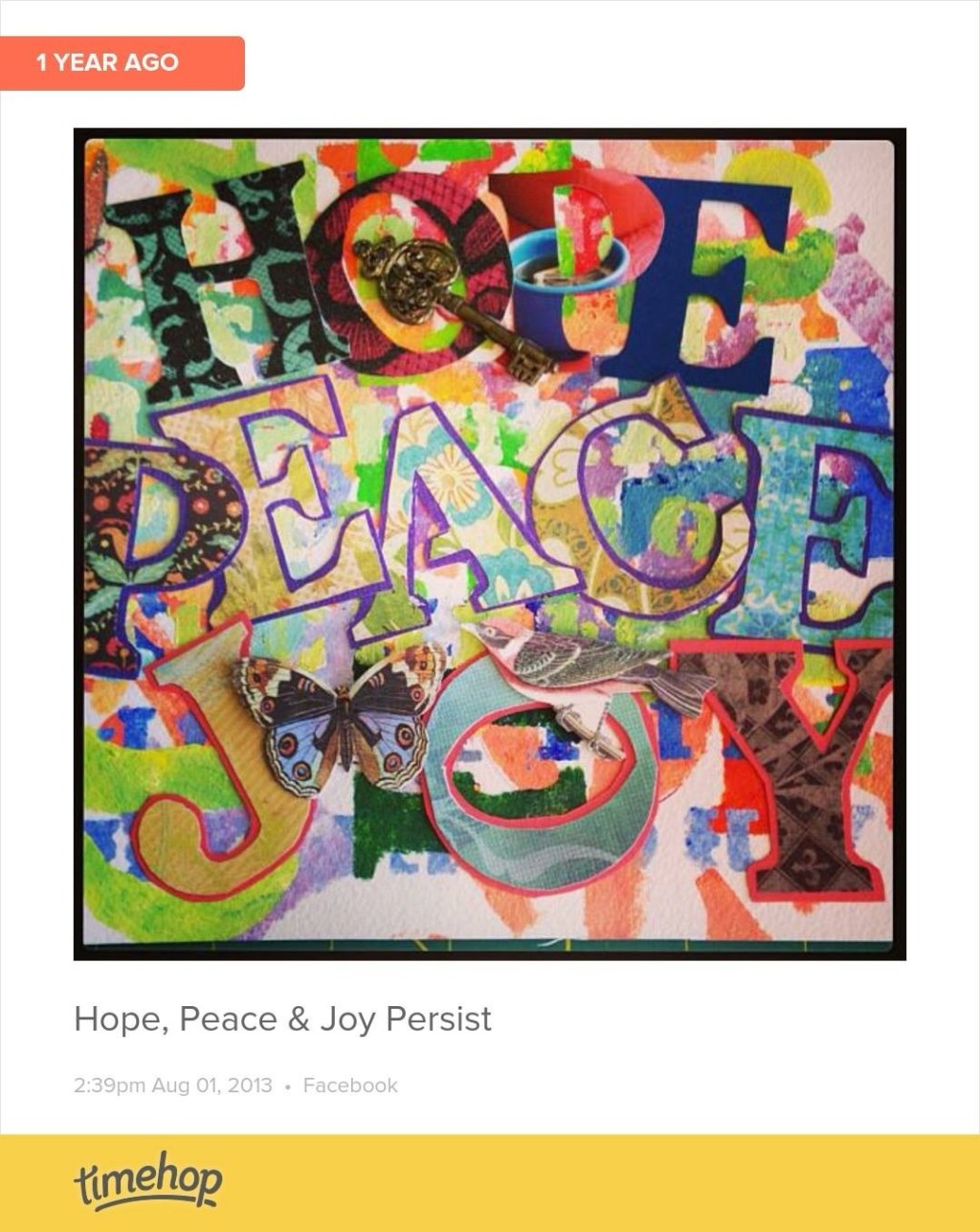
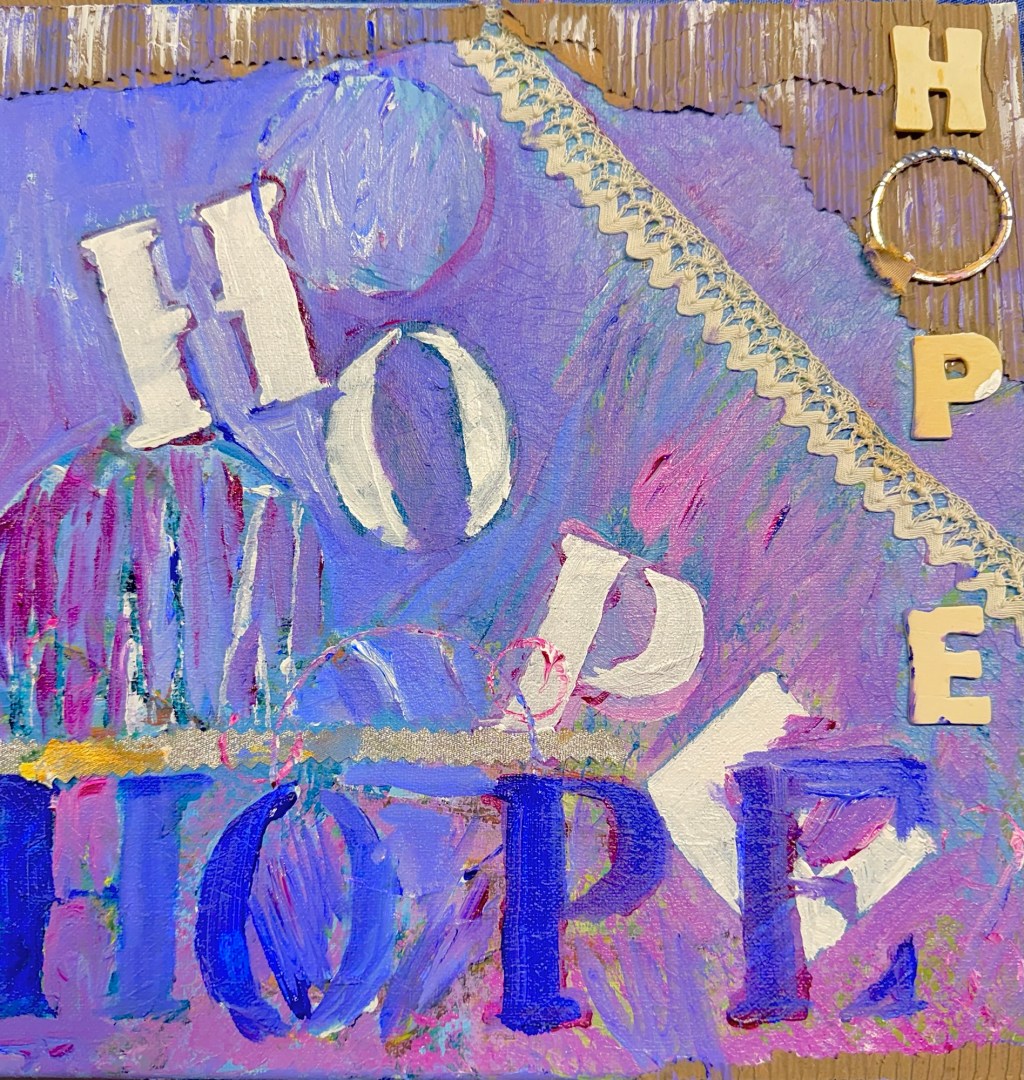
Hope is part of our GrecoRoman heritage also. “Dum spiro spero” is Latin for “While I breathe, I hope.” Some form of this saying has been around since the 3rd century BCE. My grandmother sewed her antique crochet trim onto pillowcases for wedding gifts. This is a scrap I found in her sewing kit. I stenciled the letters HOPE and glued down the wooden letters H, P, and E. I used an old metal circle for the O. Torn corrugated paper added a touch of texture, as did a few string prints. Sometimes hope appears to slide away or seems raw and unvarnished. The colors are blue and violet because Advent is the great season of Hope. Matthew quotes the Servant Song from Isaiah in 12:18-21—

“Here is my servant, whom I have chosen,

my beloved, with whom my soul is well pleased.

I will put my Spirit upon him,

and he will proclaim justice to the Gentiles.

He will not wrangle or cry aloud,

nor will anyone hear his voice in the streets.

He will not break a bruised reed

or quench a smoldering wick

until he brings justice to victory.

And in his name the Gentiles will hope.”

This is the Messiah of Hope of Israel and the Anointed Christ in whom we hope today. We can best share the hope of this Christ to our suffering world by serving the suffering, the grieving, the hungry, and the overlooked.

Joy, peace, and hope,

Cornelia


Light Overcomes the Darkness

art, Bethlehem, Christmas, Faith, Hanukkah, hope, Israel, Light of the World, mystery, Nativity, suffering, Ten Commandments

“The light shines in the darkness, and the darkness did not overcome it.” —John 1:5.

Work in progress: Light Shines in the Darkness

Some of us can hear these words with hope, two thousand years after John’s gospel was first written. These words come as a ray of hope, like a flashlight’s beam bursting into a collapsed mine to let imprisoned workers know help and life-giving oxygen is on the way. For the people in the first century who lived under the Pax Romana—the peace of Rome—not everyone had the same rights and privileges as the citizens of Rome. The conquered lands, including the nation of Israel, were under military occupation and suffered brutal taxation and unfair application of the laws.

More importantly, obedience to the emperor and the empire was required, which for the Jewish people meant making a sacrifice in honor of the emperor. Because this act would acknowledge a human being as a god, the Jews were between a rock and a hard place. If they denied the emperor, they were unpatriotic. If they sacrificed to him, they committed blasphemy against their God. After all, we find one of the great commandments in Exodus 20:2-3:

“I am the LORD your God, who brought you out of the land of Egypt, out of the house of slavery; you shall have no other gods before me.”

We take religious freedom and expression as a given here in the United States, since the first European settlers to these shores came here with the express purpose of worshipping God in their own way. Unfortunately, they also persecuted the next groups who arrived and who worshipped differently. After gaining independence from England, America has been one of the few nations of the world in that one of its core values is to honor every faith tradition and allow each person to worship freely (or not) God as they want.

Insisting on the priority or preference for one religion isn’t historical or grounded in our constitution. We find this in both Article VI of our Constitution, which prohibited religious tests for federal office holders, and in Article I of the Bill of Rights:

“Congress shall make no law respecting an establishment of religion, or prohibiting the free exercise thereof; or abridging the freedom of speech, or of the press; or the right of the people peaceably to assemble, and to petition the Government for a redress of grievances.”

In this present time, when certain groups of Christians (Christian Nationalists) want to claim an alternative history of our national origin and our national destiny, they also are trying to rewrite our history to make it fit their purposes. This elevates their religious group above others and gives them preference over other Christian denominations as well as other faiths and nonbelievers. When these other groups become persecuted or marginalized, the whole suffers, while a few prosper.

The situation was much the same back in the first century CE, when tax farming was a corrupt practice in the Roman provinces. A family bought the rights to a tax area, collected whatever they wanted, and gave the due to Rome. The rest they kept as profit. No wonder folks hated the local tax collectors: they were not only greedy, but they colluded with the occupation. The priests in the temple made sure they never rocked the boat, so they could keep up their rituals and practices of the law, both scriptural and secular.

Therefore the people yearned for a savior, a messiah. In every age, in the stillness of the night, in the darkness of despair, when hope was flickering to an ember, a voice of a prophet would arise. These prophetic voices weren’t often heard, but occasionally one voice would pierce the gloom like a bright light in a dark cave. When a prophet speaks a true word from God, people recognize it as true because it speaks the truth of God, reminds people they belong to God, calls the people back to God, and tells them the consequences of their resulting behavior. Prophecy isn’t just about fortune telling.

Poets are often the prophets of their age. The first stanza of William Butter Yeats’ Ode speaks both toward that first century past and to the second coming:

“Turning and turning in the widening gyre
The falcon cannot hear the falconer;
Things fall apart; the centre cannot hold;
Mere anarchy is loosed upon the world,
The blood-dimmed tide is loosed, and everywhere
The ceremony of innocence is drowned;
The best lack all conviction, while the worst
Are full of passionate intensity.”


Final State: The Light Shines in the Darkness

If we lose hope, if we give up on the hope of redeeming our world and ourselves, we will fall into despair and nihilism. These emotions are not good. We won’t listen for the still small voice of God in the dark and quiet spaces anymore. We won’t hear the voice of God in the weed growing in the crack in the pavement of the sidewalk as we go about our daily tasks. We will fail to hear the promises of new hope and new strength when the crocuses pop through the snow next spring.

Art and poetry keep us connected to the magic and mystery of the Spirit of God. A steady diet of news and television is a soul killer. If you find your attitude going south, I recommend you limit your news consumption to two hours or less per day. Replace those other hours with sunlight, exercise, cooking, a new hobby, fiction reading, journaling, or whatever. If you keep getting drawn back into the distressing activity, remember to let go, and return to a better activity. Optimism and a sense of hope will carry us further than negativity will. As Isaiah 6:13 says,

“Even if a tenth part remain in it, it will be burned again, like a terebinth or an oak whose stump remains standing when it is felled. The holy seed is its stump.”

Or as my daddy always said, “Don’t let the bad guys grind you down.” Of course, this sentiment had some bad medical school Latin he and his friends translated when the going got tough and the sleep got short in his younger days. “While I breathe, I hope,” is “Dum spiro spero,” in Latin. It’s been one of my favorite sayings. Night doesn’t last forever, and morning will come. Dawn will break! There will be a new day and a fresh opportunity to do at least one thing better. To make a difference in one person’s life, to make a difference for the good for someone, somewhere. I may be just baking cookies to bring to overworked volunteers somewhere, who are doing good for others, but I can bring a bright light to someone’s day today. I don’t have to save the entire world.

If I can be a ray of light for someone today, I might give them hope. Hope is a gift. We should share it freely. Then hope would grow and “The people who walked in darkness have seen a great light; those who lived in a land of deep darkness—on them light has shined.” (Isaiah 9:2).


Joy, peace, and light,

Cornelia

Faith of Our Forefathers (May 1998) – Library of Congress Information Bulletin

https://www.loc.gov/loc/lcib/9805/religion.html

The Second Coming | The Poetry Foundation

https://www.poetryfoundation.org/poems/43290/the-second-coming


art, Attitudes, Creativity, Faith, Fear, generosity, hope, Icons, Imagination, inspiration, Israel, Light of the World, Ministry, Painting, poverty, renewal, Spirituality, suffering, Sun, United Methodist Church, vision

The first bright light of creation must have been an awesome sight. Of course, only God was there to see it or hear it. The earth was a formless void, and darkness covered the face of the deep. Genesis 1:3 tells us, “Then God said, “Let there be light;” and there was light.”

John Martin: The Creation of Light, Mezzotint, 1825, Royal Collection of the Arts, London.

I have often wondered if God’s creation of light was accomplished with sound. If at one time only darkness existed, then suddenly light appeared, would this sudden change happen like an atomic bomb flash? Not with the bomb’s destructive evil and force, but with the creative and life-giving energy of God’s power and love. While scripture tells us we hear God’s voice in the sheer silence (1 Kings 19:11-12), this is after God has created everything which we humans might worship instead of God. When God first created light, what was the power behind God’s words?

George Richmond: The Creation of Light, Tempera, gold, and silver on mahogany, 1826, support: 480 × 417 mm, frame: 602 × 539 × 66 mm, Tate Gallery, London.

Maybe no one cares, for if no one is in a forest to hear a mighty oak fall, can we say it ever made a sound? Just because human beings weren’t created yet does not mean the light did not come into existence or make a noise. We might as well say bombs are not leveling towns in Ukraine and Gaza merely because we are not running from the falling bricks and dust. Yet, we can see the pictures on television and know these facts as true.

We are in a trickier situation when we try to find information to prove the existence of the creation of the first light and the facts of its origin. We are certain light was created, for light now exists. Tracking light’s history to its birth story is the challenge!

The Creation of Day and Night, by Francisco de Holanda, De Aetatibus Mundi Imagines, 1543.

When the Old Testament says God created light, the ancient readers understood this word to mean a special light, not the light of the sun, moon, or the stars. God created these lesser lights on a later day, so they possess a different form of light from the first light. The early Hebrew philosophers distinguished between chomer, matter, and tzurah, the form or function of an object. A raw material has chomer, matter, but once it’s made into an object, it acquires the form or tzurah.

Michelangelo’s The Separation of Light from Darkness, (c. 1512), the first of nine central panels that run along the centre of the Sistine Chapel ceiling.

At the beginning of creation, nothing had form. It was all matter. Then God created the Ohr Ha-Ganuz, or the Hidden Light. This special light played a critical role in Creation. Just as regular light allows us to see and relate to our surroundings, the Hidden Light enabled the different elements of creation to interact with one another. It dispelled the initial state of darkness when all objects were isolated and disconnected from one another. Through this special light, the universe’s myriad objects acquired purpose and function and were able to work together towards a common goal.

About 13.8 billion years ago, our universe ballooned outward at an incredible speed. Everything we see today, which was once packed tightly together, expanded in a roiling mass of light and particles. It took 380,000 years for this hot, dense soup to thin and cool enough to allow light to travel through it. This first light, dating back to the formation of early atoms, we call the cosmic microwave background and we can still detect it today.

Creation: Bright Beam, stage 1

The Advanced Simons Observatory in the Atacama Desert in Chile is on the forefront of research for detecting cosmic microwave background radiation to give us a better picture of the early universe, its evolution, and the many phenomena within it. Beyond the cosmic microwave background, they will hunt for and study the birthplaces of distant stars, the contents of interstellar dust, exo-Oort clouds—spherical shells of ice and dust at the edges of solar systems—and several other phenomena. But, given the unique capabilities of this observatory, they are also open to finding some unexpected and unexplained puzzle pieces in the universe that we did not know we were missing.

Creation: Bright Beam, stage 2

Before there were any stars or galaxies, 13.8 billion years ago, our universe was just a ball of hot plasma—a mixture of electrons, protons, and light. Sound waves shook this infant universe, triggered by minute, or “quantum,” fluctuations happening just moments after the big bang that created our universe. The question we first asked, “Did the creation of light make an audible sound?” is related to the “cosmic wave background radiation” that the observatory in the Chilean desert is seeking.

Although scientists call this moment the Big Bang, it was not a loud explosion. Instead, it was more like an imperceptible humming because this first moment happened when the universe was denser than the air on Earth and sound waves could travel through it. This covered the first 100,000 to 700,000 years. As the universe cooled and expanded, the sound waves grew longer and and the sounds lower. As the universe continued to expand, the wavelengths became so long the sounds became inaudible to the human ear.

NASA Sound File Magnified of Big Bang Microwave Radiation

For this sound file, the patterns in the sky the Planck Observatory observed were translated to audible frequencies. This sound mapping represents a 50-octave compression, going from the actual wavelengths of the primordial sound waves (around 450,000 light-years, or around 47 octaves below the lowest note on the piano), to wavelengths we can hear.

Creation: Bright Beam, stage 3 in the studio

Maybe as you read this, you wonder, why do artists have an interest in science? This is an attribute of artists from Leonardo in the Renaissance down through the Impressionists who studied the play of light and atmospheres on surfaces in the 19th century. Today we know the speed of light means we are always seeing a “late arriving sunbeam.” The speed of light gives us an amazing tool for studying the universe. Because light only travels a mere 300,000 kilometers per second, when we see distant objects, we’re always looking back in time. If we the universe clock backwards, right to the beginning, and you get to a place that was hotter and denser than it is today. So dense that the entire universe shortly after the Big Bang was just a soup of protons, neutrons, and electrons, with nothing holding them together.

Lentil and ancient grains pasta soup, held together by melted cheese—metaphor for the early universe

The moment of first light in the universe, between 240,000 and 300,000 years after the Big Bang, is known as the Era of Recombination. The first time that photons could rest for a second, attached as electrons to atoms. It was at this point that the universe went from being opaque, to transparent. The earliest possible light astronomers can see is the cosmic microwave background radiation. Because the universe has been expanding over the 13.8 billion years from then until now, those earliest photons were stretched out, or red-shifted, from ultraviolet and visible light into the microwave end of the spectrum.

Today we have tools unavailable to the 15th or 19th centuries, but what we have in common is the human mind. Because we are created in the image of God, we have the same desire to create and shape our world and to understand our place in it. For some people, they find placing their trust in God’s absolute power over all creation and events as a way of understanding the problem of good and evil in the world. This justifies suffering and allows them to ignore the plight of the poor. Prosperity religion, which preaches the good prosper and the bad suffer, is a classic example of this theological belief. We United Methodists believe in doing good to all people, as often as possible, with all the means we can. As the gospel says in Matthew 25:37-40—

Then the righteous will answer him, ‘Lord, when was it that we saw you hungry and gave you food, or thirsty and gave you something to drink? And when was it that we saw you a stranger and welcomed you, or naked and gave you clothing? And when was it that we saw you sick or in prison and visited you?’ And the king will answer them, ‘Truly I tell you, just as you did it to one of the least of these who are members of my family, you did it to me.’

We know Jesus as the Light of the World (John 8:12)—

Jesus spoke to them, saying, “I am the light of the world. Whoever follows me will never walk in darkness but will have the light of life.”

Perhaps this ancient light of creation has not yet reached everyone who reads these words. I can only guess they ignore even the voice of the Old Testament prophet Isaiah (58:10):

“If you offer your food to the hungry and satisfy the needs of the afflicted, then your light shall rise in the darkness and your gloom be like the noonday.”

The sun will always shine when we help others. The light of Christ will burn bright in us to burn away our gloom and despair when we give a hand to others who are in need. Their lives will be brighter in turn. We often turn away from people in hard circumstances because we do not want to face the prospect that we one day might need a hand up. This strikes at our self image of invincibility and self sufficiency. We keep remembering “God loves a cheerful giver.” If we think only of this part of the verse outside of its context, we might think God only loves the giver. God also must love the one in need to provide the blessing for the giver. As we read in 2 Corinthians 9:7-8—

Cornelia DeLee: Creation: Bright Beam, acrylic on canvas, 16” x 20”, 2024.

“Each of you must give as you have made up your mind, not reluctantly or under compulsion, for God loves a cheerful giver. And God is able to provide you with every blessing in abundance, so that by always having enough of everything, you may share abundantly in every good work.”

As an old mentor of mine taught me, “Don’t do all the work for your people. You’ll rob them of the blessing of serving the Lord.” None of us can replace the eternal light of Christ, which has been traveling to us since the dawn of time, although the Light has been with God since before time began. This Light is even now permeating the universe, in a prevenient journey to the furthest distances of creation. There is no place the Light will not go before us. Even as we attempt a return to the moon and hope to go to Mars in the future, the light of Christ has already gone before us.

If this does not give you hope in what many think is a dark and despairing world, refocusing on the Light with us instead of the darkness that always seems so near might help to change your attitude.

Joy, peace, and light,

Cornelia


What Did the Big Bang Sound Like? | HowStuffWorks

https://science.howstuffworks.com/what-did-big-bang-sound-like.htm

Breishit: The Hidden Light of Creation

https://www.ravkooktorah.org/BREISHIT_67.htm

The science illuminated by the first light in the universe | Stanford Report

https://news.stanford.edu/stories/2023/07/science-illuminated-first-light-universe

When was the first light in the universe?

https://phys.org/news/2016-11-universe.html

The Creation of Light: William Blake and Francisco de Holanda/thehumandivinedotorg

https://thehumandivine.org/2022/02/27/the-creation-of-light-william-blake-and- francisco-de-holanda/


OAKLAWN FRIDAY ART CLASS

adult learning, art, Attitudes, brain plasticity, change, cognitive decline, Creativity, hope, renewal, summer vacation, Uncategorized, United Methodist Church

WE’RE BACK!!!

The older I get, the faster time flies! When I was a child, summers were long and lazy times. I actually got so bored, by the first of August I’d start to play school. I’d line up my brothers and the neighborhood children and pretend to teach them.  It was our way of “playing ourselves into a new reality.”

Art has many right answers!

Children practice life lessons during their play experiences. We can also play our way into learning a new skill in art class. All we need is a “beginner’s mind.” The Japanese Zen term shoshin translates as ‘beginner’s mind’ and refers to a paradox: the more you know about a subject, the more likely you are to close your mind to further learning. As the Zen monk Shunryu Suzuki put it in his book Zen Mind, Beginner’s Mind (1970): “In the beginner’s mind there are many possibilities, but in the expert’s there are few.” 

Jerzy Nowosielski: Landscape with a vision of the Sun, oil on canvas, 1965, National Museum of Krakow, Poland. 

In a similar vein, Picasso once said, “When I was young, I could paint like Raphael, but it took me my whole life to learn to draw like a child.” Part of our art class experience is to learn to suspend our adult ego’s need to constantly be ranking, besting, and giving into our competitive natures. We learn more when we give up our egos and our needs to protect our false selves, and allow our true selves to learn. This story in Luke 9:46-48 on “True Greatness” speaks to this:

“An argument arose among them as to which one of them was the greatest. But Jesus, aware of their inner thoughts, took a little child and put it by his side, and said to them, “Whoever welcomes this child in my name welcomes me, and whoever welcomes me welcomes the one who sent me; for the least among all of you is the greatest.”

Mary Delaney, Xanthium Spinosum, from an album (Vol.IX, 98). 1778. Collage of coloured papers, with bodycolour and watercolour, on black ink background
© The Trustees of the British Museum

Our first meeting will be Friday, September 6, at 10 am in the old Oaklawn UMC fellowship hall. Bring your own acrylic paints, brushes, and a canvas or canvas panel to paint on. We begin with a short visual inspiration from some great art works, so that we can wonder and be filled with awe at some great artists’ works. 

Basic 2 point perspective

I’ll give some direction on the skill we’ll work on in the session, and then everyone is free to bring their own unique expression to their paintings. We don’t copy my work and judge how well a person can match it. Instead, we learn from the masters or from real life. We can learn to stretch our own skills to create something new. 

That’s US!

Of course, making great art isn’t our first purpose. As we age, the harsh truth is we will lose our ability to learn new skills until we lose our memory of what we just ate for breakfast or how to work the tv remote. Challenging our brains is one of the best ways to keep our brain cells firing and “chatting with one another.” We can actually grow new neurons as we grow older. Our brains don’t have to shrink like a cotton shirt washed in hot water. Socialization and encouragement also helps to keep our brains young. Teaching this class helps me stay young! We help each other in this matter. 

That goes for children of any age!

Of course, making art means we have to give up our desire to be perfect. Children always have a “beginner’s mind,” so they are free to explore and experiment. Artists quickly learn perfection comes from practice, or working at it. Every baby stumbles and falls as they learn to walk, but we dotting adults still encourage every trembling step. This is what art teachers also do. I’ve always had a rule in my classes, especially when I taught in middle school: 

“No Negative Talking about People or Art.”

This includes a student’s own art works. My students always had to give at least three positive comments about their work before they spoke about the negative. “My work needs improvement” is better than saying, “My work stinks!” After all, this way of thinking is more positive than negative and helps to build confidence in a person. 

God would post your art on Heaven’s Refrigerator

Of course, we’ve all grown up and worked in environments where negativity is the rule. Art class is a place of grace because this is how life should be. If we can transform a blank canvas into a field of color, why can’t we transform our communities and our world into fields of hope, joy, and love? 

The Light overcomes the Darkness

Perhaps because we try to make everyone copy/fit into our idea of the proper end product, rather than allow everyone discover their own creative response to the given subject of the day. The museums of our world are richer and more vibrant because artists have listened to the Spirit of the Creating God. We might do well to realize God’s creative energies are varied and vibrant also, just as Isaiah wrote about his vision of God’s Glorious New Creation: 

“For I am about to create new heavens and a new earth; 

the former things shall not be remembered or come to mind.

But be glad and rejoice forever in what I am creating;

for I am about to create Jerusalem as a joy, and its people as a delight.”  (65:17-18)


I hope to see you there. I don’t charge for the class sessions, since this is one of my ministries as a retired elder in the United Methodist Church. As John Wesley once said, “The World is my Parish.” When we grow in confidence in the joys of creating, we find more beauty in the created world. Optimism is one of the side benefits of the creative life, not fame or riches, and sometimes not even accomplishment. Just the act of being a co-creator with the creating God helps us to find more peace in life.

Joy and Peace,

Pastor Cornelia 

How to foster ‘shoshin’ | Psyche Guides

https://psyche.co/guides/how-to-cultivate-shoshin-or-a-beginners-mind

The Creating God

art, Attitudes, change, Creativity, Evangelism, Faith, garden, Healing, Holy Spirit, hope, Imagination, incarnation, inspiration, john wesley, Light of the World, Ministry, Painting, purpose, Reflection, renewal, shadows, Spirituality, vision, Work

In the dead heat of summer, our gardens aren’t putting forth the fruit of our planting. Maybe the animals of our neighborhood have made their too frequent nightly visitations, so our harvest is skimpy. We can forget God is a both a creating god and a recreating god as well. The first words of the alternate NRSV translation of the Bible’s first book Genesis (a word meaning “origin”) are—

First stage: string, fabric scraps, and under painting

 “When God began to create…”

In the old KJV, Genesis 1:1 readsIn the beginning, God created the heaven and the earth.”

I appreciate even more the next verse from Genesis 1:2—

“The earth was a formless void and darkness covered the face of the deep, while a wind from God swept over the face of the waters.”

Alternate translations read— “while the spirit of God or while a mighty wind” swept over the face of the waters. This reminds us nothingness and darkness aren’t problems for God, who is able to bring glorious light to any situation.

Psalms 139:12 speaks of the nature of God:

“Even the darkness is not dark to you; the night is as bright as the day, for darkness is as light to you.”

I’ve lived for over half a century with chronic depression, so I can recognize darkness, not only in my own life, but also in the lives of others. Most of my ministry and even my secular work was done with a calling to bring others to the light of hope and confidence that anything was possible.

In art classes, I asked my students to trust in ABC—Attitude, Behavior, and Consequences. If they had a Positive Attitude, they would have Positive Behavior and work on their assignments. If they worked, they would see Positive Consequences or Improvement over time. Asking people who’ve been told they can’t do art to believe they can learn even if they aren’t “talented” is a big ask, but if they have faith in this promise, they discover it’s true.

When I sold insurance, I asked people to trust in the idea of making a small sacrifice now to prevent a greater loss later. Also, if they had no loss, they shared in a community to underwrite the group losses and keep the cost of protecting their own property low. Not everyone has the light to see this benefit of community, but for those who do, I could help keep their consequences from being a disaster.

Second stage: overpainting, printed circles, and added ruler lines

When I entered the ministry, I discovered congregations who had lost their faith in the God who could make something out of nothing This began with the creation story, the choosing of the nation of Israel to be God’s people (even though they were once no one’s people), and feeding them in the extended wilderness wandering before they arrived at the promised land. The Bible is full of examples of God’s providing more when people have too little to sustain them: Elijah and the widow of Zarephath, the feeding of the crowds with a few fish and loaves, and the water turned into wine. These modern people didn’t have a “recreating faith” that God could work in their lives today, just as God had once worked in the lives of others in the days of Christ.

That is what we call a “dead faith,” or as John Wesley put it in his notes on the New Testament at 2 Timothy 3:5— “An appearance of godliness, but not regarding, nay, even denying and blaspheming, the inward power and reality of it.”

It’s dead, because the Spirit isn’t at work in it. I used to tell my beloved evangelism professor, the late Dr. Billy Abraham, the first place we needed to do evangelism was in the local church, because folks hadn’t heard the good news. If they weren’t excited enough to have a living faith, they wouldn’t go out and spread the good news to others.

I’ve never been a cheerleader, although I did have some time in my high school pep squad. I was more often involved in making the football banners and pep posters for the other sports activities. Also debate team took up much of my time. One of the best practices I learned in debate was positive points sell better than negative ones. Also, it’s better to make the same point over and over with different facts and examples.

When I say our God is a creating and recreating God, I can point to the beautiful verses of John 1:1-5—

“In the beginning was the Word, and the Word was with God, and the Word was God. He was in the beginning with God. All things came into being through him, and without him not one thing came into being. What has come into being in him was life, and the life was the light of all people. The light shines in the darkness, and the darkness did not overcome it.”

In the beginning was the Word

 As believers in the Holy Trinity, the Word made flesh is Christ, so he was co-creating with God the Father and God the Holy Spirit from the beginning. By virtue of the incarnation, Christ takes on our flesh to redeem us and make us whole again. This comes to completion through the cross. When we place our faith in Christ’s act of love for all creation, we are made one with Christ, and one with God. The Holy Spirit brings us ever closer to the true nature of Christ, until we’re perfected in love of God and neighbor.

I painted on unprimed canvas, just to see what would happen. Also, because I knew the paint surface would be different than the usual texture on the primed canvas. After I painted several different colors in blocks with the scrap pieces of cut canvas used as “masking tape,” I decided to use a mix of iridescent gold and silver acrylic paints to glaze over the under painting. I also added some circles and straight lines. I’ve collected a few jar tops recently, I used some string elements, and I had a school ruler left from my last teaching job back in the 1980’s. (Yes, I keep things. They are tools of the trade. My Sears Craftsman staple gun from art school finally died after half a century of use.)

I’ll be working some more of these experiments for a while. Creating and recreating our lives is what keeps us new every morning. As someone who has been renewed and recreated more than one time can attest, along with the prophet Jeremiah,

“For surely I know the plans I have for you, says the LORD, plans for your welfare and not for harm, to give you a future with hope.” (29:11)

Joy and peace,

Cornelia


John Wesley’s Notes on The New Testament, 1755:

2 Timothy 3:5—“holding to the outward form of godliness but denying its power. Avoid them!”

Anne Frank’s Last Birthday Cake

Anne Frank, art, Auschwitz, beauty, Children, Creativity, Faith, Family, Holocaust, hope, inspiration, Ministry, Painting, perspective, shadows, suffering, vision

Anne Frank’s Last Birthday Cake, acrylic on canvas, mixed media, 18” x 20,” 2024.

We never know when the tides of time will change. Most of us aren’t creatures of change, but prefer instead the well-worn and familiar paths. As a United Methodist pastor, I moved every two or three years during my ministry, so one thing I kept was my telephone company. I know some people like to switch providers almost as often as they switch their underwear, but that’s not me. Having to switch utility companies, banks, and hairdressers was more than enough agony for me. I signed up for this life, however, so I kept my moving boxes and made a spreadsheet for notifying all my address changes.

I talk about this because I only lived in three homes as a child. I never had to leave in the middle of the night to escape bad debts, the law, or a hateful Nazi regime. I have no way to imagine Anne Frank’s life, except when I was also 13 years old, I read her wonderful diary. Anne kept her diary, beginning at the same age, during the two years she spent in hiding while the Germans occupied her homeland during World War II. She had received a red, cream, and beige checkered cloth notebook diary for her 13th birthday on June 12, 1942. The underground Dutch radio station had encouraged people to keep diaries so future generations would know what the conditions were under the German occupation.

Because of the Nazi purity rules, Jews weren’t allowed to mix with non-Jewish persons. According to the Nazis, Jews were not Aryans or the Master Race. They thought Jews belonged to a separate race that was inferior to all other races. The Nazis believed that the presence of Jews in Germany threatened the German people. They believed they had to separate Jews from other Germans to protect and strengthen Germany. Their Nuremberg Laws were an important step towards achieving this goal. 

We hear this same sentiment today from the neo-Nazi movement groups who say, “Jews shall not replace us,” and “Immigrants are poisoning the blood of our nation.” As a result, only Anne’s Jewish friends could come to her birthday party. Her father set up a movie projector to show “Rin Tin Tin,” the famous Hollywood dog film star. The chairs were set up in rows like a movie theater. The family went all out for their Anne. Her mom had baked cookies for her classroom to share, since they couldn’t come to the party, but she baked a strawberry cream cake for this party attended by her Jewish friends. This was early June and the strawberries would be juicy, fresh, and in season.

Anne and Hanna playing before the Frank family fled into hiding.

Two weeks after her 13th birthday, Anne and the Frank family had disappeared from the neighborhood. They left no forwarding address. Her best friend of eight years, Hannah Pick-Goslar, didn’t see her again until they were both in the same concentration camp. Hannah survived. Anne did not, but the enduring story of her life in hiding continues through her diary.

When I was painting this, I used a large doily as the “cake.” I’d been saving it for a halo for a saint painting, but it works great for a cake top too. My viewpoint is from above, and I omitted the 95 candles. No need to burn the house down! The cream color was a bit pink, but if I were a young teen girl, I’d want it more pink than just white. I painted the background as a blue sky, because young people almost always have hope and optimism. The left side of the canvas has the storm clouds approaching, as well as the grey soot soiling the sky from the overworked crematoriums at the concentration camps where so many Jewish people lost their lives in the Holocaust.

If we can learn anything from one small girl who ate strawberries on an early summer day, I hope it will be to appreciate the beauty of this brief moment and to love one another deeply. Also, life is too short to hate anyone just because they are in someway different from you. Celebrate their differences as part of God’s creative generosity to this world. Also as Mary Oliver reminds us about the importance of keeping a journal:

“Instructions for living a life. Pay attention. Be astonished. Tell about it.”

Joy and Peace,

Cornelia


Remembering Anne Frank’s Last Birthday Party | TIME
https://time.com/6284557/anne-frank-birthday-party-hannah-pick-goslar/

What Hannah Pick-Goslar’s Memoir Reveals About Anne Frank | TIME

https://time.com/6282024/anne-frank-friend-hannah-pick-goslar-memoir-

The Nuremberg Race Laws | Holocaust Encyclopedia
https://encyclopedia.ushmm.org/content/en/article/the-nuremberg-race-laws


Great American Eclipse Paintings

adult learning, art, Creativity, Faith, Great American Eclipse, Imagination, inspiration, Love, Ministry, nature, Painting, photography, salvation, Spirituality, vision

After the Great American Eclipse, I’m reminded once again how great and wide is the love of our God. We say, “Our God,” as if we could own or possess the one who holds us, since God is beyond our knowing or possession. We can own a boat, a house, or a work of art. In the bad old days before the Civil War in America, people once owned other human beings. We fought a mighty conflict so our nation could be made up of free people, all of whom have equal rights. Unfortunately, not all have equal opportunity.

Patriotic Sunglasses

In America, we are so privileged, we often look at most everything through red, white, and blue lenses. We don’t take off our “American eyes” to see as God sees. To make this point, the Great American Eclipse actually began over the Pacific Ocean, so perhaps whales and sea birds would have been the first to experience it. When the eclipse reached land in Mexico, those in Mazatlán saw it before anyone in Texas did. I have lived in Texas, so I know they like to be the “first, best, and biggest” in everything, so they’ll ignore the fact this eclipse actually was seen by others first.

Eclipse Path: you are here

We don’t need to be first or best to deserve God’s love and providence. God proves God’s love for us every day the sun rises and sets. God gives us the rain in its season and grass for the herds to feed upon. We don’t have to exclude others to get God’s love, for God’s love is wide enough to include all. A God, who can call an entire universe into being with just a word, has the infinite resources to love all fully and completely. We are the finite ones, having limited resources and understanding, who find the need to limit God’s love to a few.

We tend to think in human terms of competition, in which one person gets a blue ribbon or a trophy and everyone else is a “loser.” That’s the Rickey Bobby of Talladega Nights school of theology. God made the entire universe, even tiny Pluto, which our astronomers demoted from planet status to a dwarf planet in the Kuiper Belt. Just because we relegated Pluto to a minor status doesn’t mean God diminishes God’s love, care, and concern for God’s creation.

Bill Maxey: Total Eclipse at Hot Springs AR

When we have the opportunity to view an awesome event of creation, such as a total eclipse of the sun, we have to consider ourselves privileged to be alive and part of God’s care. When the moon fully covers the sun and darkness falls upon the face of the earth where you stand, the cool air touches your skin, and your heart burns within. The excitement and rush of energy is so great I had to shout! I’ve heard some people cry. I guess I’m an exuberant sort.

Nana’s Poem: typed from memory

On 20 August 1892, “The Times” published an article by Kipling, “Half-a-Dozen Pictures”: it was one of a series of travel articles called From Tideway to Tideway. The article described a visit to an art gallery and Kipling’s reflections on the failure of most painters to match the beauty and vitality of the world around them. He offered some attractive verbal sketches of his own, though it wasn’t part of his purpose to contrast the approaches to nature of writers and painters. His main concern was to urge artists of all kinds to get out and see the world for themselves: (Letters of Travel 1892-1913 p. 40):

Now, disregarding these things and others – wonders and miracles all – men are content to sit in studios and, by light that is not light, to fake subjects from pots and pans and rags and bricks that are called “pieces of color”. Their collection of rubbish costs in the end quite as much as a ticket, a first-class one, to new worlds where the “props” are given away with the sunshine. (Letters of Travel 1892-1913 p.77).

Eight days later, the same article was published in the New York Sun. This time it closed with the untitled poem ‘When Earth’s Last Picture is Painted…’ which changed the article’s emphasis from an exhortation to artists to become travelers and pioneers, to what sounds very much like a manifesto for realism in art:

“And only Rembrandt shall teach us, and only Van Dyck shall blame:

And no one shall work for money, and no one shall work for fame,

But each for the joy of working, and each, in his separate star,

Shall draw the Thing as he sees It for the God of Things as They are!

Four years later, Kipling changed the first line of that stanza to:

“And only the Master shall praise us, and only the Master shall blame,”

Kipling, the son of an artist, knew the true joy in life comes from one’s dedication to whatever work is in hand, and the task of the Artist is to convey to others the excitement and wonder of an expanding world. By changing the last line from artists’ names to the Master, Kipling heightened the spirituality of his poem. The artist’s task isn’t merely to render a faithful image of the landscape or person before them, but to bring forth all the inner energies and personality they see and feel.

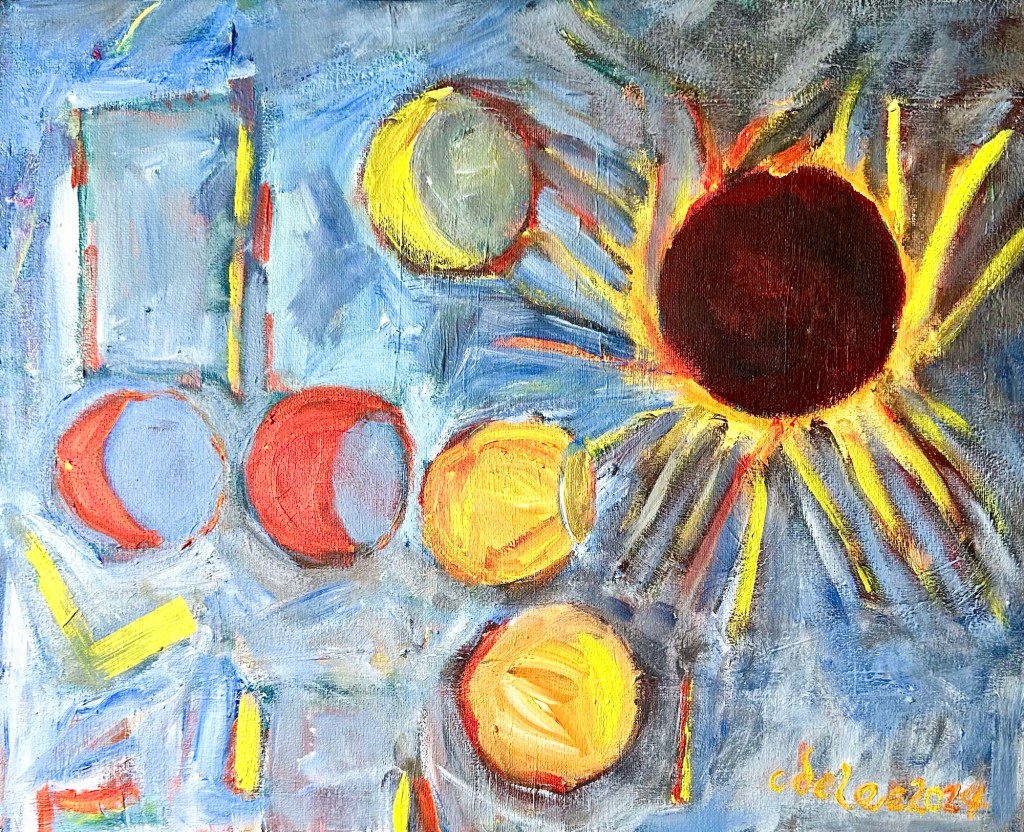
Cornelia DeLee: Memory of the Last Great Eclipse, acrylic on canvas, 12” x 24”

This is why we don’t copy nature, since it’s three dimensional and we have a two-dimensional surface on which we make our marks to represent what we see. Perspective is our visual language to fool the eye into believing our flat surface has depth. Often we paint abstract shapes and colors because these are the best means to convey our emotions about an experience. Photography captures one way of seeing, but painting can render emotions with brush strokes and colors.

Cornelia DeLee: Door to Another Reality in the Eclipse, acrylic on canvas, 18” x 24”

I subscribe to a wonderful poetry series by Steve Garnaas-Holmes, which I receive daily. This poem’s theme of universal love spoke to me as I felt the in-flooding joy of God’s creating power during the Great American Eclipse:

I have other sheep that do not belong to this fold.   I must bring them also, and they will listen to my voice. —John 10.16


We think we’re being open-minded
when we include “all of us,” Protestant and Catholic,
Orthodox and Coptic, as if we see the whole landscape.
But the pasture and the Shepherd are far greater than that.
Believer, unbeliever and other-believer alike
are all shepherded, each in their own language.
And still there are more, and more other, sheep. 
Like, well, sheep.
Do not the deer and otter, whale and fungus
follow the Shepherd faithfully?
Is not the bird migrating its continents shepherded as well?
Christ is not the partisan figurehead of a religion,
Christ is the infinite embodied grace of God,
the Shepherd of all Creation,
who leads rivers to the sea and winter into spring
and each of us into life.
So there are still other, and more “other,” sheep.
For Copernicus isn’t done with us yet:
we admit the sun doesn’t revolve around the earth,
but we still think God does.
No, little one: we are in a small corner.
Yet even the far galaxies,
the trillion trillions of stars and their planets,
and yes, their doubtless forms of life,
are also under the calm eye of the Shepherd,
and follow the Shepherd’s voice.
All of us, Baptist and Sufi, fish, bug and bird,
earthling and alien, village and nebula, all are one flock. One.
And, behold, even on the remotest planet
in the farthest flung galaxy—like ours—
or the most desolate spot in a life like yours,
under the loving gaze of the Shepherd who seeks out the one,
there is no one who is not at the center.


May you each find joy in your working, each in your separate stars, and draw the Thing as you see It, for the God of Things as They are!

Not only can God watch the sparrow, but also all the many suns and planets of creation.

Joy and peace,

Cornelia


When Earth’s last picture is painted – The Kipling Society

Steve Garnaas-Holmes: Unfolding Light 
www.unfoldinglight.net


Time Travel and Iconography Experiments

adult learning, art, Creativity, Faith, Hagia Sophia, Holy Spirit, hope, Icons, Imagination, inspiration, Leonardo da Vinci, Medical care, Painting, Pantocrator, renewal, Spirituality, Turkey, vision

Every once in a while, I like to go on journeys. Sometimes they’re actual trips, such as my recent vacation over spring break to visit family down in Texas, but other times I like to “time travel.” The best way to time travel today, since I don’t have access to a DeLorean, is to study history. Buckle your seatbelts, we’re in for a ride through Christian and art history.

Right before spring break, our art class tried some experimental techniques with chalk, watercolor pencils, and pan watercolor with brushes. I also brought some images from the beautiful church of Hagia Sophia of the ancient capital of Constantinople, which I brought home from a pilgrimage I made several years ago.

The church was sponsored by the first Christian emperor Constantine, so it has exceptional mosaics and frescoes decorating all its surfaces. We each chose an image to use as a starting off place and went from there. Inspiration comes not only from what we see, but from the materials we use. Combining new images with new materials can bring new directions.

Desis Icon, Hagia Sophia, Constantinople, Turkey

Our primary images were the archangel Michael, the enthroned Christ, the decorative jewel designs, and the cross. All of these designs figure in prominence in Hagia Sophia or the Basilica of Holy Wisdom, the primary seat of Christianity in the Eastern Church during the Byzantine era.

Unknown Artist: Moschophoros, The Calf Bearer, 165 cm high, Limestone, 570-560 BCE, Acropolis Museum, Athens, Greece.

Early Christian art took its themes from contemporary Greco-Roman subject matter, but repurposed it for its own religious significance.


The Good Shepherd, the Catacomb of Priscilla, Rome, Italy, 250–300 CE, adopts the standard form of Apollo statues.

The archangel Michael was connected in the 4th CE with Constantine as a divine messenger and intermediary between heaven and earth. Michael was not only the guardian angel of the nation of Israel, but other nations have adopted his protection also. In this same century one of the doctors of the early church, St. Basil of Caesarea, known as “the Great,” said:

“Beside each believer stands an angel as protector and shepherd, leading him to life.”

Constantine felt the presence of the mediating angelic hand in his vision of the cross in the sky at the Milvian Bridge, at his baptism, and in his role as Emperor of the Eastern Christian Empire. Constantine was actually baptized twice: once to cure him from leprosy and again on his death bed. In the early days of Christianity, various sects prevailed and the doctrine of one baptism as sufficient for all times hadn’t yet taken hold. After all, it’s not the water, the place, the church, the location, or the priest that makes a baptism effective, but the work of God through the Holy Spirit. As Ephesians 4:4-6 says,

“There is one body and one Spirit, just as you were called to the one hope of your calling, one Lord, one faith, one baptism, one God and Father of all, who is above all and through all and in all.”

Constantine’s Vision of the Cross: Bibliothèque nationale de France, Illustrated painted parchment Greek manuscript (879-883 AD) of the homilies of Gregory of Nazianzus in the Bibliothèque nationale de France.
(BnF MS grec 510) folio 440r.
https://gallica.bnf.fr/ark:/12148/btv1b84522082/f891

Constantine’s first cross apparition took place at the beginning of his military campaign in Italy. The young emperor realized that the tyrant Maxentius, who controlled Rome at that time, had set a trap at the Milvian Bridge over the Tiber. Fearing his rival’s machinations, Constantine had sought the aid of the God worshiped by his father, Constantius Chlorus (r. 305–6). While he marched on to a field together with his troops, he saw the sign of the cross revealed in the afternoon sky, shinning brighter that the sun, alongside an exhortation inscribed “by means of a starry form: By this you shall conquer, Constantine!”

Mike’s Cross Painting

Note the use of common materials in Mike’s work. The circle is the same size as a foam plate, the cross from the table decorations fits just inside it, and he embellished the outer and inner spaces with a bilateral and balanced design. He’s getting more skilled to “eyeball those proportions” from across the room. Plus, he enjoys making these designs.

The ancient writers Eusebius and Euthymios both mention the emperor’s troops also witnessed this miracle. The significance of the vision was subsequently clarified by Christ, who appeared to Constantine in a dream advising him to carry a cross-shaped banner before his armies in order to defeat Maxentius.

Byzantine hagiographical works, or the writings about the lives of saints, name this apparition of the cross as a decisive step toward Constantine’s conversion to Christianity. This first episode is part of a faith narrative, which runs through the tale of Constantine’s leprosy and his miraculous healing through his first baptism, which was officiated by Pope Silvester.

The depiction of Pope Sylvester in the church decoration, a leading figure in the iconography of Roman popes in Byzantine art, deserves special comment. Sylvester was born in Rome and was pope between 314 and 335, succeeding pope Miltiades. Both the Latin and Orthodox rites honor Silvester as a saint and the patriarchate of Constantinople commemorates him on 2 January. The fictional account of his life, Actus Silvestri, written in the 4th-5th century, records the story of his curing Constantine of leprosy and then baptizing him.

Baptism of Constantine

It was during this first baptism Constantine had another vision which converted him to Christ. Constantine’s baptism is narrated in the Greek Life of Silvester in a verbatim translation of the story by Zonaras. Having recovered his health by means of the sacramental bath, the now Christian basileus (king) donned a bright garment and “said to the bystanders that he had felt a hand: It had stretched out from above and touched me while I was descending into the font.”

Baptism of Constantine

The visualization of St. Michael’s involvement in Constantine’s baptism has no direct precedent in Byzantine and Balkan iconography. Similar descriptions appear in the shorter ninth-century vita of the hierarch and in the lives of Constantine. In the “Guidi” legend, the emperor’s confession is specifically addressed to the pope: “Servant of God, as I was standing in [the water] of the holy baptism, I felt a hand touching me and cleaning the sickness of the flesh.”

Unlike the hagiographical account by Zonaras, this fragment from the “Guidi” vita is not attested in the manuscript culture of the East-Carpathian environment. Even if it doesn’t include this passage in the section on Constantine’s baptism, the encomium (eulogy) by Patriarch Euthymios contains an allusion to the motif of God’s hand:

Upon waking up from the dream in which SS Peter and Paul offered him the cure of baptism, the emperor dismissed the pagan healer ( ) who attended him and said that: “(…) from now on, I need no human help, for the hand of God Almighty ( ) helped me.” Although it anticipates the king’s baptism, this statement is merely a symbolic reference to the divine power which came to Constantine’s aid, not a description of a miracle occurring during the ceremony.

The Slavonic translation of the Life of Silvester by Zonaras remains the only account that constitutes a plausible narrative background for St. Michael’s involvement in the scenes at the Romanian churches of Rădăuți and Bălinești. We don’t know if these fresco designers used a specific copy somehow related to the manuscript at the Neamț monastery. Yet once it had been integrated into the liturgy, the legend of Pope Silvester might have developed an independent circulation through storytelling. Perhaps the local audience interpreted Constantine’s confession about the divine hand that touched him in the water as a sign of the ethereal presence of the Archangel as pictured in the compositions of Constantine’s baptism.

Creation: The Nuremberg Chronicles (1493), written by Hartmann Schedel and illustrated with woodcuts by Michael Wolgemut

Perhaps these tales seem strange to our modern scientific minds, colored as we are by notions of “pictures, or it didn’t happen!” We want proof, repeatable and documented evidence, not just some such nonsensical woo-woo about visions and dreams. After all, we are more likely to think these voices could be drug induced or anxiety provoked, but we aren’t so familiar with God speaking to mortals, as it was back in the days when the boy Samuel was ministering to the LORD under Eli:

“The word of the LORD was rare in those days;
visions were not widespread.” (1 Samuel 3:1)

We aren’t big on either voices or angels, but God does still work in supernatural ways. While some may see prayer as supernatural healing, others may see God’s healing hand at work in guiding doctors, nurses, and caregivers to bring people to get the medical attention that brings them to better health. God gives us the heart for healing and compassion for the suffering, which then sets us out to discover new medicines and treatments for dread diseases. These wonderful advances would appear as magic to those from a century ago, or even a few decades before.

Take the miracle of cystic fibrosis advances. In the 1980’s, the life expectancy for a CF patient in the United States was only 12 years and 20 years in Canada. By 2017, with new medications and therapies, the median life expectancy for CF patients was 47. Because new medications and improved treatment of respiratory infections and other complications have extended the predicted life expectancy of CF patients to almost 50 years, some are now living well into their sixth and seventh decades. I call this a miracle, even if others call it mere “science.” It means I have a grand nephew who likely will have a full lifetime and even enjoy his own children.

Humanists will give all the glory to the human creature. They are self-made men and women in love with their own creation. People of faith will give all the glory to God for the gifts of their hearts, minds, bodies, and spirits. We have been given much, so we give much to others.

Nike of Samothrace

Just as the earliest Christian art works repurposed secular and mythological Roman themes, so later Christian art used Greco-Roman mythological imagery. The angels are based on the female winged victories, such as the famous Nike of Samothrace. In the early fourth century, angels suddenly appeared as figures in Christian iconography, usually without feet and dressed in garments of a white pallium over a tunic. This was a large rectangular cloak worn over a tunic, as worn by Greek philosophers and religious teachers. In the earliest Christian art works, angels were depicted as wingless, but wings became normative by the fifth century. By the High Middle Ages, angels were more elegantly garbed (depending on their station in the hierarchies) and appeared to be androgynous.

The first known Christian depiction of winged angels does not appear until this splendid 4th century marble ‘Prince’s Sarcophagus’. It was discovered after a fire in Sariguzel, near Istanbul in the 1930s

The word for Angel, mal’akh in Hebrew and angelos in Greek, simply means messenger, which is the job description of the Angel, who acts as an intermediary between humans and God. The Bible never says angels have wings, but we all imagine angels with wings. Perhaps we assign them wings because angels can travel from the “heavens above to the earth below.”

Egypt’s Red Monastery, The church of Anba Bishay and Anba Bigol

The church of Anba Bishai and Anba Bigol, known as the Red Monastery, is the most important extant early Christian monument in Egypt’s Nile Valley. It’s one of the most significant historical sites of the period in the Mediterranean region. Created in the 4th and 5th CE, this fine painted Coptic Christian image of Christ surrounded by angels has survived multiple restorations of the church building.

Leonardo da Vinci: Annunciation, 1472, oil on canvas, Uffizi Gallery, Florence, Italy.

Although the principle of angels being sexless continued, later renaissance artists presented them as male figures with fashionably delicate facial features and long hair, dressed in contemporary garments (making them more approachable to the common era). As the lines between the angelic spheres became blurred, along with the renaissance adaptation of classical Greco-Roman art, plump little children with wings began showing up in Christian art. We know these as cherubs.

Cornelia’s Watercolor Angel from Hagia Sophia

I used a mix of pastels and watercolor on this painting, working from a 1.5-inch square image of the Archangel Michael. The contrast of light and dark shows up in the naturalist wings and hair, with the glowing and reflective gold mosaic pieces.

Angel from Hagia Sophia

Regarding his rank in the celestial hierarchy, opinions vary. St. Basil in his homily Angels, as well as other fathers, place St. Michael over all the angels. They say he is called “Archangel” because he is the prince of the other angels. Christian tradition gives St. Michael four offices:

  1. To fight against Satan.
  2. To rescue the souls of the faithful, from the power of the enemy, especially at the hour of death.
  3. To be the champion of God’s people, the Jews in the Old Law, the Christians in the New Testament.
  4. Therefore, he was the patron Saint of the Church; he is considered to be the protector of Christians against the devil.
Christ between St. Peter and St. Paul, Catacomb of Sts. Marcellinus and Peter on the Via Labicana, Rome, 4th CE.

This image of Christ on the Throne, dating to the 4th century, shows Michael between St. Peter and St. Paul. It was painted in the Catacomb of Sts. Marcellinus and Peter on the Via Labicana in Rome, located near a villa that used to belong to Emperor Constantine. Below the main figures of the painting—Jesus, Peter and Paul—we find Gorgonius, Peter, Marcellinus, and Tiburtius, four martyrs who had been buried in that catacomb, and are depicted as they point to the Lamb of God on his heavenly altar.

Zeus: Archaeological Park of Campi Flegrei at the Castle of Baiae on the Gulf of Naples, Italy


The enthroned Christ follows the thematic form of Zeus, king of the gods, seated on his throne. A good example is statue from the Archaeological Park of Campi Flegrei at the Castle of Baiae on the Gulf of Naples. This statue of Zeus Enthroned is a 29-inch-high marble statue dating to the 1st century B.C. and is likely of Greek manufacture.

It was inspired by the colossal gold and ivory statue of the god at the temple of Zeus at Olympia made by sculptor Pheidias in 430 B.C. It was one of the Seven Wonders of the ancient world. Just as the angels were repurposed from the Nike victory statues, so the Christ Enthroned statues were re-envisioned from the ruler of the gods and humans statues. Art and artists can be put to work for whoever is in power at the moment. We need to eat and pay bills in every age.

Zeus: fresco, 62-79 CE, Casa dei Dioscuri, Pompeii (VI, 9, 6-7, atrio corinzio 37), Museo Archeologico Nationial, Italy.

A lovely fresco from Pompeii, found in the House of the twins, has a glowing red background and shows Jupiter or Zeus, the king of the gods, seated on his throne. A sphere lies beside him, an eagle at his feet, and a rectangular base is at his feet. In the same manner, the icon of the enthroned Christ places his feet on a rectangular base, representing his lordship over the four corners of the world.Gail W used the pastels in the clothing and background.

Gail W’s Enthroned Christ watercolor


From one of the royal figures, Gail S chose one of the jeweled embellishments for her focus. Gail enjoys ordered designs, so finding an image with a regular pattern was right up her alley. The outer circle with an inner square is divided along the diagonals by red lines, as if the cross were tilted on its side. The circle and square give unity to the design, as does the monochrome cross. The triangles are balanced by colors. The outer blue rim holds it all together. Gail tried the watercolor pencils out along with the pan watercolor washes.

Gail S inspiration and creation

While nothing is ever new in art, we artists keep reimagining the old patterns in new ways. After all, the basic elements of design never change, but we see the world with fresh eyes in every generation. Using our hands to create restores us and recreates us by reducing our anxieties and giving us a sense of accomplishment. We each serve the God of beauty and joy as God reveals God’s self to each of us. Doing any creative work with our hands is good for the mind, spirit and soul.

As our hand grows in competency with the media and our eye is better able to discern shape and patterns, we come under the Holy Spirit’s inspiration of creating power and we make art! We may start from the ancient wisdom, but then we go onto find the wisdom for today. After all, God is always in a rebuilding mode, for that which God created, God will preserve:


“When you send forth your spirit, they are created;
and you renew the face of the ground.” ~~ Psalms 104:30

Joy and Peace,

Cornelia

Diane Apostolos-Cappadocia : Why Ukraine Calls Upon Michael the Archangel, Christianity Today, April 12, 2022, https://www.christianitytoday.com/ct/2022/april-web-only/michael-archangel-ukraine-kyiv-patron-saint.html

Saint Mamas at Exeles: An Unusual Case of Ritual Piety on Karpathos
Katsioti, Angeliki; Mastrochristos, Nikolaos.  Arts; Basel Vol. 12, Iss. 4, (2023): 176. DOI:10.3390/arts12040176
Saint Mamas at Exeles: An Unusual Case of Ritual – ProQuest https://www.proquest.com/docview/2856776246?sourcetype=Scholarly%20Journals

The Historical Evolution of CF Treatments and Understanding
https://cysticfibrosisnewstoday.com/news/cf-treatments/

Life Expectancy with Cystic Fibrosis (CF)
https://www.nationaljewish.org/conditions/cystic-fibrosis-cf/life-expectancy

ARCHANGELS MICHAEL AND GABRIEL
https://www.stjohnarmenianchurch.org/archangels-michael-and-gabriel/

Archangel Michael
https://www.etd.ceu.edu/2023/dumitrescu_andrei.pdf

Art for the Inner Child

adult learning, Apocalypse, art, Christmas, Creativity, Enneagram, Faith, Holy Spirit, hope, Imagination, inspiration, Light of the World, Ministry, Painting, perfection, purpose, salvation, Spirituality, vision

Discovery is exciting

What is the purpose of an art class? Why does anyone learn to speak a foreign language or take up a craft or sport they’ve never attempted before? We must want to explore some unknown universe or get out of our comfort zone, or as my old favorite television series would announce weekly, “to boldly go where no one has gone before.”

Light of the World Icon: Stencil effect

There are art classes and then there are Art Classes. Just as we shouldn’t make up our minds about a subject or a food until we experience it directly, we can have an open mind about a novel event, rather than rejecting it out of hand. Many of us have lived our lives under judgmental circumstances, dealing with rejection and disappointment at not being the best. “Talladega Nights: The Ballad of Ricky Bobby,” the NASCAR themed film of redemption and finding one’s purpose in life, stars Will Ferrell, whose father crippled him with this tragic life message:

“If you ain’t first, you’re last. You know, you know what I’m talking about?”

Near the end of the movie, Ricky Bobby learns this all was just crazy talk:

Ricky Bobby: Wait, Dad. Don’t you remember the time you told me “If you ain’t first, you’re last”?
Reese Bobby: Huh? What are you talking about, Son?
Ricky Bobby: That day at school.
Reese Bobby: Oh hell, Son, I was high that day. That doesn’t make any sense at all, you can be second, third, fourth… hell you can even be fifth.
Ricky Bobby: What? I’ve lived my whole life by that!

According to Baseball Reference, Ruth’s 183.1 career WAR — combining his value as a hitter and pitcher — is the highest all time, well ahead of Walter Johnson’s 164.8. For reference, the highest mark among active players is Albert Pujols’ 99.6 WAR.

We call this living out a “bad script” our ancestors have written for us. We see it all the time in the movies and on television. We read about it in novels and in comic books. For the most part, people don’t change their wicked ways, but get the consequences they’re due. The bad suffer and the good prosper. Or we read fairy tales in which the good little children get rewarded, or the unjustly treated ones are raised up, like Cinderella. These are the popular stories, but not the biblical tales. The book of Job calls this “retribution theology” into question, as does Jesus in the New Testament.

Annie French (1872 – 1965) Scottish: Cinderella and the Ugly Sisters, About 1900 – 1910, Pen and ink, watercolour and gold paint on vellum paper, 23.50 x 21.50 cm, Scottish National Gallery of Art.

In the Bible, God sends prophets, not only to call the people to account (critique their actions or behavior), but to offer the hope of a better future if they return to God and God’s ways (positive changes in behavior). In this way, a good art teacher is like a biblical prophet, who offers both positive and negative critique on the artwork. The teacher also offers “hope” or suggestions on how to improve the work. Teachers aren’t telling the person they don’t measure up, only that they need more time invested in making art to be able to bring their own artistic vision into reality.

Mike on Being the Light in the World

If we expected babies to chew steak from the moment of birth, the world would be a lonely place. If we expected these same babies to get up right away and “bring home the bacon” to buy their own steak and potatoes, they’d starve. Babies aren’t meant to walk before they crawl, nor or they chewing meat before they drink milk or pablum for a year or two.

Bacon Cake: Oh, Baby! I hope that’s REAL BACON!!

Someone who comes to art class should always come to learn something more, no matter how much they already know. I’m always learning new ideas and techniques. The act of making art is always an act of exploring new territories. We also grow by sharpening one another. Folks in the class are always excited to see how each other approaches the subject each week.

Mike’s May 2022 class work shows he’s been learning some things.

Only the apocalyptic writers in Scripture had a fixed view of the future. For them, God had given up on humanity. We humans were too far gone, too broken, and had destroyed God’s world beyond our weak means to repair it. Their only hope was for God to create “a new heaven and a new earth, for the first heaven and the first earth had passed away, and the sea was no more.” (Revelation 21:1)

Gail went the extra mile with Cri-Cut lettering

Of course, this isn’t a prediction of a certain time, but it’s a future hope for all times. It’s the hope all we creative people have every time we face a blank canvas, a pile of found objects, or a bag of scrap cloths. We also do this when we pull together a dinner before we go to the grocery store, and we take some of this and that which we have in our cupboards and refrigerators. We’re going to make something new! We do hope the Spirit of God descends to make this an inspired concoction! And if it doesn’t work out, we always know our salvation isn’t at stake over a single random supper creation. If I’m hungry enough, I’ll eat anything. Or there’s always peanut butter and jelly sandwiches.

Leftover Doughnuts and Sausage Bread Pudding Bunt Cakes

I was reading Richard Rohr’s Enneagram commentary on the American people. He says America is a nation of Threes: competitive, striving, always looking for success and improvement. When we hit a down cycle, and economics tells us we always have ups and downs in our economy, Americans act like we’ve been insulted. This doesn’t happen to us—to others maybe—but not to us! We’ll look both for a scapegoat and a savior, but never realize these conditions are a natural part of life.

Always be the best YOU. There’s never going to be another one just like YOU.

Likewise in groups, we’re always judging who got more, who has the most status, who’s preferred, and who’s on the out. We’re even liable to self-select to be on the outer group if we believe we won’t measure up, just to spare ourselves the shame of being found wanting. Joyce Rupp has a great poem about this very topic:

WE CAN LOVE THE IMPERFECT SELF
If I wait to be perfect
before I love myself
I will always be
unsatisfied
and ungrateful.

if I wait until
all the flaws, chips,
and cracks disappear
I will be the cup
that stands on the shelf
and is never used.

Magic Teacup Cake from Alice in Wonderland

If we’re faithful scripture readers, we know God never chooses the best persons to do God’s work. When we were children, we saw these characters as heroic figures, just as we saw our parents as great and invincible. The Old Testament records how Moses was a murderer, Joshua was afraid, Amos was a lowly shepherd, and David was an adulterer. Not exactly Perfect Role Models, but transformed people can do God’s mighty deeds if they let God work God’s purpose through their lives.

This word doesn’t mean what the headline writer thinks it does.

In Art Class, we don’t reject “poor work.” We aren’t a factory producing widgets. We have other goals: art appreciation, learning about colors, learning to see more clearly, developing a creative mind, and developing drawing skills. Art is a unique visual language, so learning how to render a three-dimensional form onto a two-dimensional surface takes some time and practice. Developing our own voice is the step beyond mastering the basics of artistic vocabulary. As I used to tell my parents at back-to-school night, just enjoy whatever your child brings to you! If you leave your “critical parent” at home, and bring your “inner child” to Art Class, life is way more fun!

Mike’s Christmas Card Collage

We’re currently on holiday sabbatical at Oaklawn UMC, but classes will return in the new year. We meet in the old Fellowship Hall at 10 am to noon. We always have coffee, and on occasional days, a tasty treat. Our class will begin working in watercolor beginning on January 5, 2024. I don’t charge for the class instruction, but each person should bring their own supplies. Supplies needed are:

Prang Oval 8 watercolor paint set with brush
  1. Prang Oval 8 watercolor paint set (containing brush)—on line at Walmart and Amazon. This has best color and pigments. I found a prime deal on Amazon for $3 each if you buy 3, free shipping.
  2. Watercolor paper pad 9” x 12” or larger (90 lb or heavier)
  3. Tall plastic container for water (iced tea glass size plus)
  4. Your inner child

Joy and peace,

Cornelia

MERRY CHRISTMAS, PEACE ON EARTH, GOOD WILL TO ALL

Talladega Nights: The Ballad of Ricky Bobby https://www.imdb.com/title/tt0415306/quotes/?item=qt0425224

Babe Ruth’s Top 10 career statistics— Shohei Ohtani produced 9.1 total WAR during his spectacular two-way campaign in 2021. Even he maintained that level of performance for 20 consecutive seasons, he would still be 1.1 WAR short of matching Ruth. https://www.mlb.com/news/babe-ruth-s-top-10-career-statistics-c163792958

Sharansky’s Hanukkah

art, Creativity, Faith, Hanukkah, holidays, hope, Imagination, inspiration, Israel, Light of the World, Painting, righteousness, risk, shadows, Spirituality

NOTE: This extraordinary story comes from Arguable by Jeff Jacoby, an opinion writer for the Boston Globe, on December 12, 2023. I’m sharing it with all of you because even in the worst of times, even with the least of resources, if we have faith in God, we can be a light unto the world.

In his transcendent prison memoir, “Fear No Evil,” Natan Sharansky tells the story of his nine years in the Soviet gulag, a fate to which he was sentenced for the crime of wanting to emigrate to Israel. Even now, 35 years after it was published, it is an amazing read, a great narrative by a great man who refused to be intimidated by his captors. The more the KGB tried to berate or punish him for his Jewish pride and Zionist yearning, the more joyfully and fearlessly Sharansky embraced them.

To mark this week of Hanukkah, consider this extraordinary incident recounted in “Fear No Evil.”

Davis Stark Design, Architectural Digest 2017

Sharansky was in the Siberian prison camp of Perm 35 and Hanukkah was drawing near. Intent on observing the holiday as best he could, Sharansky had a menorah constructed from some wooden scraps. A few candles were found, and each evening Sharansky lit his menorah, reciting the blessing, and describing to his fellow prisoners — none of them Jewish — the story of the Maccabee rebellion long ago. On the sixth night of Hanukkah, the authorities confiscated his menorah and candles. When he demanded to know why, a prison guard claimed that the menorah was made from “state materials” and therefore illegal.

Sharansky declared a hunger strike. “In a statement to the procurator general,” he recounts, “I protested against the violation of my national and religious rights, and against KGB interference in my personal life.”

Two days later, Sharansky was summoned by Major Osin, the prison camp warden. Osin wanted the refusenik to call off his protest before the expected arrival of an inspection committee. In that case, Sharansky said, “Give me back the menorah, as tonight is the last evening of Hanukkah.” He promised to end his hunger strike if he was allowed to light the candles.

Davis Stark Design, Architectural Digest 2017

But a protocol for its confiscation had already been drawn up, and Osin couldn’t back down in front of the entire camp. . . . I was seized by an amusing idea.

“Listen,” I said, “I’m sure you have the menorah somewhere. It’s very important to me to celebrate the last night of Hanukkah. Why not let me do it here and now, together with you. You’ll give me the menorah, I’ll light the candles and say the prayer, and if all goes well I’ll end the hunger strike.”

Osin thought it over and promptly the confiscated menorah appeared from his desk.

When Sharansky said he needed eight candles, Osin took a knife and cut the candle into eight stubs. Then, with amazing audacity, Sharansky said that the ceremony required everyone present to stand with head covered, listen to the blessing, and answer “Amen.”

Osin complied. He stood behind his desk, donned his major’s cap, watched as Sharansky kindled his eight candle stubs, and then waited for his prisoner to recite the blessing. Speaking in Hebrew — which Osin, of course, did not understand — Sharansky recited a blessing he had composed himself: “Blessed are you, O God, for allowing me to light these candles. May you allow me to light the Hanukkah candles many times in your city, Jerusalem, with my wife, Avital, and my family and friends.”

Then he had a brainstorm.

Inspired by the sight of Osin standing meekly at attention, I added: “And may the day come when all our enemies, who today are planning our destruction, will stand before us and hear our prayers and say ‘Amen.’ ”

“Amen,” Osin echoed back. He sighed with relief, sat down, and removed his hat.

Sharansky writes that he returned to his barracks “in a state of elation.” Who can doubt it? What magnificent chutzpah! What a triumph of the spirit! And what an uplifting reminder that even in the depths of the gulag — even in a time and place filled with the enemies of Jewish faith and freedom — those who refuse to fear can turn the table on their oppressors and dispel the darkness with a candle’s light.

From Book Blurb: For anyone with an interest in human rights—and anyone with an appreciation for the resilience of the human spirit—
he illuminates the weapons with which the powerless can humble the powerful: physical courage, an untiring sense of humor, a bountiful imagination, and the conviction that “Nothing they do can humiliate me. I alone can humiliate myself.”

Hachette Books: Use HOLIDAY23 for 20% off site wide until 12/31. (Order by 12/13 to get your gift under the tree!)

This link also has links to other retailers. Price is set by publisher.

https://www.publicaffairsbooks.com/titles/natan-sharansky/fear-no-evil/9780786723249/

Nativity at Night by Geertgen tot Sint Jans, c. 1490, after a composition by Hugo van der Goes of c. 1470; sources of light are the infant Jesus, the shepherds’ fire on the hill behind, and the angel who appears to them

Joy, peace, and light,

Cornelia