HALLOWEEN HAPPENINGS

adult learning, art, CharlieBrown, Halloween, holidays, Imagination, Ministry, Painting, picasso, pumpkins

Michael Jackson: Thriller Video still, 1982

Let’s party like it’s 2025! Nothing takes our minds off the stresses of the real world’s ghouls and goblins like pretending to be a ghost, zombie, pirate, princess or superhero in the All Hallows’ Eve hijinks of the holiday we know as Halloween. Especially if we have the license to eat candy or drink purple fluid to slake our thirst after our door to door “threats of trick or treat.” With all that masked mayhem in the cities, towns, and county seats of the country, the forces of ICE and Homeland Security won’t know which to turn. The INSURRECTION they conjured out of thin air will suddenly become real, only to disappear shortly after sunset. And before troops can surge to all points involved. 

Portland ICE protest—October 11, 2025—gives people an opportunity to wear costumes early

How many people in America will celebrate Halloween? Across the country 132.6 million households purchase about 745.8 million pounds of candy during the Halloween season every year. This works out to the weight of 33.9 billion bats or 62.16 million jack-o’-lanterns. Also only about 20% of people don’t celebrate Halloween at all. While I don’t eat loads of candy, I also don’t expect to micromanage other parents. My folks put a limit on our consumption back in the dark ages, plus we only went to a single neighborhood. Once we made the circuit of our city block and arrived home, we were done. The concept of “haul” was nonexistent in the days when dinosaurs lurked in the shadows, along with actual ghosts and other scary creatures. 

Vintage Card, reminds me of the Headless Horseman

Most Halloween shoppers (79%) anticipate prices will be higher this year, specifically because of tariffs. Despite these reservations, nearly three-quarters of consumers (73%) plan to celebrate the holiday, in line with last year’s 72%. Top holiday activities include handing out candy (66%), dressing up in costume (51%) and decorating their home or yard (51%). 

Economist’s Pumpkin, noting the scary prices of everything

Also, chocolate costs more because of cocoa prices, which have soared in recent years, have hit record highs amid adverse weather conditions, pest outbreaks and supply tightness in West Africa, which produces around three-fourths of the global supply. Cocoa futures have remained choppy but overall eased this year, falling from $8,177 per metric ton at the start of January to around $7,855 in August. That compares with $2,374 three years ago. Your basic Hershey Kiss is up 12% in price. If your favorite chocolate seems a tad lean on the chocolate, remember a warming climate means pests, droughts or floods, and fungi, all of which impact growing food. 

Medium Pumpkins are the Best Buy

Even if candy costs more, it continues to be the most popular purchase, with total spending expected to reach $3.9 billion. Across other categories, 71% plan to purchase costumes and spending is expected to reach $4.3 billion. Another 78% plan to purchase decorations, up from 75% last year, and will spend an estimated $4.2 billion in total. And 38% plan to purchase greeting cards, an increase from 2024’s 33%, with total spending estimated at $0.7 billion.

Picasso: Blue period, The Family of the Blind Man, 1903

Compared with last year, more people also plan to carve a pumpkin (46%), throw or attend a party (32%), visit a haunted house (24%) or dress up their pets (23%). October also means our art class works on a pumpkin still life. This year instead of making a realistic rendering, we looked at Picasso’s different styles. He began as a classically trained artist, and then broke all the rules of realism with cubism by fragmenting his subjects into multiple surfaces or flat geometric patterns. Later he did return to a “balloon” neoclassicism, but reverted once more to flat patterns of color. Picasso was always reinventing and responding to the creative genius within him. He didn’t feel constrained to continue to produce art to please others. 

Pablo Picasso, Mother and Child, 1921, Art Institute of Chicago, IL, USA. © Estate of Pablo Picasso.

Our pumpkin paintings reflect this creative energy. Gail S chose various red hues and deconstructed the pumpkin, as well as imagining it from above. She added some gourd shapes to the mix. 

Gail S’s Deconstructed Pumpkins

If Picasso had an orange period in addition to his blue and rose periods, my pumpkins would fit right in. They certainly look like his balloon neoclassical period! I confess I spent more time visiting with a stranger who graced the church door and who seemed to need to talk, but could not find her words. 

Cornelia’s Orange Period Pumpkins and Leaves

She didn’t want a pumpkin muffin either, so we let her sit. After a bit, I began to talk about how some of my well meaning friends give me advice that doesn’t make any sense. Like if I make one small mistake, they think I’m ready for assisted living!

“What are they thinking?” was Gail’s response. 

“Exactly, this comment says more about them than me. I ignore it and go on. Some folks are perfectionists.” 

We painted for a while and then I spoke up again, “You can’t please everyone. If you make A happy, B gets upset, or if you make B happy, then A is upset. Group C is just contrary and nothing ever pleases them. I try to make God happy and let people know that is my only goal. I’m not here to choose sides in their puny fights.”

I must have said something that helped her out, for she said she now felt strong enough to deal with her day and its problems. We thanked her for stopping by and wished her well. We didn’t have much attendance in art class, but if there had been more people, this lady might not have felt free to be with us. God must have provided this quiet space for this woman who had an unvoiced need that day. We aren’t always open to the human needs of those on the margins, but we should recognize they struggle with the same need for autonomy and authenticity as everyone else does. 

Another vintage Halloween card

Speaking of pumpkins, the Wôpanâak are a Native American tribe from the eastern coastal region. Their language gives us the loan word for the ubiquitous fruit that “grows forth round,” also known as a Pôhpukun or pumpkin. Marion Webster posits the derivation of this word as follows: “alteration of earlier pumpion, modification of French popon, pompon melon, pumpkin, from Latin pepon-, pepo, from Greek pepōn, from pepōn ripened; akin to Greek pesseinto cook, ripen — more at COOK.”

Of course, this pedigree prefers the Eurocentric derivatives because Native Americans were once considered savages, and therefore unworthy of their historic contributions to our language. We know better today and celebrate the gifts and graces of all persons who contribute to the vast melting pot of the great stew we call America. 

What a dull soup we would be if we were just the pale watered down broth with no pumpkins or spinach, no tomatoes or onions, no garlic (to ward off werewolves), and no corn, beans, chicken or beef to provide substance to our stew. We need a variety of spices to make a good soup, just as we need a variety of people’s to build a great community. 

Some people go all out for Halloween

One night a year, we can dress up in the costume of our shadow fears or our innermost desires. We get to act like our inner child. We carve our pumpkins with scary faces and put them on porches decorated with all sorts of ghoulish things. The Halloween holiday is cathartic, for it allows us to share with others our innermost selves, an act many of us have difficulty doing.

Worst Halloween Candies

If we eat a bit of candy here and there, it’s ok. It’s one night, and we can plan for this. The goblins do not win, for they are not real. They are here today, and gone tomorrow. I usually set my candy haul into the freezer where I can’t see it. Out of sight, out of mind. I have a piece now and then, “for medicinal purposes,” as my nanny would say, when she took a nip of the bottle stashed in the linen closet. Always with a table spoon, a measured dose, of course, because she “didn’t drink.”

Always go for the Chocolate!

If it helps to keep your cravings in check, you do what you have to do. I just ask, remember our life is short upon this round ball, so don’t rob yourself of the joy of this time. Find something to celebrate daily. On Halloween, we can celebrate our inner child. Even better, we can give the gift of magic to a small child by entering into the fantasy of the night. 

Joy, peace, pumpkin spice, and magic, 

Cornelia

USDA List of Retail Prices for Fruits and Vegetables, page 11, pumpkins.

https://www.ams.usda.gov/mnreports/fvwretail.pdf

NRF | NRF Consumer Survey Finds Halloween Spending to Reach Record $13.1 Billion

https://nrf.com/media-center/press-releases/nrf-consumer-survey-finds-halloween-spending-to-reach-record-13-1-billion

The states most mad for Halloween — and candy — revealed in new survey

https://www.scrippsnews.com/life/holidays-and-celebrations/the-states-most-mad-for-halloween-and-candy-revealed-in-new-survey

Chocolate lovers, brace yourselves: Prices are rising, but not forever

https://www.cnbc.com/2025/08/22/chocolate-set-to-get-more-expensive-but-2026-outlook-looks-sweeter.html

How Americans Are Celebrating Halloween Despite Rising Prices

Fun with Words | WLRP Home

https://www.wlrp.org/fun-with-words

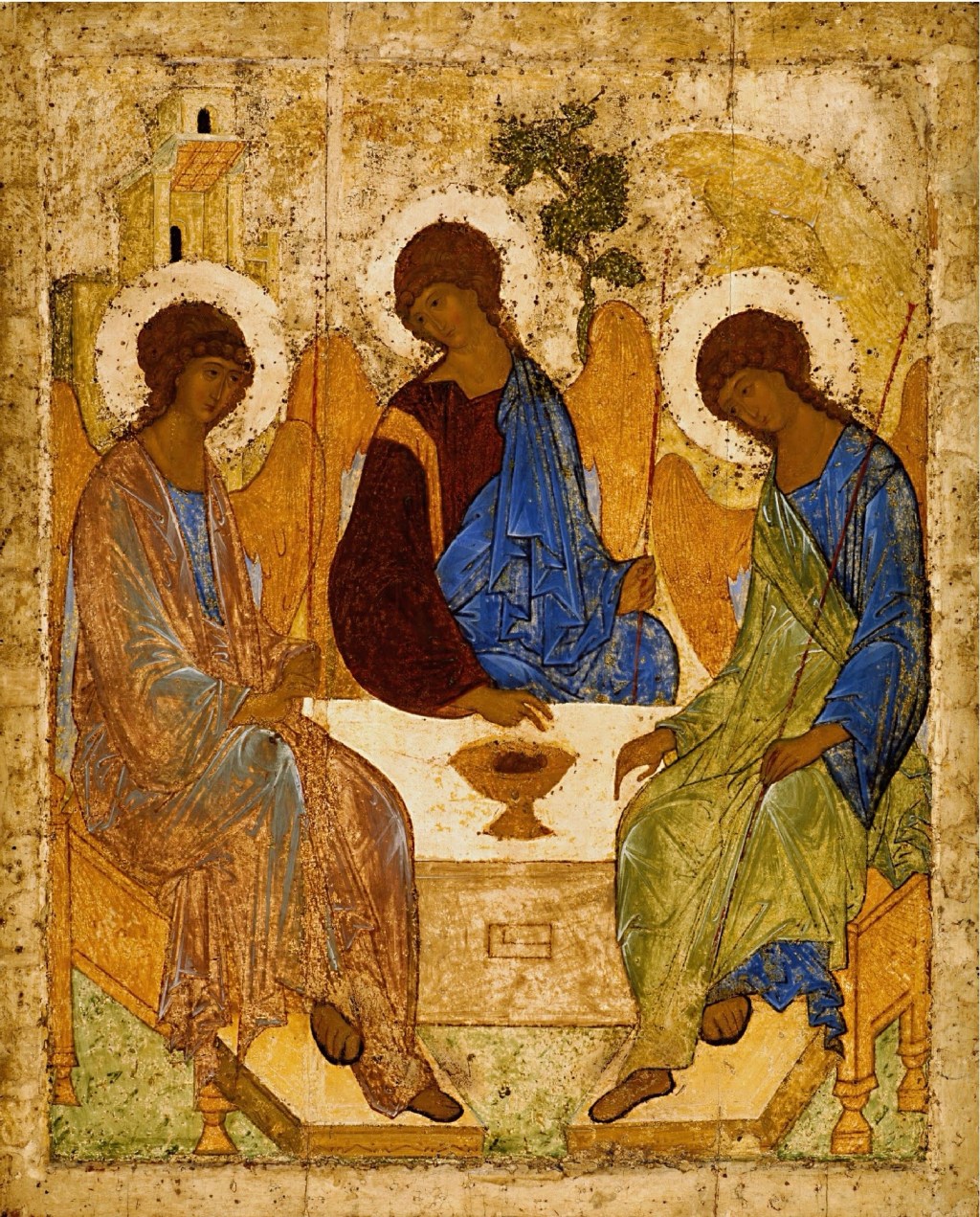
Rublev’s Holy Trinity

art, epilepsy, Faith, generosity, Holy Spirit, Holy Trinity, Icons, inspiration, Painting, Rublev, salvation, vision

Rublev: The Holy Trinity, 1411 or 1425-27, Russia

One of my favorite icons is Andrei Rublev’s Holy Trinity because it not only has the theological theme of the Trinity, but also the message of hospitality to strangers. As Hebrews 13:2 reminds us,

“Do not neglect to show hospitality to strangers, for by doing that some have entertained angels without knowing it.”

This subject of this icon is the three angels for whom Abraham spread a feast in the wilderness where he and his barren wife Sarah lived while they tended their flocks. The angels appear with their walking staffs and sit at Abraham’s table set with a dish of food. In the background is a mountain, representing the wilderness and a tree, locating the scene at the oaks of Mamre.

Koulouris Iconography House: Saint George Greek Orthodox Church, West Bank Territory, Holy Land

Rublev’s palette is full of light with a predominance of gold, shining ochre, delicate shades of green, pink, and violet, and his inimitable sky-blue, too, in combination with the fine rhythm of lines and perfect composition. Altogether this produces an image of unearthly beauty and a heavenly harmony. This isn’t just a banquet in the desert wilderness, but a meal in the inbreaking moment in which we experience the timeless realm of heaven.

On earth, we count the minutes, days, and years, but in the company of God, we enter into the eternal and timeless experience in which God lives. Yesterday, today, and tomorrow are the same for the God who is known as I AM, for I AM lives always in the present and I AM is always becoming. There never was a time when the I AM was not. God always IS, even if we think God is not.

We may forget God, and our love may fail, but the steadfast love of the great I AM never fails because God’s love is, as the prophet Isaiah describes it (43:25):

“I, I am He who blots out your transgressions for my own sake, and I will not remember your sins.”

Copy of Rublev’s Holy Trinity, iconostasis at the monastery, 16th CE, St. Sergio’s Lavra, Russia.

Andrei Rublev painted the original icon in the Trinity-St. Sergius Monastery in either 1411 or 1425-1427. An artist made a copy of the Holy Trinity icon in the 16th CE. The Orthodox Church certified the Rublev Trinity as miraculous in 1626 and gave it a place of honor in the church, as well as metallic and jeweled embellishments. Over the next 500 years, artists restored the original Rublev icon several times. The early 1900’s saw two professional restorations: each one removed more layers of paint and lacquer until they revealed the original. The restorers decided hiding with a frame what was an “exclusive, in its worldwide importance, work of art” from the palette of Andrei Rublev was unacceptable.

Dating this important icon is more difficult than deciding its painter. Some think the icon was originally meant for the wooden Trinity Cathedral erected in 1411 and believe after the stone church was built, the congregation moved the icon there. Other art historians believe Rublev painted the “Holy Trinity” at the same time as his workshop painted the iconostasis in the new cathedral in 1425-27.

Rublev received a commission to paint this icon for the image of the Holy Trinity from St. Nikon of Radonezh: “an image for the Holy Trinity to be painted in his time, to venerate His Holy Father, St. Sergius the Wonderworker,” the monk who founded the monastery at Radonezh.

Since a cathedral dedicated to the Holy Trinity should have an icon of the Holy Trinity in it as its primary icon, the obvious choice was to select the best image that would convey the spiritual essence of the cathedral. This icon would embody the name of the Holy Trinity in color.

Icons have a purpose in worship, beyond mere mere beauty or illustration or teaching of doctrine. St. John of Damascus spoke in his “Apologies against Those who Decry Holy Images”, with which he addressed the Seventh Ecumenical Council calling on renowned painters for brave deeds, to set forth in their art the images of the Old and New Testaments, so that those who were not learned and could not read the Holy Scripture, would be able—by examining those stories—to enjoy the lives of holy men and their good deeds, for

“What the book does for those who understand letters, the image does for the illiterate; the word appeals to hearing, the image appeals to sight; it conveys understanding.” (Treatise 1.17)”’

Betsy Porter: Holy Trinity icon with Holy Communion

In other arguments against those iconoclastic believers, those who advocated instead for the use of images in worship reminded people the icon represents the truth of a spiritual reality. Some have compared the icon to a “window into heaven.” No one then or now worships the icon itself, but they do venerate the holiness of the person represented in the image. They hope to recognize the presence of God with them when they come to the quiet and stillness before the icon at their home altar and when they share in the presence of God in public worship in the sanctuary among the holy icons.

Abraham and the Three Angels, Mosaics in Santa Maria Maggiore, Rome (432-40 CE)

Theologically, the Western church has treated all three members of the Holy Trinity as coequal members, as seen in the mosaics of the 5th CE basilica of Santa Maria Maggiore. By placing all the heads on one level, or the use of isocephaly, the artist tells us the figures are equal in stature. Abraham is therefore lower than the heavenly visitors. Isocephaly is the art term which originates from the Greek words “isos” meaning “equal” and “kephalos” meaning “head”. We already know this word from our common knowledge: isosceles triangles have two equal sides and encephalitis is an inflammation of the brain, which is within our heads. (Sorry, old schoolteachers never die, but keep on explaining our 50 cent words; it must be that “back to school” time of year!)

Commercial Paper icon appliqué on wood panel “after Rublev,” but lacks the background architecture and has a substantial table without a cloth covering.

The Rublev icon has the heads of the three angels arranged in a triangle. They represent the Triune God. The center figure is slightly higher than the other two figures’ heads. This is because the Eastern Orthodox Church holds a slightly different view of the Holy Trinity. The incomprehensible God has indeed revealed God’s self in a manner that is incomprehensible.

All errors in trying to explain the Trinity come down to the following issue: we try to explain the living God, using a method of human thought—rational, natural, or philosophical—instead of witnessing to the reality and the truth of an encounter with the living God. To ask what God is, is the wrong question. Rather, who God is, is the primary question.

Prepratory stage

The answer is—God is Triune. We know God by God’s activity in the world, or energies, which we can see and can understand. In fact, all our understanding of God or what we say about God, comes from what God has done in the world, from God’s energies. The essence of God is still beyond our understanding, inaccessible to our understanding. If we could understand it, it would not be God, for God is beyond our understanding, as Isaiah 55:8-9 reminds us:

“For my thoughts are not your thoughts,

nor are your ways my ways, says the LORD.

For as the heavens are higher than the earth,

so are my ways higher than your ways

and my thoughts than your thoughts.”

Second day, making some corrections

Both the Western and the Orthodox Churches are in agreement as regards the unity of the Trinity as to the persons and their shared being. They also agree the Trinity isn’t three separate gods or three different revelations of one singular god. The Eastern Church and the Western Church did split over whether the Holy Spirit proceeded from the Son alone (East) or from the Father AND the Son (West).

Gaining on it, another studio day

The earliest creeds from the 4th CE didn’t even mention the Holy Spirit, mostly because the early church was combatting heresies about the nature of the Son (such as he was actually human, only appeared to be human, only parts were human, and other variations other than he was a full member of the Trinity and in Christ being fully human and fully divine).

By 381 CE in Constantinople, the creed included the words:

“And in the Spirit, the holy, the lordly and life-giving one, proceeding forth from the Father, co-worshipped and co-glorified with Father and Son, the one who spoke through the prophets; in one, holy, catholic and apostolic church.”

The first Latin council to add the phrase “and the Son” (filioque) to its creed was the 447 CE Synod of Toledo, Spain. The filioque formula was also used in a letter from the Catholic Pope Leo I to the members of that synod regarding opposition to a form of the fifth century manifestations of the Arian heresy which was prevalent among the Germanic tribes of Europe.

Stage 4, the draperies are taking the shape of the bodies

As football season heats up in the USA, we fight our culture wars on social media, not in the streets. The latest heresy for some is professional football teams now have male cheerleaders on the sidelines. The conservative rabble rousers destroyed their coffeemakers and burned their team jerseys in the past. Wearing paper sacks to maintain anonymity at the games is too yesterday. The recent announcement of the heroic and rugged Minnesota Vikings football team’s addition of two talented and athletic young male dancers is more than they can take. The keys of their favorite social media platform have been clicking and clacking. Radio waves are sizzling and heating up our already too sweaty summer.

Trinity, stage 5: two steps forward and one step back

The bishops at Toledo affirmed the Holy Spirit’s procession from both the Father and the Son to exclude the Arian notion of the Son being something less than a co-eternal and equal partner with the Father from the very beginning of existence. Street protests were common during this time over theological beliefs: the Catholics chanted, “There never was a time the Father was not a Father, the Son not a Son, and the Spirit didn’t proceed from both!” Against them, the Arians marched, “The Son was born, not begotten!” Exciting times, the late 5th CE.

Stage 6, details showing up

Several of our past GOP presidents were college cheerleaders, including Ronald Regan and George Bush. On a personal note, six decades ago, my big city high school in the Deep South had a tradition of boy and girl cheerleaders on a team of equal numbers to do exciting and complicated stunts. We were not aware of being “woke.” We were, however, always seeking to bring out the best of each person to reflect well upon our school and our city, which we represented.

Unfortunately, accusing the present NFL teams of being “woke” ignores American history, since the USA FEDERATION FOR SPORT CHEERING recognizes the first cheer in America as occurring on November 2, 1898 at the University of Minnesota, when student Johnny Campbell got up from the seats and took the field to lead the student body in a chant. If 127 years is too far back for people’s minds, we can turn to more recent history.

DeLee: Holy Trinity after Rublev, acrylic on canvas, 16” x 20”

Cheerleading is a metaphor for hospitality, which is one of the great attributes of the Holy Trinity. Hospitality is only possible where love resides and where community is experienced and practiced. Los Angeles led the way in 2018 by including two male dancers on their NFL Ram’s team. They were part of the Super Bowl LIII in 2019. Tryouts have always been “open,” but only women had shown up before. Like the strangers who showed up at Abraham’s tent, the cheer squad welcomed the men into the family and brought them under the protection of their group. When we practice hospitality, the “other” is no longer a “them.” The “stranger” becomes one of “us” because we reflect God’s loving nature to the vulnerable and we offer the bounty of our table to nourish their body and spirit.

I began working on this icon during social and personal distress. The social distress is obvious to anyone who reads a newspaper or watches a television newscast. Never have I seen so many professing Christians refuse to “love their neighbor as themselves,” or “do unto others as you would have others do unto you.” I don’t know how they sleep at night, for my own heart hurts for the pain inflicted upon the strangers who walk among us, who very well may be the Holy Trinity in earthly disguise. If we treat them like their next stop on their journey, only a few of us will walk away unscathed.

My personal distress comes from the blessing of living long enough, thanks to excellent medical care and the ability to live a structured, carefree life. As we age, medication affects us differently. My neurologist dropped the amount of my seizure medication, and my cardiologist upped my blood pressure medication. I was taking too much magnesium, so that was making me lethargic as well as lowering my blood pressure. Now that I’ve gotten stabilized, I feel a lot peppier.

Unfortunately, I began painting and drawing this icon while all this unwellness was going on. I can see “room for improvement,” as I always remind folks to say when critiquing their own art works. I have learned much from this time and have seen the icon in a new and closer light. I will come back to it again when I feel I’m more competent to give it my best.

A masterpiece always deserves the best we can offer, yet I rest secure knowing God has grace for those of us who are wounded, weak, or broken in any way. Whatever we bring in this time and place right now is the best we can offer upon God’s altar. God refuses no honest gift. If we spread peanut butter sandwiches on the table for the visitors as the offered feast because this is what we have, God will bless this gift.

The Holy Trinity of God lives in a loving community of self-giving hospitality and generosity within its unity of being. All three persons love, support, and care for one another in equal measure. As we humans would understand this: no one in the Trinity carries a heavier burden than another. In like manner, each person shares all the energies and work of the others.

The work of salvation may be through our faith in Christ’s work on the cross, yet it was the Father who sent the Son to redeem all creation and the Holy Spirit who brings us to the understanding of this saving grace. The whole work of God in Three Persons saves us if we have Trinitarian faith. And it is by the power of all the Holy Three we can stand against the hatreds and evils of this age.

Indeed, if we can offer any service well-pleasing to God, following the admonitions of Hebrews 13:1-2 would help all:

“Let mutual love continue. Do not neglect to show hospitality to strangers, for by doing that some have entertained angels without knowing it.”

Rublev: The Holy Trinity icon

Abraham’s angelic visitors blessed him and his wife Sarah with the promise of a longed-for son. We might learn to love our neighbors more if we shared our hospitality and opened our hearts to the people we meet. May you meet angels in your daily life and share whatever feast is in your pantry.

Joy and peace,

Cornelia

Andrei Rublev: Image of the “Holy Trinity,” The Tretyakov Gallery Magazine. Andrei Rublev painted the Holy Trinity icon, which is the central image in the cathedral’s iconostasis. One of the most famous Russian icons, he created it “in praise of St. Sergius.” The original is in the hall of Old Russian painting of the Tretyakov Gallery, in a special glass case with controlled humidity and temperature. In Trinity Cathedral you can see a copy of the icon to the right of the royal doors in the first (lowest) tier of the iconostasis.

https://www.tretyakovgallerymagazine.com/node/7196

Excerpts from Three Treatises on the Divine Images by St John of Damascus, translation and introduction by Fr. Andrew Louth, St Vladimir’s Seminary Press, 2003.

https://www.svots.edu/blog/st-john-damascus-divine-images

 A Miracle of Knowledge: St. Sergius of Radonezh / OrthoChristian.Com

https://orthochristian.com/41950.html

Venerable Nikon, Abbot of Radonezh, disciple of Venerable Sergius – Orthodox Church in America

https://www.oca.org/saints/lives/2016/11/17/103316-venerable-nikon-abbot-of-radonezh-disciple-of-venerable-sergius

Daily readings from the lives of the Orthodox Saints:

https://www.oca.org/saints/lives

Home – Icons: Windows Into Heaven – LibGuides at Duquesne University: This is a reputable source for orthodox icon information via the Duquesne Library. Links to outside sources are broken. Reference books are available elsewhere.

https://guides.library.duq.edu/icons

Mosaics in Santa Maria Maggiore, Rome (432-40): if you’ve never been to Italy, you can see the entire beautiful interior of this 5th CE basilica here.

https://www.wga.hu/html_m/zearly/1/4mosaics/1rome/3maggior/index.html

Introduction to Orthodoxy 4: The Holy Trinity – Orthodox Catechism Project

https://www.orthodoxcatechismproject.org/introduction-to-orthodoxy/-/asset_publisher/IXn2ObwXr9vq/content/introduction-to-orthodoxy-4-the-holy-trinity

First Council of Constantinople 381 – Papal Encyclicals

First Known Cheerleader was a Male Student

Vikings Respond to Male Cheerleader Backlash – Newsweek—12 NFL teams are reportedly set to have male cheerleaders on their squads this season. The teams as the Vikings, Ravens, Rams, Saints, Eagles, 49ers, Patriots, Titans, Colts, Chiefs, Buccaneers and Panthers.

https://www.newsweek.com/minnesota-vikings-respond-backlash-male-cheerleaders-2113864


Cosmic Rainbow

Apocalypse, art, beauty, cosmology, Creativity, Faith, hope, inspiration, John Ruskin, Leonardo da Vinci, nature, Painting, purpose, sleep, Spirituality, Van Gogh, vision, William Blake

In times of cultural change and uncertainty, some faith-based communities turn to apocalyptic literature to find meaning, if not solace, for their suffering. Other communities of faith look forward to a future of hope and joy, even though they live in the same circumstances.

Apocalyptic literature is a genre of writing that appeared during times of crisis or persecution. It often presents a vision of the end times and the ultimate triumph of good over evil. Apocalyptic literature has several major characteristics:

“The supreme manifestation of Satan in this world is war.” By William Blake, 1805, apocalyptic painting with
tempera, gum, glue, and chalks, Tate Galleries, London.
  1. Dualism: Apocalyptic literature often portrays a cosmic battle between good and evil forces, highlighting the struggle between light and darkness.
  2. Symbolism: Deeper meanings and abstract concepts are represented by symbolic language and imagery.
  3. Eschatology: Apocalyptic literature focuses on the end times (Greek eschatos last, farthest) and the ultimate judgment of humanity, exploring themes of divine justice and the afterlife.
  4. Pseudonymity: Many apocalyptic texts attribute their authorship to famous figures from the past, using pseudonyms or false names.
  5. Visions and Dreams: Apocalyptic literature often includes visionary experiences and dreams as a means of conveying divine messages and revelations.
  6. The future is fixed and decided in apocalyptic literature, whereas with prophecy, people can change their future by repentance and restoring their relationship with God.

Since John was already in exile, “The Revelation to John” doesn’t bother to hide his authorship for his safety. He does claim it’s a vision of Christ mediated by an angel. It also checks the boxes of good vs evil, symbolism, the end times, and a fixed future. The actual date of this future isn’t revealed, however.

An interpretive mistake many make is to take this letter written to encourage the persecuted churches of the first century and project its message into our modern-day society. The symbols which were meaningful to John’s audience are for that historical context alone. Reinterpretations of these signs to make them relevant to our current geopolitical situation is bad scriptural interpretation.

Plate 12, First book of Urizen, by William Blake

What we can do is ask, “What can persecuted communities or suffering societies of the past teach us about resilience, hope, and faith?” Some will focus on God’s destructive forces to eradicate evil and harm. Belief in God’s power to overcome evil is a source of deep comfort for people without power. These are often the ones who feel excluded from the halls of power, but also those who believe their privilege and place is slipping away.

God’s fridge would be covered with photos!

Both these groups forget they are beloved of God, just as God loves all God’s children. Sometimes we forget God’s refrigerator is large enough to have the photographs of all the people of the world on its door, along with all our latest art works also. If that’s a humongous refrigerator, then that gives us an idea of the expansive reach of God’s love, mercy, and grace for all creation.

The First Day of Creation, by Francisco de Holanda (1545), with caption, “Let there be light.”

A negative outcome of this dualist, apocalyptic belief is extremist beliefs about the end times. Unfortunately, some extremist pastors have convinced their followers to end their lives to meet their predicted apocalyptic end of the world. The leader creates the fiction of an evil out-group to bind the members more closely to their cult and proclaims apocalyptic themes to brainwash their members. Numerous mass suicides worldwide have occurred as a result, including 914 people of Jim Jones’ People’s Temple. In 1997, 39 members of the Heaven’s Gate cult in San Diego, California, committed mass suicide by poisoning to coincide with the arrival of the Hale-Bopp comet, considering this a signal for their exit from Earth. Others have given away their entire nest eggs to apocalyptic cults because “no one will need money in the new creation.”

Paul Klee: Clarification, 1932, Oil on canvas, 27 3/4” × 37 7/8” (70.5 × 96.2 cm), The Berggruen Klee Collection, 1984 Accession Number: 1984.315.54

Some of us prefer to focus on The New Heaven and the New Earth instead, as found in Revelation 21:1-4—

Then I saw a new heaven and a new earth; for the first heaven and the first earth had passed away, and the sea was no more. And I saw the holy city, the new Jerusalem, coming down out of heaven from God, prepared as a bride adorned for her husband.

And I heard a loud voice from the throne saying,

“See, the home of God is among mortals. He will dwell with them; they will be his peoples, and God himself will be with them; he will wipe every tear from their eyes. Death will be no more; mourning and crying and pain will be no more, for the first things have passed away.”

Stage 1—strings and base colors

What a day that will be! The last time God destroyed the earth with a great flood, God placed a rainbow in the sky as a promise the earth would never be destroyed again by water.

Leonardo da Vinci said, “Where the spirit does not work with the hand there is no art.” For some people, the only “good art” is representational art, or art which faithfully describes a landscape, portrait, or still life. With abstract art, colors carry emotions and shapes to form pleasing patterns for the viewer. What will the new heaven and the new earth look like? Revelation 21:11 says “It has the glory of God and a radiance like a very rare jewel, like jasper, clear as crystal.”

Stage 2—addition of gold and silver washes

While many today think of heaven as an earthly paradise, this concept is a Persian idea of an enclosed garden, much like the original garden of Eden. We tend to imagine a heaven as being a better place than the world we know, but imagining an altogether different world is next to impossible! Luke 20:27-38 is Jesus’ answer to the law-abiding Sadducees about how relationships work in heaven, and a reminder to us heaven isn’t just a perfect earth.

When I think of the providence of God, which is grounded in creation and is always recreating the face of the earth, I remember God’s promise to Noah in Genesis 9:11-13—

“I establish my covenant with you, that never again shall all flesh be cut off by the waters of a flood, and never again shall there be a flood to destroy the earth….This is the sign of the covenant that I make between me and you and every living creature that is with you, for all future generations: I have set my bow in the clouds, and it shall be a sign of the covenant between me and the earth.”

Stage 3—Added circles and more gold and silver washes

It is this cosmic rainbow of colors, the spiritual energies which most of us cannot see for the overwhelming ordinariness of daily life. We race from chore to chore, dash from task to task, and drop exhausted at the end of our days. We long for a better life, but we’re stuck on a galloping treadmill trying to keep our feet under us. I long to walk rather than run through my days. When I was younger, older people told me to slow down. As I hit middle age, I heard I would soon start slowing down. Now that I’m inching closer to 80, slowing down is finally becoming a reality!

Vincent Van Gogh said, “Paintings have a life of their own that originate in the soul of the artist.” We cannot see the new heaven and new earth unless we stop our busywork and allow God to attend to the business of our spiritual life. When we see the first glimmers of the new heaven and the new earth, we’ll realize how imperfect our world is and begin to help change it for the better, one small act of kindness at a time. This is soul work.

Sometimes that kindness first means being kind to ourselves, when we admit we can’t say YES to everything and everyone. When we admit we actually need eight hours of sleep for our health and a daily quiet time, and we can stop to study the flowers in the cultivated gardens of our neighborhoods and in our parks.

Cosmic Rainbow—acrylic on canvas, 24” x 30”, 2024.

Then we can be a beautiful rainbow, God’s light in this world for good, and bring the hope and joy of the end times to these times. We then will bring the radiance of the new heaven and the new earth to this present age and to these yearning people.

Joy, peace, and rainbows,

Cornelia


 what are the five major characteristics of apocalyptic literature – brainly.com

https://brainly.com/question/35289093

World’s most chilling cults

https://www.france24.com/en/live-news/20230424-world-s-most-chilling-cults

Paradise Definition & Meaning – Merriam-Webster

https://www.merriam-webster.com/dictionary/paradise

 Middle English paradis, paradise “the Garden of Eden, heaven,” borrowed from Anglo-French paradis, borrowed from Late Latin paradīsus, borrowed from Greek parádeisos “enclosed park or pleasure ground” (Xenophon), “the Garden of Eden” (Septuagint), “the abode of the blessed, heaven” (New Testament), borrowed from an Iranian word (perhaps Median *paridaiza-) cognate with Avestan pairidaēza- “enclosure,” nominal derivative of pairidaēz- “build a barrier around,” from pairi- “before, around” (going back to Indo-European *per-i, whence also Sanskrit pári “around, about,” Greek péri “around, in excess”) + -daēza- “heap up, build” (occurring only with prefixes), going back to Indo-European *dhoi̯ǵh-éi̯e-, iterative derivative of *dhei̯ǵh- “knead, shape” — more at PERI-, FEIGN

NOTE: As an independent derivative of the verb, Avestan daēza- “heap, pile (of earth, stones)” has been compared with Greek teîchos (neuter s-stem) “wall, fortification,” toîchos (masculine) “wall of a house or enclosure,” Sanskrit dehaḥ “body,” dehī́ “wall, embankment,” Oscan feíhúss (accusative plural) “walls.” For a Germanic derivative from the same verbal base with a different sense, see DOUGH.

THE TEN COMMANDMENTS IN THE SCHOOLS

art, Children, elections, Faith, Forgiveness, holidays, Icons, incarnation, inspiration, Marcus Aurelius, Ministry, Painting, righteousness, Ten Commandments, vision

When does an image become a meme? Or an icon, an idol, or a shibboleth? I ask those questions, and then have go about defining them. We all know what an image is—a representation of something which actually exists. An icon is the Greek word for image, but to become a venerable image, it must bring the viewer into the spiritual realm, rather than leave the viewer only in this earthly world.

An idol is an inert representation of a god, but isn’t a god at all, for the god is invisible and spiritual. Praying to a golden calf or a carved wooden statue will get no response since it has no power or animation. The same can be said for shibboleth, which is a word or saying used by adherents of a party, sect, or belief and usually regarded by others as empty of real meaning. If the Ten Commandments are held up as mere words, idolized, but not kept in their hearts and lives, then they are as empty of power as golden calves. They also aren’t to be worshipped, but the God who gave them is.

Are the Ten Commandments now a meme? Memes are an amusing or interesting item (such as a captioned picture or video) or genre of items that are spread widely online especially through social media. Because this version of the Ten Commandments had its origin in the Charlton Heston movie, “The Ten Commandments,” which we see every single Easter and Passover season, it’s definitely in the public sphere. I’m of the opinion it’s fast becoming a meme—devoid of actual meaning and held up to ridicule.

DeLee: Icon of Christ, acrylic on woven canvas , 2022.

The version in the Louisiana law matches the wording on the Ten Commandments monolith that stands outside of the Texas State Capitol in Austin. It was given to the state in 1961 by the Fraternal Order of Eagles, a more than 125-year-old, Ohio-based service organization with thousands of members. In 2005, a divided U.S. Supreme Court ruled it did not violate the constitution and could stay.

The Eagles organization notes on its website that it distributed about 10,000 Ten Commandments plaques in 1954. The organization also partnered with the creators of “The Ten Commandments” to market the film, spreading public displays of the list around the country.

“It’s significant that the Louisiana law uses the same text created for ‘The Ten Commandments’ movie promotions by the Fraternal Order of Eagles and Paramount Pictures because it reminds us that this text isn’t one found in any Bible and isn’t one used by any religious faith,” Kruse said via email. “Instead, it’s a text that was crafted by secular political actors in the 1950s for their own ends.” Kevin M. Kruse is the author of “One Nation Under God: How Corporate America Invented Christian America” and a history professor at Princeton University.

Unknown Flemish Artist: God speaks to Moses while the people worship the golden calf, colored ink and gold leaf on parchment, 1372, National Library of the Netherlands.

The actual biblical Ten Commandments are spiritual and can bring us closer to understanding God’s relationship with God’s chosen people during their wilderness journey. We can learn about boundaries, justice and mercy. Also we learn God wants us to be imitators of God’s nature, something that’s missing in the movie version of the Ten Commandments. The movie commandments are a Reader’s Digest version of the Biblical commandments and miss the grace of God entirely.

For Benjamin Marsh, a North Carolina pastor watching the Louisiana law, his primary concern is people’s spiritual formation, so altering the Ten Commandments is worrisome to him. “The problem with changing the text of the Ten Commandments is you rob the spiritual implications of the actual biblical text. So you’re giving some vague likeness to the Ten Commandments that isn’t the real thing,” said Marsh. He leads First Alliance Church Winston-Salem, which is part of a conservative evangelical denomination.

So I offer these two versions below for you to read. I believe the placing of the Ten Commandments in the schools in these states has less to do with “religion” than with culture wars, which these politicians hope to use to their advantage. If we see these in our communities, we should ask for comparative religions to be taught, or none at all. I find the misuse of scripture abusive. This isn’t what we should be doing to vulnerable children. We should give them a God who loves, cares for, and provides for their needs. The Ten Commandments in the school houses is like having a cop in the classrooms.

FROM THE MOVIE, “The Ten Commandments:”

The Ten Commandments I AM the LORD thy God. Thou shalt have no other gods before me. Thou shalt not make to thyself any graven images. Thou shalt not take the Name of the Lord thy God in vain. Remember the Sabbath day, to keep it holy. Honor thy father and thy mother, that thy days may be long upon the land which the Lord thy God giveth thee. Thou shalt not kill. Thou shalt not commit adultery. Thou shalt not steal. Thou shalt not bear false witness against thy neighbor. Thou shalt not covet thy neighbor’s house. Thou shalt not covet thy neighbor’s wife, nor his manservant, nor his maidservant, nor his cattle, nor anything that is thy neighbor’s.

FROM KJV: Exodus 20:2-17

I am the LORD thy God, which have brought thee out of the land of Egypt, out of the house of bondage. Thou shalt have no other gods before me. Thou shalt not make unto thee any graven image, or any likeness of any thing that is in heaven above, or that is in the earth beneath, or that is in the water under the earth: Thou shalt not bow down thyself to them, nor serve them: for I the LORD thy God am a jealous God, visiting the iniquity of the fathers upon the children unto the third and fourth generation of them that hate me; And shewing mercy unto thousands of them that love me, and keep my commandments. Thou shalt not take the name of the LORD thy God in vain; for the LORD will not hold him guiltless that taketh his name in vain. Remember the sabbath day, to keep it holy. Six days shalt thou labour, and do all thy work: But the seventh day is the sabbath of the LORD thy God: in it thou shalt not do any work, thou, nor thy son, nor thy daughter, thy manservant, nor thy maidservant, nor thy cattle, nor thy stranger that is within thy gates: For in six days the LORD made heaven and earth, the sea, and all that in them is, and rested the seventh day: wherefore the LORD blessed the sabbath day, and hallowed it.

Honour thy father and thy mother: that thy days may be long upon the land which the LORD thy God giveth thee. Thou shalt not kill. Thou shalt not commit adultery. Thou shalt not steal. Thou shalt not bear false witness against thy neighbour. Thou shalt not covet thy neighbour’s house, thou shalt not covet thy neighbour’s wife, nor his manservant, nor his maidservant, nor his ox, nor his ass, nor any thing that is thy neighbour’s.

Joy, peace, and time to read your Bible,

Cornelia

Louisiana Ten Commandments law raises preferential treatment concerns | AP News

https://apnews.com/article/ten-commandments-louisiana-public-schools-religious-views-7c4af860da21df52c304346fab76c4ae

Fraternal Order of the Eagles

https://www.foe.com/About-The-Eagles/History

Great American Eclipse Paintings

adult learning, art, Creativity, Faith, Great American Eclipse, Imagination, inspiration, Love, Ministry, nature, Painting, photography, salvation, Spirituality, vision

After the Great American Eclipse, I’m reminded once again how great and wide is the love of our God. We say, “Our God,” as if we could own or possess the one who holds us, since God is beyond our knowing or possession. We can own a boat, a house, or a work of art. In the bad old days before the Civil War in America, people once owned other human beings. We fought a mighty conflict so our nation could be made up of free people, all of whom have equal rights. Unfortunately, not all have equal opportunity.

Patriotic Sunglasses

In America, we are so privileged, we often look at most everything through red, white, and blue lenses. We don’t take off our “American eyes” to see as God sees. To make this point, the Great American Eclipse actually began over the Pacific Ocean, so perhaps whales and sea birds would have been the first to experience it. When the eclipse reached land in Mexico, those in Mazatlán saw it before anyone in Texas did. I have lived in Texas, so I know they like to be the “first, best, and biggest” in everything, so they’ll ignore the fact this eclipse actually was seen by others first.

Eclipse Path: you are here

We don’t need to be first or best to deserve God’s love and providence. God proves God’s love for us every day the sun rises and sets. God gives us the rain in its season and grass for the herds to feed upon. We don’t have to exclude others to get God’s love, for God’s love is wide enough to include all. A God, who can call an entire universe into being with just a word, has the infinite resources to love all fully and completely. We are the finite ones, having limited resources and understanding, who find the need to limit God’s love to a few.

We tend to think in human terms of competition, in which one person gets a blue ribbon or a trophy and everyone else is a “loser.” That’s the Rickey Bobby of Talladega Nights school of theology. God made the entire universe, even tiny Pluto, which our astronomers demoted from planet status to a dwarf planet in the Kuiper Belt. Just because we relegated Pluto to a minor status doesn’t mean God diminishes God’s love, care, and concern for God’s creation.

Bill Maxey: Total Eclipse at Hot Springs AR

When we have the opportunity to view an awesome event of creation, such as a total eclipse of the sun, we have to consider ourselves privileged to be alive and part of God’s care. When the moon fully covers the sun and darkness falls upon the face of the earth where you stand, the cool air touches your skin, and your heart burns within. The excitement and rush of energy is so great I had to shout! I’ve heard some people cry. I guess I’m an exuberant sort.

Nana’s Poem: typed from memory

On 20 August 1892, “The Times” published an article by Kipling, “Half-a-Dozen Pictures”: it was one of a series of travel articles called From Tideway to Tideway. The article described a visit to an art gallery and Kipling’s reflections on the failure of most painters to match the beauty and vitality of the world around them. He offered some attractive verbal sketches of his own, though it wasn’t part of his purpose to contrast the approaches to nature of writers and painters. His main concern was to urge artists of all kinds to get out and see the world for themselves: (Letters of Travel 1892-1913 p. 40):

Now, disregarding these things and others – wonders and miracles all – men are content to sit in studios and, by light that is not light, to fake subjects from pots and pans and rags and bricks that are called “pieces of color”. Their collection of rubbish costs in the end quite as much as a ticket, a first-class one, to new worlds where the “props” are given away with the sunshine. (Letters of Travel 1892-1913 p.77).

Eight days later, the same article was published in the New York Sun. This time it closed with the untitled poem ‘When Earth’s Last Picture is Painted…’ which changed the article’s emphasis from an exhortation to artists to become travelers and pioneers, to what sounds very much like a manifesto for realism in art:

“And only Rembrandt shall teach us, and only Van Dyck shall blame:

And no one shall work for money, and no one shall work for fame,

But each for the joy of working, and each, in his separate star,

Shall draw the Thing as he sees It for the God of Things as They are!

Four years later, Kipling changed the first line of that stanza to:

“And only the Master shall praise us, and only the Master shall blame,”

Kipling, the son of an artist, knew the true joy in life comes from one’s dedication to whatever work is in hand, and the task of the Artist is to convey to others the excitement and wonder of an expanding world. By changing the last line from artists’ names to the Master, Kipling heightened the spirituality of his poem. The artist’s task isn’t merely to render a faithful image of the landscape or person before them, but to bring forth all the inner energies and personality they see and feel.

Cornelia DeLee: Memory of the Last Great Eclipse, acrylic on canvas, 12” x 24”

This is why we don’t copy nature, since it’s three dimensional and we have a two-dimensional surface on which we make our marks to represent what we see. Perspective is our visual language to fool the eye into believing our flat surface has depth. Often we paint abstract shapes and colors because these are the best means to convey our emotions about an experience. Photography captures one way of seeing, but painting can render emotions with brush strokes and colors.

Cornelia DeLee: Door to Another Reality in the Eclipse, acrylic on canvas, 18” x 24”

I subscribe to a wonderful poetry series by Steve Garnaas-Holmes, which I receive daily. This poem’s theme of universal love spoke to me as I felt the in-flooding joy of God’s creating power during the Great American Eclipse:

I have other sheep that do not belong to this fold.   I must bring them also, and they will listen to my voice. —John 10.16


We think we’re being open-minded
when we include “all of us,” Protestant and Catholic,
Orthodox and Coptic, as if we see the whole landscape.
But the pasture and the Shepherd are far greater than that.
Believer, unbeliever and other-believer alike
are all shepherded, each in their own language.
And still there are more, and more other, sheep. 
Like, well, sheep.
Do not the deer and otter, whale and fungus
follow the Shepherd faithfully?
Is not the bird migrating its continents shepherded as well?
Christ is not the partisan figurehead of a religion,
Christ is the infinite embodied grace of God,
the Shepherd of all Creation,
who leads rivers to the sea and winter into spring
and each of us into life.
So there are still other, and more “other,” sheep.
For Copernicus isn’t done with us yet:
we admit the sun doesn’t revolve around the earth,
but we still think God does.
No, little one: we are in a small corner.
Yet even the far galaxies,
the trillion trillions of stars and their planets,
and yes, their doubtless forms of life,
are also under the calm eye of the Shepherd,
and follow the Shepherd’s voice.
All of us, Baptist and Sufi, fish, bug and bird,
earthling and alien, village and nebula, all are one flock. One.
And, behold, even on the remotest planet
in the farthest flung galaxy—like ours—
or the most desolate spot in a life like yours,
under the loving gaze of the Shepherd who seeks out the one,
there is no one who is not at the center.


May you each find joy in your working, each in your separate stars, and draw the Thing as you see It, for the God of Things as They are!

Not only can God watch the sparrow, but also all the many suns and planets of creation.

Joy and peace,

Cornelia


When Earth’s last picture is painted – The Kipling Society

Steve Garnaas-Holmes: Unfolding Light 
www.unfoldinglight.net


Art for the Inner Child

adult learning, Apocalypse, art, Christmas, Creativity, Enneagram, Faith, Holy Spirit, hope, Imagination, inspiration, Light of the World, Ministry, Painting, perfection, purpose, salvation, Spirituality, vision

Discovery is exciting

What is the purpose of an art class? Why does anyone learn to speak a foreign language or take up a craft or sport they’ve never attempted before? We must want to explore some unknown universe or get out of our comfort zone, or as my old favorite television series would announce weekly, “to boldly go where no one has gone before.”

Light of the World Icon: Stencil effect

There are art classes and then there are Art Classes. Just as we shouldn’t make up our minds about a subject or a food until we experience it directly, we can have an open mind about a novel event, rather than rejecting it out of hand. Many of us have lived our lives under judgmental circumstances, dealing with rejection and disappointment at not being the best. “Talladega Nights: The Ballad of Ricky Bobby,” the NASCAR themed film of redemption and finding one’s purpose in life, stars Will Ferrell, whose father crippled him with this tragic life message:

“If you ain’t first, you’re last. You know, you know what I’m talking about?”

Near the end of the movie, Ricky Bobby learns this all was just crazy talk:

Ricky Bobby: Wait, Dad. Don’t you remember the time you told me “If you ain’t first, you’re last”?
Reese Bobby: Huh? What are you talking about, Son?
Ricky Bobby: That day at school.
Reese Bobby: Oh hell, Son, I was high that day. That doesn’t make any sense at all, you can be second, third, fourth… hell you can even be fifth.
Ricky Bobby: What? I’ve lived my whole life by that!

According to Baseball Reference, Ruth’s 183.1 career WAR — combining his value as a hitter and pitcher — is the highest all time, well ahead of Walter Johnson’s 164.8. For reference, the highest mark among active players is Albert Pujols’ 99.6 WAR.

We call this living out a “bad script” our ancestors have written for us. We see it all the time in the movies and on television. We read about it in novels and in comic books. For the most part, people don’t change their wicked ways, but get the consequences they’re due. The bad suffer and the good prosper. Or we read fairy tales in which the good little children get rewarded, or the unjustly treated ones are raised up, like Cinderella. These are the popular stories, but not the biblical tales. The book of Job calls this “retribution theology” into question, as does Jesus in the New Testament.

Annie French (1872 – 1965) Scottish: Cinderella and the Ugly Sisters, About 1900 – 1910, Pen and ink, watercolour and gold paint on vellum paper, 23.50 x 21.50 cm, Scottish National Gallery of Art.

In the Bible, God sends prophets, not only to call the people to account (critique their actions or behavior), but to offer the hope of a better future if they return to God and God’s ways (positive changes in behavior). In this way, a good art teacher is like a biblical prophet, who offers both positive and negative critique on the artwork. The teacher also offers “hope” or suggestions on how to improve the work. Teachers aren’t telling the person they don’t measure up, only that they need more time invested in making art to be able to bring their own artistic vision into reality.

Mike on Being the Light in the World

If we expected babies to chew steak from the moment of birth, the world would be a lonely place. If we expected these same babies to get up right away and “bring home the bacon” to buy their own steak and potatoes, they’d starve. Babies aren’t meant to walk before they crawl, nor or they chewing meat before they drink milk or pablum for a year or two.

Bacon Cake: Oh, Baby! I hope that’s REAL BACON!!

Someone who comes to art class should always come to learn something more, no matter how much they already know. I’m always learning new ideas and techniques. The act of making art is always an act of exploring new territories. We also grow by sharpening one another. Folks in the class are always excited to see how each other approaches the subject each week.

Mike’s May 2022 class work shows he’s been learning some things.

Only the apocalyptic writers in Scripture had a fixed view of the future. For them, God had given up on humanity. We humans were too far gone, too broken, and had destroyed God’s world beyond our weak means to repair it. Their only hope was for God to create “a new heaven and a new earth, for the first heaven and the first earth had passed away, and the sea was no more.” (Revelation 21:1)

Gail went the extra mile with Cri-Cut lettering

Of course, this isn’t a prediction of a certain time, but it’s a future hope for all times. It’s the hope all we creative people have every time we face a blank canvas, a pile of found objects, or a bag of scrap cloths. We also do this when we pull together a dinner before we go to the grocery store, and we take some of this and that which we have in our cupboards and refrigerators. We’re going to make something new! We do hope the Spirit of God descends to make this an inspired concoction! And if it doesn’t work out, we always know our salvation isn’t at stake over a single random supper creation. If I’m hungry enough, I’ll eat anything. Or there’s always peanut butter and jelly sandwiches.

Leftover Doughnuts and Sausage Bread Pudding Bunt Cakes

I was reading Richard Rohr’s Enneagram commentary on the American people. He says America is a nation of Threes: competitive, striving, always looking for success and improvement. When we hit a down cycle, and economics tells us we always have ups and downs in our economy, Americans act like we’ve been insulted. This doesn’t happen to us—to others maybe—but not to us! We’ll look both for a scapegoat and a savior, but never realize these conditions are a natural part of life.

Always be the best YOU. There’s never going to be another one just like YOU.

Likewise in groups, we’re always judging who got more, who has the most status, who’s preferred, and who’s on the out. We’re even liable to self-select to be on the outer group if we believe we won’t measure up, just to spare ourselves the shame of being found wanting. Joyce Rupp has a great poem about this very topic:

WE CAN LOVE THE IMPERFECT SELF
If I wait to be perfect
before I love myself
I will always be
unsatisfied
and ungrateful.

if I wait until
all the flaws, chips,
and cracks disappear
I will be the cup
that stands on the shelf
and is never used.

Magic Teacup Cake from Alice in Wonderland

If we’re faithful scripture readers, we know God never chooses the best persons to do God’s work. When we were children, we saw these characters as heroic figures, just as we saw our parents as great and invincible. The Old Testament records how Moses was a murderer, Joshua was afraid, Amos was a lowly shepherd, and David was an adulterer. Not exactly Perfect Role Models, but transformed people can do God’s mighty deeds if they let God work God’s purpose through their lives.

This word doesn’t mean what the headline writer thinks it does.

In Art Class, we don’t reject “poor work.” We aren’t a factory producing widgets. We have other goals: art appreciation, learning about colors, learning to see more clearly, developing a creative mind, and developing drawing skills. Art is a unique visual language, so learning how to render a three-dimensional form onto a two-dimensional surface takes some time and practice. Developing our own voice is the step beyond mastering the basics of artistic vocabulary. As I used to tell my parents at back-to-school night, just enjoy whatever your child brings to you! If you leave your “critical parent” at home, and bring your “inner child” to Art Class, life is way more fun!

Mike’s Christmas Card Collage

We’re currently on holiday sabbatical at Oaklawn UMC, but classes will return in the new year. We meet in the old Fellowship Hall at 10 am to noon. We always have coffee, and on occasional days, a tasty treat. Our class will begin working in watercolor beginning on January 5, 2024. I don’t charge for the class instruction, but each person should bring their own supplies. Supplies needed are:

Prang Oval 8 watercolor paint set with brush
  1. Prang Oval 8 watercolor paint set (containing brush)—on line at Walmart and Amazon. This has best color and pigments. I found a prime deal on Amazon for $3 each if you buy 3, free shipping.
  2. Watercolor paper pad 9” x 12” or larger (90 lb or heavier)
  3. Tall plastic container for water (iced tea glass size plus)
  4. Your inner child

Joy and peace,

Cornelia

MERRY CHRISTMAS, PEACE ON EARTH, GOOD WILL TO ALL

Talladega Nights: The Ballad of Ricky Bobby https://www.imdb.com/title/tt0415306/quotes/?item=qt0425224

Babe Ruth’s Top 10 career statistics— Shohei Ohtani produced 9.1 total WAR during his spectacular two-way campaign in 2021. Even he maintained that level of performance for 20 consecutive seasons, he would still be 1.1 WAR short of matching Ruth. https://www.mlb.com/news/babe-ruth-s-top-10-career-statistics-c163792958

Rabbit! Rabbit!

adult learning, at risk kids, brain plasticity, Children, city, Dreamscape, Faith, Family, flowers, Healing, holidays, Icons, Love, mandala, Mandylion, Ministry, ministry, nature, Prayer, purpose, rabbits, Reflection, renewal, risk, school shootings, shame, Spirituality, Stonehenge, summer solstice, texas, Uncategorized

Welcome to June! I’ve found my sunshades and my flip flops, so this rabbit is ready for a summer vacation. Old school teachers never die, they just take the summer off. And teachers, as well as students, will need a summer off, along with some intensive counseling, to get them ready to return in a healthy frame of mind next fall.

Summer Solstice Mandala

In my early years in ministry, I served in a certain county where many people were caught up in despair. I often complained to my district superintendent of my desire to pour mood elevators into the public water supply.

“You do know drugging the water supply isn’t exactly an acceptable activity for a Methodist minister?”

“Oh, yeah, but it sure would make my job easier.”

Rabbits Love One Another

Remember, June 3 is Love Conquerors All Day. I need to remind myself of this on occasion when I want to take the easy road. As Jesus reminds us in Matthew 7:13—

“Enter through the narrow gate; for the gate is wide
and the road is easy that leads to destruction,
and there are many who take it.”

Taking the easy way out isn’t always the best choice, but it’s the one we rabbits most often choose. We rabbits don’t like to rock the boat, and we like to make all the other rabbits happy if at all possible. The only problem is if we please A, B gets upset. If we please B, A gets upset. We don’t even try to please C, since C is so cranky, even the good Lord Jesus couldn’t fry an egg to please them. We set our hearts and minds on pleasing God, as best we can, and hope to hear the words, “Well done, good and faithful servant, enter into the joy of your master.”

Make Mine Chocolate Ice Cream Day

Chocolate ice cream brings me joy any day of the year, but June 7 is a day dedicated to this frozen delight. Don’t worry about frying eggs, but keep it frozen. I like mine plain, but fresh strawberries or peaches are a nice addition, plus some chopped nuts. Always go for complex, unless you just can’t wait. Then grab a spoon and eat it straight from the pint. (Mark it with your name, since you ate from it.)

Often we cut the Gordian Knot and go for the shortcut to our complex problems. Sometimes this is a good solution, for the shortest distance between two points is a straight line. My daughter used to call my vacation navigation shortcuts “the long cuts,” since I’m directionally challenged. Most of the time, that straight line went through swamp land and alligators. I can hear her voice now, “NOOOOO!!!” I’m known for taking the scenic route, so I often see America’s less known sights, which are off the beaten path.

In the gospel of Luke (14:34), Jesus quotes a proverbial saying:

“Salt is good; but if salt has lost its taste, how can its saltiness be restored?”

Another translation of the latter portion of this verse is “how can it be used for seasoning?”

When I think of loss, I think of a life snuffed out. Some people are burned out, so we can say they’ve lost their seasoning ability. There’s no vim or vigor in them. Other lives are cut short and aren’t able to fulfill their purpose to season the great soup of our community. Our past month was marked by 47 mass shooting incidents in May alone. A mass shooting incident is defined as one in which at least four people are injured or killed, not including the shooter. Suicides aren’t included.

Suicides are also a public health problem. They are the “deaths of despair” that leave ripples of grief and hopelessness in the survivors. They’re the ultimate shortcut solution to a problem, the placing of a period where life has placed a comma or a semicolon. My daughter once attempted suicide by downing half a bottle of aspirin. I noticed the open bottle and pills scattered across the floor. She said the “dog ate it.”

“That’s too bad, I’m going to miss that dog. She won’t be long for this world. We’ll need to make burial plans for her.”

“Well, actually, I’m the one who ate the aspirin.”

“Then we’re going to the hospital. You aren’t going to like getting your stomach pumped, but it’s better than being dead. You want to have a chance to grow up and have a good life. A dog we can replace. You—not so much.”

It was a rough time in her life, and mine too. But God was with us. And we had support from counselors, friends, family, and our church family. My work family and my clients supported me too. I must be the most extroverted rabbit in the patch, because I asked everyone for help. It turned out my problem was shared by everyone else. I discovered I wasn’t alone, but was the most ordinary of rabbits around.

This is a humbling experience, especially when you’re a first child and the only girl. I admit to being spoiled, but don’t let my brother rabbits hear me say this. I’ll deny it to my last breath: I’m like every other rabbit I know. I want to think I’m someone special, even when I’m just as fluffy as every other bunny out there on Gods green earth.

June 21—Summer Solstice

Unfortunately, half the suicides today are committed with a gun, not aspirins. When looking at overall gun deaths, roughly two-thirds are attributed to suicides—a proportion that is consistent across most states. Gun suicides are on the rise and data also indicates men, white Americans, older people, and individuals living in rural areas present higher rates of gun suicides. Another group presenting a unique risk for suicide is current and former members of the armed forces, especially those with PTSD.

Compared with the general population, current and former military members have significantly higher rates of gun ownership. According to a 2015 study, nearly 50% of U.S. veterans own a gun. In contrast, studies suggest that only about 22% of the general U.S. population owns firearms. Similarly, the age groups of 50 to 64 years old and 65 and older have the highest rates of gun ownership, according to a 2017 Pew Research Center study. This can further explain the high rates of suicide among older veterans.

According to data from the U.S. Department of Veterans Affairs (VA), in 2019, close to 4,332 veterans died by gun suicide in the United States, representing close to 18 percent of the total number of gun suicides reported by the Centers for Disease Control and Prevention (CDC) during that year. Perhaps more alarming is the fact this figure shows a veteran is killed by gun suicide every two hours. In 2019, active duty military members committed suicide by gun 64% of the 498 total (318), almost one gun suicide per day.

Why isn’t anyone speaking about this? For all the lip service our politicians give to the flag and to the armed service members, they seem to forget them once they’re no longer useful to fight their wars or march in their parades. Perhaps because Congress won’t devote any money to study the effects of gun violence on the citizens of our Beautiful America, so we have to fund private studies here and there to piece together a patchwork of facts of this scourge on the peace of our people.

My young neighbor, only 8 years old, was in a panic as he knocked on my door the other day. His parents hadn’t come straight up the elevator, as they’d said they would. He was crying to beat the band and was sure something bad had happened to them. I invited him inside and left the door open so we could see them come past. He was so worked up, he couldn’t sit down. I suggested a call to his daddy, but they came walking past just at that moment.

June 19—Father’s Day

We don’t realize what terror these school shootings put our children through. There’s no safe place for them any more, no matter how “hardened” we make the buildings. Some person always breaks the shell at the most inopportune moment.

Some rabbits will have empty seats at their family reunion tables because someone decided to act impulsively. Father’s Day (June 19) won’t be a celebration without the son or daughter to give Dad the tie, the golf balls, or breakfast in bed.

I think back to my own childhood. We worried in the 1950’s more about the urban legends of Halloween candy poisoning, when we were more likely to get killed crossing Highway 1, a four lane highway running through our town. My mother rabbit would wait for me to ride the trolley home from school. She would wait until the near lane of traffic cleared before she walked out to the center median and time this so the far lane’s cars would finish passing so she could walk across the newly empty lanes to meet me on the other side. We held hands and crossed in the same manner on the way back to our home.

This was our routine from the start of school until sometime in the autumn. Mother was delayed one day, so I sat down to wait for her and opened my book to read. I was wearing a brown jacket against the early cool spell, and my dirty blonde hair blended in with the pile of dry leaves on the ground. Intent on my book, I failed to see her come outside. She overlooked me and went inside thinking I’d missed my ride.

A bit later, I decided if she wasn’t coming for me, I’d come to her. Gathering up my possessions, I stood on the curbside. I watched the comings and goings of the quickly moving traffic. Once I saw the break in the pattern, I walked out into the clearing, waited at the median, and crossed behind the trailing traffic of the second lane. When I walked inside, my mother had a conniption fit. After this, I began riding my bicycle to school, and my brother got to come with me.

Brain Functions

Not everyone is mature enough to cross a four lane busy highway by themselves when they’re in the fourth grade, which is the same age as the children who lost their lives at Robb Elementary in Uvalde, Texas. . Some people still need to be supervised at work even in their 20’s. The brain keeps maturing past age 21, as the frontal lobes, which are home to key components of the neural circuitry underlying “executive functions” (such as planning, working memory, and impulse control) are among the last areas of the brain to mature; they may not be fully developed until halfway through the third decade of life. Although neuroscience has been called upon to determine adulthood, there is little empirical evidence to support age 18, the current legal age of majority, as an accurate marker of adult capacities.

Since May 24, the date of this tragedy in Uvalde, Texas, the gunviolencearchive.org has recorded 16 mass shootings in six days, with 79 killed or wounded. Some of these are high school graduation parties where uninvited guests arrived and gunfire broke out, others are the result of young people wandering about in the late hours and getting into trouble with guns. During my time of ministry, youth, alcohol, and firearms were usually a recipe for trouble. Maybe parental rabbits’ brains are still developing too, if they aren’t able to put their rabbit foot down and tell the junior rabbits to leave their weapons at home. Visiting Jack Rabbit in jail for accidental death or intentional use of a firearm will throw a curve into your best laid plans for your progeny.

Rabbits in Cars Going for a Joyride

Instead, cities may have to reinstitute curfews after dark to curtail the opportunities for gun violence. Or they could raise the age to buy a weapon and require a longer waiting time and a more thorough background check. I wouldn’t be opposed to a training class and a test to see if the owner knows how to use the weapon safely. After all, we do this for the 2 ton weapon of mass destruction known as the family automobile. So what if the founding fathers never had autos; they also never had automatic pistols or large magazine weapons, modeled on the ones used in combat.

Did I mention June is National Safety Month? Its emphasis is workplace safety, but as a former teacher, this old rabbit reminds you, between 2009 and 2020, teachers’ workplaces are in schools, which is where 30% of mass shootings occurred in public places (schools, malls, or bars), while 61% of mass shootings occurred entirely in the home and another 9% occurred partially in a home and partially in a public location. The common factor in these is the gun and the presence of domestic violence. In at least 53 percent of mass shootings between 2009 and 2020, the perpetrator shot a current or former intimate partner or family member during the rampage.

Richard Small seen posing with his rifle before turning it over to police.
(Joshua Lott/The Washington Post)

I know y’all usually expect a bright and cheery note from me at the beginning of the month, but my heart is broken. Thoughts and prayers are nice, but they don’t stop the carnage. We need to make some changes. At least one man has turned in his assault weapon to his local police station, so it doesn’t fall into the wrong hands. He couldn’t bear the thought of it being used to perpetrate a similar crime if he were to sell it. If we parents don’t say no to our children, if we keep voting for politicians who are doing nothing, then we get to keep the distinction of having the highest rate of violent gun deaths for any of the developed countries.

That’s not the American Exceptionalism I believe in. We can do better. These are crimes against the common good and against the innocent. The shooter shares the primary blame, but everyone who does nothing to change our society for the better also shares the blame and shame for the next group of victims. At the rate we’re going, we’re having about one mass shooting per day. Eventually this scourge will come to YourTown, USA, and your small town police force will be just as flabbergasted as poor Uvalde’s. How could this happen in our little corner of the world?

I cry along with Jeremiah ( 8:21-22):

For the hurt of my poor people I am hurt,
I mourn, and dismay has taken hold of me.
Is there no balm in Gilead?
Is there no physician there?
Why then has the health of my poor people
not been restored?

Time Magazine Cover from 2019 with all the Mass Shooting Locations Named

Sometimes we go along with the attributes of cultural Christianity, rather than practicing the Christianity of Jesus Christ. Romans 12:2 reminds us

“Do not be conformed to this world, but be transformed
by the renewing of your minds, so that you may discern
what is the will of God—what is good and acceptable and perfect.”

Joy, peace, and balm for hurting souls,

Rev. Cornelia

Deadly Dreams: What Motivates School Shootings? – Scientific American
https://www.scientificamerican.com/article/deadly-dreams/

You can view a report of any 2022 mass shooting incident by visiting the list on the Gun Violence Archive’s website:
https://www.gunviolencearchive.org/reports/mass-shooting

Poisoned Halloween Candy | Snopes.com
https://www.scientificamerican.com/article/deadly-dreams/

Mass Shootings in America | Everytown Research & Policy | Everytown Research & Policy
https://everytownresearch.org/maps/mass-shootings-in-america/

Adolescent Maturity and the Brain: The Promise and Pitfalls of Neuroscience Research in Adolescent Health Policy – PMC
https://www.ncbi.nlm.nih.gov/pmc/articles/PMC2892678/

Guns and Mass Shootings: Data Show Why US Is Outlier on Deaths From Firearms
https://www.bloomberg.com/graphics/2022-us-gun-violence-world-comparison/

Texas romance with guns tested by Uvalde school shooting – The Washington Post
https://www.washingtonpost.com/nation/2022/05/30/uvalde-shooting-guns/

The Character of a Methodist

art, Attitudes, change, Creativity, Faith, Fear, Forgiveness, gambling, Holy Spirit, Homosexuality, Icons, Imagination, incarnation, john wesley, Love, Meditation, Ministry, Painting, purpose, Reflection, renewal, righteousness, salvation, Spirituality, United Methodist Church, vision

Love Knows No Fear

Wesley’s Historic Teaching on Holiness

John Wesley wrote extensively to teach the Methodists of his day the tenets of the faith. We teach seminarians the historic doctrines, but many think these are “dead ideas of a long ago world.” Wesley gave us 52 Standard Sermons and the Notes on the New Testament, both of which are part of our doctrinal standards. Today many believe as long as they can justify an idea by scripture, reason, tradition, and experience, they can believe anything they want regardless of our standards. Of course, Wesley himself believed scripture, reason, and tradition led to the experience of being a child of God, but that’s another story for another day.

  1. The first tract I ever wrote expressly on this subject was published in the latter end of this year. That none might be prejudiced before they read it, I gave it the indifferent title of “The Character of a Methodist.” In this I described a perfect Christian, placing in the front, “Not as though I had already attained.” Part of it I subjoin without any alteration: —

Loves the Lord with All the Heart
“A Methodist is one who loves the Lord his God with all his heart, with all his soul, with all his mind, and with all his strength. God is the joy of his heart, and the desire of his soul, which is continually crying, ‘Whom have I in heaven but thee? and there is none upon earth whom I desire besides thee.’ My God and my all! ‘Thou art the strength of my heart, and my portion for ever.’ He is therefore happy in God; yea, always happy, as having in him a well of water springing up unto everlasting life, and over-flowing his soul with peace and joy. Perfect love living now cast out fear, he rejoices evermore. Yea, his joy is full, and all his bones cry out, ‘Blessed be the God and Father of our Lord Jesus Christ, who, according to his abundant mercy, hath begotten me again unto a living hope of an inheritance incorruptible and undefiled, reserved in heaven for me.’

Good is the Will of the Lord
“And he, who hath this hope, thus full of immortality, in everything giveth thanks, as knowing this (whatsoever it is) is the will of God in Christ Jesus concerning him. From him therefore he cheerfully receives all, saying, ‘Good is the will of the Lord;’ and whether he giveth or taketh away, equally blessing the name of the Lord. Whether in ease or pain, whether in sickness or health, whether in life or death, he giveth thanks from the ground of the heart to Him who orders it for good; into whose hands he hath wholly committed his body and soul, ‘as into the hands of a faithful Creator.’ He is therefore anxiously ‘careful for nothing,’ as having ‘cast all his care on Him that careth for him;’ and ‘in all things’ resting on him, after ‘making’ his ‘request known to him with thanksgiving.’

Prays Without Ceasing
“For indeed he ‘prays without ceasing;’ at all times the language of his heart is this, ‘Unto thee is my mouth, though without a voice; and my silence speaketh unto thee.’ His heart is lifted up to God at all times, and in all places. In this he is never hindered, much less interrupted, by any person or thing. In retirement or company, in leisure, business, or conversation, his heart is ever with the Lord. Whether he lie down, or rise up, ‘God is in all his thoughts:’ He walks with God continually; having the loving eye of his soul fixed on him, and everywhere ‘seeing Him that is invisible.’

Loves the Neighbor as the Self
“And loving God, he ‘loves his neighbour as himself;’ he loves every man as his own soul. He loves his enemies, yea, and the enemies of God. And if it be not in his power to ‘do good to them that hate’ him, yet he ceases not to ‘pray for them,’ though they spurn his love, and still ‘despite. fully use him, and persecute him.’

Pure in Heart
“For he is ‘pure in heart.’ Love has purified his heart from envy, malice, wrath, and every unkind temper. It has cleansed him from pride, whereof ‘only cometh contention;’ and he hath now ‘put on bowels of mercies, kindness, humbleness of mind, meekness, long-suffering.’ And indeed all possible ground for contention, on his part, is cut off. For none can take from him what he desires, seeing he ‘loves not the world, nor any of the things of the world;’ but ‘all his desire is unto God, and to the remembrance of his name.’

Does the Will of God
“Agreeable to this his one desire, is this one design of his life; namely, ‘to do, not his own will, but the will of Him that sent him.’ His one intention at all times and in all places is, not to please himself, but Him whom his soul loveth. He hath a single eye; and because his ‘eye is single, his whole body is full of light. The whole is light, as when the bright shining of a candle doth enlighten the house.’ God reigns alone; all that is in the soul is ‘holiness to the Lord.’ There is not a motion in his heart but is according to his will. Every thought that arises points to him, and is in ‘obedience to the law of Christ.’

Tree Known by Fruits
“And the tree is known by its fruits. For, as he loves God, so he ‘keeps his commandments;’ not only some, or most of them, but all, from the least to the greatest. He is not content to ‘keep the whole law and offend in one point,’ but has in all points ‘a conscience void of offence towards God, and towards man.’ Whatever God has forbidden, he avoids; whatever God has enjoined, he does. ‘He runs the way of God’s commandments,’ now He bath set his heart at liberty. It is his glory and joy so to do; it is his daily crown of rejoicing, to ‘do the will of God on earth, as it is done in heaven.’

Keeping the Commandments
“All the commandments of God he accordingly keeps, and that with all his might; for his obedience is in proportion to his love, the source from whence it flows. And therefore, loving God with all his heart, he serves him with all his strength; he continually presents his soul and ‘body a living sacrifice, holy, acceptable to God;’ entirely and without reserve devoting himself, all he has, all he is, to his glory. All the talents he has, he constantly employs according to his Master’s will; every power and faculty of his soul, every member of his body.

Doing All to the Glory of God
“By consequence, ‘whatsoever he doeth, it is all to the glory of God.’ In all his employments of every kind, he not only aims at this, which is implied in having a single eye, but actually attains it; his business and his refreshments, as well as his prayers, all serve to this great end. Whether he ‘sit in the house, or walk by the way,’ whether he lie down, or rise up, he is promoting, in all he speaks or does, the one business of his life. Whether he put on his apparel, or labour, or eat and drink, or divert himself from too wasting labour, it all tends to advance the glory of God, by peace and good-will among men. His one invariable rule is this: ‘Whatsoever ye do, in word or deed, do it all in the name of the Lord Jesus, giving thanks to God, even the Father, through him.’

Running the Race, Not as the World Runs
“Nor do the customs of the world at all hinder his ‘ running the race which is set before him.’ He cannot therefore ‘lay up treasures upon earth,’ no more than he can take fire into his bosom. He cannot speak evil of his neighbour, any more than he can lie either for God or man. He cannot utter an unkind word of any one; for love keeps the door of his lips. He cannot ‘speak idle words; no corrupt conversation’ ever ‘comes out of his mouth;’ as is all that is not ‘good to the use of edifying,’ not fit to ‘minister grace to the hearers.’ But ‘whatsoever things are pure, whatsoever things are lovely, whatsoever things are’ justly ‘of good report,’ he thinks, speaks, and acts, ‘adorning the doctrine of God our Saviour in all things.'”

Lovely, Pure, Clean

Christian Perfection is Wesley’s Theme
These are the very words wherein I largely declared, for the first time, my sentiments of Christian perfection. And is it not easy to see, (1.) That this is the very point at which I aimed all along from the year 1725; and more determinately from the year 1730, when I began to be +homo unius libri,+ “a man of one book,” regarding none, comparatively, but the Bible? Is it not easy to see, (2.) That this is the very same doctrine which I believe and teach at this day; not adding one point, either to that inward or outward holiness which I maintained eight-and- thirty years ago? And it is the same which, by the grace of God, I have continued to teach from that time till now; as will appear to every impartial person from the extracts subjoined below.

Wesley goes on for some length, in his 18th century fondness for expositions. He’s not a modern blogger, but wrote for people who had time and leisure to read extensively. What I find most important for us Methodists today is his teaching about sin in believers, which is one of the points he makes strongly in the following sections.

Christian Perfection Explained
1.) In what sense Christians are not, (2.) In what sense they are, perfect.

“(1.) In what sense they are not. They are not perfect in knowledge. They are not free from ignorance, no, nor from mistake. We are no more to expect any living man to be infallible, than to be omniscient. They are not free from infirmities, such as weakness or slowness of understanding, irregular quickness or heaviness of imagination. Such in another kind are impropriety of language, ungracefulness of pronunciation; to which one- might add a thousand nameless defects, either in conversation or behaviour. From such infirmities as these none are perfectly freed till their spirits return to God; neither can we expect till then to be wholly freed from temptation; for ‘the servant is not above his master.’ But neither in this sense is there any absolute perfection on earth. There is no perfection of degrees, none which does not admit of a continual increase.

Christian Perfection means Sins Are Not Committed
“(2.) In what sense then are they perfect? Observe, we are not now speaking of babes in Christ, but adult Christians But even babes in Christ are so far perfect as not to commit sin. This St. John affirms expressly; and it cannot be disproved by the examples of the Old Testament. For what, if the holiest of the ancient Jews did sometimes commit sin? We cannot infer from hence, that ‘all Christians do and must commit sin as long as they live.’

Christians have the Holy Spirit
“The privileges of Christians are in nowise to be measured by what the Old Testament records concerning those who were under the Jewish dispensation; seeing the fulness of time is now come, the Holy Ghost is now given, the great salvation of God is now brought to men by the revelation of Jesus Christ. The kingdom of heaven is now set up on earth, concerning which the Spirit of God declared of old time, (so far is David from being the pattern or standard of Christian perfection,) ‘He that is feeble among them, at that day, shall be as David, and the house of David shall be as the angel of the Lord before them.’ (Zech. 12:8.)

Christ Cleanses Us from Unrighteousness
But St. John himself says, ‘If we say that we have no sin, we deceive ourselves;’ and, ‘If we say we have not sinned, we make him a liar, and his word is not in us.’

“I answer,
1.) The tenth verse fixes the sense of the eighth: ‘If we say we have no sin,’ in the former, being explained by, ‘If we say we have not sinned,’ in the latter, verse.

2.) The point under consideration is not, whether we have or have not sinned heretofore; and neither of these verses asserts that we do sin, or commit sin now.

3.) The ninth verse explains both the eighth and tenth: ‘If we confess our sins, he is faithful and just to forgive us our sins, and to cleanse us from all unrighteousness.’ As if he had said, ‘I have before affirmed, The blood of Christ cleanseth from all sin.’ And no man can say, ‘I need it not; I have 110 sin to be cleansed, from.’ ‘If we say, we have no sin, that ‘we have not sinned, we deceive ourselves,’ and make God a liar: But ‘if we confess our sins, he is faithful and just,’ not only ‘to forgive us our sins,’ but also ‘to cleanse us from all unrighteousness,’ that we may ‘go and sin no more.’ In conformity, therefore, both to the doctrine of St. John, and the whole tenor of the New Testament, we fix this conclusion: A Christian is so far perfect, as not to commit sin.

Good Trees don’t Produce Evil Fruits
“This is the glorious privilege of every Christian, yea, though he be but a babe in Christ. But it is only of grown Christians it can be affirmed, they are in such a sense perfect, as, Secondly, to be freed from evil thoughts and evil tempers. First, from evil or sinful thoughts. Indeed, whence should they spring? ‘Out of the heart of man,’ if at all, ‘proceed evil thoughts.’ If, therefore, the heart be no longer evil, then evil thoughts no longer proceed out of it: For ‘a good tree cannot bring forth evil fruit.’

Christ Lives in the Heart
“And as they are freed from evil thoughts, so likewise from evil tempers. Every one of these can say, with St. Paul, ‘I am crucified with Christ; nevertheless I live; yet not I, but Christ liveth in me;’ – – words that manifestly describe a deliverance from inward as well as from outward sin. This is expressed both negatively, ‘I live not,’ my evil nature, the body of sin, is destroyed; and positively, ‘Christ liveth in me,’ and therefore all that is holy, and just, and good. Indeed, both these, ‘Christ liveth in me,’ and, ‘I live not,’ are inseparably connected. For what communion hath light with darkness, or Christ with Belial?

Wesley was fond of quoting his brother Charles’ hymns in his writings:
“He walks in glorious liberty, To sin entirely dead:

The Truth, the Son hath made him free, And he is free indeed.”

Lessons for Methodists Today
Do we Methodists today understand this classic teaching on Christian Perfection overriding the ancient concept of justification over and over again? That idea implied we’re always in a state of corruption, so we constantly needed a sacrifice to make us right with God. Wesley taught justification by Christ, followed by the Spirit helping to refine us until we were entirely sanctified to be as Christ. This could happen in this life if we expected it and cooperated with the Spirit, but more likely the state came at the moment of death.

If we Methodists actually agreed on living out the “heart so full of love of God and neighbor that nothing else exists” motto, we’d not be listing the sins of others we find distasteful, but looking instead to shed God’s love abroad in the world.

Instead, we still attempt to keep the old laws, rather than the law of Christ’s faith, which proceeds from God’s love for the world. As Wesley writes,

Christ is the End of the Old Laws
“For Christ is the end of the Adamic, as well as the Mosaic, law. By his death, he hath put an end to both; he hath abolished both the one and the other, with regard to man; and the obligation to observe either the one or the other is vanished away. Nor is any man living bound to observe the Adamic more than the Mosaic law. [I mean, it is not the condition either of present or future salvation.]

“In the room of this, Christ hath established another, namely, the law of faith. Not every one that doeth, but every one that believeth, now receiveth righteousness, in the full sense of the word; that is, he is justified, sanctified, and glorified.”

Love is the Fulfillment of the Law
Q. 4. Is love the fulfilling of this law?

“A. Unquestionably it is. The whole law under which we now are, is fulfilled by love. (Rom. 13:9, 10.) Faith working or animated by love is all that God now requires of man. He has substituted (not sincerity, but) love, in the room of angelic perfection.

“Q. 5. How is ‘love the end of the commandment?’ (1 Tim. 1:5.)

“A. It is the end of every commandment of God. It is the point aimed at by the whole and every part of the Christian institution. The foundation is faith, purifying the heart; the end love, preserving a good conscience.

“Q. 6. What love is this?

“A. The loving the Lord our God with all our heart, mind, soul, and strength; and the loving our neighbour, every man, as ourselves, as our own souls.

DeLee: Resurrection Icon

Thoughts on the Future
The question for me is, how do we as Methodists retain our classical teachings and interpret them for our modern world? While some in fear want to move toward the exclusionary teachings of other faiths, Methodists have never lived in fear, for “perfect love drives out fear.” Yet some persist in excluding some for the sake of “the law,” as if the breaking of one law were more heinous than all the others.

Today in our congregations we have persons who’ve had serial divorces or cohabitate, plus those who gamble, drink excessively, mismanage personal funds, have babies out of wedlock, and are a public nuisance. You know who I’m talking about, but we love these folks and pray for them just the same. This isn’t right to include folks whose infirmities are in the straight world, but to exclude those who have the same problems just because they have a different sexual orientation. It’s not a choice for anyone who they love. It’s not a disease to be straight or gay. It is a problem if our hearts are closed and the love of God for all our neighbors isn’t filling our hearts to overflowing.

Wesley once said, “if your heart be as my heart, then give me your hand.” In a manner of speaking, we’re saying, if your experience is the same as my experience, let’s be partners. We think too much separates us, or there’s a rat between or among us, so no one extends their hand in fellowship. We distrust what we fear, for we don’t live in perfect love, but live instead according to the ways of the world.

The Quadrilateral Doesn’t Exist

But Scripture and tradition would not suffice without the good offices (positive and negative) of critical reason. Thus, he insisted on logical coherence and as an authorized referee in any contest between contrary positions or arguments. And yet, this was never enough. It was, as he knew for himself, the vital Christian experience of the assurance of one’s sins forgiven that clinched the matter. (24)

Scripture Alone is Not Enough

When challenged for his authority, on any question, his first appeal was to the Holy Bible… Even so, he was well aware that Scripture alone had rarely settled any controverted point of doctrine… Thus, though never as a substitute or corrective, he would also appeal to ‘the primitive church’ and to the Christian tradition at large as competent, complementary witnesses to ‘the meaning’ of this Scripture or that…

Doctrine of Assurance
This is Methodism’s gift to the world and the reason we can live in perfect love, which casts out all fear. We have the assurance of the forgiveness of sins and our adoption as sons and daughters of God, so that we are the joint heirs with Christ to all the innumerable riches of God’s inheritance. This isn’t just for a few, but for all who give themselves to Christ.

We humans aren’t allowed to say whom God forgives or who is worthy to be forgiven. That would put us smack onto the throne of god and make us a god. Then we would be worshipping our own selves, an act which would be the highest form of idolatry and worshipping the creature. God forbid we Methodists fall into this trap!

Notes:

24—https://www.amazon.com/Wesleyan-Theological-Heritage-Essays-Albert/dp/0310754712

Notes on the 1992 Report to General Conference: Scripture, Science, and Sexuality | Beyond General Conference | Asbury United Methodist Church—

https://www.visitasbury.org/beyond-general-conference/scripture-science-and-sexuality/

A PLAIN ACCOUNT OF CHRISTIAN PERFECTION by John Wesley—

https://www.whatsaiththescripture.com/Fellowship/Wesley.Christian.Perfectio.html

The Works of John Wesley, J and J Harper, 1827, free ebook.—

https://books.google.com/books/about/The_Works.html?id=PcWyAAAAMAAJ

Keep It Simple

adult learning, art, Attitudes, beauty, Creativity, failure, Forgiveness, Holy Spirit, Imagination, Love, nature, Painting, Philosophy, photography, renewal, Spirituality, Strength, trees, Uncategorized, vision

I awoke Sunday morning to a fog enveloped world. My brain was much the same until I made my morning cup of coffee. Unfortunately, this took longer than I expected, for I had only one tablespoon of grounds and a full bag of beans. I’m glad the electric coffee grinder was standing silent beside the coffee pot, waiting only for its moment to be of service. On any ordinary day, I ignore it completely, just as many of us fail to observe the subtle changing of colors from day to day or how the sunlight of the seasons has a different temperature and feel.

Seeing is a learned skill, but like the ancient, secret, gnostic wisdom known only to a few and passed by word of mouth, seeing is best learned in an art class with one who is an eye already. Cézanne characterized Monet as “only an eye—yet what an eye.” Monet taught students not to think of the tree, the building, or the flowers they painted, but of the colors and shapes they were putting on their canvases. This is a conceptual leap, as if we were translating English into Spanish or Martian (we may need this when we go to Mars).

Mike’s Trees

When faced with all the many impressions daily flooding into our consciousness, most of us have learned to block all these distractions out. We do this to “get our chores done in record time” and “come home to escape from this rat race.” “Out of sight and out of mind” is a phrase I often heard growing up. We are often “unconscious people,” walking about in a fog. My dad grew a mustache and my mother kissed him every night before bed without realizing he’d changed his facial appearance. I came home for a visit and said, “When did you grow the Col. Saunders’s look?” My mother was shocked she hadn’t noticed it.

Our first lessons in art class are drawing the geometric figures, since we can simplify or translate most things in nature to these forms. Bushes are balls, houses are cubes, trees are cones, and so on. Some are multiplications of the forms, such as some tree’s foliage is made up of several ball shapes. You get the idea. This way of looking helps to simplify the details so people don’t get stuck on every single leaf.

Another way to simplify is to leave out some of what you see and focus only on what you think is important. If you were a camera in front of a landscape, your eye would take in everything in front of it. We aren’t cameras, however. We can paint as much or as little of what we see before us as we want. I remember in seminary study groups, we prepared for final exams together. The exam would be 3 hours long and cover a semester’s work, which included all the class notes and 15,000 pages of reading. Some of my pals would write a book length answer to one study question. “Fine, but there’s going to be a dozen other questions, so can you hone this down to an essay?” Keeping it simple is a good motto in art class.

Gail’s Trees

Friday in art class I brought in angel hair spaghetti. If the kids eat it, I’m not worried. Fortunately, my “kids” are grownups, but we like to get our inner child out to play every once in a while. We put paint on the sticks and tossed them down on our canvases wherever luck would have them land. In biblical terms, this is “casting lots.” I had given them some ideas for landscape images or they could do some squares in the style of Paul Klee. They went with trees. Mr. Energy and Exuberance, aka Mike, finished his up with jewel tones. Gail, Thoughtful and Precise, did a hard edge tree with a lightning bolt in the background. I worked on a Klee square piece, but I only got the first layer down. It needs more subtle overpainting.

Paul Klee Color Study
(Not my work)

Learning how to see is a lifetime process. The aim of art is to represent not the outward appearance of things, but their inward significance, and this, and not the external manner and detail, is true reality, said Aristotle. Art opens us up not only to the outer world, but also to our inner world. As we see more in the world about us, we find more compassion for its brokenness as well as more love for its beauty. Likewise, we realize we too are both broken and beautiful, so we find we can be more compassionate and loving towards our own selves. As forgiven and reconciled people, we can pour God’s love out into the world and into our art as well.

We discover art isn’t just about decorating a surface with pretty colors and shapes, but art is more about the spiritual process of growing in grace, accepting our lack of strength, and learning to depend on the power of the Spirit moving our hands and hearts. The more we try to impose our power upon the work, the less life it has, but the more we “get out of ourselves,” and let our inner witness work, the more life our creation embodies.

So the artist within each of us is always creating a new thing, just as God is creating:        

For I am about to create new heavens and a new earth;

the former things shall not be remembered or come to mind.

~~ Isaiah 65:17

All You Need is Love

Altars, arkansas, art, Faith, Forgiveness, Healing, john wesley, Love, Ministry, purpose, Reflection, renewal, righteousness, salvation, Spirituality, United Methodist Church

Our annual conference began today here in Arkansas. We United Methodists have a rich tradition from our founder John Wesley, who was a brand plucked from a burning parsonage back in 18th century England. While the Church of England thought him something of a firebrand and an upstart, he only wanted to rekindle the flame of the Spirit of God and renew the church of his time.

Love, Joy, Peace, and Hope

Wesley understood people could go through the motions of an outward show of religion, but lack an inward conviction of any true faith and trust in God’s saving grace. As we say today, just going to Burger King won’t make you a burger any more than going to a KFC will make you a chicken. If showing up in church doesn’t make one a Christian, what does give the evidence of the fully formed Christian person?

Wesley’s answer is to contrast the religion of the world, or what we might call civic religion today, with the soul so thirsty for God, only the love of God and love of neighbor can satisfy that desire. Wesley says in his “Sermon on the Mount, 2, (Standard Sermon #22), “And it is as impossible to satisfy such a soul, a soul that is athirst for God, the living God, with what the world accounts religion, as with what they account happiness. The religion of the world implies three things:
1. The doing no harm, the abstaining from outward sin; at least from such as is scandalous, as robbery, theft, common swearing, drunkenness.
2. The doing good, the relieving the poor; the being charitable, as it is called.
3. The using the means of grace; at least the going to church and to the Lord’s Supper. He in whom these three marks are found is termed by the world a religious man.”

Then Wesley asks, “But will this satisfy him who hungers after God? No: It is not food for his soul. He wants a religion of a nobler kind, a religion higher and deeper than this. He can no more feed on this poor, shallow, formal thing, than he can “fill his belly with the east wind.”

True, he is careful to abstain from the very appearance of evil; he is zealous of good works; he attends all the ordinances of God: But all this is not what he longs for. This is only the outside of that religion, which he insatiably hungers after. The knowledge of God in Christ Jesus; “the life which is hid with Christ in God;” the being “joined unto the Lord in one Spirit;” the having “fellowship with the Father and the Son;” the “walking in the light as God is in the light;” the being “purified even as He is pure;” — this is the religion, the righteousness, he thirsts after: Nor can he rest, till he thus rests in God.

For John Wesley and all who claim his mantle in the ages following, the words Love of God and Love of Neighbor still echo across the years. If ever there were a watchword from Wesley’s life, from his conversion through his many years of preaching, it is the word Love. Once he trusted Christ for his salvation, the next day his diary entry was, “My song shall be always of the loving-kindness of the Lord: with my mouth will I ever be showing forth thy truth from one generation to another.”

This great Standard Sermon ends with the words:
“But my full soul shall still require
A whole eternity of love.”

The whole sermon is below, for your blessing and spiritual formation. May all your exercises be done in love today and always.

Joy and Peace, Cornelia


“Blessed are the meek: For they shall inherit the earth. Blessed are they which do hunger and thirst after righteousness: For they shall be filled. Blessed are the merciful: For they shall obtain mercy.”
~~ Matthew 5:5-7

I. Who are the meek who shall inherit the earth?
II. The hunger and thirst for righteousness are the strongest of our spiritual appetites.
III. The merciful are they who love their neigbors as themselves.

I.
1. When “the winter is past,” when “the time of singing is come, and the voice of the turtle is heard in the land;” when He that comforts the mourners is now returned, “that he may abide with them for ever;” when, at the brightness of his presence, the clouds disperse, the dark clouds of doubt and uncertainty, the storms of fear flee away, the waves of sorrow subside, and their spirit again rejoiceth in God their Saviour; then is it that this word is eminently fulfilled; then those whom he hath comforted can bear witness, “Blessed,” or happy, “are the meek; for they shall inherit the earth.”

2. But who are “the meek?” Not those who grieve at nothing, because they know nothing; who are not discomposed at the evils that occur, because they discern not evil from good. Not those who are sheltered from the shocks of life by a stupid insensibility; who have, either by nature or art, the virtue of stocks and stones, and resent nothing, because they feel nothing. Brute philosophers are wholly unconcerned in this matter. Apathy is as far from meekness as from humanity. So that one would not easily conceive how any Christians of the purer ages, especially any of the Fathers of the Church, could confound these, and mistake one of the foulest errors of Heathenism for a branch of true Christianity.

3. Nor does Christian meekness imply, the being without zeal for God, any more than it does ignorance or insensibility. No; it keeps clear of every extreme, whether in excess or defect. It does not destroy but balance the affections, which the God of nature never designed should be rooted out by grace, but only brought and kept under due regulations. It poises the mind aright. It holds an even scale, with regard to anger, and sorrow, and fear; preserving the mean in every circumstance of life, and not declining either to the right hand or the left.

4. Meekness, therefore, seems properly to relate to ourselves[.] But it may be referred either to God or our neighbour. When this due composure of mind has reference to God, it is usually termed resignation; a calm acquiescence in whatsoever is his will concerning us, even though it may not be pleasing to nature; saying continually, “It is the Lord; let him do what seemeth him good.” When we consider it more strictly with regard to ourselves, we style it patience or contentedness. When it is exerted toward other men, then it is mildness to the good, and gentleness to the evil.

5. They who are truly meek, can clearly discern what is evil; and they can also suffer it. They are sensible of everything of this kind, but still meekness holds the reins. They are exceeding “zealous for the Lord of hosts;” but their zeal is always guided by knowledge, and tempered, in every thought, and word, and work, with the love of man, as well as the love of God. They do not desire to extinguish any of the passions which God has for wise ends implanted in their nature; but they have the mastery of all: They hold them all in subjection, and employ them only in subservience to those ends. And thus even the harsher and more unpleasing passions are applicable to the noblest purposes; even hatred, and anger, and fear, when engaged against sin, and regulated by faith and love, are as walls and bulwarks to the soul, so that the wicked one cannot approach to hurt it.

6. It is evident, this divine temper is not only to abide but to increase in us day by day. Occasions of exercising, and thereby increasing it, will never be wanting while we remain upon earth. “We have need of patience, that after we have done” and suffered “the will of God, we may receive the promise.” We have need of resignation, that we may in all circumstances say, “Not as I will, but as thou wilt.” And we have need of “gentleness toward all men;” but especially toward the evil and unthankful: Otherwise we shall be overcome of evil, instead of overcoming evil with good.

7. Nor does meekness restrain only the outward act, as the Scribes and Pharisees taught of old, and the miserable Teachers who are not taught of God will not fail to do in all ages. Our Lord guards against this, and shows the true extent of it, in the following words: “Ye have heard that it was said by them of old time, Thou shalt not kill; and whosoever shall kill, shall be in danger of the judgment:” (Matt. 5:21, &c.) “But I say unto you, That whosoever is angry with his brother without a cause, shall be in danger of the judgment: And whosoever shall say to his brother, Raca, shall be in danger of the council: But whosoever shall say, Thou fool, shall be in danger of hell-fire.”

8. Our Lord here ranks under the head of murder, even that anger which goes no farther than the heart; which does not show itself by an outward unkindness, no, not so much as a passionate word. “Whosoever is angry with his brother,” with any man living, seeing we are all brethren; whosoever feels any unkindness in his heart, any temper contrary to love; whosoever is angry without a cause, without a sufficient cause, or farther than that cause requires, “shall be in danger of the judgment;” enochos estai, shall, in that moment, be obnoxious to the righteous judgment of God.
But would not one be inclined to prefer the reading of those copies which omit the word eikE, without a cause? Is it not entirely superfluous? For if anger at persons be a temper contrary to love, how can there be a cause, a sufficient cause for it, — any that will justify it in the sight of God?
Anger at sin we allow. In this sense we may be angry, and yet we sin not. In this sense our Lord himself is once recorded to have been angry: “He looked round about upon them with anger, being grieved for the hardness of their hearts.” He was grieved at the sinners, and angry at the sin. And this is undoubtedly right before God.

9. “And whosoever shall say to his brother, Raca;” — whosoever shall give way to anger, so as to utter any contemptuous word. It is observed by commentators, that Raca is a Syriac word, which properly signifies, empty, vain, foolish; so that it is as inoffensive an expression as can well be used, toward one at whom we are displeased. And yet, whosoever shall use this, as our Lord assures us, “shall be in danger of the council;” rather, shall be obnoxious thereto: He shall be liable to a severer sentence from the Judge of all the earth.

“But whosoever shall say, Thou fool;” — whosoever shall so give place to the devil, as to break out into reviling, into designedly reproachful and contumelious language, “shall be obnoxious to hell-fire;” shall, in that instant, be liable to the highest condemnation. It should be observed, that our Lord describes all these as obnoxious to capital punishment. The first, to strangling, usually inflicted on those who were condemned in one of the inferior courts; the second, to stoning, which was frequently inflicted on those who were condemned by the great Council at Jerusalem; the third, to burning alive, inflicted only on the highest offenders, in the “valley of the sons of Hinnom;” GE Hennon, from which that word is evidently taken which we translate “hell.”

10. And whereas men naturally imagine, that God will excuse their defect in some duties, for their exactness in others; our Lord next takes care to cut off that vain, though common imagination. He shows, that it is impossible for any sinner to commute with God; who will not accept one duty for another, nor take a part of obedience for the whole. He warns us, that the performing our duty to God will not excuse us from our duty to our neighbour; that works of piety, as they are called, will be so far from commending us to God, if we are wanting in charity, that, on the contrary, that want of charity will make all those works an abomination to the Lord.

“Therefore, if thou bring thy gift to the altar, and there rememberest that thy brother hath aught against thee,” — on account of thy unkind behaviour toward him, of thy calling him “Raca,” or, “Thou fool;” think not that thy gift will atone for thy anger; or that it will find any acceptance with God, so long as thy conscience is defiled with the guilt of unrepented sin. “Leave there thy gift before the altar, and go thy way; first be reconciled to thy brother,” (at least do all that in thee lies toward being reconciled,) “and then come and offer thy gift.” (Matt. 5:23, 24)

11. And let there be no delay in what so nearly concerneth thy soul. “Agree with thine adversary quickly;” — now; upon the spot; “whiles thou art in the way with him;” if it be possible, before he go out of thy sight; “lest at any time the adversary deliver thee to the judge;” lest he appeal to God, the Judge of all; “and the judge deliver thee to the officer;” to Satan, the executioner of the wrath of God; “and thou be cast into prison;” into hell, there to be reserved to the judgment of the great day: “Verily, I say unto thee, Thou shalt by no means come out thence, till thou hast paid the uttermost farthing.” But this it is impossible for thee ever to do; seeing thou hast nothing to pay. Therefore, if thou art once in that prison, the smoke of thy torment must “ascend up for ever and ever.”

12. Meantime “the meek shall inherit the earth.” Such is the foolishness of worldly wisdom! The wise of the world had warned them again and again, — that if they did not resent such treatment, if they would tamely suffer themselves to be thus abused, there would be no living for them upon earth; that they would never be able to procure the common necessaries of life, nor to keep even what they had; that they could expect no peace, no quiet possession, no enjoyment of anything. Most true, — suppose there were no God in the world; or, suppose he did not concern himself with the children of men: But, “when God ariseth to judgment, and to help all the meek upon earth,” how doth he laugh all this heathen wisdom to scorn, and turn the “fierceness of man to his praise!” He takes a peculiar care to provide them with all things needful for life and godliness; he secures to them the provision he hath made, in spite of the force, fraud, or malice of men; and what he secures he gives them richly to enjoy. It is sweet to them, be it little or much. As in patience they possess their souls, so they truly possess whatever God hath given them. They are always content, always pleased with what they have: It pleases them because it pleases God: So that while their heart, their desire, their joy is in heaven, they may truly be said to “inherit the earth.”

13. But there seems to be a yet farther meaning in these words, even that they shall have a more eminent part in “the new earth, wherein dwelleth righteousness;” in that inheritance, a general description of which (and the particulars we shall know hereafter) St. John has given in the twentieth chapter of the Revelation: “And I saw an angel come down from heaven, — and he laid hold on the dragon, that old serpent, — and bound him a thousand years. — And I saw the souls of them that were beheaded for the witness of Jesus, and for the word of God, and of them which had not worshipped the Beast, neither his image, neither had received his mark upon their foreheads or in their hands; and they lived and reigned with Christ a thousand years. But the rest of the dead lived not again, until the thousand years were finished. This is the first resurrection. Blessed and holy is he that hath part in the first resurrection: On such the second death hath no power, but they shall be priests of God and of Christ, and shall reign with him a thousand years.” [Rev. 20:1-6]

II.
1. Our Lord has hitherto been more immediately employed in removing the hindrances of true religion: Such is pride, the first, grand hindrance of all religion, which is taken away by poverty of spirit; levity and thoughtlessness, which prevent any religion from taking root in the soul, till they are removed by holy mourning; such are anger, impatience, discontent, which are all healed by Christian meekness. And when once these hindrances are removed, these evil diseases of the soul, which were continually raising false cravings therein, and filling it with sickly appetites, the native appetite of a heaven-born spirit returns; it hungers and thirsts after righteousness: And “blessed are they which do hunger and thirst after righteousness; for they shall be filled.”

2. Righteousness, as was observed before, is the image of God, the mind which was in Christ Jesus. It is every holy and heavenly temper in one; springing from, as well as terminating in, the love of God, as our Father and Redeemer, and the love of all men for his sake.

3. “Blessed are they which do hunger and thirst after” this: In order fully to understand which expression, we should observe, First, that hunger and thirst are the strongest of all our bodily appetites. In like manner this hunger in the soul, this thirst after the image of God, is the strongest of all our spiritual appetites, when it is once awakened in the heart: Yea, it swallows up all the rest in that one great desire, — to be renewed after the likeness of Him that created us.

We should, Secondly, observe, that from the time we begin to hunger and thirst, those appetites do not cease, but are more and more craving and importunate, till we either eat and drink, or die. And even so, from the time that we begin to hunger and thirst after the whole mind which was in Christ, these spiritual appetites do not cease, but cry after their food with more and more importunity; nor can they possibly cease, before they are satisfied, while there is any spiritual life remaining.

We may, Thirdly, observe, that hunger and thirst are satisfied with nothing but meat and drink. If you would give to him that is hungry all the world beside, all the elegance of apparel, all the trappings of state, all the treasure upon earth, yea thousands of gold and silver; if you would pay him ever so much honour; — he regards it not: All these things are then of no account with him. He would still say, “These are not the things I want; give me food, or else I die.” The very same is the case with every soul that truly hungers and thirsts after righteousness. He can find no comfort in anything but this: He can be satisfied with nothing else. Whatever you offer besides, it is lightly esteemed: Whether it be riches, or honour, or pleasure, he still says, “This is not the thing which I want! Give me love, or else I die!”

4. And it is as impossible to satisfy such a soul, a soul that is athirst for God, the living God, with what the world accounts religion, as with what they account happiness. The religion of the world implies three things: (1.) The doing no harm, the abstaining from outward sin; at least from such as is scandalous, as robbery, theft, common swearing, drunkenness: (2.) The doing good, the relieving the poor; the being charitable, as it is called: (3.) The using the means of grace; at least the going to church and to the Lord’s Supper. He in whom these three marks are found is termed by the world a religious man. But will this satisfy him who hungers after God? No: It is not food for his soul. He wants a religion of a nobler kind, a religion higher and deeper than this. He can no more feed on this poor, shallow, formal thing, than he can “fill his belly with the east wind.”

True, he is careful to abstain from the very appearance of evil; he is zealous of good works; he attends all the ordinances of God: But all this is not what he longs for. This is only the outside of that religion, which he insatiably hungers after. The knowledge of God in Christ Jesus; “the life which is hid with Christ in God;” the being “joined unto the Lord in one Spirit;” the having “fellowship with the Father and the Son;” the “walking in the light as God is in the light;” the being “purified even as He is pure;” — this is the religion, the righteousness, he thirsts after: Nor can he rest, till he thus rests in God.

5. “Blessed are they who” thus “hunger and thirst after righteousness; for they shall be filled.” They shall be filled with the things which they long for; even with righteousness and true holiness. God shall satisfy them with the blessings of his goodness, with the felicity of his chosen. He shall feed them with the bread of heaven, with the manna of his love. He shall give them to drink of his pleasures as out of the river, which he that drinketh of shall never thirst, only for more and more of the water of life. This thirst shall endure for ever.

The painful thirst, the fond desire,
Thy joyous presence shall remove;
But my full soul shall still require
A whole eternity of love.

6. Whosoever then thou art, to whom God hath given to “hunger and thirst after righteousness,” cry unto him that thou mayest never lose that inestimable gift, — that this divine appetite may never cease. If many rebuke thee, and bid thee hold thy peace, regard them not; yea, cry so much the more, “Jesus, Master, have mercy on me!” ” Let me not live, but to be holy as thou art holy!” No more “spend thy money for that which is not bread, nor thy labour for that which satisfieth not.”

Canst thou hope to dig happiness out of the earth, — to find it in the things of the world? O trample under foot all its pleasures, despise its honours, count its riches as dung and dross, — yea, and all the things which are beneath the sun, –“for the excellency of the knowledge of Christ Jesus,” for the entire renewal of thy soul in that image of God wherein it was originally created. Beware of quenching that blessed hunger and thirst, by what the world calls religion; a religion of form, of outward show, which leaves the heart as earthly and sensual as ever. Let nothing satisfy thee but the power of godliness, but a religion that is spirit and life; thy dwelling in God and God in thee, — the being an inhabitant of eternity; the entering in by the blood of sprinkling “within the veil,” and sitting “in heavenly places with Christ Jesus.”

III.
1. And the more they are filled with the life of God, the more tenderly will they be concerned for those who are still without God in the world, still dead in trespasses and sins. Nor shall this concern for others lose its reward. “Blessed are the merciful; for they shall obtain mercy.”

The word used by our Lord more immediately implies the compassionate, the tender-hearted; those who, far from despising, earnestly grieve for, those that do not hunger after God.
This eminent part of brotherly love is here, by a common figure, put for the whole; so that “the merciful,” in the full sense of the term, are they who love their neighbours as themselves.”

2. Because of the vast importance of this love, — without which, “though we spake with the tongues of men and angels, though we had the gift of prophecy, and understood all mysteries, and all knowledge; though we had all faith, so as to remove mountains; yea, though we gave all our goods to feed the poor, and our very bodies to be burned, it would profit us nothing,” — the wisdom of God has given us, by the Apostle Paul, a full and particular account of it; by considering which we shall most clearly discern who are the merciful that shall obtain mercy.

3. “Charity,” or love, (as it were to be wished it had been rendered throughout, being a far plainer and less ambiguous word,) the love of our neighbour as Christ hath loved us, “suffereth long;” is patient toward all men: It suffers all the weakness, ignorance, errors, infirmities, all the frowardness and littleness of faith, of the children of God; all the malice and wickedness of the children of the world. And it suffers all this, not only for a time, for a short season, but to the end; still feeding our enemy when he hungers; if he thirst, still giving him drink; thus continually “heaping coals of fire,” of melting love, “upon his head.”

4. And in every step toward this desirable end, the “overcoming evil with good,” “love is kind:” (chrEsteuetai, a word not easily translated:) It is soft, mild, benign. It stands at the utmost distance from moroseness, from all harshness or sourness of spirit; and inspires the sufferer at once with the most amiable sweetness, and the most fervent and tender affection.

5. Consequently, “love envieth not:” It is impossible it should; it is directly opposite to that baneful temper. It cannot be, that he who has this tender affection to all, who earnestly wishes all temporal and spiritual blessings, all good things in this world and the world to come, to every soul that God hath made, should be pained at his bestowing any good gift on any child of man. If he has himself received the same, he does not grieve, but rejoice, that another partakes of the common benefit. If he has not, he blesses God that his brother at least has, and is herein happier than himself. And the greater his love, the more does he rejoice in the blessings of all mankind; the farther is he removed from every kind and degree of envy toward any creature.

6. Love ou perpereuetai, — not “vaunteth not itself;” which coincides with the very next words; but rather, (as the word likewise properly imports,) is not rash or hasty in judging; it will not hastily condemn any one. It does not pass a severe sentence, on a slight or sudden view of things: It first weighs all the evidence, particularly that which is brought in favour of the accused. A true lover of his neighbour is not like the generality of men, who, even in cases of the nicest nature, “see a little, presume a great deal, and so jump to the conclusion.”

No: He proceeds with wariness and circumspection, taking heed to every step; willingly subscribing to that rule of the ancient Heathen, (O where will the modern Christian appear!) “I am so far from lightly believing what one man says against another, that I will not easily believe what a man says against himself. I will always allow him second thoughts, and many times counsel too.”

7. It follows, love “is not puffed up:” It does not incline or suffer any man “to think more highly of himself than he ought to think;” but rather to think soberly: Yea, it humbles the soul unto the dust. It destroys all high conceits, engendering pride; and makes us rejoice to be as nothing, to be little and vile, the lowest of all, the servant of all. They who are “kindly affectioned one to another with brotherly love,” cannot but “in honour prefer one another.” Those who, having the same love, are of one accord, do in lowliness of mind “each esteem other better than themselves.”

8. “It doth not behave itself unseemly:” It is not rude, or willingly offensive to any. It “renders to all their due; fear to whom fear, honour to whom honour;” courtesy, civility, humanity to all the world; in their several degrees “honouring all men.” A late writer defines good breeding, nay, the highest degree of it, politeness, “A continual desire to please, appearing in all the behaviour.” But if so, there is none so well-bred as a Christian, a lover of all mankind. For he cannot but desire to “please all men for their good to edification:”

And this desire cannot be hid; it will necessarily appear in all his intercourse with men. For his “love is without dissimulation:” It will appear in all his actions and conversation; yea, and will constrain him, though without guile, “to become all things to all men, if by any means he may save some.”

9. And in becoming all things to all men, “love seeketh not her own.” In striving to please all men, the lover of mankind has no eye at all to his own temporal advantage. He covets no man’s silver, or gold, or apparel: He desires nothing but the salvation of their souls: Yea, in some sense, he may be said, not to seek his own spiritual, any more than temporal, advantage; for while he is on the full stretch to save their souls from death, he, as it were, forgets himself. He does not think of himself, so long as that zeal for the glory of God swallows him up.

Nay, at some times he may almost seem, through an excess of love, to give up himself, both his soul and his body; while he cries out, with Moses, “O, this people have sinned a great sin; yet now, if thou wilt forgive their sin — ; and if not, blot me out of the book which thou hast written;” (Exod. 32:31, 32) — or, with St. Paul, “I could wish that myself were accursed from Christ, for my brethren, my kinsmen according to the flesh!” (Rom. 9:3)

10. No marvel that such “love is not provoked:” ou paroxynetai. Let it be observed, the word easily, strangely inserted in the translation, is not in the original: St. Paul’s words are absolute. “Love is not provoked:” It is not provoked to unkindness toward any one. Occasions indeed will frequently occur; outward provocations of various kinds; but love does not yield to provocation; it triumphs over all. In all trials it looketh unto Jesus, and is more than conqueror in his love.

It is not improbable that our translators inserted that word, as it were, to excuse the Apostle; who, as they supposed, might otherwise appear to be wanting in the very love which he so beautifully describes. They seem to have supposed this from a phrase in the Acts of the Apostles; which is likewise very inaccurately translated. When Paul and Barnabas disagreed concerning John, the translation runs thus, “And the contention was so sharp between them, that they departed asunder.” (Acts 15:39) This naturally induces the reader to suppose, that they were equally sharp therein; that St. Paul, who was undoubtedly right, with regard to the point in question, (it being quite improper to take John with them again, who had deserted them before,) was as much provoked as Barnabas, who gave such a proof of his anger, as to leave the work for which he had been set apart by the Holy Ghost. But the original imports no such thing; nor does it affirm that St. Paul was provoked at all. It simply says, egeneto oun paroxysmos, — “And there was a sharpness,” a paroxysm of anger; in consequence of which Barnabas left St. Paul, took John, and went his own way. Paul then “chose Silas and departed, being recommended by the brethren to the grace of God;” (which is not said concerning Barnabas;) “and he went through Syria and Cilicia,” as he had proposed, “confirming the churches.” [Acts 15:39-41] But to return.

11. Love prevents a thousand provocations which would otherwise arise, because it “thinketh no evil.” Indeed the merciful man cannot avoid knowing many things that are evil, he cannot but see them with his own eyes, and hear them with his own ears. For love does not put out his eyes, so that it is impossible for him not to see that such things are done; neither does it take away his understanding, any more than his senses, so that he cannot but know that they are evil.

For instance: When he sees a man strike his neighbour, or hears him blaspheme God, he cannot either question the thing done, or the words spoken, or doubt of their being evil. Yet, ou logizetai to kakon. The word logizetai, “thinketh,” does not refer either to our seeing and hearing, or to the first and involuntary acts of our understanding; but to our willingly thinking what we need not; our inferring evil, where it does not appear; to our reasoning concerning things which we do not see; our supposing what we have neither seen nor heard. This is what true love absolutely destroys. It tears up, root and branch, all imagining what we have not known. It casts out all jealousies, all evil surmisings, all readiness to believe evil. It is frank, open, unsuspicious; and, as it cannot design, so neither does it fear, evil.

12. It “rejoiceth not in iniquity;” common as this is, even among those who bear the name of Christ, who scruple not to rejoice over their enemy, when he falleth either into affliction, or error, or sin. Indeed, how hardly can they avoid this, who are zealously attached to any party! How difficult is it for them not to be pleased with any fault which they discover in those of the opposite party, — with any real or supposed blemish, either in their principles or practice! What warm defender of any cause is clear of these?

Yea, who is so calm as to be altogether free? Who does not rejoice when his adversary makes a false step, which he thinks will advantage his own cause? Only a man of love. He alone weeps over either the sin or folly of his enemy, takes no pleasure in hearing or in repeating it, but rather desires that it may be forgotten for ever.

13. But he “rejoiceth in the truth,” wheresoever it is found; in “the truth which is after godliness;” bringing forth its proper fruit, holiness of heart, and holiness of conversation. He rejoices to find that even those who oppose him, whether with regard to opinions, or some points of practice, are nevertheless lovers of God, and in other respects unreprovable. He is glad to hear good of them, and to speak all he can consistently with truth and justice. Indeed, good in general is his glory and joy, wherever diffused throughout the race of mankind. As a citizen of the world, he claims a share in the happiness of all the inhabitants of it. Because he is a man, he is not unconcerned in the welfare of any man; but enjoys whatsoever brings glory to God, and promotes peace and good-will among men.

14. This “love covereth all things:” (So, without all doubt, panta stegei should be translated; for otherwise it would be the very same with panta hypomenei, “endureth all things:”) Because the merciful man rejoiceth not in iniquity, neither does he willingly make mention of it. Whatever evil he sees, hears, or knows, he nevertheless conceals, so far as he can without making himself “partaker of other men’s sins.” Wheresoever or with whomsoever he is, if he sees anything which he approves not, it goes not out of his lips, unless to the person concerned, if haply he may gain his brother. So far is he from making the faults or failures of others the matter of his conversation, that of the absent he never does speak at all, unless he can speak well. A tale-bearer, a backbiter, a whisperer, an evil-speaker, is to him all one as a murderer. He would just as soon cut his neighbour’s throat, as thus murder his reputation. Just as soon would he think of diverting himself by setting fire to his neighbour’s house, as of thus “scattering abroad arrows, fire-brands, and death,” and saying, “Am I not in sport?”

He makes one only exception. Sometimes he is convinced that it is for the glory of God, or (which comes to the same) the good of his neighbour, that an evil should not be covered. In this case, for the benefit of the innocent, he is constrained to declare the guilty.
But even here, (1.) He will not speak at all, till love, superior love, constrains him. (2.) He cannot do it from a general confused view of doing good, or promoting the glory of God, but from a clear sight of some particular end, some determinate good which he pursues. (3.) Still he cannot speak, unless he be fully convinced that this very means is necessary to that end; that the end cannot be answered, at least not so effectually, by any other way. (4.) He then doeth it with the utmost sorrow and reluctance; using it as the last and worst medicine, a desperate remedy in a desperate case, a kind of poison never to be used but to expel poison. Consequently, (5.) He uses it as sparingly as possible. And this he does with fear and trembling, lest he should transgress the law of love by speaking too much, more than he would have done by not speaking at all.

15. Love “believeth all things.” It is always willing to think the best; to put the most favourable construction on everything. It is ever ready to believe whatever may tend to the advantage of any one’s character. It is easily convinced of (what it earnestly desires) the innocence or integrity of any man; or, at least, of the sincerity of his repentance, if he had once erred from the way. It is glad to excuse whatever is amiss; to condemn the offender as little as possible; and to make all the allowance for human weakness which can be done without betraying the truth of God.

16. And when it can no longer believe, then love “hopeth all things.” Is any evil related of any man? Love hopes that the relation is not true, that the thing related was never done. Is it certain it was? — “But perhaps it was not done with such circumstances as are related; so that, allowing the fact, there is room to hope it was not so ill as it is represented.” Was the action apparently undeniably evil? Love hopes the intention was not so. Is it clear, the design was evil too? — “Yet might it not spring from the settled temper of the heart, but from a start of passion, or from some vehement temptation, which hurried the man beyond himself.” And even when it cannot be doubted, but all the actions, designs, and tempers are equally evil; still love hopes that God will at last make bare his arm, and get himself the victory; and that there shall be “joy in heaven over” this “one sinner that repenteth, more than over ninety and nine just persons that need no repentance.”

17. Lastly. It “endureth all things.” This completes the character of him that is truly merciful. He endureth not some, not many, things only; not most, but absolutely all things. Whatever the injustice, the malice, the cruelty of men can inflict, he is able to suffer. He calls nothing intolerable; he never says of anything, “This is not to be borne.” No; he can not only do, but suffer, all things through Christ which strengtheneth him. And all he suffers does not destroy his love, nor impair it in the least. It is proof against all. It is a flame that burns even in the midst of the great deep. “Many waters cannot quench” his “love, neither can the floods drown it.” It triumphs over all. It “never faileth,” either in time or in eternity.

In obedience to what heaven decrees,
Knowledge shall fail, and prophecy shall cease;
But lasting charity’s more ample sway,
Nor bound by time, nor subject to decay,
In happy triumph shall for ever live,
And endless good diffuse, and endless praise receive.

So shall “the merciful obtain mercy;” not only by the blessing of God upon all their ways, by his now repaying the love they bear to their brethren a thousand fold into their own bosom; but likewise by “an exceeding and eternal weight of glory,” in the “kingdom prepared for them from the beginning of the world.”

18. For a little while you may say, “Woe is me, that I” am constrained to “dwell with Mesech, and to have my habitation among the tents of Kedar!” You may pour out your soul, and bemoan the loss of true, genuine love in the earth: Lost indeed! You may well say, (but not in the ancient sense,) “See how these Christians love one another!” These Christian kingdoms, that are tearing out each other’s bowels, desolating one another with fire and sword!

These Christian armies, that are sending each by thousands, by ten thousands, quick into hell! These Christian nations, that are all on fire with intestine broils, party against party, faction against faction! These Christian cities, where deceit and fraud, oppression and wrong, yea, robbery and murder, go not out of their streets! These Christian families, torn asunder with envy, jealousy, anger, domestic jars, without number, without end! Yea, what is most dreadful, most to be lamented of all, these Christian Churches!
–Churches (“tell it not in Gath,” — but, alas! how can we hide it, either from Jews, Turks, or Pagans?) that bear the name of Christ, the Prince of Peace, and wage continual war with each other! That convert sinners by burning them alive! That are “drunk with the blood of the saints!” — Does this praise belong only to “Babylon the Great, the mother of harlots and abominations of the earth?”

Nay, verily; but Reformed Churches (so called) have fairly learned to tread in her steps. Protestant Churches too know to persecute, when they have power in their hands, even unto blood. And, meanwhile, how do they also anathematize each other! Devote each other to the nethermost hell! What wrath, what contention, what malice, what bitterness, is everywhere found among them, even where they agree in essentials, and only differ in opinions, or in the circumstantials of religion!

Who follows after only the “things that make for peace, and things wherewith one may edify another?” O God! how long? Shall thy promise fail? Fear it not, ye little flock! Against hope, believe in hope! It is your Father’s good pleasure yet to renew the face of the earth. Surely all these things shall come to an end, and the inhabitants of the earth shall learn righteousness. “Nation shall not lift up sword against nation, neither shall they know war any more.” “The mountains of the Lord’s house shall be established on the top of the mountains;” and “all the kingdoms of the earth shall become the kingdoms of our God.” “They shall not” then “hurt or destroy in all his holy mountain;” but they shall call their “walls salvation, and their gates praise.”

They shall all be without spot or blemish, loving one another, even as Christ hath loved us. — Be thou part of the first-fruits, if the harvest is not yet. Do thou love thy neighbor as thyself. The Lord God fill thy heart with such a love to every soul, that thou mayest be ready to lay down thy life for his sake! May thy soul continually overflow with love, swallowing up every unkind and unholy temper, till he calleth thee up into the region of love, there to reign with him for ever and ever!

Acknowledgements
[Edited by William A. Buckholdt III, student at Northwest Nazarene College (Nampa, ID), with corrections by George Lyons for the Wesley Center for Applied Theology.]
This document is from the Christian Classics Ethereal Library server.
http://www.wbbm.org/john-wesley-sermons/serm-022.htm