Weaving a Life Story

Academy for Spiritual Formation, adult learning, art, Creativity, Faith, Holy Spirit, Icons, inspiration, Ministry, Nativity, renewal, righteousness, Silence, suffering, vision

Weaving is a metaphor for our life’s story and journey. We envision the weaver in charge of the colors, designs, and textures of the finished fabric. The weaver’s goal is to produce a beautiful product. We often think we are in charge of our own destiny, as “The Weaving Song” by Carolyn Hester, in which an old 1960’s era folk singer would sing:

Choose the right color And push the right tread

Throw through the shuttle And peg down the thread

Work is all laid Before your start

To make your own pallet Of bright hue or dark

The loom of life is moving The weaving is all your own

Choose the right color And push the right tread

Throw through the shuttle And peg down the thread

Rainbow of colors Is at your command

Choose all the right shades Offered in the stand

The loom of life is moving The weaving is all your own

Life’s but a grey And heavy with care

May blooms scarlet With couragе rare

The loom of life is moving Thе weaving is all your own.

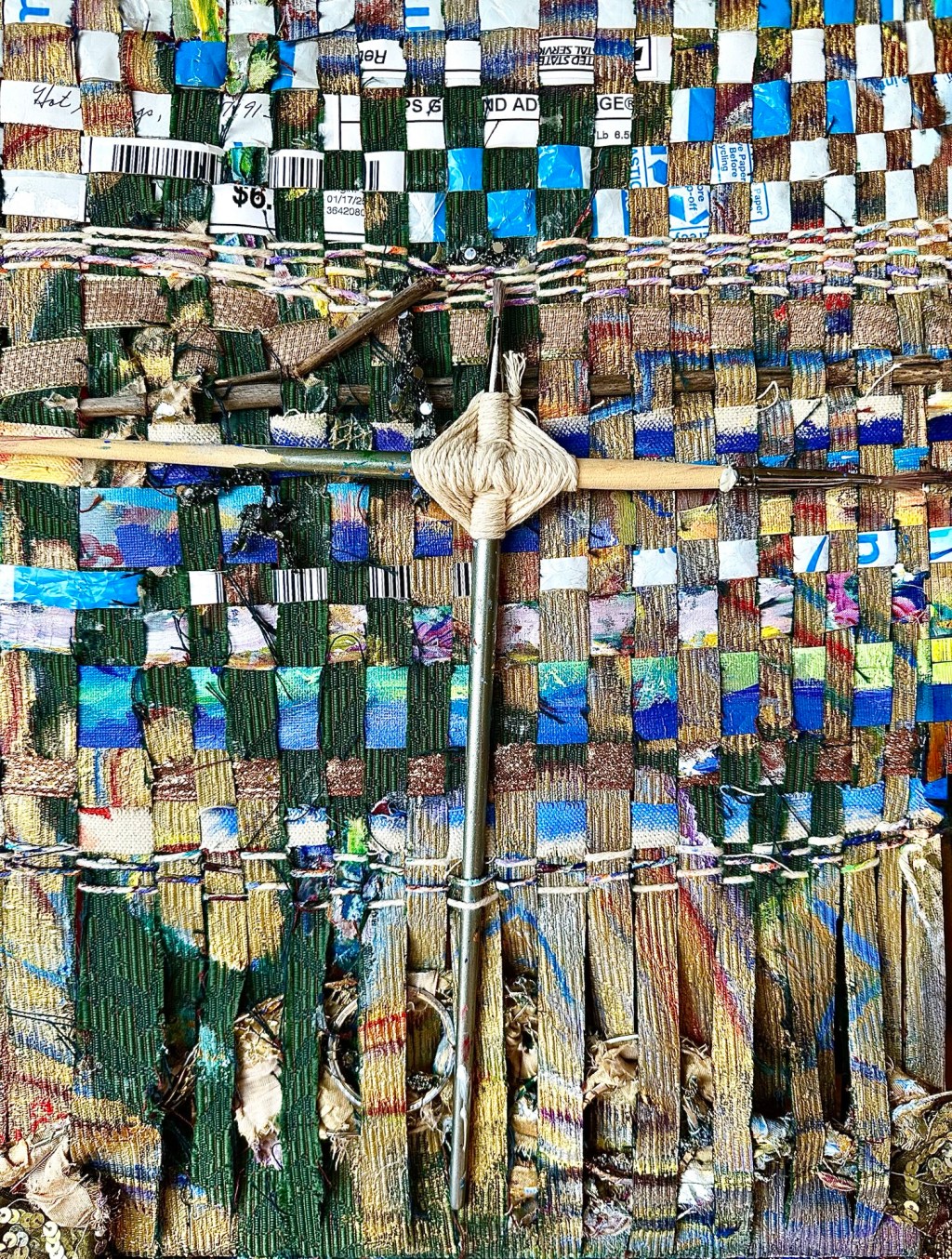
DeLee: God’s Eye and Cross, woven canvas, branch, string, paint brushes, fabric scraps, wire, packing materials, 16” x 20”, 2025.

Yet life doesn’t always work out the way we thought it would. The Bible says Job was the most righteous person of his era, and Job complains after losing everything and everyone:

  “My days are swifter than a weaver’s shuttle and come to their end without hope.” (7:6)

This wisdom text reminds us sometimes the righteous suffer, even while the wicked prosper, but God is still God, and we will understand this mystery of God when we see God face to face. We call this “theodicy,” (from Greek theos, “god”; dikē, “justice”), or our explanation of why a perfectly good, almighty, and all-knowing God still permits evil to exist.

God gives human beings free will. We make our own choices in life, just as everyone else does. Since we don’t live in a universe of one, other people’s choices impact our choices. Imagine a pingpong ball tossed into a room filled with mousetraps all loaded with other pingpong balls. If one ball hits a loaded trap, it sets that ball off into motion and those balls set more balls into motion until chaos ensues! If more than one person is involved, some sort of disagreement is sure to follow. Some of us are even at odds with our own selves!

As the old joke goes, a solitary man was rescued from a desert island. On this island were several structures. When asked, he said, “That one was my house and that one was my church.” And the other building? “That was the church I used to go to!”

Louise Bourgeois: Spider, metal, National Gallery of Canada, in Ottawa, Ontario. Her mother mended tapestries, like a spider spins a web.

When life is chaotic, creative people find solace in the quiet of their chosen deserts: the studio, the workshop, or their favorite writing chair. While we artists have the illusion we can control the images we produce or the songs which bubble up from our hearts, in truth, what we create is a shared product with our heart, mind, and the creating spirit. If we begin to lose our humility about this shared process, we lose the creative energy underwriting our works.

Louise Bourgeois: Metal Spider wrapped in yarn, Japan

We know this emotion as “pride,” and the ancient cultures warned against it. Throughout history, legendary and mythological figures have been used as examples of either virtue or a moral failing. The story of Arachne and Minerva is no different.

Attributed to Amasis Painter, 6th BCE, Greece, clay, Metropolitan Museum of Art, New York.

A 6th BCE Attic Black Figure Lekythos storage vessel attributed to the Amasis Painter shows the type of standing loom and the various shuttles of different threads a weaver would use for a fabric. Today we think of weavers sitting at their looms, but the ancients stood at their work.

Arachne was a mortal who excelled in the weaving arts: spinning her own yarn and selecting the correct colors to produce the beautiful images for the finished fabric. Minerva, the goddess of handicrafts and the Roman correlate to the Greek goddess Athena, had heard of Arachne’s prowess and her pride. Disguised as an old woman, Minerva visited Arachne to warn her not to disparage the gift of the gods. Arachne rebuffed her, and held her ground, even when Minerva revealed her true identity.

Minerva (Athena) and Arachne by René-Antoine Houasse (1706), Versailles

When the weaving contest began, both were even in technique and design. Minerva’s image was of the pantheon of the gods, but Arachne told the stories of the god’s mishaps with humanity. This angered Minerva, who struck Arachne with a weaver’s shuttle. Embarrassed, Arachne took a rope to hang herself, but Minerva had pity on her and changed her into a spider instead. We call spiders, ever weaving their gossamer webs, “arachnids” in her memory.

Spider Web

In Christian art, the theme of listening beside a well or spring is connected both to the angel’s annunciation to the Virgin Mary and to her weaving curtains for the Temple. The third-century Dura-Europos church baptistery has a fresco of a woman drawing water from a well, which Yale theologian Michael Peppard believes represents the Annunciation to Mary at a well, from a scene from the gnostic writing, Protevangelium-18.

Woman drawing water at the well. Possibly the Virgin hearing the Angel’s voice. Dura Europa.

Others think it represents the Samaritan woman at the well or Rebecca from the Old Testament. Because the fresco doesn’t include Jesus, the empty space instead represents “the bodiless voice” that Mary hears in the Protevangelium. Also, a five-pointed star appears on the woman’s torso, which could symbolize the new child in her womb. The star in later iconography was repositioned to the shoulder of her mantle, and the water vessel survives all the way into the Renaissance art as a vase with flowers.

Icon of Virgin at Well with Angel

From The Protoevangelium of James, section 11: And she took the pitcher, and went out to fill it with water. And, behold, a voice saying:

“Hail, you who hast received grace; the Lord is with you; blessed are you among women!” (Luke 1:28) And she looked round, on the right hand and on the left, to see whence this voice came. And she went away, trembling, to her house, and put down the pitcher; and taking the purple, she sat down on her seat, and drew it out. And, behold, an angel of the Lord stood before her, saying: “Fear not, Mary; for you have found grace before the Lord of all, and you shall conceive, according to His word.” And she hearing, reasoned with herself, saying: “Shall I conceive by the Lord, the living God? And shall I bring forth as every woman brings forth?” And the angel of the Lord said: “Not so, Mary; for the power of the Lord shall overshadow you: wherefore also that holy thing which shall be born of you shall be called the Son of the Most High. And you shall call His name Jesus, for He shall save His people from their sins.” And Mary said: “Behold, the servant of the Lord before His face: let it be unto me according to your word.”

This apocryphal Greek text, which was first written in the 2nd CE, with Syrian revisions into the 5th CE, is important because it increases our insights into women’s history, the childhood history of Jesus, Jewish-Christian relations, and the impact of Christian apocrypha on Islamic origins. This text, which contains the infancy narratives of the Virgin Mary, John (the Baptist), and Jesus is the source many of the Western Catholic and Eastern Orthodox religious feast days. Moreover, it’s also the origin for the icons representing the birth of Jesus in a cave.

Duccio: The Nativity with the Prophets Isaiah and Ezekiel, tempera and gold on panel, 1308-1311, National Gallery of Art, Washington D. C. Part of a series of the Life of Christ, the rest of which are in Sienna, Italy. 

A similar Marian birth narrative, The Gospel of Pseudo-Matthew, gives more details on the life of the Virgin, the miracles surrounding her marriage and the birth of Christ. It also tells the story of the Annunciation in two visits rather than one. The angel’s first greeting is beside a fountain and the second is inside while Mary is weaving the curtains for the Temple.

DeLee: Freeform Weaving while Listening

When I was on a recent Five-Day Academy for Spiritual Formation retreat, one of our hands on projects was a small weaving. Our package had a small loom, some yarn to weave with, and beads to attach. Of course I had to use a second packet to finish out my weaving because I tightened the horizontal rows more tightly than the organizers thought the regular attendees would do with their yarns and ribbons.

I also had my eye on a nice lichen covered branch to use as a hanging support. When I picked it up, it had red ants on it. I had to do some mad shaking to get them off! Anything for art! During one of our quiet reflection sessions, I sat beside a small lake under a pavilion to let my hands work. I’ve always needed a quiet space to process the flood of ideas and the rush of emotions when meeting new people and hearing new ideas. I operate as an extrovert, but when I get full to overflowing, I need quiet to recreate and recharge. I find new power in the admonition of Psalm 46:1-6—

God is our refuge and strength,
a very present help in trouble.
Therefore we will not fear, though the earth should change,
though the mountains shake in the heart of the sea;
though its waters roar and foam,
though the mountains tremble with its tumult.
Selah
There is a river whose streams make glad the city of God,
the holy habitation of the Most High.
God is in the midst of the city; it shall not be moved;
God will help it when the morning dawns.
The nations are in an uproar, the kingdoms totter;
he utters his voice, the earth melts.
The LORD of hosts is with us;
the God of Jacob is our refuge.

Diedrick Brackens, “prodigal” (2023), cotton and acrylic yarn

When my hands touch the different textures of the threads, and I let my spirit work with the creating Spirit of the word and world, I can shed all the strain and stress of being on a different schedule from traveling, having nerve pain in my neck from a bulging disk, and more interaction than I’m used to since I no longer work.

I always fought to carve out quiet times when I was in active ministry, for listening to God is the first calling of any leader worth their salt. I knew I wouldn’t hear God’s voice in the pell mell rush and cacophony of our world. The disembodied voice is more likely to come to us when we’re alone or in a receptive moment. It’s important to note Mary was one of the virgins of the House of David chosen to weave the curtains for the Temple in Jerusalem, according to The Protoevangelium of James, section 10. She was busy, but working for her God. It was when she took a break to draw water from a life giving well that she heard the messenger from God.

Bruce Conner, Arachne, 1959, mixed media: nylon stockings, collage, cardboard, 65 3⁄4 x 48 3⁄4 x 4 1⁄4 in. (167.0 x 123.8 x 10.7 cm), Smithsonian American Art Museum, Bequest of Edith S. and Arthur J. Levin, 2005.5.12

When I was appointed to a church, I always had a list of tasks to do, but I often never completed them because God would send “interruptions” to my well laid plans for the day. After several years, I began to understand these interruptions were my real tasks of ministry for the day. We have plans, but God has a better plan.

The prayer in my weaving supplies was appropriate for me on this retreat:

Teach us to listen, O Lord. 

Quiet the noise of our lives

so we can hear your voice. Amen.

After several weeks, I’ve come back to finish this blog. In the meantime I’ve had anterior cervical discectomy and fusion for my neck pain and numb fingers. It’s for the bulging neck disk that causes pressure on the spinal cord. If this happens in the lower back, a person gets sciatica and numbness in the legs. In the neck,the same condition affects the arm and hands. I feel better than I did before, so I’m thankful for all healing mercies. I have to be careful not to overdo my activities. The instructions “Don’t do housework!” were gladly received.

I hope you seek out your quiet spaces and quiet moments to hear the sheer, still sounds of silence, the inaudible voice of our God.

Joy and peace,

Cornelia


 NOTES:

Carolyn Hester: The Weaving Song, Track 10 on At Town Hall, One, Produced by Norman Petty, 1965.

Troubadour: Weaving Song: similar words to Hester coffee house ballad above. https://music.apple.com/us/album/weaving-song/400303687?i=400303767

Myth of Arachne https://www.worldhistory.org/Arachne/

Ally Kateusz: Mary and Early Christian Women: Hidden Leadership,1st ed., 2019, Kindle Edition 


Annunciation or Samaritan Woman, Dura-Europos Baptistery
https://www.christianiconography.info/Wikimedia%20Commons/annunciationDura.html

Charles Bertram Lewis:”The Origin of the Weaving Songs and the Theme of the Girl at the Fountain,” PMLA, Jun., 1922, Vol. 37, No. 2 (Jun., 1922), pp. 141-18, Modern Language Association. http://www.jstor.com/stable/457

Susan B. Matthews: Dura Europos—The Ancient City and The Yale Collection, Yale University Art Gallery, 1982, Yale University Printing Service. https://artgallery.yale.edu/sites/default/files/publication/pdfs/ag-doc-2378-0002-doc.pdf

Camille Leon Angelo and Joshua Silver: “Debating the domus ecclesiae at Dura-Europos: the Christian Building in context,” Journal of Roman Archaeology 37 (2024), 264–303, doi:10.1017/S1047759424000126. https://www.cambridge.org/core/services/aop-cambridge-core/content/view/E76ED3AD86D09A74893368840DEDFA6A/S1047759424000126a.pdf/debating-the-domus-ecclesiae-at-dura-europos-the-christian-building-in-context.pdf

The Protoevangelium of James, section 11. https://www.newadvent.org/fathers/0847.htm

The Gospel of Pseudo-Matthew, section 9.  https://www.newadvent.org/fathers/0848.htm

Horn, C. (2018). The Protoevangelium of James and Its Reception in the Caucasus: Status Quaestionis. Scrinium, 14(1), 223-238. https://doi.org/10.1163/18177565-00141P15

art, Attitudes, Creativity, Faith, Fear, generosity, hope, Icons, Imagination, inspiration, Israel, Light of the World, Ministry, Painting, poverty, renewal, Spirituality, suffering, Sun, United Methodist Church, vision

The first bright light of creation must have been an awesome sight. Of course, only God was there to see it or hear it. The earth was a formless void, and darkness covered the face of the deep. Genesis 1:3 tells us, “Then God said, “Let there be light;” and there was light.”

John Martin: The Creation of Light, Mezzotint, 1825, Royal Collection of the Arts, London.

I have often wondered if God’s creation of light was accomplished with sound. If at one time only darkness existed, then suddenly light appeared, would this sudden change happen like an atomic bomb flash? Not with the bomb’s destructive evil and force, but with the creative and life-giving energy of God’s power and love. While scripture tells us we hear God’s voice in the sheer silence (1 Kings 19:11-12), this is after God has created everything which we humans might worship instead of God. When God first created light, what was the power behind God’s words?

George Richmond: The Creation of Light, Tempera, gold, and silver on mahogany, 1826, support: 480 × 417 mm, frame: 602 × 539 × 66 mm, Tate Gallery, London.

Maybe no one cares, for if no one is in a forest to hear a mighty oak fall, can we say it ever made a sound? Just because human beings weren’t created yet does not mean the light did not come into existence or make a noise. We might as well say bombs are not leveling towns in Ukraine and Gaza merely because we are not running from the falling bricks and dust. Yet, we can see the pictures on television and know these facts as true.

We are in a trickier situation when we try to find information to prove the existence of the creation of the first light and the facts of its origin. We are certain light was created, for light now exists. Tracking light’s history to its birth story is the challenge!

The Creation of Day and Night, by Francisco de Holanda, De Aetatibus Mundi Imagines, 1543.

When the Old Testament says God created light, the ancient readers understood this word to mean a special light, not the light of the sun, moon, or the stars. God created these lesser lights on a later day, so they possess a different form of light from the first light. The early Hebrew philosophers distinguished between chomer, matter, and tzurah, the form or function of an object. A raw material has chomer, matter, but once it’s made into an object, it acquires the form or tzurah.

Michelangelo’s The Separation of Light from Darkness, (c. 1512), the first of nine central panels that run along the centre of the Sistine Chapel ceiling.

At the beginning of creation, nothing had form. It was all matter. Then God created the Ohr Ha-Ganuz, or the Hidden Light. This special light played a critical role in Creation. Just as regular light allows us to see and relate to our surroundings, the Hidden Light enabled the different elements of creation to interact with one another. It dispelled the initial state of darkness when all objects were isolated and disconnected from one another. Through this special light, the universe’s myriad objects acquired purpose and function and were able to work together towards a common goal.

About 13.8 billion years ago, our universe ballooned outward at an incredible speed. Everything we see today, which was once packed tightly together, expanded in a roiling mass of light and particles. It took 380,000 years for this hot, dense soup to thin and cool enough to allow light to travel through it. This first light, dating back to the formation of early atoms, we call the cosmic microwave background and we can still detect it today.

Creation: Bright Beam, stage 1

The Advanced Simons Observatory in the Atacama Desert in Chile is on the forefront of research for detecting cosmic microwave background radiation to give us a better picture of the early universe, its evolution, and the many phenomena within it. Beyond the cosmic microwave background, they will hunt for and study the birthplaces of distant stars, the contents of interstellar dust, exo-Oort clouds—spherical shells of ice and dust at the edges of solar systems—and several other phenomena. But, given the unique capabilities of this observatory, they are also open to finding some unexpected and unexplained puzzle pieces in the universe that we did not know we were missing.

Creation: Bright Beam, stage 2

Before there were any stars or galaxies, 13.8 billion years ago, our universe was just a ball of hot plasma—a mixture of electrons, protons, and light. Sound waves shook this infant universe, triggered by minute, or “quantum,” fluctuations happening just moments after the big bang that created our universe. The question we first asked, “Did the creation of light make an audible sound?” is related to the “cosmic wave background radiation” that the observatory in the Chilean desert is seeking.

Although scientists call this moment the Big Bang, it was not a loud explosion. Instead, it was more like an imperceptible humming because this first moment happened when the universe was denser than the air on Earth and sound waves could travel through it. This covered the first 100,000 to 700,000 years. As the universe cooled and expanded, the sound waves grew longer and and the sounds lower. As the universe continued to expand, the wavelengths became so long the sounds became inaudible to the human ear.

NASA Sound File Magnified of Big Bang Microwave Radiation

For this sound file, the patterns in the sky the Planck Observatory observed were translated to audible frequencies. This sound mapping represents a 50-octave compression, going from the actual wavelengths of the primordial sound waves (around 450,000 light-years, or around 47 octaves below the lowest note on the piano), to wavelengths we can hear.

Creation: Bright Beam, stage 3 in the studio

Maybe as you read this, you wonder, why do artists have an interest in science? This is an attribute of artists from Leonardo in the Renaissance down through the Impressionists who studied the play of light and atmospheres on surfaces in the 19th century. Today we know the speed of light means we are always seeing a “late arriving sunbeam.” The speed of light gives us an amazing tool for studying the universe. Because light only travels a mere 300,000 kilometers per second, when we see distant objects, we’re always looking back in time. If we the universe clock backwards, right to the beginning, and you get to a place that was hotter and denser than it is today. So dense that the entire universe shortly after the Big Bang was just a soup of protons, neutrons, and electrons, with nothing holding them together.

Lentil and ancient grains pasta soup, held together by melted cheese—metaphor for the early universe

The moment of first light in the universe, between 240,000 and 300,000 years after the Big Bang, is known as the Era of Recombination. The first time that photons could rest for a second, attached as electrons to atoms. It was at this point that the universe went from being opaque, to transparent. The earliest possible light astronomers can see is the cosmic microwave background radiation. Because the universe has been expanding over the 13.8 billion years from then until now, those earliest photons were stretched out, or red-shifted, from ultraviolet and visible light into the microwave end of the spectrum.

Today we have tools unavailable to the 15th or 19th centuries, but what we have in common is the human mind. Because we are created in the image of God, we have the same desire to create and shape our world and to understand our place in it. For some people, they find placing their trust in God’s absolute power over all creation and events as a way of understanding the problem of good and evil in the world. This justifies suffering and allows them to ignore the plight of the poor. Prosperity religion, which preaches the good prosper and the bad suffer, is a classic example of this theological belief. We United Methodists believe in doing good to all people, as often as possible, with all the means we can. As the gospel says in Matthew 25:37-40—

Then the righteous will answer him, ‘Lord, when was it that we saw you hungry and gave you food, or thirsty and gave you something to drink? And when was it that we saw you a stranger and welcomed you, or naked and gave you clothing? And when was it that we saw you sick or in prison and visited you?’ And the king will answer them, ‘Truly I tell you, just as you did it to one of the least of these who are members of my family, you did it to me.’

We know Jesus as the Light of the World (John 8:12)—

Jesus spoke to them, saying, “I am the light of the world. Whoever follows me will never walk in darkness but will have the light of life.”

Perhaps this ancient light of creation has not yet reached everyone who reads these words. I can only guess they ignore even the voice of the Old Testament prophet Isaiah (58:10):

“If you offer your food to the hungry and satisfy the needs of the afflicted, then your light shall rise in the darkness and your gloom be like the noonday.”

The sun will always shine when we help others. The light of Christ will burn bright in us to burn away our gloom and despair when we give a hand to others who are in need. Their lives will be brighter in turn. We often turn away from people in hard circumstances because we do not want to face the prospect that we one day might need a hand up. This strikes at our self image of invincibility and self sufficiency. We keep remembering “God loves a cheerful giver.” If we think only of this part of the verse outside of its context, we might think God only loves the giver. God also must love the one in need to provide the blessing for the giver. As we read in 2 Corinthians 9:7-8—

Cornelia DeLee: Creation: Bright Beam, acrylic on canvas, 16” x 20”, 2024.

“Each of you must give as you have made up your mind, not reluctantly or under compulsion, for God loves a cheerful giver. And God is able to provide you with every blessing in abundance, so that by always having enough of everything, you may share abundantly in every good work.”

As an old mentor of mine taught me, “Don’t do all the work for your people. You’ll rob them of the blessing of serving the Lord.” None of us can replace the eternal light of Christ, which has been traveling to us since the dawn of time, although the Light has been with God since before time began. This Light is even now permeating the universe, in a prevenient journey to the furthest distances of creation. There is no place the Light will not go before us. Even as we attempt a return to the moon and hope to go to Mars in the future, the light of Christ has already gone before us.

If this does not give you hope in what many think is a dark and despairing world, refocusing on the Light with us instead of the darkness that always seems so near might help to change your attitude.

Joy, peace, and light,

Cornelia


What Did the Big Bang Sound Like? | HowStuffWorks

https://science.howstuffworks.com/what-did-big-bang-sound-like.htm

Breishit: The Hidden Light of Creation

https://www.ravkooktorah.org/BREISHIT_67.htm

The science illuminated by the first light in the universe | Stanford Report

https://news.stanford.edu/stories/2023/07/science-illuminated-first-light-universe

When was the first light in the universe?

https://phys.org/news/2016-11-universe.html

The Creation of Light: William Blake and Francisco de Holanda/thehumandivinedotorg

https://thehumandivine.org/2022/02/27/the-creation-of-light-william-blake-and- francisco-de-holanda/


Cosmic Rainbow

Apocalypse, art, beauty, cosmology, Creativity, Faith, hope, inspiration, John Ruskin, Leonardo da Vinci, nature, Painting, purpose, sleep, Spirituality, Van Gogh, vision, William Blake

In times of cultural change and uncertainty, some faith-based communities turn to apocalyptic literature to find meaning, if not solace, for their suffering. Other communities of faith look forward to a future of hope and joy, even though they live in the same circumstances.

Apocalyptic literature is a genre of writing that appeared during times of crisis or persecution. It often presents a vision of the end times and the ultimate triumph of good over evil. Apocalyptic literature has several major characteristics:

“The supreme manifestation of Satan in this world is war.” By William Blake, 1805, apocalyptic painting with
tempera, gum, glue, and chalks, Tate Galleries, London.
  1. Dualism: Apocalyptic literature often portrays a cosmic battle between good and evil forces, highlighting the struggle between light and darkness.
  2. Symbolism: Deeper meanings and abstract concepts are represented by symbolic language and imagery.
  3. Eschatology: Apocalyptic literature focuses on the end times (Greek eschatos last, farthest) and the ultimate judgment of humanity, exploring themes of divine justice and the afterlife.
  4. Pseudonymity: Many apocalyptic texts attribute their authorship to famous figures from the past, using pseudonyms or false names.
  5. Visions and Dreams: Apocalyptic literature often includes visionary experiences and dreams as a means of conveying divine messages and revelations.
  6. The future is fixed and decided in apocalyptic literature, whereas with prophecy, people can change their future by repentance and restoring their relationship with God.

Since John was already in exile, “The Revelation to John” doesn’t bother to hide his authorship for his safety. He does claim it’s a vision of Christ mediated by an angel. It also checks the boxes of good vs evil, symbolism, the end times, and a fixed future. The actual date of this future isn’t revealed, however.

An interpretive mistake many make is to take this letter written to encourage the persecuted churches of the first century and project its message into our modern-day society. The symbols which were meaningful to John’s audience are for that historical context alone. Reinterpretations of these signs to make them relevant to our current geopolitical situation is bad scriptural interpretation.

Plate 12, First book of Urizen, by William Blake

What we can do is ask, “What can persecuted communities or suffering societies of the past teach us about resilience, hope, and faith?” Some will focus on God’s destructive forces to eradicate evil and harm. Belief in God’s power to overcome evil is a source of deep comfort for people without power. These are often the ones who feel excluded from the halls of power, but also those who believe their privilege and place is slipping away.

God’s fridge would be covered with photos!

Both these groups forget they are beloved of God, just as God loves all God’s children. Sometimes we forget God’s refrigerator is large enough to have the photographs of all the people of the world on its door, along with all our latest art works also. If that’s a humongous refrigerator, then that gives us an idea of the expansive reach of God’s love, mercy, and grace for all creation.

The First Day of Creation, by Francisco de Holanda (1545), with caption, “Let there be light.”

A negative outcome of this dualist, apocalyptic belief is extremist beliefs about the end times. Unfortunately, some extremist pastors have convinced their followers to end their lives to meet their predicted apocalyptic end of the world. The leader creates the fiction of an evil out-group to bind the members more closely to their cult and proclaims apocalyptic themes to brainwash their members. Numerous mass suicides worldwide have occurred as a result, including 914 people of Jim Jones’ People’s Temple. In 1997, 39 members of the Heaven’s Gate cult in San Diego, California, committed mass suicide by poisoning to coincide with the arrival of the Hale-Bopp comet, considering this a signal for their exit from Earth. Others have given away their entire nest eggs to apocalyptic cults because “no one will need money in the new creation.”

Paul Klee: Clarification, 1932, Oil on canvas, 27 3/4” × 37 7/8” (70.5 × 96.2 cm), The Berggruen Klee Collection, 1984 Accession Number: 1984.315.54

Some of us prefer to focus on The New Heaven and the New Earth instead, as found in Revelation 21:1-4—

Then I saw a new heaven and a new earth; for the first heaven and the first earth had passed away, and the sea was no more. And I saw the holy city, the new Jerusalem, coming down out of heaven from God, prepared as a bride adorned for her husband.

And I heard a loud voice from the throne saying,

“See, the home of God is among mortals. He will dwell with them; they will be his peoples, and God himself will be with them; he will wipe every tear from their eyes. Death will be no more; mourning and crying and pain will be no more, for the first things have passed away.”

Stage 1—strings and base colors

What a day that will be! The last time God destroyed the earth with a great flood, God placed a rainbow in the sky as a promise the earth would never be destroyed again by water.

Leonardo da Vinci said, “Where the spirit does not work with the hand there is no art.” For some people, the only “good art” is representational art, or art which faithfully describes a landscape, portrait, or still life. With abstract art, colors carry emotions and shapes to form pleasing patterns for the viewer. What will the new heaven and the new earth look like? Revelation 21:11 says “It has the glory of God and a radiance like a very rare jewel, like jasper, clear as crystal.”

Stage 2—addition of gold and silver washes

While many today think of heaven as an earthly paradise, this concept is a Persian idea of an enclosed garden, much like the original garden of Eden. We tend to imagine a heaven as being a better place than the world we know, but imagining an altogether different world is next to impossible! Luke 20:27-38 is Jesus’ answer to the law-abiding Sadducees about how relationships work in heaven, and a reminder to us heaven isn’t just a perfect earth.

When I think of the providence of God, which is grounded in creation and is always recreating the face of the earth, I remember God’s promise to Noah in Genesis 9:11-13—

“I establish my covenant with you, that never again shall all flesh be cut off by the waters of a flood, and never again shall there be a flood to destroy the earth….This is the sign of the covenant that I make between me and you and every living creature that is with you, for all future generations: I have set my bow in the clouds, and it shall be a sign of the covenant between me and the earth.”

Stage 3—Added circles and more gold and silver washes

It is this cosmic rainbow of colors, the spiritual energies which most of us cannot see for the overwhelming ordinariness of daily life. We race from chore to chore, dash from task to task, and drop exhausted at the end of our days. We long for a better life, but we’re stuck on a galloping treadmill trying to keep our feet under us. I long to walk rather than run through my days. When I was younger, older people told me to slow down. As I hit middle age, I heard I would soon start slowing down. Now that I’m inching closer to 80, slowing down is finally becoming a reality!

Vincent Van Gogh said, “Paintings have a life of their own that originate in the soul of the artist.” We cannot see the new heaven and new earth unless we stop our busywork and allow God to attend to the business of our spiritual life. When we see the first glimmers of the new heaven and the new earth, we’ll realize how imperfect our world is and begin to help change it for the better, one small act of kindness at a time. This is soul work.

Sometimes that kindness first means being kind to ourselves, when we admit we can’t say YES to everything and everyone. When we admit we actually need eight hours of sleep for our health and a daily quiet time, and we can stop to study the flowers in the cultivated gardens of our neighborhoods and in our parks.

Cosmic Rainbow—acrylic on canvas, 24” x 30”, 2024.

Then we can be a beautiful rainbow, God’s light in this world for good, and bring the hope and joy of the end times to these times. We then will bring the radiance of the new heaven and the new earth to this present age and to these yearning people.

Joy, peace, and rainbows,

Cornelia


 what are the five major characteristics of apocalyptic literature – brainly.com

https://brainly.com/question/35289093

World’s most chilling cults

https://www.france24.com/en/live-news/20230424-world-s-most-chilling-cults

Paradise Definition & Meaning – Merriam-Webster

https://www.merriam-webster.com/dictionary/paradise

 Middle English paradis, paradise “the Garden of Eden, heaven,” borrowed from Anglo-French paradis, borrowed from Late Latin paradīsus, borrowed from Greek parádeisos “enclosed park or pleasure ground” (Xenophon), “the Garden of Eden” (Septuagint), “the abode of the blessed, heaven” (New Testament), borrowed from an Iranian word (perhaps Median *paridaiza-) cognate with Avestan pairidaēza- “enclosure,” nominal derivative of pairidaēz- “build a barrier around,” from pairi- “before, around” (going back to Indo-European *per-i, whence also Sanskrit pári “around, about,” Greek péri “around, in excess”) + -daēza- “heap up, build” (occurring only with prefixes), going back to Indo-European *dhoi̯ǵh-éi̯e-, iterative derivative of *dhei̯ǵh- “knead, shape” — more at PERI-, FEIGN

NOTE: As an independent derivative of the verb, Avestan daēza- “heap, pile (of earth, stones)” has been compared with Greek teîchos (neuter s-stem) “wall, fortification,” toîchos (masculine) “wall of a house or enclosure,” Sanskrit dehaḥ “body,” dehī́ “wall, embankment,” Oscan feíhúss (accusative plural) “walls.” For a Germanic derivative from the same verbal base with a different sense, see DOUGH.

Anne Frank’s Last Birthday Cake

Anne Frank, art, Auschwitz, beauty, Children, Creativity, Faith, Family, Holocaust, hope, inspiration, Ministry, Painting, perspective, shadows, suffering, vision

Anne Frank’s Last Birthday Cake, acrylic on canvas, mixed media, 18” x 20,” 2024.

We never know when the tides of time will change. Most of us aren’t creatures of change, but prefer instead the well-worn and familiar paths. As a United Methodist pastor, I moved every two or three years during my ministry, so one thing I kept was my telephone company. I know some people like to switch providers almost as often as they switch their underwear, but that’s not me. Having to switch utility companies, banks, and hairdressers was more than enough agony for me. I signed up for this life, however, so I kept my moving boxes and made a spreadsheet for notifying all my address changes.

I talk about this because I only lived in three homes as a child. I never had to leave in the middle of the night to escape bad debts, the law, or a hateful Nazi regime. I have no way to imagine Anne Frank’s life, except when I was also 13 years old, I read her wonderful diary. Anne kept her diary, beginning at the same age, during the two years she spent in hiding while the Germans occupied her homeland during World War II. She had received a red, cream, and beige checkered cloth notebook diary for her 13th birthday on June 12, 1942. The underground Dutch radio station had encouraged people to keep diaries so future generations would know what the conditions were under the German occupation.

Because of the Nazi purity rules, Jews weren’t allowed to mix with non-Jewish persons. According to the Nazis, Jews were not Aryans or the Master Race. They thought Jews belonged to a separate race that was inferior to all other races. The Nazis believed that the presence of Jews in Germany threatened the German people. They believed they had to separate Jews from other Germans to protect and strengthen Germany. Their Nuremberg Laws were an important step towards achieving this goal. 

We hear this same sentiment today from the neo-Nazi movement groups who say, “Jews shall not replace us,” and “Immigrants are poisoning the blood of our nation.” As a result, only Anne’s Jewish friends could come to her birthday party. Her father set up a movie projector to show “Rin Tin Tin,” the famous Hollywood dog film star. The chairs were set up in rows like a movie theater. The family went all out for their Anne. Her mom had baked cookies for her classroom to share, since they couldn’t come to the party, but she baked a strawberry cream cake for this party attended by her Jewish friends. This was early June and the strawberries would be juicy, fresh, and in season.

Anne and Hanna playing before the Frank family fled into hiding.

Two weeks after her 13th birthday, Anne and the Frank family had disappeared from the neighborhood. They left no forwarding address. Her best friend of eight years, Hannah Pick-Goslar, didn’t see her again until they were both in the same concentration camp. Hannah survived. Anne did not, but the enduring story of her life in hiding continues through her diary.

When I was painting this, I used a large doily as the “cake.” I’d been saving it for a halo for a saint painting, but it works great for a cake top too. My viewpoint is from above, and I omitted the 95 candles. No need to burn the house down! The cream color was a bit pink, but if I were a young teen girl, I’d want it more pink than just white. I painted the background as a blue sky, because young people almost always have hope and optimism. The left side of the canvas has the storm clouds approaching, as well as the grey soot soiling the sky from the overworked crematoriums at the concentration camps where so many Jewish people lost their lives in the Holocaust.

If we can learn anything from one small girl who ate strawberries on an early summer day, I hope it will be to appreciate the beauty of this brief moment and to love one another deeply. Also, life is too short to hate anyone just because they are in someway different from you. Celebrate their differences as part of God’s creative generosity to this world. Also as Mary Oliver reminds us about the importance of keeping a journal:

“Instructions for living a life. Pay attention. Be astonished. Tell about it.”

Joy and Peace,

Cornelia


Remembering Anne Frank’s Last Birthday Party | TIME
https://time.com/6284557/anne-frank-birthday-party-hannah-pick-goslar/

What Hannah Pick-Goslar’s Memoir Reveals About Anne Frank | TIME

https://time.com/6282024/anne-frank-friend-hannah-pick-goslar-memoir-

The Nuremberg Race Laws | Holocaust Encyclopedia
https://encyclopedia.ushmm.org/content/en/article/the-nuremberg-race-laws


What’s the Point of Suffering?

art, city, Creativity, inspiration, Israel, Megiddo, Painting, righteousness, Solomon’s Temple, suffering

I’ve visited the Holy Land twice, and I’m always surprised how small this country is. So much history and events of our faith happened here, yet the land isn’t much bigger than Vermont. This land is a place of great suffering, marked by the historic sites of Masada, Megiddo, and Golgotha. It’s also the place of great joy, as evidenced in the Church of the Nativity in Bethlehem, the Church of the Holy Sepulcher in Jerusalem, and the Western Wall of the Temple in Jerusalem.

Map Painting: Temple Mount of Jerusalem

When we speak of the Holy Land, we include the ancient kingdoms of Judea and Israel, as well as modern day Palestine. The modern state of Israel was formed in 1948, as a homeland for diaspora Jews, who are the ones whom conquering foreign nations had exiled from their homeland over the centuries.

The history of the Hebrew people has been marked by suffering. As Deuteronomy relates, they are a “people holy to the LORD your God; the LORD your God has chosen you out of all the peoples on earth to be his people, his treasured possession. It was not because you were more numerous than any other people that the LORD set his heart on you and chose you—for you were the fewest of all peoples” (7:6-7).

They endured slavery in Egypt, wandering in the wilderness until they entered the promised land, and then were at the mercy of stronger nations who wanted to control the trade routes, which intersected inside the borders of Israel.

The earliest diaspora was the Babylonian exile in 586 BCE, plus a later exile to Alexandria, Egypt, in the 1st century BCE. That first exile was marked by the trauma of the Jews’ loss of Solomon’s Temple and their residency in the holy city. They’d always depended on these two as permanent and a source of God’s special protection. However, their failure to honor God completely negated this protection. In the exile, the people learned how to live as God’s chosen people by studying God’s word, keeping the law, and separating themselves from the Gentiles.

About five million Jews lived outside of Palestine during the Roman era, but most of them lived within the confines of the Roman Empire. Even before the destruction of the Jerusalem Temple in 70 CE, diaspora Jews outnumbered those who lived within the bounds of the territory of the Holy Land.

Western Wall of Temple, Men’s prayer area nearby and Women’s area in distance, 2019

After World War II, with the Nazi massacre of over 6,000,000 Jewish individuals of all ages and sexes, this Holocaust ignited the desire within those others who shared with Jews the same values they represented in the world. Social justice and compassionate assistance to the weak stood in the way of Hitler’s regime, for he believed Jews opposed the Nazi natural order, which was the powerful exercise unrestrained power on behalf of the superior white race. In Hitler’s view, any restraint on the exercise of white power would inevitably lead to the weakening, even the defeat, of this master race. (We hear echoes of this heretical view in the current replacement conspiracy, which claims migrants are poisoning the blood of our nation.)

Harvard Center for Geographic Analysis: Comparative Size of Israel and Occupied Territories to State of Vermont (11,200 square miles to 9,200 square miles)

An entire book in the Old Testament is dedicated to the question of suffering, especially the question of do the righteous suffer. Under the retribution theory of justice, a good person should not suffer, and a sinful person deserves suffering. However, all of us know infants born with dread physical conditions, who obviously haven’t had a chance to sin. In the Old Testament view, his parents’ sin would have caused his suffering, but Jesus reminds us in John 9:3–

“Neither this man nor his parents sinned; he was born blind so that God’s works might be revealed in him.”

Ossip Zadkine’s The Destroyed City (1951) is a man without a heart and is dedicated to the city of Rotterdam, destroyed by the Nazi Luftwaffe.

The book of Job reminds us suffering happens to all of us, and how we react to it is evidence of our transformation into the image of God. Do we seek mere retribution, or will we let suffering transform us? This is a moral question for us today, especially in our suffering adverse society. Yet, we’ll let those on the margins suffer, while we avoid suffering ourselves. The 31st chapter of Job lists the acts of a righteous man who cares for the widows, orphans, and strangers in his land, yet he suffers. But Job is no quitter, even if he is a complainer. He asks God, “Why do the righteous suffer?”

The Gaza Strip, where all the fighting between the Israeli army and the Hamas militants is currently ongoing, is slightly more than twice the size of Washington, DC., our nation’s Capitol. The Capitol is 68.35 square miles, while the Gaza Strip is just shy of 139 square miles. As a comparison, Little Rock, Arkansas, is 123 square miles in area. Little Rock has a 2024 population of 200,546. Compare this with the two million people live in the Gaza Strip. After living in rural Arkansas most of my ministry, I find Little Rock crowded. The Gaza Strip is 10 times more crowded than our state capital.

September Megiddo Painting 2023

Why do I mention this? When a tornado rips through a town or a city in Arkansas, it causes damage on a large scale to those people in that area. Because we don’t have densely populated areas, our suffering is limited to a few. This doesn’t discount their particular suffering, but it does mean suffering is limited, for which we can be thankful. When 2,000 pound bombs drop on high rise dwellings, numerous people are made homeless, and the possibility of injuries is high. Perhaps we don’t see this suffering because it’s in a distant land, or because some of the injured call god by another name. If we can’t recognize human suffering as the suffering of another child of God, we’re losing our ability to see the world as God sees God’s world.

The famous Banksy’s Armored Dove of Peace, the painting of a peace dove wearing a flak jacket. The dove is painted on a wall near the separation wall between Bethlehem (Palestinian Territories) and Israel. Nov. 18, 2023

Rebuilding Gaza will be a massive undertaking because Israel’s bombardment has caused mass destruction. Current estimates are at least a half million Palestinians in the enclave won’t have a home to return to when the war ends, according to the UN aid office. By the end of 2023, about 1.9 million people had been displaced, or nearly the entire population, some more than once, as people moved in search of safety. Because of bombing, by the end of 2023, about 65,000 housing units across Gaza Strip have been destroyed or rendered uninhabitable. In addition, over 290,000 housing units had been damaged, according to the Government Media Office in Gaza. Officials estimate many more will be unable to return immediately due to the level of damage to surrounding infrastructure, as well as the risk posed by of Explosive Remnants of War.

The Greek Orthodox Church of Saint Porphyrius in Gaza, believed to be the third oldest church in the world, was hit by missiles as hundreds of Palestinians sought shelter there during a Israeli missile strike in its war against Hamas.

Currently residents in Gaza are facing famine, for the existing World Food Program ready-to-eat food options are falling short of meeting people’s crucial caloric needs. Bread, made from fortified flour, holds the potential to address some of the unmet requirements for essential vitamins and minerals, which the current ready-to-eat baskets fail to provide. Moreover, providing bread as a no-cook food option is crucial when households lack the means to cook meals. Thus, incorporating bread into aid provisions is not only as a practical solution, but also is a key strategy to fulfill immediate nutritional needs.

Children try to get food relief in the southern Gaza Strip city of Rafah, on December 31, 2023.

I first visited the Holy Land in 2000, just before the intifada of 2001. At the time, the Gaza Strip was under Israeli control. Following the 1948 Arab-Israeli War, Egypt administered the newly formed Gaza Strip; Israel captured it in the Six-Day War in 1967. Under a series of agreements known as the Oslo Accords signed between 1993 and 1999, Israel transferred to the newly created Palestinian Authority (PA) security and civilian responsibility for many Palestinian-populated areas of the Gaza Strip as well as the West Bank.

After June 2007, when HAMAS took over the Gaza Strip, Israel and Egypt have enforced tight restrictions on movement and access of goods and individuals into and out of Gaza. Fatah, another political movement, and HAMAS have since reached a series of agreements aimed at restoring political unity between the Gaza Strip and the West Bank but have struggled to enact them. Therefore, Egypt and Israel have maintained border control over the Gaza Strip, determining who and what enters or leaves.

Since Hamas’ surprise attack on the music festival and the settlement nearby, not only have the Jewish people suffered harm due to 1,200 immediate deaths but also the continued terror of those held captive by the Hamas terrorists. Some say Christ suffers only for those who go on to have faith in his saving work on the cross. I was asked once on an Emmaus walk, “Are we saved when we profess our faith in Christ, or when Christ died on the cross for us?”

Byzantine Mosaic apsidal, San Clemente, Rome

They were surprised when I answered, “Yes.” It’s not an either-or question. After all, Christ died once, for all, as an act of saving grace. God raised him from the dead to make him the first of many to cast off the chains of sin and death. When we, centuries later, profess our faith in Christ, we accept his suffering on our behalf and his resurrection as our promise of a life to come. As Christians, we often base our world view on our claim to the promises of God, but we forget Christ’s death and resurrection is a promise to all people, even to those who haven’t professed faith in Christ. As the writer of Hebrews (1:8-9) once said:

“Now in subjecting all things to them, God left nothing outside their control. As it is, we do not yet see everything in subjection to them, but we do see Jesus, who for a little while was made lower than the angels, now crowned with glory and honor because of the suffering of death, so that by the grace of God he might taste death for everyone.”

Red Megiddo Cross

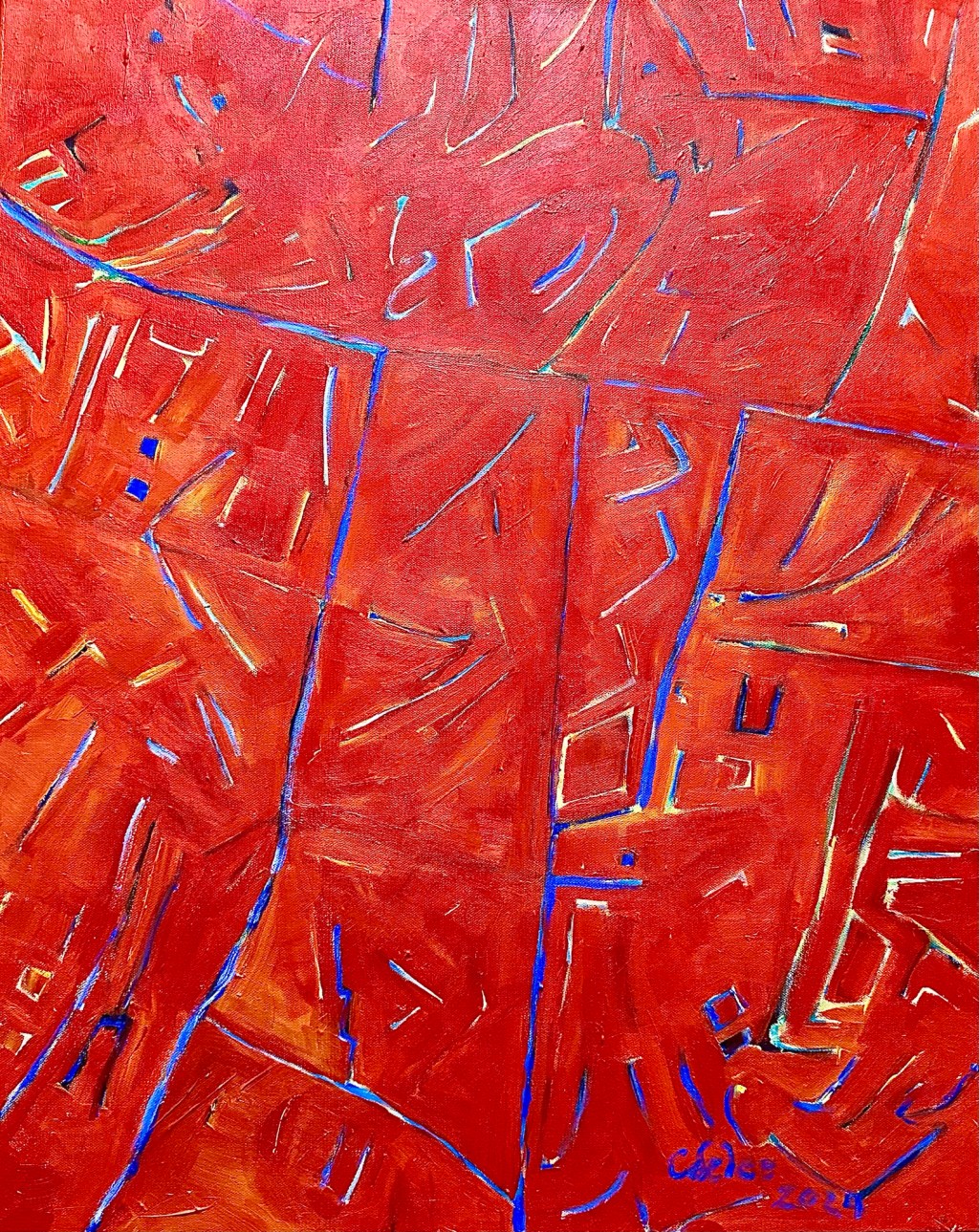
As I worked on my painting, it went through several iterations. First it stayed close to the map of the ruins of Megiddo, which I painted in yellows. Megiddo is the site of the battle to end all battles, and the place where the forces of good meet the forces of evil. Because Israel is on the crossroads of many trade routes, nations have always met there to contest for dominance. I left many scar scribbles on the canvas to represent the destroyed walls of the ancient city. As is my usual practice, I hung up my canvas to live with it awhile, but the longer my painting hung on my wall, the more unsatisfied I was. I can always tell when my inner vision isn’t meshing with finished work. When I took the work down, I flipped it 180 degrees and repainted it in red, for the bloodshed of this most recent war. As I painted out most of the scribbles, I saw the cross appear out of the image. By destroying the remnants of destruction, I had simplified the image down to its essence.

In all things, the cross is crucial. We moderns don’t understand suffering or pain. We deny it, reject it or medicate it with something that keeps us from feeling it. My personal medicinal choices are ice cream and chocolate. If I can combine them in one substance, so much the better! A recent bout with the shingles this past December had me consuming both foods for medicinal relief. Other people use wine, TikTok, or another medication of choice to escape from emotional or physical pain.

The winter of my discontent, brought by Mayhem

Revenge is is a dish best served cold because if we take revenge in the heat of the moment, we’ll over do our response and won’t know when to stop. If we wait, cooler heads will prevail, and a more limited response will likely be our action. Less damage, and less mayhem, but we humans don’t seem to be built this way. Those who have suffered will often return suffering in kind as a “hair of the dog cure.” This is why abuse and family violence is generational. The ancient Hebrews practiced the BAN, or a primitive religious practice of dedicating for destruction an entire group of people and their possessions to the LORD. This was done to cleanse the land and keep the Hebrew people pure from idolatry. Paul had Deuteronomy in mind when he wrote in Romans 12:19—

“Beloved, never avenge yourselves, but leave room for the wrath of God; for it is written, “Vengeance is mine, I will repay, says the Lord.”

While the western world has the crusade mentality, which is similar to the extreme ban, we also have the just war theory. Modern wars are fought by democracies mostly with this mindset, for the international community is in agreement the ends should justify the means. Unfortunately, terrorists don’t agree and fight according to their own extremist beliefs. We have to ask ourselves what happens to us when we adopt their policies and inflict extreme suffering on civilians to the point of causing starvation and homelessness by destroying their homeland. If we act the same as those whom as we despise, have we become them instead? We lose the moral high ground when this happens. It’s time to draw back and reconsider our motives and our methods: how can we be just, compassionate, and holy, as God is holy? Otherwise, we’re suffering for nothing or causing others to suffer meaninglessly.

When we read scripture, God’s Holy Spirit should work in our hearts and minds to make a change in us to confront and conform us into God’s holy nature. If no change happens, we need to ask God to open our hearts and minds to be conformed to God’s Holy Spirit. If it’s painful to read scripture, remember Christ suffered for us. Many of us can’t read the scriptures to be transformed, for change is difficult and painful. However, staying the same is also difficult and painful. (Maybe this is why only 10% of Americans read their Bible daily.) I find God has compassion on those who suffer, especially those who do so while “working out their own salvation in fear and trembling.”

Remember God has compassion and is near to the broken hearted,

Joy and Peace,

Cornelia

Gaza Strip – The World Factbook
https://www.cia.gov/the-world-factbook/countries/gaza-strip/

Hostilities in the Gaza Strip and Israel | Flash Update #85 | United Nations Office for the Coordination of Humanitarian Affairs – occupied Palestinian territory
https://www.ochaopt.org/content/hostilities-gaza-strip-and-israel-flash-update-85

Holocaust | Definition, Concentration Camps, History, & Facts | Britannica
https://www.britannica.com/event/Holocaust

Little Rock, Arkansas Population 2024
https://worldpopulationreview.com/us-cities/little-rock-ar-population

Ban – Encyclopedia of The Bible – Bible Gateway
https://www.biblegateway.com/resources/encyclopedia-of-the-bible/Ban

Report: 26 Million Americans Stopped Reading the Bible Reg…… | News & Reporting | Christianity Today https://www.christianitytoday.com/news/2022/april/state-of-bible-reading-decline-report-26-million.html

Sharansky’s Hanukkah

art, Creativity, Faith, Hanukkah, holidays, hope, Imagination, inspiration, Israel, Light of the World, Painting, righteousness, risk, shadows, Spirituality

NOTE: This extraordinary story comes from Arguable by Jeff Jacoby, an opinion writer for the Boston Globe, on December 12, 2023. I’m sharing it with all of you because even in the worst of times, even with the least of resources, if we have faith in God, we can be a light unto the world.

In his transcendent prison memoir, “Fear No Evil,” Natan Sharansky tells the story of his nine years in the Soviet gulag, a fate to which he was sentenced for the crime of wanting to emigrate to Israel. Even now, 35 years after it was published, it is an amazing read, a great narrative by a great man who refused to be intimidated by his captors. The more the KGB tried to berate or punish him for his Jewish pride and Zionist yearning, the more joyfully and fearlessly Sharansky embraced them.

To mark this week of Hanukkah, consider this extraordinary incident recounted in “Fear No Evil.”

Davis Stark Design, Architectural Digest 2017

Sharansky was in the Siberian prison camp of Perm 35 and Hanukkah was drawing near. Intent on observing the holiday as best he could, Sharansky had a menorah constructed from some wooden scraps. A few candles were found, and each evening Sharansky lit his menorah, reciting the blessing, and describing to his fellow prisoners — none of them Jewish — the story of the Maccabee rebellion long ago. On the sixth night of Hanukkah, the authorities confiscated his menorah and candles. When he demanded to know why, a prison guard claimed that the menorah was made from “state materials” and therefore illegal.

Sharansky declared a hunger strike. “In a statement to the procurator general,” he recounts, “I protested against the violation of my national and religious rights, and against KGB interference in my personal life.”

Two days later, Sharansky was summoned by Major Osin, the prison camp warden. Osin wanted the refusenik to call off his protest before the expected arrival of an inspection committee. In that case, Sharansky said, “Give me back the menorah, as tonight is the last evening of Hanukkah.” He promised to end his hunger strike if he was allowed to light the candles.

Davis Stark Design, Architectural Digest 2017

But a protocol for its confiscation had already been drawn up, and Osin couldn’t back down in front of the entire camp. . . . I was seized by an amusing idea.

“Listen,” I said, “I’m sure you have the menorah somewhere. It’s very important to me to celebrate the last night of Hanukkah. Why not let me do it here and now, together with you. You’ll give me the menorah, I’ll light the candles and say the prayer, and if all goes well I’ll end the hunger strike.”

Osin thought it over and promptly the confiscated menorah appeared from his desk.

When Sharansky said he needed eight candles, Osin took a knife and cut the candle into eight stubs. Then, with amazing audacity, Sharansky said that the ceremony required everyone present to stand with head covered, listen to the blessing, and answer “Amen.”

Osin complied. He stood behind his desk, donned his major’s cap, watched as Sharansky kindled his eight candle stubs, and then waited for his prisoner to recite the blessing. Speaking in Hebrew — which Osin, of course, did not understand — Sharansky recited a blessing he had composed himself: “Blessed are you, O God, for allowing me to light these candles. May you allow me to light the Hanukkah candles many times in your city, Jerusalem, with my wife, Avital, and my family and friends.”

Then he had a brainstorm.

Inspired by the sight of Osin standing meekly at attention, I added: “And may the day come when all our enemies, who today are planning our destruction, will stand before us and hear our prayers and say ‘Amen.’ ”

“Amen,” Osin echoed back. He sighed with relief, sat down, and removed his hat.

Sharansky writes that he returned to his barracks “in a state of elation.” Who can doubt it? What magnificent chutzpah! What a triumph of the spirit! And what an uplifting reminder that even in the depths of the gulag — even in a time and place filled with the enemies of Jewish faith and freedom — those who refuse to fear can turn the table on their oppressors and dispel the darkness with a candle’s light.

From Book Blurb: For anyone with an interest in human rights—and anyone with an appreciation for the resilience of the human spirit—
he illuminates the weapons with which the powerless can humble the powerful: physical courage, an untiring sense of humor, a bountiful imagination, and the conviction that “Nothing they do can humiliate me. I alone can humiliate myself.”

Hachette Books: Use HOLIDAY23 for 20% off site wide until 12/31. (Order by 12/13 to get your gift under the tree!)

This link also has links to other retailers. Price is set by publisher.

https://www.publicaffairsbooks.com/titles/natan-sharansky/fear-no-evil/9780786723249/

Nativity at Night by Geertgen tot Sint Jans, c. 1490, after a composition by Hugo van der Goes of c. 1470; sources of light are the infant Jesus, the shepherds’ fire on the hill behind, and the angel who appears to them

Joy, peace, and light,

Cornelia

Rabbit! Rabbit!

arkansas, art, autumnal equinox, Children, Christmas, Civil War, Constitution, Declaration of Independence, elections, Fall Equinox, Family, holidays, Imagination, inspiration, Labor Day, perfection, photography, rabbits, St. Patrick’s Day, summer vacation, texas, US Constitution

Rabbits under a Harvest Moon

September marks the return to order and organization, since the summer for most of us meant a relaxation of rules and schedules. “Vacay mode” of late mornings, pajama days, and snack meals are now a fading figment of our fevered frenzies. I remember these days all too well. My little girl threw a conniption fit one morning as I hurriedly dressed her so we wouldn’t be late for her pre-k class and my teaching assignment at the same school. We dashed out of the house, I locked her in the car seat, and flew to my workplace. I delivered her to the precare room and made a beeline for my art shack.

Two Types of Teachers

Later on at lunch, her teacher informed me I’d brought my fussy child to school without panties. Oops! Luckily, all the children were required to have a spare change of clothes “just in case of emergency.” Saved by those who are more organized than most. My art classroom always had the paint organized by rainbow colors, the scissors numbered, and shelves labeled. The moral of this annecdote is, “Innanimate objects are easy to organize; people not so much.” Murphy’s Law also comes to mind: “Anything that can go wrong will go wrong,” and Murphy’s First Corrollary: “It will cause the most damage possible.”

For Bunnies, maybe…

In the “No Pants Scandal,” of four decades ago, only my pride was injured. I’m not as organized or as perfect as I thought I was. This brings me to a little chat on appearances vs. our true selves. Our “false self” wants to appear organized, on top of things, spiritual, magnanimous, and virtuous. We’d like to be “perfect” in thought and deed. Yet the more we try to attain perfection or to act perfectly, the more likely dark, hateful, or mean thoughts arise from the depths of our hearts. We see this is our dualist world view, which divides our world into pure evil or pure good. The book of Proverbs reminds us, “Pride goes before destruction, and a haughty spirit before a fall” (16:18). It’s always better to admit, as I did, “I didn’t have a great morning and she wasn’t cooperative. I’m surprised we got here at all.”

Welcome to September 2023

Speaking about regular and organized, our earth is about to have another equinox on September 23, 2023, at 1:50 am CDT. The Fall Equinox happens yearly on or around September 22nd. The date of the fall equinox is variable because the 365 day Gregorian calendar doesn’t match up perfectly with the position of Earth in its orbit around the sun. When we add the leap year, the equinox date also changes. While the September equinox usually occurs on September 22 or 23, it can very rarely fall on September 21 or September 24. A September 21 equinox has not happened for several millennia. However, in the 21st century, it will happen twice—in 2092 and 2096. The last September 24 equinox occurred in 1931, the next one will take place in 2303. This rabbit won’t be around for any of these rare events, so don’t send me an invite.

Rabbits on the Playground

The September 29 full moon occurs at 4:57 AM CDT. It’s called the Harvest Moon in some years, or the Hunter’s Moon in other years. Technically, the Harvest Moon, which is the Anglo-Saxon name, is the Full Moon closest to the September equinox on September 22/23. The Harvest Moon is the only Full Moon name determined by the equinox rather than a month. Most years, it’s in September, but around every three years, it falls in October. We also know this September full moon as the Corn Moon from the Native American tribes harvesting their corn in this time. Other names for this month’s full moon are Celtic and Old English names: Wine Moon, Song Moon, and Barley Moon.

E. Irving Couse: Harvest Moon

Just as summer’s laissez-faire moments will give away to school and work routines, so the onset of autumn and the fall equinox herald another change. You might not yet recognize it over the insistent hum of your air conditioning system or feel it due to the heat waves rising from the black asphalt of your company’s parking lot, but autumn is just around the corner.

ERCOT Service Zones cover most of Texas

Don’t look at your utility bill just yet, and don’t pack your bags for Texas. I talked to my brother down there who has his AC set to “stun”—he said when the bill comes, “It will stun him a second time.” Texas doesn’t belong to the national energy grid, but to ERCOT, the Electric Reliability Council of Texas. It’s not connected to the two major electrical systems of the lower 48 states, but has its own grid to avoid federal regulation. When Thomas Edison started the first electric power plant in Manhattan in 1882, he set off a gold rush of independent power companies. During WWI, they began to unite and even more joined after WWII.

Don’t Mess With Texas

Texas takes seriously its “Don’t mess with Texas” rhetoric. Only on rare, catastrophic instances has it briefly joined either the American or Mexican utility grids. While Texas is a large state with rich energy resources, the USA is larger. When extreme weather events happen, energy costs rise. Rates can vary wildly as a result. The economic lesson is ERCOT is Dollar Store trying to outbid the Walmart of the national grids who can share energy with those in need.

Thomas Nast: The Lightening Speed of Honesty, 1877

Speaking of nations, on September 7, 1813, the United States got its nickname: Uncle Sam. Samuel Wilson from New York, a meat supplier to the US Army, stamped his barrels with US for United States. The soldiers began calling their rations “Uncle Sam’s,” a name the local newspaper noted, which began to spread and soon became the personification of the federal government. Thomas Nast (1840-1902) popularized the image of Uncle Sam. In Nast’s evolving works, Uncle Sam acquired the white beard and the stars-and-stripes suit we associate with the character today. The satirical cartoon of yesteryear’s dithering Congress is apropos of our modern chambers, which can’t seem to come a reasonable compromise to get the people’s business done by funding our country’s basic needs.

Columbia, The Gem of the Ocean

Over a century before Uncle Sam, Columbia was an idealized feminine figure that personified the new nation of America. She was created in 1697 when Chief Justice Samuel Sewall of the Massachusetts Bay Colony wrote a poem that suggested the American colonies be called Columbina, a feminized version of Christopher Columbus’ last name. Over 70 years later, the name evolved further when former slave, Phillis Wheatley, wrote an ode to George Washington invoking Columbia in 1775. Born around 1753, Phillis Wheatley was the first black poet in America to publish a book. She was listed among the enslaved persons at Mount Vernon. You can read her amazing poem here:

His Excellency General Washington by Phillis Wheatley— https://poets.org/poem/his-excellency-general-washington

Over time, the image of Columbia became a symbol for American ideals during wars, such as the American Revolution, the War of 1812, and World War I, as well as the subject of political cartoons and literary works. With her liberty cap and patriotic shield, Columbia stood as the spirit of the country. We even see her name, image, and likeness in modern industry in the Columbia Broadcasting System or CBS, as well as in the seat of our national government, the District of Columbia.

Well Done Labor Poster

Uncle Sam also has honored workers on Labor Day, which we celebrate on September 4th. Many rabbit families treat this three day weekend as the last hurrah of summer. Let’s remember those essential workers who serve and protect the rest of us while we barbecue in our backyards and national parks. The first Labor Day “parade” in 1882 was a strike. Workers marched en masse from New York City Hall to Union Square to protest terrible working conditions during the Industrial Revolution. Workers, including children as young as five years old, labored in unsafe factories, farms, mills and mines for 12 hours or more per day, seven days a week, often without breaks, fresh air or even clean water.

Credits: NASA’s Goddard Institute for Space Studies

This map shows global temperature anomalies for July 2023 according to the GISTEMP analysis by scientists at NASA’s Goddard Institute for Space Studies. Temperature anomalies reflect how July 2023 compared to the average July temperature from 1951-1980.

Only 5 States Provide Heat Relief Laws for Workers. Arkansas doesn’t protect workers from dangerous heat inside or outside.

Today, 141 years later, during the hottest July since 1880, some states are passing laws to prevent workers from getting “special treatment due to the heat” such as extra breaks for cooling or water. Currently only five states have protections for workers in these extreme conditions. According to the U.S. Bureau of Labor Statistics, between 1992 and 2019, extreme heat killed more than 900 workers and sickened tens of thousands more. Those numbers, however, are likely an undercount due to the lack of reporting by negligent employers or by workers who are worried about retaliation or deportation. In addition to the physical implications, time off from a job due to illness can lead to missed wages or the loss of a job altogether.

Bain photograph: LC-USZ62-49516: Four women strikers from Ladies Tailors union on picket line during the “Uprising of the 20,000,” garment workers strike, New York City, 1910 February, glass negative photo, Library of Congress.

As a rabbit who once endured a few days in an unairconditioned art shack at the beginning of school and then fainted from heat exposure, I have a heart for all workers in extreme circumstances. I made sure to take care of my people, since my bosses didn’t care about me. It’s never right to treat others poorly just because you were wronged.

Reading The Constitution Online is also an Option

In late September, we celebrate Constitution Week (Sept. 17-23). The Declaration of Independence, written in 1776, was a list of grievances against the king of England and intended to justify separation from British rule. The Constitution was written and signed in 1787. It was a charter of government ratified by the states, and continues to be the supreme law of the land. All members of the armed services and Congress take a vow to defend the constitution, as do the President and Vice President of our country.

We rabbits will all need to brush up on our civics lessons in the days to come, for the upcoming presidential candidates may be affected by their lack of appreciation for the constitution and the consequences as a result. As I always told my students, “Attitudes drive Behavior and Behavior leads to Consequences. You can choose the good or the negative. It’s all up to you. Try for a good attitude every day.”

Tales of a Bunny Who Went to School

The 14th Amendment, section 3, passed after the Civil War, or the last great insurrection by the southern secessionist states, forbids holding office in the US government by former office holders who then participate in insurrection or rebellion. This constitutional provision is currently being tested in the courts. September is back to school for all us rabbits. The last time I remember a civics lesson was the seventh grade in Mrs. Tampke’s class, but “ex post facto” might have been “non sequitur,” as I was passing notes rather than paying attention.

Mr. Flopsy’s Rabid Rabbit Pirate won’t be Messed with.

We rabbits can only take so much seriousnes in our short lives until we need a break. Thank you September 19th: International Talk Like a Pirate Day! Everyone can ARRGG their way MATIES through a Tuesday, and if Monday is a pain, who says we rabbits can’t Pirate on that day too? After all, pirates rob and steal, lawless vagabonds that they are. Let’s just take over the good ship Monday and drink our strong Pirate Coffee with vigor and daring.

The Bluebird of Happiness

National Bluebird of Happiness Day is September 24th. I love these little blue glass figurines. Dorothy in the Wizard of Oz sings, “If happy little bluebirds fly beyond the rainbow, why, oh, why can’t I?” Bluebirds uplift the heart into joy when we see them in nature. The blue glass iconic sculptures, made in Arkansas by the Ward family, have sold over 9 million birds, large and small. They’re no longer made due to concerns about climate change because the glass production process requires large amounts of natural gas and electricity. I treasure the blue bird in my possession and greet it daily. You might find one in a secondhand store.

God Please Keep My Children Safe, by Grayson Perry, 2005

Love Note Day is September 26, so I suggest you write a sweet letter to your beloved. This might be a spouse, significant other, parent, mentor, or even your own self. Share some affirmations to those who mean something to you. Don’t stop at one note of love, but make a whole symphony of blessings. In our world today, folks don’t hear many positive messages. You can help balance the scales for your recipients.

If the Sears Catalog were still a thing, we bunnies would be wishing

September 30, the last day of this month marks 92 days left in 2023. Where has this year gone?! Don’t ask this rabbit. I’ve already bought a couple of little Christmas gifts for my bunny friends. I’m never this organized. This means I’ll likely lose or misplace these items in the 86 days before Christmas Day. Then again, this is also enough time for this rabbit to find these packages once again! Live with optimism! Expect the best and work for it.


May the Blue Bird of Happiness bring you

Joy and Peace,


Cornelia


The September Equinox

https://www.timeanddate.com/calendar/september-equinox.html


Traditional Full Moon Names

https://www.timeanddate.com/astronomy/moon/full-moon-names.html


Why does Texas have its own power grid? | The Texas Tribune
https://www.texastribune.org/2011/02/08/texplainer-why-does-texas-have-its-own-power-grid/


How The United States Got its Nickname

https://www.history.com/this-day-in-history/united-states-nicknamed-uncle-sam


The lightning speed of honesty [Uncle Sam seated on snail “45th Congress” carrying Army and Navy payroll and money, with Resumption Act (of honesty) in his pocket] / Th Nast.
https://loc.getarchive.net/media/the-lightning-speed-of-honesty-uncle-sam-seated-on-snail-45th-congress-carrying


Database of Mount Vernon’s Enslaved Community · George Washington’s Mount Vernon
https://www.mountvernon.org/george-washington/slavery/slavery-database/


Heat Stress Is Killing Workers. States Can Protect Them.

https://www.nrdc.org/stories/heat-stress-killing-workers-states-can-protect-them


Short Summary—The Character to Lead: Republicans’ Fork in the Road Between Trump and the Constitution’s Eligibility Requirements for President

https://www.justsecurity.org/87750/the-character-to-lead-republicans-fork-in-the-road-between-trump-and-the-constitutions-eligibility-requirements-for-president/


Deep Dive— The Sweep and Force of Section Three. 172 U. PA. L. REV. (forthcoming 2024). William Baude & Michael Stokes Paulsen. https://deliverypdf.ssrn.com/delivery.php?ID=791101027092090122082025003064104018105084007031052035109090080088105005086003018089043050055106031007050097096000078089031112025019027055033023110008092018116067055086024100075002015088106075126126082029114024094102088002003074126075030067104090009&EXT=pdf&INDEX=TRUE

U.S. Senate: The Senate’s First Act—the Oath Act and 1862 Ironclad Oath
https://www.senate.gov/legislative/landmark-legislation/oath-act.htm

Arkansas Bluebird of Happiness – Encyclopedia of Arkansas. https://encyclopediaofarkansas.net/entries/arkansas-bluebird-of-happiness-3822/


Chaos and the Order of the Day

911, adult learning, Altars, art, Astrology, Creativity, Faith, Imagination, Israel, Leonardo da Vinci, Ministry, Painting, Spirituality, vision

Morse Peckham, author of Man’s Rage for Chaos, believed “Order is humanity’s freedom; but the rage for order creates its own limits on that freedom.” Art, he maintained, enabled the artist to fight that rage, which destroys what it would create. Only the rage for chaos can balance the rage for order.

Stellar Bones: Aries zodiac sign. Horoscope. Illustration for souvenirs and social networks.

As one who was born under the Aries sun, with an Aries moon, and a Virgo rising sign, I fully understand this rage for chaos and order within my own body. I somehow always have fifty-eleven projects and and even more ideas I’d like to accomplish, but I too have the same limits as all other people: we all have only 24 hours on any given day. Some of these moments must be given to the life giving nurture of the body, which carries our great mind and imagination and the hands which do our good works. Some days the balance scales of Virgo call my chaos into order, while on others my Aries excitement causes the balance to quaver. This tension shows up in my work.

Venus and Saturn at Early Sunset: follow the line of the building

I mention my astrological signs, for once in ages past, people believed the stars ruled their lives. The heroes ascended into the stars—Sagittarius, the archer, while other constellations were named for animals or the humans who were turned into animals, such as bears and swans. Some got their names for resembling objects—the dippers, while others were named for legendary persons—Cassiopeia’s chair and Orion’s Belt come to mind. In the time of dark skies, our ancestors could pick out these sky patterns with ease. Light pollution in our cities makes these shapes harder to discern every year. Our national parks may be the only places our city dwelling future generations will be able to see the night sky in all its glory.

The Ancient Greeks believed the gods ruled their fates. The writer Pausanius listed the many shrines to the deities in Athens, including “in the Athenian market-place among the objects not generally known is an altar to Mercy, of all divinities the most useful in the life of mortals and in the vicissitudes of fortune, but honored by the Athenians alone among the Greeks. And they are conspicuous not only for their humanity but also for their devotion to religion. They have an altar to Shamefastness, one to Rumour and one to Effort. It is quite obvious that those who excel in piety are correspondingly rewarded by good fortune.”

Altar to an Unknown God, Athens, Greece

The apostle Paul even noted the Athenians had a temple to an “unknown god,” just in case they didn’t cover their bases with offerings to all the other deities (Acts 17:23). Yet, you already know him, he said, for

“The God who made the world and everything in it, he who is Lord of heaven and earth, does not live in shrines made by human hands, nor is he served by human hands, as though he needed anything, since he himself gives to all mortals life and breath and all things.” — Acts 17:24-25

Our creation story in Genesis 1:1-2 begins with familiar words:

“In the beginning when God created the heavens and the earth, the earth was a formless void and darkness covered the face of the deep, while a wind from God swept over the face of the waters.”

Milton addressed the same Spirit of God, which was at creation, in his epic poem, Paradise Lost:

“And chiefly Thou O Spirit, that dost prefer Before all Temples th’ upright heart and pure, Instruct me, for Thou know’st; Thou from the first Wast present, and with mighty wings outspread. and with mighty wings outspread. Dove-like satst brooding on the vast Abyss And mad’st it pregnant.”

William Blake: Temptation of Adam and Eve, Pittsburgh Univ.

God is always creating order out of nothingness, but human beings have a tendency to create disorder wherever they go. We aren’t God, or even “as gods,” as the first humans hoped to be in the garden when they ate that fateful fruit. Even knowing “good from evil” doesn’t seem to keep us from our propensity to engage in chaos. I don’t live in a messy home, but because I put away some of my projects when I lose interest, I can forget where I “hid them.” I know what they look like, I can find others like them, but I might need several days to find the intended object of my desire. I’ll put all of these in ONE PLACE when I’m done with them. This will guarantee I’ll lose them all at once the next time I go looking for them!

Frank Hinder: Bomber Crash, 1941

In art class, we began our projects by thinking about the contrast of order and chaos. The emotional experience of the disruption chaos brings to our sense of order can change our perception of our position in the world. When Frank Hinder was serving in World War II, his bomber was shot down. As part of his therapy, he painted his memory of that occasion. That chaos in his life got channeled into a painting, for art allows us a safe haven in which we can experience cognitive dissonance.

Most of us wouldn’t willingly chose to experience such an event first hand, but we can imagine it in art, poetry, music, or fiction. This is why we exercise our creative freedom. Dealing with raw emotions in paint or other media is better than stuffing them inside, from where they can fester and harm us, or worse, break out and inflict terrible wounds upon others. We seek to center our emotions and focus our energies in a more balanced, positive manner, much like the renaissance genius, Leonardo da Vinci.

Leonardo: Virtuvian Man

Lauralei is finishing up a drawing and is going to work the famous Leonardo Virtuvian Man into it somehow. I can hardly wait to see this. Virtuvian Man is a classic Renaissance image of order: Leonardo saw the great picture chart of the human body he had produced through his anatomical drawings and his Vitruvian Man drawing as a cosmografia del minor mondo (cosmography of the microcosm). He believed the workings of the human body were an analogy for the workings of the universe. That’s seeing order in the many details.

Mike has been called away from class the past two weeks to take care of courthouse business. He has a 9/11 work in mind, if the judge ever lets him go. He has many images in his mind, so simplifying the many into a few might help him get his ideas out of his head and onto the canvas. He’s got business to attend to, however, so all things will come about in God’s good time.

Gail’s Painting of Creation

Gail chose the first day of creation as her inspiration. The tiny words are photocopies from a child’s Bible, which are plucked from the first chapter of Genesis. They read more as white directional or linear strokes than actual words, but I have a major cataract in my right eye, and my judgment on readability is suspect at the moment. Others may be able to see the words better than I. She used a sponge on this canvas, a new technique for her. She also wants to use gold leaf flakes to finish it out, so she may yet have another step to it.

First Work: Overhead View of Ancient Jerusalem

This small square painting began from an image of an old Jerusalem map with the surrounding walls of the city. This site was destroyed numerous times over the centuries, notably in 587 BCE by the Babylonians, in 70 CE by the Romans, while the walls were destroyed by the Muslim Calif in 1250 CE, but Suliman the Magnificent rebuilt them in 1538-1541 CE. In addition to the sacks of war, earthwakes and other disasters have rendered the era of Christ to the deep basements, which are only accessed today by descending narrow, spiral staircases. The era of the prophets of the Babylonian Exile are deeper yet. The famous Western Wall of the Herodian Temple, rebuilt after Solomon’s Temple was destroyed by the Babylonians, is only the upper third of the structure.

The people of Israel believed God’s favor rested upon them because of their proximity to God’s Temple. The prophets were quick to remind them, “They were to be holy, as God is holy,” for the Temple wasn’t a magic token like a rabbit’s foot. The book of Joel probably was written in the post exile period, around 350 BCE, but could be as early as 650 BCE, due to its description of an eclipse. The prophet reminds the people:

“So you shall know that I, the LORD your God, dwell in Zion, my holy mountain. And Jerusalem shall be holy, and strangers shall never again pass through it.” (Joel 3:17)

When the king and his court, the learned priests, all the educated tradespeople, and anyone who had any skill or knowledge was taken into slavery far distant from the sacred land where they worshipped their tribal god, the people had to wonder if God was still their god in this foreign land. Would God hear their prayers? If they could no longer offer sacrifices or make the required pilgrimages to God’s altar, were they faithful to their god anymore? In their grief, they wrote Psalms 137:4-5:

“How could we sing the LORD’s song in a foreign land? If I forget you, O Jerusalem, let my right hand wither!”

During the Exile, the Hebrew people developed the synagogue as the focus of their worship of God and the study of scripture, as well as a place of prayer and fellowship, and the site of life’s transitional rituals. In 538 BCE, Babylon fell and the Jewish exiles eturned to their homeland to rebuild the walls and the temple. For the people, the earlier promise of God from the prophet was finally being fulfilled:

“Return to the LORD, your God, for he is gracious and merciful, slow to anger, and abounding in steadfast love, and relents from punishing.” —Joel 3:13

Back home, both the synagogue and the Temple prospered, but when the Romans sacked Jerusalem and destroyed the Temple in 70 CE, all of the pious acts transferred to the synagogues and the homes of the faithful. Never again were sacrifices made for Passover, but the thought of the Holy City remained. The closer one came to the Mount where the Temple once stood, because the area was more holy, so the person coming near had to be more ritually pure. They may have chanted from Psalms 125:1 in unison as they made their ascent:

“Those who trust in the LORD are like Mount Zion, which cannot be moved, but abides forever.”

God’s Love Flows Beyond The City Walls

Today, Mount Zion is holy to the Muslim faith, for there Mohammad is said to have received the words of the Quran and also to have been lifted into heaven from here. This is also the traditional site of the Binding of Issac (Genesis 22), and it’s holy also to Christians because this is the temple where the boy Jesus was found in “his father’s house” (Luke 2:41).

The three great monotheistic faiths have fought for generations within their families of origin over who has rights to be included in the family, beginning with Abraham and Sarah’s attempt to fulfill God’s promise of an heir by using the slave woman Hagar. When God showed up to announce the birth of Isaac, it was unbelievable. When Sarah had her promised child, Hagar and Ishmael were sent out to die in the desert. God saved them, however, but the two blood relatives haven’t gotten along since.

Christians accept the promised messiah, but those years of crusading and crushing the “Muslim infidels” have left a bad taste in their mouths for us, and for some of us too. We all keep fighting, even though we’re all branches off the same tree. We all claim the same holy sites and we’ll fight over them “till the last dog dies.”

As Jesus reminded the Samaritan Woman in John 4:21 & 23:

“Woman, believe me, the hour is coming when you will worship the Father neither on this mountain nor in Jerusalem…But the hour is coming, and is now here, when the true worshipers will worship the Father in spirit and truth, for the Father seeks such as these to worship him.”

Remember the lesson of the exile: God is everywhere and not fixed to one altar or site. The same God who led us through the wilderness also leads us through the ups and downs of our daily lives, wherever we find ourselves. No disruption or chaos can move the steadfast God of love and mercy from our side.

Joy and peace,

CORNELIA

The Project Gutenberg eBook of Astronomical Myths, by John F. Blake, 1877.

https://www.gutenberg.org/files/36495/36495-h/36495-h.htm#Page_269

PAUSANIAS, DESCRIPTION OF GREECE 1.17-29 – Theoi Classical Texts Library

https://www.theoi.com/Text/Pausanias1B.html

Milton: Paradise Lost, DjVu Editions E-books, © 2001, Global Language Resources, Inc.

http://triggs.djvu.org/djvu-editions.com/MILTON/LOST/Download.pdf#page5

The Vitruvian Man – by Leonardo da Vinci

https://www.leonardodavinci.net/the-vitruvian-man.jsp

Rabbit! Rabbit!

adult learning, at risk kids, brain plasticity, Children, city, Dreamscape, Faith, Family, flowers, Healing, holidays, Icons, Love, mandala, Mandylion, Ministry, ministry, nature, Prayer, purpose, rabbits, Reflection, renewal, risk, school shootings, shame, Spirituality, Stonehenge, summer solstice, texas, Uncategorized

Welcome to June! I’ve found my sunshades and my flip flops, so this rabbit is ready for a summer vacation. Old school teachers never die, they just take the summer off. And teachers, as well as students, will need a summer off, along with some intensive counseling, to get them ready to return in a healthy frame of mind next fall.

Summer Solstice Mandala

In my early years in ministry, I served in a certain county where many people were caught up in despair. I often complained to my district superintendent of my desire to pour mood elevators into the public water supply.

“You do know drugging the water supply isn’t exactly an acceptable activity for a Methodist minister?”

“Oh, yeah, but it sure would make my job easier.”

Rabbits Love One Another

Remember, June 3 is Love Conquerors All Day. I need to remind myself of this on occasion when I want to take the easy road. As Jesus reminds us in Matthew 7:13—

“Enter through the narrow gate; for the gate is wide
and the road is easy that leads to destruction,
and there are many who take it.”

Taking the easy way out isn’t always the best choice, but it’s the one we rabbits most often choose. We rabbits don’t like to rock the boat, and we like to make all the other rabbits happy if at all possible. The only problem is if we please A, B gets upset. If we please B, A gets upset. We don’t even try to please C, since C is so cranky, even the good Lord Jesus couldn’t fry an egg to please them. We set our hearts and minds on pleasing God, as best we can, and hope to hear the words, “Well done, good and faithful servant, enter into the joy of your master.”

Make Mine Chocolate Ice Cream Day

Chocolate ice cream brings me joy any day of the year, but June 7 is a day dedicated to this frozen delight. Don’t worry about frying eggs, but keep it frozen. I like mine plain, but fresh strawberries or peaches are a nice addition, plus some chopped nuts. Always go for complex, unless you just can’t wait. Then grab a spoon and eat it straight from the pint. (Mark it with your name, since you ate from it.)

Often we cut the Gordian Knot and go for the shortcut to our complex problems. Sometimes this is a good solution, for the shortest distance between two points is a straight line. My daughter used to call my vacation navigation shortcuts “the long cuts,” since I’m directionally challenged. Most of the time, that straight line went through swamp land and alligators. I can hear her voice now, “NOOOOO!!!” I’m known for taking the scenic route, so I often see America’s less known sights, which are off the beaten path.

In the gospel of Luke (14:34), Jesus quotes a proverbial saying:

“Salt is good; but if salt has lost its taste, how can its saltiness be restored?”

Another translation of the latter portion of this verse is “how can it be used for seasoning?”

When I think of loss, I think of a life snuffed out. Some people are burned out, so we can say they’ve lost their seasoning ability. There’s no vim or vigor in them. Other lives are cut short and aren’t able to fulfill their purpose to season the great soup of our community. Our past month was marked by 47 mass shooting incidents in May alone. A mass shooting incident is defined as one in which at least four people are injured or killed, not including the shooter. Suicides aren’t included.

Suicides are also a public health problem. They are the “deaths of despair” that leave ripples of grief and hopelessness in the survivors. They’re the ultimate shortcut solution to a problem, the placing of a period where life has placed a comma or a semicolon. My daughter once attempted suicide by downing half a bottle of aspirin. I noticed the open bottle and pills scattered across the floor. She said the “dog ate it.”

“That’s too bad, I’m going to miss that dog. She won’t be long for this world. We’ll need to make burial plans for her.”

“Well, actually, I’m the one who ate the aspirin.”

“Then we’re going to the hospital. You aren’t going to like getting your stomach pumped, but it’s better than being dead. You want to have a chance to grow up and have a good life. A dog we can replace. You—not so much.”

It was a rough time in her life, and mine too. But God was with us. And we had support from counselors, friends, family, and our church family. My work family and my clients supported me too. I must be the most extroverted rabbit in the patch, because I asked everyone for help. It turned out my problem was shared by everyone else. I discovered I wasn’t alone, but was the most ordinary of rabbits around.

This is a humbling experience, especially when you’re a first child and the only girl. I admit to being spoiled, but don’t let my brother rabbits hear me say this. I’ll deny it to my last breath: I’m like every other rabbit I know. I want to think I’m someone special, even when I’m just as fluffy as every other bunny out there on Gods green earth.

June 21—Summer Solstice

Unfortunately, half the suicides today are committed with a gun, not aspirins. When looking at overall gun deaths, roughly two-thirds are attributed to suicides—a proportion that is consistent across most states. Gun suicides are on the rise and data also indicates men, white Americans, older people, and individuals living in rural areas present higher rates of gun suicides. Another group presenting a unique risk for suicide is current and former members of the armed forces, especially those with PTSD.

Compared with the general population, current and former military members have significantly higher rates of gun ownership. According to a 2015 study, nearly 50% of U.S. veterans own a gun. In contrast, studies suggest that only about 22% of the general U.S. population owns firearms. Similarly, the age groups of 50 to 64 years old and 65 and older have the highest rates of gun ownership, according to a 2017 Pew Research Center study. This can further explain the high rates of suicide among older veterans.

According to data from the U.S. Department of Veterans Affairs (VA), in 2019, close to 4,332 veterans died by gun suicide in the United States, representing close to 18 percent of the total number of gun suicides reported by the Centers for Disease Control and Prevention (CDC) during that year. Perhaps more alarming is the fact this figure shows a veteran is killed by gun suicide every two hours. In 2019, active duty military members committed suicide by gun 64% of the 498 total (318), almost one gun suicide per day.

Why isn’t anyone speaking about this? For all the lip service our politicians give to the flag and to the armed service members, they seem to forget them once they’re no longer useful to fight their wars or march in their parades. Perhaps because Congress won’t devote any money to study the effects of gun violence on the citizens of our Beautiful America, so we have to fund private studies here and there to piece together a patchwork of facts of this scourge on the peace of our people.

My young neighbor, only 8 years old, was in a panic as he knocked on my door the other day. His parents hadn’t come straight up the elevator, as they’d said they would. He was crying to beat the band and was sure something bad had happened to them. I invited him inside and left the door open so we could see them come past. He was so worked up, he couldn’t sit down. I suggested a call to his daddy, but they came walking past just at that moment.

June 19—Father’s Day

We don’t realize what terror these school shootings put our children through. There’s no safe place for them any more, no matter how “hardened” we make the buildings. Some person always breaks the shell at the most inopportune moment.

Some rabbits will have empty seats at their family reunion tables because someone decided to act impulsively. Father’s Day (June 19) won’t be a celebration without the son or daughter to give Dad the tie, the golf balls, or breakfast in bed.

I think back to my own childhood. We worried in the 1950’s more about the urban legends of Halloween candy poisoning, when we were more likely to get killed crossing Highway 1, a four lane highway running through our town. My mother rabbit would wait for me to ride the trolley home from school. She would wait until the near lane of traffic cleared before she walked out to the center median and time this so the far lane’s cars would finish passing so she could walk across the newly empty lanes to meet me on the other side. We held hands and crossed in the same manner on the way back to our home.

This was our routine from the start of school until sometime in the autumn. Mother was delayed one day, so I sat down to wait for her and opened my book to read. I was wearing a brown jacket against the early cool spell, and my dirty blonde hair blended in with the pile of dry leaves on the ground. Intent on my book, I failed to see her come outside. She overlooked me and went inside thinking I’d missed my ride.

A bit later, I decided if she wasn’t coming for me, I’d come to her. Gathering up my possessions, I stood on the curbside. I watched the comings and goings of the quickly moving traffic. Once I saw the break in the pattern, I walked out into the clearing, waited at the median, and crossed behind the trailing traffic of the second lane. When I walked inside, my mother had a conniption fit. After this, I began riding my bicycle to school, and my brother got to come with me.

Brain Functions

Not everyone is mature enough to cross a four lane busy highway by themselves when they’re in the fourth grade, which is the same age as the children who lost their lives at Robb Elementary in Uvalde, Texas. . Some people still need to be supervised at work even in their 20’s. The brain keeps maturing past age 21, as the frontal lobes, which are home to key components of the neural circuitry underlying “executive functions” (such as planning, working memory, and impulse control) are among the last areas of the brain to mature; they may not be fully developed until halfway through the third decade of life. Although neuroscience has been called upon to determine adulthood, there is little empirical evidence to support age 18, the current legal age of majority, as an accurate marker of adult capacities.

Since May 24, the date of this tragedy in Uvalde, Texas, the gunviolencearchive.org has recorded 16 mass shootings in six days, with 79 killed or wounded. Some of these are high school graduation parties where uninvited guests arrived and gunfire broke out, others are the result of young people wandering about in the late hours and getting into trouble with guns. During my time of ministry, youth, alcohol, and firearms were usually a recipe for trouble. Maybe parental rabbits’ brains are still developing too, if they aren’t able to put their rabbit foot down and tell the junior rabbits to leave their weapons at home. Visiting Jack Rabbit in jail for accidental death or intentional use of a firearm will throw a curve into your best laid plans for your progeny.

Rabbits in Cars Going for a Joyride

Instead, cities may have to reinstitute curfews after dark to curtail the opportunities for gun violence. Or they could raise the age to buy a weapon and require a longer waiting time and a more thorough background check. I wouldn’t be opposed to a training class and a test to see if the owner knows how to use the weapon safely. After all, we do this for the 2 ton weapon of mass destruction known as the family automobile. So what if the founding fathers never had autos; they also never had automatic pistols or large magazine weapons, modeled on the ones used in combat.

Did I mention June is National Safety Month? Its emphasis is workplace safety, but as a former teacher, this old rabbit reminds you, between 2009 and 2020, teachers’ workplaces are in schools, which is where 30% of mass shootings occurred in public places (schools, malls, or bars), while 61% of mass shootings occurred entirely in the home and another 9% occurred partially in a home and partially in a public location. The common factor in these is the gun and the presence of domestic violence. In at least 53 percent of mass shootings between 2009 and 2020, the perpetrator shot a current or former intimate partner or family member during the rampage.

Richard Small seen posing with his rifle before turning it over to police.
(Joshua Lott/The Washington Post)

I know y’all usually expect a bright and cheery note from me at the beginning of the month, but my heart is broken. Thoughts and prayers are nice, but they don’t stop the carnage. We need to make some changes. At least one man has turned in his assault weapon to his local police station, so it doesn’t fall into the wrong hands. He couldn’t bear the thought of it being used to perpetrate a similar crime if he were to sell it. If we parents don’t say no to our children, if we keep voting for politicians who are doing nothing, then we get to keep the distinction of having the highest rate of violent gun deaths for any of the developed countries.

That’s not the American Exceptionalism I believe in. We can do better. These are crimes against the common good and against the innocent. The shooter shares the primary blame, but everyone who does nothing to change our society for the better also shares the blame and shame for the next group of victims. At the rate we’re going, we’re having about one mass shooting per day. Eventually this scourge will come to YourTown, USA, and your small town police force will be just as flabbergasted as poor Uvalde’s. How could this happen in our little corner of the world?

I cry along with Jeremiah ( 8:21-22):

For the hurt of my poor people I am hurt,
I mourn, and dismay has taken hold of me.
Is there no balm in Gilead?
Is there no physician there?
Why then has the health of my poor people
not been restored?

Time Magazine Cover from 2019 with all the Mass Shooting Locations Named

Sometimes we go along with the attributes of cultural Christianity, rather than practicing the Christianity of Jesus Christ. Romans 12:2 reminds us

“Do not be conformed to this world, but be transformed
by the renewing of your minds, so that you may discern
what is the will of God—what is good and acceptable and perfect.”

Joy, peace, and balm for hurting souls,

Rev. Cornelia

Deadly Dreams: What Motivates School Shootings? – Scientific American
https://www.scientificamerican.com/article/deadly-dreams/

You can view a report of any 2022 mass shooting incident by visiting the list on the Gun Violence Archive’s website:
https://www.gunviolencearchive.org/reports/mass-shooting

Poisoned Halloween Candy | Snopes.com
https://www.scientificamerican.com/article/deadly-dreams/

Mass Shootings in America | Everytown Research & Policy | Everytown Research & Policy
https://everytownresearch.org/maps/mass-shootings-in-america/

Adolescent Maturity and the Brain: The Promise and Pitfalls of Neuroscience Research in Adolescent Health Policy – PMC
https://www.ncbi.nlm.nih.gov/pmc/articles/PMC2892678/

Guns and Mass Shootings: Data Show Why US Is Outlier on Deaths From Firearms
https://www.bloomberg.com/graphics/2022-us-gun-violence-world-comparison/

Texas romance with guns tested by Uvalde school shooting – The Washington Post
https://www.washingtonpost.com/nation/2022/05/30/uvalde-shooting-guns/

Rabbit! Rabbit! Welcome to April 2022

adult learning, art, Carl Jung, Creativity, Easter, Faith, holidays, hope, Ministry, mystery, nature, Painting, rabbits, renewal, shadows, trees

Ukrainian Psyanky Easter Eggs

What a difference a month makes! Only a few weeks ago, I was speaking with a rabbit pal, who was ground down by her constant caregiving in this pandemic world. She cares for elderly rabbits in a nursing home, a vulnerable population, plus she’s grieved the passing of several of her own family members lost to COVID.

“I’m not getting another shot,” she said. “I’m so tired of COVID, I could scream.”
“I know,” I replied, “but this isn’t over. As long as we have hosts—those who either can’t or won’t get vaccinated—COVID is going to mutate and stick around.”

“Oh, don’t tell me that! We’ve been through alpha, beta, and gamma. We’re on omicron now. What’s next?”

I laughed. “It doesn’t matter. It could be gigatron, megaton, or atragon—they’re all monsters and we’ll have to cross that bridge when we come to it. We’ll do what ever it takes to beat those monsters, just like in the Japanese movies.”

Booster Shots Meme

Her mood lifted somewhat, for in these hard times a friend has to be a support. I was only returning the favor, for she’s been my rock when I’ve been down.

Speaking of monsters, I love Japanese films. I once had a boyfriend in college who had a fondness for Japanese films.

“Oh, me too!” I exulted.
“What’s your favorite ?” he asked.
“I really like Mothra and Godzilla,” I replied to his frozen face.

Mothra and Godzilla

He favored more arcane fare, such as The Burmese Harp, Rashomon, and others with samurai military themes. We did share a common love of pasta, but his military service took him elsewhere, and my artistic sensibilities took me to a different place also.

We rabbits like to escape from reality when life gets too real at times, as it has this past month. The Bible speaks of “the spring of the year, the time when kings go out to battle,” in 2 Samuel 11:1. When the sap rises and the light gets brighter, some circadian rhythm must kick in that sets off a power struggle amongst the powers that be. When I taught school back in the day, all my rabbit students were wild as hares from April Fool’s Day until the last day of school in May. During my first year teaching, we got an extra week of spring break, since we didn’t use any of our snow days.

My old daddy found me crying on that Monday morning.
“What’s wrong, honey?”

I sobbed, “We only have one more week of vacation before school starts again!”
“It’s all downhill from here, honey. You can do this,” he said, encouragingly. “Dry those tears and let’s share a cup of coffee at the breakfast room table.”

Life is always better with coffee, and with an older bunny to talk some sense back into you. At least my daddy was always willing to listen to my tales of woe. I must have been a real drama queen back when I was young, but surviving those “bad old days” meant I could take my turn later on and help other young rabbits through their peaks and valleys. As the apostle Paul wrote in 2 Corinthians 12:10—

“Therefore I am content with weaknesses, insults, hardships, persecutions, and calamities for the sake of Christ; for whenever I am weak, then I am strong.”

Atragon, Monster of the Mu Empire

One of the ways I would escape reality was to watch those Japanese monster movies. They weren’t always long on plot or character development, but you could count on lots of action. Atragon, a huge monster of the Mu empire, an underwater civilization that was supposedly extinct, resurfaced in one movie to declare war against all nations. The sole hope of humanity seemed to lie on Captain Hachiro Jinguji, who refused to surrender, and his atomic super-submarine, the Gotengo. When the Mu and their evil Queen kidnapped his daughter, he decided to attack them. Earthquakes and battles between submarines and the great sea monster ensued.

Demon Brand

I’ve always found watching monster movies and the concomitant destruction they cause easier than watching the actual mayhem reported on the evening news, but then I grew up in the Vietnam era. I always had difficulty with the people my parents’ age who wanted to “bomb the North Vietnamese back to the Stone Age.” Now when I see a Russian dictator doing this very deed to Ukraine, an independent nation, I have even more distaste for this activity. I’m reminded how easy it is for us to project a demonic nature on those who do terrible, unprovoked, and unimaginable deeds on others.

Krampus: The Punisher of Bad Children at Christmas

In the years after the United States dropped atomic bombs on Hiroshima and Nagasaki, the Japanese worked out their fears of another nuclear horror or the after effects of that first one with their mutated monsters by atomic radiation. Today, we have movies which deal with our fears of robots taking over the world or artificial intelligence throwing over its creators.

1939 Attack of The Robots

These aren’t new themes, of course, for Greek mythology tells of the early Titan king Chronos, who swallowed all his children, so none would fulfill the prophecy of taking his throne. When Zeus was born, his mother spirited him away. When he grew up, he came home, caused his father to vomit up his siblings, and together they defeated him. This is how the gods came to rule the heavens, the oceans, and the underworld. These gods were made in the image of human kind, so while they were more beautiful, stronger, and immortal, they were also given to the same passions and consequences as those besetting humanity.

The Greeks and Romans were always in a contest of power, whether between the gods, gods and humans, or humans alone. Nothing was ever in a steady state. Their great leaders were known both for their military successes as well as their political prowess. They were leaders both in peace and war. The Ancient Greek philosopher
Heraclitus said, “War is both king of all and father of all, and it has revealed some as gods, others as men; it has made some slaves, others free” (no. 22 fragment B53).

Wolf image

Native American tribes have a story of the warring nature we each carry within us. It’s commonly known as “the two wolves” or “the grandfather story.”

“I have a fight going on in me,” the old man said. “It’s taking place between two wolves. One is evil – he is anger, envy, sorrow, regret, greed, arrogance, self-pity, guilt, resentment, inferiority, lies, false pride, superiority, and ego.”

The grandfather looked at the grandson and went on. “The other embodies positive emotions. He is joy, peace, love, hope, serenity, humility, kindness, benevolence, empathy, generosity, truth, compassion, and faith. Both wolves are fighting to the death. The same fight is going on inside you and every other person, too.”

The grandson took a moment to reflect on this. At last, he looked up at his grandfather and asked, “Which wolf will win?”

The old Cherokee gave a simple reply. “The one you feed.”

We each have a wolf or a Godzilla within ourselves, but sometimes we fail to notice it. Instead we see it only in the outsiders, in our enemies, or those whom we’ve excluded from our privileged circle. How we manage this “darkness” within us, how we the battle the “enemy within,” is the great work Jung spoke to when he proposed the presence of the Shadow within each of us.

The Shadows we all carry

When the world is falling apart, we too feel unmoored. When a dictator attempts to redraw the borders of another country, our cognitive maps also fall apart. If that part of the world isn’t safe, is our world at risk also? Even though we know change is inevitable, will the apple cart be set on fire or just dumped over? We rabbits aren’t the bravest animals, so we can borrow trouble from the morrow, as well as from the next half hour. Somehow we have to revision our old lives, shed our old cocoons, and renew our selves for the new world to which we find ourselves awakening.

A hundred years ago, T. S. Elliott wrote these opening lines of his famous poem, The Waste Land. In the days after the end of World War I, his wife was suffering from mental illness and his marriage was falling apart because she was having an affair with another man. He too was suffering from the shared grief of the loss of so many in the Great War, as well as his own personal relationship problems. He wrote this poem at a sanatorium, where he was taking a “cure” for his own mental health.

April Lilacs on Hwy 7S to Arkadelphia

April is the cruelest month, breeding
Lilacs out of the dead land, mixing
Memory and desire, stirring
Dull roots with spring rain.
Winter kept us warm, covering
Earth in forgetful snow, feeding
A little life with dried tubers.

If we’re ever to understand the great mysteries of faith, we have to meet the darkness within us. That’s what is symbolized by the suffering, death and resurrection of Christ. The loneliness in the garden of Gethsemane, the descent into the grave, and the rising back to life once again. If ever we’ve had this loneliness, emptiness, and sense of rebirth, we’re participating in the Easter mystery. Once we die to our old selves, we can live the Christ life, not just a life assenting to the doctrines of the Christian faith.

Sea Bass by Paul Summer: recycled antique and modern tin, riveted to a hand-carved pinewood base, forming colorful scales

No one will be able to call us rabbits April Fools, even if they call us fools for Christ. Let’s celebrate this month some of the great faith holidays, and don’t forget your taxes are due. That perhaps is “the cruelest” event of April.

April 3—Ramadan begins—revelation of the Koran to Muhammad
April 10–Palm Sunday
April 14–Maundy Thursday
April 15–Good Friday & Income Tax Day
April 16–Passover & Holy Saturday Vigil
April 17–Easter
April 18–Easter Monday (Emmaus Monday)
April 24–Orthodox Easter
April 28–Holocaust Remembrance Day
April 29–Laylat al Qadr is the day in Ramadan that observes the night when the Prophet Mohammad received the first verses of the Koran

Joy, peace, and mysteries,

Cornelia

Atragon (Ishiro honda, 1963)—underwater monster takes Tokyo.

The Burmese Harp
https://en.wikipedia.org/wiki/The_Burmese_Harp_(1956_film)

The Waste Land by T. S. Eliot | Poetry Foundation
https://www.poetryfoundation.org/poems/47311/the-waste-land

The waste land : a facsimile and transcript of the original drafts, including the annotations of Ezra Pound / T. S. Eliot ; edited by Valerie Eliot. – British Library
http://explore.bl.uk/primo_library/libweb/action/dlDisplay.do?vid=BLVU1&afterPDS=true&institution=BL&docId=BLL01010067643&_ga=2.6871095.423095881.1648426637-1262842970.1648307341

Justice and the Justification of War in Ancient Greece: Four Authors
Tristan K . Husby
http://digitalcommons.conncoll.edu/classicshp/1?utm_source=digitalcommons.conncoll.edu%2Fclassicshp%2F1&utm_medium=PDF&utm_campaign=PDFCoverPages