Four Pears Still Life

art, Cezanne, Creativity, failure, nature, Painting, Pompeii, Transfiguration

We painted a still life of four pears and a handmade blue bowl in our recent Friday art class. After looking at some art prompts and reminding the class, “Pears are just variations on spheres piled on top of each other,” we got down to business. In art class this means spending some time looking. Unless we’re designing an abstract creation, we usually have a desire to make our images reflect what we see. Yet each of us sees from a unique perspective and we each have a special creative use of color and line. This is our creative genius which lives within each of us. My goal as a teacher is to lead this genius out of each person and set it free to feel confident to exercise its own voice.

Pompeii Genius mural, House of Lares

The genius is a Greco Roman idea like our guardian angel, in that each person has a guardian spirit. The Romans put the father at the head of the family, so the genius was the spirit of the male head of the household. In the family altar areas lares, (guardians of the family, who protect the household from external threats) stand on either side of the genius, who wears a toga and makes a sacrifice. Beneath them all is a serpent. The murals often depict snakes in the lararia because the Romans believed they were also guardian spirits of the family and as well as messengers to the underworld.

The poet Horace half-seriously said only the genius knows what makes one person so different from another, adding the genius is a god who is born and dies with each one of us. Individuals worshipped their own individual genii, especially on their own birthdays. Today we use the term genius to mean “gifted or special,” but each of us has special abilities of our own genius, just by the grace of God at birth. As Romans 12:6 reminds us,

“We have gifts that differ according to the grace given to us: prophecy, in proportion to faith; ministry, in ministering; the teacher, in teaching; the exhorter, in exhortation; the giver, in generosity; the leader, in diligence; the compassionate, in cheerfulness.”

Some of us may be rich in gifts, and some of us may be letting our gifts lie fallow, but we can all work at increasing the gift we have. Some of us may discover a hitherto unknown gift! None of us would ever want to be like the third servant who received the one talent and promptly buried it out in the back yard in a coffee can, only to return it to the master without even added interest. He was so afraid of failure and loss, and worried about future punishment, that he did not even loan the money out at interest. (Matthew 25:24ff)

Samuel Beckett in in Westward Ho (1983), said:

“Ever tried. Ever failed. No matter. Try Again.

Fail again. Fail better.”

This quote was written on the back of a envelope in my grandmother’s art studio up on the second floor of the big wooden Victorian home my granddaddy built for them when he was promoted to conductor on the railroad. He had an eighth grade education, but made sure his boys had more. My grandmother was not going to let anything stop them.

Failure is how we learn what we don’t know. Then we learn some more things and discover we still don’t know everything! We become lifetime learners because the world is always changing, whether we want it to or not. We too will transform, because this is the truth of the Christian life.

Test of Vanguard launch vehicle for U.S. International Geophysical Year (IGY) program

Most of life in the art studio is a process of failing upward. Most people think failing is always a negative activity, but children always fall before they can consistently walk. We give them joy, cookies, and hugs. I am old enough to remember rocket ships blowing up on the launchpad more often than streaking into the great beyond. NASA had a few kinks to work out before we sent chimpanzees or humans into space. Even then, space has claimed its heroes. We don’t call NASA a failed organization. These sacrifices taught us much. We are infinitely more careful and do not want to move so fast that we break humanity. Break the technology but care for the humanity.

In my own work, I can learn so much on one painting, I will look at it a month later and want to “fix it.” I realized long ago I needed to let that feeling go. If I were to work with new insights on the old work, I would have to totally repaint it. I would be better off beginning all over. I’m now in a new place and have new skills. My individual genius is ready for a new challenge. I will learn so much on the new work, I will be eager to start on the next one.

Transfiguration Icon

Art is like life. We get a new day to do better and another opportunity to do better. There are cynics among us who believe people cannot do better, or they will never change. Those of us, who afflicted with incurable optimism, believe change is possible and a better life awaits. We would have no teachers, healers, or community leaders, much less no clergy of any faith, if we didn’t believe in transformation or think we have no part in bringing it to fruition. I am not one to settle for chaos and despair. I keep saying this world has enough negativity, and I will not contribute to that excess.

Henri Rousseau: Pears, Apples, and Teapot, c.1910, oil on canvas, private collection

Simplifying what we see before us is a first step in drawing from life. The KISS Principle works in art class too: “Keep It Simple Silly.” Most of us try to eat the elephant all at once. We look at a houseful of boxes and collapse: where to start? After years of itinerating, I can say with certainty, “The one nearest to you at the moment.” If it took three weeks to pack, expect the same amount of time to unpack. Hooray, you get to eat out until you find the kitchen gear. Likewise with a painting, we make a mark with a light-colored wash. If it is in the wrong place or the wrong size, we can overpaint it. No one will ever know.

Our Four Pears: One View

Mike kept his pear painting simple. He made a study of the one pear which called his name. Just because I brought four pears and a blue bowl didn’t mean he felt the need to paint the whole still life. This is his unique genius. In his work life he can find the primary truths and key facts to support his clients’ cases. Those same attributes will show up in his artwork. At the end of the class, he was unhappy, however.

“Use your words,” I always say, “or at least point to where you are unhappy with your work.”

Pointing to the waistline of the pear, he said, “This section here looks wrong.”

“That’s where you quit looking at the pear and were just putting paint on the canvas.”

“OK, I thought that was what was bothering me about this, but I didn’t know why.”

Mike: Four Pears are The One Pear

“We have to keep looking at the objects while painting. Our memories aren’t that good to keep the image in mind for long.” We can train our memories by the technique of blind drawing, which is the technique of only looking at the objects, but never at our drawing. This trains our hand to connect to our eye. Our first drawings are very lopsided because the right side usually won’t match up to the left side. Yet with practice, these blind drawings will look somewhat realistic.

Gail S: Four Pears

Gail S has a more reflective and introspective approach, so she will dissect the major elements of the still life before she makes a mark on the canvas. Some people can imagine three dimensional objects as two dimensional patterns without making marks visible. I consider this a particular form of genius, for they also can usually access their thoughts without having to write them down, which is what extroverted thinkers need to do. This is another example of how different people approach art from their own specific genius: if we all were all alike, we would produce indistinguishable results as if from a factory. Art class isn’t a factory production line, but an experience and opportunity to get in touch with our creative selves.

Cornelia: Four Pears

I managed to catch the personality of the different pear species. I was painting on a raw, unprimed canvas, so my first layers of paint soaked into the weave. The successive layers built up the colors. I ignored the drapery and the busy background of the actual setting, but I added the rainbow clouds of my own. The violet grey of the tablecloth might read to some eyes as a mountain. Then the size context of the pears and the bowl becomes questionable. Are they normal sized pears on a table or giant-sized pears on a mountain? The tension is part of the painting.

Rembrandt: The Night Watch, 1642

Once the artist makes their work, they give it a title for what it is meant to say to others. That is its “birth name.” Much like a sermon, once the word or image gets out into the public, people interpret it according to their own lived experiences and prejudices. As an example, historians have misinterpreted Rembrandt’s Night Watch, which wasn’t its original title.

Contrary to popular myth, the commissioners did not reject painting, but it has suffered many indignities in its almost 400 year history. In 1715, the townspeople pared it down to fit between two doors in Amsterdam’s Town Hall, and its current name arrived at the end of the 18th century on account of varnish and dirt that had darkened it into a nighttime scene. The action takes place at dawn’s first light, a fact revealed after a recent 2013 cleaning.

Paul Cézanne: Still Life with Apples and Pears, ca. 1891–92, Oil on canvas, 17 5/8 x 23 1/8 in. (44.8 x 58.7 cm), Metropolitan Museum of Art, New York, NY.

The same goes with any spoken word or sermon. If we wonder how so many people can get so many different meanings from a preacher’s sermon, or how people can read the same Bible, but produce wildly different interpretations of the claim Christ has on their lives from the same holy word, it might be because we all come from differing perspectives, environments, cultures, and therefore have unique “geniuses.”

In the seminary we try our best to strip all our preconceived notions away from our hearts and minds and hear the texts as the authors originally spoke to those who wrote them down. Then we ask, “What meaning do they have for us today? What is Christ calling us to be? What are we to do to bring God’s kingdom one step closer?” If the scripture cannot touch us, transform us, and call us to action, we will be as John Wesley once feared, only “almost Christians.” To be fully Christian we need to have not only the outward appearance of the Christian life but also have “the love of God and neighbor shed abroad in our hearts.” That is the mark of the “altogether Christian,” rather than the one who is only just as good as the “honest heathen.”

Wesley never minced his words, as you can read in his sermon, “The Almost Christian.” When our toes tingle, we might want to give some thought to our strongly held beliefs. If scripture contradicts them, then we might want to look deeper into the background of that text and see if the rest of the Bible speaks with the same voice. We also might want to consider if this word has meaning for today (for instance, we no longer make animal sacrifices to God, since Christ made that need irrelevant by his gift on the cross).

Cezanne: Still life with three pears, Pencil and watercolor on paper, 1880-82, 12.6 x 20.8 cm, Museum Boijmans Van Beuningen, Rotterdam, Koenigs Collection

When we struggle in learning a new art technique, we are also undergoing a transformation. We sometimes must unlearn an old comfortable habit to learn a better one. Anyone who has played a sport knows the difficulty of making a swing change or adjusting their throwing motion. We are creatures of habit and want to take the well traveled path. We fear any disruption from the ordinary. Yet it’s in the challenge of the new where we learn. Iron sharpens iron. We never hear the metaphor, “Wool sharpens steel.”

We will do Day of the Dead T shirts next and turban pumpkins after that. It is always an interesting time in Friday Art Class. You can join us and begin at your level. Bring your own acrylic paints, brushes, and a small canvas or canvas panel.

Joy and peace,

Cornelia


Genius | Ancient Beliefs & Practices

https://www.britannica.com/topic/genius-Roman-religion

Revealing the Secret History of Rembrandt’s ‘The Night Watch’

https://news.artnet.com/art-world/secrets-of-rembrandt-the-night-watch-2627404

BBC – History – Ancient History in depth: Pompeii Art and Architecture Gallery

https://www.bbc.co.uk/history/ancient/romans/pompeii_art_gallery_08.shtml

Wesley’s Sermon Reprints: The Almost Christian | Christian History Magazine

https://christianhistoryinstitute.org/magazine/article/wesleys-sermon-reprints-almost-christian

Test of Vanguard launch vehicle for U.S. International Geophysical Year (IGY) program to place satellite in Earth orbit to determine atmospheric density and conduct geodetic measurements. Malfunction in first stage caused vehicle to lose thrust after two seconds and Mission Control destroyed the vehicle.


Light Overcomes the Darkness

art, Bethlehem, Christmas, Faith, Hanukkah, hope, Israel, Light of the World, mystery, Nativity, suffering, Ten Commandments

“The light shines in the darkness, and the darkness did not overcome it.” —John 1:5.

Work in progress: Light Shines in the Darkness

Some of us can hear these words with hope, two thousand years after John’s gospel was first written. These words come as a ray of hope, like a flashlight’s beam bursting into a collapsed mine to let imprisoned workers know help and life-giving oxygen is on the way. For the people in the first century who lived under the Pax Romana—the peace of Rome—not everyone had the same rights and privileges as the citizens of Rome. The conquered lands, including the nation of Israel, were under military occupation and suffered brutal taxation and unfair application of the laws.

More importantly, obedience to the emperor and the empire was required, which for the Jewish people meant making a sacrifice in honor of the emperor. Because this act would acknowledge a human being as a god, the Jews were between a rock and a hard place. If they denied the emperor, they were unpatriotic. If they sacrificed to him, they committed blasphemy against their God. After all, we find one of the great commandments in Exodus 20:2-3:

“I am the LORD your God, who brought you out of the land of Egypt, out of the house of slavery; you shall have no other gods before me.”

We take religious freedom and expression as a given here in the United States, since the first European settlers to these shores came here with the express purpose of worshipping God in their own way. Unfortunately, they also persecuted the next groups who arrived and who worshipped differently. After gaining independence from England, America has been one of the few nations of the world in that one of its core values is to honor every faith tradition and allow each person to worship freely (or not) God as they want.

Insisting on the priority or preference for one religion isn’t historical or grounded in our constitution. We find this in both Article VI of our Constitution, which prohibited religious tests for federal office holders, and in Article I of the Bill of Rights:

“Congress shall make no law respecting an establishment of religion, or prohibiting the free exercise thereof; or abridging the freedom of speech, or of the press; or the right of the people peaceably to assemble, and to petition the Government for a redress of grievances.”

In this present time, when certain groups of Christians (Christian Nationalists) want to claim an alternative history of our national origin and our national destiny, they also are trying to rewrite our history to make it fit their purposes. This elevates their religious group above others and gives them preference over other Christian denominations as well as other faiths and nonbelievers. When these other groups become persecuted or marginalized, the whole suffers, while a few prosper.

The situation was much the same back in the first century CE, when tax farming was a corrupt practice in the Roman provinces. A family bought the rights to a tax area, collected whatever they wanted, and gave the due to Rome. The rest they kept as profit. No wonder folks hated the local tax collectors: they were not only greedy, but they colluded with the occupation. The priests in the temple made sure they never rocked the boat, so they could keep up their rituals and practices of the law, both scriptural and secular.

Therefore the people yearned for a savior, a messiah. In every age, in the stillness of the night, in the darkness of despair, when hope was flickering to an ember, a voice of a prophet would arise. These prophetic voices weren’t often heard, but occasionally one voice would pierce the gloom like a bright light in a dark cave. When a prophet speaks a true word from God, people recognize it as true because it speaks the truth of God, reminds people they belong to God, calls the people back to God, and tells them the consequences of their resulting behavior. Prophecy isn’t just about fortune telling.

Poets are often the prophets of their age. The first stanza of William Butter Yeats’ Ode speaks both toward that first century past and to the second coming:

“Turning and turning in the widening gyre
The falcon cannot hear the falconer;
Things fall apart; the centre cannot hold;
Mere anarchy is loosed upon the world,
The blood-dimmed tide is loosed, and everywhere
The ceremony of innocence is drowned;
The best lack all conviction, while the worst
Are full of passionate intensity.”


Final State: The Light Shines in the Darkness

If we lose hope, if we give up on the hope of redeeming our world and ourselves, we will fall into despair and nihilism. These emotions are not good. We won’t listen for the still small voice of God in the dark and quiet spaces anymore. We won’t hear the voice of God in the weed growing in the crack in the pavement of the sidewalk as we go about our daily tasks. We will fail to hear the promises of new hope and new strength when the crocuses pop through the snow next spring.

Art and poetry keep us connected to the magic and mystery of the Spirit of God. A steady diet of news and television is a soul killer. If you find your attitude going south, I recommend you limit your news consumption to two hours or less per day. Replace those other hours with sunlight, exercise, cooking, a new hobby, fiction reading, journaling, or whatever. If you keep getting drawn back into the distressing activity, remember to let go, and return to a better activity. Optimism and a sense of hope will carry us further than negativity will. As Isaiah 6:13 says,

“Even if a tenth part remain in it, it will be burned again, like a terebinth or an oak whose stump remains standing when it is felled. The holy seed is its stump.”

Or as my daddy always said, “Don’t let the bad guys grind you down.” Of course, this sentiment had some bad medical school Latin he and his friends translated when the going got tough and the sleep got short in his younger days. “While I breathe, I hope,” is “Dum spiro spero,” in Latin. It’s been one of my favorite sayings. Night doesn’t last forever, and morning will come. Dawn will break! There will be a new day and a fresh opportunity to do at least one thing better. To make a difference in one person’s life, to make a difference for the good for someone, somewhere. I may be just baking cookies to bring to overworked volunteers somewhere, who are doing good for others, but I can bring a bright light to someone’s day today. I don’t have to save the entire world.

If I can be a ray of light for someone today, I might give them hope. Hope is a gift. We should share it freely. Then hope would grow and “The people who walked in darkness have seen a great light; those who lived in a land of deep darkness—on them light has shined.” (Isaiah 9:2).


Joy, peace, and light,

Cornelia

Faith of Our Forefathers (May 1998) – Library of Congress Information Bulletin

https://www.loc.gov/loc/lcib/9805/religion.html

The Second Coming | The Poetry Foundation

https://www.poetryfoundation.org/poems/43290/the-second-coming


I See the Icon—The Icon Sees Me

art, beauty, Faith, Holy Spirit, Icons, Imagination, incarnation, inspiration, Love, Mandylion, mystery, Painting, Pantocrator, Plato, renewal, salvation, St. Athanasius, vision

The icons of Christ radiate a sense of calm, a spiritual experience created countless times by various artists over the ages. Each one channels the spiritual force which lies outside of language, mystery, and mysticism. Over the years, we’ve come to understand the icon serves as a window into the world beyond our own. In this world we think of dualities: good and evil, winning and losing, ours and theirs. In the world beyond ours, everything belongs to God, we are all one, and no one lacks for anything. The heavenly banquet table is a never ending feast for everyone and no one is reduced to begging for the crumbs that fall from it. No one hungers or thirsts in this land of the unclouded sky.

Jesus is the Bread of Life

The icon represents to us the world we yearn to be. In this respect, it’s a “wormhole” from the fully perfected world to this world, which is still going onto perfection. The New Heaven and the New Earth promised in Revelation 21:1-4 speaks to this very event:

Then I saw a new heaven and a new earth; for the first heaven and the first earth had passed away, and the sea was no more. And I saw the holy city, the new Jerusalem, coming down out of heaven from God, prepared as a bride adorned for her husband. And I heard a loud voice from the throne saying, “See, the home of God is among mortals. He will dwell with them; they will be his peoples, and God himself will be with them; he will wipe every tear from their eyes. Death will be no more; mourning and crying and pain will be no more, for the first things have passed away.”

The Good Shepherd

Until that time comes, we have the icons gazing upon us to remind us of this promise, as well as of our calling to be coworkers with God in bringing this world into fruition. If we see with spiritual eyes, we’ll be able to look beyond the paint and canvas, beyond the image and likeness, and beyond material truth to see the spiritual truth of the icon before us.

To understand the icon better,we ought to take a trip in the WayBack machine to Ancient Greece to visit Plato and study up on his philosophy. This is important because whether they know it or not, artists of every stripe and measure participate in this “not yet, but yearning for a better world” as they make their art. In the 4th C BCE, Plato believed the true reality was in the ideal forms which existed in a world outside of this one which we daily experience. Every form we see on earth is merely a copy of the ideal form, but not the “truth.” Plato’s truth existed in this realm of ideas, rather than in the senses. This is the opposite of how most modern people look for “truth,” especially scientific or observational evidence based truths.

Christ Enthroned

For Plato, the ideals of good and truth had to exist as a form in the eternal world so we could recognize them in our transitory world. All things, even virtue, justice, love, and beauty, must have an ideal form in this realm beyond our sensibilities. Where we get into trouble is believing this world’s representations of the ideal forms must follow the pattern exactly. The examples we consider beautiful can change over the centuries, but the idea of beauty as the highest ideal of loveliness never changes. This is why we don’t keep repeating Greek and Roman Classical themes for our public buildings in the modern era.

James 1:17 says of God: “Every generous act of giving, with every perfect gift, is from above, coming down from the Father of lights, with whom there is no variation or shadow due to change.”

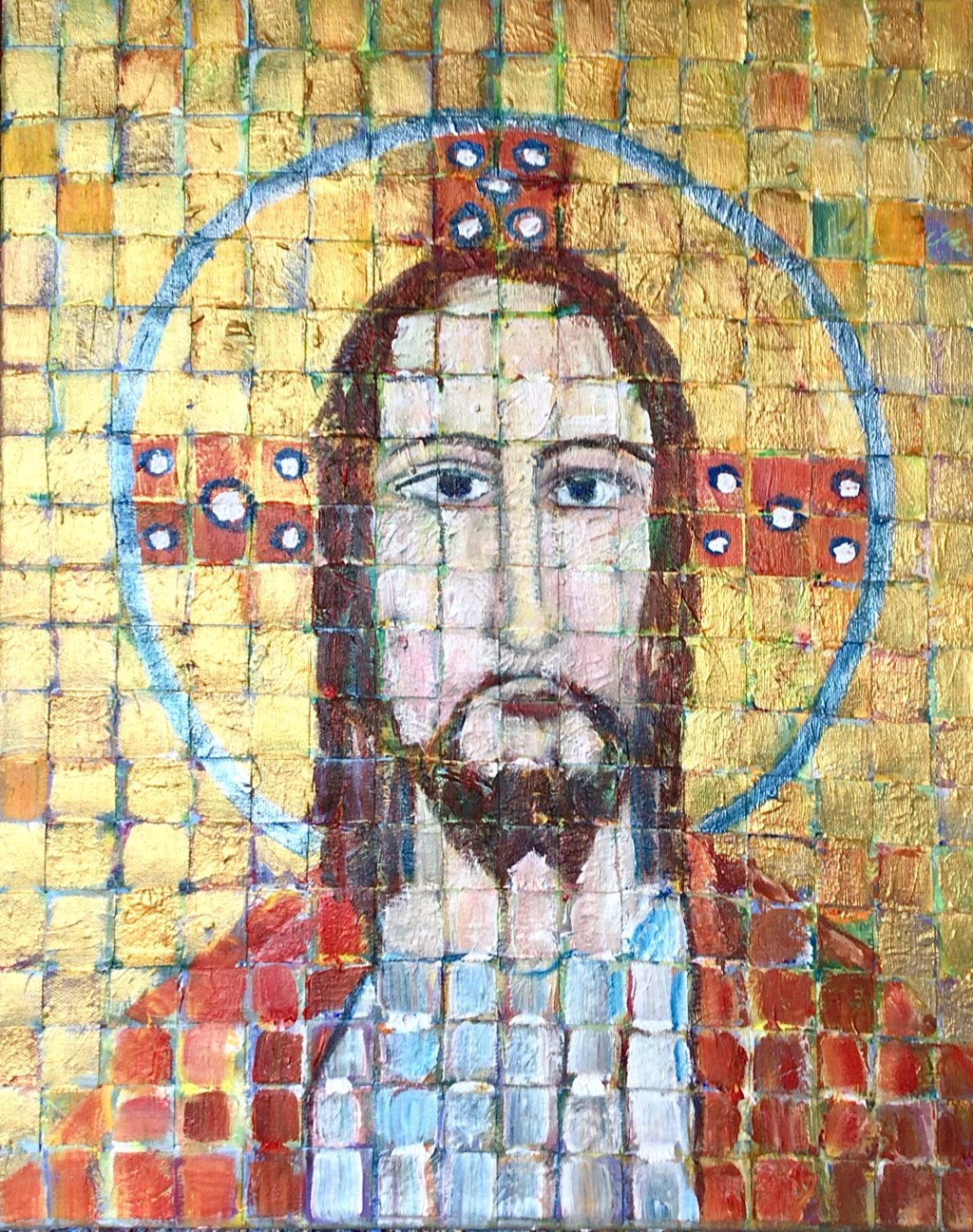
The Golden Christ

When we say “God doesn’t change,” we mean God never quits loving us, always wants to save us, and always wants to work for good for those who love the Lord and are called according to God’s purposes. God does change God’s mind when we give up our wayward ways and return to godly ways. The Old Testament is full of times God had a change of heart. Maybe some of these events were the people having a heart change and coming back to God. God does seem absent when we turn away, while God seems near when we turn towards God.

Coptic Jewel Icon

But I digress, and I plead the hot weather. Plato’s perfect forms are the subject, especially the form of the Good. For Plato, only the soul or the mind can know the true forms, while the sensible body is suspect. Plato’s philosophy is a form of dualism, which elevates the spiritual over the physical. This is an important concept for early Christianity, since they had to hash out an understanding of the incarnation of Christ. For some, Jesus was purely divine, while for others he was purely human.

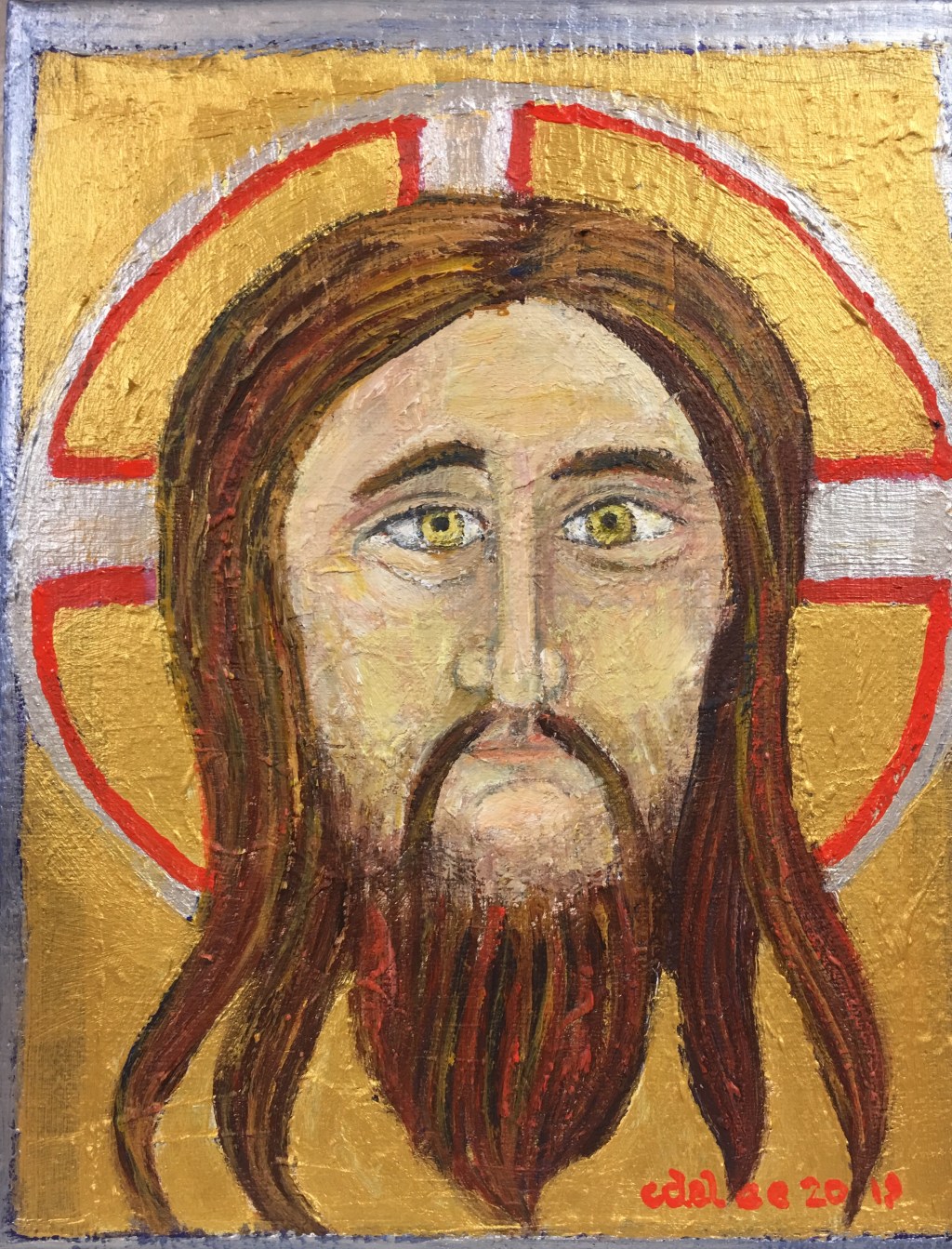
Variation on the Christ Not Made by Hands Icon

The traditional interpretation of Jesus Christ is he is both fully human and fully divine, as Athanasius so succinctly said in his treatise On the Incarnation: “for God became man so that man might become god” (54:3). This theology of theosis, or perfection in love, always boggles the mind of those of us who are used to 1 + 1 = 2, or the sensible and mathematic physical reality of this world. One of the rallying cries back in those days was “There never was a time when the Son wasn’t the Son.” People marched in the streets to proclaim this belief: the Son of God never gave up his divinity even when he became human for the sake of our salvation. It was necessary for him to become human to save all of us and only if he were completely God would he be able to save us entirely.

Christ Pantocrator

For the icon painters, Athanasius also is informative when he writes about the Incarnation: “and He manifested Himself by a body that we might receive the idea of the unseen Father; and He endured the insolence of men that we might inherit immortality.”

As Jesus says in John 14:7, “If you know me, you will know my Father also. From now on you do know him and have seen him.” Like Phillip, we can only believe in what we’ve seen. Many of us are doubting Thomases, who need to touch and hold onto physical proof before we can be convinced. The icons remind us that Jesus is

“the image of the invisible God, the firstborn of all creation; for in him all things in heaven and on earth were created, things visible and invisible, whether thrones or dominions or rulers or powers—all things have been created through him and for him” (Colossians 1:15-16).

What image is the Christ icon? That depends on the time and place where the icon was created, but all images share certain qualities. The eyes are prominent, the mouth is small, the forehead is broad, and the lower jaw is small. Most of the icons of Christ look like a philosopher, rather than a warrior king, which was the original meaning of the Jewish messiah. All icons have at least one ear visible to hear the prayers of the faithful.

These letters form the present participle, ὤν, of the Greek verb to be, with a masculine singular definite article, ὁ. A literal translation of Ὁ ὬΝ would be “the being one,” which does not mean much. “He who is” is a better translation

The backgrounds are gold and represent a timeless, eternal spiritual space. Today, yesterday, and tomorrow are all the same for God, who is known by the name I AM. In John 8:58, Jesus got into an argument with some of the Pharisees over who were the true children of Abraham. When he told them, “Very truly, I tell you, before Abraham was, I am,” they were ready to stone him  for claiming to be god. Moreover, as the author of Hebrews reminds us, “Jesus Christ is the same yesterday and today and forever” (13:8).

Roman Icon, 12th CE, oil on wood panel, Vatican Museum

The icon itself isn’t holy, but the image it represents is holy. This is why icons are venerated , while Christ is worshipped. The image isn’t holy, but the person represented is holy. In this sense, every icon points to the ideal form of Christ in the spiritual world beyond us and the icon acts as a window or a wormhole opening so that spiritual world can enter into our sensible and material world here. The more we live with an icon, the more our hearts and minds are tuned to the silent harmonics of the hymns of joy, peace, love, beauty, generosity, and compassion. This is because we become open to the truth of Christ in a mystical way which supersedes our own personal beliefs and experiences. We lose our attachment to the world of dualisms and enter into the world of union with the divine. We are undergoing theosis. Theosis is more than just salvation and divine pardon, but is  rather the process of spiritual transformation that culminates in mystical union with God. It is a cooperative work of the Holy Spirit and the believer that results in this union.

After 12th Century Vatican Icon

Art has a way of affecting the energies of a human being. It’s well known how certain colors affect mood, so designers use these techniques to create appropriate spaces in buildings. Public art adds to the charm of a city and likewise, destroying green spaces can render a city to grimness. Having art in one’s home or office elevates it above the ordinary.

Even artists who aren’t painting icons, but are making landscapes or abstractions can be said to be seeking a platonic form, one which only they may see in their own mind’s eye. We keep looking for the next challenge, the creation which comes closest to our imagination. We artists keep on going, however, for each new work not only refines our imagination, but it also moves us closer to our desired goal. We’re like long distance runners who always seek a new personal best!

Resurrection Christ

The icon makes a claim on our lives as we return its gaze. In the silence, Christ asks, “Are you going onto perfection in the love of God and neighbor?” We take a silent stock of our lives and our interactions in prayer. Most days we agree with the apostle Paul in his letter to the Philippians (3:12):

“Not that I have already attained this—that is, I have not already been perfected— but I strive to lay hold of that for which Christ Jesus also laid hold of me (NET).”

Joy and peace,

Cornelia

Plato
https://www.webpages.uidaho.edu/engl257/classical/platonic%20idealism.htm

Early Christian Heresies
http://webspace.ship.edu/cgboer/heresies.html

CHURCH FATHERS: On the Incarnation of the Word (Athanasius) 54:3. https://www.newadvent.org/fathers/2802.htm


Faith is a Gift from God

arkansas, art, beauty, change, Evangelism, Faith, Fear, generosity, Healing, Holy Spirit, hope, Icons, inspiration, john wesley, Love, Mandylion, Ministry, Painting, perfection, purpose, renewal, Spirituality, United Methodist Church, Van Gogh, vision

In the “late unpleasantness” which has some of our Methodist congregations in turmoil, many have their reasons for going or staying. As one born into the Methodist Church, who spent a portion of my life looking for a “better god” before God called me back home, I have some experience with faith. I’ve had it, lost it, and received it once again. My privilege in seminary to work along side the Wesley librarian allowed me to touch authentic Wesley letters. I also had the blessing of being the late Dr. Billy Abraham’s assistant for the Evangelism Chair. When I think of faith, Romans 12:3 comes to mind:

“For by the grace given to me I say to everyone among you not to think of yourself more highly than you ought to think, but to think with sober judgment, each according to the measure of faith that God has assigned.”

Here Paul’s word for faith is the Greek word pistis, which is always a gift from God, never something that can be produced by people. In short, faith for the believer is always “God’s divine persuasion” and therefore distinct from confidence or human belief. The Spirit continuously births faith in the yielded believer so they can know God’s will (1 Jn 5:4).

The former UMC Bishop Mike Lowery wrote in his notice of withdrawal from the Council of Bishops as he surrendered his elder’s orders: “I believe “We are in a fight for the faith delivered once for all.” (Jude 3, CEB).

Resurrection Christ

I’m not picking on the former bishop. I knew him from my Emmaus community days in Southwest Texas. But his posted letter, which can be read at the link below, charges the United Methodist Church has lost her Wesleyan understanding of Christianity. This piqued my interest, so I decided to focus my own thoughts, as well as to inform others, on this matter of faith.

Faith as Doctrine of Assent vs Doctrine of Assurance:

Today we often think of faith as a set of beliefs, or the Doctrine of Assent. In Wesley’s time, he understood faith as the Doctrine of Assurance, a unique gift to the Christian church, whereby believers can know with certainty they are truly beloved of God with a steadfast love which endures forever.

This love is unconditional and saves us from the tragic consequences of the law of sin and death by bringing us into the law of life and love through Jesus Christ’s life, death, and resurrection. That descriptive mouthful is John Wesley’s heartwarming experience he had at Aldersgate in 1738 on the fateful evening when he attended a meeting very unwillingly, yet had the heart changing event that set his life on a different path.

Christ Surrounded by Angels

Historic Wesleyan Faith is a Gift of Grace

We need to ask, “What is the historic Wesleyan understanding of the Christian faith, anchored in the Holy Trinity and welded to Christ as Lord and Savior?” Is it located in regeneration, aka the new birth, or is it located in human morality as proof of righteousness in Jesus Christ? This probably means nothing to people in the pews, but if we’re going to claim the mantle of John Wesley, or the argument from tradition, we must get Wesley’s understanding of faith down pat. We find Wesley’s thoughts in his Notes on the New Testament and in his Standard Sermons, both of which are part of our Methodist teaching.

In the sermon OF EVIL ANGELS, Wesley reminds us faith is “our evidence of things unseen.”

“Faith is the life of the soul; and if ye have this life abiding in you, ye want no marks to evidence it to yourself: but [elencos pneumatos/Spirit control] that divine consciousness, that witness of God, which is more and greater than ten thousand human witnesses,” is Wesley’s explanation of faith in AWAKE, O SLEEPER.

Faith as the Spirit of Adoption

Another way of saying this is Romans 8:15-17,

“When we cry Abba! Father! It is that very Spirit bearing witness with our spirit that we are children of God, and if children, then heirs, heirs of God and joint heirs with Christ.”

For Wesley, faith is a gift of salvation, our trust in the saving work of Christ. As he says in the sermon AWAKE OH SLEEPER:

“Awake, and cry out with the trembling jailer, ‘What must I do to be saved?’ And never rest till thou believest on the Lord Jesus, with a faith which is His gift, by the operation of His Spirit.”

Then Wesley gives his altar call:
“In what state is thy soul? Was God, while I am yet speaking to require it of thee, art thou ready to meet death and judgement? Canst thou stand in His sight, who is of ‘purer eyes than to behold iniquity’? Art thou ‘meet to be partaker of the inheritance of the saints in light’? Hast thou ‘fought a good fight, and kept the faith’? Hast thou secured the one thing needful? Hast thou recovered the image of God, even righteousness and true holiness? Hast thou put off the old man, and put on the new? Art thou clothed upon with Christ?”

“Hast thou oil in thy lamp? grace in thy heart? Dost thou ‘love the Lord thy God with all thy heart, and with all thy mind and with all thy soul, and with all thy strength’? Is that mind in thee, which was also in Christ Jesus? Art thou a Christian indeed that is, a new creature? Are old things passed away, and all things become new?”

Mandylion: Image Not Made by Human Hands

Faith comes as a Gift. Our good works respond to Christ’s work.

Most of us are in agreement Wesley’s initial understanding of FAITH having to do with accepting Christ’s work for us as the only precondition for our salvation. There is no good deed or accumulation of good deeds needed to earn our salvation from God. What many of us have difficulty is accepting we also don’t earn our perfection in holiness by our own power.

Our Christian perfection is always a cooperative work of the Holy Spirit and our own spirit. As the Spirit works in us, we respond to work toward the complete renewal into the original image of God in which we were created. While it’s possible we might attain this perfect state in this lifetime, most Christians will attain completion in the purity of love of God and neighbor at the moment of death by God’s work, not by our own accomplishments.

Do the Born Again Christians Sin?

In Wesley’s sermon, “The Great Privilege of Those That Are Born of God,” he quotes 1 John 3:9—

“Whosoever is born of God doth not commit sin.”

The Golden Bridge—Ba Na Hills, Vietnam

Wesley admits people who are born again can err or make mistakes, but they don’t sin. That’s a bridge too far for many to accept today, for many of us are prone to judging others. We have a dysfunctional understanding of “perfection.” We think it’s like a Martha Stewart design, forgetting she has a whole staff of helpers to carry out her ideas. As one of my professors once explained it, “Once you’ve been to Waxahachie, you’ve always been to Waxahachie.”

If you don’t know Waxahachie, it’s a midsized Texas town about the size of Hot Springs, Arkansas. It was known for cotton in its hey day, and now hosts a crepe myrtle festival. Once you’ve been there, you can’t lose that experience. In the same way, you can’t lose your status of new birth. It’s a gift of the Holy Spirit, given by faith through Christ.

But some of us will try to throw it away anyhow. Wesley wrote in that same sermon, The Great Privilege, “Some sin of omission, at least, must necessarily precede the loss of faith; some inward sin: But the loss of faith must precede the committing outward sin.”

The Outward Appearance vs. The Inward Attributes

So, one who has faith doesn’t sin, since we have to lose faith in God to sin. In other words, we have to reject the gift freely given to us without price. As he also says in his great sermon on Christian Perfection, “Every one of these can say, with St. Paul, “I am crucified with Christ: Nevertheless I live; yet not I, but Christ liveth in me:” [Gal 2:20]— Words that manifestly describe a deliverance from inward as well as from outward sin.”

Van Gogh: The Good Samaritan

Christian Perfection

For Wesley, the goal of Christian perfection, or the recovery of the image of God, was to love God and neighbor with one’s whole heart until nothing else could exist inside. No favoritism for a group, no exclusion for a group, no yearning to be better than others, no desiring a better place at the table, no hoarding of resources for selfish purposes, no fear of tomorrow, nor any other anxiety that strikes the human heart.

We give our resources away so we can have room for new blessings. God always provides for those who give with generous hearts. We open our doors to the least, the last, the lost, and the unloved, because Jesus and Wesley went out into the fields and met the people where they were. Those are our people out there, and they aren’t “living moral lives,” any more than the imperfect people within our churches are. But we all can and do live lives of faith. We all can learn to trust a savior who loves every sinew of our wounded and broken bodies. We can love a God who never gives up on us even if we’ve given up on ourselves.

Homeless Jesus Statue, Timothy Schmaltz

We United Methodists might be messy, but we surely can love God and neighbor. Moreover, we’re all going on to perfection, even if some of us are moving more slowly than others. We’re still a community of faith, a people who trust God’s grace and one another to get through this thing called life together. We’ll bring each other along, for we’re not leaving anyone behind. We include in the great worldwide Body of Christ the body of Christ whom we meet outside our doors. After all, the race isn’t to the swift, but to the ones who help their brothers and sisters to the finish line, where we have a finishing medal for everyone, along with a big potluck dinner with enough food for folks to take home leftovers. That’s the never ending banquet table to which we invite all who hunger and thirst for community—both spiritual and personal.

The Word of God holds the Scripture of Salvation

Trusting Faith for a Risky Love in Unsettled Times

All we have to do is ask ourselves in this unsettled time: “Do I have Wesley’s trusting faith to live this risky love? Are these the people with whom I want to experience God’s steadfast love and share the grace of Christ? This is our heritage in the United Methodist Church, for we’re a people of faithfulness, who believe the “Bible has everything sufficient for salvation.”

I can only hope for those who leave, whether they become global Methodists, independents, or community congregations, that they will provide a large enough tent for our big God and big Christ, for the Spirit always is seeking people and places to fill completely with the gift of God’s extraordinary love and power.

Why not become all aflame with the fire of God’s redeeming love?

My prayer is our United Methodist churches will receive a fresh rush of the Spirit to become even more of what we are today, for

“Who will separate us from the love of Christ?“

Joy, peace, and faith,

Cornelia

Strong’s Greek: 4102. πίστις (pistis) — faith, faithfulness
https://biblehub.com/greek/4102.htm

Crossing the Rubicon: A Bishop Says Goodbye to the United Methodist Church
https://firebrandmag.com/articles/crossing-the-rubicon-a-bishop-says-goodbye-to-the-united-methodist-church

Of Evil Angels, sermon by John Wesley
http://wesley.nnu.edu/john-wesley/the-sermons-of-john-wesley-1872-edition/sermon-72-of-evil-angels/

Awake, Thou that Sleepest, sermon by John Wesley
http://wesley.nnu.edu/john-wesley/the-sermons-of-john-wesley-1872-edition/sermon-3-awake-thou-that-sleepest/

The Great Privilege of those that are Born of God, sermon by John Wesley
http://wesley.nnu.edu/john-wesley/the-sermons-of-john-wesley-1872-edition/sermon-19-the-great-privilege-of-those-that-are-born-of-god/

“Our standards affirm the Bible as the source of all that is “necessary” and “sufficient” unto salvation (Articles of Religion) and “is to be received through the Holy Spirit as the true rule and guide for faith and practice” (Confession of Faith).”
Theological Guidelines: Scripture
https://www.umc.org/en/content/theological-guidelines-scripture

On Christian Perfection, sermon by John Wesley
http://wesley.nnu.edu/john-wesley/the-sermons-of-john-wesley-1872-edition/sermon-40-christian-perfection/

NOTE: For a longer discussion on “Love thy neighbor,” see—
Kierkegaard, D. Anthony Storm’s Commentary on—Works Of Love
http://sorenkierkegaard.org/works-of-love.html

John Wesley’s Notes on the Old and New Testaments. http://bible.christiansunite.com/wesindex.shtml

Sermons of John Wesley, 1872 edition
http://wesley.nnu.edu/john-wesley/the-sermons-of-john-wesley-1872-edition/

Rabbit! Rabbit!

adult learning, at risk kids, brain plasticity, Children, city, Dreamscape, Faith, Family, flowers, Healing, holidays, Icons, Love, mandala, Mandylion, Ministry, ministry, nature, Prayer, purpose, rabbits, Reflection, renewal, risk, school shootings, shame, Spirituality, Stonehenge, summer solstice, texas, Uncategorized

Welcome to June! I’ve found my sunshades and my flip flops, so this rabbit is ready for a summer vacation. Old school teachers never die, they just take the summer off. And teachers, as well as students, will need a summer off, along with some intensive counseling, to get them ready to return in a healthy frame of mind next fall.

Summer Solstice Mandala

In my early years in ministry, I served in a certain county where many people were caught up in despair. I often complained to my district superintendent of my desire to pour mood elevators into the public water supply.

“You do know drugging the water supply isn’t exactly an acceptable activity for a Methodist minister?”

“Oh, yeah, but it sure would make my job easier.”

Rabbits Love One Another

Remember, June 3 is Love Conquerors All Day. I need to remind myself of this on occasion when I want to take the easy road. As Jesus reminds us in Matthew 7:13—

“Enter through the narrow gate; for the gate is wide
and the road is easy that leads to destruction,
and there are many who take it.”

Taking the easy way out isn’t always the best choice, but it’s the one we rabbits most often choose. We rabbits don’t like to rock the boat, and we like to make all the other rabbits happy if at all possible. The only problem is if we please A, B gets upset. If we please B, A gets upset. We don’t even try to please C, since C is so cranky, even the good Lord Jesus couldn’t fry an egg to please them. We set our hearts and minds on pleasing God, as best we can, and hope to hear the words, “Well done, good and faithful servant, enter into the joy of your master.”

Make Mine Chocolate Ice Cream Day

Chocolate ice cream brings me joy any day of the year, but June 7 is a day dedicated to this frozen delight. Don’t worry about frying eggs, but keep it frozen. I like mine plain, but fresh strawberries or peaches are a nice addition, plus some chopped nuts. Always go for complex, unless you just can’t wait. Then grab a spoon and eat it straight from the pint. (Mark it with your name, since you ate from it.)

Often we cut the Gordian Knot and go for the shortcut to our complex problems. Sometimes this is a good solution, for the shortest distance between two points is a straight line. My daughter used to call my vacation navigation shortcuts “the long cuts,” since I’m directionally challenged. Most of the time, that straight line went through swamp land and alligators. I can hear her voice now, “NOOOOO!!!” I’m known for taking the scenic route, so I often see America’s less known sights, which are off the beaten path.

In the gospel of Luke (14:34), Jesus quotes a proverbial saying:

“Salt is good; but if salt has lost its taste, how can its saltiness be restored?”

Another translation of the latter portion of this verse is “how can it be used for seasoning?”

When I think of loss, I think of a life snuffed out. Some people are burned out, so we can say they’ve lost their seasoning ability. There’s no vim or vigor in them. Other lives are cut short and aren’t able to fulfill their purpose to season the great soup of our community. Our past month was marked by 47 mass shooting incidents in May alone. A mass shooting incident is defined as one in which at least four people are injured or killed, not including the shooter. Suicides aren’t included.

Suicides are also a public health problem. They are the “deaths of despair” that leave ripples of grief and hopelessness in the survivors. They’re the ultimate shortcut solution to a problem, the placing of a period where life has placed a comma or a semicolon. My daughter once attempted suicide by downing half a bottle of aspirin. I noticed the open bottle and pills scattered across the floor. She said the “dog ate it.”

“That’s too bad, I’m going to miss that dog. She won’t be long for this world. We’ll need to make burial plans for her.”

“Well, actually, I’m the one who ate the aspirin.”

“Then we’re going to the hospital. You aren’t going to like getting your stomach pumped, but it’s better than being dead. You want to have a chance to grow up and have a good life. A dog we can replace. You—not so much.”

It was a rough time in her life, and mine too. But God was with us. And we had support from counselors, friends, family, and our church family. My work family and my clients supported me too. I must be the most extroverted rabbit in the patch, because I asked everyone for help. It turned out my problem was shared by everyone else. I discovered I wasn’t alone, but was the most ordinary of rabbits around.

This is a humbling experience, especially when you’re a first child and the only girl. I admit to being spoiled, but don’t let my brother rabbits hear me say this. I’ll deny it to my last breath: I’m like every other rabbit I know. I want to think I’m someone special, even when I’m just as fluffy as every other bunny out there on Gods green earth.

June 21—Summer Solstice

Unfortunately, half the suicides today are committed with a gun, not aspirins. When looking at overall gun deaths, roughly two-thirds are attributed to suicides—a proportion that is consistent across most states. Gun suicides are on the rise and data also indicates men, white Americans, older people, and individuals living in rural areas present higher rates of gun suicides. Another group presenting a unique risk for suicide is current and former members of the armed forces, especially those with PTSD.

Compared with the general population, current and former military members have significantly higher rates of gun ownership. According to a 2015 study, nearly 50% of U.S. veterans own a gun. In contrast, studies suggest that only about 22% of the general U.S. population owns firearms. Similarly, the age groups of 50 to 64 years old and 65 and older have the highest rates of gun ownership, according to a 2017 Pew Research Center study. This can further explain the high rates of suicide among older veterans.

According to data from the U.S. Department of Veterans Affairs (VA), in 2019, close to 4,332 veterans died by gun suicide in the United States, representing close to 18 percent of the total number of gun suicides reported by the Centers for Disease Control and Prevention (CDC) during that year. Perhaps more alarming is the fact this figure shows a veteran is killed by gun suicide every two hours. In 2019, active duty military members committed suicide by gun 64% of the 498 total (318), almost one gun suicide per day.

Why isn’t anyone speaking about this? For all the lip service our politicians give to the flag and to the armed service members, they seem to forget them once they’re no longer useful to fight their wars or march in their parades. Perhaps because Congress won’t devote any money to study the effects of gun violence on the citizens of our Beautiful America, so we have to fund private studies here and there to piece together a patchwork of facts of this scourge on the peace of our people.

My young neighbor, only 8 years old, was in a panic as he knocked on my door the other day. His parents hadn’t come straight up the elevator, as they’d said they would. He was crying to beat the band and was sure something bad had happened to them. I invited him inside and left the door open so we could see them come past. He was so worked up, he couldn’t sit down. I suggested a call to his daddy, but they came walking past just at that moment.

June 19—Father’s Day

We don’t realize what terror these school shootings put our children through. There’s no safe place for them any more, no matter how “hardened” we make the buildings. Some person always breaks the shell at the most inopportune moment.

Some rabbits will have empty seats at their family reunion tables because someone decided to act impulsively. Father’s Day (June 19) won’t be a celebration without the son or daughter to give Dad the tie, the golf balls, or breakfast in bed.

I think back to my own childhood. We worried in the 1950’s more about the urban legends of Halloween candy poisoning, when we were more likely to get killed crossing Highway 1, a four lane highway running through our town. My mother rabbit would wait for me to ride the trolley home from school. She would wait until the near lane of traffic cleared before she walked out to the center median and time this so the far lane’s cars would finish passing so she could walk across the newly empty lanes to meet me on the other side. We held hands and crossed in the same manner on the way back to our home.

This was our routine from the start of school until sometime in the autumn. Mother was delayed one day, so I sat down to wait for her and opened my book to read. I was wearing a brown jacket against the early cool spell, and my dirty blonde hair blended in with the pile of dry leaves on the ground. Intent on my book, I failed to see her come outside. She overlooked me and went inside thinking I’d missed my ride.

A bit later, I decided if she wasn’t coming for me, I’d come to her. Gathering up my possessions, I stood on the curbside. I watched the comings and goings of the quickly moving traffic. Once I saw the break in the pattern, I walked out into the clearing, waited at the median, and crossed behind the trailing traffic of the second lane. When I walked inside, my mother had a conniption fit. After this, I began riding my bicycle to school, and my brother got to come with me.

Brain Functions

Not everyone is mature enough to cross a four lane busy highway by themselves when they’re in the fourth grade, which is the same age as the children who lost their lives at Robb Elementary in Uvalde, Texas. . Some people still need to be supervised at work even in their 20’s. The brain keeps maturing past age 21, as the frontal lobes, which are home to key components of the neural circuitry underlying “executive functions” (such as planning, working memory, and impulse control) are among the last areas of the brain to mature; they may not be fully developed until halfway through the third decade of life. Although neuroscience has been called upon to determine adulthood, there is little empirical evidence to support age 18, the current legal age of majority, as an accurate marker of adult capacities.

Since May 24, the date of this tragedy in Uvalde, Texas, the gunviolencearchive.org has recorded 16 mass shootings in six days, with 79 killed or wounded. Some of these are high school graduation parties where uninvited guests arrived and gunfire broke out, others are the result of young people wandering about in the late hours and getting into trouble with guns. During my time of ministry, youth, alcohol, and firearms were usually a recipe for trouble. Maybe parental rabbits’ brains are still developing too, if they aren’t able to put their rabbit foot down and tell the junior rabbits to leave their weapons at home. Visiting Jack Rabbit in jail for accidental death or intentional use of a firearm will throw a curve into your best laid plans for your progeny.

Rabbits in Cars Going for a Joyride

Instead, cities may have to reinstitute curfews after dark to curtail the opportunities for gun violence. Or they could raise the age to buy a weapon and require a longer waiting time and a more thorough background check. I wouldn’t be opposed to a training class and a test to see if the owner knows how to use the weapon safely. After all, we do this for the 2 ton weapon of mass destruction known as the family automobile. So what if the founding fathers never had autos; they also never had automatic pistols or large magazine weapons, modeled on the ones used in combat.

Did I mention June is National Safety Month? Its emphasis is workplace safety, but as a former teacher, this old rabbit reminds you, between 2009 and 2020, teachers’ workplaces are in schools, which is where 30% of mass shootings occurred in public places (schools, malls, or bars), while 61% of mass shootings occurred entirely in the home and another 9% occurred partially in a home and partially in a public location. The common factor in these is the gun and the presence of domestic violence. In at least 53 percent of mass shootings between 2009 and 2020, the perpetrator shot a current or former intimate partner or family member during the rampage.

Richard Small seen posing with his rifle before turning it over to police.
(Joshua Lott/The Washington Post)

I know y’all usually expect a bright and cheery note from me at the beginning of the month, but my heart is broken. Thoughts and prayers are nice, but they don’t stop the carnage. We need to make some changes. At least one man has turned in his assault weapon to his local police station, so it doesn’t fall into the wrong hands. He couldn’t bear the thought of it being used to perpetrate a similar crime if he were to sell it. If we parents don’t say no to our children, if we keep voting for politicians who are doing nothing, then we get to keep the distinction of having the highest rate of violent gun deaths for any of the developed countries.

That’s not the American Exceptionalism I believe in. We can do better. These are crimes against the common good and against the innocent. The shooter shares the primary blame, but everyone who does nothing to change our society for the better also shares the blame and shame for the next group of victims. At the rate we’re going, we’re having about one mass shooting per day. Eventually this scourge will come to YourTown, USA, and your small town police force will be just as flabbergasted as poor Uvalde’s. How could this happen in our little corner of the world?

I cry along with Jeremiah ( 8:21-22):

For the hurt of my poor people I am hurt,
I mourn, and dismay has taken hold of me.
Is there no balm in Gilead?
Is there no physician there?
Why then has the health of my poor people
not been restored?

Time Magazine Cover from 2019 with all the Mass Shooting Locations Named

Sometimes we go along with the attributes of cultural Christianity, rather than practicing the Christianity of Jesus Christ. Romans 12:2 reminds us

“Do not be conformed to this world, but be transformed
by the renewing of your minds, so that you may discern
what is the will of God—what is good and acceptable and perfect.”

Joy, peace, and balm for hurting souls,

Rev. Cornelia

Deadly Dreams: What Motivates School Shootings? – Scientific American
https://www.scientificamerican.com/article/deadly-dreams/

You can view a report of any 2022 mass shooting incident by visiting the list on the Gun Violence Archive’s website:
https://www.gunviolencearchive.org/reports/mass-shooting

Poisoned Halloween Candy | Snopes.com
https://www.scientificamerican.com/article/deadly-dreams/

Mass Shootings in America | Everytown Research & Policy | Everytown Research & Policy
https://everytownresearch.org/maps/mass-shootings-in-america/

Adolescent Maturity and the Brain: The Promise and Pitfalls of Neuroscience Research in Adolescent Health Policy – PMC
https://www.ncbi.nlm.nih.gov/pmc/articles/PMC2892678/

Guns and Mass Shootings: Data Show Why US Is Outlier on Deaths From Firearms
https://www.bloomberg.com/graphics/2022-us-gun-violence-world-comparison/

Texas romance with guns tested by Uvalde school shooting – The Washington Post
https://www.washingtonpost.com/nation/2022/05/30/uvalde-shooting-guns/

What Makes a Real Christmas?

art, Children, Christmas, coronavirus, Creativity, Faith, Family, Food, grief, holidays, Icons, Imagination, Love, mystery, pandemic, poverty, Spirituality

I was cleaning up my condo Sunday afternoon because the Pandemic restrictions have caused my housekeeping to need some intensive care. Between all the various projects I’ve done and my new paintings, plus the seasonal change requiring my closet revamp, I realized I haven’t seen the top of my table in months. Since I’m not receiving visitors, I really don’t have to worry about this, but even I can only live with so much disorder and clutter.

When I was in seminary, my roommate and I would make a pact: no cleaning during exam week and ice cream runs every night. Amazingly, some compacts are easily kept, and studying for finals was less stressful because of our sweet rewards. A little chaos for a short period of time isn’t a problem, but months or years of confusion and neglect can bring about disaster.

I realize chaos is the norm for many people during the holidays, even if we’re not attending parties at work, or visiting with relatives or friends. We still have other rituals to indulge, especially if we have children. One year I stopped to list out all the experiences I remember which make up an ideal Christmas. I never imagined the list would be so long, or that my parents worked so hard to make the season wonderful for us children. As you read this list, feel free to add your own traditions to the list.

Natchitoches Christmas Lights
  1. Writing Santa a letter
  2. Traveling to Natchitoches to see the Christmas lights
  3. Pizza and Car trip to see the Christmas lights in town
  4. Hanging Christmas lights on the house
  5. Finding the perfect Christmas tree
  6. Decorating the Christmas tree
  7. Making Christmas decorations
  8. Making popcorn and cranberry strings for the tree
  9. Family ornaments
  10. Watching the bubble lights
  11. Hanging the Christmas stockings
  12. The brass Angel chimes
  13. Finding a thorn bush for a gumdrop tree
  14. Eating ribbon candy from the jar at my nanny’s home
  15. Candy lifesavers in a book
  16. Special foods, such as Ham and yam, and the green bean thing
  17. Christmas breakfast of biscuits and strawberry jam
  18. Drinking from the Santa mug
  19. Christmas plates and mugs
  20. Making fruitcake cookies and cakes
  21. Wrapping and hiding presents
  22. Dreaming while reading the Sears catalog
  23. Holiday visits
  24. Visit to Santa Claus
  25. Gifts from Santa, rather than from the parents
  26. Christmas candlelight service at church
  27. Children’s Christmas pageant and choir concert
  28. Special music
  29. Nativity scenes
  30. Staying up late to assemble toys
  31. Never enough batteries
  32. Stocking stuffers
  33. New red robe or pajamas
  34. Christmas letters from all our friends
  35. A vain hope for snow
  36. Wreath on the door
  37. Wrapping paper everywhere
  38. Handing out presents
  39. Opening presents
  40. Teacher gifts
  41. Making a Christmas list
  42. Dropping hints
  43. Candles in the window to guide the wise men
  44. Advent wreath candles
  45. Advent calendars
  46. Pine cones
  47. Caroling from house to house, mostly off key
  48. Parties
  49. Christmas clothes and Sox
  50. Garish Christmas sweaters

At this rate, I’d have to accomplish 1.7 per day to get all 50 done in between Thanksgiving and Christmas Eve. Like any big project, no one does it all at once. We always divided it up into smaller, achievable experiences, some of which extended over the whole season, and others we did once a week. How we managed to cram a dozen of these into each one of the four weeks before Christmas is beyond me. These days my work ethic is on furlough and if it ever returns, I’ll probably send it on vacation rather than let it clock back into work. I do lead a simpler life now.

My Christmas Tree Today

Any month of 30 days can be converted to one of these units:

  • 2,592,000 seconds
  • 43,200 minutes
  • 720 hours
  • 4 weeks and 2 days or
  • 8.20% of a standard year

These past nine months of COVID, with its quarantines, terrible toilet paper, and bad haircuts have been exacerbated by the illnesses and deaths of friends and family we’ve known and loved. With over 3,000 Americans dying from this disease daily, celebrating a real Christmas as we once did, seems unconscionable. Those of us who’ve lost a loved one look for any light in these dark days. Like Frodo, we might say, “I wish it need not have happened in my time.”

“So do I,” said Gandalf, “and so do all who live to see such times. But that is not for them to decide. All we have to decide is what to do with the time that is given us.” (J.R.R. Tolkien, The Fellowship of the Ring).

When I think of my life of seven decades plus, I remember when I was a child, every one of those two and a half million seconds before Christmas seemed to stretch out to eternity. Just as the three months of summer flew by like an icicle on a hot stovetop, the one month between Thanksgiving and Christmas moved slowly, as if I were watching a stalactite grow imperceptibly across the centuries. Maybe this is why my parents organized this magnificent list of projects to keep us children from whining over and over, “Is it Christmas yet?”

Christmas tree skirt from the 1950’s

I’ve never understood how they managed to teach us deferred gratification. After all, every single day in the month prior to Christmas had some sort of activity, and some of those projects extended over the whole season. One year mother decided to bead a skirt for the tree. She bought a “Twelve Days of Christmas” kit, which contained the white felt skirt, a green fringe, and multi colored felt squares imprinted with the patterns. As we worked each night, we filled each design with brightly colored sequins. Some of these early days were so heavy they had no fabric showing. As Christmas came closer and our project was as yet unfinished, we began to limit our decorating. We also were running out of colored beads and sequins by this time.

Handmade Stockings on an Antique Sideboard

Another year mother made new stockings for us kids, with our names on them. She also sewed a small bell on these so our early arising would wake her up. For the first grandchild, she had more time on her hands. That stocking was fully embroidered and had no warning bell. Of course, it hung at my home, so mother and daddy didn’t have to worry about any early bird interrupting their beauty sleep.

My parents did have a rule that we kids needed to wait until the crack of dawn before we entered the room where the tree was. If we got up earlier, and we almost always did, we took our pillows and covers into the dining room. Our old house had French doors separating the dining room from the living room. We’d pile our bedding down close to these doors and look through the bottom window into the magic darkness of the corner where the Christmas tree stood guard over mysterious packages wrapped in seasonal colors.

“What do you think that big one is?” My brother would whisper.
“It’s probably clothes,” I’d reply, “you know those rectangular packages are usually pajamas or pants.”
“Gross!”
I’d giggle and he’d elbow me in the ribs.

All three of us would strain and crain to see the indistinct shapes back under the lower branches of the fir tree. Until the first light came into the window beside the tree, we could only imagine the treasure hidden there. In our eager efforts and earnest desire to meet the rising sun, we often fell back asleep dreaming of Christmas morning. We’d awaken when our parents began their morning coffee ritual, which usually happened in bed, but on Christmas, they drank their caffeine on the couch and watched our joy, as we unwrapped the presents from Santa Claus.

None of us children were ever hungry on Christmas morning, at least not until we’d discovered the answer to all the questions we’d asked in the dark of night. Once those were revealed and our curiosity satisfied, we could turn our appetites to breakfast. Someone always gave daddy a good jam and biscuit gift in a wooden tub, so it was our go to meal for breakfast. We didn’t eat biscuits often, so they were a treat with huge dripping globs of melting butter. We’d go to one of the grandparents’ homes for lunch soon afterwards, so we didn’t need a big meal.

As I think back on these 1950’s Christmas memories, I was too young to know about the hunger and poverty of others. I do remember the poliovirus and the vaccine in my arm. There was the nuclear threat of the Cold War era and I lived in the time of the McCarthy Hearings and the John Birch Society. This is also the time of Brown vs. Board of Education and the Civil Rights Movement. My parents may have instituted all these seasonal home grown activities not only for us children, but also for themselves. If they were busy with “Christmas,” then they were focused on a spiritual journey and not on the chaos of the world.

Icon of The Creation of the Stars

When my daughter was small, I began buying her Christmas in August, because that’s when I got my first paycheck as a schoolteacher. I bought one little thing at a time, and put aside a little more money on a couple of larger gifts in layaway. I wasn’t going to buy anything for myself, but the choir at my church gave me a ham and a little love offering so I could have a bright red blouse for Christmas. I recalled the year after my marriage, my husband gave away some of our wedding gifts as Christmas presents “to keep up appearances.” We shouldn’t have to lie to the ones we love, especially at Christmas, but not everyone can live with the truth. Christmas isn’t about the gifts we give to one another, but about the gift God gave to humankind.

Creation of Light

Sometimes it seems like our world has gone mad, and folks can’t tell a truth from a lie. My daddy used to say there were folks who’d say the sun was shining even when it was pitch black outside. I’d shake my head in disbelief, but I hadn’t been out in the world as much as he had. Even if we now live in a world gone crazy, we can take comfort in these true words from the gospel of John (1:1-5)—

In the beginning was the Word, and the Word was with God, and the Word was God. He was in the beginning with God. All things came into being through him, and without him not one thing came into being. What has come into being in him was life, and the life was the light of all people. The light shines in the darkness, and the darkness did not overcome it.

Icon of the Nativity with Visit of the Magi

HOW DID A SAINT BECOME A SANTA?

art, Children, Christmas, Civil War, Faith, generosity, Icons, Imagination, Love, photography, poverty, purpose, Spirituality

Once upon a time, Bishop Nicholas of the Greek Orthodox Church was known for his charity to the poor and other good deeds. After his death, enough miracles in his name elevated him to sainthood. People began to give gifts to others in his name to celebrate his feast day, December 6th.

Later on, the gift giving at Christmas became more important. After Clement Moore’s 1823 Poem, A Night Before Christmas, the visit of “Old Saint Nick” came alive in children’s imagination. With Thomas Nast’s Illustrations during the Civil War era, Old Saint Nick transformed into Santa Claus.

Of course, even though the two were once one person, their personalities are different. Everybody loves Santa Claus. He embodies holiday cheer, happiness, fun, and gifts—warm happy aspects of the Christmas season. How do Santa Claus and St. Nicholas differ?

Santa Claus belongs to childhood;

St. Nicholas models for all of life.

Santa Claus, as we know him, developed to boost Christmas sales—the commercial Christmas message;

St. Nicholas told the story of Christ and peace, goodwill toward all—the hope-filled Christmas message.

Lorenzetti—Saint Nicholas giving gold to a poor family

Santa Claus encourages consumption;

St. Nicholas encourages compassion.

Santa Claus appears each year to be seen and heard for a short time;

St. Nicholas is part of the communion of saints, surrounding us always with prayer and example.

Santa Claus flies through the air—from the North Pole;

St. Nicholas walked the earth—caring for those in need.

Santa Claus, for some, replaces the Babe of Bethlehem;

St. Nicholas, for all, points to the Babe of Bethlehem.

Santa Claus isn’t bad;

St. Nicholas is just better.

We can actually keep the spirit of both Santa and the Saint all year long if we keep the joy of giving and receiving gifts to all, especially by giving to those who have less than we have.

If we keep the love of all persons in our hearts, then we’re loving as God loves us, for this is how the saints love the world. Even Santa loves all the world like this—really! Does any child ever get coal in their stocking? No! This is only a grownup threat to make the child behave. All children get a Santa gift, for the “Santas” in the community will make it happen, for they are the Saints who walk among us.

I want to thank the folks at the St. Nicholas Center for this idea. They have good resources for teachers for downloading. Check them out. I found the images on google search.

http://www.stnicholascenter.org/pages/compare-santa-st-nicholas/

Generation to Generation: Learning to be Free

Creativity, Imagination, photography, Prayer, purpose, purpose, renewal, Spirituality, Uncategorized

old photographs, mostly unmarked, in decaying cigar box, found at grandmother's house.

old photographs, mostly unmarked, in decaying cigar box, found at grandmother’s house.

The slave does not have a permanent place in the household; the son has a place there forever. So if the Son makes you free, you will be free indeed.” ~~ John 8:35-36 

With all the Paula Deen jambalaya on the airwaves lately about her treatment of African-Americans and her misplaced desire to have a plantation themed wedding reception with “slaves attending their masters,” I thought I ought to spend some time researching my own Southern ancestors.  Creeping age does that to one, as does the addition of yet another life to our family tree. I flew to Florida to celebrate becoming a grand aunt for the first time. Bringing gifts embellished with the family emblem, the fleur de lis, as well as handmade gifts that harken back to a simpler, earlier time when I was young, this child will know that he is a true DeLee.

I also brought a gift that has been another long-term project, my nephew’s family tree album.  When my parents died, as the oldest child I inherited the photos and memorabilia of their lives. This is that detritus of accumulated treasure of the deceased that they didn’t organize, identify, or otherwise “get a round tuit,” but they also wouldn’t get rid of it because of the love and memories they had locked up in those old photos and letters. This is the debris that the rest of my family either didn’t have the patience to deal with, or their emotions were too raw at the time, so they said, “Just set a match to it and burn it all up.” I knew I might not have the time or emotional capability to handle this task in the days or months after our last parent died, but the day would come when I would have that desire and the gift of time.

First I did research on the generations of our family tree for a Family Systems Class. I learned that each family or organizational system is interconnected across the generations, and our own lives today can’t be understood outside of this generational legacy.  Our history affects our present relationships: family, friends, and workplace.

I discovered some interesting “myths” about my Dad’s family that were told to “keep face,” for it seems not all my ancestors were such fine, upstanding citizens as my parents were trying to raise in their generation. I also discovered that my Mom’s people were all fairly straightforward folks. Maybe the fact that their history goes back much longer than my Dad’s people makes a difference, for my earliest ancestor I’ve found on his side is from the early 1800’s in South Louisiana, just after the Louisiana Purchase.  Jonathan Livingston DeLee married Mary Day, a young widow with a child, after she lost her husband who died of the measles after helping Stonewall Jackson defend New Orleans in the Battle of 1812.

My ancestors in Louisiana were all slaveholders before the Civil War, or “The War Between The States,” as my unreconstructed Daddy was wont to call it.  I discovered that I had great and grandparents in the KKK. I wondered how they could sleep soundly at night or keep their souls at peace by day. Their sons and daughters in my parent’s generation formed “private clubs” from public restaurants so that they wouldn’t have to integrate their dining establishments. This ruse didn’t last long, and now no one bats an eye, thankfully, because my generation marched with MLK in Atlanta and turned the world upside down for justice’s sake.

The question is today, how would any of us know the difference between the life of a slave and the life of the son/daughter in the family? If we are all “free people in these United States of America,” are some of us yet living in bondage, while some others have been set free? In the matter of faith, some of us are still slaves, while some of us have the freedom of the sons and daughters of God.  Jesus said, “I came that they may have life, and have it abundantly” (John 10:10). He also said, “The thief comes only to steal and kill and destroy” (same verse). To have this abundance is to live by faith in the work that Christ has done for us. The thief is our delusion that we must be good enough to earn God’s love or that we must work hard to be loved by the God that already loves us beyond measure (“But God, who is rich in mercy, out of the great love with which he loved us even when we were dead through our trespasses, made us alive together with Christ*—by grace you have been saved— and raised us up with him and seated us with him in the heavenly places in Christ Jesus, so that in the ages to come he might show the immeasurable riches of his grace in kindness towards us in Christ Jesus.” ~~ Ephesians 4:4-7)

Some of us have spent our lives trying our hardest to earn our parents’ approval, our loved one’s approval, our child’s approval, our boss’ approval, or our friend’s approval.  We can’t turn around without trying to please someone else, only to discover that what pleases one displeases another! Now we are caught up in the anxiety circle, for we are stuck halfway and please no one, not even ourselves.  There is the third party whom we can never please, The Contrarians, for this group isn’t happy with anything we do and will surely find fault in us!)

We think that God is also like this, only bigger and more difficult to please. We have heard the verse, “Be perfect, therefore, as your heavenly Father is perfect” (Matthew 5:48). We pile rule upon rule for our lives and the lives of others to measure up as “good enough.” This is why we are not “free to love God as a son or daughter,” for we are like slaves always looking out under the corner of our eyes to see if we are going to be punished for doing the wrong thing.  We can’t allow God to love us freely, for we are in bondage: slaves to the managed life, the life of rules and regulations, bound to the prison of punishments for failure to attain perfection.  We cannot love a God who keeps us in chains, for we are slaves and slaves want to be free.  If we only knew that “perfect” in Greek meant “complete,” then we might have a different take on how we live our lives.

The daughters and sons of God love their Father freely, for they will inherit all that their parent has. I may have received the house and the bric-a-brac along with all the photos from my earthly parents, but I will inherit the kingdom from my heavenly Father (Matt 25:34), as well as eternal life (Luke 18:18). If our goal as a person of faith is to live our life with a heart so full of the love of God and neighbor that nothing else exists, surely then we will be “perfect/complete in love” in this life. We live by faith knowing that God enables us to grow toward this goal of complete love day by day.

As you reflect in your journal on the faith of a son or a daughter versus that of a slave or a servant, consider: are you just a hired hand for God, showing up faithfully when God rewards you with a blessing, but being scarce or quitting on God when the “paycheck” seems short? Journal your feelings or use a stencil to make word art that sums up your feelings.

Death by China: Wesley and Barnum Meet Dr. Who

Family, Food, generosity, Health, Love, New Year, poverty, Spirituality, stewardship, Uncategorized, vision, Work

Overheard: PT Barnum & the Rev. John Wesley on the Movie “Death by China”

Citizens of 1880 and 1760 usually don’t have the opportunity to visit over coffee, unless Dr. Who activates his telephone booth or we use the research tools available to us to bring their ideas together in the same space. “Free Books” can bring PT Barnum’s The Art of Money Getting or Golden Rules for Making Money[1] and John Wesley can give us his thoughts on “The Use of Money” from his Standard Sermons.[2] These we can bring together to share thoughts both secular and religious that open up the conversations we should be having with each other as we prepare for our Black Friday Shopping Marathons, for surely our merchants are eagerly awaiting our arrival.

PT Barnum was known for passing off a fake ancient giant skull because a rival group wouldn’t sell him the skull known as the “Cardiff Giant,” which was found in a dig in New York State.  Barnum told the story that this other giant was the fake and his was authentic, causing the other owner to say the immortal words falsely attributed to PT Barnum:  “A sucker is born every minute.” Unfortunately, the Cardiff Giant was an elaborate hoax, so the prophecy was unfortunately true.

This misquote, “A sucker is born every minute,” must have been designed for America when we signed the papers admitting China to the World Trade Organization, for 57,000 factories in America have shut down since China joined the WTO in 2001. These closed factories represent jobs that are no more, but they also represent other support facilities and businesses that supported those workers and factories: beauty and barber shops, bakeries, cafes, shoe shops, clothing shops, and other small businesses such as accounting and legal services, mechanics, and gas stations. All these begin to fold when a factory closes because the workers have no income to spread around. Every one manufacturing job supports a half dozen other jobs. Since 2001, America has lost 2.7 million jobs (Economic Policy Institute estimate), nearly 77% in manufacturing.

We believed a free market would operate in China and open trade would bring prosperity to all parties. Instead by 2012 we posted a $174.5 trillion trade deficit with China. Their low wages and standard of living, combined with their disregard of environmental hazards, pollution standards, labor standards, safe working conditions, and minimum wage laws meant that they could produce goods more cheaply than Americans could. There was no level playing field, so there was no free market. The cheap, addictive products made in China attracted Americans, who wanted to keep their standard of living at the same level.

These Americans had lost their living due to job and wage loss, and didn’t count the costly consequences of also buying from the hand that bit them (lost jobs, closed factories, lost manufacturing base in USA, outsourced economy.)  These facts are brought forward in the movie, “Death by China,” by Peter Navarro (produced by Greg Autry).

We are buying these products on credit: one is the trade imbalance, and the other is the credit card debt people are carrying. Barnum refers to debt as “working for a dead horse” (p. 54), for it doesn’t earn money for anyone. He also said that even in 1880, “Americans as a nation are far too superficial, they are striving to get rich quickly, and do not generally do their business as substantially and thoroughly as they should” (p. 101).

Black Friday deals are made in China: Lead painted toys & jewelry, toxify me Elmo, Cheap electronics and home furnishings, and Shoes produced by prison labor.  If Wal-Mart were a country, it would be the fourth largest trading partner of China. Americans will line up overnight to be the first inside the stores to claim these “bargains.” While we are there we might pick up some Tainted pet food, Toxic toothpaste with antifreeze or Fish/tilapia from China that is raised in a polluted stream. We’ll save a few pennies, but we’ll pay more in health costs in the long run. This is what Barnum calls “penny wise and pound foolish” (p.9). Those of us that have Wal-Mart stocks will celebrate when the sales on Black Friday bring the folks in, as our futures will seem to be more secure. But Barnum reminds us in his book, The Art of Money Getting, or Golden Rules for Making Money, “You cannot accumulate a fortune by taking the road that leads to poverty” (p. 18).

In Sermon 50, “The Use of Money,” John Wesley quotes scripture: “the love of money is the root of all evil” (1 Tim 6:10), but admits that money itself isn’t evil, for the fault lies in those that use it. He proposes several rules: “Gain all you can, Save all you can, Give all you can.” However, he qualifies “Gain all you can” in this manner, for some employments aren’t worth exchanging your life for them, and we have all been in jobs that suck either the life or health out of us.  Wesley’s advice is to change our job even if it means less money. We also aren’t to engage in sinful activities to earn our wages or do work that causes us to lose our souls. We should gain all we can without hurting our neighbor: this includes not selling goods below market price, seeking ways to ruin the neighbors’ trade, or stealing away the neighbor’s employees.  Also, we aren’t to gain by hurting our neighbors’ body, or by impairing the health of the neighbor (spirituous liquors in Wesley’s day, selling illegal drugs or tainted products today). As noted in the paragraph above, the Chinese don’t pass Wesley’s smell test in the Gain of Money.

Wesley’s second principle “Save all you can,” seems to apply to all of us bargain seekers, who should buy the least expensive item and not the most expensive choice.  Instead, Wesley suggests that we reassess our lifestyles and not spend our money on idle expenses: things that merely gratify the desire of the flesh, the desire of the eye, or the pride of life. Most families in America have many more things than European families, and way more things than Asian or African families. We trash more things each year than others buy! Most of what we buy is for the adulation of others, and not for gathering praise from God. Wesley particularly advises his followers to avoid superfluous or expensive apparel or needless ornaments for self and the home.

Lastly, his admonition, “Give all you can,” is the purest test of our love of God and neighbor and the true assay of our hearts. Wesley takes the Biblical view that we are all stewards of God’s creation, for God owns all things that God created.  First we provide for our needs, our family’s needs and then from the surplus, we are to “do good to them that are of the household of faith. If there is an over surplus, we are to do good unto all men.” For the good reverend, the test he used was “Can I offer up this expense as a sacrifice to God through Jesus Christ?”

Today some corporations are taking a new look at their use of money. Their leadership now understands that you have to give back to make more money and they are trying to change their shareholder’s understanding. As a result, Corporations made up 5% or $15 billion of US giving in 2010.  Individuals accounted for 73% or  $211 billion.[3

Black Friday is the day our local merchants will make their books turn from loss to profit. This is the day that determines if they survive into the New Year to spread their dollars around to the other small businesses in town and keep them alive also. Our corporations maximize short-term profits at the risk of long-term jobs. We value money over people, and we value now rather than tomorrow. Outsourcing our jobs is part of valuing the short-term profit over the long-term value of investments in people, research, development, and commitment to excellence that will make our country strong for generations to come.  For instance, the US military uses aircraft “flying” technology that is made in China. We don’t make this in the USA anymore, just as we don’t make our computers, printers, smartphones, iPads, or any other technology. If we end up at war, this is very dangerous. We leave ourselves open to theft of our intellectual property, as well as theft of our national security property.

Manufacturing is the origin of Research and Development. When we outsource the manufacturing, we also farm out the activity of R&D.  Our intellectual property is our inheritance. It is what we build upon for the future. We have sold it for a mess of pottage: a short-term profit to ease our hunger, but we will starve in the long run, for we have lost our blessing to another.

My Nannie used to say those that “bought cheap would live poor.” She meant that you get what you pay for: if you want a quality product, you have to pay for the quality worker. If you want a green and sustainable factory producing the item, you need to pay for the product. If you want workers treated humanely and given a living wage so that they can live in decent housing, you need to pay for it.  If you decide that you are good with buying cheap because it suits your pocket book, look into the eyes of the neighbor who is joining the unemployment line.  This sad and dejected person is the mirror looking back at you.

We have a choice, and our money will talk.  We can put it where our mouth is! What are our ethics in buying? Do we use our money to support poor working conditions, low wages, and hazardous environmental conditions? Do we support our companies outsourcing our jobs and economic prosperity overseas? Buy American as often as possible: it’s better made, lasts longer, keeps our money at home, circulates the wealth in your community, and benefits your neighbors. Look for the designation “Made in America.” This means it was produced here at home. This is different from “Assembled in America” from foreign materials, or “assembled in X” from American materials. Only Made in America is 100% American. [4]

I want to thank Alliance Rubber Company for bringing “Death by China” to the Market Street Cinema in Little Rock for its Arkansas premier. Alliance Rubber Company is a Hot Springs company that is celebrating its 90th year in business. Ms. Bonnie Schawxie, the owner, is carrying on the tradition that her Family began back in Ohio.  They are an American success story, celebrating Manufacturing Day and American Made by keeping American Workers producing quality products at a reasonable price.


[1] Free Books App for iPhone

[2] http://wesley.nnu.edu/john-wesley/the-sermons-of-john-wesley-1872-edition John Wesley Sermon Project General Editors: Ryan N. Danker and George Lyons. Copyright 1999-2011, by the Wesley Center for Applied Theology. Text may be freely used for personal or scholarly purposes or mirrored on other web sites, provided this notice is left intact.

[3] Giving USA Foundation report, The Center on Philanthropy, Indiana University.

Gifts for Everybody!

at risk kids, Children, Creativity, Evangelism, Food, generosity, Holy Spirit, home, Meditation, Ministry, photography, poverty, Prayer, purpose, Spirituality, Uncategorized

“Now there are varieties of gifts, but the same Spirit, and there are varieties of services, but the same Lord, and there are varieties of activities, but it is the same God who activates all of them in everyone.” ~~ 1 Cor 12:4-6

In my actively practicing carboholic years, I loved going to the mall because there I could indulge my addiction at the candy stores. The various colored jelly bellies in clear plastic boxes lined up against the walls of the small shoebox stores brought me inside as if they were a rainbow leading me to a pot of gold. I would select my stash of varied flavors & colors, making sure to make a double purchase of my favorite black liquorish beans.

Once I had those treats in hand, I might peruse a bookstore, but if I were truly pressed for time, I went straight for the chocolate shop. There I bought my favorites: the turtles, brownies and the chocolate covered strawberries. These last I ate before I left the store, for fragile fruit wouldn’t travel well and I needed something for the road.

On the way home, I might purchase a Route 44 Diet Lime aide at the Sonic and eat a couple of the brownies. Diet drinks do cancel out the sugar calories, right? It’s the mantra of every dieter in denial, who has had his or her passport stamped many times over at that famous river in Egypt. The boredom of the drive home and the temptation of my treats in their pristine white sacks were usually too much to resist, and they often met their untimely ends before I met my driveway and my kitchen counter at home.

I can just imagine the Corinthian church, fragmented as it was, arguing over desert choices too. Brownies! Blondies! Red velvet Cake! Pineapple Upside Down Cake! Apple Cobbler! Fruit Salad! Donuts! Jell-O Pudding! Coconut Pie! Etc.!

Paul would have written them a letter saying, “There are varieties of deserts, but only one Cook, varieties of ingredients, but only one Spirit, and varieties of service, but only one Lord…”

Instead, they argued about spiritual gifts, ways to serve Jesus, and how God acts in the world. In this they sound like very modern people. We value and understand what is most like ourselves for we can recognize this in others, as if we are looking in a mirror. This is why when we get excited about a program or a ministry opportunity, we have a hard time understanding why others aren’t also enthusiastic about the same thing.  We sometimes don’t realize that others are just more eager about a different service experience and are putting their energy elsewhere.

If we stopped to think about this, if everyone did the same ministry within the body of Christ, many needful works would be left undone. If we were all “preaching,” it would be a cacophony of sound, or we might get only an occasional week to practice our gift. A better use of this group’s one gift would be to send them all out into the world to spread the good news of Christ with other congregations who had no one with the gift of “preaching.” Disbanding this group would be best, for it doesn’t have the variety of gifts, services and activities to sustain it.  Likewise in a community, not everyone will serve in the same arenas, for some will support the arts, others will feed the hungry, others will champion the children, and others still will want to make sure justice is served for all, rich and poor alike.

This is why the Holy and Triune God in his wisdom assigns a variety of gifts, services and activities to the body of Christ that we call the Church. While we may think that our congregation isn’t “gifted,” we aren’t trusting the faithfulness of God, for “it is the same God who activates (these gifts, services, and activities) in everyone” (1 Cor 12:6).

When scripture makes a blanket promise of “everyone,” it means “all,” not “some or a few.” If we are trusting God for our lives, since he gave his only begotten Son for us that we might live with him forever, then we also need to trust the Holy Spirit to make that promise of “everyone” true in our life also. Each of us has some gift, service, or activity that we can do well. Our gift may be something we learned growing up, like how to make biscuits the old fashioned way. Making biscuits for potlucks is just an activity to some, but it is a gift of hospitality when done in the Spirit for the Lord. Teaching the next generation this skill is a service not only to the body of Christ, but also to human kind, for we no longer know how to cook, but merely heat our foods in this generation. The next generation will only know how to eat at the drive through or from a can or a box, and that is a loss to our humanity.

As we live out our lives this week, we creative people should consider how we use our giftedness in the service of the Lord Jesus Christ. If our gifts are from the one Spirit, and our service is to the one Lord, and if all our creativity is activated by the one God who works in each one of us, how are we using these gifts in God’s world today? Do we stay in our studios creating only for ourselves? When we come out, is it only to do errands, exercise, party, wash clothes, or attend to the other details of our lives? What have we done for the good of others?

I have a young friend how has answered the call to be an urban missionary to the homeless. He is using his art and music background in his ministry with these men and women of the streets. He used to be a musician in the church. My health keeps me from being a full time pastor, but I can teach art in the church day care one hour each week on Awesome Art Tuesday. I get paid with hugs and excitement when I arrive at the door. Each of us has a call from God on our hearts if we will but listen in the silence to hear his voice. What is God calling you to do with your giftedness? Journal about this and do some research on arenas in which you might serve.

This week attempt a self-portrait, which will be difficult, for the face has more planes than the ordinary still life or landscape.  If the drawing or painting is beyond your skill level, pose yourself and capture your inner spirit. This isn’t an “Olin Mills” portrait or a school photo or even a mug shot with numbers under it.  It’s not the idealized photo most of us put on our Facebook pages.  This photo should carry the freight of your personality and your inner heart and soul.  Good work will come of this if you let God work within you!