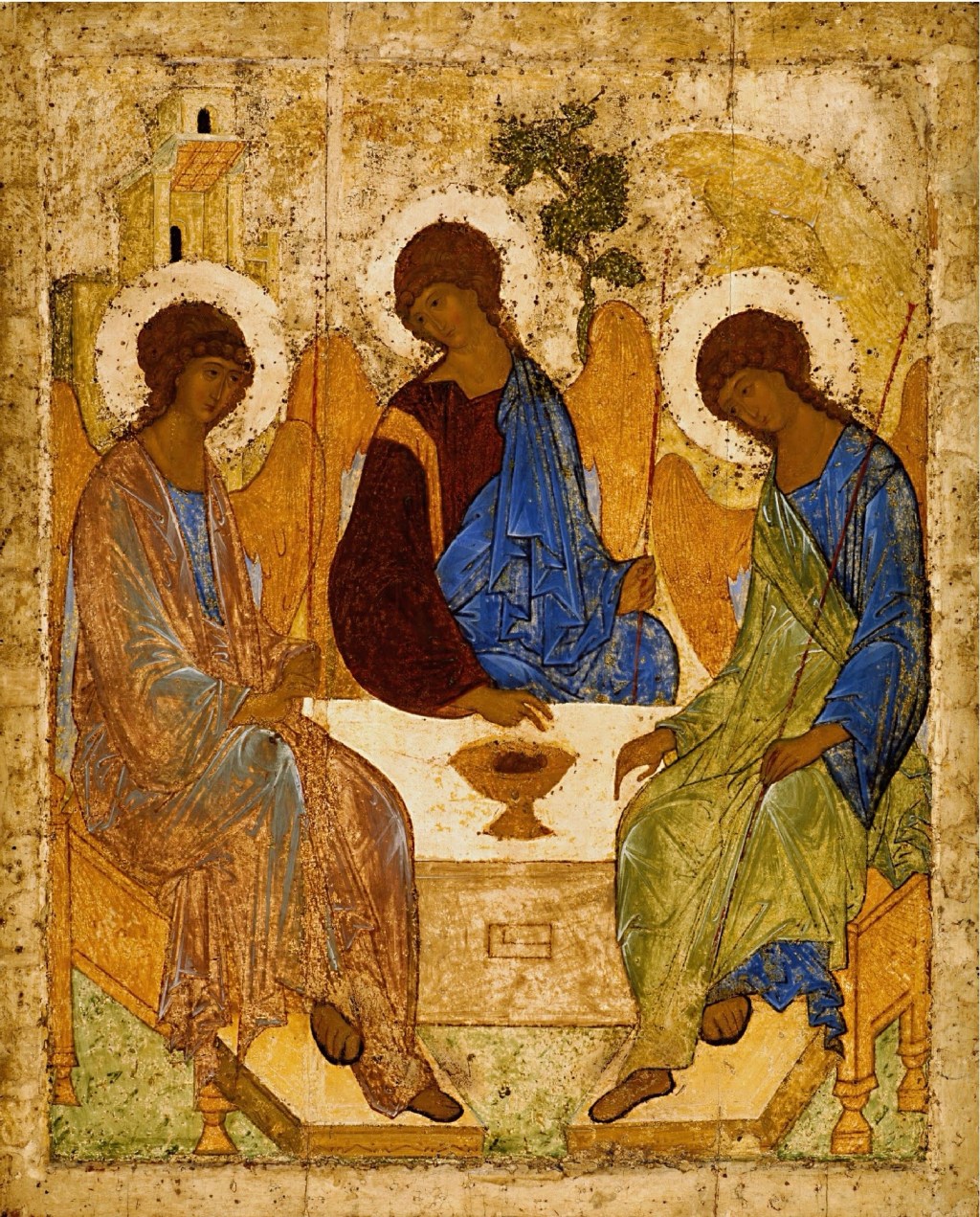
Rublev’s Holy Trinity

art, epilepsy, Faith, generosity, Holy Spirit, Holy Trinity, Icons, inspiration, Painting, Rublev, salvation, vision

Rublev: The Holy Trinity, 1411 or 1425-27, Russia

One of my favorite icons is Andrei Rublev’s Holy Trinity because it not only has the theological theme of the Trinity, but also the message of hospitality to strangers. As Hebrews 13:2 reminds us,

“Do not neglect to show hospitality to strangers, for by doing that some have entertained angels without knowing it.”

This subject of this icon is the three angels for whom Abraham spread a feast in the wilderness where he and his barren wife Sarah lived while they tended their flocks. The angels appear with their walking staffs and sit at Abraham’s table set with a dish of food. In the background is a mountain, representing the wilderness and a tree, locating the scene at the oaks of Mamre.

Koulouris Iconography House: Saint George Greek Orthodox Church, West Bank Territory, Holy Land

Rublev’s palette is full of light with a predominance of gold, shining ochre, delicate shades of green, pink, and violet, and his inimitable sky-blue, too, in combination with the fine rhythm of lines and perfect composition. Altogether this produces an image of unearthly beauty and a heavenly harmony. This isn’t just a banquet in the desert wilderness, but a meal in the inbreaking moment in which we experience the timeless realm of heaven.

On earth, we count the minutes, days, and years, but in the company of God, we enter into the eternal and timeless experience in which God lives. Yesterday, today, and tomorrow are the same for the God who is known as I AM, for I AM lives always in the present and I AM is always becoming. There never was a time when the I AM was not. God always IS, even if we think God is not.

We may forget God, and our love may fail, but the steadfast love of the great I AM never fails because God’s love is, as the prophet Isaiah describes it (43:25):

“I, I am He who blots out your transgressions for my own sake, and I will not remember your sins.”

Copy of Rublev’s Holy Trinity, iconostasis at the monastery, 16th CE, St. Sergio’s Lavra, Russia.

Andrei Rublev painted the original icon in the Trinity-St. Sergius Monastery in either 1411 or 1425-1427. An artist made a copy of the Holy Trinity icon in the 16th CE. The Orthodox Church certified the Rublev Trinity as miraculous in 1626 and gave it a place of honor in the church, as well as metallic and jeweled embellishments. Over the next 500 years, artists restored the original Rublev icon several times. The early 1900’s saw two professional restorations: each one removed more layers of paint and lacquer until they revealed the original. The restorers decided hiding with a frame what was an “exclusive, in its worldwide importance, work of art” from the palette of Andrei Rublev was unacceptable.

Dating this important icon is more difficult than deciding its painter. Some think the icon was originally meant for the wooden Trinity Cathedral erected in 1411 and believe after the stone church was built, the congregation moved the icon there. Other art historians believe Rublev painted the “Holy Trinity” at the same time as his workshop painted the iconostasis in the new cathedral in 1425-27.

Rublev received a commission to paint this icon for the image of the Holy Trinity from St. Nikon of Radonezh: “an image for the Holy Trinity to be painted in his time, to venerate His Holy Father, St. Sergius the Wonderworker,” the monk who founded the monastery at Radonezh.

Since a cathedral dedicated to the Holy Trinity should have an icon of the Holy Trinity in it as its primary icon, the obvious choice was to select the best image that would convey the spiritual essence of the cathedral. This icon would embody the name of the Holy Trinity in color.

Icons have a purpose in worship, beyond mere mere beauty or illustration or teaching of doctrine. St. John of Damascus spoke in his “Apologies against Those who Decry Holy Images”, with which he addressed the Seventh Ecumenical Council calling on renowned painters for brave deeds, to set forth in their art the images of the Old and New Testaments, so that those who were not learned and could not read the Holy Scripture, would be able—by examining those stories—to enjoy the lives of holy men and their good deeds, for

“What the book does for those who understand letters, the image does for the illiterate; the word appeals to hearing, the image appeals to sight; it conveys understanding.” (Treatise 1.17)”’

Betsy Porter: Holy Trinity icon with Holy Communion

In other arguments against those iconoclastic believers, those who advocated instead for the use of images in worship reminded people the icon represents the truth of a spiritual reality. Some have compared the icon to a “window into heaven.” No one then or now worships the icon itself, but they do venerate the holiness of the person represented in the image. They hope to recognize the presence of God with them when they come to the quiet and stillness before the icon at their home altar and when they share in the presence of God in public worship in the sanctuary among the holy icons.

Abraham and the Three Angels, Mosaics in Santa Maria Maggiore, Rome (432-40 CE)

Theologically, the Western church has treated all three members of the Holy Trinity as coequal members, as seen in the mosaics of the 5th CE basilica of Santa Maria Maggiore. By placing all the heads on one level, or the use of isocephaly, the artist tells us the figures are equal in stature. Abraham is therefore lower than the heavenly visitors. Isocephaly is the art term which originates from the Greek words “isos” meaning “equal” and “kephalos” meaning “head”. We already know this word from our common knowledge: isosceles triangles have two equal sides and encephalitis is an inflammation of the brain, which is within our heads. (Sorry, old schoolteachers never die, but keep on explaining our 50 cent words; it must be that “back to school” time of year!)

Commercial Paper icon appliqué on wood panel “after Rublev,” but lacks the background architecture and has a substantial table without a cloth covering.

The Rublev icon has the heads of the three angels arranged in a triangle. They represent the Triune God. The center figure is slightly higher than the other two figures’ heads. This is because the Eastern Orthodox Church holds a slightly different view of the Holy Trinity. The incomprehensible God has indeed revealed God’s self in a manner that is incomprehensible.

All errors in trying to explain the Trinity come down to the following issue: we try to explain the living God, using a method of human thought—rational, natural, or philosophical—instead of witnessing to the reality and the truth of an encounter with the living God. To ask what God is, is the wrong question. Rather, who God is, is the primary question.

Prepratory stage

The answer is—God is Triune. We know God by God’s activity in the world, or energies, which we can see and can understand. In fact, all our understanding of God or what we say about God, comes from what God has done in the world, from God’s energies. The essence of God is still beyond our understanding, inaccessible to our understanding. If we could understand it, it would not be God, for God is beyond our understanding, as Isaiah 55:8-9 reminds us:

“For my thoughts are not your thoughts,

nor are your ways my ways, says the LORD.

For as the heavens are higher than the earth,

so are my ways higher than your ways

and my thoughts than your thoughts.”

Second day, making some corrections

Both the Western and the Orthodox Churches are in agreement as regards the unity of the Trinity as to the persons and their shared being. They also agree the Trinity isn’t three separate gods or three different revelations of one singular god. The Eastern Church and the Western Church did split over whether the Holy Spirit proceeded from the Son alone (East) or from the Father AND the Son (West).

Gaining on it, another studio day

The earliest creeds from the 4th CE didn’t even mention the Holy Spirit, mostly because the early church was combatting heresies about the nature of the Son (such as he was actually human, only appeared to be human, only parts were human, and other variations other than he was a full member of the Trinity and in Christ being fully human and fully divine).

By 381 CE in Constantinople, the creed included the words:

“And in the Spirit, the holy, the lordly and life-giving one, proceeding forth from the Father, co-worshipped and co-glorified with Father and Son, the one who spoke through the prophets; in one, holy, catholic and apostolic church.”

The first Latin council to add the phrase “and the Son” (filioque) to its creed was the 447 CE Synod of Toledo, Spain. The filioque formula was also used in a letter from the Catholic Pope Leo I to the members of that synod regarding opposition to a form of the fifth century manifestations of the Arian heresy which was prevalent among the Germanic tribes of Europe.

Stage 4, the draperies are taking the shape of the bodies

As football season heats up in the USA, we fight our culture wars on social media, not in the streets. The latest heresy for some is professional football teams now have male cheerleaders on the sidelines. The conservative rabble rousers destroyed their coffeemakers and burned their team jerseys in the past. Wearing paper sacks to maintain anonymity at the games is too yesterday. The recent announcement of the heroic and rugged Minnesota Vikings football team’s addition of two talented and athletic young male dancers is more than they can take. The keys of their favorite social media platform have been clicking and clacking. Radio waves are sizzling and heating up our already too sweaty summer.

Trinity, stage 5: two steps forward and one step back

The bishops at Toledo affirmed the Holy Spirit’s procession from both the Father and the Son to exclude the Arian notion of the Son being something less than a co-eternal and equal partner with the Father from the very beginning of existence. Street protests were common during this time over theological beliefs: the Catholics chanted, “There never was a time the Father was not a Father, the Son not a Son, and the Spirit didn’t proceed from both!” Against them, the Arians marched, “The Son was born, not begotten!” Exciting times, the late 5th CE.

Stage 6, details showing up

Several of our past GOP presidents were college cheerleaders, including Ronald Regan and George Bush. On a personal note, six decades ago, my big city high school in the Deep South had a tradition of boy and girl cheerleaders on a team of equal numbers to do exciting and complicated stunts. We were not aware of being “woke.” We were, however, always seeking to bring out the best of each person to reflect well upon our school and our city, which we represented.

Unfortunately, accusing the present NFL teams of being “woke” ignores American history, since the USA FEDERATION FOR SPORT CHEERING recognizes the first cheer in America as occurring on November 2, 1898 at the University of Minnesota, when student Johnny Campbell got up from the seats and took the field to lead the student body in a chant. If 127 years is too far back for people’s minds, we can turn to more recent history.

DeLee: Holy Trinity after Rublev, acrylic on canvas, 16” x 20”

Cheerleading is a metaphor for hospitality, which is one of the great attributes of the Holy Trinity. Hospitality is only possible where love resides and where community is experienced and practiced. Los Angeles led the way in 2018 by including two male dancers on their NFL Ram’s team. They were part of the Super Bowl LIII in 2019. Tryouts have always been “open,” but only women had shown up before. Like the strangers who showed up at Abraham’s tent, the cheer squad welcomed the men into the family and brought them under the protection of their group. When we practice hospitality, the “other” is no longer a “them.” The “stranger” becomes one of “us” because we reflect God’s loving nature to the vulnerable and we offer the bounty of our table to nourish their body and spirit.

I began working on this icon during social and personal distress. The social distress is obvious to anyone who reads a newspaper or watches a television newscast. Never have I seen so many professing Christians refuse to “love their neighbor as themselves,” or “do unto others as you would have others do unto you.” I don’t know how they sleep at night, for my own heart hurts for the pain inflicted upon the strangers who walk among us, who very well may be the Holy Trinity in earthly disguise. If we treat them like their next stop on their journey, only a few of us will walk away unscathed.

My personal distress comes from the blessing of living long enough, thanks to excellent medical care and the ability to live a structured, carefree life. As we age, medication affects us differently. My neurologist dropped the amount of my seizure medication, and my cardiologist upped my blood pressure medication. I was taking too much magnesium, so that was making me lethargic as well as lowering my blood pressure. Now that I’ve gotten stabilized, I feel a lot peppier.

Unfortunately, I began painting and drawing this icon while all this unwellness was going on. I can see “room for improvement,” as I always remind folks to say when critiquing their own art works. I have learned much from this time and have seen the icon in a new and closer light. I will come back to it again when I feel I’m more competent to give it my best.

A masterpiece always deserves the best we can offer, yet I rest secure knowing God has grace for those of us who are wounded, weak, or broken in any way. Whatever we bring in this time and place right now is the best we can offer upon God’s altar. God refuses no honest gift. If we spread peanut butter sandwiches on the table for the visitors as the offered feast because this is what we have, God will bless this gift.

The Holy Trinity of God lives in a loving community of self-giving hospitality and generosity within its unity of being. All three persons love, support, and care for one another in equal measure. As we humans would understand this: no one in the Trinity carries a heavier burden than another. In like manner, each person shares all the energies and work of the others.

The work of salvation may be through our faith in Christ’s work on the cross, yet it was the Father who sent the Son to redeem all creation and the Holy Spirit who brings us to the understanding of this saving grace. The whole work of God in Three Persons saves us if we have Trinitarian faith. And it is by the power of all the Holy Three we can stand against the hatreds and evils of this age.

Indeed, if we can offer any service well-pleasing to God, following the admonitions of Hebrews 13:1-2 would help all:

“Let mutual love continue. Do not neglect to show hospitality to strangers, for by doing that some have entertained angels without knowing it.”

Rublev: The Holy Trinity icon

Abraham’s angelic visitors blessed him and his wife Sarah with the promise of a longed-for son. We might learn to love our neighbors more if we shared our hospitality and opened our hearts to the people we meet. May you meet angels in your daily life and share whatever feast is in your pantry.

Joy and peace,

Cornelia

Andrei Rublev: Image of the “Holy Trinity,” The Tretyakov Gallery Magazine. Andrei Rublev painted the Holy Trinity icon, which is the central image in the cathedral’s iconostasis. One of the most famous Russian icons, he created it “in praise of St. Sergius.” The original is in the hall of Old Russian painting of the Tretyakov Gallery, in a special glass case with controlled humidity and temperature. In Trinity Cathedral you can see a copy of the icon to the right of the royal doors in the first (lowest) tier of the iconostasis.

https://www.tretyakovgallerymagazine.com/node/7196

Excerpts from Three Treatises on the Divine Images by St John of Damascus, translation and introduction by Fr. Andrew Louth, St Vladimir’s Seminary Press, 2003.

https://www.svots.edu/blog/st-john-damascus-divine-images

 A Miracle of Knowledge: St. Sergius of Radonezh / OrthoChristian.Com

https://orthochristian.com/41950.html

Venerable Nikon, Abbot of Radonezh, disciple of Venerable Sergius – Orthodox Church in America

https://www.oca.org/saints/lives/2016/11/17/103316-venerable-nikon-abbot-of-radonezh-disciple-of-venerable-sergius

Daily readings from the lives of the Orthodox Saints:

https://www.oca.org/saints/lives

Home – Icons: Windows Into Heaven – LibGuides at Duquesne University: This is a reputable source for orthodox icon information via the Duquesne Library. Links to outside sources are broken. Reference books are available elsewhere.

https://guides.library.duq.edu/icons

Mosaics in Santa Maria Maggiore, Rome (432-40): if you’ve never been to Italy, you can see the entire beautiful interior of this 5th CE basilica here.

https://www.wga.hu/html_m/zearly/1/4mosaics/1rome/3maggior/index.html

Introduction to Orthodoxy 4: The Holy Trinity – Orthodox Catechism Project

https://www.orthodoxcatechismproject.org/introduction-to-orthodoxy/-/asset_publisher/IXn2ObwXr9vq/content/introduction-to-orthodoxy-4-the-holy-trinity

First Council of Constantinople 381 – Papal Encyclicals

First Known Cheerleader was a Male Student

Vikings Respond to Male Cheerleader Backlash – Newsweek—12 NFL teams are reportedly set to have male cheerleaders on their squads this season. The teams as the Vikings, Ravens, Rams, Saints, Eagles, 49ers, Patriots, Titans, Colts, Chiefs, Buccaneers and Panthers.

https://www.newsweek.com/minnesota-vikings-respond-backlash-male-cheerleaders-2113864


REMEMBERING SEPTEMBER 11th

9/1/11, 911, Altars, art, Attitudes, Christmas, Easter, Faith, Forgiveness, grief, Healing, hope, Icons, inspiration, Ministry, Painting, renewal, Spirituality

Looking up at the night sky, I think of the Eskimo Proverb which says, “ Perhaps they are not stars, but rather openings in Heaven where the love of our lost ones pours through and shines down upon us to let us know they are happy.” The fatal September 2001 event at 7:14 am CDT impressed its significance on the nation to such a great extent that 93% of American adults 30 years old or greater can tell you exactly where they were when they first heard about the attacks. Only 42% of those 25 and younger can do the same.

NGC 3603: From Beginning To End
Credit: Wolfgang Brandner (JPL/IPAC), Eva K. Grebel (U. Wash.), You-Hua Chu (UIUC), NASA

I remember my church was fuller than for Easter or Christmas on the Sunday after the devastation of the Twin Towers, the collapse of the Pentagon, and the crash of the airplane in which the terrorists had hoped to hit the White House. Only those brave passengers of Flight 93 stood between the terrorists achieving a psychological victory and their ultimate ignoble demise. As I recall, people were eager to hear “What is the Christian Response to Violence?” If they hoped to hear the one and only response, as the THE implies in the sermon title, the air was let out of their balloons.

A photo taken on September 11, 2001 by the New York City Police Department as the North Tower collapses, engulfing lower Manhattan in smoke and ash.

Of course, Christians across the centuries have had three major responses to violence. The first is “turning the other cheek” or nonviolence. We see this in the Biblical witness, for Jesus admonishes his followers in Matthew 5:38-42—

“You have heard that it was said, ‘An eye for an eye and a tooth for a tooth.’ But I say to you, Do not resist an evildoer. But if anyone strikes you on the right cheek, turn the other also; and if anyone wants to sue you and take your coat, give your cloak as well; and if anyone forces you to go one mile, go also the second mile. Give to everyone who begs from you, and do not refuse anyone who wants to borrow from you.”

Il Tintoretto: Christ before Pilate, Museum Scuola di San Rocco, Venice

Jesus himself practiced a non-violence response to violence when he appeared before Pilate after his arrest. Pilate questioned Jesus in Matthew 27:11-14—

Now Jesus stood before the governor; and the governor asked him, “Are you the King of the Jews?” Jesus said, “You say so.” But when he was accused by the chief priests and elders, he did not answer. Then Pilate said to him, “Do you not hear how many accusations they make against you?” But he gave him no answer, not even to a single charge, so that the governor was greatly amazed.

Unknown German artist: Aquamanile in the Form of a Mounted Knight, Copper alloy, ca. 1250, used to pour water over hands at the altar or at dinner table, Metropolitan Museum of Art, New York City.

The opposite of non-violence is the Crusade mindset. In this response, the infidel is “othered” to the point of inhumanity. Because the unbelievers don’t share the same god, purging them from the living is a good deed, worthy of merit for salvation or for forgiveness of past sins. As you can imagine, this makes people who believe in other gods “less than human,” so what we modern people would consider war crimes would be easy to commit for a person in Crusade mentality. We still hear vestiges of this dualist mindset in the vocabulary of people who talk about “weaponizing government” or those who feel the need to “hit the ground running.” If we’re always in “attack mode” at work, we need to question how we think about others if we believe we’re in a hostile environment or in enemy territory.

If the Christian has both a head and a heart, both of which are being conformed to the love, mercy, and justice of God, then we must have a middle way between passive nonviolence and crusade extremism. This golden mean is the Just War Theory. It’s taught in all our military academies and has its beginnings in Christian theology. The saints Augustine of Hippo and Thomas Aquinas developed the primary ideas:

  • Make war only for a just cause
  • Be sure your intentions are right
  • Only legitimate authority can make war
  • Use just proportionally in the war, nothing to excess
  • Go to war as a last resort 
  • During war only attack military targets, not civilians 
  • Following unjust orders isn’t a legal defense for unjust actions 
  • Punish war crimes, compensate victims
  • Peace treaties must be fair and just to all, even the warmongers
Psalter Saint Louis et Blanche de Castile, MS 1186, BnF, folio 11b

Those of us who struggle with conflict—if we have a family, we have conflict or if we live in a community, we have conflict—yes, I’m starting to meddle now. You knew I’d get around to it. After all, God the Father had Adam and Eve, and God tossed those two kids out of the House. They had everything, and still wouldn’t follow the one rule (Don’t eat from that one tree). Just one rule. How hard could that be? It was downhill from there.

I always take comfort, knowing God had troublesome children. It means perfect parents can still have conflict at home. This gives hope to us less than perfect folks. The Bible reminds us always how God still loves the human race and hasn’t give up on us, so we don’t give up on those we have fusses with. We don’t roll over and play dead, yet we don’t set out on a crusade against unruly kids or others with whom we have conflicts. As Micah 7:18 reminds us about God’s Compassion and Steadfast Love:

Who is a God like you, pardoning iniquity and passing over the transgression of the remnant of your possession? He does not retain his anger forever, because he delights in showing clemency.

Remnant of the Twin Towers

Maybe we should look at the just war thoughts and modify our attitudes and behaviors. We can come to a peace, even if others cannot. As Jesus says in Matthew 5:9—

“Blessed are the peacemakers,

for they will be called children of God.”


Joy and Peace,

Cornelia


Two Decades Later, the Enduring Legacy of 9/11 | Pew Research Center


Just War Theory – The Ethics Centre Ethics Explainer
https://ethics.org.au/ethics-explainer-just-war/


Rabbit! Rabbit!

art, Astrology, autumnal equinox, brain plasticity, change, cognitive decline, coronavirus, cosmology, Creativity, Family, Great American Eclipse, greek myths, Helios, nature, Painting, pandemic, photography, rabbits, Reflection, The Lord of The Rings, trees, vision

Welcome to August!

In the long summer evenings, after an extended car trip, and way beyond the too many times I’d asked my mother and daddy rabbits, “Are we there yet?” I would get their firm reminders I wasn’t to bother them any more, for they too were hot, tired, and daddy had to pay attention to the road. In the gathering darkness, I’d rest my blonde curls on the door near the open window. We had God air conditioning back then. We rolled down the window glass of our old Pontiac and drove as fast as the road would allow.

Go Faster!

I’d watch the darkening shadows as the landscape passed by this opening, noticing how the kudzu vines changed the trees into strange and monstrous shapes in the growing gloom, but I couldn’t take my eyes off of these apparitions. I was certain if I did, they’d begin to make their way toward our family car. I think I was at the age of magical thinking, for I believed I could keep these haints at bay by my will alone.

The soft flup flup of rubber tires half melting on the overheated concrete road, combined with my brother rabbits’ body heat in the seat beside me, and the enforced silence of our parents who’d had a long day with their hyperactive bunny brood finally had an effect on my eyelids. Try as I might, I would fall asleep at my watch, only to be awakened by my daddy’s sing song voice as he tickled my toes:

“This little piggy went to market, this little piggy stayed home.
This little piggy ate roast beef, and this little piggy had none!
And this little piggy cried wee-wee-wee all the way home!”

I’d rub my eyes as he picked me up to carry me into the house and into my bedroom. On the way, I’d always say,

“I see the moon, and the moon sees me,
God bless the moon, and God bless me!”

Perhaps this is a generational gift in my family, for when my own dear bunny child was small, we repeated these same scenes until she was too heavy for me to carry. The moon blessing dates from 1784 and the little piggy rhyme is even older: 1728.

That latter date is when horses and carriages were banned from Boston Common. Since I went to school in Boston, I can attest no horses, carriages, or cows are now on the grounds of the Common, which is now a 50 acre public park. The Common dates from 1634, when William Blaxton sold the remainder of his land to the Puritans, receiving six shillings or more from each shareholder to purchase the land for this public land. This was the site of the Boston Massacre, in which five people died. One good thing about going to school in an historic community, everywhere you went, you weren’t far from history.

When I think of history, I think not only of the stories we pass down to the next generation, but also of the stories we weave for ourselves. How do we remember our childhood or our families of origin? This is a generational gift of privilege, for those who lost their families when they were young may not have memories to weave together. Refugees from wars and violence might not want to recall traumatic experiences. Yet Abraham, the father of the Jewish nation, is remembered as “My ancestor was a wandering Arameam” (Deut 26:5).

Some of us choose to write about our better days, for they outnumber our bad days. Everyone has imperfections, but each of us rabbits are still going on to perfection with the help of the good God above. Perhaps when we see the beauty of the full bright moon against a dark, clear night, our heart leaps inside and says,

“I see the moon, and the moon sees me,
God bless the moon, and God bless me!”

For some of us rabbits, nature brings us closer to God than anything else. The majesty of the summer thunderclouds rising in the heated air, and giving way to either refreshing rain or flashing floods, reminds us once again of the powers of God unleashed in God’s creation. The rainbow after the storm is the promise once again of that covenant made so long ago: the earth will never be destroyed by floods again. In the rainbow, in the light of all the colors, we hear God’s promise of love and care for God’s creation and God’s creatures.

DeLee: Blue Moon

I’m looking at a full super moon tonight, July 3, but August will have TWO super moons. Looking ahead to September 29, we’ll have our FOURTH super moon in a row. The moon on the 31st of August will be a blue moon. This is the second full moon in the same month. We won’t have another blue moon until May, 2026. This is why things that don’t happen often are called “once in a blue moon” events.

Once upon a time, we were agrarian people who eked out a subsistence living on the land. The persistence of The Old Farmer’s Almanac and other ancient weather wisdom lore is proof you can take the bunny out of the country, but you can’t take the country out of the bunny. Yet as our alphabetical generations accumulate beyond the boomers, like Lucy on the Honeymooners, we often “got some explaining to do” to make ourselves understood.

Sirius in the Night Sky

We can count the “Dog Days of Summer” among the sayings folks don’t understand today. The term has nothing to do with the four legged creatures known as our best friends, but instead, it’s an astronomical term. The name comes from Sirius, the Dog Star, which rises before dawn. We find it on a vertical line below the three stars of Orion’s Belt. Sirius was named from the Greek Seirios, which means ‘glowing’ or ‘scorcher.’ This is an apt description of the warmest days from mid July to mid August.

Crepe Myrtle Bark Peeling in the Heat

Aratus, a Greek 3rd BCE poet wrote in his astronomical poem Phaenomena, (p. 328 ff, trans. Mair):

“A star that keenest of all blazes with a searing flame and him men call Seirios (Sirius). When he rises with Helios (the Sun), no longer do the trees deceive him by the feeble freshness of their leaves. For easily with his keen glance he pierces their ranks, and to some he gives strength but of others he blights the bark utterly. Of him too at his setting are we aware.”

These Dog Days of Summer in the ancient Mediterranean were marked not only by heat, but also by drought and pistelence. This year, with an El Niño weather pattern, wild fires, floods, and extreme heat have settled on the area due to a heat dome, which the European meteorologists have named Cerebus, after the three-headed dog guardian to Hades. The ruins on the Acropolis now close from noon to late afternoon to prevent heat illness.

Porch of the Maidens, Acropolis, Athens

Although the ancient Greeks and Romans believed Sirius was the reason for summer’s intense heat, we know now that star is too far away to affect our weather. What does affect our weather today is the result of human activities. Back in the Eemian period, around 116,000 to 129,000 years ago, the earth’s axis was tilted more towards the sun than now. This caused our northern polar region to be warmer and grow trees, which kept snow from accumulating. As a result, the earth’s temperature was 2 degrees C hotter than preindustrial levels, while today’s temperatures average 1 degree C warmer.

Today, we have evidence of geographic drift caused by climate change in our crops. Areas once known for coffee or wheat are shrinking, moving further north or to higher altitudes. We also see shrinking polar ice sheets, which cause ocean levels to rise. More water, combined with more heat leads to more intense storms. We also have rivers of wind, aka the jet stream, which lock in the heat domes. These can persist for days, while the rest of the earth gets flooding and storms.

Not a Watermelon Chart: Similar to the National Weather Service’s heat index chart, this chart translates combinations of air temperature and relative humidity into critical environmental limits, above which core body temperature rises. The border between the yellow and red areas represents the average critical environmental limit for young men and women at minimal activity.

Extreme heat is the number-one weather-related cause of death in the U.S., and it kills more people most years than hurricanes, floods and tornadoes combined. Despite the fact that extreme heat has been the number one cause of weather-related deaths in the United States over the last three decades, the federal government has repeatedly declined to declare extreme heat a federal disaster. The US government has never issued a federal disaster declaration for an extreme heat event in the three times it’s been requested, even as heat domes and long, uninterrupted stretches of 100-plus degree days have claimed lives in cities and states across the country in recent years.

The 10 hottest years on record have occurred since 2010 and the month of June alone in the USA has broken over 1,000 high temperature records. The combination of El Niño, a warming ocean current, and climate change is the cause. The excessive heat in the oceans are causing coral diebacks, which have negative implications for future hurricane shore losses, since coral reefs break the incoming waves.

We bunnies can blame the Stafford Act for this. Natural disasters in the USA are handled by FEMA—Federal Emergency Management Agency. The Robert T. Stafford Disaster Relief and Emergency Assistance Act, PL 100-707, was signed into law November 23, 1988 when Congress amended the Disaster Relief Act of 1974, PL 93-288. Named for the Vermont senator who was instrumental in its passage, this is one of the 100 laws a President can use to declare a national emergency or disaster. Former President Trump used it to declare the COVID pandemic an emergency. It’s this Stafford Act that defines “Emergency.”

According to Congressional laws, a disaster emergency is “any occasion or instance for which, in the determination of the President, Federal assistance is needed to supplement state and local efforts and capabilities to save lives and to protect property and public health and safety, or to lessen or avert the threat of a catastrophe in any part of the United States in a Major Disaster.

The act defines “major disaster” as any natural catastrophe (including any hurricane, tornado, storm, high water, winddriven water, tidal wave, tsunami, earthquake, volcanic eruption, landslide, mudslide, snowstorm, or drought), or, regardless of cause, any fire, flood, or explosion, in any part of the USA, which in the determination of the President, causes damage of sufficient severity and magnitude to warrant major disaster assistance under this chapter to supplement the efforts and available resources of states, local governments, and disaster relief organizations in alleviating the damage, loss, hardship, or suffering caused thereby.

Fires of Mordor have nothing on Phoenix Heat

To get heat relief, it will require an Act of Congress. In plain speak, we’ll see snowfall before heat relief legislation becomes law in today’s divided and polarized congressional body. In the last century, we bunnies weren’t thinking about climate change, extreme weather events, or even naming our winter storms. Perhaps next summer we’ll begin naming our extended heat waves and treat them with the same seriousness as we give to hurricanes and blizzards.

In the meantime, this bunny has set her AC to cool and is keeping the ice bin filled and the tea jar full. I’m feeling the siren call of the school supply aisle, so I’ll find a cool morning in mid August to go buy ink pens, notebooks, and some postynotes. A bunny who keeps learning will always stay young. Building new pathways for the neurons is like cleaning out the clutter in our brain box.

Write now, Edit later. The stories are more important than the form.

I always recommend picking up a new skill or renewing an old one, for not only do creative activities give us an opportunity to focus on something other than how hot it is, but also we can enjoy our progress as we continue to work. If you’ve ever wanted to write about your family history, begin now, for the day will come for all of us when we won’t remember the ones we love. This bunny hopes you have bunnies who love you and honor you for who you’ve always been, even if you become the “one who comes to kiss me every afternoon at 4 o’clock.”

Pluto: Now a Dwarf Planet

I’ll probably go buy my journal supplies on August 24th, and sit in my favorite coffee shop for a bit to drink in memory of Pluto, who was worthy enough to be a planet for my generation,but has been demoted to a dwarf planet because it hasn’t cleared its neighborhood of other objects.

I look forward to cooler breezes, falling leaves, and Pumpkin Spice lattes. See you in September!

Joy, peace, and iced tea,

Cornelia

The Project Gutenberg eBook of Gammer Gurton’s Garland, or, The Nursery Parnassus, by Joseph Ritson.
https://www.gutenberg.org/files/34601/34601-h/34601-h.htm

Teaching Early Math to Children—This Little Piggy
https://www-tc.pbs.org/parents/earlymath/pdf/LittlePiggy.pdf

Origin of This Little Piggy
https://www.rhymes.org.uk/this_little_piggy.htm

Boston Common Master Plan
https://www.bostoncommonmasterplan.com/history

Super Moons, Blue Moons
https://www.fullmoonphase.com/

What is a blue moon and when will the next one occur? | Royal Observatory Greenwich https://www.rmg.co.uk/stories/topics/what-blue-moon-how-often-does-it-occur

SIRIUS (Seirios) – Greek God of Dog-Star https://www.theoi.com/Titan/AsterSeirios.html

THE DOG DAYS OF SUMMER: European heat wave takes toll on tourists – Travel Industry Today
https://travelindustrytoday.com/the-dog-days-of-summer-european-heat-wave-takes-toll-on-tourists/

42 U.S. Code § 5122 – Definitions | U.S. Code | US Law | LII / Legal Information Institute FEMA STAFFORD ACT
https://www.law.cornell.edu/uscode/text/42/5122
https://www.fema.gov/disaster/stafford-act

Extreme Heat Is Deadlier Than Hurricanes, Floods and Tornadoes Combined – Scientific American
https://www.scientificamerican.com/article/extreme-heat-is-deadlier-than-hurricanes-floods-and-tornadoes-combined/

From Japan to Louisiana to Rome, Here Are Ten Heat Records Earth Has Broken Since June | Smart News| Smithsonian Magazine https://www.smithsonianmag.com/smart-news/ten-heat-records-earth-has-broken-since-june-180982562/

Radical Love

art, Attitudes, Faith, Forgiveness, Healing, holidays, Holy Spirit, hope, inspiration, Love, Martin Luther Ling, Ministry, Reflection, silkscreen, Spirituality, Uncategorized, Valentine’s Day

Victorian Embossed Valentine Card

Valentine’s Day is all about love. Television advertisements push candies, dipped gold “eternal” roses, gaudy jewelry—a price for every pocketbook—and the dating apps have been in full swing since the new year.

“Everybody needs somebody to love,” the old song goes. The Blues Brothers sing this oldie before their mad escape from the Illinois Law Enforcement Community. Solomon Burkes treats it with his indigenous soul blues from his lived experience and The Rolling Stones give it their percussive upbeat treatment. Wilson Picket has a good cover, but I don’t recommend the explicit version of Rod Wave’s Sneaky Links. Fitz and the Tantrums was interesting. My “old person “ is probably showing about the edges here.

Martin Luther King, Jr. Quote

We all can love our friends or sweethearts, especially in mid February. After all, February is “for lovers.” The bigger question is, How do we love our enemies? Dr. Martin Luther King, Jr., in his book, A Gift of Love, writes:

“First, we must develop and maintain the capacity to forgive. (The one) who is devoid of the power to forgive is devoid of the power to love. It is impossible even to begin the act of loving one’s enemies without the prior acceptance of the necessity, over and over again, of forgiving those who inflict evil and injury upon us.”

Well, how can I forgive the person who hurt me, my child, my family, my tribe, or my community? We all want that person to come crawling to us and ask for forgiveness, but that’s not how radical love works. We want the wrong doer to show remorse and ask us for mercy and forgiveness. This puts them in a subordinate position and us in a position of power. But that’s not how radical love works. Radical love initiates forgiveness, even if the wrongdoer never shows contrition.

Dr. King goes on to say:

“It is also necessary to realize that the forgiving act must always be initiated by the person who has been wronged, the victim of some great hurt, the recipient of some tortuous injustice, the absorber of some terrible act of oppression.”

Sir Terry Frost: Sun Tree, 2003, Silkscreen on Paper with 9 collage elements. Frost was a prisoner of war in WWII with Adrian Heath, who taught him to paint. They were both imprisoned in Stalag 383, in Germany.

Why must the wronged take on the indignity of offering forgiveness to unrepentant wrongdoers? In this act, we become most like Christ on the cross, who in his final moments, forgave not only the thief who asked for forgiveness, but also all those who crucified him, who had no intention of repenting. Our problem is we enjoy being like the risen Christ, the one with the “name above all names,” but most of us don’t want to “pick up our cross and follow” Jesus, especially if it leads to an ignominious death on that very cross.

Sir Terry Frost: Blue Love Tree, 2003, Silkscreen on Paper

As Dr. King wrote,

“The wrongdoer may request forgiveness. He may come to himself, and, like the prodigal son, move up some dusty road, his heart palpitating with the desire for forgiveness. But only the injured neighbor, the loving father back home, can really pour out the warm waters of forgiveness.”

The injured one, whose heart has been broken and wounded by someone else’s words or deeds, is the only one who can heal the broken rift between them. This is why the deepest lovers of Christ are most often the wounded ones who’ve been healed by God’s mercy, grace, and forgiveness. The woman with the alabaster jar of ointment anointed Jesus’ feet in the house of the Pharisee, but the host had failed at the minimum hospitality for his guest, so Jesus reminded him (Luke 7:47):

“Therefore, I tell you, her sins, which were many, have been forgiven; hence she has shown great love. But the one to whom little is forgiven, loves little.”

Mending Broken Hearts, silkscreen, artist unknown

If we would be healers in our broken and fragmented world, we need to first address our own woundedness. Each of us has a hidden pain or suffering, for this is the human condition. If we give this to God, our healing makes us into vessels where our cracks are filled with precious gold. We can offer more love, more forgiveness, and more hope to people who have been sitting in darkness and despair. People are waiting for joy and love to flow out in abundance from God’s heart into our hearts and into their world. Then we can be the light in the darkness for them, the holy fire that lights the embers of hope in their hearts, not just on St. Valentine’s Day, but every day.

Joy, Peace, and Love,

Cornelia

Kintsugi: Mending cracks with gold

Excerpt from A Gift of Love | Penguin Random House Canada
By Dr. Martin Luther King, Jr.
Chapter 5, Loving Your Enemies

https://www.penguinrandomhouse.ca/books/212014/a-gift-of-love-by-martin-luther-king-jr/9780807000632/excerpt

Seeds of Dissent and a Harvest of Distrust

Ancestry, arkansas, art, Faith, Family, Forgiveness, greek myths, Holy Spirit, hope, incarnation, inspiration, john wesley, Love, Ministry, Painting, perfection, poverty, purpose, Ravenna Italy, renewal, Retirement, stewardship, Stress, United Methodist Church, vision

Christ Enthroned with the Angels
6th century Mosaic
Church of Sant’Apollinare Nuovo, Ravenna, Italy

Nothing springs full grown to life in an instant. Everything begins in a seed, which is planted, watered, and nourished into full growth. Only in myths or fantasies can an idea come into being instantly. Zeus had a very bad headache, a “splitting headache,” that birthed his daughter Athena, the goddess of wisdom. She leapt out in fully grown from his brow. We don’t take this myth to be scientifically true, but as a metaphor for the difficulty and struggles we undergo to obtain wisdom. As my daddy used to tell me after I’d learned some hard life lesson, “The school of experience is a rough master, and we all earn a costly degree in gaining its wisdom.”

Little Master Lip Painter Attributed to the Phrynos Painter: Birth of Athena, Attic Black Figure Ware, Kylix, Date ca. 555 – 550 B.C., Early Archaic Period,

Some of us will repeat the same lessons over and over, as if we expect to get a different result. The purpose of an education isn’t to regurgitate a right answer to pass a test, but to understand why the answer is right. That’s why math classes require showing the steps to the solution, rather than the “full blown adult answer” only. In matters of faith or ethics, many of us haven’t had the training to “set out the proof” for our final answer or deed. In fact, in one situation we may think or act one way, and quite differently in another.

The name for this behavior is “situational ethics.” Less kindly, it’s also known as spinelessness, shiftiness, being two faced, or dishonesty. Mostly it means people don’t have a true center or a plumb line by which they measure themselves. If we’re measuring our lives against other people, we’re measuring against other fallible human beings. Even our heroes have feet of clay, for none of us are gods. When I used to call my parents out on this character trait, they always told me, “Do as I say, not as I do.” This sets up a moral conflict for most people, even those raised in the church or in religious homes.

We need to have a moral center based on a higher authority than our individual or cultural conventions, one that includes or exceeds the ethics of the group to which we belong, and not just our individual beliefs and actions. Professional groups—physicians, lawyers, clergy, educators, and others—all have ethical standards for caring for those they serve, even if they morally disagree with the behaviors that bring them into their care. Who decides the ethics of the group? At the risk of making my favorite seminary professor, Billy Abraham, roll about in his still fresh grave, we United Methodists do have the so-called Wesleyan Quadrilateral of Scripture, Tradition, Reason, and Experience to guide us. Often we assign our personal life experience to this latter quadrilateral edge, but Wesley meant our Experience of the Assurance of God’s All Embracing and Adopting Love. As Wesley once said, “God is able to save all to the uttermost.”

The Good Samaritan by English School, (19th century)

Ethics and morals are often used as synonyms, but ethics refer to rules provided by an external source, e.g., codes of conduct in workplaces or principles in religions. Morals refer to an individual’s own principles regarding right and wrong. Ethics is a a late 17th century word derived from the Greek ēthos (disposition, character), in contrast to pathos (suffering). In Latin it means ‘character, depiction of character’, or (plural) ‘customs’.

Then we have the words moral and morals. The first is concerned with the principles of right and wrong behavior. The goodness or badness of human character is another concern. From these, people decide what behavior is considered right or acceptable in a particular society. We often say a person has morals if they conform to standards of behavior or beliefs concerning what is and is not acceptable for them to do. We can speak of “the corruption of public morals, “ or you can hear people talking as if “they believe addicts have no morals and can’t be trusted,” rather than understanding the disease and abuse bases which often underlie addictions.

These distinctions don’t change the negative consequences of the addict’s behaviors, yet the addicted person still has the same image of God and the same potential for wholeness each of us have, but perhaps with more suffering, or pathos. If we judge the morality of a person’s choices, and then refer that moral state to the individual’s worthiness, we can end up losing compassion for the person as well as losing the will to help them better their lives. This leads to hard heartedness and a lack of love. We reject our neighbors and make them strangers, unwelcome to our world. We forget our spiritual ancestors were once strangers in a strange land, wanderers without a home. How easily we forget our savior, who had no place to be born even in his ancestral home, and whose family fled religious persecution and certain death to live in Egypt, far from home. Strange how some Christians have no sympathy for others in the same fix today.

Moral is a word from the late Middle English by way of the Latin moralis, from mos, mor- ‘custom’, with the plural mores or ‘morals’. It refers to one having the property of being right or wrong, good or evil, or voluntary or deliberate, and therefore open to ethical appraisal. When we apply moral attributes to a person, it means “capable of moral action; able to choose between right and wrong, or good and evil.” Not until 1803 did moral come to mean “virtuous with regard to sexual conduct,” according to the Oxford English Dictionary.

As a noun, we meet the word in the Latin Moralia, the title of St Gregory the Great’s moral exposition of the Book of Job. Later it was applied to the works of various classical writers. All Methodists and the holiness denominations birthed from the seed of the great Methodist revival recognize the genius of John Wesley. We all quote him, but we also apply his wisdom through our own individual preconceived notions of what is “good, true, and noble.”

When John Wesley was asked, “What is that faith whereby we are sanctified?” he answered:

“First believe that God has promised to save you from all sin, and to fill you with all holiness; secondly, believe that He is able thus to save to the uttermost all that come unto God through him; thirdly, believe that He is willing, as well as able, to save you to the uttermost; to purify you from all sin, and fill up all your heart with love. Believe fourthly, that He is not only able, but willing to do it now! Not when you come to die; not at any distant time; not tomorrow, but today. He will then enable you to believe, it is done, according to His Word.”

In the old days, we said we were “going on to perfection,” not that we were so bold as to claim that we’d already arrived there or been perfected. Oh no, we allowed God could complete this for us and had the power to do it, as well as the will, but our human nature was still fallible. If a word comes up more than once in a text, writers go to the thesaurus for an alternative, but in reading scripture, we learned repetition was a sign of importance, a marker especially meant for those of us who are slow learners in the school of life.

Oliver O’Donovan in “Scripture and Christian Ethics” writes, “Moral theologians have a secret knowledge, apparently concealed from other kinds of theologians, especially those devoted to hermeneutics. They know that the most mysterious and most difficult question we ever have to answer is not, what does Scripture mean?, but, what does the situation we are facing mean?, where do we find ourselves existentially?”

We tend to speak as if our selves and our situations were known quantities, so that it only remains to choose out of Scripture whatever seems to fit our circumstances as we conceive them. Scripture has an uncanny way of shedding light on our self and our situation, to overcome our preconceptions about them. We don’t read about our situation directly in the Scriptures, yet it’s from the Scriptures we gain categories of understanding, which re-frame our view of our situation and ourselves. We can’t look for individual texts to guide our actions, but need to consider the whole of the revealed Scripture and God’s nature as we discern our path forward.

Carl Bloch: Monk Looking in a Mirror, 1875, oil on canvas, Nivaagaard Museum, Denmark.

In this sense, the Bible is a mirror which reflects our inner nature to us, convicting us of our failings and giving us grace and comfort in our times of need. We can learn much about ourselves from the verses we lean on, just as much as we can by the verses we ignore. There’s a reason we interpret texts by the whole of scripture, and not piecemeal. This is one way we understand the authority of scripture.

As an interesting aside, SWTX, my original conference, which approved my candidacy for the ministry, didn’t think I should attend seminary because I scored so low on the abstract reasoning tests I took. They didn’t think I would make 65, seminary’s passing grade, in my class work. It’s true I learn and process differently, but knowing this, I crammed a three year program into four years. If I’m slow to grasp the whole until I first understand the parts, this doesn’t reflect on my fitness for ministry or my intellectual ability. It merely reflects a different way of processing information. There’s more way to skin a cat, and many ways people learn.

When I taught art classes, I had to make sure I covered all the learning methods for all my students to have success. I talked about the project, I demonstrated the techniques, I had the steps written out, and for some few children, I had to place their hands in the optimum position to get them started. This covered ear and eye learning, visual reminders, and haptic or touch learning. Some students needed multiple types of learning throughout their working time on a project. Some needed reteaching every class period. Some just needed encouragement when they got stuck at a rough patch. Most all had to learn to talk in positive terms about themselves and their work, as well as about others and their creative process also.

I talk about this teaching method, for this is how we consciously or unconsciously teach those around us ethics and morals. As one youth asked me at a church I once served, “Why are you wearing your cross today? It’s not Sunday.”

“Because Jesus is important to me every day, not just on the day I lead church services.”

I realized even though her family was very active and faithful in our congregation, when they were out in the world of day to day folks, they didn’t stand out from the crowd. Maybe one day day this child will come to a time when wearing a cross becomes bearing a cross. Then again, how many people willingly choose suffering for the sake of the body of Christ? This suffering is often difficult for those of us who’ve committed our lives to Christ’s call, but we realize most laity won’t voluntarily submit to that kind of stress. Yet experience is a great teacher. We learn from others, even those who have differing opinions and choose different actions.

Wesley’s Sermon, “The Nature of Enthusiasm,” has some advice for us: “Beware you are not a fiery, persecuting enthusiast. Do not imagine that God has called you (just contrary to the spirit of Him you style your Master) to destroy men’s lives, and not to save them. Never dream of forcing men into the ways of God. Think yourself, and let think. Use no constraint in matters of religion. Even those who are farthest out of the way never compel to come in by any other means than reason, truth, and love.”

Jean Bondel: The fall of man—Adam and Eve eat from the Tree of Knowledge of Good and Evil, 1372, illustrated manuscript, National Library of the Netherlands.

As a further reminder from his all time classic Sermon, On Working Out Our Own Salvation, 1785: “By justification we are saved from the guilt of sin…by sanctification we are saved from the power and root of sin…”In modern terms, when we profess our faith, Christ saves us from the guilt of that first sin. Some say Adam and Eve were disobedient. They then emphasize rule keeping as their moral choice. There’s always a reason behind every behavior, however. Why were they disobedient? We hear the answer in the parable of the Tree of Wisdom:

“But the serpent said to the woman, “You will not die; for God knows that when you eat of it your eyes will be opened, and you will be like God, knowing good and evil.” (Genesis 3:4-5)

The man and the woman both heard the half truth, saw the shiny fruit, believed the promises of a creature rather than their creator, and ate the fruit they hoped would make them like gods. Instead they only gained knowledge of their nakedness and vulnerability. This first lesson of the school of life came with cost: fig leaves ooze irritating sap. They won’t choose this solution again. God’s providence replaced their poor choice with animal skin clothing even as God sent them out into the world. We might say the attitude of pride or greed drove their bad behavior and was the cause of their negative consequences.

As we grow in holiness and love of God and neighbor, the Holy Spirit destroys any remaining root of sin. One of the important sins, Wesley noted, was pride. Pride is that feeling of deep pleasure or satisfaction we get from our own achievements, or those of our family, tribe, nation, or other associated group. In matters of faith, we always have to remember Paul’s admonition to the Romans (10:9-13):

“because if you confess with your lips that Jesus is Lord and believe in your heart that God raised him from the dead, you will be saved. For one believes with the heart and so is justified, and one confesses with the mouth and so is saved. The scripture says, “No one who believes in him will be put to shame.” For there is no distinction between Jew and Greek; the same Lord is Lord of all and is generous to all who call on him. For, “Everyone who calls on the name of the Lord shall be saved.”

Paul reminds us of the unity of the Jews and the Gentiles, the clean and the unclean, the former masters and slaves, with the gulf now bridged between the former God worshippers and the idol worshiping strangers. Now there’s “no Jew nor Greek, no slave or free, no male or female, but all are one in Christ Jesus” (Galatians 3:28).

When we joined together into one annual conference in 2003, almost twenty years ago, we had good reasons to make one combined administrative body for our faith community. We had underfunded pension obligations, we were over heavy with administrators, and clergy didn’t have equity in retirement accumulation. Likewise, the conferences weren’t equally treated, since one didn’t fully fund pension needs, an act which caused clergy to seek appointments in the other conference, thus robbing the first of talents and gifts. These were the logical consequences of attitudes and behaviors, however.

Historic Souvenir—Can you drink this cup?

The logical person thought, “Let’s make Arkansas One Faith, One Focus, One Fellowship,” and this will solve all our problems. It may have looked good on paper, but our congregations had been used to a personal touch to remind them at least once a year they belonged to a greater whole. Their pride in showing off their home church and being a good host for the Superintendent was taken from them if they were just attendees at another group meeting. The moral choice of what’s better for me, a relaxing Sunday afternoon with my family or a meeting elsewhere, gets weighed and measured.

So now here we are, nearly twenty years into this optimistic marriage of the two annual conferences. The seeds for dissent and discontent were planted long ago, even before this joining. When I inventoried the historic memorabilia of the dead bishops at the SMU Bridwell Library, I saw how the chaos of the Vietnam War era and the sea changes our society were experiencing then affected our church in many ways. Some wanted to hold onto tradition more tightly, while others were ready to experiment with new wine in fresh wine skins. These were just “outer trappings,” however, for the message of “saved by faith, sanctified by faith, and made perfect in love by faith” never changes. This is Christ’s work, enabled by the Holy Spirit.

The past sixty years, as the last two decades, haven’t always been smooth sailing. We often have had trials, storms, and tribulations on our shared journeys. Sometimes we’re so far out to sea, we don’t see the land, and the skies are occluded, so we can’t take a bearing off the stars. Yet God’s spirit will blow us along, for even detours are within God’s providence. As James reminds us:

“Consider it pure joy, my brothers and sisters, whenever you face trials of many kinds, because you know that the testing of your faith produces perseverance. Let perseverance finish its work so that you may be mature and complete, not lacking anything.” (1:2-4)

Van Gogh: The Good Samaritan, after Delaquoix, 1890, oil on canvas, Kroller-Muller Museum, Netherlands

Today we also have powerful economic and political forces that are like wolves in sheep’s clothing. They purport to work for religion and democracy, but actually work against the stewardship of our earth ‘s resources and environment, fail to care for the poor and dispossessed, and support military interventions around the world. Moreover, some of them actively work to destabilize religious denominations with social justice callings, such as the UMC, the Presbyterian Church USA, and others. Some today think “things fall apart; the center will not hold.”

Two final words in summary: one is from the ancient wisdom tradition and the other from Paul’s paean of joy in the midst of suffering. Proverbs 22:1 reminds us, “A good name is to be chosen rather than great riches, and favor is better than silver or gold.” My dying grandfather spoke these words to me in his last hours. Ive always considered them a plumb line for my life.

Byzantine Mosaic, Ravenna, Italy

“Finally, brothers and sisters, whatever is true, whatever is noble, whatever is right, whatever is pure, whatever is lovely, whatever is admirable—if anything is excellent or praiseworthy—think about such things. Whatever you have learned or received or heard from me, or seen in me—put it into practice. And the God of peace will be with you.” — Philippians 4:8-9

Joy and Peace,

Cornelia

Oliver O’Donovan: Scripture and Christian Ethics
(This is a great read!)
https://biblicalstudies.org.uk/pdf/anvil/24-1_021.pdf

John Wesley: Repentance in Believers (Sermon 14), “Repent ye, and believe the gospel.” Mark 1:15. The Complete Works of John Wesley, vol. 1 of 3, Kindle ereader. Read on line here:
http://www.godonthe.net/wesley/jws_014.html

John Wesley’s Quotes – Seedbed
https://seedbed.com/on-john-wesley-quotes/

InterChurch Holiness Convention: a community project of various Wesleyan holiness denominations, with all male leadership
https://ihconvention.com/devotional/may-9-2/

On Patience: James 1:4–But let patience have her perfect work, that you may be perfect and entire, wanting nothing.
https://biblehub.com/sermons/auth/collyer/patience.htm

The Grammarphobia Blog: Ethics vs. morals
https://www.grammarphobia.com/blog/2012/02/ethics-vs-morals.html

The Second Coming by William Butler Yeats | Poetry Foundation https://www.poetryfoundation.org/poems/43290/the-second-coming

My Summer Vacation

adult learning, art, Creativity, crucifixion, Faith, Family, Forgiveness, holidays, Imagination, inspiration, mandala, Ministry, Painting, purpose, Spirituality, summer vacation

Friday Night Food Fight

The last day of our art class we had a “free for all.” Not exactly a “food fight” or “slug fest” free for all, but a finish up or start a personal project type of day. Our class never disappoints me. Mike brought in his patio parrots, some of which have seen better days. These are papier-mâché sculptures that have been brightly painted and covered with shellac. He hopes to paint over them and repair them so they will look respectable once again in the poolside area. If that’s not possible, I see a vacation south of the border in his future.

A Typical Parrot by the Pool

Gail brought an icon she didn’t quite finish to add gold outlining to the figures. This detail gave her work an extra embellishment to bring it to life. Before, she’d left an edge of white canvas between the background and the figures. This had the same effect, but also gave her work an unfinished appearance.

Gail’s Icon

I’ve been working on a series of Creation Icons from the first chapter of Genesis. Actually, they’re mandalas, but they serve the same purpose as an icon: to focus the viewer’s sight into the window of the world beyond this one and to contemplate the universal mysteries of the universe and the God who created it. The Creation inspired me because I’ve seen old icons with this theme painted both in figurative and abstract styles.

This one represents Day three and is from The Nuremberg Chronicles (1493). Written by Hartmann Schedel and illustrated with woodcuts by Michael Wolgemut, it represents a monumental place in the history of the printed page. One of the most beautifully illustrated texts of all time, the approximately 600 pages, in-folio, contain 1,804 woodcuts intended to communicate to the public a schedule of events predetermined by God, beginning with the Creation, and ending with the end of time.

Creation of Plants by Wolgemut

My icon is a stylized flower against a blue sky with a cross in the center to remind us, as John 1:1-3 says,

“In the beginning was the Word, and the Word was with God,
and the Word was God. He was in the beginning with God.
All things came into being through him,
and without him not one thing came into being.”

Third Day Of Creation Icon

I chose a sunflower as my representative plant, for the young plants constantly track the sun’s transit across the sky each day. The older plants don’t make use of this mechanism of heliotropism, but always face east to wait for the sunrise. The ancient wisdom says when Christ comes in his final glory, he’ll first appear in the east at the Beautiful Gate in Jerusalem. However, the Bible says in Revelation 1:7,

“Look! He is coming with the clouds;
every eye will see him,
even those who pierced him;
and on his account all the tribes of the earth will wail.
So it is to be. Amen.”

I think it best to be ready, day or night, for like the servants whose master has gone off on a trip, we don’t know when he’s coming back. We should be always ready, always eager to serve. We’re never too young or too old to be a servant for Christ. As we grow older, one of our best gifts is mentoring the next generation for leadership. Perhaps they’ll make mistakes, or maybe they’ll do things differently than we did, but mission and ministry will happen.

Most mistakes don’t matter in the great scheme of life, unless they’re breaking a moral or legal law. If they’re just doing a task in a different order, like my arrangement of the dishes in the dishwasher at my mother’s house, we should probably leave that alone. I went and sat in the den and let my mother load the next evening’s dirty dishes because “If you’re going to rearrange everything, you might as well put them in yourself.” She did that one night and sat in the den the next night. Training is everything. My mom spent years training me, so I learned from the best. When it’s time to let go, you step aside and let them do it on their own. Learning from mistakes is part of leadership.

In art class we also learn from our mistakes. Sometimes we find out our palettes are too small to mix up all the different colors we want. This can limit our color schemes, muddy our colors, or tempt us into putting more color over the old color in the same tiny space for mixing. Then we look at our painting and wonder why it’s grey and dull, but fail to notice how dark our glass of brush water is. When the water gets dark, we need to pour it out and get clean water, or we carry that wash water full of pigments into our painting with our brush. In a like manner, if we hold our grudges or anger over time, these soil and blemish our souls. Washing them clean through prayer to God makes a difference in our countenance and joy. We’re brighter people when we rid ourselves of these burdens.

I’m taking the summer off from teaching. I have an art show planned for August to September at the Garland County Library, so I’ll be finishing up some work for that event. I also have a couple of chores around my condo planned, and more of my SOULJOURNIES blog to put into shape. I’m excited about these creative renewal projects. I’ll see y’all on the flip side.

Joy, peace, and sunshine,

Cornelia

The Science Behind Why Sunflowers Move
https://spectrumlocalnews.com/nys/buffalo/weather/2020/08/29/the-science-behind-why-some-sunflowers-move

Rabbit! Rabbit!

adult learning, at risk kids, brain plasticity, Children, city, Dreamscape, Faith, Family, flowers, Healing, holidays, Icons, Love, mandala, Mandylion, Ministry, ministry, nature, Prayer, purpose, rabbits, Reflection, renewal, risk, school shootings, shame, Spirituality, Stonehenge, summer solstice, texas, Uncategorized

Welcome to June! I’ve found my sunshades and my flip flops, so this rabbit is ready for a summer vacation. Old school teachers never die, they just take the summer off. And teachers, as well as students, will need a summer off, along with some intensive counseling, to get them ready to return in a healthy frame of mind next fall.

Summer Solstice Mandala

In my early years in ministry, I served in a certain county where many people were caught up in despair. I often complained to my district superintendent of my desire to pour mood elevators into the public water supply.

“You do know drugging the water supply isn’t exactly an acceptable activity for a Methodist minister?”

“Oh, yeah, but it sure would make my job easier.”

Rabbits Love One Another

Remember, June 3 is Love Conquerors All Day. I need to remind myself of this on occasion when I want to take the easy road. As Jesus reminds us in Matthew 7:13—

“Enter through the narrow gate; for the gate is wide
and the road is easy that leads to destruction,
and there are many who take it.”

Taking the easy way out isn’t always the best choice, but it’s the one we rabbits most often choose. We rabbits don’t like to rock the boat, and we like to make all the other rabbits happy if at all possible. The only problem is if we please A, B gets upset. If we please B, A gets upset. We don’t even try to please C, since C is so cranky, even the good Lord Jesus couldn’t fry an egg to please them. We set our hearts and minds on pleasing God, as best we can, and hope to hear the words, “Well done, good and faithful servant, enter into the joy of your master.”

Make Mine Chocolate Ice Cream Day

Chocolate ice cream brings me joy any day of the year, but June 7 is a day dedicated to this frozen delight. Don’t worry about frying eggs, but keep it frozen. I like mine plain, but fresh strawberries or peaches are a nice addition, plus some chopped nuts. Always go for complex, unless you just can’t wait. Then grab a spoon and eat it straight from the pint. (Mark it with your name, since you ate from it.)

Often we cut the Gordian Knot and go for the shortcut to our complex problems. Sometimes this is a good solution, for the shortest distance between two points is a straight line. My daughter used to call my vacation navigation shortcuts “the long cuts,” since I’m directionally challenged. Most of the time, that straight line went through swamp land and alligators. I can hear her voice now, “NOOOOO!!!” I’m known for taking the scenic route, so I often see America’s less known sights, which are off the beaten path.

In the gospel of Luke (14:34), Jesus quotes a proverbial saying:

“Salt is good; but if salt has lost its taste, how can its saltiness be restored?”

Another translation of the latter portion of this verse is “how can it be used for seasoning?”

When I think of loss, I think of a life snuffed out. Some people are burned out, so we can say they’ve lost their seasoning ability. There’s no vim or vigor in them. Other lives are cut short and aren’t able to fulfill their purpose to season the great soup of our community. Our past month was marked by 47 mass shooting incidents in May alone. A mass shooting incident is defined as one in which at least four people are injured or killed, not including the shooter. Suicides aren’t included.

Suicides are also a public health problem. They are the “deaths of despair” that leave ripples of grief and hopelessness in the survivors. They’re the ultimate shortcut solution to a problem, the placing of a period where life has placed a comma or a semicolon. My daughter once attempted suicide by downing half a bottle of aspirin. I noticed the open bottle and pills scattered across the floor. She said the “dog ate it.”

“That’s too bad, I’m going to miss that dog. She won’t be long for this world. We’ll need to make burial plans for her.”

“Well, actually, I’m the one who ate the aspirin.”

“Then we’re going to the hospital. You aren’t going to like getting your stomach pumped, but it’s better than being dead. You want to have a chance to grow up and have a good life. A dog we can replace. You—not so much.”

It was a rough time in her life, and mine too. But God was with us. And we had support from counselors, friends, family, and our church family. My work family and my clients supported me too. I must be the most extroverted rabbit in the patch, because I asked everyone for help. It turned out my problem was shared by everyone else. I discovered I wasn’t alone, but was the most ordinary of rabbits around.

This is a humbling experience, especially when you’re a first child and the only girl. I admit to being spoiled, but don’t let my brother rabbits hear me say this. I’ll deny it to my last breath: I’m like every other rabbit I know. I want to think I’m someone special, even when I’m just as fluffy as every other bunny out there on Gods green earth.

June 21—Summer Solstice

Unfortunately, half the suicides today are committed with a gun, not aspirins. When looking at overall gun deaths, roughly two-thirds are attributed to suicides—a proportion that is consistent across most states. Gun suicides are on the rise and data also indicates men, white Americans, older people, and individuals living in rural areas present higher rates of gun suicides. Another group presenting a unique risk for suicide is current and former members of the armed forces, especially those with PTSD.

Compared with the general population, current and former military members have significantly higher rates of gun ownership. According to a 2015 study, nearly 50% of U.S. veterans own a gun. In contrast, studies suggest that only about 22% of the general U.S. population owns firearms. Similarly, the age groups of 50 to 64 years old and 65 and older have the highest rates of gun ownership, according to a 2017 Pew Research Center study. This can further explain the high rates of suicide among older veterans.

According to data from the U.S. Department of Veterans Affairs (VA), in 2019, close to 4,332 veterans died by gun suicide in the United States, representing close to 18 percent of the total number of gun suicides reported by the Centers for Disease Control and Prevention (CDC) during that year. Perhaps more alarming is the fact this figure shows a veteran is killed by gun suicide every two hours. In 2019, active duty military members committed suicide by gun 64% of the 498 total (318), almost one gun suicide per day.

Why isn’t anyone speaking about this? For all the lip service our politicians give to the flag and to the armed service members, they seem to forget them once they’re no longer useful to fight their wars or march in their parades. Perhaps because Congress won’t devote any money to study the effects of gun violence on the citizens of our Beautiful America, so we have to fund private studies here and there to piece together a patchwork of facts of this scourge on the peace of our people.

My young neighbor, only 8 years old, was in a panic as he knocked on my door the other day. His parents hadn’t come straight up the elevator, as they’d said they would. He was crying to beat the band and was sure something bad had happened to them. I invited him inside and left the door open so we could see them come past. He was so worked up, he couldn’t sit down. I suggested a call to his daddy, but they came walking past just at that moment.

June 19—Father’s Day

We don’t realize what terror these school shootings put our children through. There’s no safe place for them any more, no matter how “hardened” we make the buildings. Some person always breaks the shell at the most inopportune moment.

Some rabbits will have empty seats at their family reunion tables because someone decided to act impulsively. Father’s Day (June 19) won’t be a celebration without the son or daughter to give Dad the tie, the golf balls, or breakfast in bed.

I think back to my own childhood. We worried in the 1950’s more about the urban legends of Halloween candy poisoning, when we were more likely to get killed crossing Highway 1, a four lane highway running through our town. My mother rabbit would wait for me to ride the trolley home from school. She would wait until the near lane of traffic cleared before she walked out to the center median and time this so the far lane’s cars would finish passing so she could walk across the newly empty lanes to meet me on the other side. We held hands and crossed in the same manner on the way back to our home.

This was our routine from the start of school until sometime in the autumn. Mother was delayed one day, so I sat down to wait for her and opened my book to read. I was wearing a brown jacket against the early cool spell, and my dirty blonde hair blended in with the pile of dry leaves on the ground. Intent on my book, I failed to see her come outside. She overlooked me and went inside thinking I’d missed my ride.

A bit later, I decided if she wasn’t coming for me, I’d come to her. Gathering up my possessions, I stood on the curbside. I watched the comings and goings of the quickly moving traffic. Once I saw the break in the pattern, I walked out into the clearing, waited at the median, and crossed behind the trailing traffic of the second lane. When I walked inside, my mother had a conniption fit. After this, I began riding my bicycle to school, and my brother got to come with me.

Brain Functions

Not everyone is mature enough to cross a four lane busy highway by themselves when they’re in the fourth grade, which is the same age as the children who lost their lives at Robb Elementary in Uvalde, Texas. . Some people still need to be supervised at work even in their 20’s. The brain keeps maturing past age 21, as the frontal lobes, which are home to key components of the neural circuitry underlying “executive functions” (such as planning, working memory, and impulse control) are among the last areas of the brain to mature; they may not be fully developed until halfway through the third decade of life. Although neuroscience has been called upon to determine adulthood, there is little empirical evidence to support age 18, the current legal age of majority, as an accurate marker of adult capacities.

Since May 24, the date of this tragedy in Uvalde, Texas, the gunviolencearchive.org has recorded 16 mass shootings in six days, with 79 killed or wounded. Some of these are high school graduation parties where uninvited guests arrived and gunfire broke out, others are the result of young people wandering about in the late hours and getting into trouble with guns. During my time of ministry, youth, alcohol, and firearms were usually a recipe for trouble. Maybe parental rabbits’ brains are still developing too, if they aren’t able to put their rabbit foot down and tell the junior rabbits to leave their weapons at home. Visiting Jack Rabbit in jail for accidental death or intentional use of a firearm will throw a curve into your best laid plans for your progeny.

Rabbits in Cars Going for a Joyride

Instead, cities may have to reinstitute curfews after dark to curtail the opportunities for gun violence. Or they could raise the age to buy a weapon and require a longer waiting time and a more thorough background check. I wouldn’t be opposed to a training class and a test to see if the owner knows how to use the weapon safely. After all, we do this for the 2 ton weapon of mass destruction known as the family automobile. So what if the founding fathers never had autos; they also never had automatic pistols or large magazine weapons, modeled on the ones used in combat.

Did I mention June is National Safety Month? Its emphasis is workplace safety, but as a former teacher, this old rabbit reminds you, between 2009 and 2020, teachers’ workplaces are in schools, which is where 30% of mass shootings occurred in public places (schools, malls, or bars), while 61% of mass shootings occurred entirely in the home and another 9% occurred partially in a home and partially in a public location. The common factor in these is the gun and the presence of domestic violence. In at least 53 percent of mass shootings between 2009 and 2020, the perpetrator shot a current or former intimate partner or family member during the rampage.

Richard Small seen posing with his rifle before turning it over to police.
(Joshua Lott/The Washington Post)

I know y’all usually expect a bright and cheery note from me at the beginning of the month, but my heart is broken. Thoughts and prayers are nice, but they don’t stop the carnage. We need to make some changes. At least one man has turned in his assault weapon to his local police station, so it doesn’t fall into the wrong hands. He couldn’t bear the thought of it being used to perpetrate a similar crime if he were to sell it. If we parents don’t say no to our children, if we keep voting for politicians who are doing nothing, then we get to keep the distinction of having the highest rate of violent gun deaths for any of the developed countries.

That’s not the American Exceptionalism I believe in. We can do better. These are crimes against the common good and against the innocent. The shooter shares the primary blame, but everyone who does nothing to change our society for the better also shares the blame and shame for the next group of victims. At the rate we’re going, we’re having about one mass shooting per day. Eventually this scourge will come to YourTown, USA, and your small town police force will be just as flabbergasted as poor Uvalde’s. How could this happen in our little corner of the world?

I cry along with Jeremiah ( 8:21-22):

For the hurt of my poor people I am hurt,
I mourn, and dismay has taken hold of me.
Is there no balm in Gilead?
Is there no physician there?
Why then has the health of my poor people
not been restored?

Time Magazine Cover from 2019 with all the Mass Shooting Locations Named

Sometimes we go along with the attributes of cultural Christianity, rather than practicing the Christianity of Jesus Christ. Romans 12:2 reminds us

“Do not be conformed to this world, but be transformed
by the renewing of your minds, so that you may discern
what is the will of God—what is good and acceptable and perfect.”

Joy, peace, and balm for hurting souls,

Rev. Cornelia

Deadly Dreams: What Motivates School Shootings? – Scientific American
https://www.scientificamerican.com/article/deadly-dreams/

You can view a report of any 2022 mass shooting incident by visiting the list on the Gun Violence Archive’s website:
https://www.gunviolencearchive.org/reports/mass-shooting

Poisoned Halloween Candy | Snopes.com
https://www.scientificamerican.com/article/deadly-dreams/

Mass Shootings in America | Everytown Research & Policy | Everytown Research & Policy
https://everytownresearch.org/maps/mass-shootings-in-america/

Adolescent Maturity and the Brain: The Promise and Pitfalls of Neuroscience Research in Adolescent Health Policy – PMC
https://www.ncbi.nlm.nih.gov/pmc/articles/PMC2892678/

Guns and Mass Shootings: Data Show Why US Is Outlier on Deaths From Firearms
https://www.bloomberg.com/graphics/2022-us-gun-violence-world-comparison/

Texas romance with guns tested by Uvalde school shooting – The Washington Post
https://www.washingtonpost.com/nation/2022/05/30/uvalde-shooting-guns/

The Chair

adult learning, art, Creativity, Forgiveness, Holy Spirit, hope, Imagination, incarnation, inspiration, john wesley, ministry, Painting, perfection, photography, picasso, purpose

The everyday objects around us are like so much white noise: we know they’re present, but after a while, we tend to ignore them. A running joke among the clergy is “Never move anything at the new appointment for six months because you don’t know what objects are the sacred cows.” I learned this the hard way in my first full time appointment when I suggested we rid ourselves of an aging, olive green, velvet curtain hanging on the back wall of the fellowship hall stage, since “It was just hanging there for no purpose.” Oh, the outcries of rage! Little did I know this was the one and only curtain to survive the fire which destroyed the old church building. The people saw this ragged banner as a symbol of hope for the church they were rebuilding for the future. They had invested spiritual meaning into this curtain, even though it no longer served a spiritual purpose.

Picasso: The Chair, 1946

In the same way, we treat our Bibles as holy objects because they contain the inspired writings handed down over the centuries. We recognize they tell us important truths about God, humanity, and our relationship with the God whose steadfast love for God’s creation never wavers. In worship, we often say after reading from scripture, “The word of God for the people of God.” When many read John 1:1—

“In the beginning was the Word, and the Word was with God, and the Word was God.”

These same readers connect the “word of God” with the ”Word and the Word (who) was with God, and the Word was God.” The English translation of LOGOS to WORD derives from the Greek principle of Logos, or divine reason and creative order, which is identified in the Gospel of John with the second person of the Trinity incarnate in Jesus Christ. This is how the early Christian writers argued for the preexistence of Christ and for the existence of the Holy Trinity. When we refer to the Logos/Word of God, we are speaking of Christ. If we read the Old Testament, we’re speaking of the one God who has spoken through the ages, but only revealed God’s Son to humanity during the New Testament era. The Spirit has been active always.

This reminds us to honor the Bible for revealing the Incarnate Christ through inspired words, but not to idolize the Bible as a object greater than the God it reveals. After all, over the centuries, the Bible has been interpreted differently by various schools of thought. This brings up the question of how do we know what we know. There’s a whole body of philosophy dedicated to how we know what we know, called epistemology. There are various kinds of knowing:

  1. Sensory perception or observation of facts
  2. Reason or logic
  3. Authority of tradition or common wisdom
  4. Intuition, revelation, or inspiration

Some of us use one way more than others, but each has both good and bad points. In the case of the authority of tradition or common wisdom, for instance, some have been time tested across the ages, but deference to authority without critical thinking can be a mark of intellectual laziness on our part.

Wesleyan Quadrilateral

John Wesley’s famous understanding of what we now call the Quadrilateral comes from Albert Cook Outler’s discussion on how Wesley understood authority. When challenged for Wesley’s authority on any question, Wesley’s first appeal was to the Holy Bible. Even so, he was well aware that Scripture alone had rarely settled any controversial point of doctrine. Thus, though never as a substitute or corrective, he would also appeal to ‘the primitive church’ and to the Christian Tradition at large as competent, complementary witnesses to ‘the meaning’ of this Scripture or that.

However, Scripture and Tradition would not suffice without the good offices (positive and negative) of critical Reason. Thus, he insisted on logical coherence and as an authorized referee in any contest between contrary positions or arguments. And yet, this was never enough. It was, as he knew for himself, the vital Christian Experience of the assurance of one’s sins forgiven that clinched the matter.

Anglican Meme

In reality, Wesley’s diagram for how we know is really a triangle— consisting of Scripture, Tradition, and Reason—which leads to the Christian Experience of being a Child of God, forgiven for our sins. It’s based on the Anglican tripod of the faith: scripture, reason, and tradition. Wesley took the tripod and added the firm “seat of experience” of God’s loving mercy to forgive all our sins. This insight came out of Wesley’s life changing Aldersgate experience, which he recorded in his journal on May 24, 1738.

“In the evening, I went very unwillingly to a society in Aldersgate Street, where one was reading Luther’s preface to the Epistle to the Romans. About a quarter before nine, while he was describing the change which God works in the heart through faith in Christ, I felt my heart strangely warmed. I felt I did trust in Christ, Christ alone for salvation, and an assurance was given me that he had taken away my sins, even mine, and saved me from the law of sin and death.”

Wesley understood he could spend his whole life learning about God, reading about God, and even serving God to the best of his ability, but he was in his words, an “almost Christian” because he didn’t have the faith of a son or daughter who served God out of love, but had instead the faith of a slave or a servant, who served only from fear of punishment. One of Wesley’s Standard Sermons is the “Almost Christian,” which you can read in its 18th century glorious English at the link below. Most of us would be glad to be accounted in the “almost” category, but Wesley asks, why don’t we go farther and become “altogether Christian?”

In Methodist terms, this is “entire sanctification,” or “going on to perfection.” We don’t talk much about this any more, but it’s the purpose of our Christian life to be conformed to the image of God. We aren’t trying to be like Beyoncé, JayZ, Taylor Swift, or Jake Owen. Instead we have the promise in Romans 8:29—

“For those whom he foreknew he also predestined to be conformed to the image of his Son, in order that he might be the firstborn within a large family.”

David Hockney: Walking Past Two Chairs

We don’t do this on our own, but with the assistance of the Holy Spirit. That’s why the Spirit is called a helper, for it’s a coworker in the process of perfection or sanctification. This epistemology for knowing is useful for art classes also. Some of us believe we need to be perfect from the get go and can’t accept our raggedy messes we produce as we learn the techniques of color mixing and shading, much less the fine motor coordination required to connect our thoughts with our hand movements. If we aren’t able to endure the rough edges of imperfection as we “go on to perfection,” we won’t last long in art class. Just learning how to see the three dimensional world and translate it onto a two dimensional surface is a Mount Everest accomplishment in itself. Some days we have no energy to cope, and that’s when we need to come for support and encouragement.

Last Friday we painted chairs. Every artist’s work we viewed for inspiration had a different take on the chair. We no longer have to make a photographic rendering of an object because we have cameras for this purpose. We can use the chair as a reason to break up the picture plane and organize the spaces. I found a funny little poem called “The Chair,” by Theodore Roethke:

A Funny Thing about a Chair:
You Hardly Ever Think it’s There.
To Know a Chair is Really It,
You Sometimes have to Go and Sit.

Sally’s Chair

As the class went on, Sally decided she wanted to copy one of the inspiration images. She’s new, so she was practicing color mixing with her limited palette. When she couldn’t get the bright turquoise color, I brought my manganese blue over and mixed it with her titanium white. The color she wanted came popping out, much to her delight. “I’m going to buy me some of that color.” Sometimes all we need is the right materials.

Lauralei’s Shower Chair

Lauralei’s humor takes the cake with her shower chair. She can imagine the model chairs in a new environment. She doesn’t let the reality limit her options.

Gail’s Chairs

Gail divided up the canvas into various planes of colors, which sing for joy. I think she had fun. As the only one of our group who took the challenge of the entire scene, Mike took a bird’s eye view of the table and chairs. I hear he may be traveling again, or at least yearning to fly away from the day to day grind of full time work to something closer to retirement.

Mike’s Chairs and Table

I can understand that feeling. After years of teaching school, I look forward to summer vacation. We’ll have art class on the last two Fridays of May, and then take the summer off. Our current plan is to return on September 9, the first Friday after Labor Day. In the meantime, if you want to know how God really is,

“Be still, and know that I am God!” ~~ Psalms 46:10

A fun summertime activity is building a chair fort or a chair cave. All you have to do is turn over a couple of chairs on the floor and throw a sheet or blanket over them. This provides a quiet place for a child of any age to have a “time out” alone during a long summer. I recommend a quiet place for children of all ages, even those who’re long of tooth.

Cornelia’s Chairs

Joy, peace, and a quiet place,

Cornelia

Experience in the so-called “Wesleyan Quadrilateral” | Kevin M. Watson
https://kevinmwatson.com/2013/05/13/experience-in-the-so-called-wesleyan-quadrilateral/

The Wesleyan Theological Heritage: Essays of Albert C. Outler: Albert Cook Outler, Thomas C. Oden, Leicester R. Longden: 9780310754718: Books
https://www.amazon.com/gp/product/0310754712/ref=as_li_ss_tl?ie=UTF8&camp=1789&creative=390957&creativeASIN=0310754712&linkCode=as2&tag=deeplcommi-20

Sermon—The Almost Christian by John Wesley via Words Of Wesley Quotes
http://www.wordsofwesley.com/libtext.cfm?srm=2&

Great Blog by Adam Hamilton on biblical authority and how we read the Bible in different eras
https://www.adamhamilton.com/blog/the-bible-homosexuality-and-the-umc-part-one/

Rabbit! Rabbit! Welcome to February!

art, Civil War, epilepsy, Evangelism, exercise, Faith, Food, Forgiveness, generosity, Healing, Health, holidays, Love, Ministry, rabbits, Reflection, Spirituality, Valentine’s Day

Mother Theresa

February is a cold month here in the northern hemisphere. Maybe that’s why we rabbits yearn for the warmth of love, since those emotions kindle a fire in our hearts. It’s a cold, dead heart of a bunny that can’t quicken with love. I find those who have difficulty loving others often are struggling with an inner pain or grief, which often expresses itself in depression. Depression closes a person off from others. As we used to say when we were young, “Been down so long, it looks like up to me.” That phrase was originally used by bluesman Furry Lewis in his 1928 song “I Will Turn Your Money Green.” Both Jim Morrison of the Doors in 1966 and Bob Dylan in 1978 incorporated a lyric from the old bluesman’s song.

Reliquary Arm of St. Valentine, now in the Metropolitan Museum of Fine Art, New York City

Yet February is also known as a month for love. In the middle of the month, for this one has only 28 days, we celebrate Valentine’s Day. Of course, history gives us not one, but three men by the name of Valentinus, Latin for strong or powerful. It was a common name in the Roman Empire back in the early years of the Christian church. One Valentinus was a general stationed in North Africa, who died on February 14th with his men in battle. The other two, who also died on the same date, have a better claim to the sainthood. One was the bishop of Terni, who healed a crippled boy and converted his whole family to Christianity.

The Roman senate heard of this heresy, arrested Valentinus, and decapitated him. The boy’s family arranged to take his body back to Terni, but all of the funeral procession was killed by the Romans. Chopping up bodies doesn’t just belong to Zombie movies. This is how pieces of the saints’ bones were distributed to various churches. Of course, sometimes this results in multiple skulls, but the saints didn’t have double heads.

Roman emperors didn’t like contending with other gods

The third Valentinus had a similar story about healing and conversion. He came to the attention of the emperor because he was preaching Christianity.  Then he was sent to house arrest, where the owner was promised a bounty if he could dissuade Valentinus from his faith. Instead, the faithful man healed his jailer’s daughter. Then he baptized the householder and all who lived there, more than forty in all. Of course, everyone went to jail and did not pass go. No one collected $200. There was no get out of jail free card. This is how one becomes a red martyr, which is why our Valentine hearts are red, not white or blue.

Vintage Valentine

What’s interesting is none of the historic Valentines were ever connected to love and affection. They were known instead for healing and faith, especially epilepsy. There are almost 40 saints associated with epilepsy, a number only surpassed by those related to the black plague. In France they were called “saints convulsionnaires” (convulsion saints). During the middle ages the difference between epilepsy and chorea (neurodegenerative diseases affecting movements) wasn’t well known yet. This is how St. Vitus became one of the saints to which patients with epilepsy prayed more often for help. Epileptic people also sought the help of St. Willibrord, St. John the Baptist and St. Matthew.

19th CE German card: St. Valentine Healing an Epileptic Youth

Undoubtedly, the most renowned was Valentine. The cult began in several European countries, up to the point that this condition became linked with the saint’s name. In France epilepsy was called “maladie de Saint Valentin,” in Germany the “plague of Saint Valentine” and in Dutch the word sintvelten was a synonym of the type of epilepsy with falling seizures. In German, Valentine is pronounced “fallentin” and is connected with one of the symptoms of epilepsy, the falling sickness or the falling-down disease.

Every birdie needs some birdie to love

How did we get to cute cupids with tiny bows and heart shaped arrows aimed at our sweetie pie’s love center? We can thank Chaucer, who wrote The Parliament of Fowls in 1380, and mentioned “seynt Volantynys day/ Whan euery bryd comyth there to chese his make. [Saint Valentine’s day, when every bird comes there to choose his mate.]” Bird love apparently occurred on Valentine’s feast day at the start of the English spring. If birds can do it, maybe we rabbits and humans should take the hint. After all, it’s been a long cold winter.

Bad bun puns abound

February 2nd is Ground Hog Day, and if Punxsutawney Phil sees his shadow on Groundhog Day, then that means there are six more weeks of winter. If not, then we’ll have an early spring. Or so the legend goes. Of course, any time Phil’s prediction has turned out to be wrong, it’s always been a result of a “mistranslation” by his handlers. Of course, we’ll have what we have. We rabbits take the good with the bad. An early spring means fresh greens in Mr. McGregor’s garden, while more winter means more warm soup and cuddling by the fireplace.

Music score illustration in heart shaped book

Everybody needs somebody to love. We can love another person, we can love our country, we can love our neighbors, we can love god, and we can’t forget to love ourselves. Love is one of the most popular themes in music, as the lion’s share of pop music lyrics in every decade contained references to relationships and love (67.3%) and/or sex and sexual desire (29.9%). In my own music library, I found 117 songs for 8 hours and 43 minutes worth of “love” playlist.

When I think of love, I remember the many texts I’ve preached to various congregations over my time in ministry. The most important is 1 John 4:19-20—

“We love because he first loved us. Those who say, “I love God,” and hate their brothers or sisters, are liars; for those who do not love a brother or sister whom they have seen, cannot love God whom they have not seen.”

With Love

Gods love for God’s creation is the source of all other love, for if we’ve known God’s unconditional love for us, then we can share that same love for others. Our lack of forgiveness for others and our need to control them “so they deserve our love,” only shows how little most of the rabbit population understands the steadfast love of God, which persists, even when our love fails and turns away.

Popular music reminds us over and over, “Everybody needs somebody to love.” Jerry Wexler signed Solomon Burke to Atlantic Records in the early ’60s. Together, with producer Bert Berns, they turned that song for the offering into Burke’s most famous 1964 song: “Everybody Needs Somebody to Love.” You can hear him preach and sing it here:

The original Everybody Needs Somebody to Love

We probably know this same song better from The Blues Brothers movie. The Blues Brothers’ version of “Everybody Needs Somebody to Love” not only included Burke’s introductory spoken words, it modified those words to adapt to the plot. It was the climactic performance of the movie, and as such, it became one of the more memorable renditions of the song. In 1989, The Blues Brothers’ “Everybody Needs Somebody to Love” was released as a single in the UK, peaking at Number 12. Here’s the movie clip:

The Blues Brothers at their Best

“Everybody Needs Somebody to Love” has been covered by groups as famous as The Rolling Stones, the Grateful Dead, as well as Wilson Pickett, not to mention psychedelic garage rock bands. Those rabbits are still having flashbacks, and there’s no accounting for taste if they’re still listening to that in garages today.

If bunnies could talk…

February 20th is Love your Pet day. I know you want to give your pet the love and attention it deserves as one of God’s creatures, for it didn’t ask to be born into this world and it depends on us, just as a child does. Pets give us unconditional love and appreciation, something we can learn from them. Too often we love only if someone reciprocates tit for tat for us. This is called conditional love. It’s transactional, a give and get, or a mutual backscratching. This is the lowest form of rabbit love: “I’ll give you a carrot if you don’t interrupt me for fifteen minutes.” I confess I’ve stooped to this in my life with my own small daughter bun.

The third Monday is always Presidents’ Day, which is a three day holiday for many people. This is a day to love your country. It celebrates George Washington, our first President, who led our ragtag armies, but was a man of deep thought: “The foundations of our national policy will be laid in the pure and immutable principles of private morality, and the preeminence of free government be exemplified by all the attributes which can win the affections of its citizens, and command the respect of the world.”

The other President we honor is Abraham Lincoln, who steered our nation through its most divisive period, the Civil War. In his first Inaugural Address to Congress on March 4, 1861, he closed with these fateful words, only to have the Confederate States fire on Fort Sumpter in the early morning hours of April 12, 1861.

“In your hands, my dissatisfied fellow countrymen, and not in mine, is the momentous issue of civil war. The government will not assail you. You can have no conflict, without being yourselves the aggressors. You have no oath registered in Heaven to destroy the government, while I shall have the most solemn one to “preserve, protect and defend” it.

I am loth to close. We are not enemies, but friends. We must not be enemies. Though passion may have strained, it must not break our bonds of affection. The mystic chords of memory, stretching from every battle-field, and patriot grave, to every living heart and hearthstone, all over this broad land, will yet swell the chorus of the Union, when again touched, as surely they will be, by the better angels of our nature.”

In 1862, Confederate soldier Robert King made this basket weave folded card for his wife from scrounged paper. Opened up, it showed two crying lovers, a particularly sad foretelling of his death.

So much for the “war of northern aggression,” for some rabbits have been dispensing “alternative facts” for over a century and a half. But, we yearn always to make the broken whole, for like the Saints Valentinus of old, love is a healing balm. The love of God flows through these miracle workers and it’s God’s power, not the human beings, that heals the afflicted. Indeed, even today, when we have modern medicine, we faithful rabbits say, God called people into healing ministries, God provided the resources of intelligence and inspiration, and also the generosity of funding.

Visiting the Rabbit Doctor

Some rabbits want to restrict God’s miracles to those which happen without medical assistance (extraordinary means), but some of us recognize God most often works in and through ordinary means. This isn’t an alternative fact, but healing miracles happen all the time. At the time of the Civil War, life expectancy in the USA was only 40 years. Today, it’s almost twice that! We have 40 more years to live, love, and laugh. We now have 40 years to be “over the hill,” so I think for every rabbit’s sake, we need to banish this ridiculous rite of passage, or at least move it to age 50.

If today’s rabbits would take better care of their bodies than my generation, they might extend the life expectancy and enjoyment by some years. Love your body and care for it with nutritious food, adequate sleep each night, and appropriate exercise at least three to five days a week. Also think of activity minutes, and move about a bit every hour, rather than just sitting all day.

Love is a divine energy

There’s many a holiday in February, but Fat Tuesday will be March 1 with Ash Wednesday on the following day. So let’s practice LOVE all month long to prepare our hearts for the greatest gift of love of all (John 3:16-17):

“For God so loved the world that he gave his only Son, so that everyone who believes in him may not perish but may have eternal life. Indeed, God did not send the Son into the world to condemn the world, but in order that the world might be saved through him.”

Remember, Every bunny needs some bunny to love!

Joy, peace, and love,

Cornelia

Percentage of top-40 songs referring to 19 content categories by decade. | Download Table

https://www.researchgate.net/figure/Percentage-of-top-40-songs-referring-to-19-content-categories-by-decade_tbl1_322664390

Been Down So Long by The Doors – Songfacts

https://www.songfacts.com/facts/the-doors/been-down-so-long

Who Was Saint Valentine? A History of The Figure’s Origins – HistoryExtra

https://www.historyextra.com/period/roman/valentine-day-history-saint-who-real-story-cured/

Saint Valentine: Patron of lovers and epilepsy – ScienceDirect

https://www.sciencedirect.com/science/article/pii/S0121737217300833

George Washington, The First Inaugural Address

Cover Songs Uncovered: “Everybody Needs Somebody to Love” – The Pop Culture Experiment

Abraham Lincoln, First Inaugural Address (March 4, 1861)

United States: life expectancy 1860-2020 | Statista

https://www.statista.com/statistics/1040079/life-expectancy-united-states-all-time/

Dreams of Trees and Butterflies

arkansas, art, butterflies, coronavirus, Creativity, Faith, Forgiveness, grief, Healing, Historic neighborhood, holidays, hope, Imagination, inspiration, nature, pandemic, renewal, vision

The saying is true: “If nothing ever changed, there’d be no butterflies.” Yet how hard do we humans hold to the past, even if we need to move on into the future? As an artist, I’ve always been caught between my desire to honor the traditions of the past, but also to move into the the unknown realms of the future. Artists already have a vocabulary and boundaries to describe the works of the past, so we can tell if our current works “meet the criteria for excellence.”

Found Object Butterfly: roadside debris, wire, scrap cloth, and metallic beads

When we go beyond this known world into the uncharted territories, we’re like Columbus, who landed in the Caribbean islands, but thought he was on the continent of North America. I wonder if the monarch butterfly, just emerging from the cocoon, has any idea it soon will begin a 3,000 mile migration to its ancestral winter home in Mexico. The butterfly has the innate ability to navigate this path, whereas we humans are like Abram, for we’re going to a land our God will show us. We have no idea where we’ll end up, but we do know we’ll travel by stages and God’s guiding inspiration will always be with us.

During this current protracted COVID pandemic, with cases beginning in mid December 2019, we’ve now lost over 766,206 persons in the US alone and over 47,390,239 individuals have had COVID. Worldwide, the numbers are far greater: over 5 million have died and nearly 255 million have contracted COVID, mostly because vaccines and health care services aren’t available to the extent they are in America and the European Community. Not only has our world as a whole suffered a great grief, but each of us individually have lost friends, neighbors, or loved ones. This adds to our collective grief.

Airport Road at MLK Hwy Intersection, empty lots

When we see the rest of our world changing around us, we feel another loss, and this becomes the grief leading to the death of a thousand tiny cuts. Just as in our workplaces, when the ideas of the young, the female, and the ethnic individuals aren’t valued, their dismissal leads to devaluation of their perspectives as well as their personhood. When we devalue nature and treat creation as an arena for humanity to restructure for our purposes alone, we can fall into the trap of thinking only for our immediate future, but not for the generations to follow. This is why building lots inside the city get cleaned off and offered as a blank slate, since this makes them valuable to the greatest number of buyers.

Death by a thousand cuts was supposedly a form of torture in ancient China. It was reserved for the most heinous crimes, such as matricide, patricide, treason, and the like. From all the tiny slices, the accused finally bled to death. It was a cruel and unusual punishment, rather like flogging the back of a law breaker until the flesh was raw, but this punishment was intended to cause death because the executioner kept at it until he succeeded.

Most of us are blissfully unaware of the loss of a few trees here and there in our neighborhoods. Sometimes we even want to cut down the trees on our own property because we’re tired of raking leaves every fall, or if we have a magnolia tree, we’re tired of our year round duty of leap reaping. Of course, if you want a high strung, classy tree to show off in your front yard, you also need to sign onto the high maintenance these trees require. “Those that wears the fancy pants has to take care of those fancy pants,” my mother always reminded me.

Yard work is a type of infrastructure most of us can understand. With Thanksgiving just around the corner, those of us hosting the feast are also getting the house and yard ready for family and friends to visit. Infrastructure has been in the news lately also, with politicians debating whether soft or hard infrastructure deserves the most funding.

In Hot Springs, we have “Green Infrastructure,” which includes all the natural assets that make the city livable and healthy: trees, parks, streams, springs, lakes and other open spaces. These assets are ‘infrastructure’ because they support peoples’ existence. For example, tree canopy keeps the city cooler while also absorbing air pollutants and mitigating flooding. The Hot Springs National Park forest area is also an important resource for a variety of reasons. The mountain area is in the recharge zone for the hot springs and the forest provides other important ecosystem services.

Hot Springs is Very Green

In urban areas, we can evaluate the landscape on a smaller scale, so even small patches of green space become important, since together they can make a greater large cumulative impact. Smaller urban spaces, such as linear stream valleys, or even pocket parks, can add up to a connected green landscape. When evaluating the ecological health of an urban area, urban tree canopy is a key green asset. For instance, Hot Springs has 57% tree canopy coverage and an additional 12% green space coverage. This adds to our quality of life, for this isn’t only pleasing to the eye, but the trees and grass convert carbon dioxide to oxygen, thus improving the air we breathe.

Cities are beginning to recognize the importance of their urban trees because they provide tremendous dividends. For example, city trees are a strategic way to reduce excess stormwater runoff and flooding. Even one tree can play an important role in stormwater management. For example, estimates for the amount of water a typical street tree can intercept in its crown range from 760 gallons to 4000 gallons per tree per year, depending on the species and age. Taken city-wide, the trees within the city provide an annual stormwater interception of 1.2 to 1.5 million gallons which equates to 7 to 9 million dollars in benefits. The loss of one tree is worth so much money, replanting our tree cover is an investment in our future wellbeing.

I often heard an old proverbial poem growing up, which may not be repeated much today:

For want of a nail the shoe was lost.
For want of a shoe the horse was lost.
For want of a horse the rider was lost.
For want of a rider the battle was lost.
For want of a battle the kingdom was lost.
And all for the want of a horseshoe nail.

My nanny would remind me of the same principle in other words, “A stitch in time saves nine.” My daddy was from the school of “If it ain’t broke, don’t fix it.” While those two schools of thought still persist today, I think making a small, inexpensive repair, rather than a costly replacement, is a better choice, but too many of us live in a throwaway society.

Wisterias among the Trees

When we lose one small thing, we brush it off as no matter, but after a thousand small losses, we just can’t take it any longer. We look around and wonder what happened to our world, why didn’t we take action sooner, and now we might be in a hole so deep we can’t see the top. When I first painted the trees on this vacant lot, the little coffee kiosk had closed shop and moved on. It was springtime and the violet wisteria vines were bright against a sunlit cerulean sky.

As I was taking a few photos with my iPhone last spring, the local policeman pulled into the circular drive to check on me. We chatted a bit, but he wanted to make sure I was OK. I’m at that age when silver alerts go out for others, but I’m not there yet. I guess “old gal taking photographs of trees” still looks suspicious in my small town. I’m thankful my town is this quiet.

When I told the officer, “These trees called to me,” he might have had second thoughts about my state of mind. Then he realized he was talking to an artist. I was rescued when his radio called him off to take care of some real trouble. I find I do my best work when I feel called to a subject, for I have a spiritual connection with it.

That was this past April, and here at year’s end, this lot is up for auction, with a commercial use zoning. It has easy access to the bypass and would be good for a food place or a fuel stop. Things change and we can’t hold back progress. I know people who buy a vacation home to visit while they still work, but as soon as they retire to this same place, they grouse about all the weekenders who come and spoil their solitude. They put up with it a year or so, griping daily, and then sell and move on. Life changed for them and they didn’t adjust to their new normal. I wonder why they never realized Hot Springs was a vacation destination. We think we need an infrastructure just for the 38,500 people who live here year round, but we actually need an infrastructure to support the over two million visitors to whom we offer the hospitality of our hot springs, our hotels, our fine dining, our attractions, and our natural beauty.

When I saw the trees were gone and the lots had been plowed level, I wondered if the trees had a swift death, or if they had brief dreams and fantasies while the saws pierced their outer skins. I thought of the butterflies encased in their cocoons, and the deep sleep of their transformation. Do butterflies dream in this stage, or do they even dream like we do? I wondered if next April I would see wisteria growing near the ground, for as a weed, it’s hard to kill. I always hope, for I’ve learned over time, if I’m a prisoner of hope, this is better than seeing only the loss.

Stage One

After traveling and recovering from an autumn sinus infection, I decided to destroy an old mobile sculpture of a butterfly made from found materials and attach it to a canvas. I took some scraps of cloth from some mask projects, and glued the whole to the canvas. Maybe I crammed more than I should have onto the small surface, but I was going with it. This work might be more catharsis than art, or more process and possibility than success. It doesn’t matter, for sometimes art is more therapeutic than anything else.

The first layer held all the colors and shapes of the original Google map. The second layer began to make sense of the shapes and textures, for I started to pull together the small areas into larger spaces. By the third layer, I’d lost most of the color areas and turned them instead into linear shapes. The primary colors of the background I subdued beneath an overall gold tone. The lines now are like an automatic writing or glyphic writing, which might be the language spoken either by the trees or the butterflies, or by all natural living beings.

Stage Two

When we confront suffering in nature, in our lives, or in the world, we often ask, “Where is God in all of this?” In the days past when I suffered, I held on to the words of the Apostle Paul to the Romans:

“I consider that the sufferings of this present time are not worth comparing with the glory about to be revealed to us. For the creation waits with eager longing for the revealing of the children of God; for the creation was subjected to futility, not of its own will but by the will of the one who subjected it, in hope that the creation itself will be set free from its bondage to decay and will obtain the freedom of the glory of the children of God.” (8:18-21)

Dreams of Trees and Butterflies

Often we suffer because we can’t change our past, or we think we can’t affect our future. At some point in our lives, we come to accept our suffering. We don’t have to continue to suffer, of course, but we need to accept that what happened to us is over. We can forgive ourselves for not leaving a bad relationship earlier, or being too young to know we were being harmed. Some of us may have survivor guilt from our nation’s wars, and suffer moral injuries from acts of war. Only good and decent human beings would feel this guilt, and they can heal with Christ’s forgiveness. We can be changed and then begin to change the world, even if we begin only with our own selves.

After all, the Psalms promise us God is faithful both to us and to the creation also: “When you send forth your spirit, they are created; and you renew the face of the ground.” (104:30)

Joy and peace,

Cornelia

Vegetation Community Monitoring at Hot Springs National Park, Arkansas, 2007–2014
Natural Resource Data Series NPS/HTLN/NRDS—2017/1104
https://www.nps.gov/articles/upload/HOSP_VegCommunity2007_2014r-508.pdf

GREEN INFRASTRUCTURE LANDSCAPE STUDY AND PLAN
City of Hot Springs, AR
Green Infrastructure Committee
https://www.cityhs.net/DocumentCenter/View/6245/Hot-Springs-AR-GI-Study-and-Plan-Final?bidId=

Hot Springs General Information: Hot Springs National Park Arkansas
https://www.hotsprings.org/pages/general-information/