Pumpkins and Gourds

adult learning, art, Creativity, Faith, generosity, inspiration, Ministry, nature, Painting, picasso, pumpkins, shadows, Spirituality, suffering, Winston Churchill

Sometimes I can work for hours and end up with nothing to show for it. In grammar school, I could use the excuse, “The dog ate my diorama.” Today my primary reason is “The latest iOS upgrade sent my file into the far realms of the cloud and smashed it to smithereens while it was traveling to some unknown destination.” I can be thankful at least my mind only goes on occasional jaunts to Pluto, but it returns after those excursions after a time. And no worse for wear, not that anyone would ever notice.

Selfie as Bat Girl

Today will be different. I am determined. I am convinced. I am also wearing my Bat Girl costume, so I will not let the powers and principalities of evil defeat me. I will fight against the darkness of the night and bring the light to the hidden places. When we start a new venture, the only way we can gain experience is by failing. In fact, failure is how we learn. The best teachers set up the learning process in structured practices which build upon each prior experience. We also observe our students to note if we need to reteach a lesson from a different point of view to cement their understanding before we move onto the next phase.


Mr. Rogers was still breaking world records in running for his age group at age 100. He died on November 14, 2019, while in hospice care at the age of 101.

No one learns to lift a huge weight in their first exercise class. They begin to lift progressively heavier weights until they can lift the heaviest weights possible. No one becomes a world class artist in kindergarten, but sensitive teachers guide them from an early age to focus and hone their skills. Later, once they absorb what their masters can teach them, artists begin to find their own personal expressions and style. Art also provides an emotional outlet for people who have no aspirations to become a professional artist. Some people only want to explore their creativity, enjoy playing with the colors, get out of the house, and interact with others. Socialization and challenging our minds are important activities for a healthy life.

Sir Winston Churchill
Still Life, Fruit, ca. 1930’s
Heather James Fine Art

“Happy are the painters for they shall not be lonely. Light and color, peace, and hope, will keep them company to the end, or almost to the end, of the day.”

Winston Churchill wrote this in Hobbies in 1925. reflecting on the solace painting had provided him since the death of his daughter Marigold.

Hans Hoffman, The Pumpkin, oil on canvas, 1950, 36” x 48”.

One of the great teaching artists, Hans Hoffman, was known for his quote:

“The ability to simplify means to eliminate the unnecessary so that the necessary may speak.”

When we see a landscape, a still life, or a face, most of us get overwhelmed with the myriad details. We want to focus first on the details, instead of the bigger shapes. This gets us in trouble every time. What do the time management gurus tell us over and over? Write down your list. Number your biggest priority. Do it first. Always do the biggest, hardest, and nearest in time deadline things first.

The Eisenhower Matrix Decision Chart

This is how we make our basic sketches on our canvas. Get the big shapes on the canvas first. They do not have to be a great outline, but a general gesture that takes up the space of the object, proportionately to the other objects. Often, we treat our marks as if we are chiseling in stone. With paint, we can let it dry and go over it and no one will know the difference.

As we paint big to small, we can paint the darks, the lights, and the middle tones. This allows us to blend the colors together if that is our desire. Sometimes the blank white canvas fills us with trepidation. We may think our first sketch might be somehow “wrong.” There are no wrong marks in art class, but we may make many marks on the way to fulfilling our mind’s ideas in life. Winston Churchill has a remarkable story of his personal experience learning to meet the open maw of the great white canvas. It once terrified him as much as “Jaws” does the modern movie goer.

Picasso Cubist Still Life with Watermelon

This week we approached our seasonal gourd and pumpkins from several different directions. We looked at zen tangle designs, realism, and pumpkin patch photos. We also looked at paintings that focused on the stems and vines. We also looked at Picasso’s still lifes. He was a master of the Cubist patterns and simplification of forms. He did not try to make the objects look real, but made shapes, which were pleasing to the eye.


Michael’s Pumpkin

Michael painted an exuberant pumpkin with a giant green stem and his usual textured background. He enjoys his time in art class and his work shows it.


Gail S.’s pumpkin

Gail S. painted a multicolored group of pumpkins attached to a sinuous vine. She brings her knowledge and background in nature as a park ranger to her artwork. She always has an interesting design element to her work.


Gail W.’s Zen Tangle Pumpkin

Gail W. Started with a realist rendering, but ended up with thin layers of paint overlapping at the edges of the pumpkin creases. When she asked what was going on in her painting technique to cause this, I noticed she was using water to thin her paints. “When you thin your paint so it is transparent, then when it overlaps, you get a solid line. Use your paint straight out of the tube next time.” She took her painting home, added another layer of paint straight from the tubes, and decorated the whole with zen tangle designs, using a fine point marker.

Cornelia’s Gourds

I put my gourds in an interior setting, as if they were on a tabletop near a window, which looked out onto a blue sky. I added a tree branch bereft of autumn leaves, as if a cold and rainy day had preceded the day of this painting. The barren landscape outside contrasts with the luscious treatment given the gourds inside. Each gourd has its own personality and spirit. They are more than mere natural objects.

They brim with the reproductive power of nature, as a testimony to the promise of tomorrow’s abundance, even in the face of today’s barrenness. One gourd casts a shadow, while the other does not. A viewer might feel some psychic dissonance because a realistic rendering would have both objects cast a similar shadow. The space is not “real,” but “spiritual” instead.

This is the promise of a faithful God for those who believe in God’s steadfast love and providence. As we hear in Habakkuk 3:17-18, we can have trust and joy during trouble:

“Though the fig tree does not blossom,

and no fruit is on the vines;

though the produce of the olive fails,

and the fields yield no food;

though the flock is cut off from the fold,

and there is no herd in the stalls,

yet I will rejoice in the LORD;

I will exult in the God of my salvation.”

 In a world in which the good often suffer and evil seems to prosper, we always remember God is still at work to fulfill our daily needs, if not all our infinite desires. We will not want. Those who have the heart of God will always share with those who have less. Those who are greedy and don’t share God’s generous nature will stay stingy. This is how we know who is doing the work of God—the people who are loving God and neighbor both. .

Joy, peace, and providence,

Cornelia


SCHEDULE FOR 2024:

November 8—Painting

November 15—No Class—Vacation

November 22—No Class —Vacation

November 29—No Class—Thanksgiving

December 6—Painting

December 13— Painting

December 20— Painting

December 27—TBD —holiday season and school vacation calendar


Painting as a Pastime – International Churchill Society

When He Wasn’t Making History, Winston Churchill Made Paintings | Artsy
https://www.artsy.net/article/artsy-editorial-making-history-winston-churchill-made-paintings

Hans Hofmann: Quotes

https://www.hanshofmann.net/quotes.html

The Eisenhower Matrix: How to Prioritize Your To-Do List [2024] • Asana
https://asana.com/resources/eisenhower-matrix


Intuitive Color Wheels

adult learning, art, at risk kids, cognitive decline, color Wheel, Creativity, Imagination, inspiration, Lost Cause, Ministry, Painting, renewal, vision

The great and wonderful part of art is exercising imagination and discovering new ways to solve problems. One of my favorite memories in art school was the day our professor came to class with a single red clay brick. Our first thought was this is going to be the most boring drawing class ever, but then he asked us, “How many uses can you find for a brick?”

Thick as a Brick

After we quickly named multiple uses for a single brick—doorstop, paperweight, weapon, counterweight, and bookend—we were at a loss to name much more. As we scratched our heads, our teacher prompted us, “Did I restrict you to a single brick?” And we were off to the races! Wall, fireplace, house, road, sidewalk, planter, sculpture, picnic table, bookshelf, and more. I can’t remember if this was an early morning class or we were just dense, but I’ve come to believe we can teach creativity. At the very least, we need to give people permission to accept “multiple art answers can be true” and give them the opportunity to consider “other possibilities.”

Canvas bound in strings

When I taught art years ago, children who were troublemakers in regular classrooms were usually well behaved in art class. I attribute this outcome to their ability to express their own individuality in solving the weekly art assignments. Math always has a right answer; there is no “alternative fact” to 2 + 2 = 4. History is the same: the Confederacy seceded from the Union to keep their economic system of enslavement. There was no “states rights movement,” no matter what the Lost Cause proponents pushed in our state approved textbooks. All we had to do was look at the original source documents from the 1860’s.

Simple Color Wheel

Adults usually conform to socially acceptable norms. Helping adults with creative thinking is important because the creative process is more important than the tangible result. Most adults give up the idea they will ever paint the Sistine Chapel ceiling, while children are humble enough to realize they need many more years of practice before they get that kind of opportunity. Also, what we know about creativity can’t be applied in the same way to all creative endeavors because they involve different subjective decisions and processes.


Gino Severini: Expansion of Light. (Centrifugal and Centripetal), ca. 1913 – 1914, Oil on Canvas. 65 x 43.3 cm
Museo Nacional Thyssen-Bornemisza, Madrid

Creative insight depends in part on new combinations of existing ideas, concepts, and perceptions that the brain has stored over time. This is why we begin each class looking at famous art works. We need good art influences and inspiration to “prime our creative pumps” so we can draw up from the pure wellsprings of our own creativity. Just as we need spiritual food for our soul, we need beauty for our creative ideas.

First stage

Last year we worked on copying the color wheel and matching it. That is an intellectual skill. To make this into a creative, intuitive activity, we took strings and wrapped our canvases. This made multiple shapes for our colors. Using the primary colors—red, yellow, and blue, plus white—we mixed various combinations and surprised ourselves with the results.

Gail W’s first stage

Our first class was lightly attended, due to doctor appointments and vacations, so we still have room for anyone else who wants to come. All skill levels are welcome, for I’ve taught from K-5 to adults. Everyone progresses from their own level, so the longer you sit and think you wish you were good enough for lessons is merely time wasted when you could be working with a practiced teacher! Anyway, the lessons are free; you bring your materials and discover your unknown abilities and gifts. We journey with fellow travelers. Plus it keeps your brain young.

We will continue to work on this project next Friday at 10 am.

 Joy and peace,

Cornelia

National Endowment for the Arts: Creativity and the Brain

https://www.arts.gov/sites/default/files/how-creativity-works-in-the-brain-report.pdf

OAKLAWN FRIDAY ART CLASS

adult learning, art, Attitudes, brain plasticity, change, cognitive decline, Creativity, hope, renewal, summer vacation, Uncategorized, United Methodist Church

WE’RE BACK!!!

The older I get, the faster time flies! When I was a child, summers were long and lazy times. I actually got so bored, by the first of August I’d start to play school. I’d line up my brothers and the neighborhood children and pretend to teach them.  It was our way of “playing ourselves into a new reality.”

Art has many right answers!

Children practice life lessons during their play experiences. We can also play our way into learning a new skill in art class. All we need is a “beginner’s mind.” The Japanese Zen term shoshin translates as ‘beginner’s mind’ and refers to a paradox: the more you know about a subject, the more likely you are to close your mind to further learning. As the Zen monk Shunryu Suzuki put it in his book Zen Mind, Beginner’s Mind (1970): “In the beginner’s mind there are many possibilities, but in the expert’s there are few.” 

Jerzy Nowosielski: Landscape with a vision of the Sun, oil on canvas, 1965, National Museum of Krakow, Poland. 

In a similar vein, Picasso once said, “When I was young, I could paint like Raphael, but it took me my whole life to learn to draw like a child.” Part of our art class experience is to learn to suspend our adult ego’s need to constantly be ranking, besting, and giving into our competitive natures. We learn more when we give up our egos and our needs to protect our false selves, and allow our true selves to learn. This story in Luke 9:46-48 on “True Greatness” speaks to this:

“An argument arose among them as to which one of them was the greatest. But Jesus, aware of their inner thoughts, took a little child and put it by his side, and said to them, “Whoever welcomes this child in my name welcomes me, and whoever welcomes me welcomes the one who sent me; for the least among all of you is the greatest.”

Mary Delaney, Xanthium Spinosum, from an album (Vol.IX, 98). 1778. Collage of coloured papers, with bodycolour and watercolour, on black ink background
© The Trustees of the British Museum

Our first meeting will be Friday, September 6, at 10 am in the old Oaklawn UMC fellowship hall. Bring your own acrylic paints, brushes, and a canvas or canvas panel to paint on. We begin with a short visual inspiration from some great art works, so that we can wonder and be filled with awe at some great artists’ works. 

Basic 2 point perspective

I’ll give some direction on the skill we’ll work on in the session, and then everyone is free to bring their own unique expression to their paintings. We don’t copy my work and judge how well a person can match it. Instead, we learn from the masters or from real life. We can learn to stretch our own skills to create something new. 

That’s US!

Of course, making great art isn’t our first purpose. As we age, the harsh truth is we will lose our ability to learn new skills until we lose our memory of what we just ate for breakfast or how to work the tv remote. Challenging our brains is one of the best ways to keep our brain cells firing and “chatting with one another.” We can actually grow new neurons as we grow older. Our brains don’t have to shrink like a cotton shirt washed in hot water. Socialization and encouragement also helps to keep our brains young. Teaching this class helps me stay young! We help each other in this matter. 

That goes for children of any age!

Of course, making art means we have to give up our desire to be perfect. Children always have a “beginner’s mind,” so they are free to explore and experiment. Artists quickly learn perfection comes from practice, or working at it. Every baby stumbles and falls as they learn to walk, but we dotting adults still encourage every trembling step. This is what art teachers also do. I’ve always had a rule in my classes, especially when I taught in middle school: 

“No Negative Talking about People or Art.”

This includes a student’s own art works. My students always had to give at least three positive comments about their work before they spoke about the negative. “My work needs improvement” is better than saying, “My work stinks!” After all, this way of thinking is more positive than negative and helps to build confidence in a person. 

God would post your art on Heaven’s Refrigerator

Of course, we’ve all grown up and worked in environments where negativity is the rule. Art class is a place of grace because this is how life should be. If we can transform a blank canvas into a field of color, why can’t we transform our communities and our world into fields of hope, joy, and love? 

The Light overcomes the Darkness

Perhaps because we try to make everyone copy/fit into our idea of the proper end product, rather than allow everyone discover their own creative response to the given subject of the day. The museums of our world are richer and more vibrant because artists have listened to the Spirit of the Creating God. We might do well to realize God’s creative energies are varied and vibrant also, just as Isaiah wrote about his vision of God’s Glorious New Creation: 

“For I am about to create new heavens and a new earth; 

the former things shall not be remembered or come to mind.

But be glad and rejoice forever in what I am creating;

for I am about to create Jerusalem as a joy, and its people as a delight.”  (65:17-18)


I hope to see you there. I don’t charge for the class sessions, since this is one of my ministries as a retired elder in the United Methodist Church. As John Wesley once said, “The World is my Parish.” When we grow in confidence in the joys of creating, we find more beauty in the created world. Optimism is one of the side benefits of the creative life, not fame or riches, and sometimes not even accomplishment. Just the act of being a co-creator with the creating God helps us to find more peace in life.

Joy and Peace,

Pastor Cornelia 

How to foster ‘shoshin’ | Psyche Guides

https://psyche.co/guides/how-to-cultivate-shoshin-or-a-beginners-mind

The Hand Rewrites the Brain

adult learning, art, brain plasticity, cognitive decline, Creativity, Faith, Health, inspiration, Lassen Volcanic National Park, Ministry, Painting, Pergamum, perspective, Turkey, vision

Aristotle once said, “The hand is the tool of tools.” Our hands with their opposable thumbs are an evolutionary miracle. Our opposable thumbs evolved around two million years ago, even before humans began to make tools. Our hands helped us to develop language and procure nourishment, as well as create mysterious images on cave walls which united the physical and spiritual worlds of our distant ancestors.

Hands at the Cuevas de las Manos (Cave of Hands) upon Río Pinturas, near the town of Perito Moreno in Santa Cruz Province, Argentina (2005) (image by Mariano via Wikimedia Commons)

Richard Rohr, the Catholic priest and spiritual writer, notes “only the contemplative mind can help bring forward the new consciousness needed to awaken a more loving, just, and sustainable world. We need a practice that touches our unconscious conditioning where all our wounds and defense mechanisms lie. That’s the only way we can be changed at any significant or lasting level.”

We have many spiritual practices to change our hearts and minds, such as prayer, meditation, contemplation, reading Scripture, and hearing the word preached. Attending holy communion and practicing the presence of God are other ways to be transformed. In art or faith, we don’t take anything at face value, but we seek the deeper meanings in the experiences we have with life.

Image I took while walking downtown. I paid attention to the composition when I took the photograph.

As one who slacked off my weight training over the pandemic, the gym rat saying holds true: “Use it or lose it.” We can lose muscle tone and aerobic capacity in just a few days if we’re older or recovering from injuries. Even if we’re young and healthy, we may lose capacity in a week or so. Likewise, some of us get our diplomas and never read a book again. For instance, 42% of college graduates never read another book after college and only 32% of the US population over the age of 16 reads books for pleasure.

One of the problems even in the USA is 52% of adults read at a 7th grade level or below, and 48% read at an 8th grade level and above. Yet reading has many benefits for keeping the brain healthy:

  1. Reading for just six minutes daily can reduce stress levels by 68%.
  2. Reading can increase empathy and emotional intelligence.
  3. Reading can improve sleep quality.
  4. Reading can increase vocabulary and improve writing skills.
  5. Reading can improve mental focus and concentration.
  6. Reading can reduce the risk of developing Alzheimer’s disease.

When we connect the brain and the hand, this results in increased activation of the nerve cells in the sensory and motor hand representational areas. As a consequence, the hand expands its representational area in the cortical hand map because it requires more brain resources, more ‘brain space’. Thus, the hand can ‘shape’ the brain; in other words, the brain is functionally shaped based on the hand’s experiences.

“Crop Doctor, Agronomist or Crop Doctor for Yardup. Checking on crops for disease, insects and nutrition.” © Phoebe Milne

If the hand, in contrast, is passive and immobile for a long time, its representation in the brain decreases and may totally disappear. Quite simply, the hand has to be active to maintain its representation in the brain: “use it or lose it.” On the other hand, we know the hand representation in the brain can be re-established by training and manual activities.

What sort of activity rebuilds the brain? The brain cortex contains more than 100 billion nerve cells and innumerable synaptic connections. The cortical body map is not fixed or hardwired, but can rapidly become reorganized as a result of a strengthening or weakening of the synaptic connections. Moreover, repetitive movements can overwhelm the hand and cause trauma, such as writer’s cramp. We need to find ways to exercise our hand, so we cause no harm, but build the brain pathways.

The hand has been called the “outer brain.”

In aging samples, for instance, there’s evidence to indicate that age‐related cognitive decline may be partly driven by a process of atrophy. Some studies have shown that adopting a less engaging lifestyle across the lifespan may accelerate loss of cognitive function11, due to lower “cognitive reserve” (the ability of the brain to withstand insult from age and/or pathology)12. Some emerging evidence indicates that disengaging from the “real world” in favor of virtual settings may similarly induce adverse neurocognitive changes.

Extensive media multi‐tasking during childhood and adolescence could also negatively impact cognitive development through indirect means, by reducing engagement with academic and social activities, as well as by interfering with sleep35, or reducing the opportunity to engage in creative thinking36, 37. I remember telling my schoolteacher mother, “Listening to the radio helps me concentrate on my homework.” She wasn’t buying that argument at all, and radio silence prevailed.

An important aspect of instant access to the internet is our ability to get information online, which has caused us to become more likely to remember where these facts could be retrieved, rather than to remember the facts themselves. This results in our becoming reliant on the Internet for information retrieval. For instance, most people no longer memorize telephone numbers anymore, but depend upon their phones to maintain their contact lists through the cloud, just as we once stored them on the internal SIM card. I personally don’t know anyone’s phone number anymore because I depend on my phone’s contact list. If it ever died on me, I’d be out of luck! The cloud better recognize me if I ever need to replace my phone.

Asklepion, Pergamum, Turkey: site of healing waters, temples, and cultural events, for pilgrims who would often stay for weeks. The ancients believed healing was a sacred art and people’s souls needed to be mended as well as their bodies.

Art and healing are intimately connected. The new Alice Walton School of Medicine in Bentonville, Arkansas, will integrate the arts in an intentional way. The students will be classically trained medical doctors who also will be equipped with knowledge to address all areas of wellness, whether it’s spiritual, emotional or social.

The science of neuroaesthetics is detailed in Susan Magsamen’s book, Your Brain on Art. She said the field can be described as the study of how art measurably influences the brain, body and behavior. The study of neuroaesthetics is “neuroarts.” Magsamen said the pursuit of creative expression is as important to humans as nutrition, sleep and exercise.

There are four parts of neuroaesthetics and “the aesthetic mindset:”

■ Being open to curiosity.

■ Playful exploration.

■ Sensory experiences.

■ Becoming a maker and beholder.

We discover this in art class when we want to draw or paint a picture beyond our skill level or the time limits of the work period. In seminary, we’d have three-hour final exams. Some of our fellow students would prepare six-hour answers to the advance sample questions our professors gave us to study. I always practiced the “triage method” of reducing everything we learned to the essentials. If we pick out the most important facts, we can best make our points in the time limits given. In the emergency room, doctors treat the most important issues first to save the patient’s life and tend to the details once the patient is out of the woods. No one can give a 6 hour answer in a 3 hour time limit. Ask yourself, “What’s the most important question here?”

Mike’s Mushroom

The same idea works in drawing or painting. We need to find the main forms and sketch them in before we get carried away with the tiny details. Mike showed me a great photo he took of the corvettes in Memphis. I suggested if he wanted to do this painting in a single class meeting, he needed to simplify it by enlarging it, so it had much less detail or plan on taking two classes to finish it. He chose to paint a mushroom in the wild instead. Even then he noticed his mushroom cap lacked the perspective to look realistic on a two-dimensional surface. We’ll have to pick up some perspective lessons in the fall again.

Cornelia’s Corvettes

This is a drawing from memory I made on my iPad. I stripped Mike’s photo down to the barest essentials. The vehicles may not even be recognized as sports cars, but they are convertibles. I do remember the great steel triangles of a bridge or other structure where the cars were parked. I did this in about 15 minutes, but I have over half a century of experience of seeing and drawing practice.

Internet image of corvettes on Beale Street

I sometimes forget my hand and brain have been trained to see the basic shapes “instantly.” Not because of some DNA of pure sight, but because I’ve practiced looking, dissecting, and memorizing what I see. Some of my experiences are blind drawing, which means I only look at the object, but never the drawing itself. This trains the hand to only go as far as the eye can “see.”

Gail S’s Landscape

Gail had the class over to her home and we were glad to see her in recovery mode. Since she’s still homebound, we took advantage of the good weather and her front porch to exercise our brains and hands.

Ansel Adams: Old Faithful Geyser, Yellowstone National Park, 1933-1942

Gail had a mountain landscape image from a screenshot she wanted to work with. The focus of our class was taking our camera photographs and using the editing software to heighten our images. Once we’d done that, we would see more clearly what was important in our image. The current theme in social media is “no filter,” but the great photographers of history always gone to the dark room to develop their photos and dodge the whites lighter or burn more black. Ansel Adams was a master at this.

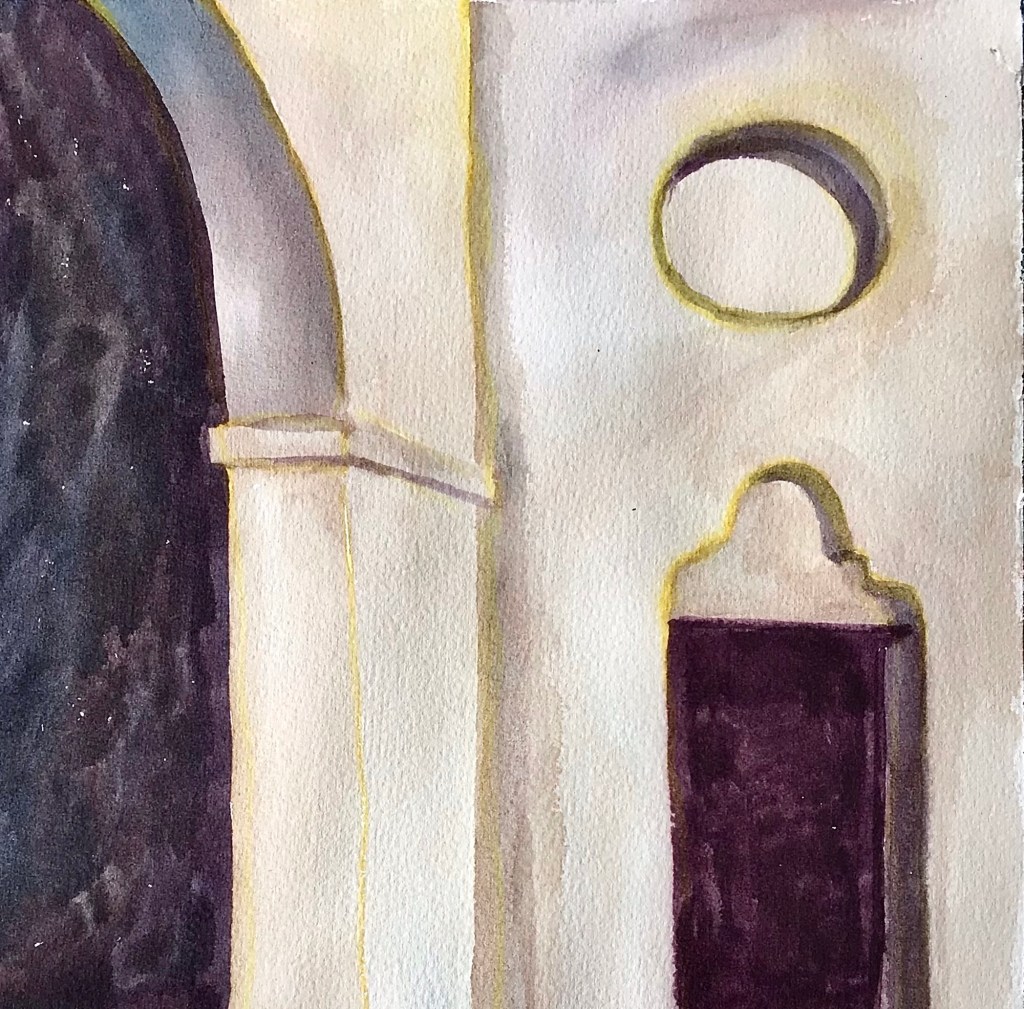
Cornelia: Prang 8 color box on Arches paper, from original photograph

Notice on my short watercolor study, I didn’t bother to include the whole photograph image. I “triaged” the details I couldn’t complete in our short class time. I mixed my own blacks, rather than using the pan color available. This gave me much richer colors and more variation in my shadows. I had outlined my basic shapes in yellow, but got to talking about the others’ directions and let the paint dry too much, or I would have picked it up better. It would have been less noticeable. I see now some of my lights could have been lighter. I can go back with a clean brush full of water and pick up some of that front face of the archway.

Of course, my eye sees more than most people can see, and it’s both a curse and a blessing. I’m always graceful with my students and try to give at least half as much grace to myself. We mustn’t get discouraged, but keep pressing upward! We don’t have to be a master at something to be a maker; we just have to do it. Having no fixed expectations of an outcome is the best way to exhibit creative expression. Following the less traveled path can lead to new destinations and new discoveries.

Art has the capacity to heal, to cross-fertilize, and to challenge fixed ideas. Art can’t be confined to gallery spaces or the walls of our homes. Art can not only renew our brains, but also the practice of art can renew how we see the world because we learn to see it afresh. Sometimes for the first time, we see it as we’ve never seen it before, and then we bring our own experience and expression to what we have seen. That’s when we become artists, creators, and cocreators guided by the hand of God.  As we are made in the image of the creating God, God heals us as he cares for the creation:


“I have seen their ways, but I will heal them;
I will lead them and repay them with comfort,
creating for their mourners the fruit of the lips.
Peace, peace, to the far and the near, says the LORD;
and I will heal them.”
~~ Isaiah 57:18-19

Joy and peace,

Cornelia


The Tool of Tools and the Form of Forms – 3 Wisdoms | Scott Randall Paine


59 Reading Statistics and Facts You Should Know

https://www.abtaba.com/blog/59-reading-statistics

What’s the latest U.S. literacy rate?

How the Hand Shapes the Brain, Hand Surgery Department of Clinical Sciences, Malmö Lund University Skäne University Hospital, Malmö, Sweden

NOTES FROM—The “online brain”: how the Internet may be changing our cognition –https://www.ncbi.nlm.nih.gov/pmc/articles/PMC6502424/

11. Hultsch DF, Hertzog C, Small BJ et al. Use it or lose it: engaged lifestyle as a buffer of cognitive decline in aging? Psychol Aging 1999;14:245‐63. [PubMed] [Google Scholar]

12. Small BJ, Dixon RA, McArdle JJ et al. Do changes in lifestyle engagement moderate cognitive decline in normal aging? Evidence from the Victoria Longitudinal Study. Neuropsychology 2012;26:144‐55. [PMC free article] [PubMed] [Google Scholar]

25–Uncapher MR, Wagner AD. Minds and brains of media multitaskers: current findings and future directions. Proc Natl Acad Sci 2018;115:9889‐96. [PMC free article] [PubMed] [Google Scholar]

35. van Der Schuur WA, Baumgartner SE, Sumter SR et al. The consequences of media multitasking for youth: a review. Comput Human Behav 2015;53:204‐15. [Google Scholar]

36. Altmann EM, Trafton JG, Hambrick DZ. Momentary interruptions can derail the train of thought. J Exp Psychol Gen 2014;143:215‐26. [PubMed] [Google Scholar]

37. Baird B, Smallwood J, Mrazek MD et al. Inspired by distraction: mind wandering facilitates creative incubation. Psychol Sci 2012;23:1117‐22. [PubMed] [Google Scholar]

Researcher Talks of Arts Benefits

https://ao.pressreader.com/article/281908778227901

The Hand: How Its Use Shapes the Brain, Language, and Human Culture,

By Frank R. Wilson

https://www.washingtonpost.com/wp-srv/style/books/reviews/hand.htm


Inspired by Autumn Leaves

adult learning, art, Attitudes, autumn leaves, cognitive decline, Creativity, Enneagram, Imagination, inspiration, Matisse, Ministry, Painting, Spirituality, trees, Van Gogh

I returned from a spiritual retreat at Mount Eagle, at which we studied the Enneagram. This is our United Methodist camp site dedicated to holy listening. Of the nine spiritual personality types, I happen to be a Four: The Creative. I’m “The Sensitive, Introspective Type: Expressive, Dramatic, Self-Absorbed, and Temperamental.” Fours are self-aware, sensitive, and reserved. They’re emotionally honest, creative, and personal, but also can be moody and self-conscious. Fours sometimes feel vulnerable and defective, so they’ll withdraw from others, and they can also feel disdainful and exempt from ordinary ways of living. A Four typically has problems with melancholy, self-indulgence, and self-pity; but at their best, they’re inspired and highly creative, and they’re able to renew themselves and transform their experiences.

One of the things I’ve learned over my years of teaching art is every student is unique. They all aren’t Creative Fours, even if they have an interest in art. When I taught in schools, some of the students didn’t even have an interest in art at all. It was a requirement, and they were unwilling prisoners, who were set on rebellion because they knew they wouldn’t succeed. In most education classes, this would be true. Art education classes teach young teachers how to make lesson plans with distinct outcomes and a list of steps. This makes grading easy: did the student follow the steps and how close did their product match the model?

I don’t teach art this way. Children learn to walk by crawling, but they have to roll over and pull up first. Each step is an improvement over the first one. As long as a student keeps working and learning, their work will improve. We adults have to silence the judgmental voices in our heads that tells us, “You aren’t any good.” Instead, let’s listen to that inner voice of joy which says, “Wow, we’re having fun playing with the colors and making shapes appear—it’s like magic!”

We first looked at a few images of leaf paintings to get some ideas. Often by Friday morning, my brain needs some extra caffeine as well as extra jolts of creative input to get an inspired thought to percolate through the fog. We don’t all learn just by listening, but by seeing also. Sometimes students need a demonstration or hands-on experience to figure out the best way to use the materials. I always try to let them manipulate the materials themselves, since the best way to learn is by doing. This isn’t brain surgery, so we won’t harm anyone. We also won’t lose our salvation if the paint gets out of hand. We can always save our old works and say, “Look where I started from!”

Yayoi Kusama: Leaf painting (1990)

Tim was entranced by the Yayoi Kusama Leaf painting (1990), so he began to work on drawing a leaf in this manner. He’s recovering from carpal tunnel surgery, so smaller movements are better therapy for his hand.

Tim: Leaf drawing in progress

Not everyone is focused on details. Milton Avery is a modern colorist who simplifies the landscape into its essential elements. His trees often look like large leaves.

Milton Avery: Landscape with Trees

The bright colors of the autumn leaves in the landscape provided Mike’s color scheme for his one brilliant tree. Mike has exuberance in all he does.

Mike: Tree Aflame

Henri Rousseau was famed for his jungle scenes. These were green in every shade possible. He visited the botanical gardens in Paris for his inspiration.

Van Gogh favored yellow and orange, especially in his later years. The Mulberry Tree from 1889 is a lovely example.

Norton Simon Art Foundation, Pasadena, CA

Gail went outside to grab an actual leaf, rather than work from her imagination. She has a direct connection with nature, maybe because of her years with the national parks.

A leaf against our painting cloth

Repeating this leaf shape, she covered the canvas with it, allowing it to overlap in some areas and run off the edges in others. Using a monochromatic color scheme, she gave the illusion of shadows and light.

Gail’s Golden Leaves

Matisse sought to reunify humans with each other and with nature. As the great painter said, “What I dream of is a balanced, pure and quiet art which can avoid the trouble of frustrating subjects. This kind of art gives everyone’s mind peace and comfort, like a comfortable chair where they can have a rest when tired.”

Matisse: The Dance, 1909-1910

Viewers in Matisse’s day thought his brightly colored painting of dancers was quite daring, but today we can appreciate his work as an ode to life, joy and nature.

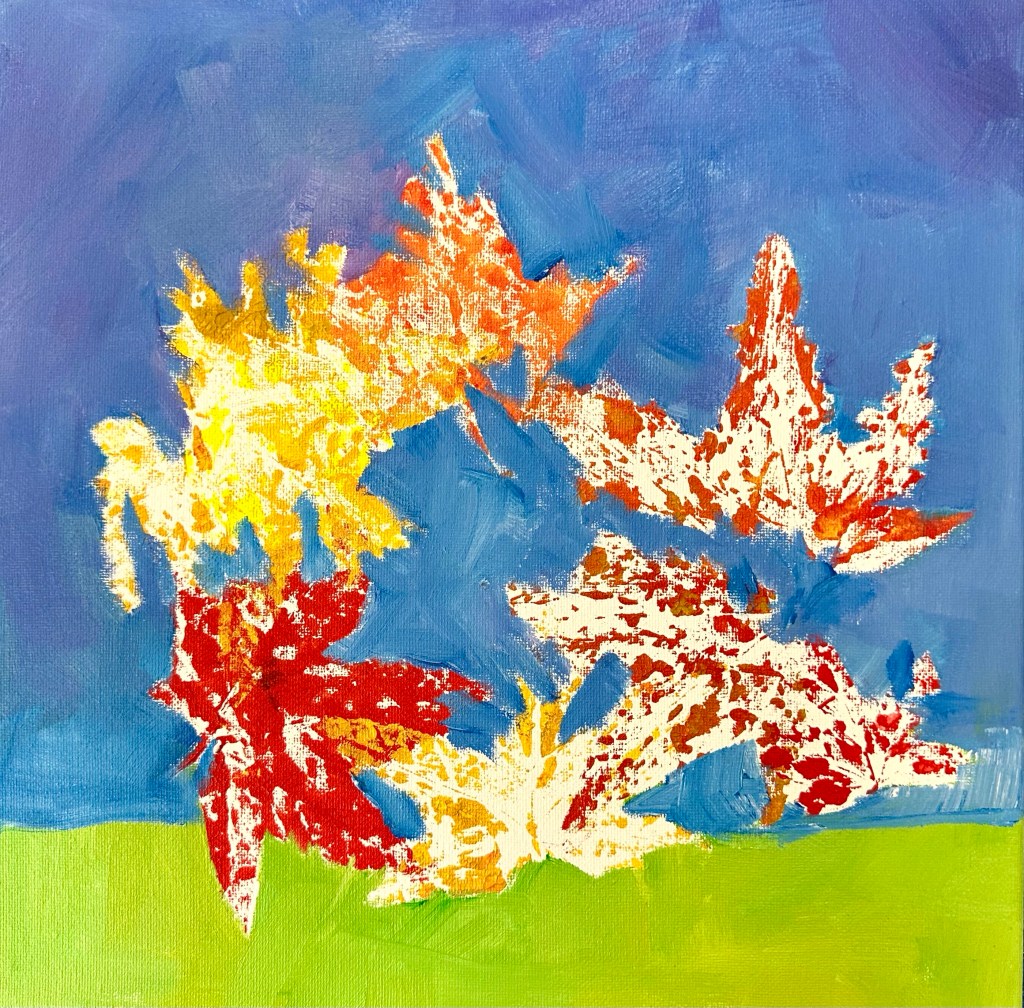
Cornelia: Dancing Leaves

As I’ve been watching the brisk winds blow the gold and red leaves from the trees this fall, I’ve also watched them dance against the bright cerulean sky. When the sun shines on these dancers, they glow even brighter than before. They don’t have a care for tomorrow, much less for today. Now and this moment is enough for them. They remind me of the Lord’s advice to us on the Sermon on the Mount in Matthew 6:34—

“So do not worry about tomorrow, for tomorrow will bring worries of its own. Today’s trouble is enough for today.”

I painted the back side of the leaves with a thin coat of acrylic paint and laid them one by one down on the white surface of the canvas. Then I gently hand rubbed the top of each leaf until I thought I’d transferred the paint. The hansa yellow was least successful as a print color, so I over printed it at the end. I mixed the green ground with the cerulean blue and two yellows. The sky has cerulean, violet, Ultramarine, and white. These I mixed as I painted, so the sky wasn’t an even color. (All skies change color due to atmosphere and distance: they get lighter toward the horizon).

Next Friday we’re going to make stamp prints. You may have cut your own design in a potato once upon a time in scouts or used vegetables to make prints. We can also use leaves, natural materials, metal objects, or found objects to create prints. Art is a time to explore and experiment. We’ll find out what works and what doesn’t!! Curiosity and the willingness to experiment and explore are all aspects of creativity. We can all learn to stretch our boundaries and learn resilience, which are experiences that help us address the stresses and challenges of daily life.

I learn something new every day. Today I learned a starfish has a brain that covers its entire body. Its whole body is made up of brain nodes! There are days I wish I were a starfish: I would have loads of brain cells!

Joy, peace, and happiness to everyone!

Cornelia


Type Four: The Individualist — The Enneagram Institute

https://www.enneagraminstitute.com/type-4

The 9 Enneagram Types — The Enneagram Institute

https://www.enneagraminstitute.com/type-descriptions

Art Analysis: Dance by Henri Matisse – Artsper Magazine

Texture Paintings

adult learning, Aristotle, art, autumn leaves, beauty, brain plasticity, cognitive decline, Creativity, flowers, Holy Spirit, Imagination, Leonardo da Vinci, Painting, renewal, Uncategorized, vision

Leaf Textures

I don’t do wine painting classes. Since I teach in a United Methodist Church, our Wesleyan temperance tradition holds sway: we serve no alcohol. However, out in the world beyond there are classes where everyone drinks wine and paints the same image. They’re out for fellowship purposes more than for art, but these classes serve to get people started in the basic techniques of the media. Students copy the teacher’s model painting, often working along as the teacher instructs the class. This is the “show and tell” style of teaching, which usually results in most students’ works approximating the teacher’s example.

Wine painting classes: One Lion to Rule Them All

College art education classes often are taught this way, but art classes in art schools are never taught like this. Why you might ask? Because art schools exist to help students find their own voice, for they know copying another’s style only diminishes a student’s true voice. The creative spirit within each of us is unique,
breathed into us by a holy God. Ecclesiastes 12:7 reminds us at our end, “the breath (Spirit) returns to God who gave it.” If art students are copying any art works, their teachers are humble enough to send their students to the masters first, or to life itself.

Laguna College of Art and Design art class

Art, like golf, is a humbling experience. In both we’re always playing against our handicap: we want to be “Perfect,” but we weren’t given the means to accomplish this goal without God’s grace. We go on to perfection by degrees, with the help of God, if we don’t get lazy and take the shortcuts, as the Adam and Eve, Prodigal Son, and many other great stories tell. As Jesus reminds his followers in Matthew 23:11-12—

“The greatest among you will be your servant. All who exalt themselves will be humbled, and all who humble themselves will be exalted.”

Why is it difficult to draw from life? Or for that matter, to really look hard at a painting to copy it? From an early age, most of us are taught it’s impolite to stare. In some cultures, even looking directly into the eyes of another person as you speak is unacceptable behavior. I know my parents taught me to look at them when I was in trouble, even when I wanted to look down in shame. I had to face their anger. While I didn’t enjoy it as a child, it prepared me as a teen for hateful comments from my peers, and as an adult for discrimination in the workplace. I could look people in the eye and call them out. This is likely why our early teenage children roll and flutter their eyes at us when we call them to account. They “look at us” without “looking.” And why we say, “Look me in the eye!”

19th century humorous postcard: The Artist’s Studio

We also have thoughts running through our heads: our to do lists, our concerns about our friends and loved ones, as well as the woes of the world stage. The more we learn to focus on the present moment in which we find ourselves, the better off we are. I find when I can pay attention to my colors, patterns, and how they come together on the canvas, I forget everything else.

I have some artist friends who always have a glass of wine in the studio, since it helps them relax. I think they just like wine. I’m a coffee lover, but too much caffeine makes my hand jittery, and too much wine would make my hand sloppy. I personally believe in moderation in all things, but then I’m sold on Aristotle’s “golden mean,” or the “Goldilocks zone,” where

“at the right times, about the right things, towards the right people, for the right end, and in the right way, is the intermediate and best condition, and this is proper to virtue.”

We barely avoided the 15th government shutdown since 1981, but we now have a House majority without a Leader due to a few extremist members. These Republican Party members who are “pirates who take no prisoners and make no compromises” might want to catch up on their ancient philosophical reading before chaos ensues. Sometimes life imitates art: if you have MAX, you can watch Michael Cain in “Our Flag Means Death.”

Little Vase of Flowers

All creativity improves with either time or wine. Both allow you to loosen up and not control what happens but go with the flow of what happens on the canvas, instead of forcing the paint to go where you want it to be. I have canvases which began in one direction and ended up in quite another. I can only say my original idea was rejected by the painting in progress, for I had to “listen to what the painting wanted to become.” As Psalms 104:30 says:

“When you send forth your spirit, they are created;
and you renew the face of the ground.”

In case you’re wondering, the “ground” of a canvas is the white primer, so it’s not a stretch to say, God’s Spirit works through us to renew the face of the “ground.” Some texts translate this as the “earth,” and God’s Spirit also works through us to restore and renew our planet to health after all the damage from industrial pollution and man made climate changes.

Leonardo da Vinci, the Renaissance genius, claimed, “There are three classes of people: Those who see. Those who see when they are shown. Those who do not see.” We can all learn to see. How we learn to see takes time and effort. This is why I always talk about some examples of good art before we begin our work. I know most people haven’t seen the masters, so getting images in mind is important. A little art history lesson never hurt anyone. Then I explain the project and we get to work. Stephen King, the noted author, says this about the creative experience: “Amateurs sit and wait for inspiration, the rest of us just get up and go to work.”

Tim’s Flower

In class we were using the flower arrangement which had been residing in the kitchen fridge for the past several weeks. I don’t know who to thank for it, but we put it back where we found it. Our group was given the key to use patterns and textures in the work.
Tim wants to learn to draw from life better, but he was struggling to get his proportions to scale. I showed him the trade skill of using a pencil or part of his hand to measure part of the object and compare its size to another part.

We give away our secret sauce recipe all the time! Everyone knows how to multiply with a ruler for a scale drawing, but that idea often doesn’t occur to them if they aren’t using it on a flat plane. If they have no real ruler, the idea of using an ordinary object as a measuring device also doesn’t enter our brains. This is normal, but once upon a time, we used our bodies to measure the work in progress: a cubit was the distance from the elbow to the middle fingertip and a hand-width was just that: the width of the four fingers. Over the years these were standardized to 18 inches and 4 inches. Horses are still measured in hands today, but we moderns measure in feet and meters rather than cubits.

Gail’s Texture Painting

Gail lined out some lovely patterns on her canvas and made good progress on her painting. She always gets a good plan and executes it.

Mike was glad to be back after doing renewal work/manual labor. This creative exercise of moving bold colors and strong patterns around his canvas was a welcome respite after all that physical activity. A mental challenge seemed welcome to him.

Mike’s Flowers

I had done a pattern piece in the week before, so I enjoyed painting the still life, and may use it as a study for something larger later.

Late 1800’s Levi Strauss advertisement

We finished up our works on the second session. Tim reworked the pumpkin drawing from an earlier time and Gail finished up her texture painting of the flowers. Mike dropped in with Van Gogh books before going out on an errand of mercy to rescue a young client. He was impressed with the amount of blue clothing the people wore in Van Gogh’s paintings. I reminded him the very denim jeans we wear first came from Nimes, France. We call these “jeans,” because the weavers in France were trying to imitate the techniques of Genoa, Italy, but failed, and made instead the sturdy fabric that’s blue outside and white inside. Hence, “jeane de Nimes.”

“I did not know that!” He exclaimed.

Art is for wondering, for seeing new things, for opening up our minds to new realities and new possibilities. Whenever we go beyond what we already know, we open a new brain pathway and create new connections between the neurons. This keeps our minds agile and staves off the worst aspect of aging: the pessimistic belief that nothing is new under the sun. If we keep the optimism of a child, for whom everything is the newest and best, we’ll keep a youthful heart and spread joy wherever we go.

Joy and Peace,

Cornelia

The ‘Golden Mean’: Aristotle’s Guide to Living Excellently —Philosophy Break
https://philosophybreak.com/articles/the-golden-mean-aristotle-guide-to-living-excellently/

Weights & Measures
https://www.jewishvirtuallibrary.org/weights-measures

History of Denim & the Origin of Jeans
https://www.hawthornintl.com/history-of-denim

Welcome to My World

adult learning, architecture, art, Creativity, Habits, Imagination, Painting, shadows, vision

The Physician

I’m currently reading Noah Gordon’s The Physician, the story of a Christian masquerading as a Jew so he can study in the ancient medical school in Persia during the Middle Ages. Authors have to describe their characters and the world they inhabit in order for the reader to imagine a realistic place, even if the location could only exist in the imagination. I find this book a great escape from the histrionics of the recent news cycles.

An artist who wants to render a three dimensional scene on a two dimensional surface has the extra challenge of learning a new visual language to describe the scene. Drawing in perspective is a brand new way of seeing and rendering a multidimensional world on a flat surface so the appearance of depth and solidity is realized. In some paintings, the artist’s style of painting depicts objects with photographically realistic detail. These works can “fool the eye” of the viewer.

The realism of Gerrit Dou’s “The Doctor” allows us to see the portrait of the physician through a window niche. The bas relief sculptural rendering on the wall is partly covered by a luxurious rug, on which a burnished copper dish rests. The window behind the Doctor adds a back light, but he uses the primary light from the niche opening to observe the liquid in the specimen container. His assistant is in the dimmer light of the background. We are looking through this window and watching him pursue his calling.

In other art works, the “realism” isn’t so much concerned with photographic accuracy, but with the emotional experience of the space rendered. The Scream, painted in 1893 by Edvard Munch, uses classical one point perspective to introduce the sensation of depth with the bridge. The two people walking away balance the one facing forward, who screams from the gut. The colors and shapes of the landscape are emotional reflections of the interior, psychic experiences of the screamer.

The Scream

In art class last year, we had several lessons on perspective. Most students, no matter what their age, dislike these basic lessons. They want to jump right in and learn to paint a still life, figure, landscape, or a building. Unfortunately, if they jump over these basic instructions in drawing, they struggle to set a form in space or have difficulty getting the proportions of the objects correct in relation to eschew other. Art school students usually have have an entire semester class devoted to the multiple forms of perspective. I remember drawing the overhead pipes, book shelves, the corners of rooms, and anything else that had a vanishing point.

Black and White Sketch of Geometric Figures

Perspective teaches us how to see by eliminating the extraneous and unnecessary information and concentrating instead on only the simplest and essential forms and lines. We can hold our paint brush handle up to the objects to measure them. This helps us know if the cone is twice the height of the cube, or 2.5 times. When we lay in our first sketch in a pale yellow wash, we don’t worry if it isn’t exact, we can adjust it with the paint. Why don’t we draw it in pencil? This tool tends to confine our creativity, since we’re used to small movements for writing and filling in correct answers from our school days. It has an eraser, so we struggle to get it “right.” Then we don’t paint with our hearts, but mechanically fill in the lines of a paint by number design.

Last week I was sick, and when I came back from the dead, others were down for the count, working the polls, or working in the salt mines. Gail and I were the only ones in attendance. She’d had the benefit of doing this lesson before, so I suggested we take the setup as a springboard for our imagination. We looked at some modern architecture, which depend on geometric forms for their design interest. One that caught our eye was a simple stacked design of rectangular blocks in a smoky atmosphere: Charles Willard Moore’s “Late Entry to the Tribune Tower Competition, Perspective,” 1980.

Moore: Tribune Tower Entry

When we got busy painting, I put on Dvorak’s New World Symphony, since we were creating a new world for our new buildings to inhabit (the link below is to you tube, if you want to listen along). I also ate a few Girl Scout Samoas, since I bought several cookie boxes from Gail. They reside in the freezer now so I don’t eat them all before Easter. I’m sure Gail can supply you if you want cookies.

While painting, I often lose track of time, perhaps because I enter into this “other world” of my creation. I focus on the image I see and the image I paint on the canvas. My problems fade away, for all I can think about are how to bring the form closer to the foreground: do I need a lighter, brighter color or do I need to change the direction of my brush stroke too? I may need to darken the shape behind or the shadow below it to best evoke the depth of space. Sometimes just a line across the back is enough to set the objects in space, but if we’re trying to build a new world, we might have to indicate some form of landscape.

We talked about the science fiction movies which invent an entire language complete with syntax and vocabulary for the various peoples and architecture suitable for their worlds. If we lived on a planet of crystalline structures, we’d always see the individual parts of white light. Then we’d be people who analyzed the world about us and looked for multiple meanings in the simplest of sayings. If we lived on a hot desert world, we might yearn for cool, dark places, so caves would be our preferred dwelling places. There’s a home for each person, for as Jesus reminded his disciples in John 14:2—

“In my Father’s house there are many dwelling places.
If it were not so, would I have told you that I go to prepare a place for you?”

What is real, you ask, and what is true? What comes from the heart and mind of the artist is real and true. It may not be of high quality, but proficiency comes from putting your true self into your work, without holding back. As the hand gains competence, the heart and mind have to struggle to remain true to the unique person who creates the work. The great danger is we become proficient at pleasing others for the sake of fame or fortune. Then we make pretty pictures, which will decorate walls and match furniture, but we may not reach the depths of the human heart and emotion required to produce lasting works of art.

Martian Landscape

None of us in our art class are here for fame and glory, yet we are progressing as the weeks go by. I like the rich texture of Gail’s Martian landscape and the red dust filled atmosphere of her painting. The odd geometric shapes look right at home on the extra planetary body. My landscape has a spring fondant look of a non-Lenten pilgrimage hostel or BNB. If anyone wants to journey elsewhere, the road is open before us, and is limited only by our imagination. Art class is where we let our minds stretch to consider the impossible and then create a structure to take us there. This is why VISION, HOPE, and OPTIMISM are also part of the artist’s toolbox.

Unfinished Fondant Landscape

Trompe-l’œil Painting
https://jhna.org/articles/gerrit-dous-enchanting-trompe-loeil-virtuosity-agency-in-early-modern-collections/

Gerrit Dou, The Doctor, 1653, oil on panel, 49.3 x 37 cm. Kunsthistorisches Museum, Vienna, inv. no. GG 592. Photo credit: Erich Lessing / Art Resource, NY (artwork in the public domain)

Edward Munch: The Scream
https://www.edvardmunch.org/the-scream.jsp

Dvorak: New World Symphony
https://youtu.be/Qut5e3OfCvg

Mountains and Molehills

adult learning, art, Attitudes, beauty, Creativity, Faith, Fear, Imagination, Love, Ministry, Painting, purpose, renewal, Right Brain, righteousness, seashells, shadows, United Methodist Church, vision

I’m one of the world’s worst worriers. I can make a mountain out of a molehill. This doesn’t bode well for living life to the fullest, for none of us know for certain what’s coming up around the corner, much less further down the road. This knowledge paralyses some of us, so that some of us cannot make choices until we have more information.

The fear of making a poor choice keeps some of us confined to our beds, for what happens if we get out on the wrong side of the bed? Our whole day might be ruined. We’ll choose to stay in bed, rather than risk making this first bad choice of many. After all, there’s no sense of starting a day that will only go downhill from the gitgo.

In times of stress, I have repeated this sentence as if it were a mantra:
“There is no fear in love, but perfect love casts out fear;
for fear has to do with punishment,
and whoever fears has not reached perfection in love.”

~~ 1 John 4:18

When faced with a blank canvas, we all have choices. If we use a pencil to draw the shapes, then we try to fill in the exact lines, even though we may not have yet found the perfection of form of the object we are representing. I always recommend drawing the general shape of the subject matter with a brush dipped in a wash of yellow paint. This helps the artist do two things: set the general composition and forms on the canvas, and provide an opportunity to correct any first misperceptions, since the pale yellow is easily over painted.

Lines of a Landscape

Of course, most of us have not lived in a world of unconditional love, even in the church. We Methodists are traditionally called to go “onto perfection in love of God and neighbor until our hearts are so full of love, nothing else exists.” Judgement causes fear, so people are afraid to give what they have or to serve with their gifts, if others tell them how poorly they are doing.

In art class, we have a rule of positive critiques. First we find three constructive statements to make about a student’s work. Then we talk about what can be improved. It takes time to move people’s minds from thinking negatively about their own work, to believing positively in their capabilities to learn. In this aspect, I confess to a belief in “works righteousness,” for persistence will pay off. While we may not become Matisse or Michelangelo, we can enjoy the pleasures of color and the creative act of making art in our own way.

We had a full class last Friday when I brought a small still life. The objects were a small clay lamp from the Holy Land, a white stone scraper I found on an arrowhead hunt with my family, my grandmother’s darning egg, a stone fossil from my San Antonio neighborhood, and a leaf I picked up in the parking lot. Artists can make anything interesting, for we don’t need to have luxurious items for our subjects. Each person brought elements of their own personality to the subject at hand.

Mike is one of my repeat students, who loves texture and mixing colors. You can see he favored the lamp, the scraper, and the fossil, for these have these best rendering. The rest are suggested just enough to balance the others.

Mike Still Life

Erma is new to the class and comes from a mosaic background. Her shapes are true and carefully drawn. Working to get the dimensional qualities is a challenge for everyone. This comes from learning to see the light and darks. Last year the class had traditional perspective drawing classes. I may have to do this again for this group, now that I see where they are.

Erma Still Life

Tatiana has a fine drawing of the leaf and the fossil. Her colors are natural. Getting shapes down is the first goal. Later we’ll work on highlights and shadows.

Tatiana Still Life

I was glad to see Glenn back after his health issue. Can’t keep a good man down. He was in good humor the whole class and was a blessing to all of us. He got the basic shapes of the still life on the canvas. Next time, we’ll work on filling more of the canvas, so it won’t feel so lonely.

Glenn Still Life

Gail is on her second year of art classes. She’s either a glutton for punishment or she’s getting some pleasure from them. She is an example of persistence leading to improvement. Her objects are to scale, relative to each other. We see highlights from the light source, as well as the cast shadows, both of which emphasize the sense of solidity of the objects represented. She has marked off a front plane from the blue background.

Gail Still Life

Some say artists never use logic, or the left side of their brains, but I’d disagree with this. Back in the 1970’s, the commonly held theory was creativity’s location was in the right side of the brain, but today neuroscientists believe both logic and creativity use both sides of the brain at once. While speech and sight are located in certain areas, which if damaged, can affect these abilities, logic and creativity are spread out across many areas of the brain, says Dr. Kara D. Federmeier, who is a professor of psychology at the University of Illinois at Urbana-Champaign, where she’s also affiliated with the Neurosciences Program and The Beckman Institute for Advanced Science and Technology.

As we age, older adults tend to learn better how to be both logical AND creative. This may occur because this kind of a shift is helpful to bring extra processing resources to bear on a task to compensate for age-related declines in function. Or it might be a sign that the brain is simply less good at maintaining its youthful division of labor. Understanding hemispheric specialization is thus also important for discovering ways to help us all maintain better cognitive functioning with age.

Those folks who say “you can’t teach an old dog new tricks,” haven’t been to an art class. We don’t teach, we give opportunities to learn. Every day in my own studio, I learn something new about myself, the paint, my world, my calling, and my vision for the future. I never reach perfection, but at least I’m going on to perfection. My little still life has a mosaic quality, because I took an old canvas, which didn’t meet my expectations, and I sliced it up into evenly spaced vertical cuts. I took another poorly done old work, cut it up into horizontal strips and wove it into the first canvas. Then I painted over what was underneath. Yes, I had to pile the paint on thickly, but that gives it a rich effect, as opposed to a thinned out, watercolor feeling. While I made no clear line of demarcation, the color change denotes the difference between the table and the background.

Cornelia Still Life

I do not know what tomorrow will will bring, or what will come to life on the blank canvas before me. If we will trust the one who lived, died, and rose for us, we can live and work in perfect love every moment of our whole lives. I know I trust the word of our Lord who always will be there for us in our futures to make our mountains into molehills.

“But after I am raised up, I will go before you to Galilee.”
~~ Mark 14:28

https://www.npr.org/sections/13.7/2013/12/02/248089436/the-truth-about-the-left-brain-right-brain-relationship

Time and Art March Along

adult learning, art, Creativity, Faith, Health, Ministry, Painting, purpose, renewal, Spirituality, vision

Time and the tide waits for no one, we’re certain of this, for we can no more wrestle the waters of the sea to keep the waves from their constant flowing in and out than we can stop the minutes and seconds from slipping into the past, where they’ll be only a memory for a while.

As a mother, I endured the pains of childbirth for excruciating moments, but when I held my beloved daughter in my arms, I immediately began to replace those difficult memories with the present joys of her new life and my new hopes for our life to come. I learned how quickly a newborn child could grow, for she hardly had a chance to wear those cute 3 month old clothes before she outgrew them. When she was six, I bought her lace Sox and white patent leather shoes two weeks before her baptism, but she out grew them and walked to the font barefooted to receive the sacramental water.

Apple

I was appalled, but children’s feet don’t pay attention to parent’s pocketbooks or church calendars. Besides, God called her to holy ground, so her feet needed to be bared. The rest of us were just doing church. Time and tide, as well as the Holy Spirit, can’t be controlled by any human means. We have to ask, what does this have to do with art?

Fruit

Samuel Johnson, the English author said, “The true art of memory is the art of attention.” To what do we pay attention?

1. To the various lists of chores we need to do before we can do something for our own joy or spiritual health?

2. To our list of fears and anxieties about what others will think of our choice to do an activity?

3. To our feelings of inadequacy if we don’t achieve instant success?

I could name others, but in truth, the true art of memory, which is the art of attention, is being present to oneself and to the present moment. We aren’t asked to be in the future or the past, but in the now. This isn’t as easy as it seems, but it’s extremely rewarding. When an artist “gets into this zone of the present moment,” all cares fall away, thinking about pains and problems ceases, and only the creative process and the creation becomes important. In a sense, the artist enters into the life of the creating God. How is this so? God is I AM, or the one who is I AM BECOMING. God is also I WILL BE, for God’s name is all of the “being and becoming” verbs at once.

Autumn Leaves

I began formal art lessons at age 8 years old, but not everyone has that opportunity. Grandma Moses began painting at 78 years of age. Some people paint for fame or to try to earn a living. That was my goal before God called me to the ministry. Now I see my art as the opportunity for others to grow closer to God as a form of meditation. It’s also a good way to challenge the brain, since learning new things helps to keep the mind sharp. Adults need this, along with exercise, a healthy lifestyle, and companionship.

Over the last year, two students have persisted. Both have improved their drawing skills, they are better able to make self directed choices, they are better problem solvers, they see better, and their painting skills are improving. Moreover, while they say “I really don’t have time for this, but if I don’t do it, I get overwhelmed by too many other things. Art class helps me clear out a space for myself.”

Autumn Leaves

In a sense, painting is like prayer. If we don’t have time for prayer, we can find our lives cycling out of control. We are ships on tides we can’t control and live from day to day, watching the leaves of our calendars fly past us, never to return again. Some of us may like living in chaos, since it gives us the feeling of being alive. Others choose to live in chaos because then they don’t have to deal with their feelings, but can spend their time putting out the fires. If we stop for prayer, or stop to paint, these feelings will come to the surface. At least in prayer or in art class, we’re in a place where God is close at hand. As the scriptures promise,

“The Lord is near to all who call on him, to all who call on him in truth.” (Psalms 145:18)

Homage to Morandi

adult learning, art, Children, Creativity, Faith, Love, Ministry, nature, Painting, shadows, Spirituality, trees, United Methodist Church, vision

Morandi: Still Life

My students in the art class at the church have shown much progress since we began last year. I’m proud of them for sticking in there and taking this journey down a path less traveled by others. Most art education classes begin with the idea of a model and the students should all try to match it. This is typical of “right answers” in most schoolwork, such as math. Indeed, 2 plus 2 should equal 4, and not 3 or 5. We can’t get creative in our answers in math class, but we can have room for creativity in art class. If we have a still life to render on a page, we should have something that’s recognizable as the objects, but Cubism has taught us the objects don’t have to be painted as Realism. We can paint them different, emotional colors, as in Fauvism, or in a monochromatic scheme, like Georgio Morandi.

Mike’s Most Recent Work

Another growth area we have is continuing to observe the subject while we draw and paint. Children draw the idea or symbol of the thing they’re representing. If we’re attempting to render a realistic subject, we need to constantly check back to the objects to notice the negative spaces and the shadows, as well as the forms themselves. This is a matter of discipline, which all artists have to undergo. I spent many an hour in art school drawing models without ever being able to look at my work—this is how you train your brain to connect to your hand. The first efforts are pretty goofy looking, for sure. You have to leave your ego at the door if you want to become an artist.

All beginning artists try to make a shape perfect first and then color it in, much like filling in the black lines of a coloring book. This year we’re working on losing our need to be perfect from the start, and begin to paint from the first. This lets us have more emotion and feeling in our work. We do this by drawing with a brush and a light, yellow wash on the canvas. We can easily paint over it with our thicker paints. If we don’t get it right, we can scribble over it, or use a pale pink wash to make a different line. 

Gail’s Most Recent Work

About the age of nine, children begin to draw what they see, but still have no real sense of perspective or scale. The most important object is the largest. About the time they become teenagers, they show an interest in realism and the artistic skills needed to produce these tricks of the eye. More precocious children will begin earlier, and others may never show an interest at all. Some naive painters will retain childish forms, but have strong pattern and design elements, such as Grandma Moses, who painted the memories of her childhood. 

Last year I started the class on basic perspective. It might have been too difficult for some, or too uninteresting for others. Yet basic perspective is a building block lesson for any art lesson that is more than decorating a flat surface with pretty colors. Likewise, making a shadow study of basic geometric forms is important because all objects in nature can be reduced to a geometric form: tree trunks are cylinders, fir trees are cones, oak trees are spheres, houses and churches are rectangular solids and pyramids, and bridges are rectangular solids supported by piers, which are more of the same. A complex landscape becomes easier to sketch out in block shapes if the artist can identify the basic components of what he or she sees.

Last Year: Boxes on Top of Boxes

People think art is “Just something I can do when I feel like I’ve got nothing else to do.” This is the description for finger painting for kindergarteners, if you think about it. Art is for both thinking and feeling, since both the brain and the heart need to be active at the same time. Some say only the heart needs to be active, but the head is exercising choices and making decisions to limit the red or to add more yellow or to rip a huge black down the side of the canvas. Only the artists who are unintegrated will contend they work only from the mind or from the heart. We actually work with both, even if one is diminished in nature.

Cornelia’s Homage to Morandi

If the great commandment, “You shall love the Lord your God with all your heart, and with all your soul, and with all your mind,” means anything in the art life, it’s we aren’t meant to separate any one part of our experience from any other part. In our art expressions, as in our faith expressions, our heart, soul, and mind needs to be fixed on love of God, as well as love of neighbor, for loving our neighbor, in whatever form, fashion, or fix our neighbors find themselves in, is the same as loving the image of God in which they were also made. By loving our neighbors, we love ourselves also. If we hate our neighbors, we hate ourselves. God didn’t mean for us to hate God’s image.

These are the wonderful spiritual truths we learn in art class. It’s more than learning how to mix colors or draw a box in perspective. These are art skills. Life skills are way more important. Take a look at the work from last year and this year. You can still join this class. You aren’t competing with anyone, but you will be working to improve over time. Going onto perfection takes time. Now is a good time to begin!