Picasso’s African Masks and Inner Mysteries

adult learning, art, Creativity, cubism, elections, Imagination, inspiration, Painting, picasso, renewal, The Lord of The Rings, Thomas Merton, vision

What is the key to open the door to the hidden mysteries? For Frodo and his fellow travelers in The Lord of the Rings trilogy, they needed to know the elvish answer to the riddle, “Speak friend and enter.” Gandalf knows this language, so they enter with ease. For years, the Egyptian hieroglyphics were unintelligible because we had no living person who knew the ancient language. After the discovery of the Rosetta Stone in Egypt with its three languages depicting the same text, the race was on to translate the pictographic writing.

Rosetta Stone, British Museum

In art school my fellow students and I worked in our shared studio classes daily, but sometimes we never made any progress. Then the day would come when the light bulb clicked on in one of our brains. When we took a break, instead of giving everyone’s work a cursory glance before going out for a snack, we would linger and take in the special magic of a unique vision. Where does this special insight come from? Is it a visitation from above? Or a piercing of the soul by divine artistic insight? Sometimes I think the rare and the strange shock us out of our ease and complacency.

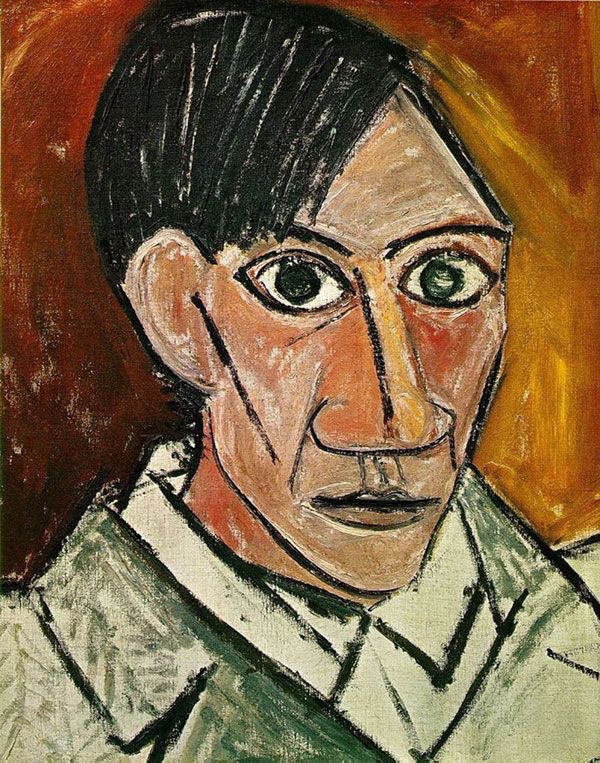
Picasso: Self Portrait, oil on canvas, 1907.

Art historians divide Picasso’s early periods into his Blue Period (1901-1904), the Rose Period (1905-1907), the African-influenced Period (1908-1909), and Cubism (1909-1919). Some art historians call Picasso’s African Period his “Proto-Cubist” or primitive period. It lasted from 1907 to 1909. Picasso was 24 years old when he saw an exhibit of African art at the ethnographic museum at Palais du Trocadéro. He experienced a “revelation” and began to explore African art further. African masks and sculptures strongly influenced Picasso’s art for several years, when he began to paint in sculptural forms, earth tones, and in flattened sharpened shapes.


Pablo Picasso in his Montmartre Studio,1908, via The Guardian

Picasso had first seen an African mask at Gertrude Stein’s home. Recalling his visit to the Trocadéro Museum of Ethnology (now the Musée de l’Homme), Picasso said of the museum:

“A smell of mould and neglect caught me by the throat. I was so depressed that I would have chosen to leave immediately. But I forced myself to stay, to examine these masks, all these objects that people had created with a sacred, magical purpose, to serve as intermediaries between them and the unknown, hostile forces surrounding them, trying in that way to overcome their fears by giving them color and form. And then I understood what painting really meant. It’s not an aesthetic process; it’s a form of magic that interposes itself between us and the hostile universe, a means of seizing power by imposing a form on our terrors as well as on our desires. The day I understood this, I had found my path.”

That path led Picasso to what he called his “periode nègre” (black period) or African period. It lasted only a few years, to 1909, but it turned Picasso into an avid collector of African art, masks, and sculptures that inspired him for the rest of his career.

Picasso: Woman with joined hands, 1907, Paris.

In our art class we chatted about how these masks inspired Picasso. Picasso used a palette of earthy tones, overlapping browns, and yellows with dark reds. By using Cubism, he explored a simplified geometry and the redefinition of perspectives. He tried to reveal objects from a different vantage point—from the mind, not only how the eyes perceive them. His Les Demoiselles d’Avignon signified a radical break from the naturalism that had defined Western art since the Renaissance, derailing former notions of what art was supposed to look like.

Picasso: Les Demoiselles d’Avignon (1907), oil on canvas.

People criticized Picasso’s two-dimensional women as unfeminine, for their confrontational demeanor was a complete departure from the traditional depiction of female beauty. Artists and critics alike received the work negatively and saw its menacing sex workers as promiscuous and unfit for Paris salons. Picasso rolled up the canvas, considered scandalous even amongst his innermost circle, and stored it in his studio for years to come. Yet this groundbreaking painting influenced his future works.

As Thomas Merton wrote in No Man Is an Island:

“In an aesthetic experience, in the creation or the contemplation of a work of art, the psychological conscience is able to attain some of its highest and most perfect fulfillments. Art enables us to find ourselves and lose ourselves at the same time.”

Picasso broke through the accepted boundaries of Western culture and discovered his true spirit in through the voices of the ancestors speaking from the African past. He met the other and found himself. By bringing the African masks into his studio, Picasso lived out the message of Hebrews 13:2—

“Do not neglect to show hospitality to strangers, for by doing that some have entertained angels without knowing it.”

As artists today, who seek to find their own true self and unique voice, we must both find ourselves and lose ourselves. We must lose our preconceived notions of who we should be and discover our true selves. Some artists use this as license to be caricatures of an artist, but actual artists have work ethics because they have obligations to galleries and clients. Looking like an artist and being an artist are two different things. Finding our true selves is not only a task for creatives, but also a lifetime journey for all people engaged in spiritual growth. We all can recover the image of God, which is our true self, by both God’s grace and our cooperation in doing good to all.

We artists are not here to make pretty pictures, but to break down the boundaries between our walls that keep us estranged from God and neighbor. We are not as bold as Picasso! Most of us are not risk takers. Willingness to leap out in faith is what marks a famous artist. That same riskiness is what marks the prophets of the Bible. Prophets never praise the status quo, but remind the people of the nature of their God:

“For the LORD your God is God of gods and Lord of lords, the great God, mighty and awesome, who is not partial and takes no bribe, who executes justice for the orphan and the widow, and who loves the strangers, providing them food and clothing.” (Deuteronomy 10:17-18)

Isaiah 1:17 reminded the people of his day, “learn to do good; seek justice, rescue the oppressed, defend the orphan, and plead for the widow.” Jesus will pick up this same voice in Matthew 25:40, “And the king will answer them, ‘Truly I tell you, just as you did it to one of the least of these who are members of my family, you did it to me.’”

So how will we find our unique voice and creative expression today? The more we steep our heart and mind in the great spiritual writings of the ages, particularly those of whom have come through great suffering or difficulties, the closer we will come to understanding our own challenges in life. These hardships are not hurdles or barriers to our progress, but refiners of any weakness that needed to be strengthened.

As my teachers always said, “We test you, not to see how ignorant you are, but to see what we failed to teach well.”

I always liked their attitude better! I did not feel so dumb when I missed the right answer on their tests. I always liked art better, for more than one answer could be correct. If we work within the parameters of the assignment, we can interpret the art with our own vision and style.

Our recent class with the African masks was a big diversion from our usual method of working. First, the masks are from a different culture. They are as much of a culture shock to us as they were to Picasso. He had the privilege of buying them in the Parisian curio shops, so they sat around in his environment. We only had images. The mystery of these objects might not connect to us as they did to him.

Mike’s Mask

Mike brought several masks from his home collection. He decided to paint one that spoke to him. Like Picasso, he had an emotional connection to this mask. He made a successful rendering of the object before him. Unfinished, he would bring it back to the next class.

Tim’s First Layers

Tim worked on a mask representing his wife. He first painted his background with a dark wash, then began drawing a lighter design on top of it. The contrast of the dark and light without the middle tone was difficult for me to look at, but he seemed to be enjoying getting the big shapes down. I often let people work without jumping into change their activity. I figure they will learn more from going down a dead-end road by themselves than if I stop them before they go there. They will ask about this, and we will talk about it. They will not do it again. A little suffering leads to learning if we do no harm to the body.

Gail’s First Layets

Gail S. understood the concept of simplifying the faces into a mask. She chose a photo of herself and her granddaughter. With two mask shapes, she had multiple decisions to make. As with the others, her work was unfinished at the end of class.

This was a difficult and challenging lesson for everyone. Asking students to make an emotional connection and render the object also was aspirational. It also gave me an opportunity to see where they were on this learning journey. I will not issue this sort of challenge again for a while. I was afraid I had been boring them, but maybe not. I may need to bring brownies next Friday to make up to them. For some, they may be “grief snacks,” while for others, they will be “encouragement food.” If my bunged-up shoulder permits, I will indulge in grief baking. Otherwise, I will just eat the chocolate ice cream in my freezer, and ask for understanding.

Cornelia’s Trump Portrait

I painted a Trump mask to get my emotions out and not have them bottled up inside. If we dislike an attribute in another person, it is because we have that attribute in our own life. I can get incredibly angry, but I bottle it up and it hurts me. I do not often let anyone else see it, so it can make me sick from holding it in. Whenever someone calls you a name, I remember the old song my parents taught me when I was a child:

“Sticks and stones may break my bones, but words will never hurt me.”

Anger is a difficult emotion for many people, especially for women. It is a “culturally unacceptable behavior,” for we have always expected strong emotions from men, but this expectation is changing over the generations. Proverbs 14:29 reminds all of us,

“Whoever is slow to anger has great understanding, but one who has a hasty temper exalts folly.”

The Old Testament often speaks of God’s anger, but this is because God’s people keep finding other gods to worship instead of the one true God. Psalms 145:8-9 reminds us of God’s true nature:

“The LORD is gracious and merciful, slow to anger and abounding in steadfast love.

The LORD is good to all, and his compassion is over all that he has made.”

The hidden mystery is in plain sight. It is the word of hope we hear:  We are not sinners in the hand of an angry God. We are all beloved and God’s everlasting grace is redeeming us always. When things fall apart, God works to reframe and renew, even if we have difficulty recognizing God’s new creation or wanting to take part in God’s plans for the new heaven and the new earth.

Joy, peace, and recovery,

Cornelia


Historical Influence of African Art in the Modern Art Movement – ARTDEX

Pablo Picasso – Artists – Mnuchin Gallery

https://www.mnuchingallery.com/artists/pablo-picasso#:~:text=Picasso’s%20early%20work%20can%20be,Cubism%20(1909%2D1919)

Stealing beauty | Art | The Guardian

https://www.theguardian.com/artanddesign/2006/mar/15/art

Historical Influence of African Art in the Modern Art Movement – ARTDEX

Sticks And Stones May Break My Bones – Meaning & Origin of The Phrase

https://www.phrases.org.uk/meanings/sticks-and-stones-may-break-my-bones.html


Pumpkins and Gourds

adult learning, art, Creativity, Faith, generosity, inspiration, Ministry, nature, Painting, picasso, pumpkins, shadows, Spirituality, suffering, Winston Churchill

Sometimes I can work for hours and end up with nothing to show for it. In grammar school, I could use the excuse, “The dog ate my diorama.” Today my primary reason is “The latest iOS upgrade sent my file into the far realms of the cloud and smashed it to smithereens while it was traveling to some unknown destination.” I can be thankful at least my mind only goes on occasional jaunts to Pluto, but it returns after those excursions after a time. And no worse for wear, not that anyone would ever notice.

Selfie as Bat Girl

Today will be different. I am determined. I am convinced. I am also wearing my Bat Girl costume, so I will not let the powers and principalities of evil defeat me. I will fight against the darkness of the night and bring the light to the hidden places. When we start a new venture, the only way we can gain experience is by failing. In fact, failure is how we learn. The best teachers set up the learning process in structured practices which build upon each prior experience. We also observe our students to note if we need to reteach a lesson from a different point of view to cement their understanding before we move onto the next phase.


Mr. Rogers was still breaking world records in running for his age group at age 100. He died on November 14, 2019, while in hospice care at the age of 101.

No one learns to lift a huge weight in their first exercise class. They begin to lift progressively heavier weights until they can lift the heaviest weights possible. No one becomes a world class artist in kindergarten, but sensitive teachers guide them from an early age to focus and hone their skills. Later, once they absorb what their masters can teach them, artists begin to find their own personal expressions and style. Art also provides an emotional outlet for people who have no aspirations to become a professional artist. Some people only want to explore their creativity, enjoy playing with the colors, get out of the house, and interact with others. Socialization and challenging our minds are important activities for a healthy life.

Sir Winston Churchill
Still Life, Fruit, ca. 1930’s
Heather James Fine Art

“Happy are the painters for they shall not be lonely. Light and color, peace, and hope, will keep them company to the end, or almost to the end, of the day.”

Winston Churchill wrote this in Hobbies in 1925. reflecting on the solace painting had provided him since the death of his daughter Marigold.

Hans Hoffman, The Pumpkin, oil on canvas, 1950, 36” x 48”.

One of the great teaching artists, Hans Hoffman, was known for his quote:

“The ability to simplify means to eliminate the unnecessary so that the necessary may speak.”

When we see a landscape, a still life, or a face, most of us get overwhelmed with the myriad details. We want to focus first on the details, instead of the bigger shapes. This gets us in trouble every time. What do the time management gurus tell us over and over? Write down your list. Number your biggest priority. Do it first. Always do the biggest, hardest, and nearest in time deadline things first.

The Eisenhower Matrix Decision Chart

This is how we make our basic sketches on our canvas. Get the big shapes on the canvas first. They do not have to be a great outline, but a general gesture that takes up the space of the object, proportionately to the other objects. Often, we treat our marks as if we are chiseling in stone. With paint, we can let it dry and go over it and no one will know the difference.

As we paint big to small, we can paint the darks, the lights, and the middle tones. This allows us to blend the colors together if that is our desire. Sometimes the blank white canvas fills us with trepidation. We may think our first sketch might be somehow “wrong.” There are no wrong marks in art class, but we may make many marks on the way to fulfilling our mind’s ideas in life. Winston Churchill has a remarkable story of his personal experience learning to meet the open maw of the great white canvas. It once terrified him as much as “Jaws” does the modern movie goer.

Picasso Cubist Still Life with Watermelon

This week we approached our seasonal gourd and pumpkins from several different directions. We looked at zen tangle designs, realism, and pumpkin patch photos. We also looked at paintings that focused on the stems and vines. We also looked at Picasso’s still lifes. He was a master of the Cubist patterns and simplification of forms. He did not try to make the objects look real, but made shapes, which were pleasing to the eye.


Michael’s Pumpkin

Michael painted an exuberant pumpkin with a giant green stem and his usual textured background. He enjoys his time in art class and his work shows it.


Gail S.’s pumpkin

Gail S. painted a multicolored group of pumpkins attached to a sinuous vine. She brings her knowledge and background in nature as a park ranger to her artwork. She always has an interesting design element to her work.


Gail W.’s Zen Tangle Pumpkin

Gail W. Started with a realist rendering, but ended up with thin layers of paint overlapping at the edges of the pumpkin creases. When she asked what was going on in her painting technique to cause this, I noticed she was using water to thin her paints. “When you thin your paint so it is transparent, then when it overlaps, you get a solid line. Use your paint straight out of the tube next time.” She took her painting home, added another layer of paint straight from the tubes, and decorated the whole with zen tangle designs, using a fine point marker.

Cornelia’s Gourds

I put my gourds in an interior setting, as if they were on a tabletop near a window, which looked out onto a blue sky. I added a tree branch bereft of autumn leaves, as if a cold and rainy day had preceded the day of this painting. The barren landscape outside contrasts with the luscious treatment given the gourds inside. Each gourd has its own personality and spirit. They are more than mere natural objects.

They brim with the reproductive power of nature, as a testimony to the promise of tomorrow’s abundance, even in the face of today’s barrenness. One gourd casts a shadow, while the other does not. A viewer might feel some psychic dissonance because a realistic rendering would have both objects cast a similar shadow. The space is not “real,” but “spiritual” instead.

This is the promise of a faithful God for those who believe in God’s steadfast love and providence. As we hear in Habakkuk 3:17-18, we can have trust and joy during trouble:

“Though the fig tree does not blossom,

and no fruit is on the vines;

though the produce of the olive fails,

and the fields yield no food;

though the flock is cut off from the fold,

and there is no herd in the stalls,

yet I will rejoice in the LORD;

I will exult in the God of my salvation.”

 In a world in which the good often suffer and evil seems to prosper, we always remember God is still at work to fulfill our daily needs, if not all our infinite desires. We will not want. Those who have the heart of God will always share with those who have less. Those who are greedy and don’t share God’s generous nature will stay stingy. This is how we know who is doing the work of God—the people who are loving God and neighbor both. .

Joy, peace, and providence,

Cornelia


SCHEDULE FOR 2024:

November 8—Painting

November 15—No Class—Vacation

November 22—No Class —Vacation

November 29—No Class—Thanksgiving

December 6—Painting

December 13— Painting

December 20— Painting

December 27—TBD —holiday season and school vacation calendar


Painting as a Pastime – International Churchill Society

When He Wasn’t Making History, Winston Churchill Made Paintings | Artsy
https://www.artsy.net/article/artsy-editorial-making-history-winston-churchill-made-paintings

Hans Hofmann: Quotes

https://www.hanshofmann.net/quotes.html

The Eisenhower Matrix: How to Prioritize Your To-Do List [2024] • Asana
https://asana.com/resources/eisenhower-matrix


Creating a Picasso Still Life

art, brain plasticity, Cezanne, change, Creativity, Habits, Healing, Imagination, inspiration, Painting, perspective, picasso, purpose, renewal, Spirituality, vision, war

Einstein never said, “If we do the same thing every time, but expect a different result, this is the definition of insanity.” So why do artists return over and over to the still life? For that matter, why do preachers repeatedly use the same scripture texts for their sermons? Some of my former congregation members might have said I was overly fond of certain verses. The scalawags among them might have thought I did not get my point across the first five times I preached a version of the sermon text. As Jesus was wont to say in Luke 14:34-35 about Salt:

Picasso: Self Portrait, 1907, oil on canvas, National Gallery of Prague

“Salt is good; but if salt has lost its taste,

how can its saltiness be restored?

It is fit neither for the soil nor for the manure pile;

they throw it away.

Let anyone with ears to hear listen!”

Three Sacramental Vessels

I always kept my sermon notes just in case I had a difficult week and might need a backup sermon, but I never used these notes. I wrote each of those sermons for a time and a place, but they were never useful for the current time or the present location. Likewise, an artist brings their emotions and experiences of the present time to each working session in the studio. Sometimes an artist is chock full of energy and power, full of joy and life. Their paintings or works exude these same emotions. At other times, the cares and chaos of the world intrude into the otherwise peaceful precincts of the artist’s workplace. These emotions and troubles will also be visible in their work, for artists are in tune with their times.

Picasso: Still Life with Dead Pigeon, oil on canvas, 1941, Nagasaki Prefectural Art Museum

This year in the adult art class I’m teaching at Oaklawn UMC, the students are getting lessons not only on how to paint, but on awakening their individual creative voice. These lessons are part art history and part “thinking like an artist” by painting in another artist’s style. The week before, we worked on a typical still life painting. For this session, we worked on what we saw in front of us, but tried to make an emotional connection with the objects. When most of our energy is going to getting proportions in proper order, shadows cast in the right direction, following the shape of the objects, and the colors correct, putting our emotions into the work comes in a distant fifth or last.

Morandi still life: he painted the same vessels so often, they became as friends who shared their innermost secret thoughts with him.

To be sure, our class is still analyzing the containers as physical objects more than feeling or experiencing the vessels as objects with personality. We have not yet become friends with the objects, or really gotten to know them on a deep and intimate level. This is also a problem in our society today. We are not willing to know others too deeply, and we aren’t likely to let many others know us too deeply either.

Gail S in the first week: realism

This isn’t a problem confined to older people. For my own demographic, meeting new people seems a mite risky these days in the online world because we never know who is behind that chatbot or Facebook account who seems so charming. For younger people, who sometimes never seem to come up for air from the online world, this online reality can seem more real than the three-dimensional world in which we live. (I was today old years when I learned the latest online AI fad is personalizing your own chatbot companion. I wonder if these chatbots have Asimov’s 3 Laws of Robotics ingrained in their program guardrails.)

Gail W in the first week: realism

Having empathy with inanimate objects is difficult. Artists bring into their own studio the objects which interest them. A teacher brings in objects her students can approach, given their skill level. I will blow that concept out of the water this Friday with some crazy Halloween pumpkins but, if the subject matter is consistently too difficult, many students will give up if the challenge is too far out of reach.

Picasso Still Life, oil on canvas, 1937, private collection.

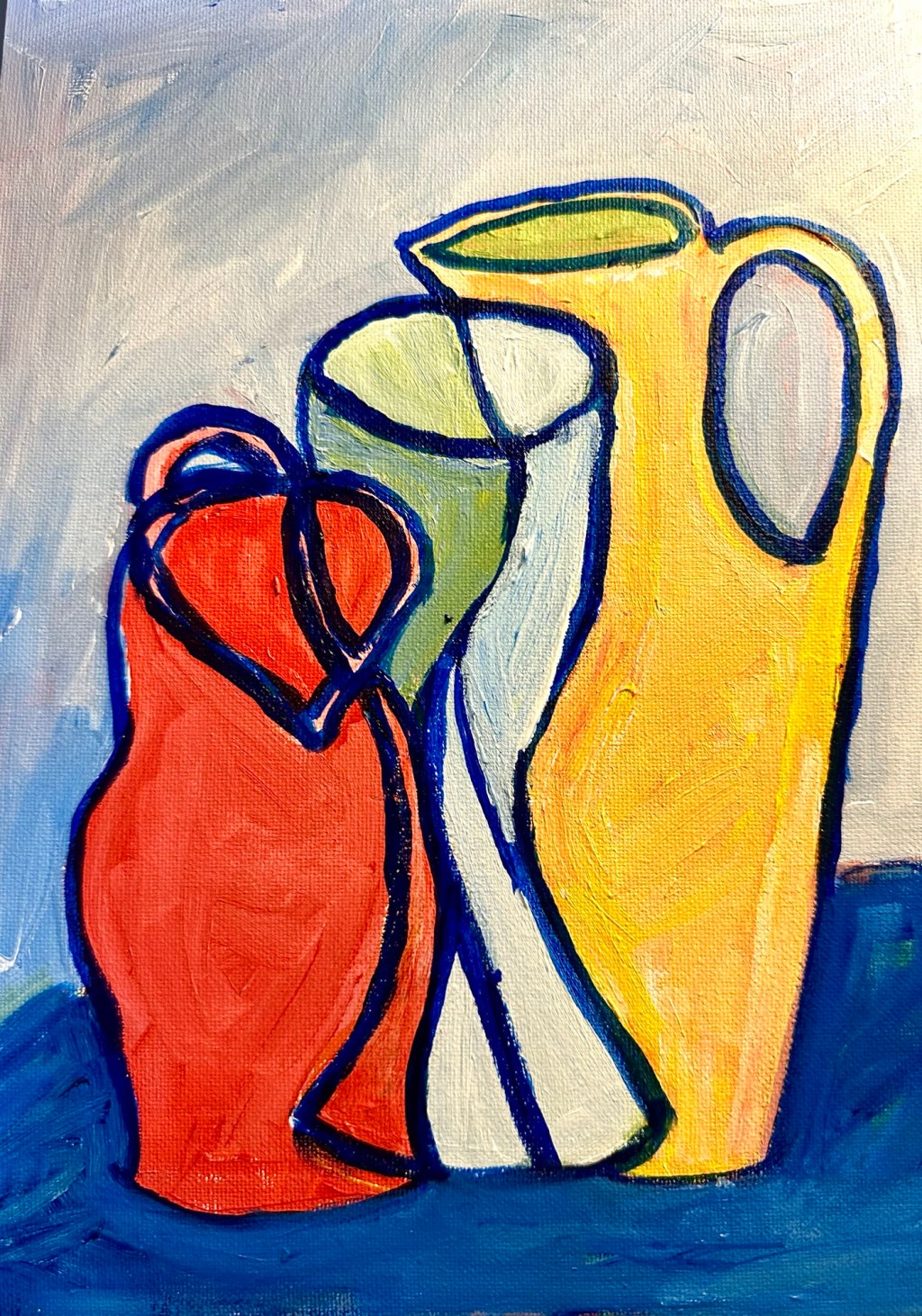
In the second session when our class saw these same liturgical vessels, we chatted about Picasso and cubism. Cubism had several different forms of expression, but we focused on synthetic cubism, a later phase of the cubist style dating from about 1912 to 1914. It had simpler shapes and brighter colors. Synthetic cubist works also often include collaged real elements such as newspapers and cardboard. These works have interesting designs, such as multiple points of view (perspective), overlapping shapes which make their own patterns, and linear outlines. This style is an outgrowth of the work of Cézanne, who said: “A work of art which did not begin in emotion is not art.”

Gail S. took a cubist vision to our same three pots

If you’ve ever tried to put on your socks in the morning beginning with a different foot than normal, you can begin to appreciate how difficult it is to imagine how to create an artwork in a fresh style. If we were to ever have a stroke or a traumatic brain injury, relearning how to do simple tasks is much the same.

Tim’s first effort. He was one week out from surgery. His body was devoted to recovery, not to thinking about cubism.

Our brains can handle the rebuilding project, but we will feel strange doing it! This is because we are building new neural circuits and pathways in our brains. Going to work or the grocery store by taking a different route also feels strange, as does a golfer trying to reconstruct their swing pattern.

Tim took a second week to elaborate on his still life. It’s a better solution! Amazing what happens when our bodies have extra energy to give to creative projects.

As a comparison, we can look at the great hurricane which came through North Carolina recently and took out the big interstate highway that runs through the mountains and valleys. The sooner the highway construction engineers can come inspect the ground, the better. They must decide if the land is safe for rebuilding and then check the infrastructure also. They may need to redesign the road to current standards and also the underlying roadbed. When the great 1900 hurricane hit Galveston, rebuilding the city took twelve years. People were still living there, and life was going on, but the city began a process of raising the land levels and building a sea wall that took that extensive time.

Cornelia’s overlapping shapes and shifting perspectives

Change doesn’t happen overnight. Every sales or leadership training session I’ve been in has emphasized the idea “Three weeks are necessary to build a habit.” The origin of this myth has nothing to do with habit formation. Instead it comes from a 1960 self-help book Psycho-Cybernetics, in which plastic surgeon Maxwell Maltz wrote how his patients took about 21 days to become used to their new appearance after surgery.

He did no double blind, peer reviewed study to verify this, but his book applied this 21-day timeline to many other wide-ranging aspects of self-transformation in life. He also believed three weeks was the time people needed to adapt to a new house or change their mind about their beliefs. (He also didn’t live with a preteen girl child who enjoyed rearranging the living room every night just to see how her mom negotiated a new obstacle pattern in the dark when she came home from a sales call.)

If artists want to make paintings which are technically proficient and resemble the objects they see, they are only halfway to creating a good painting. They must also bring who they are and allow the voice of God to speak through their hand to make a masterpiece. In this way we separate artists into the good and the great, the ordinary and the masters. Not all of us will be prophets who listen to God’s word, but all of us can and should silence our hearts and minds of the world’s chatter and claims so the word of God can pierce our hearts.

Picasso: Guernica, 1937, 11’ x 25.5’,
Museo Nacional Centro de Arte Reina Sofía (MNCARS), Madrid, Spain

Rabbi Nahum Ward-Lev describes how the ancient prophets listened for God’s liberating word: 

“At its heart, the prophetic witness was a way of listening, listening beyond the social norms of the day, listening to the word of the liberating God. The prophets urged the people to listen to God’s word because the discourse of the king, princes, and wealthy landowners was too narrow and was limited to the interests of these elites. This conversation did not include the voices of suffering people. The prophets, in God’s name, offered a much broader discourse, a conversation that listened to and addressed the needs of the poor and the disadvantaged….

The prophetic listening tradition is alive today to inspire people to listen beyond the established conversation. The prophetic tradition challenges us to listen especially to the cries of those who suffer and to listen to the voice of alternative possibility, to the voice of God.”

Picasso: Still Life—fruits and pitcher, oil and enamel on canvas, 10 3/4 x 16 1/8 inches, Guggenheim Art Museum, NYC.

Making a painting is quite different from making a work of art. This is why house painters aren’t called artists. They may cover a surface with color and not make a mess, but their heart and soul isn’t in their work. Learning to risk our vulnerability and emotional expression is also part of art class, just as much as learning what colors to mix to make orange or green. Picasso, quoted in Alfred H. Barr Jr.’s Picasso: Fifty Years of his Art (1946), understood this:

“The artist is a receptacle for emotions that come from all over the place: from the sky, from the earth, from a scrap of paper, from a passing shape, from a spider’s web.”

We have these same experiences also, but we don’t realize these are part of the artist’s toolbox. These ordinary moments of life are also the extraordinary means of God speaking to us, if only we have ears to hear and a heart and hands ready to be used by God for God’s good purposes.

Joy, peace, and prophecy,

Cornelia


Quote Origin: Insanity Is Doing the Same Thing Over and Over Again and Expecting Different Results—Quote Investigator®. The origin of the quote is misattributed to Albert Einstein, but it originated in the 12-Step Anonymous groups in the 1980’s.

https://quoteinvestigator.com/2017/03/23/same/

Isaac Asimov’s “Three Laws of Robotics”:

  1. A robot may not injure a human being or, through inaction, allow a human being to come to harm.
  2. A robot must obey orders given it by human beings except where such orders would conflict with the First Law.
  3. A robot must protect its own existence as long as such protection does not conflict with the First or Second Law.

https://webhome.auburn.edu/~vestmon/robotics.html#:~:text=A%20robot%20may%20not

How Long Does It Really Take to Form a Habit? | Scientific American

https://www.scientificamerican.com/article/how-long-does-it-really-take-to-form-a-habit/

Nahum Ward-Lev, The Liberating Path of the Hebrew Prophets: Then and Now (Maryknoll, NY: Orbis Books, 2019), 133, 134, 135–136.                         

https://cac.org/daily-meditations/living-presence-liberating-journey/

 Meet My AI Friends, by Kevin Roose, NYTimes gift article

https://www.nytimes.com/2024/05/09/technology/meet-my-ai-friends.html?unlocked_article_code=1.Uk4.9sLW.VYS9bW4dc3ib&smid=nytcore-ios-share&referringSource=articleShare

Pablo Picasso – Oxford Reference
https://www.oxfordreference.com/display/10.1093/acref/9780191826719.001.0001/q-oro-


Truth in Art

9/1/11, adult learning, art, beauty, cosmology, Creativity, Faith, Forgiveness, grief, Healing, Meditation, ministry, Painting, Philosophy, renewal, shame, Spirituality, vision

What is Real? What is True? What has Meaning for our shared lives in community? Is there an Authority for any of these questions, or are we all on our own when we try to figure out how to make sense of our world? The ancient Greeks were onto these questions long before the fateful day when Pilate asked Jesus, “What is truth?”

Today we have a branch of philosophy which studies how we know things. It’s called epistemology. The word comes from the Greek words episteme and logos. Episteme can be translated as knowledge, understanding, or acquaintance, while logos is often translated as account, argument, or reason. Logos also means word, saying, speech, discourse, thought, proportion, ratio, and reckoning. In some strains of Greek thought, the Logos was the rational principle which governed and developed the universe. In early Christianity, the Christ was the Logos or Divine Word through which God created and ordered the universe.

Normally, in ordinary conversation, we don’t throw around these fifty cent words, but prefer instead the nickel and dime ones of our fast food conversations. “How was your day?” We answer, “Fine,” but don’t pull up the deeper words of our emotions to share with the ones we love the most. Eventually we come to a quiet acceptance of togetherness, but perhaps also an inherent loneliness also. The isolation of this Pandemic has cut us off from sharing with others, so now we may feel this inner pain more acutely.

I personally miss the brief give and takes between the random strangers whom I meet in the grocery store or at the coffee shop. Just the opportunity to compliment a stranger or to help an elderly shopper find a product makes me feel good. Likewise, if someone does the same for me, I also feel better about myself. Making connections gives us a sense of community and unity in this trying time.

Some folks actually dress up to grocery shop

If we put on a brave face, smile, and say, “I’m fine,” are we being Real, True, or merely hiding behind what society has determined is the appropriate response to this time and place in which we find ourselves? Artists find themselves in this position every single time they approach a blank canvas, a lump of clay or a block of stone. “Am I going to do what all the artists before me have also done, or will I look at this in a new light and make an entirely new expression?” When the first Cubist paintings went on exhibit in France in 1911 at the Salon of the Independents, the people who attended were outraged, for the artists had broken every rule of “good painting,” which the attendees could see first hand in the other exhibits.

Braque: Still Life with Banderillas
1911

Cubism broke the plane of the canvas into an overall fractured space, rather than an attempt to render a three dimensional subject on a flat surface. It presented multiple viewpoints of the objects at once, rather than a single view. Picasso and Braque challenged the accepted representation of art: does art have to represent the world as we see it? Do we instead carry the ability to disassemble reality and reassemble it in a way that’s not limited to the dimensions of the real world? These artists were groundbreaking because they actively deconstructed the real form to illustrate the chaotic and puzzling side of the real world. For cubists, artists aren’t just people who paint beautiful things, but people who give others the chance to think about the world they’re living in through artistic expression.

Traumatic events like September 11th and this Pandemic also “disassemble our reality” and may cause us to reject it outright, hide from it, deny its impact, or find a way to make sense of a fallen and broken world. We can either become wounded healers or we can become wounded people who keep on wounding others. Nothing can take away the losses we’ve suffered, but we can learn to make use of our grief to help others get to better places in their own lives.

Art often serves as therapy for traumatized persons, as does journaling. This is because both are physical means of expression and both require focused breathing. I find I can’t paint when I’m agitated, but if I do a little cleaning of my palette and preparing of my work area, I begin to calm down enough to concentrate. With writing, I like using old fashioned pen and ink on paper to let the good ideas flow, but I can also tap, tap on the iPad if I have a well conceived idea beforehand.

Spider lilies are popping out all over

If we let the thoughts inside of us come up to the surface, we can become aware of them and deal with them. Sometimes we don’t like these painful images that arise, for they remind us of old trauma and grief, which may depress or anger us. We need to look these feelings in the face for what they are: emotions only, but they aren’t the definition of our eternal Truth. These are mere moments in time, not forever moments, unless we choose them to be. As a person living with chronic depression, I had to learn how to think positively and stay appropriately medicated, as well as to do the healthy self care behaviors to enhance my ability for an optimistic outlook on life. We can be survivors, not victims. If I ruminated on my sad thoughts or anxious feelings, I wouldn’t be able to take positive steps forward. Learning how to refocus my thoughts took time and practice, but the effort was worth it.

Art pushes our boundaries outward, so we are more resilient when we meet struggles in the world. If we struggle and fail on a painting, we still learn from our work some lessons to apply on the next one. Art is a series of building up of failures until you get competency surrounded. One day your hand, eye, heart, and mind all click into one circuit. Suddenly your art looks like you seem to know what you’re doing. It has a voice unique to you and begins to speak to the world beyond. This is the moment when your inner spirit and emotions are at work, for you have enough technical ability to get the meaning across.

Gail’s painting broke the space up into design elements and patterns

How long does this take before your work takes on its own personality? We all have it from the beginning, for we each have our own unique insight into the world built up from our past experiences. The better question we ask is “when does our work look good?” At this point we’re asking, “Is it Beautiful, Technically Competent, Engaging, or Appealing?” Sometimes we’re asking, is it commercially viable, or will someone buy it? If the test of great art is someone will purchase it, Rembrandt’s later works and most of Van Gogh’s oeuvre don’t make the cut. Yet, history proves these are museum worthy paintings. This means we don’t need to concern ourselves with this question, but we shouldn’t quit our day job anytime soon.

Mike used multiple the viewpoints of Cubism in his painting

A recent study found if a family has an annual income of $100,000, a child is twice as likely to become an artist, actor, musician or author than a would-be creative with a family income of $50,000. Raise the annual income to $1 million and $100,000, respectively, and the stakes become even higher, with members of the first household nearly 10 times more likely to choose a creative profession than those from the second. Overall, for every additional $10,000 in total income, or pre-tax earnings of immediate family members, a person is two percent more likely to enter a creative field. This is why we see so few persons of color in the art world today, for historically their art was not only disparaged in early American history, but today people of color have lower median incomes than whites, partly due to systemic racism resulting from inequalities in education, but also lack of entry into home ownership due to redlining.

Art is like ministry: we don’t do it to get rich. We do it to live our best life. We do it because we have a need to express the deeper voice which we hear in the depths of our hearts and mind. It isn’t the call of the world, but the mysterious calling of the Divine Word, which we remember from John 1:1-5, was “The Word Became Flesh:”

In the beginning was the Word, and the Word was with God, and the Word was God. He was in the beginning with God. All things were made through him, and without him was not any thing made that was made. In him was life, and the life was the light of men. The light shines in the darkness, and the darkness has not overcome it.

Cornelia: least “cubist” influence, most emotional energy.

When we make art of any kind, we reassemble a new reality, for we proclaim we’re living in the power of the creating God. We know we aren’t a god, but we share God’s image and God’s work of creation. Because of this, we can rebuild the broken world, heal the broken people, and show love and compassion to all we meet. For many of us who grieve or judge ourselves harshly, maybe self compassion and self love is the first reconstruction of our world we should work on. If we aren’t painting or sculpting, we can bake pies or cookies, keep gardens, grow flowers or veggies, or do any other life giving endeavors.

Art gives us an safe space and an opportunity to build a new world. If it doesn’t hang together, we can always paint over it and try again. Or we can start afresh on a brand new canvas. How many of us wish we could wipe yesterday from our memories? Or come to tomorrow clean and new? We can have hope, as Jeremiah 29:11 reminds us:

For I know the plans I have for you, declares the LORD, plans for welfare and not for evil, to give you a future and a hope.

NOTES:

A New Study Shows Most Artists Make Very Little Money, With Women Faring the Worst
https://news.artnet.com/market/artists-make-less-10k-year-1162295

Wealth Is a Strong Predictor of Whether an Individual Pursues a Creative Profession | Smart News | Smithsonian Magazine
https://www.smithsonianmag.com/smart-news/wealth-strong-predictor-whether-individual-pursues-creative-profession-180972072/