A Life of Mystery and Hope

adult learning, arkansas, art, brain plasticity, Creativity, Faith, hope, Icons, Israel, mystery, Painting, Spirituality, suffering, vision

Our weather is changeable. Last week I had the heat turned on, but this weekend I have gone back to ceiling fans and my air conditioner. I was so ready for cooler temperatures, but I am not in charge of the thermostat outside, only the one inside. Of course, while the calendar may say it is autumn and the northern states may get their first snows, we southern folks should know better than to put away all our lightweight clothing just because we have had a first frost. That first frost freeze is just a tease, since an eighty-degree day or two will soon follow.

I talk about the mysteries of our weather because when we try a new art medium for the first time, we sometimes think, “Oh, this has some similarities to a prior experience.” Then we get into it and come to the “unknown land”—the place where we realize we are lost and have no idea which way to turn. We cannot go back, we do not know how to go forward, and we think if we stay in this place, we might starve to death.

We are like Abraham, who heard God’s call to “go to a land I will show you” (Genesis 12:1), but we have no idea how long that journey will take or where we will end up. We go from our safe place as an act of faith, travel in faith, and meet every obstacle and detour with the faith God will bring us through. Every artist is an Abraham in their heart, for they are always on a spiritual journey. Even when we reach the promised land, we always are moving spiritually “from Dan to Beersheba” as we hone our craft, just as Abraham and his family followed their flocks to the seasonal pastures. Like the ancient Jews, we too can confess:

“A wandering Aramean was my ancestor…” (Deuteronomy 26:5).

If we wander, we need a guide. Beginning artists have always sought more experienced artists as their guides and teachers. For the basics, we more experienced persons act as teachers by giving instruction and directions. Some teachers give their students works to copy so each person produces an approximation of the teacher’s image. Since this method does not encourage creativity or intense attention, I have always taught people to use their own eyes to see the image, rather than have me prescribe and define it for them. That would take the greater part of the “seeing and imagining” work away from the students. This would build my neurons but not do all that much for theirs. The more difficult task challenges us and keeps our brains from becoming numb from disuse. Art is one of the best exercises for stimulating the brain.

Marie Woods: Seeking Serendipity II, Mixed media on birch panel, 12″ x 12″, 13″ x 13″ overall, Framed in a tray frame

To start the class, I showed some multi-media art works using words and found objects. Because everyone has a different learning style, I find showing images for visual learners helps those who learn through sight, while talking about these examples helps those who are auditory or hearing learners. I sometimes need to take the tools in hand to show the haptic or hands on learners. No style is “better” or more “advanced” than another, but our unique style of learning has to do with the design of our brains. We can train our brains to work in a different fashion, but our preference will always be easier.

I had begun working on a piece the week before when Mike and Gail were in class. Mike had to go away to handle a work emergency and Gail wanted to finish a pumpkin painting. Since they had known what we would work on, and we had a week off, they were ready with a fleshed-out idea. These two also have experimented with other media in the past also. Gail’s granddaughter brought a variety of materials to work with and already had an idea. Marilyn had a promising idea, but needed technical help to bring it to life.

This is where we become those who say, “we walk by faith, not by sight” (2 Corinthians 5:7). We might look at our canvas, the paint we have put on it, the gauze we tied to it, and say to ourselves: “Well, this is a fine mess I’ve gotten myself into!” This is when a call for help, the lack of activity, or the smoking of a brain working overtime makes me look up from my own work and ask, “You need some help?”

I do not read minds, but my old schoolteacher skills never really die. If the room gets too quiet, someone is either in trouble or fixing to cause trouble. In our Friday art class, we do not have the latter. When I went to help Marilyn, she was at a decision point over what to do with her image without the netting. To begin with, she had tied it on tightly and did not have scissors on hand. In our class, we are willing to share, so no one has any need. As the writer of Hebrews 13:16 reminds us,

“Do not neglect to do good and to share what you have, for such sacrifices are pleasing to God.”

My scissors broke when one of our group tried to cut a cork, so I borrowed Gail’s X-acto knife. Plan A was not available so we moved to Plan B. First the blade fell out, but I put it back in. Marilyn may have been wondering if we ever were going to find a working tool to cut away her netting. She had tied it very securely on the canvas board. Once we got it off, we could look at the paint texture on her board. There was always plan C—arm wrestle the netting off the canvas by sheer force of will, but Plan D would have been better: use the shears in the kitchen. Nothing stops us when we are going to make art. We will find a way.

Marilyn: Continental Drift

“Talk to me about your goals here,” I said.

“I was trying to get some green here, like a green ground.”

“You have plenty of green colors on your palette. Do you want solid greens or washes, like transparent greens?”

“More like transparent greens.”

“So, use your big brush and water.”

“I did not bring my big brushes. Just my small ones.”

“You can borrow mine.”

This is how the art studio life goes. We chat things out for a bit until we get over a hump, and then we let a person explore on their own some more. Some things they will discover for themselves. The more water you put into a color, the thinner it is on the canvas. The more paint put on your brush, the more opaque it is. If you want transparency, you thin your paint with a medium or water, but if you want to cover an area, you paint straight out of the tube. Keeping your brushes clean by changing the water often is also important. Otherwise, you are dragging colored water into your other colors. None of your other colors will be true colors, but will take on the color of your water.


Jimmie Durham: “Still Life with Spirit and Xitle”, car being crushed by a volcanic boulder with a comical smiley face painted on it.

When we journey, we sometimes need to take a detour along our well-planned route because a boulder has rolled down into the middle of the road or a recent flood has washed out the bridge. My map reading skills before GPS were so suspect, my daughter was frightened whenever I announced, “I’ve found a shortcut to save us some time.”

“Oh, no! Not the long cut!” She would wail. Unfortunately, she was usually correct. The shortcut might have been true, but my map reading skills always turned these short trips into long journeys. I do get to see the “unknown lands” off the beaten path of the scenic tours of whatever place I visit. “Oh, the places I have been!”

Dr. Seuss is a prophet

Learning how to paint, create art, make pottery, play a musical instrument, or any other creative activity does require attention, practice, critiquing, and patience. We must be pilgrims on a journey, knowing the long walk is part of the spiritual process of becoming the person we want to be. Our works will reflect our inner journey as we get closer to our destination. An artist never quits learning, so the artist’s journey never ends until they can no longer create physical works here on earth. As Anselm Kiefer, a modern German multimedia artist says,

“Art is longing. You never arrive, but you keep going in the hope that you will.”

Anselm Kiefer: Feld (Field), 2019-20, Emulsion, oil, and acrylic on canvas, 110¼x149% inches (280 x 380 cm)

Gail tried laying her paint on with a painter’s spackling knife. Normally she thins her paint out with water and treats it like a watercolor painting. She will build up layers to add depth and color. She also has a good clean edge to these works. She brought none of that vision to this painting, but laid on the three primary colors so thickly, they glistened. She tried printing the words with a rubbery shelf paper, but they did not stand out enough. I asked, “Do you think those words would read better in a different color?”

Gail: Elusive Peace

Her reply, “Peace is elusive these days. It is hard to find.”

“Form follows function” is a design principle, so Gail must be on to the metaphor of her theme word.

My Heart is on the Sea

Harper came to visit and made an ocean with sea foam bubble wrap and a heart floating on the water. She also brought her latest fancy bead bracelets.

Michael’s Cross and Crown

Mike was making up for missing art. He sat down with all his materials and worked his background in paint. After listening to my intro, he returned to cut up his purple cloth, arrange it on the canvas, and set the two pieces of scrap wood into a cross shape. Then he used spray fixative to hold the lot together. I saw him trying to get the wood to stick, so I suggested putting spray on both surfaces. This way the two would bond together. That piece of information was a technical revelation.

“I just need it to stick together long enough to get it home,” he said, “and then I can glue it for real.”

Aurora Across Arkansas 11/11/25

I noted his background colors reflected the unusual auroras which graced our evening skies this past week.

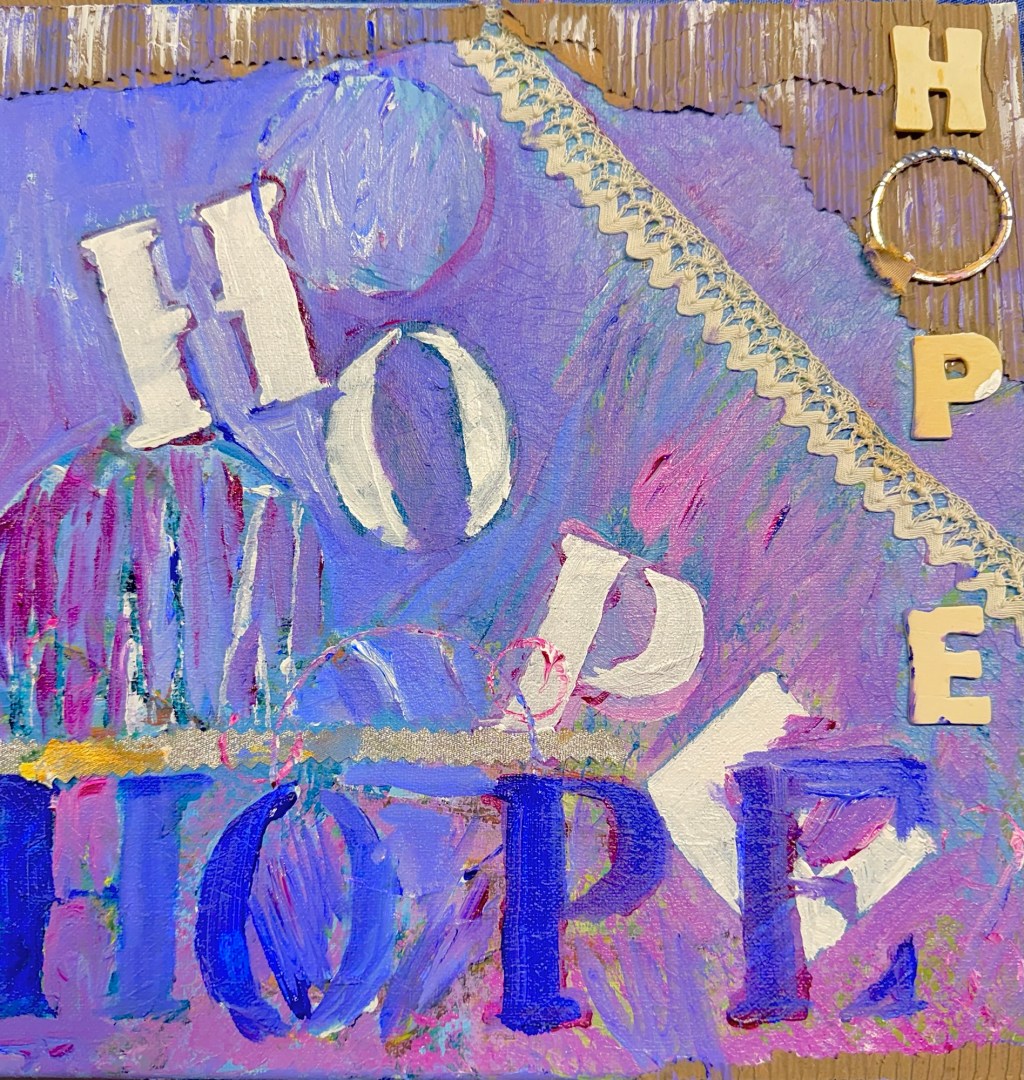
Eternal Hope

I had started my small canvas the week before when I was half sick. My hand, heart, and mind never feel quite connected when I feel bad, but I still work anyway. The beauty of acrylics is I can paint over them later. In fact, this is a repurposed canvas. If a work does not “speak to me” after a few months, I either cut it up to reweave it or paint it over entirely. I always think I will find hope for it in another form, but it may need to take its own journey to find its best self.

Jeremiah once said to the Jewish exiles in Babylon,

“For surely I know the plans I have for you, says the LORD, plans for your welfare and not for harm, to give you a future with hope.” (29:11)

When we have forgotten what our home looks like, God still remembers where we once lived. When we have lost our memories of the ancient Temple practices, God still knows the rituals. God will remind God’s faithful of our service. If we have lost our knowledge of how to walk with God, God will send us teachers once more. God always provides us with what we need.

Christ the Redeemer, 16th CE, Gallery of Art, Skopje.

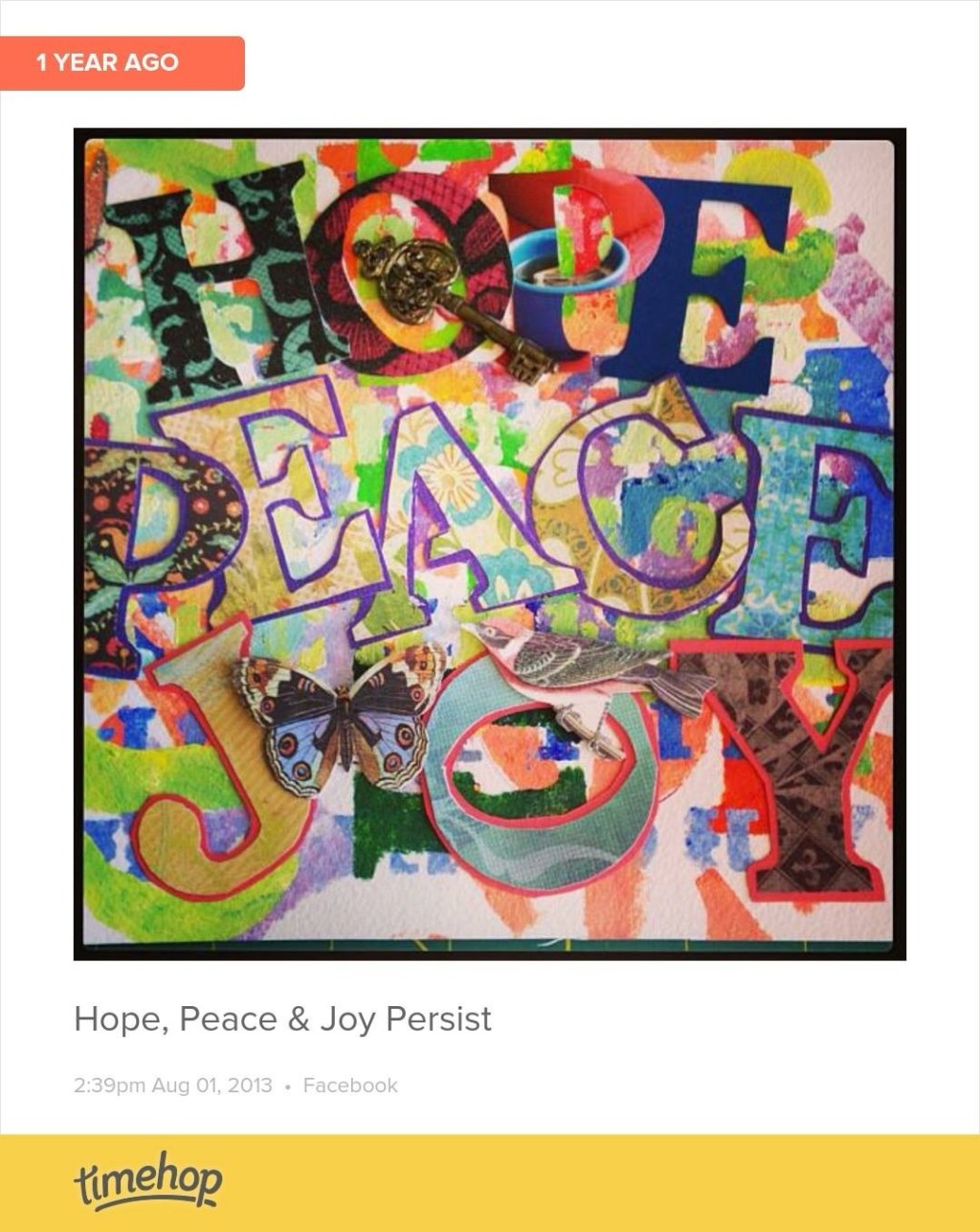
Hope is part of our GrecoRoman heritage also. “Dum spiro spero” is Latin for “While I breathe, I hope.” Some form of this saying has been around since the 3rd century BCE. My grandmother sewed her antique crochet trim onto pillowcases for wedding gifts. This is a scrap I found in her sewing kit. I stenciled the letters HOPE and glued down the wooden letters H, P, and E. I used an old metal circle for the O. Torn corrugated paper added a touch of texture, as did a few string prints. Sometimes hope appears to slide away or seems raw and unvarnished. The colors are blue and violet because Advent is the great season of Hope. Matthew quotes the Servant Song from Isaiah in 12:18-21—

“Here is my servant, whom I have chosen,

my beloved, with whom my soul is well pleased.

I will put my Spirit upon him,

and he will proclaim justice to the Gentiles.

He will not wrangle or cry aloud,

nor will anyone hear his voice in the streets.

He will not break a bruised reed

or quench a smoldering wick

until he brings justice to victory.

And in his name the Gentiles will hope.”

This is the Messiah of Hope of Israel and the Anointed Christ in whom we hope today. We can best share the hope of this Christ to our suffering world by serving the suffering, the grieving, the hungry, and the overlooked.

Joy, peace, and hope,

Cornelia


HALLOWEEN HAPPENINGS

adult learning, art, CharlieBrown, Halloween, holidays, Imagination, Ministry, Painting, picasso, pumpkins

Michael Jackson: Thriller Video still, 1982

Let’s party like it’s 2025! Nothing takes our minds off the stresses of the real world’s ghouls and goblins like pretending to be a ghost, zombie, pirate, princess or superhero in the All Hallows’ Eve hijinks of the holiday we know as Halloween. Especially if we have the license to eat candy or drink purple fluid to slake our thirst after our door to door “threats of trick or treat.” With all that masked mayhem in the cities, towns, and county seats of the country, the forces of ICE and Homeland Security won’t know which to turn. The INSURRECTION they conjured out of thin air will suddenly become real, only to disappear shortly after sunset. And before troops can surge to all points involved. 

Portland ICE protest—October 11, 2025—gives people an opportunity to wear costumes early

How many people in America will celebrate Halloween? Across the country 132.6 million households purchase about 745.8 million pounds of candy during the Halloween season every year. This works out to the weight of 33.9 billion bats or 62.16 million jack-o’-lanterns. Also only about 20% of people don’t celebrate Halloween at all. While I don’t eat loads of candy, I also don’t expect to micromanage other parents. My folks put a limit on our consumption back in the dark ages, plus we only went to a single neighborhood. Once we made the circuit of our city block and arrived home, we were done. The concept of “haul” was nonexistent in the days when dinosaurs lurked in the shadows, along with actual ghosts and other scary creatures. 

Vintage Card, reminds me of the Headless Horseman

Most Halloween shoppers (79%) anticipate prices will be higher this year, specifically because of tariffs. Despite these reservations, nearly three-quarters of consumers (73%) plan to celebrate the holiday, in line with last year’s 72%. Top holiday activities include handing out candy (66%), dressing up in costume (51%) and decorating their home or yard (51%). 

Economist’s Pumpkin, noting the scary prices of everything

Also, chocolate costs more because of cocoa prices, which have soared in recent years, have hit record highs amid adverse weather conditions, pest outbreaks and supply tightness in West Africa, which produces around three-fourths of the global supply. Cocoa futures have remained choppy but overall eased this year, falling from $8,177 per metric ton at the start of January to around $7,855 in August. That compares with $2,374 three years ago. Your basic Hershey Kiss is up 12% in price. If your favorite chocolate seems a tad lean on the chocolate, remember a warming climate means pests, droughts or floods, and fungi, all of which impact growing food. 

Medium Pumpkins are the Best Buy

Even if candy costs more, it continues to be the most popular purchase, with total spending expected to reach $3.9 billion. Across other categories, 71% plan to purchase costumes and spending is expected to reach $4.3 billion. Another 78% plan to purchase decorations, up from 75% last year, and will spend an estimated $4.2 billion in total. And 38% plan to purchase greeting cards, an increase from 2024’s 33%, with total spending estimated at $0.7 billion.

Picasso: Blue period, The Family of the Blind Man, 1903

Compared with last year, more people also plan to carve a pumpkin (46%), throw or attend a party (32%), visit a haunted house (24%) or dress up their pets (23%). October also means our art class works on a pumpkin still life. This year instead of making a realistic rendering, we looked at Picasso’s different styles. He began as a classically trained artist, and then broke all the rules of realism with cubism by fragmenting his subjects into multiple surfaces or flat geometric patterns. Later he did return to a “balloon” neoclassicism, but reverted once more to flat patterns of color. Picasso was always reinventing and responding to the creative genius within him. He didn’t feel constrained to continue to produce art to please others. 

Pablo Picasso, Mother and Child, 1921, Art Institute of Chicago, IL, USA. © Estate of Pablo Picasso.

Our pumpkin paintings reflect this creative energy. Gail S chose various red hues and deconstructed the pumpkin, as well as imagining it from above. She added some gourd shapes to the mix. 

Gail S’s Deconstructed Pumpkins

If Picasso had an orange period in addition to his blue and rose periods, my pumpkins would fit right in. They certainly look like his balloon neoclassical period! I confess I spent more time visiting with a stranger who graced the church door and who seemed to need to talk, but could not find her words. 

Cornelia’s Orange Period Pumpkins and Leaves

She didn’t want a pumpkin muffin either, so we let her sit. After a bit, I began to talk about how some of my well meaning friends give me advice that doesn’t make any sense. Like if I make one small mistake, they think I’m ready for assisted living!

“What are they thinking?” was Gail’s response. 

“Exactly, this comment says more about them than me. I ignore it and go on. Some folks are perfectionists.” 

We painted for a while and then I spoke up again, “You can’t please everyone. If you make A happy, B gets upset, or if you make B happy, then A is upset. Group C is just contrary and nothing ever pleases them. I try to make God happy and let people know that is my only goal. I’m not here to choose sides in their puny fights.”

I must have said something that helped her out, for she said she now felt strong enough to deal with her day and its problems. We thanked her for stopping by and wished her well. We didn’t have much attendance in art class, but if there had been more people, this lady might not have felt free to be with us. God must have provided this quiet space for this woman who had an unvoiced need that day. We aren’t always open to the human needs of those on the margins, but we should recognize they struggle with the same need for autonomy and authenticity as everyone else does. 

Another vintage Halloween card

Speaking of pumpkins, the Wôpanâak are a Native American tribe from the eastern coastal region. Their language gives us the loan word for the ubiquitous fruit that “grows forth round,” also known as a Pôhpukun or pumpkin. Marion Webster posits the derivation of this word as follows: “alteration of earlier pumpion, modification of French popon, pompon melon, pumpkin, from Latin pepon-, pepo, from Greek pepōn, from pepōn ripened; akin to Greek pesseinto cook, ripen — more at COOK.”

Of course, this pedigree prefers the Eurocentric derivatives because Native Americans were once considered savages, and therefore unworthy of their historic contributions to our language. We know better today and celebrate the gifts and graces of all persons who contribute to the vast melting pot of the great stew we call America. 

What a dull soup we would be if we were just the pale watered down broth with no pumpkins or spinach, no tomatoes or onions, no garlic (to ward off werewolves), and no corn, beans, chicken or beef to provide substance to our stew. We need a variety of spices to make a good soup, just as we need a variety of people’s to build a great community. 

Some people go all out for Halloween

One night a year, we can dress up in the costume of our shadow fears or our innermost desires. We get to act like our inner child. We carve our pumpkins with scary faces and put them on porches decorated with all sorts of ghoulish things. The Halloween holiday is cathartic, for it allows us to share with others our innermost selves, an act many of us have difficulty doing.

Worst Halloween Candies

If we eat a bit of candy here and there, it’s ok. It’s one night, and we can plan for this. The goblins do not win, for they are not real. They are here today, and gone tomorrow. I usually set my candy haul into the freezer where I can’t see it. Out of sight, out of mind. I have a piece now and then, “for medicinal purposes,” as my nanny would say, when she took a nip of the bottle stashed in the linen closet. Always with a table spoon, a measured dose, of course, because she “didn’t drink.”

Always go for the Chocolate!

If it helps to keep your cravings in check, you do what you have to do. I just ask, remember our life is short upon this round ball, so don’t rob yourself of the joy of this time. Find something to celebrate daily. On Halloween, we can celebrate our inner child. Even better, we can give the gift of magic to a small child by entering into the fantasy of the night. 

Joy, peace, pumpkin spice, and magic, 

Cornelia

USDA List of Retail Prices for Fruits and Vegetables, page 11, pumpkins.

https://www.ams.usda.gov/mnreports/fvwretail.pdf

NRF | NRF Consumer Survey Finds Halloween Spending to Reach Record $13.1 Billion

https://nrf.com/media-center/press-releases/nrf-consumer-survey-finds-halloween-spending-to-reach-record-13-1-billion

The states most mad for Halloween — and candy — revealed in new survey

https://www.scrippsnews.com/life/holidays-and-celebrations/the-states-most-mad-for-halloween-and-candy-revealed-in-new-survey

Chocolate lovers, brace yourselves: Prices are rising, but not forever

https://www.cnbc.com/2025/08/22/chocolate-set-to-get-more-expensive-but-2026-outlook-looks-sweeter.html

How Americans Are Celebrating Halloween Despite Rising Prices

Fun with Words | WLRP Home

https://www.wlrp.org/fun-with-words

Weaving a Life Story

Academy for Spiritual Formation, adult learning, art, Creativity, Faith, Holy Spirit, Icons, inspiration, Ministry, Nativity, renewal, righteousness, Silence, suffering, vision

Weaving is a metaphor for our life’s story and journey. We envision the weaver in charge of the colors, designs, and textures of the finished fabric. The weaver’s goal is to produce a beautiful product. We often think we are in charge of our own destiny, as “The Weaving Song” by Carolyn Hester, in which an old 1960’s era folk singer would sing:

Choose the right color And push the right tread

Throw through the shuttle And peg down the thread

Work is all laid Before your start

To make your own pallet Of bright hue or dark

The loom of life is moving The weaving is all your own

Choose the right color And push the right tread

Throw through the shuttle And peg down the thread

Rainbow of colors Is at your command

Choose all the right shades Offered in the stand

The loom of life is moving The weaving is all your own

Life’s but a grey And heavy with care

May blooms scarlet With couragе rare

The loom of life is moving Thе weaving is all your own.

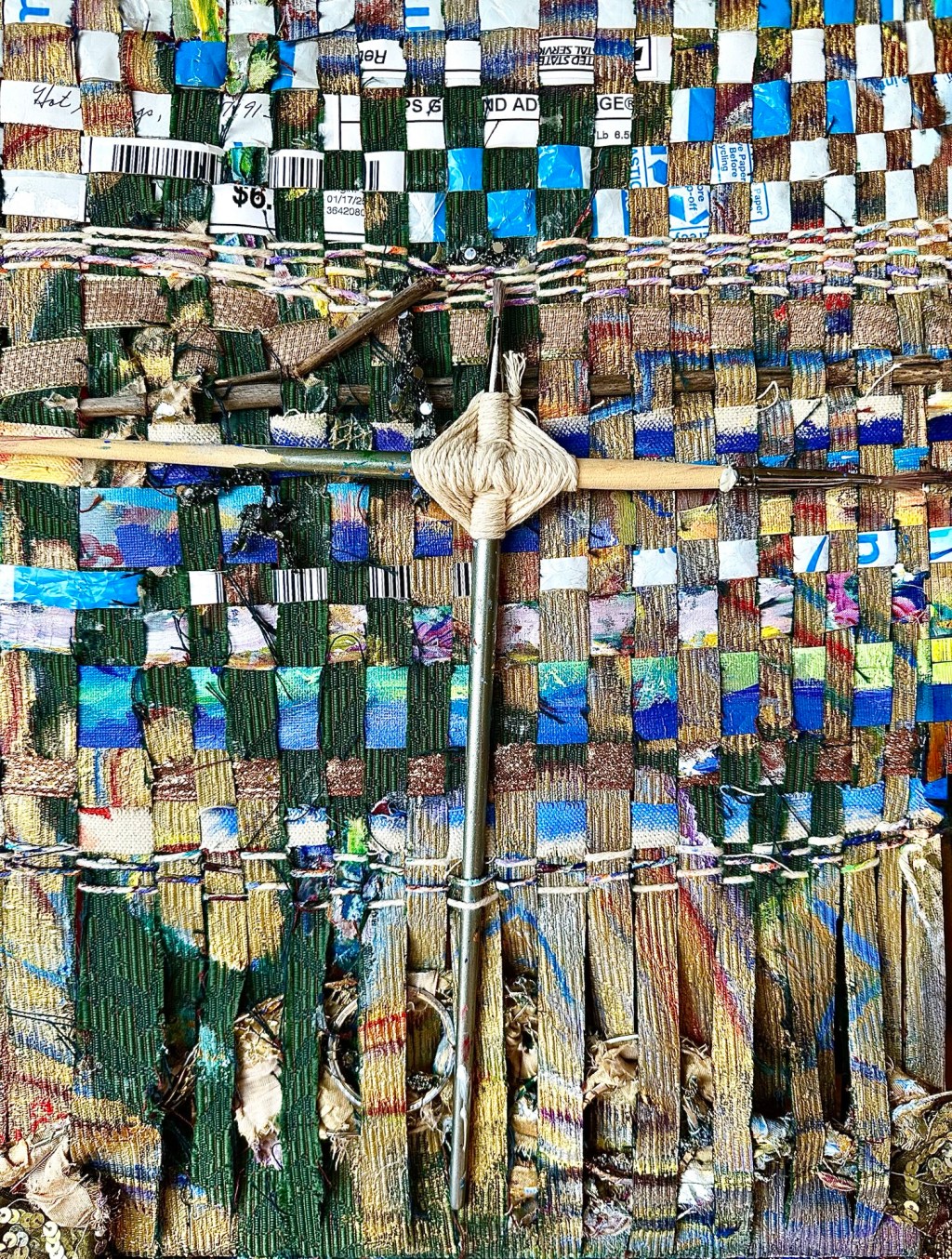
DeLee: God’s Eye and Cross, woven canvas, branch, string, paint brushes, fabric scraps, wire, packing materials, 16” x 20”, 2025.

Yet life doesn’t always work out the way we thought it would. The Bible says Job was the most righteous person of his era, and Job complains after losing everything and everyone:

  “My days are swifter than a weaver’s shuttle and come to their end without hope.” (7:6)

This wisdom text reminds us sometimes the righteous suffer, even while the wicked prosper, but God is still God, and we will understand this mystery of God when we see God face to face. We call this “theodicy,” (from Greek theos, “god”; dikē, “justice”), or our explanation of why a perfectly good, almighty, and all-knowing God still permits evil to exist.

God gives human beings free will. We make our own choices in life, just as everyone else does. Since we don’t live in a universe of one, other people’s choices impact our choices. Imagine a pingpong ball tossed into a room filled with mousetraps all loaded with other pingpong balls. If one ball hits a loaded trap, it sets that ball off into motion and those balls set more balls into motion until chaos ensues! If more than one person is involved, some sort of disagreement is sure to follow. Some of us are even at odds with our own selves!

As the old joke goes, a solitary man was rescued from a desert island. On this island were several structures. When asked, he said, “That one was my house and that one was my church.” And the other building? “That was the church I used to go to!”

Louise Bourgeois: Spider, metal, National Gallery of Canada, in Ottawa, Ontario. Her mother mended tapestries, like a spider spins a web.

When life is chaotic, creative people find solace in the quiet of their chosen deserts: the studio, the workshop, or their favorite writing chair. While we artists have the illusion we can control the images we produce or the songs which bubble up from our hearts, in truth, what we create is a shared product with our heart, mind, and the creating spirit. If we begin to lose our humility about this shared process, we lose the creative energy underwriting our works.

Louise Bourgeois: Metal Spider wrapped in yarn, Japan

We know this emotion as “pride,” and the ancient cultures warned against it. Throughout history, legendary and mythological figures have been used as examples of either virtue or a moral failing. The story of Arachne and Minerva is no different.

Attributed to Amasis Painter, 6th BCE, Greece, clay, Metropolitan Museum of Art, New York.

A 6th BCE Attic Black Figure Lekythos storage vessel attributed to the Amasis Painter shows the type of standing loom and the various shuttles of different threads a weaver would use for a fabric. Today we think of weavers sitting at their looms, but the ancients stood at their work.

Arachne was a mortal who excelled in the weaving arts: spinning her own yarn and selecting the correct colors to produce the beautiful images for the finished fabric. Minerva, the goddess of handicrafts and the Roman correlate to the Greek goddess Athena, had heard of Arachne’s prowess and her pride. Disguised as an old woman, Minerva visited Arachne to warn her not to disparage the gift of the gods. Arachne rebuffed her, and held her ground, even when Minerva revealed her true identity.

Minerva (Athena) and Arachne by René-Antoine Houasse (1706), Versailles

When the weaving contest began, both were even in technique and design. Minerva’s image was of the pantheon of the gods, but Arachne told the stories of the god’s mishaps with humanity. This angered Minerva, who struck Arachne with a weaver’s shuttle. Embarrassed, Arachne took a rope to hang herself, but Minerva had pity on her and changed her into a spider instead. We call spiders, ever weaving their gossamer webs, “arachnids” in her memory.

Spider Web

In Christian art, the theme of listening beside a well or spring is connected both to the angel’s annunciation to the Virgin Mary and to her weaving curtains for the Temple. The third-century Dura-Europos church baptistery has a fresco of a woman drawing water from a well, which Yale theologian Michael Peppard believes represents the Annunciation to Mary at a well, from a scene from the gnostic writing, Protevangelium-18.

Woman drawing water at the well. Possibly the Virgin hearing the Angel’s voice. Dura Europa.

Others think it represents the Samaritan woman at the well or Rebecca from the Old Testament. Because the fresco doesn’t include Jesus, the empty space instead represents “the bodiless voice” that Mary hears in the Protevangelium. Also, a five-pointed star appears on the woman’s torso, which could symbolize the new child in her womb. The star in later iconography was repositioned to the shoulder of her mantle, and the water vessel survives all the way into the Renaissance art as a vase with flowers.

Icon of Virgin at Well with Angel

From The Protoevangelium of James, section 11: And she took the pitcher, and went out to fill it with water. And, behold, a voice saying:

“Hail, you who hast received grace; the Lord is with you; blessed are you among women!” (Luke 1:28) And she looked round, on the right hand and on the left, to see whence this voice came. And she went away, trembling, to her house, and put down the pitcher; and taking the purple, she sat down on her seat, and drew it out. And, behold, an angel of the Lord stood before her, saying: “Fear not, Mary; for you have found grace before the Lord of all, and you shall conceive, according to His word.” And she hearing, reasoned with herself, saying: “Shall I conceive by the Lord, the living God? And shall I bring forth as every woman brings forth?” And the angel of the Lord said: “Not so, Mary; for the power of the Lord shall overshadow you: wherefore also that holy thing which shall be born of you shall be called the Son of the Most High. And you shall call His name Jesus, for He shall save His people from their sins.” And Mary said: “Behold, the servant of the Lord before His face: let it be unto me according to your word.”

This apocryphal Greek text, which was first written in the 2nd CE, with Syrian revisions into the 5th CE, is important because it increases our insights into women’s history, the childhood history of Jesus, Jewish-Christian relations, and the impact of Christian apocrypha on Islamic origins. This text, which contains the infancy narratives of the Virgin Mary, John (the Baptist), and Jesus is the source many of the Western Catholic and Eastern Orthodox religious feast days. Moreover, it’s also the origin for the icons representing the birth of Jesus in a cave.

Duccio: The Nativity with the Prophets Isaiah and Ezekiel, tempera and gold on panel, 1308-1311, National Gallery of Art, Washington D. C. Part of a series of the Life of Christ, the rest of which are in Sienna, Italy. 

A similar Marian birth narrative, The Gospel of Pseudo-Matthew, gives more details on the life of the Virgin, the miracles surrounding her marriage and the birth of Christ. It also tells the story of the Annunciation in two visits rather than one. The angel’s first greeting is beside a fountain and the second is inside while Mary is weaving the curtains for the Temple.

DeLee: Freeform Weaving while Listening

When I was on a recent Five-Day Academy for Spiritual Formation retreat, one of our hands on projects was a small weaving. Our package had a small loom, some yarn to weave with, and beads to attach. Of course I had to use a second packet to finish out my weaving because I tightened the horizontal rows more tightly than the organizers thought the regular attendees would do with their yarns and ribbons.

I also had my eye on a nice lichen covered branch to use as a hanging support. When I picked it up, it had red ants on it. I had to do some mad shaking to get them off! Anything for art! During one of our quiet reflection sessions, I sat beside a small lake under a pavilion to let my hands work. I’ve always needed a quiet space to process the flood of ideas and the rush of emotions when meeting new people and hearing new ideas. I operate as an extrovert, but when I get full to overflowing, I need quiet to recreate and recharge. I find new power in the admonition of Psalm 46:1-6—

God is our refuge and strength,
a very present help in trouble.
Therefore we will not fear, though the earth should change,
though the mountains shake in the heart of the sea;
though its waters roar and foam,
though the mountains tremble with its tumult.
Selah
There is a river whose streams make glad the city of God,
the holy habitation of the Most High.
God is in the midst of the city; it shall not be moved;
God will help it when the morning dawns.
The nations are in an uproar, the kingdoms totter;
he utters his voice, the earth melts.
The LORD of hosts is with us;
the God of Jacob is our refuge.

Diedrick Brackens, “prodigal” (2023), cotton and acrylic yarn

When my hands touch the different textures of the threads, and I let my spirit work with the creating Spirit of the word and world, I can shed all the strain and stress of being on a different schedule from traveling, having nerve pain in my neck from a bulging disk, and more interaction than I’m used to since I no longer work.

I always fought to carve out quiet times when I was in active ministry, for listening to God is the first calling of any leader worth their salt. I knew I wouldn’t hear God’s voice in the pell mell rush and cacophony of our world. The disembodied voice is more likely to come to us when we’re alone or in a receptive moment. It’s important to note Mary was one of the virgins of the House of David chosen to weave the curtains for the Temple in Jerusalem, according to The Protoevangelium of James, section 10. She was busy, but working for her God. It was when she took a break to draw water from a life giving well that she heard the messenger from God.

Bruce Conner, Arachne, 1959, mixed media: nylon stockings, collage, cardboard, 65 3⁄4 x 48 3⁄4 x 4 1⁄4 in. (167.0 x 123.8 x 10.7 cm), Smithsonian American Art Museum, Bequest of Edith S. and Arthur J. Levin, 2005.5.12

When I was appointed to a church, I always had a list of tasks to do, but I often never completed them because God would send “interruptions” to my well laid plans for the day. After several years, I began to understand these interruptions were my real tasks of ministry for the day. We have plans, but God has a better plan.

The prayer in my weaving supplies was appropriate for me on this retreat:

Teach us to listen, O Lord. 

Quiet the noise of our lives

so we can hear your voice. Amen.

After several weeks, I’ve come back to finish this blog. In the meantime I’ve had anterior cervical discectomy and fusion for my neck pain and numb fingers. It’s for the bulging neck disk that causes pressure on the spinal cord. If this happens in the lower back, a person gets sciatica and numbness in the legs. In the neck,the same condition affects the arm and hands. I feel better than I did before, so I’m thankful for all healing mercies. I have to be careful not to overdo my activities. The instructions “Don’t do housework!” were gladly received.

I hope you seek out your quiet spaces and quiet moments to hear the sheer, still sounds of silence, the inaudible voice of our God.

Joy and peace,

Cornelia


 NOTES:

Carolyn Hester: The Weaving Song, Track 10 on At Town Hall, One, Produced by Norman Petty, 1965.

Troubadour: Weaving Song: similar words to Hester coffee house ballad above. https://music.apple.com/us/album/weaving-song/400303687?i=400303767

Myth of Arachne https://www.worldhistory.org/Arachne/

Ally Kateusz: Mary and Early Christian Women: Hidden Leadership,1st ed., 2019, Kindle Edition 


Annunciation or Samaritan Woman, Dura-Europos Baptistery
https://www.christianiconography.info/Wikimedia%20Commons/annunciationDura.html

Charles Bertram Lewis:”The Origin of the Weaving Songs and the Theme of the Girl at the Fountain,” PMLA, Jun., 1922, Vol. 37, No. 2 (Jun., 1922), pp. 141-18, Modern Language Association. http://www.jstor.com/stable/457

Susan B. Matthews: Dura Europos—The Ancient City and The Yale Collection, Yale University Art Gallery, 1982, Yale University Printing Service. https://artgallery.yale.edu/sites/default/files/publication/pdfs/ag-doc-2378-0002-doc.pdf

Camille Leon Angelo and Joshua Silver: “Debating the domus ecclesiae at Dura-Europos: the Christian Building in context,” Journal of Roman Archaeology 37 (2024), 264–303, doi:10.1017/S1047759424000126. https://www.cambridge.org/core/services/aop-cambridge-core/content/view/E76ED3AD86D09A74893368840DEDFA6A/S1047759424000126a.pdf/debating-the-domus-ecclesiae-at-dura-europos-the-christian-building-in-context.pdf

The Protoevangelium of James, section 11. https://www.newadvent.org/fathers/0847.htm

The Gospel of Pseudo-Matthew, section 9.  https://www.newadvent.org/fathers/0848.htm

Horn, C. (2018). The Protoevangelium of James and Its Reception in the Caucasus: Status Quaestionis. Scrinium, 14(1), 223-238. https://doi.org/10.1163/18177565-00141P15

Learning Creativity

adult learning, art, brain plasticity, Children, Creativity, Painting, photography, renewal

Is creativity innate or can we learn creativity? From my experience, children are creative up until about age eight, at which time peer pressure begins to suppress their imagination and willingness to experiment and exercise their own inner truths. About this age, children acquire an understanding of the “real world,” as opposed to the worlds of their imagination. This is when they want to draw “realistic images.” Their skies begin to meet the earth, rather than being a single ribbon of blue across the top of the page. They often attempt textures of clothing and realistic renderings of hair and facial details in their artwork.

This is part of their artistic growth, but not every child grows at the same pace. Because adults often praise these early achievements, those children whose brains haven’t matured often begin to give up on their creative endeavors. We can’t rush brain development. Therefore, we shouldn’t disparage children who don’t progress as quickly. Children all go through predictable stages, but the environment and their innate nature determines how quickly they progress through these levels, or if they quit at some point.

This nature and nurture process is part of what we call “neuroplasticity.” This is a fancy $2 word meaning the brain has the “ability to reorganize pathways, create new connections, and, in some cases, even create new neurons.” At birth, every neuron in the cerebral cortex has an estimated 2,500 synapses. By the age of three, this number has grown to a whopping 15,000 synapses per neuron! Yet the adult brain has only about half that number of synapses. This is because as we gain new experiences, synaptic pruning strengthens some connections in our brains, while others are eliminated. Those we don’t use, we lose.

This is why as we age, we should learn something new everyday. As Mary Oliver, the Pulitzer Prize winning poet said: “Instructions for living a life. Pay attention. Be astonished. Tell about it.”

We are building new brain synapses. Getting out to socialize is also important. While people used to believe the brain became fixed after a certain age, newer research has revealed our brains never stop changing in response to learning. In this sense we are always able to learn, even if we’re a little slower than younger people. As I age, I realize I don’t move as fast, but I’ve never quit waking up and looking forward to the challenge of the day.

The day might come when we have a stroke, or damage to the brain. At that time, a belief in the ability of our brain to rebuild itself will be important, for recovery of speech or the ability to walk or feed ourselves will be our goal. Art class helps us face small challenges in non-consequential situations and prepares us to have courage and confidence to meet with optimism the greater challenges of life. Art, like life, is a growth process. Because art is a creative experience, we always are working with God’s help, and not by our own power:

“So neither the one who plants nor the one who waters is anything, but only God who gives the growth.” —1 Corinthians 3:7

SCRIBBLE STAGE

The scribble stage is a critical part of early childhood because it helps children develop their hand-eye coordination and fine motor skills. This age is from the child’s ability to hold a crayon to around 4 years old. Characteristics of this initial stage are:

  1. Random scribbling
  2. Purposeful scribbling
  3. Naming scribbles

The best way to encourage these young artists is to ask, “Can you tell me more about this?” This allows children to share all the things they enjoy about their work. Make sure the supplies you use are easy to control, like thick tempera paint, unwrapped crayons, washable markers, and chalk. Children use their imagination, rather than looking at things to copy. Copying is frustrating and confusing for children.

Tadpole People of the Pre Schematic Stage

PRE-SCHEMATIC STAGE

This a stage beginning from 3 1/2 years old to 7 years old. Children begin to make patterns in their drawings and label it as a representation of the things they know in their world. They begin to draw human figures by merging the circle with lines. Initially, these figures look like “tadpoles” or “head feet” symbols. Often children’s first figures are unrealistic or lack body parts. Yet this is an important stage in which helps children develop their own sense of identity by allowing them to explore different self-images before they arrive at a satisfactory one. Art plays an important part in defining who we are at this stage. We can encourage our children by asking them to tell us about the stories behind their artworks and not requiring them to match the reality we see.

Schematic Stage, age 7-9

SCHEMATIC STAGE

Between age 7 to 9, children develop their own symbols for each object they’re trying to create. Their drawings follow a specific pattern: the sky is a strip across the top of the page, just as the ground is a strip across the bottom. Objects no longer float in the middle space, but are attached to the ground. The most important objects are larger than the less important ones. Perspective doesn’t follow any one rule. We can encourage children to look at their environment more closely, but without correcting their artwork. Any corrective actions we make to get our child to progress more quickly than they are capable will just set them back.

Pre Realism drawing by young girl

PRE-REALISM STAGE

The child’s inner critic awakens between age 8 to 12 years old. They still create images according to their own symbols , but begin to overlap them. They still use flat coloring, but add more details. They begin to care what others think about their work. We can encourage them best by showing them how to do things and not trying to push them into skills beyond their ability.

Young artist, pseudo realism: note everything is a pattern or symbolic representation of reality, but the overall image is flat, rather than three dimensional.

PSEUDO REALISM STAGE

Between 11 to 14 years old, children begin to add shadows and try realistic perspective in their artwork. They look more intentionally at their environment and at individuals, while they attempt to record these details in their art projects. They’re also more critical of their product. Therefore, they need more positive feedback. My rule in middle school art class was, “Say three positive statements about your work before you tell me three negative criticisms.” This helped my students know they had succeeded on some levels before they looked at the areas that needed improvement.

Learning and exploring new art methods are a wonderful way to keep these youths engaged. Not all these youths are ready for perspective, but they can learn to see simple stacked boxes and draw them.


Period of Decision (Ages 14-17)

DECISION MAKING STAGE

Beyond the age of 14 is a critical time, for young people will make the decision to continue with art or drop it altogether. Their inner critic combined with the judgement of outsiders (parents, teachers, other influencers) confirms their belief art is a pointless exercise. A few others, who have been rewarded with positive reinforcement, will decide to continue with their art experience by mastering skills, learning perspective, and developing their own personal style. We can encourage all students at this age by reminding them art is important in their everyday lives. When we expose students to art history, we expand not only their cultural awareness, but also show them the possibilities of artistic expression and creativity. We also have to offer opportunities for both visual and haptic (hands on) learners.

As a result, many adults come to art classes at the Pseudo Realism Stage. This isn’t an insult to them, as if saying they’re at “arrested development,” but if they haven’t had training beyond this age, this is a realistic assessment of their skill level. This is why we go through lessons on color mixing, perspective and drawing skills. Each person looks at the image from their own viewpoint and tries to translate their best impression of the three-dimensional world on to a two-dimensional canvas. This skill is the equivalent of translating German into Italian by an English speaker. It’s a learned skill, but one can practice it and develop it over time with repetitive exercises.

The brain actively uses its thinking processes to create a work of art. We always need to remember, this art work isn’t a representation of a thing, but of our experiences with the thing. Our choices of color, line, size, weight, and value all speak volumes of our emotions as we relate to the subject matter. When we look at an artwork that seems dead, but is technically proficient, we know the artist had no emotional connection to the subject matter. Likewise, we can see a more primitive painter who put their heart and soul into their artwork and judge this work to be “fine.” What we artists try to do is keep an open and tender heart and stay emotionally invested in our subject matter so we can allow our work to come alive.

As a teacher, I always hope to discern where each adult student is in their artistic development. The old saying, “Rome wasn’t built in a day,” also applies to building our art skills. The more we work and get positive critiques on how to improve our work (this criticism involves what we did well also), the faster we usually progress. In fact, when we critique our own work, we see what we did well and what we could improve. Our next experience builds on that learning.

One thing I always underestimate is the length of time students take to do a project. Children fly through projects, but many adults have an inner critic who second guesses their decisions. I often say, “Just dab some colors on the tip of your brush and dab them on those trees for leaves. Pretend like you’re the god of your painting, and “let there be leaves!” They laugh at me, but I’m just trying to keep them from painting every single leaf individually. We see trees as a mass of leaves, not as individuals, especially if we look from a distance.

Sometimes I look over at someone working and suggest, “Maybe you might want to work in a different area. Your wet brush is just picking up the paint on your canvas now. Let that area dry and come back later.” Some of my students have been around long enough to have this lesson ingrained in them. If we hit this wall often enough, we learn how futile this behavior is. My old daddy always said, “Experience is the best teacher.” In truth, if we make a mistake often enough, we’ll learn that’s not the right fork in the road to take. Thankfully, we’re not working with electricity.

Our paintings from these two weeks were from photographs which we edited in our phones using the available digital tools. We weren’t trying to work towards a good photograph, but toward an image we could use as a photographic sketch for our painting. Gail S. took two images and blended them together. This is a challenge because each image had a different light and perspective. She solved it by placing the wall behind the tree, rather than using the actual photo image of the wall itself. We also used the color wheel to find a good grey color for the wall. Gail got some good details in the leaf mass. She is more used to creating her images from life.


Gail W. had a spring forest image with a footpath through it. She changed that footpath to a stream. She spent the second session putting shadows and highlights on the trees, as well getting the leaf masses to cover the timber stand. She even used a thin marker to get some dark shadows when she didn’t have a thin enough brush to make those details. Our two Gail’s are putting these lessons to effective use.

Black and white photo of retreat area

I used a photo I took on a recent retreat at Mount Eagle. A photo records everything before it. An artist can use the tools of the camera and the developing room to bring out the best qualities of the scene. My iPhone editing software did its best.

Then I made my painting from it. The great benefit of art is the maker’s decision to include only those parts of the image which stand out. We don’t have to draw every tree in the forest. We only have to paint those who call out to us to be remembered. This decision making action is part of making new neural pathways. Each new experience is a challenge and every challenge is a fresh opportunity for new growth.

The most important achievement we can make at any age is rewriting our brains. Neuroplasticity is the brain’s ability to reorganize itself by forming new neural pathways throughout life and in response to experiences. While the brain usually does this itself in response to injury or disease, when humans focus their attention enough, they can slowly rewire these pathways themselves. We can also do this intentionally by engaging in learning a new language, writing in a journal, doing creative art projects, quilting, woodworking, dancing, or creating new recipes. Anything we do to try a new experience helps to rewire our brains.

After all, we want to be around for many days to say with the writer of Psalms 90:14—

“Satisfy us in the morning with your steadfast love,

so that we may rejoice and be glad all our days.”

Joy and peace,

Cornelia


Neuroplasticity: How Experience Changes the Brain

https://www.verywellmind.com/what-is-brain-plasticity-2794886


Victor Lowenfeld: Creative and Mental Growth, 3rd edition, copyright 1957, The Macmillan Company, New York.


Intuitive Color Wheels

adult learning, art, at risk kids, cognitive decline, color Wheel, Creativity, Imagination, inspiration, Lost Cause, Ministry, Painting, renewal, vision

The great and wonderful part of art is exercising imagination and discovering new ways to solve problems. One of my favorite memories in art school was the day our professor came to class with a single red clay brick. Our first thought was this is going to be the most boring drawing class ever, but then he asked us, “How many uses can you find for a brick?”

Thick as a Brick

After we quickly named multiple uses for a single brick—doorstop, paperweight, weapon, counterweight, and bookend—we were at a loss to name much more. As we scratched our heads, our teacher prompted us, “Did I restrict you to a single brick?” And we were off to the races! Wall, fireplace, house, road, sidewalk, planter, sculpture, picnic table, bookshelf, and more. I can’t remember if this was an early morning class or we were just dense, but I’ve come to believe we can teach creativity. At the very least, we need to give people permission to accept “multiple art answers can be true” and give them the opportunity to consider “other possibilities.”

Canvas bound in strings

When I taught art years ago, children who were troublemakers in regular classrooms were usually well behaved in art class. I attribute this outcome to their ability to express their own individuality in solving the weekly art assignments. Math always has a right answer; there is no “alternative fact” to 2 + 2 = 4. History is the same: the Confederacy seceded from the Union to keep their economic system of enslavement. There was no “states rights movement,” no matter what the Lost Cause proponents pushed in our state approved textbooks. All we had to do was look at the original source documents from the 1860’s.

Simple Color Wheel

Adults usually conform to socially acceptable norms. Helping adults with creative thinking is important because the creative process is more important than the tangible result. Most adults give up the idea they will ever paint the Sistine Chapel ceiling, while children are humble enough to realize they need many more years of practice before they get that kind of opportunity. Also, what we know about creativity can’t be applied in the same way to all creative endeavors because they involve different subjective decisions and processes.


Gino Severini: Expansion of Light. (Centrifugal and Centripetal), ca. 1913 – 1914, Oil on Canvas. 65 x 43.3 cm
Museo Nacional Thyssen-Bornemisza, Madrid

Creative insight depends in part on new combinations of existing ideas, concepts, and perceptions that the brain has stored over time. This is why we begin each class looking at famous art works. We need good art influences and inspiration to “prime our creative pumps” so we can draw up from the pure wellsprings of our own creativity. Just as we need spiritual food for our soul, we need beauty for our creative ideas.

First stage

Last year we worked on copying the color wheel and matching it. That is an intellectual skill. To make this into a creative, intuitive activity, we took strings and wrapped our canvases. This made multiple shapes for our colors. Using the primary colors—red, yellow, and blue, plus white—we mixed various combinations and surprised ourselves with the results.

Gail W’s first stage

Our first class was lightly attended, due to doctor appointments and vacations, so we still have room for anyone else who wants to come. All skill levels are welcome, for I’ve taught from K-5 to adults. Everyone progresses from their own level, so the longer you sit and think you wish you were good enough for lessons is merely time wasted when you could be working with a practiced teacher! Anyway, the lessons are free; you bring your materials and discover your unknown abilities and gifts. We journey with fellow travelers. Plus it keeps your brain young.

We will continue to work on this project next Friday at 10 am.

 Joy and peace,

Cornelia

National Endowment for the Arts: Creativity and the Brain

https://www.arts.gov/sites/default/files/how-creativity-works-in-the-brain-report.pdf

OAKLAWN FRIDAY ART CLASS

adult learning, art, Attitudes, brain plasticity, change, cognitive decline, Creativity, hope, renewal, summer vacation, Uncategorized, United Methodist Church

WE’RE BACK!!!

The older I get, the faster time flies! When I was a child, summers were long and lazy times. I actually got so bored, by the first of August I’d start to play school. I’d line up my brothers and the neighborhood children and pretend to teach them.  It was our way of “playing ourselves into a new reality.”

Art has many right answers!

Children practice life lessons during their play experiences. We can also play our way into learning a new skill in art class. All we need is a “beginner’s mind.” The Japanese Zen term shoshin translates as ‘beginner’s mind’ and refers to a paradox: the more you know about a subject, the more likely you are to close your mind to further learning. As the Zen monk Shunryu Suzuki put it in his book Zen Mind, Beginner’s Mind (1970): “In the beginner’s mind there are many possibilities, but in the expert’s there are few.” 

Jerzy Nowosielski: Landscape with a vision of the Sun, oil on canvas, 1965, National Museum of Krakow, Poland. 

In a similar vein, Picasso once said, “When I was young, I could paint like Raphael, but it took me my whole life to learn to draw like a child.” Part of our art class experience is to learn to suspend our adult ego’s need to constantly be ranking, besting, and giving into our competitive natures. We learn more when we give up our egos and our needs to protect our false selves, and allow our true selves to learn. This story in Luke 9:46-48 on “True Greatness” speaks to this:

“An argument arose among them as to which one of them was the greatest. But Jesus, aware of their inner thoughts, took a little child and put it by his side, and said to them, “Whoever welcomes this child in my name welcomes me, and whoever welcomes me welcomes the one who sent me; for the least among all of you is the greatest.”

Mary Delaney, Xanthium Spinosum, from an album (Vol.IX, 98). 1778. Collage of coloured papers, with bodycolour and watercolour, on black ink background
© The Trustees of the British Museum

Our first meeting will be Friday, September 6, at 10 am in the old Oaklawn UMC fellowship hall. Bring your own acrylic paints, brushes, and a canvas or canvas panel to paint on. We begin with a short visual inspiration from some great art works, so that we can wonder and be filled with awe at some great artists’ works. 

Basic 2 point perspective

I’ll give some direction on the skill we’ll work on in the session, and then everyone is free to bring their own unique expression to their paintings. We don’t copy my work and judge how well a person can match it. Instead, we learn from the masters or from real life. We can learn to stretch our own skills to create something new. 

That’s US!

Of course, making great art isn’t our first purpose. As we age, the harsh truth is we will lose our ability to learn new skills until we lose our memory of what we just ate for breakfast or how to work the tv remote. Challenging our brains is one of the best ways to keep our brain cells firing and “chatting with one another.” We can actually grow new neurons as we grow older. Our brains don’t have to shrink like a cotton shirt washed in hot water. Socialization and encouragement also helps to keep our brains young. Teaching this class helps me stay young! We help each other in this matter. 

That goes for children of any age!

Of course, making art means we have to give up our desire to be perfect. Children always have a “beginner’s mind,” so they are free to explore and experiment. Artists quickly learn perfection comes from practice, or working at it. Every baby stumbles and falls as they learn to walk, but we dotting adults still encourage every trembling step. This is what art teachers also do. I’ve always had a rule in my classes, especially when I taught in middle school: 

“No Negative Talking about People or Art.”

This includes a student’s own art works. My students always had to give at least three positive comments about their work before they spoke about the negative. “My work needs improvement” is better than saying, “My work stinks!” After all, this way of thinking is more positive than negative and helps to build confidence in a person. 

God would post your art on Heaven’s Refrigerator

Of course, we’ve all grown up and worked in environments where negativity is the rule. Art class is a place of grace because this is how life should be. If we can transform a blank canvas into a field of color, why can’t we transform our communities and our world into fields of hope, joy, and love? 

The Light overcomes the Darkness

Perhaps because we try to make everyone copy/fit into our idea of the proper end product, rather than allow everyone discover their own creative response to the given subject of the day. The museums of our world are richer and more vibrant because artists have listened to the Spirit of the Creating God. We might do well to realize God’s creative energies are varied and vibrant also, just as Isaiah wrote about his vision of God’s Glorious New Creation: 

“For I am about to create new heavens and a new earth; 

the former things shall not be remembered or come to mind.

But be glad and rejoice forever in what I am creating;

for I am about to create Jerusalem as a joy, and its people as a delight.”  (65:17-18)


I hope to see you there. I don’t charge for the class sessions, since this is one of my ministries as a retired elder in the United Methodist Church. As John Wesley once said, “The World is my Parish.” When we grow in confidence in the joys of creating, we find more beauty in the created world. Optimism is one of the side benefits of the creative life, not fame or riches, and sometimes not even accomplishment. Just the act of being a co-creator with the creating God helps us to find more peace in life.

Joy and Peace,

Pastor Cornelia 

How to foster ‘shoshin’ | Psyche Guides

https://psyche.co/guides/how-to-cultivate-shoshin-or-a-beginners-mind

The Creating God

art, Attitudes, change, Creativity, Evangelism, Faith, garden, Healing, Holy Spirit, hope, Imagination, incarnation, inspiration, john wesley, Light of the World, Ministry, Painting, purpose, Reflection, renewal, shadows, Spirituality, vision, Work

In the dead heat of summer, our gardens aren’t putting forth the fruit of our planting. Maybe the animals of our neighborhood have made their too frequent nightly visitations, so our harvest is skimpy. We can forget God is a both a creating god and a recreating god as well. The first words of the alternate NRSV translation of the Bible’s first book Genesis (a word meaning “origin”) are—

First stage: string, fabric scraps, and under painting

 “When God began to create…”

In the old KJV, Genesis 1:1 readsIn the beginning, God created the heaven and the earth.”

I appreciate even more the next verse from Genesis 1:2—

“The earth was a formless void and darkness covered the face of the deep, while a wind from God swept over the face of the waters.”

Alternate translations read— “while the spirit of God or while a mighty wind” swept over the face of the waters. This reminds us nothingness and darkness aren’t problems for God, who is able to bring glorious light to any situation.

Psalms 139:12 speaks of the nature of God:

“Even the darkness is not dark to you; the night is as bright as the day, for darkness is as light to you.”

I’ve lived for over half a century with chronic depression, so I can recognize darkness, not only in my own life, but also in the lives of others. Most of my ministry and even my secular work was done with a calling to bring others to the light of hope and confidence that anything was possible.

In art classes, I asked my students to trust in ABC—Attitude, Behavior, and Consequences. If they had a Positive Attitude, they would have Positive Behavior and work on their assignments. If they worked, they would see Positive Consequences or Improvement over time. Asking people who’ve been told they can’t do art to believe they can learn even if they aren’t “talented” is a big ask, but if they have faith in this promise, they discover it’s true.

When I sold insurance, I asked people to trust in the idea of making a small sacrifice now to prevent a greater loss later. Also, if they had no loss, they shared in a community to underwrite the group losses and keep the cost of protecting their own property low. Not everyone has the light to see this benefit of community, but for those who do, I could help keep their consequences from being a disaster.

Second stage: overpainting, printed circles, and added ruler lines

When I entered the ministry, I discovered congregations who had lost their faith in the God who could make something out of nothing This began with the creation story, the choosing of the nation of Israel to be God’s people (even though they were once no one’s people), and feeding them in the extended wilderness wandering before they arrived at the promised land. The Bible is full of examples of God’s providing more when people have too little to sustain them: Elijah and the widow of Zarephath, the feeding of the crowds with a few fish and loaves, and the water turned into wine. These modern people didn’t have a “recreating faith” that God could work in their lives today, just as God had once worked in the lives of others in the days of Christ.

That is what we call a “dead faith,” or as John Wesley put it in his notes on the New Testament at 2 Timothy 3:5— “An appearance of godliness, but not regarding, nay, even denying and blaspheming, the inward power and reality of it.”

It’s dead, because the Spirit isn’t at work in it. I used to tell my beloved evangelism professor, the late Dr. Billy Abraham, the first place we needed to do evangelism was in the local church, because folks hadn’t heard the good news. If they weren’t excited enough to have a living faith, they wouldn’t go out and spread the good news to others.

I’ve never been a cheerleader, although I did have some time in my high school pep squad. I was more often involved in making the football banners and pep posters for the other sports activities. Also debate team took up much of my time. One of the best practices I learned in debate was positive points sell better than negative ones. Also, it’s better to make the same point over and over with different facts and examples.

When I say our God is a creating and recreating God, I can point to the beautiful verses of John 1:1-5—

“In the beginning was the Word, and the Word was with God, and the Word was God. He was in the beginning with God. All things came into being through him, and without him not one thing came into being. What has come into being in him was life, and the life was the light of all people. The light shines in the darkness, and the darkness did not overcome it.”

In the beginning was the Word

 As believers in the Holy Trinity, the Word made flesh is Christ, so he was co-creating with God the Father and God the Holy Spirit from the beginning. By virtue of the incarnation, Christ takes on our flesh to redeem us and make us whole again. This comes to completion through the cross. When we place our faith in Christ’s act of love for all creation, we are made one with Christ, and one with God. The Holy Spirit brings us ever closer to the true nature of Christ, until we’re perfected in love of God and neighbor.

I painted on unprimed canvas, just to see what would happen. Also, because I knew the paint surface would be different than the usual texture on the primed canvas. After I painted several different colors in blocks with the scrap pieces of cut canvas used as “masking tape,” I decided to use a mix of iridescent gold and silver acrylic paints to glaze over the under painting. I also added some circles and straight lines. I’ve collected a few jar tops recently, I used some string elements, and I had a school ruler left from my last teaching job back in the 1980’s. (Yes, I keep things. They are tools of the trade. My Sears Craftsman staple gun from art school finally died after half a century of use.)

I’ll be working some more of these experiments for a while. Creating and recreating our lives is what keeps us new every morning. As someone who has been renewed and recreated more than one time can attest, along with the prophet Jeremiah,

“For surely I know the plans I have for you, says the LORD, plans for your welfare and not for harm, to give you a future with hope.” (29:11)

Joy and peace,

Cornelia


John Wesley’s Notes on The New Testament, 1755:

2 Timothy 3:5—“holding to the outward form of godliness but denying its power. Avoid them!”

The Hand Rewrites the Brain

adult learning, art, brain plasticity, cognitive decline, Creativity, Faith, Health, inspiration, Lassen Volcanic National Park, Ministry, Painting, Pergamum, perspective, Turkey, vision

Aristotle once said, “The hand is the tool of tools.” Our hands with their opposable thumbs are an evolutionary miracle. Our opposable thumbs evolved around two million years ago, even before humans began to make tools. Our hands helped us to develop language and procure nourishment, as well as create mysterious images on cave walls which united the physical and spiritual worlds of our distant ancestors.

Hands at the Cuevas de las Manos (Cave of Hands) upon Río Pinturas, near the town of Perito Moreno in Santa Cruz Province, Argentina (2005) (image by Mariano via Wikimedia Commons)

Richard Rohr, the Catholic priest and spiritual writer, notes “only the contemplative mind can help bring forward the new consciousness needed to awaken a more loving, just, and sustainable world. We need a practice that touches our unconscious conditioning where all our wounds and defense mechanisms lie. That’s the only way we can be changed at any significant or lasting level.”

We have many spiritual practices to change our hearts and minds, such as prayer, meditation, contemplation, reading Scripture, and hearing the word preached. Attending holy communion and practicing the presence of God are other ways to be transformed. In art or faith, we don’t take anything at face value, but we seek the deeper meanings in the experiences we have with life.

Image I took while walking downtown. I paid attention to the composition when I took the photograph.

As one who slacked off my weight training over the pandemic, the gym rat saying holds true: “Use it or lose it.” We can lose muscle tone and aerobic capacity in just a few days if we’re older or recovering from injuries. Even if we’re young and healthy, we may lose capacity in a week or so. Likewise, some of us get our diplomas and never read a book again. For instance, 42% of college graduates never read another book after college and only 32% of the US population over the age of 16 reads books for pleasure.

One of the problems even in the USA is 52% of adults read at a 7th grade level or below, and 48% read at an 8th grade level and above. Yet reading has many benefits for keeping the brain healthy:

  1. Reading for just six minutes daily can reduce stress levels by 68%.
  2. Reading can increase empathy and emotional intelligence.
  3. Reading can improve sleep quality.
  4. Reading can increase vocabulary and improve writing skills.
  5. Reading can improve mental focus and concentration.
  6. Reading can reduce the risk of developing Alzheimer’s disease.

When we connect the brain and the hand, this results in increased activation of the nerve cells in the sensory and motor hand representational areas. As a consequence, the hand expands its representational area in the cortical hand map because it requires more brain resources, more ‘brain space’. Thus, the hand can ‘shape’ the brain; in other words, the brain is functionally shaped based on the hand’s experiences.

“Crop Doctor, Agronomist or Crop Doctor for Yardup. Checking on crops for disease, insects and nutrition.” © Phoebe Milne

If the hand, in contrast, is passive and immobile for a long time, its representation in the brain decreases and may totally disappear. Quite simply, the hand has to be active to maintain its representation in the brain: “use it or lose it.” On the other hand, we know the hand representation in the brain can be re-established by training and manual activities.

What sort of activity rebuilds the brain? The brain cortex contains more than 100 billion nerve cells and innumerable synaptic connections. The cortical body map is not fixed or hardwired, but can rapidly become reorganized as a result of a strengthening or weakening of the synaptic connections. Moreover, repetitive movements can overwhelm the hand and cause trauma, such as writer’s cramp. We need to find ways to exercise our hand, so we cause no harm, but build the brain pathways.

The hand has been called the “outer brain.”

In aging samples, for instance, there’s evidence to indicate that age‐related cognitive decline may be partly driven by a process of atrophy. Some studies have shown that adopting a less engaging lifestyle across the lifespan may accelerate loss of cognitive function11, due to lower “cognitive reserve” (the ability of the brain to withstand insult from age and/or pathology)12. Some emerging evidence indicates that disengaging from the “real world” in favor of virtual settings may similarly induce adverse neurocognitive changes.

Extensive media multi‐tasking during childhood and adolescence could also negatively impact cognitive development through indirect means, by reducing engagement with academic and social activities, as well as by interfering with sleep35, or reducing the opportunity to engage in creative thinking36, 37. I remember telling my schoolteacher mother, “Listening to the radio helps me concentrate on my homework.” She wasn’t buying that argument at all, and radio silence prevailed.

An important aspect of instant access to the internet is our ability to get information online, which has caused us to become more likely to remember where these facts could be retrieved, rather than to remember the facts themselves. This results in our becoming reliant on the Internet for information retrieval. For instance, most people no longer memorize telephone numbers anymore, but depend upon their phones to maintain their contact lists through the cloud, just as we once stored them on the internal SIM card. I personally don’t know anyone’s phone number anymore because I depend on my phone’s contact list. If it ever died on me, I’d be out of luck! The cloud better recognize me if I ever need to replace my phone.

Asklepion, Pergamum, Turkey: site of healing waters, temples, and cultural events, for pilgrims who would often stay for weeks. The ancients believed healing was a sacred art and people’s souls needed to be mended as well as their bodies.

Art and healing are intimately connected. The new Alice Walton School of Medicine in Bentonville, Arkansas, will integrate the arts in an intentional way. The students will be classically trained medical doctors who also will be equipped with knowledge to address all areas of wellness, whether it’s spiritual, emotional or social.

The science of neuroaesthetics is detailed in Susan Magsamen’s book, Your Brain on Art. She said the field can be described as the study of how art measurably influences the brain, body and behavior. The study of neuroaesthetics is “neuroarts.” Magsamen said the pursuit of creative expression is as important to humans as nutrition, sleep and exercise.

There are four parts of neuroaesthetics and “the aesthetic mindset:”

■ Being open to curiosity.

■ Playful exploration.

■ Sensory experiences.

■ Becoming a maker and beholder.

We discover this in art class when we want to draw or paint a picture beyond our skill level or the time limits of the work period. In seminary, we’d have three-hour final exams. Some of our fellow students would prepare six-hour answers to the advance sample questions our professors gave us to study. I always practiced the “triage method” of reducing everything we learned to the essentials. If we pick out the most important facts, we can best make our points in the time limits given. In the emergency room, doctors treat the most important issues first to save the patient’s life and tend to the details once the patient is out of the woods. No one can give a 6 hour answer in a 3 hour time limit. Ask yourself, “What’s the most important question here?”

Mike’s Mushroom

The same idea works in drawing or painting. We need to find the main forms and sketch them in before we get carried away with the tiny details. Mike showed me a great photo he took of the corvettes in Memphis. I suggested if he wanted to do this painting in a single class meeting, he needed to simplify it by enlarging it, so it had much less detail or plan on taking two classes to finish it. He chose to paint a mushroom in the wild instead. Even then he noticed his mushroom cap lacked the perspective to look realistic on a two-dimensional surface. We’ll have to pick up some perspective lessons in the fall again.

Cornelia’s Corvettes

This is a drawing from memory I made on my iPad. I stripped Mike’s photo down to the barest essentials. The vehicles may not even be recognized as sports cars, but they are convertibles. I do remember the great steel triangles of a bridge or other structure where the cars were parked. I did this in about 15 minutes, but I have over half a century of experience of seeing and drawing practice.

Internet image of corvettes on Beale Street

I sometimes forget my hand and brain have been trained to see the basic shapes “instantly.” Not because of some DNA of pure sight, but because I’ve practiced looking, dissecting, and memorizing what I see. Some of my experiences are blind drawing, which means I only look at the object, but never the drawing itself. This trains the hand to only go as far as the eye can “see.”

Gail S’s Landscape

Gail had the class over to her home and we were glad to see her in recovery mode. Since she’s still homebound, we took advantage of the good weather and her front porch to exercise our brains and hands.

Ansel Adams: Old Faithful Geyser, Yellowstone National Park, 1933-1942

Gail had a mountain landscape image from a screenshot she wanted to work with. The focus of our class was taking our camera photographs and using the editing software to heighten our images. Once we’d done that, we would see more clearly what was important in our image. The current theme in social media is “no filter,” but the great photographers of history always gone to the dark room to develop their photos and dodge the whites lighter or burn more black. Ansel Adams was a master at this.

Cornelia: Prang 8 color box on Arches paper, from original photograph

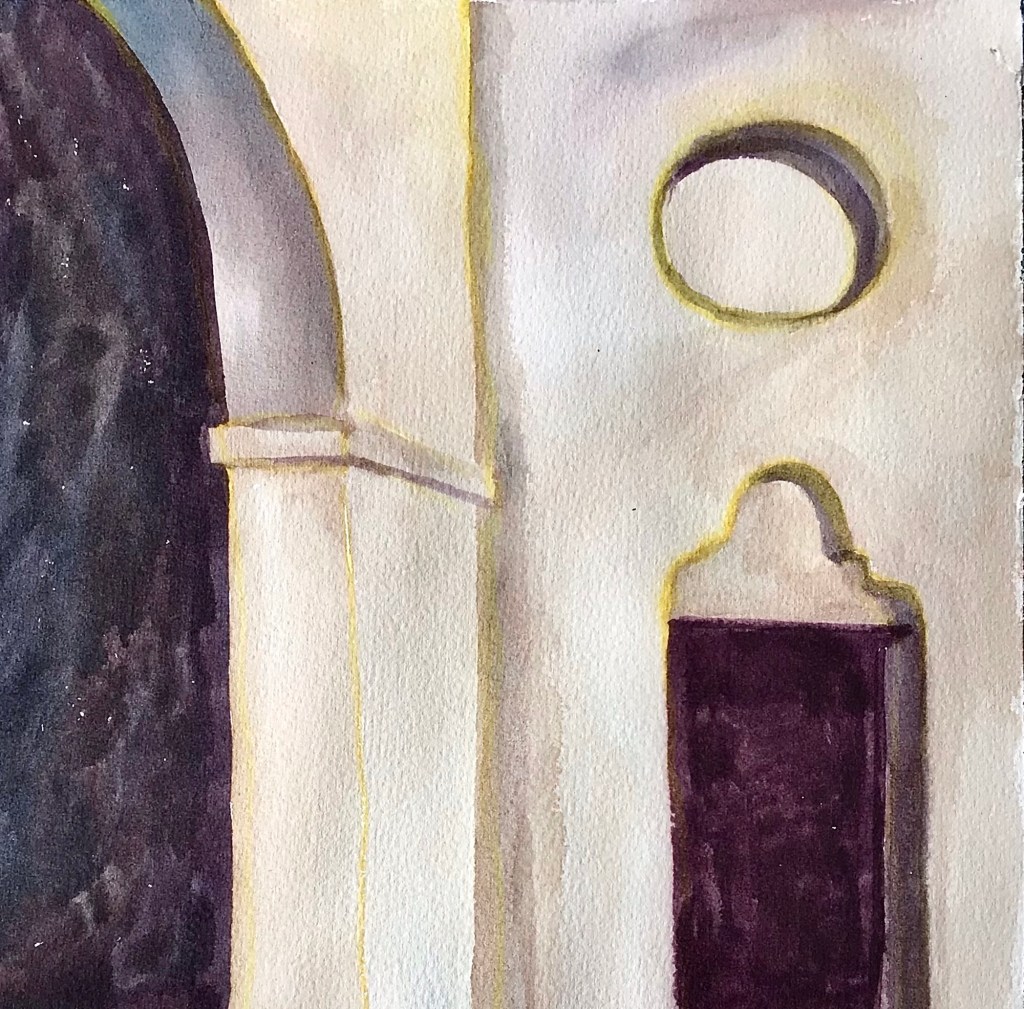
Notice on my short watercolor study, I didn’t bother to include the whole photograph image. I “triaged” the details I couldn’t complete in our short class time. I mixed my own blacks, rather than using the pan color available. This gave me much richer colors and more variation in my shadows. I had outlined my basic shapes in yellow, but got to talking about the others’ directions and let the paint dry too much, or I would have picked it up better. It would have been less noticeable. I see now some of my lights could have been lighter. I can go back with a clean brush full of water and pick up some of that front face of the archway.

Of course, my eye sees more than most people can see, and it’s both a curse and a blessing. I’m always graceful with my students and try to give at least half as much grace to myself. We mustn’t get discouraged, but keep pressing upward! We don’t have to be a master at something to be a maker; we just have to do it. Having no fixed expectations of an outcome is the best way to exhibit creative expression. Following the less traveled path can lead to new destinations and new discoveries.

Art has the capacity to heal, to cross-fertilize, and to challenge fixed ideas. Art can’t be confined to gallery spaces or the walls of our homes. Art can not only renew our brains, but also the practice of art can renew how we see the world because we learn to see it afresh. Sometimes for the first time, we see it as we’ve never seen it before, and then we bring our own experience and expression to what we have seen. That’s when we become artists, creators, and cocreators guided by the hand of God.  As we are made in the image of the creating God, God heals us as he cares for the creation:


“I have seen their ways, but I will heal them;
I will lead them and repay them with comfort,
creating for their mourners the fruit of the lips.
Peace, peace, to the far and the near, says the LORD;
and I will heal them.”
~~ Isaiah 57:18-19

Joy and peace,

Cornelia


The Tool of Tools and the Form of Forms – 3 Wisdoms | Scott Randall Paine


59 Reading Statistics and Facts You Should Know

https://www.abtaba.com/blog/59-reading-statistics

What’s the latest U.S. literacy rate?

How the Hand Shapes the Brain, Hand Surgery Department of Clinical Sciences, Malmö Lund University Skäne University Hospital, Malmö, Sweden

NOTES FROM—The “online brain”: how the Internet may be changing our cognition –https://www.ncbi.nlm.nih.gov/pmc/articles/PMC6502424/

11. Hultsch DF, Hertzog C, Small BJ et al. Use it or lose it: engaged lifestyle as a buffer of cognitive decline in aging? Psychol Aging 1999;14:245‐63. [PubMed] [Google Scholar]

12. Small BJ, Dixon RA, McArdle JJ et al. Do changes in lifestyle engagement moderate cognitive decline in normal aging? Evidence from the Victoria Longitudinal Study. Neuropsychology 2012;26:144‐55. [PMC free article] [PubMed] [Google Scholar]

25–Uncapher MR, Wagner AD. Minds and brains of media multitaskers: current findings and future directions. Proc Natl Acad Sci 2018;115:9889‐96. [PMC free article] [PubMed] [Google Scholar]

35. van Der Schuur WA, Baumgartner SE, Sumter SR et al. The consequences of media multitasking for youth: a review. Comput Human Behav 2015;53:204‐15. [Google Scholar]

36. Altmann EM, Trafton JG, Hambrick DZ. Momentary interruptions can derail the train of thought. J Exp Psychol Gen 2014;143:215‐26. [PubMed] [Google Scholar]

37. Baird B, Smallwood J, Mrazek MD et al. Inspired by distraction: mind wandering facilitates creative incubation. Psychol Sci 2012;23:1117‐22. [PubMed] [Google Scholar]

Researcher Talks of Arts Benefits

https://ao.pressreader.com/article/281908778227901

The Hand: How Its Use Shapes the Brain, Language, and Human Culture,

By Frank R. Wilson

https://www.washingtonpost.com/wp-srv/style/books/reviews/hand.htm


Total Eclipse of the Heart

adult learning, arkansas, art, Astrology, cosmology, Creativity, Faith, Great American Eclipse, Imagination, inspiration, Light of the World, Love, mystery, nature, Painting, photography, shadows, Spirituality, Travel, Uncategorized, vision

In the Bonnie Tyler song, “Total Eclipse of the Heart,” her rock and roll soul pines for a young man as she sings:

“Every now and then

I know there’s no one in the universe

As magical and wondrous as you.”

Love struck teen heart ballads tend to elevate the beloved to a high pedestal, while hymns lift the praises of God to the highest heavens. If we look at John Wesley’s Notes on the New Testament, one of the doctrinal standards of the United Methodist Church, his commentary on 2 Corinthians 4:6 (KJV) is instructive:

“For God, who commanded the light to shine out of darkness, hath shined in our hearts, to give the light of the knowledge of the glory of God in the face of Jesus Christ.”

We might be more familiar with this verse in the NRSV, a more modern translation, which wasn’t available in the middle of the 18th century:

For it is the God who said, “Let light shine out of darkness,” who has shone in our hearts to give the light of the knowledge of the glory of God in the face of Jesus Christ.

Bailey’s Ring, from an earlier total eclipse over the South Pacific Ocean

Wesley’s commentary in his Notes on this text is succinct:

  1. For God hath shined in our hearts—The hearts of all those whom the God of this world no longer blinds.
  2. God who is himself our light; not only the author of light, but also the fountain of it.
  3. To enlighten us with the knowledge of the glory of God—Of his glorious love, and of his glorious image.
  4. In the face of Jesus Christ—Which reflects his glory in another manner than the face of Moses did.

What do the Total Eclipse of the Heart and Paul’s words to the Corinthian community have to do with art and faith? We’ve just experienced, what was for most of us, was a once in a lifetime experience. The last time a total solar eclipse was visible across the entire continent was in June 1918, when a total solar eclipse was visible from Washington to Florida, according to the US parks service. Nearly 100 years passed until this present Great American Eclipse.

At the 1878 total eclipse, Maria Mitchell led the Vassar College eclipse party, an all-female expedition from that pioneering women’s institution, which came to Denver in an era when science was a male bastion. Even higher education was deemed risky for the “fairer sex.” In 1873, the prominent Boston physician Edward H. Clarke had warned in an incendiary book titled “Sex in Education,” that the recent push for female colleges and coeducation could undermine women’s health by taxing their brains and causing their reproductive organs to atrophy — leading to “a dropping out of maternal instincts, and an appearance of Amazonian coarseness and force.” Nearly 150 years later some men still concern themselves with outmoded and 19th century views on women’s health concerns.

Eclipse as seen through the hands

I drove over four hundred miles to Kentucky in 2017 for the prior Great American Eclipse and got to stay home to see this second Great American Eclipse in my own front yard. Some folks couldn’t have been bothered about this current grand event, while others were convinced God was informing America of her impending doom. Moreover, multiple conspiracy theories abounded, none of which came true, of course. For instance, the world didn’t come to an end and our cell phones still work. Even the electric grid held up, even though the sun didn’t shine for all of a few minutes as the shadow traveled at over 1,600 miles per hour as it raced along the path of totality. This wasn’t even Y2K, which we all remember was a nonstarter at least and a dud at best.

Eclipse over Niagara Falls, 2024

In art class Friday Tim and I talked about the experience of this celestial event. We humans often elevate our own importance when we measure ourselves against one another and the works of our hands. When we go out into nature, we’re faced with the grandeur of God’s creation, especially when we visit the Grand Canyon or Niagara Falls. In Psalms 19:1, we read:

The heavens are telling the glory of God; and the firmament proclaims his handiwork.”

We see the beauty of nature and feel a warmth in our hearts. Our spirits soar. This intimacy with nature is one of the reasons we send our children to our United Methodist Church Camps, not just because they’ll have a great Christian experience, but because they’ll have that faith experience in nature with trusted leaders. I still remember my adventures and experiences in nature at those camps as part of my spiritual journey.

Towering Cumulus Clouds

Even in seminary, when I was having difficulty with some of my courses, I could go for a walk on the campus under the tree lined walks and search the skies for hopeful signs. Sometimes I saw the towering cumulus clouds in the Texas sky as a sign God was with me “in the cloud by day.” In those times of difficulty, even the cloistered realm of preparation seemed like a wilderness journey, but I was glad for a guide.

Bill Maxey, from Nebraska, taken at Hot Springs, AR.

When I was actively serving as a pastor, sometimes I just had to get away. I’d drive until I found some nature, a national park, national forest, or some fields outside of town. If it was a hot summer, I looked for some deep woods and cool shade to shelter me. In the cool spring, I drove until I found flowers. Maybe this is why I retired to a lake in a national park. I don’t need a big house, since I’d rather go out into nature instead.

Totality on Lake Hamilton, with sunset in the west, outside the path of totality

It was the heat of summer in 2017, so you’d think I’d remember the temperature drop right before the eclipse was halfway through. This year I was on Lake Hamilton, and the breeze off the lake combined with the cooler air was decidedly noticeable. When we entered totality, the lights on the Highway 70 bridge and at Bubba Brews automatically came on. The distant sky in the southwest, outside the path of totality, looked like a summer sunset. My neighbors and our visitors from afar were cheering.

Bill Maxey: multiple exposure of the Great American Eclipse, 2024

Not everyone can make an artwork that expresses their emotions as well as the shapes of the image. We can learn the rules of perspective and color, but then we have to learn to let our heart rule our head. This is what I call an “artistic leap of faith.” When we were young, we accepted the basic ideas of Christianity. As we got older, life happened, and we might have begun to struggle with our childhood beliefs not being equal to our adult needs. If we keep our childlike faith, we risk losing our faith. If we are able to wrestle with our faith and find a new and more mature faith, we can handle the major challenges of later life. As Paul says in 1 Corinthians 13:11-12—

“When I was a child, I spoke like a child, I thought like a child, I reasoned like a child; when I became an adult, I put an end to childish ways. For now we see in a mirror, dimly, but then we will see face to face. Now I know only in part; then I will know fully, even as I have been fully known.”

Tim’s Partial Eclipse painting using red, blue and brown to build the sky

Tim experimented with mixing colors to get richer depth. Using the Prang watercolor palette, he mixed the red, blue, and brown to get the black sky of the eclipse event. The red orange of the sun has some brown in it too. He layered the colors with multiple strokes, with a nod to Van Gogh. He worked from a photograph I brought. I pulled many of them off the internet, and many of my friends sent me some too.

Cornelia: Total Eclipse of the Sun

I worked on an image I’d taken from my iPhone. I had placed one of my eclipse glasses over the lens and was wearing another pair. It wasn’t that easy to get the sun lined up with all that blocking! My image looked a lot like a fried egg or an eyeball. I used several jar lids to get the circles painted cleanly. My dark sky is red, blue, and violet. The shape of the corona was not distinct, due to the quality of my camera. NASA has a very high-resolution image, which breath taking. Our tax dollars at work are bringing great scientific research and development to benefit us in everyday life, such as solar panels and heart implants.

NASA: High Resolution Image of the Total Eclipse

Thomas Merton, in No Man is an Island, in a chapter called “Being and Doing,” wrote—

“We cannot be happy if we expect to live all the time at the highest peak of intensity. Happiness is not a matter of intensity but of balance and order and rhythm and harmony. Music is pleasing not only because of the sound but because of the silence that is in it: without the alternation of sound and silence there would be no rhythm.”

I was a bit exhausted after all the excitement of this big event. I’d met new people from three different states, visited around our patio, and been gifted crystals that had been dug from Mt. Ida and “energized by the eclipse.” I’m not a crystal person, but I understand from those that are these crystals are “special.” I was feeling every bit of my new age as the calendar flipped over for another year.

Bourbon Codex: Aztec priestly document recording astronomical observations: eclipse

But today is another day, I had a night to sleep, and we had fun in art class. As long as we find joy in life, we know we’re alive. Our joys aren’t just collections of peak experiences, but some are the joy of the assurance of God’s enduring presence in our later lives when our youthful vigor has left us. We need to remember just as the moon eclipses the sun, once it passes, it also reveals the sun’s glory. One day this Bible verse from Philippians 3:21 will be true for each one of us, who has a heart full of love for God and neighbor:

“He will transform our humble bodies that they may be conformed to his glorious body, by the power that also enables him to make all things subject to himself.”

Joy and peace,

Cornelia


Bonnie Tyler – Total Eclipse Of The Heart Lyrics | AZLyrics.com

https://www.azlyrics.com/lyrics/bonnietyler/totaleclipseoftheheart.html

John Wesley: Explanatory Notes on the New Testament (With Active Table of Contents) [Kindle Edition], first published 1757

John Wesley: Wesley’s Notes on the Bible – Christian Classics Ethereal Library—online free edition of this book

https://ccel.org/ccel/wesley/notes/notes.toc.html

The Solar Eclipse Is the Super Bowl for Conspiracists | WIRED

https://www.wired.com/story/solar-eclipse-conspiracies/

Solar Eclipse 2017: Sun and moon put on celestial performance – CBS News

https://www.cbsnews.com/news/2017-eclipse-dazzles-million-watch-celestial-performance-sun-moon/

Thomas Merton—“No Man is an Island” in a chapter called “Being and Doing” [TMHI]: 1955

 A Woman in Eclipse: Maria Mitchell and the Great Solar Expedition of 1878

https://undark.org/2017/08/17/wilo-maria-mitchell-astronomer-eclipse/

NASA: Benefits Stemming from Space Exploration

https://www.nasa.gov/wp-content/uploads/2015/01/benefits-stemming-from-space-exploration-2013-tagged.pdf?emrc=ca90d1#:~:text=Overcoming%20the%20challenges%20of%20working,information%20technology%2C%20and%20industrial%20productivity


Eclipse T-Shirts

adult learning, art, Children, cosmology, Creativity, Faith, Good Friday, Great American Eclipse, Habits, Icons, Imagination, incarnation, inspiration, mystery, nature, Painting, Philosophy, Spirituality, vision

Friday in art class we painted our own unique designs on t-shirts for Monday’s Total Eclipse of the Sun. Anticipation of an event is characteristic of young children, while adults often feel over saturated with the early build up of attention given to an important event. By the time it gets here, we go, “Wow, what a letdown.” Children, who have fewer years of experience and anticipation comparison, can still marvel at the alternate reality of the total eclipse.

In the sixth century BCE, Anaximandros believed “the moon has a false light and is illuminated by the sun, and the sun isn’t smaller than the earth and it is pure fire.” The Greeks in 290 BCE knew the moon was unlike the sun. Anaximenes wrote it “didn’t shine with its own light, but with the reflected light of the sun,” as Eudimos wrote in his book History of Astronomy.  The Chinese also studied the skies and stars. They used bones heated in fires to divine messages from their deceased ancestors as early as the 12th century BCE.

Chinese oracle bone depicting lunar eclipse of 12/27-28/1192 BCS.

The Death of Jesus in the Synoptic Gospels has the record of an eclipse occurring during the time of the crucifixion. John’s Gospel, which comes from a different source, doesn’t mention this time of darkness.

Egon Schiele, Crucifixion with Darkened Sun, Oil on Canvas, 1907.

When it was noon, darkness came over the whole land until three in the afternoon. ~~ Mark 15:33

From noon on, darkness came over the whole land until three in the afternoon. ~~ Matthew 27:45

It was now about noon, and darkness came over the whole land until three in the afternoon, while the sun’s light failed; and the curtain of the temple was torn in two. ~~ Luke 23:44-45

When Jesus had received the wine, he said, “It is finished.” Then he bowed his head and gave up his spirit. ~~ John 19:30

Yet the Gospel of John tells us more about the miracles of Christ and his dual nature (both human and divine), so that we might believe and have everlasting life through him. New Testament scholar Ernst Käsemann is correct when he says of the Fourth Gospel: “Judged by the modern concept of reality, our Gospel is more fantastic than any other writing of the New Testament.”

Bruce Metzger, noted New Testament scholar and lead translator of the NRSV said, “The more often you have copies (of biblical texts) that agree with each other, especially if they emerge from different geographical areas, the more you can cross-check them to figure out what the original document was like. The only way they’d agree would be where they went back genealogically in a family tree that represents the descent of the manuscripts.[104]

Tim’s Eclipse T-shirt: very simple due to his rehab from arm surgery. He uses his arm until it hurts and then he rests. We do what we can, not what we can’t.

We modern folks are used to looking at the world through the eyes of science and education. We look for repeatable patterns and consistent evidence. We have “grown up minds” with calendars, schedules, to do lists, and multiple people who make demands on our time. Often, we are thinking about our next meeting or chore before we even finish the one we’re currently working on at the moment.

We aren’t practicing Brother Lawrence’s admonition to “Practice the present moment.” Our constantly chiming cell phones don’t help us be present, even though we could set our notifications to silent. Indeed, we’re never present or still enough to know the peace of the God whose name means “I AM.”

Lauralei’s Eclipse T-shirt: experimenting with fabric paint

What is “reality?” How can we know the present moment and come closer to God? With the advent of photography people began to think super realism in painting was preferred to some degree of emotional expression. Today, with the introduction of Artificial Intelligence, we can make computer generated photos and paintings that go beyond our wildest dreams! This means our new generations may likely begin using tactile materials and hand-built techniques to create future art works. Instead of fantastic other worlds, they might find their inspiration in the environment or in social justice concerns.

Gail W’s Eclipse T-shirt: first stage in class. She came with a design in mind and brought her sewing chalk also.
Gail W’s Eclipse T-shirt: the finished product.
Some of our inspirations are too grand to be completed in a few hours. We need to have the desire to carry the effort forward to meet our goal.

As with the icon, the artwork is only a reflection of the image which is painted. The icon isn’t holy, but the person depicted is holy. As the writer of Hebrews 1:3-4 says:

“He is the reflection of God’s glory and the exact imprint of God’s very being, and he sustains all things by his powerful word. When he had made purification for sins, he sat down at the right hand of the Majesty on high, having become as much superior to angels as the name he has inherited is more excellent than theirs.”

I didn’t get a photo of Mike’s “Crawford Law Eclipse T-shirt.” Work called and he had cats to herd. He was generous as usual to bring fabric paints for the group to share. We used old newspapers inside our T-shirts to keep the paint from bleeding through to the backside. We had an opportunity to share stories and eat my birthday doughnuts which Tim blessed me with.

Cornelia’s Eclipse T-shirt: I collapsed all the moments of occlusion into three, so I could finish in one sitting.

If we take time to practice our art, we may realize our own works may be only a reflection of the glory of what we saw, but we we can continue to practice our skills in prayer, for God will bring us ever closer to perfection if we commit our work to God’s glory.

Leonardo da Vinci: Study of the technique for observing solar eclipse, Codex Trivulzianus, 1487–1490

Also, Marilyn, who was working with some other ladies of the church on the potato bar posters, had brought the warm-gooecrescent roll-cream cheese-vanilla-cinnamon-sugar dessert. If you ever have a chance to put this into your mouth, you will be transported into an alternate reality. This is the stuff from which dreams and visions arise! If you eat it, and you merely remark, “Good,” my thought is you’re dead to this world or you’ve lost your sense of taste. The child in me screamed for MORE!! The adult in me will see if I can reduce the calories with no depreciation in taste.

Paul Nash: Eclipse of the Sunflower, 1945

I hope we get a break from the clouds on the Great American Eclipse Day. The last one I traveled to in 2017 was very impressive and worth the journey. Watch it on television if you can’t be outside. Only look at the sun with certified eclipse glasses. Some experiences are such that we can only say “Awe!” And we may want to stop time forever, but time will march on, for we can’t move the sun either forward or backwards. No matter how important we are, we aren’t gods, and we aren’t even Time Lords. If we manage to grasp only a portion of the holiness and beauty of God’s creation in this one event, we will better experience the joy of the passing glory of our God:

“When I look at your heavens, the work of your fingers, the moon and the stars, that you have established, what are human beings that you are mindful of them, mortals that you care for them?” ~~ Psalm 8:3,4 (NRSV)

View of the Great American Eclipse 2017 at
Lake Barkley through a pinhole

Joy and peace,

Cornelia


Eclipses and the Ancient Greek Philosophers

By H. Rovithis-Livaniou and P. Rovithis

https://articles.adsabs.harvard.edu/cgi-bin/nph-iarticle_query?bibcode=2007ASPC..370..115R&db_key=AST&page_ind=0&data_type=GIF&type=SCREEN_VIEW&classic=YES

How Ancient Humans Studied—And Predicted—Solar Eclipses | Scientific American

https://www.scientificamerican.com/article/how-ancient-humans-studied-and-predicted-solar-eclipses/

Historical Reliability of the Gospels, Encyclopedia MDPI

https://encyclopedia.pub/entry/29465

https://handwiki.org/wiki/Religion:Historical_reliability_of_the_Gospels

104. Strobel, Lee. “The Case for Christ”. 1998. Chapter three, when quoting biblical scholar Bruce Metzger

In Memoriam: Bruce M. Metzger (1914-2007) | Bible.org

https://bible.org/article/memoriam-bruce-m-metzger-1914-2007

Bruce Metzger was the master of several ancient and modern languages and ended up teaching at Princeton for 46 years after he received his PhD there. As one of the editors of the standard Greek New Testament used today and the senior editor of the NRSV, his scholarship has proved to be almost impeccable. His specialty was New Testament textual criticism, the field whose primary goal is to ascertain the wording of the original text. Many considered him the finest NT textual critic of the 20th century. His death in 2007 left giant footprints for the next generation to come. 

Paul Nash, British Military artist, died in 1946 of complications from asthma. He didn’t see the total eclipse, but knew of it and was very connected to nature.

Read about him in A landscape of mortality | Tate

https://www.tate.org.uk/art/artists/paul-nash-1690/landscape-mortality

Map of the 1945 eclipse: SE1945Jul09T.gif 1,121×1,452 pixels