Two Types of Color Wheels

adult learning, art, color Wheel, Creativity, flowers, Painting, picasso, Rumi

Rumi, the 13th CE Persian poet and theologian, once said, “Inside you there’s an artist you don’t know about…say yes quickly, if you know, if you’ve known it from before the beginning of the universe.” Most of us live unawakened to this talent. When we were children, we had no thoughts of “trying to be an artist.” We picked up colors or clay and made our shapes and designs without a care in the world. Our loved ones praised our projects, and we felt good.

Johannes Itten: In the beginning

Somewhere along the 4th or 5th grade, many of us lost touch with that artist within. As Picasso said, “It took me my whole life to learn to draw like a child.” What Picasso meant is he learned all the adult rules for a good painting first and then unlearned them so he could create something completely new. When children are between 9 to 13 years old, they try to draw more naturalistic figures and landscapes by using shadows and perspective. They also start comparing their work with others, but this discourages those who are not discovering the new visual language of realism.

Picasso: Great Still Life on Pedestal, 1931, oil on canvas

As a result, by the time many children reach middle school, they are no longer in touch with their inner artist. Young children do not worry about whether they are wrong. They will forge bravely into unfamiliar territory, even knowing they may make a wrong decision. However, as we mature, we quickly learn that being wrong often has negative consequences. We learn quickly in school that making mistakes brings negative consequences. Not studying for the test brings a bad grade. Talking too much might get a time out in the dark cloak room (traumatic 3rd grade experiences).

Jeannie: Color Wheel Flower

Teaching art to middle school students who say, “I can’t draw a straight line without a ruler” always got my retort, “We don’t have straight lines in nature, so you won’t have that problem in this class!” They learned working would bring improvement. This is a lesson learned well by the folks who have been with me for the last five years since Pastor Russ Brashears invited me to teach classes here. While we are saved by faith, not by works, in art class we need to have faith that our work will bring us closer to perfection. (Of course, there’s always an exception …)

Frank Stella: Harran II, 1967, Polymer and fluorescent polymer paint on canvas

At work, the boss penalizes us for being wrong. According to Sir Ken Robinson, an expert in creativity, “If you are not prepared to be wrong, you will never produce anything original. Since creativity inherently requires a willingness to be wrong, we begin to avoid it. For many of us, we become so good at avoiding it that we convince ourselves we are “not creative.” Another destroyer of creativity is current need to teach to the test standards. The one right answer for this important test leads children to think many questions have one answer, when in truth, multiple answers might be worthy.

Gail: Color Wheel Designs

In addition, many factors that seem related to the self-controlled aspect of ourselves—like research, facts, or being grounded in reality—feel like they are helping us mitigate the risk of being wrong. Therefore, we rely more on our executive function skills and behaviors, and less on our imaginative behaviors. Psychologists at Cornell University conducted a study that showed that we have an implicit bias against less conventional, practical-seeming ideas. We tend to like what everyone else likes, rather than original or creative ideas.

Johannes Itten: Bau Haus Color Star with Shades, 1921

This tendency runs deep since studies going back to the 1950’s have shown people are prone to conforming to popular opinions and perspectives. Research suggests that the rote learning and direct instruction used in schools often drives out whatever nonconformist tendencies we may have as children. This type of instruction may counteract our more exploratory and creative modes of thinking and learning. The Fauves, or “wild beasts,” were a group of French artists who scandalized the Academic standards by painting in wild and unnatural colors to evoke emotion, rather than observable reality. Of course, we love their works today.

Mike: Age of Aquarius: moon in 7th house

Half our class has been doing the color wheel multiple times, while the other half is getting their first exposure to it. Gail and Mike have made enough color wheels that I would not ask them to make another unless we changed our medium. Then it is always worthwhile to see how a new set of colors behaves when mixed. I gave them the guide, “Choose any design you want, and mix up the colors to make an interesting design.” Of course, they are two different personalities, so they produced two different paintings.

Basic Color Wheel

The basic premise for the beginner’s color wheel exercise is to take the 3 primary colors of red, yellow, and blue, and mix them to form the 3 secondary colors of orange, green, and violet. The tertiary colors are the “in between color” of each primary and secondary color. I was pleased that both Jeannie and Tonya mixed the colors well and kept their brushes clean in between the varied colors. This showed concentration and care, which are attributes of good craftsmanship. This will pay off in the future when we paint more complicated three-dimensional objects.

They also took time to add backgrounds. Jeannie made her color wheel into a giant flower on a green stem, with a softly sun kissed leaf. Tonya set hers against a night sky, as if it were a cosmic wheel of time. I enjoyed the burst of enthusiasm from their hearts when they added these parts of their own imaginations.

DeLee: Doves returning with green leaves after the flood

One of my goals as a teacher is to release the artist within each person. Some people keep a tight rein on that creative genius living within them. Society has acculturated us adults to conform to the common denominator, so most of us have lost our spark of creativity. This is not an individual problem, but a societal fact. Creativity scores among adults have been declining since the 1990’s, even though intelligence scores are rising worldwide due to better health care and nutrition.

If I can have a second opportunity to help create minds which are more flexible, more imaginative, and more productive over the long term, I will have fulfilled my call to teach another generation the joys of the creative life. My own example is from the Genesis story (8:10-11):

“He waited another seven days, and again he sent out the dove from the ark; and the dove came back to him in the evening, and there in its beak was a freshly plucked olive leaf; so Noah knew that the waters had subsided from the earth.”

The square is a symbol from the language of the icons for the earth, so I painted it primarily in earth colors. The surrounding is in various shades of blue or blue blacks. The abstract doves hold an edge of green in their beaks. Is it too abstract to understand? This is a creative solution to “color wheel,” not a travel book. It is a painting, not a map. If you need to find Mount Ararat, ask your GPS for directions. Not everything has to be functional. Some things can be “art for art’s sake.”

Leaving you with thoughts and the hope you dream more,

Joy and peace,

Cornelia


Why Art — Give Kids Art

https://www.givekidsart.org/why-art

 7 Surprising Facts About Creativity, According to Science – Fast Company

https://www.fastcompany.com/3063626/7-surprising-facts-about-creativity-according-to-science

Kyung Hee Kim (2011): The Creativity Crisis: The Decrease in Creative Thinking Scores on the Torrance

Tests of Creative Thinking, Creativity Research Journal, 23:4, 285-295

http://dx.doi.org/10.1080/10400419.2011.627805

Frank Stella, Harran II, 1967. Polymer and fluorescent polymer paint on canvas, 10 x 20 feet (304.8 x 609.6 cm), Solomon R. Guggenheim Museum, New York Gift, Mr. Irving Blum, 1982. © 2023 Frank Stella / Artists Rights Society (ARS), New York

Picasso: Great Still Life on Pedestal, 1931, oil on canvas, Picasso Museum, Paris France. 195 x 135 cm


Intuitive Color Wheels

adult learning, art, at risk kids, cognitive decline, color Wheel, Creativity, Imagination, inspiration, Lost Cause, Ministry, Painting, renewal, vision

The great and wonderful part of art is exercising imagination and discovering new ways to solve problems. One of my favorite memories in art school was the day our professor came to class with a single red clay brick. Our first thought was this is going to be the most boring drawing class ever, but then he asked us, “How many uses can you find for a brick?”

Thick as a Brick

After we quickly named multiple uses for a single brick—doorstop, paperweight, weapon, counterweight, and bookend—we were at a loss to name much more. As we scratched our heads, our teacher prompted us, “Did I restrict you to a single brick?” And we were off to the races! Wall, fireplace, house, road, sidewalk, planter, sculpture, picnic table, bookshelf, and more. I can’t remember if this was an early morning class or we were just dense, but I’ve come to believe we can teach creativity. At the very least, we need to give people permission to accept “multiple art answers can be true” and give them the opportunity to consider “other possibilities.”

Canvas bound in strings

When I taught art years ago, children who were troublemakers in regular classrooms were usually well behaved in art class. I attribute this outcome to their ability to express their own individuality in solving the weekly art assignments. Math always has a right answer; there is no “alternative fact” to 2 + 2 = 4. History is the same: the Confederacy seceded from the Union to keep their economic system of enslavement. There was no “states rights movement,” no matter what the Lost Cause proponents pushed in our state approved textbooks. All we had to do was look at the original source documents from the 1860’s.

Simple Color Wheel

Adults usually conform to socially acceptable norms. Helping adults with creative thinking is important because the creative process is more important than the tangible result. Most adults give up the idea they will ever paint the Sistine Chapel ceiling, while children are humble enough to realize they need many more years of practice before they get that kind of opportunity. Also, what we know about creativity can’t be applied in the same way to all creative endeavors because they involve different subjective decisions and processes.


Gino Severini: Expansion of Light. (Centrifugal and Centripetal), ca. 1913 – 1914, Oil on Canvas. 65 x 43.3 cm
Museo Nacional Thyssen-Bornemisza, Madrid

Creative insight depends in part on new combinations of existing ideas, concepts, and perceptions that the brain has stored over time. This is why we begin each class looking at famous art works. We need good art influences and inspiration to “prime our creative pumps” so we can draw up from the pure wellsprings of our own creativity. Just as we need spiritual food for our soul, we need beauty for our creative ideas.

First stage

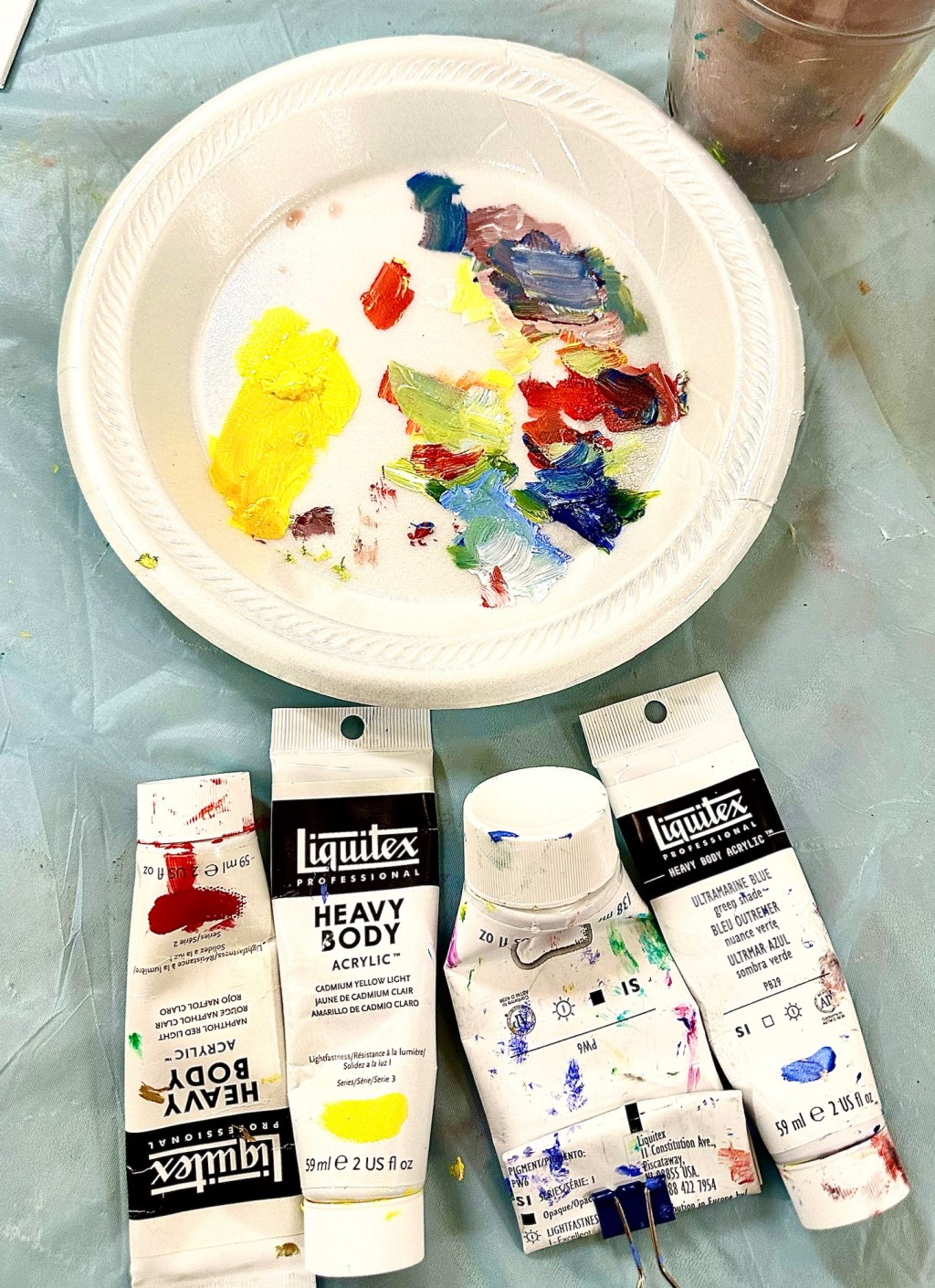
Last year we worked on copying the color wheel and matching it. That is an intellectual skill. To make this into a creative, intuitive activity, we took strings and wrapped our canvases. This made multiple shapes for our colors. Using the primary colors—red, yellow, and blue, plus white—we mixed various combinations and surprised ourselves with the results.

Gail W’s first stage

Our first class was lightly attended, due to doctor appointments and vacations, so we still have room for anyone else who wants to come. All skill levels are welcome, for I’ve taught from K-5 to adults. Everyone progresses from their own level, so the longer you sit and think you wish you were good enough for lessons is merely time wasted when you could be working with a practiced teacher! Anyway, the lessons are free; you bring your materials and discover your unknown abilities and gifts. We journey with fellow travelers. Plus it keeps your brain young.

We will continue to work on this project next Friday at 10 am.

 Joy and peace,

Cornelia

National Endowment for the Arts: Creativity and the Brain

https://www.arts.gov/sites/default/files/how-creativity-works-in-the-brain-report.pdf

Color Theory Paintings

adult learning, Altars, art, color Wheel, Creativity, Faith, Hilma af Klint, Imagination, inspiration, Ministry, mystery, Painting, shadows, Spirituality

Cezanne: Four Apples, 1880-1881, oil on canvas

Cezanne once said, “We live in a rainbow of chaos.” Perhaps he meant we’re surrounded by colors, in various and sundry shades, and through art, we try to find some order to this chaos, even if our resulting work seems outwardly disorderly. In his own lifetime, Cezanne was accused of being a madman, “afflicted while painting with delirium tremens.” His response was to shrug off the guardians of the Academy: “With an apple I want to astonish Paris.” He worked in isolation for a very long time, only gaining financial success in the last ten years of his life.

Jackson Pollock: Number 32, 1949, auctioned in 2018 at Sotheby’s

Another artist who broke ground is Jackson Pollock. When we view a Pollock action painting, we realize there’s actually an order to this chaos. The drips and pours are more like calligraphy and live in tension with one another. They vary in color, size, and energy, not unlike a song. The action paintings are not just “drip paintings,” but energies expressing emotions by means of fluid dynamics. This is why we don’t say, “My grandkid could do this.” People try to forge Pollocks and fail. Even Pollock had difficulty creating these unique works, the best of which belong primarily to a two year period when he refrained from his alcohol habit, which affected his depressive disorder.

As compositions, each of Pollock’s drip pictures simultaneously dissolves into a chaotic jumble of individual lines, while also coming together as a structurally uniform, whole field. We’re mostly used to works best viewed from a single fixed point, such as a High Renaissance painting. Instead, to view a Pollock, we must move across the whole surface, and look deep into the layers. His works draw their audience in to inspect the details closely, passage by passage, and at the same time overwhelm the viewer with their monumental size. Their coloristic and textural richness emphasizes the expansive surface, yet the elaborate and totally visible overlay of multiple layers of paint (and sand, cigarette butts, glass, and other materials) create a very real depth and space. It’s definitely not your grandchild’s artwork.

HANS HOFMANN: Elysium, 1960, oil on canvas, BLANTON MUSEUM OF ART

Hans Hofmann, a 20th C American abstract expressionist, once said, “Colors must fit together as pieces in a puzzle or cogs in a wheel.” Often we use the colors straight out of the tube, or we flail around trying to figure out which yellow and which blue will give us the shade of green we want to use. Experience is the best teacher, for learning how to see the colors of life is like solving a puzzle that doesn’t have a photo for a guide. Once we begin to recognize their composite colors, we begin to see the order in the midst of chaos. Then we have the cogs to the wheel and it will turn the next wheel in good order. Experience becomes our Rosetta Stone for decoding the other mysterious languages of color we hear around us every day.

Color Wheel with Neutral Grey at Center

One of the cues we’ve come to recognize in our painting class is the color of our brush wash water. If it’s a lovely neutral gray, like the center circle in the wheel above, we’ve balanced the warm and cool colors on our canvas. Most of our group in attendance chose colors from this wheel.

Paul Klee: Watercolor Word Study

We saw a number of color theory examples from history, including Paul Klee’s geometric watercolors, which vary from color blocks, landscapes, and written images.

Hilma af Klint: Primordial Chaos, Number 7

A little known colorist is the Swedish artist, Hilma af Klint, who was one of the earliest abstract painters. She developed a language, or visual imagery, to share the spiritual experiences she received during her participation in automatic drawing. As with many others of her era at the turn of the 20th century, she and her friends, in the group called The Five, mixed elements of traditional Christianity with seances and beliefs in a mystical guiding higher spirit. If she lived today, we’d likely call her beliefs “new age.” She also incorporated new advances in science for her time in her explorations.

Hilma af Klint: Altar Piece, Number 1

Her work for The Temple was heroic in size, with each of the 193 paintings measuring about 7 x 9 feet.These were completed between 1906 and 1915. The whole sequence can perhaps be understood as af Klint’s pursuit of an original “oneness,”or the basic unity which she believed existed at the world’s creation. She believed this integrity had since been lost, giving way instead to a world of polarities: good and evil, woman and man, matter and spirit. In her work after 1912, af Klint seemed to move stylistically away from techniques related to spirit channeling, such as the fluid lines of The Five’s automatic drawings. Her use of Christian iconography and geometric forms increased. By 1917, af Klint stopped producing art through a spirit altogether. Her 2,000 plus works are owned and administered by The Hilma af Klint Foundation in Stockholm, Sweden.

Dusty: Circle in Space

Dusty used a plastic plate to draw his circle. This plate served a secondary purpose as well: it was also his palette to mix his colors. “Art imitates life, even in abstraction.” He used the ruler to measure out equal pie shaped segments, and divided the background planes. I almost stopped him in the midst of his planning, but I wasn’t about to stop that train of thought. I could only admire it for its balance and symmetry. He mixed the shades of the colors, and filled in the spaces. Then he added a few “motion” marks to indicate the movement of the disc in the atmosphere.

Gail: Sun and Waves

Gail pulled a plastic French curve drawing shape out of her toolbox to make the unique shapes in her painting. The blue and green curves are the waves of the sea and the central oranges of the resulting negative shape is the sun above the water. I always appreciate her paintings, which connect to her love of nature and have a sense of order to them.

Lauralei: Geometric Shapes

I think I have this painting right side up. I followed the path of the brush strokes. Lauralei wins the prize for most different number of colors mixed on the palette. So often we get accustomed to using the same familiar colors over and over. Everyone had a café au lait colored interior two decades ago, then we all went white, and gray predominated for a while. Maybe soon we’ll paint our homes actual colors instead of following the crowd.

Mike: Rainbow Cross

Mike had this idea percolating in his mind before he came to class, but didn’t have time to work on it at home. As soon as he saw our inspiration works, he decided to follow his inner guide, which had opened this image to him. He took the ruler to mark off some guide lines, then focused on bringing this idea to life. The radiating energy bolts of dynamic rainbow colors coming from the cross remind us of God’s love in Jesus Christ for all things and all people. We’re also one in Christ and belong to the one family of God, no matter how we worship, or what our understanding of God is.

Cornelia’s First Stage: Light and Dark

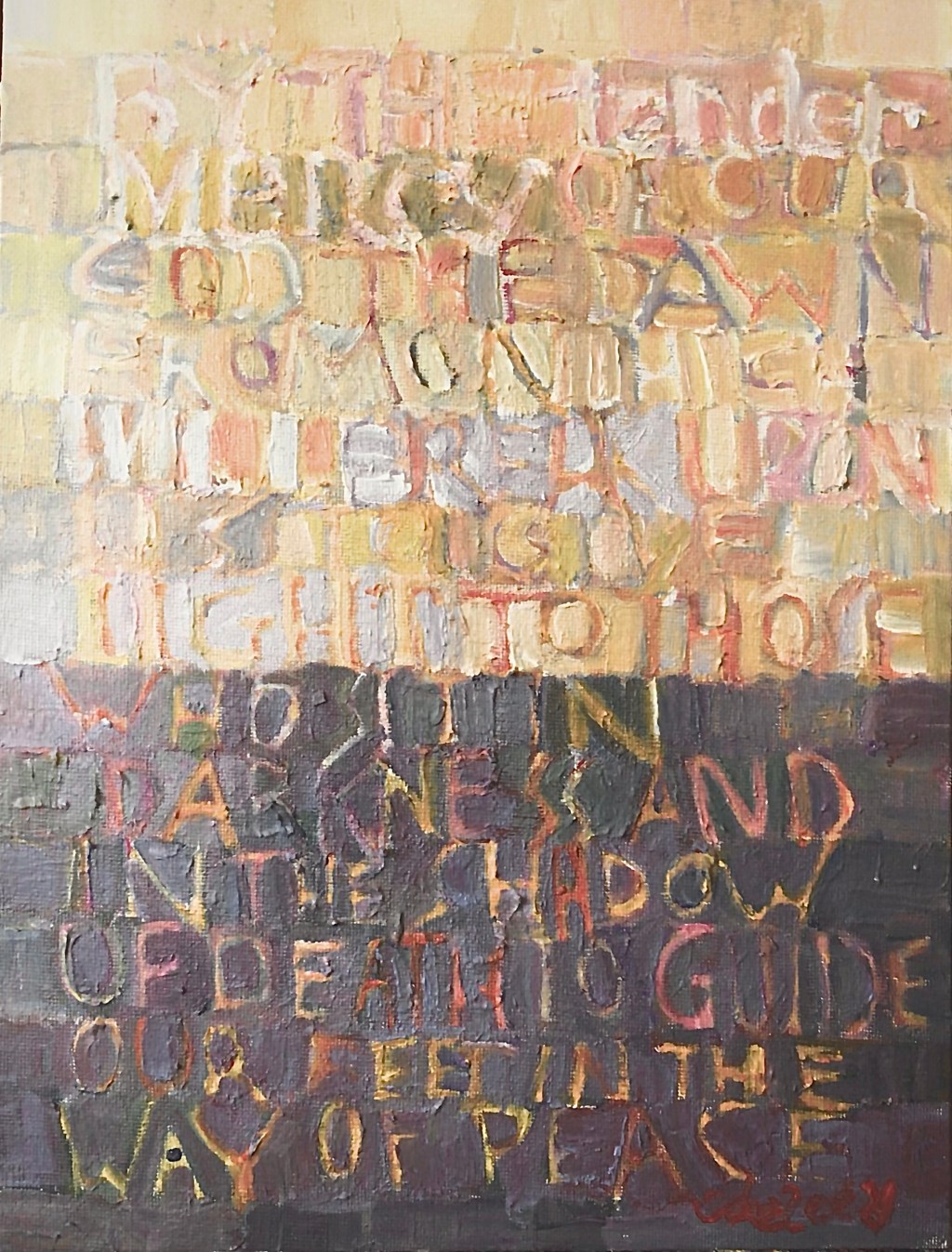
I began my little painting as a homage to Klee, but I didn’t get far in the 90 minutes we have for painting. I attempted to leave the negative space for the letters, but my brush was either too large or my painting surface was too small for the text I chose. I brought it home and worked another six or seven hours on it in the following week.

Cornelia’s Final Stage: Light and Dark

In the quiet of my studio, I realized I wasn’t paying attention to the emotions of the words, but only to the technical aspects of mixing the colors. I reread again my text from Luke 1:78-79:

“By the tender mercy of our God,
the dawn from on high will break upon us,
to give light to those who sit in darkness
and in the shadow of death,
to guide our feet into the way of peace.”

At this time, I saw the upper half needed to be light, while the lower part of the painting needed to be in darkness, since the two verses broke in this direction. This also gave my painting a landscape feel, as if the dark earth hadn’t yet seen the dawn of God’s light. As I painted, I began to lose the sense of the letters and the words, and the patches of color became more important than trying to keep the sentence legible.

I’m very impressed with this group, who’ve taken to heart my teaching mantra: Everyone will find their own voice if they engage in creative thinking and do the work. In the spiritual life, we’re saved by faith, but in art, we do find “works righteousness.” Amazingly, we get better the more we practice, especially if we have positive critiques and goal oriented lessons designed to help us grow. This provides fertile ground to awaken the spirit living within each of us, so that we can become co-creators in God’s renewal of the world. Maybe Hilma af Klimt was on to something special after all.

Our next class will be The City. We can either treat this as a lesson in perspective, poster design, abstraction, or a close up view of a building. Vacation photos are a good resource to bring, if you have a special place you want to remember. Antique photos are good too. Till next time, keep your hearts full of

Joy and Peace,

Cornelia

The Fascinating Physics of Jackson Pollock’s “Drip” Paintings
http://hyperallergic.com/526383/the-fascinating-physics-of-jackson-pollocks-drip-paintings/

Jackson Pollock’s Paintings: Characteristics of Drip Painting Technique
http://www.visual-arts-cork.com/famous-artists/jackson-pollock-paintings.htm

Paintings for the Temple | The Guggenheim Museums and Foundation
https://www.guggenheim.org/teaching-materials/hilma-af-klint-paintings-for-the-future/paintings-for-the-temple

Hilma af Klint The Paintings for the Temple 1906–1915 ARTBOOK | D.A.P. 2021 Catalog Bokförlaget Stolpe 9789189069114
https://www.artbook.com/9789189069114.html