Two Types of Color Wheels

adult learning, art, color Wheel, Creativity, flowers, Painting, picasso, Rumi

Rumi, the 13th CE Persian poet and theologian, once said, “Inside you there’s an artist you don’t know about…say yes quickly, if you know, if you’ve known it from before the beginning of the universe.” Most of us live unawakened to this talent. When we were children, we had no thoughts of “trying to be an artist.” We picked up colors or clay and made our shapes and designs without a care in the world. Our loved ones praised our projects, and we felt good.

Johannes Itten: In the beginning

Somewhere along the 4th or 5th grade, many of us lost touch with that artist within. As Picasso said, “It took me my whole life to learn to draw like a child.” What Picasso meant is he learned all the adult rules for a good painting first and then unlearned them so he could create something completely new. When children are between 9 to 13 years old, they try to draw more naturalistic figures and landscapes by using shadows and perspective. They also start comparing their work with others, but this discourages those who are not discovering the new visual language of realism.

Picasso: Great Still Life on Pedestal, 1931, oil on canvas

As a result, by the time many children reach middle school, they are no longer in touch with their inner artist. Young children do not worry about whether they are wrong. They will forge bravely into unfamiliar territory, even knowing they may make a wrong decision. However, as we mature, we quickly learn that being wrong often has negative consequences. We learn quickly in school that making mistakes brings negative consequences. Not studying for the test brings a bad grade. Talking too much might get a time out in the dark cloak room (traumatic 3rd grade experiences).

Jeannie: Color Wheel Flower

Teaching art to middle school students who say, “I can’t draw a straight line without a ruler” always got my retort, “We don’t have straight lines in nature, so you won’t have that problem in this class!” They learned working would bring improvement. This is a lesson learned well by the folks who have been with me for the last five years since Pastor Russ Brashears invited me to teach classes here. While we are saved by faith, not by works, in art class we need to have faith that our work will bring us closer to perfection. (Of course, there’s always an exception …)

Frank Stella: Harran II, 1967, Polymer and fluorescent polymer paint on canvas

At work, the boss penalizes us for being wrong. According to Sir Ken Robinson, an expert in creativity, “If you are not prepared to be wrong, you will never produce anything original. Since creativity inherently requires a willingness to be wrong, we begin to avoid it. For many of us, we become so good at avoiding it that we convince ourselves we are “not creative.” Another destroyer of creativity is current need to teach to the test standards. The one right answer for this important test leads children to think many questions have one answer, when in truth, multiple answers might be worthy.

Gail: Color Wheel Designs

In addition, many factors that seem related to the self-controlled aspect of ourselves—like research, facts, or being grounded in reality—feel like they are helping us mitigate the risk of being wrong. Therefore, we rely more on our executive function skills and behaviors, and less on our imaginative behaviors. Psychologists at Cornell University conducted a study that showed that we have an implicit bias against less conventional, practical-seeming ideas. We tend to like what everyone else likes, rather than original or creative ideas.

Johannes Itten: Bau Haus Color Star with Shades, 1921

This tendency runs deep since studies going back to the 1950’s have shown people are prone to conforming to popular opinions and perspectives. Research suggests that the rote learning and direct instruction used in schools often drives out whatever nonconformist tendencies we may have as children. This type of instruction may counteract our more exploratory and creative modes of thinking and learning. The Fauves, or “wild beasts,” were a group of French artists who scandalized the Academic standards by painting in wild and unnatural colors to evoke emotion, rather than observable reality. Of course, we love their works today.

Mike: Age of Aquarius: moon in 7th house

Half our class has been doing the color wheel multiple times, while the other half is getting their first exposure to it. Gail and Mike have made enough color wheels that I would not ask them to make another unless we changed our medium. Then it is always worthwhile to see how a new set of colors behaves when mixed. I gave them the guide, “Choose any design you want, and mix up the colors to make an interesting design.” Of course, they are two different personalities, so they produced two different paintings.

Basic Color Wheel

The basic premise for the beginner’s color wheel exercise is to take the 3 primary colors of red, yellow, and blue, and mix them to form the 3 secondary colors of orange, green, and violet. The tertiary colors are the “in between color” of each primary and secondary color. I was pleased that both Jeannie and Tonya mixed the colors well and kept their brushes clean in between the varied colors. This showed concentration and care, which are attributes of good craftsmanship. This will pay off in the future when we paint more complicated three-dimensional objects.

They also took time to add backgrounds. Jeannie made her color wheel into a giant flower on a green stem, with a softly sun kissed leaf. Tonya set hers against a night sky, as if it were a cosmic wheel of time. I enjoyed the burst of enthusiasm from their hearts when they added these parts of their own imaginations.

DeLee: Doves returning with green leaves after the flood

One of my goals as a teacher is to release the artist within each person. Some people keep a tight rein on that creative genius living within them. Society has acculturated us adults to conform to the common denominator, so most of us have lost our spark of creativity. This is not an individual problem, but a societal fact. Creativity scores among adults have been declining since the 1990’s, even though intelligence scores are rising worldwide due to better health care and nutrition.

If I can have a second opportunity to help create minds which are more flexible, more imaginative, and more productive over the long term, I will have fulfilled my call to teach another generation the joys of the creative life. My own example is from the Genesis story (8:10-11):

“He waited another seven days, and again he sent out the dove from the ark; and the dove came back to him in the evening, and there in its beak was a freshly plucked olive leaf; so Noah knew that the waters had subsided from the earth.”

The square is a symbol from the language of the icons for the earth, so I painted it primarily in earth colors. The surrounding is in various shades of blue or blue blacks. The abstract doves hold an edge of green in their beaks. Is it too abstract to understand? This is a creative solution to “color wheel,” not a travel book. It is a painting, not a map. If you need to find Mount Ararat, ask your GPS for directions. Not everything has to be functional. Some things can be “art for art’s sake.”

Leaving you with thoughts and the hope you dream more,

Joy and peace,

Cornelia


Why Art — Give Kids Art

https://www.givekidsart.org/why-art

 7 Surprising Facts About Creativity, According to Science – Fast Company

https://www.fastcompany.com/3063626/7-surprising-facts-about-creativity-according-to-science

Kyung Hee Kim (2011): The Creativity Crisis: The Decrease in Creative Thinking Scores on the Torrance

Tests of Creative Thinking, Creativity Research Journal, 23:4, 285-295

http://dx.doi.org/10.1080/10400419.2011.627805

Frank Stella, Harran II, 1967. Polymer and fluorescent polymer paint on canvas, 10 x 20 feet (304.8 x 609.6 cm), Solomon R. Guggenheim Museum, New York Gift, Mr. Irving Blum, 1982. © 2023 Frank Stella / Artists Rights Society (ARS), New York

Picasso: Great Still Life on Pedestal, 1931, oil on canvas, Picasso Museum, Paris France. 195 x 135 cm


Music of the Spheres

adult learning, Aristotle, art, color Wheel, Creativity, Faith, Holy Spirit, Horeb, Icarus, Imagination, nature, Painting, Prayer, Pythagorean Cosmology, Silence, Spirituality, vision

One of my favorite hymns growing up in the church was “This Is My Father’s World,” by Maltbie D. Babcock, a Presbyterian minister. Written in 1901, to the tune Terra Beata, or Blessed Earth, the song was originally a traditional English folk tune, but composer Franklin L. Sheppard arranged a variation specifically for this text. This hymn and “The Church in the Valley in the Wildwood” were my mother’s and my grandmother’s two favorites to sing. I loved them both also because of their location in nature.

This is my Father’s world,
And to my listening ears
All nature sings, and round me rings
The music of the spheres.
This is my Father’s world:
I rest me in the thought
Of rocks and trees, of skies and seas–
His hand the wonders wrought.

As Paul wrote in Romans 1:20—

“Ever since the creation of the world (God’s) eternal power and divine nature, invisible though they are, have been understood and seen through the things (God) has made.”

Tracing history backwards from the 1st CE, the Pythagoreans (active from the late 6th to the mid 5th century BCE) thought the music of the spheres was an ethereal harmony produced by the vibration of the celestial spheres.

Aristotle said the Pythagoreans believed things are numbers or they are made out of numbers by noticing more similarities between things and numbers than between things and the elements, such as fire and water, as adopted by earlier thinkers. The Pythagoreans thus concluded things were numbers or were made of numbers. Therefore, the principles of numbers, the odd and the even, are the principles of all things. The odd was limited and the even was unlimited.

Aristotle criticized the Pythagoreans for being so enamored of numerical order that they imposed it on the world even where it wasn’t suggested by the phenomena. Thus, appearances suggested there were nine heavenly bodies orbiting in the heavens but, since they regarded ten as the perfect number, they supposed there must be a tenth heavenly body, the counter-earth, which we cannot see.

Pythagoreans presented the principles of reality as consisting of ten pairs of opposites:

1. limited—unlimited

2. odd—even

3. unity—plurality

4. right—left

5. male—female

6. rest—motion

7. straight—crooked

8. light—darkness

9. good—bad

10. square—oblong

In art we have similar categories which we use to create dynamic images. If our painting is all of one value—all white, all black, or all middle value—it lacks visual interest. We are drawn to images which have contrasting values covering multiple values. As with everything, too much of a good thing can become a bad thing! In medicine, a small dose of Botox can make wrinkles disappear, but a large dose could poison a person. As I tell folks, some things require experts, not DIY practitioners.

The Middle Path is safest and best—
Unknown Artist: The fall of Icarus., Fresco of the Third style from Pompeii, 50—75 CE. (H. 35.5, W. 34.5 cm.),
London, British Museum.

I’ve probably mentioned before my encounter with the Hostess chocolate cupcakes. When I realized I could buy a whole box for slightly more money than a package of two tiny cakes, of course my starving art school student budget sprung for the box. That’s when I ate chocolate cupcakes for breakfast, lunch and dinner. By the end of that box, I was cured of my chocolate cupcake desire for a very long time. This is a classic case of “too much of a good thing,” or “knowing when to stop.” The Greeks recognized the need to curb human behavior of our “all or nothing” thinking by prescribing the idea of the Golden Mean, or “nothing to excess.” I definitely went to excess on my cupcake journey.


Mies van der Rohe’s Tugendhat Armchair was designed for the Tugendhat House in Brno, the Czech Republic in 1929 and is one of several different furniture pieces designed for the home of Greta Weiss and Fritz Tugendhat.   In the design of the home, Mies designed nearly every detail down to the furniture used.  He also prescribed the placement of each furniture piece in the home to maintain spatial composition.

Mies van der Rohe, whose architecture and furniture design exemplified his style, “less is more,” never reduced his work to nothing. His work was faithful to the new industrial materials of steel and glass being used in skyscrapers. Our excess in art is never to nothingness, but we don’t over elaborate or over decorate, just for the sake of filling the space.

So, what do we do and how we proceed? When faced with the challenge of all we see before us, what do we select to make our images? I believe this is where the creating Spirit comes into play, for we can walk past a tree all day long, but on a certain day, the tree comes alive for us. When Moses was herding his father-in-law’s sheep out in the wilderness, his mind was on the sheep, his current family, and his past life and deeds. Scripture doesn’t tell us how long the bush burned on that mountain before Moses noticed it and said, “I must turn aside and look at this great sight, and see why the bush is not burned up.” (Exodus 3:3)

Likewise, we walk past inspiring images daily when we’re preoccupied with our day-to-day concerns. We also have difficulty finding time to create because others want our attention first. One of my seminary professors lectured us in class about taking time to keep our spiritual lives front and center as we moved through school and our church appointments. She said our spouses and children would want to be first, plus our congregations also would want to be first. We’d most likely want to put our careers first to get a bigger steeple or to please our supervisors. However, if we put anything or anyone before God, our spiritual lives would suffer, and like dominos, everything else would fall also. “Many are called, but few are chosen,” as Jesus says in Matthew 22:14.

In art as in life, we need to be deeply rooted in the life of the Spirit. I can tell when I’m going through the motions, but I keep on painting, for I figure I’ll at least learn something from my adequate work, so I’ll be found ready when the creative Spirit strikes. Sometimes I’m more present to the cares and concerns of this world and my work suffers for it. Other times, I’m under the creating power of a Greater Power and my work is altogether more inspired because of that energy. We’d all be more vigorous and creative in our everyday lives if we spent more time in prayer, contemplation, and searching the scriptures to hear God’s voice speak in the silent corners of our hearts and minds.

Mike: Sun and Moon, quick painting

Last week, only Mike and I showed up for art class. Everyone else was either tied up with doctor appointments or at home with rehab or otherwise occupied. Mike and I explored making different colors with the 8 Color Prang Watercolor Set. We can make interesting colors by combining the complementary colors or the tertiary colors. Mike’s first landscape painting got the energies of his competing needs out of the way.

Mike’s Second start—just beginning

As in journaling, we often need to make a habit of writing our thoughts so our deepest feelings can get expressed. He began a second painting with more focus on the goal of mixing new colors.

Music of the Spheres: watercolor

I started my painting with the circles by using yellow watercolor to outline intersecting circles of the same size on my paper. Then I mixed some primary colors together, some secondary colors together and some tertiary colors together. I painted different sections of the overlapping circles. Some of the paint I thinned to a wash, and others I laid on fully. When I got home, I painted in the background, allowing some areas to be a wash and other parts to be thicker.

Music of the Spheres: Creation Energy, acrylic

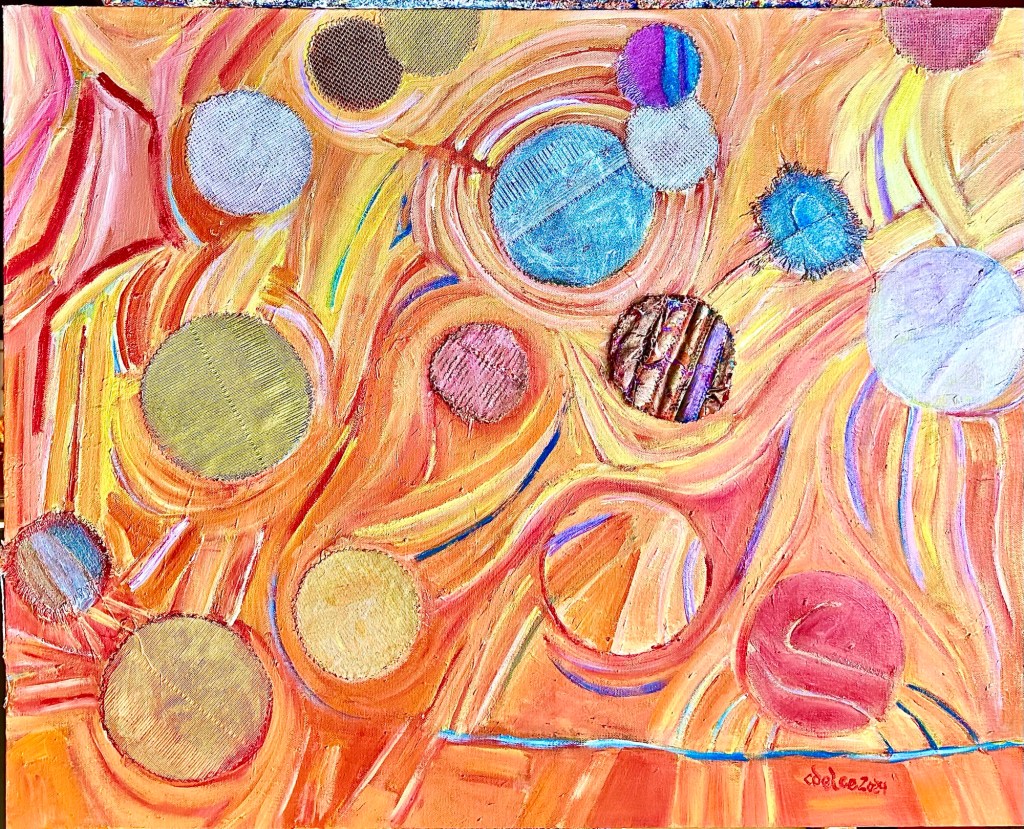
I finished at home an acrylic painting, which explores some of the same themes as the watercolors we’ve worked on in class. In this I used various material with different textures for my spheres. One of the circles is more three dimensional because it’s from a handmade cloth mask left over from the pandemic. I painted parts of it, also. The background has lines of “energy” all about.

While the Pythagoreans attempted to see unity and harmony in the creation in numbers, our Judeo-Christian faith recognizes God as creator of nature and nature revealing the Creator. One of the best texts to understand this distinction is 1 Kings 19: 11-13, in which Elijah meets the LORD on the mountain at Horeb:

(God) said, “Go out and stand on the mountain before the LORD, for the LORD is about to pass by.” Now there was a great wind, so strong that it was splitting mountains and breaking rocks in pieces before the LORD, but the LORD was not in the wind; and after the wind an earthquake, but the LORD was not in the earthquake; and after the earthquake a fire, but the LORD was not in the fire; and after the fire a sound of sheer silence.

When Elijah heard it, he wrapped his face in his mantle and went out and stood at the entrance of the cave. Then there came a voice to him that said, “What are you doing here, Elijah?”

No one has ever heard the music of the spheres, and the voice of God arrives in the sound of sheer silence. Perhaps that “polar opposite” of the Pythagorean’s world view was on to something after all. If we’re very quiet and still, we may hear both the music of the spheres and the voice of God in the great silence.

Joy and peace,

Cornelia


This Is My Father’s World | Hymnary.org

https://hymnary.org/text/this_is_my_fathers_world_and_to_my

Counterfeit Version of Botox Found in Multiple States | FDA

https://www.fda.gov/drugs/drug-safety-and-availability/counterfeit-version-botox-found-multiple-states

Pythagoreanism (Stanford Encyclopedia of Philosophy)

https://plato.stanford.edu/entries/pythagoreanism/

Spring Flowers

adult learning, art, Creativity, Easter, Faith, flowers, garden, Garden of Gethsemane, Good Friday, Holy Spirit, Imagination, incarnation, Israel, Ministry, nature, Painting, picasso, Prayer, purpose, salvation, Spirituality, Stations of the Cross, Travel

How many colors exist in creation? Many more than we can buy in a tube at the art supply store and even more than the number of paint chips at our local building supply store. Recently I gave my adult art class an assignment to use their primary colors and white only to mix new colors, since I noticed they were not getting middle values in their paintings. I too enjoy the brightness of the primary colors, so this was also a challenge for me.

Power of the Cross

The following week I needed to do less geometry and more nature, but I came back to the cross theme once again, for these flowers are from a photo of the Easter “Living Cross” at my church. While we can’t see the arms of the cross, anymore than we can see Jesus today, we know the cross is there, just as we know Jesus is present for us in the power of the Holy Spirit.

This makes Christ alive, not only in our hearts, but also in the lives of all who suffer: the poor, the immigrant or stranger in our land, and the oppressed. Even the land itself, which suffers from human caused climate change, can be a place where we meet the living Christ.

Spring Flowers

The Garden of Gethsemane in Jerusalem is a powerful place, for it was where Christ was handed over to his captors by a former friend. From there he went to death on the cross and resurrection for our salvation. This garden retains this energy of struggle: Jesus prayed to get his will in line with God’s will.

If the story ended here, we’d have no living crosses full of beautiful flowers on Easter Sunday. Out of pain and struggle comes great beauty. Most of us will avoid any challenge in our lives, thinking the easy way is the best way. Intentionally causing others to suffer pain isn’t acceptable for moral reasons: “do no harm” is a good adage, as is “do unto others as you would have them do unto you.” Setting achievable goals and challenges are different. These cause us to grow. They may also cause us discomfort, but this isn’t pain.

On this canvas, Spring Flowers, I had to overpaint and scumble to create the textured grays of the background. I even had to repaint the wispy border flowers several times to get their petals colored and straight, plus to get the ground varied enough to make them stand out.

One of the artists I most admire is Picasso, for he was always reinventing his style. Today artists pick a style and stick with it. Perhaps this is lucrative and makes economic sense. Still, I wonder what happens to the creative spirit when it’s not nurtured, challenged, and expressed. Of course, this may be the difference between a great artist and a good artist, and only the centuries will tell which among us now will be great.