Rublev’s Holy Trinity

art, epilepsy, Faith, generosity, Holy Spirit, Holy Trinity, Icons, inspiration, Painting, Rublev, salvation, vision

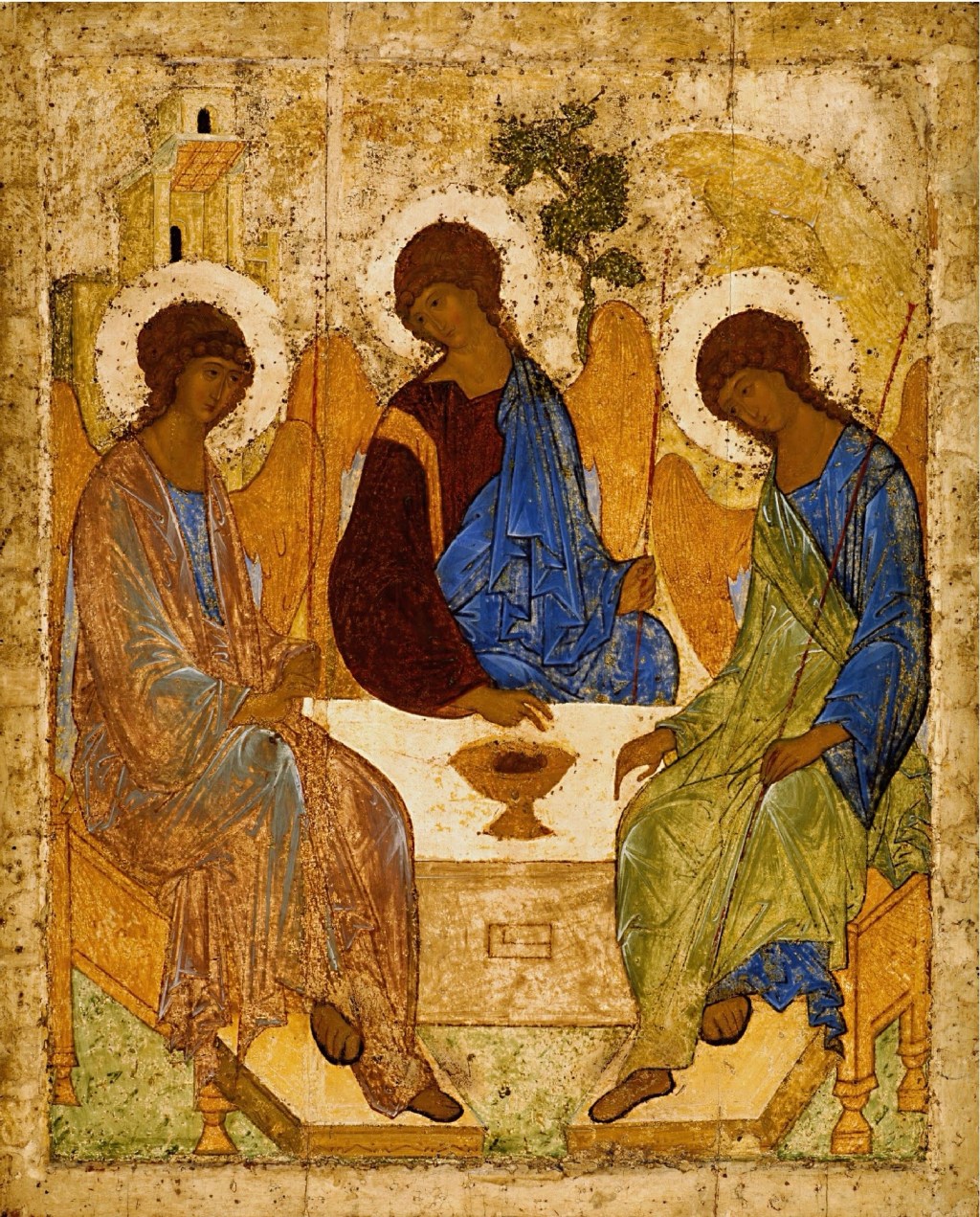
Rublev: The Holy Trinity, 1411 or 1425-27, Russia

One of my favorite icons is Andrei Rublev’s Holy Trinity because it not only has the theological theme of the Trinity, but also the message of hospitality to strangers. As Hebrews 13:2 reminds us,

“Do not neglect to show hospitality to strangers, for by doing that some have entertained angels without knowing it.”

This subject of this icon is the three angels for whom Abraham spread a feast in the wilderness where he and his barren wife Sarah lived while they tended their flocks. The angels appear with their walking staffs and sit at Abraham’s table set with a dish of food. In the background is a mountain, representing the wilderness and a tree, locating the scene at the oaks of Mamre.

Koulouris Iconography House: Saint George Greek Orthodox Church, West Bank Territory, Holy Land

Rublev’s palette is full of light with a predominance of gold, shining ochre, delicate shades of green, pink, and violet, and his inimitable sky-blue, too, in combination with the fine rhythm of lines and perfect composition. Altogether this produces an image of unearthly beauty and a heavenly harmony. This isn’t just a banquet in the desert wilderness, but a meal in the inbreaking moment in which we experience the timeless realm of heaven.

On earth, we count the minutes, days, and years, but in the company of God, we enter into the eternal and timeless experience in which God lives. Yesterday, today, and tomorrow are the same for the God who is known as I AM, for I AM lives always in the present and I AM is always becoming. There never was a time when the I AM was not. God always IS, even if we think God is not.

We may forget God, and our love may fail, but the steadfast love of the great I AM never fails because God’s love is, as the prophet Isaiah describes it (43:25):

“I, I am He who blots out your transgressions for my own sake, and I will not remember your sins.”

Copy of Rublev’s Holy Trinity, iconostasis at the monastery, 16th CE, St. Sergio’s Lavra, Russia.

Andrei Rublev painted the original icon in the Trinity-St. Sergius Monastery in either 1411 or 1425-1427. An artist made a copy of the Holy Trinity icon in the 16th CE. The Orthodox Church certified the Rublev Trinity as miraculous in 1626 and gave it a place of honor in the church, as well as metallic and jeweled embellishments. Over the next 500 years, artists restored the original Rublev icon several times. The early 1900’s saw two professional restorations: each one removed more layers of paint and lacquer until they revealed the original. The restorers decided hiding with a frame what was an “exclusive, in its worldwide importance, work of art” from the palette of Andrei Rublev was unacceptable.

Dating this important icon is more difficult than deciding its painter. Some think the icon was originally meant for the wooden Trinity Cathedral erected in 1411 and believe after the stone church was built, the congregation moved the icon there. Other art historians believe Rublev painted the “Holy Trinity” at the same time as his workshop painted the iconostasis in the new cathedral in 1425-27.

Rublev received a commission to paint this icon for the image of the Holy Trinity from St. Nikon of Radonezh: “an image for the Holy Trinity to be painted in his time, to venerate His Holy Father, St. Sergius the Wonderworker,” the monk who founded the monastery at Radonezh.

Since a cathedral dedicated to the Holy Trinity should have an icon of the Holy Trinity in it as its primary icon, the obvious choice was to select the best image that would convey the spiritual essence of the cathedral. This icon would embody the name of the Holy Trinity in color.

Icons have a purpose in worship, beyond mere mere beauty or illustration or teaching of doctrine. St. John of Damascus spoke in his “Apologies against Those who Decry Holy Images”, with which he addressed the Seventh Ecumenical Council calling on renowned painters for brave deeds, to set forth in their art the images of the Old and New Testaments, so that those who were not learned and could not read the Holy Scripture, would be able—by examining those stories—to enjoy the lives of holy men and their good deeds, for

“What the book does for those who understand letters, the image does for the illiterate; the word appeals to hearing, the image appeals to sight; it conveys understanding.” (Treatise 1.17)”’

Betsy Porter: Holy Trinity icon with Holy Communion

In other arguments against those iconoclastic believers, those who advocated instead for the use of images in worship reminded people the icon represents the truth of a spiritual reality. Some have compared the icon to a “window into heaven.” No one then or now worships the icon itself, but they do venerate the holiness of the person represented in the image. They hope to recognize the presence of God with them when they come to the quiet and stillness before the icon at their home altar and when they share in the presence of God in public worship in the sanctuary among the holy icons.

Abraham and the Three Angels, Mosaics in Santa Maria Maggiore, Rome (432-40 CE)

Theologically, the Western church has treated all three members of the Holy Trinity as coequal members, as seen in the mosaics of the 5th CE basilica of Santa Maria Maggiore. By placing all the heads on one level, or the use of isocephaly, the artist tells us the figures are equal in stature. Abraham is therefore lower than the heavenly visitors. Isocephaly is the art term which originates from the Greek words “isos” meaning “equal” and “kephalos” meaning “head”. We already know this word from our common knowledge: isosceles triangles have two equal sides and encephalitis is an inflammation of the brain, which is within our heads. (Sorry, old schoolteachers never die, but keep on explaining our 50 cent words; it must be that “back to school” time of year!)

Commercial Paper icon appliqué on wood panel “after Rublev,” but lacks the background architecture and has a substantial table without a cloth covering.

The Rublev icon has the heads of the three angels arranged in a triangle. They represent the Triune God. The center figure is slightly higher than the other two figures’ heads. This is because the Eastern Orthodox Church holds a slightly different view of the Holy Trinity. The incomprehensible God has indeed revealed God’s self in a manner that is incomprehensible.

All errors in trying to explain the Trinity come down to the following issue: we try to explain the living God, using a method of human thought—rational, natural, or philosophical—instead of witnessing to the reality and the truth of an encounter with the living God. To ask what God is, is the wrong question. Rather, who God is, is the primary question.

Prepratory stage

The answer is—God is Triune. We know God by God’s activity in the world, or energies, which we can see and can understand. In fact, all our understanding of God or what we say about God, comes from what God has done in the world, from God’s energies. The essence of God is still beyond our understanding, inaccessible to our understanding. If we could understand it, it would not be God, for God is beyond our understanding, as Isaiah 55:8-9 reminds us:

“For my thoughts are not your thoughts,

nor are your ways my ways, says the LORD.

For as the heavens are higher than the earth,

so are my ways higher than your ways

and my thoughts than your thoughts.”

Second day, making some corrections

Both the Western and the Orthodox Churches are in agreement as regards the unity of the Trinity as to the persons and their shared being. They also agree the Trinity isn’t three separate gods or three different revelations of one singular god. The Eastern Church and the Western Church did split over whether the Holy Spirit proceeded from the Son alone (East) or from the Father AND the Son (West).

Gaining on it, another studio day

The earliest creeds from the 4th CE didn’t even mention the Holy Spirit, mostly because the early church was combatting heresies about the nature of the Son (such as he was actually human, only appeared to be human, only parts were human, and other variations other than he was a full member of the Trinity and in Christ being fully human and fully divine).

By 381 CE in Constantinople, the creed included the words:

“And in the Spirit, the holy, the lordly and life-giving one, proceeding forth from the Father, co-worshipped and co-glorified with Father and Son, the one who spoke through the prophets; in one, holy, catholic and apostolic church.”

The first Latin council to add the phrase “and the Son” (filioque) to its creed was the 447 CE Synod of Toledo, Spain. The filioque formula was also used in a letter from the Catholic Pope Leo I to the members of that synod regarding opposition to a form of the fifth century manifestations of the Arian heresy which was prevalent among the Germanic tribes of Europe.

Stage 4, the draperies are taking the shape of the bodies

As football season heats up in the USA, we fight our culture wars on social media, not in the streets. The latest heresy for some is professional football teams now have male cheerleaders on the sidelines. The conservative rabble rousers destroyed their coffeemakers and burned their team jerseys in the past. Wearing paper sacks to maintain anonymity at the games is too yesterday. The recent announcement of the heroic and rugged Minnesota Vikings football team’s addition of two talented and athletic young male dancers is more than they can take. The keys of their favorite social media platform have been clicking and clacking. Radio waves are sizzling and heating up our already too sweaty summer.

Trinity, stage 5: two steps forward and one step back

The bishops at Toledo affirmed the Holy Spirit’s procession from both the Father and the Son to exclude the Arian notion of the Son being something less than a co-eternal and equal partner with the Father from the very beginning of existence. Street protests were common during this time over theological beliefs: the Catholics chanted, “There never was a time the Father was not a Father, the Son not a Son, and the Spirit didn’t proceed from both!” Against them, the Arians marched, “The Son was born, not begotten!” Exciting times, the late 5th CE.

Stage 6, details showing up

Several of our past GOP presidents were college cheerleaders, including Ronald Regan and George Bush. On a personal note, six decades ago, my big city high school in the Deep South had a tradition of boy and girl cheerleaders on a team of equal numbers to do exciting and complicated stunts. We were not aware of being “woke.” We were, however, always seeking to bring out the best of each person to reflect well upon our school and our city, which we represented.

Unfortunately, accusing the present NFL teams of being “woke” ignores American history, since the USA FEDERATION FOR SPORT CHEERING recognizes the first cheer in America as occurring on November 2, 1898 at the University of Minnesota, when student Johnny Campbell got up from the seats and took the field to lead the student body in a chant. If 127 years is too far back for people’s minds, we can turn to more recent history.

DeLee: Holy Trinity after Rublev, acrylic on canvas, 16” x 20”

Cheerleading is a metaphor for hospitality, which is one of the great attributes of the Holy Trinity. Hospitality is only possible where love resides and where community is experienced and practiced. Los Angeles led the way in 2018 by including two male dancers on their NFL Ram’s team. They were part of the Super Bowl LIII in 2019. Tryouts have always been “open,” but only women had shown up before. Like the strangers who showed up at Abraham’s tent, the cheer squad welcomed the men into the family and brought them under the protection of their group. When we practice hospitality, the “other” is no longer a “them.” The “stranger” becomes one of “us” because we reflect God’s loving nature to the vulnerable and we offer the bounty of our table to nourish their body and spirit.

I began working on this icon during social and personal distress. The social distress is obvious to anyone who reads a newspaper or watches a television newscast. Never have I seen so many professing Christians refuse to “love their neighbor as themselves,” or “do unto others as you would have others do unto you.” I don’t know how they sleep at night, for my own heart hurts for the pain inflicted upon the strangers who walk among us, who very well may be the Holy Trinity in earthly disguise. If we treat them like their next stop on their journey, only a few of us will walk away unscathed.

My personal distress comes from the blessing of living long enough, thanks to excellent medical care and the ability to live a structured, carefree life. As we age, medication affects us differently. My neurologist dropped the amount of my seizure medication, and my cardiologist upped my blood pressure medication. I was taking too much magnesium, so that was making me lethargic as well as lowering my blood pressure. Now that I’ve gotten stabilized, I feel a lot peppier.

Unfortunately, I began painting and drawing this icon while all this unwellness was going on. I can see “room for improvement,” as I always remind folks to say when critiquing their own art works. I have learned much from this time and have seen the icon in a new and closer light. I will come back to it again when I feel I’m more competent to give it my best.

A masterpiece always deserves the best we can offer, yet I rest secure knowing God has grace for those of us who are wounded, weak, or broken in any way. Whatever we bring in this time and place right now is the best we can offer upon God’s altar. God refuses no honest gift. If we spread peanut butter sandwiches on the table for the visitors as the offered feast because this is what we have, God will bless this gift.

The Holy Trinity of God lives in a loving community of self-giving hospitality and generosity within its unity of being. All three persons love, support, and care for one another in equal measure. As we humans would understand this: no one in the Trinity carries a heavier burden than another. In like manner, each person shares all the energies and work of the others.

The work of salvation may be through our faith in Christ’s work on the cross, yet it was the Father who sent the Son to redeem all creation and the Holy Spirit who brings us to the understanding of this saving grace. The whole work of God in Three Persons saves us if we have Trinitarian faith. And it is by the power of all the Holy Three we can stand against the hatreds and evils of this age.

Indeed, if we can offer any service well-pleasing to God, following the admonitions of Hebrews 13:1-2 would help all:

“Let mutual love continue. Do not neglect to show hospitality to strangers, for by doing that some have entertained angels without knowing it.”

Rublev: The Holy Trinity icon

Abraham’s angelic visitors blessed him and his wife Sarah with the promise of a longed-for son. We might learn to love our neighbors more if we shared our hospitality and opened our hearts to the people we meet. May you meet angels in your daily life and share whatever feast is in your pantry.

Joy and peace,

Cornelia

Andrei Rublev: Image of the “Holy Trinity,” The Tretyakov Gallery Magazine. Andrei Rublev painted the Holy Trinity icon, which is the central image in the cathedral’s iconostasis. One of the most famous Russian icons, he created it “in praise of St. Sergius.” The original is in the hall of Old Russian painting of the Tretyakov Gallery, in a special glass case with controlled humidity and temperature. In Trinity Cathedral you can see a copy of the icon to the right of the royal doors in the first (lowest) tier of the iconostasis.

https://www.tretyakovgallerymagazine.com/node/7196

Excerpts from Three Treatises on the Divine Images by St John of Damascus, translation and introduction by Fr. Andrew Louth, St Vladimir’s Seminary Press, 2003.

https://www.svots.edu/blog/st-john-damascus-divine-images

 A Miracle of Knowledge: St. Sergius of Radonezh / OrthoChristian.Com

https://orthochristian.com/41950.html

Venerable Nikon, Abbot of Radonezh, disciple of Venerable Sergius – Orthodox Church in America

https://www.oca.org/saints/lives/2016/11/17/103316-venerable-nikon-abbot-of-radonezh-disciple-of-venerable-sergius

Daily readings from the lives of the Orthodox Saints:

https://www.oca.org/saints/lives

Home – Icons: Windows Into Heaven – LibGuides at Duquesne University: This is a reputable source for orthodox icon information via the Duquesne Library. Links to outside sources are broken. Reference books are available elsewhere.

https://guides.library.duq.edu/icons

Mosaics in Santa Maria Maggiore, Rome (432-40): if you’ve never been to Italy, you can see the entire beautiful interior of this 5th CE basilica here.

https://www.wga.hu/html_m/zearly/1/4mosaics/1rome/3maggior/index.html

Introduction to Orthodoxy 4: The Holy Trinity – Orthodox Catechism Project

https://www.orthodoxcatechismproject.org/introduction-to-orthodoxy/-/asset_publisher/IXn2ObwXr9vq/content/introduction-to-orthodoxy-4-the-holy-trinity

First Council of Constantinople 381 – Papal Encyclicals

First Known Cheerleader was a Male Student

Vikings Respond to Male Cheerleader Backlash – Newsweek—12 NFL teams are reportedly set to have male cheerleaders on their squads this season. The teams as the Vikings, Ravens, Rams, Saints, Eagles, 49ers, Patriots, Titans, Colts, Chiefs, Buccaneers and Panthers.

https://www.newsweek.com/minnesota-vikings-respond-backlash-male-cheerleaders-2113864


The Mosaic Christ

art, Creativity, Faith, Historic neighborhood, Holy Spirit, hope, Icons, incarnation, inspiration, Italy, mystery, Painting, perfection, Ravenna Italy, Reflection, renewal, Spirituality, Travel, vision

The Body of Christ is All of Us

The Body of Christ represents the perfection of all humanity as the image of God. The body of Christ we know as the church is made of many individuals, just as a mosaic design is constructed of many pieces to make a whole. I think of these as the “two bodies of Christ,” even though the literalists among us might think Jesus has only one body. The mysterious body of Christ is what Paul speaks about in his letter to the Romans:

“For as in one body we have many members, and not all the members have the same function, so we, who are many, are one body in Christ, and individually we are members one of another” (12:4-5).

I Am the Bread of Life: Macaroni Christ Icon

Since each one of us is made in the image of God, but of ordinary materials, together we become a mosaic of the whole Body of Christ, going onto his perfection as we encounter and encourage one another within and without the church. After all, the body of Christ isn’t limited to the walls of our buildings, for Christ said in Matthew 25:40—

“And the king will answer them, ‘Truly I tell you, just as you did it to one of the least of these who are members of my family, you did it to me.’”

I have a penchant for recycling canvases and paintings which no longer please me. I’m willing to destroy them and make something new. They die and are reborn into a new life. I learned something from that former experience, but now it’s time to move on. When I read my Bible, I’m always getting new inspiration and ideas from the same verses. I have texts I’ve preached on at least a dozen times, but I always came at it from a different angle. This is how we know the Bible is a living document and the Holy Spirit is always at work in us to reveal what we need to hear for our time and place.

Basilica of Sant’ Apollinaire: The Good Shepherd

We Christians in the Western world have tended to limit God’s self revelation to the spoken word and, to a lesser degree, to the Eucharistic elements in the Institution of the Lord’s Supper:

“While they were eating, he took a loaf of bread, and after blessing it he broke it, gave it to them, and said, “Take; this is my body.” (Mark 14:22).

Unfortunately, when we emptied the world of images of God, we also emptied the created world of God. This is why art is so important and necessary to bring us back to appreciate not only creativity, but also the creating God.

Likewise, images in art are beautiful and inspiring. Some which I’ve had the privilege to see in person over the years have made a difference in my artistic and spiritual journeys. These are a few which have inspired me: Byzantine mosaics in Ravenna, Pompeiian artifacts buried by Vesuvius, and the sacred treasures of the Vatican.

Emperor Justinian

I’ll focus only on the mosaics in Ravenna, which is the site of the Mausoleum of Theoderic (c.520) and the Basilica of Sant’ Apollinaire Nuovo (500-514), both built by Theodoric the Great (454-526). Here too is the Basilica of San Vitale (c.527-546), begun by Queen Amalasuntha (495-535), Theodoric’s daughter; and the Basilica of Sant’ Apollinare in Classe (c.535-549), built by the Greek banker Julianus Argentarius, who also financed the church of San Vitale. These were all very important people of their time.

San Vitale, Ravenna

Although many of Ravenna’s surviving structures have been heavily restored, the city remains the most important site of Byzantine art outside Constantinople, notably for its exquisite decorative art, including mosaics, relief sculpture, mural pictures, ceramic art, maiolica, ivory carving, marble inlays, goldsmithing, ornamented sarcophagi and much more. This treasure house of art objects made Ravenna a must see on our itinerary during my summer in Italy.

My parents gave me the choice of a car or a trip to Italy with the University Systems of Georgia for my college graduation present. Of course, I took the trip. Cars are everywhere and I could get my own one day or ride the bus if I needed to get somewhere. Italy was a trip of a lifetime, for we’d spend a whole summer in the studios in Cortona, and travel about the countryside on day trips during the session. I even got good enough with my Italian to hold small conversations with native speakers. People even invited into their homes for lunch, where I got my first taste of rabbit. These animals were sold live in the farmer’s market in Cortona’s town square on Saturdays.

At every site we visited, I stood amazed in the presence of some ancient and inspiring work of art. In the historic churches, the best artists and craftspeople of the era had the opportunity to put their skills to good use, for they were not only working for notable patrons, but also for God. Money wasn’t an object either, for extravagance for God was considered a good work worthy of a heavenly reward.

Of course, seeing the art works and experiencing the spiritual impact of the works in their setting are two entirely different things. On a tour, when huge groups of people are tramping in and out of the sanctuary, tour leaders raise their flags, signs, or ubiquitous water bottles to quiet their group before they give a lecture, and then they turn en mass like a flock of ducks, everyone exiting together to clamber onto the bus or to walk to the next place to view some sacred site.

Golden Mosaics in San Vitale

As a person on a spiritual pilgrimage, this experience can be quite jarring unless you prepare yourself in advance. Even though in that period of my life I wasn’t a believer in a personal god, nevertheless I was still seeking the mysterious experience of the presence of God. I found if I took a few moments of personal quiet to put my spirit in a receptive mode before I entered the holy spaces, I was able to ignore the chaos around me. No longer did I focus on the comings and goings of the people around me, but I looked up instead at the beautiful artworks and the glory the ancient artists wanted to give to God as they rendered the images on the walls or sculpted the images.

These mosaics are fantastic works of art, with each image made of thousands of tiny pieces of stone and glass. In the early morning light, the golden tesserae shimmer and reflect the sunlight streaming inside. When viewed in this light, the figures would see to float in a heavenly light.

6th-century apse mosaic of Sant’Apollinare in Classe.

The icons of Christ always have an other worldly look about them, as Jesus said,

“My kingdom is not from this world.” (John 18:36).

We always see in the icon the resurrected body of Christ, the heavenly body of Christ, not merely the physical body of Christ. As Paul reminds us in 1 Corinthians 15:44—

“It is sown a physical body, it is raised a spiritual body. If there is a physical body, there is also a spiritual body.”

This is why the icons have elongated faces, small mouths, and large eyes. Their facial proportions are not “realistic “according to “actual proportions.” In western art, representation of physical reality with perspective, foreshortening, and shading gives us a sense of earthly realism. Icon “writers” reject perspective, and other cues of reality to give their works a sense of “other worldliness.”

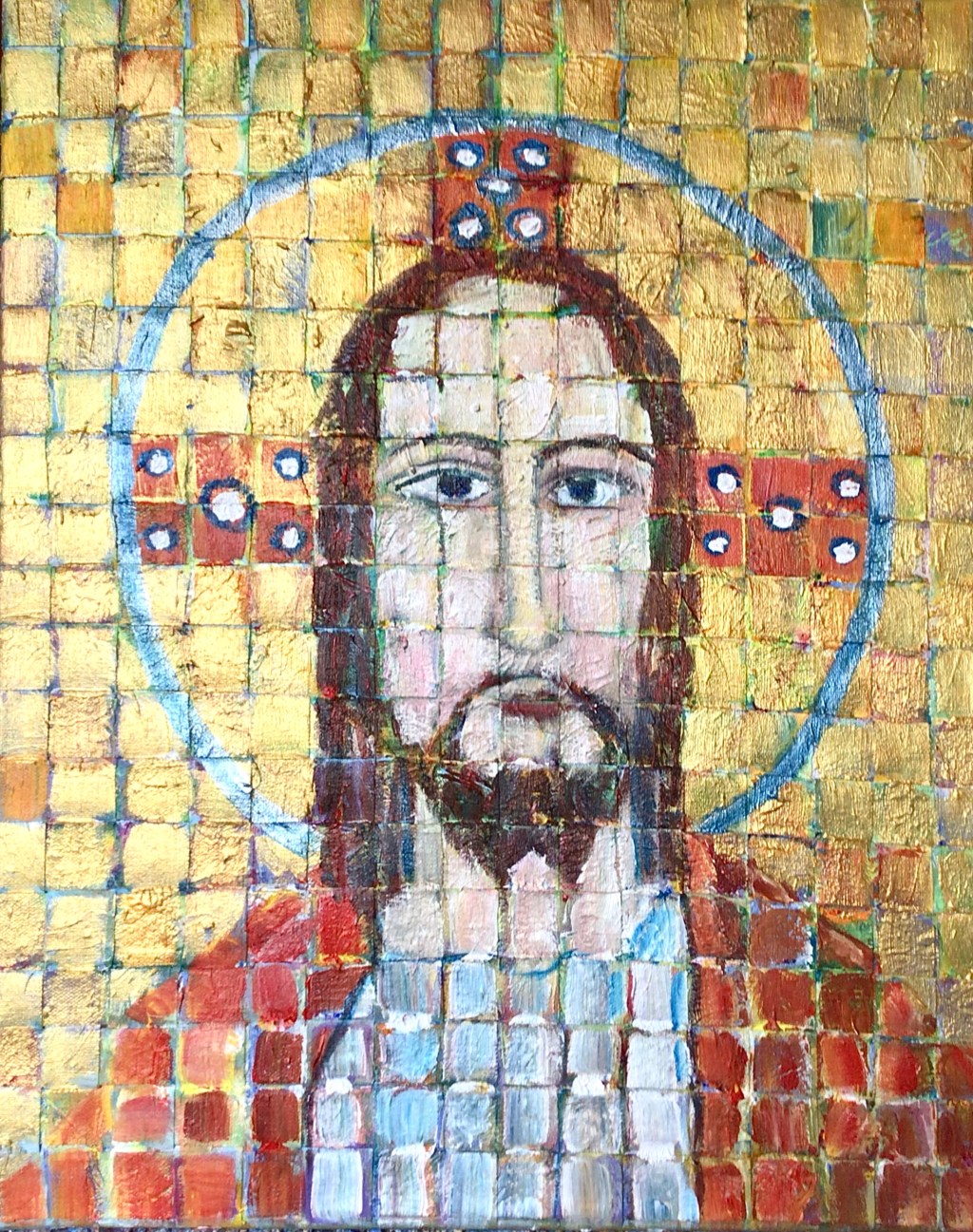
Mosaic Christ Painting

In other words, we see what we are going on to be, rather than what we are now. The icons are a window into the spiritual or heavenly world. If we have an icon in our home, it is a conduit to that heavenly world, much like a wormhole is a conduit to another point in space. Christ’s eyes have a far away look, as if he sees beyond this moment of now, in which we so firmly fix ourselves, to see the future hope of which the prophet Jeremiah speaks in 29:11—

“For surely I know the plans I have for you, says the LORD, plans for your welfare and not for harm, to give you a future with hope.”

This Mosaic Christ woven canvas art work has a light coat of gold acrylic paint over the multi colored background, so the colors show through. Because the brushstrokes don’t cover the whole square, the grid colors show up as colored mortar. The shape of the face and the hair aren’t treated subtly as in a painting, but take on the look of a mosaic.

When I paint an icon, I lose all sense of time. I enter into that holy time in which God IS, and where Jesus is when he says, “Very truly, I tell you, before Abraham was, I AM.” (John 8:58) In other words, I lose all concept of chronological time and enter into the kairos time of God: the right and opportune time, which is known only to God. I stop painting when I sense I’m taking back control of the brush, for then I’ve left kairos time and reentered chronological time.

I look at the clock and think, “Snack time.” It’s time to stop, take care of my physical body, until I’m once again able to renter that spiritual space where time has no meaning, for I’m at home with God. Painting a holy icon is a truly spiritual experience, for those who make their hearts open to the opportunity to experience the holy encroaching into this world. I hope your eyes now are more opened to seeing the holy image of God in-breaking into this earthly realm.

Joy, peace, and sugar cookies,

Cornelia