In times of cultural change and uncertainty, some faith-based communities turn to apocalyptic literature to find meaning, if not solace, for their suffering. Other communities of faith look forward to a future of hope and joy, even though they live in the same circumstances.
Apocalyptic literature is a genre of writing that appeared during times of crisis or persecution. It often presents a vision of the end times and the ultimate triumph of good over evil. Apocalyptic literature has several major characteristics:
“The supreme manifestation of Satan in this world is war.” By William Blake, 1805, apocalyptic painting with tempera, gum, glue, and chalks, Tate Galleries, London.
Dualism: Apocalyptic literature often portrays a cosmic battle between good and evil forces, highlighting the struggle between light and darkness.
Symbolism: Deeper meanings and abstract concepts are represented by symbolic language and imagery.
Eschatology: Apocalyptic literature focuses on the end times (Greek eschatos last, farthest) and the ultimate judgment of humanity, exploring themes of divine justice and the afterlife.
Pseudonymity: Many apocalyptic texts attribute their authorship to famous figures from the past, using pseudonyms or false names.
Visions and Dreams: Apocalyptic literature often includes visionary experiences and dreams as a means of conveying divine messages and revelations.
The future is fixed and decided in apocalyptic literature, whereas with prophecy, people can change their future by repentance and restoring their relationship with God.
Since John was already in exile, “The Revelation to John” doesn’t bother to hide his authorship for his safety. He does claim it’s a vision of Christ mediated by an angel. It also checks the boxes of good vs evil, symbolism, the end times, and a fixed future. The actual date of this future isn’t revealed, however.
An interpretive mistake many make is to take this letter written to encourage the persecuted churches of the first century and project its message into our modern-day society. The symbols which were meaningful to John’s audience are for that historical context alone. Reinterpretations of these signs to make them relevant to our current geopolitical situation is bad scriptural interpretation.
Plate 12, First book of Urizen, by William Blake
What we can do is ask, “What can persecuted communities or suffering societies of the past teach us about resilience, hope, and faith?” Some will focus on God’s destructive forces to eradicate evil and harm. Belief in God’s power to overcome evil is a source of deep comfort for people without power. These are often the ones who feel excluded from the halls of power, but also those who believe their privilege and place is slipping away.
God’s fridge would be covered with photos!
Both these groups forget they are beloved of God, just as God loves all God’s children. Sometimes we forget God’s refrigerator is large enough to have the photographs of all the people of the world on its door, along with all our latest art works also. If that’s a humongous refrigerator, then that gives us an idea of the expansive reach of God’s love, mercy, and grace for all creation.
The First Day of Creation, by Francisco de Holanda (1545), with caption, “Let there be light.”
A negative outcome of this dualist, apocalyptic belief is extremist beliefs about the end times. Unfortunately, some extremist pastors have convinced their followers to end their lives to meet their predicted apocalyptic end of the world. The leader creates the fiction of an evil out-group to bind the members more closely to their cult and proclaims apocalyptic themes to brainwash their members. Numerous mass suicides worldwide have occurred as a result, including 914 people of Jim Jones’ People’s Temple. In 1997, 39 members of the Heaven’s Gate cult in San Diego, California, committed mass suicide by poisoning to coincide with the arrival of the Hale-Bopp comet, considering this a signal for their exit from Earth. Others have given away their entire nest eggs to apocalyptic cults because “no one will need money in the new creation.”
Paul Klee: Clarification, 1932, Oil on canvas, 27 3/4” × 37 7/8” (70.5 × 96.2 cm), The Berggruen Klee Collection, 1984 Accession Number: 1984.315.54
Some of us prefer to focus on The New Heaven and the New Earth instead, as found in Revelation 21:1-4—
Then I saw a new heaven and a new earth; for the first heaven and the first earth had passed away, and the sea was no more. And I saw the holy city, the new Jerusalem, coming down out of heaven from God, prepared as a bride adorned for her husband.
And I heard a loud voice from the throne saying,
“See, the home of God is among mortals. He will dwell with them; they will be his peoples, and God himself will be with them; he will wipe every tear from their eyes. Death will be no more; mourning and crying and pain will be no more, for the first things have passed away.”
Stage 1—strings and base colors
What a day that will be! The last time God destroyed the earth with a great flood, God placed a rainbow in the sky as a promise the earth would never be destroyed again by water.
Leonardo da Vinci said, “Where the spirit does not work with the hand there is no art.” For some people, the only “good art” is representational art, or art which faithfully describes a landscape, portrait, or still life. With abstract art, colors carry emotions and shapes to form pleasing patterns for the viewer. What will the new heaven and the new earth look like? Revelation 21:11 says “It has the glory of God and a radiance like a very rare jewel, like jasper, clear as crystal.”
Stage 2—addition of gold and silver washes
While many today think of heaven as an earthly paradise, this concept is a Persian idea of an enclosed garden, much like the original garden of Eden. We tend to imagine a heaven as being a better place than the world we know, but imagining an altogether different world is next to impossible! Luke 20:27-38 is Jesus’ answer to the law-abiding Sadducees about how relationships work in heaven, and a reminder to us heaven isn’t just a perfect earth.
When I think of the providence of God, which is grounded in creation and is always recreating the face of the earth, I remember God’s promise to Noah in Genesis 9:11-13—
“I establish my covenant with you, that never again shall all flesh be cut off by the waters of a flood, and never again shall there be a flood to destroy the earth….This is the sign of the covenant that I make between me and you and every living creature that is with you, for all future generations: I have set my bow in the clouds, and it shall be a sign of the covenant between me and the earth.”
Stage 3—Added circles and more gold and silver washes
It is this cosmic rainbow of colors, the spiritual energies which most of us cannot see for the overwhelming ordinariness of daily life. We race from chore to chore, dash from task to task, and drop exhausted at the end of our days. We long for a better life, but we’re stuck on a galloping treadmill trying to keep our feet under us. I long to walk rather than run through my days. When I was younger, older people told me to slow down. As I hit middle age, I heard I would soon start slowing down. Now that I’m inching closer to 80, slowing down is finally becoming a reality!
Vincent Van Gogh said, “Paintings have a life of their own that originate in the soul of the artist.” We cannot see the new heaven and new earth unless we stop our busywork and allow God to attend to the business of our spiritual life. When we see the first glimmers of the new heaven and the new earth, we’ll realize how imperfect our world is and begin to help change it for the better, one small act of kindness at a time. This is soul work.
Sometimes that kindness first means being kind to ourselves, when we admit we can’t say YES to everything and everyone. When we admit we actually need eight hours of sleep for our health and a daily quiet time, and we can stop to study the flowers in the cultivated gardens of our neighborhoods and in our parks.
Cosmic Rainbow—acrylic on canvas, 24” x 30”, 2024.
Then we can be a beautiful rainbow, God’s light in this world for good, and bring the hope and joy of the end times to these times. We then will bring the radiance of the new heaven and the new earth to this present age and to these yearning people.
Joy, peace, and rainbows,
Cornelia
what are the five major characteristics of apocalyptic literature – brainly.com
Middle English paradis, paradise “the Garden of Eden, heaven,” borrowed from Anglo-French paradis, borrowed from Late Latin paradīsus, borrowed from Greek parádeisos “enclosed park or pleasure ground” (Xenophon), “the Garden of Eden” (Septuagint), “the abode of the blessed, heaven” (New Testament), borrowed from an Iranian word (perhaps Median *paridaiza-) cognate with Avestan pairidaēza- “enclosure,” nominal derivative of pairidaēz- “build a barrier around,” from pairi- “before, around” (going back to Indo-European *per-i, whence also Sanskrit pári “around, about,” Greek péri “around, in excess”) + -daēza- “heap up, build” (occurring only with prefixes), going back to Indo-European *dhoi̯ǵh-éi̯e-, iterative derivative of *dhei̯ǵh- “knead, shape” — more at PERI-, FEIGN
NOTE: As an independent derivative of the verb, Avestan daēza- “heap, pile (of earth, stones)” has been compared with Greek teîchos (neuter s-stem) “wall, fortification,” toîchos (masculine) “wall of a house or enclosure,” Sanskrit dehaḥ “body,” dehī́ “wall, embankment,” Oscan feíhúss (accusative plural) “walls.” For a Germanic derivative from the same verbal base with a different sense, see DOUGH.
I don’t don’t know about you, but I don’t willingly sign up for pain or suffering. Pollen season isn’t my friend. I could do without all this yellow and green stuff clogging my brain cells and my lungs. As I cough and die, swill decongestant tonics, and huff my asthma inhaler, I wonder if this particular cross bearing has to be on my things to do list every Lenten season.
Mid 10th CE ivory Deesis Icon, Metropolitan Museum of Art, NYC
As Jesus turned his face towards Jerusalem, he knew his fate was certain. His message began to change, as he told his followers in Luke 14:27, “Whoever does not carry the cross and follow me cannot be my disciple.” Of course, not all were ready to hear or to follow, for some had obligations at home, and others weren’t yet ready to live the itinerant life. Many today don’t answer the call to ministry because they can’t see the long unknown road ahead. Only those willing to walk by faith and not by sight will journey off, trusting in God’s providence, mercy and grace.
Earliest sculpture panel of the Crucifixion, Maskell Passion Ivories, 420-430 CE, one of four carved panels of a sarcophagus, British Museum, London.
I used to say, “Give me a few months and I can whittle any group down to size. I can prune with the best of gardeners—all I have to do is read actual scripture!” I figure if folks want to get mad, they should take it out on the original writers. Blaming the messenger is useless. As the apostle Paul says:
“For the message about the cross is foolishness to those who are perishing, but to us who are being saved it is the power of God.” (1 Corinthians 1:18)
The oldest icon of the Crucifixion of Christ, Greek Orthodox Holy Monastery of St. Catherine, Mount Sinai, 8th CE
The ancient crucifixion icons glorify the triumph of the Incarnate God and his victory over death, which is the consequence of our fall; that fatal moment in the garden of Eden when Adam and Eve chose to desire to be like God, even though they had only the image, but not the ability to be gods themselves. Icons of the crucifixion represent Christ who, fully human and fully divine, takes on death so humanity no longer has to die. Christ conquers death by being a suffering servant, he becomes a victorious king.
Mary from the Hagia Sophia Deesis mosaic
Most of us would rather jump to the Bible’s Victory story and skip its Victim sections because we live in an age which validates the strong and successful, while denying the worth of the weak and wounded. Easter and Palm Sunday are more triumphant celebrations than the sonorous and somber Foot-washing Maundy Thursday and Good Friday Vigils. Yet without suffering, would we have cause for rejoicing? Would we even know the meaning of joy without some pain in our lives? Everyone has some pain in their life, whether it’s the pain of an unrequited love, the loss of a child stillborn, a divorce, a war wound, a frenemy wound, or some other brokenness.
Stage one
Mary knew early on her child of destiny would bring her both joy and pain, as all mothers discover soon enough. Luke records in 2:34-35,
“Then Simeon blessed them and said to his mother Mary, “This child is destined for the falling and the rising of many in Israel, and to be a sign that will be opposed so that the inner thoughts of many will be revealed—and a sword will pierce your own soul too.”
Deesis. Top center front panel of the Harbaville Triptych. Ivory. Ca. 940-960 CE. Musée du Louvre, Paris.
Many today only want to show the happy times in their hyper-curated lives on social media. As a result, “Keeping up with the Joneses” gets harder all the time. With Facebook’s constant encouragement of “you may know algorithms,” we’re encouraged to add more friends to our circle. We’re exposed to too many families of that surname, when once we only knew a few who lived in our own neighborhoods. If all these Jones folks are always smiling widely for the camera, we might be tempted to ask, “Why don’t I feel like smiling also?”
I know people who don’t read newspapers, watch the news on television, or even listen to the snippets on the radio. “Too much bad news!” They too don’t want to hear of the suffering, the plight of the weak, or face their seeming impotence to do anything about it. We are weak people. We are not strong, no matter how often we quote passages like Philippians 4:13—
“I can do all things through him who strengthens me.”
Richard Rohr, in The Enneagram, A Christian Perspective, says, “It is the things that you cannot do anything about and the things that you cannot do anything with that do something with you.” Suffering and prayer are what truly transform us, if only we don’t waste time looking for someone to blame.
13th CE Hagia Sophia Mosaic, Istanbul, Turkey
So far, no one person has been able to stop the Russian invasion of the democratic nation of Ukraine, but plenty of people are holding up an aid package that would help this small country fight this battle at great cost to life and limb. The Ukrainians suffer and America dithers. We seem to think our leaders have infinite powers, as if they were gods, but we forget all people are only human and have only the image of god, but no huma has either the power or the glory of the true God.
Unknown Ukrainian Artist: The Deesis, Icon, Tempera, silvering on gesso-grounded two-piece fir-wood panel, engraving, carving; 1735, h 114, w 84, d 9, National Art Museum of Ukraine.
So far, no one person has been able to keep either Hamas or Israel from wreaking havoc on each other. My daddy used to say, “you can’t make a silk purse out of a sow’s ear.” After years of teaching and pastoring, I’d throw my two cents in: “we can lead a horse to water, but we can’t make it drink.” As long as people are invested in retribution, they will return suffering for suffering. The sad truth is people who have never processed their own suffering will cause suffering for others as well as for themselves. The children will cry. And the women will cry. But now the men are crying too.
Late Roman Magical gem; intaglio; green-brown jasper; oval; bevelled edge on side B, 2nd-3rd CE, British Museum, London.
No one has a magic wand to eliminate suffering or harm. In ancient times, the image of the crucified Christ was used as a magic charm to keep the wearer from harm. Some people today wear a cross for the same reason; it’s a fashion statement, a good luck charm, and a symbol of their faith. Instead of a charm, we offer acts of prayer and mercy.
Hagia Sophia Deesis Mary icon 2024, finished
We don’t just cry for the fact of the sufferings we endure, or for the sufferings of others, but we cry out in our suffering to the only one who can hear us, heal us and make whole our broken hearts and homes. We cry out to the God, who created all of us in God’s own image out of the dust of an obliterated and bombed out land. We cry out to the God who brings rains in their seasons to a land parched by climate change and ruined by reckless use of natural resources. We cry out to the God who raised God’s son from the dead, even as people everywhere bury their own dead sons and daughters from the wars fought by nations and non-state actors who wrestle for power in tiny slivers of contested territories.
Christ and the Apostles in the Heavenly Jerusalem, apse mosaic, early fifth century, Rome, Santa Pudenziana.
We can see in this image a dramatic transformation in the conception of Christ from the pre-Constantinian period. In the Santa Pudenziana mosaic, Christ is shown in the center seated on a jewel encrusted throne. He is surrounded by apostles, biblical women, and symbolic images of the four gospel writers. The ideal landscape is the New Jerusalem, or the Heavenly Kingdom. This image was created after Constantine’s victory and conversion to Christianity. Prior to this, Christian art repurposed Greco-Roman themes of the Good Shepherd and the Apollo Sun god.
Unknown Artist: Plaque with Christ flanked by the Virgin and Saint John, late 19th–early 20th century (Byzantine style), Cloisonné enamel, gold; 6 9/16 x 5 9/16 x 1/16 in. (16.6 x 14.1 x 0.1 cm); Metropolitan Museum of Art, NYC, Gift of the Estate of Mrs. Otto H. Kahn, 1952, Accession Number: 52.54.1
The Byzantine Empire was fond of the Deesis Icon, which has Christ in the center bounded by the Virgin Mary and the Precursor, John the Baptist, on either side. They both entreat the Lord in prayer. This was one of the most widespread middle Byzantine icon types. The name comes from the Greek δέησις or “supplication,” which in Byzantine art, describes a representation of Christ enthroned and flanked by supplicants, such as the Virgin Mary, St. John the Baptist, or other saints and/or angels. Images of the deesis often appear on an iconostasis, or the screen separating the altar from the people. The subject matter traditionally represents the first witnesses to Christ’s divinity, the Virgin and Saint John, who came to be seen as holy figures who would act as intercessors with him on behalf of humanity.
The Deesis. End of the 17th century. Northern Russia. Wood, gesso, tempera. Found from the village Nizhnyaya (Dolgovitsi), Tarnoga Raion, Vologda Oblast. Collection of Nikolai Kormashov.
Nikolai Kormashov, an Estonian artist and collector, who collected and restored a great collection of 15th-20th century Russian icons during his lifetime said, “That which is not destined to perish, announces itself again and again, to attest to elusive spiritual beauty and the light of truth.”
The truth is all people of every country and culture in every age will suffer, but God isn’t removed and distant from our pain. God, through the incarnation of the Son, has experienced our human suffering from the birth pangs of Christ’s birth to the hunger, thirst, and weariness of his itinerant earthly preaching. Not only this, but God through God’s Son knows the heartbreak of betrayal and insult, the sting of the whip, and the pain of death on a cross.
The light of truth for the Easter season is this: in the midst of darkness and death, God raised his Son to light and life, so we too might lose the chains of sin and death and live to light and love. As the people of prayer, we ask for the gift of hope to give light to those in darkness and a helping hand to those in need.
Joy and peace,
Cornelia
Relief plaque icon, depicting the Deesis Crucifixion with full-length figures of the Virgin on the left and St John on the right, Late Byzantine (13 thc). Materials: Steatite – Gold
Greek déēsis entreaty, equivalent to deē-, variant stem of déesthai to beg + -sis-sis
Leonid Ouspensky: The Meaning of Icons, revised edition, St. Vladimir’s Seminary Press, Crestwood, NY, 1999, p. 180.
Image— The oldest icon of the Crucifixion of Christ at the Greek Orthodox Holy Monastery of St. Catherine on Mount Sinai is an extraordinary testament to the intricate relationship between the Greco-Roman art heritage and early Christian iconography. This invaluable artifact offers a unique glimpse into the artistic and cultural milieu of the time, highlighting the exchange of ideas and the shared history that shaped the development of Christian art in 8th CE. See following link for comparison of early Roman and Christian art.
I was reading an article in the New York Times the other day. In “How I Learned to Love Finishing Last,” the author wrote about her slow pace as a runner. As one who regularly finishes last in my age group in the annual Spa 5K Walk each November, I’m optimistic one day I might get old enough to be in a nonagenarian age group all on my own. Perhaps if I’m 90 and still doing a 5K, they’ll give me a ribbon just for participating! “The last will be first and the first will be last,” especially if there’s only one of us in the race!
“When we compare ourselves to others,” said Dr. Justin Ross, a clinical psychologist in Denver who specializes in athlete mental health and performance, “we set ourselves up to suffer. Instead, the real psychological benefits come from enjoying what your body can do.”
Portrait of Yayoi Kusama in costume in front of pumpkin painting, photo: Noriko Takasugi
Suffering physically isn’t what art class is about, although we may suffer indignities to our egos, but this shouldn’t hold us back from doing our art works. The case of the Japanese artist Yayoi Kusama is evidence even hallucinations of voices and images can’t keep an artist from creating. If our daily efforts don’t measure up to what we imagined in our mind, it’s merely because our inner eye sees better than our hands can execute our vision. Sometimes our eye forgets what it once learned, for we haven’t used our skill of looking in a while. A runner doesn’t leap off the couch and immediately run a marathon or even a 5K. The smart athlete takes the time to train progressively for the distance beforehand. Also, they get new shoes.
Kroger Run: Two ghost pumpkins and a small pie pumpkin
Sometimes the coach has slept over the summer also. Just as students in school need a time to relearn last year’s lessons, as a coach in art class I sometimes forget the lessons, which are second nature to me because they’ve been inculcated by multiple teachers since I was eight years old, aren’t as ingrained to my own students. I also forget I’m always observing everything around me: cloud patterns, changing colors on trees, sunlight dappling on tree branches, shadows on the ground, and reflections in windows. I think about these patterns rather than about what I need to do next or next week. My calendar will remind me of these things in due time. I’ll be wrapping this up soon so I can work on my monthly Rabbit blog.
Rabbit playing “Hide the Pumpkin.”
A National Institute on Aging study found five healthy lifestyle factors — physical activity, not smoking, not drinking heavily, following the Mediterranean-style diet, and engaging in mentally stimulating activities — can have important benefits. People who engaged in four or five of these behaviors had a 60% lower risk of developing Alzheimer’s compared to those who only followed one or none. People who followed two or three of the activities had a 37% lower risk. This is your free wellness plan from Dr. Cornie, who has no medical degree, but did stay in a Holiday Inn once.
Debunking the Myth of the Split Brain Theory
Although we commonly think art is a “right brained” activity, in 2013 a group of researchers at the University of Utah discovered people actually use both sides of their brains equally. Back in the 1970’s when I was seeking employment after graduate school, the “Art is a right brain myth” ruled the creative work world. I once suggested I’d be a good candidate for a museum position because I understood both the artistic and the logical mind. I was not hired. Intuitive understanding of the brain a half century ahead of time doesn’t exactly open the doors to a fancy job.
As I recall, I got a checker’s job in a grocery store and ended up counting the teller trays and preparing the bank deposits for that store. The good news is creating works of art is a multi-process activity, one that depends on several brain regions and on redundancy of art-related functional representation rather than on a single cerebral hemisphere, region or pathway. This means even when we lose our ability to form words (typically a left hemisphere activity) our ability to create art still exists. We can still express our inner feelings and thoughts. This is good news for the aging and those who love them.
One one the great sadnesses in my ministry is being with young people who desperately want to have their old one’s memories recorded, but waited too late to ask them or were too busy with their own lives to sit and listen to these stories of the olden days. Once their old person has a stroke and loses the ability to form words, the opportunity has passed. Those stories will be locked in their minds due to aphasia, and no one or no amount of time will pull them out. We always tell young parents their babies need to be enjoyed while they’re still young, but we should also tell families to get the stories of their elders while they still can. “Strike while the iron is still hot” will take on a new meaning one day.
We needed bigger pumpkins
Gail and I were the only ones in class today. Lauralei showed up to gift us chocolate cake and keep us company. Tim and Mike were out of town. Gail and I both repainted old canvases. I showed some of the unusual ways pumpkins have been decorated by various artists, but none of them sparked any interest. We got down to work by covering our old canvas with a base of titanium white paint. Then I located all three of the pumpkins with circles and drew a baseline for the object on which they sat. I didn’t look over at Gail’s work for a while, but then I noticed she’d almost completely finished one pumpkin without roughing in the shapes of the others.
Gail had a big canvas today.
“Did you plan on finishing that one pumpkin before drawing the other two?” I asked.
Gail gave me a “needs more caffeine” stare.
“That’s what I thought. Maybe next time draw in the rough shapes so you get everything located in space relevant to each other.”
Pumpkin Spice Latte Time
We kept on painting until clean up time. I often say “I’ve slept since then.” It’s my all purpose excuse for forgetfulness or just plain airheadedness. Sometimes I have my mind on other things and I’m not focused on what’s in front of me. I forget about the wisdom of Brother Lawrence, who said “many do not advance in the Christian progress because they stick in penances and particular exercises while they neglect the love of God which is the end. This appeared plainly by their works and was the reason why we see so little solid virtue.” He also said, “there needed neither art nor science for going to God, but only a heart resolutely determined to apply itself to nothing but Him and to love Him only.”
Cornelia’s small painting of pumpkins
We know Brother Lawrence from the classic text, The Practice of the Presence of God. Although it dates from the late 17th century, his lessons on living life in joy in the present moment, all for the love of God are invaluable for us modern folks who tend to live for our 15 minutes of personal fame, social media clicks, or self interest. We aren’t used to the monastic life today, or to the discipline of that lifestyle. We live in a Burger King world, in which each individual gets his or her own way to every extent possible. Unfortunately, the Christian lifestyle is one of discipline, but not harsh punishment:
“Now, discipline always seems painful rather than pleasant at the time, but later it yields the peaceful fruit of righteousness to those who have been trained by it.” ~~ Hebrews 12:11
In art class we focus on the disciplines, just as the guild artists taught the apprentices back in the day. These disciplines are not only for safety, for some of our art tools are dangerous, but also some of our techniques are proven to yield better results than others. This is why carpenters measure twice and cut once. They also cut on the outside of the line, rather than the inside. They can shave down a piece easier than adding to it. Murphy’s Law recognizes this: “A wire cut to length will be too short.”
Zen Tangle drawing of pumpkins: exercise in texture
Art class has no mysteries, but we can forget the “secret gnostic knowledge passed down by word of mouth” from our previous classes. I often use the excuse “I’ve slept since then.” Another good excuse is “My mind has gone to Pluto.” I share these with you all, for they’ve always worked for me. Of course it helps to be a natural blonde. Then again, I’m very organized, but I’m also very active, so sometimes my calendar gets overwhelmed, and I pull out the “OOPS! Card.” Even in retirement I’m still creating and sharing my faith through art and writing. It’s my way of exercising those brain cells to keep them from dying off. We old folks can still learn new things, even if it takes longer. This is what we call the persistence of effort. Those who keep using their skills won’t be losing those skills.
The same goes for learning a new skill. It’s all a matter of repetition. We can’t get frustrated if we don’t get it on the first try. We won’t be a good role model for the young if we have that attitude. We need to lower our expectations. I used to think I couldn’t knit, but only crochet. After my mom, who was a stellar knitter passed on, a friend taught me to knit in an afternoon! Where this sudden bilateral coordination came from I have no idea, but it was so welcome. Perhaps I needed to be in the right frame of mind, or I wanted to be able to carry on my mom’s memory, but I was definitely receptive to her teaching.
Letter to Theo Van Gogh, September 18, 1888
It’s never too late to learn and we’re never too old to start learning. Art isn’t just good for the brain, but it’s good for the soul. Art is our attempt to represent truth, beauty, and nature in media that can be accessible to others. By doing this, we bear witness to the creation and the Creator. We only need give our best efforts, and let God’s Spirit guide our growth.
Joy, peace, and perseverance,
Cornelia
We have pumpkins galore on the autumn altar.
How I Learned to Love Finishing Last
How the Aging Brain Affects Thinking | National Institute on Aging
Welcome to June! I’ve found my sunshades and my flip flops, so this rabbit is ready for a summer vacation. Old school teachers never die, they just take the summer off. And teachers, as well as students, will need a summer off, along with some intensive counseling, to get them ready to return in a healthy frame of mind next fall.
Summer Solstice Mandala
In my early years in ministry, I served in a certain county where many people were caught up in despair. I often complained to my district superintendent of my desire to pour mood elevators into the public water supply.
“You do know drugging the water supply isn’t exactly an acceptable activity for a Methodist minister?”
“Oh, yeah, but it sure would make my job easier.”
Rabbits Love One Another
Remember, June 3 is Love Conquerors All Day. I need to remind myself of this on occasion when I want to take the easy road. As Jesus reminds us in Matthew 7:13—
“Enter through the narrow gate; for the gate is wide and the road is easy that leads to destruction, and there are many who take it.”
Taking the easy way out isn’t always the best choice, but it’s the one we rabbits most often choose. We rabbits don’t like to rock the boat, and we like to make all the other rabbits happy if at all possible. The only problem is if we please A, B gets upset. If we please B, A gets upset. We don’t even try to please C, since C is so cranky, even the good Lord Jesus couldn’t fry an egg to please them. We set our hearts and minds on pleasing God, as best we can, and hope to hear the words, “Well done, good and faithful servant, enter into the joy of your master.”
Make Mine Chocolate Ice Cream Day
Chocolate ice cream brings me joy any day of the year, but June 7 is a day dedicated to this frozen delight. Don’t worry about frying eggs, but keep it frozen. I like mine plain, but fresh strawberries or peaches are a nice addition, plus some chopped nuts. Always go for complex, unless you just can’t wait. Then grab a spoon and eat it straight from the pint. (Mark it with your name, since you ate from it.)
Often we cut the Gordian Knot and go for the shortcut to our complex problems. Sometimes this is a good solution, for the shortest distance between two points is a straight line. My daughter used to call my vacation navigation shortcuts “the long cuts,” since I’m directionally challenged. Most of the time, that straight line went through swamp land and alligators. I can hear her voice now, “NOOOOO!!!” I’m known for taking the scenic route, so I often see America’s less known sights, which are off the beaten path.
In the gospel of Luke (14:34), Jesus quotes a proverbial saying:
“Salt is good; but if salt has lost its taste, how can its saltiness be restored?”
Another translation of the latter portion of this verse is “how can it be used for seasoning?”
When I think of loss, I think of a life snuffed out. Some people are burned out, so we can say they’ve lost their seasoning ability. There’s no vim or vigor in them. Other lives are cut short and aren’t able to fulfill their purpose to season the great soup of our community. Our past month was marked by 47 mass shooting incidents in May alone. A mass shooting incident is defined as one in which at least four people are injured or killed, not including the shooter. Suicides aren’t included.
Suicides are also a public health problem. They are the “deaths of despair” that leave ripples of grief and hopelessness in the survivors. They’re the ultimate shortcut solution to a problem, the placing of a period where life has placed a comma or a semicolon. My daughter once attempted suicide by downing half a bottle of aspirin. I noticed the open bottle and pills scattered across the floor. She said the “dog ate it.”
“That’s too bad, I’m going to miss that dog. She won’t be long for this world. We’ll need to make burial plans for her.”
“Well, actually, I’m the one who ate the aspirin.”
“Then we’re going to the hospital. You aren’t going to like getting your stomach pumped, but it’s better than being dead. You want to have a chance to grow up and have a good life. A dog we can replace. You—not so much.”
It was a rough time in her life, and mine too. But God was with us. And we had support from counselors, friends, family, and our church family. My work family and my clients supported me too. I must be the most extroverted rabbit in the patch, because I asked everyone for help. It turned out my problem was shared by everyone else. I discovered I wasn’t alone, but was the most ordinary of rabbits around.
This is a humbling experience, especially when you’re a first child and the only girl. I admit to being spoiled, but don’t let my brother rabbits hear me say this. I’ll deny it to my last breath: I’m like every other rabbit I know. I want to think I’m someone special, even when I’m just as fluffy as every other bunny out there on Gods green earth.
June 21—Summer Solstice
Unfortunately, half the suicides today are committed with a gun, not aspirins. When looking at overall gun deaths, roughly two-thirds are attributed to suicides—a proportion that is consistent across most states. Gun suicides are on the rise and data also indicates men, white Americans, older people, and individuals living in rural areas present higher rates of gun suicides. Another group presenting a unique risk for suicide is current and former members of the armed forces, especially those with PTSD.
Compared with the general population, current and former military members have significantly higher rates of gun ownership. According to a 2015 study, nearly 50% of U.S. veterans own a gun. In contrast, studies suggest that only about 22% of the general U.S. population owns firearms. Similarly, the age groups of 50 to 64 years old and 65 and older have the highest rates of gun ownership, according to a 2017 Pew Research Center study. This can further explain the high rates of suicide among older veterans.
According to data from the U.S. Department of Veterans Affairs (VA), in 2019, close to 4,332 veterans died by gun suicide in the United States, representing close to 18 percent of the total number of gun suicides reported by the Centers for Disease Control and Prevention (CDC) during that year. Perhaps more alarming is the fact this figure shows a veteran is killed by gun suicide every two hours. In 2019, active duty military members committed suicide by gun 64% of the 498 total (318), almost one gun suicide per day.
Why isn’t anyone speaking about this? For all the lip service our politicians give to the flag and to the armed service members, they seem to forget them once they’re no longer useful to fight their wars or march in their parades. Perhaps because Congress won’t devote any money to study the effects of gun violence on the citizens of our Beautiful America, so we have to fund private studies here and there to piece together a patchwork of facts of this scourge on the peace of our people.
My young neighbor, only 8 years old, was in a panic as he knocked on my door the other day. His parents hadn’t come straight up the elevator, as they’d said they would. He was crying to beat the band and was sure something bad had happened to them. I invited him inside and left the door open so we could see them come past. He was so worked up, he couldn’t sit down. I suggested a call to his daddy, but they came walking past just at that moment.
June 19—Father’s Day
We don’t realize what terror these school shootings put our children through. There’s no safe place for them any more, no matter how “hardened” we make the buildings. Some person always breaks the shell at the most inopportune moment.
Some rabbits will have empty seats at their family reunion tables because someone decided to act impulsively. Father’s Day (June 19) won’t be a celebration without the son or daughter to give Dad the tie, the golf balls, or breakfast in bed.
I think back to my own childhood. We worried in the 1950’s more about the urban legends of Halloween candy poisoning, when we were more likely to get killed crossing Highway 1, a four lane highway running through our town. My mother rabbit would wait for me to ride the trolley home from school. She would wait until the near lane of traffic cleared before she walked out to the center median and time this so the far lane’s cars would finish passing so she could walk across the newly empty lanes to meet me on the other side. We held hands and crossed in the same manner on the way back to our home.
This was our routine from the start of school until sometime in the autumn. Mother was delayed one day, so I sat down to wait for her and opened my book to read. I was wearing a brown jacket against the early cool spell, and my dirty blonde hair blended in with the pile of dry leaves on the ground. Intent on my book, I failed to see her come outside. She overlooked me and went inside thinking I’d missed my ride.
A bit later, I decided if she wasn’t coming for me, I’d come to her. Gathering up my possessions, I stood on the curbside. I watched the comings and goings of the quickly moving traffic. Once I saw the break in the pattern, I walked out into the clearing, waited at the median, and crossed behind the trailing traffic of the second lane. When I walked inside, my mother had a conniption fit. After this, I began riding my bicycle to school, and my brother got to come with me.
Brain Functions
Not everyone is mature enough to cross a four lane busy highway by themselves when they’re in the fourth grade, which is the same age as the children who lost their lives at Robb Elementary in Uvalde, Texas. . Some people still need to be supervised at work even in their 20’s. The brain keeps maturing past age 21, as the frontal lobes, which are home to key components of the neural circuitry underlying “executive functions” (such as planning, working memory, and impulse control) are among the last areas of the brain to mature; they may not be fully developed until halfway through the third decade of life. Although neuroscience has been called upon to determine adulthood, there is little empirical evidence to support age 18, the current legal age of majority, as an accurate marker of adult capacities.
Since May 24, the date of this tragedy in Uvalde, Texas, the gunviolencearchive.org has recorded 16 mass shootings in six days, with 79 killed or wounded. Some of these are high school graduation parties where uninvited guests arrived and gunfire broke out, others are the result of young people wandering about in the late hours and getting into trouble with guns. During my time of ministry, youth, alcohol, and firearms were usually a recipe for trouble. Maybe parental rabbits’ brains are still developing too, if they aren’t able to put their rabbit foot down and tell the junior rabbits to leave their weapons at home. Visiting Jack Rabbit in jail for accidental death or intentional use of a firearm will throw a curve into your best laid plans for your progeny.
Rabbits in Cars Going for a Joyride
Instead, cities may have to reinstitute curfews after dark to curtail the opportunities for gun violence. Or they could raise the age to buy a weapon and require a longer waiting time and a more thorough background check. I wouldn’t be opposed to a training class and a test to see if the owner knows how to use the weapon safely. After all, we do this for the 2 ton weapon of mass destruction known as the family automobile. So what if the founding fathers never had autos; they also never had automatic pistols or large magazine weapons, modeled on the ones used in combat.
Did I mention June is National Safety Month? Its emphasis is workplace safety, but as a former teacher, this old rabbit reminds you, between 2009 and 2020, teachers’ workplaces are in schools, which is where 30% of mass shootings occurred in public places (schools, malls, or bars), while 61% of mass shootings occurred entirely in the home and another 9% occurred partially in a home and partially in a public location. The common factor in these is the gun and the presence of domestic violence. In at least 53 percent of mass shootings between 2009 and 2020, the perpetrator shot a current or former intimate partner or family member during the rampage.
Richard Small seen posing with his rifle before turning it over to police. (Joshua Lott/The Washington Post)
I know y’all usually expect a bright and cheery note from me at the beginning of the month, but my heart is broken. Thoughts and prayers are nice, but they don’t stop the carnage. We need to make some changes. At least one man has turned in his assault weapon to his local police station, so it doesn’t fall into the wrong hands. He couldn’t bear the thought of it being used to perpetrate a similar crime if he were to sell it. If we parents don’t say no to our children, if we keep voting for politicians who are doing nothing, then we get to keep the distinction of having the highest rate of violent gun deaths for any of the developed countries.
That’s not the American Exceptionalism I believe in. We can do better. These are crimes against the common good and against the innocent. The shooter shares the primary blame, but everyone who does nothing to change our society for the better also shares the blame and shame for the next group of victims. At the rate we’re going, we’re having about one mass shooting per day. Eventually this scourge will come to YourTown, USA, and your small town police force will be just as flabbergasted as poor Uvalde’s. How could this happen in our little corner of the world?
I cry along with Jeremiah ( 8:21-22):
For the hurt of my poor people I am hurt, I mourn, and dismay has taken hold of me. Is there no balm in Gilead? Is there no physician there? Why then has the health of my poor people not been restored?
Time Magazine Cover from 2019 with all the Mass Shooting Locations Named
Sometimes we go along with the attributes of cultural Christianity, rather than practicing the Christianity of Jesus Christ. Romans 12:2 reminds us
“Do not be conformed to this world, but be transformed by the renewing of your minds, so that you may discern what is the will of God—what is good and acceptable and perfect.”
I was an art major before I attended seminary at Perkins, where I had the great privilege to take Philosophy from Dr. Billy Abraham. Of course this privilege was extended to me because I failed my one and only philosophy class in undergraduate school. I had taken it pass fail, but hit a terrible depression after my art teacher died. I had no energy to even hand in a paper with my name on it, even though the professor offered this as an act of grace to pass me.
“I’ve not done the work, I’m in over my head, and I haven’t understood any of these concepts in this class,” I said. “I don’t deserve to pass.”
“It’s a pass fail class. It doesn’t count toward a grade average, but it can count against you. Just turn in the paper,” he pleaded.
It didn’t seem appropriate to me, or honorable to take this option, but that could have been my depression coloring my decision making process. Still, I wasn’t raised to take credit for haphazard efforts, and providence ensured my F didn’t count against me when I transferred to art school the next semester, so that F didn’t affect my ultimate grade average after all.
Raphael: School of Athens, Vatican City
I speak about this because in seminary, Billy Abraham daily stretched the brains of every one of us first year students. First we heard one Greek philosopher say this was “true and real.” Then the philosopher who was his student came along and directly contradicted his old master, saying, “No, instead, something else is true and real.”
We all were in hair pulling mode, not to mention Dr. Abraham’s favorite description, “getting our underwear tied into knots.” I’ve always heard there’s a Rosetta Stone, which can unlock the meaning of an unknown language for those who have the eyes to see it. Perhaps only the creative ones, those who can see the patterns and the similarities, or what the mathematicians call the “sets” and the biologists call the “modules,” can suddenly see the key in plain sight.
Rosetta Stone
I admit I too was floundering until I had the eye opening realization I already held the key in my hand. I’d met this same question before in my art studio and history classes: “What is beautiful and what is truly art?” This definition had changed over the centuries, so why should the ideas of what is “reality and truth” remain fixed? This is a great example of “transfer of learning,” a well known educational concept, which resulted in my “lightbulb moment.”
Leonardo: Mona Lisa
As I explained to a fellow student, “Think of these as distinct historical ideas, not as your individual truth. It’s like looking at a fashion show from the ancient times to the present: no one expects those clothes to look like what we wear today. Just memorize what each of these styles look like. You don’t have to wear a toga to know what these Greeks thought. We just have to know how these old ideas influence later trends of thought fashions.” This is teaching by analogy, which is familiar to Bible readers as “parables.”
Coffee Bean Madonna
Most people can get over that intellectual hump. Seminary is designed so persons who aren’t agile thinkers will reconsider their educational choices. Philosophy and theology will winnow those who need to be told what to think, rather that learning how to think and understand deeply. Biblical studies will sort out those who aren’t able to interact with more than one voice of biblical interpretation. Then the internships and clinical pastoral settings will further sort those who don’t play well in groups. Finally the supervisory process we all go through toward our ordination into one of the orders of the annual conference is a long period of discernment, for all concerned.
The good news we can all do ministry, for we’re ordained by our baptism into the priesthood of all believers, not only reflect the Christ who lives in us, but to be the Christ in service to our neighbors. As we read 1 Peter 2:9—
But you are a chosen race, a royal priesthood, a holy nation, God’s own people, in order that you may proclaim the mighty acts of him who called you out of darkness into his marvelous light.
Minion Madonna
This is why it’s important we consider such concepts as truth, beauty, and the good. The Greek adjective kalon only approximates English for “beautiful.” Kalon has more of an ethical tone, but doesn’t mean the same thing as agathon or the “good, ” but rather is a special complement to goodness. At times kalon narrowly means “noble,” or “admirable.”
What was true for Plato were the forms, and everything here on earth were mere reflections or imitations of these ultimate truths. The true beauty and the good existed beyond this world, but everything and everyone could aspire to that ideal. Plato thought art and poetry were the arenas of greatest beauty, as Simonides, the Greek poet, drew an explicit analogy: “Painting is silent poetry and poetry is painting that speaks.”
While some say, “Imitation is the sincerest form of flattery,” for Plato imitation is found in the appearance of things, rather than in reality (the forms, which exist in an ideal world elsewhere), so judged on its own terms, the product of imitation has an ignoble pedigree (Republic 603b). Therefore, the imitative arts direct a soul toward appearances and away from proper objects of inquiry, which are the forms. While a mirror reflection might prompt you to turn around and look at the thing being reflected, an imitation keeps your eyes on the copy alone. Imitation has a base cause and baser effects.
Festival Madonna
Plato also believed poets created their works under irrational conditions, with inspiration arriving sometimes spontaneously, as if it were from the gods, a “divine madness,” as it were. Even today, people think creative types are more likely to be mentally ill, but science doesn’t bear out this romantic notion. Illness isn’t a prerequisite for creativity, even though many artists have suffering in their life histories.
Another Coffee Madonna
Creativity of any kind—making a collage, taking photographs, or publishing in a literary magazine—tends to make individuals more open-minded, curious, persistent, positive, energetic, and intrinsically motivated by their activity. Those who score high in everyday creativity also reported feeling a greater sense of well-being and personal growth compared to those who engage less in everyday creative behaviors. Creating can also be therapeutic for those who are already suffering. For instance, research shows that expressive writing increases our immune system functioning, and the emerging field of post traumatic growth is evidence we can turn adversity into growth.
Realism was the primary purpose of painting until the 19th century, when the invention of photography took over this task. This freed painters to engage in the higher search for what is beautiful and what is true, rather than to limit a painting to reproducing a likenesses or the mere imitation of nature. Yet many people still judge a work of art by how close it resembles the natural world. Of course, we also say the say the same about the embalmer’s art as we view the deceased in the casket: “My, doesn’t so and so look natural! So lifelike, as if they were asleep.”
Source
For our first lesson back in art class, we worked on seeing the familiar in a fresh way. This isn’t as easy as it sounds. We’re so used to recognizing faces in the ordinary way, to see them in a different way is a struggle. Take the Mona Lisa, by Leonardo Da Vinci. It’s an icon or representative image of the renaissance portrait. No matter what an artist does to it, we still recognize it as the Mona Lisa. Our goal was to take a photo of of someone we know, and push the limits of the facial expression and shapes so it wasn’t like the image we worked from originally.
Mike’s Painting
Mike copied the cover of the Bad Girls of The Bible, and made a good likeness. In between calls from work, he focused on replicating an image he could see. After several years of sincere efforts to paint what he sees, it’s hard to break this habit and paint something beyond his vision.
We’ll take a shot at this again. I a similar lesson early in the group’s existence and I remember it was distressing to them to draw without seeing. We were feeling the objects inside bags, and they didn’t like not looking. Bring out of control was disconcerting.
Gail’s grandchild isn’t really a zombie
Gail took her grandchild’s photo and stretched it into another dimension by treating the image as if it were a Night of the Living Dead character or the Scream from the German artist Munch. She had the most success of any of us in terms of breaking the norms of “portrait.”
Sally’s painting
Sally, new to our group, began a lyrical study of a woman’s head. I confess I never saw the image from which she drew her inspiration. It’s her first try, and we’re glad she got paint on the canvas. We’ll keep working on it together. All art, as is life, a work in progress.
Russian Icon of the Pantocrator
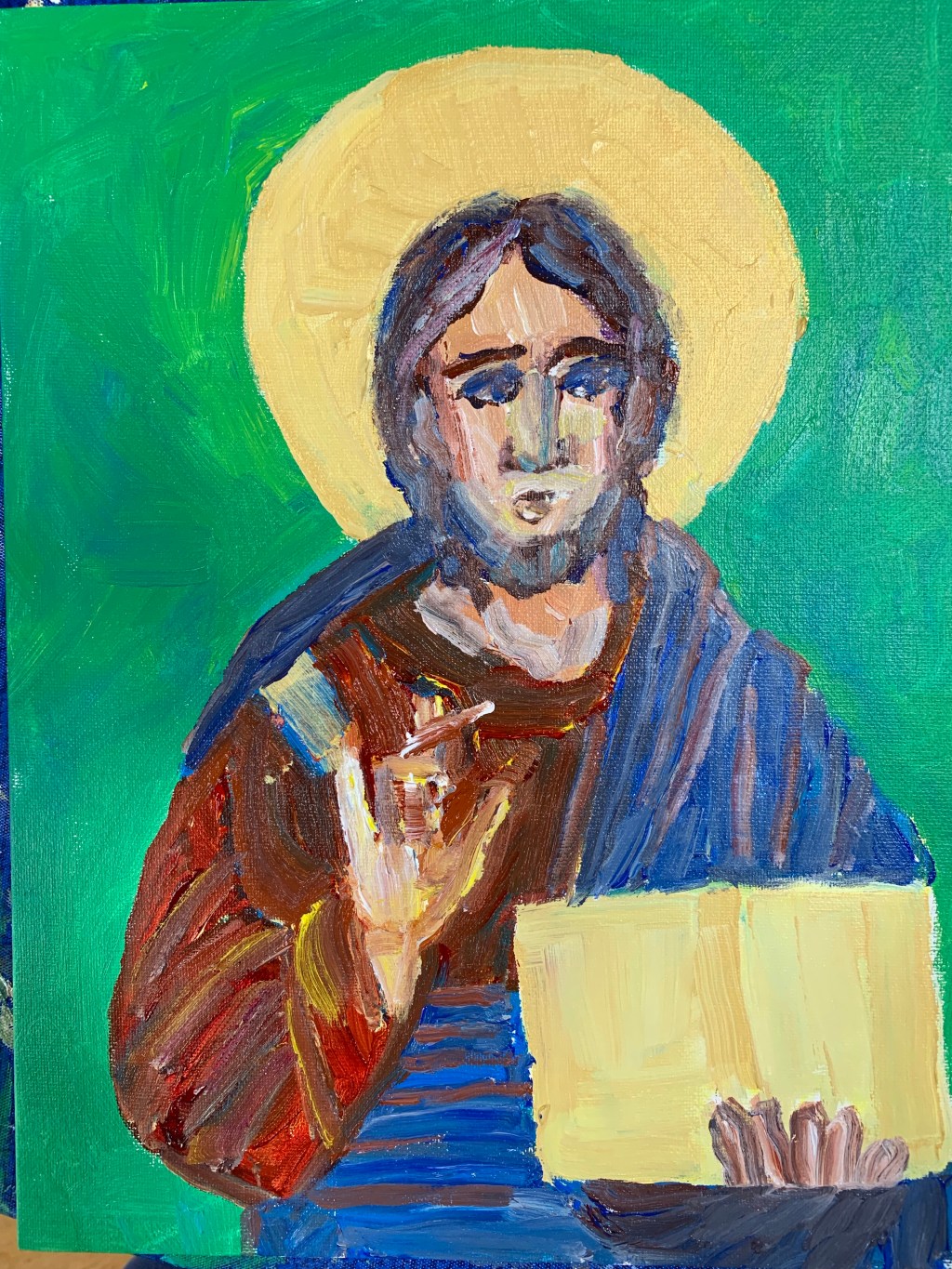
I worked from an icon of Jesus, which I knew would test me to break the form I saw before me. As it turned out, I too couldn’t break it on this first day. When the Platonic Ideal Form exerts its pull on the mind and hand, the artist keeps making the reflection of that form as a work, which exists as an imitation or a window into the true reality where the Holy is found.
Low Blood Sugar Painting
After a long summer break with all the Covid isolation a person could stand, I quite forgot how much energy teachers expend in explaining new concepts and in the excitement of the first day back. I noticed about 11 am I was struggling for words and not making good choices with my brush, but I ignored it in the thrill of being back with people. After cleaning up, I always check my blood sugar before I drive home. It was 45. I’d never seen it that low, but I was paying attention to other people, not to my body. I ate the crackers I always carry for just such an emergency.
The Wisdom of Solomon (7:26) speaks about God’s Wisdom personified: “For she is a reflection of eternal light, a spotless mirror of the working of God, and an image of his goodness.”
In Hebrews (1:3), the writer describes The Christ: “He is the reflection of God’s glory and the exact imprint of God’s very being, and he sustains all things by his powerful word.”
This long discussion on Plato, the true forms elsewhere and the imitations and reflections here help us to realize how much debt Christian spiritually and art history have to Greek thought. Art isn’t just “I know what I like and that’s all that counts.” We can all experience making art and enjoy it on any level. Having the depth of understanding to see how art connects us across the human community will give us a greater appreciation for our common spirit.
I promise I’ll bring a healthy snack to eat during class next Friday! I’ve learned my lesson on this, if nothing else! We’ll work on faces for two more weeks, then we’ll take a short break and come back in October and decorate cookies one week for Day of the Dead and paint an autumn themed subject for the other week.
Joy and Peace,
Cornelia
Simonides on poetry and painting—Plutarch: The Glory of the Athenians 3.1, 346f-347a.
Creativity and Rationality on JSTOR The Journal of Aesthetics and Art Criticism Vol. 70, No. 3 (SUMMER 2012), pp. 259-270 (12 pages) https://www.jstor.org/stable/43496511
If we watch the evening news on television, read a newspaper, or check our Twitter feed, bad news seems to fill the whole of it. Sometimes it gets to be too much, and we turn it all off, for we can’t cope with the next straw; it will break our camel’s back and we won’t be able to go on. Or we may already be broken by all the grief and pain, wounded by the wounds we can’t heal or by those wounded ones who wound others, rather than seek healing. I often thought I spent 50% of my pastoral care on 10% of my congregation, the “broken” ones.
After a while, we can feel like Elijah, who was worn out from doing great things for the LORD, and felt “I alone am left.” God comes to remind him he’s not alone. John Donne was very ill when he wrote this famous meditation. The artists all are from the margins, or made their art during a time of suffering. Yet, what beauty they found in this time. Artists often find their way back into the unity of all things by joining in the creating spirit of God.
Sam Doyle: Untitled (Rambling Rose), paint on metal, Smithsonian Institute.
Sam Doyle, who was on born and died St. Helena Island, SC (1906-1985), was a self taught Gullah artist, who painted the local stories of his community on anything he could find. He covered the walls of his home, as well as scraps of metal and wood with iconic figures of his people. You can read about this richly talented primitive artist at https://www.soulsgrowndeep.org/artist/sam-doyle
Hilda Wilkinson Brown: Third and Rhode Island, Washington DC, oil on canvas, 1930-40, Smithsonian Institute
Hilda Wilkinson Brown was born in Washington, DC 1894 and died there in 1981. She was an African American artist and art educator who brought her love of education and creativity to everything she did. Her work was mostly “under the radar,” except for in her own community. Yet she persisted. As a teacher, she’s best remembered for introducing individual creativity as a goal, rather than having students mimic the teacher’s model. Unfortunately, art education classes are still teaching mimicry.
Myrna Báez: Platanal, acrylic on canvas, 1974, Smithsonian Institute.
Myrna Báez of Puerto Rico (1931-2018), painted this lush field of plantain trees, a crop long wedded to concepts of Puerto Rican identity and sovereignty. She depicted the crop’s large leaves as they reflect the tropical sun and delighted in her manipulation of paint on unprimed canvas. Báez’s belief in Puerto Rican independence manifests in her impulse to look, depict, and therefore possess the island’s landscape on her own terms. Puerto Rico is currently an unincorporated territory of the United, in which the people are American citizens, but have no vote, unless they move to the mainland.
Georgia O’Keeffe: Hibiscus with Plumeria, oil on canvas, 1939, Smithsonian Institute
Georgia O’Keeffe, who was born in Sun Prairie, WI in 1887 and died in Santa Fe, NM in 1986, painted this exquisite “Hibiscus with Plumeria,” (oil on canvas, 1939, Smithsonian Institute). Intrigued by the opportunity to paint tropical flora, O’Keeffe accepted an offer from the Dole Pineapple Company for an all-expenses paid trip to the state of Hawaii to create a painting for the company’s 1939 advertising campaign. It was a perfect escape from the stress of her husband, Alfred Stieglitz’s ongoing affair with Dorothy Norman, the beautiful young wife of an heir to the Sears, Roebuck & Co fortune.
She visited Maui, O’ahu, Hawai’i, and Kaua’i, painting the islands’ dramatic gorges, waterfalls, and tropical flowers, among them Hibiscus with Plumeria. Pink and yellow petals towering against a clear blue sky transform the delicate blossoms into a joyous monumentality. But of the twenty canvases of Hawaii she completed, none showed a pineapple. Only after Dole had one flown to New York did she finally, if reluctantly, paint the desired fruit.
George Bellows: Vine Clad Shore–Monhegan Island, oil on canvas, 1913, Smithsonian Institute
George Bellows was born in Columbus, OH in 1882 and died when his appendix ruptured at the age of 42 in New York City in 1925. He’s best known for his “outsider” subject matter: tenement life, New York street scenes, and boxing subjects. While Bellows was famous for his fight scenes, he recovered his soul in the landscape, such as this Vine Clad Shore on Monhegan Island, Maine.
Frank Wilbert Stokes: The Eighth of March–Island Ice, Greenland, 1894, Peary and Party near 6 p.m., oil on canvas, 1893, Smithsonian Institute.
Frank Wilbert Stokes (born Nashville, TN 1858-died New York City 1955) was the artist member of Robert Edwin Peary’s Greenland Expeditions. He did small works such as this one on site as a record of the journey. Stokes spent eight weeks in the Arctic, the first painter to work on the ice fields, where he had to learn a method as he went, mixing kerosene into his pigments to stop them freezing and sketching outdoors through indistinguishable Arctic days and nights. Based in his studio at Bowdoin Bay, Stokes would spend fourteen months in all working in this extraordinary Arctic environment:
The outside winter temperature was frequently forty degrees below zero Fahrenheit. The lowest temperature experienced was frequently sixty-five degrees below zero. In order to prevent his colours from freezing, [Stokes] mixed them with petrol and poppy oil and kept his colour box in a deerskin bag. Lieutenant Peary’s general orders forbade any member of the party to go more than a quarter of a mile from the main camp. This restriction was relaxed in the case of Mr. Stokes, who frequently went four or five miles in moonlight or starlight, during the polar night, to study effects which he had declared to be indescribable in words, but which are shown by his pictures.
Thomas James Delbridge: Lower Manhattan, oil on canvas, 1934, Smithsonian Institute
Thomas James Delbridge (born Atlanta, GA 1894-died Long Island, NY 1968) painted this view of Lower Manhattan, an oil on canvas, in 1934, which is now in the Smithsonian Institute. It was part of the Federal Work Projects Administration, which gave support to “starving artists” during the Great Depression. Lower Manhattan’s glorious skyscrapers inspired all New Yorkers, including the city’s artists, through the worst hardships of the Great Depression.
Looking from the dock of a harbor island, Thomas Delbridge showed the dark mouths of Manhattan’s ferry terminals; above them ever taller buildings climb out of red shadows into gold and white sunshine. The crisply outlined forms evoke such famous structures as the Woolworth Building to the left and the Singer Building to the right without placing the buildings precisely or describing specific details. The skyscraper at the center suggests the mighty Empire State Building as it had stood incomplete before its triumphant opening on May 1, 1931. Even as the stock market foundered and thousands were thrown out of work, New Yorkers had gathered in excited throngs to watch their tallest tower rise. The Manhattan skyscrapers in the painting appear to be pushing back dark clouds, creating an oasis of brilliant blue around the island. (1934: A New Deal for Artists exhibition label)
DeLee: How Many Times Must Paradise Burn?
Does art come only from the mind, or does it come from the greater depths of our souls and our hearts or guts? If we reduce art to only its analytical forms and colors, we may rob ourselves of the deeper experiences of the art itself. Likewise, if we put on our false face of “I’m fine,” but in fact we’re falling apart inside, pretty soon our facade will crack open too. Then folks will say, “What happened there?” And perhaps we’ll be too ashamed by then to speak of it, for we lied about our truth too long.
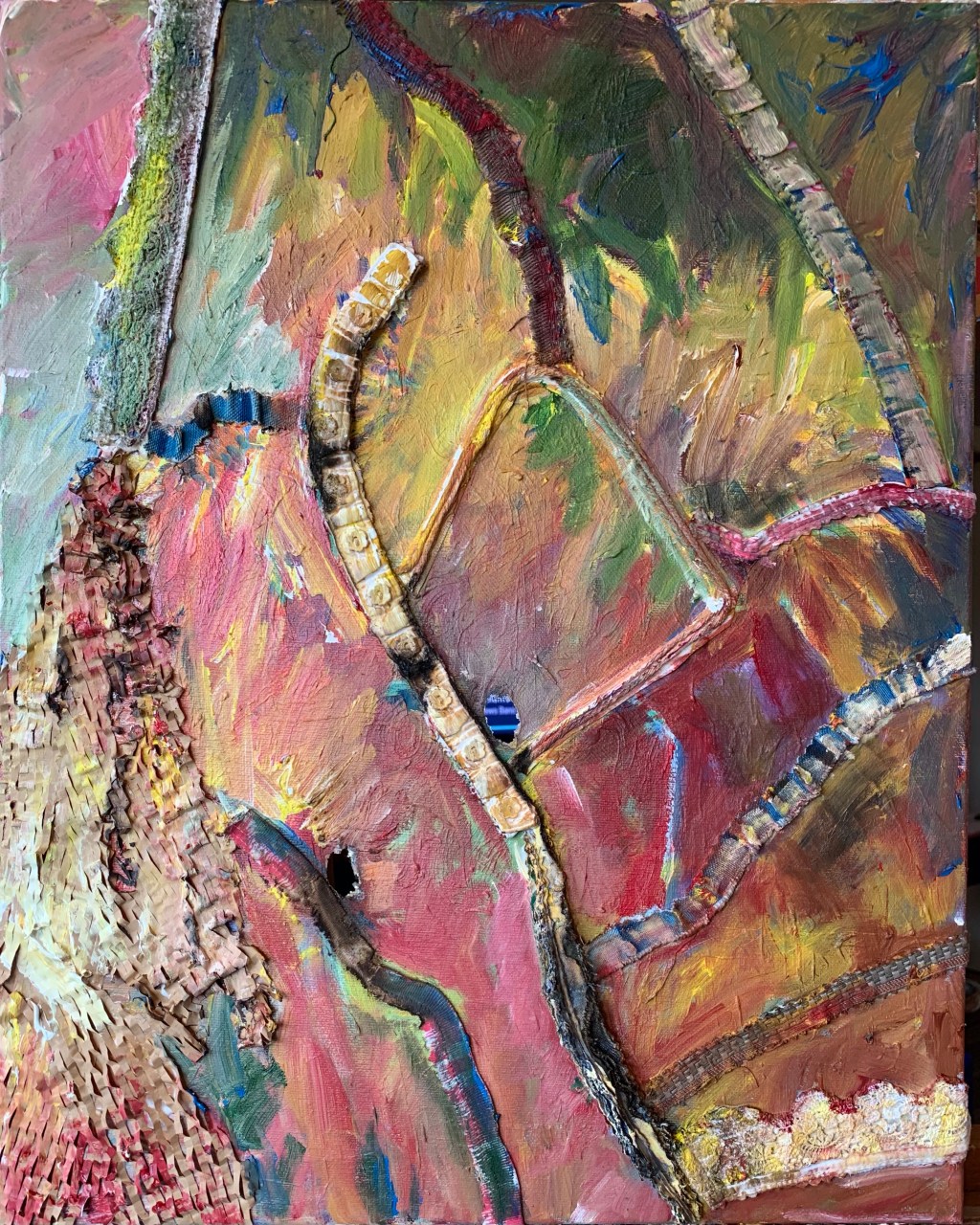
My recent canvas is another cognitive map, for it deals with the changing landscape and our changing climate. It uses paper scraps, lace trims, the button row of an old outfit, and old blue jean seams all glued on the canvas in the proximate place of the main roads of the Dixie Fire out in California. I painted flame colors over the surface, but left some greens for where the fire hadn’t yet spread. Then I took out my handy Bic torch lighter to sear some of the cloth additions. Even acrylic paints, if overheated, will combust, as I soon discovered, for I burned two holes in the painting. They look like the black holes of outer space or the dark night of the soul in our spiritual lives.
When I think of all the needless deaths from the coronavirus since we’ve have the introduction of our current safe and effective vaccines, I feel very sad for every life lost. Even with nearly 4.4 million deaths worldwide and almost 639,000 deaths in the USA alone, I’m not so inured to the loss of my brothers and sisters that I can just shrug it off. I know very few of those Covid has taken from us, but the world is a lesser place without those millions.
And so I leave you with this famous meditation. Donne didn’t know if he was on his deathbed or not when he wrote it. I’m pretty sure I won’t leave behind such immortal words when I think my end is near.
No man is an island, entire of itself; every man is a piece of the continent, a part of the main. If a clod be washed away by the sea, Europe is the less, as well as if a promontory were. as well as if a manor of thy friend’s or of thine own were. Any man’s death diminishes me, because I am involved in mankind; and therefore never send to know for whom the bell tolls; it tolls for thee.
~~ John Donne, “Meditation 17,” (1623, transcribed into modern English)
“It was fitting that God, for whom and through whom all things exist, in bringing many children to glory, should make the pioneer of their salvation perfect through sufferings. For the one who sanctifies and those who are sanctified all have one Father. For this reason Jesus is not ashamed to call them brothers and sisters.” —Hebrews 2:10-11 NRSV
After the initial burst of summer excitement, my community is not only sweltering in a heat wave, but we’re also smack dab in the midst of the third wave of this Covid-19 pandemic. We might be more than halfway through 2021, but at the rate my home state of Arkansas is pursuing vaccinations, it’ll be years before we reach the holy grail of herd immunity, estimated to be at 80% immunity. Only 37% of our people are fully immunized, with Alabama and Mississippi pulling up the rear nationally with 35% and the states of Louisiana and Wyoming tied with us at 37%.
@rdaily—Arkansas hospital bed availability. Getting nearly impossible to find an ICU bed again. Many really sick patients being held in ER beds all over the state.
Like the old gal who’s always worn a certain size shoe or dress, my state now tries to fit an increasing number of Covid patients into a fixed set of ICU beds in our state. My days of a size seven shoe or skirt are a dim memory, as are the days of empty medical facilities.
“We have nowhere to send COVID-19 patients within the State of Arkansas. There is limited bed capacity at trauma centers increasing pressure on the time-sensitive healthcare system,” said Jeff Tabor, program director for the COVIDComm system, which helps match covid-19 patients with hospitals.
Tabor said the one COVID ICU bed which is available is located in southern Arkansas. There are five hospitals, also in southern Arkansas, showing limited COVID bed space. Tabor said some COVID-19 patients are so critical at rural Arkansas hospitals that they cannot be transferred to other hospitals because the patient is too critical and because of bed space.
Recently our state legislature adjourned a special session without amending their misguided law mandating no masks ever in public schools or government agencies. Act 1002, by Sen. Trent Garner, R-El Dorado, prohibits state and local governments, including public schools, from requiring people to wear masks. Act 1002 became effective on July 28.
The state’s largest school district, joined by a small district already suffering from Covid quarantine attendance problems in its early opening days, filed suit in court to stop this law from going into effect. The judge issued a temporary restraining order. The reasons for this aren’t political, but are found in the Arkansas constitution.
LRSD and MSD are likely to succeed on the merits. Act 1002 violates the Education Article of the Arkansas Constitution, Article 14, § 1, which requires that “the State shall ever maintain a general, suitable and efficient system of free public schools and shall adopt all suitable means to secure to the people the advantages and opportunities of education.” A suitable and efficient system of public education would not require students to risk their health and their lives to get the education promised to them in the Arkansas Constitution, especially when the State is required to “adopt all suitable means” to provide them “the advantages and opportunities of education”.
An affidavit provided by Dr. Glen Fenter, the superintendent of the Marion School District, said that incentives, including gift certificates, groceries, and even big-screen televisions, didn’t entice many local citizens to take the vaccine. Only one out of every three students in the district has acceptable home internet service, making remote learning difficult; even then, “very few” students who did “participate in the virtual education option last year achieved an acceptable level of academic progress,” the affidavit said.
The Marion superintendent said that his district was forced to “quarantine over 500 students and employees” based on CDC and state health department guidance after the second week of school. The school year in Marion began July 27, 2021. This rural system has only 3,325 students enrolled for the 2021-22 school year. Their math proficiency score averages 22% and reading averages 31%, compared to the statewide averages of 47% and 45%.
The broader lawsuit argues that the Act violates an education clause of the state constitution, the equal protection clause of the state constitution, and that certain federal laws preempt the state from enforcing the Act. It also argues that the Act violates separation of powers principles, conflicts with a subsequent state law, and violates the premise of Jacobson v. Commonwealth of Mass., the 1905 U.S. Supreme court case during the smallpox scourge, which allowed mandatory vaccination policies — and penalties for those who refused to comply — to stand.
On another front, the mayor of Little Rock, Frank Scott, Jr., said the capitol city’s covid-19 task force had recommended to him that “masks be worn again in public spaces for which the city is responsible.” He strongly exhorted businesses to follow suit. Scott made note of the many children who visit city parks and community centers and who will be returning to school later this month, adding that “right now, they don’t have the ability to mask up.”
“The Lotus Eaters” by James Dromgole Linton
In the middle of all this stress, I ponder these questions: “What inspires a work of art? In our search for beauty in this world, do we have to forget our pain and become as the lotus eaters of the ancient myths?”
Edward Marle: The Lotus Eaters, 1970, Glasgow Museum
Worn out from the years of the Trojan war fought in a foreign land and tired from an unending journey full of trials and tribulations on the way home, Odysseus found his men succumbing to the hypnotic lure of the magic flower. When eaten, it caused people to forget both their troubles and also their future plans. In the words of the hippies of yore, they were content to “get high and get by.”
Alfred Lord Tennyson’s poem, The Lotus Eaters, inspired Robert S. Duncanson, an African American landscape painter, prior to the Civil War:
Hateful is the dark-blue sky,
Vaulted o’er the dark-blue sea.
Death is the end of life; ah, why
Should life all labour be?
Let us alone. Time driveth onward fast,
And in a little while our lips are dumb.
Let us alone. What is it that will last?
All things are taken from us, and become
Portions and parcels of the dreadful past.
Let us alone. What pleasure can we have
To war with evil? Is there any peace
In ever climbing up the climbing wave?
All things have rest, and ripen toward the grave
In silence; ripen, fall and cease:
Give us long rest or death, dark death, or dreamful ease.
Robert S. Duncanson, Land of The Lotus Eaters, 1861
Odysseus had to bodily carry his men back to the ship and tie them to their seats to keep them rowing on a straight course for home. Today we’re treated to videos of airline passengers taped to their seats because of their unruly behaviors. Rage flying has taken the place of rage driving. Neither the roads, the post offices, nor the skies are friendly anymore. “Going postal” has almost lost its meaning when no workplace is safe these days.
In the midst of the record deaths of despair, come now the increasing deaths of our most precious inheritance—our children. The number of children contracting Covid-19 has increased fivefold since the end of June, with a “substantial” 84% jump in the last week alone, according to a new report from the American Academy of Pediatrics. This number comes as numerous states report upticks in child hospitalizations amid the ongoing delta surge. In Arkansas, we’ve had three children die from Covid.
Picasso: The Weeping Woman, 1937 (Portrait of Dora Maar)
Some would say this is an “acceptable loss or trade off to allow others to have freedom.” I find this line of reasoning heartless at best and cruel in reality. I wonder what these folks would say if their child had lost their life instead. It seems not too long ago some of these same persons were advocating for the elderly to accept a shortened lifespan, since their productive lifetimes were expended. They seem to value people only for their economic ability, rather than for their humanness or for their lived experience. Allowing the “weak” to die in this part of the pandemic also devalues those who aren’t yet ready to produce economic gain for the big machine. (Yet, they fail to recognize the loss of future gain of these young “production units.”)
I would rage blog at the inhumanity of our legislators, who couldn’t find an giant acorn in the midst of an empty football field, even if they had the scales removed from their eyes, but then there’s always the hope they might learn the lesson of Job, for whom suffering brought new understanding of God. Then they’d call themselves back into session and amend their own misbegotten law so it’s flexible enough to meet our current, extreme circumstances. Who knows, they might even rescind this unconscionable law, for persons who truly have the capacity to lead with courage also have the ability to change their minds. Some say it’ll never happen, but I’ve always been afflicted with incurable optimism.
Google Map of National Park Medical Centet
In the meantime, I paint and pray. Even this dire event can inspire a work of art. One of our local hospitals has already canceled elective surgeries in order to concentrate on Covid care. The other hospital has very limited intensive care unit availability. Right now, no one in our tourist town needs to get sick and we certainly don’t need a mass casualty incident. Of course, I could live in a rural county and my nearest medical facility with a trauma unit could be hours away. I remember my early years of ministry when I reminded people, “If I’m ever unconscious, please just have them stabilize me and send me off to the big hospital in Little Rock or Memphis.”
Photo Sketch on Google Map
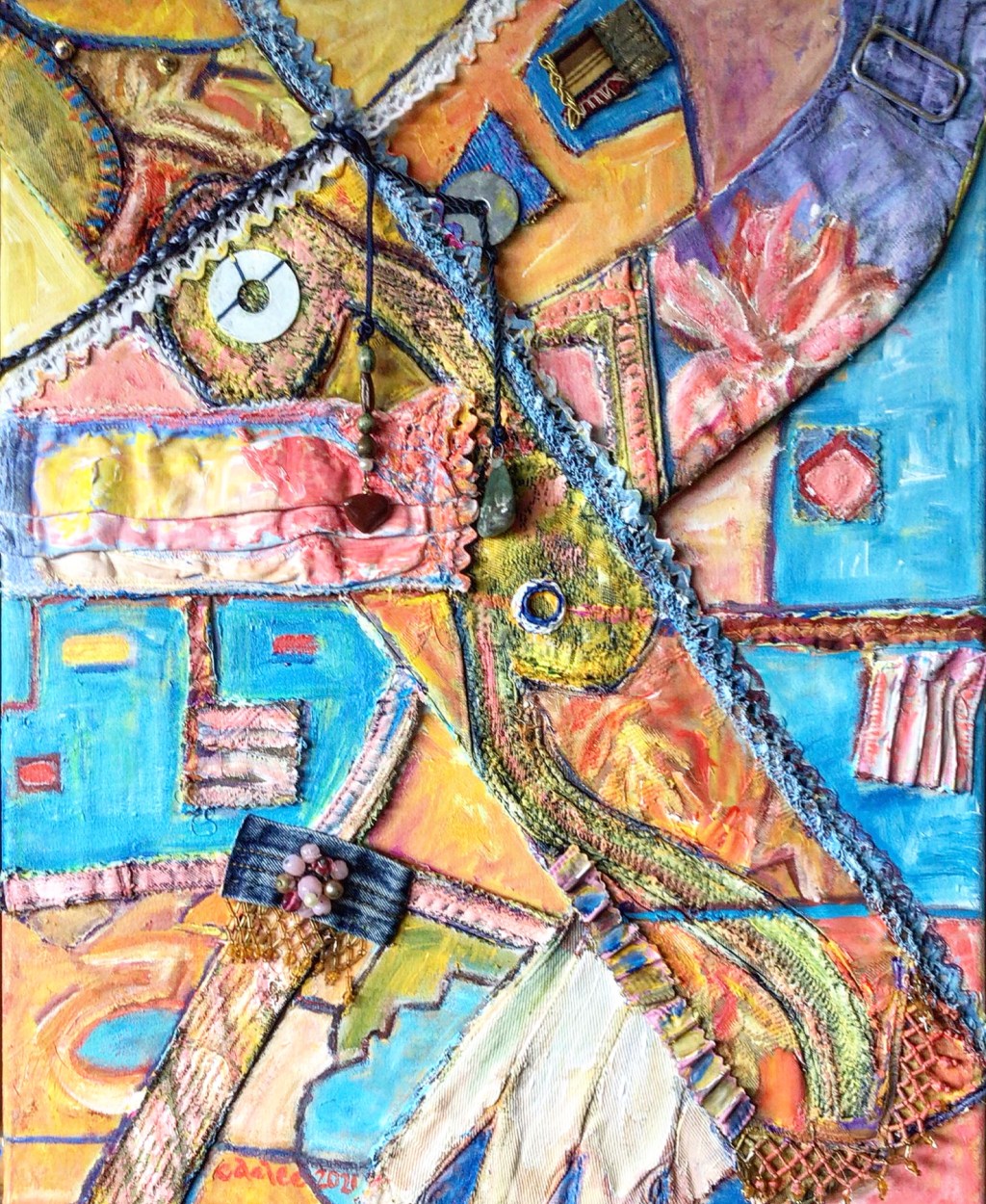
Today I blog about another painting based on a Google map of my adopted city, so it’s another “cognitive map.” I used scraps of an old preaching stole. I made the stole from odd pieces of fabric, plus an old pair of overalls, and a garden glove. I deconstructed the stole, since I’m no longer preaching in my retirement years, and added a few worn out face masks, in which I sewed small pleats. I took some of my grandmother’s old crochet and rickrack trim to mark some of the roads, but let the three dimensional shapes mark the other directional lines. My mother made Belgian lace collars for my young daughter’s dresses, so I’d used these for masks.
Layout on Raw Canvas of Primary Fabric Elements
I too wore these masks until I was tired of them. I was hopeful when those who know more than I do believed the virus had subsided and we were safe to shed our face coverings. One day in early July at Kroger I had an hour long conversation with a young man who was also glad to be shed of the mask, just to see people’s smiles. We talked for a while and I learned he was just a few weeks past a suicide attempt. This pandemic has been hard on him. We talked some more, for I’ve been in the dark place before too.
Cognitive Map: Search for Healing
I don’t need a preaching stole anymore, for preaching isn’t what I do best in this season of my life. God sets people in my path who need an encouraging or healing word. The world, in its beauty or its sadness, inspires me to paint a new vision of the world as it could be, for I don’t think I’ve ever painted what was ever “real.”
People ask, “Why don’t you make a painting that looks like real life?”
I answer, “We have cameras today for this. In any event, how do we know this ordinary world we see today is what God intended? This could be the fallen world, and not the original world of colors and joy, which God originally created.”
Perhaps we need to rethink our cognitive maps or how we view our world. If we consider all persons to be made in the image of God, then caring for them becomes important also. We can’t separate the Spirit of God from the body in which it resides. We also have to recognize God works through extraordinary events as well as through ordinary events. If we are to reject the inspiration and special providence of God in the matter of scientific discovery, then we’re going to go back to living in caves for a long time.
Posted on Homes to Warm of Highly Transmissible Disease
I remember when my daddy came home from his medical office with a small vial and a special double pronged needle. The windows were open, so it wasn’t yet the heat of summer. He stood next to the light, as he always did in his office when he worked, and gave us children the smallpox vaccine.
“Let’s put a little light on the subject, shall we?” I laughed as I proffered my left arm. He washed it with a cotton swab and alcohol, in his usual calm way. I went first because I was the oldest. Also, I was a role model for my brothers, but I was used to this because of my birth order. I knew to trust my daddy and to show my brothers the way forward. A few tiny pin pricks later, a bandaid, and I was good to go. My brothers followed suit, and we were all told, “Hands off.” We were restricted from playing with our friends because of our parents’ fear we’d end up with a limp or in an iron lung. Polio was eradicated in the USA in 1979, but it still occurs in war torn and poverty areas worldwide.
Finally, while some will write off as heartless idiots the ones using the tired canard of freedom of choice (the ones who fail to protect our vulnerable children), I remind them we require measles, mumps and rubella vaccines to enter schools because medical professionals deem it important for the children’s health and welfare. Of course this same group throws back to us the name “liberal whackdoodles” in return. Maybe we’d all be better off if we thought less of our own egos and territory, and cared more about the welfare of our future generations.
We could then fulfill the promise of God in Isaiah 57:19—
“Peace, peace, to the far and the near, says the LORD;
and I will heal them.”
God is full of grace and love, given to offering gifts of healing to those who are both close to us—our neighbors—and those who are far from us—the strangers. If only we humans could love one another as God loves us all.
Changing the way we see our world, one map at a time, brings
Stop all the clocks, cut off the telephone, Prevent the dog from barking with a juicy bone, Silence the pianos and with muffled drum Bring out the coffin, let the mourners come.
Let aeroplanes circle moaning overhead Scribbling on the sky the message ‘He is Dead’. Put crepe bows round the white necks of the public doves, Let the traffic policemen wear black cotton gloves.
He was my North, my South, my East and West, My working week and my Sunday rest, My noon, my midnight, my talk, my song; I thought that love would last forever: I was wrong.
The stars are not wanted now; put out every one, Pack up the moon and dismantle the sun, Pour away the ocean and sweep up the wood; For nothing now can ever come to any good.
What Percentage of Arkansas is Vaccinated? | Arkansas Vaccine Tracker | USAFacts
“Heraclitus, I believe, says that all things pass and nothing stays, and comparing existing things to the flow of a river, he says you could not step twice into the same river.” Plato quoted an older Greek thinker about life’s being constantly in a state of flux or change. We can’t dive into our rabbit holes at every quivering leaf or shadow of every cloud passing over the sun. We rabbits know the world is changing all the time, even if we don’t like it, but we still have to venture outside of our den and hutches to find tasty carrots and spinach leaves.
Fear of Change—
Yet some rabbits have a fear of change or fear of changing the order of things. This goes by another Greek word, Metathesiophobia. This is a new word for this old rabbit, so I guess I’ve modified a few brain cells in learning this. In fact, when we learn new words, we actually get happier! There’s even science behind this. In a study, “increased subjective pleasantness ratings were also related to new-words remembered after seven days. These results suggest that intrinsic—potentially reward-related—signals, triggered by self-monitoring of correct performance, can promote the storage of new information into long-term memory through the activation of the SN/VTA-Hippocampal loop, possibly via dopaminergic modulation of the midbrain.”
Even if we don’t understand the scientific jargon of that sentence, we know learning new things gives us a feeling of pride and accomplishment. We feel good about ourselves when we accomplish a new trick or master a new skill. Repeating the same experiences over and over leads to dullness,even if we find safety in the predictably.
If we were small bunnies, we’d never find the refrigerators in our homes, since they’d be covered up in our latest glorious art project. Every rabbit parent raves about their genius offspring, if they’re raising them right. We always want to catch our small ones doing something right and praise them for it. We’ll get more cooperation than if we’re always telling them NO, and GO TO YOUR ROOM.
I ask you, which rabbit among us doesn’t want to be happier in this world? Currently we’re in the midst of the worst crisis most of us have ever experienced. We rabbits need to name it and face it, rather than deny it, for this pandemic isn’t not going away anytime soon. This causes some of our bunny friends to find a “boogeyman lurking in every dark corner.” When I was young, my parents scared me, or scarred my memories, over my messy closet.
Fancy Dress Up Clothes
“You’d better clean up that pile of clothes in there, young lady! If you don’t, a rat might come crawling out of those clothes piled up on the floor!”
EEEK! I was so frightened, I untwisted an old metal coat hanger and stood outside my closet while I fished out my dress up play clothes, one article at a time. If a rat were to come out with them, I wanted a running head start. I was on my own in art school over a decade later before I could sleep with the bedroom closet open. This was a long standing fear to shake. Not everyone can put aside their fears and coping mechanisms, however.
I’ve had rabbit friends who get up in the middle of the night to make sure their closets are neatly arranged, with all the shoes in the right boxes and all the clothes facing the same direction on the hangers. I have no such anxiety, for I hang my clothes up and don’t worry once I’ve done it. I have other tasks to tackle. Uninterrupted sleep is a worthy goal for rabbit health. Plus I have other creative tasks to engage me, and I’m learning new things every day. In any event, I know my salvation won’t be impaired by this failure to act on my part, just as it won’t be earned if I keep a perfect closet.
Change is moving swifter than the atmospheric river that’s currently dumping rain and mudslides on the Pacific coast and ice and snow on the Atlantic coast. Atmospheric rivers are long, narrow regions in the atmosphere—like rivers in the sky—that transport water vapor, according to the National Oceanic and Atmospheric Administration. Drastic swings from extremely wet to extremely dry and vice versa will be nearly twice as likely, occuring on average once every 25 years, by 2100. Dramatic swings are becoming more common and will continue to do so in the coming decades thanks to man-made climate change.
Presidents’ Day—
Of course climate change isn’t the only change we’re dealing with in February.
Today we have one holiday to celebrate Abraham Lincoln and George Washington. Back in this rabbit’s kitten days, we had two holidays for these two presidents, but the times change and the holiday became popularly known as Presidents’ Day after it was moved as part of 1971’s Uniform Monday Holiday Act, which was an attempt to create more three-day weekends for the nation’s workers.
At the time, Congress thought setting three day weekends would end employee absenteeism. Today the coronavirus pandemic has put most white collar workers out of the office and many blue collar workers out of a job. Until we get this pandemic behind us by vaccinating as many of our people as possible and continuing safe practices, we won’t get back to any semblance of normal any time soon. This virus hunts a host, and it’s sure to find a rabbit to use as its own personal Petri dish.
Super Bowl LV—Next Super Spreader Event?
On the first Sunday in February, the big game goes down. While the 7,500 health care workers who’ll be the stadium attendees will be following COVID protocols, the fans at home remain susceptible to infection. A recent Seton Hall Sports Poll collected answers from 1,522 adults spread all over the country from Jan. 22-25. That data shows 25% of respondents said they would gather with people outside of their home (defined as those who aren’t roommates or cohabitants) to watch the game. Sixty-four percent of respondents said they would not attend a gathering and 11% said they weren’t sure.
Among avid fans however, 40% of that group said they would indeed gather with members outside of their household. The CDC doesn’t recommend holding these types of gatherings, especially if they are inside and last for the duration of the game. The Super Bowl will be played in Raymond James Stadium in Tampa and is scheduled for Sunday, February 7, with a 6:30 p.m. ET kickoff, with an estimated game length of four hours, not counting the additional four hours of preliminary extravaganza programming.
Chocolate Strawberry Footballs
I’ve always gathered the various rabbits who live in my condo building for the game festivities. It’s a good opportunity for us to socialize and since everyone always waits for “someone to take charge,” I just step up. We won’t do it in person this year, however, for we rabbits can best observe safely the whole shebang from the comfort of our couches and Zoom or find other other media connections with our loved ones and friends so we can have a real party next year.
Super Bowl LV Firsts—
There are new changes to the Super Bowl this year. Amanda Gorman, the inaugural poet, will recite an original poem before Super Bowl LV, as part of both the in-stadium pregame ceremony and the TV broadcast. The poem will honor three everyday heroes who have been chosen as honorary game captains by the NFL. These people include Trimaine Davis, a Los Angeles teacher who fought to secure internet access and laptops for his students amid the pandemic; Suzie Dorner, a Tampa nurse who managed the COVID ICU at Tampa General Hospital; and James Martin, a Marine veteran who has helped veterans and their families connect virtually through the Wounded Warrior Project.
Gorman isn’t the only pregame excitement. Miley Cyrus will perform as part of the TikTok Tailgate event for the Health Care Heroes. This will also be televised. Then there’s the The Pepsi Super Bowl Halftime Show, which is the most-watched musical performance of the year, with more than 104 million viewers tuning in to last year’s show. The rhythm and blues artist known as The Weekend (Abel Makkonen Tesfaye) will be the featured performer.
The Weekend
“The Weeknd has introduced a sound all his own. His soulful uniqueness has defined a new generation of greatness in music and artistry,” said Shawn JAY-Z Carter. “This is an extraordinary moment in time and the Pepsi Super Bowl LV Halftime Show is going to be an extraordinary experience with an extraordinary performer.” This rabbit has been listening to his oeuvre on Apple Music, and I’m quite excited to hear the show. It ought to be a bang up program with no wardrobe malfunctions.
JAY-Z and his company, Roc Nation, have worked over the past year on the selection of artists playing the Super Bowl Halftime Show as the league’s official Live Music Entertainment Strategists. The partnership aims to “nurture and strengthen community” through music and support the NFL’s Inspire Change social justice initiative, and also has Roc Nation serving as a co-producer of the Super Bowl Halftime Show.
GRAMMY-nominated artists Eric Church and Jazmine Sullivan are set to pair up for the first time to sing the National Anthem as part of Super Bowl LV pregame festivities. Grammy-award winning artist, H.E.R., will join the pregame lineup with her rendition of America the Beautiful. In addition, on behalf of the National Association of the Deaf (NAD), Warren “Wawa” Snipe, acclaimed Deaf rapper and recording artist, will perform the National Anthem and America the Beautiful in American Sign Language. For Super Bowl LV, the National Anthem will be arranged and produced by Adam Blackstone.
Sarah Thomas
“Sarah Thomas will made history again as the first female Super Bowl official,” NFL EVP of football operations Troy Vincent said. “Her elite performance and commitment to excellence has earned her the right to officiate the Super Bowl. Congratulations to Sarah on this well-deserved honor.” She will be a down judge on a seven-person crew of distinguished game officials. You go girl!
This is just one more change for a world that spins 360 degrees daily and moves around the sun on its invisible circular river which it completes every 365 1/4 days. Our planet never stays in in one place as it courses through the unseen river of time in the heavens, but we see ourselves think we have a fixed place in the universe. If we observe nature, the rising and setting of the sun moves along the horizon line as the seasons change and it rises higher into the sky during the summer than the winter. These changes are part of our ordinary life, and give a structure and rhythm to our days and time upon this world.
Champions in a Championship Game
Speaking of firsts, the Chiefs are trying to become the first team in 16 years to win back-to-back Super Bowls. The last team to do it was Tom Brady’s 2003-04 New England Patriots. Tom Brady is set to become one offour quarterbacks to start a Super Bowl for multiple teams and he could join Peyton Manning, who is currently the only quarterback in NFL history to win a Super Bowl start with multiple teams. So while the seasoned champion with a brand new team goes against a young champion trying to make the magic happen two years in a row, we should have a good game, rather than watching it for the commercials.
In other firsts, the Super Bowl is almost always the top rated TV show for audience numbers. Only the final episodes of M.A.S.H. and Cheers have ever pushed it to number two. The commercials are first class also. CBS’s asking price of $5.5 million per 30-second spot is merely the cost of reserving the requisite airtime; after production expenses, ancillary social-media investments and agency fees are accounted for, the actual outlay for a single Super Bowl ad can swell to $20 million. That’s a lot of rabbit feed.
We won’t see the Budweiser Clydesdales for the first time in 37 years, for the company will be focusing on supporting Covid vaccine awareness education spots instead. Other companies related to restaurants may be missing due to lower sales and profits, but this gives other companies an opportunity to take their place. The pandemic has changed our economy in many ways. Avocados are in demand because we rabbits eat our salads at home, not in a restaurant. This is good for grocers, but bad for cooks, wait staff, and restaurant owners.
While parts of our economy are currently staggering along, the middle class and poor are lagging behind, as if they had chains and a huge millstone binding their bodies. Nearly 12 million renters will owe an average of $5,850 in back rent and utilities by January, Moody’s Analytics warns. People would go to work, but the businesses are either closed or the parent needs to stay home to school the child. Unpaid rents affect landlords, and roll on to the bankers who hold those notes.
The Census Bureau’s Household Pulse Survey, launched in April 2020, has provided nearly real-time weekly data on how the unprecedented health and economic crisis is affecting the nation. Nearly 24 million adults—11 percent of all adults in the country— reported that their household sometimes or often didn’t have enough to eat in the last seven days. Adults in households with children were likelier to report that the household didn’t get enough to eat: 15 percent, compared to 9 percent for households without children. Hunger in America or food insecurity is linked to a greater chance of cardiovascular mortality in counties throughout the U.S. Researchers believe if the pandemic goes on long enough, more people will begin to die of hunger or famine related circumstances than the disease itself.
Some want to spend a little and let it “trickle down,” but my grandmother rabbit always said that was “penny wise and pound foolish.” After WWII, American generosity rebuilt Germany, the home of the Nazi enemies. If we rebuilt the country of our enemies, I wonder what keeps us from rebuilding our own land? We need a Marshal Plan for America.
St. Valentine’s Day—
Be my valentine! XXOOXX
As a small bunny, I fondly remember classroom Valentines Day Parties, mostly because I got to decorate a shoebox as my “Valentine Mailbox” and enjoyed all the dime store paper valentines from my bunny friends. Mostly I really enjoyed the pink icing on the chocolate cupcakes and those Necco candy hearts with their pithy, saucy, love quotes. In this pandemic world of Zoom classrooms, gone are class parties, valentines for everyone, and a special gift for the teacher. As a former teacher, my hope is we can get our school teams vaccinated and get our little bunnykins back in a communal setting, so they can learn socialization skills as well as educational materials.
Ash Wednesday—
Some grieve about this year as if it’s lost year, and it’ll never be gotten back. This is true, however, there’re other great crises our little bunnies went through in our history, through no fault of their own. The Civil War was one, for it disrupted some youth we wouldn’t let have keys to a car today. One of my grandfather bunnies dropped out of school in the eighth grade to work on the railroad when his own father left home. He made sure his own little bunnies got their education, even if he didn’t get his.
Just because we have a twelve year program for public school doesn’t mean we have to finish it in that length of time. If we have a large monkey wrench thrown into our best laid plans, we might need to cram those twelve years into thirteen years. If we live to seventy-nine years, the average life span in America, this extra year is only 1/79 or 1% of our lives. We spend more time than this sleeping, since we spend about 33% of our lives asleep. No one seems to grieve about this broad swath of time in bed in fact, more of us rabbits are trying their best to get either more or better sleep! Perhaps we need to reframe then way we look at some of these problems to reduce our anxiety about them. Then we’d have more strength to cope with the day to day struggles, which are real and difficult.
Ash Wednesday is moveable feast day, so its date varies. It depends on when Easter is celebrated, and that too is dependent on the lunar calendar. My old daddy rabbit had this ancient piece of lore memorized: “Easter is always the first Sunday after the first full moon after the spring equinox.” While we may be able to move certain holidays around the calendar, Easter and its connected rituals of faith, Ash Wednesday and the forty days of Lent, move every year.
Because of coronavirus protocols, the hands on imposition of ashes by pastors, priests, or worship leaders will change in this pandemic year. Some churches will sprinkle ashes upon people’s heads, while others will give out packets of ashes for self imposition. The ashes are a traditional sign of humility. We may ask, if the ritual changes, is it as effective as it once was? The better question to ask is, “Does the ritual save us or does the power of God’s Holy Spirit flowing through the moment change us for the better?” Sometimes we put too much emphasis on the outward and visible elements, rather than the inward and invisible experience of God at work in us.
The Constant in the Midst of Change—
In the midst of a world intent on stoking our fears to a fever pitch, some of us rabbits find ourselves pulled down the proverbial rabbit hole into vast conspiracy theories, which purport to connect unlikely coincidences, but actually push anti-Semitic, far-right or white-supremacist ideology. Some of these ideas are as old as the Middle Ages, while others came from Russia and got passed into the American milieu during the first Red Scare in the 1920’s.
One of the worst examples is “The Protocols of the Learned Elders of Zion,” a classic of paranoid, racist literature. Taken by the gullible as the confidential minutes of a Jewish conclave convened in the last years of the nineteenth century, it has been heralded by anti-Semites as proof that Jews are plotting to take over the world. Since its contrivance around the turn of the century by the Russian Okhrana, or Czarist secret police, “The Protocols of the Learned Elders of Zion” has taken root in bigoted, frightened minds around the world.
When the world is in chaos, fearful rabbits look for a demonic figure to blame, when they should look instead to a positive source of power and strength. Fear paralyzes us, but the power of God sets us free to change our world for the better.
Bierstadt: Merced River, Yellowstone Valley
God is our refuge and strength,
a very present help in trouble.
Therefore we will not fear, though the earth should change,
though the mountains shake in the heart of the sea;
though its waters roar and foam,
though the mountains tremble with its tumult.
~~ Psalms 46:1-3
May you make enough small changes every day to get new wrinkles in your brain, rather than on your brow.
Joy and Peace,
Cornie
Intrinsic monitoring of learning success facilitates memory encoding via the activation of the SN/VTA-Hippocampal loop | eLife
Millions of Americans are heading into the holidays unemployed and over $5,000 behind on rent. Hefty bills will come due in early 2021 for rent and utilities. Economists warn many unemployed families won’t be able to pay without more stimulus aid from Congress. By Heather Long
Who had hurricanes named with the Greek alphabet on their 2020 Bingo card? In a season when catastrophic west coast fires cause Pumpkin Spice skies, we shouldn’t be surprised. Heat lightning striking drought parched national forests and a gender reveal party blunder set off the blazes. Over the years, all of the top 10 costliest wild land fires in the country have been in California. The costliest of all was Camp Fire in 2018, which set insurers back over $8.5 billion, according to numbers tallied by the Insurance Information Institute. But the Camp Fire was just one fire. Reinsurer Munich Re estimates the costs for all the wildfires that year to be over $20 billion. So far this year’s fires should bring in a similar calculation.
Hurricane Sally knocked out power to 320,000 people along the Gulf Coast and caused initial damages of over $29 million just to roads and public buildings. Homes and personal property damages have yet to be counted. Folks are waiting for flood waters to recede for that estimate to accrue. Over thirty inches of rain fell at the coast, with lesser amounts inland. A major section of a three mile long bridge collapsed, with no date for repair.
None of the dollar costs account for the loss of precious lives, the impact on businesses, or the quality of live in these hard hit areas. Is New Orleans the same post Katrina? Are Miami and Puerto Rico thriving yet? Most of Houston has recovered from the $127 billion loss due to the 2017 hurricane and flooding of the lowlands in the city, and now a large portion of its residents believe climate change is a clear and present threat to future flooding.
The climatological peak of the Atlantic hurricane season is around the second weak of September, which means that August is normally when we start to see a major ramp up of tropical cyclone activity. The year 2020 being, well, a crazy pants year, 2020 is writing a new script. Records are dropping like flies this season as we’ve come to realize those 21 names aren’t going to be enough. Already Tropical Storm Beta, the second letter in the Greek alphabet, is threatening the Bahamas
According to the National Hurricane Center website, “In the event that more than twenty-one named tropical cyclones occur in the Atlantic basin in a season, additional storms will take names from the Greek alphabet.” In 2005, six storms were named with the Greek letter alphabet. During the Great Depression in 1933, hurricane season was also great, with twenty-seven named storms, which beat the former record of 21 storms, according to NASA. Zeta formed December 30, 1933, after the official end to the season.
The number and cost of disasters are increasing over time due to several causes. These include increased exposure or values at risk of possible loss, and vulnerability or how much damage does the intensity of wind speed or flood depth at a location cause. We also consider how climate change is increasing the frequency of some types of weather extremes that lead to billion-dollar disasters. There were four billion-dollar weather disasters in the United States in August 2020, according to scientists from the National Oceanic and Atmospheric Administration: the derecho storm that hit the Midwest, Hurricanes Isaias and Laura, and California’s wildfires.
Curry: The Line Storm
A wonderful 1934 oil painting, “The Line Storm,” by John Steuart Curry, 1897-1946, possibly inspired by the approach of a derecho-producing storm in Curry’s home state of Kansas, shows the dramatic approach of the shelf cloud driven by the straight line winds.
These storms and their costs weren’t a record, but warming temperatures do account for more frequent and intense weather events. This is important because a report commissioned by President Trump’s Commodity Futures Trading Commission issued dire warnings about climate change’s impact on financial markets, as the costs of wildfires, storms, droughts, and floods spread through insurance and mortgage markets, pension funds and other financial institutions. In calling for climate-driven policy changes, the report’s authors likened the financial risk of global warming to the threat posed by the coronavirus today and by mortgage-backed securities that precipitated the financial crash in 2008. The wildfires in California this year alone have burned 5 million acres of forested lands. To grasp the size, compare Arkansas’s forests, which cover 19 million acres or 56 percent of the State and contain 11.9 billion trees.
Sometimes we’re like Egyptians who live along De-Nile. If we can ignore the problem today, someone else can take care of it tomorrow. Unfortunately, this isn’t the order of God’s world. In the beginning, “God made the two great lights—the greater light to rule the day and the lesser light to rule the night—and the stars.” (Genesis 1:16)
Moreover, “…God created humankind in his image, in the image of God he created them; male and female he created them. God blessed them, and God said to them, “Be fruitful and multiply, and fill the earth and subdue it; and have dominion over the fish of the sea and over the birds of the air and over every living thing that moves upon the earth.” (Genesis 1:27-28)
To rule and to have dominion are both terms related to sovereignty, just as Christ is Lord. We don’t talk much about kings in a Democratic society, but we humans have authority over nature. Unfortunately, we don’t always use our power well. We waste resources, fill oceans with plastic, or buy single use items destined for landfills that won’t decompose. As we approach autumn stewardship season, we might want to reconsider our attitudes and relationships towards nature.
Bisecting America along the Meridian
In the central Great Plains, the 100th meridian roughly marks the western boundary of the normal reach of moist air from the Gulf of Mexico, and the approximate boundary between the semi-arid climate to the west and the humid continental (north of about 37°N) and humid subtropical (south of about 37°N) climates to the east. The type of agriculture west of the meridian typically relies heavily on irrigation. Historically the meridian has often been taken as a rough boundary between the eastern and western United States. This area around the 100th meridian, was settled after the American Civil War, beginning in the 1870s .
In the United States the meridian 100° west of Greenwich forms the eastern border of the Texas panhandle with Oklahoma, which traces its origin to the Adams-Onís Treaty in 1819 which settled the border between New Spain and the United States between the Red River and Arkansas River. Dodge City, Kansas lies exactly at the intersection of the Arkansas River and the 100th meridian. The latitude of Hot Springs, AR, USA is 34.496212, and the longitude is -93.057220. This means we’re east of the 100th meridian and in the “humid, subtropical south” section of the USA. Of course, spending a single summer here in the Spa City would convince any skeptic of the truth of this. We should have no “weather deniers,” even if we have “climate change deniers.”
Yet we here in Arkansas are far removed from the coastlines of our nation. We have our tornadoes and occasional floods, but we think of these as facts of life. If these disasters don’t impact us, or someone we know, too often we can shrug them off as just another sad occasion. We might collect flood buckets or give a few dollars to disaster relief, but the emotional impact of the life and death circumstances of other human beings doesn’t often register in our households. I’ve often wondered about this, but perhaps we grew numb during the Vietnam war to the nightly body counts and the images of war gore on television. About 62,000 service people died in the Vietnam War, a number which pales in comparison to the number of deaths during this pandemic, which now number 204,202 souls.
Goya: Executions on the Third of May
Since art carries with it the notion it should be “beautiful,” subjects about social commentary or politics often run against this grain. “Executions on the Third of May,” by Francisco Goya is an example. On 3 May 1808, Marshal-Prince Joachim Murat wrote to the Infante Don Antonio Pascual that he had executed about one hundred Spaniards, ‘Peasants . . . our common enemy’. Later police reports recorded that the French executed mainly artisans, laborers, one or two policemen and beggars during the street protests in Madrid.
J. L. David: The Death of Marat
The Death of Marat, by Jacques Louis David, is another social commentary painting. Marat was a popular radical French politician, political theorist and journalist, who advocated for basic human rights for the poor during the French Revolution. Marie Anne Charlotte Corday, a royalist from Caen, purchased a knife in a nearby store, walked into his home, and stabbed him dead while he was soaking in his bathtub. David, his friend, painted this memorial to the man who was working up to the last moment of his life for the common good of all the people.
In our faith life, we first learn to pray for our families, then for our friends. With spiritual growth, we can pray for strangers who are like us, and finally we learn to pray for our enemies. When we grow ever closer to God’s presence, we discover we also grow closer to our neighbors. The lawyer who tested Jesus with the question, “But who is my neighbor?” went on to discover the neighbor is the one who shows mercy to the stranger. If we want to be true neighbors, we must be the first to show mercy to the strangers in our midst, and not wait for them to “deserve it” or “give mercy to us first.”
How can we make emotional connections so we can do this? In art, as in other endeavors, we can stick with analysis and order. This is our problem solving brain. “What’s the quickest route from point A to B?” We look for one and done. That’s how we operate in most of our lives. Creative solutions, however, seek multiple options: “How many uses can I find for a brick? How many ways can I use a stick?” When we paint a still life, often we stick with the problem solving skills of our brains, and under use our emotional skills. Sometimes this has to do with our timidity regarding our technical skills, so eventually we’ll gain more confidence in our handling of the media. The expression will come through once we are comfortable with the media. It’s a matter of practice and time.
Putting emotions into our art work is also difficult because we’ve been trained since childhood to repress our feelings. Many of us can’t own our feelings. Perhaps we grew up in families with substance abuse and saw our parents out of control. If the other parent told us, “You don’t really see this,” or “We’re just fine, so go to your room,” we might be confused about how we actually feel. Learning to sort the truth from the lie is hard, but we can learn it at any age. Others of us have been taught to “get along with others by smiling a lot.” Another way of saying this is “don’t speak about anything that will upset anyone.” It’s also known as Peace at Any Price, or Prilosec for Everyone.
Marsden Hartley: Ghosts in the Forest
Marsden Hartley painted Ghosts of the Forest in 1938, in the woods of his home state of Maine. He saw the giant logs, felled by the forest industry, as if they were bones leeched white on a desert. He had returned from New York to find his own individual voice in the landscape he knew best, in the place in which he was born. (Hartley also wrote Adventures in the Arts, which you can read as a free ebook through the Gutenberg ebook project).
In art class, we talked about how 2020 has been a snowball rolling down from an avalanche high up in the mountains. It’s been one catastrophe after another. I know some young folks who’ve quit watching the news altogether, since they can’t handle one more piece of fuel thrown onto the conflagration of the chaos of their lives. Older people, who’ve survived other chaotic times, tend to breathe in, exhale, and say to themselves, “Be still, and know that I am God.” We know once this pandemic passes, some other excitement will take its place. We’ve learned to focus our energy on things that matter to us, rather than on the chaos which the world throws at us. Practicing spiritual disciplines helps us to meet the world calmly.
In art, we call this principle imposing order on disorder. Every work of art, no matter how abstract, has an internal order. Sometimes the order is a limited color scheme, such as a cool or warm palette. The balance may be evenly distributed on both sides, as opposed to a large central shape. Each of us has our own personality, of course, so we show our creative streaks differently.
Gail: Forest on Fire
Gail’s energetic painting of the flames eating the trees came from her heart. With her long experience in the park service, nature is a close companion. The fires in California have made a big impact on her, for she can imagine such a fire in the Ozark’s of Arkansas. This is empathy, which is a characteristic of a good neighbor.
Mike: First stage, Plan for a City
Mike’s painting recognizes the need for city planning. Out west, people want to live next to nature, just as we do, but having homes near drought stricken forests is a prescription for calamity and combustion. The beginning of his design reminds me of his last year’s Day of the Dead altarpiece, which was quite the elaborate project. When we learn from other people’s mistakes, folks call us intelligent. If we repeat the same mistakes others have made before us, folks don’t have kind words for us. That’s when we wish they would practice smiling more, and speaking less.
DeLee: Oaklawn Racetrack
I often do traditional landscapes, with a foreground, middle ground, and background. I’ve always wanted to do some paintings based on maps, or aerial views, so I looked up Oaklawn UMC and the racetrack. I brought some scraps of clothing, canvas, glue, and scissors to add some dimension to my work. While it doesn’t have my usual palette colors of yellows and reds, maybe the grays are like the smoke filled skies overhead. This California smoke has traveled on the jet stream as far as Northern Europe, or about 5,000 miles.
The whole purpose of art is to stretch our minds and push our boundaries. The more we encounter the world around us, the more likely we come close to the edge. That’s scary for some folks, but it’s just paint, canvas, or other materials. We aren’t jumping off a tall building. That would be an irreversible harm to life. If our end product looks sad at the end of the class, we can work it over later on. We get second chances, and another opportunity to improve. We learn from our mistakes. As my grandmother, a portrait painter, used to say, “Fail again, but fail better each time.”
We can also redeem our world, for we still have time. This is how we can live out our image of God, co-creating and recreating a better world.
“When you send forth your spirit, they are created; and you renew the face of the ground.” ~~ Psalms 104:30
Not too many days ago I felt the seasons change. This is an imperceptible feeling for most people, but for artists, and perhaps also for those who make their living off the land, this transition from summer to autumn was important. The autumnal equinox won’t be until September 22, at 8:30 am CST. After the autumnal equinox, the Sun begins to rise later and nightfall comes sooner. This ends with the December solstice, when days start to grow longer and nights shorter.
Green Space: Trees Across from Emergent Arts, 2019
I had already noticed the first edges of color on the trees around mid August, a change my less optimistic friends claimed was “just heat stress.” However, fall foliage colors aren’t due just to current weather conditions. Leaves change color because of the amount of daylight and photosynthesis. Fall colors don’t begin to appear in the Ozarks and other northern sections of Arkansas until the second week in October and then continue to flow slowly southward. Mid to late October generally provides peak fall color in the northern portions of Arkansas. October and November are two of the most popular months for visitors due to the beautiful fall colors and favorable weather.
Some of us are happier than others…
The technical term for this color change is “leaf senescence,” or deterioration with age, much like this year, which has only 121 days to go. This old rabbit must be feeling a chill in her bones, or perhaps this Pandemic’s pervasive pain has crept also into my heart. Usually in September I’m eager and ready to buy new ink pens, journals, and art supplies as my “back to school” routine I’ve kept up since my own entrance into first grade or my child’s progress through school. Even now I want to buy crayons in the big box, just to see all the pretty colors and sniff the wax, but I came home to mix colored paint on a canvas instead.
Covid anxiety may have struck some of you other bunny families out there as you prepare for more on-line schooling. As a former teacher, I would remind my bunny friends of all ages to get up and move around at least once an hour. Sitting all day long in one place isn’t good for heart health for anyone of any age. Blocks of time can keep a young bunny focused, knowing they get a break or a snack afterwards. Rewards and incentives are good.
While we wish we could have school, church, life, and sports the way they were before, we all have to live safely in the current Covid environment to get to that happy place. No one wants this disease, especially since we don’t know the long term after effects. No one wants to bear the responsibility for giving this disease to a vulnerable person and possibly causing them harm or death. We bunnies have to be responsible not only for ourselves, but also for one another. After all, we all live in the same carrot patch.
Today I offer a prayer for all of the bunny families who’ve been touched by the coronavirus. I pray for consolation for each of you who’ve lost a loved one, for all of you who have a loved one in the midst of this illness, and also for each of you who are trying to stay healthy and keep your family safe. We can get through this together, by the grace of God, who cares for the least of the creatures of God’s world, as well as for the great unnumbered stars of the night sky above us. We may not see God’s guiding hand in this time of trial, but God can use this struggle for good, if only to help us see clearly what is truly important in life.
Or get into Good Trouble…
Right now, persons of color, under the age of 34, with less than an associate’s degree have the highest unemployment. White men over 55 with a bachelor’s degree or better have the least unemployment, but it’s still around 9%, to which no one would give a prize for excellence. Is this a matter of achievement, or is it systemic racial injustice? It’s easy for a bunny to win a race if they get a half mile head start. We have underfunded schools in non white neighborhoods for over a century. This Pandemic is bringing uncomfortable truths to light.
Running Rabbit
The Great Depression of the 1930’s had unemployment rates of nearly 25%, the Great Recession of 2008’s unemployment rate was 10% in 2009, and this Pandemic Recession has sent unemployment from 3.5% in February to around 13% in May. Since some workers weren’t counted, the rate was likely even higher. Every bunny has been tightening the belt a notch tighter, since many jobs haven’t yet come back on line.
The World Bank considers the Pandemic Recession to have begun already, with recovery not on the horizon until we have a widely available and effective vaccine or herd immunity. One of the contributing factors to this current recession was prior to the pandemic, some richer countries were moving away from global trade and cooperation, which hurt developing countries by reducing investments and cutting off markets for exporting oil, metals and other goods they provide. Without income, developing countries didn’t have the economic resources to put toward hospitals, schools, and roads. This keeps them from advancing and giving their people a better life.
The McGregor Boot
When I would read Beatrix Potter’s Benjamin Bunny stories to my little girl, she always asked, “Why did Mr. McGregor chase the rabbits out of his garden?”
“Darling, he thought he didn’t have enough to share.” “But he never went hungry, did he?” “No, sweetie, he always had enough for his family and all the bunny families too. Now sleep tight and don’t let the bedbugs bite!”
In the Garden of Plenty
“The summer ended. Day by day, and taking its time, the summer ended. The noises in the street began to change, diminish, voices became fewer, the music sparse. Daily, blocks and blocks of children were spirited away. Grownups retreated from the streets, into the houses. Adolescents moved from the sidewalk to the stoop to the hallway to the stairs, and rooftops were abandoned. Such trees as there were allowed their leaves to fall – they fell unnoticed—seeming to promise, not without bitterness, to endure another year.
At night, from a distance, the parks and playgrounds seemed inhabited by fireflies, and the night came sooner, inched in closer, fell with a greater weight. The sound of the alarm clock conquered the sound of the tambourine, the houses put on their winter faces. The houses stared down a bitter landscape, seeming, not without bitterness, to have resolved to endure another year.”