HALLOWEEN HAPPENINGS

adult learning, art, CharlieBrown, Halloween, holidays, Imagination, Ministry, Painting, picasso, pumpkins

Michael Jackson: Thriller Video still, 1982

Let’s party like it’s 2025! Nothing takes our minds off the stresses of the real world’s ghouls and goblins like pretending to be a ghost, zombie, pirate, princess or superhero in the All Hallows’ Eve hijinks of the holiday we know as Halloween. Especially if we have the license to eat candy or drink purple fluid to slake our thirst after our door to door “threats of trick or treat.” With all that masked mayhem in the cities, towns, and county seats of the country, the forces of ICE and Homeland Security won’t know which to turn. The INSURRECTION they conjured out of thin air will suddenly become real, only to disappear shortly after sunset. And before troops can surge to all points involved. 

Portland ICE protest—October 11, 2025—gives people an opportunity to wear costumes early

How many people in America will celebrate Halloween? Across the country 132.6 million households purchase about 745.8 million pounds of candy during the Halloween season every year. This works out to the weight of 33.9 billion bats or 62.16 million jack-o’-lanterns. Also only about 20% of people don’t celebrate Halloween at all. While I don’t eat loads of candy, I also don’t expect to micromanage other parents. My folks put a limit on our consumption back in the dark ages, plus we only went to a single neighborhood. Once we made the circuit of our city block and arrived home, we were done. The concept of “haul” was nonexistent in the days when dinosaurs lurked in the shadows, along with actual ghosts and other scary creatures. 

Vintage Card, reminds me of the Headless Horseman

Most Halloween shoppers (79%) anticipate prices will be higher this year, specifically because of tariffs. Despite these reservations, nearly three-quarters of consumers (73%) plan to celebrate the holiday, in line with last year’s 72%. Top holiday activities include handing out candy (66%), dressing up in costume (51%) and decorating their home or yard (51%). 

Economist’s Pumpkin, noting the scary prices of everything

Also, chocolate costs more because of cocoa prices, which have soared in recent years, have hit record highs amid adverse weather conditions, pest outbreaks and supply tightness in West Africa, which produces around three-fourths of the global supply. Cocoa futures have remained choppy but overall eased this year, falling from $8,177 per metric ton at the start of January to around $7,855 in August. That compares with $2,374 three years ago. Your basic Hershey Kiss is up 12% in price. If your favorite chocolate seems a tad lean on the chocolate, remember a warming climate means pests, droughts or floods, and fungi, all of which impact growing food. 

Medium Pumpkins are the Best Buy

Even if candy costs more, it continues to be the most popular purchase, with total spending expected to reach $3.9 billion. Across other categories, 71% plan to purchase costumes and spending is expected to reach $4.3 billion. Another 78% plan to purchase decorations, up from 75% last year, and will spend an estimated $4.2 billion in total. And 38% plan to purchase greeting cards, an increase from 2024’s 33%, with total spending estimated at $0.7 billion.

Picasso: Blue period, The Family of the Blind Man, 1903

Compared with last year, more people also plan to carve a pumpkin (46%), throw or attend a party (32%), visit a haunted house (24%) or dress up their pets (23%). October also means our art class works on a pumpkin still life. This year instead of making a realistic rendering, we looked at Picasso’s different styles. He began as a classically trained artist, and then broke all the rules of realism with cubism by fragmenting his subjects into multiple surfaces or flat geometric patterns. Later he did return to a “balloon” neoclassicism, but reverted once more to flat patterns of color. Picasso was always reinventing and responding to the creative genius within him. He didn’t feel constrained to continue to produce art to please others. 

Pablo Picasso, Mother and Child, 1921, Art Institute of Chicago, IL, USA. © Estate of Pablo Picasso.

Our pumpkin paintings reflect this creative energy. Gail S chose various red hues and deconstructed the pumpkin, as well as imagining it from above. She added some gourd shapes to the mix. 

Gail S’s Deconstructed Pumpkins

If Picasso had an orange period in addition to his blue and rose periods, my pumpkins would fit right in. They certainly look like his balloon neoclassical period! I confess I spent more time visiting with a stranger who graced the church door and who seemed to need to talk, but could not find her words. 

Cornelia’s Orange Period Pumpkins and Leaves

She didn’t want a pumpkin muffin either, so we let her sit. After a bit, I began to talk about how some of my well meaning friends give me advice that doesn’t make any sense. Like if I make one small mistake, they think I’m ready for assisted living!

“What are they thinking?” was Gail’s response. 

“Exactly, this comment says more about them than me. I ignore it and go on. Some folks are perfectionists.” 

We painted for a while and then I spoke up again, “You can’t please everyone. If you make A happy, B gets upset, or if you make B happy, then A is upset. Group C is just contrary and nothing ever pleases them. I try to make God happy and let people know that is my only goal. I’m not here to choose sides in their puny fights.”

I must have said something that helped her out, for she said she now felt strong enough to deal with her day and its problems. We thanked her for stopping by and wished her well. We didn’t have much attendance in art class, but if there had been more people, this lady might not have felt free to be with us. God must have provided this quiet space for this woman who had an unvoiced need that day. We aren’t always open to the human needs of those on the margins, but we should recognize they struggle with the same need for autonomy and authenticity as everyone else does. 

Another vintage Halloween card

Speaking of pumpkins, the Wôpanâak are a Native American tribe from the eastern coastal region. Their language gives us the loan word for the ubiquitous fruit that “grows forth round,” also known as a Pôhpukun or pumpkin. Marion Webster posits the derivation of this word as follows: “alteration of earlier pumpion, modification of French popon, pompon melon, pumpkin, from Latin pepon-, pepo, from Greek pepōn, from pepōn ripened; akin to Greek pesseinto cook, ripen — more at COOK.”

Of course, this pedigree prefers the Eurocentric derivatives because Native Americans were once considered savages, and therefore unworthy of their historic contributions to our language. We know better today and celebrate the gifts and graces of all persons who contribute to the vast melting pot of the great stew we call America. 

What a dull soup we would be if we were just the pale watered down broth with no pumpkins or spinach, no tomatoes or onions, no garlic (to ward off werewolves), and no corn, beans, chicken or beef to provide substance to our stew. We need a variety of spices to make a good soup, just as we need a variety of people’s to build a great community. 

Some people go all out for Halloween

One night a year, we can dress up in the costume of our shadow fears or our innermost desires. We get to act like our inner child. We carve our pumpkins with scary faces and put them on porches decorated with all sorts of ghoulish things. The Halloween holiday is cathartic, for it allows us to share with others our innermost selves, an act many of us have difficulty doing.

Worst Halloween Candies

If we eat a bit of candy here and there, it’s ok. It’s one night, and we can plan for this. The goblins do not win, for they are not real. They are here today, and gone tomorrow. I usually set my candy haul into the freezer where I can’t see it. Out of sight, out of mind. I have a piece now and then, “for medicinal purposes,” as my nanny would say, when she took a nip of the bottle stashed in the linen closet. Always with a table spoon, a measured dose, of course, because she “didn’t drink.”

Always go for the Chocolate!

If it helps to keep your cravings in check, you do what you have to do. I just ask, remember our life is short upon this round ball, so don’t rob yourself of the joy of this time. Find something to celebrate daily. On Halloween, we can celebrate our inner child. Even better, we can give the gift of magic to a small child by entering into the fantasy of the night. 

Joy, peace, pumpkin spice, and magic, 

Cornelia

USDA List of Retail Prices for Fruits and Vegetables, page 11, pumpkins.

https://www.ams.usda.gov/mnreports/fvwretail.pdf

NRF | NRF Consumer Survey Finds Halloween Spending to Reach Record $13.1 Billion

https://nrf.com/media-center/press-releases/nrf-consumer-survey-finds-halloween-spending-to-reach-record-13-1-billion

The states most mad for Halloween — and candy — revealed in new survey

https://www.scrippsnews.com/life/holidays-and-celebrations/the-states-most-mad-for-halloween-and-candy-revealed-in-new-survey

Chocolate lovers, brace yourselves: Prices are rising, but not forever

https://www.cnbc.com/2025/08/22/chocolate-set-to-get-more-expensive-but-2026-outlook-looks-sweeter.html

How Americans Are Celebrating Halloween Despite Rising Prices

Fun with Words | WLRP Home

https://www.wlrp.org/fun-with-words

Inspired by Autumn Leaves

adult learning, art, Attitudes, autumn leaves, cognitive decline, Creativity, Enneagram, Imagination, inspiration, Matisse, Ministry, Painting, Spirituality, trees, Van Gogh

I returned from a spiritual retreat at Mount Eagle, at which we studied the Enneagram. This is our United Methodist camp site dedicated to holy listening. Of the nine spiritual personality types, I happen to be a Four: The Creative. I’m “The Sensitive, Introspective Type: Expressive, Dramatic, Self-Absorbed, and Temperamental.” Fours are self-aware, sensitive, and reserved. They’re emotionally honest, creative, and personal, but also can be moody and self-conscious. Fours sometimes feel vulnerable and defective, so they’ll withdraw from others, and they can also feel disdainful and exempt from ordinary ways of living. A Four typically has problems with melancholy, self-indulgence, and self-pity; but at their best, they’re inspired and highly creative, and they’re able to renew themselves and transform their experiences.

One of the things I’ve learned over my years of teaching art is every student is unique. They all aren’t Creative Fours, even if they have an interest in art. When I taught in schools, some of the students didn’t even have an interest in art at all. It was a requirement, and they were unwilling prisoners, who were set on rebellion because they knew they wouldn’t succeed. In most education classes, this would be true. Art education classes teach young teachers how to make lesson plans with distinct outcomes and a list of steps. This makes grading easy: did the student follow the steps and how close did their product match the model?

I don’t teach art this way. Children learn to walk by crawling, but they have to roll over and pull up first. Each step is an improvement over the first one. As long as a student keeps working and learning, their work will improve. We adults have to silence the judgmental voices in our heads that tells us, “You aren’t any good.” Instead, let’s listen to that inner voice of joy which says, “Wow, we’re having fun playing with the colors and making shapes appear—it’s like magic!”

We first looked at a few images of leaf paintings to get some ideas. Often by Friday morning, my brain needs some extra caffeine as well as extra jolts of creative input to get an inspired thought to percolate through the fog. We don’t all learn just by listening, but by seeing also. Sometimes students need a demonstration or hands-on experience to figure out the best way to use the materials. I always try to let them manipulate the materials themselves, since the best way to learn is by doing. This isn’t brain surgery, so we won’t harm anyone. We also won’t lose our salvation if the paint gets out of hand. We can always save our old works and say, “Look where I started from!”

Yayoi Kusama: Leaf painting (1990)

Tim was entranced by the Yayoi Kusama Leaf painting (1990), so he began to work on drawing a leaf in this manner. He’s recovering from carpal tunnel surgery, so smaller movements are better therapy for his hand.

Tim: Leaf drawing in progress

Not everyone is focused on details. Milton Avery is a modern colorist who simplifies the landscape into its essential elements. His trees often look like large leaves.

Milton Avery: Landscape with Trees

The bright colors of the autumn leaves in the landscape provided Mike’s color scheme for his one brilliant tree. Mike has exuberance in all he does.

Mike: Tree Aflame

Henri Rousseau was famed for his jungle scenes. These were green in every shade possible. He visited the botanical gardens in Paris for his inspiration.

Van Gogh favored yellow and orange, especially in his later years. The Mulberry Tree from 1889 is a lovely example.

Norton Simon Art Foundation, Pasadena, CA

Gail went outside to grab an actual leaf, rather than work from her imagination. She has a direct connection with nature, maybe because of her years with the national parks.

A leaf against our painting cloth

Repeating this leaf shape, she covered the canvas with it, allowing it to overlap in some areas and run off the edges in others. Using a monochromatic color scheme, she gave the illusion of shadows and light.

Gail’s Golden Leaves

Matisse sought to reunify humans with each other and with nature. As the great painter said, “What I dream of is a balanced, pure and quiet art which can avoid the trouble of frustrating subjects. This kind of art gives everyone’s mind peace and comfort, like a comfortable chair where they can have a rest when tired.”

Matisse: The Dance, 1909-1910

Viewers in Matisse’s day thought his brightly colored painting of dancers was quite daring, but today we can appreciate his work as an ode to life, joy and nature.

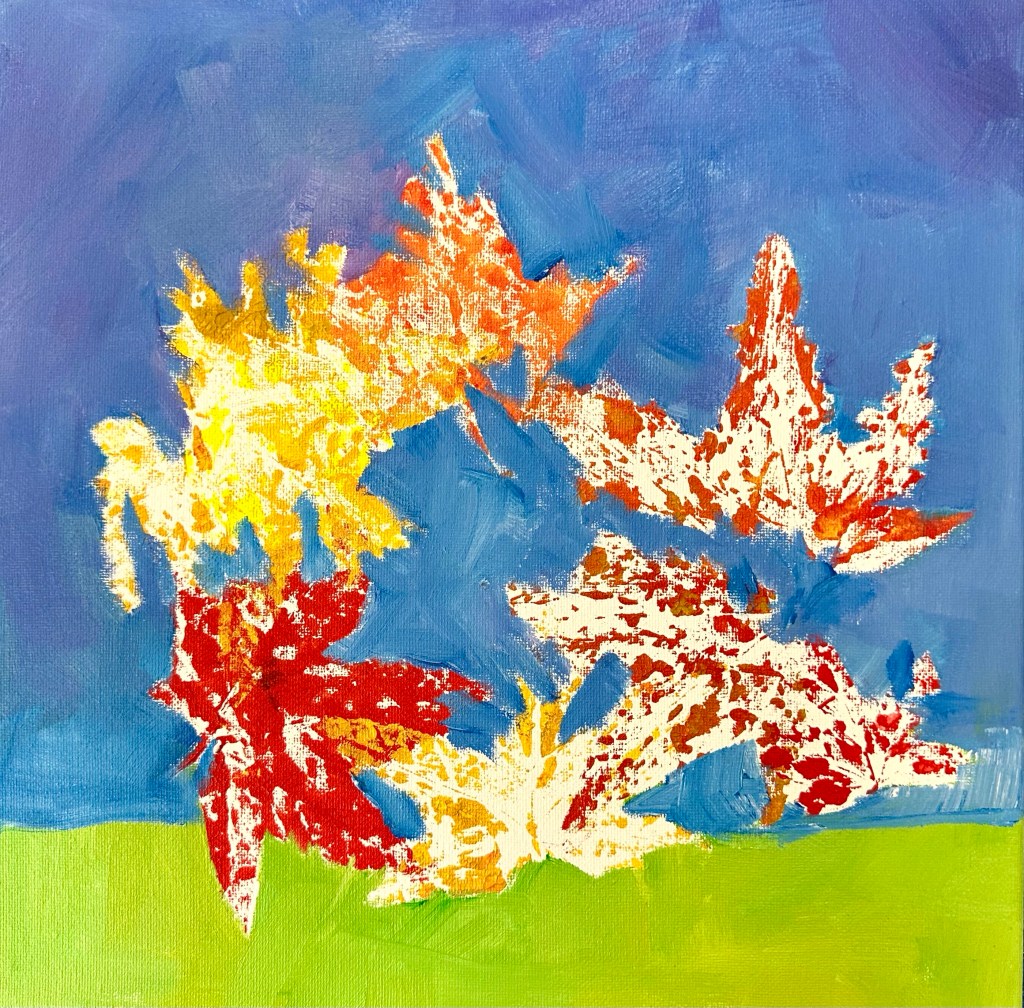
Cornelia: Dancing Leaves

As I’ve been watching the brisk winds blow the gold and red leaves from the trees this fall, I’ve also watched them dance against the bright cerulean sky. When the sun shines on these dancers, they glow even brighter than before. They don’t have a care for tomorrow, much less for today. Now and this moment is enough for them. They remind me of the Lord’s advice to us on the Sermon on the Mount in Matthew 6:34—

“So do not worry about tomorrow, for tomorrow will bring worries of its own. Today’s trouble is enough for today.”

I painted the back side of the leaves with a thin coat of acrylic paint and laid them one by one down on the white surface of the canvas. Then I gently hand rubbed the top of each leaf until I thought I’d transferred the paint. The hansa yellow was least successful as a print color, so I over printed it at the end. I mixed the green ground with the cerulean blue and two yellows. The sky has cerulean, violet, Ultramarine, and white. These I mixed as I painted, so the sky wasn’t an even color. (All skies change color due to atmosphere and distance: they get lighter toward the horizon).

Next Friday we’re going to make stamp prints. You may have cut your own design in a potato once upon a time in scouts or used vegetables to make prints. We can also use leaves, natural materials, metal objects, or found objects to create prints. Art is a time to explore and experiment. We’ll find out what works and what doesn’t!! Curiosity and the willingness to experiment and explore are all aspects of creativity. We can all learn to stretch our boundaries and learn resilience, which are experiences that help us address the stresses and challenges of daily life.

I learn something new every day. Today I learned a starfish has a brain that covers its entire body. Its whole body is made up of brain nodes! There are days I wish I were a starfish: I would have loads of brain cells!

Joy, peace, and happiness to everyone!

Cornelia


Type Four: The Individualist — The Enneagram Institute

https://www.enneagraminstitute.com/type-4

The 9 Enneagram Types — The Enneagram Institute

https://www.enneagraminstitute.com/type-descriptions

Art Analysis: Dance by Henri Matisse – Artsper Magazine

The Sunlit Tree

Imagination, Meditation, Ministry, photography, Spirituality, Travel, Uncategorized, vision, Work

20130926-065924.jpg

I am not a point A to point B person, but what right brained artist is? Yet, making a work of art requires planning and structure, just as building a house requires plans, or both will fall apart before very long. This is why some of our efforts continue to please us many years into the future, while others, with our more experienced eye, now are relegated to paint over land.

This field of trees caught my eye, not because it was full of light or promise of abundance, but because only one great tree stood proud with a glorious yellow robe amid a field of dried up stunted trees and weeds. It was so different that I had to detour from the interstate, retrace my path on the old state highway and take a picture with my camera. I’ve kept this photo for a dozen years, waiting for the time when I had both the skill and the spirit to bring it to life as a painting.

I have shown this photo to various people over the years. “That’s nice, a big tree, it’s a lot of yellow and brown, and it looks half dead and half alive” are some of the comments I’ve heard. I’m used to this, for most folks don’t have vision. They cannot see the promise in the grey clouds of the rainbow to come. The rainbow must be there in all her radiance, dancing all seven of her colors across the heavens, for the hope of the promise to be written in bold enough letters for most of us to read it in the sky.

A few rare people have vision. Some are cooks, some are tinkerers, some are prophets, and some are artists. If I had copied this photo, I would have made a very different painting, one in which all the values are nearly the same, for it was an overcast day when I took the image. As a photograph, it was unworthy, but as a sketch or a plan for a future work, it was worth keeping. My mother saw this photo and said, “This is a strong tree that survives and shelters others.” My Mother had vision.

I could have gone in several directions with this painting. One choice I considered was the gathering grey clouds anticipating a certain storm. The lighting of the trees and the field would have been more dramatic. I decided to go with a brilliant autumn day, with the sky and fields full of light. All the trees were in their full dress glory as the winds shake their leaves of yellows, oranges, and reds.

The verse from Ezekiel 17:24 came into my mind: “And all the trees of the field shall know that I am the Lord; I bring low the high tree, and make high the low tree, dry up the green tree, and make the dry tree flourish. I am the Lord; I have spoken, and I will do it.”

This vision of sunlight, warm wind, healing and uplifting the dried up landscape brought hope into my heart! We may be discouraged for a season, but our standing rooted as we trust the God who loves us means that we will be there when God’s promises come true. If we are the dry tree, we will flourish! If we are the low tree, we will be made high!

As artists, we are constantly creating, so we share this activity in common with God. Do we have the vision to see beyond our circumstances to God’s promises that await? Do we have the courage to continually work along side God to bring God’s vision into reality? Take your sketchbook, your easel, or your camera this week out into the countryside. Find the tree that calls you apart from your designated journey. Enter into a conversation with this place. Perhaps you are not used to being still, or quiet. Listen to the sounds of this place. Do not be too quick to hurry off to worship the idol, “I’ve got better or more important things to do with my life.”