Picasso’s African Masks and Inner Mysteries

adult learning, art, Creativity, cubism, elections, Imagination, inspiration, Painting, picasso, renewal, The Lord of The Rings, Thomas Merton, vision

What is the key to open the door to the hidden mysteries? For Frodo and his fellow travelers in The Lord of the Rings trilogy, they needed to know the elvish answer to the riddle, “Speak friend and enter.” Gandalf knows this language, so they enter with ease. For years, the Egyptian hieroglyphics were unintelligible because we had no living person who knew the ancient language. After the discovery of the Rosetta Stone in Egypt with its three languages depicting the same text, the race was on to translate the pictographic writing.

Rosetta Stone, British Museum

In art school my fellow students and I worked in our shared studio classes daily, but sometimes we never made any progress. Then the day would come when the light bulb clicked on in one of our brains. When we took a break, instead of giving everyone’s work a cursory glance before going out for a snack, we would linger and take in the special magic of a unique vision. Where does this special insight come from? Is it a visitation from above? Or a piercing of the soul by divine artistic insight? Sometimes I think the rare and the strange shock us out of our ease and complacency.

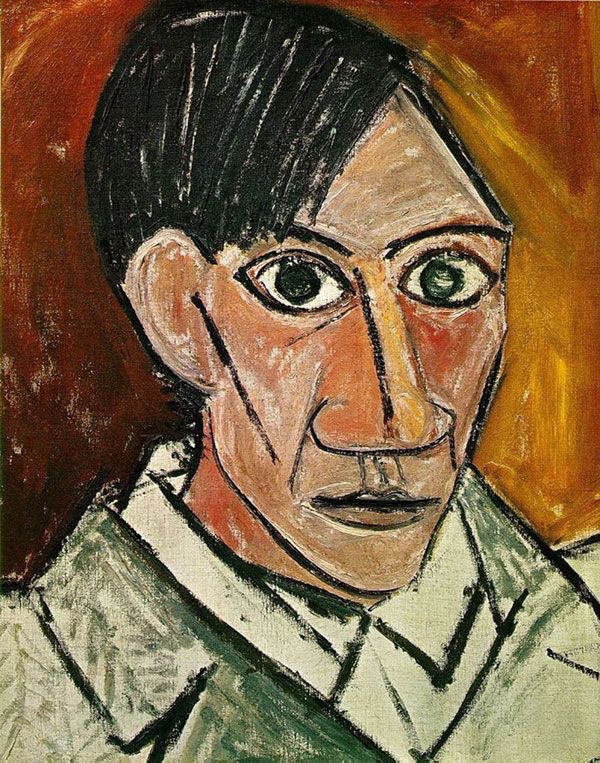
Picasso: Self Portrait, oil on canvas, 1907.

Art historians divide Picasso’s early periods into his Blue Period (1901-1904), the Rose Period (1905-1907), the African-influenced Period (1908-1909), and Cubism (1909-1919). Some art historians call Picasso’s African Period his “Proto-Cubist” or primitive period. It lasted from 1907 to 1909. Picasso was 24 years old when he saw an exhibit of African art at the ethnographic museum at Palais du Trocadéro. He experienced a “revelation” and began to explore African art further. African masks and sculptures strongly influenced Picasso’s art for several years, when he began to paint in sculptural forms, earth tones, and in flattened sharpened shapes.


Pablo Picasso in his Montmartre Studio,1908, via The Guardian

Picasso had first seen an African mask at Gertrude Stein’s home. Recalling his visit to the Trocadéro Museum of Ethnology (now the Musée de l’Homme), Picasso said of the museum:

“A smell of mould and neglect caught me by the throat. I was so depressed that I would have chosen to leave immediately. But I forced myself to stay, to examine these masks, all these objects that people had created with a sacred, magical purpose, to serve as intermediaries between them and the unknown, hostile forces surrounding them, trying in that way to overcome their fears by giving them color and form. And then I understood what painting really meant. It’s not an aesthetic process; it’s a form of magic that interposes itself between us and the hostile universe, a means of seizing power by imposing a form on our terrors as well as on our desires. The day I understood this, I had found my path.”

That path led Picasso to what he called his “periode nègre” (black period) or African period. It lasted only a few years, to 1909, but it turned Picasso into an avid collector of African art, masks, and sculptures that inspired him for the rest of his career.

Picasso: Woman with joined hands, 1907, Paris.

In our art class we chatted about how these masks inspired Picasso. Picasso used a palette of earthy tones, overlapping browns, and yellows with dark reds. By using Cubism, he explored a simplified geometry and the redefinition of perspectives. He tried to reveal objects from a different vantage point—from the mind, not only how the eyes perceive them. His Les Demoiselles d’Avignon signified a radical break from the naturalism that had defined Western art since the Renaissance, derailing former notions of what art was supposed to look like.

Picasso: Les Demoiselles d’Avignon (1907), oil on canvas.

People criticized Picasso’s two-dimensional women as unfeminine, for their confrontational demeanor was a complete departure from the traditional depiction of female beauty. Artists and critics alike received the work negatively and saw its menacing sex workers as promiscuous and unfit for Paris salons. Picasso rolled up the canvas, considered scandalous even amongst his innermost circle, and stored it in his studio for years to come. Yet this groundbreaking painting influenced his future works.

As Thomas Merton wrote in No Man Is an Island:

“In an aesthetic experience, in the creation or the contemplation of a work of art, the psychological conscience is able to attain some of its highest and most perfect fulfillments. Art enables us to find ourselves and lose ourselves at the same time.”

Picasso broke through the accepted boundaries of Western culture and discovered his true spirit in through the voices of the ancestors speaking from the African past. He met the other and found himself. By bringing the African masks into his studio, Picasso lived out the message of Hebrews 13:2—

“Do not neglect to show hospitality to strangers, for by doing that some have entertained angels without knowing it.”

As artists today, who seek to find their own true self and unique voice, we must both find ourselves and lose ourselves. We must lose our preconceived notions of who we should be and discover our true selves. Some artists use this as license to be caricatures of an artist, but actual artists have work ethics because they have obligations to galleries and clients. Looking like an artist and being an artist are two different things. Finding our true selves is not only a task for creatives, but also a lifetime journey for all people engaged in spiritual growth. We all can recover the image of God, which is our true self, by both God’s grace and our cooperation in doing good to all.

We artists are not here to make pretty pictures, but to break down the boundaries between our walls that keep us estranged from God and neighbor. We are not as bold as Picasso! Most of us are not risk takers. Willingness to leap out in faith is what marks a famous artist. That same riskiness is what marks the prophets of the Bible. Prophets never praise the status quo, but remind the people of the nature of their God:

“For the LORD your God is God of gods and Lord of lords, the great God, mighty and awesome, who is not partial and takes no bribe, who executes justice for the orphan and the widow, and who loves the strangers, providing them food and clothing.” (Deuteronomy 10:17-18)

Isaiah 1:17 reminded the people of his day, “learn to do good; seek justice, rescue the oppressed, defend the orphan, and plead for the widow.” Jesus will pick up this same voice in Matthew 25:40, “And the king will answer them, ‘Truly I tell you, just as you did it to one of the least of these who are members of my family, you did it to me.’”

So how will we find our unique voice and creative expression today? The more we steep our heart and mind in the great spiritual writings of the ages, particularly those of whom have come through great suffering or difficulties, the closer we will come to understanding our own challenges in life. These hardships are not hurdles or barriers to our progress, but refiners of any weakness that needed to be strengthened.

As my teachers always said, “We test you, not to see how ignorant you are, but to see what we failed to teach well.”

I always liked their attitude better! I did not feel so dumb when I missed the right answer on their tests. I always liked art better, for more than one answer could be correct. If we work within the parameters of the assignment, we can interpret the art with our own vision and style.

Our recent class with the African masks was a big diversion from our usual method of working. First, the masks are from a different culture. They are as much of a culture shock to us as they were to Picasso. He had the privilege of buying them in the Parisian curio shops, so they sat around in his environment. We only had images. The mystery of these objects might not connect to us as they did to him.

Mike’s Mask

Mike brought several masks from his home collection. He decided to paint one that spoke to him. Like Picasso, he had an emotional connection to this mask. He made a successful rendering of the object before him. Unfinished, he would bring it back to the next class.

Tim’s First Layers

Tim worked on a mask representing his wife. He first painted his background with a dark wash, then began drawing a lighter design on top of it. The contrast of the dark and light without the middle tone was difficult for me to look at, but he seemed to be enjoying getting the big shapes down. I often let people work without jumping into change their activity. I figure they will learn more from going down a dead-end road by themselves than if I stop them before they go there. They will ask about this, and we will talk about it. They will not do it again. A little suffering leads to learning if we do no harm to the body.

Gail’s First Layets

Gail S. understood the concept of simplifying the faces into a mask. She chose a photo of herself and her granddaughter. With two mask shapes, she had multiple decisions to make. As with the others, her work was unfinished at the end of class.

This was a difficult and challenging lesson for everyone. Asking students to make an emotional connection and render the object also was aspirational. It also gave me an opportunity to see where they were on this learning journey. I will not issue this sort of challenge again for a while. I was afraid I had been boring them, but maybe not. I may need to bring brownies next Friday to make up to them. For some, they may be “grief snacks,” while for others, they will be “encouragement food.” If my bunged-up shoulder permits, I will indulge in grief baking. Otherwise, I will just eat the chocolate ice cream in my freezer, and ask for understanding.

Cornelia’s Trump Portrait

I painted a Trump mask to get my emotions out and not have them bottled up inside. If we dislike an attribute in another person, it is because we have that attribute in our own life. I can get incredibly angry, but I bottle it up and it hurts me. I do not often let anyone else see it, so it can make me sick from holding it in. Whenever someone calls you a name, I remember the old song my parents taught me when I was a child:

“Sticks and stones may break my bones, but words will never hurt me.”

Anger is a difficult emotion for many people, especially for women. It is a “culturally unacceptable behavior,” for we have always expected strong emotions from men, but this expectation is changing over the generations. Proverbs 14:29 reminds all of us,

“Whoever is slow to anger has great understanding, but one who has a hasty temper exalts folly.”

The Old Testament often speaks of God’s anger, but this is because God’s people keep finding other gods to worship instead of the one true God. Psalms 145:8-9 reminds us of God’s true nature:

“The LORD is gracious and merciful, slow to anger and abounding in steadfast love.

The LORD is good to all, and his compassion is over all that he has made.”

The hidden mystery is in plain sight. It is the word of hope we hear:  We are not sinners in the hand of an angry God. We are all beloved and God’s everlasting grace is redeeming us always. When things fall apart, God works to reframe and renew, even if we have difficulty recognizing God’s new creation or wanting to take part in God’s plans for the new heaven and the new earth.

Joy, peace, and recovery,

Cornelia


Historical Influence of African Art in the Modern Art Movement – ARTDEX

Pablo Picasso – Artists – Mnuchin Gallery

https://www.mnuchingallery.com/artists/pablo-picasso#:~:text=Picasso’s%20early%20work%20can%20be,Cubism%20(1909%2D1919)

Stealing beauty | Art | The Guardian

https://www.theguardian.com/artanddesign/2006/mar/15/art

Historical Influence of African Art in the Modern Art Movement – ARTDEX

Sticks And Stones May Break My Bones – Meaning & Origin of The Phrase

https://www.phrases.org.uk/meanings/sticks-and-stones-may-break-my-bones.html


Rabbit! Rabbit! Welcome to November

Abraham Lincoln, All Saints Day, Altars, art, change, chocolate, Civil War, Constitution, Day of the Dead, exercise, Faith, Family, Food, generosity, Habits, Health, holidays, inspiration, Love, nature, poverty, pre-diabetes, pumpkins, rabbits, Thanksgiving, trees, Ukraine, Uncategorized, US Constitution, Van Gogh

My parents would often say, “Time flies when you’re having fun.” If this is so, I’ve had a one whale of a time in 2023. I don’t know where the time has gone, for I’d swear I just woke up in the bright new year of 2023, and now this year has grown a beard of some length. Indeed, the ground was bare, awaiting the warm breath of spring, and now it has experienced its first freeze.

Autumn is a time of transitions. Not only do the trees change colors, and then lose their wardrobe altogether, but we rabbits go from Halloween’s sugar high on October 31st to overstuffing ourselves and the roast beast at the Thanksgiving feast on the Fourth Thursday of this new month. Then we segue into Christmas somnolence with yet more cookies and egg nog (spiked and plain). On occasion we tramp out to decorate the house or scour the woods for greenery, but those days are long gone for most urban dwellers. We’re going to buy from local providers or have it delivered online.

Some of us on the first day of November will still have some of the 35 million pounds of candy corn which are still produced each year. That’s about 9 billion pieces — over a billion more than there are people on Earth. As far as this bunny is concerned, this is 8,999,999,999 pieces of candy corn too many. I’m not a lover of this form of sugar; give me dark chocolate any day. Fortune reported the “dangerous” amount of sugar consumed by kids on Halloween — three cups of sugar in 7,000 calories of candy. For context: That’s 675 grams of sugar, or the same as chomping down almost 169 standard sugar cubes, according to a Fortune article published in 2017.

A Young Bunny

When I was a young bunny, sugar was so restricted in our home, my friends and I would escape our parents’ notice during fellowship time at church to go to the empty adult Sunday school classrooms. We knew where they kept the wonderful Domino Pure Cane sugar cubes for the coffee the grownups drank. We didn’t care for coffee, which was already gone, but the sugar we fell upon like pirates on buried treasure. We didn’t ever consume 169 cubes at once, since that would’ve destroyed the entire stash.

If these had been the 35 million pounds of candy corn, which are still produced each year for Halloween, neither I nor my bunny friend would have ever touched them. The idea about 9 billion pieces — over a billion more than there are people on Earth—are still produced today is incomprehensible to my bunny brain. I think the texture of corn syrup and gelatin isn’t my first choice.

Of course, when the weather turns colder, our bunny bodies sense the need to stoke our internal fires. We do this by consuming more calories, especially the quick acting carbohydrates we find in the sugars and starches that provide the instant “heat” boost our bodies crave. Actually, any food will heat us up, but fruits and vegetables don’t have the same appeal as warm, savory, and fatty foods do in colder weather. The shorter days and the decrease of light in the winter cause problems with our body’s biological clock and lower the levels of the brain chemical serotonin. Plus, many of us reduce our physical activity, so our exercise induced levels of serotonins drop.

Healthy Eating includes More Fiber

We can overcome this loss by planning to be outside during the daytime and making sure to exercise at least 30 minutes daily. Having protein rich snacks and fiber rich soups with complex carbohydrates will help control our hunger spikes. Perhaps this transition time into longer nights and shorter days is why the First Wednesday in November is always National Eating Healthy Day (November 1). If we do only one new healthy choice per week, and add a new healthy option each week thereafter, we can transition our lifestyle into “Eating Healthy.” As a bunny, I remind my friends, it’s also National Vinegar Day—have compassion on yourself and on others. We can love ourselves and others into a better life with kindness rather than harshness. As my grandfather Bunny always said, “You catch more flies with honey than vinegar.”

Day of the Dead Skull

All Saints Day and Dia de los Muertos both are celebrated on November 1. Both recognize the departed loved ones. All Saints recognizes both those who have worked miracles as well as those ordinary saints who have lived among us and given quiet witness to their faith. Dia de los Muertos, the Day of the Dead, is a three-day festival to remember the ancestors and friends who predeceased us. People decorate altars with marigold flowers, photos, and skulls in memory of the dead. They make special food offerings in their honor also.

All Soul’s Day on November 2 is a Catholic holiday to pray for the souls which aren’t yet in heaven, but are in purgatory. Protestants don’t believe in purgatory, so we don’t attend upon this day as holy.

Cookie Monster: “Me want COOKIES!”

Many of us do celebrate Cookie Monster Day on November 2, because who doesn’t like cookies?! The same goes for National Sandwich Day on November 3, for hot or cold, almost anything can be slapped between two slices of bread and get slathered with avocado or mayonnaise, and it’s good to go.

Sandwiches first appeared in American cookbooks in 1816. The fillings were no longer limited to cold meat, but the recipes called for a variety of things: cheese, fruit, shellfish, nuts and mushrooms. After the Civil War sandwich consumption increased and were sold both in high-class lunch rooms and in working-class taverns. A typical turkey sandwich in the 1980s contained about 320 calories, according to a report from the National Heart, Lung and Blood Institute. Twenty years later, a turkey sandwich contained about 820 calories. Choose whole grain bread if possible.

We seniors have more than time on our hand

“Fall Back” on Sunday, November 5, when Daylight Savings Time Ends. We get another hour of sleep on this day when the clocks go back 1 hour at 2 am. I won’t be awake to notice it, but I suggest those of you who aren’t good sleepers begin to look at your evening routines. Set a wind down time on your clock, watch, or mobile device. Let it remind you to turn on quiet music, read inspirational books, or begin your bedtime routine. Sometimes taking off our outside clothes and wearing our “at home” clothes is a signal to our mind to let go of the cares of the world.

Fighting over Van Gogh Pokémon Gifts at the Museum

Go to an Art Museum Today Day and National Chaos Never Dies Day are both celebrated on November 9 this year. I don’t normally consider chaos and art museums as being in the same category, but Disney has made several Night at the Museum movies that revolve around the trope of ancient Egyptian gods awakening to cause havoc. Actual chaos recently erupted at the Van Gogh Museum in Amsterdam when visitors realized the gift shop had already sold out of the Pikachu with Grey Felt Hat promo card, which was modeled on the Vincent self-portrait. Evidently a small group of fans descended on the gift shop, causing a ruckus, and buying out the merchandise. It’s now for sale on eBay.

2023 Veterans Day Poster

Armistice Day marks the November 11,1918 anniversary of World War I, a war which began in August 1914, that few expected to last beyond Christmas. In 1921, an unknown soldier was buried in Arlington National Cemetery. This First World War was “the war to end all wars,” but we’re an overly optimistic nation. We’ve had a Second World War since then, plus many a regional conflict. Every time our battle ships show the flag somewhere, people think it’s going to be WWIII. Fear mongering doesn’t help the nation. We’re better and stronger than that. Plus, we have the moral duty of leadership: our country needs to show the world there’s a better way.

As I recall, both the North and the South expected the great Civil War to last just a short while, just as Putin entered Ukraine believing his army would roll into Kiev in mere weeks. Yet WWI lasted four years, WWII was six years (the US was involved only the four years from 1941-1945), and our Civil War was another 4-year slog. Wars aren’t so much “won” as lost by attrition: one side loses more men, materiel, and willpower so they surrender to the other. War is the most brutal way to settle our differences.

Armistice Day now is Veterans’ Day, November 11, but observed a day earlier (10th) this year. We celebrate our veterans who do the difficult and challenging work of using judicious force against enemy combatants, rather than civilian populations. All of our enlisted personnel take the same oath to protect and to defend our Constitution against all enemies, foreign and domestic:

I, (state name of enlistee), do solemnly swear (or affirm) that I will support and defend the Constitution of the United States against all enemies, foreign and domestic; that I will bear true faith and allegiance to the same; and that I will obey the orders of the President of the United States and the orders of the officers appointed over me, according to regulations and the Uniform Code of Military Justice. (So help me God).”

The US Constitution, 1787

We are an unusual people, we Americans, for our loyalty isn’t to a party, a president, or a person. We are loyal to the constitution, which protects our democratic institutions, values, and freedoms. We can be thankful for those who were inspired to write it, heard the prophetic call to amend it, and have the wisdom to keep us on the straight and narrow.

National Hunger and Homeless Awareness Week is November 11-19 this year. While the economy is recovering, the loss of pandemic assistance funds Is hurting lower income households. They are making hard choices: food or rent, medicine or food. The number of homeless veterans has decreased, but so has the overall population of veterans. The bad news is veterans are still overrepresented in the homeless population. As you prepare for your own feast this year, I hope you remember the hungry in your community. The best way to help is with a financial donation to the local food bank. The bank can purchase food from the warehouse food bank at greatly reduced prices, thereby providing more food per dollar than individuals can purchase on their own.

World Diabetes Day is November 14. Diabetes is a disease on the increase in the world today. In the US alone, over 37 million people have this disease and over 8.5 million have it but are undiagnosed. Over 96 million US adults have prediabetes, a condition in which their insulin doesn’t take the sugar out of the bloodstream well. Switching to whole grains, less processed foods, and adding more fiber to the diet usually helps lower the blood sugar. So does daily moderate exercise.

National Clean Out Your Refrigerator Day is November 15. This is a good day to practice this task, since you’ll be filling it up with excess foods if you’re hosting the feast, or you’ll be traveling away from home. If the latter, you don’t want to return home to spoiled food if the power goes off for any length of time. Ugh: I won’t regale you with the story of stench of the refrigerator in the garage which didn’t power back on after a power outage. Those outlets need to be reset manually because they’re in a “might get wet” zone. The refrigerator inside will come back on automatically. (This turned out to be a get rid of the refrigerator day.)

National Stuffing Day is November 21. If you bake your bread mixture outside of the great bird, it’s called dressing, but if you cram it into the bird, it’s stuffing. It’s safer to cook the bird without stuffing, also quicker. When baking stuffing inside a turkey, it can get get wet and mushy. If you make a flavorful stock from the turkey neck and giblets, you can make your stuffing moist and flavorful without turning it into mush.

If you live in a giant pumpkin, buy a smaller pumpkin for your pie

Pumpkin Pie Day is also November 21, so you can prepare this ahead of time if you wish. You can make a handmade crust or use a store-bought crust from the grocery. Pre bake it and fill it with the pumpkin mixture.

National Cranberry Relish Day is November 22. You can easily make your own with the juice of an orange, some sugar to taste, and cinnamon combined with a package of rinsed cranberries. Heat over medium in a saucepan, stirring frequently to keep from sticking. When the berries burst, reduce heat to simmer and reduce the liquid. Taste and adjust the seasoning. Take off the heat and put into container for icebox. Chill overnight to let seasonings combine. Serve cold as side dish.

Thanksgiving Day is Thursday, November 23. You’ve baked the turkey, and it smells amazing! Let me introduce you to pan gravy from the drippings. You need a little flour, about 2 Tbs; some pepper, about ½ cup of drippings, and 1 cup of hot water. Put the drippings in a heavy saucepan or skillet, add the flour, stirring constantly over medium high heat until flour turns caramel color. This is a medium roux. Slowly add hot water, stirring so no lumps form. Keep stirring till smooth, reducing heat. Add more water slowly if gravy thickens too much. Pepper and salt if necessary.

The idea of “thanksgiving” for the harvest is as old as time, with records from the Egyptians, Greeks, and Romans. Native Americans in North America celebrated harvest festivals for centuries long before Europeans appeared on their soil and before Thanksgiving was formally established in the United States.

In the 1600s, settlers in Massachusetts and Virginia had feasts to thank for surviving, fertile fields, and their faith. The Pilgrims in Plymouth, Massachusetts, had their infamous Thanksgiving feast in 1621 with the Wampanoag Native Americans. The three-day feast consisted mainly of meat: wild fowl procured by the colonists and five deer brought to the feast by the Wampanoag. A a stew called sobaheg was most likely served as a side dish to the main course. It was an easy way to make use of seasonal ingredients, for the stew often included a mixture of beans, corn, poultry, squash, nuts and clam juice. All are used in the traditional dish today, and all would have been available in 1621.

Potatoes weren’t around in 17th-century New England, but corn was plentiful. Natalija Sahraj

Corn and cornmeal were the main carbohydrates on the first thanksgiving meal. The first New England crop of potatoes was grown in Derry, New Hampshire in 1722, so no mashed potatoes were on the menu. Corn bread, corn mush, and corn puddings abounded, since the Native Tribes had shown the colonists how to plant beans, squash, and corn together to maximize growth of all three. The harvest of 1621 likely included beans, squash, onions, turnips and greens such as spinach and chard. All could have been cooked at length to create a green, pulpy sauce that later became a staple in early New England homes. Sweet dishes concocted from sugar or maple syrup weren’t on the menu, nor were honey sweetened deserts. At least, the Pilgrims didn’t have to save room for pie.

After the Pilgrims, for more than two centuries, individual colonies and states celebrated days of thanksgiving. The first national celebration of Thanksgiving was observed for a slightly different reason than a celebration of the harvest—it was in honor of the creation of the new United States Constitution! In 1789, President George Washington issued a proclamation designating November 26 of that year as a ”Day of Publick Thanksgivin” to recognize the role of providence in creating the new United States and the new federal Constitution. During the Civil War, President Lincoln called for a national Thanksgiving Day on the last Thursday of November after the Battle of Gettysburg. In the Great Depression President Franklin Roosevelt moved Thanksgiving Day to the next to last Thursday in November. After two years of public unhappiness, Congress passed a law in 1941 setting Thanksgiving on the fourth Thursday of November.

Thanksgiving, 1858, by Winslow Homer, Boston Public Library

During the week of Thanksgiving, from November 19-25 or 26, we have the holidays of Church/State Separation Week and National Bible Week. If you haven’t been giving thanks for your blessings up to this time, take a break, breathe, and rejoice that you are alive. Give thanks for your hands, your food, your breath, and your heart of love. Share this thanksgiving with someone else. If each of us gives a bit of hope to someone else, we can help others have something to be thankful about.

Chocolate answers all questions.

After the rush of Thanksgiving, some of us bunnies may need medicinal chocolate. November 29 is Chocolate Day. Depending on your personality, you can buy fancy chocolate to share, or you can enjoy it by yourself along with a good book and some lavender tea. If Thanksgiving Day was really overwhelming, National Personal Space Day on November 30 might be calling your name. We all have times in our lives when we don’t need hugs, either because of physical or emotional distress. Besides, we bunnies need to catch our breath before we dash into the Christmas season.

I’m thankful for each of you who read and share my stories.

Joy and peace,

Cornelia


2023 November Holidays Information from Holidays and Observances

http://www.holidays-and-observances.com/november-holidays.html

15 Mind-Blowing Facts About Halloween Candy Consumption in the US

https://www.businessinsider.com/halloween-candy-consumption-usa-facts-statistics-2019-10

Control Your Winter Appetite

https://www.webmd.com/diet/features/control-your-winter-appetite


History of Thanksgiving in America | The Old Farmer’s Almanac

https://www.almanac.com/www.almanac.com/content/when-thanksgiving-day

What the first Thanksgiving dinner actually looked like

https://theconversation.com/what-the-first-thanksgiving-dinner-actually-looked-like-85714


Is Stuffing Your Turkey Safe?

https://www.marthastewart.com/8163046/is-it-safe-stuff-turkey


Wall Street Journal: The American Diet Has a Sandwich Problem – Center for Health Incentives and Behavioral Economics (CHIBE)

https://chibe.upenn.edu/news/wall-street-journal-the-american-diet-has-a-sandwich-problem/


History of the Sandwich | The History Kitchen Blog | PBS Food

https://www.pbs.org/food/the-history-kitchen/history-sandwich/

Van Gogh Museum pulls its Pokémon promo card after opening day chaos

https://www.engadget.com/van-gogh-museum-pulls-its-pokemon-promo-card-after-opening-day-chaos-083349757.html


Seeds of Dissent and a Harvest of Distrust

Ancestry, arkansas, art, Faith, Family, Forgiveness, greek myths, Holy Spirit, hope, incarnation, inspiration, john wesley, Love, Ministry, Painting, perfection, poverty, purpose, Ravenna Italy, renewal, Retirement, stewardship, Stress, United Methodist Church, vision

Christ Enthroned with the Angels
6th century Mosaic
Church of Sant’Apollinare Nuovo, Ravenna, Italy

Nothing springs full grown to life in an instant. Everything begins in a seed, which is planted, watered, and nourished into full growth. Only in myths or fantasies can an idea come into being instantly. Zeus had a very bad headache, a “splitting headache,” that birthed his daughter Athena, the goddess of wisdom. She leapt out in fully grown from his brow. We don’t take this myth to be scientifically true, but as a metaphor for the difficulty and struggles we undergo to obtain wisdom. As my daddy used to tell me after I’d learned some hard life lesson, “The school of experience is a rough master, and we all earn a costly degree in gaining its wisdom.”

Little Master Lip Painter Attributed to the Phrynos Painter: Birth of Athena, Attic Black Figure Ware, Kylix, Date ca. 555 – 550 B.C., Early Archaic Period,

Some of us will repeat the same lessons over and over, as if we expect to get a different result. The purpose of an education isn’t to regurgitate a right answer to pass a test, but to understand why the answer is right. That’s why math classes require showing the steps to the solution, rather than the “full blown adult answer” only. In matters of faith or ethics, many of us haven’t had the training to “set out the proof” for our final answer or deed. In fact, in one situation we may think or act one way, and quite differently in another.

The name for this behavior is “situational ethics.” Less kindly, it’s also known as spinelessness, shiftiness, being two faced, or dishonesty. Mostly it means people don’t have a true center or a plumb line by which they measure themselves. If we’re measuring our lives against other people, we’re measuring against other fallible human beings. Even our heroes have feet of clay, for none of us are gods. When I used to call my parents out on this character trait, they always told me, “Do as I say, not as I do.” This sets up a moral conflict for most people, even those raised in the church or in religious homes.

We need to have a moral center based on a higher authority than our individual or cultural conventions, one that includes or exceeds the ethics of the group to which we belong, and not just our individual beliefs and actions. Professional groups—physicians, lawyers, clergy, educators, and others—all have ethical standards for caring for those they serve, even if they morally disagree with the behaviors that bring them into their care. Who decides the ethics of the group? At the risk of making my favorite seminary professor, Billy Abraham, roll about in his still fresh grave, we United Methodists do have the so-called Wesleyan Quadrilateral of Scripture, Tradition, Reason, and Experience to guide us. Often we assign our personal life experience to this latter quadrilateral edge, but Wesley meant our Experience of the Assurance of God’s All Embracing and Adopting Love. As Wesley once said, “God is able to save all to the uttermost.”

The Good Samaritan by English School, (19th century)

Ethics and morals are often used as synonyms, but ethics refer to rules provided by an external source, e.g., codes of conduct in workplaces or principles in religions. Morals refer to an individual’s own principles regarding right and wrong. Ethics is a a late 17th century word derived from the Greek ēthos (disposition, character), in contrast to pathos (suffering). In Latin it means ‘character, depiction of character’, or (plural) ‘customs’.

Then we have the words moral and morals. The first is concerned with the principles of right and wrong behavior. The goodness or badness of human character is another concern. From these, people decide what behavior is considered right or acceptable in a particular society. We often say a person has morals if they conform to standards of behavior or beliefs concerning what is and is not acceptable for them to do. We can speak of “the corruption of public morals, “ or you can hear people talking as if “they believe addicts have no morals and can’t be trusted,” rather than understanding the disease and abuse bases which often underlie addictions.

These distinctions don’t change the negative consequences of the addict’s behaviors, yet the addicted person still has the same image of God and the same potential for wholeness each of us have, but perhaps with more suffering, or pathos. If we judge the morality of a person’s choices, and then refer that moral state to the individual’s worthiness, we can end up losing compassion for the person as well as losing the will to help them better their lives. This leads to hard heartedness and a lack of love. We reject our neighbors and make them strangers, unwelcome to our world. We forget our spiritual ancestors were once strangers in a strange land, wanderers without a home. How easily we forget our savior, who had no place to be born even in his ancestral home, and whose family fled religious persecution and certain death to live in Egypt, far from home. Strange how some Christians have no sympathy for others in the same fix today.

Moral is a word from the late Middle English by way of the Latin moralis, from mos, mor- ‘custom’, with the plural mores or ‘morals’. It refers to one having the property of being right or wrong, good or evil, or voluntary or deliberate, and therefore open to ethical appraisal. When we apply moral attributes to a person, it means “capable of moral action; able to choose between right and wrong, or good and evil.” Not until 1803 did moral come to mean “virtuous with regard to sexual conduct,” according to the Oxford English Dictionary.

As a noun, we meet the word in the Latin Moralia, the title of St Gregory the Great’s moral exposition of the Book of Job. Later it was applied to the works of various classical writers. All Methodists and the holiness denominations birthed from the seed of the great Methodist revival recognize the genius of John Wesley. We all quote him, but we also apply his wisdom through our own individual preconceived notions of what is “good, true, and noble.”

When John Wesley was asked, “What is that faith whereby we are sanctified?” he answered:

“First believe that God has promised to save you from all sin, and to fill you with all holiness; secondly, believe that He is able thus to save to the uttermost all that come unto God through him; thirdly, believe that He is willing, as well as able, to save you to the uttermost; to purify you from all sin, and fill up all your heart with love. Believe fourthly, that He is not only able, but willing to do it now! Not when you come to die; not at any distant time; not tomorrow, but today. He will then enable you to believe, it is done, according to His Word.”

In the old days, we said we were “going on to perfection,” not that we were so bold as to claim that we’d already arrived there or been perfected. Oh no, we allowed God could complete this for us and had the power to do it, as well as the will, but our human nature was still fallible. If a word comes up more than once in a text, writers go to the thesaurus for an alternative, but in reading scripture, we learned repetition was a sign of importance, a marker especially meant for those of us who are slow learners in the school of life.

Oliver O’Donovan in “Scripture and Christian Ethics” writes, “Moral theologians have a secret knowledge, apparently concealed from other kinds of theologians, especially those devoted to hermeneutics. They know that the most mysterious and most difficult question we ever have to answer is not, what does Scripture mean?, but, what does the situation we are facing mean?, where do we find ourselves existentially?”

We tend to speak as if our selves and our situations were known quantities, so that it only remains to choose out of Scripture whatever seems to fit our circumstances as we conceive them. Scripture has an uncanny way of shedding light on our self and our situation, to overcome our preconceptions about them. We don’t read about our situation directly in the Scriptures, yet it’s from the Scriptures we gain categories of understanding, which re-frame our view of our situation and ourselves. We can’t look for individual texts to guide our actions, but need to consider the whole of the revealed Scripture and God’s nature as we discern our path forward.

Carl Bloch: Monk Looking in a Mirror, 1875, oil on canvas, Nivaagaard Museum, Denmark.

In this sense, the Bible is a mirror which reflects our inner nature to us, convicting us of our failings and giving us grace and comfort in our times of need. We can learn much about ourselves from the verses we lean on, just as much as we can by the verses we ignore. There’s a reason we interpret texts by the whole of scripture, and not piecemeal. This is one way we understand the authority of scripture.

As an interesting aside, SWTX, my original conference, which approved my candidacy for the ministry, didn’t think I should attend seminary because I scored so low on the abstract reasoning tests I took. They didn’t think I would make 65, seminary’s passing grade, in my class work. It’s true I learn and process differently, but knowing this, I crammed a three year program into four years. If I’m slow to grasp the whole until I first understand the parts, this doesn’t reflect on my fitness for ministry or my intellectual ability. It merely reflects a different way of processing information. There’s more way to skin a cat, and many ways people learn.

When I taught art classes, I had to make sure I covered all the learning methods for all my students to have success. I talked about the project, I demonstrated the techniques, I had the steps written out, and for some few children, I had to place their hands in the optimum position to get them started. This covered ear and eye learning, visual reminders, and haptic or touch learning. Some students needed multiple types of learning throughout their working time on a project. Some needed reteaching every class period. Some just needed encouragement when they got stuck at a rough patch. Most all had to learn to talk in positive terms about themselves and their work, as well as about others and their creative process also.

I talk about this teaching method, for this is how we consciously or unconsciously teach those around us ethics and morals. As one youth asked me at a church I once served, “Why are you wearing your cross today? It’s not Sunday.”

“Because Jesus is important to me every day, not just on the day I lead church services.”

I realized even though her family was very active and faithful in our congregation, when they were out in the world of day to day folks, they didn’t stand out from the crowd. Maybe one day day this child will come to a time when wearing a cross becomes bearing a cross. Then again, how many people willingly choose suffering for the sake of the body of Christ? This suffering is often difficult for those of us who’ve committed our lives to Christ’s call, but we realize most laity won’t voluntarily submit to that kind of stress. Yet experience is a great teacher. We learn from others, even those who have differing opinions and choose different actions.

Wesley’s Sermon, “The Nature of Enthusiasm,” has some advice for us: “Beware you are not a fiery, persecuting enthusiast. Do not imagine that God has called you (just contrary to the spirit of Him you style your Master) to destroy men’s lives, and not to save them. Never dream of forcing men into the ways of God. Think yourself, and let think. Use no constraint in matters of religion. Even those who are farthest out of the way never compel to come in by any other means than reason, truth, and love.”

Jean Bondel: The fall of man—Adam and Eve eat from the Tree of Knowledge of Good and Evil, 1372, illustrated manuscript, National Library of the Netherlands.

As a further reminder from his all time classic Sermon, On Working Out Our Own Salvation, 1785: “By justification we are saved from the guilt of sin…by sanctification we are saved from the power and root of sin…”In modern terms, when we profess our faith, Christ saves us from the guilt of that first sin. Some say Adam and Eve were disobedient. They then emphasize rule keeping as their moral choice. There’s always a reason behind every behavior, however. Why were they disobedient? We hear the answer in the parable of the Tree of Wisdom:

“But the serpent said to the woman, “You will not die; for God knows that when you eat of it your eyes will be opened, and you will be like God, knowing good and evil.” (Genesis 3:4-5)

The man and the woman both heard the half truth, saw the shiny fruit, believed the promises of a creature rather than their creator, and ate the fruit they hoped would make them like gods. Instead they only gained knowledge of their nakedness and vulnerability. This first lesson of the school of life came with cost: fig leaves ooze irritating sap. They won’t choose this solution again. God’s providence replaced their poor choice with animal skin clothing even as God sent them out into the world. We might say the attitude of pride or greed drove their bad behavior and was the cause of their negative consequences.

As we grow in holiness and love of God and neighbor, the Holy Spirit destroys any remaining root of sin. One of the important sins, Wesley noted, was pride. Pride is that feeling of deep pleasure or satisfaction we get from our own achievements, or those of our family, tribe, nation, or other associated group. In matters of faith, we always have to remember Paul’s admonition to the Romans (10:9-13):

“because if you confess with your lips that Jesus is Lord and believe in your heart that God raised him from the dead, you will be saved. For one believes with the heart and so is justified, and one confesses with the mouth and so is saved. The scripture says, “No one who believes in him will be put to shame.” For there is no distinction between Jew and Greek; the same Lord is Lord of all and is generous to all who call on him. For, “Everyone who calls on the name of the Lord shall be saved.”

Paul reminds us of the unity of the Jews and the Gentiles, the clean and the unclean, the former masters and slaves, with the gulf now bridged between the former God worshippers and the idol worshiping strangers. Now there’s “no Jew nor Greek, no slave or free, no male or female, but all are one in Christ Jesus” (Galatians 3:28).

When we joined together into one annual conference in 2003, almost twenty years ago, we had good reasons to make one combined administrative body for our faith community. We had underfunded pension obligations, we were over heavy with administrators, and clergy didn’t have equity in retirement accumulation. Likewise, the conferences weren’t equally treated, since one didn’t fully fund pension needs, an act which caused clergy to seek appointments in the other conference, thus robbing the first of talents and gifts. These were the logical consequences of attitudes and behaviors, however.

Historic Souvenir—Can you drink this cup?

The logical person thought, “Let’s make Arkansas One Faith, One Focus, One Fellowship,” and this will solve all our problems. It may have looked good on paper, but our congregations had been used to a personal touch to remind them at least once a year they belonged to a greater whole. Their pride in showing off their home church and being a good host for the Superintendent was taken from them if they were just attendees at another group meeting. The moral choice of what’s better for me, a relaxing Sunday afternoon with my family or a meeting elsewhere, gets weighed and measured.

So now here we are, nearly twenty years into this optimistic marriage of the two annual conferences. The seeds for dissent and discontent were planted long ago, even before this joining. When I inventoried the historic memorabilia of the dead bishops at the SMU Bridwell Library, I saw how the chaos of the Vietnam War era and the sea changes our society were experiencing then affected our church in many ways. Some wanted to hold onto tradition more tightly, while others were ready to experiment with new wine in fresh wine skins. These were just “outer trappings,” however, for the message of “saved by faith, sanctified by faith, and made perfect in love by faith” never changes. This is Christ’s work, enabled by the Holy Spirit.

The past sixty years, as the last two decades, haven’t always been smooth sailing. We often have had trials, storms, and tribulations on our shared journeys. Sometimes we’re so far out to sea, we don’t see the land, and the skies are occluded, so we can’t take a bearing off the stars. Yet God’s spirit will blow us along, for even detours are within God’s providence. As James reminds us:

“Consider it pure joy, my brothers and sisters, whenever you face trials of many kinds, because you know that the testing of your faith produces perseverance. Let perseverance finish its work so that you may be mature and complete, not lacking anything.” (1:2-4)

Van Gogh: The Good Samaritan, after Delaquoix, 1890, oil on canvas, Kroller-Muller Museum, Netherlands

Today we also have powerful economic and political forces that are like wolves in sheep’s clothing. They purport to work for religion and democracy, but actually work against the stewardship of our earth ‘s resources and environment, fail to care for the poor and dispossessed, and support military interventions around the world. Moreover, some of them actively work to destabilize religious denominations with social justice callings, such as the UMC, the Presbyterian Church USA, and others. Some today think “things fall apart; the center will not hold.”

Two final words in summary: one is from the ancient wisdom tradition and the other from Paul’s paean of joy in the midst of suffering. Proverbs 22:1 reminds us, “A good name is to be chosen rather than great riches, and favor is better than silver or gold.” My dying grandfather spoke these words to me in his last hours. Ive always considered them a plumb line for my life.

Byzantine Mosaic, Ravenna, Italy

“Finally, brothers and sisters, whatever is true, whatever is noble, whatever is right, whatever is pure, whatever is lovely, whatever is admirable—if anything is excellent or praiseworthy—think about such things. Whatever you have learned or received or heard from me, or seen in me—put it into practice. And the God of peace will be with you.” — Philippians 4:8-9

Joy and Peace,

Cornelia

Oliver O’Donovan: Scripture and Christian Ethics
(This is a great read!)
https://biblicalstudies.org.uk/pdf/anvil/24-1_021.pdf

John Wesley: Repentance in Believers (Sermon 14), “Repent ye, and believe the gospel.” Mark 1:15. The Complete Works of John Wesley, vol. 1 of 3, Kindle ereader. Read on line here:
http://www.godonthe.net/wesley/jws_014.html

John Wesley’s Quotes – Seedbed
https://seedbed.com/on-john-wesley-quotes/

InterChurch Holiness Convention: a community project of various Wesleyan holiness denominations, with all male leadership
https://ihconvention.com/devotional/may-9-2/

On Patience: James 1:4–But let patience have her perfect work, that you may be perfect and entire, wanting nothing.
https://biblehub.com/sermons/auth/collyer/patience.htm

The Grammarphobia Blog: Ethics vs. morals
https://www.grammarphobia.com/blog/2012/02/ethics-vs-morals.html

The Second Coming by William Butler Yeats | Poetry Foundation https://www.poetryfoundation.org/poems/43290/the-second-coming

Rabbit! Rabbit! Welcome to July

adult learning, art, Children, Declaration of Independence, Family, Foundational Documents, Habits, holidays, Independence Day, inspiration, instagram, Painting, purpose, rabbits, risk, sleep, summer vacation, Virginia Bill of Rights, vision

It s time to celebrate!

Are we the United States of America or the Un-Tied States of America? One of the apocryphal sayings misattributed to the great Benjamin Franklin is “We must all hang together, or assuredly we shall all hang separately.” Many are the words of wisdom from those who can’t speak up for themselves anymore, but especially numerous are the aphorisms of those we hold in high esteem, the founders of our nation.

As a young rabbit, my summers were often spent in the game of “School,” as the days lengthened beyond the end of actual school. My mother rabbit, a school teacher in real life, would find me underneath the shade tree in our backyard where I’d be instructing my younger neighbor rabbits sitting in neat rows. Since old school teachers never lose their calling to teach, the upcoming anniversary of the birth of our nation is an opportunity for all of us to remember our national struggle for independence and liberty was a cause both difficult and hard won.

I’ll take one of each flavor, thank you!

As we rabbits pull out our flags, bunting, firecrackers, and ice cream churns, we might want to take a moment to remember the danger and risk our ancestors took to become an independent nation, rather than colonies subservient to the English crown. For many great reasons we can thank our ancestors for their refusal to endure the insults of taxation without representation and the indignities of having all their judicial decisions subject to revision by a foreign party. Indeed, the colonists lived as second class citizens, a fact which grated upon their very souls. Many were their entreaties to the King of England for redress of these wrongs, but to no avail.

Redress is the righting of a wrong. Some wrongs are more wrong than others, to be sure. As a young rabbit in the first year of junior high school, I discovered all my classmates had later bedtimes than I did. In fact, I was still turning in at 7 pm along with my baby brother, who was a mere 8 years old. I made an extensive survey of my different class groups and discovered the average bedtime was 8 pm. I knew my old fashioned rabbit parents would never let me stay up until 10 pm at my tender age.

Every Bunny Needs a Good Night’s Sleep

My daddy was always saying, “Young rabbits need their sleep to grow up big, strong, healthy, smart, and good looking.” I never had a good argument against these reasons, so I’d go to bed, even if I might sneak a flashlight and read a book under the covers. I did get permission to stay up to the late hour of 8 pm, however. Perhaps rebellion is part of the American DNA.

Birthing the American Union wasn’t easy. The collection of individual colonies operated separately and had their own interests. Joining them together into one whole wasn’t an easy task, for each would have to put the common good ahead of their own individual needs and desires. Benjamin Franklin proposed The Albany Plan In July 21, 1754, for a union of the American provinces, which he proposed to a conference of provincial delegates at Albany, New York, to better battle the French and their Indian allies. We remember this era as the French and Indian Wars.

Benjamin Franklin. Plan of Proposed Union (Albany Plan), 1754. Manuscript. Hazard Papers in the Peter Force Collection, Manuscript Division, Library of Congress (2.00.02)

The Albany Plan called for proportional representation in a national legislature and a president general appointed by the King of Great Britain. It served as a model for Franklin’s revolutionary Plan of Confederation in 1775. His original idea germinated in people’s minds, along with other writings which Franklin “lay upon the table.” Not everyone was ready to approve these proposals, but his proposed Draft Articles of Confederation helped the committee when they finally began to focus their action in July, 1775 to write what became our constitution.

In November, 1755, Governor Morris of Pennsylvania pressed for a Militia Act in order to recruit persons for defense of the area from Indian and French attacks. The military units contemplated were purely voluntary and the officers, though commissioned by the governor, were to be elected from below, not appointed from above. The most important difference was that in 1747 the Association was a completely extra-legal body created by the volunteers themselves, while in 1755 the military units were, for the first time in Pennsylvania history, to be established by formal legislative act. And during the eleven months before news of its disallowance by the King reached the colony, the act did serve, in spite of its limitations, as a basis for raising reserve forces for provincial defense.

The Virginia delegates to the Philadelphia convention of 1774 went with this charge in hand:

“It cannot admit of a Doubt but that British Subjects in America are entitled to the same Rights and Privileges as their Fellow Subjects possess in Britain; and therefore, that the Power assumed by the British Parliament to bind America by their Statutes, in all Cases whatsoever, is unconstitutional, and the Source of these unhappy Differences.”

The crown had placed an embargo on the colonists and had forbidden them to import any manufactured goods, books, and while they might trade with other parts of the realm, those countries didn’t have to reciprocate. Economic sanctions were used for political purposes even in the 18th century.

Richard Henry Lee of Virginia introduced a Resolution of Independence on June 7, 1776.

Thomas Paine’s pamphlet Common Sense, published in January 1776, was sold by the thousands. By the middle of May 1776, eight colonies had decided that they would support independence. When the Continental Congress met in Philadelphia Hall on June 7, 1776, Richard Henry Lee of Virginia read his resolution beginning: “Resolved: That these United Colonies are, and of right ought to be, free and independent States, that they are absolved from all allegiance to the British Crown, and that all political connection between them and the State of Great Britain is, and ought to be, totally dissolved.”

After 21 years of planning, priming, and planting of the seeds for the fragile fruit of a New Democratic nation, it would finally come to life in the July 1776 Declaration of Independence and the 1789 Constitution of the United States of America. Yet not everyone was on board, not everyone wanted to leave the established relationship, even if it wasn’t the best situation.

Thomas Jefferson: Rough Draft of Declaration of Independence

Jefferson modeled the Declaration of Independence on the Virginia Bill of Rights, which became the basis for the Bill of Rights of the new Constitution of the United States of America. Notice the sections on 3: Governance by the Majority, 5: Separation of Governmental Powers, with Executive and Legislative members returned to private service, 12: Freedom of the Press, and 13: Armed State Militias.

“That a well-regulated militia, composed of the body of the people, trained to arms, is the proper, natural, and safe defense of a free state; that standing armies, in time of peace, should be avoided as dangerous to liberty; and that in all cases the military should be under strict subordination to, and governed by, the civil power.”

Virginia Declaration of Rights, one of several pages

Section 13 of the Virginia Bill of Rights is one of the founding documents of our nation. Many today talk about “what the founders wanted.” One way we can know in part is to look at the historic records, although they are few and far between. We can find these in the National Archives, the Library of Congress, and at the Smithsonian Museum, among others. We don’t have to be mind readers or seek some medium to channel the spirits of their ancestral vision. We’re fortunate they and their descendants recognized their importance to history. Today we throw away records at a fast pace, not knowing what will be important for the future.

Rabbit Picnic in the Present Moment

While today nearly every young rabbit instagrams their lunch or their night out with a comment, which lasts in perpetuity on the internet, sometimes to a more mature rabbit’s shame and embarrassment, people nearly 250 years ago had to sit down, collect their thoughts, sharpen a quill pen, dip it frequently into the ink well, and write on precious sheets of paper.

Scholars think the Declaration of Independence was not signed by any of the delegates of the Continental Congress on July 4. The huge canvas painting by John Trumbull hanging in the grand Rotunda of the U.S. Capitol depicting the signing of the Declaration is a work of imagination. In his biography of John Adams, historian David McCullough wrote: “No such scene, with all the delegates present, ever occurred at Philadelphia.” We do have Jefferson’s draft copy as well as several printed copies that are “originals,” plus the clean, handwritten copy we treasure as a founding document.

John Trumbull, American, 1756–1843
The Declaration of Independence, July 4, 1776
1786–1820, Oil on canvas,
Yale University Art Gallery,
New Haven, Connecticut

If we had been members of the Second Continental Congress in 1776, we would have been rebels and considered traitors by the King. He would have posted a reward for the capture of each of us, since we were the most prominent rebel leaders. Soon enough the largest British armada ever assembled would anchor just outside New York harbor. By affixing our names to the document,we pledged our life,our fortune, and our sacred honor to the cause of freedom. Perhaps this would causes us today to pause. Then again, we might dip the quill into the ink well and take our first breath as a free American. We’d sign our name with pride. We would be part of history now.

As we prepare our menus for our backyard barbecues and make our plans for block parties, let’s remember in most urban areas firecrackers and explosive devices are banned, except for professional light and sound experiences. Be safe in large crowds, especially at night and in entertainment districts. Be safe, be smart, keep hot food hot and cold food cold.

Jello Pudding Icebox Cake with Graham Cracker Layers and Fresh Fruit Flag Design

Joy, peace, and history,

Cornelia

Choose your preferred font and “sign the Declaration of Independence”
https://www.archives.gov/founding-docs/join-the-signers

Jefferson’s Rough Draft of Declaration of Independence. [Digital ID# us0002_2]//www.loc.gov/exhibits/creating-the-united-states/DeclarationofIndependence/RevolutionoftheMind/Assets/us0002_2_725.Jpeg

Is July 2 America’s true Independence Day? John Adams thought so. – The Washington Post. https://www.washingtonpost.com/news/answer-sheet/wp/2016/07/01/is-july-2-the-true-independence-day-john-adams-thought-so/

Silk Declaration of Independence Scarf, Full size, supports the US National Archive
https://www.nationalarchivesstore.org/products/declaration-of-independence-silk-scarf

Militia Act, [25 November 1755]
https://founders.archives.gov/documents/Franklin/01-06-02-0116

Rabbit, Rabbit, Welcome to June!

arkansas, art, Astrology, change, Children, coronavirus, Faith, Family, Forgiveness, Healing, hope, Mental Illness, pandemic, photography, renewal, Stonehenge, summer solstice, Travel

Road Trip, anyone?

Can you believe we’re almost halfway through 2021? My how time flies when you’re having fun! And to think only a year or so ago, we thought our lives were going to be locked up behind closed doors forever and a day! Amazing how following good hand washing practices, not congregating in large groups, and wearing masks managed to stem the larger transmission of this deadly pandemic in most areas, until we could begin getting shots in people’s arms. Now that about half of Americans are vaccinated, the summer months are looking “like the good ole summertime” of memory.

Folks are going en masse on vacation and indulging their pent up travel bug by plane, car, and train, as well as bus and cruise ship. I live in a tourist town, so a goodly number of the 34 million people who kicked off the summer vacation season by traveling in a car are jamming our city streets. We’re thankful for them, however, for they spend money at the local hotels and restaurants, and that means the folks who work there can support their families. The City of Hot Springs has 38,468 people, while Garland County has 96,371. We have year round visitors, with more enjoying our hospitality in the spring and summer. Annually over 2.1 million people visit us to hold conventions, reunions, weddings, and vacations in our fair, historic town. Some days you can’t stir them with a stick. You’d think this was Times Square in New York City, or a rabbit farm.

But I digress. Those who visit us here in the Ozarks seem to be better mannered than those who travel elsewhere. Perhaps because they drive here, they refrain from alcohol until they arrive, unlike the airline passengers who’ve gained their fifteen minutes of infamy on social media and a lifetime ban from traveling on the friendly skies of the major airlines. No one will miss these bad actors on airplanes in these early days of recovering from the pandemic. Instead, we might want to recover some “good old summertime events and activities” in their place.

Vacation Bible School

One of my fondest memories from childhood was Vacation Bible School. I looked forward to it each year for the arts and crafts projects, the singing, and the snacks. I might have remembered the teachings, but I liked being with my friends from across town, who went to other schools. We could see more of each other during VBS. Children who attended my home church always created a traditional craft, the plaster hand cast. I made one in the 1950’s when I put my right hand into a pie plate full of quickset plaster. After it dried, I was allowed to pick one color to paint it. In the 1980’s, my daughter made the same craft, but she could paint it any way she wanted; she always fancied rainbows.

The Helping Hand

Rainbows and Joy

If I learned anything in Bible School, it’s we’re called to give our hands to God’s service for good for all, especially for the weak and defenseless. Also, no hand is too small to serve God. The good news is even if VBS isn’t able to be held inside at one place with the usual songs, skits, and crafts, it could always be held in a park, in a parking lot, or by traveling from backyard to backyard in carpools, or “car pods” as we call them today.

Sidewalk Entrepreneurs

Another fond memory is the neighborhood lemonade or Kool-Aid stand. As I recall, this endeavor was never profitable, but it kept us out of trouble for at least an entire afternoon. If we kids managed to keep our noses clean that long, it was likely a world record. Our parents were glad for the peace and quiet, and the opportunity for adult conversation. We kids worked together to solve our own problems and overcome any obstacles to our sales project. Of course, my brothers usually retorted to my suggestions, “You’re not the boss of me!” To which I’d reply, “But I’m older and I know better!” We’d hash it out and find a middle way.

Sometime in the middle of summer I’d get a break from those ornery brothers and get to go to camp. At first it was YWCA Day Camp, then Church Camp at an old Works Project Administration lake, and on to tent camping with the Girl Scouts. While the water might taste like iron in places, if I were thirsty, I’d drink it gladly. Some places we built our own tables with tree limbs and ropes. I learned knot tying and cooperation out in the woods. I also learned how to cook an entire meal in the coals of a fire by wrapping it in tinfoil. As my daddy would say, “There’s more than one way to skin a cat.”

Father Rabbit

Speaking of Fathers, a major holiday for all rabbits is Father’s Day on June 20th. We all have a father who has guided us in the good paths of life, even if this person wasn’t our birth or adoptive father. Often it’s another outside the family unit, such as a teacher, a coach, a pastor or lay leader in our faith tradition. For those rabbits among us who had distressing experiences with their fathers, this is a fraught day, for our past memories can color current events and relationships. If we cannot change our past, we can change how the past affects our present and our future. This is part of the healing process by which we face the pains of the past and gain power over the memories so we can have a better future not only for ourselves, but also for the next generation. Otherwise, our pain can become an unwelcome generational inheritance.

D-Day Invasion of Europe, World War II, June 6 US troops of the 4th Infantry Division “Famous Fourth” land on ‘Utah Beach’ as Allied forces storm the Normandy beaches on D-Day.

Just as soldiers returning from wars have to put aside the mental and physical wounds of wartime with medical and psychological help, anyone who has suffered abuse at the hands of a father figure also needs healing. PTSD help available through the VA for everyone. They have apps available at the link below anyone can access, but nothing takes the place of a human professional. Your health care provider or clergy person can refer you.

Of course, for fathers, the meaning of “manhood” is always in question, as American historian Timothy Marr wrote in American Masculinities: A Historical Encyclopedia (Sage Reference Publication 1st edition) that in the holiday’s early decades, men ‘scoffed at the holiday’s sentimental attempts to domesticate manliness with flowers and gift giving, or they derided the proliferation of such holidays as a commercial gimmick to sell more products — often paid for by the father himself.'” We usually gave Dad a necktie, or handkerchiefs. These are gifts going the way of the dodo bird, so my guess today’s equivalent is sports equipment or tech wearables.

National Iced Tea Day

The 1904 World’s Fair

We have the hot summer of the 1904 St. Louis World’s Fair to thanks for the popularity of iced tea. In fact, if you believe the tales, more new American foods were invented at the 1904 World’s Fair in St. Louis, Missouri, than during any other single event in history. The list includes the hamburger, the hot dog, peanut butter, iced tea, the club sandwich, cotton candy, and the ice cream cone, to name just a few.

Art Nouveau Gilt Glasses from Austria, mouth blown, 1910

By the First World War, Americans were buying tall glasses, which became commonly known as iced-tea glasses, long spoons suitable for stirring sugar into taller glasses and lemon forks. Prohibition, which ran from 1920 to 1933, helped boost the popularity of iced tea as Americans looked at alternatives to drinking beer, wine and hard liquor, which were made illegal during this period.
Cold tea first appeared in the early nineteenth century when cold green tea punches spiked with booze gained in popularity. Recipes for “punches” began appearing in English and American cookbooks, and called for green tea, rather than the black tea consumed by most Americans today.  

Early Iced Tea Recipe

In 2003, Georgia State Representative John Noel introduced a House Bill proposing that all Georgia restaurants that serve tea be required to serve sweet tea. It was done apparently as an April Fool’s Day joke. Noel is said to have acknowledged that the bill was an attempt to bring humor to the Legislature, but wouldn’t mind if it became law. This is certainly better legislation than some of the recent laws Georgia and other southern states have passed recently to combat the imaginary boogeyman of a stolen election and voter fraud, although there were zero instances of voter fraud in Georgia in 2020, and only 20 total instances in the conservative Heritage Center Voter Fraud Data Base. The ancient, well worn wisdom is “Don’t fix what ain’t broke.”

Summer Solstice

Stonehenge under Snow, 1947, Bill Brandt. Credit: the Museum of Modern Art – MoMa, New York.

We meet the middle of our astrological year on the summer solstice, which will occur on June 20, at 10:32 pm CDT in the USA. The most famous solstice site is certainly Stonehenge, in England. The stone settings at Stonehenge were built at a time of “great change in prehistory,” says English Heritage, “just as new styles of ‘Beaker’ pottery and the knowledge of metalworking, together with a transition to the burial of individuals with grave goods, were arriving from Europe. From about 2400 BC, well furnished Beaker graves such as that of the Amesbury Arche are found nearby”.

The Cyclone, Coney Island: Roller Coaster Thrills, Nat Norman, 1962

Perhaps in American society we’re at a turning point, just as the days are approaching the summer solstice. It’s as if we’ve been on a roller coaster carnival ride on the ups and downs, and now we’ve chugged our way up to the very heights. We’re ready to throw our hands up over our heads and scream all the way home and get off the ride ready to go again. We can’t forget the rest of the world beyond our shores, for if we don’t defeat the virus abroad, it will come back to carry us on the roller coaster ride again. Besides, the generosity of the American spirit calls us to heal the nations of the world, for the good of all.

Sons who are Fathers and Grandfathers now.

The summer solstice is the longest day of the year of the year, so all good bunnies should remember to reapply sunscreen every few hours if you’re playing in pools or running through sprinklers or enjoying the waves on a sandy beach. A hat is also good. Don’t forget to drink lots of water, for the warm breezes can dry you out, the activity can tire you out, and then you get cranky in the afternoon. Take a nap in the afternoon, or just rest inside in a cool place and read a book. Don’t wait till August to do your whole summer reading program. You’ll thank your old teacher rabbit for this suggestion, as the days begin to dwindle down again and routines require relearning.

Summer Solstice

I’m in the middle of a condo renovation, so I’ve got very busy rabbits coming and going, with hammering and banging noises all day long. We’re down to the bathroom now, so sometimes I have water and sometimes I don’t, but at least I live near others who can open their homes to me. We’ve all been isolated for the past year, so some of us may take time to lower the walls and learn to once again to trust one another. Not everyone should get the welcome mat, especially unvaccinated persons. Yet hope is on the horizon, for two of the main vaccines have sought full approval from the FDA, and children 12 and above can get the vaccine now.

De Gray Lake Resort: a sunset so magnificent I had to stop and photograph it.

As we rabbits always say,
“Sing praises to the LORD, O you his faithful ones,
and give thanks to his holy name.
For his anger is but for a moment;
his favor is for a lifetime.
Weeping may linger for the night,
but joy comes with the morning.”

~~ Psalms 30:4-5

May your sunrises and sunsets always be glorious,

Joy and Peace,
Cornelia

PTSD help available through the VA for everyone: apps for mindfulness and information at this site, plus links to Veterans Administration
https://maibergerinstitute.com/june-is-national-ptsd-awareness-month/

Face Masks for Children
https://www.healthychildren.org/English/health-issues/conditions/COVID-19/Pages/Cloth-Face-Coverings-for-Children-During-COVID-19.aspx

The 1904 World’s Fair: A Turning Point for American Food
https://www.seriouseats.com/food-history-1904-worlds-fair-st-louis

American Masculinities: A Historical Encyclopedia (Sage Reference Publication): Carroll, Bret: 9780761925408: Amazon.com: Books
https://www.amazon.com/American-Masculinities-Historical-Encyclopedia-Publication/dp/0761925406

Celebrating Iced Tea Day
https://www.nationalicedteaday.com/celebrating-iced-tea-day.html#.YLbJ5y08L4A

Heritage Center Voter Fraud Data Base
https://www.heritage.org/voterfraud/search?state=GA&combine=&year=&case_type=All&fraud_type=All&page=0

History Extra: Stonehenge
https://www.historyextra.com/period/stone-age/10-facts-about-stonehenge/

Rabbit! Rabbit!

art, Easter, Faith, Family, generosity, Good Friday, Imagination, Love, nature, rabbits, renewal, Spirituality

Welcome to April!

Although we celebrated the vernal equinox on the 20th last month, the church counts March 21 as the equinox date in the ecclesiastical calendar, rather than the actual date, which can vary between March 19-21.

Vintage Easter Greetings

This is important because the Council of Nicaea in 325 CE established Easter would be held on the first Sunday after the first Full Moon occurring on or after the spring equinox. From then on, the church determined the full moon would be on March 21 for the vernal equinox. This means Easter can be as early as March 22nd, or as late as April 25th.

My dad loved to recite this bit of lore each year, just as much as he relished knowing the difference between first and second cousins and those kin who were once removed from us. If I live long enough, I may one day learn this arcane knowledge of relationships, but for now I’m doing well to keep the date of Easter in my head.

A boy and his pet rabbit

Easter is always a Sunday celebration, while Good Friday and the Passover are Friday events. Although the text says Jesus was taken down from the cross before sundown before the beginning of the Passover, the two celebrations don’t always coincide. The Christian calendar follows the sun, whereas the Hebrew calendar follows the moon. These two can get out of sync over time.

The two festivals do share a common theme, however. God works a miracle in the lives of the people. In the Passover, God spared the Hebrew families, but visited the plagues upon the Egyptians until Pharaoh freed the people. At Good Friday, God freed the people from bondage to sin and death and through the resurrection of Jesus on Easter, freed all who believe to live in freedom in love and life.

This is why we can say with Ellis Peters, “Every spring is the only spring—a perpetual astonishment.”  If we wear our new or best clothes in honor of the resurrection, it’s only because we want to share the experience of rebirth in our own lives. After a grim winter, or a rain filled March, the bright colors of the Easter resurrection feel more real than the few small bursts of colors we’ve seen in the garden to date.

Longfellow wrote in Kavanaugh: A Tale,
“If Spring came but once in a century, instead of once a year, or burst forth with the sound of an earthquake, and not in silence, what wonder and expectation there would be in all hearts to behold the miraculous change!  But now the silent succession suggests nothing but necessity.  To most men only the cessation of the miracle would be miraculous and the perpetual exercise of God’s power seems less wonderful than its withdrawal would be.”

Enameled Egg

If we were only barely holding on to hope during the days of false spring, now as the days grow longer and warmer, we can feel hope taking hold in our hearts for certain. Maybe we feel better because of the longer days, or we can be outside more often. We don’t know, but we thank God for this blessing and the resurrection of hope in our hearts.

Perhaps it’s true: “The day the Lord created hope was probably the same day he created Spring.” —Bernard Williams

As a reminder, Time is infinite, even if we mark its passing in moments, minutes, hours, days, months, years, decades, centuries, and millennia. While we’re not infinite, the love of God is inexhaustible and steadfast, enduring forever. Where we see paucity, God provides abundance. The message of the eternal springtime and the resurrection is hope abounds in the most unlikely and darkest of days.

God’s Kairos Time is not our Chronological Time

May you have a blessed Easter and a new hope in your hearts and lives! My gift to you is a poem I’ve loved for nearly half a century.

Joy and Peace, Cornelia

Time XXI
A Poem by Khalil Gibran

And an astronomer said, “Master, what of Time?”
And he answered:

You would measure time the measureless and the immeasurable.
You would adjust your conduct and even direct the course of your spirit according to hours and seasons.
Of time you would make a stream upon whose bank you would sit and watch its flowing.

Yet the timeless in you is aware of life’s timelessness,
And knows that yesterday is but today’s memory and tomorrow is today’s dream.
And that that which sings and contemplates in you is still dwelling within the bounds of that first moment which scattered the stars into space.

Who among you does not feel that his power to love is boundless?
And yet who does not feel that very love, though boundless, encompassed within the centre of his being, and moving not from love thought to love thought, nor from love deeds to other love deeds?

And is not time even as love is, undivided and paceless?
But if in your thoughts you must measure time into seasons, let each season encircle all the other seasons,
And let today embrace the past with remembrance and the future with longing.

https://www.poemhunter.com/poem/time-xxi/

Day of the Dead Altars

adult learning, All Saints Day, Altars, Ancestry, art, Creativity, Day of the Dead, Faith, Family, grief, Healing, Health, Imagination, Meditation, Ministry, photography, poverty, Reflection, renewal, Spirituality, vision

DeLee—Ancestor Altar

Some things I take for granted, since I had the great privilege of knowing my great grandmother in her last years. I knew all but one of my grandparents, since my daddy’s father died when I was only a year old. Even my daughter knew both her Nana and all four of her grandparents. Growing up we attended family reunions or homecomings every summer without fail. We renewed ties with the distant or “kissing cousins” who also showed up for the food and fellowship. I also have family members who care about genealogy, especially if this gets them into exclusive organizations, but I’ve never joined these.

The Mexican festival for the Day of the Dead pays respects to the ancestors. In truth, we don’t need to know who they are, or to have had an intimate relationship with them. After all, I certainly didn’t know my great great ancestors! I can appreciate I wouldn’t be here without their gift of life to my more proximate relatives. This is what the writer of Hebrews means by, “we are surrounded by so great a cloud of witnesses” (12:1).

The Day of the Dead is celebrated on or around All Saints Day, and sometimes for several days on either side of it. It began with an Aztec custom, and blended into the Catholic tradition. This is a time for feasting, celebrations, and joy, to make memorable the experience of recalling the lives of the ancestors. Sweet foods shaped like skulls are one of the traditions.

Michael—Altar

Michael worked on a pyramid of foam core boards, which he painted to look like stones. He decorated it with store bought skulls and a photo of his deceased brother. He has more nuts and bolts from a found object stash to add to it. Telling the story of his beloved one is part of the project. Art is part therapy and part project. We may work with our hands, but our hearts and minds are also involved.

Michael—Found Objects

Gail worked on a tombstone painting with images of her ancestors and their pets. She figured our how to transfer photos to cloth via the printer! Technology! I was impressed! Plus Gail made coffee for my sake, and it was a means of grace, since I’ve had a serious sinus infection that won’t go away. Coffee really is a blessing.

Gail—Ancestral Line

I’m slowly working on a new box for my daughter’s memory. This is the third anniversary of her death. When we think of the Dead, we remember
we believe “he is God not of the dead, but of the living; for to him all of them are alive” (Luke 20:38). So we don’t grieve like others do, for our loved ones aren’t lost to us. Since God is close to us, and our loved ones are with God, this means our loved ones are always as close to us as God is.

In these past three years, grief has roiled not only our nation, but the nations of the world. Since 2015, more than 33,000 Americans have died as a result of the opioid epidemic, but drug overdose deaths overall are even larger. In 2015 alone, 52,404 people died from a drug overdose and 64,070 died in the year ending in January, 2017. Across the world, 2015 was remarkable for forcibly displaced persons: 21.3 million refugees, 40.8 million internally displaced persons, and 3.2 million asylum seekers. The photo of the drowned Syrian boy, who washed up on a Turkish beach, helped open Europe’s doors to people fleeing the war torn country they once called home. Now we have neighbors from the south fleeing gangs and corruption in the hope of a place to work and give their families a better life.

Perhaps we’ve had so much of our own grief, we can’t deal with any more. We’ve become numb to the pain of others. If this is the case, we are dead inside, and others need to grieve for us. The fancy name for our condition is “compassion fatigue,” for we hear folks saying, “We should take care of our own first,” but our own go hungry and sleep in the bushes behind our churches or on our city streets.

To live with joy isn’t easy in the early days after the death of a loved one, but as our journey progresses toward recovery, we come to remember who we are and whose we are. Making a scrapbook, writing a journal, or building an altar are all physical means to engage the senses. Once we tap these, we can open the floodgates to our emotions and thoughts, and then healing can begin. We aren’t healed in a moment, but by a process over time.

“Hear, LORD, and be merciful to me; LORD, be my help.
You turned my wailing into dancing;
you removed my sackcloth and clothed me with joy”
~~ Psalms 30:10-11

NEXT WEEK: We begin a new still life painting series—Ornamental Gourds.
No, we aren’t painting ON the gourds…Bring paints and a canvas!

Joy and Peace, Cornelia

Drug Overdose Statistics:
https://jamanetwork.com/journals/jama/fullarticle/2657548

NOTES ON A FAMILY TREE

Ancestry, art, Children, Creativity, Family, Forgiveness, home, Love, New Year, Racism, trees, Uncategorized

DeLee: In This Place, acrylic on canvas, 30 x40, $350

I’m finishing up my grandchildren’s family history scrapbooks. I got to thinking about our family tree. The high holy days between Thanksgiving and Christmas, Hanukkah, Kwanza, and the year end festivities bring families together. This often results in a few fireworks or flamethrowers at some of these gatherings. I suspect alcohol may be involved in some of this, but old grudges and scores, which haven’t been settled in decades, won’t get settled on this holiday either. 

My mother’s sister claimed our family goes back to the Baronial Order of the Magna Charter. These are a distinct group of the descendants of the signers of the 1215 document, in which King John of England granted the principles of constitutional law. The most important was each person, even the king, was subject to the law. 

For my family, the real importance was our Anglo Saxon ancestry was ancient and noble, as well as white. Our linage also qualifies us for membership in the DAR, Daughters of the American Revolution, and DOC, Daughters of the Confederacy, two more all white groups. Both of these are institutions of a bye gone age and a bifurcated society. I have folks in my family tree who liked to put on “airs,” as folks in the country like to say. All the old ones in my family tree went to their graves holding these beliefs firmly. I loved them anyway. 

Trees are meant to live by breathing fresh air and growing new leaves and branches. Even if trees only propagate by pollinating with their own kind, each tree is part of a giant forest of many species of trees. If a forest were a monoculture, a single disease or pest could wipe out the entire growth. If the forest consists of many different plants and trees, the destructive organism has to work very hard to destroy the whole, for the different and unlike species provide protection for one another. The variety of a diverse culture is its strength. 

If we human creatures took note of our surroundings more, we would not fear the Others, but would embrace them. We would make them our friends, and we’d defend one another from harm. 

The next generation of my family tree, I hope, is learning to love the other families of this diverse and wonderful world. I hope the branches of your family tree are open, growing, and renewing. Perhaps your branches can provide a shelter and make America friends again.