In most adults, learning and thinking plateaus and then begins to decline after age 30 or 40. The old adage, “Don’t trust anyone over thirty” takes on new meaning in regards to creativity. People after this age start to perform worse in tests of cognitive abilities such as processing speed, the rate at which someone does a mental task. The slide becomes even steeper after 60 years of age. We also notice a similar learning decline in children after summer vacation, which results in the fall semester becoming a “reteaching opportunity.”
As one who is also “growing long in tooth,” I have passed this yardstick by a mile. I notice I have a “slower processing speed” in my creative writing. I don’t consider it a reason to quit, but a reason to better organize my other time-wasting behaviors (social media, newsletters, newspapers, etc.). I can always ignore cleaning the condominium! Creativity before housework, is my motto.
Housecleaning Meme
We often think older adults are on a downward slope with unrecoverable loss. “Use it or lose it,” the saying goes. Recent research suggests we need to apply a more hopeful mindset and vocabulary when discussing older people—much like that used for childhood or early adulthood. Decline, as we so often see it, may not be inevitable. In fact, learning a new skill and practicing it for three months has shown benefits beyond the the practice time.
Adults often have limited time or resources, so if we encourage learning a new skill, this may help them step out of their comfort zones. In people’s later years, many personal and societal changes—such as moving out of state to be closer to family members, switching jobs or coping with physical distance from loved ones—make learning new skills necessary to adapt and succeed.
For example, taking a class to improve technological skills could aid seniors’ success in an increasingly digital world, such as helping them use Telehealth or online banking platforms. Learning new skills in an art class allows a person to express their feelings and solve problems in creative ways. Each person can find their own path to success in artistic practice.
Potholder Loom, just like the one I had back in the day.
Our art class is trying a new thing: weaving. We have been painting for quite a while, so this is really a hands-on project. Some of us had the benefit of making woven potholders as children, or weaving newspaper “sit-upons” at summer camp. The technique isn’t unknown, but making a creative design interpretation is how we take our basic skill forward into a stimulating and creative brain challenge.
DeLee: Woven Paper on a Stick (Earth and Sky)
We could just repeat what we already know, but this doesn’t build us new neurons in our brains. If we keep the same old paths and don’t create new ones, we aren’t flexible when we meet new situations. Since we live in a rapidly changing world, building a brain capable of rapidly adapting is important to live independently and vibrantly for as long as possible.
I remember how my Daddy could only use the old tv remote to change the channel for the original non cable stations. When “Murder, She Wrote” came on the cable channel, my Mother had to use the cable remote to change the station for him. His Alzheimer’s disease prevented him from learning new skills, but he remembered all of his previous medical training and could diagnose his condition and boss the emergency room doctors when he was admitted to the hospital for a fall. Our brains are a mystery indeed.
Mike jumped the gun on Valentine’s Day and created a woven heart. These were big in the Danish and German communities and very popular in the 19th century in America. During the Civil War, soldiers made many of these in elaborate forms to send to their loved ones back home.
Unknown Artist: Affirmation Weaving
The brain is a fantastic and mysterious organ. If we make a habit of learning something new every day, of whatever interests us, we have the opportunity to keep our lucidity for a longer time. We also we meet the quickening changes of modern life with a steadfast heart and mind. We stress less when we know we can adapt and change in our own lives. We don’t have to be the people who say, “You can’t teach an old dog new tricks.” We can teach and we can learn, but we might need to be more patient with the old dog. In some corners, we call that “grace.”
I watched my Granddaughter’s Daddy Daughter Dance
Our group was in and out during the several weeks devoted to this project. One of us was sick, one was grieving the death of a beloved pet, another had pressing work issues, and the teacher went to Florida to see her granddaughter get married. Amazingly, life goes on. People dropped in for spiritual support, which is a side benefit of the community of art class. I managed to get mine mostly done, and Gail S. finished hers completely. Sometimes life interrupts our best intentions and we move on. We will learn new lessons on the next project.
Gail S’s “Eye of God” weaving
Gail S’s “Eye of God” weaving incorporates yarns from two different mop heads, some sticks, and a bird feather. Gail almost always keeps a realist focus in her works, so her eye of God has a bird feather to mark the pupil. The upper field of grey and white mop yarns represent the cloudy sky, while the blue yarn stands for the water and the brown for the land. God watches over all of God’s creation. Gail S’s love of the outdoors and all of nature is evident in all her work.
Cornelia’s Cross on a Hill (unfinished)
I also recycled some old paintings and cords which I’d used in the preparatory work of other paintings. In addition, I used some recycled strips of Amazon shipping parcels as well as a wire shape which once belonged to a butterfly wing. In repurposing these items into the weaving along with two old brushes bound together with a God’s eye, I invoke the renewal of life after death.
We people of faith have two opportunities for a renewal of life after death. The first is by our profession of faith in Christ and his life, death, and resurrection on our behalf for our salvation. This gives us a living faith in this world. The second renewal is for the resurrection from death itself. This gives us a life beyond this world. Our faith is worthless if it doesn’t change us for our walk upon this world. If we don’t have the heart and mind of Christ within us, and if we aren’t earnestly seeking to be made perfect in the love of Christ daily, our United Methodist heritage tells us we’ve not yet been converted.
Yet Christ desires to save all, as John records in 12:32, Jesus tells the crowd,
“And I, when I am lifted up from the earth, will draw all people to myself.”
Not just some people, or only the best, or even just us United Methodists, but ALL people. Most of us aren’t able to understand such a wide ranging love, for we live in a world of tribal loyalties. If we look at creation, which is God’s first work, God loves that which God created. God loves everything God created. We humans are the ones who choose sides and introduce boundaries and hate into God’s singular creation. The world or Kosmos is the creation first and then the people in it.
Today we tend to ascribe “world” to the “culture,” or secular society in general, but its plain meaning is creation and the human presence, for good or ill. The ancient Greeks and Romans divided the world into the material (bad) and the spiritual or mind (good), but the Jewish theology conceived the unity of both as part of God’s gift to humankind.
In the fifty-fourth chapter of On the Incarnation, St. Athanasius of Alexandria wrote a sentence that has echoed down through the centuries even into our own time as a brilliant summary of the Gospel. He wrote this: “God became man so that man might become god” (54:3).
This doctrine is called theosis or acquiring the whole nature of God. We United Methodists call this state Christian Perfection, or “a heart so full of love of God and neighbor that nothing else exists.” Our Wesleyan heritage was influenced by the Wesley brothers’ deep love for the Greek Orthodox fathers of the early church. To focus only on fallen nature is to deny the power of God to redeem us and all creation and to make all things new. We humans and nature aren’t more powerful than God!
If we cut off part of our God given self, we deny the incarnation of Christ, who became human for us that we might become divine. We need to remember what John 3:16 so succinctly states:
“For God so loved the world that he gave his only Son, so that everyone who believes in him may not perish but may have eternal life.”
Art is a way to open our eyes and hearts to a new way of seeing spiritual truths. Art is also reflective of the artist’s soul and spirit. A sensitive viewer can read the tale of trauma or the struggle for survival in an artist’s body of work. More than this, we can listen for their voices straining to be heard. Most people have been silenced and conformed to the “cause no trouble, don’t get out of step” mantra of the public school system training our youth for the workplace.
In art class, we can lose our fear of being different because being different gets rewarded! Being original gets an attaboy or attagirl. I find such joy helping people find new courage and creativity they didn’t know existed within themselves. My students keep me young too. I feel blessed beyond measure.
Joy and peace,
Cornelia
To Stay Sharp as You Age, Learn New Skills | Scientific American
In the dead heat of summer, our gardens aren’t putting forth the fruit of our planting. Maybe the animals of our neighborhood have made their too frequent nightly visitations, so our harvest is skimpy. We can forget God is a both a creating god and a recreating god as well. The first words of the alternate NRSV translation of the Bible’s first book Genesis (a word meaning “origin”) are—
First stage: string, fabric scraps, and under painting
“When God began to create…”
In the old KJV, Genesis 1:1 reads—“In the beginning, God created the heaven and the earth.”
I appreciate even more the next verse from Genesis 1:2—
“The earth was a formless void and darkness covered the face of the deep, while a wind from God swept over the face of the waters.”
Alternate translations read— “while the spirit of God or while a mighty wind” swept over the face of the waters. This reminds us nothingness and darkness aren’t problems for God, who is able to bring glorious light to any situation.
Psalms 139:12 speaks of the nature of God:
“Even the darkness is not dark to you; the night is as bright as the day, for darkness is as light to you.”
I’ve lived for over half a century with chronic depression, so I can recognize darkness, not only in my own life, but also in the lives of others. Most of my ministry and even my secular work was done with a calling to bring others to the light of hope and confidence that anything was possible.
In art classes, I asked my students to trust in ABC—Attitude, Behavior, and Consequences. If they had a Positive Attitude, they would have Positive Behavior and work on their assignments. If they worked, they would see Positive Consequences or Improvement over time. Asking people who’ve been told they can’t do art to believe they can learn even if they aren’t “talented” is a big ask, but if they have faith in this promise, they discover it’s true.
When I sold insurance, I asked people to trust in the idea of making a small sacrifice now to prevent a greater loss later. Also, if they had no loss, they shared in a community to underwrite the group losses and keep the cost of protecting their own property low. Not everyone has the light to see this benefit of community, but for those who do, I could help keep their consequences from being a disaster.
Second stage: overpainting, printed circles, and added ruler lines
When I entered the ministry, I discovered congregations who had lost their faith in the God who could make something out of nothing This began with the creation story, the choosing of the nation of Israel to be God’s people (even though they were once no one’s people), and feeding them in the extended wilderness wandering before they arrived at the promised land. The Bible is full of examples of God’s providing more when people have too little to sustain them: Elijah and the widow of Zarephath, the feeding of the crowds with a few fish and loaves, and the water turned into wine. These modern people didn’t have a “recreating faith” that God could work in their lives today, just as God had once worked in the lives of others in the days of Christ.
That is what we call a “dead faith,” or as John Wesley put it in his notes on the New Testament at 2 Timothy 3:5— “An appearance of godliness, but not regarding, nay, even denying and blaspheming, the inward power and reality of it.”
It’s dead, because the Spirit isn’t at work in it. I used to tell my beloved evangelism professor, the late Dr. Billy Abraham, the first place we needed to do evangelism was in the local church, because folks hadn’t heard the good news. If they weren’t excited enough to have a living faith, they wouldn’t go out and spread the good news to others.
I’ve never been a cheerleader, although I did have some time in my high school pep squad. I was more often involved in making the football banners and pep posters for the other sports activities. Also debate team took up much of my time. One of the best practices I learned in debate was positive points sell better than negative ones. Also, it’s better to make the same point over and over with different facts and examples.
When I say our God is a creating and recreating God, I can point to the beautiful verses of John 1:1-5—
“In the beginning was the Word, and the Word was with God, and the Word was God. He was in the beginning with God. All things came into being through him, and without him not one thing came into being. What has come into being in him was life, and the life was the light of all people. The light shines in the darkness, and the darkness did not overcome it.”
In the beginning was the Word
As believers in the Holy Trinity, the Word made flesh is Christ, so he was co-creating with God the Father and God the Holy Spirit from the beginning. By virtue of the incarnation, Christ takes on our flesh to redeem us and make us whole again. This comes to completion through the cross. When we place our faith in Christ’s act of love for all creation, we are made one with Christ, and one with God. The Holy Spirit brings us ever closer to the true nature of Christ, until we’re perfected in love of God and neighbor.
I painted on unprimed canvas, just to see what would happen. Also, because I knew the paint surface would be different than the usual texture on the primed canvas. After I painted several different colors in blocks with the scrap pieces of cut canvas used as “masking tape,” I decided to use a mix of iridescent gold and silver acrylic paints to glaze over the under painting. I also added some circles and straight lines. I’ve collected a few jar tops recently, I used some string elements, and I had a school ruler left from my last teaching job back in the 1980’s. (Yes, I keep things. They are tools of the trade. My Sears Craftsman staple gun from art school finally died after half a century of use.)
I’ll be working some more of these experiments for a while. Creating and recreating our lives is what keeps us new every morning. As someone who has been renewed and recreated more than one time can attest, along with the prophet Jeremiah,
“For surely I know the plans I have for you, says the LORD, plans for your welfare and not for harm, to give you a future with hope.” (29:11)
Joy and peace,
Cornelia
John Wesley’s Notes on The New Testament, 1755:
2 Timothy 3:5—“holding to the outward form of godliness but denying its power. Avoid them!”
We are a people who follow Jesus, “the pioneer and perfecter of our faith, who for the sake of the joy that was set before him endured the cross, disregarding its shame, and (who) has taken his seat at the right hand of the throne of God,” as the writer of Hebrews 12:2 reminds us. The suffering servant motif of Christ was once a model all early Christians expected to inherit and emulate.
The Suffering Servant
Paul spoke to this suffering model in his letter to the Romans:
“…How can we who died to sin go on living in it? Do you not know that all of us who have been baptized into Christ Jesus were baptized into his death? Therefore, we have been buried with him by baptism into death, so that, just as Christ was raised from the dead by the glory of the Father, so we too might walk in newness of life. For if we have been united with him in a death like his, we will certainly be united with him in a resurrection like his.” (6:2-5)
Paul’s first sentence is perceptive because he recognizes many who call on the name of Christ nevertheless go on living an unchristlike life. In the early Christian centuries, many didn’t get baptized until they were near death because they weren’t ready to change their wicked ways. The early Christian habit of hyper-delayed baptism is well attested by the later fourth century. Apparently, the reasoning behind waiting until fairly late in life was the belief baptism cleansed sin once and only once. Consequently, any meaningful sin after baptism could leave one in a serious lurch in the economy of salvation. We have the well-known example of the early 4th CE Emperor Constantine who delayed baptism until his deathbed.
Of course, this is a misunderstanding of the Holy Spirit’s work of perfecting our human nature, but it took many centuries to work this out. We can thank John Wesley for our understanding the works of grace in the ongoing process of Christian Perfection. Baptism washes us from the stain of original sin, which is common to all humanity. Baptism also anoints us with the Holy Spirit to be continually with us and bring us to know God’s saving love in Jesus Christ.
As we grow in faith and the Spirit of God calls us to give our lives to Christ, we are justified from past sins. Some faith communities stop here, so they need over and over justification. They have no ongoing theology of sanctifying grace. We United Methodists do have this great gift, which we can give to the world. When we aren’t going on to perfection in love quite as fast as our neighbors wish we were, it’s because we’re being stubborn and resisting God’s grace.
W. H. Auden says it best:
“We would rather be ruined than changed,
We would rather die in our dread
Than climb the cross of the moment
And let our illusions die.”
The Cross and Self-Denial
The cross is ever a witness to our willingness or unwillingness to bear the cross of Christ. As Jesus told his disciples:
“If any want to become my followers, let them deny themselves and take up their cross and follow me. For those who want to save their life will lose it, and those who lose their life for my sake will find it. For what will it profit them if they gain the whole world but forfeit their life? Or what will they give in return for their life? (Matthew 16:24-26)
Often we interpret this verse in terms of giving up material possessions, but we can never give up outward things unless we’re first willing to give up our false images of ourselves. We might want to be large and in charge, or soft and sweet. Perhaps our self image is invested in being holy and serious. We may even be the class clown. These are only masks behind which we hide our truths and vulnerabilities.
Jesus spoke a parable in John 12:24-25—
“Very truly, I tell you, unless a grain of wheat falls into the earth and dies, it remains just a single grain; but if it dies, it bears much fruit. Those who love their life lose it, and those who hate their life in this world will keep it for eternal life.”
If we want to be changed, we must die to our ordinary selves, and then rise as a new creation. If we remain the same, we won’t be much, but if we’re willing to take on the image of Christ, we can be a new creation of the first order.
How The Witness was made
Ukrainian children’s hospital bombed by Russia
This is how art gets made. I saw an image of a bombed-out children’s hospital in Ukraine. Because the photographer had cropped it in a certain way, I saw an image of a cross on the brickwork. Those rectangular bricks contrasted with the diamond shaped wire work in the darkened areas in the four outer quadrants. I usually weave the whole painting surface, but this time I wove only the cross area. That was a challenge. I had to invent a new way to secure the woven canvas strips on the wooden stretcher strips.
Weaving two paintings together
As I painted the first layer, I made all the contrast of bright colors in the cross and dark blues and reds in the outer quadrants. The next day, I added a gold wash over the cross squares and painted diamond line patterns over the dark quadrants. I came back to add silver into the diamond shapes and to touch up the diagonal lines. I also painted the sides of the canvas to unify it.
Adding blocks of color to the cross of witness
I began with a gritty black and white image, but ended up with bright colors, silver and gold. This too is a metaphor for for the change which we undergo when we die to old selves and begin our transformation into the wholeness of the new creation in Christ. As Paul wrote to the Corinthians:
Gold cross and diamond shapes in the dark quadrants
“So if anyone is in Christ, there is a new creation: everything old has passed away; see, everything has become new! All this is from God, who reconciled us to himself through Christ, and has given us the ministry of reconciliation; that is, in Christ God was reconciling the world to himself, not counting their trespasses against them, and entrusting the message of reconciliation to us.” (2 Corinthians 5:17-19)
Finished painting: Cross of Witness
The cross isn’t a means to divide us from one another, just because we hold varying views on baptism, holy communion, pastoral authority, and scriptural authority or interpretation. The cross stands as a witness to all who are willing to give up their identities to their old egos and claim the only one uniting all persons every day.
Unity through the Cross
This is the Christ, whose love was so great for all creation, he was willing to be lifted up on the cross to draw all humankind unto himself. As Jesus said in John 12:32-33—
“And I, when I am lifted up from the earth, will draw all people to myself.” (He said this to indicate the kind of death he was to die.)
We want to have our Big Mac and Eat it too.
Delusional Mathematics
As we self interested people today have difficulty with many of the words of Christ, we resort to our cafeteria style of choosing which bites we want to enjoy. If a dish in the line is too expensive or not on our diet plan, we can ignore it. The problem with Christ is how we can ignore one claim upon our faith, reject another, and keep another. As a dieter from way back days, I splurged on many a Big Mac or Whopper and large fries, which I washed down with a giant Diet Coke. Unfortunately, my body didn’t follow the same mathematical logic of my mind. I was practicing delusional math.
“Cheeseburger and fries, with a side of Diet Coke.”
“This is my commandment, that you love one another as I have loved you. No one has greater love than this, to lay down one’s life for one’s friends. You are my friends if you do what I command you” (John 15:12-14). John Wesley, in his sermon, The Almost Christian, talks about those who have the outward form of Christianity, but not the inward being. They can be recognized by their attendance at Sunday services, their good deeds, and their attention to the outward shows of ritual. Inside, however, their hearts aren’t filled with love, but with anger, spite, or mere duty instead. They lack sincerity, which is a classic characteristic of one who wears a false mask.
The Last Presidential Assassination
When Ronald Regan was shot by a would-be assassin, his diary recorded his thoughts on his excruciating experience.
“Getting shot hurts. Still my fear was growing because no matter how hard I tried to breathe it seemed I was getting less & less air. I focused on that tiled ceiling and prayed. But I realized I couldn’t ask for God’s help while at the same time I felt hatred for the mixed-up young man who had shot me. Isn’t that the meaning of the lost sheep? We are all God’s children & therefore equally beloved by him. I began to pray for his soul and that he would find his way back to the fold.”
The Altogether Christian
To be a Christian in the true sense, Wesley says the “Altogether Christian” requires us both to “love God and neighbor in our hearts until nothing else exists.” This means even our enemies. I personally find this the most difficult part. I can hold a grudge with the best of the nonbelievers. Yet I don’t find myself calling those people evil or deranged, like so many others who seek to find a reason for their scapegoating.
I can still see people, even myself, as part of flawed and fallen humanity.
Christian Perfection
Wesley defines the pure faith: “Now, whatsoever has this faith, which purifies the heart, (by the power of God, who dwelleth therein,) from pride, anger, desire, from all unrighteousness, from all filthiness of flesh or spirit; which fills it with love stronger than death, both to God and to all mankind; love that doth the works of God, glorying to spend and be spent for all men, and that endureth with joy, not only the reproach of Christ, the being mocked, despised, and hated of all men, but whatsoever the wisdom of God permits the malice of men or devils to inflict: whosoever has this faith, thus working by love is not almost only, but altogether a Christian.”
Under John Wesley’s exacting standards, we may all be “almost Christians,” but the good news is we can always hope in the one who gave his life to begin a new life in us and others. If we pray for our enemies’ faults, which we spot so easily because they are our own, God will help to heal both them and us.
Mending Broken Hearts
The Cross Supplants Division
An ancient wisdom story told among the rabbis says the students were questioned on the difference between night and day. All their answers marked divisions: some prayers are said only at certain hours, or there isn’t enough light to distinguish one field or a house from another. The rabbi grew frustrated and cut them off. “You only know how to divide! Daylight begins when you can look on your neighbor’s face and see a friend, not an enemy.”
In this time of division, the witness of the cross reminds us Christ died for all humanity, so no one is outside the love of Christ. If we’re to love our neighbor as ourselves, caring for the poor and marginalized should be a priority for the people of faith. Our neighbors don’t stop at our borders, for our world is interconnected.
Migrations were a fact back in Abraham’s day, when Egypt was the land of opportunity. We ought to treat immigrants better than the Pharaohs treated the Hebrew people. Moreover, in our current political landscape, we might want to quit name calling and playing to the lowest denominator of our bases. Policy statements won’t get sound bites on television, but that’s a good thing. Sound bites play to our false selves and not to our true selves in Christ Jesus.
DeLee: Sun Mandala, 2022, private collection
I can close with a poem from the Persian poet Rumi:
I only speak of the Sun because the Sun is my Beloved I worship even the dust at His feet.
I am not a night-lover and do not praise sleep I am the messenger of the Sun ! Secretly I will ask Him and pass the answers to you.
Like the Sun I shine on those who are forsaken I may look drunk and disheveled but I speak the Truth.
Tear off the mask, your face is glorious, your heart may be cold as stone but I will warm it with my raging fire.
No longer will I speak of sunsets or rising Moons, I will bring you love’s wine for I am born of the Sun I am a King !
Joy, peace, and sacrificial love,
Cornelia
—W. H. Auden, The Age of Anxiety: A Baroque Eclogue (Princeton, NJ: Princeton University Press, 2011), 105.
April Fool! Caught you! Were you the prankster or the pranked? Even an institution as stuffy as the British Broadcasting Corporation isn’t above pranking the public on the first day of April. If a fool and his money are soon parted, then whatever the BBC was selling, they were having a jolly good time in their advertising department. You can watch their mini documentary on Flying Penguins below:
When I was at Perkins Seminary, we editors of the weekly newsletter had a tradition of an April Surprise. This followed the practice of the former Babylonian Schismatic, which was an alternative, satirical student newsletter published occasionally between 1981 and 1988.
One year, when I was coeditor, it was more of an April Debacle. My partner in crime and I were sure the beach ball bouncing off the usual chapel steeple logo would be enough to clue our community into the prank. However, we failed to realize how little sleep our fellow students actually got during school weeks, how seriously they took the printed word, and worst of all, that our newsletter also went to bishops’ widows in faraway places. This last was what got us into the real trouble.
Our faux reports of Perkins losing its accreditation due to shenanigans of prior graduates, who were in the news at the time, had graduate students storming the dean’s office. Even worse, the bishop’s widows were calling him to inquire what kind of school he was overseeing. The fact schools can only lose accreditation for their own failures (and not the trespasses of former students or faculty) never crossed anyone’s mind in the ensuing uproar. So of course, we criminals wrote handwritten letters of apology to the widows and printed retractions in the next newsletter for the students. I now understand why my mother said I sometimes take things too seriously. Still, I’ve have found others who make me look like a giggle queen.
The Giggle Queen and her Pet Rabbit
Speaking of giggles, although the historical roots of April Fool’s Day are shrouded in mystery, the British, who are mostly known for their dry wit and stiff upper lip, seem to enjoy this holiday to excess. Especially at the BBC, which back in 1957, produced a fascinating prank documentary on the Swiss Artisanal Spaghetti Industry. They showed a Swiss family harvesting ripe spaghetti strands from their spaghetti bushes. At the time because of rationing, spaghetti wasn’t widely available. After 1956 in the British Isles, Italian companies opened spaghetti factories and Italian immigrants opened restaurants. The British developed a taste for this food. As a result, some British families were so enthusiastic, they wanted to purchase their own spaghetti bushes for a home garden. Others were unhappy to be pranked. This may be one of the first times the medium of television was used to stage an April Fool’s Day hoax.
Moveable Feasts: Passover and Easter
Israel was an ancient agricultural culture and followed a lunar calendar, so sighting the full moon was important. Passover is always pegged to the Hebrew calendar, which is based on the lunar cycle. It starts in the middle of the month of Nisan, when the moon is full, typically falling in March or April of the modern Gregorian calendar. As a result, Passover typically begins very close to Easter. Easter Sunday is always the first Sunday after the first full moon after the Spring Equinox. However, due to the shorter Hebrew calendar, sometimes it gets a leap month to keep it in tune with the seasons. In 2024, when the leap month plays a part, we’ll have an early Easter on March 21st, but Passover won’t start until April 22nd.
Rabbit Last Supper
These religious holidays are forever entertwined because of the historical events of the Last Supper, which we assume was a ritual meal or Seder, and the crucifixion on a Friday, which required Christ’s body to be taken down from the cross due to the beginning of Passover at sunset.The Last Supper took place on a Thursday night, even though the actual Passover didn’t begin until Friday night.
Dali: The Sacrament of the Last Supper, 1955, oil on canvas, National Gallery of Art, Washington D. C.
As Wesley’s Notes on The New Testament observe, “Jesus took the bread—the bread or cake, which the master of the family used to divide among them, after they had eaten the passover. The custom our Lord now transferred to a nobler use. This bread is, that is, signifies or represents my body, according to the style of the sacred writers.”
We know this because Jesus was arrested in Gesthemane after this meal and then taken to the Roman Governor Pilate on Friday morning, the day of Preparation for the Passover. John 18:28 reminds us how the temple priests “…took Jesus from Caiaphas to Pilate’s headquarters. It was early in the morning. They themselves did not enter the headquarters, so as to avoid ritual defilement and to be able to eat the Passover.”
Early Handdrawn Valentine, 1814, writing in an unending circle
The Jews in the first century kept faithfulness according to laws of separation and purity, so they kept away from unbelievers on holy days. This was the biblical practice of the time. Early Christians continued this practice until Paul began his outreach to the Greek and Roman citizens of the world. When in the later gospel of John (14:15) Christ says, “if ye love me, keep my commandments, Wesley’s commentary understands this to mean: “Immediately after faith he exhorts to love and good works.” This is why we United Methodists practice an open table at Holy Communion, or the Lord’s Supper, for all who love the Lord and desire to be in love and fellowship with their neighbors are welcome at his table. We don’t exclude anyone, for God includes all people into the circle of God’s love.
Love never ends and love never dies
Since Easter Sunday is always the first Sunday after the first full moon after the spring equinox, this makes Easter a “moveable feast.” Unlike a picnic, for which we tote our fixings from our kitchen to a park or to the countryside, or unlike a house to house “progressive dinner,” Easter is called “moveable” because it’s not on a fixed date like Christmas or New Year’s Day.
Baked Ham with Canned Pineapple Rings and Cloves
My family’s Easter feast always centered about a baked ham, often covered with canned pineapple rings and studded with cloves. We were a modern American 1950-60’s family and Betty Crocker reigned in my mother’s kitchen. Just this week I saw a tv advertisement of a family feast with this very same baked ham. I suppose when the economy gets dicey, people pull out old familiar recipes from the great-great-grandmother’s kitchen. Since I have a new great-grandchild on the way, and a knitting project started, I can safely say, this isn’t an April Fool’s joke. I’ve seen the sonogram images!
2012-2022 Top Ten Cities for Extreme Weather Warnings issued by National Weather Service
“April showers bring May flowers” is an ancient rhyme. Unfortunately, these showers also bring pollens of every kind, since trees and flowers both acquire crowns of glory. The Old Farmer’s’ Almanac notes while November has a bit more rain in store for Arkansas than April usually brings, this month’s warmer weather favors conditions for flowers to bloom and trees to bud. While we might tire of the storms and the havoc they wrack upon the populace, we’re always thankful if they only cause damage to property and don’t take human lives.
Sick Bunny
Across North America, the pollen season has lengthened by 20 days since 1990. Pollen concentrations have also increased by 21 percent over the past three decades. This means some of us have been doctoring ourselves or visiting the RD—real doctor—since February. The stubbornest of us waited until almost April because we were convinced we could heal ourselves. If you still have no energy and are grumpy to boot after a month, you too need a RD. Better living through chemistry with put a perk back into your bunny hop.
Stylish Bunnies
Speaking of the weather, I have seen many years now of Easter sunrise services, and even more later noontime Easter feasts. One thing ties them all together: no matter how cute my spring outfit is, no one ever sees it because I’m always wearing a raincoat or a winter coat over it. My guess is rain and cool weather will come and our egg hunts will likely be inside. As long as there’s a dark chocolate Easter rabbit for my personal gratification, I’ll be happy. I discovered last year’s version stored in the cabinet, so I’d better make some chocolate chip cookies soon.
Only hugging can save us
There’s plenty of silly or merchandising holidays in April, but you can read about them at the link below my name. Until May, I remain your April Fool…
Oscar Wilde famously said, “Life imitates art far more than art imitates life.” This is because the self-conscious aim of life is to find expression and art offers it certain beautiful forms, through which it may realize that energy. Yet most people who look at artworks judge them for the degree to which they represent “three dimensional reality,” in either two or three dimensions (painting, draw,or sculpture and assemblage).
Often I’ve been asked about my colorful landscapes, “Don’t you ever paint these in normal colors?”
My answer is usually, “How do we know the colors we see today are the original colors of Creation? After all, we now live in a fallen and broken world. Perhaps these bright colors were God’s original palette.” I’m not painting just what I see, but what was and what is yet to come. These are visions of a better world, where the leaves clap their hands for joy.
In art class, we not only struggle to master drawing shapes “as they are,” but also to challenge our minds to break free of our need to exactly reproduce the shapes before us. We always have the tension to make only a “copy of the image before us,” rather than to meet the image on a spiritual plane and portray an intimate portrait of its inner truth.
When we meet a stranger, we can hide behind our masks and keep our distance. Likewise, we can fail to become intimate with our painting’s subject matter. The resulting work is cold and dead, like a limp handshake. It’s a risky business to bare your heart to the canvas and paint. The brush will tell if your heart and soul is in it or not.
We get more comfortable with this risky business by practicing risk taking. It’s not like we’re facing tigers in a circus cage or jumping out of an airplane without a parachute. We can’t lose our salvation in Christ if we make a bad painting. We only have a new level from which to start afresh. All growth requires risk and failure. We discover what works, keep that, and eliminate the unuseful.
Willingness to learn is related to the “growth mind-set.” This is the belief your abilities aren’t fixed but can improve. This willingness is a belief not primarily about the self, but about the world. It’s a belief every class or learning experience offers something worthwhile, even if we don’t know in advance what that something is. Every teacher or parent worth their salt has to believe their students or children can learn and grow, or they need to give up their profession so another can grow. The first lesson even the most recalcitrant student needs to learn is to believe growth and progress is possible.
Christ on Tree of Life, San Clemente Basilica, 12th Century mosaic, Rome, Italy.
The Christian life has a parallel to the growth mindset. The whole of the Christian life is wrapped up in this faith: with God’s help, we can go on to perfection. This is a basic Methodist belief known as sanctification. We also call it going on to perfection in love of God and neighbor. Some of us think because we’re not able to change on our own, we don’t need to grow in our love. God has done all the work for us in Christ. The Holy Spirit was sent to be a truthful guide:
“When the Spirit of truth comes, he will guide you into all the truth; for he will not speak on his own, but will speak whatever he hears, and he will declare to you the things that are to come.” (John 16:13)
Christ in Majesty, Book-Cover Plaque, French, Limoges, enamel, ca. 1200 CE, Metropolitan Museum of Art, NYC.
Paul speaks of this truth in Philippians 3:20-21, when he reminds the people of their present state as sojourners in this world, while their citizenship is elsewhere:
“But our citizenship is in heaven, and it is from there that we are expecting a Savior, the Lord Jesus Christ. He will transform our humble bodies that they may be conformed to his glorious body, by the power that also enables him to make all things subject to himself.”
Mother About to Wash Her Sleepy Child Mary Cassatt, 1880
If life is a journey, the Christian life is even more of a pilgrimage. We all go through stages of faith if we seriously reflect and consider our beliefs when our life experiences intersect with our faith. Our earliest stage of faith begins with our parents or caregivers. Here we learn to trust or distrust, as we experience an embodied faith. The next stage is early childhood (age 3-7). Faith at this stage is experiential and develops through encounters with stories, images, the influence of others, a deeper intuitive sense of what is right and wrong, and innocent perceptions of how God causes the universe to function.
Michaelangelo: Creation of Adam, Sistine Chapel Ceiling
The next stage has been labeled “Mythic-Literal Faith” (Ages 7-12). Children at this stage have a belief in justice and fairness in religious matters, a sense of reciprocity in the workings of the universe (e.g. doing good will result in a good result, doing bad will cause a bad thing to happen) and an anthropomorphic image of God (e.g. a man with a long white beard who lives in the clouds). Religious metaphors are often taken literally, thus leading to misunderstandings. If God’s rewards or punishments don’t apply in proper retribution, in the believer’s mind, their faith in God’s system becomes fragile.
Théodore Géricault, Raft of the Medusa, 1818–19, oil on canvas, Louvre, Paris.
“The Conventional Faith” stage (12-adult) arises when individuals join a religious institution, belief system, or authority, and begin the growth of a personal religious or spiritual identity. Conflicts occur when one’s beliefs are challenged are often ignored because they represent too much of a threat to one’s faith-based identity.
Théodore Géricault’s “Raft of the Medusa,”painted in 1818–19, is nearly 17 by 23 feet large. It commands its space as any proper historic painting of the past ever did. Rather than present a moral lesson from the past, the artist instead chose to paint an event from his present time: the rescue of the abandoned sailors and slaves from a wrecked ship. The French nation had sent the new governor of the Senegal colony, his family, and some other government officials and others on the Medusa. The government officials went to secure French possession of the colony and to assure the continuation of the covert slave trade, even though France had officially abolished the practice. Another group aboard the Medusa was composed of reformers and abolitionists who hoped to eliminate the practice of slavery in Senegal by engaging the local Senegalese and the French colonists in the development of an agricultural cooperative that would make the colony self-sustaining.
On the way, the ship ran aground and broke up. The officials and their families were put in lifeboats, but the 150 others on board got a makeshift raft, which was tied to the lifeboats. When the raft impeded the lifeboats, the officials cut the raft loose and all the lives with it. Only 15 were rescued after days at sea, and only ten lived to tell their tales. It was a scandal of the times. Géricault read all the newspapers, interviewed survivors, and made studies from ancient sculptures to inform his design. When younger artists saw his inspirational work in the Paris Salon, they knew a sea change had happened. Conservative critics and writers were appalled and accused Géricault of creating a disgusting, repulsive mistake. They were not yet ready to leave the past behind.
William Faulkner once said, “You cannot swim for new horizons until you have courage to lose sight of the shore” (The Mansion , 1959). When we meet that initial storm, our first thought is to bring our fragile bark into port. In life, we batten down the hatches and book it for a safe harbor. In art class, we want to fall back on what we’ve always done before, what we know we can do, and what we’ve been successful with in the past. This is our “safe harbor.”
“Individuative-Reflective Faith” (Mid-Twenties to Late Thirties). The individual takes personal responsibility for her beliefs or feelings, often by angst and struggle. Religious or spiritual beliefs can take on greater complexity and shades of nuance, and a greater sense of open-mindedness. These can also open up the individual to potential conflicts as the different beliefs or traditions collide.
To progress and grow in our art skills, or to move through the “dark night of the soul” when we question our formerly held spiritual truths, is a crucial time. Crucial is a word sharing the same root as crucifix. The crux of both of these situations results in a life and death situation. Not that the person quits breathing or their heart stops beating, but will their old life die and their faith be reborn anew? Also, will they trust a power greater than themselves to bring them back from the depths? Many of us aren’t willing to give up control to anyone, and certainly not to a God we can’t see. We’re two year olds in our spiritual lives too often, for “I can do it myself!” Is our answer to everything and everyone. (Test it out—how many of you read the directions after you start putting a project together?)
The Cross that Spoke to St. Francis, San Damiano Chapel, Italy, 1205 CE
“Conjunctive” Faith (Mid-Life Crisis). A person at this stage acknowledges paradoxes and the mysteries attendant on transcendent values. This causes the person to move beyond the conventional religious traditions or beliefs he may have inherited from previous stages of development. A resolution of the conflicts of this stage occurs when the person is able to hold a multi-dimensional perspective that acknowledges ”truth’ as something that cannot be articulated through any particular statement of faith. This is where the Holy Awe begins to fill all the nooks and crannies from which it was once forbidden.
Face of Christ (All People of the World), photo montage
“Universalizing” Faith (or ”Enlightenment”). (Later Adulthood). This stage is only rarely achieved by individuals. A person at this stage is not hemmed in by differences in religious or spiritual beliefs among people in the world, but regards all beings as worthy of compassion and deep understanding. Here, individuals ”walk the talk” of the great religious traditions (e.g. ”the kingdom of God is within you”).
“Jesus of the People” by Janet McKenzie.
In 1999 Janet McKenzie’s painting “Jesus of the People” was selected winner of the National Catholic Reporter’s competition for a new image of Jesus by judge Sister Wendy Beckett, host of the PBS show “Sister Wendy’s Story of Painting.” In the words of Sister Wendy, “This is a haunting image of a peasant Jesus—dark, thick-lipped, looking out on us with ineffable dignity, with sadness but with confidence. Over His white robe He draws the darkness of our lack of love, holding it to Himself, prepared to transform all sorrows if we will let Him.” The model was an African-American woman and the painting includes a yin-yang symbol of Eastern traditions and feather of Native American traditions. (Photo courtesy of Paul Smith)
Next week, we’ll still be working on order and chaos. We got started on this at our first meeting, and the concept is a challenge. I’ll write about our class work then. We’re always open to anyone joining us, for you come as you are and begin where you are. Our art group is a “one room schoolhouse” with all levels of students mixed together. We may all be doing the “same project,” but everyone does it at their own skill level. I give you special attention according to your needs.
Remember, “The only way you can be behind is if you never start.”
One of my favorite Saturday morning cartoons was Rocky and Bullwinkle. I loved Mr. Peabody and Sherman, who would climb into the WABAC machine after setting the controls to a time and place of historical importance. That a bow tie wearing dog had adopted a human boy never crossed my mind as being strange. It was a cartoon, after all. In the 1960’s we didn’t take cartoons as real life. We knew they were fantasy.
Votive relief. Pentelic marble. Found in the sanctuary of Eleusis.
In times of change we always want to hold on to traditions: our rituals, our places of worship, our routines. I think the newly minted Christians in the first century, who had friendships and business relationships tied up in the pagan temple sacrificial banquets, most likely had this problem too. The temples were where they ate food sacrificed to the pagan gods, drank to celebrate new deals or cement old relationships, and soon one thing would lead to another. It was the “another” that Paul had words about, for In sharing these meals, Christians were also indulging in the sexual activities that resulted from the feast. (1 Corinthians 8)
Monarch Metamorphosis
If Christians were to live a new life and their lifestyles were to reflect this newness, they needed to make an outward change to reflect the inward transformation of their hearts. We don’t keep the old but take on a newness of heart that transforms our outer life. Consider the caterpillar. It only knows how to be a caterpillar, but it has an inner drive to spin a cocoon. Once inside, it rests, reflects, and directs its energy to becoming a new creation. Then it breaks free to become what its new and true self is meant to be. If it remains bound in a cocoon, it won’t fulfill the wonderful design of God’s best hopes and dreams for its life.
We too have to reimagine and revision our spiritual lives. I’ve always based my vision for ministry on John Wesley’s doctrine of Christian Perfection: “A heart so full of love for God and neighbor that nothing else can exist.” Like the lawyer in the parable, many of us ask, “Who is my neighbor?” Jesus and Wesley say “Everybody is our neighbor.” I’d add, even those we’re most upset with, even if they’ve part of our family and we have disagreements with them.
Most of us have a Bible, but we don’t all read the same translation and we also have major disagreements on how to interpret this holy book. A particularly fraught scripture is 1 Corinthians 6:9-11:
“Do you not know that wrongdoers will not inherit the kingdom of God? Do not be deceived! Fornicators, idolaters, adulterers, male prostitutes, sodomites, thieves, the greedy, drunkards, revilers, robbers—none of these will inherit the kingdom of God. And this is what some of you used to be. But you were washed, you were sanctified, you were justified in the name of the Lord Jesus Christ and in the Spirit of our God.” (NRSV)
Wesley wrote in his Notes on the New Testament on 1 Corinthians 6:9—
“Idolatry is here placed between fornication and adultery, because they generally accompanied it. Nor the effeminate—Who live in an easy, indolent way; taking up no cross, enduring no hardship. But how is this? These good-natured, harmless people are ranked with idolaters and sodomites! We may learn hence, that we are never secure from the greatest sins, till we guard against those which are thought the least; nor, indeed, till we think no sin is little, since every one is a step toward hell.”
In Wesley’s Notes on The Entire Bible, of which his Notes on the New Testament is part of our United Methodist Doctrinal standards, he also reminds us, “ Fornication—The original word implies criminal conversation of any kind whatever.” (1 Corinthians 6:9)
That was Wesley in 1754, or the mid 18th century, but most modern Wesleyans today would be shocked at that interpretation of this text. Interestingly, Wesley departed from the KJV in over 12,000 instances in his Notes on the NT. Wesley valued the Authorised Version of the Bible (KJV), but he always preferred to study the Scriptures in their original languages over any and all translations. If we’re traditionalists, we need to remember Wesley was a radical in his time. As Albert Outler was always keen to remind Methodists, Wesley looked better without his halo.
A later day hero was my dear friend and mentor, Dr. Billy Abraham. As his research assistant at Perkins, I had the wonderful opportunity to learn from his thought and appreciate the early church fathers and mothers. Through him I was privileged to meet and learn from Dr. Roberta Bondi, a noted expert on early church history. I learned from Billy about differing views of scriptural authority and from Roberta how a heart of love and mercy helps us live in community.
I decided I’d go with Wesley’s view: “The Bible contains everything necessary for salvation.” This meant I didn’t have to get into creationist arguments because that’s not going to interfere with anyone’s salvation. Of course, that was the big issue a quarter century ago. Even our disagreements change over time. I learned to pray from Dr. Bondi, “Help us to love one another as God loves us.”
When we read scripture in translation, we read from the vantage point of our times and our context. We don’t have a 1960’s Rocky and Bullwinkle WABAC machine to visit the historical people who wrote the Bible. (If only we could time travel!) Only by studying the life and times of that era can we read with a clearer mind what the original authors meant. Even then, we’re caught up in the translation, for we don’t have many full copies of the holy books from the earliest times. Our earliest complete New Testament dates from the 4th century, long after Christ and the first apostles walked these rocks and clods we call earth.
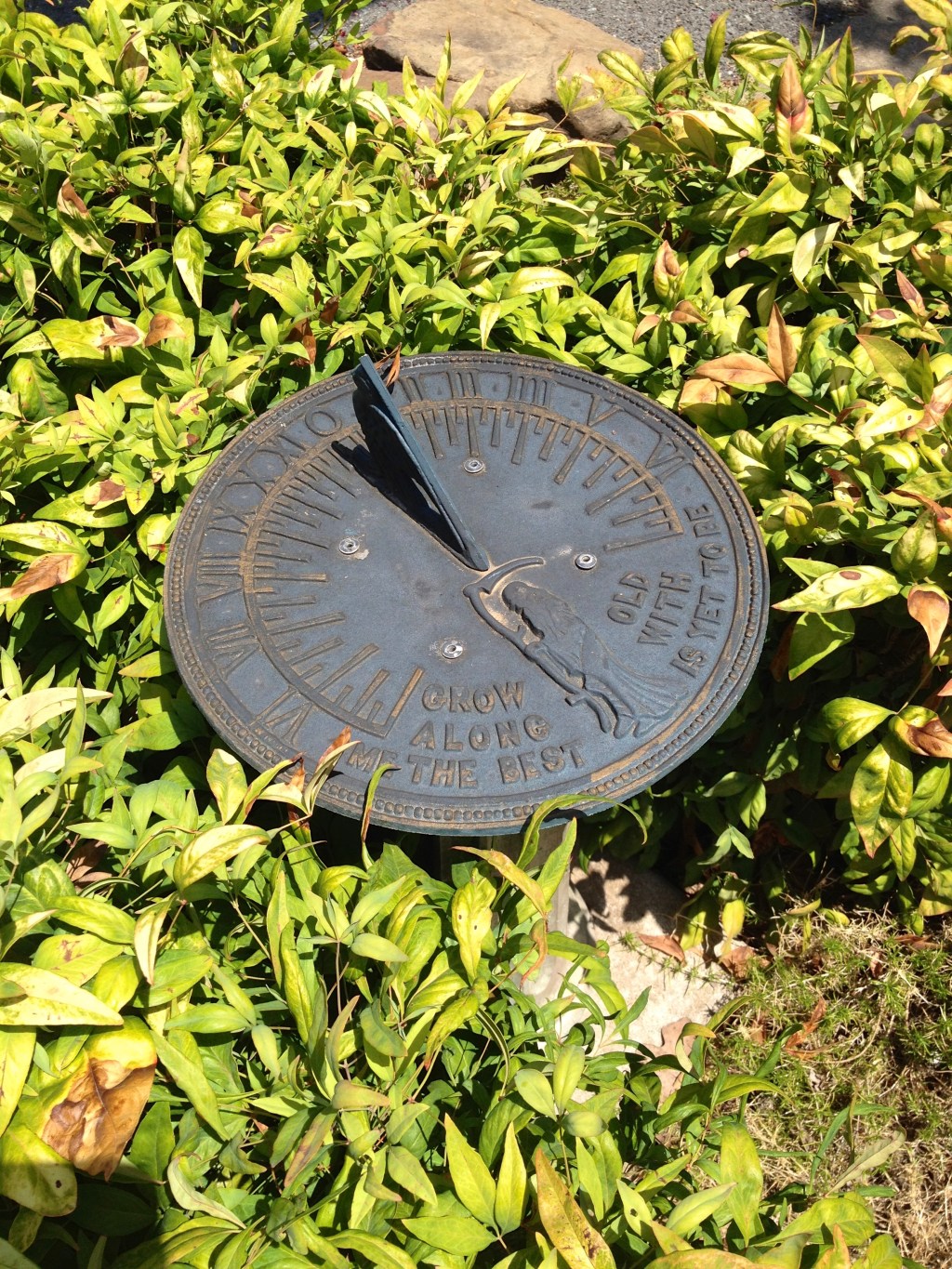
Sundial at Mt. Sequoyah
Then too, we have concepts today which ancient people hadn’t yet conceived. In Roman times, which is the time of the earliest New Testament writings, the day was divided into watches or hours. We think of those hours as having 60 minutes each, but they had no mechanical clocks for precision time keeping. The sundial kept the hour count, so a summer day had long watch hours, while a winter day had shorter ones. Since everyone was on the same system, everyone was on time, or they were late if they were my ancestors.
We all read the same Bible, but we have different translations in our hands. I choose the NRSV because it’s a modern translation that’s as literal as possible and as free as necessary, unlike the NIV, which is a dynamic translation or one that seeks to make the best readable sense of the text. Those translators have to make decisions on how to render rare words in the text. For instance, the word “arsenokoitai,” which shows up in two different verses in the bible, wasn’t translated to mean “homosexual” until 1946. It appears in the RSV, whereas in the KJV, the word gets translated as “nor abusers of themselves with mankind” (or to put it less delicately—trigger warning—masturbation).
Douris: Drinking cup (kylix) depicting an erotic scene of Eros and a youth
How was the word translated previously? It referred to the common Greek practice of pederasty: adult male love for younger boys, which everyone today would be opposed to and disgusted by this cultural practice once common in Greek society. Abuse of youths by adults is something all of us can dislike because that experience isn’t a relationship of equals. One has too much power, authority, and dominance over the other. For the same reason we object to other unequal sexual relationships: clergy and laity, counselors and campers, teachers and students, bosses and employees, and so on.
Circle of Euthymides: Two-handled storage jar (pelike) depicting young athletes jumping
This particular word shows up exactly two times in the whole Bible. It’s now translated as “sodomites.” This too is an unfortunate translation, since the sin of Sodom wasn’t homosexuality, but the townspeople’s failure to respect the laws of hospitality. When the visitors came under Lot’s protection in his home, the townies gathered outside his door and begged to have their sport with his guests. We’re horrified Lot would offer up his own daughters, but in that day and time, protecting the honor of the patriarch’s offer of hospitality to strangers was more important than anything that happened to the women of the household. We don’t have to like the culture as it was back then to get the lesson of “entertaining angels unawares.” This is an instance we’re glad fathers today have respect both for their guests and their daughters. Cultures change and we’re very glad for that.
The word “μαλακός” or Malakos refers to something soft and effeminate. It could refer to silk clothing or to an adult man who shaved his beard or grew long hair. In the Ancient Greek society, once a boy grew a beard, he was no longer subjected to pederastic abuse. Instead, he passed “the gift on” to the next generation. We’re well aware today how child abuse is generational. This is what Paul railed about in this text.
When the holidays crank up, the greedy, drunkards, and maybe a few adulterers and fornicators will go to town. The angry criticizers will probably be driving the bus and the swindlers (robbers: ἅρπαγες) will be grifting the unsuspecting flock as they barrel along. We don’t have any temples with male prostitutes as the ancient Greek cities once had. There were also women prostitutes serving at these temples, so everyone had their pick when visiting with a celebrant for an intercession with the gods. I’m really glad our current clergy orders don’t include this ritual as part of “pastoral care.” Culture changes. Maybe today’s clergy body is glad this duty isn’t added to their holiday activities.
It’s good the culture has changed from that of Rome and Athens of the first century. In fact, culture keeps on changing all the time. This is why Jesus spoke of “new wine in new wine skins.” We’re no longer a first century church, but some principles still apply. We can’t pour the new wine into an old skin, or the fermentation will burst open the weak old skin. This is why we are a new and changing church, for just as butterflies break out of their cocoons, we too have to break free from what has bound us in a past time. The Holy Spirit keeps refreshing and invigorating a living community, whether it worships in a tent, a rented room, or in a set place.
Now we look forward, to a new land, a new existence, and new possibilities. If we hear the voice of God, we hear the calling: “Go to the land I will show you.” God has always led God’s people in every place and in every time. God has brought God’s people through good times and bad, through war and peace, and in exile to the promised land. We can trust God to be faithful once again.
Joy, peace, and hope,
Cornelia
Drinking cup (kylix) depicting an erotic scene of Eros and a youth Signed by: Douris: clay, Greek, made in Attica, Athens, Late Archaic Period, about 490–485 B.C., Museum of Fine Arts, Boston, MA.
Two-handled storage jar (pelike) depicting young athletes jumping Circle of Euthymides (Greek), Archaic Period, about 520–515 B.C., Museum of Fine Arts, Boston, MA.
Drinking cup (kylix) depicting pentathletes Onesimos: Greek, Late Archaic Period, about 500–490 B.C., Museum of Fine Arts, Boston, MA.
Crossing the Threshold of Divine Revelation: Abraham, William J. Here Abraham argues for divine revelation as another leg of understanding and interpretation of church traditions and scripture.
Canon and Criterion in Christian Theology: From the Fathers to Feminism by William J. Abraham This is a seminary textbook and historical overview.
“John Wesley’s Notes On The Entire Bible” by John Wesley (1754) Start reading it for free: https://a.co/3UKifSG
STRONGS NT 3120: μαλακός μαλακός, μαλακή, μαλακον, soft; soft to the touch: ἱμάτια, Matthew 11:8 R G L brackets; Luke 7:25 (ἱματίων πολυτελῶν καί μαλακων, Artemidorus Daldianus, oneir. 1, 78; ἐσθής, Homer, Odyssey 23, 290; Artemidorus Daldianus, oneir. 2, 3; χιτών, Homer, Iliad 2, 42); and simply τά μαλακά, soft raiment (see λευκός, 1): Matthew 11:8 T Tr WH.
Like the Latin mollis, metaphorically, and in a bad sense: effeminate, of a catamite, a male who submits his body to unnatural lewdness, 1 Corinthians 6:9 (Dionysius Halicarnassus, Antiquities 7, 2 under the end; ((Diogenes Laërtius 7, 173 at the end)).
Strong’s Exhaustive Concordance: effeminate, soft. Of uncertain affinity; soft, i.e. Fine (clothing); figuratively, a catamite — effeminate, soft.
Thayer’s Greek Lexicon, STRONGS NT 733: ἀρσενοκοίτης 733 arsenokoítēs (from 730 /árrhēn, “a male” and 2845 /koítē, “a mat, bed”) – properly, a man in bed with another man; a homosexual. ἀρσενοκοίτης, ἀρσενοκοιτου, ὁ (ἄρσην a male; κοίτη a bed), one who lies with a male as with a female, a sodomite: 1 Corinthians 6:9; 1 Timothy 1:10. (Anthol. 9, 686, 5; ecclesiastical writings.)
Christ Enthroned with the Angels 6th century Mosaic Church of Sant’Apollinare Nuovo, Ravenna, Italy
Nothing springs full grown to life in an instant. Everything begins in a seed, which is planted, watered, and nourished into full growth. Only in myths or fantasies can an idea come into being instantly. Zeus had a very bad headache, a “splitting headache,” that birthed his daughter Athena, the goddess of wisdom. She leapt out in fully grown from his brow. We don’t take this myth to be scientifically true, but as a metaphor for the difficulty and struggles we undergo to obtain wisdom. As my daddy used to tell me after I’d learned some hard life lesson, “The school of experience is a rough master, and we all earn a costly degree in gaining its wisdom.”
Little Master Lip Painter Attributed to the Phrynos Painter: Birth of Athena, Attic Black Figure Ware, Kylix, Date ca. 555 – 550 B.C., Early Archaic Period,
Some of us will repeat the same lessons over and over, as if we expect to get a different result. The purpose of an education isn’t to regurgitate a right answer to pass a test, but to understand why the answer is right. That’s why math classes require showing the steps to the solution, rather than the “full blown adult answer” only. In matters of faith or ethics, many of us haven’t had the training to “set out the proof” for our final answer or deed. In fact, in one situation we may think or act one way, and quite differently in another.
The name for this behavior is “situational ethics.” Less kindly, it’s also known as spinelessness, shiftiness, being two faced, or dishonesty. Mostly it means people don’t have a true center or a plumb line by which they measure themselves. If we’re measuring our lives against other people, we’re measuring against other fallible human beings. Even our heroes have feet of clay, for none of us are gods. When I used to call my parents out on this character trait, they always told me, “Do as I say, not as I do.” This sets up a moral conflict for most people, even those raised in the church or in religious homes.
We need to have a moral center based on a higher authority than our individual or cultural conventions, one that includes or exceeds the ethics of the group to which we belong, and not just our individual beliefs and actions. Professional groups—physicians, lawyers, clergy, educators, and others—all have ethical standards for caring for those they serve, even if they morally disagree with the behaviors that bring them into their care. Who decides the ethics of the group? At the risk of making my favorite seminary professor, Billy Abraham, roll about in his still fresh grave, we United Methodists do have the so-called Wesleyan Quadrilateral of Scripture, Tradition, Reason, and Experience to guide us. Often we assign our personal life experience to this latter quadrilateral edge, but Wesley meant our Experience of the Assurance of God’s All Embracing and Adopting Love. As Wesley once said, “God is able to save all to the uttermost.”
The Good Samaritan by English School, (19th century)
Ethics and morals are often used as synonyms, but ethics refer to rules provided by an external source, e.g., codes of conduct in workplaces or principles in religions. Morals refer to an individual’s own principles regarding right and wrong. Ethics is a a late 17th century word derived from the Greek ēthos (disposition, character), in contrast to pathos (suffering). In Latin it means ‘character, depiction of character’, or (plural) ‘customs’.
Then we have the words moral and morals. The first is concerned with the principles of right and wrong behavior. The goodness or badness of human character is another concern. From these, people decide what behavior is considered right or acceptable in a particular society. We often say a person has morals if they conform to standards of behavior or beliefs concerning what is and is not acceptable for them to do. We can speak of “the corruption of public morals, “ or you can hear people talking as if “they believe addicts have no morals and can’t be trusted,” rather than understanding the disease and abuse bases which often underlie addictions.
These distinctions don’t change the negative consequences of the addict’s behaviors, yet the addicted person still has the same image of God and the same potential for wholeness each of us have, but perhaps with more suffering, or pathos. If we judge the morality of a person’s choices, and then refer that moral state to the individual’s worthiness, we can end up losing compassion for the person as well as losing the will to help them better their lives. This leads to hard heartedness and a lack of love. We reject our neighbors and make them strangers, unwelcome to our world. We forget our spiritual ancestors were once strangers in a strange land, wanderers without a home. How easily we forget our savior, who had no place to be born even in his ancestral home, and whose family fled religious persecution and certain death to live in Egypt, far from home. Strange how some Christians have no sympathy for others in the same fix today.
Moral is a word from the late Middle English by way of the Latin moralis, from mos, mor- ‘custom’, with the plural mores or ‘morals’. It refers to one having the property of being right or wrong, good or evil, or voluntary or deliberate, and therefore open to ethical appraisal. When we apply moral attributes to a person, it means “capable of moral action; able to choose between right and wrong, or good and evil.” Not until 1803 did moral come to mean “virtuous with regard to sexual conduct,” according to the Oxford English Dictionary.
As a noun, we meet the word in the Latin Moralia, the title of St Gregory the Great’s moral exposition of the Book of Job. Later it was applied to the works of various classical writers. All Methodists and the holiness denominations birthed from the seed of the great Methodist revival recognize the genius of John Wesley. We all quote him, but we also apply his wisdom through our own individual preconceived notions of what is “good, true, and noble.”
When John Wesley was asked, “What is that faith whereby we are sanctified?” he answered:
“First believe that God has promised to save you from all sin, and to fill you with all holiness; secondly, believe that He is able thus to save to the uttermost all that come unto God through him; thirdly, believe that He is willing, as well as able, to save you to the uttermost; to purify you from all sin, and fill up all your heart with love. Believe fourthly, that He is not only able, but willing to do it now! Not when you come to die; not at any distant time; not tomorrow, but today. He will then enable you to believe, it is done, according to His Word.”
In the old days, we said we were “going on to perfection,” not that we were so bold as to claim that we’d already arrived there or been perfected. Oh no, we allowed God could complete this for us and had the power to do it, as well as the will, but our human nature was still fallible. If a word comes up more than once in a text, writers go to the thesaurus for an alternative, but in reading scripture, we learned repetition was a sign of importance, a marker especially meant for those of us who are slow learners in the school of life.
Oliver O’Donovan in “Scripture and Christian Ethics” writes, “Moral theologians have a secret knowledge, apparently concealed from other kinds of theologians, especially those devoted to hermeneutics. They know that the most mysterious and most difficult question we ever have to answer is not, what does Scripture mean?, but, what does the situation we are facing mean?, where do we find ourselves existentially?”
We tend to speak as if our selves and our situations were known quantities, so that it only remains to choose out of Scripture whatever seems to fit our circumstances as we conceive them. Scripture has an uncanny way of shedding light on our self and our situation, to overcome our preconceptions about them. We don’t read about our situation directly in the Scriptures, yet it’s from the Scriptures we gain categories of understanding, which re-frame our view of our situation and ourselves. We can’t look for individual texts to guide our actions, but need to consider the whole of the revealed Scripture and God’s nature as we discern our path forward.
Carl Bloch: Monk Looking in a Mirror, 1875, oil on canvas, Nivaagaard Museum, Denmark.
In this sense, the Bible is a mirror which reflects our inner nature to us, convicting us of our failings and giving us grace and comfort in our times of need. We can learn much about ourselves from the verses we lean on, just as much as we can by the verses we ignore. There’s a reason we interpret texts by the whole of scripture, and not piecemeal. This is one way we understand the authority of scripture.
As an interesting aside, SWTX, my original conference, which approved my candidacy for the ministry, didn’t think I should attend seminary because I scored so low on the abstract reasoning tests I took. They didn’t think I would make 65, seminary’s passing grade, in my class work. It’s true I learn and process differently, but knowing this, I crammed a three year program into four years. If I’m slow to grasp the whole until I first understand the parts, this doesn’t reflect on my fitness for ministry or my intellectual ability. It merely reflects a different way of processing information. There’s more way to skin a cat, and many ways people learn.
When I taught art classes, I had to make sure I covered all the learning methods for all my students to have success. I talked about the project, I demonstrated the techniques, I had the steps written out, and for some few children, I had to place their hands in the optimum position to get them started. This covered ear and eye learning, visual reminders, and haptic or touch learning. Some students needed multiple types of learning throughout their working time on a project. Some needed reteaching every class period. Some just needed encouragement when they got stuck at a rough patch. Most all had to learn to talk in positive terms about themselves and their work, as well as about others and their creative process also.
I talk about this teaching method, for this is how we consciously or unconsciously teach those around us ethics and morals. As one youth asked me at a church I once served, “Why are you wearing your cross today? It’s not Sunday.”
“Because Jesus is important to me every day, not just on the day I lead church services.”
I realized even though her family was very active and faithful in our congregation, when they were out in the world of day to day folks, they didn’t stand out from the crowd. Maybe one day day this child will come to a time when wearing a cross becomes bearing a cross. Then again, how many people willingly choose suffering for the sake of the body of Christ? This suffering is often difficult for those of us who’ve committed our lives to Christ’s call, but we realize most laity won’t voluntarily submit to that kind of stress. Yet experience is a great teacher. We learn from others, even those who have differing opinions and choose different actions.
Wesley’s Sermon, “The Nature of Enthusiasm,” has some advice for us: “Beware you are not a fiery, persecuting enthusiast. Do not imagine that God has called you (just contrary to the spirit of Him you style your Master) to destroy men’s lives, and not to save them. Never dream of forcing men into the ways of God. Think yourself, and let think. Use no constraint in matters of religion. Even those who are farthest out of the way never compel to come in by any other means than reason, truth, and love.”
Jean Bondel: The fall of man—Adam and Eve eat from the Tree of Knowledge of Good and Evil, 1372, illustrated manuscript, National Library of the Netherlands.
As a further reminder from his all time classic Sermon, On Working Out Our Own Salvation, 1785: “By justification we are saved from the guilt of sin…by sanctification we are saved from the power and root of sin…”In modern terms, when we profess our faith, Christ saves us from the guilt of that first sin. Some say Adam and Eve were disobedient. They then emphasize rule keeping as their moral choice. There’s always a reason behind every behavior, however. Why were they disobedient? We hear the answer in the parable of the Tree of Wisdom:
“But the serpent said to the woman, “You will not die; for God knows that when you eat of it your eyes will be opened, and you will be like God, knowing good and evil.” (Genesis 3:4-5)
The man and the woman both heard the half truth, saw the shiny fruit, believed the promises of a creature rather than their creator, and ate the fruit they hoped would make them like gods. Instead they only gained knowledge of their nakedness and vulnerability. This first lesson of the school of life came with cost: fig leaves ooze irritating sap. They won’t choose this solution again. God’s providence replaced their poor choice with animal skin clothing even as God sent them out into the world. We might say the attitude of pride or greed drove their bad behavior and was the cause of their negative consequences.
As we grow in holiness and love of God and neighbor, the Holy Spirit destroys any remaining root of sin. One of the important sins, Wesley noted, was pride. Pride is that feeling of deep pleasure or satisfaction we get from our own achievements, or those of our family, tribe, nation, or other associated group. In matters of faith, we always have to remember Paul’s admonition to the Romans (10:9-13):
“because if you confess with your lips that Jesus is Lord and believe in your heart that God raised him from the dead, you will be saved. For one believes with the heart and so is justified, and one confesses with the mouth and so is saved. The scripture says, “No one who believes in him will be put to shame.” For there is no distinction between Jew and Greek; the same Lord is Lord of all and is generous to all who call on him. For, “Everyone who calls on the name of the Lord shall be saved.”
Paul reminds us of the unity of the Jews and the Gentiles, the clean and the unclean, the former masters and slaves, with the gulf now bridged between the former God worshippers and the idol worshiping strangers. Now there’s “no Jew nor Greek, no slave or free, no male or female, but all are one in Christ Jesus” (Galatians 3:28).
When we joined together into one annual conference in 2003, almost twenty years ago, we had good reasons to make one combined administrative body for our faith community. We had underfunded pension obligations, we were over heavy with administrators, and clergy didn’t have equity in retirement accumulation. Likewise, the conferences weren’t equally treated, since one didn’t fully fund pension needs, an act which caused clergy to seek appointments in the other conference, thus robbing the first of talents and gifts. These were the logical consequences of attitudes and behaviors, however.
Historic Souvenir—Can you drink this cup?
The logical person thought, “Let’s make Arkansas One Faith, One Focus, One Fellowship,” and this will solve all our problems. It may have looked good on paper, but our congregations had been used to a personal touch to remind them at least once a year they belonged to a greater whole. Their pride in showing off their home church and being a good host for the Superintendent was taken from them if they were just attendees at another group meeting. The moral choice of what’s better for me, a relaxing Sunday afternoon with my family or a meeting elsewhere, gets weighed and measured.
So now here we are, nearly twenty years into this optimistic marriage of the two annual conferences. The seeds for dissent and discontent were planted long ago, even before this joining. When I inventoried the historic memorabilia of the dead bishops at the SMU Bridwell Library, I saw how the chaos of the Vietnam War era and the sea changes our society were experiencing then affected our church in many ways. Some wanted to hold onto tradition more tightly, while others were ready to experiment with new wine in fresh wine skins. These were just “outer trappings,” however, for the message of “saved by faith, sanctified by faith, and made perfect in love by faith” never changes. This is Christ’s work, enabled by the Holy Spirit.
The past sixty years, as the last two decades, haven’t always been smooth sailing. We often have had trials, storms, and tribulations on our shared journeys. Sometimes we’re so far out to sea, we don’t see the land, and the skies are occluded, so we can’t take a bearing off the stars. Yet God’s spirit will blow us along, for even detours are within God’s providence. As James reminds us:
“Consider it pure joy, my brothers and sisters, whenever you face trials of many kinds, because you know that the testing of your faith produces perseverance. Let perseverance finish its work so that you may be mature and complete, not lacking anything.” (1:2-4)
Van Gogh: The Good Samaritan, after Delaquoix, 1890, oil on canvas, Kroller-Muller Museum, Netherlands
Today we also have powerful economic and political forces that are like wolves in sheep’s clothing. They purport to work for religion and democracy, but actually work against the stewardship of our earth ‘s resources and environment, fail to care for the poor and dispossessed, and support military interventions around the world. Moreover, some of them actively work to destabilize religious denominations with social justice callings, such as the UMC, the Presbyterian Church USA, and others. Some today think “things fall apart; the center will not hold.”
Two final words in summary: one is from the ancient wisdom tradition and the other from Paul’s paean of joy in the midst of suffering. Proverbs 22:1 reminds us, “A good name is to be chosen rather than great riches, and favor is better than silver or gold.” My dying grandfather spoke these words to me in his last hours. Ive always considered them a plumb line for my life.
Byzantine Mosaic, Ravenna, Italy
“Finally, brothers and sisters, whatever is true, whatever is noble, whatever is right, whatever is pure, whatever is lovely, whatever is admirable—if anything is excellent or praiseworthy—think about such things. Whatever you have learned or received or heard from me, or seen in me—put it into practice. And the God of peace will be with you.” — Philippians 4:8-9
John Wesley: Repentance in Believers (Sermon 14), “Repent ye, and believe the gospel.” Mark 1:15. The Complete Works of John Wesley, vol. 1 of 3, Kindle ereader. Read on line here: http://www.godonthe.net/wesley/jws_014.html
Ready or not, the creative juices must be stirred. If the brain has lain fallow all summer, or it’s been overworked keeping the youngsters occupied, now you can find your own groove again. Yes, it’s time for Adult Art Class at Oaklawn UMC.
Our first meeting will be Friday, September 9, at 10 am in the old fellowship hall. Bring your own acrylic paints, brushes, and a canvas or canvas panel to paint on. We begin with a short visual inspiration from some great art works, I’ll give some direction on the skill we’ll work on in the session, and then everyone is free to bring their own unique expression to their paintings. We don’t copy my work and judge how well a person can match it. We learn from the great masters and stretch our own skills to create something new.
Walter Nowatka: Abstract Ferris Wheel
Of course, making great art isn’t our first purpose. As we age, we will lose our ability to learn new skills until we lose our memory of what we just ate for breakfast. Challenging our brains is one of the best ways to keep our brain cells firing and “chatting with one another.” Our brains have the immensely powerful ability to remodel themselves because each of us have 1,000 trillion synapses, which are constantly being modified every second of every day. Socialization and encouragement also helps to keep our brains young.
Frank Lloyd Wright: March of Balloons
Of course, we have to give up our desire to be perfect. Perfection comes from practice, or working at it. Every baby stumbles and falls when they learn to walk, but dotting adults encourage every trembling step. This is what art teachers also do. I’ve always had a rule in my classes, especially when I taught in middle school: No Negative Talking about People or Art. This included a student’s own art works. They always had to give at least three positive comments about their work before they spoke about the negative. “My work needs improvement” became the replacement phrase for “My work stinks!”
De Fem. Titel saknas, 1908. HAK 1274. Kat. 12. 52,5 x 62,8 cm
Of course, we’ve all grown up and worked in environments where negativity is the rule. Art class is a place of grace because this is how life should be. If we can transform a blank canvas into a field of color, why can’t we transform our communities and our world into fields of hope, joy, and love? Perhaps because we try to make everyone copy/fit into our idea of the proper end product, rather than allow everyone discover their own creative response to the given subject of the day. The museums of our world are richer and more vibrant because artists have listened to the Spirit of the Creating God. We might do well to realize God’s creative energies are varied and vibrant also, just as Isaiah wrote about his vision of God’s Glorious New Creation:
“For I am about to create new heavens and a new earth; the former things shall not be remembered or come to mind. But be glad and rejoice forever in what I am creating; for I am about to create Jerusalem as a joy, and its people as a delight.” (65:17-18)
James Wyper: City of Dreams
I hope to see you there. I don’t charge for the class sessions, since this is one of my ministries as a retired elder in the United Methodist Church. As John Wesley once said, “The World is my Parish.”
Joy and Peace,
Pastor Cornelia
Wes Ely: How long covid reshapes the brain — and how we might treat it
In the “late unpleasantness” which has some of our Methodist congregations in turmoil, many have their reasons for going or staying. As one born into the Methodist Church, who spent a portion of my life looking for a “better god” before God called me back home, I have some experience with faith. I’ve had it, lost it, and received it once again. My privilege in seminary to work along side the Wesley librarian allowed me to touch authentic Wesley letters. I also had the blessing of being the late Dr. Billy Abraham’s assistant for the Evangelism Chair. When I think of faith, Romans 12:3 comes to mind:
“For by the grace given to me I say to everyone among you not to think of yourself more highly than you ought to think, but to think with sober judgment, each according to the measure of faith that God has assigned.”
Here Paul’s word for faith is the Greek word pistis, which is always a gift from God, never something that can be produced by people. In short, faith for the believer is always “God’s divine persuasion” and therefore distinct from confidence or human belief. The Spirit continuously births faith in the yielded believer so they can know God’s will (1 Jn 5:4).
The former UMC Bishop Mike Lowery wrote in his notice of withdrawal from the Council of Bishops as he surrendered his elder’s orders: “I believe “We are in a fight for the faith delivered once for all.” (Jude 3, CEB).
Resurrection Christ
I’m not picking on the former bishop. I knew him from my Emmaus community days in Southwest Texas. But his posted letter, which can be read at the link below, charges the United Methodist Church has lost her Wesleyan understanding of Christianity. This piqued my interest, so I decided to focus my own thoughts, as well as to inform others, on this matter of faith.
Faith as Doctrine of Assent vs Doctrine of Assurance:
Today we often think of faith as a set of beliefs, or the Doctrine of Assent. In Wesley’s time, he understood faith as the Doctrine of Assurance, a unique gift to the Christian church, whereby believers can know with certainty they are truly beloved of God with a steadfast love which endures forever.
This love is unconditional and saves us from the tragic consequences of the law of sin and death by bringing us into the law of life and love through Jesus Christ’s life, death, and resurrection. That descriptive mouthful is John Wesley’s heartwarming experience he had at Aldersgate in 1738 on the fateful evening when he attended a meeting very unwillingly, yet had the heart changing event that set his life on a different path.
Christ Surrounded by Angels
Historic Wesleyan Faith is a Gift of Grace
We need to ask, “What is the historic Wesleyan understanding of the Christian faith, anchored in the Holy Trinity and welded to Christ as Lord and Savior?” Is it located in regeneration, aka the new birth, or is it located in human morality as proof of righteousness in Jesus Christ? This probably means nothing to people in the pews, but if we’re going to claim the mantle of John Wesley, or the argument from tradition, we must get Wesley’s understanding of faith down pat. We find Wesley’s thoughts in his Notes on the New Testament and in his StandardSermons, both of which are part of our Methodist teaching.
In the sermon OF EVIL ANGELS, Wesley reminds us faith is “our evidence of things unseen.”
“Faith is the life of the soul; and if ye have this life abiding in you, ye want no marks to evidence it to yourself: but [elencos pneumatos/Spirit control] that divine consciousness, that witness of God, which is more and greater than ten thousand human witnesses,” is Wesley’s explanation of faith in AWAKE, O SLEEPER.
Faith as the Spirit of Adoption
Another way of saying this is Romans 8:15-17,
“When we cry Abba! Father! It is that very Spirit bearing witness with our spirit that we are children of God, and if children, then heirs, heirs of God and joint heirs with Christ.”
For Wesley, faith is a gift of salvation, our trust in the saving work of Christ. As he says in the sermon AWAKE OH SLEEPER:
“Awake, and cry out with the trembling jailer, ‘What must I do to be saved?’ And never rest till thou believest on the Lord Jesus, with a faith which is His gift, by the operation of His Spirit.”
Then Wesley gives his altar call: “In what state is thy soul? Was God, while I am yet speaking to require it of thee, art thou ready to meet death and judgement? Canst thou stand in His sight, who is of ‘purer eyes than to behold iniquity’? Art thou ‘meet to be partaker of the inheritance of the saints in light’? Hast thou ‘fought a good fight, and kept the faith’? Hast thou secured the one thing needful? Hast thou recovered the image of God, even righteousness and true holiness? Hast thou put off the old man, and put on the new? Art thou clothed upon with Christ?”
“Hast thou oil in thy lamp? grace in thy heart? Dost thou ‘love the Lord thy God with all thy heart, and with all thy mind and with all thy soul, and with all thy strength’? Is that mind in thee, which was also in Christ Jesus? Art thou a Christian indeed that is, a new creature? Are old things passed away, and all things become new?”
Mandylion: Image Not Made by Human Hands
Faith comes as a Gift. Our good works respond to Christ’s work.
Most of us are in agreement Wesley’s initial understanding of FAITH having to do with accepting Christ’s work for us as the only precondition for our salvation. There is no good deed or accumulation of good deeds needed to earn our salvation from God. What many of us have difficulty is accepting we also don’t earn our perfection in holiness by our own power.
Our Christian perfection is always a cooperative work of the Holy Spirit and our own spirit. As the Spirit works in us, we respond to work toward the complete renewal into the original image of God in which we were created. While it’s possible we might attain this perfect state in this lifetime, most Christians will attain completion in the purity of love of God and neighbor at the moment of death by God’s work, not by our own accomplishments.
Do the Born Again Christians Sin?
In Wesley’s sermon, “The Great Privilege of Those That Are Born of God,” he quotes 1 John 3:9—
“Whosoever is born of God doth not commit sin.”
The Golden Bridge—Ba Na Hills, Vietnam
Wesley admits people who are born again can err or make mistakes, but they don’t sin. That’s a bridge too far for many to accept today, for many of us are prone to judging others. We have a dysfunctional understanding of “perfection.” We think it’s like a Martha Stewart design, forgetting she has a whole staff of helpers to carry out her ideas. As one of my professors once explained it, “Once you’ve been to Waxahachie, you’ve always been to Waxahachie.”
If you don’t know Waxahachie, it’s a midsized Texas town about the size of Hot Springs, Arkansas. It was known for cotton in its hey day, and now hosts a crepe myrtle festival. Once you’ve been there, you can’t lose that experience. In the same way, you can’t lose your status of new birth. It’s a gift of the Holy Spirit, given by faith through Christ.
But some of us will try to throw it away anyhow. Wesley wrote in that same sermon, The Great Privilege, “Some sin of omission, at least, must necessarily precede the loss of faith; some inward sin: But the loss of faith must precede the committing outward sin.”
The Outward Appearance vs. The Inward Attributes
So, one who has faith doesn’t sin, since we have to lose faith in God to sin. In other words, we have to reject the gift freely given to us without price. As he also says in his great sermon on Christian Perfection, “Every one of these can say, with St. Paul, “I am crucified with Christ: Nevertheless I live; yet not I, but Christ liveth in me:” [Gal 2:20]— Words that manifestly describe a deliverance from inward as well as from outward sin.”
Van Gogh: The Good Samaritan
Christian Perfection
For Wesley, the goal of Christian perfection, or the recovery of the image of God, was to love God and neighbor with one’s whole heart until nothing else could exist inside. No favoritism for a group, no exclusion for a group, no yearning to be better than others, no desiring a better place at the table, no hoarding of resources for selfish purposes, no fear of tomorrow, nor any other anxiety that strikes the human heart.
We give our resources away so we can have room for new blessings. God always provides for those who give with generous hearts. We open our doors to the least, the last, the lost, and the unloved, because Jesus and Wesley went out into the fields and met the people where they were. Those are our people out there, and they aren’t “living moral lives,” any more than the imperfect people within our churches are. But we all can and do live lives of faith. We all can learn to trust a savior who loves every sinew of our wounded and broken bodies. We can love a God who never gives up on us even if we’ve given up on ourselves.
Homeless Jesus Statue, Timothy Schmaltz
We United Methodists might be messy, but we surely can love God and neighbor. Moreover, we’re all going on to perfection, even if some of us are moving more slowly than others. We’re still a community of faith, a people who trust God’s grace and one another to get through this thing called life together. We’ll bring each other along, for we’re not leaving anyone behind. We include in the great worldwide Body of Christ the body of Christ whom we meet outside our doors. After all, the race isn’t to the swift, but to the ones who help their brothers and sisters to the finish line, where we have a finishing medal for everyone, along with a big potluck dinner with enough food for folks to take home leftovers. That’s the never ending banquet table to which we invite all who hunger and thirst for community—both spiritual and personal.
The Word of God holds the Scripture of Salvation
Trusting Faith for a Risky Love in Unsettled Times
All we have to do is ask ourselves in this unsettled time: “Do I have Wesley’s trusting faith to live this risky love? Are these the people with whom I want to experience God’s steadfast love and share the grace of Christ? This is our heritage in the United Methodist Church, for we’re a people of faithfulness, who believe the “Bible has everything sufficient for salvation.”
I can only hope for those who leave, whether they become global Methodists, independents, or community congregations, that they will provide a large enough tent for our big God and big Christ, for the Spirit always is seeking people and places to fill completely with the gift of God’s extraordinary love and power.
Why not become all aflame with the fire of God’s redeeming love?
My prayer is our United Methodist churches will receive a fresh rush of the Spirit to become even more of what we are today, for
“Our standards affirm the Bible as the source of all that is “necessary” and “sufficient” unto salvation (Articles of Religion) and “is to be received through the Holy Spirit as the true rule and guide for faith and practice” (Confession of Faith).” Theological Guidelines: Scripture https://www.umc.org/en/content/theological-guidelines-scripture
The everyday objects around us are like so much white noise: we know they’re present, but after a while, we tend to ignore them. A running joke among the clergy is “Never move anything at the new appointment for six months because you don’t know what objects are the sacred cows.” I learned this the hard way in my first full time appointment when I suggested we rid ourselves of an aging, olive green, velvet curtain hanging on the back wall of the fellowship hall stage, since “It was just hanging there for no purpose.” Oh, the outcries of rage! Little did I know this was the one and only curtain to survive the fire which destroyed the old church building. The people saw this ragged banner as a symbol of hope for the church they were rebuilding for the future. They had invested spiritual meaning into this curtain, even though it no longer served a spiritual purpose.
Picasso: The Chair, 1946
In the same way, we treat our Bibles as holy objects because they contain the inspired writings handed down over the centuries. We recognize they tell us important truths about God, humanity, and our relationship with the God whose steadfast love for God’s creation never wavers. In worship, we often say after reading from scripture, “The word of God for the people of God.” When many read John 1:1—
“In the beginning was the Word, and the Word was with God, and the Word was God.”
These same readers connect the “word of God” with the ”Word and the Word (who) was with God, and the Word was God.” The English translation of LOGOS to WORD derives from the Greek principle of Logos, or divine reason and creative order, which is identified in the Gospel of John with the second person of the Trinity incarnate in Jesus Christ. This is how the early Christian writers argued for the preexistence of Christ and for the existence of the Holy Trinity. When we refer to the Logos/Word of God, we are speaking of Christ. If we read the Old Testament, we’re speaking of the one God who has spoken through the ages, but only revealed God’s Son to humanity during the New Testament era. The Spirit has been active always.
This reminds us to honor the Bible for revealing the Incarnate Christ through inspired words, but not to idolize the Bible as a object greater than the God it reveals. After all, over the centuries, the Bible has been interpreted differently by various schools of thought. This brings up the question of how do we know what we know. There’s a whole body of philosophy dedicated to how we know what we know, called epistemology. There are various kinds of knowing:
Sensory perception or observation of facts
Reason or logic
Authority of tradition or common wisdom
Intuition, revelation, or inspiration
Some of us use one way more than others, but each has both good and bad points. In the case of the authority of tradition or common wisdom, for instance, some have been time tested across the ages, but deference to authority without critical thinking can be a mark of intellectual laziness on our part.
Wesleyan Quadrilateral
John Wesley’s famous understanding of what we now call the Quadrilateral comes from Albert Cook Outler’s discussion on how Wesley understood authority. When challenged for Wesley’s authority on any question, Wesley’s first appeal was to the Holy Bible. Even so, he was well aware that Scripture alone had rarely settled any controversial point of doctrine. Thus, though never as a substitute or corrective, he would also appeal to ‘the primitive church’ and to the Christian Tradition at large as competent, complementary witnesses to ‘the meaning’ of this Scripture or that.
However, Scripture and Tradition would not suffice without the good offices (positive and negative) of critical Reason. Thus, he insisted on logical coherence and as an authorized referee in any contest between contrary positions or arguments. And yet, this was never enough. It was, as he knew for himself, the vital Christian Experience of the assurance of one’s sins forgiven that clinched the matter.
Anglican Meme
In reality, Wesley’s diagram for how we know is really a triangle— consisting of Scripture, Tradition, and Reason—which leads to the Christian Experience of being a Child of God, forgiven for our sins. It’s based on the Anglican tripod of the faith: scripture, reason, and tradition. Wesley took the tripod and added the firm “seat of experience” of God’s loving mercy to forgive all our sins. This insight came out of Wesley’s life changing Aldersgate experience, which he recorded in his journal on May 24, 1738.
“In the evening, I went very unwillingly to a society in Aldersgate Street, where one was reading Luther’s preface to the Epistle to the Romans. About a quarter before nine, while he was describing the change which God works in the heart through faith in Christ, I felt my heart strangely warmed. I felt I did trust in Christ, Christ alone for salvation, and an assurance was given me that he had taken away my sins, even mine, and saved me from the law of sin and death.”
Wesley understood he could spend his whole life learning about God, reading about God, and even serving God to the best of his ability, but he was in his words, an “almost Christian” because he didn’t have the faith of a son or daughter who served God out of love, but had instead the faith of a slave or a servant, who served only from fear of punishment. One of Wesley’s Standard Sermons is the “Almost Christian,” which you can read in its 18th century glorious English at the link below. Most of us would be glad to be accounted in the “almost” category, but Wesley asks, why don’t we go farther and become “altogether Christian?”
In Methodist terms, this is “entire sanctification,” or “going on to perfection.” We don’t talk much about this any more, but it’s the purpose of our Christian life to be conformed to the image of God. We aren’t trying to be like Beyoncé, JayZ, Taylor Swift, or Jake Owen. Instead we have the promise in Romans 8:29—
“For those whom he foreknew he also predestined to be conformed to the image of his Son, in order that he might be the firstborn within a large family.”
David Hockney: Walking Past Two Chairs
We don’t do this on our own, but with the assistance of the Holy Spirit. That’s why the Spirit is called a helper, for it’s a coworker in the process of perfection or sanctification. This epistemology for knowing is useful for art classes also. Some of us believe we need to be perfect from the get go and can’t accept our raggedy messes we produce as we learn the techniques of color mixing and shading, much less the fine motor coordination required to connect our thoughts with our hand movements. If we aren’t able to endure the rough edges of imperfection as we “go on to perfection,” we won’t last long in art class. Just learning how to see the three dimensional world and translate it onto a two dimensional surface is a Mount Everest accomplishment in itself. Some days we have no energy to cope, and that’s when we need to come for support and encouragement.
Last Friday we painted chairs. Every artist’s work we viewed for inspiration had a different take on the chair. We no longer have to make a photographic rendering of an object because we have cameras for this purpose. We can use the chair as a reason to break up the picture plane and organize the spaces. I found a funny little poem called “The Chair,” by Theodore Roethke:
A Funny Thing about a Chair: You Hardly Ever Think it’s There. To Know a Chair is Really It, You Sometimes have to Go and Sit.
Sally’s Chair
As the class went on, Sally decided she wanted to copy one of the inspiration images. She’s new, so she was practicing color mixing with her limited palette. When she couldn’t get the bright turquoise color, I brought my manganese blue over and mixed it with her titanium white. The color she wanted came popping out, much to her delight. “I’m going to buy me some of that color.” Sometimes all we need is the right materials.
Lauralei’s Shower Chair
Lauralei’s humor takes the cake with her shower chair. She can imagine the model chairs in a new environment. She doesn’t let the reality limit her options.
Gail’s Chairs
Gail divided up the canvas into various planes of colors, which sing for joy. I think she had fun. As the only one of our group who took the challenge of the entire scene, Mike took a bird’s eye view of the table and chairs. I hear he may be traveling again, or at least yearning to fly away from the day to day grind of full time work to something closer to retirement.
Mike’s Chairs and Table
I can understand that feeling. After years of teaching school, I look forward to summer vacation. We’ll have art class on the last two Fridays of May, and then take the summer off. Our current plan is to return on September 9, the first Friday after Labor Day. In the meantime, if you want to know how God really is,
“Be still, and know that I am God!” ~~ Psalms 46:10
A fun summertime activity is building a chair fort or a chair cave. All you have to do is turn over a couple of chairs on the floor and throw a sheet or blanket over them. This provides a quiet place for a child of any age to have a “time out” alone during a long summer. I recommend a quiet place for children of all ages, even those who’re long of tooth.